anaheim-gazette 1886-04-17
Scanned page
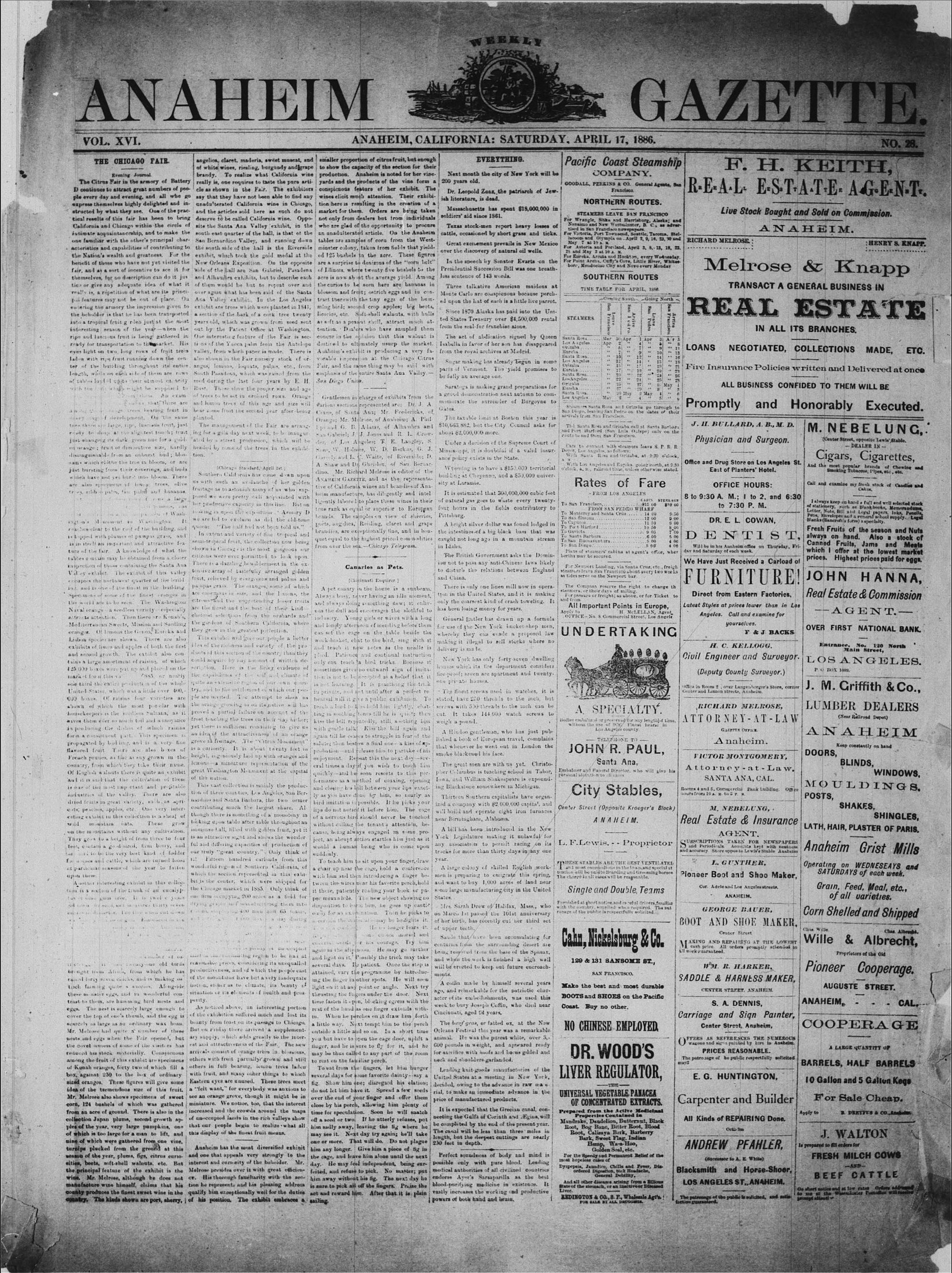
Searchable text
THE CHICAGO FAIR.
Evening Journal.
The Citrus Fair in the armory of Battery D continues to attract great numbers of people every day and evening, and all who go express themselves highly delighted and instructed by what they see. One of the practical results of this fair has been to bring California and Chicago within the circle of intimate acquaintancehip, and to make the one familiar with the other's principal characteristics and capabilities of contributing to the Nation's wealth and greatness. For the benefit of those who have not yet visited the fair, and as a sort of incentive to see it for themselves, for no description can do it justice or give any adequate idea of what it really is, a repetition of what are its principal features may not be out of place. On entering the armory the impression given to the beholder is that he has been transported into a tropical fruit garden just at the most interesting season of the year—when the ripe and luscious fruit is being gathered in ready for transportation to the market. His eyes light on two long rows of fruit trees laden with ripe fruit running down the center of the building throughout its entire length, while on each side of them are rows of tables loaded up their almost capacity with the fruits which might be supposed to come from them. An examiner says that there are among the orange trees bearing fruit in every stage of development. On the same trees there are large, ripe, luscious fruit, just ready to drop at the slightest touch; fruit just changing its dark, green hue for a golden orange; fruit of diminutive size, hardly distinguishable from an unburst bud; blossoms which eldthe tree in bloom, or are just bursting from their coverings, and buds angelica, claret, maderia, sweet muscat, and of white wines, riesling, burgundy and grape brandy. To realize what California wine really is, one requires to taste the pure article as shown in the Fair. The exhibitors say that they have not been able to find any unadulterated California wine in Chicago, and the articles sold here as such do not deserve to be called California wine. Opposite the Santa Ana Valley exhibit, in the south east quarter of the hall, is that of the San Bernardino Valley, and running down the south side of the hall is the Riverside exhibit, which took the gold medal at the New Orleans Exposition. On the opposite side of the hall are San Gabriel, Pasadena and Alhambra exhibits, but to describe each of them would be but to repeat over and over again what has been said of the Santa Ana Valley exhibit. In the Los Angeles exhibit are trees which were planted in 1841, a section of the bark of a cork tree twenty years old, which was grown from seed sent out by the Patent Office at Washington. One interesting feature of the Fair is sections of the Yacca palm from the Antelope valley, from which paper is made. There is also shown in the Fair nursery stock of oranges, lemons, loquats, palms, etc., from South Pasadena, which was raised from the seed during the last four years by E. H. Hust. These show the proper size and age of trees to be set in orchard rows. Orange and lemon trees of this age and size will bear some fruit the second year after being planted.
The management of the Fair are arranging for a gala day next week, to be inaugurated by a street procession, which will be headed by some of the trees in the exhibition.
[Chicago Standard; April 1st]
Southern California has gone down upon smaller proportion to show the cocoa production. yards and these conspicuous wines elicit mention here is real market for them not only from who are glad of an unadulterated tables are same minister colony ed 125 bushels are a surprise of Illinois, where acre is now abate the curios to blossom and frant t thereof with ming bird; sooc licorice, etc., as soft as a peasantion. Deal concur in the destined to new Anaheim's exhilarable impress Fair, and the s emphasia of the San Diego Univ.
Gentlemen in various sections Crane, of South Orange; Mr. M. Lips and G. B. San Gabriel; J. Der, of Los Ames, W. Holt Carely and L. A. Shaw and Dino. Mr. Rice
A section of the trunk of an eucalyptus in one gum tree. It is twelve years
Among the orange trees bearing fruit in every stage of development. On the same tree there are large, ripe, luscious fruit, just ready to drop at the slightest touch; fruit just changing its dark green hue for a golden orange; fruit of diminutive size, hardly distinguishable from an unburst fruit; blossoms which elicit the tree in bloom, or are just bursting from their coverings, and buds which have not yet burst into bloom. There are also specimens of leung trees, olive trees, rubbish palm, fan palm and bananas.
The exhibit of this valley occupies the northwest quarter of the building and is one of the finest in the building. Specimens of some of the finest oranges in the world are to be seen. The Washington Naval orange—a seedless variety—especially attracts attention. Then there are Konah's Mediterranean Sweets, Mission and Seedling oranges. Of lemons the Genoa, Eureka and Lisbon species are shown. There are also exhibits of limes and apples of both the first and second growth. The exhibit also contains a large assortment of raisins, of which 125,000 boxes were put up and placed on the market from this year.
One third the entire production of the whole United States, which was a little over 400,000 boxes. Of raisins four varieties are shown of which the most popular with housekeepers is the redless Nuttana, as it saves them ever so much toll and annoyance in producing the dishes of which raisins form a constituent part. This specimen is propagated by budding, and is a very fine flavored fruit. There are also boxes of French prunes, as fine as any grown in the country, from which they take their name. Of English walnuts there is quite an exhibit and it is said that the cultivation of these is one of the most important and profitable industries of the valley. There are also dried fruits in great variety, such as apricots, peaches, apples, etc. One very interesting exhibit in this collection is a sheaf of wild mountain bats. These grow on the mountains without any cultivation. They grow to a height of from three to four feet, contain a good sized, firm berry, and are to be the very best kind of fodder for horses and cattle, which are turned loose at particular seasons of the year to fatten upon them.
Another interesting exhibit in this collection is a section of the trunk of an eucalyptus in one gum tree. It is twelve years
South Pasadena, which was raised from the seed during the last four years by E. H. Rust. Those show proper size and age of trees to be set in orchard rows. Oranges and lemon trees of this age and size will bear some fruit the second year after being planted.
The management of the Fair are arranging for a gala day next week, to be inaugurated by a street procession, which will be headed by some of the trees in the exhibition.
[Chicago Standard, April 1st]
Southern California has come down upon us with such an avidanche of her golden fruitage as to astonish many of us who supposed we were pretty well acquainted with her productive capacity in this line. But on looking in upon the expoition "Armory D" we are led to explain as did the old-time queen: "The half had not been told us."
In extent and variety of fine tropical and semi-tropical fruit, the collection now being shown in Chicago is the most gorgeous our citizens were ever permitted to look upon. There is a dazzling bewilderment in the extensive array of tastefully arranged golden fruit, relieved by evergreens and palms and pumapas grass. The oranges, some of which are enormous in size, and the lemons, the citrons and the unpleasant lesser fruits are the finest and the best of their kind—choice selections from the orchards and the gardens of Southern California, where they grow in the greatest perfection.
This exhibit will give our people a better idea of the richness and variety of the products of this section of the country than they could acquire by any amount of written description. Here is the living evidence of the capabilities of the soil and climate of quite an extensive region of our own country, and to the settlement of which our people are invited. The attempt to show us the orange growing as on its native soil has proved a partial failure on account of the frost touching the trees on their way higher; yet there is sufficient remaining to give us an idea of the attractiveness of an orange grove in fruitage. The "Citrus Monument" is a curiosity. It is about twenty feet in height, ingeniously laid up with oranges and lemons—a miniature representation of the great Washington Monument at the capital of this nation.
This vast collection is mainly the production of three counties, Los Angeles, San Bernardino and Santa Barbara, the two former contributing much the largest share. Although there is something of a monotony in looking upon table after table throughout an immense hall, filled with golden fruit, yet it is an attractive sight and shows the wonderful and differing capacities of production of our truly "great country." Only think of it. Fifteen hundred carloads from this wonderful region of Southern California, of which the section represented in this exhibit is the center, which were shipped for the Chicago market in 1885. Only think of one firm occupying 200 acres as a field for gentlemen in various sections of Crane, of South Orange; Mr. Miles Uppe and G. B. San Gabriel; Judger, of Los Angeles; W. Holt Garrelly and L.
A Shaw and Daino. Mr. Riccione Anaheim Gazette;ATIVE OF CALIFORNIA hemm manufacture ligently labored true rank as equiv brands. The sports, angleda, brandies, are oui quiet equal to those from over the sea.
Can
A pet canary Always busy, neat and always doing cane dull and industry. You and lonely after can set the cage work-basket, chop and teach it plied. Patience only can teach sometimes given is not to be used not learning in privacy, and hearsal will it get teaching a bird to sing in southing kiss the bill type with gentle talk again till he ceases salute; then best probation—and enjoyment.
Reral times a day quickly—and his performance as a man and closing his lips as you have done bird imitation in lips do not notice of a nervous bird without calling cause, being always ject, an abrupt w would a human suddenly.
To teach him a chair up near with him and thienen the wires it there, patient per mean while
dried fruits in great variety, such as apricots, peaches, apples, etc. One very interesting exhibit in this collection is a sheaf of wild mountain oats. These grow on the mountains without any cultivation. They grow to a height of from three to four feet, contain a good sized firm berry, and are to be the very best kind of fodder for horses and cattle, which are turned loose at particular seasons of the year to fatten upon them.
Another interesting exhibit in this collection is a section of the trunk of an eucalyptus or pine gum tree. It is twelve years old and no need for seed, but measures thirty seven inches in diameter. The tree when cut down is humming bird nests and eggs. The nest is scarcely large enough to cover the top of one's thumb, and the egg is scarcely as large as an ordinary wax bean. Mr. Melrose had quite a number of these nests and eggs when the Fair opened, but the covetousness of some of the visitors has reduced his stock materially. Conspicuous among the fruit of this exhibit are specimens of Kona oranges, forty two of which fill a box against 250 to the box of ordinary sized oranges. These figures will give some idea of the tremendous size of this fruit. Mr. Melrose also shows specimens of sweet corn, 124 bushels of which was gathered from an acre of ground. There is also in the collection Japan plums, second growth apples of the year, very large pumpkins, one of which is too large for a man to lift, and nine of which were gathered from one vine, turnips plucked from the ground at this season of the year, plums, figs, citrus curiosities, beets, soft-shell walnuts, etc. But the principal feature of the exhibit is the wine. Mr. Melrose, although he does not manufacture wine himself, claims that his county produces the finest awset wine in the country. The kinds shown are port, sherry,
Anaheim has the most diversified exhibit and one that appeals very strongly to the interest and curiosity of the beholder. Mr. Melrose presides over it with great efficiency. His thorough familiarity with the section he represents and his pleasing address qualify him exceptionally well for the duties of his position. The exhibit embraces a
bird imitation in lips do not notice of a nervous bird without calling cause, being always jject, an abrupt would a human suddenly.
To teach him a chair up near him and tween the wires it there, patient per mean whole disposition to bear only for an exeerer during the day during a pleasant region of Southern California, of which the section represented in this exhibit is the center, which were shipped for the Chicago market in 1885. Only think of one firm encrypting 200 acres as a field for drying grapes and manufacturing them into coarsely processed 400 men and 65 teams.
Only think of fifteen hundred earlords from this wonderful region of Southern California, of which the section represented in this exhibit is the center, which were shipped for the Chicago market in 1885. Only think of one firm encrypting 200 acres as a field for drying grapes and manufacturing them into coarsely processed 400 men and 65 teams.
As noticed above, an interesting portion of the exhibition suffered much and lost its beauty from frost on its passage to Chicago. But on rainy there arrived a supplementary supply, which adds greatly to the interest and attractiveness of the Fair. The new arrivals consist of orange trees in blossoms, others with fruit partially grown and still others in full bearing, lemon trees laden with fruit, and many other things to which Eastern eyes are unused. These trees meet a "felt want," for everybody was anxious to see an orange grove, though it might be in miniature. We notice, too, that the interest increased and the crowds around the maps of unoccupied lands in the rich valleys show that our people begin to realize what all this display of the finest fruit means.
The most diversified exhibit and one that appeals very strongly to the interest and curiosity of the beholder. Mr. Melrose presides over it with great efficiency. His thorough familiarity with the section he represents and his pleasing address qualify him exceptionally well for the duties of his position. The exhibit embraces a
WEEKLY
ANAHEIM, CALIFORNIA: SATURDAY, APRIL 17, 1886.
EVERYTHING.
Next month the city of New York will be 200 years old.
Dr. Leopold Zunz, the patriarch of Jewish literature, is dead.
Massachusetts has spent $18,000,000 in soldiers' aid since 1861.
Texas stock-men report heavy losses of cattle, occasioned by short grass and ticks.
Great excitement prevails in New Mexico over the discovery of natural oil wells.
In the speech by Senator Evarts on the Presidential Succession Bill was one breathless sentence of 143 words.
Three talkative American maidens at Monte Carlo are conspicuous because perched upon the hat of each is a little live parrot.
Since 1870 Alaska has paid into the United States Treasury over $4,500,000 rental from the seal-fur franchise alone.
The act of abdication signed by Queen Isabella in favor of her son has disappeared from the royal archives at Madrid.
Sugar making has already begun in some parts of Vermont. The yield promises to be fully an average one.
Saratoga is making grand preparations for a grand demonstration next autumn to commemorate the surrender of Burgoyne to Gates.
The taxable limit at Boston this year is $10,663,882, but the City Council asks for about $2,000,000 more.
Under a decision of the Supreme Court of Mississippi, it is doubtful if a valid insurance policy exists in the State.
Wyoming is to have a $151,000 territorial holdover and a $54,000 reserve.
Pacific Coast Steamship COMPANY.
GOODALL, PERRINS & CO. General Agents,
Francisco.
NORTHERN ROUTES.
STEAMERS LEAVE SAN FRANCISCO
For Wrangle, Sitka and Harrisburg, Alaska;
Nanaimo and New Westminster, B.C., as adtised in San Francisco newspapers.
For Victoria, Port Townsend, Seattle, Tacoma,
Biscoton and Olympia on April 2, 9, 16, 23, 30,
May 7 at 19 a.m.
For Astoria and Portland, April 3, 8,-13, 18,
25 and May 3 at 16 a.m.
For Eureka, Arcata and Hookton, every Wednesday
For Point Arena, Cuddy's Cove, Little River, Whibore, Mendocino City and Novo every Monday.
SOUTHERN ROUTES
TIME TABLE FOR APRIL, 1886.
Coming South Going North
STEAMERS
Mar Apr Apr Apr Apr Apr Apr Apr Apr Apr Apr Apr Apr Apr Apr Apr Apr Apr Apr Apr Apr Apr Apr Apr Apr Apr Apr Apr Apr Apr Apr Apr Apr Apr Apr Apr Apr Apr Apr Apr Apr Apr Apr Apr Apr Apr Apr Apr Apr Apr Apr Apr AprAprAprAprAprAprAprAprAprAprAprAprAprAprAprAprAprAprAprAprAprAprAprAprAprAprAprAprAprAprAprAprAprAprAprAprAprilAprilAprilAprilAprilAprilAprilAprilAprilAprilAprilAprilAprilAprilAprilAprilAprilAprilAprilAprilAprilAprilAprilAprilAprilAprilAprilAprilAprilAprilAprilAprilAprilAprilAprilAprilAprilAprilAprilAprilAprilAprilAprilAprilAprilAprilAprilAprilAprilAprilAprilAprilAprilApril April April April April April April April April April April April April April April April April April April April April April April April April April April April April April April April April April April April April April April April April April April April April April April April April April April April April April April April April April April April April April April April April April April April April April April April April April April April
Steamers Santa Rosa and Orizaba go through
San Diego, leaving San Pedro on the dates of th
arrivals from San Francisco.
The Santa Rosa and Orizaba call at Santa Barbo
and Port Harford (San Luis Obispo) only on t
route to and from San Francisco.
Care to connect with steamers leave S. P. R.
Depart Los Angeles as follows:
With Santa Rosa and Orizaba, at 9:30 o'clock
A.M.
With Los Angeles and Eureka going north at 9
o'clock a.m., railroad time, unless otherwise stated.
Gentlemen in charge of exhibits from the various sections represented are: Dr. J. A. Crane, of Santa Ana; Mr. Fredericks, of Oranges; Mr. Melrose, of Anabeim; A. Phillips and G. B. Alams, of Alhambra and San Gabriel; J. J. Jones and R. L. Crowder, of Los Angeles; T. E. Langley, S. Sane, W. Holmes, W. D. Buckas, G. J. Garcelly and L. C. Waite, of Riverside; D. A. Shaw and Dr. Gherden, of San Bernardino. Mr. Richard Melrose is editor of the Anaheim Gazette, and as the representative of California wines and brands of Anaheim manufacture, has diligently and intellectually labored to place these wines in their true rank as equal or superior to European brands. The samples on view of sherry ports, angelica, Reising, claret and grape brandies, are exceptionally fine, and in bouquet equal to the highest priced commodities from over the sea.
Canaries as Pets.
[Chinatown Enquirer]
A pet canary in the house is a sunbeam. Always busy, never having an idle moment, and always doing something new; it enlives the dull and encourages the slothful to industry. Young girls or wives with a long and lonely afternoon of mending before them can set the cage on the table beside the work basket, chat to the bird, sing with it and teach it new notes as the needle is plied. Patience and continual instruction only can teach a bird tricks. Because it sometimes gives no outward sign of imitation is not to be accepted as a belief that it is not learning. It is practicing the trick in private, and not until after a perfect rehearsal will it give a public exhibition. To teach a bird to kiss hold him lightly, chatting in soothing tones he is quiet; then kiss the bill repeatedly, still, something him with gentle talk! Kiss the bill again and again till he ceases to struggle in fear of the salute; then bestow a final one—a kiss of apprehension—and release him to partake of his enjoyment. Repeat this the next day—several times a day if you wish to teach him quickly—and he soon resorts to this performance as a method of coaxing, opening and closing his bill between your lips exactly as you have done by him, so nearly as bird imitation is possible. If he picks your lips do not notice it before him. The cage of a nervous bird should never be touched without calling the tenant's attention, because being always engaged in some project, an abrupt action startles him just as it would a human being who is come upon suddenly.
To teach him to sit upon your finger, draw a chair up near the cage, hold a conference with him and then introducing a finger between the wires near his favorite perch, hold it there, patiently reading your book or paper meanwhile. The new object showing no Saratoga is making grand preparations for a grand demonstration next autumn to commemorate the surrender of Burgoyne to Gates.
The taxable limit at Boston this year is $10,663,882, but the City Council asks for about $2,000,000 more.
Under a decision of the Supreme Court of Mississippi, it is doubtful if a valid insurance policy exists in the State.
Wyoming is to have a $151,000 territorial building at Cheyenne, and a $50,000 university at Laramie.
It is estimated that 300,000,000 cubic feet of natural gas goes to waste every twenty-four hours in the fields contributory to Pittsburg.
A bright silver dollar was found lodged in the intestines of a big black bass that was caught not long ago in a mountain stream in Idaho.
The British Government asks the Dominion not to pass any anti-Chinese laws likely to disturb the relations between England and China.
There is only one linen mill now in operation in the United States, and it is making only the coarser kind of crash toweling. It has been losing money for years.
General Butler has drawn up a formula for use of the New York bucket-shop men, whereby they can evade a proposed law making it illegal to sell stocks where no delivery is made.
New York has only forty-seven dwelling houses which its fire department considers fire-proof; seven are apartment and twenty-one private houses.
The finest screws used in watches, it is stated, have 220 threads to the inch, but screws with 590 threads to the inch can be cut. It takes 144,000 watch screws to weigh a pound.
A Hindoo gentleman, who has just published a book of European travel, complains that whenever he went out in London the smoke blackened his face.
The great men are with us yet. Christopher Columbus is teaching school in Tabor, Iowa, and William Shakespeare is expounding Blackstone somewhere in Michigan.
Thirteen Southern capitalists have organized a company with $2,000,000 capital, and will build and operate eight iron furnaces near Burningham, Alabama.
A bill has been introduced in the New York Legislature making it unlawful for any association to permit racing on its tracks for more than thirty days in any one year.
A large colony of skilled English workmen is preparing to engrate this spring, and want to buy 1,000 acres of land near some large manufacturing city in the United States.
bird imitation is possible. If he picks your lips do not notice it before him. The cage of a nervous bird should never be touched without calling the tenant's attention, because, being always engaged in some project, an abrupt action startles him just as it would a human being who is come upon suddenly.
To teach him to sit upon your finger, draw a chair up near the cage, hold a conference with him and then introducing a finger between the wires near his favorite petch, hold it there, patiently reading your book or paper meanwhile. The new object showing no disposition to borne him, he goes up cautiously for an examination. Then he picks to ascertain the material may be hesitant it.
He no longer fears it. He once morsel and enchant words for his courage. Try him again in the afternoon. He may go further and light on it. Possibly the trick may take several days. His patient. Once the step is attained, vary the programme by introducing the finger in other spots. He will soon light on it at any point or angle. Next try thrusting the fingers under the door. Next time fasten it open, blocking egress with the rest of the hand as one finger extends within. When he perches on it draw him forth a little way. Next tempt him to the perch outside a little and so on. In a short time you but have to open the cage door, uphift a finger, and he is sure to fly for it, and he may be thus called to any part of the room to rest on the familiar perch.
To eat from the fingers, let him hunger several days for some favorite dainty—say a fig. Show him one; disregard his elation; do not let him have it. Spread a few seeds over the end of your finger and offer them close by his perch, allowing him plenty of time for speculation. Soon he will snatch off a seed or two. If he utterly refuses, put him sadly away, leaving the fig where he may see it. Next day try again; he'll take one or more. That will do. Do not plague him any longer. Give him a piece of fig in the cage, and leave him alone until the next day. He may feel independent, being surfeited, and refuse to pick. No matter; put him away without his fig. The next day he is sure to pick all off the fingers. Praise the act and reward him. After that it is plain sailing.
A bill has been introduced in the New York Legislature making it unlawful for any association to permit racing on its tracks for more than thirty days in any one year.
A large colony of skilled English workmen is preparing to emigrate this spring, and want to buy 1,000 acres of land near some large manufacturing city in the United States.
Mrs. Sarah Drew of Halifax, Mass., who on March 1st passed the 101st anniversary of her birth, has recently cut her third set of upper teeth.
Sandia that have been accumulating for centuries from the surrounding desert are being removed from the base of the Sphinx, and when the work is finished a high wall will be erected to keep out future encroachments.
A cofin made by himself several years ago, and remarkable for the patriotic character of its embellishments, was used this week to bury Joseph Coffin, who died near Cincinnati, aged 24 years.
The beef gras, or fatted ox, at the New Orleans Festival this year was a remarkable animal. He was the purest white, over 3,600 pounds in weight, and appeared ready for sacrifice with hoofs and horns gilded and neck and shoulders garlanded.
Leading knit-goods manufactories of the United States at a meeting in New York, decided, owing to the advance in raw materials, to make an immediate advance in the price of manufactured products.
It is expected that the Grecian canal, connecting the Gulfs of Corinth and Aegina, will be completed by the end of the present year. The canal will be less than three miles in length, but the deepest cuttings are nearly 250 feet in depth.
Perfect soundness of body and mind is possible only with pure blood. Leading medical authorities of all civilized countries endorse Ayer's Sarsaparilla as the best blood-purifying medicine in existence. It vastly increases the working and productive powers of both hands and brain.
GAZETTE.
APRIL 17, 1886.
NO. 28.
Coast Steamship COMPANY.
BEEKINS & CO. General Agents, San Francisco.
NORTHERN ROUTES.
ERS LEAVE SAN FRANCISCO
Sitka and Harrisburg, Alaska; and New Westminster, B. C., as advertFrancisco newspapers.
Port Townsend, Seattle, Tacoma, StelOlympia on April 2, 9, 16, 23, 30 and
31 M.
and Portland, April 3, 8, 13, 18, 22,
at 10 A.M.
Costa and Hookton, every Wednesday.
Cuffy's Cove, Little River, Whitesino City and Novo every Monday.
SOUTHERN ROUTES
TABLE FOR APRIL, 1886.
Coming South Going North
San Francisco Leave San Francisco Arrive San Pedro Leave San Francisco Arrive San Francisco
Mar 30 Apr 1 Apr 3 Apr 5 Apr 8 Apr 11 Apr 14 Apr 17 Apr 20 Apr 23 Apr 26 Apr 29 May 1 May 4 May 8 May 12 May 15 May 18 May 21 May 24 May 27 May 30 May 2
R. H. KEITH,
REAL ESTATE AGENT.
Live Stock Bought and Sold on Commission.
ANAHEIM.
RICHARD MELROSE:
HENRY S. KNAPP.
Melrose & Knapp
TRANSACT A GENERAL BUSINESS IN
REAL ESTATE
IN ALL ITS BRANCHES.
LOANS NEGOTIATED, COLLECTIONS MADE, ETC.
Fire Insurance Policies written and Delivered at once
ALL BUSINESS CONFIDED TO THEM WILL BE
Promptly and Honorably Executed.
J. H. BULLARD, A. B., M. D.
Physician and Surgeon.
Office and Drug Store on Los Angeles St.
East of Planters' Hotel.
M. NEBELUNG,
(Center Street, opposite Lewis' Stable.
DEALER IN
Cigars, Cigarettes,
And the most popular brands of Chewing and Smoking Tobaccoe, Pipes, etc., etc.
ALL BUSINESS CONFIDED TO THEM WILL BE
Promptly and Honorably Executed.
J. H. BULLARD, A. B., M. D.
Physician and Surgeon.
Office and Drug Store on Los Angeles St.
East of Planters' Hotel.
OFFICE HOURS:
8 to 9:30 A. M.; 1 to 2, and 6:30
to 7:30 P. M.
DR. E. L. COWAN,
DENTIST.
Will be in his Annheim office on Thursday, Friday and Saturday of each week.
We Have Just Received a Carload of
FURNITURE!
Direct from Eastern Factories.
Latest Styles at prices lower than in Los
Angeles. Call and examine for
yourselves.
P & J BACKS
H. C. KELLOGG.
Civil Engineer and Surveyor.
(Deputy County Surveyor.)
Office in Room 2, over Langenberger's Store, corner Center and Leuon streets, Anaheim.
RICHARD MELROSE,
ATTORNEY-AT-LAW
GAZETTE OFFICE.
Anaheim.
VICTOR MONTGOMERY,
Attorney-at-Law.
SANTA ANA, CAL.
Rooms 4 and 5, Commercial Bank Building. Office hours from 10 A.M. to 3 P.M.
M. NEBELUNG,
Real Estate & Insurance
AGENT.
SUBSCRIPTIONS TAKEN FOR NEWSPAPERS
and Periodicals. Accounts kept with neatness
and accuracy. Store opposite Lewis's Stable Anaheim.
L. GUNTHER,
Pioneer Boot and Shoe Maker,
Cor. Adele and Los Angeles streets.
ANAHEIM.
M. NEBELUNG,
(Center Street, opposite Lewis' Stable.
— DEALER IN —
Cigars, Cigarettes,
And the most popular brands of Chewing and Smoking Tobacco, Pipes, etc., etc.
Call and examine my fresh stock of Candles and Cakes.
I always keep on hand a full and well selected stock of stationery, such as Blankbooks, Memorandums, Letter, Note, Bill and Legal papers, Inks, Penalties, Pens, Envelopes and a general school supply. Legal Blanks (Bancroft's form) a specialty.
Fresh Fruits of the season and Nuts always on hand. Also a stock of Canned Fruits, Jams and Meats which I offer at the lowest market prices. Highest prices paid for eggs.
JOHN HANNA,
Real Estate & Commission
— AGENT.
OVER FIRST NATIONAL BANK.
Entrance, No. 120 North Main Street,
LOS ANGELES.
P.O. BOX 1009.
J. M. Griffith & Co.,
LUMBER DEALERS
(Near Railroad Depot)
ANAHEIM
Keep constantly on hand
DOORS,
BLINDS,
WINDOWS,
MOULDINGS.
POSTS,
SHAKES,
SHINGLES,
LATH, HAIR, PLASTER OF PARIS.
Anaheim Grist Mills
Operating on WEDNESEAYS and SATURDAYS of each week.
Grain, Feed, Meal, etc., of all varieties.
M. NEBELUNG,
Real Estate & Insurance
AGENT.
SUBSCRIPTIONS TAKEN FOR NEWSPAPERS
and Periodicals. Accounts kept with neatness
and accuracy. Store opposite Lewis's Stable Anaheim.
L. GUNTHER.
Pioneer Boot and Shoe Maker,
Cor. Adele and Los Angeles streets.
ANAHEIM.
GEORGE BAUER,
BOOT AND SHOE MAKER,
Center Street.
MAKING AND REPAIRING AT THE LOWEST
cash price. All orders promptly attenual to
All work guaranteed.
W.M. R. HARKER,
SADDLE & HARNESS MAKER,
CENTER STREET. ANAHEIM.
S. A. DENNIS,
Carriage and Sign Painter,
Center Street, Anaheim,
OFFERS AS REFERENCES THE NUMEROUS
wagons and signs painted by him in Anaheim.
PRICES REASONABLE.
The patronage of the public respectfully solicited
E. G. HUNTINGTON,
Carpenter and Builder
All Kinds of REPAIRING Done.
Oct. 31m
ANDREW PFAHLER,
(Successor to A. E. White)
Blacksmith and Horse-Shoer,
LOS ANGELES ST., ANAHEIM.
The patronage of the public is solicited, and satisfaction guaranteed.
J. WALTON
Is prepared to fill orders for
FRESH MILCH COWS
—AND—
BEEF CATTLE
On short notice and at low rates Orders addressed
to me at the Westchester Postoffice will receive
prompt attention.