anaheim-gazette 1886-04-03
Scanned page
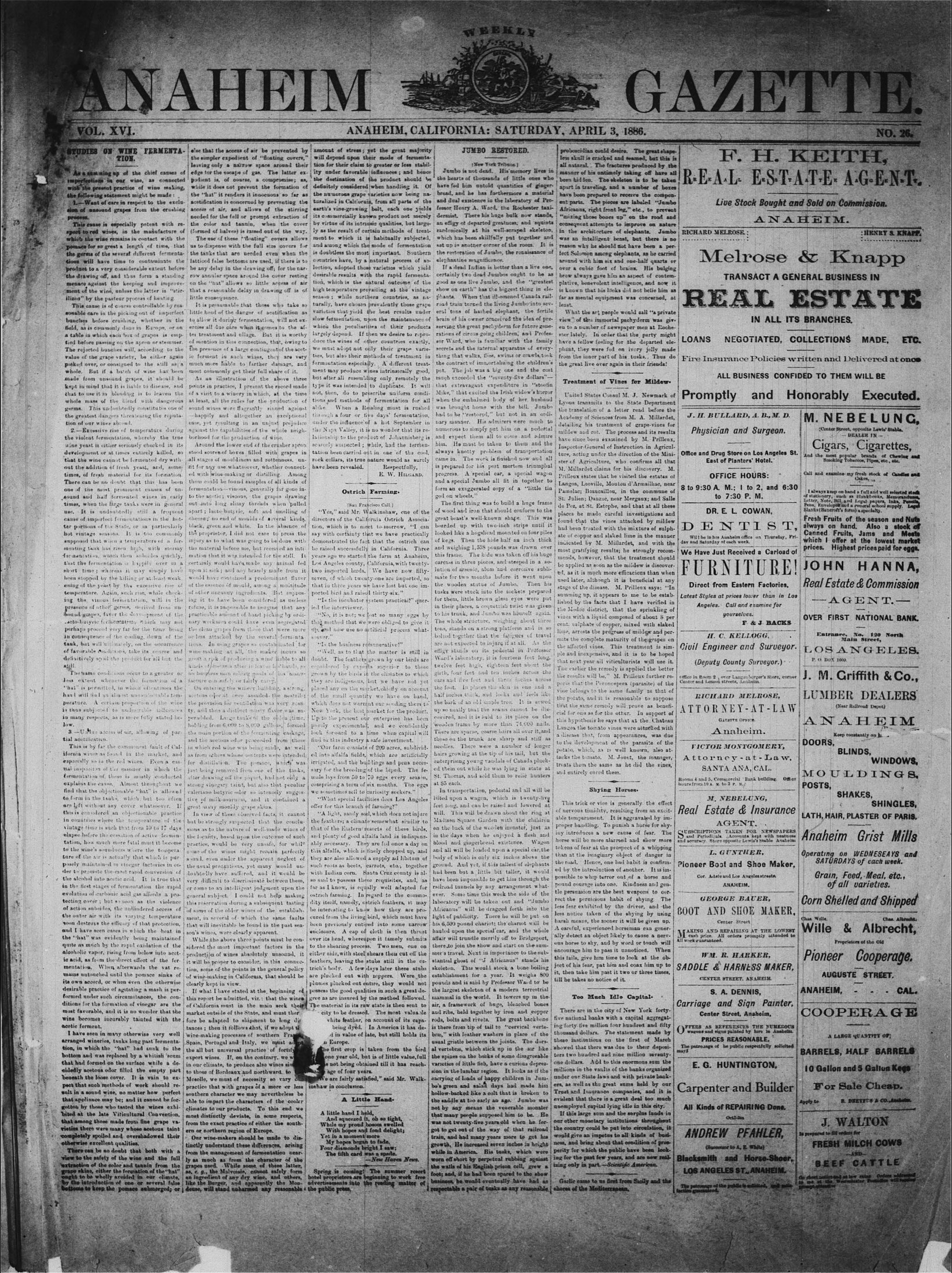
Searchable text
STUDIES ON WINE FERMENTATION.
As a summing up of the chief causes of imperfections in our wine, as connected with the present practice of wine making, the following statement might be made:
1. Want of care in respect to the exclusion of unsound grapes from the crushing process.
This cause is especially potent with respect to red wines, in the manufacture of which the wine remains in contact with the pomace for so great a length of time, that the germs of the several different fermentations will have time to contaminate the product to a very considerable extent before the drawing off, and thus form a standing menace against the keeping and improvement of the wine, unless the latter is "stirrized" by the pasteur process of heating.
This cause is of course controllable by reasonable care in the picking out of imperfect bunches before crushing, whether in the field, as is commonly done in Europe, or on a table in which each box of grapes is emptied before passing on the apron or stemmer. The rejected bunches will, according to the value of the grape variety, be either again picked over, or consigned to the still as a whole. But if a batch of wine has been made from unsound grapes, it should be kept in mind that it is liable to disease, and that to use it in blending is to leaven the whole mass of the blend with dangerous germs. This undoubtedly constitutes one of the greatest dangers threatening the reputation of our wines abroad.
2. Excessive rise of temperature during the violent fermentation, whereby the true wine yeast is either seriously checked in its development or at times entirely killed, so that the wine cannot be fermented dry without the addition of fresh yeast, and, sometimes of fresh material for its formation, else that the access of air be prevented by the simpler expedient of "floating covers," leaving only a narrow space around their edge for the escape of gas. The latter expedient is, of course, a compromise; as, while it does not prevent the formation of the "hat" it renders it innocuous so far as acetification is concerned by preventing the access of air, and allows of the stirring needed for the full or prompt extraction of the color and tannin, when the cover (formed of halves) is raised out of the way.
The use of these "floating" covers allows us to dispense with the full size covers for the tanks that are needed even when the latticed false bottoms are used, if there is to be any delay in the drawing off; for the narrow annular space around the cover resting on the "hat" allows so little access of air that a reasonable delay in drawing off is of little consequence.
It is presumable that those who take so little head of the danger of acetification as to allow it during fermentation, will not exercise all due care when it comes to the after treatment and tillage. But it is worthy of mention in this connection, that, owing to the presence of a large contingent of the acetic ferment in such wines, they are very much more liable to further damage, and most commonly get their full share of it.
As an illustration of the above three points in practice, I present the record made of a visit to a winery in which, at the time at least, all the rules for the production of sound wines were flagrantly sinned against—happily and altogether an exceptional case, yet resulting in an unjust prejudice against the capabilities of the whole neighborhood for the production of wine.
Around the lower end of the crusher apron stood scores of boxes filled with grapes in all stages of mouldiness and rottenness, until for any use whatsoever, whether connected with wine-making or distilling. Among amount of stress will depend upon tion for their chlity under favour destination definitely consideri naturalized in California's vine-growing its commercially by virtue of its result ment to which and among which is doubtless ther countries have lection, adopted desirable results which is ther high temperature season; while naturally, have chl varieties that yield slow fermentation which the people largely depend. Since the wines we must adopt nties, but also ther fermentation espent may produce but after all res type it was inter not, then, do tions and methods alike. When through a four under the influencer Napa Valley lationship to ther scarcey inspected tation been carried rock cellars, it have been revealed
made from unsound grapes, it should be kept in mind that it is liable to disease, and that to use it in blending is to leaven the whole mass of the blend with dangerous germs. This undoubtedly constitutes one of the greatest dangers threatening the reputation of our wines abroad.
2. Excessive rise of temperature during the violent fermentation, whereby the true wine yeast is either seriously checked in its development or at times entirely killed, so that the wine cannot be fermented dry without the addition of fresh yeast, and, sometimes, of fresh material for its formation. There can be no doubt that this has been one of the most prominent causes of unsound and half fermented wines in early times, when the large tanks were in general use. It is undoubtedly still a frequent cause of imperfect fermentations in the hotter portions of the State, or in particularly hot vintage seasons. It is too commonly supposed that when a temperature of a fermenting tank has risen high, with stormy fermentation, which then subsides quickly, that the fermentation or happily over in a short time; whereas it may simply have been stopped by the killing or at least weakening of the yeast by the excessive rise of temperature. Again, such rise, while checking the vinous fermentation, will in the presence of other germs, derived from unsound grapes, favor the development of the lacto-butyric fermentation, which may not perhaps proceed very far for the time being in consequence of the cooling, down of the tank, but will ultimately, on the occurrence of favorable conditions, take its course and definitively spoil the product for all but the still.
The name conditions occur to a greater or less extent whenever the formation of a "hat" is permitted, in which oftentimes the hand will find an almost uncontrollable temperature. A certain proportion of the wine is thus subjected to undesirable influences in many respects, as is more fully stated below.
3. Unusual access of air, allowing of partial acetification.
This is by far the commonest fault of California wines as found in the market, and especially so in the red wines. Even a casual inspection of the manner in which the fermentation of these is mostly conducted explains the cause. Almost throughout we find that the objectionable "hat" is allowed to form in the tanks, which, but too often are left without any cover whatsoever. If this is considered an objectionable practice in countries where the temperature of the vintage time is such that from 10 to 17 days elapse before the cessation of active fermentation, how much more fatal must it become to the wine's soundness where the temperature of the air is actually that which is purposely maintained in vinegar factories in order to promote the most rapid conversion of the alcohol into acetic acid. It is true that in the first stages of fermentation the rapid evolution of carbonic acid gas affords a proAs an illustration of the above three points in practice, I present the record made of a visit to a winery in which, at the time at least, all the rules for the production of sound wines were flagrantly sinned against—happily and altogether an exceptional case, yet resulting in an unjust prejudice against the capabilities of the whole neighborhood for the production of wine.
Around the lower end of the crusher apron stood scores of boxes filled with grapes in all stages of mouldiness and rottenness, until for any use whatsoever, whether connected with wine-making or distilling. Among them could be found samples of all kinds of fermentation—vinous, generally far gone into the acetic; viscous, the grapes drawing out into long slimy threads when pulled apart; lactic-butyric, soft and smelling of cheese; no end of moulds of several kinds, black, green and white. In the absence of the proprietor, I did not care to press the injury as to what was going to be done with the material before me, but received an intimation that it was intended for the still. It certainly would have made any animal fed upon it sick; and any branly made from it would have contained a predominant flavor of the essence of mould, among a multitude of other uncanny ingredients. But supposing it to have been considered as useless refuse, it is impossible to imagine that any practicable amount of hand picking by ordinary workmen could have even segregated the clean grapes from those that were more or less attacked by the several fermentations. In using grapes so contaminated for wine making at all, the maker incurs so great a risk of producing a wine liable to all kinds of misuse after it leaves hands, so no business man selling goods of his manufacture can safely or fairly carry.
On entering the winery building, a strong acetone odor once assailed; the nostril; the provision for ventilation was very scanty, and thus a distinct musty flavor was superadded. Large tanks of the cold-time, holding from 6,000 to 8,000 gallons, formed the main portion of the fermenting cascade, and the acetone odor proceeded from those in which red wine was being made, as well as from others whose contents were intended for distillation. The ponsace, which was just being removed from one of the tanks, after drawing off the pipet, had not only a strong vinegar taint, but also that peculiar valerian butyric odor so intensely suggestive of milk-sourness, and it contained a great many mouthy grape skins.
In view of these observed facts, it cannot but be strongly suspected that the conclusions as to the nature of well-made wines of the locality, based upon the outcome of such practice, would be very unsafe, for while some of the wines might remain perfectly sound, even under the apparent neglect of the usual precautions, yet many would undoubtedly have suffered, and it would be very difficult to discriminate between them, or come to an intelligent judgment upon the general subject. I could not help making but after all reservation not then do these and methods alike. When through a four or under the influence of Napa Valley lationship to their scarcely suspected tion been carried rock cellars, its have been revealed.
Ostrich
[Say]
"Yes," said Mr director of the station, which is to say with certain demonstration that he raised success years ago we start Los Angeles county two imported bays seven, of which that in three years ported bird and dog.
"Is the incubation led the interview?
"No, it is not that method that up and now uses ever."
"Is the business?
"Well, as to this doubt. The feature considered by him grown by the bushes they are indigenous placed any on thaof small quail which does not New York,the Up tothe present porally experiming lock forward to find in this industry.
"Our farm coneled into alfalfa fined irrigated,and thaary forthe breeder male lays from 54 comprising a terrine we sometimes sell."
"What special offer for this brand?
"A light,sand feathers;a clue that ofthe Easter and plenty of goodably necessary.
this alfalfawhich they are also allowsuch roots as beeswith Indian cornso said to possessfar as I knowis ostrich farming."
to form in the tanks, which but too often are left without any cover whatsoever. If this is considered an objectionable practice in countries where the temperature of the vintage time is such that from 10 to 17 days elapse before the cessation of active fermentation, how much more fatal must it become to the wine's soundness where the temperature of the air is actually that which is properly maintained in vinegar factories in order to promote the most rapid conversion of the alcohol into acetic acid. It is true that in the first stages of fermentation the rapid evolution of carbonic acid gas affords a protecting cover; but so soon as the violence of action subsides, the unlindered access of the outer air with its varying temperature soon destroys the efficacy of that protection, and I have seen cases in which the heat in the "hat" was evidently being maintained quite as much by the rapid oxidation of the alcoholic vapor, rising from below into acetic acid, as from the direct effect of the fermentation. When afterwards the vat remains untouched until the pomace sinks of its own accord, or when even the otherwise desirable practice of agitating a mash is performed under such circumstances, the conditions for the formation of vinegar are the most favorable, and it is no wonder that the wine becomes incurably tainted with the acetic ferment.
I have seen in many otherwise very well arranged wineries, tanks long past fermentation, in which the "hat" had sunk to the bottom and was replaced by a whitish semn that had formed on the surface while a decidedly acetous odor filled the empty part beneath the loose cover. It is vain to expect that such methods of work should result in a sound wine, no matter how perfect that appliance may be; and it cannot be forgotten by those who tasted the wines exhibited at the late Viticultural Convention, that among those made from fine grape varieties there were many whose acetous taint completely spoiled and overshadowed their otherwise excellent qualities.
There can be no doubt that both with a view to the safety of the wine and the full extraction of the color and tannin from the grape skins, either the formation of the "hat" ought to be wholly avoided in our climate, by the introduction of one or several false bottoms to keep the pomace submerged; or
In view of these observed facts, it cannot but be strongly suspected that the conclusions as to the nature of well-made wines of the locality, based upon the outcome of such practice, would be very unsafe, for while some of the wines might remain perfectly sound, even under the apparent neglect of the usual precautions, yet many would undoubtedly have suffered, and it would be very difficult to discriminate between them, or come to an intelligent judgment upon the general subject. I could not help making this reservation during a subsequent tasting of some of the older wines of the establishment, in several of which the same faults that will inevitable be found in the past season's wines, were clearly apparent.
While the above three points must be considered the most important factors in the production of wines absolutely unsound, it will be proper to consider, in this connection, some of the points in the general policy of wine-making in California, that should be clearly kept in view.
If what I have stated at the beginning of this report be admitted, viz.: that the wines of California must in the main seek their market outside of the State, and must therefore be adapted to shipment to long distances; then it follows that, if we adopt the all but universal practice of fortify export wines. If, on the contrary, we wish in our climate, to produce also wines similar to those of Bordeaux and northward to Moselle, we must of necessity so vary practice that with grapes of a more or less southern character we may nevertheless be able to impart the characters of the cooler climates to our products. To this end we must distinctly deviate, in some respects, from the exact practice of either the southern or northern region of Europe.
Our wine-makers should be made to distinctly understand these differences, arising from the management of fermentation nearly as much as from the character of the grapes used. While some of these latter, as e.g., the Malvoisie, cannot safely form an ingredient of any dry wine, and others, like the Burger, and apparently the Mondeuse, will stand unharmed any reasonable
WEEKLY
EIM GAL
ANAHEIM, CALIFORNIA: SATURDAY, APRIL 3, 1886.
amount of stress; yet the great majority will depend upon their mode of fermentation for their claim to greater or less stability under favorable influences; and hence the destination of the product should be definitely considered when handling it. Of the numerous grape varieties now being naturalized in California, from all parts of the earth's vine-growing belt, each one yields its commercially known product not merely by virtue of its intrinsic qualities, but largely as the result of certain methods of treatment to which it is habitually subjected, and among which the mode of fermentation is doubtless the most important. Southern countries have, by a natural process of selection, adopted those varieties which yield desirable results with the rapid fermentation, which is the natural outcome of the high temperature prevailing at the vintage season; while northern countries, as naturally, have chosen prevalently those grape varieties that yield the best results under slow fermentation, upon the maintenance of which the peculiarities of their products largely depend. If then we desire to reproduce the wines of other countries exactly, we must adopt not only their grape varieties, but also their methods of treatment in fermentation especially. A different treatment may produce wines intrinsically good, but after all resembling only remotely the type it was intended to duplicate. It will not, then, do to prescribe uniform conditions and methods of fermentation for all alike. When a Reisling must be rushed through a four or five days' fermentation, under the influence of a hot September in the Napa Valley, it is no wonder that its relationship to the product of Johannisberg is scarcely suspected; while, had the fermentation been carried out in one of the cool, rock cellars, its true nature would as surely have been revealed.
JUMBO RESTORED.
[New York Tribune]
Jumbo is not dead. His memory lives in the hearts of thousands of little ones who have fed him untold quantities of gingerbread, and he has furthermore a material and dual existence in the laboratory of Professor Henry A. Ward, the Rochester taxi-dermist. There his huge bulk now stands, an effigy of departed greatness, and squints zardenically at his well-scraped skeleton, which has been skillfully put together and set up in another corner of the room. It is the restoration of Jumbo, the renaissance of elephantine magnificence.
If a dead Indian is better than a live one, certainly two dead Jumbos ought to be as good as one live Jumbo, and the "greatest show on earth" has the biggest thing in elephants. When that ill-omened Canada railroad train turned the living Jumbo into several tons of hashed elephant, the fertile brain of his owner conceived the idea of preserving the great pachyderm for future generations of circus going children, and Professor Ward, who is familiar with the family secrets and the internal apparatus of everything that walks, flies, swims or crawls, took the contract of immortalizing the children's pet. The job was a big one and the cost much exceeded the "seventy-five dollars"—that extravagant expenditure in "stoofin Mike," that excited the Irish widow's horror when she embalmed body of her husband was brought home with the bill. Jumbo had to be "restored," but not in an ordinary manner. His admirers were much to numerous to simply put him on a pedestal and expect them all to come and admire him. He must be taken to them and the always knotty problem of transportation came in. The work is finished now and all is prepared for his post mortem triumphal progress. A special car, a special wagon proboscilian could desire. The great shape less skull is cracked and seamed, but this is all natural. The fractures produced by the manner of his untimely taking off have been hidden. The skeleton is to be taken apart in traveling, and a number of boxes have been prepared to receive the compost parts. The pieces are labeled "Jumbo Africanus, right front leg," etc., to prevent "mixing those bones up" on the road and consequent attempts to improve on nature in the architecture of elephants. Jumbo was an intelligent beast, but there is no reason why he should not have been a perfect Solomon among elephants, as he carries around with him six and one-half quarts over a cubic foot of brains. His bulging brow always gave him an aspect of contemptive, benevolent intelligence, and now it is known that his looks did not belie him far as mental equipment was concerned, at least.
What the art people would call "a private view" of this immortal pachyderm was given to a number of newspaper men at Rochester lately. In order that the party might have a fellow feeling for the departed elephant, they were fed on ivory jelly made from the inner part of his tusks. Thus did the great live over again in their friends!
Treatment of Vines for Mildew
United States Consul M. J. Newmark of Lyons transmits to the State Department the translation of a letter read before the Academy of Sciences from M. A. Millardet detailing his treatment of grape-vines for mildew and rot. The process and its result have since been examined by M. Prilleux Inspector-General of Instruction in Agriculture, acting under the direction of the Minister of Agriculture, who confirms all that M. Millardet claims for his discovery.
but after all resembling only remotely the type it was intended to duplicate. It will not, then, do to prescribe uniform conditions and methods of fermentation for all alike. When a Reisling must be rushed through a four or five days' fermentation, under the influence of a hot September in the Napa Valley, it is no wonder that its relationship to the product of Johannisberg is scarcely suspected; while, had the termination been carried out in one of the cool, rock collars, its true nature would as surely have been revealed. Respectfully,
E. W. Hilgard.
Ostrich Farming.
(San Francisco Call.)
"Yes," said Mr. Walkinshaw, one of the directors of the California Ostrich Association, which is to meet to morrow, "I can say with certainty that we have practically demonstrated the fact that the ostrich can be raised successfully in California. Three years ago we started the farm at Anaheim, Los Angeles county, California, with twenty-two imported birds. We have now fifty-seven, of which twenty-one are imported, so that in three years we have lost but one imported bird and raised thirty-six."
"Is the incubator system practicat?" queried the interviewer.
"No, it is not; we lost so many eggs by that method that we were obliged to give it up and now use no artificial process whatsoever."
"Is the business remunerative?"
"Well, as to that the matter is still in doubt. The feathers grown by our birds are considered by experts superior to those grown by the birds in the climates to which they are indigenous, but we have not yet placed any on the market, chiefly on account of the small quantity we have on hand, which does not warrant our sending them to New York, the best market for the product. Up to the present our enterprise has been persistently experimental, and we confidently look forward to a time when capital will find in this industry a safe investment.
"Our farm consists of 200 acres, subdivided into alfalfa fields, which are artificially irrigated, and the buildings and pens necessary for the breeding of the biped. The female lays from 50 to 70 eggs every season, comprising a term of six months. The eggs we sometimes sell to curiosity seekers."
"What special facilities does Los Angeles offer for this branch of farming?"
"A light, sandy soil, which does not injure the feathers; a climate somewhat similar to that of the Eastern resorts of these birds, and plenty of good alfalfa land is indispensably necessary. They are fed once a day on this alfalfa, which is finely chopped up, and they are also allowed a supply ad libitum of such roots as beets, carrots, etc., together with Indian corn. Santa Cruz county is also said to possess these requisites, and, as far as I know, is equally well adapted for ostrich farming. In regard to the commo-
much exceeded the "seventy-five dollars"—that extravagant expenditure in "stoodin Mike," that excited the Irish widow's horror when the embalmed body of her husband was brought home with the bill. Jumbo had to be "restored," but not in an ordinary manner. His admirers were much to numerous to simply put him on a pedestal and expect them all to come and admire him. He must be taken to them and the always knotty problem of transportation came in. The work is finished now and all is prepared for his post mortem triumphal progress. A special car, a special wagon and a special Jumbo all fit in together to form an exaggerated copy of a "little tin god on wheels."
The first thing was to build a huge frame of wood and iron that should conform to the great beast's well-known shape. This was boarded up with two-inch strips until it looked like a hoghead mounted on four piles of kegs. Then the hide half an inch thick and weighing 1,538 pounds was drawn over this frame. The hide was taken off his huge careass in three pieces, and steeped in a solution of arsenic, alum and corrosive sublimate for two months before it went upon the wooden statue of Jumbo. Then his tusks were stuck into the sockets prepared for them, little brown glass eyes were put in their places, a coquettish twist was given to his trunk, and Jumbo was himself again. The whole structure, weighing about three tons, stands on a strong platform and is so bolked together that the fatigues of travel are not expected to injure if at all. As the effigy stands on its pedestal in Professor Ward's laboratory, it is fourteen feet long, twelve feet high, eighteen feet about the girth, four feet and ten inches across the cars and five feet and three inches across the foot. In places the skin is one and a half inches thick, and looks and feels like the bark of an old maple tree. It is sewed up so neatly that the seams cannot be discovered, and it is held to its place on the wooden frame by more than 74,000 nails. There are sparse, coarse hairs all over it, and those on the trunk are sharp and stiff as needles. There were a number of longer hairs growing at the tip of his tail, but the enterprising young vandals of Canada plucked them out while he was lying in state at St. Thomas, and sold them to relie hunters at $5 each.
In transportation, pedestal and all will be lifted upon a wagon, which is twenty-five feet long, and can be raised and lowered at will. This will be drawn about the ring at Madison Square Garden with the children on the back of the wooden monster, just as in the days when he enjoyed a flesh and blood and gingerbread existence. Wagon and all will be loaded upon a special car, the body of which is only six inches above the ground. And yet, if this tallest of elephants had been but a little bit taller, it would have been impossible to get him through the railroad tunnels by any arrangement whatever. Some time this week the side of the much exceeded the "seventy-five dollars"—that extravagant expenditure in "stoodin Mike," that excited the Irish widow's horror when the embalmed body of her husband was brought home with the bill. Jumbo had to be "restored," but not in an ordinary manner. His admirers were much to numerous to simply put him on a pedestal and expect them all to come and admire him. He must be taken to them and the always knotty problem of transportation came in. The work is finished now and all is prepared for his post mortem triumphal progress. A special car, a special wagon and a special Jumbo all fit in together to form an exaggerated copy of a "little tin god on wheels."
The first thing was to build a huge frame of wood and iron that should conform to the great beast's well-known shape. This was boarded up with two-inch strips until it looked like a hoghead mounted on four piles of kegs. Then the hide half an inch thick and weighing 1,538 pounds was drawn over this frame. The hide was taken off his huge careass in three pieces, and steeped in a solution of arsenic, alum and corrosive sublimate for two months before it went upon the wooden statue of Jumbo. Then his tusks were stuck into the sockets prepared for them, little brown glass eyes were put in their places, a coquettish twist was given to his trunk, and Jumbo was himself again. The whole structure, weighing about three tons, stands on a strong platform and is so bolked together that the fatigues of travel are not expected to injure if at all. As the effigy stands on its pedestal in Professor Ward's laboratory, it is fourteen feet long, twelve feet high, eighteen feet about the girth, four feet and ten inches across the cars and five feet and three inches across the foot. In places the skin is one and a half inches thick, and looks like the bark of an old maple tree. It is sewed up so neatly that the seams cannot be discovered, and it is held to its place on the wooden frame by more than 74,000 nails. There are sparse, coarse hairs all over it, and those on the trunk are sharp and stiff as needles. There were a number of longer hairs growing at the tip of his tail, but the enterprising young vandals of Canada plucked them out while he was lying in state at St. Thomas, and sold them to relie hunters at $5 each.
In transportation, pedestal and all will be lifted upon a wagon, which is twenty-five feet long, and can be raised and lowered at will. This will be drawn about the ring at Madison Square Garden with the children on the back of the wooden monster, just as in the days when he enjoyed a flesh and blood gingerbread existence. Wagon and all will be loaded upon a special car,the body of which is only six inches above the ground. And yet, if this tallest of elephants had been but a little bit taller, it would have been impossible to get him through the railroad tunnels by any arrangement whatever. Some time this week the side of the much exceeded the "seventy-five dollars"—that extravagant expenditure in "stoodin Mike," that excited the Irish widow's horror when the embalmed body of her husband was brought home with the bill. Jumbo had to be "restored," but not in an ordinary manner. His admirers were much to numerous to simply put him on a pedestal and expect them all to come and admire him. He must be taken to them and the always knotty problem of transportation came in. The work is finished now and all is prepared for his post mortem triumphal progress. A special car, a special wagon and a special Jumbo all fit in together to form an exaggerated copy of a "little tin god on wheels."
The first thing was to build a huge frame of wood and iron that should conform to the great beast's well-known shape. This was boarded up with two-inch strips until it looked like a hoghead mounted on four piles of kegs. Then the hide half an inch thick and weighing 1,538 pounds was drawn over this frame. The hide was taken off his huge careass in three pieces, and steeped in a solution of arsenic, alum and corrosive sublimate for two months before it went upon the wooden statue of Jumbo. Then his tusks were stuck into the sockets prepared for them, little brown glass eyes were put in their places, a coquettish twist was given to his trunk, and Jumbo was himself again. The whole structure, weighing about three tons, stands on a strong platform and is so bolked together that the fatigues of travel are not expected to injure if at all. As the effigy stands on its pedestal in Professor Ward's laboratory, it is fourteen feet long, twelve feet high, eighteen feet about the girth, four feet and ten inches across the cars and five feet and three inches across the foot. In places the skin is one and a half inches thick, and looks like the bark of an old maple tree. It is sewed up so neatly that the seams cannot be discovered, and it is held to its place on the wooden frame by more than 74,000 nails. There are sparse, coarse hairs all over it, and those on the trunk are sharp and stiff as needles. There were a number of longer hairs growing at the tip of his tail, but the enterprising young vandals of Canada plucked them out while he was lying in state at St. Thomas, and sold them to relie hunters at $5 each.
In transportation, pedestal and all will be lifted upon a wagon, which is twenty-five feet long, and can be raised and lowered at will. This will be drawn about the ring at Madison Square Garden with the children on the back of the wooden monster, just as in the days when he enjoyed a flesh and blood gingerbread existence. Wagon and all will be loaded upon a special car,the body of which is only six inches above the ground. And yet, if this tallest of elephants had been but a little bit taller, it would have been impossible to get him through the railroad tunnels by any arrangement whatever. Some time this week the side of much exceeded the "seventy-five dollars"—that extravagant expenditure in "stoodin Mike," that excited the Irish widow's horror when the embalmed body of her husband was brought home with the bill. Jumbo had to be "restored," but not in an ordinary manner. His admirors were much to numerous to simply put him on a pedestal and expect them all to come and admire him. He must be taken to them and the always knotty problem of transportation came in. The work is finished now and all is prepared for his post mortem triumphal progress. A special car,a special wagon和a special Jumbo all fit in together to form an exaggerated copy of a "little tin god on wheels."
The first thing was to build a huge frame of wood and iron that should conform to the great beast's well-known shape. This was boarded up with two-inch strips until it looked like a hoghead mounted on four piles of kegs. Then the hide half an inch thick and weighing 1,538 pounds was drawn over this frame. The hide was taken off his huge careass in three pieces, and steeped in a solution of arsenic,alum和 corrosive sublimate for two months before it went upon the wooden statue of Jumbo. Then his tusks were stuck into the sockets prepared for them, little brown glass eyes were put in their places,a coquettish twist was given to his trunk,and Jumbo was himself again. The whole structure, weighing about three tons,stands on a strong platform和 is so bolked together that the fatigues of travel are not expected to injure if at all. As the effigy stands on its pedestal in Professor Ward's laboratory, it is fourteen feet long,十二feet high,eighteenfeet aboutthe girth,四feetandtenfeetaboutthecarssandfivefeetaboutthekneeofanoldmaple树。它是ewrittentogethimthroughtherailroadtunnelsbymorethan74000nails。Therearesparse,cousardehairsalloverit,andthoseonthetrunkaresharpandstiffasneedles。Therewereanumberoflongerhairsgrowingatthetipofhistail,但theenterprisingyoungvandalsofCanadapluckedthemoutwhilehewaslyinginstateatSt.Tommas,andsoldthemtoreliehuntersat$5each。
In transportation,pedestalandallwillbe lifteduponawagonwhichistwentyfivefeetlong,andcanberaisedandloweredatwill。这willbe drawnabouttheringatMadisonSquareGardenwiththechildrenonthebackofthewoodenmonsterjustasinthendayswhenheenjoyedafreshandbloodgingerbreadexistence.Wagonandallwillbeloadeduponapspecialcar,thebodyofwhichisonlysixinchesabovetheground.Andyetifthis tallestofelephantshadbutbuta littlebittaller,它 wouldhavebeenimpossibletowhipterroroutofahorseandpoundcourageintoone.Kindnessandgentlepersuasionarethebestweaponstocorrectthepermissiblehabitatofshying.HundredStatesConsulM.J.NewmarkofLyononstransmittotheStateDepartmentthetranslationofaletterreadbeforetheAcademyofSciencesfromM.A.Millarddetailinghis treatmentofgrape-vinesforministerofAgriculture,nobelwinnersallmaintainsincorrectbythedevelopmentoftheparasiteofthe vinewithaliquidcomposedofabout8percent,sulphateofcopper,mixedwithslakedlime,andarreststheprogressofmildewandpermitsthecompletematurityofthegrapesontheaffectivedvine.Thetreatmentissimpleandinexpensive,anditistobewatchedbythefactsonetiquityrutilerswilluseit.The earlierremedyisappliedthebetterresultswillbe.M.I.PrilleuxfurtherrepresentsthePeronospera(parasite)ofthevinebelongstothesamefamilyasthatofthepotato,anditisreasonabletosupposethatthe same remedywillproveasbeneficialforoneasforother.Insupportofthis hypothesishe saysthatattheChateauLangoua,thetomatovineswereattackedwitha diseasethat,从appearances,wasduetothedevelopmentoftheparasiteofthe vinewhichaswellknownalsoattacksthetomato.M.Jouet,themanager,treatshemethereasheasdidnotpeculiarlysyuggestsintroducedtothecustoryseekers."
WhatspecialfacilitiesdoesLosAngelesofferforthisbranchoffarming?
"Alight,sandysoilwhichdoesnotinjurethefeathers;aclimate somewhatsimilartothatoftheEasternresortsofthesebirds,andpledentsindigenous,boththeyareindigenous,boththeyareindigenous,boththeyareindigenous,boththeyareindigenous,boththeyareindigenous,boththeyareindigenous,boththeyareindigenous,boththeyareindigenous,boththeyareindigenous,boththeyareindigenous,boththeyareindigenous,boththeyareindigenous,boththeyareindigenous,boththeyareindigenous,boththeyareindigenous,boththeyareindigenous,boththeyareindigenous,boththeyareindigenous,boththeyareindigenous,boththeyareindigenous,boththeyareindigenous,boththeyareindigenous,boththeyareindigenous,boththeyareindigenous,boththeyareindigenous,boththeyareindigenous,boththeyareindigenous,boththeyareindigenous,boththeyareindigenous,boththeyareindigenous,boththeyareindigenous,boththeyareindigenous,boththeyareindigenous,both they are indigenously irrigated,andthe buildingsandpensnecessaryforthebreedingofthebiped.The female lays from 50to70 eggsevery season.comprisinga termof sixmonths.The eggswe sometimes sellto curiosityseekers."
“WhatspecialfacilitiesdoesLosAngelesofferforthisbranchoffarming?”
"Alight,sandysoilwhichdoesnotinjurethefeathers;aclimate somewhatsimilartothatoftheEasternresortsofthesebirds,andpledentsindigenous,boththeyareindigenous,boththeyareindigenous,boththeyareindigenous,boththeyareindigenous,boththeyareindigenous,boththeyareindigenous,boththeyareindigenous,both they are indigenously irrigated,andthe buildingsandpensnecessaryforthebreedingofthebiped.The female lays from 50to70 eggsevery season.comprisinga termof sixmonths.The eggswe sometimes sellto curiosityseekers.”
“WhatspecialfacilitiesdoesLosAngelesofferforthisbranchoffarming?”
"Alight,sandysoilwhichdoesnotinjurethefeathers;aclimate somewhatsimilartothatoftheEasternresortsofthesebirds,andpledentsindigenous,both they are indigenously irrigated,andthe buildingsandpensnecessaryforthebreedingofthebiped.The female lays from 50to70 eggsevery season.comprisinga termof sixmonths.The eggswe sometimes sellto curiosityseekers.”
“WhatspecialfacilitiesdoesLosAngelesofferforthisbranchoffarming?”
"Alight,sandysoilwhichdoesnotinjurethefeathers;aclimate somewhatsimilartothatoftheEasternresortsofthesebirds,andpledentsindigenous,both they are indigenously irrigated,andthe buildingsandpensnecessaryforthebreedingofthebiped.The female lays from 50to70 eggsevery season.comprisinga termof sixmonths.The eggswe sometimes sellto curiosityseekers.”
“WhatspecialfacilitiesdoesLosAngelesofferforthisbranchOffarming?”
"Alight,sandysoilwhichdoesnotinjurethefeathers;aclimate somewhatsimilartothatoftheEasternresortsOfTheseBirdsAndPledentsIndigenously IrrigatedAndTheBuildingsAndPensNecessaryForTheBreedingOfTheBiped.The Female Lays From 50 To 70 Eggs Every Season Comprising A Term Of Six Months.The Eggs We Sometimes Sell To Curiosity Seekers.”
“WhatspecialfacilitiesdoesLosAngelesofferforthisbranchOffarming?”
"Alight,sandysoilwhichdoesnotinjurethefeathers;aclimate somewhatsimilartothatofTheEasternResortsOfTheseBirdsAndPledentsIndigenously IrrigatedAndTheBuildingsAndPensNecessary ForTheBreedingOfTheBiped.The Female Lays From 50 To 70 Eggs Every Season Comprising A Term Of Six Months.The Eggs We Sometimes Sell To Curiosity Seekers.”
“WhatspecialfacilitiesdoesLosAngelesofferforthisbranchOffarming?”
"Alight,sandysoilwhichdoesnotinjurethefeathers;aclimate somewhatsimilartoThatOfTheEasternResortsOfTheseBirdsAndPledentsIndigenously IrrigatedAndTheBuildingsAndPensNecessary ForTheBreedingOfTheBiped.The Female Lays From 50 To 70 Eggs Every Season Comprising A Term Of Six Months.The Eggs We Sometimes Sell To Curiosity Seekers.”
“WhatspecialfacilitiesdoesLosAngelesofferforthisbranchOffarming?”
"Alight,sandysoilwhichdoesnotinjurethefeathers;aclimate somewhatsimilarToThatOfTheEasternResortsOfTheseBirdsAndPledentsIndigenously IrrigatedAndTheBuildingsAndPensNecessary ForTheBreedingOfTheBiped.The Female Lays From 50 To 70 Eggs Every Season Comprising A Term Of Six Months.The Eggs We Sometimes Sell To Curiosity Seekers.”
“WhatspecialfacilitiesdoesLosAngelesofferforthisbranchOffarming?”
"Alight,sandysoilwhichdoesnotinjurethefeathers;aclimate somewhatsimilarToThatOfTheEasternResortsOfTheseBirdsAndPledentsIndigenously IrrigatedAndTheBuildingsAndPensNecessary ForTheBreedingOfTheBiped.The Female Lays From 50 To 70 Eggs Every Season Comprising A Term Of Six Months.The Eggs We Sometimes Sell To Curiosity Seekers.”
“WhatspecialfacilitiesdoesLosAngelesofferforthisbranchOffarming?”
"Alight,sandysoilwhichdoesnotinjurethefeathers;aclimate somewhatsimilarToThatOfTheEasternResortsOfTheseBirdsAndPledentsIndigenously IrrigatedAndTheBuildingsAndPensNecessary ForTheBreedingOfTheBiped.The Female Lays From 50 To 70 Eggs Every Season Comprising A Term Of Six Months.The Eggs We Sometimes Sell To Curiosity Seekers.”
“WhatspecialfacilitiesdoesLosAngelesofferforthisbranchOffarming?”
"Alight,sandysoilwhichdoesnotinjurethefeathers;aclimate somewhatsimilarToThatOfTheEasternResortsOfTheseBirdsAndPledentsIndigenously IrrigatedAndTheBuildingsAndPensNecessary ForTheBreedingOfTheBiped.The Female Lays From 50 To 70 Eggs Every Season Comprising A Term Of Six Months.The Eggs We Sometimes Sell To Curiosity Seekers.”
“WhatspecialfacilitiesdoesLosAngelesofferforthisbranchOffarming?”
"Alight,sandysoilwhichdoesnotinjurethefeathers;aclimate somewhatsimilarToThatOfTheEasternResortsOfTheseBirdsAndPledentsIndigenously IrrigatedAndTheBuildingsAndPensNecessary ForTheBreedingOfTheBiped.The Female Lays From 50 To 70 Eggs Every Season Comprising A Term Of Six Months.The Eggs We Sometimes Sell To Curiosity Seekers.”
“WhatspecialfacilitiesdoesLosAngelesofferforthisbranchOffarming?”
"Alight,sandysoilwhichdoesnotinjurethefeathers;aclimate somewhatsimilarToThatOfTheEasternResortsOfTheseBirdsAndPledentsIndigenously IrigratedAndTheBuildingsAndPensNecessary ForTheBreedingOfTheBiped.The Female Lays From 50 To 70 Eggs Every Season Comprising A Term Of Six Months.The Eggs We Sometimes Sell To Curiosity Seekers.”
“WhatspecialfacilitiesdoesLosAngelesofferforthisbranchOffarming?”
"Alight,sandysoilwhichdoesnotinjurethefeathers;aclimate somewhatsimilarToThatOfTheEasternResortsOfTheseBirdsAndPledentsIndigenously IrigratedAndTheBuildingsAndPensNecessary ForTheBreedingOfTheBiped.The Female Lays From 50 To 70 Eggs Every Season Comprising A Term Of Six Months.The Eggs We Sometimes Sell To Curiosity Seekers.”
“WhatspecialfacilitiesdoesLosAngelesofferforthisbranchOffarming?”
"Alight,sandysoilwhichdoesnotinjurethefeathers;aclimate somewhatsimilarToThatOfTheEasternResortsOfTheseBirdsAndPledentsIndigenously IrigratedAndTheBuildingsAndPensNecessary ForTheBreedingOfTheBiped.The Female Lays From 50 To 70 Eggs Every Season Comprising A Term Of Six Months.The Eggs We Sometimes Sell To Curiosity Seekers.”
“WhatspecialfacilitiesdoesLosAngelesofferforthisbranchOffarming?”
"Alight,sandysoilwhichdoesnotinjurethefeathers;aclimate somewhatsimilarToThatOfTheEasternResortsOfTheseBirdsAndPledentsIndigenously IrigratedAndTheBuildingsAndPensNecessary ForTheBreedingOfTheBiped.The Female Lays From 50 To 70 Eggs Every Season Comprising A Term Of Six Months.The Eggs We Sometimes Sell To Curiosity Seekers.”
“WhatspecialfacilitiesdoesLosAngelesofferforthisbranchOffarming?”
"Alight,sandysoilwhichdoesnotinjure
What special facilities does Los Angeles offer for this branch of farming?
"A light, sandy soil, which does not injure the feathers; a climate somewhat similar to that of the Eastern resorts of these birds, and plenty of good alfalfa land is indispensable necessary. They are fed once a day on this alfalfa, which is finely chopped up, and they are also allowed a supply ad libitum of such roots as beets, carrots, etc., together with Indian corn. Santa Cruz county is also said to possess these requisites, and, as far as I know, is equally well adapted for ostrich farming. In regard to the commodity itself, namely, ostrich feathers, it may be interesting to know how they are procured from the living bird, which must have been previously enticed into some narrow enclosure. A cap of cloth is then thrust over its head, whereupon it tamely submits to the shearing process. Two men, one on either side, with steel shears then cut off the feathers, leaving the stubs still in the ostrich's body. A few days later these stubs are plucked out with nippers. Were the plumes plucked out entire, they would not possess the good qualities in such a great degree as are insured by the method followed. The material in its raw state is then sent to city to be dressed. The most valuable white feather, on account of its cap being dyed. In America it has devel'd in value of late, but still holds its own Europe.
The first crop is taken from the bird one year old, but is of little value, full of not being obtained till it has reached age of four years.
We are fairly satisfied," said Mr. Walkinshaw in conclusion.
A Little HandA little hand I held,
And squeezed it, oh so tight,
While my proud bosom swelled
With hopes and fond delight;
Yet in a moment more
My hopes began to fade.
Four diamonds bright I saw;
The fifth card was a spade.
—New Haven News.
Spring is coming! The summer resort hotel proprietors are beginning to work free advertisements into the reading matter of the public press.
This trick or vice is generally the effect of nervous timidity, resulting from an excitable temperament. It is aggravated by improper handling. To punish a horse for shyny introduces a new cause of fear. The horse will be more alarmed and show more tokens of fear at the prospect of a whipping than at the imaginary object of danger in the road. Hence, one bad habit is confirmed by the introduction of another. It is impossible to whip terror out of a horse and pound courage into one. Kindness and gentle persuasion are the best weapons to correct the pernicious habit of shying. The less fear exhibited by the driver, and the less notice taken of the shying by using harsh means, the sooner it will be given up. A careful, experienced horseman can generally detect an object likely to cause a nervous horse to shy, and by word or touch will encourage him to pass it unnoticed. When this fails, give him time to look at the object of his fear, pat him and coax him up to it, then take him past it two or three times, till he takes no notice of it.
Too Much Idle CapitalThere are in the city of New York forty-five national banks with a capital aggregating forty-five million four hundred and fifty thousand dollars. The statement made by these institutions on the first of March showed that there was due to their depositors two hundred and nine million seventy-one dollars. Add to this enormous sum the millions in the vaults of the banks organized under our State laws and with private bankers, as well as the great sums held by our Trust and Insurance companies, and it is evident that there is a great deal too much unemployed capital lying idle in this city.
If this large sum and the surplus funds in our other monetary institutions throughout the country could be put into circulation, it would give an impetus to all kinds of business, and bring about that condition of prosperity for which the public have been looking for the past few years, and are now realizing only in part — Scientific American.
Garlic came to us first from Sicily and the shores of the Mediterranean.
GAZETTE.
APRIL 3, 1886.
NO. 26.
F. H. KEITH,
REAL ESTATE AGENT.
Live Stock Bought and Sold on Commission.
ANAHEIM.
RICHARD MELROSE:
HENRY S. KNAPP.
Melrose & Knapp
TRANSACT A GENERAL BUSINESS IN
REAL ESTATE
IN ALL ITS BRANCHES.
LOANS NEGOTIATED, COLLECTIONS MADE, ETC.
Fire Insurance Policies written and Delivered at once
ALL BUSINESS CONFIDED TO THEM WILL BE
Promptly and Honorably Executed.
J. H. BULLARD, A. B., M. D.
Physician and Surgeon.
Office and Drug Store on Los Angeles St.
East of Planters' Hotel.
M. NEBELUNC,
Center Street, opposite Lewis' Stable.
DEALER IN
Cigars, Cigarettes,
And the most popular brands of Chewing and Smoking Tobacco, Pipes, etc., etc.
ALL BUSINESS CONFIDED TO THEM WILL BE
Promptly and Honorably Executed.
J. H. BULLARD, A. B., M. D.
Physician and Surgeon.
Office and Drug Store on Los Angeles St.
East of Planters' Hotel.
OFFICE HOURS:
8 to 9:30 A. M.; 1 to 2, and 6:30
to 7:30 P. M.
DR. E. L. COWAN,
DENTIST,
Will be in his Anaheim office on Thursday, Friday and Saturday of each week.
We Have Just Received a Carload of
FURNITURE!
Direct from Eastern Factories,
Latest Styles at prices lower than in Los
Angeles. Call and examine for
yourselves.
F & J BACKS
H. C. KELLOGG.
Civil Engineer and Surveyor.
(Deputy County Surveyor.)
Office in Room 2, over Langenberger's Store, corner Center and Lemon streets, Anaheim.
RICHARD MELROSE,
ATTORNEY-AT-LAW
GAENITE OFFICE.
Anaheim.
VICTOR MONTGOMERY,
Attorney-at-Law,
SANTA ANA, CAL.
Rooms 4 and 5, Commercial Bank building. Office hours from 19 A. M. to 3 P. M.
M. NEBELUNG,
Real Estate & Insurance
AGENT.
SUBSCRIPTIONS TAKEN FOR NEWSPAPERS
and Periodicals. Accounts kept with neatness
and accuracy. Store opposite Lewis's Stable Anaheim.
L. GUNTHER.
Pioneer Boot and Shoe Maker,
Cor. Adele and Los Angeles streets.
ANAHEIM.
GEORGE BAUER.
M. NEBELUNG,
(Center Street, opposite Lewis' Stable.
DEALER IN -
Cigars, Cigarettes,
And the most popular brands of Chewing and Smoking Tobacco, Pipes, etc., etc.
Call and examine my fresh stock of Candles and Cakes.
I always keep on hand a full and well selected stock of stationery, such as Bankbooks, Memorandums, Letter, Note, Bill and Legal papers, Inks, Penils, Pens, Envelopes and a general school supply. Legal Blanks (Baneroft's form) a specialty.
Fresh Fruits of the season and Nuts always on hand. Also a stock of Canned Fruits, Jams and Meats which I offer at the lowest market prices. Highest prices paid for eggs.
JOHN HANNA,
Real Estate & Commission
— AGENT. —
OVER FIRST NATIONAL BANK.
Entrance No. 120 North Main Street,
LOS ANGELES.
P.O. BOX 1000.
J. M. Griffith & Co.,
LUMBER DEALERS
(Near Railroad Depot)
ANAHEIM
Keep constantly on h.
DOORS,
BLINDS,
WINDOWS,
MOULDINGS.
POSTS,
SHAKES,
SHINGLES,
LATH, HAIR, PLASTER OF PARIS.
Anaheim Grist Mills
Operating on WEDNESEAYS and SATURDAYS of each week.
Grain, Feed, Meal, etc., of all varieties.
M. NEBELUNG,
Real Estate & Insurance
AGENT.
SUBSCRIPTIONS TAKEN FOR NEWSPAPERS
and Periodicals. Accounts kept with neatness
and accuracy. Store opposite Lewis's Stable Anaheim.
L. GUNTHER.
Pioneer Boot and Shoe Maker,
Cor. Adele and Los Angeles streets.
ANAHEIM.
GEORGE BAUER,
BOOT AND SHOE MAKER,
Center Street
MAKING AND REPAIRING AT THE LOWEST
cash price. All orders promptly attended to
All work guaranteed.
WM. R. HARKER,
SADDLE & HARNESS MAKER,
CENTER STREET, ANAHEIM.
S. A. DENNIS,
Carriage and Sign Painter,
Center Street, Anaheim,
OFFERS AS REFERENCES THE NUMEROUS
wagons and signs painted by hirs in Anaheim.
PRICES REASONABLE.
The patronage of the public respectfully solicited
E. G. HUNTINGTON,
Carpenter and Builder
All Kinds of REPAIRING Done.
Oct2-3m
ANDREW PFAHLER,
(Successor to A. E. White)
Blacksmith and Horse-Shoer,
LOS ANGELES ST., ANAHEIM.
The patronage of the public is solicited, and solicitation guaranteed.
SHINGLES,
LATH, HAIR, PLASTER OF PARIS.
Anaheim Grist Mills
Operating on WEDNESEAYS and
SATURDAYS of each week.
Grain, Feed, Meal, etc.,
of all varieties.
Corn Shelled and Shipped
Chas. Wille.
Chas. Albrecht.
Wille & Albrecht,
Proprietors of the Old
Pioneer Cooperage.
AUGUSTE STREET.
ANAHEIM, - - - CAL.
COOPERAGE
A LARGE QUANTITY OF;
BARRELS, HALF BARRELS
10 Gallon and 5 Gallon Kege
For Sale Cheap.
Apply to
B. DEEYEUS & CO., Anaheim.
J. WALTON
Is prepared to fill orders for
FRESH MILCH COWS
AND
BEEF CATTLE
On short notice and at low rates Orders addressed
to me at the Westminster Post Office will require attentive