anaheim-gazette 1886-03-27
Scanned page
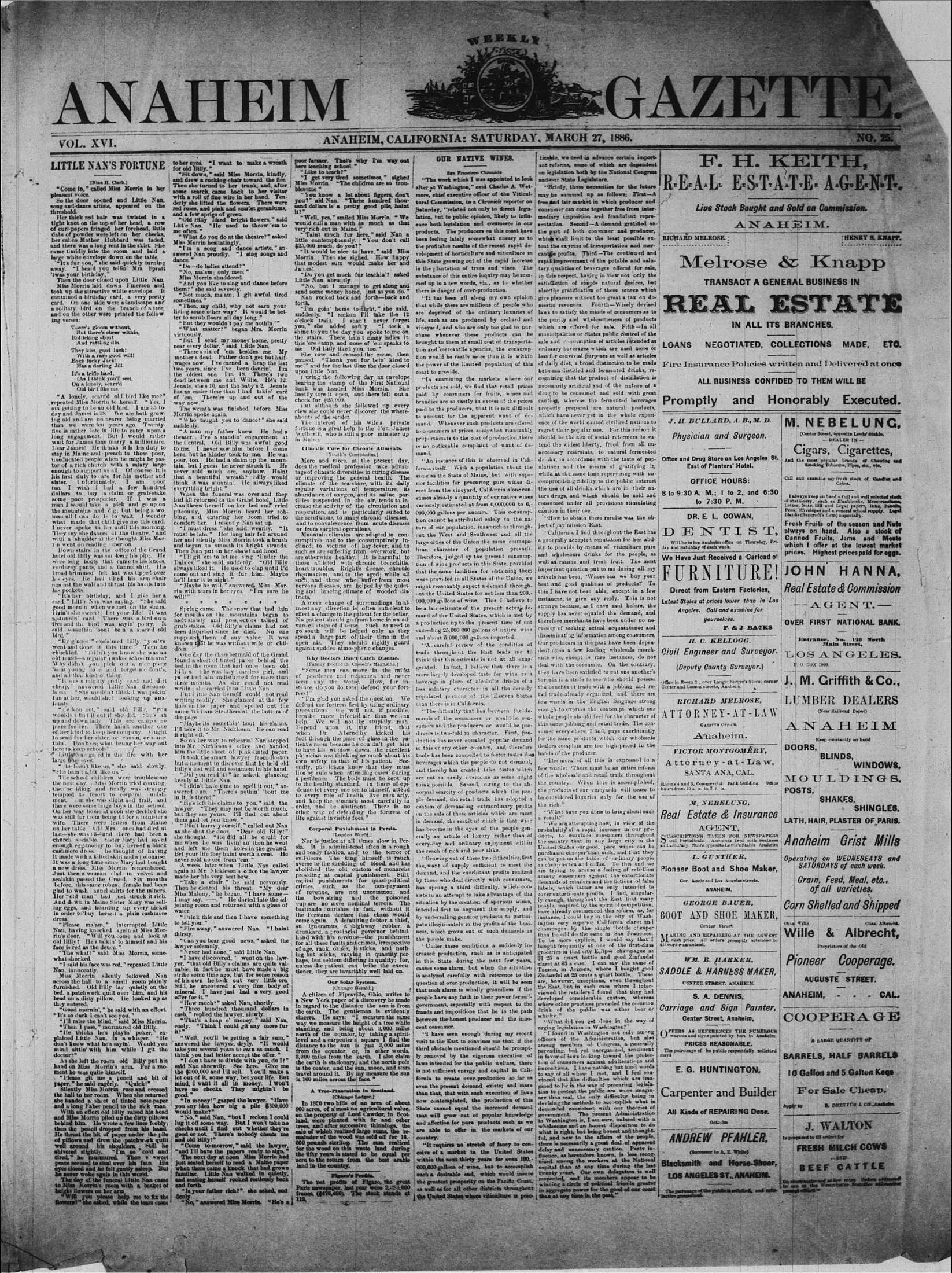
Searchable text
LITTLE NAN'S FORTUNE
[Nina H. Clark]
"Come in," called Miss Morrin in her pleasant voice.
So the door opened and Little Nan, song-and-dance artiste, appeared on the threshold.
Her thick red hair was twisted in a tight knot on the top of her head, a row of curl-papers fringed her forehead, little dals of powder were left on her cheeks, her calico Mother Hubbard was faded, and there was a long rent in the skirt. She came timidly into the room and laid a large white envelope down on the table.
"It's fur you," she said quickly turning away. "I heard you tellin' Mrs. Spratt 'twas your birthday."
Then the door closed upon Little Nan. Miss Morrin laid down Emerson and took up the attractive white envelope. It contained a birthday card, a very pretty card. On one side were a landscape and a solitary bird on the branch of a tree, and on the other were printed the following verses:
There's gloom without,
But there's cheer within,
Rollicking shout
And rattling din.
They kiss, good luck!
With a rays good will!
Each lucky Jack!
Has a darling Jill.
It's a trifle hard,
(As I think you'll see),
On a lonely, scarred
Old bird like me.
"A lonely, scarred old bird like me?" repeated Miss Morrin to herself. "Yes, I am getting to be an old bird. I am 25 today and James is 38. We are both growing old and are no nearer being married than we were ten years ago. Twenty-five is rather late in life to enter upon a long engagement. But I would rather wait for James than marry a millionaire. Dear James! He thinks it is his duty to stay in Maine and preach to those poor, uneducated people when he might be pastor of a rich church with a salary large enough to support us all. Of course it is to her eyes." I want to make a wreath for old Billy."
"Sit down," said Miss Morrin, kindly, and drew a rocking-chair toward the fire. Then she turned to her trunk, and, after some search, came back to her visitor with a roll of fine wire in her hand. Tenderly she lifted the flowers. There were red roses, and pink and scarlet geraniums, and a few sprigs of green.
"Old Billy liked bright flowers," said Littie Nan. "He used to throw 'em to me often."
"What do you do at the theatre?" asked Miss Morrin hesitatingly.
"I'm a song and dance artist," answered Nan proudly. "I sing songs and dance."
"Do—do ladies attend?"
No, ma'am; only men.
Miss Morrin shuddered.
And you like to sing and dance before them?" she said seveely.
"Not much, ma'am; I git awful tired sometimes."
Then my child, why not earn your living some other way? It would be better to scrub floors all day long.
But they wouldn't pay me nothin'.
"What matter?" began Mrs. Morrin virtuously.
But I send my money home, pretty near every dollar," said Little Nan.
There’s six of 'em besides me. My mother’s dead. Father don’t get but half-wages now. I've earned a heap the last two years, since I've been dancing'. I'm the oldest one. Im 18. There's two dead between me and Willie. He’s 12. Jennie, she’s 10, and the baby’s 2. Jennie has an easier time than I had takin’ care of 'em. There’re up and out of the way now.
The wreath was finished before Miss Morrin spoke again.
"Who taught you to dance?" she said suddenly.
"A man my father knew. He had a theater. I've a standin' engagement at the Central. Old Billy was awful good to me. I never saw him before I come here, but he kinder took to me. He was poor, too. He had a claim up the mountain, but I guess he never struck it. He never sold much ore, anyhow. Haint poor farmer. That's here teaching school."
"I get very tired Miss Morrin." The clerical bluesome.
"You know a lot you?" aid Nan. "The sand dollars is a pretend it?"
"Well, yes," smiled she would call a man with very rich out in Maine.
"Taint much fur little contemptously.$25,000 much, do you?
"It would be nice to Morrin. Then she sighed that modest sum worth James!
"Do you get much Little Nan, abruptly?
"No, but I manage send some money home Nan rocked back and forth.
"I’m goin’ home suddenly.” I reckon o’clock train. I shove you,” she added shine to you the day y’the stairs. There have this ‘ere camp, and no me Old Billy like y’She rose and crossed paused.“ Thank you me!” and for the last time upon little Nan.
During the following bearing the stamp of bank was handed Mastily tore it open, a check for $25,000.
But although she clew she could never about of the sender.
The interest of fortune is a great help Wetherill, who is still in Maine.
Climatic Cure for Cancer
More and more, does the medical proficiency of climatic diversion
"A lonely, scarred old bird like me?" repeated Miss Morrin to herself. "Yes, I am getting to be an old bird. I am 35 today and James is 28. We are both growing old and are no nearer being married than we were ten years ago. Twenty-five is rather late in life to enter upon a long engagement. But I would rather wait for James than marry a millionaire. Dear James! He thinks it is his duty to stay in Maine and preach to those poor, uneducated people when he might be pastor of a rich church with a salary large enough to support us all. Of course it is his first duty to care for his mother and sister. Unfortunately, I am poor too. I wish I had a few hundred dollars to buy a claim or grub-stake some poor prospector. If I was a man I would take a pick and go up on the mountains and dig; but being a woman all I can do is to wait. I wonder what made that child give me this card. I never spoke to her until this morning. They say she dances at the theatre," and with a shudder at the thought Miss Morrin went on reading an essay.
Down-stairs in the office of the Grand hotel old Billy was smoking his pipe. He wore long boots that came to his knees, corduroy pants, and a fannel shirt. His broad brimmed hat was tipped over his eyes. He had tilted his arm chair against the wall and thrust his hands into his pockets.
"It's her birthday, and I give her a card." Little Nan was saying. "She said good morning when we met on the stairs. Hain't she sweet? Let your heart be warmed."
Broad brimmed hat was tipped over his eyes. He had tilted his arm chair against the wall and thrust his hands into his pockets.
"It was a mighty pretty card and dirt cheap," answered Little Nan disconsolately. "She wouldn't think I was pokin' fun at her, would she? looking up anxiously."
"We kon not," said old Pillle, "you wouldn't find it out if she did. She's an up and down lady. This ere camp no place for her. There hain't another one of her kind to keep her company. Gought to send fur her sister, or cousin, or some thin. Don't see what brung her way out here to keep school."
Little Nan gaed in the life with her large one eyes.
"He haunt't like us," she said slowly. "She haunt't abit like us."
The school children were troublesome the next day. Miss Morrin tried coaxing them seldom, and finally was strongly tempted to resort to corporal punishment. But she was slight and frail, and there were some large boys in the school. On her way home at noon she decided she was still far from being fit for a minister's wife.
There were letters from Maine on her table. Old Mrs. ones had died at last—she was 13—and there had been a church sociable. Sister Mary had saved enough egg money to buy herself a black cashmere dress. He thought of having it made with a kilted skirt and a polonaise. It was a long time since Mary had bought a new dress, Miss Morrin remembered. Just then a woman clad in velvet and sealskin passed the Grand. Six months before, this same robust, female had been glad to wash an annel shirts for the miners. Her "old man" had just struck it rich.
"The wreath was finished before Miss Morrin spoke again."
"Who taught you to dance?" she said suddenly.
"A man my father knew. He had a theater. I've a standin' engagement at the Central. Old Billy was awful good to me. I never saw him before I come here, but he kinder took to me. He was poor, too. He had a claim up the mountain, but I guess he never struck it. He never sold much ore, anyhow. Haint that a beautiful wreath? Billy would think it was smuin'. He always liked everything bright."
When the funeral was over and they had all returned to the Grand hotel, Little Nan threw herself on her bed and cried piteously. Miss Morrin heard her sobbing, and entering her room, tried to comfort her. I resently Nan sat up.
"I must dress," she said, wearily. "It must be late." Her long hair fell around her and silently Miss Morrin took a brush and began to smooth its bright strands. Then Nan put on her shawl and hood.
"I'll git em to let me sing 'Under the Daisies,'" she said, suddenly. "Old Billy always liked it. He used to clap until I'd come out and sing it fur him. Maybe he'll hear it to night."
"Maybe he will," answered Miss Morrin with tears in her eyes. "I'm sure he will."
Spring came. The snow that had lain for months on the mountains began to melt slowly and prospectors talked of grub stakes. Old Billy's claims had not been disturbed since he died. No one suppsed them of any value. It was known that he was without wife or children.
One day the chambermaid of the Grand found a sheet of tinted paper behind the bed in the room that had once been old Billy's. She was lazy carless girl, and paer had hain undisturbed for more than three months. As she could not read writing she carried it to Little Nan.
Put little Nan herself could not read writing readily. She glanced at the few lines on the paper and spelled out the name William Struthers at the bottom m of the page.
"Maybe its somethin' bout his claims, I'll take it to Mr. Nickleson. He can read it right off."
So on her way to rehearsal Nan stepped into Mr. Nickleson's office and handed him the little sheet of pink-tinted paper.
It took the smart lawyer from Boston but a moment to discover that he held old Billy's last will and testament in his hand.
"Did you read it?" he asked, glancing keenly at Dittle Nan.
"I didn't have time to spell it out," answered Ann. "There's nothin' bout me in it, is there?"
He's left his claims to you," said the lawyer.
"They may not be worth much, but they are yours." I fill out about them and let you know.
"Don't hurry yourself," called out Nan as she shut the door. "Dear old Billy!" she thought. "He did all he could for me when he was living'an then he went and left me them holes in the ground. Bet your life they haint worth a cent. He never sold no ore from'em."
A week later when Little Nan called again at Mr. Nickleson's office the lawyer made her very best bow.
"Take a chair," he said nervously. Then he cleared his throat. "My dear Miss Malony," he began. "I have some—too revenue, are no bowstring."
Climate Care for Children
More and more, does the medical profession of climatology diversify or improving the geography of the sea-shell regular variations of abundance of oxygen, tides suspended in crease the activity of respiration, and is part of the scrofulous, and to convalescence or from surgical operations.
Mountain climates sumptuous and to clined; to victims of such as are suffering from those affected with heart troubles, Bright Rheumatism, and so such, and those whose nervous diseases, are ing and bracing climets.
A mere change of most any direction in effect in change in the patient should go vanell stage of disease go south will be he spend a large part of open air. They shall against sudden atmospheric changes.
Why Doctors Don’t
[Family Doctor in C]
Some men can no pestility and no seem any the worst stance, do you doctors ress?
"I'm glad you askest defend the fortress first precautions. We will breathe more infective help. We will not depend upon it, when Dr. Aberneth foot through the panesient's room because he has his window off phisician was thinking own safety as that oundly, physicians knit live by rule when attire a psilence. The body to the healthy standard demic let every one see to every rule of health and keep the stomach order, and be abstinent other way of defending life against invisible force."
but she was slight and frail, and there were some large boys in the school.
On her way home at noon she decided she was still far from being hit for a minister's wife.
There were letters from Maine on her table. Old Mrs. ones had died at last—she was 18—and there had been a church soelable. Sister Mary had saved enough egg money to buy herself a black cashmere dress. He thought of having it made with a kilted skirt and a polonaise.
It was a long time since Mary had bought a new dress, Miss Morrin remembered.
Just then a woman clad in velvet and sealskin passed the Grand. Six months before, this same robus, female had been glad to wash annel shirts for the miners. Her "old man" had just struck it rich. And down in Maine Sister Mary was selling eggs, and hoarding up every nickel in order to buy herself a plain cashmere dress.
"Please ma'am," interrupted Little Nan, having knocked again at Miss Morrin's door. "Will you come and look at old Billy? He's talkin' to himself and his face is red as the deuce."
"The what?" said Miss Morrin, somewhat shocked.
"I said his face was red," repeated Little Nan, innocently.
Miss Morrin silently followed Nan across the hall to a small room plainly furnished. Old Billy lay quietly on the bed, a patchwork quilt over him, and his head on a dirty pillow. He looked up as they entered.
"Good mornin'," he said with an effort. "It's so dark I can't see you."
"I'll raise the blind," said Miss Morrin.
"Then I pass," murmured old Billy.
He thinks he's playin' poker," explained Little Nan, in a whisper. "He don't know what he's sayin'. Would you mind sittin' with him while I git the doctor?"
As she left the room old Billy put his hand on Miss Morrin's arm. For a moment he was quite himself.
"Please git me a pencil and bit of paper," he said eagerly.
Silently Miss Morrin rose and crossed the hall to her room. When she returned she handed a sheet of tinted note paper and a long Faber pencil to the sick man.
With an effort old Billy raised his head and Miss Morrin piled up the dirty pillows behind him. He wrote a few lines feebly; then the pencil dropped from his hand. He thrust the bit of paper under the pile of pillows and drew the patchwork quilt well around his shoulders. Still he shivered slightly. "I'm so cold and tired," he murmured. Then a sweet peace seemed to steal over his face. His eyes closed and he felt gently asleep. But he never woke again in this world.
The day of the funeral Little Nan came to Miss Morrin's room with a basket of bright flowers on her arm.
"Will you please help me to fix the flowers?" she asked, while the tears came
"He's left his claims to you," said the lawyer. "They may not be worth much, but they are yours. I'll find out about them and let you know."
"Don't hurry yourself," called out Nan as she shut the door. "Dear old Billy!" she thought. "He did all he could for me when he was livin'an then he went and left me them holes in the ground. Bet your life they haint worth a cent. He never sold no ore from 'em."
A week later when Little Nan called again at Mr. Nickleson's office the lawyer made her his very best bow.
"Take a chair," he said nervously. Then he cleared his throat. "My dear Miss Malony," he began, "I have some—I may say, —." He darted into the adjoining room and returned with a glass of water.
"Drink this and then I have something to tell you."
"Fire away," answered Nan. "I haunt thirsty."
"Can you bear good news," asked the lawyer solemnly.
"Never had none," said Little Nan.
"I have discovered," went on the lawyer. "that old Billy's claims are quite valuable; in fact he must have made a big strike some time ago, but for some reason of his own he took out very little ore. Still, he uncovered a very fine body of mineral. I have just had a very good offer for it."
"How much?" asked Nan, shortly.
"Three hundred thousand dollars in cash," replied the lawyer, slowly.
"That's a heap o'money," said Nan, cooly. "Think I could git any more fur it?"
Well, you'll be getting a fair sum," answered the lawyer, dryly. "It would take you several years to earn as much. I think you had better accept the offer."
"I don't have to divide with you, do I?" said Nan shrewdly. See here Give me the $200,000 and I'll sell. You'll make a lot out of it, some way, bet your life. But mind, I want it all in money. I won't have no checks. They mightn't be good."
In money!" gasped the lawyer. "Have you any idea how big a pile $300,000 would make?"
No," said Nan, "but I reckon I could lug it off some way. But I won't take no checks until I find out whether they're good or not. There's nobody cheats me and old Billy!"
Come to-morrow," said the lawyer, "and I'll have the papers ready to sign."
The next day at noon Miss Morrin had just seated herself to read a Maine paper when there came a knock that had grown familiar. Little Nan walked in quietly, and seating herself rocked restlessly back and forth.
"Is your father rich?" she asked, suddenly.
"No," answered Miss Morrin. "He's a
WEEKLY
IM GA
ANAHEIM, CALIFORNIA: SATURDAY, MARCH 27, 1886.
poor farmer. That's why I'm way out here teaching school."
"Like to teach?"
"I get very tired sometimes," sighed Miss Morrin. "The children are so troublesome."
"You know a lot about figgers, don't you?" said Nan. "Three hundred thousand dollars is a pretty good pile, haint it?"
"Well, yes," smiled Miss Morrin. "We would call a man with as much as that very rich out in Maine."
"Taint much fur here," said Nan a little contemptiously. "You don't call $25,000 much, do you?"
"It would be nice to have," said Miss Morrin. Then she sighed. How happy that modest sum would make her and James!
"Do you get much fur teachin'? asked Little Nan, abruptly.
"No, but I manage to get along and send some money home, just as you do."
Nan rocked back and forth—back and forth.
"I'm goin' home tonight," she said, suddenly. "I reckon I'll take the 12 o'clock train. I shan't never forget you," she added softly. "I took a shine to you the day you spoke to me on the stairs. There hain't many ladies in this 'ere camp, and none of 'em speaks to me. Old Billy liked you, too."
She rose and crossed the room, then paused. "Thank you! fur bein' kind to me!" and for the last time the door closed upon little Nan.
During the following day, an envelope bearing the stamp of the First National bank was handed Miss Morrin. She hastily tore it open, and there fell out a check for $25,000.
But although she followed up every clew she could never discover the whereabouts of the sender.
The interest of his wife's private fortune is a great help to the Rev. James Wetherill, who is still a poor minister up in Maine.
Climatic Cure for Chronic Allments.
[Youth's Companion.]
More and more, at the present day, does the medical profession take advantage of climatic diversities in curing disease.
OUR NATIVE WINES.
San Francisco Chronicle
"The work which I was appointed to look after at Washington," said Charles A. Wetmore, chief executive officer of the Vitucultural Commission, to a Chronicle reporter on Saturday, "related not only to direct legislation, but to public opinion, likely to influence both legislation and commerce in our products. The producers on this coast have been feeling lately somewhat uneasy as to the profitable results of the recent rapid development of horticulture and viticulture in this State growing out of the rapid increase in the plantation of trees and vines. The substance of this entire inquiry may be summed up in a few words, viz., as to whether there is danger of over-production.
"It has been all along my own opinion that while there are millions of people who are deprived of the ordinary luxuries of life, such as are produced by orchard and vineyard, and who are only too glad to purchase whenever these products can be brought to them at small cost of transportation and mercantile agencies, the consumption would be vastly more than it is within the power of the limited population of this coast to provide.
In examining the markets where our products are sold, we find that retail prices paid by consumers for fruits, wines and brandies are so vastly in excess of the prices paid to the producers, that it is not difficult to account for the apparent want of demand. Whenever such products are offered to consumers at prices somewhat reasonably proportionate to the cost of production, there is no noticeable complaint of want of demand.
An instance of this is observed in California itself. With a population about the state of Maine, but with smaller ticks, we need in advance certain important reforms, some of which are dependent on legislation both by the National Congress and our State Legislature.
Briefly, those necessities for the future may be summed up as follows: First—A free and fair market in which producer and consumer can come together free from intermediary imposition and fraudulent representation. Second—A demand gratified on the part of both consumer and producer, which shall limit to the least possible extent the expense of transportation and mercantile profits. Third—The continued and rapid improvement of the potable and salinary qualities of beverages offered for sale, in this respect, having in view not only the satisfaction of simple natural desires, but also the gratification of those senses which give pleasure without too great a tax on domestic revenues. Fourth—Wisely devised laws to satisfy the minds of consumers as to the purity and wholesomeness of products which are offered for sale. Fifth—In all municipalities or States public control of the sale and consumption of articles intended as ordinary beverages which are used more or less for convivial purposes as well as articles of daily diet, a broad distinction to be made between distilled and fermented drinks, recognizing that the product of distillation is necessarily artificial and of the nature of a drug to be consumed and sold with great caution, whereas the fermented beverages properly prepared are natural products, which have never yet in the whole experience of the world caused civilized nations to regret their popular use. For this reason it should be the aim of social reformers to extend the widest liberty, freed from all unnecessary restraints, to natural fermented drinks, in accordance with the taste of populations and the means of gratifying it, while at the same time supervising with un-
Iuring the following day an envelope bearing the stamp of the First National bank was handed Miss Morrin. She hastily tore it open, and there fell out a check for $25,000.
But although she followed up every clew she could never discover the whereabouts of the sender.
The interest of his wife's private fortune is a great help to the Pev. James Wetherill, who is still a poor minister in Main.
Climate Cure for Chronic Allments.
[Youth's Companion.]
More and more, at the present day, does the medical profession take advantage of climatic diversities in curing disease or improving the general health. The climate of the sea shore, with its daily regular variations of temperature, its abundance of oxygen, and its saline particles suspended in the air, tends to increase the activity of the circulation and respiration, and is particularly suited to the scrofulous, to many chronic diseases, and to convalescence from acute diseases or from surgical operations.
Mountain climates are adapted to consumptives and to the consumptively inclined; to victims of hay-fever; and to such as are suffering from overwork, but are otherwise healthy. It is harmful to those afflicted with chronic bronchitis, heart troubles, Bright disease, chronic rheumatism, and to the aged; while all such, and those who suffer from most nervous diseases, are helped by the quieting and bracing climate of wooded districts.
A mere change of surroundings in almost any direction is often sufficient to effect a change in the patient for the better. No patient should go from home in an advanced stage of disease; such as need to go south will be helped only as they spend a large part of their time in the open air. They should rigidly guard against sudden atmospheric changes.
Why Doctors Don't Catch Disease.
[Family Doctor in Crescent's Magazine.]
"Some men can move in the midst of pestilence and misnata and never seem any the worse. How, for instance, do you do this defend your fortress?
"I'm glad you asked the question. We defend the fortress first by using ordinary precautions. We will not, if possible, breathe more infected air than we can help. We will not be stupidly rash. Depend upon it, my friend, that when Dr. Aberdey kicked his foot through the pane of glass in the patient's room because he couldn't get him to have his window down, the excellent physician was thinking as much about his own safety as that of his patient. Secondly, physicians know that they must live by rule when attending cases during a pestilence. The body must be kept up to the healthy standard. In times of epidemic let every one see to himself, attend to every rule of health, live regularly, and keep the stomach most carefully in order, and be abstinent. There is no other way of defending the fortress of life against invisible foes."
Corporal Punishment in Persia.
[London World.]
Nor is justice at all times slow in Persia. It is administered often in a rough and ready fashion, and to the terror of evil-doers. The king himself is much averse to the shedding of blood, and has abolished the old custom of monarchs presiding at capital punishment. Still, capital punishments for quasi-political crimes, such as the non-payment of revenue, are not uncommon; and the bowstring and the poisoned "In examining the markets where our products are sold, we find that retail prices paid by consumers for fruits, wines and brandies are so vastly in excess of the prices paid to the producers, that it is not difficult to account for the apparent want of demand. Whenever such products are offered to consumers at prices somewhat reasonably proportionate to the cost of production, there is no noticeable complaint of want of demand.
"An instance of this is observed in California itself. With a population about the same as the State of Maine, but with superior facilities for procuring pure wines direct from the vineyard, California alone consumes already a quantity of our native wines variously estimated at from 4,000,000 to 6,000,000 gallons per annum. This consumption cannot be attributed solely to the nature of our population, inasmuch as throughout the West and Southwest and all the large cities of the Union the same cosmopolitan character of population prevails. Therefore, judged by the present consumption of wine products in this State, provided that the same facilities for obtaining them were provided in all States of the Union, we might reasonably expect a demand throughout the United States for not less than 200,000,000 gallons of wine. This I believe to be a fair estimate of the present actual demand of the United States, which is met by a production up to the present time of not exceeding 25,000,000 gallons of native wine and about 5,000,000 gallons imported.
"A careful review of the condition of trade throughout the East leads me to think that this estimate is not at all exaggerated. In fact, I believe that there is a more largely developed taste for wine as a beverage in place of alcoholic drinks of a less salutary character in all the densely populated portions of the 'Eastern States than there is in California.
"The difficulty that lies between the demands of the consumers or would-be consumers and the producers or would-be producers is twofold in character. First, production has never equaled popular demand in this or any other country, and therefore trade has been compelled to foster tastes for beverages which the people do not demand, and thereby has created false tastes which are not so easily overcome as some might think possible. Second, owing to the abnormal security of products which the people demand, the retail trade has adopted a custom of demanding extraordinary profits on the sale of those articles which are most in demand, the result of which is that wine has become in the eyes of the people generally an article of luxury rather than of everyday and ordinary enjoyment within the reach of rich and poor alike.
"Growing out of these two difficulties, first the want of supply sufficient to meet the demand, and the exorbitant profits realized by those who deal directly with consumers, has sprung a third difficulty, which consists in an attempt to take advantage of the cognizing that the product of distillation is necessarily artificial and of the nature of a drug to be consumed and sold with great caution, whereas the fermented beverages properly prepared are natural products, which have never yet in the whole experience of the world caused civilized nations to regret their popular use. For this reason it should be the aim of social reformers to extend the widest liberty, freed from all unnecessary restraints, to natural fermented drinks, in accordance with the taste of populations and the means of gratifying it, while at the same time supervising with uncompromising fidelity to the public interest the use of all drinks which are in their nature drugs, and which should be sold and consumed under all provisions stimulating caution in their use.
"How to obtain these results was the object of my mission East.
"California I find throughout the East has a generally accepted reputation for her ability to provide by means of viticulture pure and wholesome drinks for the people, as well as raisins and fresh fruit. The most important question put to me during all my travels has been, 'Where can we buy your best and good qualities of products?' To this I have not been able, except in a few instances, to give any reply. This is not strange because, as I have said before, the supply has never equaled the demand, and therefore merchants have been under no necessity of seeking actual acquaintance and disseminating information among consumers. Our producers in the past have been dependent upon a few leading wholesale merchants who, except in rare instances, do not deal with the consumer. On the contrary, they have been satisfied to cut one another's threats in a strife to see who should possess the benefits of trade with a jobbing and retail trade already organized, and there are few words in the English language strong enough to express the content pt which our whole people should feel for the character of this same jobbing and retail trade. The consumer everywhere I find pays excititantly for the same products which our wholesale dealers complain are too high-priced in the hands of the producer.
"The moral of all this is expressed in a few words: 'There must be an entire reform of the wholesale and retail trade throughout the country. When this is accomplished, the products of our vineyards will cease to be considered luxuries only for the use of the rich.'"
"What have you done to bring about such a result?"
"We are attempting now, in view of the probability of a rapid increase in our products, to convince consumers throughout the country that in any large city in the United States our good, pure wines can be purchased cheaper than milk, and that they can be put on table of ordinary people as cheap as tea and coffee. To this end we are trying to arouse a feeling of rebellion among consumers against the extortionate demands of retailers andthe fictiousoffalselabelswhichlatterareonlyintendedtocoverextortionateprofits.IfindsingularlyenoughthroughtheEastthatmany
Corporal Punishment in Persia.
[London World.]
Nor is justice at all times slow in Persia. It is administered often in a rough and ready fashion, and to the terror of evil doers. The king himself is much averse to the shedding of blood, and has abolished the old custom of monarchs presiding at capital punishment. Still, capital punishments for quasi-political crimes, such as the non-payment of revenue, are not uncommon; and the bowstring and the poisoned cup are no mere nominal terrors. The bastinado nourishes in fact, without it the Persians declare that chaos would come again. A defaulting debtor, a thief, an ignoramus, a highway robber, a drunkard, a provincial governor behind-hand with his revenue—the punishment for all these faults and crimes, irrespective of age, rank, or sex, is sticks, and nothing but sticks, varying in quantity perhaps, but seldom differing in quality; for, unless the patient can bribe the executioner, they are invariably well laid on.
Our Solar System.
[Chicago Herald.]
A citizen of Pipesville, Ohio, writes to a New York paper of a discovery he made in regard to the distance the sun is from the earth. The gentleman is evidently sincere. He says: "I measure the same way we measure the height of a tree while standing, and being about 3,000 miles north of the equator, by taking a spirit-level and a carpenter's square I find the distance to the sun is just 3,000 miles from the equator, or, in other words, 3,000 miles from the earth. I also claim the earth is stationary, and the north pole is the center, and the sun, moon, and stars travel around it. By my measure the sun is 100 miles across the face."
A Tree-Plantation in Scotland.
[Chicago Ledger.]
In 1820 two hills of an area of about 800 acres, of almost no agricultural value, on the property of Lord Cawdor, in Scotland, were planted with fir and other trees, and after successive thinnings, the sale of which realized large sums, the remainder of the wood was sold off for 16.000 pounds sterling. The sum realized for the wood on this waste land during the fifty years is stated to be equal per acre to the return from the best arable land in the country.
Figaro's Profits.
The net profits of Figaro, the great Paris newspaper, last year were 2,383,000 francs ($476,000). The stock stands at 112.
The retail trade has adopted a custom of demanding extraordinary profits on the sale of those articles which are most in demand, the result of which is that wine has become in the eyes of the people generally an article of luxury rather than of everyday and ordinary enjoyment within the reach of rich and poor alike.
"Growing out of these two difficulties, first the want of supply sufficient to meet the demand, and the exorbitant profits realized by those who deal directly with consumers, has sprung a third difficulty, which consists in an attempt to take advantage of the situation by the creation of spurious wines, intended first to augment the supply, and by underselling genuine products to participate illegitimately in the profits of the business, which grows out of such demands as the people make.
"Under these conditions a suddenly increased production, such as is anticipated in this State during the next few years, causes some alarm, but when the situation is analyzed carefully with reference to the question of over-production, it will be seen that such alarm is wholly groundless if the people have any faith in their power for self-government, especially with respect to the frauds and impositions that lie in the path between the honest producer and the innocent consumer.
"I have seen enough during my recent visit to the East to convince me that if the third obstacle mentioned should be promptly removed by the vigorous execution of laws intended for the public welfare, there is not sufficient energy and capital in California to create over-production so far as even the present demand exists; and more than that, that with such execution of laws now contemplated, the production of this State cannot equal the increased demand that will grow out of popular knowledge and affection for pure products such as we are able to offer in the markets of our country.
"It requires no stretch of fancy to conceive of a market in the United States within the next thirty years for even 100.,000,000 gallons of wine, but to accomplish such a desirable end, which would insure the greatest prosperity on the Pacific Coast, as well as for all other districts throughout the United States where viticulture is pre-
What have you done to bring about such a result?
"We are attempting now, in view of the probability of a rapid increase in our products, to convince consumers throughout the country that in any large city in the United States our good, pure wines can be purchased cheaper than milk, and that they can be put on the table of ordinary people as cheap as tea and coffee. To this end we are trying to arouse a feeling of rebellion among consumers against the extortionate demands of retailers and the fictious of false labels, which latter are only intended to cover extortionate profits. I find, singularly enough throughout the East that many people, inspired by the spirit of competition, have already commenced this reform, as for instance, I could buy in the city of Washington very superior California claret and champagne by the single bottle cheaper than I could do the same in San Francisco. To be more explicit, I would say that I bought frequently at one of the first-class groceries in that city Eclipse champagne at $125 a quart bottle and good Zinfandel claret at $3 a case. I can say the same of Tucson, in Arizona, where I bought good Zinfandel at 25 cents a quart bottle. These are however exceptions, even throughout the East, but in each case where I interviewed the retailers I found that they had developed considerable custom, whereas where other practices provailed the common drink of the public was either beer or whisky."
"What did you get done in the way of urging legislation in Washington?"
"I found in Washington not only among officers of the Administration, but also among members of Congress, a generally pervading but yet unorganized sentiment in favor of laws looking toward the protection of consumers against adulterations and impositions. I have nothing but kind words to say of all whom I met. And I feel convinced that the difficulties which are imagined to lie in the way of procuring legislation to protect the public are more imaginative than real, the only difficulty being in devising methods to accomplish what is demanded consistent with our theories of government. The present Administration in Washington is I am sure, imbued with a wholesome and an honest disposition to do what is right, but being honest and thoughtful, and new to the affairs of the people, there is necessarily a great deal of apparent delay and unnecessary caution. Party influence, as heretofore known, is less recognized among the workers at the National capital than at any time during the last twenty years. Our own delegation is well respected, and its members appear to be winning a circle of political friends greater in aggregate power for the good of our coast than at any time in the past."
GAZETTE.
17, 1886. NO. 25.
F. H. KEITH,
REAL ESTATE AGENT.
Live Stock Bought and Sold on Commission.
ANAHEIM.
RICHARD MELROSE: HENRY S. KNAPP.
Melrose & Knapp
TRANSACT A GENERAL BUSINESS IN
REAL ESTATE
IN ALL ITS BRANCHES.
LOANS NEGOTIATED, COLLECTIONS MADE, ETC.
Fire Insurance Policies written and Delivered at once
ALL BUSINESS CONFIDED TO THEM WILL BE
Promptly and Honorably Executed.
J. H. BULLARD, A. B., M. D.
Physician and Surgeon.
Office and Drug Store on Los Angeles St.
East of Planters' Hotel.
M. NEBELUNG,
(Center Street, opposite Lewis' Stable).
DEALER IN
Cigars, Cigarettes,
And the most popular brands of Chewing and Smoking Tobacco, Pipes, etc., etc.
ALL BUSINESS CONFIDED TO THEM WILL BE
Promptly and Honorably Executed.
J. H. BULLARD, A. B., M. D.
Physician and Surgeon.
Office and Drug Store on Los Angeles St.
East of Planters' Hotel.
OFFICE HOURS:
8 to 9:30 A. M.; 1 to 2, and 6:30
to 7:30 P. M.
DR. E. L. COWAN,
DENTIST,
Will be in his Anaheim office on Thursday, Friday and Saturday of each week.
We Have Just Received a Carload of
FURNITURE!
Direct from Eastern Factories,
Latest Styles at prices lower than in Los Angeles. Call and examine for yourselves.
P & J. BACKS
H. C. KELLOGG.
Civil Engineer and Surveyor.
(Deputy County Surveyor.)
Office in Room 2, over Langenberger's Store, corner Center and Lemon streets, Anaheim.
RICHARD MELROSE,
ATTORNEY-AT-LAW
GAZETTE OFFICE.
Anaheim.
VICTOR MONTGOMERY,
Attorney-at-Law,
SANTA ANA, CAL.
Rooms 4 and 5, Commercial Bank building. Office hours from 10 A. M. to 3 P. M.
M. NEBELUNG,
Real Estate & Insurance AGENT.
SUBSCRIPTIONS TAKEN FOR NEWSPAPERS and Periodicals. Accounts kept with neatness and accuracy. Store opposite Lewis's Stable Anaheim.
L. GUNTHER.
Pioneer Boot and Shoe Maker,
Cor. Adele and Los Angeles streets.
ANAHEIM.
M. NEBELUNG,
(Center Street, opposite Lewis' Stable.
DEALER IN -
Cigars, Cigarettes,
And the most popular brands of Chewing and Smoking Tobacco, Pipes, etc., etc.
Call and examine my fresh stock of Candles and Cakes.
I always keep on hand a full and well selected stock of stationery, such as Blankbooks, Memorandums, Letter, Note, Bill and Legal papers, Inks, Penalties, Pens, Knifes and a general school supply. Legal Blanks (Bancroft's form) is specially.
Fresh Fruits of the season and Nuts always on hand. Also a stock of Canned Fruits, Jams and Meats which I offer at the lowest market prices. Highest prices paid for eggs.
JOHN HANNA,
Real Estate & Commission
AGENT.
OVER FIRST NATIONAL BANK.
Entrance No. 120 North Main Street,
LOS ANGELES.
P.O. BOX 1000.
J. M. Griffith & Co.,
LUMBER DEALERS
(Near Railroad Depot)
ANAHEIM
Keep constantly on hand
DOORS,
BLINDS,
WINDOWS,
MOULDINGS.
POSTS,
SHAKES,
SHINGLES,
LATH, HAIR, PLASTER OF PARIS.
Anaheim Grist Mills
Operating on WEDNESEAYS and SATURDAYS of each week.
Grain, Feed, Meal, etc., of all varieties.
M. NEBELUNG,
Real Estate & Insurance
AGENT.
SUBSCRIPTIONS TAKEN FOR NEWSPAPERS
and Periodicals. Accounts kept with neatness
and accuracy. Store opposite Lewis's Stable Anaheim.
L. GUNTHER,
Pioneer Boot and Shoe Maker,
Cor. Adele and Los Angeles streets.
ANAHEIM.
GEORGE BAUER,
BOOT AND SHOE MAKER,
Center Street.
MAKING AND REPAIRING AT THE LOWEST
cash price. All orders promptly attended to
All work guaranteed.
WM. R. HARKER,
SADDLE & HARNESS MAKER,
CENTER STREET. ANAHEIM.
S. A. DENNIS,
Carriage and Sign Painter,
Center Street, Anaheim.
OFFERS AS REFERENCES THE NUMEROUS
wagons and signs painted by him in Anaheim.
PRICES REASONABLE.
The patronage of the public respectfully solicited
E. G. HUNTINGTON,
Carpenter and Builder
All Kinds of REPAIRING Done.
Oct 5-3m
ANDREW PFAHLER,
(Successor to A. E. White)
Blacksmith and Horse-Shoer,
LOS ANGELES ST., ANAHEIM.
The patronage of the public is solicited, and satisfaction guaranteed.
SHAKES,
SHINGLES,
LATH, HAIR, PLASTER OF PARIS.
Anaheim Grist Mills
Operating on WEDNESEAYS and
SATURDAYS of each week.
Grain, Feed, Meal, etc.,
of all varieties.
Corn Shelled and Shipped
Chas Wille
Chas. Albrecht.
Wille & Albrecht,
Proprietors of the Old
Pioneer Cooperage.
AUGUSTE STREET.
ANAHEIM,
COOPERAGE
A LARGE QUANTITY OF
BARRELS, HALF BARRELS
10 Gallon and 5 Galton Keqs
For Sale Cheap.
Apply to:
B. DEEYUS & CO., Anaheim.
J. WALTON
In prepared to fill orders for
FRESH MILCH COWS
AND
BEEF CATTLE
On short notice and at low rates. Orders addressed
to us at the Westminster Post offices will number
much more."