anaheim-gazette 1886-03-20
Scanned page
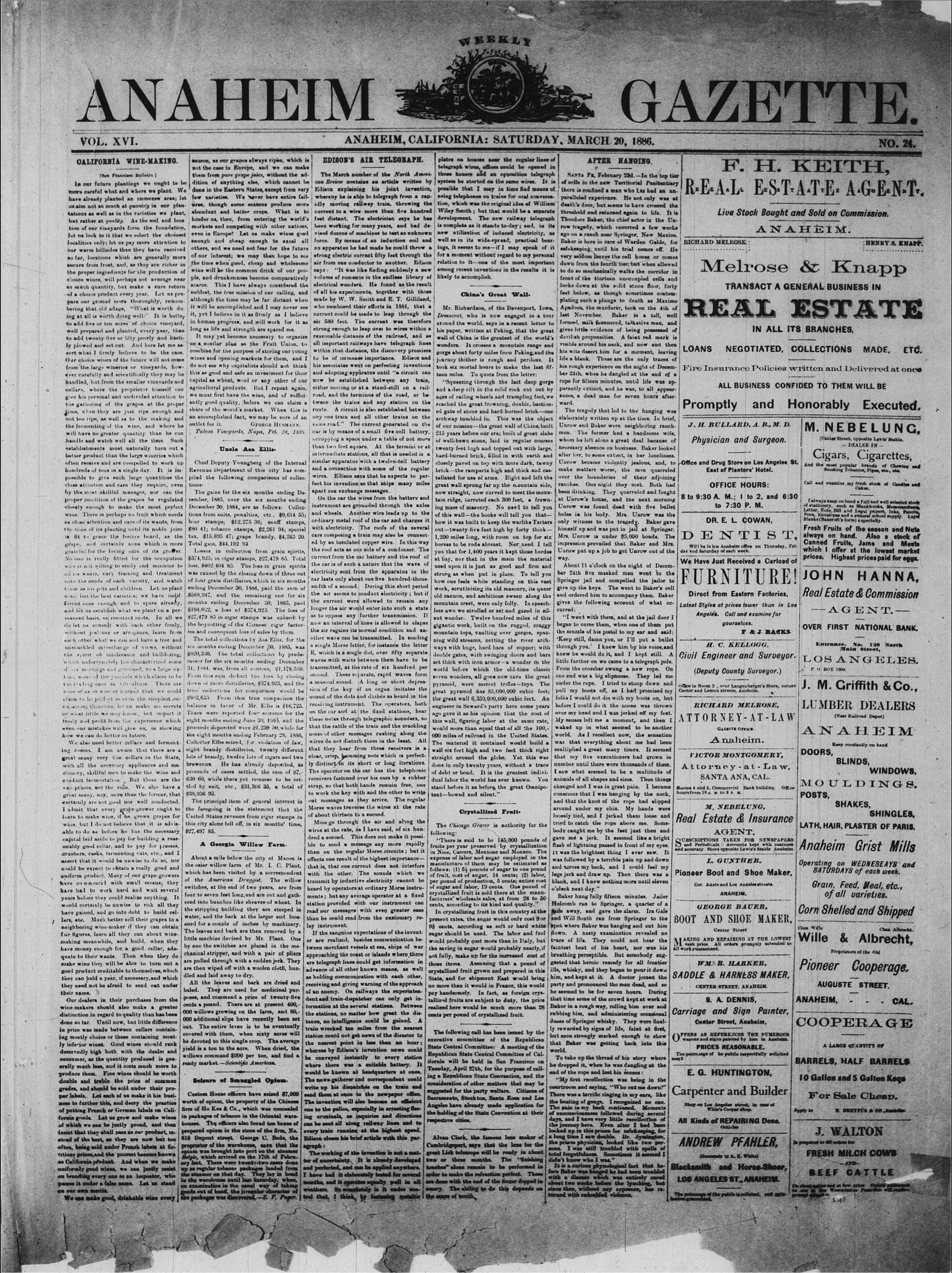
Searchable text
CALIFORNIA WINE-MAKING.
[San Francisco Bulletin.]
In our future plantings we ought to be more careful what and where we plant. We have already planted an immense area; let us aim not so much at quantity in our plantations as well as in the varieties we plant, but rather at quality. As the soil and location of our vineyards form the foundation, let us look to it that we select the choicest localities only; let us pay more attention to our warm hillsides than they have received so far, locations which are generally more secure from frost, and, as they are richer in the proper ingredients for the production of choice wines, will perhaps not average near so much quantity, but make a sure return of a choice product every year. Let us prepare our ground more thoroughly, remembering that old adage, "What is worth doing at all is worth doing well." It is better to add five or ten acres of choice vineyard, well prepared and planted, every year, than to add twenty-five or fifty poorly and hastily plowed and set out. And here let me assert what I firmly believe to be the case. Our choice wines of the future will not come from the large wineries or vineyards, however carefully and scientifically they may be handled, but from the smaller vineyards and cellars, where the proprietor himself can give his personal and undivided attention to the gathering of the grapes at the proper time, when they are just ripe enough and not too ripe, as well as to the making and the fermenting of the wine, and where he will have no greater quantity than he can handle and watch well all the time. Such establishments must naturally turn out a better product than the large wineries which often receive and are compelled to work up hundreds of tons in a single day. It is im-
season, as our grapes always ripen, which is not the case in Europe, and we can make them from pure grape juice, without the addition of anything else, which cannot be done in the Eastern States, except from very few varieties. We never have entire failures, though some seasons produce more abundant and better crops. What is to hinder us, then, from entering the world's markets and competing with other nations, even in Europe? Let us make wines good enough and cheap enough to excel all others, and we need not fear for the future of our interest; we may then hope to see the time when good, cheap and wholesome wine will be the common drink of our people, and drunkenness become comparatively scarce. This I have always considered the noblest, the true mission of our calling, and although the time may be far distant when it will be accomplished and I may never see it, yet I believe in it as firmly as I believe in human progress, and will work for it as long as life and strength are spared me.
It may yet become necessary to organize on a similar plan as the Fruit Union, to combine for the purpose of storing our young wines and opening markets for them, and I do not see why capitalists should not think this as good and safe an investment for their capital as wheat, wool or any other of our agricultural products. But I repeat again, we must first have the wine, and of sufficiently good quality, before we can claim a share of the world's market. When this is an accomplished fact, we may be sure of an outlet for it.
GEORGE HUSMANN.
Talcoa Vineyards, Napa, Feb. 28, 1886.
Uncle Asa Ellis.
Chief Deputy Youngberg of the Internal Revenue Department of this city has com-
Uncle Asa Ellis
Chief Deputy Youngberg of the Internal Revenue Department of this city has compiled the following comparisons of collections:
The gains for the six months ending December 30, 1884, are as follows: Collections from suits, penalties, etc., $9,614.55; beer stamps; $12,275.36; snuff stamps; $80.41; tobacco stamps; $2,261.94; special tax; $15,695.47; grape brandy; $4,265.20. Total gain, $44,192.93.
Losses in collection from grain spirits, $374,925; in cigar stamps, $27,479.85. Total loss, $402,404.85. The loss in grain spirits was caused by the closing down of three out of four grain distilleries, which in six months ending December 30, 1884, paid the sum of $568,947, and the remaining one for six months ending December 30, 1885, paid $194,022, a loss of $374,925. The loss of $27,479.85 in cigar stamps was caused by the boycotting of the Chinese cigar factories and consequent loss of sales by them.
The total collections by Asa Ellis for the six months ending December 30, 1885, was $820,360. The total collections by predecessor for the six months ending December 31, 1884, was from all sources, $1,178,560. From this sum deduct the loss by closing down of three distilleries, $374,925, and the true collections for comparison would be $803,635. From this true comparison the balance in favor of Mr. Ellis is $16,725. There were reported four seizures for eight months ending June 30, 1885, and the proceeds deposited were $1,239.50, while for the eight months ending February 28, 1886, Collector Ellis seized, for violation of law, eight brandy distilleries, twenty different lots of brandy, twelve lots of cigars and two breweries. He has already deposited as proceeds of cases settled, the sum of $7,630.60, while there yet remains to be settled by suit, etc., $31,306.35, a total of $38,936.95.
The principal item of general interest in the foregoing is the statement that the United States revenue from cigar stamps in this city alone fell off, in six months' time, $27,497.85.
A Georgia Willow Farm.
About a mile below the city of Macon is the oister willow farm of Mr. I. C. Plaut, which has been visited by a correspondent of the American Druggist. The willow switches at the end of two years, are from four to seven feet long, and are cut and gath-ed a second. The able to send a more than on the regular effects one result of that is, that one can with the other transmit by indirect heard by operators; but any avail-
certainly are not good nor well conducted.
I admit that every grape grower ought to learn to make wine, if he grows grapes for wine, but I do not believe that it is advisable to do so before he has the necessary capital laid aside to pay for building a reasonably good cellar, and to pay for presses, crushers, casks, fermenting vats, etc., and I assert that it would be unwise to do so, nor could he expect to obtain a really good and uniform product. Many of our grape-growers have commenced with small means; they have had to work hard and wait several years before they could realize anything. It would certainly be unwise to risk all they have gained, and go into debt to build cellars, etc. Much better sell their grapes to a neighboring wine-maker if they can obtain fair figures, learn all they can about wine-making meanwhile, and build, when they have money enough for a good cellar, adequate to their wants. Then when they do make wine they will be able to turn out a good product creditable to themselves, which they can hold a year, if necessary, and which they need not be afraid to send out under their name.
Our dealers in their purchases from the wine-makers should also make a greater distinction in regard to quality than has been done so far. Until now, but little difference in price was made between cellars containing mostly choice or those containing mostly inferior wines. Good wines should rank deservedly high both with the dealer and consumer, as the quantity produced is generally much less, and it costs much more to produce them. Fine wines should be worth double and treble the price of common grades, and should be sold under their proper labels. Let each of us make it his business to further this, and decry the practice of putting French or German labels on California goods. Let us grow and make wines of which we can be justly proud, and then insist that they shall pass as our product, instead of the best, as they are now but too often, being sold under French labels at fictitious prices, and the poorest become known as California product. And when we make uniformly good wines, we can justly insist on branding every one as an impostor, who passes it under a false name. Let us stand on our own merits.
We can make good, drinkable wine every
The principal item of general interest in the foregoing is the statement that the United States revenue from cigar stamps in this city alone fell off, in six months' time, $27,497 85.
A Georgia Willow Farm.
About a mile below the city of Macon is the osier willow farm of Mr. I. C. Plant, which has been visited by a correspondent of the American Druggist. The willow switches, at the end of two years, are from four to seven feet long, and are cut and gathered into bunches like sheaves of wheat. In the stripping building they are steeped in water, and the bark at the larger end loosened for a couple of inches by machinery. The leaves and bark are then removed by a little machine devised by Mr. Plant. One by one the switches are placed in the mechanical stripper, and with a pair of pliers are pulled through with a sudden jerk. They are then wiped off with a woolen cloth, bundled and laid away to dry.
All the leaves and bark are dried and baled. They are used for medicinal purposes, and command a price of twenty-five cents a pound. There are at present 400,000 willows growing on the farm, and 80,000 additional slips have recently been set out. The entire levee is to be eventually covered with them, when sixty acres will be devoted to this single crop. The average yield is a ton to the acre. When dried, the willows command $200 per ton, and find a ready market.—Scientific American.
Seizure of Smuggled Opium.
Custom House officers have seized $7,600 worth of opium, the property of the Chinese firm of Ho Kee & Co., which was concealed in packages of tobacco in the Oriental warehouses. The officers also found ten boxes of prepared opium in the store of the firm, No. 818 Dupont street. George C. Bode, the proprietor of the warehouse, says that the opium was brought into port on the steamer Belgic, which arrived on the 17th of February last. There were twenty-two cases done up as regular tobacco packages landed from the steamer on that day. They lay in bond in the warehouse until last Saturday, when, on examination in the usual way of taking goods out of band, the irregular character of the packages was discovered.—S. F. Paper.
The working of the ter or uncertainty.
and perfected, and o I have had it elaborate months, and it operates weatherly. So com-
WEEKLY
EIM GA
ANAHEIM, CALIFORNIA: SATURDAY, MARCH 20, 1886.
EDISON'S AIR TELEGRAPH.
The March number of the North American Review contains an article written by Edison explaining his joint invention, whereby he is able to telegraph from a rapidly moving railway train, throwing the current to a wire more than five hundred feet distant. The electrician says he has been working for many years, and had devised dozens of machines to test an unknown force. By means of an induction coil and an apparatus he had made he could throw a strong electric current fifty feet through the air from one conductor to another. Edison says: "It was like finding suddenly a new volume of romance in the endless library of electrical wonders. He found as the result of all his experiments, together with those made by W. W. Smith and E. T. Gilliland, who combined their efforts in 1881, that a current could be made to leap through the air 580 feet. The current was therefore strong enough to leap over to wires within a reasonable distance of the railroad, and as all important railways have telegraph lines within that distance, the discovery promises to be of immense importance. Edison and his associates went on perfecting inventions and adopting apparatus until "a circuit can now be established between any train, either moving or at a stand-still on a railroad, and the terminus of the road, or between the trains and any station on the route. A circuit is also established between any one train and all other trains on the same road." The current generated on the car is by means of a small five-cell battery, occupying a space under a table of not more than two feet square. At the terminal or at intermediate stations, all that is needed is a similar apparatus with a twelve-cell battery and a connection with some of the regular plates on houses near the regular lines of telegraph wires, offices could be opened in those houses and an opposition telegraph system be started on the same wires. It is possible that I may in time find means of using telephones on trains for oral conversation, which was the original idea of William Wiley Smith; but that would be a separate development. The new railway telegraph is complete as it stands to-day; and, in its new utilization of induced electricity, as well as in its wide-spread, practical bearings, it seems to me—if I may speak of it for a moment without regard to my personal relation to it—one of the most important among recent inventions in the results it is likely to accomplish.
China's Great Wall.
Mr. Richardson, of the Davenport, Iowa, Democrat, who is now engaged in a tour around the world, says in a recent letter to his paper, written at Peking, that the great wall of China is the greatest of the world's wonders. It crosses a mountain range and gorge about forty miles from Peking, and the journey thither is rough and perilous. It took six mortal hours to make the last fifteen miles. To quote from the letter:
"Squeezing through the last deep gorge and a deep rift in the solid rock cut out by ages of reiling wheels and trampling feet, we reached the great frowning, double, bastioned gate of stone and hard-burned brick—one archway tumbled in. This was the object of our mission—the great wall of China, built 215 years before our era; built of great slabs of well-hewn stone, laid in regular courses twenty feet high and topped out with large, hard-burned brick, filled in with earth and closely paved on top with more dark, tawny brick—the ramparts high and thick and cascading."
AFTER HANGING.
Santa Fe, February 23d.—In the top third of cells in the new Territorial Penitentiary there is confined a man who has had an unparalleled experience. He not only was no death's door, but seems to have crossed the threshold and returned again to life. It Theodore Baker, the chief actor in the Urow tragedy, which occurred a few weeks ago on a ranch near Springer, New Mexico. Baker is here in care of Warden Gable, for safekeeping until his trial comes off. He very seldom leaves the cell house or comes down from the fourth tier, but when allowed to do so mechanically walks the corridor front of the thirteen unoccupied cells and looks down at the solid stone floor, forfeet below, as though sometimes contenting plating such a plunge to death as Maxim Apadoca, the murderer, took on the 4th last November. Baker is a tall, we formed, milk smannered, talkative man, and gives little evidence of being possessed by devilish propensities. A faint red mark visible around his neck, and now and then his wits desert him for a moment, leaving life a blank. These are the only traces of his rough experience on the night of December 24th, when he dangled at the end of rope for fifteen minutes, until life was apparently extinct, and he was, to all appearances, a dead man for seven hours afterward.
The tragedy that led to the hanging was elaborately written up at the time. In brief Unrow and Baker were neighboring ranchmen. The former had a handsome wife whom he left alone a great deal because of necessary absence on business. Baker looked after her, to some extent, in her loneliness. Unrow became violently jealous, and, to make matters worse, the men quarreled.
The Internal has come of collecding Deaths ending:
Collec- $9,614 55;
Stamps, $4,265 20;
Special $4,265 20.
In spirits, $85. Total fun spirits three out six months the sum of six for six 885, paid the loss of exhaust by car factor them.
For the 1885, was by predeDecember 1,178,560.
And would be imprisoned the $16,725.
And the while for 1886, was of law, different and two missed, as of $7,
be set total of interest in that the stamps in time.
Macon is Plaut, respondent to willow care from and gathing through the air and along the wires at the rate, as I have said, of six hundred a second. This does not make it possible to send a message any more rapidly than on the regular Morse circuits; but it effects one result of the highest importance—that is, that one current does not interfere with the other. The sounds which we transmit by inductive electricity cannot be heard by operators at ordinary Morse instruments; but any average operator at a fixed teen miles. To quote from the letter:
"Squeezing through the last deep gorge and a deep rift in the solid rock cut out by ages of reiling wheels and trampling feet, we reached the great frowning, double, bastioned gate of stone and hard-burned brick—one archway tumbled in. This was the object of our mission—the great wall of China, built 215 years before our era; built of great slabs of well-hewn stone, laid in regular courses twenty feet high and topped out with large, hard-burned brick, filled in with earth and closely paved on top with more dark, tawny brick—the ramparts high and thick and castellated for use of arms. Right and left the great wall sprung far up the mountain side, now straight, now curved to meet the mountain ridge, turreted each 300 feet, a frowning mass of masonry. No need to tell you of this wall—the books will tell you that—how it was built to keep the warlike Tartars out—twenty-five feet high by forty thick—1,200 miles long, with room on top for six horses to be rode abreast. Nor need I tell you that for 1,400 years it kept those hordes at bay, nor that in the main the material used upon it is just as good and firm and strong as when put in place. To tell you how one feels while standing on this vast work, scrutinizing its old masonry, its queer old cannon, and ambitious sweep along the mountain crest, were only folly. In speechless awe we strolled or sat and gazed in silent wonder. Twelve hundred miles of this gigantic work, built on the rugged, craggy mountain tops, vaulting over gorges, spanning wild streams, netting the river archways with huge, hard bars of copper; with double gates, with swinging doors and bars set thick with iron armor—a wonder in the world before which the old-time classic seven wonders, all gone now save the great pyramid, were merest trifles—toys. The great pyramid has 85,000,000 cubic feet; the great wall 6,359,000,000 cubic feet. An engineer in Seward's party here some years ago gave it as his opinion that the cost of this wall, figuring labor at the same rate, would more than equal that of all the 100,000 miles of railroad in the United States. The material it contained would build a wall six feet high and two feet thick right straight around the globe. Yet this was done in only twenty years, without a trace of debt or bond. It is the greatest individual labor the world has ever known. You stand before it as before the great Omnipotent—bowed and silent."
Crystallized Fruit
The Chicago Grocer is authority for the following:
"There is said to be 145,000 pounds of fruits per year preserved by crystallization in Nice, Cannes, Mentone and Monaco. The expense of labor and sugar employed in the manufacture of them may be estimated as follows: (1) 53 pounds of sugar to one pound of fruit, cost of sugar, 14 cents; (2) labor, per pound of production, 5 cents; entire cost of sugar and labor, 19 cents. One pound of crystallized fruit is sold there at the manufacturer's wholesale sales, at from 28 to 50 teen miles. To quote from the letter:
"Squeezing through the last deep gorge and a deep rift in the solid rock cut out by ages of reiling wheels and trampling feet, we reached the great frowning, double, bastioned gate of stone and hard-burned brick—one archway tumbled in. This was the object of our mission—the great wall of China, built 215 years before our era; built of great slabs of well-hewn stone, laid in regular courses twenty feet high and topped out with large, hard-burned brick, filled in with earth and closely paved on top with more dark, tawny brick—the ramparts high and thick and castellated for use of arms. Right and left the great wall sprung far up the mountain side, now straight, now curved to meet the mountain ridge, turreted each 300 feet, a frowning mass of masonry. No need to tell you of this wall—the books will tell you that—how it was built to keep the warlike Tartars out—twenty-five feet high by forty thick—1,200 miles long, with room on top for six horses to be rode abreast. Nor need I tell you that for 1,400 years it kept those hordes at bay, nor that in the main the material used upon it is just as good and firm and strong as when put in place. To tell you how one feels while standing on this vast work, scrutinizing its old masonry, its queer old cannon, and ambitious sweep along the mountain crest, were only folly. In speechless awe we strolled or sat and gazed in silent wonder. Twelve hundred miles of this gigantic work, built on the rugged, craggy mountain tops, vaulting over gorges, spanning wild streams, netting the river archways with huge, hard bars of copper; with double gates, with swinging doors and bars set thick with iron armor—a wonder in the world before which the old-time classic seven wonders, all gone now save the great pyramid, were merest trifles—toys. The great pyramid has 85,000,000 cubic feet; the great wall 6,359,000,000 cubic feet. An engineer in Seward's party here some years ago gave it as his opinion that the cost of this wall, figuring labor at the same rate would more than equal that of all the 100,-000 miles of railroad in the United States. The material it contained would build a wall six feet high and two feet thick right straight around the globe. Yet this was done in only twenty years without a trace of debt or bond. It is the greatest individual labor the world has ever known. You stand before it as before the great Omnipotent—bowed and silent."
out messages as they arrive. The regular Morse waves traverse the wires at the rate of about thirteen to a second.
Mine go through the air and along the wires at the rate, as I have said, of six hundred a second. This does not make it possible to send a message any more rapidly than on the regular Morse circuits; but it effects one result of the highest importance—that is, that one current does not interfere with the other. The sounds which we transmit by inductive electricity cannot be heard by operators at ordinary Morse instruments; but any average operator at a fixed station provided with our instrument can read our messages with even greater ease than he could read from the customary relay instrument.
If the sanguine expectations of the inventor are realized, besides communication between merchant vessels at sea, ships of war approaching the coast or islands where there are telegraph lines could get information in advance of all other known means, as well as holding communication with each other, receiving and giving warning of the approach of an enemy. On railways the superintendent and train-dispatcher can only get information at the several stations. Between the stations, no matter how great the distance, no intelligence could be gained. A train wrecked ten miles from the nearest station could not get news of the disaster to the nearest point in less than an hour; whereas by Edison's invention news could be conveyed instantly to every station where there was a suitable battery. It would be known at headquarters at once. The news-gatherer and correspondent could write up his dispatches on the train and send them at once to the newspaper office. The invention will also become an efficient one to the police, especially in arresting fleeing criminals, as inquiries and directions can be sent all along railway lines and to every train running at the highest speed. Edison closes his brief article with this paragraph:
The working of the invention is not a matter of uncertainty. It is already developed and perfected, and can be applied anywhere. I have had it elaborately tested for several months, and it operates equally well in all weatheres. So completely is it under control that, I think, by fastening metallic out messages as they arrive. The regular Morse waves traverse the wires at the rate of about thirteen to a second.
Mine go through the air and along the wires at the rate, as I have said, of six hundred a second. This does not make it possible to send a message any more rapidly than on the regular Morse circuits; but it effects one result of the highest importance—that is, that one current does not interfere with the other. The sounds which we transmit by inductive electricity cannot be heard by operators at ordinary Morse instruments; but any average operator at a fixed station provided with our instrument can read our messages with even greater ease than he could read from the customary relay instrument.
If the sanguine expectations of the inventor are realized, besides communication between merchant vessels at sea, ships of war approaching the coast or islands where there are telegraph lines could get information in advance of all other known means, as well as holding communication with each other, receiving and giving warning of the approach of an enemy. On railways the superintendent and train-dispatcher can only get information at the several stations. Between the stations, no matter how great the distance, no intelligence could be gained. A train wrecked ten miles from the nearest station could not get news of the disaster to the nearest point in less than an hour; whereas by Edison's invention news could be conveyed instantly to every station where there was a suitable battery. It would be known at headquarters at once. The news-gatherer and correspondent could write up his dispatches on the train and send them at once to the newspaper office. The invention will also become an efficient one to the police, especially in arresting fleeing criminals, as inquiries and directions can be sent all along railway lines and to every train running at the highest speed. Edison closes his brief article with this paragraph:
The working of the invention is not a matter of uncertainty. It is already developed and perfected, and can be applied anywhere. I have had it elaborately tested for several months, and it operates equally well in all weatheres. So completely is it under control that, I think, by fastening metallic out messages as they arrive. The regular Morse waves traverse the wires at the rate of about thirteen to a second.
Mine go through the air and along the wires at the rate, as I have said, of six hundred a second. This does not make it possible to send a message any more rapidly than on the regular Morse circuits; but it affects one result of the highest importance—that is, that one current does not interfere with the other. The sounds which we transmit by inductive electricity cannot be heard by operators at ordinary Morse instruments; but any average operator at a fixed station provided with our instrument can read our messages with even greater ease than he could read from the customary relay instrument.
If the sanguine expectations of the inventor are realized, besides communication between merchant vessels at sea, ships of war approaching the coast or islands where there are telegraph lines could get information in advance of all other known means, as well as holding communication with each other, receiving and giving warning of the approach of an enemy. On railways the superintendent and train-dispatcher can only get information at the several stations. Between the stations, no matter how great the distance, no intelligence could be gained. A train wrecked ten miles from the nearest station could not get news of the disaster to the nearest point in less than an hour; whereas by Edison's invention news could be conveyed instantly to every station where there was a suitable battery. It would be known at headquarters at once. The news-gatherer and correspondent could write up his dispatches on the train and send them at once to the newspaper office. The invention will also become an efficient one to the police, especially in arresting fleeing criminals, as inquiries and directions can be sent all along railway lines and to every train running at the highest speed. Edison closes his brief article with this paragraph:
The working of the invention is not a matter of uncertainty. It is already developed and perfected, and can be applied anywhere. I have had it elaborately tested for several months, and it operates equally well in all weatheres. So completely is it under control that, I think, by fastening metallic out messages as they arrive. The regular Morse waves traverse the wires at the rate of about thirteen to a second.
Mine go through the air and along the wires at the rate, as I have said, of six hundred a second. This does not make it possible to send a message any more rapidly than on the regular Morse circuits; but it affects one result of the highest importance—that is, that one current does not interfere with the other. The sounds which we transmit by inductive electricity cannot be heard by operators at ordinary Morse instruments; but any average operator at a fixed station provided with our instrument can read our messages with even greater ease than he could read from the customary relay instrument.
If the sanguine expectations of the inventor are realized, besides communication between merchant vessels at sea, ships of war approaching the coast or islands where there are telegraph lines could get information in advance of all other known means, as well as holding communication with each other, receiving and giving warning of the approach of an enemy. On railways the superintendent and train-dispatcher can only get information at the several stations. Between the stations, no matter how great the distance, no intelligence could be gained. A train wrecked ten miles from the nearest station could not get news of the disaster to the nearest point in less than an hour; whereas by Edison's invention news could be conveyed instantly to every station where there was a suitable battery. It would be known at headquarters at once. The news-gatherer and correspondent could write up his dispatches on the train and send them at once to the newspaper office. The invention will also become an efficient one to the police, especially in arresting fleeing criminals, as inquiries and directions can be sent all along railway lines and to every train running at the highest speed. Edison closes his brief article with this paragraph:
The working of the invention is not a matter of uncertainty. It is already developed and perfected, and can be applied anywhere. I have had it elaborately tested for several months, and it operates equally well in all weatheres. So completely is it under control that, I think, by fastening metallic out messages as they arrive. The regular Morse waves traverse the wires at the rate of about thirteen to a second.
Mine go through the air and along the wires at the rate, as I have said, of six hundred a second. This does not make it possible to send a message any more rapidly than on the regular Morse circuits; but it affects one result of the highest importance—that is, that one current does not interfere with the other. The sounds which we transmit by inductive electricity cannot be heard by operators at ordinary Morse instruments; but any average operator at a fixed station provided with our instrument can read our messages with even greater ease than he could read from the customary relay instrument.
If the sanguine expectations of the inventor are realized, besides communication between merchant vessels at sea, ships of war approaching the coast or islands where there are telegraph lines could get information in advance of all other known means, as well as holding communication with each other, receiving and giving warning of the approach of an enemy. On railways the superintendent and train-dispatcher can only get information at the several stations. Between the stations, no matter how great the distance, no intelligence could be gained. A train wrecked ten miles from the nearest station could not get news of the disaster to the nearest point in less than an hour; whereas by Edison's invention news could be conveyed instantly to every station where there was a suitable battery. It would be known at headquarters at once. The news-gatherer and correspondent could write up his dispatches on the train and send them at once to the newspaper office. The invention will also become an efficient one to the police, especially in arresting fleeing criminals, as inquiries and directions can be sent all along railway lines and to every train running at the highest speed. Edison closes his brief article with this paragraph:
The working of the invention is not a matter of uncertainty. It is already developed and perfected, and can be applied anywhere. I have had it elaborately tested for several months, and it operates equally well in all weatheres. So completely is it under control that, I think, by fastening metallic out messages as they arrive. The regular Morse waves traverse the wires at the rate of about thirteen to a second.
Mine go through the air and along the wires at the rate, as I have said, of six hundred a second. This does not make it possible to send a message any more rapidly than on the regular Morse circuits; but it affects one result of the highest importance—that is, that one current does not interfere with the other. The sounds which we transmit by inductive electricity cannot be heard by operators at ordinary Morse instruments; but any average operator at a fixed station provided with our instrument can read our messages with even greater ease than he could read from the customary relay instrument.
If there was a terrific ringing in my ears, like
the beating of gongs. I recognized no one.
The pain in my back continued. Moments
of unconsciousness followed during several
days, and I have very little recollection of
the journey here. Even after I had been
locked up in this prison for safekeeping,
for a long time I saw double.
Drymington,
the prison physician, looked like two persona.
I was still troubled with spells of
total forgetfulness. Sometimes it seemed I
didn't know who I was."
It is a curious physiological fact that before Baker was hanged he had been troubled with a disease which was entirely cured about two weeks before he lynching, but since then without any expoureh has returned with redoubled violence.
Crystallized Fruit
The Chicago Grocer is authority for this following:
"There is said to be 145,000 pounds of fruits per year preserved by crystallization in Nice, Cannes, Mentone and Monaco. The expense of labor and sugar employed in the manufacture of them may be estimated as soft or hard white sugar should be used. The labor and fuel would probably cost more than in Italy, but
the saving in sugar would probably nearly if not fully, make up for the increased cost of those items. Assuming that a pound of crystallized fruit grown and prepared in this State,and for shipment East would bring no more than it would in France,the would pay handsomely.In fact ,as foreign crystallized fruits are subject to duty,the price realized here would be much more than 28 cents per pound of crystallized fruit."
Alvan Clark,the famous lens maker of Cambridgeport,says thatthe lens forthe great Lick telescopewillbe readyinabouttwoorthreemonths.The "finishingtenches" alone remaintobeperformedinordertomaketherefractionperfectThesearedonewiththeendofthefingerdippedinemery.Theabilitytodothisdependsonthesenseoftouch."
GAZETTE.
CH 20, 1886.
NO. 24.
TER HANGING.
February 23d.—In the top tier of the new Territorial Penitentiary a man who has had an unexperience. He not only was at but seems to have crossed the returned again to life. It is her, the chief actor in the Unwhich occurred a few weeks near Springer, New Mexico. In care of Warden Gable, for until his trial comes off. He resides the cell house or comes the fourth tier, but when allowed naturally walks the corridor in thirteen unoccupied cells and the solid stone floor, forty though sometimes contemplunge to death as Maximo murderer, took on the 4th of Baker. Baker is a tall, well mannered, talkative man, and evidence of being possessed of insults. A faint red mark is his neck, and now and then him for a moment, leaving those are the only traces of experience on the night of December he dangled at the end of a minutes, until life was apact, and he was, to all appear man for seven hours after that led to the hanging was written up at the time. In brief,aker were neighboring ranchermer had a handsome wife, alone a great deal because ofence on business. Baker looked some extent, in her loneliness. The violently jealous, and, to worse, the men quarreled
F. H. KEITH,
REAL ESTATE AGENT.
Live Stock Bought and Sold on Commission.
ANAHEIM.
RICHARD MELROSE:
HENRY S. KNAPP.
Melrose & Knapp
TRANSACT A GENERAL BUSINESS IN REAL ESTATE
IN ALL ITS BRANCHES.
LOANS NEGOTIATED, COLLECTIONS MADE, ETC.
Fire Insurance Policies written and Delivered at once
ALL BUSINESS CONFIDED TO THEM WILL BE
Promptly and Honorably Executed.
J. H. BULLARD, A. B., M. D.
Physician and Surgeon.
Office and Drug Store on Los Angeles St.
East of Planters' Hotel.
M. NEBELUNG,
(Center Street, opposite Lewis' Stable.
DEALER INCigars, Cigarettes,
And the most popular brands of Chewing and Smoking Tobacco, Pipes, etc., etc.
ALL BUSINESS CONFIDED TO THEM WILL BE
Promptly and Honorably Executed.
J. H. BULLARD, A. B., M. D.
Physician and Surgeon.
Office and Drug Store on Los Angeles St.
East of Planters' Hotel.
OFFICE HOURS:
8 to 9:30 A. M.; 1 to 2, and 6:30
to 7:30 P. M.
DR. E. L. COWAN,
DENTIST,
Will be in his Anaheim office on Thursday, Friday and Saturday of each week.
We Have Just Received a Carload of
FURNITURE!
Direct from Eastern Factories.
Latest Styles at prices lower than in Los
Angeles. Call and examine for
yourselves.
P & J. BACKS
H. C. KELLOGG.
Civil Engineer and Surveyor.
(Deputy County Surveyor.)
Office in Room 2, over Langeberger's Store, corner Center and Lemon streets, Anaheim.
RICHARD MELROSE,
ATTORNEY-AT-LAW
GAZETTE OFFICE.
Anaheim.
VICTOR MONTGOMERY,
Attorney-at-Law.
SANTA ANA, CAL.
Rooms 4 and 5, Commercial Bank building. Office hours from 10 A.M. to 3 P.M.
M. NEBELUNG,
Real Estate & Insurance
AGENT.
SUBSCRIPTIONS TAKEN FOR NEWSPAPERS
and Periodicals. Accounts kept with neatness and accuracy. Store opposite Lewis's Stable Anaheim.
L. GUNTHER.
Pioneer Boot and Shoe Maker,
Cor. Adele and Los Angeles streets.
ANAHEIM.
M. NEBELUNG,
(Center Street, opposite Lewis' Stable).
DEALER INCigars, Cigarettes,
And the most popular brands of Chewing and Smoking Tobacco, Pipes, etc., etc.
Call and examine my fresh stock of Candles and Cakes.
I always keep on hand a full and well selected stock of stationery, such as Blankbooks, Memorandums, Letter, Note, Bill and Legal papers, Inks, Pencils, Pens, Envelopes and a general school supply. Legal Blanks (Brochure's form) a specialty.
Fresh Fruits of the season and Nuts always on hand. Also a stock of Canned Fruits, Jams and Meats which I offer at the lowest market prices. Highest prices paid for eggs.
JOHN HANNA,
Real Estate & Commission
AGENT.
OVER FIRST NATIONAL BANK.
Entrance No. 120 North Main Street,
LOS ANGELES.
P.O. BOX 1000.
J. M. Griffith & Co.,
LUMBER DEALERS
(Near Railroad Depot)
ANAHEIM
Keep constantly on hand
DOORS,
BLINDS,
WINDOWS,
MOULDINGS,
POSTS,
SHAKES,
SHINGLES,
LATH, HAIR, PLASTER OF PARIS.
Anaheim Grist Mills
Operating on WEDNESDAYS and SATURDAYS of each week.
Grain, Feed, Meal, etc., of all varieties.
M. NEBELUNG,
Real Estate & Insurance
AGENT.
SUBSCRIPTIONS TAKEN FOR NEWSPAPERS
and Periodicals. Accounts kept with neatness
and accuracy. Store opposite Lewis's Stable Anaheim.
L. GUNTHER,
Pioneer Boot and Shoe Maker,
Cor. Adele and Los Angeles streets.
ANAHEIM.
GEORGE BAUER,
BOOT AND SHOE MAKER,
Center Street
MAKING AND REPAIRING AT THE LOWEST
cash price. All orders promptly attended to
All work guaranteed.
WM. R. HARKER,
SADDLE & HARNESS MAKER,
CENTER STREET. ANAHEIM.
S. A. DENNIS,
Carriage and Sign Painter,
Center Street, Anaheim,
OFFERS AS REFERENCES THE NUMEROUS
wagons and signs painted by him in Anaheim.
PRICES REASONABLE.
The patroonage of the public respectfully solicited may2
E. G. HUNTINGTON,
Carpenter and Builder
Shop on Los Angeles street, in rear of
Whale's Cooper shop.
All Kinds of REPAIRING Done.
Oct 3-2m
ANDREW PFAHLER,
(Surveyor to A. E. White)
Blacksmith and Horse-Shoe,
LOS ANGELES ST., ANAHEIM.
The patronage of the public is solicited, and entitlement guaranteed.
SHAKES,
SHINGLES,
LATH, HAIR, PLASTER OF PARIS.
Anaheim Grist Mills
Operating on WEDNESDAYS and
SATURDAYS of each week.
Grain, Feed, Meal, etc.,
of all varieties.
Corn Shelled and Shipped
Chas Wille
Chas. Albrecht.
Wille & Albrecht,
Proprietors of the Old
Pioneer Cooperage.
AUGUSTE STREET.
ANAHEIM, CAL.
COOPERAGE
A LARGE QUANTITY OF
BARRELS, HALF BARRELS
10 Gallon and 5 Gallon Kegs
For Sale Cheap.
Apply to R. DREYPTUS & CO., Anaheim.
J. WALTON
Is prepared to fill orders for
FRESH MILCH COWS
AND
BEEF CATTLE
On short notice and at low rates. Orders additional
to me at the Westminster Postoffice will require enclosed