anaheim-gazette 1885-12-19
Scanned page
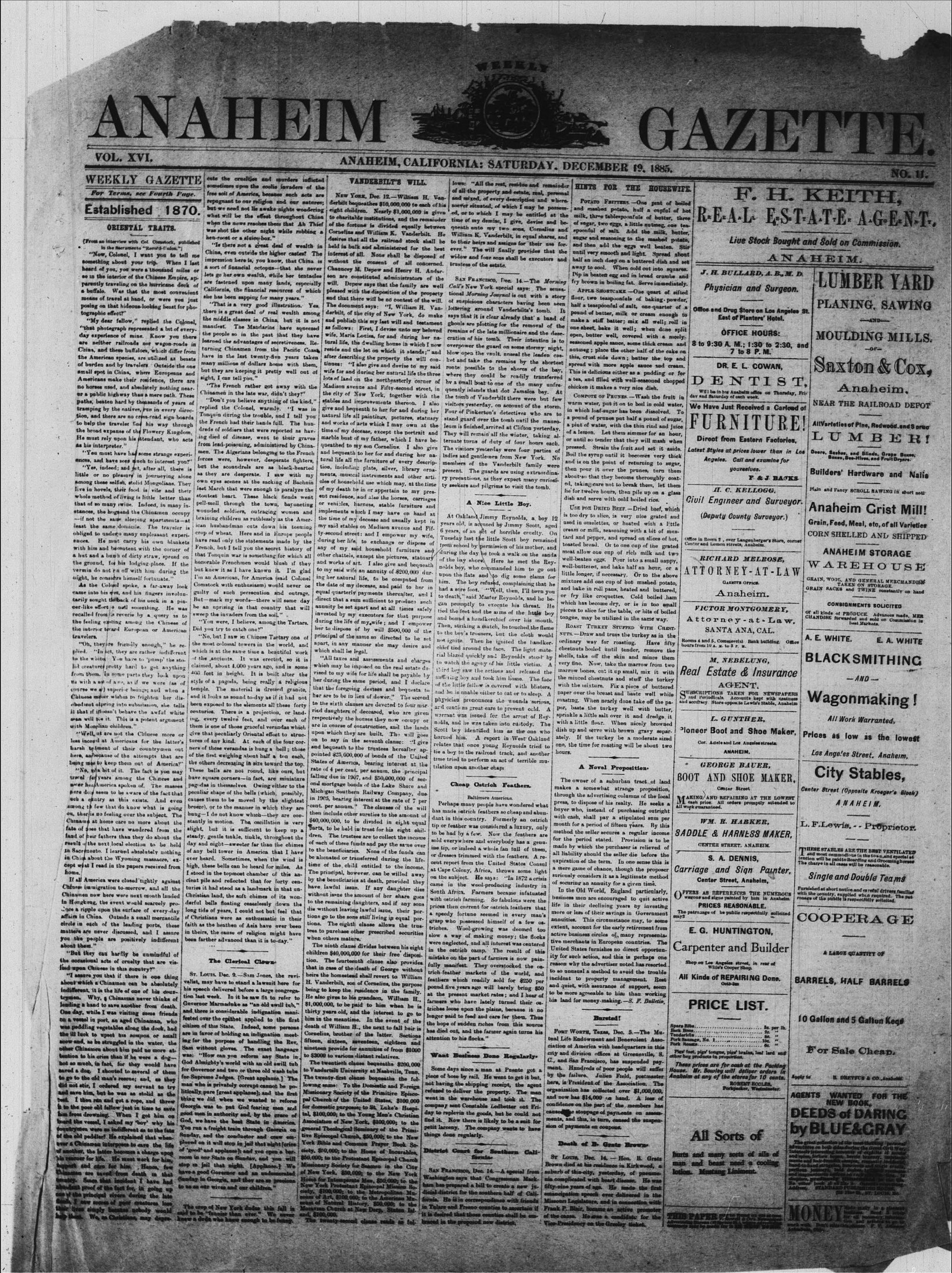
Searchable text
ANAHEIM
VOL. XVI.
WEEKLY GAZETTE
For Terms, see Fourth Page.
Established 1870.
ORIENTAL TRAITS.
[From an interview with Col. Comstock, published in the Sacramento "Record-Union."]
"Now, Colonel, I want you to tell me something about your trip. When I last heard of you, you were a thousand miles or so in the interior of the Chinese Empire, apparently traveling on the hurricane deck of a buffalo. Was that the most convenient means of travel at hand, or were you just posing on that hideous-looking beast for photographic effect?"
"My dear fellow," replied the Colonel, "that photograph represented a bit of everyday experience of mine. Know you there are neither railroads nor wagon-roads in China, and these buffaloes, which differ from the American species, are utilized as beasts of burden and by travelers. Outside the one small spot in China, where Europeans and Americans make their residence, there are no horses used, and absolutely nothing nearer a public highway than a mere path. These paths, beaten hard by thousands of years of tramping by the natives, run in every direction, and there are no cross-road sign-boards to help the traveler find his way through the broad expanse of the Flowery Kingdom. He must rely upon his attendant, who acts as his interpreter."
"You must have had some strange experiences, and have seen much to interest you?"
"Yes, indeed; and yet, after all, there is little or no pleasure in it."
cate the cruelties and murders inflicted sometimes upon the coolie invaders of the free soil of America, because such acts are repugnant to our religion and our nature; but we need not lie awake nights wondering what will be the effect throughout China when the news reaches them that Ah Thief was shot the other night while robbing a hen-roost or a sluice-box."
"Is there not a great deal of wealth in China, even outside the higher castes? The impression here is, you know, that China is a sort of financial octopus—that she never lets go her own wealth, while her tentacles are fastened upon many lands, especially California, the financial resources of which she has been sapping for many years."
"That is a very good illustration. Yes, there is a great deal of real wealth among the middle classes in China, but it is not manifest. The Mandarins have squeezed the people so in the past that they have learned the advantages of secretiveness. Returning Chinamen from the Pacific Coast have in the last twenty-five years taken many millions of dollars home with them, but they are keeping it pretty well out of sight, I can tell you."
"The French rather got away with the Chinamen in the late war, didn't they?"
"Don't you believe anything of the kind," replied the Colonel, warmly. "I was in Tonquin during the trouble, and I tell you the French had their hands full. The hundreds of soldiers that were reported as having died of disease, went to their graves from lead-poisoning, administered by Chinamen. The Algerians belonging to the French forces were, however, desperate fighters, but the scoundrels are as black-hearted as they are desperate." I saw with my New York derbilt how eight children to charitably held in bus interest of without Chauncey son are co-will. Depressed pleased with and that the document derbilt, of the and publish as follows: wife. Maria natural life, th reside and t after describe tines: "I wife for and lots of land Madison ave the city of stables and give and bequeat natural life a and works of time of my de marble bust o queathed to and bequeath tural life all t ion, including music."
Americans make their residence, there are no horses used, and absolutely nothing nearer a public highway than a mere path. These paths, beaten hard by thousands of years of tramping by the natives, run in every direction, and there are no cross-road sign-boards to help the traveler find his way through the broad expanse of the Plowery Kingdom. He must rely upon his attendant, who acts as his interpreter.
"You must have had some strange experiences, and have seen much to interest you?"
"Yes, indeed; and yet, after all, there is little or no pleasure in journeying alone among these selfish, stolid Mongolians. They live in hovels, their food is vile and their whole method of living is little better than that of so many swine. Indeed, in many instances, the hogs and the Chinamen occupy—if not the same sleeping apartments—at least the same domicile. The traveler is obliged to undergo many unpleasant experiences. He must carry his own blankets with him and be content with the corner of a hat and a bunch of dirty straw, spread on the ground, for his lodging place. If the vermin do not run off with him during the night, he considers himself fortunate."
As the Colonel spoke, a far-away look came into his eyes, and his fingers involuntarily sought the back of his neck in a pincer-like effort to pull something. He was recalled from its reverie by a query as to the feeling existing among the Chinese of the interior toward European or American travelers.
"Oh, they are friendly enough," he replied. "In fact, they are rather indifferent to the white. You have to 'pump' the stoil creatures pretty hard to get anything from them. In some parts they look upon us with a set of axe, as if we were (as of course we are) superior beings; and when a Chinese merger wishes to frighten her disobedient olpring into submission, she tells it that if doesn't behave the awful white sea will see it. This is a potent argument with Mongolian children."
"Well, it are not the Chinese more or less incarned at Americans for the latter's harsh treatment of their countrymen out here, and because of the attempts that are being made to keep them out of America?"
"No, it is bit of it. The fact is you may travel for years among the Chinese and never hear America spoken of. The masses here do seem to be aware of the fact that such a country as this exists. And even among those that do know what is going on, there is no feeling over the subject. The Chiname at home care no more about the fate of those that have wandered from the land of their fathers than they do about the result of the next local election to be held in Sacramento. I learned absolutely nothing in China about the Wyoming massacre, except what I read in the papers received from home.
If all America were closed tightly against Chinese immigration to morrow, and all the Chinamen now here were next month landed sight, I can tell you."
"The French rather got away with the Chinamen in the late war, didn't they?"
"Don't you believe anything of the kind," replied the Colonel, warmly. "I was in Tonquin during the trouble, and I tell you the French had their hands full. The hundreds of soldiers that were reported as having died of disease, went to their graves from lead-poisoning, administered by Chinamen. The Algerians belonging to the French forces were, however, desperate fighters, but the scoundrels are as black-hearted as they are desperate. I saw with my own eyes scenes at the sacking of Bachnin last March that were enough to paralyze the stoutest heart. These black fiends went pill-mell through the town, bayoneting wounded soldiers, outraging women and braining children as ruthlessly as the American husbandman cuts down his teening crop of wheat. Here and in Europe people have read only the statements made by the French, but I tell you the secret history of that Tonquin war is something for which all honorable Frenchmen would blush if they but knew it as I have known it. I'm glad I'm an American, for America (said Colonel Comstock with enthusiasm) would never be guilty of such persecution and outrage. But—mark my words—there will some day be an uprising in that country that will sweep the invaders from the soil."
"You were, I believe, among the Tartars. Did you try to catch one?"
"No, but I saw in Chinese Tartary one of the most colossal towers in the world, and which is at the same time a beautiful work of the ancients. It was erected, so it is claimed, about 4,000 years ago, and is some 400 feet in height. It is built after the style of a pagoda, being really a religious temple. The material is dressed granite, and it looks as sound to-day as if it had not been exposed to the elements all these forty centuries. There is a projection, or landing, every twelve feet, and over each of them is one of those graceful verandas which give that peculiarly Oriental effect to structures of any kind. At each of the four corners of these verandas is hung a bell; those of the first weighing about half a ton each, the others decreasing in size toward the top. These bells are not round, like ours, but have square corners—in fact, are miniature pagodas in themselves. Owing either to the peculiar shape of the bells (which possibly causes them to be moved by the slightest breeze), or to the manner in which they are hung—I do not know which—they are constantly in motion. The oscillation is very slight, but it is sufficient to keep up a steady, gentle tinkle, tinkle throughout the day and night—sweeter far than the chimes of any bell tower in America that I have ever heard. Sometimes, when the wind is high, these bells can be heard for miles. As I stood in the topmost chamber of this ancient pile and reflected that for forty centuries it had stood as a landmark in that Christian land, the soft chimes of its won-tightness."
If all America were closed tightly against Chinese immigration to morrow, and all the Chinamen now here were next month landed in Hongkou, the event would scarcely produce a ripple upon the surface of every-day affairs in China. Outside a small mercantile circle in each of the leading ports, these matters are never discussed, and I assure you the people are positively indifferent about them."
"But they can hardly be unmindful of the occasional acts of cruelty that are visited upon Chinese in this country?"
"I assure you that if there is one thing about which a Chinamen can be absolutely indifferent, it is the life of one of his countrymen. Why, a Chinaman never thinks of lending a hand to save another from death. One day, while I was visiting some friends on a vessel in port, an aged Chinaman, who was peddling vegetables along the dock, had the ill luck to upset his sonpon or small snow and, as he struggled in the water, the other Chinamen about him paid no more attention to his cries than if he were a dog—not so much, in fact, for they would have saved a dog. I shouted to several of them to go to the old man's rescue; and, as they did not stir, I ordered my servant to try and save him, but he was as stolid as the reed. I then ran and got a rope, and throw it to the poor old fellow just in time to save him from drowning. When I got him on board the vessel, I asked my 'boy' why his countrymen were so indifferent as to the fate of the old paddler? He explained that when ever a Chinaman interposes to save the life of another, the latter becomes a charge upon his rescuer for life. He must work for him, support and care for him. Hence, few Chinamen are saved from death in that county.
Since that incident I have had abundant proof of the fact for, in going up one of the principal rivers during the late floods, I saw scores of poor creatures lose their lives simply because nobody would help them. We, an Christians, may depend on a country as this exists. And even among those few that do know what is going on, there is no feeling over the subject. The Chiname at home care no more about the fate of those that have wandered from the land of their fathers than they do about the result of the next local election to be held in Sacramento. I learned absolutely nothing in China about the Wyoming massacre, except what I read in the papers received from home.
If all America were closed tightly against Chinese immigration to morrow, and all the Chinamen now here were next month landed in Hongkou, the event would scarcely produce a ripple upon the surface of every-day affairs in China. Outside a small mercantile circle in each of the leading ports, these matters are never discussed, and I assure you the people are positively indifferent about them."
"The Clerical Clown"
St. Louis, Dec. 9. — Sam Jones, the revivalist, may have to stand a lawsuit here for his speech delivered before a large congregation last week. In it he saw fit to refer to Governor Marmaduke as "an old swill tub," and there is considerable indignation manifested over the epithet applied to the first citizen of this State. Indeed, some persons are in favor of holding an indignation meeting for the purpose of handling the Rev. Sam without gloves. The exact language was: "How can you reform any State in God Almighty's world with an old swill tub for Governor and two or three old swill tubs for Supreme Judges. [Great applause.] The man who is privately corrupt cannot be politically pure [great applause]; and the first thing we did when we wanted to reform Georgia was to put God fearing men and good men in authority and, by the grace of God, we have the best State in America. You run a freight train through Georgia on Sunday, and the conductor and crew employed on it will stop in jail that night [series of 'good' and applause]; and you open a bar room in our State on Sunday, and you will stop in jail that night. [Applause.] We have a good Governor and an undeserved Sunday in Georgia, and they are so precious to us as our wives and our children."
The crop of New York dudes this fall is said to be "funnier than ever." We never knew a dude who knew enough to be funny.
ANAHEIM, CALIFORNIA: SATURDAY, DECEMBER 19, 1885.
SURDERS INFlicted Invaders of the
Mis such acts are
and our natives;
nights wondering
throughout China
that Ah Thief
while robbing a
cal of wealth in
her castes? The
war, that China is
that she never
her tentacles
lands, especially
resources of which
they have retiveness. RePacific Coast,
years taken
me with them,
my well out of
away with the
can't they?"
g of the kind."
"I was in
and I tell you
the hunsorted as havtheir graves
red by Chinato the French
rate fighters,
black-hearted
with my
VANDERBILT'S WILL.
New York, Dec. 12.—William H. Vanderbilt bequeathes $10,000,000 to each of his eight children. Nearly $1,000,000 is given to charitable institutions, and the remainder of the fortune is divided equally between Cornelius and William K. Vanderbilt. He desires that all the railroad stock shall be held in bulk and administered for the best interest of all. None shall be disposed of without the consent of all concerned. Chauncey M. Depew and Henry H. Anderson are constituted administrators of the will. Depew says that the family are well pleased with the disposition of the property and that there will be no contest of the will. The document says: "I, William H. Vanderbilt, of the city of New York, do make and publish this my last will and testament as follows: First, I devise unto my beloved wife, Maria Louisa, for and during her natural life, the dwelling house in which I now reside and the lot on which it stands;" and after describing the property the will continues: "I also give and devise to my said wife for and during her natural life the three lots of land on the northeasterly corner of Madison avenue and Fifty-second street, in the city of New York, together with the stables and improvements thereon. I also give and bequeath to her for and during her natural life all paintings, pictures, statuary and works of arts which I may own at the time of my decease, except the portrait and marble bust of my father, which I have bequeathed to my son Cornelius. I also give and bequeath to her for and during her natural life all the furniture of every description, including plate, silver, library ornaments, musical instruments."
All the rest, residue and remainder of all the property and estate, real, personal and mixed, of every description and whereever situated, of which I may be possessed, or to which I may be entitled at the time of my demise, I give, devise and bequeath unto my two sons, Cornelius and William K. Vanderbilt, in equal shares, and to their heirs and assigns for their use forever." The will finally provides that the widow and four sons shall be executors and trustees of the estate.
SAN FRANCISCO, Dec. 14.—The Morning Call's New York special says: The sensational Morning Journal is out with a story of suspicious characters having been seen loitering around Vanderbilts' tomb. It says that it is clear already that a band of ghouls are plotting for the removal of the remains of the late millionaire and the desecration of his tomb. Their intention is to overpower the guard on some stormy night, blow open the vault, unseal the leaden basket and take the remains by the shortest route possible to the shores of the bay, where they could be readily transferred by a small boat to one of the many unfrequently islands that dot Jamaica bay. At the tomb of Vanderbilt there were but few visitors yesterday, on account of the storm. Four of Pinkerton's detectives who are to stand guard over the tomb until the mansoleum is finished, arrived at Clifton yerterday. They will remain all the winter, taking alternate turns of duty of four hours each. The visitors yesterday were four parties of ladies and gentlemen from New York. No members of the Vanderbilt family were present. The guards are using extraordinaire.
HINTS FOR THE HOUSE:
Potato Fritters.—One pint of flour, two teaspoonfuls of baking powder half a teaspoonful of salt, one-quarter pound of butter, milk or cream enough make a stiff batter; mix all well; roll one sheet, bake it well; when done open, butter well, covered with a new seasoned apple sauce, some thick creamy nutmeg; place the other half of the call this, crust side down; butter the top spread with more apple sauce and crumbs. This is delicious either as a pudding or a tea, and filled with well-seasoned chicken it makes a very nice dish.
Compote OF PRUNES.—Wash the fruit warm water, put it on to boil in cold water in which loaf-sugar has been dissolved. A pound of prunes put half a pound of sugar a pint of water, with the thin rind and juice of a lemon. Let them simmer for an hour or until so tender that they will mash well pressed. Strain the fruit and set it aside. Boil the syrup until it becomes very thick and is on the point of returning to soup then pour it over the prunes, turn them over.
ANAHEIM, CALIFORNIA: SATURDAY, DECEMBER 19, 1885.
A Nice Little Boy.
At Oakland Jimmy Reynolds, a boy 12 years old, is accused by Jummy Scott, aged 6 years, of an act of horrible cruelty. On Tuesday last the little Scott boy remained from school by permission of his mother, and during the day he took a walk on the sands of the bay shore. Here he met the Reynolds boy, who commanded him to go out upon the flats and to dig some clams for him. The boy refused, complaining that he had a sore foot. "Well, then, I'll burn you to death," said Master Reynolds, and he began promptly to execute his threat. He tied the feet and the arms of the little boy and bound a handkerchief over his mouth. Then, striking a match, he touched the flame to the boy's trousers, but the cloth would not ignite. Then he ignited the handkerchief tied around the face. The light material blazed quickly and Reynolds stood to watch the agony of his little victim. A third boy saw the actions and released the suffering boy and took him home. The face of the little fellow is covered with blisters, and he is unable either to cat or to sleep. A physician pronounces the wounds serious, and cautions great care to prevent cold. A warrant was issued for the arrest of Reynolds, and he was taken into custody. The Scott boy identified him as the one who burned him. A report in West Oakland relates that once young Reynolds tried to tie a boy to the railroad track, and another time tried to perform an act of terrible mutilation upon another chap:
Cheap Ostrich Feathers.
Baltimore American.
Perhaps many people have wondered what has made ostrich feathers so cheap and abundant in this country. Formerly an ostrich tip or feather was considered a luxury, only to be had by a few. Now the feathers are sold everywhere and everybody has a genuine tip, or indeed a whole fan full of them, or dresses trimmed with the feathers. A recent report from the United States Consul at Cape Colony, Africa, throws some light on the subject. He says: "In 1872 a crisis came in the wool-producing industry in South Africa. Farmers became infatuated with ostrich farming." So far, no evidence suggests that such an event occurred in the past.
A Novel Proposition.
The owner of a suburban tract of land makes a somewhat strange proposition, through the advertising columns of the local press, to dispose of his realty. He seeks a buyer who, instead of purchasing outright with cash, shall pay a stipulated sum per month for a period of fifteen years. By this method the seller secures a regular income for the period stated. Provision is to be made by which the purchaser is relieved of all liability should the seller die before the expiration of the term. In one sense this is a mere game of chance, though the proposer seriously considers it as a legitimate method of securing an annuity for a given time.
In the Old World, England particularly, business men are encouraged to quit active work with women and as the Americas teeming Europe people made by the history of their own country all rush if they I'm glad said Colonel never be outrage, all some day that will be Tartars.
Tary one of world, and beautiful work so it is some after the religious granite it had not these forty or land each of todas which to strucure four corpell; those ton each, and the top; but miniature to the possibly, slightest they are very deep up a shoutthe chimes that unfit wind is miles. As this anerty cenet that unfit wins.
All taxes and assessments and charges which may be imposed on the real estate devised to my wife for life shall be payable by her during the same period, and I declare that the foregoing devises and bequests to her are to be in lieu of dower." The second to the sixth clauses are devoted to four married daughters of deceased, who are given respectively the houses they now occupy or are in course of construction, and the lands upon which they are built. The will goes on to say in the seventh clause: "I give and bequeath to the trustees hereafter appointed $25,000,000 of bonds of the United States of America, bearing interest at the rate of 4 per cent. per annum, the principal falling due in 1907, and $50,000,000 of second mortgage bonds of the Lake Shore and Michigan Southern Railway Company, due in 1965, bearing interest at the rate of 7 per cent. per annum." The clauses of the will then include other sureties to the amount of $40,000,000, to be divided in eight equal parts, to be held in trust for his eight children. The trustees are to collect the income of such these funds and pay the same over to the beneficiaries. None of the funds can be alienated or transferred during the lifetime of the child entitled to the income. The principal, however, can be willed away by the beneficiaries at death, provided they have lawful issue. If any daughter dies without issue the amount of her share goes where they could be readily transferred by a small boat to one of the many unfrequently islands that dot Jamaica bay. At the tomb of Vanderbilt there were but few visitors yesterday, on account of the storm. Four of Pinkerton's detectives who are to stand guard over the tomb until the mausoleum is finished, arrived at Clifton yerterday. They will remain all the winter, taking alternate turns of duty of four hours each. The visitors yesterday were four parties of ladies and gentlemen from New York. No members of the Vanderbilt family were present. The guards are using extraordinarily precautions, as they expect many curiosity seekers and pilgrims to visit the tomb.
Use FOR DRIED BEER — Dried beef, which is too dry to slice, is very nice grated and used in omelettes, or heated with a lit cream or milk, seasoning with a bit of mustard and pepper, and spread on slices of hot toasted bread. Or to one cup of the meat allow one cup of rich milk and two well-beaten eggs. Pour into a small napkin well-buttered, and bake half an hour, or little longer, if necessary. Or to the above mixture add one cup of hot mashed potato and bake in roll pans, heated and buttered or fry like croquettes. Cold boiled ham which has become dry, or is in too small pieces to slice for the table, or bits of boiled tongue, may be utilized in the same way.
ROAST TURKEY STUFFED WITH CHESTNUTS — Draw and truss the turkey as in the ordinary way for roasting. Have fifty chestnuts boiled until tender, remove the shells, take off the skin and mince them very fine. Now, take the marrow from two marrow bones, cut it up small, mix it with the minced chestnuts and stuff the turkey with the mixture. Fix a piece of buttered paper over the breast and baste well while roasting. When nearly done take off the paper, baste the turkey well with butter, sprinkle a little salt over it and dredge it with a little flour. When nicely browned dish up and serve with brown gravy separately. If the turkey be a moderate sized one, the time for roasting will be about two hours.
A Novel Proposition·
The owner of a suburban tract of land makes a somewhat strange proposition through the advertising columns of the local press, to dispose of his realty. He seeks a buyer who, instead of purchasing outright with cash, shall pay a stipulated sum per month for a period of fifteen years. By this method the seller secures a regular income for the period stated. Provision is to be made by which the purchaser is relieved of all liability should the seller die before the expiration of the term. In one sense this is a mere game of chance, though the proposer seriously considers it as a legitimate method of securing an annuity for a given time.
In the Old World, England particularly, business men are encouraged to quit active
In 1905, bearing interest at the rate of 7 per cent. per annum." The clauses of the will then include other sureties to the amount of $40,000,000, to be divided in eight equal parts, to be held in trust for his eight children. The trustees are to collect the income of each of these funds and pay the same over to the beneficiaries. None of the funds can be alienated or transferred during the lifetime of the child entitled to the income. The principal, however, can be willed away by the beneficiaries at death, provided they have lawful issue. If any daughter dies without issue the amount of her share goes to the remaining daughters, and if any sons die without leaving lawful issue, their portions go to the sons still living in equal portions. The eighth clause allows the trustees to purchase other prescribed securities when others mature.
The ninth clause divides between his eight children $40,000,000 for their free disposition. The fourteenth clause also provides that in case of the death of George without heirs the homestead shall revert to William H. Vanderbilt, son of Cornelina, the purpose being to keep the residence in the family. He also gives to his grandson, William H., $1,000,000, to be paid to him when he is thirty years old, and the interest to go to him in the meantime. In the event of the death of William H., the next to fall heir is Cornelius, brother of the latter. Sections fifteen, sixteen, seventeen and nineteen provide for annuities of from $1000 to $3000 to various distant relatives.
The twentieth clause bequeaths $200,000 to Vanderbilt University at Nashville, Tenn. The twenty-first clause bequeaths the following sums: To the Domestic and Foreign Missionary Society of the Primitive Episcopal Church of the United States, $100,000 for domestic purposes; to St. Luke's Hospital, $100,000; to the Young Men's Christian Association of New York, $100,000; to the general Theological Seminary of the Primitive Episcopal Church, $50,000; to the New York Bible and Common Prayer Book Society, $80,000; to the Home of Incurables, $60,000; to the Protestant Episcopal Church Missionary Society for Sanmen in the City of New York, $50,000; to the New York Home for Intemperate Men, $50,000; to the New York Protestant Episcopal Mission Society, $100,000; to the Metropolitan Museum of Art, $100,000; to the American Museum of Natural History, $50,000; to the Moravian Church at New Dorp, Staten Island, $100,000.
The twenty-second clause reads as follows:
Perhaps many people have wondered what has made ostrich feathers so cheap and abundant in this country. Formerly an ostrich tip or feather was considered a luxury, only to be had by a few. Now the feathers are sold everywhere and everybody has a genuine tip, or indeed a whole fan full of them, or dresses trimmed with the feathers. A recent report from the United States Consul at Cape Colony, Africa, throws some light on the subject. He says: "In 1872 a crisis came in the wool-producing industry in South Africa. Farmers became infatuated with ostrich farming. So fabulous were the prices then current for ostrich feathers that a speedy fortune seemed in every man's grasp who possessed himself of a few ostriches. Wool-growing was deemed too slow a way of making money; the flocks were neglected, and all interest was centered in the ostrich camp. The result of this mistake on the part of farmers is now painfully manifest. They overstocked the ostrich-feather markets of the world, and feathers which readily sold for $250 per pound five years ago will barely bring $50 at the present market rates; and I hear of farmers who have lately turned their ostriches loose upon the plains, because it no longer paid to feed and care for them. Thus the hope of sudden riches from this source has died out, and the farmer again turns his attention to his flocks."
Want Business Done Regularly
Some days since a man at Puente got a piece of hose by rail. He went to get it but not having the shipping receipt, the agent refused to deliver the property. The man went in the warehouse and took it. The company sent Constable Ledbetter out Friday to replevin the goods, but he could not find it. Now there is likely to be a suit for petit larceny. The company wants to have things done regularly.
District Court for Southern California.
San Francisco, Dec. 14.—A special from Washington says that Congressman Markham has prepared a bill to create a new judicial district for the southern half of California. He is in correspondence with friends in Tulare and Fresno counties to ascertain if it is desired that those counties shall be embraced in the proposed new district.
Press, to dispose of his realty. He seeks a buyer who, instead of purchasing outright with cash, shall pay a stipulated sum per month for a period of fifteen years. By this method the seller secures a regular income for the period stated. Provision is to be made by which the purchaser is relieved of all liability should the seller die before the expiration of the term. In one sense this is a mere game of chance, though the proposer seriously considers it as a legitimate method of securing an annuity for a given time.
In the Old World, England particularly, business men are encouraged to quit active life in their declining years by investing more or less of their savings in Government annuities. This circumstance may, to some extent, account for the early retirement from active business circles of many representative merchants in European countries. The United States furnishes no direct opportunity for such action, and this is perhaps one reason why the advertiser noted has resorted to so unusual a method to avoid the trouble incident to property management. Rest and quiet, with assurance of support, seem to be more agreeable to him than working his land for money-making.—S. F. Bulletin,
Bursted!
Fort Worth, Texas, Dec. 5.—The Mutual Life Endowment and Benevolent Association of America with headquarters in this city and division offices in Greeneville, S.C., and San Francisco, has suspended payment. Hundreds of poor people will suffer by the failure. Julien Field, postmaster here, is President of the Association. The organization has collected over $1,000,000, and now has $14,400 on hand. A loss of confidence on the part of the members has caused the stoppage of payments on assessments, and thus, in turn, caused the suspension of payments on coupons.
Death of B. Gratz Brown
Sr Louis, Dec. 14.—Hon. B. Gratz Brown died at his residence in Kirkwood, a suburb of this city yesterday, of pneumonia complicated with heart disease. He was fifty-nine years of age. He made the first emancipation speech ever delivered in the Missouri Legislature, and in connection with Frank P. Blair, became an active promoter of the cause. He was a candidate for the Vice-President on the Granby ticket.
GAZETTE.
MBER 19, 1885.
NO. 11.
FOR THE HOUSEWIFE.
To Frippers.—One pint of boiled potato, half a cupful of hot three tablespoonfuls of butter, three two eggs, a little nutmeg, one tea-of salt. Add the milk, butter, and seasoning to the mashed potato, add the eggs well beaten. Stir smooth and light. Spread about each deep on a buttered dish and set cool. When cold cut into squares, let egg and in bread crumbs and boil in boiling fat. Serve immediately.
SHORTCAKE—One quart of sifted teaspoonfuls of baking-powder, spoonful of salt, one-quarter of a butter, milk or cream enough to stiff batter; mix all well; roll in bake it well; when done split over well, covered with a nicely apple sauce, some thick cream and place the other half of the cake on side down; butter the top and then more apple sauce and cream.icious either as a pudding or for filled with well-seasoned chopped makes a very nice dish.
OF PRUNES.—Wash the fruit in water, put it on to boil in cold water, salt-sugar has been dissolved. To prunes put half a pound of sugar, water, with the thin rind and juice Let them simmer for an hour, tender that they will mash when train the fruit and set it aside. Up until it becomes very thick the point of returning to sugar, it over the prunes, turn them
F. H. KEITH,
REAL ESTATE AGENT.
Live Stock Bought and Sold on Commission.
ANAHEIM.
J. H. BULLARD, A.B., M.D.
Physician and Surgeon.
Office and Drug Store on Los Angeles St.
East of Planters' Hotel.
OFFICE HOURS:
8 to 9:30 A.M.; 1:30 to 2:30, and 7 to 8 P.M.
DR. E. L. COWAN,
DENTIST.
Will be in his Anaheim office on Thursday, Friday and Saturday of each week.
We Have Just Received a Carload of FURNITURE!
Direct from Eastern Factories,
Latest Styles at prices lower than in Los Angeles. Call and examine for yourselves.
LUMBER YARD
PLANING, SAWING
AND
MOULDING MILLS.
Of
Saxton & Cox,
Anaheim.
NEAR THE RAILROAD DEPOT
All Varieties of Pine, Redwood,and Spruce
LUMBER!
Doors, Sashes, and Blinds, Grape Boxes;
Boxes,Bee-Hives,and Fruit Dryers:
Builders' Hardware and Nails
DENTIST,
Will be in his Anaheim office on Thursday, Friday and Saturday of each week.
We Have Just Received a Carload of FURNITURE!
Direct from Eastern Factories.
Latest Styles at prices lower than in Los Angeles. Call and examine for youreelues.
F. & J. BACKS
H. C. KELLOGG.
Civil Engineer and Surveyor.
(Deputy County Surveyor.)
Office in Room 2, over Langenberger's Store, corner Center and Lemon streets, Anaheim.
RICHARD MELROSE,
ATTORNEY-AT-LAW
GAENITE OFFICE.
Anaheim.
VICTOR MONTGOMERY,
Attorney-at-Law,
SANTA ANA, CAL.
Rooms 4 and 5, Commercial Bank building. Office hours from 10 A.M. to 3 P.M.
M. NEBELUNG,
Real Estate & Insurance AGENT.
SUBSCRIPTIONS TAKEN FOR NEWSPAPERS and Periodicals. Accounts kept with neatness and accuracy. Store opposite Lewis's Stable, Anaheim.
L. GUNTHER,
Pioneer Boot and Shoe Maker,
Cor. Adele and Los Angeles streets.
ANAHEIM.
GEORGE BAUER,
BOOT AND SHOE MAKER,
Center Street
MAKING AND REPAIRING AT THE LOWEST cash price. All orders promptly attended to all work guaranteed.
WM. E. HARKER,
SADDLE & HARNESS MAKER,
CENTER STREET, ANAHEIM.
S. A. DENNIS,
Carriage and Sign Painter,
Center Street, Anaheim,
OFFERS AS REFERENCES THE NUMEROUS wagons and signs painted by him in Anaheim.
Anaheim.
NEAR THE RAILROAD DEPOT
All Varieties of Pine, Redwood, and Sorso LUMBER!
Doors, Sashes, and Blinds, Grape Boxes, Boxes, Bee-Hives, and Fruit Dryers.
Builders' Hardware and Nailie
Plain and Fancy SCROLL SAWING in short notch
Anaheim Crist Mill!
Grain, Feed, Meal, etc., of all Varieties CORN SHELLED AND SHIPPED
ANAHEIM STORAGE
GRAIN, WOOL, AND GENERAL MERCHANDISE TAKEN ON STORAGE.
GRAIN SACKS and TWINE constantly on hand
CONSIGNMENTS SOLICITED
Of all kinds of PRODUCE. Advances made, MER CHANDISE forwarded and sold on Commission in heat Markets.
A. E. WHITE.
E. A. WHITE
BLACKSMITHING
AND
Wagonmaking!
All Work Warranted.
Prices as low as the lowest Los Angeles Street, Anaheim.
City Stables,
Center Street (Opposite Kroeger's Block)
ANAHEIM.
L.F.Lewis, - Proprietor.
THESE STABLES ARE THE BEST VENTILATED and most commodious in the town, and special at session will be paid to Boarding and Grooming horses The charge in all cases will be reasonable.
Single and Double Teams
Furnished at short notice, and as reful drivers familiar with the country, supplied when required. The patrolage of the public is required for this purpose.
WM. R. HARKER,
SADDLE & HARNESS MAKER,
CENTER STREET, ANAHEIM.
S. A. DENNIS,
Carriage and Sign Painter,
Center Street, Anaheim,
OFFERS AS REFERENCES THE NUMEROUS wagons and signs painted by him in Anaheim.
PRICES REASONABLE.
The patronage of be public respectfully solicited may?
E. G. HUNTINGTON,
Carpenter and Builder
Shop on Los Angeles street, in rear of White's Cooper Shop.
All Kinds of REPAIRING Done.
Oct 3-5m
PRICE LIST.
Spare Ribs.....8c. per lb.
Back Bone.....2c. ""
Tenderloin.....8c. ""
Pork Sausage, No. 1.....10c. ""
Pork Roasts.....6c. ""
Plant feet, pigs' tongue, pigs' brains, leaf lard and other hog products in proportion.
These prices are for cash at the Packing House. Mr. Bowley will deliver orders in Anaheim at any of the stores for 10 cents.
ROBERT ECCLES,
Forkpacker, Westminster.
All Sorts of hurts and many sorts of ails of man and beast need a cooling lotion. Mustang Liniment.
THIS PAPER may be found on one or more Advertising Bureaus (10 Sermon St., where advertisements may be made for it).
ANAHEIM.
L. F. Lewis... Proprietor.
THESE STABLES ARE THE BEST VENTILATED and most commodious in the town, and special attention will be paid to Boarding and Grooming horses. The charge in all cases will be reasonable.
Single and Double Teams
Furnished at short notice, and careful drivers familiar with the country, supplied when required. The patronage of the public is respectfully solicited.
COOPERAGE
A LARGE QUANTITY OF
BARRELS, HALF BARRELS
10 Gallon and 5 Gallon Keqs
For Sale Cheap.
Apply to:
B. DREYFUS & CO., Anaheim.
AGENTS WANTED FOR THE NEW BOOK,
DEEDS OF DARING
by BLUE&GRAY
The great collection of the most thrilling personal adventures on both sides during the Great Civil War. Intensely interesting accounts of exploits of sewers and spies, fortune houses, horse brewery, treasure mansions and half-breed cattle, romantic buildings, hand to hand groceries, horse rides and triple breeds, portraits journals; hold dugouts, railroad trains and shipments and impressions articles on cattle, 10 chapters, predominantly on the life of the No other book at all this R. Osborne Publishing House.
STANDARD PUBLISHING MOUSE.
231 Pine St., St. Louis, Mo.
MONEY Made easily in a pleasant manner. Read 5 books for all necessary information and articles to go to work with. Don't take this chance. F. T. Johnson Aristabella, Ohio.