anaheim-gazette 1885-12-12
Scanned page
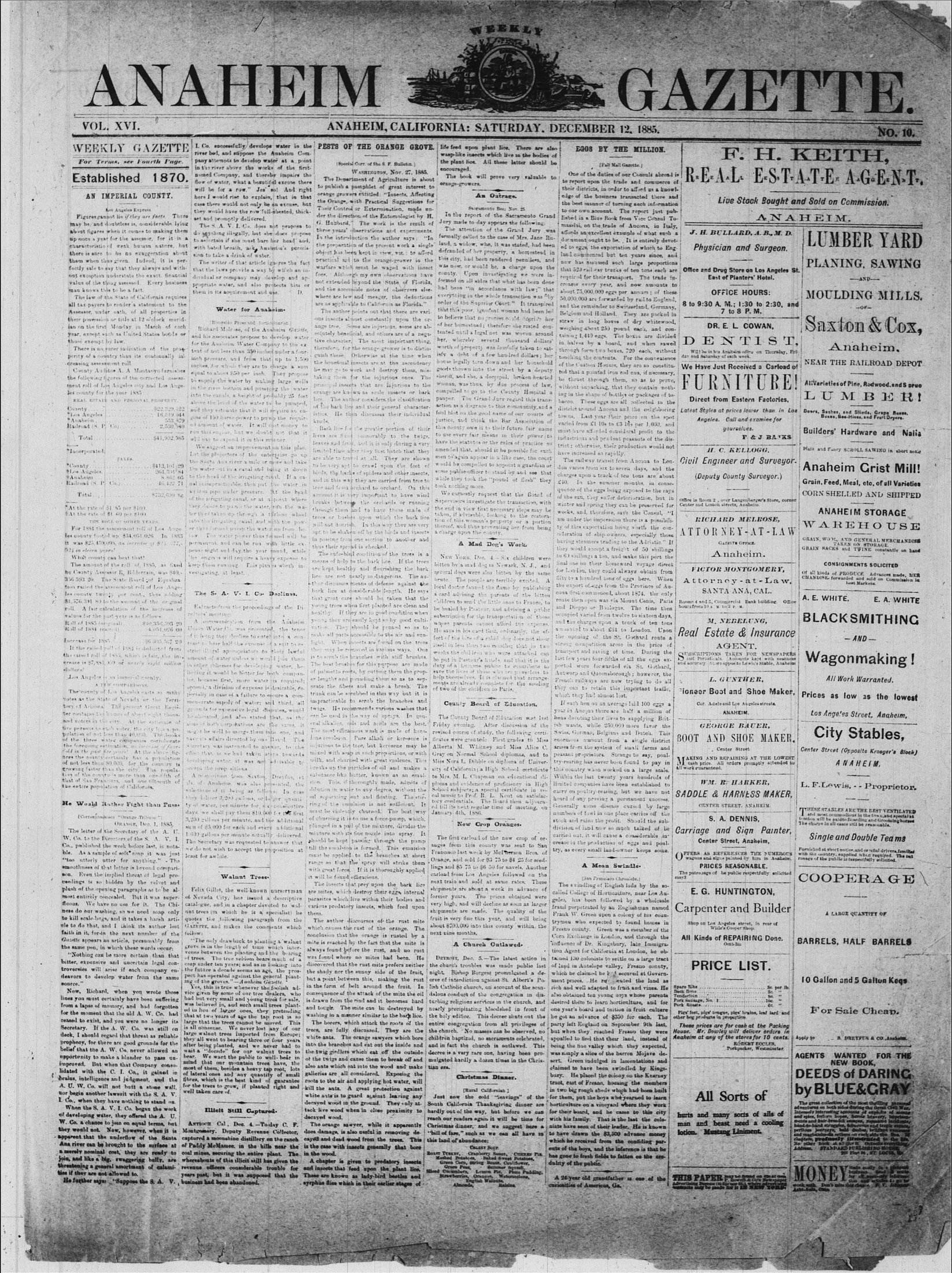
Searchable text
WEEKLY GAZETTE
For Terms, see Fourth Page.
Established 1870.
AN IMPERIAL COUNTY.
Los Angeles Express
Figures cannot lie if they are facts. There may be, and doubtless is, considerable lying about figures when it comes to making them up once a year for the assessor; for it is a characteristic of weak human nature, but there is sure to be no exaggeration about them when thus given. Indeed, it is perfectly safe to say that they always and without exception understate the exact financial value of the thing assessed. Every business man knows this to be a fact.
The law of the State of California requires all taxpayers to render a statement to the Assessor, under oath, of all properties in their possession or title at 12 o'clock meridian on the first Monday in March of each year, except such as United States bonds or those exempt by law.
There is no surer indication of the property of a country than its continually increasing assessment roll.
County Auditor A. A. Montanyo furnishes the following figures of the corrected assessment roll of Los Angeles city and Los Angeles county for the year 1885:
REAL ESTATE AND PERSONAL PROPERTY:
County: $22,329,422
* Los Angeles: 16,519,044
* Anaheim: 553,879
Railroad (S. P. Co): 2,539,940
Total: $41,932,985
Incorporated:
TAXES:
* County: $413,101,29
* Los Angeles: 264,301,84
I. Co. successfully develops water in the river bed, and suppose the Anaheim Company attempts to develop water at a point in the river above the works of the first-named Company, and thereby impairs the flow of water, what a beautiful excuse there will be for a row." Jes' sol And right here I would rise to explain, that in that case there would not only be an excuse, but they would have the row full-sheeted, thick-set and promptly delivered.
The S. A. V. I. Co. does not propose to do anything illegally, but she does propose to ascertain if she must bare her head and, with hated breath, ask Anaheim's permission to take a drink of water.
The writer of that article ignores the fact that the laws provide a way by which an individual or company may develop and appropriate water, and also protects him or them in its acquirement and use.
Water for Anaheim:
Riverside Press and Fortune Trust:
Richard Molrose, of the Anaheim Gazette, and his associates propose to develop water for the Anaheim Water Company to the extent of not less than 350 inches under a four-inch pressure, and from that up to 1,500 inches, for which they are to charge a sum equal to about 850 per inch. They propose to supply the water by sinking large wells in the river bottom and pumping the water into the canals, a height of probably 25 feet above the level of the water to be pumped, and they estimate that it will require an engine of 190 horsepower to pump the required amount of water. It will cost money to run this engine, but we doubt not that it will pay to expend it in this manner.
We suggest an improvement on this plan. Let the projectors of the enterprise go up the Santa Ana river a mile or more and take the water out in a canal and bring it down.
PESTS OPEN:
The Department to publish a paper orange growers the Orange, with Their Control der the direction G. Hubbard," three years' old. In the introduction the preparation object has been practical art warfare which foes. Although not extended by and the access where are few are as applicable.
The author pious insects along ange tree. Some suitably beneficial character therefore, for guish these. Of the beneficial im he may go to waking them for principal insects orange are known lice. The author of the hark liesistics. He thun knels.
Bark lice lives are fixed leaves and fronds limited time after are able to travel to be very apt birds, the backa
the following figures of the corrected assessment roll of Los Angeles city and Los Angeles county for the year 1885.
REAL ESTATE AND PERSONAL PROPERTY
County ... $22,329,122
*Los Angeles ... 16,519,044
*Anahiem ... 553,879
Railroad (S. P. Co.) ... 2,539,740
Total ... $41,932,985
Incorporated:
TAXES
*County ... $413,101,29
*Los Angeles ... 261,504,84
*Anahiem ... 8,862,05
Railroad (S. P. Co.) ... 46,422,71
Total ... $732,690,86
At the rate of $1.85 per $100.
At the rate of $1.60 per $100.
THE HOLL OF OTHER YEARS.
For 1884 the assessment roll of Los Angeles county footed up $34,051,026. In 1883 it was $25,459,098, an increase of $14,777,034 in eleven years!
What county can beat that?
The amount of the roll of 1885, as fixed by County Assessor R. Bidlerrain, was $40,356,593.20. The State Board of Equalization raised the assessment roll of Los Angeles county twenty per cent., thus adding $1,576,391.80 to the amount of the original roll. A fair calculation of the increase of values for the past year is as follows.
Roll of 1885 (original) ... $40,356,593.20
Roll of 1884 (revised) ... $4,051,026.00
Increase for 1885 ... $6,395,567.20
If the raised roll of 1884 is deducted from the raised roll of 1885, which is fair, the increase is $7,883,099 or nearly eight million dollars!
Los Angeles is an imperial county.
A NEW COMPARISONS.
The county of Los Angeles casts as many votes as the State of Nevada or the Territory of Arizona. The present Great Recorder contains thirteen of about eight thousand and voters in the city. At the estimate of five persons to each voter, the city has a population of not less than 40,025. The books of the three water companies correlate the foregoing estimation; an increase of fourfold in the past five years! At the above figures the county certainly has a population of not less than 89,000; for the country is growing faster than the city. The population of the county is more than one fifth of that of San Francisco; and one fifteenth of the entire population of California.
He Would Rather Fight than Fuse
(Correndences "Orange-Tribune")
ORANGE, Dec. I, 1885,
The letter of the Secretary of the A. U. W. Co. to the Directors of the S. A. V. I. Co., published the week before last, is notable. As a sample of soft soap it was just "too utterly utter for anything." The smoothness of that letter is beyond comparison. Even the implied threat of legal proceedings is so hidden by the velvet and plush of the opening paragraphs as to be almost entirely concealed. But it was super-
He Would Rather Fight than Fuse
(Felix Gillet, the well-known nurseryman of Nevada City, has issued a descriptive equal to about 200 per inch). They propose to supply the water by sinking large wells in the river bottom and pumping the water into the canals; a height of probably 25 feet above the level of the water to be pumped, and they estimate that it will require an engine of 190 horse-power to pump the required amount of water. It will cost money to run this engine, but we doubt not that it will pay to expend it in this manner.
We suggest an improvement on this plan. Let the projectors of the enterprise go up the Santa Ana river a mile or more and take the water out in a canal and bring it down to the head of the irrigating canal. If a canal is impracticable, then put the water in an iron pipe under pressure. At the head of the irrigating canal, or at a point where they desire to pump the water from the water that taken up through a turbine wheel into the irrigating canal, and with the power that formed pump the water up from below. The water power thus formed will be permanent and can be run with little expense night and day the year round, while the engines will require a heavy expense to keep them running. This plan is worth investigating at least.
The S. A. V. I. Co. Declines.
Extracts from the proceedings of the Director's meeting:
A communication from the Adaheim Union Water Unit was presented, the tenor of it being their deadline to enter into a contract to bear half the expense of a suit to restrict illegal appropriators to their lawful amount of water unless we would join them in other schemes for developing water, believing it would be better for both companies because first more water is required; second a division of expense is desirable, especially in case of a failure to secure a commensurate supply of water; and third, all grounds for expensive legal disputes would be abolished; and also stated that, as the aims of both corporations are the same, it might be well to merge them into one, and save its affairs directed by one Board. The Secretary was instructed to answer to the effect that, as we had taken orders towards developing water, it was not advisable to accept the propitions.
A proposition from Saxton, Dreyfus et al., of Anahiem, was also presented; the substance of it being as follows: In case they deliver 3,200 gallons or larger quantity of water, per minute for six consecutive days we shall pay them $10,000 for the first 3,200 gallons per minute; and the additional sum of $5,000 for each and every additional 1,600 gallons per minute actually delivered. The Secretary was requested to answer that we do not wish to accept the proposition at least for awhile.
Walnut Trees.
Felix Gillet, the well-known nurseryman of Nevada City, has issued a descriptive equal to about 200 per inch). They propose to supply the water by sinking large wells in the river bottom and pumping the water into the canals; a height of probably 25 feet above the level of the water to be pumped, and they estimate that it will require an engine of 190 horse-power to pump the required amount of water. It will cost money to run this engine, but we doubt not that it will pay to expand it in this manner.
We suggest an improvement on this plan. Let the projectors of the enterprise go up the Santa Ana river a mile or more and take the water out in a canal and bring it down to the head of the irrigating canal. If a canal is impracticable then put the water in an iron pipe under pressure. At the head of the irrigating canal, or at a point where they desire to pump the water from the water that taken up through a turbine wheel into the irrigating canal and with the power that formed pump the water up from below. The water power thus formed will be permanent and can be run with little expense night and day the year round, while the engines will require a heavy expense to keep them running. This plan is worth investigating at least.
The S. A. V. I. Co. Declines.
Extracts from the proceedings of the Director's meeting:
A communication from the Adaheim Union Water Unit was presented; the tenor of it being their deadline to enter into a contract to bear half the expense of a suit to restrict illegal appropriators to their lawful amount of water unless we would join them in other schemes for developing water; believing it would be better for both companies because first more water is required; second a division of expense is desirable; especially in case of a failure to secure a commensurate supply of water; and third, all grounds for expensive legal disputes would be abolished; and also stated that as the aims of both corporations are the same it might be well to merge them into one; and save its affairs directed by one Board. The Secretary was instructed to answer to the effect that we had taken orders towards developing water; it was not advisable to accept the proposition at least for awhile.
A proposition from Saxton, Dreyfus et al., of Anahiem, was also presented; the substance of it being as follows: In case they deliver 3,200 gallons or larger quantity of water, per minute for six consecutive days we shall pay them $10,000 for the first 3,200 gallons per minute; and the additional sum of $5,000 for each and every additional 1,600 gallons per minute actually delivered. The Secretary was requested to answer that we do not wish to accept the proposition at least for awhile.
Walnut Trees.
Felix Gillet, the well-known nurseryman of Nevada City, has issued a descriptive equal to about 200 per inch). They propose to supply the water by sinking large wells in the river bottom and pumping the water into the canals; a height of probably 25 feet above the level of the water to be pumped, and they estimate that it will require an engine of 190 horse-power to pump the required amount of water. It will cost money to run this engine, but we doubt not that it will pay to expand it in this manner.
We suggest an improvement on this plan. Let the projectors of the enterprise go up the Santa Ana river a mile or more and take the water out in a canal and bring it down to the head of the irrigating canal. If a canal is impracticable then put the water in an iron pipe under pressure. At the head of the irrigating canal, or at a point where they desire to pump the water from the water that taken up through a turbine wheel into the irrigating canal and with the power that formed pump the water up from below. The water power thus formed will be permanent and can be run with little expense night and day the year round, while the engines will require a heavy expense to keep them running. This plan is worth investigating at least.
The S. A. V. I. Co. Declines.
Extracts from this article:
A discussion on principal insects orange are known lice.
The author discusses no bark lice statistics.
He discusses methods used for help on these insects are kept healthy.
He discusses young trees when healthy.
He discusses make all parts so light.
When he may be removed all parts so light.
He discusses brush oil palmetto roots or lengths and parsley breaks up part substances like lime.
This if his dilution in water separates oil ringing of these constituents must be violently churning it is plunged in a pool mixtures with its should be kept until all conditions are met be applied range so that there with great force it will be found effusive.
The insects that are mites which do parasites have no parasites
He Would Rather Fight than Fuse.
Correspondence "Orange Tribune"
ORANGE, Dec. 1, 1885
The letter of the Secretary of the A. U. W. Co. to the Directors of the S. A. V. I. Co., published the week before last, is notable. As a sample of soft soap it was just "too utterly utter for anything." The smoothness of that letter is beyond comparison. Even the implied threat of legal proceedings is so hidden by the velvet and plush of the opening paragraphs as to be almost entirely concealed. But it was superfluous. We have no use for it. The Chinese do our washing, so we need soap only to kill scale-bugs, and it takes a harsh article to do that, and I think its author lost faith in it, for in the next number of the Gazette appears an article, presumably from the same pen, in which these words occur:
"Nothing can be more certain than that bitter, expensive and uncertain legal controversies will arise if each company endeavors to develop water from the same source."
Now, Richard, when you wrote those lines you must certainly have been suffering from a lapse of memory, and had forgotten for the moment that the old A. W. Co. had ceased to exist, and you were no longer its Secretary. If the A. W. Co. was still on deck, I should regard that threat as reliable prophecy, for there are good grounds for the belief that the A. W. Co. never allowed an opportunity to make a blunder to pass unimproved. But when that Company consolidated with the C. I. Co., it gained in brains, intelligence and judgment, and the A. U. W. Co. will not butt a stone wall, nor begin another lawsuit with the S. A. V. I. Co., when they have nothing to stand on.
When the S. A. V. I. Co. began the work of developing water, they offered the A. U. W. Co. a chance to join on equal terms, but they would not. Now, however, when it is apparent that the underflow of the Santa Ana river can be brought to the surface at a merely nominal cost, they are ready to join, and like a big swaggering bully, are threatening a general assortment of calamities if they are not allowed to.
He further says: "Suppose the S. A. V."
Walnut Trees
Felix Gillet, the well-known nurseryman of Nevada City, has issued a descriptive catalogue, and in a chapter devoted to walnut trees (in which he is a specialist) he quotes the following paragraph from the Gazette, and makes the comments which follow:
"The only drawback to planting a walnut grove is in the length of time which intervenes between the planting and the bearing of trees. The tree seldom bears much of a crop under ten years; and as in looking into the future a decade seems an age, the prospect has operated against the general planting of the groves." — Anaheim Gazette.
Yes, this is true whenever the foolish advice given by some of our tree dealers, who had but very small and young trees for sale, was believed in, and such small trees planted in lieu of larger ones, they pretending that at two years of age the tap root is so large that the trees cannot be moved. This is all nonsense. We never lost any of our large walnut trees imported from Europe; they all went to bearing three or four years after being planted, and we never had to wait a "decade" for our walnut trees to bear. We want the public to well-bear in mind that our mountain trees have, the most of them, besides a heavy tap root, lots of lateral ones and any quantity of small fibres, which is the best kind of guarantee for the trees to grow, if planted right and well taken care of.
Illicit Still Captured.
Antioch Cal., Dec. 4—To-day C. F. Montgomery, Deputy Revenue Collector, captured a moonshine distillery on the ranch of Paddy McMamee, in the hills near the coal mines, securing the entire plant. The whereabouts of this illicit still has given the revenue officers considerable trouble for years past, but it was supposed that the business had been abandoned.
The orange sawyer does damage, is also cayed and dead wood is the case with insects in the wood.
A chapter is given and insects that feed These are known as syrphus flies which
WEEKLY
EIM GA
ANAHEIM, CALIFORNIA: SATURDAY, DECEMBER 12, 1885.
PESTS OF THE ORANGE GROVE.
(Special Corr. of the S. F. Bulletin.)
WASHINGTON, Nov. 27, 1885.
The Department of Agriculture is about to publish a pamphlet of great interest to orange growers entitled: "Insects, Affecting the Orange, with Practical Suggestions for Their Control or Extermination, made under the direction of the Entomologist by H. G. Hubbard." The work is the result of three years' observations and experiments. In the introduction the author says: "In the preparation of the present work a single object has been kept in view, viz.: to afford practical aid to the orange-grower in the warfare which must be waged with insect foes. Although my own observations have not extended beyond the 'State of Florida,' and the accessible notes of observers elsewhere are few and meagar, the deductions are as applicable to California as Florida."
The author points out that there are various insects almost constantly upon the orange tree. Some are injurious, some are absolutely beneficial, and others are of a negative character. The most important thing, therefore, for the orange grower is to distinguish these. Otherwise at the time when the beneficial insects are at the ascendency he may go to work and destroy them, mistaking them for the injurious ones. The principal insects that are injurious to the orange are known as scale insects or barklice. The author considers the classification of the barklice and their general characteristics. He then discusses their individual knels.
Barklice for the greater portion of their lives are fixed immovably to the twigs, leaves and fruit, and it is only during a very limited time after they first hatch that they are able to travel at all. They are shown to be very apt to crawl upon the feet of birds, the backs of sniders and other insects.
life feed upon plant lice. There are also wasp-like insects which live in the bodies of the plant lice. All these latter should be encouraged.
The book will prove very valuable to orange-growers.
An Outrage.
Sacramento Bee; Nov. 25
In the report of the Sacramento Grand Jury made today appears the following:
The attention of the Grand Jury was formally called to the case of Mrs. Jane Ruland, a widow, who, it was stated, had been defrauded of her property, a homestead in this city, had been rendered penniless, and was now, or would be, a charge upon the county. Upon investigating we were informed on all sides that what has been done had been "in accordance with law;" that everything in the whole transaction was "by order of the Superior Court." It transpired that this poor, ignorant woman had been led to believe that no process could depress her of her homestead; therefore she roasted contented until a legal net was woven around her, whereby several thousand dollars' worth of property was losefully taken to satisfy a debt of a few hundred dollars; her house legally torn down and her household goods thrown into the street by a deputy sheriff, and she, a decrepit, broken-hearted woman, was thus, by due process of law, compelled to go to the County Hospital a painter. The Grand Jury regard this transaction as a disgrace to this community, and a fool blot on the good name of our courts of justice, and think the Bar Association of this county owe it to their future fair name to use every fair means in their power (to have the statutes or the rules of practice so amended that, should it be possible for such men to again appear in a like case, the court would be compelled to appoint a guardian or some public officer to stand by and see that
EGGS BY THE MILLION.
(Fall Mall Gazette.)
One of the duties of our Consuls abroad to report upon the trade and commerce in their districts, in order to afford us a knowledge of the business transacted there and the best manner of turning such information to our own account. The report just published in a Blue Book from Vice Consul Tammini, on the trade of Ancona, in Italy affords an excellent example of what such document ought to be. It is entirely developed to eggs, the exportation of which to England commenced but ten years since, and now has assumed such large proportion that 520 railway trucks of ten tons each are required for their transport. The trade in creams every year, and now amounts to about 75,000,000 eggs per annum; of these 50,000,000 are forwarded by rail to England and the remainder to Switzerland, Germany Belgium and Holland. They are packed in straw in long boxes of dry whitewood weighing about 250 pound each, and containing 1,440 eggs. The boxes are divided in halves by a board, and when sawn through form two boxes, 720 each, without touching the contents. For the convenience of the Custom House, they are so constituted that a pointed iron rod can, if necessary be thrust through them, so as to prove without unpacking, that they contain nothing in the shape of bottles or packages of tobacco. These eggs are all collected in the district around Ancona and the neighboring towns. Last year their prices on the spot varied from £110s to £310s per 1,000, and must have afforded considerable profit to the industrious and prudent peasants of the district; otherwise their production would not have increased so rapidly.
The railway transit from Ancona to Longdon varies from six to seven days, and the changes upon arrival of trains
taking them for the injurious ones. The principal insects that are injurious to the orange are known as scale insects or bark lice. The author considers the classification of the bark lice and their general characteristics. He then discusses their individual kinds.
Bark lice for the greater portion of their lives are fixed immovably to the twigs, leaves and fruit, and it is only during a very limited time after they first hatch that they are able to travel at all. They are shown to be very apt to crawl upon the feet of birds, the backs of spiders and other insects, and in this way they are carried from tree to tree and from orchard to orchard. On this account it is very important to have wind breaks between the orchards or running through them and to have these made of trees or bushes upon which the bark lice will not nourish. In this way they are very apt to be shaken off by the birds and insects in passing from one section to another and thus their spread is checked.
The enfeebled condition of the trees is a means of help to the bark lice. If the trees are kept healthy and flourishing the bark lice are not nearly so dangerous. The author discusses means of defense against the bark lice at considerable length. He says that great care should be taken that the young trees when first planted are clean and healthy. If they are in good condition when young they are easily kept so by good cultivation. They should be pruned so as to take all parts accessible to the air and sunlight. When insects are found on the trees they may be removed in karious ways. One is to scrub the branches with stiff brushes. The best brushes for this purpose are made of palmette roses, by cutting them the proper lengths and pounding them so as to separate the fibers and make a brush. The trunk can be scrubbed in this way but it is impracticable to scrub the branches and twigs. He recommends various washes that can be used in the way of sprays. In general alkalies, oils and acids are the best. The most efficacious wash is made of keratone emulsion. Pure alkali or kerosene is injurious to the tree, but kerosene may be mixed with soap in such proportions, or with milk, and churned with great violence. This breaks up the particles of oil and makes a substance like bitter, known as an emulsion. This, if thoroughly made, admits of dilution in water to any degree, without the oil separating it and floating. The stirring of the emulsion is not sufficient. It must be violently charred. The best way of churning it is to use a force-pump, which plunges in a pool of the mixture, divides the mixture with its fine nozzle into spray. It should be kept passing through the pump till the emulsion is formed. This emulsion must be applied to the branches at short range so that the spray will strike them with great force. If it is thoroughly applied it will be found efficacious.
The insects that prey upon the bark lice are mites, which destroy their eggs, internal parasites which live within their bodies and take them for the injurious ones. The principal insects that are injurious to the orange are known as scale insects or bark lice. The author considers the classification of the bark lice and their general characteristics. He then discusses their individual kinds.
Bark lice for the greater portion of their lives are fixed immovably to the twigs, leaves and fruit, and it is only during a very limited time after they first hatch that they are able to travel at all. They are shown to be very apt to crawl upon the feet of birds, the backs of spiders and other insects, and in this way they are carried from tree to tree and from orchard to orchard. On this account it is very important to have wind breaks between the orchards or running through them and to have these made of trees or bushes upon which the bark lice will not nourish. In this way they are very apt to be shaken off by the birds and insects in passing from one section to another and thus their spread is checked.
The enfeebled condition of the trees is a means of help to the bark lice. If the trees are kept healthy and flourishing the bark lice are not nearly so dangerous. The author discusses means of defense against the bark lice at considerable length. He says that great care should be taken that the young trees when first planted are clean and healthy. If they are in good condition when young they are easily kept so by good cultivation. They should be pruned so as to take all parts accessible to the air and sunlight. When insects are found on the trees they may be removed in karious ways. One is to scrub the branches with stiff brushes. The best brushes for this purpose are made of palmette roses, by cutting them the propel lengths and pounding them so as to separate the fibers and make a brush. The trunk can be scrubbed in this way but it is impracticable to scrub the branches and twigs. He recommends various washes that can be used in the way of sprays. In general alkalies, oils and acids are the best. The most efficacious wash is made of keratone emulsion. Pure alkali or kerosene is injurious to the tree, but kerosene may be mixed with soap in such proportions, or with milk, and churned with great violence. This breaks up the particles of oil and makes a substance like bitter, known as an emulsion. This, if thoroughly made, admits of dilution in water to any degree, without the oil separating it and floating. The stirring of the emulsion is not sufficient. It must be violently charred. The best way of churning it is to use a force-pump, which plunges in a pool of the mixture, divides the mixture with its fine nozzle into spray. It should be kept passing through the pump till the emulsion is formed. This emulsion must be applied to the branches at short range so that the spray will strike them with great force. If it is thoroughly applied it will be found efficacious.
The insects that prey upon the bark lice are mites, which destroy their eggs, internal parasites which live within their bodies and take them for the injurious ones. The principal insects that are injurious to the orange are known as scale insects or bark lice. The author considers the classification of the bark lice and their general characteristics. He then discusses their individual kinds.
Bark lice for the greater portion of their lives are fixed immovably to the twigs, leaves and fruit, and it is only during a very limited time after they first hatch that they are able to travel at all. They are shown to be very apt to crawl upon the feet of birds, the backs of spiders and other insects, and in this way they are carried from tree to tree and from orchard to orchard. On this account it is very important to have wind breaks between the orchards or running through them and to have these made of trees or bushes upon which the bark lice will not nourish. In this way they are very apt to be shaken off by the birds and insects in passing from one section to another and thus their spread is checked.
The enfeebled condition of the trees is a means of help to the bark lice. If the trees are kept healthy and flourishing the bark lice are not nearly so dangerous. The author discusses means of defense against the bark lice at considerable length. He says that great care should be taken that the young trees when first planted are clean and healthy. If they are in good condition when young they are easily kept so by good cultivation. They should be pruned so as to take all parts accessible to the air and sunlight. When insects are found on the trees they may be removed in karious ways. One is to scrub the branches with stiff brushes. The best brushes for this purpose are made of palmette roses, by cutting them the propel lengths and pounding them so as to separate the fibers and make a brush. The trunk can be scrubbed in this way but it is impracticable to scrub the branches and twigs. He recommends various washes that can be used in the way of sprays. In general alkalies, oils and acids are the best.
The most efficacious wash is made of keratone emulsion. Pure alkali or kerosene is injurious to the tree, but kerosene may be mixed with soap in such proportions, or with milk, and churned with great violence. This breaks up the particles of oil and makes a substance like bitter, known as an emulsion. This, if thoroughly made, admits of dilution in water to any degree, without the oil separating it and floating. The stirring of the emulsion is not sufficient. It must be violently charred. The best way of churning it is to use a force-pump, which plunges in a pool of the mixture, divides the mixture with its fine nozzle into spray. It should be kept passing through the pump till the emulsion is formed. This emulsion must be applied to the branches at short range so that the spray will strike them with great force. If it is thoroughly applied it will be found efficacious.
The insects that prey upon the bark lice are mites, which destroy their eggs, internal parasites which live within their bodies and take them for the injurious ones. The principal insects that are injurious to the orange are known as scale insects or bark lice. The author considers the classification of the bark lice and their general characteristics. He then discusses their individual kinds.
Bark lice for the greater portion of their lives are fixed immovably to the twigs, leaves and fruit, and it is only during a very limited time after they first hatch that they are able to travel at all. They are shown to be very apt to crawl upon the feet of birds, the backs of spiders and other insects, and in this way they are carried from tree to tree and from orchard to orchard. On this account it is very important to have wind breaks between the orchards or running through them and to have these made of trees or bushes upon which the bark lice will not nourish. In this way they are very apt to be shaken off by the birds and insects in passing from one section to another and thus their spread is checked.
The enfeebled condition of the trees is a means of help to the bark lice. If the trees are kept healthy and flourishingthe bark lice are not nearly so dangerous.The author discusses means of defense againstthe bark lice at considerable length.Her says that great care should be taken that young trees when first planted are clean and healthy.In case you are easily kept so by good cultivationThey should be pruned so as to take all parts accessibletothe airand sunlightWhen insectsare found onthetreestheymayberemovedinkariouswaysOneistoscrubthebrancheswithstiffbrushes.Thebestbrushesforthispurposearemadeofpalmettoroosbycuttingthemthepropellengthsandpoundingthemsoastoseparatethefibersandmakeabrush.Thetrunkcanbescrubbedinthiswaybutitisimpracticabletoscrubthebranchesandtwigs.Herecommendvariouswashesthatcanbeusedinthewayofsprays.Ingeneralalkalesoilsandacidsarethebest.Themostificamouswashismadeofkeratoneemulsion.Purealkaliorkeroseneisinjurioustothetree,butkerosenemaybimixedwithsoapinsuchproportions,或withmilk,andchurnedwithgreatviolenceThisbreaksuptheparticlesof油andmakesasubstancelikebitter,knownasanemulsionThisifthoroughlymade.admitsofdilutioninwatertoanydegreewithouttheoilseparating它andfloatingStirringoftheemulsionisnotsufficientItmustbeviolentlycharred.Thebestwayofchurning它istouseaforee-pump,theplungedinapoolofthemixturedividesthemixturewithitsfinenozzleintimeofmeeting.onJanuary4th,1886.
New Crop Oranges.
The first carloadofthenew cropoforangesfromthiscountywas senttoSanFrancisco last week by McHerson Bros.ofOrange,and soldfor$375to$425forseedlingsand$575to$650fornavels.AnothercarloadfromLosAngelesfollowedonthenexttrainandsoldatsameratesTheseshipmentsareaboutaweekinadvanceofformeryears.Thepricesobtainedwere
be thrust through them,sоasto provewithoutunpacking,thattheycontainnothingintheshapeofbottlesorpackagesoftobacco.TheeseggsareallcollectedinthedistrictaroundAnconaandtheneighboringtowns.Lastyear theirpriceonthesponservedfrom£10sot£10sper1,000,andmusthaveaffordedconsideralfortotheindustriainsandprudentassaults;otherwise,theproductionwouldnothaveincreasedsonrapidly.
The railway transit from Ancona.toLondonvariesfromsixtosevendays,andthechargesupona truckoftentonsamountedfrom£51toLondon.UpontheopeningoftheSt.Gothardrouteastrongcompetitionaroseinthepriceoftransportandsavingoftime.DuringthelastfewyearsfourthsfalloftheeggsexportedwereforwardedviaSt.GothardAntwerpandQueensborough;however,theFrenchrailwaysarenowtryingtodoalltheycantocontainthisimportanttrafficwhichtheyhadalmost lost.
Ifeachhenonan average laid100eggsayearinAnegua thereare halfa millionofhensdevotingtheirlivestosupplyingBritishwants,而250000more favortheSwiss,German,BelgiansandDutch.Cinnamomiumamountfroma single districtarisesfromthesystemofsmallfarmsandpeasansproprials.Strangeto say,poultry-rearinghasneverbeenfoundtowayinthiscountrywhenworkedonalargescale.Withinthelasttwentyyearshundredsoflimitedcompanieshave been establishedtocarryonpuiltreatingbutwehavenotheardofanyprovinga permanentsuccess.Generallysome disease causedbylargenumbersoffowlinoneplacecarriesoffthestockandruinstheprofit.Shouldthesubdivisionoflandnowso much talkedofbecarriedout.itwillcauseaconsiderableincreaseintheproductionofeggsandpoultry.aseverysmallland-ownerkeepssome
The insects that prey upon the bark lice are mites, which destroy their eggs internal parasites which live within their bodies and various predatory insects, which feed upon them.
The author discourses of the rust mite which causes the rust of the orange. The conclusion that the orange is rusted by a mite is reached by the fact that the mite is always found before the rust, and no rust was found where no mites had been. He discovered that the rust mite prefers neither the shady nor the sunny side of the fruit, but a point between this, making the rust in the form of belt around the fruit. In consequence of the attack of the mite the oil is drawn from the rind and it becomes hard and tough. The mite can be destroyed by washing in a manner similar to the bark lice.
The borers, which attack the roots of the trees, are fully discussed. They are the white ants. The orange sawyers which bore into the branches and eat out the inside and the twig girdlers which eat off the outside of the twigs and cause them to break off and also ants which eat into the wood and make galleries are all considered. Exposing the roots to the air and applying hot water will kill the ants. A great protection against white ants is to guard against leaving any decayed wood in the ground. They only attack live wood when in close proximity to decayed wood.
The orange sawyer, while it apparently does damage, is also useful in removing decayed and dead wood from the trees. This is the case with insects generally that bore in the wood.
A chapter is given to predatory insects and insects that feed upon the plant lice. These are known as lady-bird beetles and syrphus flies which in their earlier stages of
New Crop Oranges.
The first carload of the new crop of oranges from this county was sent to San Francisco last week by McPherson Bros. of Orange, and sold for $375 to $425 for seedlings and $575 to $650 for navels. Another carload from Los Angeles followed on the next train and sold at same rates. These shipments are about a week in advance of former years. The prices obtained were very high, and will decline as soon as larger shipments are made. The quality of the fruit is very fine this year, and will bring about $700,000 into this county within the next nine months.
A Church Outlawed.
Detroit, Dec. 5.—The latest action in the church troubles was made public last night. Bishop Borgess promulgated a decree of interdiction against St. Albert's Polish Catholic church, on account of the scandalous conduct of the congregation in disturbing religious services in the church, and nearly precipitating bloodshed in front of the holy edifice. This decree shuts out the entire congregation from all privileges of the church. No masses can be observed, no children baptized, no sacraments celebrated, and in fact the church is outlawed. This decree is a very rare one, having been promulgated hardly a dozen times in the Christian era.
Christmas Dinner.
[Rural Californian]
Just now the cold "leavings" of the South California Thanksgiving dinner are hardly out of the way, but before we can reach our readers again it will be time for Christmas dinner, and we suggest here a "bill of fare," such as we can all have in this land of abundance:
Clerk Sogar.
Boast Turkey,
Cranberry Sauce,
Chicken Pie,
Mashed Potatoes,
Baked Sweet Potatoes,
Green Corn,
String Beans,
Canolaflower,
Green Peas,
Summer Squash,
Sliced Cucumbers,
Lemon Pie,
Pine Pudding,
Strawberries,
Oranges,
Watermelons,
English Walnuts,
Almonds,
Haisins.
A 24-year old grandfather is one of the curiosities of America, Ga.
GAZETTE.
BER 12, 1885.
NO. 10.
BY THE MILLION.
[Pall Mall Gazette.]
duties of our Consuls abroad is on the trade and commerce of it, in order to afford us a knowlbusiness transacted there and easier of turning such information account. The report just pubtue Book from Vice Consul Tothe trade of Ancona, in Italy,
elegent example of what such a right to be. It is entirely devote exportation of which to England but ten years since, and
used such large proportions
day trucks of ten tons each are their transport. The trade in
year, and now amounts to
000 eggs per annum; of these forwarded by rail to England,
领到 Switzerland, Germany,
Holland. They are packed in
g boxes of dry whitewood,
at 250 pound each, and conggs. The boxes are divided
a board, and when sawed
two boxes, 720 each, without
contents. For the convenience
Houses, they are so constituted iron rod can, if necessary,
ough them, so as to prove,
liking that they contain nothone of bottles or packages of toeggs are all collected in the
Ancona and the neighboring
ear their prices on the spot
10s to £3 16s per 1,000, and
held considerable profit to the
prudent peasants of the disciple, their production would not
so rapidly.
transit from Ancona to Lons six to seven days, and the
F. H. KEITH,
REAL ESTATE AGENT.
Live Stock Bought and Sold on Commission.
ANAHEIM.
J. H. BULLARD, A.B., M.D.
Physician and Surgeon.
Office and Drug Store on Los Angeles St.
East of Planters' Hotel.
OFFICE HOURS:
8 to 9:30 A.M.; 1:30 to 2:30, and
7 to 8 P.M.
DR. E. L. COWAN,
DENTIST.
Will be in its Anaheim office on Thursday, Friday and Saturday of each week.
We Have Just Received a Carload of FURNITURE!
Direct from Eastern Factories.
Latest Styles at prices lower than in Los Angeles. Call and examine for yourselves.
F & J BAYKS.
H. C. KELLOGG.
Civil Engineer and Surveyor.
LUMBER YARD
PLANING, SAWING
AND
MOULDING MILLS.
OF
Saxton & Cox,
Anaheim.
NEAR THE RAILROAD DEPOT
All Varieties of Pine, Redwood, and S pruo
LUMBER!
Doors, Sashes, and Blinds, Grape Boxes,
Boxes, Bee-Hives, and Fruit Dryers.
Builders' Hardware and Nailia
Plain and Fancy SCROLL SAWING in short notice
Anaheim Crist Mill!
FURNITURE!
Direct from Eastern Factories.
Latest Styles at prices lower than in Los Angeles. Call and examine for yourselves.
H. C. KELLOGG.
Civil Engineer and Surveyor.
(Deputy County Surveyor.)
Office in Room 2, over Langenberger's Store, corner Center and Lemoh streets, Anaheim.
RICHARD MELROSE,
ATTORNEY-AT-LAW
GAZETTE OFFICE.
Anaheim.
VICTOR MONTGOMERY,
Attorney-at-Law.
SANTA ANA, CAL.
Rooms 4 and 5, Commercial Bank building. Office hours from 10 A.M. to 3 P.M.
M. NEBELUNG,
Real Estate & Insurance AGENT.
SUBSCRIPTIONS TAKEN FOR NEWSPAPERS and Periodicals. Accounts kept with neatness and accuracy. Store opposite Lewis's Stable, Anaheim.
L. GUNTHER,
Pioneer Boot and Shoe Maker,
Cor. Adele and Los Angeles streets.
ANAHEIM.
GEORGE BAUER,
BOOT AND SHOE MAKER.
Center Street
MAKING AND REPAIRING AT THE LOWEST cash price. All orders promptly attended to. All work guaranteed.
WM. R. HARKER,
SADDLE & HARNESS MAKER,
CENTER STREET, ANAHEIM.
S. A. DENNIS,
Carriage and Sign Painter,
Center Street, Anaheim,
OFFERS AS REFERENCES THE NUMEROUS wagons and signs painted by him in Anaheim.
PRICES REASONABLE.
E. G. HUNTINGTON,
All Varieties of Pine, Redwood, and S pruo
LUMBER!
Doors, Sashes, and Blinds, Grape Boxes,
Boxes, Bee-Hives, and Fruit Dryers.
Builders' Hardware and Nailis
Plain and Fancy SCROLL SAWING in short notice
Anaheim Crist Mill!
Grain, Feed, Meal, etc., of all Varieties
CORN SHELLED AND SHIPPED
ANAHEIM STORAGE
WAREHOUSE
GRAIN, WOOL, AND GENERAL MERCHANDISE
TAKEN ON STORAGE.
GRAIN SACKS and TWINE constantly on hand
CONSIGNMENTS SOLICITED
Of all kinds of PRODUCE. Advances made, MER CHANDISE forwarded and sold on Commission in best Markets.
A. E. WHITE.
E. A. WHITE
BLACKSMITHING
— AND —
Wagonmaking!
All Work Warranted.
Prices as low as the lowest
Los Angeles Street, Anaheim,
City Stables,
Center Street (Opposite Kroeger's Block)
ANAHEIM.
L. F. Lewis, - Proprietor.
THESE STABLES ARE THE BEST VENTILATED
and most commodious in the town, and special as tention will be paid to Boarding and Grooming horses.
The charge in all cases will be reasonable.
Single and Double Teams
Furnished at short notice, and careful drivers, families with the country, supplied when required. The net ronage of the public is respectfully solicited.
COOPERAGE
S. A. DENNIS,
Carriage and Sign Painter,
Center Street, Anaheim,
OFFERS AS REFERENCES THE NUMEROUS wagons and signs painted by him in Anaheim.
PRICES REASONABLE.
E. G. HUNTINGTON,
Carpenter and Builder
Shop on Los Angeles street, in rear of Willie's Cooper Shop.
All Kinds of REPAIRING Done.
Oct 3-2m
PRICE LIST.
Spare Ribs ... 3c. per lb.
Back Bons ... 2c. "
Tenderloin ... 8c. "
Pork Sausage, No. 1 ... 10c. "
Pork Roasts ... 6c. "
Pigs' feet, pigs' tongue, pigs' brains, leaf lard and other hog products in proportion.
These prices are for cash at the Packing House. Mr. Bowley will deliver orders in Anaheim at any of the stores for 10 cents.
ROBERT EOCLES,
Porkpacker, Westminster.
All Sorts of hurts and many sorts of ails of man and beast need a cooling lotion. Mustang Liniment.
THIS PAPER may not be found on me at own Advertising Bureau (to Spruce Hill), where advertising contracts may be made for it IN NEW YORK.
THESE STABLES ARE THE BEST VENTILATED and most commodious in the town, and special atention will be paid to Boarding and Grooming horses. The charge in all cases will be reasonable.
Single and Double Teams
Furnished at short notice, and careful drivers, families with the country, supplied when required. The butt ronage of the public is respectfully solicited.
COOPERAGE
A LARGE QUANTITY OF
BARRELS, HALF BARRELS
10 Gallon and 5 Galton Kegs
For Sale Cheap.
Apply to B. DREYFUS & CO., Anaheim.
AGENTS WANTED FOR THE NEW BOOK,
DEEDS of DARING by BLUE&GRAY
The great collection of the most thrilling personal adventures on both sides during the Great Civil War. Intensely interesting accounts of exploits of acents and spies, forlorn hopes, heroic bravery, impetuosities and hair-breath escapes, romantic incidents, hand-to-hand struggles, humorous and tragic events, perilous journeys, hold dashes, brilliant successes and machinations actions on each side the line. In chapters profusely illustrated to the life No other book at all like K. Outsella overlying Address. STANDARD PUBLISHING HOUSE.
200 Plain St., St. Louis, Mo.
MONEY
Made easily in a plaster business. Good & safe for all reasonably information and articles (4) go to work with. Don't miss this chance. P. V. Johnson Ashto-Bullet, Ohio.