anaheim-gazette 1885-11-21
Scanned page
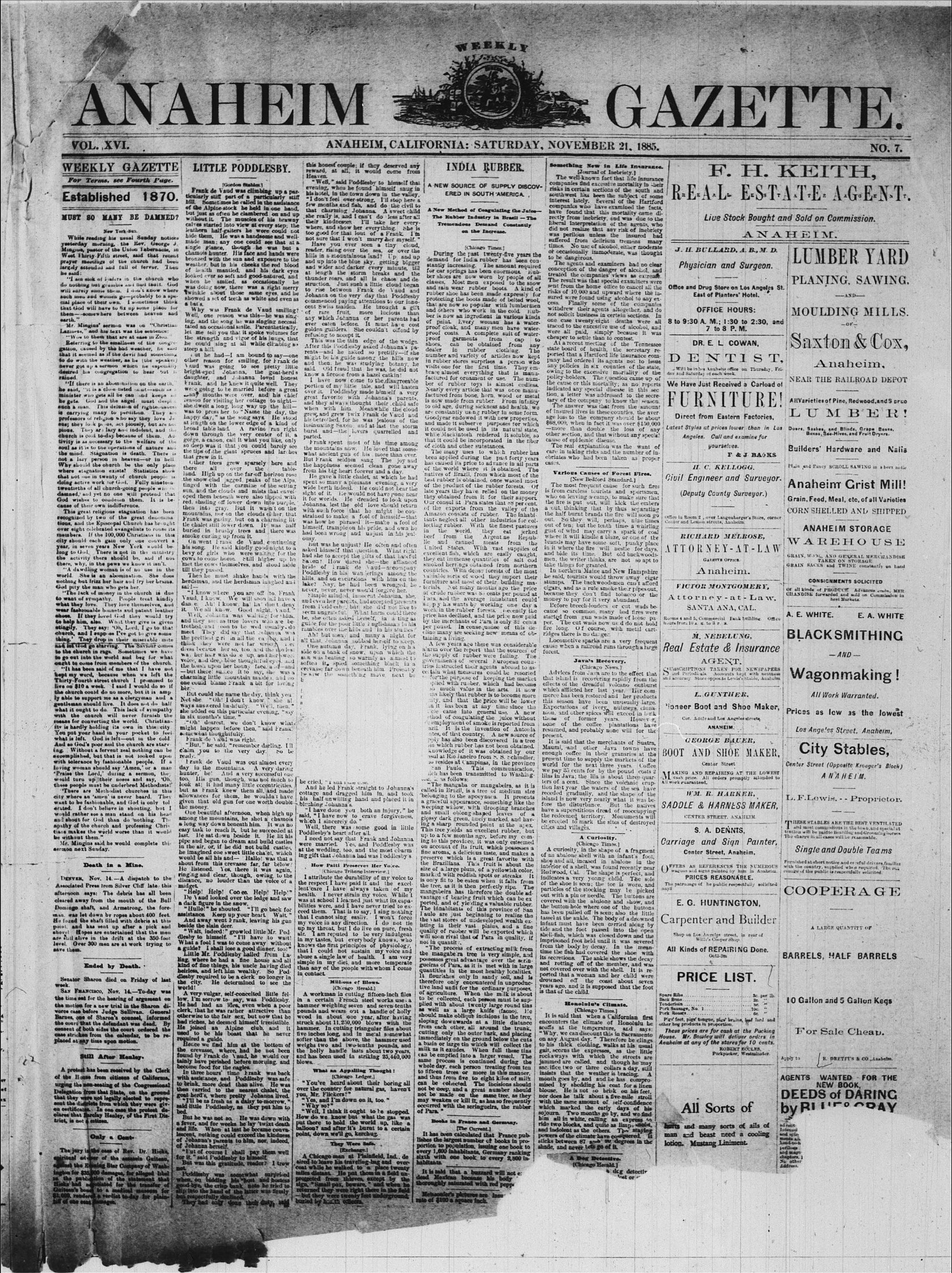
Searchable text
WEEKLY GAZETTE
For Terms, see Fourth Page.
Established 1870.
MUST SO MANY BE DAMNED?
New York-San.
While reading his usual Sunday notices yesterday morning, the Rev. George J. Mingus, pastor of the Union Tabernacle, in West Thirty-Fifth street, said that recent prayer meetings of the church had been largely attended and full of fervor. Then he said:
"I am sick of leaders in the church who do nothing but grumble and bad taint. God will surely smile them. I don't know where such men and women go—probably to a special place of their own. I sometimes think that God will have to fix up some place for them—somewhere between heaven and earth."
Mr. Mingus' sermon was on "Christian Laziness," and his text was the sentence:
"Woe to them that are at ease in Zion."
Referring to the smallness of the congregation, caused by the bad weather, he said that it seemed as if the devil had something to do with the weather, as he (the speaker) never got up a sermon which he especially desired his congregation to hear but it rained.
"If there is an abomination on the earth," he said, "it is a close-knit unit—such as a minister who gets all he can and keeps all he gets. God and the angel must despite such a man. This delusion of righteousness is carrying many to perdition. They are professors of religion who say they love Jesus; they look pious, act piously, but are not pious. They are lazy and indolent, and the church is cold to-day because of them. Activity is as necessary to the welfare of the soul as it is to the operations of nature and the mind. Stagnation is death. There is not a lazy person in heaven—or in hell. Why should the church be the only place where stagnation exists? Statistics show this honest couple reward, at all Heaven.
"Well," said Pondlesby evening, when he hit his hotel, in the town that charming Jude she really is, and held their kindnesses where, and show him too good for that he not sure that I would have you ever reader, rising over hills in a mountain and up into the blight and wilder and dark at length the sthunder roars, and struction. Just sure to rise between Johanna on the verge commenced paying cent Swiss maiden of rare fruit, any which Johanna ever caten before golden guilders. Refusing to accept this was the third After this Pondlesby rents—and he has might be his guide and then; he was said. Old fraud that know a firecone from I have now come portion of my little over it. Pondlesby great favorite wife and they always then when with him grew, and grew two his betrothed, for his insinuating Saxon burst and—the last parted.
Frank spent most of the mountains now what ancient gun of But Frank seldom the happiness seen from his big heart."
"If there is an abomination on the earth, he said, 'it is a chosen man—such as minister who gets all be can and keeps all he gets.' God and the angel must despite such a man. This devaluation of righteousness is carrying many to perish. They are professors of religion who say they love Jesus; they look pious, act piously, but are not pious. They are lazy and indolent, and the church is cold to-day because of them. Activity is as necessary to the welfare of the soul as it is to the operations of nature and the mind. Stagnation is death. There is not a lazy person in heaven—or in hell. Why should the church be the only place where stagnation exists? Statistics show that not one in twenty of church people is doing active work for God. Fully nineteen twentieths of all church-going people will be damned, and yet no one will pretend that God wishes to condemn them. It is because of their own indifference.
This great religious stagnation has been recognized by two of the great denominations, and the Episcopal Church has brought over eight celebrated evangelists to rouse its members. If the 100,000 Christians in this city should each gain only one convert a year, in seven years New York would belong to God. There is not in the ministry the activity there should be, and if now there, why, in the pews we know it isn't.
"A dawdling woman is of no use in the world. She is an abomination. She does nothing but frizz her hair and fry her brains. God pity the man who gets her.
"The lack of money in the church is due to want of sympathy. People treat kindly what they love. They love themselves, and wear fashionable bonnets and patent leather shoes. If they loved God they would try to help him, also. What they give is given stingily. They say: 'Oh, Lord, I go to that church, and I suppose I've got to give something.' They drop in their miserable mite and let God go starving. The Saviour comes to the church in rags. Sometimes we have to go out into the world and beg for what ought to come from members of the church.
"It has been said of me that I have not kept my word, because when we left the Thirty-Fourth street church I promised to live on $10 a week. I said I would do so if the church could do no more, but it is amply able to support me as a clergyman and a gentleman should live. It does not do half what it ought to do. This lack of sympathy with the church will never furnish the means for converting the world. Christianity is hardly holding its own in this city. You put your hand in your pocket to feel what is left. God is left—out in the cold. And so God's poor and the church are starving. Without a fervent zeal nothing can be accomplished, but that is not looked upon with tolerance by fashionable people. If a loving woman should say 'Amen,' or a man 'Praise the Lord,' during a sermon, they would turn up their noses and say, 'Oh, these people must be underbred Methodists!'
There are Methodist churches in this city where an 'amen' is never heard. They want to be fashionable, and God is only tolerated. I don't believe in shouting, but I would rather see a man stand on his head and shout for God than do nothing. The apathy of the church and professing Christmas makes the world worse than it would be without them."
Mr. Mingins said he would complete this sermon next Sunday.
Death in a Mine.
DENVER, Nov. 14. — A dispatch to the Associated Press from Silver Cliff late this afternoon says: The debris has all been trained from the mouth of the Bell.
"If there is an abomination on the earth, he said, 'it is a chosen man—such as minister who gets all be can and keeps all he gets.' God and the angel must despite such a man. This devaluation of righteousness is carrying many to perish. They are professors of religion who say they love Jesus; they look pious, act piously, but are not pious. They are lazy and indolent, and the church is cold to-day because of them. Activity is as necessary to the welfare of the soul as it is to the operations of nature and the mind. Stagnation is death. There is not a lazy person in heaven—or in hell. Why should the church be the only place where stagnation exists? Statistics show that not one in twenty of church people is doing active work for God. Fully nineteen twentieths of all church-going people will be damned, and yet no one will pretend that God wishes to condemn them. It is because of their own indifference.
This great religious stagnation has been recognized by two of the great denominations, and the Episcopal Church has brought over eight celebrated evangelists to rouse its members. If the 100,000 Christians in this city should each gain only one convert a year, in seventeen years New York would belong to God. There is not in the ministry the activity there should be, and if now there, why, in the pews we know it isn't.
"A dawdling woman is of no use in the world. She is an abomination. She does nothing but frizz her hair and fry her brains. God pity the man who gets her.
"The lack of money in the church is due to want of sympathy. People treat kindly what they love. They love themselves, and wear fashionable bonnets and patent leather shoes. If they loved God they would try to help him, also. What they give is given stingily. They say: 'Oh, Lord, I go to that church, and I suppose I've got to give some thing.' They drop in their miserable mite and let God go starving. The Saviour comes to the church in rags. Sometimes we have to go out into the world and beg for what ought to come from members of the church.
"It has been said of me that I have not kept my word, because when we left the Thirty-Fourth street church I promised to live on $10 a week. I said I would do so if the church could do no more, but it is amply able to support me as a clergyman and a gentleman should live. It does not do half what it ought to do. This lack of sympathy with the church will never furnish the means for converting the world. Christianity is hardly holding its own in this city. You put your hand in your pocket to feel what is left. God is left—out in the cold. And so God's poor and the church are starving. Without a fervent zeal nothing can be accomplished, but that is not looked upon with tolerance by fashionable people. If a loving woman should say 'Amen,' or a man 'Praise the Lord,' during a sermon, they would turn up their noses and say, 'Oh, these people must be underbred Methodists!'
There are Methodist churches in this city where an 'amen' is never heard. They want to be fashionable, and God is only tolerated. I don't believe in shouting, but I would rather see a man stand on his head and shout for God than do nothing. The apathy of the church and professing Christmas makes the world worse than it would be without them."
Mr. Mingins said he would complete this sermon next Sunday."
Death in a Mine.
Denver, Nov. 14.—A dispatch to the Associated Press from Silver Chiff late this afternoon says: The debris has all been cleared away from the mouth of the Bull Domingo shaft, and Armstrong, the foreman, was let down by ropes about 400 feet. He found the shaft filled with debris at this point, and has sent up after a pick and shovel. Hopes are entertained that the men are still alive in the drift at the 350-foot level. Over 300 men are at work trying to save them.
Ended by Death.
Senator Sharon died on Friday of last week.
San Francisco, Nov. 14.—To-day was the time set for the hearing of argument on the motion for a new trial in the Sharon divorce case before Judge Sullivan. General Barnes, one of Sharon's counsel, informed the court that the defendant was dead. By consent of both sides the court ordered the case stricken from the calendar, to be replaced at any time upon motion.
Still After Henley.
A protest has been received by the Clerk of the House from citizens of California, urging the non-sealing of the Congressional Delegation from that State, on the ground that they were not legally elected to represent the district from which they were given certification. In one case the protest declares that Barclay Henley, of the First District, is not a citizen.
Only a Court.
The jury in the case of Rev. Dr. Hicks, spiritual adviser of the assassin Guilleme, against the Evening Star Company of Washington for $35,000 damages, for alleged libal in the publication of the statement that Hicks had appointed for the transfer of Guilleme's bond to a medical museum for $2,000, rendered a verdict in day for plain-hit of one cent damage.
One beautiful afternoon, when high up among the mountains, he shot a chamois a long way down beneath him. It was no easy task to reach it, but he succeeded at last. He sat down beside it. He lit his pipe and began to dream and build castles in the air, or, if he did not build castles, he imagined one sweet little chalet, which would be all his and—Hallo! was that a shout from this crevasse far, far below? He listened. Yes, there it was again, ringing and clear, though, owing to the distance, no louder than the voice of a midget.
"Help! Help! Cooee. Help! Help!"
Do \and looked over the ledge and saw a dark figure in the snow.
"Hullo!" he shouted. "I'll go back for assistance. Keep up your heart. Wait."
And away went Frank, leaving his gun beside the slain deer.
"Wait, indeed!" growled little Mr. Poddlesby to himself. "I'll have to wait! What a fool I was to come away without a guide? I shall lose a good dinner, too."
Little Mr. Poddlesby halled from Eating, where he had a fine house and all kind of fine things, his uncle having died heirless, and left him wealthy. So Poddlesby required to be a clerk no longer in the city. He determined to see the world!
A very vulgar, self-conceited little fellow, I'm sorrow to say, was Poddlesby. He had had an idea, even when a poor clerk, that he was rather attractive than otherwise to the fair sex, but now that he had riches, he deemed himself irresistible. He joined an Alpine club, and it used to be his boast that he never required a guide.
Heence we find him at the bottom of the crevasse, where, had he not been found by Frank de Vaud, he would certainly have perished before morning, and become food for the cagles.
In three hours' time Frank was back with assistance, and Poddlesby was safe to brink; more dead than alive. He was then carried to the nearest chalet, the goat-herd's, where pretty Johanna lived.
"I'll be as fresh as a daisy to-morrow," said little Poddlesby, as they put him to bed.
But he was not so. He was down with a fever, and for weeks he lay 'twixt death and life. When at last he became convulsent, nothing could exceed the kindness of Johanna's parents to him, nor indeed, of Johanna herself.
"I put of course I shall pay them well for it." said Poddlesby to himself.
But was this gratitude reader? I trow not.
Poddlesby was somewhat surprised when, on bidding his host and hostess good-bye, the crisp bank note he tried to slip into the hand of the latter was firmly but respectfully declined.
They had only done their duty, said his half unwilling blushing Johanna.
"I have done you said," I have now told which I sincerely do Well, there was Poddlesby's heart after I need not say that were married. Yes at the wedding too ing gift that Johanna
How Pattl Press
I attribute the durability I have paid care I have all health. I never strained was at school I learned abilities were, and I had them. That is true that I cannot sing eagle my voice in any direction up my throat, but I do air. I am reputed to in my tastes, but ever knows the first principle that I could not abuse a single law of simple in my diet and than any of the people in contact.
Millions of Chicago
A workman in certain French hammer weighing seven pounds and wears over wood in about one struck about 11,250,000 hammer. In cutting five inches long, and softer than the above weighs two and two holly handle lash and has been used in blows.
What an Appellant
“You've heard about over the country for you, Mr. Flickers?” “Yes, and I'm down.” “Why so?” “Well, I think it out How do we know but put there to hold the balloon? and after it's point, down we'll go,”
They Wee
A Chicago man at saired to leave his travel coat while he walked miles distant. He put projected from threw sign," Small pox, bow returned they were ripe—but they were twenb buried by health office
WEEKLY
EIM GA
ANAHEIM, CALIFORNIA: SATURDAY, NOVEMBER 21, 1885.
this honest couple; if they deserved any reward, at all, it would come from Heaven.
"Well," said Poddlesby to himself that evening, when he found himself snug in his hotel, in the town down in the valley, "I don't feel over-strong. I'll stop here a few months and fish, and do the civil to that charming Johanna. A sweet child she really is, and I can't do less after all their kindnesses. I'll take her everywhere, and show her everything. She is too good for that lout of a Frank. I'm not sure that I won't marry her myself."
Have you ever seen a tiny cloud, reader, rising over the sea, or over the hills in a mountainous land? Up and up and up into the blue sky, getting bigger and wider and darker every minute, till at length the storm breaks and the thunder roars, and all is chaos and destruction. Just such a little cloud began to rise between Frank de Vaud and Johanna on the very day that Poddlesby commenced paying attentions to our innocent Swiss maiden. He brought a gift of rare fruit, more lucid than any which Johanna or her parents had ever eaten before. It must have cost golden guilders. She couldn't offend by refusing to accept it.
This was the thin edge of the wedge. After this Poddlesby asked Johanna's parents—and he asked so prettily—if she might be his guide among the hills now and then, he was studying botany, he said. Old fraud that he was, he did not know a fireone from a hazel catkin!
I have now come to the disagreeable portion of my little tale, and will hasten over it. Poddlesby made himself a very great favorite with Johanna's parents, and they always thought their child safe when with him. Meanwhile the cloud grew, and grew twix Frank de Vaud and his betrothed, for he was jealous of the insinuating Saxon, and at last the storm burst and—the lovers quarrelled and parted.
Frank spent most of his time among the mountains now. He loved that somewhat ancient gun of his more than ever. But Frank sadom sang. The joy and the happiness seemed clean gone away from his big heart forever and a day.
INDIA RUBBER.
A NEW SOURCE OF SUPPLY DISCOVERED IN SOUTH AMERICA.
A New Method of Coagulating the Jules—The Rubber Industry in Brazil—The Tremendous Demand Constantly on the Increase.
[Chicago Times.]
During the past twenty-five years the demand for India rubber has been constantly increasing. The amount required for car springs has been enormous. Rubber shoes are now worn by people of all classes. Most men exposed to the snow and rain wear rubber boots. A kind of rubber shoe has been made expressly for protecting the boots made of belted wool, that are now so popular with lumbermen and others who work in the cold. Rubber is now an ingredient in various kinds of paint. Every woman has a waterproof cloak, and many men have waterproof coats. A complete suit of waterproof garments from cap to shoes, can be obtained from any dealer in rubber clothing. The number and variety of articles now kept in rubber stores surprises a person who visits one for the first time. They embrace almost everything that is manufactured for ornament or use. The number of rubber toys is almost endless. Nearly every article that was once manufactured from bone, horn, wood or metal is now made from rubber. From infancy to old age, during sickness and health, we are constantly using rubber in some form. Goodyear endowed it with new properties, and made it subserve purposes for which it could not be used in its natural state, while Mackintosh rendered it soluble, so that it could be incorporated in the fiber of cloth and other substances.
The many uses to which rubber has been applied during the past forty years has caused its price to advance in all parts of the world where it is obtained. The natives of Brazil from which most of the Something New in Life Insurance.
[Journal of Inebriety.]
The well-known fact that life insurance companies find excessive mortality in their risks in certain sections of the south and southwest has been the subject of some interest lately. Several of the Hartford companies who have examined the facts, have found that this mortality came directly from inebriety, and was due to the liberal interpretation of the agents, who did not realize that any risk of inebriety was perilous unless the insured had suffered from delirium tremens many times. No use of alcohol, either moderate or occasionally immoderate, was thought to be dangerous.
The agents and examiners had no clear conception of the danger of alcohol, and treated the companies' views as extreme.
The result was that special examiners were sent from the home office to cancel all the risks of 10,000 and upward where the insured were found using alcohol to any excess. Finally some of the companies withdrew their agents altogether, and do not solicit business in certain sections. In one case twenty-eight deaths were all traced to the excessive use of alcohol, and were all paid, simply because it was cheaper to settle than to contest.
At a recent meeting of the Tennessee state board of health, the secretary reported that a Hartford life insurance company had ordered its agents not to issue any policies in six counties of the state, owing to the excessive mortality of the policy-holders. The question came up of the cause or this mortality; as no reports indicated any special disease in this section, a letter was addressed to the secretary of the company to know the season.
The answer was that from the amount of insured lives in these counties, the average loss to the company should be about $88,000, when in fact it was over $150,000—more than double the loss of any other section, and that without any special cause of epidemic disease.
The real explanation was the want of care in taking risks and the number of inebriates who had been taken as proper cases.
Various Causes of Forest Fires.
I have now come to the disagreeable portion of my little tale, and will hasten over it. Poddlesby made himself a very great favorite with Johanna's parents, and they always thought their child safe when with him. Meanwhile the cloud grew, and grew twix Frank de Vaud and his betrothed, for he was jealous of the insinuating Saxon, and at last the storm burst and—the lovers quarrelled and parted.
Frank spent most of his time among the mountains now. He loved that somewhat ancient gun of his more than ever. But Frank seldbm sang. The joy and the happiness seemed clean gone away from his big heart forever and a day.
He gave a little chalet, at which he had spent so many a pleasants evening, a very wide berth indeed. He could not bear the sight of it. He would not have gone near it for worlds. He dreaded to look upon Johanna, lest the old love should return with such force that he might be constrained to make a fool of himself—that was how he purased it—make a fool of himself, trample on his pride, and own he had been wrong and unjust in his jealousy.
But was he unjust? He often and often asked himself that question. What right had she to accept the gifts of that hateful Saxon? How dared she—the afflianced bride of Frank de Vaud—accompany Poddlesby in his wanerings among the hills, and on excursions with him on the lake? Say, he had been wronged, never, never, never would forgive her.
Simple minded, innocent Johanna, she, and her parents, had accepted presents from Poddlesby, but she did not like to seem ungrateful. What harm could there be, she often asked herself, in a ting as guide for the poor little Englishman in his rambles over the hills and in his studies?
Ah! but man, and many a night for all that, Johanna sobbed herself to sleep.
One autumn day, Frank lying on his side on a bank of snow, upon which the sun was beating so warmly as almost to soften it, spied something black in a crevassar far down beneath him. Presently he saw the something move next be
he cried. "I saudumee.
And he led Frank straight to Johanna's cottage and dragged him in, and took his half unwilling hand and placed it in blushing Johanna's.
"I have done you both an injury," he said, "I have now to crave forgiveness, which I sincerely do."
Well, there was some good in little Poddlesby's heart after all.
I need not say that Frank and Johanna were married. Yes, and Poddlesby was at the wedding, too, and the most charming gift that Johanna had was Poddlesby's
How Patti Preserves Her Voice.
(C Chicago Tribune interview)
I attribute the durability of my voice to the respect I have paid it and the excellent care I have always taken of my health. I never strain my voice. While I am at school I cannot be exactly factured for ornament or use. The number of rubber toys is almost endless. Nearly every article that was once manufactured from bone, horn wood or metal is now made from rubber. From infancy to old age, during sickness and health, we are constantly using rubber in some form. Goodyear endowed it with new properties, and made it subserve purposes for which it could not be used in its natural state, while Mackintosh rendered it soluble, so that it could be incorporated in the fiber of cloth and other substances.
The many uses to which rubber has been applied during the past forty years has caused its price to advance in all parts of the world where it is obtained. The natives of Brazil, from which most of the best rubber is obtained, once wasted most of the product of the rubber forests. Of late years they have relied on the money they obtained from it for their support. Our consul at Para states that 85 percent of the exports from the valley of the Amazon consists of rubber. The inhabitants neglect all other industries for collecting rubber. With the finest pastures in the world, they eat jerked beef from the Argentine Republic and canned meats from the United States. With vast supplies of excellent fish, which are easily caught, they eat immense quantities of salt cool smoked herrings obtained from northern countries. With dense forests of the most valuable sorts of wood they import their furniture and most of their building materials. Not many months ago the price of crude rubber was 80 cents per pound at Pará, and the average inhabitant could supply his wants by working one day a week in the rubber forests. Recently the price has declined, and the price now paid by the merchants of Pará is only 82 cents per pound. In consequence of this decline many are seeking new means of obtaining a living.
A few years ago there was considerable alarm over the report that the sources of the supply of rubber were failing. The governments of several European countries instructed their agents abroad to ascertain what measures could be resorted for the purpose of keeping the market supplied with rubber, which had become so much value in the arts. It now is likely that rubber is to become more city, and that the price will be lower in it has been at any time since the cake came into general use. A new method of coagulating the juice without employment of smoke is reported from zazil. It is the invention of Antoniaites, of that country. A new source of apply has also been discovered in a tree on which rubber has not been obtained. Knowledge of it was obtained by our asul at Rio Janeiro from N.S. Schindler, no resides at Campinas, in the province San Paulo. This communication, which has been transmitted to Washington, as follows:
"The mangaba or mangabeira, as it is called in Brazil, is a tree of medium size belonging to the apocynacea. It presents a graceful appearance, something like the weeping willow, with drooping branches and small oblong-shaped leaves of a glossy dark green, unearly marked, having a sharp rounded point at the apex. This tree yields an excellent rubber, but up to a few months ago, before my coming to this province, it was only esteemed on account of its fruit, which possesses a fine aroma, a delicious taste, and makes a preserve which is a great favorite with the Brazilians. This fruit is about the size of a large plum, of a yellowish color, marked with reddish spots or streaks. It is only fit to be eaten when it falls from the tree, as it is then perfectly ripe. The mangabeira has therefore the double advantage of bearing fruit which can be ex
Variola Causes of Forest Fires.
[New Bedford Standard]
The most frequent cause for such fires is from careless tourists and sportsmen who on leaving a camp to make sure that the fire is put out, will kick the embers out, thinking that by thus separating the half burnt brands the fire will soon go out. So they will perhaps, nine times out of ten; but the tenth time a whirling gust of wind may carry a spark of coal where it will kindle a blaze, or one of the brands may have some soft, punky place in it where the fire will nestle for days, and bide its time. But old backwoodsmen, the writer thinks, are not so apt to take things for granted.
In northern Maine and New Hampshire he said, tourists would throw away cigar stumps. The backwoodsmen can't afford cigars, and as a rule smoke their pipes out because they don't find tobacco or the money to pay for it very abundant.
Before breech-loaders or cut wads became so common, many bad fires were started from gun wads made of loose paper. The cut wads now used do not hold fire long. Of course, with metal cartridges there is no danger.
Locomotive sparks are a very frequent cause when a railroad runs through a large forest.
Java's Recovery.
[Chicago News]
Advices from Java are to the effect that island is recovering rapidly from the effects of the dreadful volcano outburst which afflicted her last year. Her commerce has been restored and her products this season have been unusually large. Exportations of ivory nutmegs, cinnamon, and other spices will exceed those of former years. However none of the coffee plantations have resumed, and probably none will for the present.
It is said that the merchants of Suatra, Maumi, and other Java towns have enough coffee in their granaries at the present time to supply the markets of the world for the next three years. Coffee we pay 35 cents for by the pound costs 2 lilas in Java; the lilia is about three quarters of a cent. Since the volcanic eruption last year the waters of sea have receded gradually, and the shape of the island is now very nearly what it was before the disturbance. But the natives have a superstitious dread of reoccupying the redeemed territory. Monuments will be erected to mark the sites of destroyed cities and villages.
A Curiosity.
[Chicago Times]
A curiosity in the shape of a fragment of an abalone shell with an infant's foot, shoe and all; incased in abalone in the interior of a shell; was found recently near Redwood, Cal. The shape is perfect, and indicates a very young child. The sole of the shoe is seen; the toe is worn, and particles of the stocking may be picked out with a pin or needle. The buttons are
"I have done you both an injury," he said, "I have now to crave forgiveness, which I sincerely do."
Well, there was some good in little Poddlesby's heart after all.
I need not say that Frank and Johanna were married. Yes, and Poddlesby was at the wedding, too, and the most charming gift that Johanna had was Poddlesby's
How Patti Preserves Her Voice.
[Chicago Tribune Interview]
I attribute the durability of my voice to the respect I have paid it and the excellent care I have always taken of my health. I never strain my voice. While I was at school I learned just what its capabilities were, and I have never tried to exceed them. That is to say, I sing nothing that I cannot sing easily. I won't force my voice in any direction. I do not tie up my throat, but I do live on pure, fresh air. I am reputed to be very indulgent in my tastes, but everybody knows, who knows the first principles of physiology, that I could not sustain my voice and abuse a single law of health. I am very simple in my diet, and more temperate than any of the people with whom I come in contact.
Millions of Blows.
[Chicago Herald]
A workman in cutting fifteen-inch files in a certain French steel works uses a hammer weighing seven and seventen pounds and wears out a handle of holly wood in about one year, after having struck about 11,200,000 blows with the hammer. In cutting triangular files about five inches long, and in metal somewhat softer than the above, the hammer used weighs two and two-tenths pounds, and the holly handle lasts about two years, and has been used in striking 25,440,000 blows.
What an Appalling Thought!
[Chicago Ledger.]
"You've heard about their boring all over the country for natural gas, haven't you, Mr. Flickers?"
"Yes, and I'm down on it, too."
"Why so?"
"Weil, I think it ought to be stopped. How do we know but what the gas was put there to hold the world up, like a balloon? and after it's burnt to a certain point, down we'll go, kerchug."
They Were Safe.
[Exchange.]
A Chicago man at Plainfield, Ind., deired to leave his traveling lug and overcoat while he walked to a place twenty miles distant. He put them in a field unprotected from thieves, except by the sign, "Small pox, beware," and when he returned they were right there in the field—but they were twenty feet underground; buzied by health officials.
A Curiosity.
[Chicago Times.]
A curiosity, in the shape of a fragment of an abalone shell with an infant's foot, shoe and all, incased in abalone in the interior of a shell, was found recently near Redwood, Cal. The shape is perfect, and indicates a very young child. The sole of the shoe is seen; the toe is worn, and particles of the stocking may be picked out with a pin or needle. The buttons are covered with the abalone and show, and the button-hole where one of the buttons has been pulled off is seen; also the little tassel at the ankle. The body of a drowned infant must have been carried along by tide and the foot passed into the open shell-fish, which was closed down and the imprisoned foot held until it was severed from the body by decay. In the meantime the fish had covered the shoe with its secretions. The ankle shows the decay and rotting off of the member, and was not covered over with the shell. It is reported that a woman and her child were drowned off the coast about seven years ago, and it is supposed that the foot is that of the child.
Honolulu's Climate.
[Chicago Times.]
It is said that when a Californian first encounters the climate of Honolulu he scoffs at the temperature, and says: "Why, we can discount this in Sacramento on any August day." Therefore he clings to his thick clothing, walks at his usual gait, scorns the expresses, as the little rockaways with which the streets are jammed are called, and though he may sacrifice two or three collars a day, still insists that the weather is bracing. A month goes by, and he has compromised by shedding his coat for a linen blouse. He is not so brisk on his feet, nor does he talk about a five-mile stroll with the same amount of self-confidence which marked the early days of his sojourn. Two months go by, and we find him all in white, calling an express to ride two blocks, and quite as limp, noist, and indolent as the others. The staying powers of the climate have conquered it sticks between 87 and 90 degrees in the shade, and never tells go of it.
A Dog Detective.
[Chicago Herald.]
a dog detective lost or
GAZETTE.
OCTOBER 21, 1885.
NO. 7.
F. H. KEITH,
REAL ESTATE AGENT.
Live Stock Bought and Sold on Commission.
ANAHEIM.
J. H. BULLARD, A.B., M.D.
Physician and Surgeon.
Office and Drug Store on Los Angeles St.
East of Planters' Hotel.
OFFICE HOURS:
8 to 9:30 A.M.; 1:30 to 2:30, and
7 to 8 P.M.
DR. E. L. COWAN,
DENTIST.
Will be in Anaheim office on Thursday, Friday and Saturday of each week.
We Have Just Received a Carload of
FURNITURE!
Direct from Eastern Factories,
Latest Styles at prices lower than in Los
Angeles. Call and examine for
yourselves.
F & J BACKS
LUMBER YARD
PLANING. SAWING.
AND
MOULDING MILLS.
OF
Saxton & Cox,
Anaheim.
NEAR THE RAILROAD DEPOT
All Varieties of Pine, Redwood, and Spruce
LUMBER!
Doors, Sashes, and Blinds, Grape Boxes,
Boxes, See-Hives, and Fruit Dryers.
Builders' Hardware and Nails
Plains and Fancy SCROLL SAWING in a bort notice.
We Have Just Received a Carload of FURNITURE!
Direct from Eastern Factories,
Latest Styles at prices lower than in Los Angeles. Call and examine for yourselves.
F & J BACKS
H. C. KELLOGG.
Civil Engineer and Surveyor.
(Deputy County Surveyor.)
Offices in Room 2, over Langenberger's Store, corner Center and Lemon streets, Anaheim.
RICHARD MELROSE,
ATTORNEY-AT-LAW
GAZETTE OFFICE.
Anaheim.
VICTOR MONTGOMERY,
Attorney-at-Law,
SANTA ANA, CAL.
Rooms 4 and 5, Commercial Bank building. Office hours from 10 a.m. to 3 p.m.
M. NEBELUNG,
Real Estate & Insurance AGENT.
SUBSCRIPTIONS TAKEN FOR NEWSPAPERS AND PERIODicals. Accounts kept with neatness and accuracy. Store opposite Lewis's Stable, Anaheim.
L. GUNTHER.
Pioneer Boot and Shoe Maker,
Cor. Attle and Los Angeles streets, Anaheim.
GEORGE BAUER,
BOOT AND SHOE MAKER,
Center Street.
MAKING AND REPAIRING AT THE LOWEST cash price. All orders promptly attended to. All work guaranteed.
WM. R. HARKER,
SADDLE & HARNESS MAKER,
CENTER STREET, Anaheim.
S. A. DENNIS,
Carriage and Sign Painter,
Center Street, Anaheim.
OFFERS AS REFERENCES THE NUMEROUS wagons and signs painted by him in Anaheim.
PRICES REASONABLE.
The patronage of the public respectfully solicited may
NEAR THE RAILROAD DEPOT
All Varieties of Pine, Redwood, and Spruce
LUMBER!
Doors, Sashes, and Blinds, Grape Boxes,
Boxes, See-Hives, and Fruit Dryers.
Builders' Hardware and Nailis
Plain and Fancy SCROLL SAWING in a short notice
Anaheim Grist Mill!
Grain, Feed, Meal, etc., of all Varieties
CORN SHELLED AND SHIPPED
ANAHEIM STORAGE
WAREHOUSE
GRAIN, WOOL, AND GENERAL MERCHANDISE TAKEN ON STORAGE
GRAIN SACKS and TWINE constantly on hand
CONSIGNMENTS SOLICITED
Of all kinds of PRODUCE. Advances made, MERCHANTISE forwarded and sold on Commission in best Markets.
A. E. WHITE. E. A. WHITE
BLACKSMITHING
— AND —
Wagonmaking!
All Work Warranted.
Prices as low as the lowest
Los Angeles Street, Anaheim,
City Stables,
Center Street (Opposite Kroeger's Block)
ANAHEIM.
L.F.Lewis, -- Proprietor.
THESE STABLES ARE THE BEST VENTILATED
and most commodious in the town, and special at tention will be paid to Boarding and Grooming horses.
The charge in all cases will be reasonable.
Single and Double Teams
Furnished at short notice and careful drivers familiar with the country, supplied when required. The rearage of the public is respectfully solicited.
COOPERAGE
S. A. DENNIS,
Carriage and Sign Painter,
Center Street, Anaheim,
OFFERS AS REFERENCES THE NUMEROUS
wagons and signs painted by him in Anaheim.
PRICES REASONABLE.
The patronage of the public respectfully solicited may be
E. G. HUNTINGTON,
Carpenter and Builder
Shop on Los Angeles street, in rear of Willie's Cooper Shop.
All Kinds of REPAIRING Done.
Octs-3m
PRICE LIST.
Spare Ribs ... 3c. per lb.
Back Bone ... 2c. ""
Tenderloin ... 8c. ""
Pork Sausage, No. 1 ... 10c. ""
Pork Roasts ... 6c. "
Pigs' feet, pigs' tongue, pigs' brains, leaf lard and other hog products in proportion.
These prices are for cash at the Packing House. Mr. Bowley will deliver orders in Anaheim at any of the stores for 10 cents.
ROBERT ECCLES,
Porkpacker, Westminster.
All Sorts of
hurts and many sorts of ails of man and beast need a cooling lotion. Mustang Liniment.
AGENTS WANTED FOR THE NEW BOOK,
DEEDS OF DARING
by RILEY GRAY