anaheim-gazette 1885-11-07
Scanned page
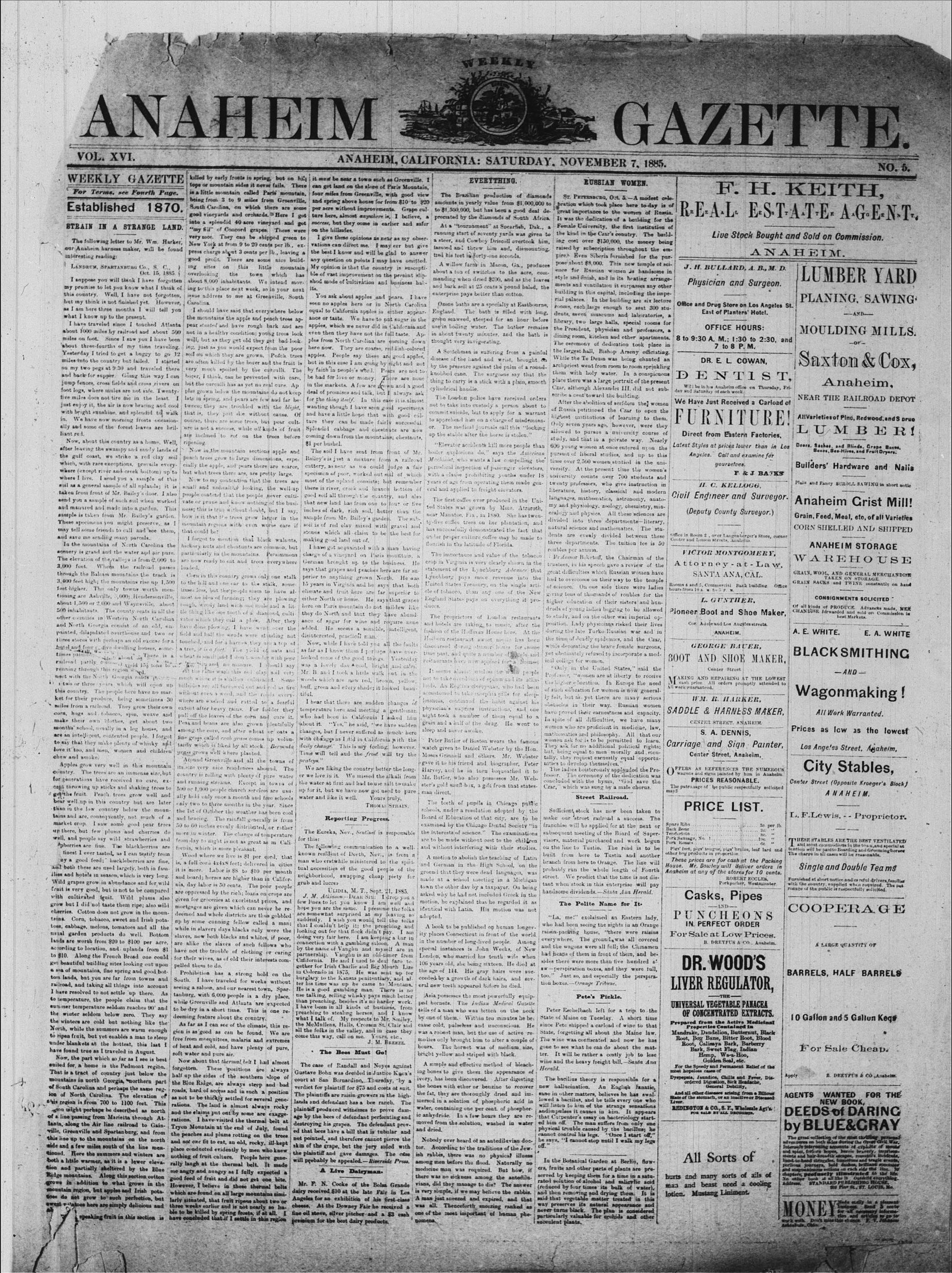
Searchable text
WEEKLY GAZETTE
For Terms, see Fourth Page.
Established 1870.
STRAIN IN A STRANGE LAND.
The following letter to Mr. Wm. Harker,
our Anaheim harness maker, will be found interesting reading:
LANDRUM, SPARTANBURG Co., S. C. )
Oct. 15, 1885
I suppose you will think I have forgotten my promise to let you know what I think of this country. Well, I have not forgotten, but my think is not finished yet. However, as I am here three months I will tell you what I know up to the present.
I have traveled since I touched Atlanta about 1000 miles by railroad and about 500 miles on foot. Since I saw you I have been about three-fourths of my time traveling. Yesterday I tried to get a buggy to go 12 miles into the country but failed. I started on my two pegs at 9:30 and traveled there and back for supper. Going this way I can jump fences, cross fields and cross rivers on foot logs, where miles are not safe. Twenty-five miles does not tire me in the least. I just enjoy it, the air is now bracing and cool with bright sunshine, and splendid to walk in. We have now morning frosts occasionally and some of the forest leaves are brilliant red.
Now, about this country as a home. Well, after leaving the swampy and sandy lands of the gulf coast, we strike a red clay soil which, with rare exceptions, prevails everywhere (except river and creek bottom) up to killed by early frosts in spring, but on hill tops or mountain sides it never fails. There is a little mountain called Paris mountain, being from 3 to 9 miles from Greenville, South Carolina, on which there are some good vineyards and orchards. Here I got into a splendid 40-acre vineyard and got "my fill" of Concord grapes. These were very nice. They can be shipped green to New York at from 9 to 20 cents per lb., express charge about 3 cents per lb., leaving a good profit. There are some nice building sites on this little mountain overlooking the town which has about 8,000 inhabitants. We intend moving to this place next week, so in your next issue address to me at Greenville, South Carolina.
I should have said that everywhere below the mountains the apple and peach trees appear stunted and have rough bark and are not in a healthy condition; young trees look well, but as they get old they get bad-looking, just as you would expect from the poor soil on which they are grown. Peach trees are often killed by the borer and the fruit is very much spoiled by the curculi. The borer, I think, can be prevented with care, but the curculi has as yet no real cure. Apples grown below the mountains do not keep late in spring, and pears are few and far between; they are troubled with the blight, that is, they just die without cause. Of course, there are some trees, but pear culture is not a success, while all kinds of fruit are inclined to rot on the trees before ripening.
Now in the mountain sections apple and peach trees grow to large dimensions, especially the apple, and pears there are scarce, but what trees there are, are pretty large.
it must be near a can get land on four miles from and spring above per acre without ture here, almost success, but they on the hillsides.
I give these observations can direct the best I know any question on my opinion is that ble of vast improv shod mode of cult its.
You ask about seen no apples he equal to California ance or taste. We apples, which we even then they hape ples from North C here now. They apples. People s but in this case I by faith in people' be bad for love or in the markets. A deal of promises are for the thing itself wanting though I and have a little h ture they can be Splendid cabbage coming down from $1 per bushel.
The soil I have Bailey's is just a n cuttery, as near as specimen of poor
and back for supper. Going this way I can jump fences, cross fields and cross rivers on foot logs, where mules are not safe. Twenty-five miles does not tire me in the least. I just enjoy it, the air is now bracing and cool with bright sunshine, and splendid to walk in. We have now morning frosts occasionally and some of the forest leaves are brilliant red.
Now, about this country as a home. Well, after leaving the swampy and sandy lands of the gulf coast, we strike a red clay soil which, with rare exceptions, prevails everywhere (except river and creek bottom) up to where I live. I send you a sample of this soil as a general sample of all uplands; it is taken from front of Mr. Bailey's door. I also send you a sample of such soil when worked and manured and made into a garden. This sample is taken from Mr. Bailey's garden. These specimens you might preserve, as I may tell some friends to call and see them, and save me sending many parcels.
In the mountains of North Carolina the scenery is grand and the water and air pure. The elevation of the valleys is from 2,000 to 2,000 feet. Where the railroad passes through the Balsam mountains the track is 3,400 feet high; the mountains rise up 1,500 feet higher. This only towns worth mentioning are Ashville, 3,000; Hendersonville, about 1,500 or 2,000 and Waynesville, about 500 inhabitants. The county seats in all the other counties in Western North Carolina and North Georgia consist of an old, unpainted, dilapidated courthouse and two or three stores with perhaps an old excuse for a hotel and four five-dwelling houses, sometimes painted about there. There is a railroad partly covered by yield 15 tons to running through this region wood.
neest with the North Georgia roads pass two or three years which will open up this country. The people here have no market for their produce, being sometimes 30 miles from a railroad. They grow their own corn, hogs and tobacco, spin, weave and make their own clothes, get about two months' school, usually in a log house, and are an intelligent, contented people. I forgot to say that they make plenty of whisky and love it too, and men, women and children chew and smoke.
Apples grow very well in this mountain country. The trees are an immense size, but for generations have received no care, except throwing up sticks and shaking trees to get the fruit. Peach trees grow well and bear well-up in this country but are later than in the low country below the mountains and are, consequently, not much of a market crop. I saw some good pear trees up there, but few plums and cherries do well, and people say wild strawberries and pberries are fine. The blackberries are finest I ever tasted, as I can testify from ny a good feed; huckleberries are fine, and both these are used largely, both in families and hotels in season, which is very long. Wild grapes grow in abundance and for wild fruit is very good, but is not to be compared with cultivated figt. Wild plums also
borer, I think, can be prevented with care, but the carcilii has as yet no real cure. Apples grown below the mountains do not keep late in spring, and pears are few and far between; they are troubled with the blight, that is, they just die without cause. Of course, there are some trees, but pear culture is not a success, while all kinds of fruit are inclined to rot on the trees before ripening.
Now in the mountain sections apple and peach trees grow to large dimensions, especially the apple, and pears there are scarce, but what trees there are are pretty large.
Now to my contention that the trees are small and unealthy looking, the well-up people contend that the people never cultivate or prune and know nothing of the business; this is true without doubt, but I say, how is it that the trees grow larger in the mountain regions with even worse care if that could be?
I forgot to mention that black walnuts, hickory nuts and chestnut are common, but particularly in the mountains. Persimmons are now ready to eat and trees everywhere loaded.
Corn in this country grows only one stalk to the hill and one ear to the stalk, sometimes less, but the people seem to have almost no idea of farming; they are plowing rough, weedy land with one male and a little thing like one tooth of a diamond cultivator which they call a plow. After they have done plowing, I have went over the field and half the weeds were standing not touched, and for a harrow they use a top of a tree, it is a foot. The yield of oats and wheat is small and I don't wonder with poor quality and no measure. I should say that the rims wash this red clay soil very much where it is shallow cultivated. Some hillsides are all furrowed out and red as fire without even a weed, and the roads everywhere are washed and rattled to a fearful extent after heavy rains. For fodder they pull off the leaves of the corn and cure it. Peas and beans are also grown plentifully among the corn, and after wheat or oats a fine grass called earth grass comes up voluntarily which is liked by all stock. Bermuda grass grows well where planted.
Around Greenville and all the towns of its size very nice residences abound. The country is rolling with plenty of pure water and running streams. Except in towns of 500 or 1,000 people church services are usually held only once a month and free schools only two to three months in the year. Since the 1st of October the weather has been cool and bracing. The rainfall generally is from 50 to 60 inches evenly distributed, or rather more in winter. The change of temperature from day to night is not as great as in California, which is more pleasant.
Wood where we live is $1 per cord, that is a full cord 4x4x8 feet; delivered in cities it is more. Labor is $8 to $10 per month and board; horses are higher than in California, day labor is 50 cents. The poor people are oppressed by the rich; loans on crops are given for groceries at cost.
be had for love or in the markets. A deal of promises are for the thing itself wanting though I am having little trouble they can be Splendid cabbage coming down from $1 per bushel.
The soil I have Bailey's is just a malt cottery, as near as specimen of poor; most of the upland there is river; creeks good soil all through that new land has inches of dark; rice sample from Mr. Bailey's soil is of red clay stones which all make good land or charge of a vineyard German brought me says that grapes and perior to anything over 15 years in Virginia climate and fruit lately either North or hometown here on Paris mounts they do North and takeance of sugar for it added. He seems disinterested, practiced Now, while I have as far as I know those looked some of the grapes was a lovely day Mr. B and I took a woods which are now buff green and every tiful.
I hear that there are temperature here and who had been in Cayor about it. "Yes," he changes, but I never with changes as I did daily change." This is Time will tell and that prateys."
We are liking the cider we live in it. We the water at first audited up for it, but we have water and like it well...
bear well up in this country but are later than in the low country below the mountains and are, consequently, not much of a market crop. I saw some good pear trees up there, but few plums and cherries do well, and people say wild strawberries and apples are fine. The blackberries are finest I ever tasted, as I can testify from my a good feed; huckleberries are fine, and both these are used largely, both in families and hotels in season, which is very long. Wild grapes grow in abundance and for wild fruit is very good, but is not to be compared with cultivated fruit. Wild plums also grow but I did not taste them ripe; also wild cherries. Cotton does not grow in the mountains. Corn, tobacco, sweet and Irish potatoes, cabbage, melons, tomatoes and all the usual garden products do well. Bottom lands are worth from $20 to $100 per acre, according to location, and uplands from $1 to $10. Along the French Broad one could get beautiful building sites looking out upon a sea of mountains, fine spring and good bottom lands, but you are far from towns and railroad, and taking all things into account I have resolved to not settle up there. As to temperature, the people claim that the summer temperature seldom reaches 90° and the winter seldom below zero. They say the winters are cold but nothing like the North, while the summers are warm enough to ripen fruit, but yet enables a man to sleep under blankets at the hottest, this last I have found true as I traveled in August.
Now, the part which so far as I see is best suited for a home is the Pedmont region. That is a tract of country just below the mountains in north Georgia, northern part of South Carolina and perhaps the same region of North Carolina. The elevation of this region is from 700 to 1100 feet. This region might perhaps be described as north of a line passing from Marietta through Atlanta, along the Air line railroad to Gainville, Greenville and Spartanburg, and from this line up to the mountains on the north side and a few miles south of the line mentioned. Here the summers and winters are both a little warmer, as it is a lower elevation and partially sheltered by the Blue Ridge mountains. Along this section cotton grows in addition to what grows in the mountain region, but apples and Irish potatoes do not grow to such perfection, but sweet potatoes here are simply delicious and all speaking fruit in this section is only two to three months in the year. Since the 1st of October the weather has been cool and bracing. The rainfall generally is from 50 to 60 inches evenly distributed, or rather more in winter. The change of temperature from day to night is not as great as in California, which is more pleasant.
Wood where we live is $1 per cord, that is, a full cord 4x4x8 feet; delivered in cities it is more. Labor is $8 to $10 per month and board; horses are higher than in California, day labor is 50 cents. The poor people are oppressed by the rich; loans on crops are given for groceries at exorbitant prices, and mortgages are given which can never be redeemed and whole districts are thus gobbled up by some cunning fellow called a man; while in slavery days blacks only were the slaves, now both blacks and whites; if poor, are alike the slaves of such fellows who have not the trouble of clothing or caring for their wives, as of old their interests compelled them to do.
Prohibition has a strong hold on the South. I have traveled for weeks without seeing a saloon, and our nearest town, Spartanburg, with 6,000 people is a dry place, while Greenville and Atlanta are expected to be dry in a short time. This is one redeeming feature about the country.
As far as I can see of the climate, this region is as good as can be found. We are free from mosquitoes, malaria and extremes of heat and cold, and have plenty of pure, soft water and pure air.
Now about that thermal belt I had almost forgotten. These positions are always half up the sides of the southern slope of the Blue Ridge, are always steep and bad roads, hard of access and in such a position as not to be thickly settled for several generations. The land is almost always rocky and the claims put out by some are exaggerations. I have visited the thermal belt at Tryon Mountain at the end of July, found the peaches and plums rotting on the trees and not one fit to eat, an old, rocky, ill-kept place conducted evidently by men who knew nothing of fruit culture. People here generally laugh at the thermal belt. It made me angry and nungry as I fully expected a good feed of fruit and did not get one bite. However, I believe in these thermal belts which are found on all large mountains similarly situated, that fruit ripens about two or three weeks earlier and is not nearly so habble to be killed by spring frosts, if at all. I have concluded that if I settle in this region
The Eureka, Nev., for this:
The following commend known resident of Deer man who erstwhile made necessary of the neighborhood, swapped grub and lucre.
Ulidia, M.
J. M. Atkinson—Drew few lines to let you know you are the same are somewhat surprised suddenly. I wish you that I couldn't help in looking out for that flock doing very fair here.
connection with a game by the name of Vaughn partnership. Vaughn California. He and I gether for Irish Charlie in Colorado in 1875.
burglary to the Kansas terrier his time was up here. He is a good gambling use talking, selling whiskey than preaching, besides I have been in all kinds preaching to stealing what I talk of. My reelection McMullens, Halls,
all the folks in the valley come this way, call on me.
The Bees
The case of Randall Gustave Bohn was decided court at San Bernardino verdict for plaintiff for Mr. The plaintiffs are raising lands and defendant hail plaintiff produced within age by the bees of defender destroying his grapes.
ed that bees have a bill not pointed, and therefore skin of the grape, but that the plaintiff and gave will probably be appealed.
A Live Dairy
Mr. F. N. Cocke oo dairy received $10 at the Angeles for an exhibition cheese. At the Downey fine oil stove, silver pitcher premium for the best dairy
WEEKLY
EIM GA
ANAHEIM, CALIFORNIA: SATURDAY, NOVEMBER 7, 1885.
it must be near a town such as Greenville. I can get land on the slope of Paris Mountain, four miles from Greenville, with good view and spring above house for from $10 to $20 per acre without improvements. Grape culture here, almost anywhere is, I believe, a success, but they come in earlier and safer on the hillsides.
I give these opinions as near as my observations can direct me. I may err but give the best I know and will be glad to answer any question on points I may have omitted. My opinion is that the country is susceptible of vast improvement on the present slipshod mode of cultivation and business habits.
You ask about apples and pears. I have seen no apples here or in North Carolina equal to California apples in either appearance or taste. We have to put sugar in the apples, which we never did in California and even then they have not the full taste. Apples from North Carolina are coming down here now. They are coarse, reddish-colored apples. People say these are good apples, but in this case I am going by sight and not by faith in people's word. Pears are not to be bad for love or money. There are none in the markets. A few are grown and a good deal of promises and talk, but I always ask for the thing itself. In this case it is almost wanting though I have seen good specimens and have a little hope that with good culture they can be made fairly successful. Splendid cabbage and chestnuts are now coming down from the mountains; chestnuts, $1 per bushel.
The soil I have sent from front of Mr. Bailey's is just a mixture from a railroad cuttery, as near as we could judge a fair specimen of poor worked out soil of which
EVERYTHING.
The Brazilian production of diamonds amounts in yearly value from $1,000,000 to $1,500,000, but has been a good deal depreciated by the diamonds of South Africa.
At a "tournament" at Spearfish, Dak., a running start of seventy yards was given to a steer, and Cowboy Driscoll overtook him, lashed and threw him and, dismounting, tied his feet in forty-one seconds.
A willow farm in Macon, Ga., produces about a ton of switches to the acre, commanding when dried $200, and as the leaves and bark sell at 25 cents a pound baled, the enterprise pays better than cotton.
Ozone baths are a specialty at Eastbourne, England. The bath is filled with long green seaweed, steeped for an hour before use in boiling water. The bathier remains in about twenty minutes, and the bath is thought very invigorating.
A Scotchman is suffering from a painful disease of the hand and wrist, brought on by the pressure against the palm of a round knobbed cane. The surgeons say that the thing to carry is a stick with a plain, smooth cylindrical handle.
The London police have received orders not to take into custody a person about to commit suicide, but to apply for a warrant to apprehend him on a charge of misdemeanor. The medical journals call this "locking up the stable after the horse is stolen."
"Elevator accidents kill more people than boiler explosions do," says the American Machinist, who wants a law compelling the periodical inspection of passenger elevators, with a clause prohibiting them under 81 years old.
RUSSIAN WOMEN.
St. Petersburg, Oct. 5 — A modest celebration which took place here to-day is of great importance to the women of Russia. It was the dedication of a building for the Female University, the first institution of the kind in the Czar's country. The building cost over $150,000, the money being raised by subscription throughout the empire. Even Siberia furnished for the purpose about $8,000. This new temple of science for Russian women is handsome in style and finish, and in its heating arrangements and ventilation it surpasses any other building in this capital, including the imperial palaces. In the building are six lecture rooms, each large enough to seat 300 students, seven museums and laboratories, a library, two large halls, special rooms for the President, physician and professors, a dining room, kitchen and other apartments. The ceremony of dedication took place in the largest hall, Bishop Arseny officiating. While the Te Deum was being chanted an archpriest went from room to room sprinkling them with holy water. In a conspicuous place there was a large portrait of the present Czar, although Alexander III. did not subscribe a cent toward the building.
After the abolition of serfdom the women of Russia petitioned the Czar to open the highest institutions of learning to them. Only seven years ago, however, were they allowed to pursue a university course of study, and that in a private way. Nearly 600 young women at once entered upon the pursuit of liberal studies, and up to this time over 2,500 women studied in the university. At the present time the women's
be had for love or money. There are none in the markets. A few are grown and a good deal of promises and talk, but I always ask for the thing itself. In this case it is almost wanting though I have seen good specimens and have a little hope that with good culture they can be made fairly successful. Splendid cabbage and chestnuts are now coming down from the mountains; chestnuts, $1 per bushel.
The soil I have sent from front of Mr. Bailey's is just a mixture from a railroad cuttery, as near as we could judge a fair specimen of poor, worked out so of which most of the upland consists; but remember there is river, creek and branch bottom of good soil all through the country, and also that new land has from one to four or five inches of dark, rich soil, better than the sample from Mr. Bailey's garden. The sub-soil is of red clay mixed with gravel and stones which all claim to be the best for making good land out of.
I have acquainted with a man having charge of a vineyard on Paris mountain, a German brought up to the business. He says that grapes and peaches here are far superior to anything grown North. He was 15 years in Virginia and he says that both climate and fruit here are far superior to either North or home. He says that grapes here on Paris mountain do not maldew like they do North and that they have abundance of sugar for wine and require none added. He seems a sensible, intelligent, disinterested, practicell man.
Now, while I have told you all the faults as far as I know them I perhaps have overlooked some of the good things. Yesterday was a lovely day cool, bright, and calm. Mr. B and I took a little walk out in the woods which are now real, brown, yellow, buff, green and every shade; it looked beautiful.
I hear that there are sudden changes of temperature here and meeting a gentleman who had been in California I asked him about it. "Yes," he said, "we have sudden changes, but I never suffered as much here with changes as I did in California with the daily change." This is my feeling, however. Time will tell and the frost will try the prateys."
We are liking the country better the longer we live in it. We missed the alkali from the water at first and had to use salt to make up for it, but we have now got used to pure water and like it well. Yours truly,
THOMAS STRAIN.
Reporting Progress.
The Eureka, Nev., Sentinel is responsible for this:
The following communication to a well-known resident of Deeth, Nev., is from a man who erstwhile ministered to the spiritual necessities of the good people of the neighborhood, swapping cheap piety for grub and lucre.
ULIDIA, M.T., Sept. 21, 1885.
J. M. Atkinson—DEAR SIR: I drop you a knobber cane.
The surgeons say that the thing to carry is a stick with a plain, smooth cylindrical handle.
The London police have received orders not to take into custody a person about to commit suicide, but to apply for a warrant to apprehend him on a charge of misdemeanor. The medical journals call this "locking up the stable after the horse is stolen."
"Elevator accidents kill more people than boiler explosions do," says the American Mechanist, who wants a law compelling the periodical inspection of passenger elevators, with a clause prohibiting youths under 18 years of age from operating them made general and applied to freight elevators.
The first coffee ever produced in the United States was grown by Mine. Atzeroth, near Manatee, Fla., in 1880. She has twenty-five coffee trees on her plantation, and has successfully demonstrated the fact that under proper culture coffee may be made to flourish in the latitude of Florida.
The importance and value of the tobacco crop in Virginia is very clearly shown in the statement of the Lynchburg Adence that Lynchburg pays more revenue into the United States Treasury, on the single article of tobacco, than any one of the New England States pays on everything it produces.
The proprietors of London restaurants and hotels are taking to music, after the fashion of the Hoffman House here. At the Holborn restaurant sweet music has been discourses during summer hours for some time past, and quite a number of folks and restaurants have now applied for a license.
It seems almost unbelievable when people not to take overloads of epiphany and its alkanoids. An English clergywoman, who had been accustomed to take morphine pills for sleeplessness, continued the habit against his physician's express instructions, and one night took a number of them equal to a grain and a half of the drug. He went to sleep and never awoke.
Peter Butler of Boston wears the famous watch given to Daniel Webster by the Hon. Moses Grinnell and others. Mr. Webster gave it to his friend and biographer, Peter Harvey, and he in turn bequeathed it to Mr. Butler, who also possesses Mr. Webster's gold snuff-box, a gift from that statesman direct.
The teeth of pupils in Chicago public schools, under a resolution adopted by the Board of Education of that city, are to be examined by the Chicago Dental Society "in the interests of science." The examinations are to be made without cost to the children and without interfering with their studies.
A motion to abolish the teaching of Latin and German in the High School, on the ground that they were dead languages, was made at a school meeting in a Michigan town the other day by a taxpayer. On being asked why he had not included Greek in the
Street Railroad.
Sufficient stock has now been taken to make our street railroad a success. The franchise will be applied for at the next or subsequent meeting of the Board of Supervisors, material purchased and work begun on the line to Tustin. The road is to be built from here to Tustin and another branch from here to Orange. The line will probably run the whole length of Fourth street. We predict that the time is not distant when stock in this enterprise will pay handsome dividends. — Santa Ana Herald.
Reporting Progress.
The Eureka, Nev., Sentinel is responsible for this:
The following communication to a well-known resident of Deeth, Nev., is from a man who erstwhile ministered to the spiritual necessities of the good people of the neighborhood, swapping cheap piety for grub and lucre.
Ulidia, M. T., Sept. 21, 1885.
J. M. Atkinson—DEAR SIM: I drop you a few lines to let you know I am well and hope you are the same. I presume the folks are somewhat surprised at my leaving so suddenly. I wish you would tell the folks that I couldn't help it; the preaching and looking out for that flock didn't pay. I am doing very fair here. I am keeping a bar in connection with a gambling saloon. A man by the name of Vaughn and myself are in partnership. Vaughn is an old-timer from California. He and I used to deal faro together for Irish Charlie and Big Mouth Lize in Colorado in 1875. He was sent up for burglary to the Kansas penitentiary, and after his time was up he came to Montana. He is a good gambling man. There is no use talking, selling whiskey pays much better than preaching, besides it's no harder work. I have been in all kinds of business, from preaching to stealing horses, and I know what I talk of. My respects to Mr. Smiley, the McMullens, Halls, Crossen St. Clair and all the folks in the valley, and in case they come this way, call on me. Yours etc., J. M. BREEZE.
The Bees Must Go!
The case of Randall and Noyes against Gustave Bohn was decided in Justice Kuox's court at San Bernardino, Thursday, by a verdict for plaintiff for $75 and costs of suit. The plaintiffs are raisin-growers in the highlands and defendant has a bee ranch. The plaintiff produced witnesses to prove damage by the bees of defendant perforating and destroying his grapes. The defendant proved that bees have a bill that is tubular and not pointed, and therefore cannot pierce the skin of the grape, but the jury sided with the plaintiff and gave damages. The case will probably be appealed. — Riverside Press.
A Live Dairyman.
Mr. F. N. Cocke of the Bolas Grande dairy received $10 at the late Fair in Los Angeles for an exhibition of his first-class cheese. At the Downey Fair he received a fine oil stove, silver pitcher and a $3 cash premium for the best dairy products.
The teeth of pupils in Chicago public schools, under a resolution adopted by the Board of Education of that city, are to be examined by the Chicago Dental Society "in the interests of science." The examinations are to be made without cost to the children and without interfering with their studies.
A motion to abolish the teaching of Latin and German in the High School, on the ground that they were dead languages, was made at a school meeting in a Michigan town the other day by a taxpayer. On being asked why he had not included Greek in the motion, he explained that he regarded it as identical with Latin. His motion was not adopted.
A book to be published on human longevity places Connecticut in front of the world in the number of long-lived people. Among special instances is John Weeks, of New London, who married his tenth wife when 106 years old, she being sixteen. He died at the age of 114. His gray hairs were succeeded by a growth of dark hairs, and several new teeth appeared before he died.
Asia possesses the most powerfully equipped hornets. The Indian Medical Gazette tells of a man who was bitten on the neck by one of them. Within ten minutes he became cold, pulseless and unconscious. He was a robust man, but the use of active remedies only brought him to after a couple of hours. The hornet was of medium size, bright yellow and striped with black.
A simple and effective method of bleaching bones to give them the appearance of ivory, has been discovered. After digesting the bones with ether or benzine to recover the fat, they are thoroughly dried and immersed in a solution of phosphoric acid in water, containing one per cent of phosphoric anhydride. In a few hours they are removed from the solution, washed in water and dried.
Nobody ever heard of an antediluvian doctor. According to the traditions of the Jewish rabbis, there was no physical illness among men before the flood. Naturally no medicine man was required. But how, if there was no sickness among the antediluvians, did they manage to die? The answer is very simple, if we may believe the rabbis. A man just sneezed and expired, and that was all. Thenceforth sneezing ranked as one of the most important of human phenomena.
Sufficient stock has now been taken to make our street railroad a success. The franchise will be applied for at the next or subsequent meeting of the Board of Supervisors, material purchased and work begun on the line to Tustin. The road is to be built from here to Tustin and another branch from here to Orange. The line will probably run the whole length of Fourth street. We predict that the time is not distant when stock in this enterprise will pay handsome dividends. — Santa Ana Herald.
The Polite Name for It:
"La, me!" exclaimed an Eastern lady, who had been seeing the sights in an Orange raisin-packing house, "there were raisins everywhere. The ground was all covered and the wagons were all full; the Chinamen had heaps of them in front of them, and besides there were more than five hundred saw—perspiration boxes, and they were full, too." Just so, and especially the perspiration boxes. — Orange Tribune.
Pete's Pickle.
Peter Eschelbach left for a trip to the State of Maine on Tuesday. A short time since Pete shipped a carload of wine to that State, forgetting all about the Maine law. The wine was confiscated and now he has gone to see what he can do about the matter. It will be rather a costly job to lose wine and the heavy freight bill. — Santa Ana Herald.
The bacillus theory is responsible for a new hallucination. An English fanatic, sane in other matters, believes he has swallowed a bacillus, and he tells every one who will listen to him of the strange sensations and impulses it causes in him. It appears that Carpenter's essay on bacteriology started him off. The man suffers from only one physical trouble caused by the bacillus; he cannot control his legs. "Once I start off," he says, "I cannot stop until I walk my legs off."
In the Botanical Garden at Berlin flowers, fruits and other parts of plants are preserved by keeping them for a time in a saturation solution of alcohol and salicylic acid (reduced by four times its bulk of water), and then removing and drying them. It is said that vegetable matter treated in this way preserves its natural appearance and never turns black. The plan is considered particularly valuable for orchids and other succulent plants.
GAZETTE.
MBER 7, 1885.
NO. 5.
RUSSIAN WOMEN.
Aug, Oct. 5.—A modest cale took place here to-day is of note to the women of Russia. Location of a building for the city, the first institution of Czar's country. The build- $150,000, the money being description throughout the emerria furnished for the pur- 100. This new temple of scien women is handsome in and in its heating arrangement it surpasses any other capital, including the impe- the building are six lecture are enough to seat 300 stu- museums and laboratories, a large halls, special rooms for physician and professors, a kitchen and other apartments. Of dedication took place in Bishop Arseny officiating. Room was being chanted an from room to room sprinkling water. In a conspicuous large portrait of the present Alexander III. did not sub- ward the building.
ion of serfdom the women used the Czar to open the sons of learning to them. Ago, however, were they due a university course of a private way. Nearly at once entered upon the studies, and up to this women studied in the uni- present time the women's
F. H. KEITH,
REAL ESTATE AGENT.
Live Stock Bought and Sold on Commission.
ANAHEIM.
J. H. BULLARD, A. B., M.D.
Physician and Surgeon.
Office and Drug Store on Los Angeles St. East of Planters' Hotel.
OFFICE HOURS:
8 to 9:30 A.M.; 1:30 to 2:30, and 7 to 8 P.M.
DR. E. L. COWAN,
DENTIST,
Will be in his Anaheim office on Thursday, Friday and Saturday of each week.
We Have Just Received a Carload of FURNITURE!
Direct from Eastern Factories.
Latest Styles at prices lower than in Los Angeles. Call and examine for yourselves.
LUMBER YARD
PLANING, SAWING
AND
MOULDING MILLS.
OFSaxton & Cox,
Anaheim,
NEAR THE RAILROAD DEPOT
All Varieties of Pinc, Redwood, and S prue
LUMBER!
Doors, Sashes, and Blinds, Grape Boxes,
Boxes, Bes-Hives, and Fruit Dryers.
Builders' Hardware and Nails
We Have Just Received a Carload of FURNITURE!
Direct from Eastern Factories.
Latest Styles at prices lower than in Los Angeles. Call and examine for yourselves.
H. C. KELLOGG.
Civil Engineer and Surveyor.
(Deputy County Surveyor.)
Office in Room 2, over Langenberger's Store, corner Center and Lemon streets, Anaheim.
VICTOR MONTGOMERY,
Attorney-at-Law,
SANTA ANA, CAL.
Rooms 4 and 5, Commercial Bank building. Office hours from 10 a.m. to 5 p.m.
L. GUNTHER,
Pioneer Boot and Shoe Maker,
Corp. Adele and Los Angeles streets.
ANAHEIM.
GEORGE BAUER,
BOOT AND SHOE MAKER,
Center Street
MAKING AND REPAIRING AT THE LOWEST cash price. All orders promptly attended to. All work guaranteed.
WM. R. HARKER,
SADDLE & HARNESS MAKER,
CENTER STREET, ANAHEIM.
S. A. DENNIS,
Carriage and Sign Painter,
Center Street, Anaheim.
OFFERS AS REFERENCES THE NUMEROUS wagons and signs painted by him in Anaheim.
PRICES REASONABLE.
The patronage of the public respectfully solicited may3
PRICE LIST.
Spare Ribs ... 3c. per lb.
Back Bone ... 2c. "
Tenderloin ... 8c. "
Pork Sausage, No. 1 ... 10c. "
Pork Roast ... 6c. "
Pigs' feet, pigs' tongue, pigs' brains, leaf lard and other hog products in proportion.
These prices are for cash at the Packing House. Mr. Bowley will deliver orders in Anaheim at any of the stores for 10 cents.
ROBERT ECCLES,
Porkpacker, Westminster.
Casks. Pipes
Anaheim,
NEAR THE RAILROAD DEPOT
All Varieties of Pinc, Redwood, and S druo LUMBER!
Doers, Sashes, and Blinde, Grape Boxes, Boxes, Bes-Hives, and Fruit Dryers.
Builders' Hardware and Nailis
Plain and Fancy SCROLL SAWING in short notice
Anaheim Crist Mill!
Grain, Feed, Meal, etc., of all Varieties
CORN SHELLED AND SHIPPED
ANAHEIM STORAGE
WAREHOUSE
GRAIN, WOOL, AND GENERAL MERCHANDISE TAKEN ON STORAGE
GRAIN SACKS and TWINE constantly on hand
CONSIGNMENTS SOLICITED
Of all kinds of PRODUCE. Advances made, MER CHANDISE Idrwarded and sold on Commission in best Markets.
A. E. WHITE. E. A. WHITE
BLACKSMITHING
— AND —
Wagonmaking!
All Work Warranted.
Prices as low as the lowest
Los Angeles Street, Anaheim,
City Stables,
Center Street (Opposite Kroeger's Block)
ANAHEIM.
L.F.Lewis... Proprietor.
THESE STABLES ARE THE BEST VENTILATED and most commodious in the town, and special at tention will be paid to Boarding and Grooming horses The charve in all cases will be reasonable.
Single and Double Teams
Furnished at short notice and as reful drivers familiar with the country, supplied when required. The patronage of the public is respectfully solicited.
PRICE LIST.
Spare Ribs ... 3c per lb.
Back Bone ... 2c. "
Tenderloin ... 8c. "
Pork Sausage, No. 1 ... 10c. "
Pork Roasts ... 6c. "
Pigs' feet, pigs' tongue, pigs' brains, leaf lard and other hog products in proportion.
These prices are for cash at the Packing House. Mr. Bowley will deliver orders in Anaheim at any of the stores for 10 cents.
ROBERT ECCLES,
Porkpacker, Westminster.
Casks, Pipes
AND
PUNCHEONS
IN PERFECT ORDER
For Sale at Low Prices.
B. DREYFUS & CO., Anaheim.
DR. WOOD'S
LIVER REGULATOR,
THE
UNIVERSAL VEGETABLE PANACEA
OF CONCENTRATED EXTRACTS.
Prepared from the Active Medicinal Properties Contained in
Mandrake, Dandelion, Butternut, Black Root, Bog Bane, Bitter Root, Blood Root, Calisaya Bark, Barberry Bark, Sweet Flag, Indian Hemp, Wa-a-Hoo, Golden Seal, etc.
For the Speedy and Permanent Relief of the most hopeless cases of
Dyspepsia, Jaundice, Chills and Fever, Disordered Digestion, Sick Headache, General Debility,
And all other diseases arising from a Billious State of the stomach, or an inactive or Diseased Liver.
REDINGTON & CO., S. F., Wholesale Agt's.
FOR SALE BY ALL DRUGGISTS.
All Sorts of hurts and many sorts of ails of man and beast need a cooling lotion. Mustang Liniment.
MONEY
Made stally in a pleasant Liniment. Send 5 cents for all necessary information and articles to go to Ashabalaue, Ohio.