anaheim-gazette 1885-10-31
Scanned page
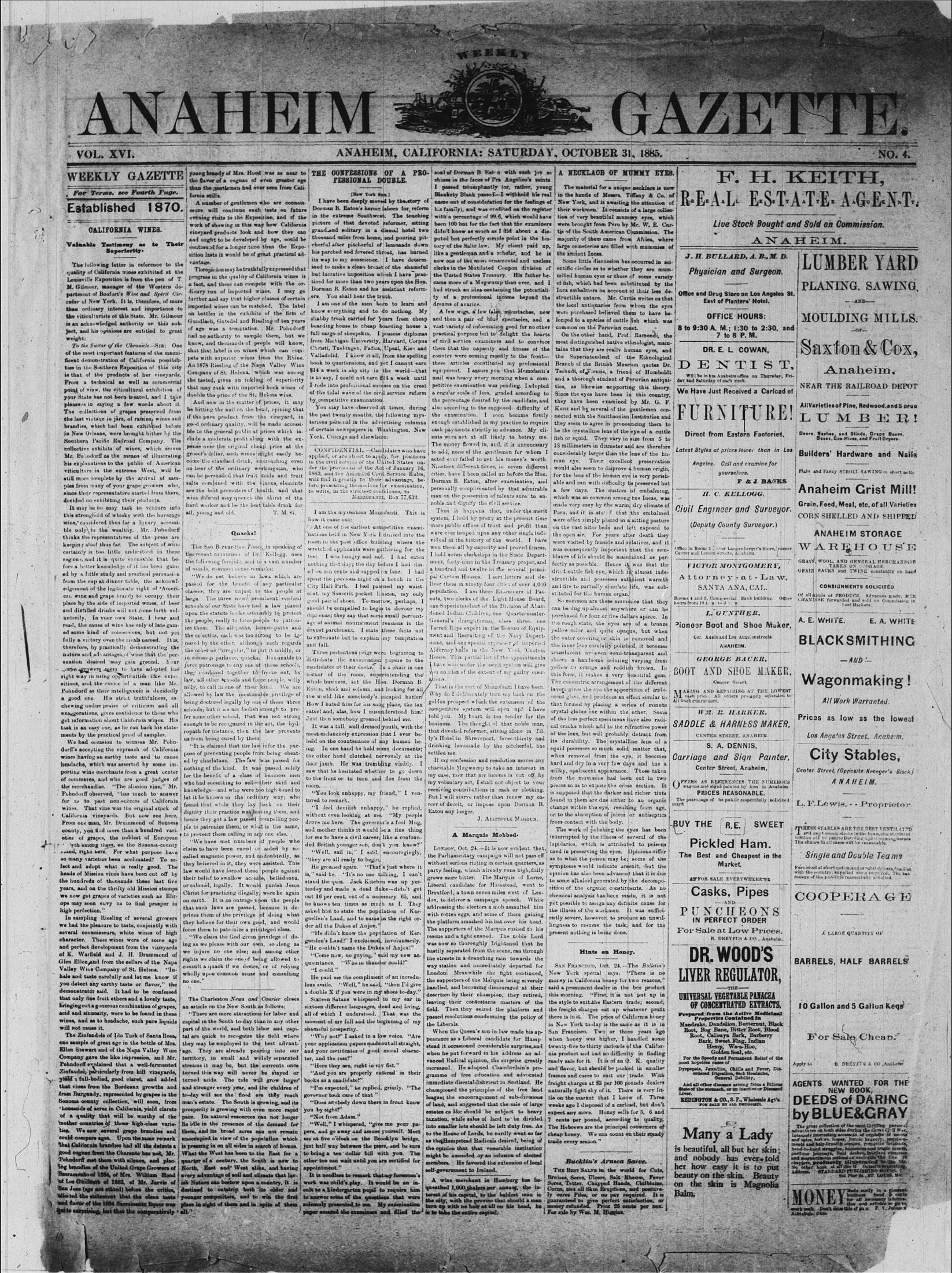
Searchable text
WEEKLY GAZETTE
For Terms, see Fourth Page.
Established 1870.
CALIFORNIA WINES.
Valuable Testimony as to Their Superiority.
The following letter in reference to the quality of California wines exhibited at the Louisville Exposition is from the pen of T. M. Gilmour, manager of the Western department of Bonfort's Wine and Spirit Circular of New York. It is, therefore, of more than ordinary interest and importance to the viticulturists of this State. Mr. Gilmour is an acknowledged authority on this subject, and his opinions are entitled to great weight:
To the Editor of the Chronicle—SIR: One of the most important features of the magnificent demonstration of California possibilities in the Southern Exposition of this city is that of the products of her vineyards. From a technical as well as commercial point of view, the viticultural exhibition of your State has not been treated, and I take pleasure in saying a few words about it. The collections of grapes preserved from the last vintage in jars, of raisins, wines and brandies, which had been exhibited before in New Orleans, were brought hither by the Southern Pacific Railroad Company. The collective exhibits of wines, which serves Mr. Pohndorff as the means of illustrating his explanations to the public of American viticulture in the extreme West, will be young brandy of Mrs. Hood was as near to the flavor of a cognac of even greater age than the gentlemen had ever seen from California stills.
A number of gentlemen who are connoisseurs will continue such tests on future evening visits to the Exposition, and if the work of showing in this way how California vineyard products look and how they can and ought to be developed by age, could be continued for a longer time than the Exposition lasts it would be of great practical advantage.
The opinion may be truthfully expressed that progress in the quality of California wines is a fact, and these can compete with the ordinary run of imported wines. I may go further and say that higher classes of certain imported wines can be matched. The label on bottles in the exhibits of the firm of Gundlach, Gutedel and Riesling of ten years of age was a temptation. Mr. Pohndorff had no authority to sample them, but we know, and thousands of people will know, that that label is on wines which can compete with superior wines from the Rhine. An 1878 Riesling of the Napa Valley Wine Company of St. Helena, which was among the tasted, gives an inkling of superiority that may rank with imported hock wines of double the price of the St. Helena wine.
And now in the matter of prices, it may be bitting the nail on the head, opining that if the pure product from the vineyard, in good ordinary quality, will be made accessible to the general public at prices which include a moderate profit along with the expense over the original cheap price at the grocer's cellar, such wines might easily become the standard drink, encroaching even on beer of the ordinary workingman, who could be considered that fruit without time.
THE CONFIDENTIAL PESSION
I have been de Dorman B. Eaton in the extreme picture of that grand and solitary thousand miles far cherful after pitting his parched and its way to my coined to make a clue but lucrative impulse for more than Dorman B. Eatoners. You shall have I am one of the know everything shabby trunk car boarding house to full cargo of sheer from Michigan U. Christi, Tuebingen Valladolid. I like book to quartern $14 a week in any is to say, I could I rode into professional of the tidal wave by competitive exe.
You may have the past twenty mterious personal intends certain newspapers York, Chicago an
From a technical as well as commercial point of view, the viticultural exhibition of your State has not been treated, and I take pleasure in saying a few words about it. The collections of grapes preserved from the last vintage in jars, of raisins, wines and brandies, which had been exhibited before in New Orleans, were brought hither by the Southern Pacific Railroad Company. The collective exhibits of wines, which serves Mr. Pohndorff as the means of illustrating his explanations to the public of American viticulture in the extreme West, will be still more complete by the arrival of samples from many of your grape growers who, since their representative started from there, decided on exhibiting their products.
It may be no easy task to venture into this stronghold of whisky with the beverage wine, considered thus far a luxury accessible only to the wealthy. Mr. Pohndorff thinks the representatives of the press are keeping aloof thus far. The subject of wine certainly is too little understood in these regions, and it is quite excusable that before a better knowledge of it has been gained by a little study and practical persuasion from the cup at dinner table, the acknowledgment of the legitimate right of American wine and grape brandy to occupy their place by the side of imported wines, of beer and distilled drinks will not come forth voluntarily. In your own State, I hear and real, the cause of wine has only of late gained some kind of concessions, but not yet fully a victory over the rivals named. It is therefore, by practically demonstrating the nature and advantages of wine that the persuasion desired may gain ground. Your grape growers seem to have adopted the right way in using opportunities like expositions, and the choice of a man like Mr. Pohndorff as their intelligencer is decidedly a good one. His strict truthfulness, eschewing undue praise or criticism and all exaggerations, gives confidence to those who get information about California wines. His task is an easy one, as he can back his statements by the practical proof of samples.
We had occasion to witness Mr. Pohndorff's accepting the reproach of California wines having an earthy taste and to cause headache, which was asserted by some importing wine merchants from a great center of commerce, and who are good judges of the merchandise. "The mission vine," Mr. Pohndorff observed, "has much to answer for as to past non-success of California wines. That vine was the original stock of California vineyards. But now see here, From one man, Mr. Drummond of Sonoma county, you find more than a hundred varieties of grapes, the noblest of European vines among them, on the Sonoma-county land, rights here. For what purpose have so many varieties been acclimated? To select and adopt what is really good. The heads of Mission vines have been cut off by the hundreds of thousands these last five years, and on the thrifty old Mission stumps we now get grapes of varieties such as Ehrh
Company of O. Hertzman, having in the tasted, gives an inkling of superiority that may rank with imported hock wines of double the price of the St. Helena wine.
And now in the matter of prices, it may be hitting the nail on the head, opening that if the pure product from the vineyard, in good ordinary quality, will be made accessible to the general public at prices which include a moderate profit along with the expense over the original cheap price at the grocer's cellar, such wines might easily become the standard drink, encroaching even on beer of the ordinary workingman, who can be persuaded that fruit acids and fruit salts combined with the vinous elements are the best promoters of health, and that wine diluted may quench the thirst of the hard worker and be the best table drink for all, young and old.
T. M. G.
Quacks!
The San Bernardino Times, in speaking of the recent conviction of Dr. Kellegg, uses the following forebids, and to a vast number of minds, common sense remarks:
"We do not believe in laws which are passed for the benefit of any particular classes; they are unjust to the people at large. The three most prominent medical schools of our State have had a law placed upon the statute books ostensibly to protect the people, really to force people to patronize them. The allopaths, homoeopaths and eclectics, each was too strong to be ignored by the other, although each regards the other as 'irregular,' to put it mildly, or in common parlance, quacks. But unable to force patronage to any one of these schools, they combined together to freeze out, by law, all other schools and force people, willy nilly, to call in one of their kind. We are allowed by law the inestimable privilege of being doctored legally by one of these three schools; but if we are foolish enough to prefer some other school, that was not strong enough to be recognized in the act, the hydropath for instance, then the law prevents us from being cured by them.
"It is claimed that the law is for the purpose of preventing people from being cheated by charlatans. The law was passed for nothing of the kind. It was passed solely for the benefit of a class of business men who had something to sell—their skill and knowledge—and who were too high-toned to let it be known in the ordinary way; who found that while they lay back on their dignity their practice was leaving them, and hence they got a law passed compelling people to patronize them; or what is the same, to prevent them calling in any one else.
"We have met numbers of people who claim to have been cured or aided by so-called magnetic power, and undoubtedly, as they believed in it, they were assisted. This law would have forced these people against their belief to swallow aconile, belladonna, or calomel, legally. It would punish Jesus Christ for practicing illegally, were he again tainted."
I am the mysterious how it came out:
At one of the ea nations held in New room in the post o wretched applicant test. I was hung nothing that day; ed on ten cents an spent the previous City Hall Park.
coat, my Sanscrit good pair of shoes should be compelled diplomas; they say age of animal now dryvest parchment; to extenuate but to end fall.
Three portentous distribute the ex candidates at their corner of the ro whole business, sa Eaton, sleek and s he world like son How I hated him f eater! and alas, he Just then somebody.
It was a tall, we most melancholy ex held on the count ing. In one hand he other hand clo door jamb. He w saw that he hesitate to the front or to room.
"You look unhappy tured to remark.
"I feel devilish without even looking drove me here. Th and mother thinks for me to have a ci ded British youngge"
Well, sail in,
they are all really He groaned again is," said he. "It's stand the quiz Jas terday and made a out 16 per cent on
for as to past non-success of California wines. That vine was the original stock of California vineyards. But now see here, From one man, Mr. Druimond of Sonoma county, you find more than a hundred varieties of grapes, the noblest of European wine among them, on the Sonoma-county land, rights here. For what purpose have so many varieties been acclimated? To select and adopt what is really good. The heads of Mission vines have been cut off by the hundreds of thousands these last five years, and on the thrifty old Mission stumps we now get grapes of varieties such as Europe may soon envy us to find prosper in high perfection."
In sampling Riesling of several growers we had the pleasure to taste, conjointly with several connoisseurs, white wines of high character. These wines were of some age and perfect development from the vineyards of K. Warfield and J. H. Drummond of Glen Ellen and from the cellars of the Napa Valley Wine Company of St. Helena. "Inhale and taste carefully and let me know if you detect any earthy taste or flavor," the demonstrator said. It had to be confessed that only fine fruit ethers and a lovely taste, bringing out a generous combination of grapes, acid and sinosity, were to be found in these wines, and as to headache, such pure liquids will not cause it.
The Zinfandels of Ido Turk of Santa Rosa, one sample of great age in the bottle of Mrs. Ellen Stewart and of the Napa Valley Wine Company gave the like impression, and Mr. Pohndorff explained that a well-fermented Zinfandel, particularly from hill vineyards, yield a full-bodied, good claret, and added that vines from the Bordeaux growths and from Burgundy, represented by grapes in the Sonoma county collection, will soon, from thousands of acres in California, yield clarets of a quality that will be worthy of the mother countries of those high-class varieties. We saw several grape brandies and could compare ages. Upon the same remark that California brandies had all the defects a good cognac from the Charente has not, Mr. Pohndorff met them with silence, and placing brandies of the United Grape Growers of Sacramento of 1884, of Mrs. William Hood of Los Guillermo of 1883, of Mr. Jarvis of San Jose (age not stated) before the critics, allocated the statement that the clean taste and flavor of the 1884 Sacramento liquor was quite surprising, but that the comparatively
The Charleston News and Courier closes an article on the New South as follows:
"There are more attractions for labor and capital in the South to-day than in any other part of the world, and both labor and capital are quick to recognize the field where they may be employed to the best advantage. They are already pouring into our territory, in small and widely separated streams it may be, but the currents once turned this way will never be stayed or turned aside. The tide will grow larger and stronger every year, and the children of to-day will see the flood ere they reach man's estate. The South is growing, and its prosperity is growing with even more rapid pace. Its natural resources can not longer lie idle in the presence of the demand for them, and its broad acres can not remain unoccupied in view of the population which is pressing in on all sides in search of homes. What the West has been to the East for a quarter of a century, the South is now to North, East and West alike, and having every advantage of soil and climate that lawish Nature can bestow upon a country, it is destined to outstrip both its older and younger competitors, and to win the first place in sight of them and in spite of them all."
WEEKLY
EIM GA
ANAHEIM, CALIFORNIA: SATURDAY, OCTOBER 31, 1885.
THE CONFESSIONS OF A PROFESSIONAL DOUBLE.
[New York Sun.]
I have been deeply moved by the story of Dorman B. Eaton's heroic labors for reform in the extreme Southwest. The touching picture of that devoted reformer, sitting grand and solitary in a dismal hotel two thousand miles from home, and pouring pitcherful after pitcherful of lemonade down his parched and fevered throat, has burned its way to my conscience. I have determined to make a clean breast of the shameful but lucrative imposition which I have practiced for more than two years upon the Hon. Dorman B. Eaton and his assistant reformers. You shall hear the truth.
I am one of the men born to learn and know everything and to do nothing. My shabby trunk carried for years from cheap boarding house to cheap boarding house a full cargo of sheepskin. I possess diplomas from Michigan University, Harvard, Corpus Christi, Tuebingen, Padua, Upsal, Kiev and Valladolid. I know it all, from the spelling book to quarternions, and yet I cannot earn $14 a week in any city in the world—that is to say, I could not earn $14 a week until I rode into professional success on the crest of the tidal wave of the civil service reform by competitive examination.
You may have observed at times, during the past twenty months, the following mysterious personal in the advertising columns of certain newspapers in Washington, New York, Chicago and elsewhere:
CONFIDENTIAL. —Candidates who have applied, or are about to apply, for positions in the civil service of the United States under the provisions of the Act of January 16, 1883, and the Amended Civil Service Rules.
A NECKLADE OF MUMMY EYES
The material for a unique necklace is now in the hands of Messra. Tiffany & Co. of New York, and is awaiting the attention of their workmen. It consists of a large collection of very beautiful mummy eyes, which were brought from Peru by Mr. W. E. Curtis of the South American Commission. The majority of them came from Africa, where large cemeteries are filled with mummies of the ancient Incas.
Some little discussion has occurred in scientific circles as to whether they are mummified human eyes or those of some variety of fish, which had been substituted by the Inca embalmers on account of their less destructible nature. Mr. Curtis writes us that the local antiquaries from whom the eyes were purchased believed them to have belonged to a species of cuttlefish which was common on the Peruvian coast.
On the other hand, Prof. Ramondi, the most distinguished native ethnologist, maintains that they are really human eyes, and the Superintendent of the Ethnological Branch of the British Museum quotes Dr. Tschudi, of Vienna, a friend of Humboldt and a thorough student of Peruvian antiquities, as likewise supporting this theory. Since the eyes have been in this country, they have been examined by Mr. G. F. Kunz and by several of the gentlemen connected with the Smithsonian Institution and they seem to agree in pronouncing them to be the crystalline lens of the eye of a cuttlefish or squid. They vary in size from 5 to 18 millimeters in diameter and are therefore considerably larger than the lens of the human eye. Their excellent preservation would also seem to disprove a human origin, for the loss of the human eye is common on the Peruvian coast.
CONFIDENTIAL. — Candidates who have applied, or are about to apply, for positions in the civil service of the United States under the provisions of the Act of January 16, 1883, and the Amended Civil Service Rules, will find it greatly to their advantage, before presenting themselves for examination, to write, in the strictest confidence, to Mezzofanti, Box 77,632.
I am the mysterious Mezzofanti. This is how it came out:
At one of the earliest competitive examinations held in New York I drilled into the room in the post office building where the wretched applicants were gathering for the test. I was hungry and sad. I had eaten nothing that day; the day before I had dined on ten cents and supped on four. I had spent the previous night on a bench in the City Hall Park. I had pawned my waistcoat, my Samscriet pocket lexicon, my only good pair of shoes. To morrow, perhaps, I should be compelled to begin to devour my diplomas; they say that some small percentage of animal nourishment remains in the dryest parchment. I state these facts not to extenuate but to explain my temptation and fall.
Three portentous prigs were beginning to distribute the examination papers to the candidates at their desks. In a chair in one corner of the room, superintending the whole business, sat the Hon. Dorman B. Eaton, sleek and solemn, and looking for all the world like somebody's escaped butler! How I hated him for his sung place, the tax eater! and alas, how I misunderstood him! Just then somebody groaned behind me.
It was a tall, well-dressed youth, with the most melancholy expression that I ever behold on the countenance of any human being. In one hand he held some documents; the other hand clutched nervously at the door jamb. He was trembling visibly. I saw that he hesitated whether to go down to the front or to turn and flee from the room.
"You look unhappy, my friend," I ventured to remark.
"I feel devilish unhappy," he replied, without even looking at me. "My people drove me here. The governor's a fool Mug, and mother thinks it would be a fine thing for me to have a civil career, like a confounded British younger son, don't you know?"
"Well, sail in," I said, encouragingly, "they are all ready to begin."
He groaned again. "That's just where it is," said he. "It's no use talking, I can't stand the quiz. Jack Kitchen was up yesterday and made a dead fluke—didn't get out 16 per cent. out of a necessary 65, and mail was heavy every morning when a competitive examination was pending. I adopted a regular scale of fees, graded according to the percentage desired by the candidate, and also according to the supposed difficulty of the examination. I soon became firmly enough established in my practice to require cash payments strictly in advance. My clients were not at all likely to betray me. The money flowed in, and, it is unnecessary to add, none of the gentlemen for whom I acted ever failed to get his money's worth. Nineteen different times, in seven different cities, have I been called up before the Hon. Dorman B. Eaton, after examination, and personally complimented by that admirable man on the possession of talents sure to enoble and dignify the civil service.
Thus it happens that, under the merit system, I hold by proxy at the present time more public offices of trust and profit than ever heaped upon any other single individual in the history of the world. I have won them all by capacity and proved fitness. I hold seven clerkships in the State Department, forty-nine in the Treasury proper, and a hundred and twelve in the several principal Custom Houses. I sort letters and deliver them in ninety-four cities of over 4,000 population. I am three Examiners of Patents, two clerks of the Light House Board, one Superintendent of the Division of Abandoned Indian Children, one Quartermaster-General's draughtman, class three. One Tarred Rope expert in the Bureau of Equipment and Recruiting of the Navy Department, and one special appraiser of imported Alderney bulls in the New York Custom House. This partial list of the appointments I have won under the merit system will give you an idea of the extent of my guilty operations.
That is the sort of Mezzofanti I have been. Why do I deliberately turn my back on the golden prospect which the extension of the competitive system will open up? I have told you. My heart is too tender for the business. The thought of that noble man, that devoted reformer, sitting alone in Filly's Hotel in Shrevenport, fever-thirsty and drinking lemonade by the pitcherful, has settled me.
If my confession and resolution moves any charitable Magwump to take an interest in my case, now that my income is cut off by my voluntary act, I shall not object to your receiving contributions in cash or clothing. But I will starve rather than renew my career of deceit, or impose upon Dorman B. Eaton any longer.
J. ARISTOTLE MAGOUN.
A Marquis Mobbed·
LONDON, Oct. 24. — It is now evident that the Parliamentary campaign will not pass off without serious rioting in certain quarters, as party feeling, which already runs high daily grows more bitter. The Marquis of Lorne, Liberal candidate for Hamstead, went to Brentford, a town seven miles west of London and a thorough student of Peruvian antiquities, as likewise supporting this theory. Since the eyes have been in this country, they have been examined by Mr. G. F. Kunz and by several of the gentlemen connected with the Smithsonian Institution and they seem to agree in pronouncing them to be the crystalline lens of the eye of a cuttle fish or squid. They vary in size from 5 to 18 millimeters in diameter and are therefore considerably larger than the lens of the human eye. Their excellent preservation would also seem to disprove a human origin, for the lens of the human eye is very perishable and can with difficulty be preserved but a few days. The custom of embalming, which was so common among the Incas, was made very easy by the warm dry climate of Peru, and it is stated that the embalmed were often simply placed in a sitting posture on the vast niter beds and left exposed to the open air. For years after death they were visited by friends and relatives, and it was consequently important that the semblance of life should be maintained as perfectly as possible. Hence it was that the dried cuttle fish eye, which is almost indestructible and possesses sufficient warmth and fire to partially simulate life, was substituted for the human organ.
So common are these mummies that they can be dug up almost anywhere or can be purchased for four or five dollars apiece. In the rough state, the eyes are of a bronze yellow color and quite opaque, but when the outer covering or skin is removed and the inner lens carefully polished, it becomes translucent or even semi-transparent and shows a handsome coloring varying from yellow to orange and reddish brown. In this form, it makes a very beautiful gem.
The concentric arrangement of the different layers gives the eye appearance of iridescent glass, and produces an effect similar to that formed by placing a series of minute crystal globes one within the other. Some of the less perfect specimens have also radical cracks which add to the refractive power of the lens, but will probably detract from its durability. The crystalline lens of a squid possesses so much solid matter that, when removed from the eye, it becomes hard and dry in a very few days and has a milky, opalescent appearance. Those taken from the mummies had been cut in two pieces so as to expose the cross section. It is supposed that the darker and richer tints found in them are due either to an organic change within the eye, resulting from age, or to the absorption of juices or antiseptics from contact with the body.
The work of polishing the eyes has been interrupted by the illness of several of the lapidaries, which is attributed to poisons used in preserving the eyes. Opinions differ as to what the poison may be; some of the symptoms would indicate arsenic; but the opinion has also been advanced that it is due to some alkaloid generated by the decomposition of the organic constituents. As no chemical analysis has been made, it is not
"I feel devilish unhappy," he replied, without even looking at me. "My people drove me here. The governor's a fool Mug, and mother thinks it would be a fine thing for me to have a civil career, like a confounded British younger son, don't you know?"
"Well, sail in," I said, encouragingly, "they are all ready to begin.
He groaned again. 'That's just where it is,' said he. 'It's no use talking, I can't stand the quiz. Jack Kitchen was up yesterday and made a dead fluke—didn't get out 16 per cent, out of a necessary 65, and he knows ten times as much as I. They asked him to state the population of Kerguelen's Land, and to name in the right order all the Dukes of Anjon."
"He didn't know the population of Kerguelen's Land!" I exclaimed, involuntarily. "He couldn't name the Dukes of Anjon!"
"Come now, no guying," said my new acquaintance. "Who in thunder could?"
"I could."
He paid me the compliment of an incredulous smile. "Well," he said, "then I'd give a double X if you were in my shoes to-day."
Sixteen Satans whispered in my ear in sixteen different languages, dead and living, all of which I understood. That was the moment of my fall and the beginning of my shameful prosperity.
"Why not?" I asked in a low voice. "Are your application papers made out all straight, and your certificates of good moral character, and the rest?"
"Here they are, right in my fist."
"And you are properly entered in their books as a candidate?"
"I'm expected," he replied, grinly. "The governor took care of that."
"Does anybody down there in front know you by sight?"
"Not from Adam."
"Well," I whispered, "give me your papers, and go away and amuse yourself. Meet me at five o'clock on the Brooklyn bridge, just half way between the pier, and be sure to bring a ten dollar bill with you. The other ten can wait until you are certified for appointment."
It is needless to remark that my forenoon's work was child's play. It would be an insult to a kindergarten pupil to require him to answer some of the questions that were solemnly presented to me. My examination paper amazed the examiners and filled the
A Marquis Mobbed.
London, Oct. 24. — It is now evident that the Parliamentary campaign will not pass off without serious rioting in certain quarters, as party feeling, which already runs high, daily grows more bitter. The Marquis of Lorne, Liberal candidate for Hamatead, went to Brentford, a town seven miles west of London, to deliver a campaign speech. While addressing the electors a mob assaulted him with rotten eggs, and some of them gaining the platform smashed his hat over his head. The supporters of the Marquis rushed to his rescue and a tight ensued. The noble Lord was now so thoroughly frightened that he hastily separated from the scene, ran through the streets in a drenching rain towards the way station and immediately departed for London. Meanwhile the fight continued, the supporters of the Marquis being severely handled, and becoming discouraged at their desertion by their champion, they retired, leaving their contestants masters of the field. Then they seized the platform and passed resolutions condemning the policy of the Liberals.
When the Queen's son-in-law made his appearance as a Liberal candidate for Hampstead it occasioned considerable surprise, and when he put forward in his address an advanced Radical opinion, the surprise greatly increased. He adopted Chamberlain's programme of free education and advocated immediate disestablishment in Scotland. He championed the principles of the free land league; the encouragement of sub-divisions of land, and suggested that the sale of large estates en bloc should be subject to heavy taxation, while sales of land to be divided into smaller lots should be left duty free. As to the House of Lords, he hardly went so far as the Hampstead Radicals desired, being of the opinion that that venerable institution might be amended by an infusion of elected members. He favored the extension of local self-government to Ireland.
A wine merchant in Hamburg has bequeathed 1,000 thalers per annum, the interest of his capital, to the baldest man in the city, with the proviso that should a man turn up with no hair at all on his head, he is to take the entire capital.
Hints on Honey.
San Francisco, Oct. 24. — The Bulletin's New York special says: "There is no money in California honey for two reasons," said a prominent dealer in the bee product this morning. "First, it is not put up in the style to suit the Eastern trade; second, the freight charges eat up whatever profit there is in it. The price of California honey in New York to-day is the same as it is in San Francisco. Two or three years ago when honey was higher, I handled some twenty-five to thirty carloads of the California product and had no difficulty in finding ready sale for it. It is of an O. K. quality and flavor, but should be packed in smaller frames and cases to suit our trade. With freight charges at 83 per 100 pounds dealers naturally fight shy of it. There is very little on the market that I know of. Three weeks ago I disposed of a carload, but don't expect any more. Honey sells for 5, 6 and 7 cents per pound, according to quality. The Hebrews are the principal consumers of cheap honey. We can count on their steady trade every season."
Bucklin's Arnica Salve.
The Best Salve in the world for Cuts, Bruises, Sores, Ulcers, Salt Rheum, Fever Sores, Tetter, Chapped Hands, Chillblains, Corms, and all Skin Eruptions, and positively cures Piles, or no pay required. It is guaranteed to give perfect satisfaction, or money refunded. Price 25 cents per box. For sale by Wm. M. Higginss
GAZETTE.
BER 31, 1885.
NO. 4.
F. H. KEITH,
REAL ESTATE AGENT:
Live Stock Bought and Sold on Commission.
ANAHEIM.
J. H. BULLARD, A. B., M. D.
Physician and Surgeon.
Office and Drug Store on Los Angeles St.
East of Planters' Hotel.
OFFICE HOURS:
8 to 9:30 A.M.; 1:30 to 2:30, and
7 to 8 P.M.
DR. E. L. COWAN,
DENTIST,
Will be in his Anaheim office on Thursday, Friday and Saturday of each week.
We Have Just Received a Carload of
FURNITURE!
Direct from Eastern Factories.
Latest Styles at prices lower than in Los
Angeles. Call and examine for
yourselves.
LUMBER YARD
PLANING, SAWING,
AND
MOULDING MILLS.
of
Saxton & Cox,
Anaheim.
NEAR THE RAILROAD DEPOT
All Varieties of Pine, Redwood, and Spruce
LUMBER!
Doors, Sashes, and Blinds, Grape Boxes,
Boxes, Doe-Hives, and Fruit Dryners.
Builders' Hardware and Nails
Plain and Fancy SCROLL SAWING in short notice
We Have Just Received a Carload of FURNITURE!
Direct from Eastern Factories,
Latest Styles at prices lower than in Los Angeles. Call and examine for yourselves.
H. C. KELLOGG.
Civil Engineer and Surveyor.
(Deputy County Surveyor.)
VICTOR MONTGOMERY,
Attorney-at-Law,
SANTA ANA, CAL.
Rooms 4 and 5, Commercial Bank building. Office hours from 10 A.M. to 3 P.M.
L. GUNTHER,
Pioneer Boot and Shoe Maker,
Cor. Adele and Los Angeles streets.
GEORGE BAUER,
BOOT AND SHOE MAKER,
Center Street.
MAKING AND REPAIRING AT THE LOWEST cash price. All orders promptly attended to. All work guaranteed.
WM. R. HARKER,
SADDLE & HARNESS MAKER,
CENTER STREET, ANAHEIM.
S. A. DENNIS,
Carriage and Sign Painter,
Center Street, Anaheim.
OFFERS AS REFERENCES: THE NUMEROUS wagons and signs painted by him in Anaheim.
PRICES REASONABLE.
The patronage of the public respectfully solicited may
BUY THE R.E. SWEET
Pickled Ham.
The Best and Cheapest in the Market.
FOR SALE EVERYWHERE
Casks, Pipes
NEAR THE RAILROAD DEPOT
All Varieties of Pine, Redwood, and Spruce LUMBER!
Deers, Sashes, and Blinds, Grape Boxes, Boxes, Bee-Hives, and Fruit Dryers.
Builders' Hardware and Nails
Plain and Fancy SCROLL SAWING in short notice
Anaheim Crist Mill!
Grain, Feed, Meal, etc., of all Varieties CORN SHELLED AND SHIPPED
ANAHEIM STORAGE
WAREHOUSE
GRAIN, WOOL, AND GENERAL MERCHANDISE TAKEN ON STORAGE.
GRAIN BACKS and TWINE constantly on hand
CONSIGNMENTS SOLICITED
Of all kinds of PRODUCE. Advances made, MUR CHANDISE forwarded and sold on Commission in best Markets.
A. E. WHITE.
E. A. WHITE
BLACKSMITHING
— AND —
Wagonmaking!
All Work Warranted.
Prices as low as the lowest
Los Angeles Street, Anaheim.
City Stables,
Center Street (Opposite Kroeger's Block)
ANAHEIM.
L. F. Lewis.- Proprietor
THESE STABLES ARE THE BEST VENTILATED AND most commodious in the town, and especially tention will be paid to Boarding and Grooming heroes.The charge in all cases will be reasonable.
Single and Double Teams
Furnished at short notice; and careful drivers, familiar with the country; supplied when required. The buttorage of the public is respectfully solicited.
BUY THE R.E. SWEET
Pickled Ham.
The Best and Cheapest in the Market.
Casks, Pipes
AND
PUNCHEONS
IN PERFECT ORDER
For Sale at Low Prices.
B. DREYFUS & CO., Anabeim.
DR. WOOD'S
LIVER REGULATOR,
THE
UNIVERSAL VEGETABLE PANACEA OF CONCENTRATED EXTRACTS.
Prepared from the Active Medicinal Properties Contained in Mandrake, Dandelion, Butternut, Black Root, Bog Bane, Bitter Root, Blood Root, Calisaya Bark, Barberry Bark, Sweet Flag, Indian Hemp, Wa-a-Hoo, Golden Seal, etc.
For the Speedy and Permanent Relief of the most hopeless cases of Dyspepsia, Jaundice, Chills and Fever, Disordered Digestion, Stick Headache, General Debility.
And all other diseases arising from a Billions State of the stomach, or an Inactive or Discased Liver.
REDINGTON & CO., S. F., Wholesale Agt's.
FOR SALE BY ALL DRUGGISTS.
Many a Lady is beautiful, all but her skin; and nobody has ever told her how easy it is to put beauty on the skin. Beauty on the skin is Magnolia Balm.
MONEY Made easily in a pleasant business Send 5 cents for all necessary information and articles so go to work with. Don't miss this en x. F. V. Johnson Aldabula, Ohio.