anaheim-gazette 1885-10-17
Scanned page
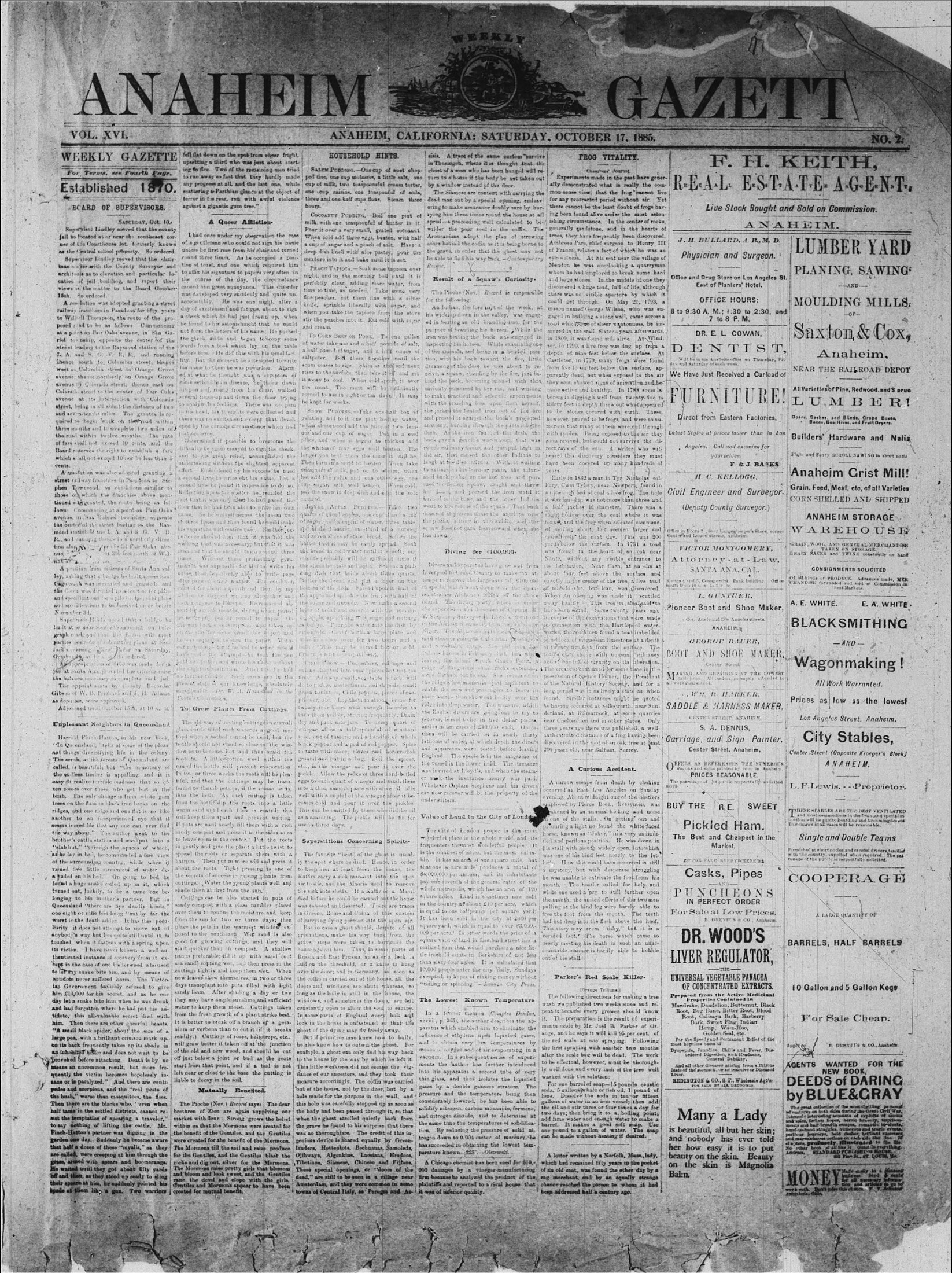
Searchable text
WEEKLY GAZETTE
For Terms, see Fourth Page.
Established 1870.
BOARD OF SUPERVISORS.
SATURDAY, Oct. 10.
Supervisor Lindley moved that the county jail be located at or near the southeast corner of the Courthouse lot, formerly known as the Central school property. So ordered.
Supervisor Lindley moved that the chairman center with the County Surveyor and architects as to elevation and particular location of jail building, and report their views on the matter to the Board October 15th. So ordered.
A resolution was adopted granting a street railway franchise in Pasadena for fifty years to Willell Thompson, the route of the proposed road to be as follows: Commencing at a point on Fair Oaks avenue, in San Gabriel township, opposite the center of the street leading to the Raymond station of the L. A. and S. G. V. R. R., and running thence south to Columbia street; then west on Columbia street to Orange Grove avenue; then northerly on Orange Grove avenue to Colorado street; then east on Colorado street to the center of Fair Oaks avenue at its intersection with Colorado street, being in all about the distance of two and seventeen miles. The grantee is required to begin work on the road within three months and to complete two miles of the road within twelve months. The rate of fare shall not exceed 10 cents, and the Board reserves the right to establish a fare which shall not exceed 10 nor be less than 5 cents.
A resolution was also adopted granting a fell flat down on the spot from sheer fright, upsetting a third who was just about starting to flee. Two of the remaining men tried to run away so fast that they hardly made any progress at all, and the last one, while scattering a Parthian glance at the object of terror in his rear, ran with awful violence against a gigantic gum tree."
A Queer Affliction.
I had once under my observation the case of a gentleman who could not sign his name unless he first rose from his chair and turned round three times. As he occupied a position of trust, and one which required him to affix his signature to papers very often in the course of the day, the circumstance caused him great annoyance. This disorder was developed very suddenly and quite unaccountably. He was one night, after a day of excitement and fatigue, about to sign a check which he had just drawn up, when he found to his astonishment that he could not form the letters of his name. He pushed the cheek aside and began to copy some words from a book which lay on the table before him. He did this with his usual facility. But the moment he attempted to write his name to them he was powerless. Alarmed at what he thought was a symptom of some serious brain disease, he threw down his pan and, rising from his chair, walked several times up and down the floor trying to analyze his feelings. There was no pain in his head, his thoughts were collected and there was no excitement except that developed by the curious circumstance which had just occurred.
Determined if possible to overcome the difficulty he again essayed to sign the check, and to his great relief, accomplished the undertaking without the slightest apparent effort. Emboldened by his success he tried...
A resolution was also adopted granting a street railway franchise in Pasadena to Stephen Townsend, on conditions similar to those on which the franchise above mentioned was granted, the route being as follows: Commencing at a point on Fair Oak Avenue, in San Gabriel township, opposite the center of the street leading to the Ravmond station (Mine L. A. and B. G. V. R., and running thence in a northerly direction along M. P. of said Fair Oak avenue, at 300 feet north of Walnut Ave.
A petition from citizens of Santa Ana valley, asking that a bridge be built across Santiago Creek was presented and granted; and the Court was directed to advertise for plans and specifications for a pile bridge; said plans and specifications to be focussed on or before November 31.
Supervisor Hinds moved that a bridge be built at or near Seaford's crossing on Telegraph road, and that the Board will meet parties sessions of submitting plans at Sanford's crossing at New Porter on Saturday, October 24 at 10 A.M. of the ordered.
An appropriation of $160 was made for a jail at Santa Ana provided the citizens raise the balance necessary to complete said jail.
The appointments by County Recorder Gibson of W. B. Prichard and J. H. Adams as deputies were approved.
Adjourned no October 15th, at 10 A.M.
Unpleasant Neighbors in Queensland
Harold Finch Hatton, in his new book, "In Queensland," tells of some of the pleasant things diversifying life in the colony: The scrub, as the forests of Queensland are called, is beautiful; but "the monotony of the endless timber is appalling, and it is easy to realize terrible madness that so often comes over those who get lost in the bush. The only change is from white gum trees on the flats to black iron barks on the ridges, and one ridge and one flat is so like another to an闷experienced eye that it seems incredible that any one can ever find the way about." The author went to the brother's cattle station and was put into a "alab hut," "through the spaces of which, as he lay in bed, he commanded a fine view of the surrounding country, while when it rained five little streamlets of water de- juded on his bed." On going to bed he found a huge snake coiled up in it, which turned out, luckily, to be a tame one belonging to his brother's partner. But in the old way of rooting cuttings in a small glass bottle filled with water is a good method when a hotbed cannot be used, but the bottle should not stand so close to the window as to become hot and thus scald the roots. A little cotton wool within the rim of the bottle will prevent evaporation. In two or three weeks the roots will be plentiful, and then the cuttings may be transferred to thumb potsker, if the season suits, into the beds. As each cutting is taken from the bottlldip the roots into a little warm sand until each fiber is created; this will keep them apart and prevent wilting. If pots are used heavily fill them with a rich sandy compost and press it to the sides so as to leave room in the center. Put the roots gently and give the plant a little twist to spread the roots or separate them with a hairpin. Then put in more soil and press it about the roots. Tight pressing is one of the secrets of success in raising plants from cuttings. Water the young plants well and shade them at first from the sun.
Cuttings can be also started in pots of some section brain disease, he throw down his pen and rising from his chair, walked several times up and down the floor trying to analyze his feelings. There was no pain in his head, his thoughts were collected and there was no excitement except that developed by the curious circumstance which had just occurred.
Determined if possible to overcome the difficulty he again essayed to sign the check, and to his great relief, accomplished the undertaking without the slightest apparent effort. Embodied by his success he tried a second time to write out his name, but a second time he found it impossible to do so. Reflecting upon the matter he recalled the fact that it was only after he had paced the floor that he had been able to grate his own name. So he walked across the room two of three times and then found he could make his signature with entire ease. Further experience showed him that it was not the walking that was necessary; but that it was essential that he should turn around three times. Without these preliminary gyrations it was impossible for him to write his name, though perfectly able to write page after page of other matter. The condition existed for about a month and then by my addition he stopped writing all further and took a walk to Europe. He remained absent for several months, during which period he never put pen or pencil to paper. On the way back a subscript on what it knew up on the ship he came charitable albeit and he was required to sign the paper. Without rather strenuous effort if he had no never would have done the attempt—he took the pen held out to him and wrote his right without the slightest hesitation. After this he hall no further trouble. Such cases are in the present state of our knowledge, absolutely most probable.
To Grow Plants From Cuttings.
The old way of rooting cuttings in a small glass bottle filled with water is a good method when a hotbed cannot be used, but the bottle should not stand so close to the window as to become hot and thus scald the roots. A little cotton wool within the rim of the bottle will prevent evaporation. In two or three weeks the roots will be plentiful, and then the cuttings may be transferred to thumb potsker, if the season suits, into the beds. As each cutting is taken from the bottlldip the roots into a little warm sand until each fiber is created; this will keep them apart and prevent wilting. If pots are used heavily fill them with a rich sandy compost and press it to the sides so as to leave room in the center. Put the roots gently and give the plant a little twist to spread the roots or separate them with a hairpin. Then put in more soil and press it about the roots. Tight pressing is one of the secrets of success in raising plants from cuttings. Water the young plants well and shade them at first from the sun.
Cuttings can be also started in pots of some section brain disease, he throw down his pen and rising from his chair, walked several times up and down the floor trying to analyze his feelings. There was no pain in his head, his thoughts were collected and there was no excitement except that developed by the curious circumstance which had just occurred.
Determined if possible to overcome the difficulty he again essayed to sign the check, and to his great relief, accomplished the undertaking without the slightest apparent effort. Embodied by his success he tried a second time to write out his name, but a second time he found it impossible to do so. Reflecting upon the matter he recalled the fact that it was only after he had paced the floor that he had been able to grate his own name. So he walked across the room two of three times and then found he could make his signature with entire case. Further experience showed him that it was not the walking that was necessary; but that it was essential that he should turn around three times. Without these preliminary gyrations it was impossible for him to write his name, though perfectly able to write page after page of other matter. The condition existed for about a month and then by my addition he stopped writing all further and took a walk to Europe. He remained absent for several months, during which period he never put pen or pencil to paper. On the way back a subscript on what it knew up on the ship he came charitable albeit and he was required to sign the paper. Without rather strenuous effort if he had no never would have done the attempt—he took the pen held out to him and wrote his right without the slightest hesitation. After this he hall no further trouble. Such cases are in the present state of our knowledge, absolutely most probable.
To Grow Plants From Cuttings.
The old way of rooting cuttings in a small glass bottle filled with water is a good method when a hotbed cannot be used, but the bottle should not stand so close to the window as to become hot and thus scald the roots. A little cotton wool within the rim of the bottle will prevent evaporation. In two or three weeks the roots will be plentiful, and then the cuttings may be transferred to thumb potsker, if the season suits, into the beds. As each cutting is taken from the bottlldip the roots into a little warm sand until each fiber is created; this will keep them apart and prevent wilting. If pots are used heavily fill them with a rich sandy compost and press it to the sides so as to leave room in the center. Put the roots gently and give the plant a little twist to spread the roots or separate them with a hairpin. Then put in more soil and press it about the roots. Tight pressing is one of the secrets of success in raising plants from cuttings. Water the young plants well and shade them at first from the sun.
Cuttings can be also started in pots of some section brain disease, he throw down his pen and rising from his chair, walked several times up and down the floor trying to analyze his feelings. There was no pain in his head, his thoughts were collected and there was no excitement except that developed by the curious circumstance which had just occurred.
Determined if possible to overcome the difficulty he again essayed to sign the check, and to his great relief, accomplished the undertaking without the slightest apparent effort. Embodied by his success he tried a second time to write out his name, but a second time he found it impossible to do so. Reflecting upon the matter he recalled the fact that it was only after he had paced the floor that he had been able to grate his own name. So he walked across the room two of three times and then found he could make his signature with entire case. Further experience showed him that it was not the walking that was necessary; but that it was essential that he should turn around three times. Without these preliminary gyrations it was impossible for him to write his name, though perfectly able to write page after page of other matter. The condition existed for about a month and then by my addition he stopped writing all further and took a walk to Europe. He remained absent for several months, during which period he never put pen or pencil to paper. On the way back a subscript on what it knew up on the ship he came charitable albeit and he was required to sign the paper. Without rather strenuous effort if he had no never would have done the attempt—he took the pen held out to him and wrote his right without the slightest hesitation. After this he hall no further trouble. Such cases are in the present state of our knowledge, absolutely most probable.
To Grow Plants From Cuttings.
The old way of rooting cuttings in a small glass bottle filled with water is a good method when a hotbed cannot be used, but the bottle should not stand so close to the window as to become hot and thus scald the roots. A little cotton wool within the rim of the bottle will prevent evaporation. In two or three weeks the roots will be plentiful, and then the cuttings may be transferred to thumb potsker, if the season suits, into the beds. As each cutting is taken from the bottlldip the roots into a little warm sand until each fiber is created; this will keep them apart and prevent wilting. If pots are used heavily fill them with a rich sandy compost and press it tothe sides so as to leave room inthe center.Putthe roots gentlyandgivetheplanta littertwisttospreadtherootsorseparatethemwithahairstm.Inthenputinmoresoilandpressitabouttherootsthanthesectionsofthesectionbracealloftheblackpepperandatoptausteadwithmice,egroundandputinacete.inthevinegarnapickle.Allowtheyelggetstoeachquartofintoathim,smoothpaillowswithacupfulofcomescoldandpourThiscanbeomittedhastasaseasoning.Theuseinthreedays.
Superstitions Co
The favorite "best" by spot where he lives to keep him at least Kaffirs carry a sick man airto life,andtheMa sick into sheds.I died before he could b
trees on the flats to black iron barks on the ridges, and one ridge and one flat is so like another to an inexperienced eye that it seems incredible that any one can ever find the way about." The author went to the brother's cattle station and was put into a "slab hut," "through the spaces of which, as he lay in bed, he commanded a fine view of the surrounding country, while when it rained five little streamlets of water de-duced on his bed." On going to bed he found a huge snake coiled up in it, which turned out, luckily, to be a tame one belonging to his brother's partner. But in Queensland "there are five deadly kinds," one eight or nine feet long; "but by far the worst is the death adder. It has this peculiarity: it does not attempt to move out of anybody's way but hes quite still until it is touched, when it fastens with a spring upon its victim. I have never known a well-authenticated instance of recovery from it except in the case of one Underwood who used to let any snake bite him, and by means of antidote never suffered harm. The Victorian Government foolishly refused to give him £10,000 for his secret, and as he one day let a snake bite him when he was drunk and had forgotten where he had put his antidote, this all-valuable secret died with him. Then there are other cheerful beasts.
"A small black spider, about the size of a large pea, with a brilliant crimson mark upon its back frequently takes up its abode in an inhabited house and does not wait to be provoked before attacking. Death is by no means an uncommon result, but more frequently the victim becomes hopelessly insane or is paralyzed." And there are centipedes and scorpions, and the "real pests of the bush," worse than mosquitoes, the flies. Then there are the blacks who, "even when half tame in the settled districts, cannot resist the temptation of spearing a traveler," to say nothing of lifting the cattle. Mr. Finch-Hatton's partner was digging in the garden one day. Suddenly he became aware that half a dozen of these "myalls," as they are called, were creeping at him through the grass, armed with spears and boomerangs. He waited until they got about fifty yards off and then, as they stood up ready to sling their spear at him, he suddenly pointed his hands at them like a gun. Two warriors from the bottle dip the roots into a little warm sand until each fiber is coated; this will keep them apart and prevent wilting. If pots are used nearly fill them with a rich sandy compost and press it to the sides so as to leave room in the center. Put the roots gently and give the plant a little twist to spread the roots or separate them with a hairpin. Then put in more soil and press it about the roots. Tight pressing is one of the secrets of success in raising plants from cuttings. Water the young plants well and shade them at first from the sun.
Cuttjogs can be also started in pots of sandy compost with a glass tumbler placed over them to continue the moisture and keep from the sun for two or three days; then place the pots in the warmest window exposed to the southeast. Wet sand is also good for growing cuttings, and they will start quicker than in compost. A shallow pan is preferable; fill it up with sand (not sea sand) sopping wet, and then press in the cuttings tightly and keep them wet. When new leaves show themselves, in two or three days transplant into pots filled with light sandy loam. After shading a day or two they may have ample sunlight and sufficient water to keep them moist. Cuttings taken from the fresh growth of a plant strike best. It is better to break off a branch of a geranium or verbena than to cut it (if it breaks readily.) Cuttings of roses, heliotrope, etc., will grow better if taken off at the junction of the old and new wood, and should be cut off just below a joint or bud as the roots start from that point, and if a bud is not left near or close to the base the cutting is liable to decay in the soil.
Mutually Benefited.
The Pioche (Nev.) Record says: The dear brethren of Zion are again supplying our market with flour. Strong grows the belief within us that the Mormons were created for the benefit of the Gentiles, and the Gentiles were created for the benefit of the Mormons. The Mormons till the soil and raise produce for the Gentiles, and the Gentiles blast the rocks and dig out, silver for the Mormons. The Mormons raise pretty girls that bloom and bloom and look sweet, and the Gentiles raise the devil and elope with the girls. Gentiles and Mormons appear to have been created for mutual benefit.
This hole was carefully made for the parrish this hole had been pass when the ghost strolled the grave he found to be was no thoroughfare. Genious device is shared landers, Hottentots, Ojibways, Algonkins, Tibetians, Stamese, These special opening dead," are still to be seen towns of Central Italy,
comes cold and pours This can be omitted here as a seasoning. The use in three days.
Superstitions Co
The favorite "beauty" by the spot where he lives to keep him at least 20 Kaffirs carry a sick man air to life, and the Maiden sick into sheds. Died before he could be was tabooed and deserted in Greece, Rome and India of carrying dying persons.
But in case a ghost precautions, make his grave, steps were taken house against him. Russia and East Prussia laid on the threshold over the door; and in the coffin is carried out doors and windows as long as the body is still windows, and sometimes constantly open to allow In some parts of England lock in the house is unghost of the dying may.
But if primitive man he also knew how to do example, a ghost can come to the house by the waist. This little weakness distance of our ancestors measure accordingly.
Out of the house, not hole made for the parrish this hole was carefully made when the ghost strolled the grave he found to be was no thoroughfare. Genious device is shared landers, Hottentots, Ojibways, Algonkins, Tibetians, Stamese, These special opening dead," are still to be seen towns of Central Italy,
comes cold and pours This can be omitted here as a seasoning. The use in three days.
Superstititions Co
WEEKLY
EIM GA
ANAHEIM, CALIFORNIA: SATURDAY, OCTOBER 17, 1885.
HOUSEHOLD HINTS.
Salem Pudding.—One cup of soot chopped fine, one cup molasses, a little salt, one cup of milk, two teaspoonsful cream tartar, one cup raisins, one teaspoonful of soda, three and one-half cups flour. Steam three hours.
Cocoanut Pudding.—Boil one pint of milk with one teaspoonful of butter in it. Pour it over a very small, grated cocoanut. When cold add three eggs, beaten, with half a cup of sugar and a pinch of salt. Have a deep dish lined with nice pastry, pour the mixture into it and bake until it is set.
Peach Tapioca.—Soak some tapioca over night, and in the morning boil until it is perfectly clear, adding more water, from time to time, as needed. Take some very fine peaches, cut them fine with a silver knife, sprinkle liberally with sugar, and when you take the tapioca from the stove stir the peaches into it. Eat cold with sugar and cream.
To Corn Beef or Pork.—To one gallon of water take one and a half pounds of salt, a half pound of sugar, and a half ounce of saltpeter. Boil these together until the scum coats to rice. Skim as thin as the sediment rises to the surface, then take it off and set it away to cool. When cold spout it over the meat. The meat will be sufficiently corned to use in eight or ten days. It may be kept for weeks.
Snow Pudding.—Take one-half box of gelating, add to it one pint boiling water, when almost cool add the juice of two lemons and one cup of sugar. Put in a cool place, and when it begins to thicken add the whites of four eggs well beaten. The longer you heat them the merrier it will be. Then turn in a soup to barren. Then take oncequarter of milk, put on to steam, when sisla. A trace of the same custom survive in Thuringen, where it is thought that the ghost of a man who has been hanged will return to a house if the body be not taken out by a window instead of the door.
The Siamese are content with carrying the dead man out by a special opening, endeavoring to make assurance doubly sure by hurrying him three times round the house at all speed—a proceeding well calculated to bewilder the poor soul in the coffin. The Araucanians adopt the plan of strowing ashes behind the coffin as it is being borne to the grave, in order that the ghost may not be able to find his way back.
Contemporary Recipe:
Result of a Squaw's Curiosity.
The Pioche (Nov.) Record is responsible for the following:
An Indian, the fore part of the week, at his wickup down in the valley, was engaged in heating an old branding iron for the purpose of branding his horses. While the iron was heating the buck was engaged in inspecting his horses. While examining one of the animals, and being in a bended position, with his back toward the fire, little dreaming of the dose he was about to receive, a squaw, standing by the fire, just behind the buck, becoming imbued with that curiosity possessed by her sex, and wishing to make practical and scientific experiments with the branding iron upon flesh herself; she jerked the heated iron out of the fire and pressed it against the buck's projected anatomy, burning through the pants into the flesh. As the iron foached this flesh, the buck gave a genuine war whip; that was recoiled many times, and jumped high in the air, that caused the other Indians to laugh at their disconcerture. Without waiting to extinguish his burning pants, the infuri-
PROG VITALITY.
Chambers' Journal.
Experiments made in the past have generally demonstrated what is really the common sense view; that the frog cannot live for any protracted period without air. Yet there cannot be the least doubt of frogs having been found alive under the most astonishing circumstance. In the center of rocks, generally sandstone, and in the hearts of trees, they have frequently been discovered. Ambrosa Pare, chief surgeon to Henry III of France, relates a fact of which he was an eye-witness. At his seat near the village of Mendon he was overlooking a quarryman whom he had employed to break some hard and large stones. In the middle of one they discovered a huge toad, full of life, although there was no visible aperture by which it could get through. On May 21, 1793, a mason named George Wilson, who was engaged in building a stone wall, came across a toad which she saw wantonness; he immedured in the wall. Sixteen years afterwards, in 1809, it was found still alive. At Windor, in 1790, a live frog was dug up from a depth of nine feet below the surface. At Castleton, in 1779, many frogs were found from five to six feet below the surface, apparently dead; but when exposed to the air they soon showed signs of animation and became active and healthy. In 1788 some laborers in digging a well from twenty-five to thirty feet in depth threw out what appeared to be stones covered with earth. These, however, proved to be frogs, and were so numerous that many of them were cut through with spades. Being exposed to the air they soon revived, but could not survive the direct rays of the sun. A writer who witnessed this discovery considers they must have been covered up many hundreds of years.
Snow Pudding — Take one half box of gelating, add to it one pint boiling water, when almost cool add the juice of two lemons and one cup of sugar. Put in a cool place, and when it begins to thicken add the whites of four eggs well beaten. The longer you heat the mixture will be. Then turn in a cold to harden. Then take one quart of milk, put on to steam, when hot add the yolks and one other egg, one cup sugar, salt well beaten. When cold, put the snow in deep dish and add the soft cushion.
Jewel Apples — Take two quarts of glued apples, one cupful and a half of sugar, half a cupful of water, three tablespoons of butter, one-third of a nutmeg and seven slices of state bread. Soften the butter that it may be easily spread. Soak the bread in cold water until it is soft; one minute probably will be sufficient time if the slices he state and light. Select a pudding dish that holds about three quarts. Butter the bread and put a layer on the bottom of the dish. Spread upon it half of the apple and sprinkle the fruit with half of the sugar and nutmeg. Now make a second layer of bread and soose it with the remaining apple, sprinkling with sugar and notting as before. Pour the water into the dish by spoonfuls. Cover with a large plate and make in slow oven for two hours and a half. This may be served hot or cold. Ornam is a litre impatient.
Citrus Snow — Cucumbers, endbage and onions chopped into small pieces but not too finely. Add any small vegetable which will do to pickle, nasturtium, radish pods, small green tomatoe, Chile peppers, pears of cannibalizer, etc. Lay them in strands before for twenty-four hours with enough tannerie to turn them yellow, stirring frequently. Drain dry and pack into jars. To every quart of vinegar allow a tablespoonful of mustard seed, one of turmeric and a handful of whole black pepper and a pod of red pepper. Spice to taste with mace, cloves and horseradish ground and put in a bag. Boil the spices, etc., in the vinegar and pour it over the pickle. Allow the yelks of three hard-boiled eggs to each quart of vinegar and mash them into a thin, smooth paste with olive oil. Mix well with a capful of the vinegar after it becomes cold and pour it over the pickles. This can be omitted by those who dislike oil as a seasoning. The pickle will be fit for use in three days.
Superstitions Concerning Spirits
The favorite "beat" of the ghost is usually the spot where he died. Hence, in order to keep him at least from the house, the Kaffirs carry a sick man-out into the open air to die, and the Maoris used to remove the sick into sheds. If a Kaffir or a Maori died before he could be carried out the house.
The City of London proper is the most wonderful place in the whole world, and its frequentest the most wonderful people. It is the smallest of cities, but the most valuable. It has an arch of one square mile, but that one square mile produces a rental of $4,000,000 per annum, and its inhabitants pay one-seventh of the general rates of the whole metropolis, which has an area of 120 square miles. Land is sometimes now sold.
Diving for £100,000.
Divers an apparatus have gone out from Liverpool to Traned Canary to make an attempt to recover the large sum of £100,000 in specks which wont down with the Spanish Alphonso XIIb off the above island. The diving party, which is under Seymur's direction of Captain R.T. Stephens, Surveyor at Lloyd's went out in the African ocean company's Niner Nagar. The Alphonso XIIb was much mail steamer going to Cuba with passengers and a valuable cargo. She put pots Las Palmas harbor in February last, but when leaving the island Guack Gando Pane, at ridge of dangerous shall rocks extending some distance out to sea. She remained on the ridge a few moments—just sufficient to enable the crew and passengers to leave in their boats—thus she went bodily over the ridge into deep water. The treasure, which the English divers are going out to try to recover, is said to be in five dollar pieces, and is in ten cases of £10,000 each. Operations will be carried on in nearly thirty fathoms of water, at which depth the divers and apparatus were tested before leaving England. The specie is in the magazine of the vessel in the lower hold. The treasure was insured at Lloyd's, and when the steamer took the insurance money was paid. Whatever Captain Stephens and his divers can now recover will be the property of the underwriters.
Value of Land in the City of London
The City of London proper is the most wonderful place in the whole world, and its frequentest the most wonderful people. It is the smallest of cities, but the most valuable. It has an arch of one square mile, but that one square mile produces a rental of $4,000,000 per annum, and its inhabitants pay one-seventh of the general rates of the whole metropolis, which has an area of 120 square miles. Land is sometimes now sold.
A Curious Accident.
A narrow escape from death by choking occurred at East Los Angeles on Sunday evening. About midnight one of the hostlers employed by Pierce Erosa, livelymen, wasrakened by an unusual kicking and noise in one of the stalls. On getting out and procuring a light he found the white faced horse, known as "Joker," in a very undignified and perilous position. He was down in his stall with mouth widely open, into which was one of his hand feet neatly to the fetlock. How this could have occurred is still a mystery, but with desperate struggling he was unable to extricate the foot from his mouth. The hostler called for help and while one used a pry to still further open the reults of her efforts to two men
Superstitions Concerning Spirits.
The favorite "beat" of the ghost is usually the spot where he died. Hence, in order to keep him at least from the house, the Kafirs carry a sick man out into the open air to die, and the Maoris used to remove the sick into sheds. If a Kafir or a Maori died before he could be carried out the house was tabooed and deserted. There are traces in Greece, Rome and China of this custom of carrying dying persons into the open air.
But in case a ghost should, despite of all precautions, make his way back from the grave, steps were taken to barricade the house against him. Thus, in some parts of Russia and East Prussia, an ax or a lock laid on the threshold, or a knife is hung over the door; and in Germany, as soon as the coffin is carried out of the house, all the doors and windows are shut; whereas, so long as the body is still in the house, the windows, and sometimes the doors, are left constantly open to allow the soul to escape. In some parts of England every bolt and lock in the house is unfastened so that the ghost of the dying may fly freely away.
But if primitive man knew how to bully, he also knew how to outwit the ghost. For example, a ghost can only find his way back to the house by the way by which he left it. This little weakness did not escape the vigilance of our ancestors, and they took their measure accordingly. The coffin was carried out of the house, not by the door, but by a hole made for the purpose in the wall, and this hole was carefully stopped up as soon as the body had been passed through it, so that when the ghost strolled quietly back from the grave he found to his surprise that there was no thoroughfare. The credit of this ingenious device is shared equally by Greenlanders, Hottentots, Bechnanes, Samolads, Ojibways, Algonkins, Laosians, Hungos, Tibetans, Siamese, Chinese and Pijfana. These special openings, or "doors of the dead," are still to be seen in a village near Amsterdam, and they were common in some towns of Central Italy, as Perugina and As-
Value of Land in the City of London
The City of London proper is the most wonderful place in the whole world, and its frequenters the most wonderful people. It is the smallest of cities, but the most valuable. It has an area of one square mile, but that one square mile produces a rental of $4,000,000 per annum, and its inhabitants pay one-seventh of the general rates of the whole metropolis, which has an area of 120 square miles. Land is sometimes now sold in the country at about £10 per acre, which is equal to one halfpenny per square yard. It has been sold in the city at £640 per square yard, which is equal to over $3,000,000 per acre. In other words the price of a square yard of land in Lombard street has a realized sum that would purchase a nice little freehold estate in Berkshire of not less than sixy-four acres. It is calculated that 10,000 people enter the city daily. Sundays excepted, in hopes of making money without "toiling or spinning." — London City Press.
The Lowest Known Temperature
In a former mansion (Comptes Dendus, xcviii., p. 365), the author describes the apparatus which enabled him to eliminate the influence of ethylene upon liquefied gases, and to obtain very low temperatures by means of oxygen and of air evaporating in a vacuum. In a subsequent series of experiments the author has further introduced into his apparatus a second tube of very thin glass, and thus isolates the liquefied gases by a double gaseous stratum. The pressure and the temperature being then considerably lowered, he has been able to solidify nitrogen, carbon monoxide, formene, and nitrogen dioxide, and to determine at the same time the temperatures of solidification. By reducing the pressure of solid nitrogen down to 0.004 meter of mercury, he has succeeded in obtaining the lowest temperature known—225°.
A Chicago chemist has been asked for $10,000 damages by a vinegar-manufacturing firm because he analyzed the product of the plaintiffs and reported to a rival house that it was of inferior quality.
A latter written by a Norfolk, Mass., lady, which had remained fifty years in the pocket of an old coat, was found the other day by a rag merchant, and by an equally strange chance reached the person to whom it had been addressed half a century ago.
GAZETT
OCT 17, 1885
NO. 2:
VITALITY.
F. H. KEITH,
REAL ESTATE AGENT.
Live Stock Bought and Sold on Commission.
ANAHEIM.
J. H. BULLARD, A.B., M.D.
Physician and Surgeon.
Office and Drug Store on Los Angeles St.
East of Planters' Hotel.
OFFICE HOURS:
8 to 9:30 A.M.; 1:30 to 2:30, and
7 to 8 P.M.
DR. E. L. COWAN,
DENTIST.
We Have Just Received a Carload of
FURNITURE!
Direct from Eastern Factories.
Latest Styles at prices lower than in Los
Angeles. Call and examine for
yourselves.
LUMBER YARD
PLANING, SAWING
AND
MOULDING MILLS.
OF
Saxton, & Cox,
Anaheim.
NEAR THE RAILROAD DEPOT
All Varieties of Pine, Redwood, and S pruo
LUMBER!
Doors, Sashes, and Blinds, Grape Boxes,
Boxes, Bea-Hives, and Fruit Dryers.
Builders' Hardware and Nalis
Plains and Fancy SCROLL SAWING in short notice
Anaheim Crist Mill!
FURNITURE!
Direct from Eastern Factories.
Latest Styles at prices lower than in Los Angeles. Call and examine for yourselves.
F & J BACKS
H.C. KELLOGG.
Civil Engineer and Surveyor.
(Deputy County Surveyor.)
VICTOR MONTGOMERY,
Attorney-at-Law,
SANTA ANA, CAL.
L. GUNTHER.
Pioneer Boot and Shoe Maker,
GEORGE BAUER,
BOOT AND SHOE MAKER.
MAKING AND REPAIRING AT THE LOWEST cash price. All orders promptly attended to. Work warranted.
W.M. R. HARKER,
SADDLE & HARNESS MAKER.
S. A. DENNIS,
Carriage, and Sign Painter,
BUY THE R.E. SWEET
Pickled Ham.
The Best and Cheapest in the Market.
Casks, Pipes
AND
PUNCHEONS
All Varieties of Pine, Redwood, and S prudo LUMBER!
Doors, Sashes, and Blinds, Grape Boxes, Boxes, Bea-Hives, and Fruit Dryers.
Builders' Hardware and Nalis
Plain and Fancy SCROLL SAWING in short notice
Anaheim Crist Mill!
Grain, Feed, Meal, etc., of all Varieties
CORN SHELLED AND SHIPPED
ANAHEIM STORAGE
WAREHOUSE
GRAIN, WOOL, AND GENERAL MERCHANDISE TAKEN ON STORAGE.
GRAIN SACKS and TWINE constantly on hand.
CONSIGNMENTS SOLICITED
Of all kinds of PRODUCE Advances made, MER CHANDISE forwarded and sold on Commission in best Markata.
A. E. WHITE. E. A. WHITE.
BLACKSMITHING
AND
Wagonmaking!
All Work Warranted.
Prices as low as the lowest
Los Angeles Street, Anaheim.
City Stables,
Center Street (Opposite Kroneer's Block)
ANAHEIM.
L.F.Lewis. ---Proprietor.
THESE STABLES ARE THE BEST VENTILATED and most commodious in the town, and special at station will be paid to Boarding and Grooming houses The charge in all cases will be reasonable.
Single and Double Teams
Furnished at short notice and careful drivers, familiar with the country, supplied when required. The patronage of the public is respectfully solicited.
COOPERAGE
BUY THE R.E. SWEET
Pickled Ham.
The Best and Cheapest in the Market.
Casks, Pipes
AND
PUNCHEONS
IN PERFECT ORDER
For Sale at Low Prices.
B. DREYFUS & CO., Anaheim.
DR. WOOD'S
LIVER REGULATOR,
THE
UNIVERSAL VEGETABLE PANACEA
OF CONCENTRATED EXTRACTS.
Prepared from the Active Medicinal Properties Contained in
Mandrake, Dandelion, Butternut, Black Root, Bog Bane, Bitter Root, Blood Root, Calisaya Bark, Barberry Bark, Sweet Flag, Indian Hemp, Wa-a-Hoo, Golden Seal, etc.
For the Speedy and Permanent Relief of the most hopeless cases of
Dyspepsia, Jaundice, Chills and Fever, Disordered Digestion, Sick Headache, General Debility,
And all other diseases arising from a Billions State of the stomach, or an inactive or Diseased Liver.
REDINGTON & CO., 8 F., Wholesale Age's FOR SALE BY ALL DREGOMIS.
Many a Lady is beautiful, all but her skin; and nobody has ever told her how easy it is to put beauty on the skin. Beauty on the skin is Magnolia Balm.
MONEY
Made easily in a pleasant business. Send 5 cents for all necessary information and articles to go to work with. Don't miss this chance. F. V. Johnson Ardenbula, Ohio.