anaheim-gazette 1885-10-03
Scanned page
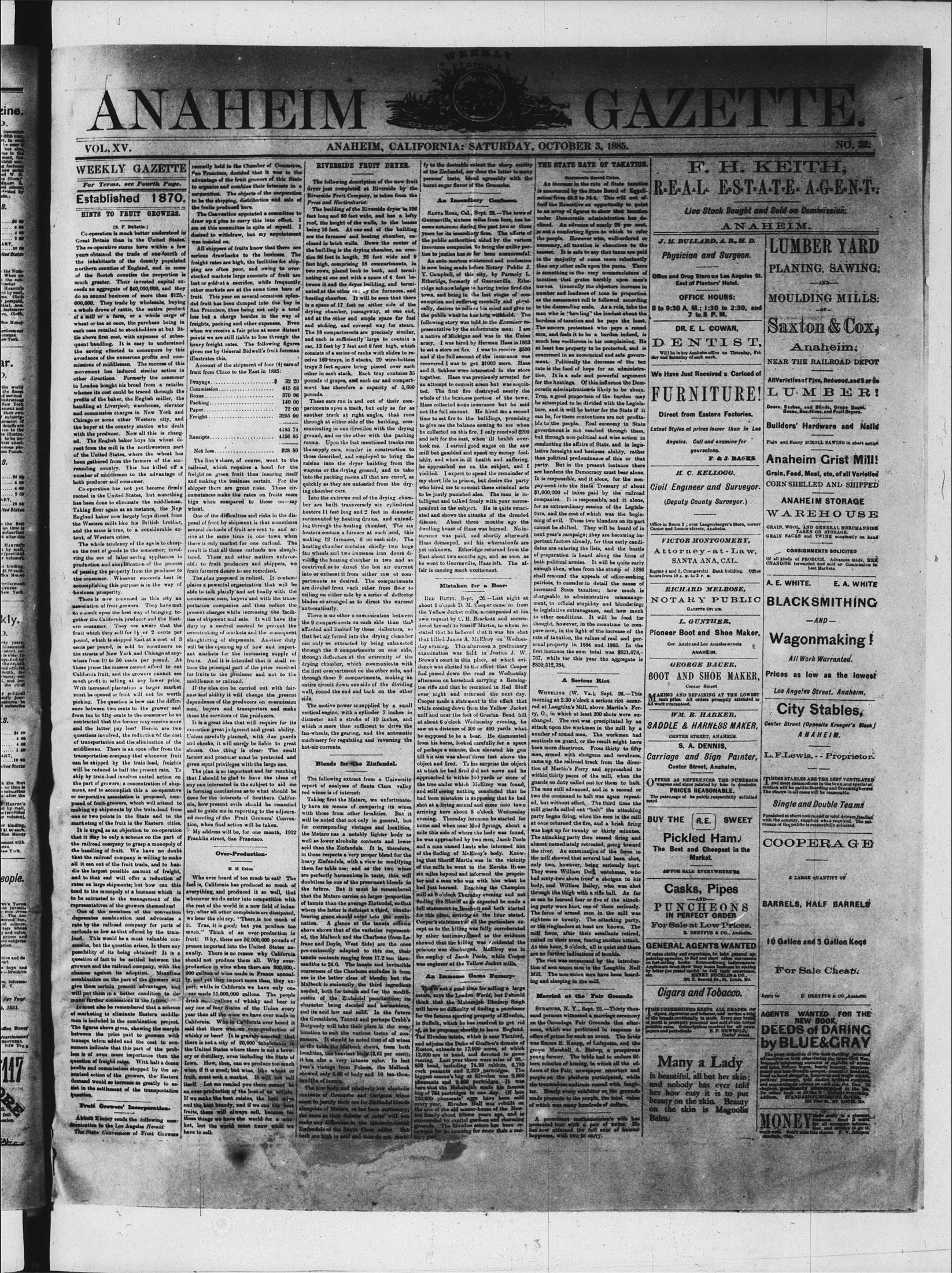
Searchable text
WEEKLY GAZETTE
For Terms, see Fourth Page.
Established 1870.
HINTS TO FRUIT GROWERS.
[B. P. Bulletin.]
Co-operation is much better understood in Great Britain than in the United States. The co-operative stores have within a few years obtained the trade of one-fourth of the inhabitants of the densely populated northern counties of England, and in some of the Scotch counties the proportion is much greater. Their invested capital exceeds an aggregate of $40,000,000, and they do an annual business of more than $125,000,000. They trade by wholesale, buying a whole drove of cattle, the entire product of a mill or a farm, or a whole cargo of wheat or tea at once, the purchase being in each case retailed to stockholders at but little above first cost, with expenses of subsequent handling. It is easy to understand the saving effected to consumers by this avoidance of the numerous profits and commissions of middlemen. The success of this movement has induced similar action in other directions. Formerly the consumer in London bought his bread from a retailer whence its cost could be traced through the profits of the baker, the English miller, the handling at Liverpool; warehouse, elevator and commission charges in New York and Chicago or some other Western city, and the buyer at the country station who dealt with the producer. Now all this is changed. The English baker buys his wheat direct from the mill in the northwestern part of the United States, where the wheat has been gathered from the farmers of the surrounding country. This has killed off a number of middlemen to the advantage of recently held in the Chamber of Commerce, San Francisco, decided that it was to the advantage of the fruit growers of this State to organize and combine their interests in a corporation. The objects of the corporation to be the shipping, distribution and sale of the fruits produced here.
The Convention appointed a committee to draw up a plan to carry this into effect. I am on this committee in spite of myself. I desired to withdraw, but my appointment was insisted on.
All shippers of fruits know that there are serious drawbacks to the business. The freight rates are high, the facilities for shipping are often poor, and owing to over-stocked markets large amounts of fruit are lost or gold-at a sacrifice, while frequently other markets are at the same time bare of fruit. This year on several occasions splendid fruit has been dumped into the bay in San Francisco, thus being not only a total loss but a charge besides in the way of freights, packing and other expenses. Even when we receive a fair price at some distant points we are still liable to loss through the heavy freight rates. The following figures given me by General Bidwell's fruit foreman illustrates this.
Account of the shipment of four (4) cars of fruit from Chico to the East in 1885:
Drayage.....$ 32 20
Commission.....415 68
Boxes.....370 96
Packing.....140 00
Paper.....72 00
Freight.....3255 00
4185 74
Receipts.....4156 85
Net loss.....$28 89
The lion's share, of course, went to the railroad, which requires a bond for the freight on green fruit thus insuring itself
RIVERSIDE
The following dryer just completed Riverside Fruit Co., Press and Horticulture.
The building of the feet long and 60 feet roof, the height of the being 16 feet. At one are the furnaces and closed in brick walls; the building is the dition 86 feet in length feet high, comprising two rows, placed basinating at one end with tween it and the drynated at the other ee heating chamber. It is a space of 17 feet drying chamber, pail and at the other end and stoking, and c The 18 compartment and each is sufficient car. 13 feet by 7 feet consists of a series-of receive 160 trays, in 8 trays 3 feet square b other in each stack. pounds of grapes, am ment has therefore pounds.
These cars run in n apartments upon a tran another track at r through at either sid municating in one di ground, and on the o rooms. Upon the last the supply cars, sim those described, and raisins into the dry wagons or the drying
other directions. Formerly the consumer in London bought his bread from a retailer whence its cost could be traced through the profits of the baker, the English miller, the handling at Liverpool; warehouse, elevator and commission charges in New York and Chicago or some other Western city, and the buyer at the country station who dealt with the producer. Now all this is changed. The English baker buys his wheat direct from the mill in the northwestern part of the United States, where the wheat has been gathered from the farmers of the surrounding country. This has killed off a number of middlemen to the advantage of both producer and consumer.
Co-operation has not yet become firmly rooted in the United States, but something has been done to eliminate the middleman. Taking flour again as an instance, the New England baker now largely buys direct from the Western mills like his British brother, and the same is true, to a considerable extent, of Western cities.
The whole tendency of the age is to cheapen the cost of goods to the consumer; involving the use of labor-saving appliances in production and simplification of the process of passing the property from the producer to the consumer. Whoever succeeds best in accomplishing this purpose is in the way of business prosperity.
There is now convened in this city an association of fruit-growers. They have met to consult upon the best way of bringing together the California producer and the Eastern consumer. They are aware that the fruit which they sell for 1½ or 2 cents per pound, which is shipped East at a cost of 3 cents per pound, is sold to consumers on the streets of New York and Chicago at anywhere from 10 to 50 cents per pound. At those prices the masses cannot afford to eat California fruit, and the growers cannot see much profit in selling at any lower price. With increased plantation a larger market must be opened or fruit will not be worth picking. The question is how can the difference between two cents to the grower and from ten to fifty cents to the consumer be so contracted that the former may receive more and the latter pay less? Herein are two questions involved, the reduction of the cost of transportation and the elimination of the middleman. There is an open offer from the transportation company that whenever fruit can be shipped by the train-load, freights will be reduced to half the present rate. To ship by train-load involves united action on the part of growers; a concentration of shipment, and to accomplish this a co-operative or corporative association is proposed, composed of fruit-growers, which will attend to making up shipments by the train-load from one or two points in the State and to the marketing of the fruit in the Eastern cities.
It is urged as an objection to co-operation that it may be only a scheme on the part of the railroad company to grasp a monopoly of the handling of fruit. We have no doubt that the railroad company is willing to make all it can out of the fruit trade, and to handle the largest possible amount of freight, and to that end will offer a reduction of rates on large shipments; but how can this tend to the monopoly of a business which is to be entrusted to the management of the other directions. Formerly the consumer in London bought his bread from a retailer whence its cost could be traced through the profits of the baker, the English miller, the handling at Liverpool; warehouse, elevator and commission charges in New York and Chicago or some other Western city, and the buyer at the country station who dealt with the producer. Now all this is changed. The English baker buys his wheat direct from the mill in the northwestern part of the United States, where the wheat has been gathered from the farmers of the surrounding country. This has killed off a number of middlemen to the advantage of both producer and consumer.
Co-operation has not yet become firmly rooted in the United States, but something has been done to eliminate the middleman. Taking flour again as an instance, the New England baker now largely buys direct from the Western mills like his British brother, and the same is true, to a considerable extent, of Western cities.
The whole tendency of the age is to cheapen the cost of goods to the consumer; involving the use of labor-saving appliances in production and simplification of the process of passing the property from the producer to the consumer. Whoever succeeds best in accomplishing this purpose is in the way of business prosperity.
There is now convened in this city an association of fruit-growers. They have met to consult upon the best way of bringing together the California producer and the Eastern consumer. They are aware that the fruit which they sell for 1½ or 2 cents per pound, which is shipped East at a cost of 3 cents per pound, is sold to consumers on the streets of New York and Chicago at anywhere from 10 to 50 cents per pound. At those prices the masses cannot afford to eat California fruit, and the growers cannot see much profit in selling at any lower price. With increased plantation a larger market must be opened or fruit will not be worth picking. The question is how can the difference between two cents to the grower and from ten to fifty cents to the consumer be so contracted that the former may receive more and the latter pay less? Herein are two questions involved, the reduction of the cost of transportation and the elimination of the middleman. There is an open offer from the transportation company that whenever fruit can be shipped by the train-load, freights will be reduced to half the present rate. To ship by train-load involves united action on the part of growers; a concentration of shipment, and to accomplish this a co-operative or corporative association is proposed, composed of fruit-growers, which will attend to making up shipments by the train-load from one or two points in the State and to the marketing of the fruit in the Eastern cities.
It is urged as an objection to co-operation that it may be only a scheme on the part of the railroad company to grasp a monopoly of the handling of fruit. We have no doubt that the railroad company is willing to make all it can out of the fruit trade, and to handle the largest possible amount of freight, and to that end will offer a reduction of rates on large shipments; but how can this tend to the monopoly of a business which is to be entrusted to the management of other directions. Formerly the consumer in London bought his bread from a retailer whence its cost could be traced through the profits of the baker, the English miller, the handling at Liverpool; warehouse, elevator and commission charges in New York and Chicago or some other Western city, andthe buyer atthe country station who dealt withthe producer. Now all this is changed. The English baker buys his wheat direct fromthe millinthenorthwesternpartoftheUnitedStateswhere,thewheathasbeengatheredfromthefarmersofthesurroundingcountry.Thishaskilledoffanumberofmiddlementotheadvantageofbothproducerandconsumer.
Co-operationhasnotyetbecomefirmlyrootedintheUnitedStates,butsomethinghasbeendonetolievaluatethemiddleman.Takingflouragainasaninstance,theNewEnglandbakernowlargelybuysdirectfromtheWesternmillsliketheBritishbrother,andthesameistrue,totheconsiderableextent.ofWesterncities.
Thewholetendencyoftheageistocheapenethecostofgoodstotheconsumer;involvingtheuseoflabor-savingappliancesinproductionandsimplificationoftheprocessofpassingthepropertyfromtheproducertotheconsumer.Whoeversucceedsbestinaccomplishingthispurposeisinthowofbusinesspropery.
Thereisnowconvenedinhithcityanonassociationoffruit-growers.ThehayesmettoconsultuponthebestwayofbringtingtogethertheCaliforniaproducerandtheEasternconsumer.Theyareawarethatthefruitwhichtheysellfor1½or2centspereundpoundisissoldtoconsumersonthestreetsofNewYorkandChicagoatanywherefrom10to50centsperpound.AtthosepricesthemasscaannotaffordtoeatCaliforniafruit,andthegrowerscannotseemuchprofitinsellingatanylowerprice.Withincreasedplantationa largermarketmustbeopenedorfruitwillnotbeworthypicking.Thequestionishowcanthedifferencebetweentwocentstothegrowerandfromtentofiftycentstotheconsumerbeosocontracttedthattheformermayreceivemoreandthelatterpayless?Hereinaretwobecauseinquiriesolved,thereductionofthecostoftransportationandtheeliminationofthemiddleman.Thethereisanopenofferfromthetransportationcompanythatwheneverfruitcanbeshippedbythetrain-loadfreightswillbereducedtoshalfthepresentrate.Toshipbytrain-loadinvolvesunitedactiononthepartofgrowers:aconcentrationofshipment,andtoachoemplativorcorporativeassociationisproposed.composedoffruit-growerswhichwillattendtomakingupshipmentsbythetrain-loadfromoneortwopointsintheStateandtothemarketingoffruitintheEasterncities.
Itisurgedasanobjectiontoco-operationthatitmaybeonlyaschemeonthepartoftherailroadcompanytograspamonopolyofthehandlingoffruitWehaveno doubtthattherailroadcompanyiswillingtomakeallitcanoutofthefruittrade,andtohandlethelargestpossibleamountoffreight,andtothatendwilloffera reductionofratesonlargeshipmentsbuthowcanthis tendto-themonopolyoftbusinesswhichistobeentrustedtothemangagementofthefruitintheEasterncities.
Drayage.$2220
Commission $41568
Boxes $37096
Packing $14000
Paper $72000
Freight $325500
Net loss $2889
Thelion'sshare.ofcourse.wenttotherailroad,whichrequiresabondforthefreightongreenfruitthusinsuringitselfandmakingthebusiness certain.要circumstancesmaketheratesonfruitsseemignwhencomparedtothoseon—saywheat.
Oneofthedifficultiesandrisksinthedisposaloffruitbyshipmentisthat sometimesseveralcarloadsoffruitaresenttoandarriveatathismetimeinonetownwhenthereisonlymarketforonecarload.Theresultisthatallthesecarloadsareslaughtered.Theseandothermattersunfavorable.tofruitproducers和shipperswefruitfarmersdesiretouseremediied.
Theplanproposedisradical.Itcontemplatesapowerfulorganizationthatwillbeabletalkplainlyandactfinalwiththecommissionmen,buyersandwiththetransportationcompaniesandthusreducethepresentchargeswhileincreasingthefacilitiesofshipmentandsale.Ittwillhavebydutybya centralcontroltopreventtheoverstockingofmarketsandtheconsequentslaughteringofships.Anotherdutywillbetheopeningupofnewandimportantmarketsfortheincreasingsupplyof fruits.Anditistintendedthatitshallreturntheprincipalpartofthepricereceivedforfruitsto.theproducerandnotto.themiddlemenorrailroad.
Iftheideacanbe carriedoutwith fairnessandabilityitwillchangethepresentdependenceoftheproducersoncommissionmen,buyersandtransportersandmaketheservitorsoftheproducers.
ItisaGreatideathatwillrequireforitsexecutiongreatjudgmentandgreatability.Unlesscarefullyplannedwithdueguardsandchecks,它will surelybelieitabletogreatabuses.Onethingisclear:Thesmallfarmerandproducermustbeprotectedandgivenequalprivilegeswiththelargeone.
TheplanissoimportantandfarreachingthatIshouldbegladtohavetheideasofanyoneinterestedinthesubjecttoaidmeinformingconclusionsastowhatshouldbedonefortheinterestsOfSouthernCalifornia,howpresentevilsshouldberemediedandtoguidemeinreportingtotheadjournedmeetingoftheFruitGrowers'Convention,whenfinalactionwillbe taken.
Myaddresswillbe,forsonemonth,1922Franklinstreet,SanFrancisco.
Over-Production·
M.M.Estee.
Whoever heardoftoo muchto eat?Thefastis,Californiahasproducedso muchofeverything,andproduceditsowell,thatwheneverwedoenterintocompetitionwith
Blendsforit
Thefollowingextra reportofanalysesonredwinesisofinterest.
TakingfirsttheMahaye havenomeansoffwiththosefromotherewillbe notedthatnotforcorrespondingwiththeMatarohasnotwellaslowercoholicacidthantheZinfandelin theserespectsavereyweightZinfandelwith themfortableuse;andareperfectlyharmonicdoubtlessbeoneofthefuture.BititthattheMataro carries
posed of fruit-growers, which will attend to making up shipments by the train-load from one or two points in the State and to the marketing of the fruit in the Eastern cities.
It is urged as an objection to co-operation that it may be only a scheme on the part of the railroad company to grasp a monopoly of the handling of fruit. We have no doubt that the railroad company is willing to make all it can out of the fruit trade, and to handle the largest possible amount of freight, and to that end will offer a reduction of rates on large shipments; but how can this tend to the monopoly of a business which is to be entrusted to the management of the representatives of the growers themselves?
One of the members of the convention deprecates combination and advocates a rate by the railroad company for parts of carloads as low as that offered by the train-load. This would be a most valuablecession, but the question arises, Is there any possibility of its being obtained? It is a question of fact to be settled between the growers and the railroad company, with the chances against its adoption. Meantime combination on the part of the growers will give them certain present advantages, and will put them in a better condition to demand further concessions in the future.
Is must also be remembered that a scheme of marketing to eliminate Eastern middlemen is included in the combination project. The figures above given, showing the margin between the price paid to growers with transportation added and the cost to consumers indicate that this part of the problem is of even more importance than the question of freight rates. With halt a dozen profits and commissions stopped by the organized action of the growers, the Eastern demand would so increase as greatly to assist in the settlement of the transportation question.
Fruit Growers' Incorporation
Abbott Kinney sends the following communication to the Los Angeles Herald:
The State Convention of Fruit Growers
Over-Production.
M. M. Estee.
Who ever heard of too much to eat? The fact is, California has produced so much of everything, and produced it so well, that whenever we do enter into competition with the rest of the world in a new field of industry, after all other complaints are dissipated, we hear the old cry, "There is too much of it. True, it is good; but you produce too much." Think of an over-production in fruit! Why, there are 50,000,000 pounds of prunes imported into the United States annually. There is no reason why California should not produce them all. Why overproduction in wine when there are 800,000,000 gallons of wine made in France annually, and yet they import more than they export; while in California we have only one ear made 15,000,000 gallons. The people drink nine gallons of whisky and beer in any one of four States of the Union every year than all the wine we have ever made in California. Who in California ever heard it said that there was an over-production of whisky or beer? It is gravelly asserted that there is not a city of 20,000 inhabitants in the United States where there is not a brewery or distillery, even including the State of Iowa. How, then, can we produce too much wine, if it is good; but wine, like wheat or fruit, must seek a market. It will not sell itself. Let me remind you there cannot be an over-production of the best of an article. If we make the best raisins, the best wine and the best brandy, and if we can the best fruits, these will always sell, because for these things we have the world for a market, but the world must know what we have to sell.
Taking first the Mataro has a not well as lower alcoholic acid than the Zinfandel in these respects a very heavy Zinfandel, with them for table use; and are perfectly harmonious doubtless be one of the future. But it is that the Mataro carries off tannin than the average where the latter is deficient bearing grape should be nation. A glance at above shows that of thiefed, the Malbeck and france and Doyle, Weasley pre-eminently adapted tannin contents ranging sandths to 24.0. The coarseness of the Charleston use in the better class Malbeck is eminently needed, both for tannination of the Zinfandel character being decided and its acid low and the Grossblaue, Tannah Burgundy will take their bination to suit the varnums. It should be borne in the table the Malbeck localities, the heaviest it has also a very intense year's vintage from Lannes showed only 2.68 of sandths of tannin.
The low body and recontents of Grenache seem to justify their malt alongside of Mataro, and the more as their defense makes any difference in Zinfandel both are high in acid malt
ANAHEIM, CALIFORNIA: SATURDAY, OCTOBER 3, 1885.
RIVERSIDE FRUIT DRYER.
The following description of the new fruit dryer just completed at Riverside by the Riverside Fruit Company, is taken from the Press and Horticulturist:
The building of the Riverside dryer is 106 feet long and 60 feet wide, and has a lofty roof, the height of the walls, to the beams being 16 feet. At one end of the building are the furnaces and heating chamber, enclosed in brick walls. Down the center of the building is the drying chamber, an erection 86 feet in length, 25 feet wide and 9 feet high, comprising 18 compartments, in two rows, placed back to back, and terminating at one end with a space of 4 feet between it and the dryer building, and terminated at the other end by the furnaces, and heating chamber. It will be seen that there is a space of 17 feet on either side of the drying chamber, passageway, at one end, and at the other end ample space for fuel and stoking, and covered way for steam. The 18 compartments are precisely similar, and each is sufficiently large to contain a car, 13 feet by 7 feet and 8 feet high, which consists of a series of racks with slides to receive 160 trays, in 8 stacks, 20 wire-bottom trays 3 feet square being placed over each other in each stack. Each tray contains 35 pounds of grapes, and each car and compartment has therefore a capacity of 5,600 pounds.
These cars run in and out of their compartments upon a track, but only as far as another track at right angles, that runs through at either side of the building, communicating in one direction with the drying ground, and on the other with the packing rooms. Upon the last mentioned tracks run the supply cars, similar in construction to those described, and employed to bring the raisins into the dryer building from the wagons or the drying ground, and to take fy to the desirable extent the sharp acidity of the Zinfandel, nor does the latter to many persons’ taste, blend agreeably with the burnt sugar flavor of the Grenache.
An Incendiary Confession.
SANTA ROSA, Cal., Sept. 25.—The town of Guerneville, sixteen miles from here, has become notorious during the past two or three years for its incendiary fires. The efforts of the public authorities, aided by the various insurance companies, to bring the guilty parties to justice has so far been unsuccessful.
An ante-mortem statement and confession is now being made before Notary Public J. Y. Campbell, of this city, by Parmely L. Etheridge, formerly of Guerneville. Etheridge acknowledges to having twice fired the town, and being in the last stages of consumption and suffering mentally and physically, desires to relieve his mind and give to the public what he has long withheld. The following story was told to the Examiner representative by the unfortunate man: I am a native of Michigan and was in the Union army. I was hired by Herman Haas in 1833 to set a store on fire. I was received $500 and if the full amount of the insurance was recovered I was to get $1000 more. Haas and S. Schloss were interested in the store together. Haas was previously arrested for an attempt to commit arson but was acquitted. The first fire destroyed nearly the whole of the business portion of the town. Haas collected some insurance but he said not the full amount. He hired me a second time to set fire to the buildings, promising to give me the balance coming to me when he collected on this fire. I only received $200 and left for the east, when ill health overtook me. I earned good wages on the saw mill but gambling and spent my money foolishly, and when in ill health and suffering, he approached me on the subject, and I yielded. I expect to spend the remainder of THE STATE RATE OF TAXATION.
Sacramento Record-Union.
An increase in the rate of State taxation is announced by the State Board of Equification from 45.2 to 54.4. This will not afford the Executive an opportunity to point to an array of figures to show that taxation under Democratic administration has declined. An advance of nearly 29 per cent. as not a comforting figure to which to refer the people. However wise, well-ordered or necessary, all taxation is obnoxious to the masses. It is safe to say that taxes are paid in the majority of cases more reluctantly than any other calls upon the purse. There is something in the very nonmenschature of taxation that grates harshly upon men’s nerves. Generally the objectors increase in number and loudness of tone in proportion as the assessment roll is followed according to the descending scale. As a rule, take the man who is “showling” the loudest about the burdens of taxation and he pays the least. The sincere protestant who pays a round sum, and feels it to be a burden indeed, is much less vociferous in his complaining. He at least has property to be protected, and is concerned in an economical and safe government. Politically the decrease of the tax rate is the food of hope for an administration. It is a safe and powerful argument for the bustings. Of this influence the Democratic administration is likely to be shorn. True, a good proportion of the burden may be attempted to be divided with the Legislature, and it will be better for the State if it can be, for these contentions are not profitable to the people. Real economy in State government is not reached through them, but through non-political and wise action in conducting the affairs of State, and in legislative foresight and business ability, rather than political predominance of this or that party. But in the present instance there are burdens that must bear alone.
the dismantles and arm when the slaughter unfavorors we, the fair present submission make for its ability. guards great small and none. teaching ideas of aid me should be Californied old journ conven-
the distances and arm when the slaughter unfavorors we, the fair present submission make for its ability. guards great small and none. teaching ideas of aid me should be Californied old journ conven-
the dismantles and arm when the slaughter unfavorors we, the fair present submission make for its ability. guards great small and none. teaching ideas of aid me should be Californied old journ conven-
the dismantles and arm when the slaughter unfavorors we, the fair present submission make for its ability. guards great small and none. teaching ideas of aid me should be Californied old journ conven-
the dismantles and arm when the slaughter unfavorors we, the fair present submission make for its ability. guards great small and none. teaching ideas of aid me should be Californied old journ conven-
the dismantles and arm when the slaughter unfavorors we, the fair present submission make for its ability. guards great small and none. teaching ideas of aid me should be Californied old journ conven-
the dismantles and arm when the slaughter unfavorors we, the fair present submission make for its ability. guards great small and none. teaching ideas of aid me should be Californied old journ conven-
the dismantles and arm when the slaughter unfavorors we, the fair present submission make for its ability. guards great small and none. teaching ideas of aid me should be Californied old journ conven-
the dismantles and arm when the slaughter unfavorors we, the fair present submission make for its ability. guards great small and none. teaching ideas of aid me should be Californied old journ conven-
the dismantles and arm when the slaughter unfavorors we, the fair present submission make for its ability. guards great small and none. teaching ideas of aid me should be Californied old journ conven-
the dismantles and arm when the slaughter unfavorors we, the fair present submission make for its ability. guards great small and none. teaching ideas of aid me should be Californied old journ conven-
the dismantles and arm when the slaughter unfavorors we, the fair present submission make for its ability. guards great small and none. teaching ideas of aid me should be Californied old journ conven-
the dismantles and arm when the slaughter unfavorors we, the fair present submission make for its ability. guards great small and none. teaching ideas of aid me should be Californied old journ conven-
the dismantles and arm when the slaughter unfavorors we, the fair present submission make for its ability. guards great small and none. teaching ideas of aid me should be Californied old journ conven-
the dismantles and arm when the slaughter unfavorors we, the fair present submission make for its ability. guards great small and none. teaching ideas of aid me should be Californied old journ conven-
the dismantles and arm when the slaughter unfavorors we, the fair present submission make for its ability. guards great small and none. teaching ideas of aid me should be Californied old journ conven-
the dismantles and arm when the slaughter unfavorors we, the fair present submission make for its ability. guards great small and none. teaching ideas of aid me should be Californied old journ conven-
the dismantles and arm when the slaughter unfavorors we, the fair present submission make for its ability. guards great small and none. teaching ideas of aid me should be Californied old journ conven-
the dismantles and arm when the slaughter unfavorors we, the fair present submission make for its ability. guards great small and none. teaching ideas of aid me should be Californied old journ conven-
the dismantles and arm when the slaughter unfavorors we, the fair present submission make for its ability. guards great small and none. teaching ideas of aid me should be Californied old journ conven-
the dismantles and arm when the slaughter unfavorors we, the fair present submission make for its ability. guards great small and none. teaching ideas of aid me should be Californied old journ conven-
the dismantles and arm when the slaughter unfavorors we, the fair present submission make for its ability. guards great small and none. teaching ideas of aid me should be Californied old journ conven-
the dismantles and arm when the slaughter unfavorors we, the fair present submission make for its ability. guards great small and none. teaching ideas of aid me should be Californied old journ conven-
the dismantles and arm when the slaughter unfavorors we, the fair present submission make for its ability. guards great small and none. teaching ideas of aid me should be Californied old journ conven-
the dismantles and arm when the slaughter unfavorors we, the fair present submission make for its ability. guards great small and none. teaching ideas of aid me should be Californied old journ conven-
the dismantles and arm when the slaughter unfavorors we, the fair present submission make for its ability. guards great small and none. teaching ideas of aid me should be Californied old journ conven-
the dismantles and arm when the slaughter unfavorors we, the fair present submission make for its ability. guards great small and none. teaching ideas of aid me should be Californied old journ conven-
the dismantles and arm when the slattery is supplied by a small vertical engine, with a cylinder 7 inches in diameter and a stroke of 10 inches, which is more than sufficient to drive the fan-wheels, the gearing, and the automatic machinery for regulating and reversing the hot-air currents.
Blends for the Zinfandel.
The following extract from a University report of analyses of Santa Clara valley red wines is of interest:
Taking first the Mataro, we unfortunately have no means of comparing its wines with those from other localities. But it will be noted that not only in general, but for corresponding vintages and localities, the Mataro has a notably lighter body as well as lower alcoholic contents and lower acid than the Zinfandel. It is, therefore, in these respects a very proper blend for the heavy Zinfandel, with a view to modifying them for table use; and as the two wines are perfectly harmonious in taste, this will doubtless be one of the prominent blends in the future. But it must be remembered that the Mataro carries no larger proportion together.
Haas was previously arrested for an attempt to commit arson but was acquitted. The first fire destroyed nearly the whole of the business portion of the town. Haas collected some insurance but he said not the full amount. He hired me a second time to set fire to the buildings, promising to give me the balance coming to me when he collected on this fire. I only received $200 and left for the east, when ill health overtook me. I earned good wages on the saw mill but gambled and spent my money foolishly, and when in ill health and suffering, he approached me on the subject, and I yielded. I expect to spend the remainder of my short life in prison, but desire the party who hired me to commit these criminal acts to be justly punished also. The man is intelligent and talked freely with your correspondent on the subject. He is quite emaciated and shows the attacks of the dreaded disease. About three months ago the dwelling house of Haas was burned. No insurance was paid, and shortly afterward Haas decamped, and his whereabouts are yet unknown. Etheridge returned from the East about two months ago, as soon as he went to Guerneville, Haas left. The affair is causing much excitement.
Mistaken for a Bear.
Red Bluff Sept. 26.-Last night at about 9 o'clock D.M.Cooper came in from the Yellow Jacket mills, accompanied at his own request by C.H.Brackett and surrendered himself to Sheriff Martin, to whom he stated that he believed that it was his shot that killed James A.McElroy on Wednesday evening. This afternoon a preliminary examination was held in Justice J.W.Brown's court in this place, at which evidence was elicited to the effect that Cooper had passed down the road on Wednesday afternoon on horseback carrying a Remington rifle and that he remained in Red Bluff overnight and returned next day. Cooper made a statement to the effect that while coming down from the Yellow Jacket mill and near the foot of Greecian Bend hill at 6 o'clock Wednesday evening, he saw at a distance of 300 or 400 yards what he supposed to be a bear. He diamounted from his horse, looked carefully for a space perhaps a minute, then elevated his gun till his aim was about three feet above the object and fired. To his surprise the object at which he had fired did not move and he approached to within 100 yards or more of the tree under which McElroy was found, and still seeing nothing concluded that he had been mistaken in supposing that he had shot at a living animal and came into town arriving here about 8 o'clock Wednesday evening. Thursday foremoon he started for home and when near Mud Springs, about a mile this side of where the body was found, he was approached by two men, Jacob Poole and a man named Lants who informed him of the finding of McElroy's body. Knowing that Sheriff Martin was in the vicinity of the mills he went to the Eureka House six miles beyond and informed the proprietor and a man who was with him what he had just learned. Reaching the Champion mill at 9 o'clock Thursday evening and not together for a railroad track from the direction of Martin's Ferry and approached to within thirty paces of the mill, when the guardes on duty called out for them to halt. The men still advanced, and in a second or two command to halt was again repeated, but without effect. The third time the mill guardes called out "halt" the attacking party began firing, when the men in the mill at once returned the fire, and a brisk firing was kept up for twenty or thirty minutes. The attacking party then ceased firing and almost immediately retreated, going toward river. An examination of force in the mill showed that several had been shot, only two, however, being seriously hurt. They were William Duff watchman, who had sixty-two shots from a shotgun in his body, and William Bailey, who was shot through the thigh with a rifle ball.
As far as can be learned form or fine of this attack
Taking first the Mataro, we unfortunately have no means of comparing its wines with those from other localities. But it will be noted that not only in general, but for corresponding vintages and localities, the Mataro has a notably lighter body as well as lower alcoholic contents and lower acid than the Zinfandela. It is, therefore, in these respects a very proper blend for the heavy Zinfandela, with a view to modifying them for table use; and as the two wines are perfectly harmonious in taste, this will doubtless be one of the prominent blends in the future. But it must be remembered that the Mataro carries no larger proportion of tannin than the average Zinfandel, so that where the latter is deficient a third, tannin-bearing grape should enter into the combination. A glance at the tannin column above shows that of the varieties represented, the Malbeck and the Charbono (from Lefranc and Doyle, West Side) are the ones pre-eminently adapted to this use, their tannin contents ranging from 17.2 ten thousandths to 24.0. The innate and invincible coarseness of the Charbono excludes it from use in the better class of blends; but the Malbeck is eminently the third ingredient needed, both for tannin and for the modification of the Zinfandel peculiarities; its character being decided and harmonious, and its acid low and mild. In the future the Grossblade, Tannat and perhaps Crabb's Burgundy will take their place in the combination to suit the various tastes of consumers. It should be noted that of all wines in the table the Malbeck shows, from both localities, the heaviest body (3.61 per cent); it has also a very intense color. In last year's vintage from Fohom, the Malbeck showed only 2.68 of body and 10 ten-thousandths of tannin.
The low body and relatively low alcoholic contents of Grenache and Carignan wines seem to justify their use for Zinfandel blends alongside of Mataro, as has been customary; the more as their defects of color will not make any difference in the intensely-tinted Zinfandel of the Santa Clara valley. But both are high in acid and thus do not modify, but without effect. The third time the mill guards called out "halt" the attacking party began firing, when the men in the mill at once returned the fire, and a brisk firing was kept up for twenty or thirty minutes. The attacking party then ceased firing and almost immediately retreated, going toward the river. An examination of the force in the mill showed that several had been shot, only two, however, being seriously hurt. They were William Duff, watchman, who had ninety-two shots from a shotgun in his body, and William Bailey, who was shot through the thigh with a rifle ball. As far as can be learned four or five of the attacking party were hurt, one of them seriously. The force of armed men in the mill was eighteen or twenty. The attacking party, or the ringleaders at least are known. The mill force, after their assaults retired, rested on their arms, fearing another attack. At this hour, 9 o'clock, all is quiet and there are no further indications of trouble.
The riot was occasioned by the introduction of non-union men in the Laughlin Nail Mill. The non-union men have been boarding and sleeping in the mill.
Married at the Fair Grounds
SYRACUSE, N.Y., Sept. 25.—Thirty thousand persons witnessed a marriage ceremony on the Onondaga Fair Grounds this afternoon, which was performed in response to offers of prizes for such an event. The bride was Emma K. Knapp, of Lafayette, and the groom Marshall A. Bishop, a prosperous young farmer. The bride had to endure fifteen minutes of kissing, in which all the officers of the Fair newspaper reporters and people on the platform participated, while the tremendous audience roared with laughter. Nearly every exhibitor on the grounds made presents to the couple, the total value of which was many hundreds of dollars.
A prominent mathematician's wife has presented him with a pair of twins. He has now attained the full sum of human happiness, with two to carry.
GAZETTE.
3, 1885.
NO: 52:
F. H. KEITH,
REAL ESTATE AGENT:
Live Stock Bought and Sold on Commission;
ANAHEIM.
J. H. BULLARD, A. B., M. D.
Physician and Surgeon.
Office and Drug Store on Los Angeles St.
East of Planters' Hotel.
OFFICE HOURS:
8 to 9:30 A.M.; 1:30 to 2:30, and
7 to 8 P.M.
DR. E. L COWAN,
DENTIST,
Will be in his Anaheim office on Thursday, Friday and Saturday of each week.
We Have Just Received a Carload of
FURNITURE!
Direct from Eastern Factories.
Latest Styles at prices lower than in Los
Angeles. Call and examine for
yourselves.
F. & J. BACKS
LUMBER YARD
PLANING, SAWING;
MOULDING MILLS:
Saxton & Cox;
Anaheim;
NEAR THE RAILROAD DEPOT
All Varieties of Pine, Redwood, and Spruce
LUMBER!
Doors, Sashes, and Blinds, Grape Baskets,
Boxes, Bee-Hives, and Fruit Dryers.
Builders' Hardware and Nails
Plain and Fancy SCROLL SAWING in short notice
Anaheim Crist Mill!
Grain, Feed, Meal, etc. of all Varieties
FURNITURE!
Direct from Eastern Factories.
Latest Styles at prices lower than in Los Angeles. Call and examine for yourselves.
H. C. KELLOGG.
Civil Engineer and Surveyor.
(Deputy County Surveyor.)
VICTOR MONTGOMERY,
Attorney-at-Law,
SANTA ANA, CAL.
RICHARD MELROSE,
NOTARY PUBLIC
Gazette Office.
L. GUNTHER,
Pioneer Boot and Shoe Maker,
Cor. Adele and Los Angeles streets.
GEORGE BAUER,
BOOT AND SHOE MAKER,
Center Street
MAKING AND REPAIRING AT THE LOWEST cash price. All orders promptly attended to all work guaranteed.
WM. B. HARKER,
SADDLE & HARNESS MAKER,
CENTER STREET, ANAHEIM.
S. A. DENNIS,
Carriage and Sign Painter,
Center Street, Anaheim,
OFFERS AS REFERENCES THE NUMEROUS wagons and signs painted by him in Anaheim.
PRICES REASONABLE.
BUY THE R.E. SWEET
Pickled Ham!
The Best and Cheapest in the Market.
Casks, Pipes
All Varieties of Pine, Redwood, and Serie LUMBER!
Deers, Sashees, and Blinds, Grape Buses, Boxes, Bee-Hives, and Fruit Dryers.
Builders' Hardware and Nails
Plain and Fancy SCROLL SAWING in short notice
Anaheim Crist Mill!
Grain, Feed, Meal, etc., of all Varieties CORN SHELLED AND SHIPPED
ANAHEIM STORAGE
WAREHOUSE
GRAIN, WOOL, AND GENERAL MERCHANDISE TAKEN ON STORAGE.
GRAIN SACKS and TWINE constantly on hand
CONSIGNMENTS SOLICITED
Of all kinds of PRODUCE. Advances made, MKE CHANDISE forwarded and sold on Commission in best Markets.
A. E. WHITE.
E. A. WHITE
BLACKSMITHING
—AND—
Wagonmaking!
All Work Warranted.
Prices as low as the lowest Los Angeles Street, Anaheim.
City Stables,
Center Street (Opposite Kroeger's Block)
ANAHEIM.
L.F.Lewis. -- Proprietor.
THESE STABLES ARE THE BEST VENTILATED and most commodious in the town, and special at tention will be paid to Boarding and Grooming horses The charge in all cases will be reasonable.
Single and Double Teams
Furnished at short notice, and as reful drivers familiar with the country, supplied when required. The passage of the public is respectfully solicited.
COOPERAGE
A LARGE QUANTITY OF
BUY THE R.E. SWEET
Pickled Ham!
The Best and Cheapest in the Market.
Casks, Pipes
AND
PUNCHEONS
IN PERFECT ORDER
For Sale at Low Prices.
B. DREYFUS & CO., Anahalm.
GENERAL AGENTS WANTED
Of extra ability and experience, to take general appointing agencies, to find and start other conveniences on fast-selling books. Extraordinary indemnities.
Applicants must show they mean business by stating by letter (no postal cards) in full their experience, etc.
HERBY BUCKLIN & CO.
201 K. Second St., St. Louis, Mo.
Cigars and Tobacco.
THE UNDERSIONED KEEPS ALL GRADES OF cigars, cigarettes and tobacco, and invites a trial of the brands continually in stock. Every new brand of merit is promptly proclaimed and sold at the lowest possible rates. Subscriptions received for all new papers and periodicals.
K. F. NEWBOLD,
Center street.
Many a Lady
is beautiful, all but her skin; and nobody has ever told her how easy it is to put beauty on the skin. Beauty on the skin is Magnolia Balm.
AGENTS WANTED FOR THE NEW BOOK,
DEEDS of DARING by BLUE&GRAY
The great collection of the most thrilling personal adventures on both sides during the Greek Civil War, intensely integrating accounts of eagles of acorns and spines, fortnum hopes, baroque horrors, imprisonments and half-breath encounters, rumble & lusture, hand-to-hand struggles, luminous and tragic events, perilous journeys, bold skies, brilliant stunts and magnanimous actions on each side the line. To chapters, profusely illustrated in the life.
No other book at all like it. Outside everything.
STANDARD PUBLISHING HOUSE,
255 Fine St., ST. LOUIS, Mo.
MONEY
Made solely in a pleasant business. Send 8 cents for all necessary information.
One and artist to go to watch work. Don't miss this chance. F. V. Johnson
Ohio.