anaheim-gazette 1885-09-26
Scanned page
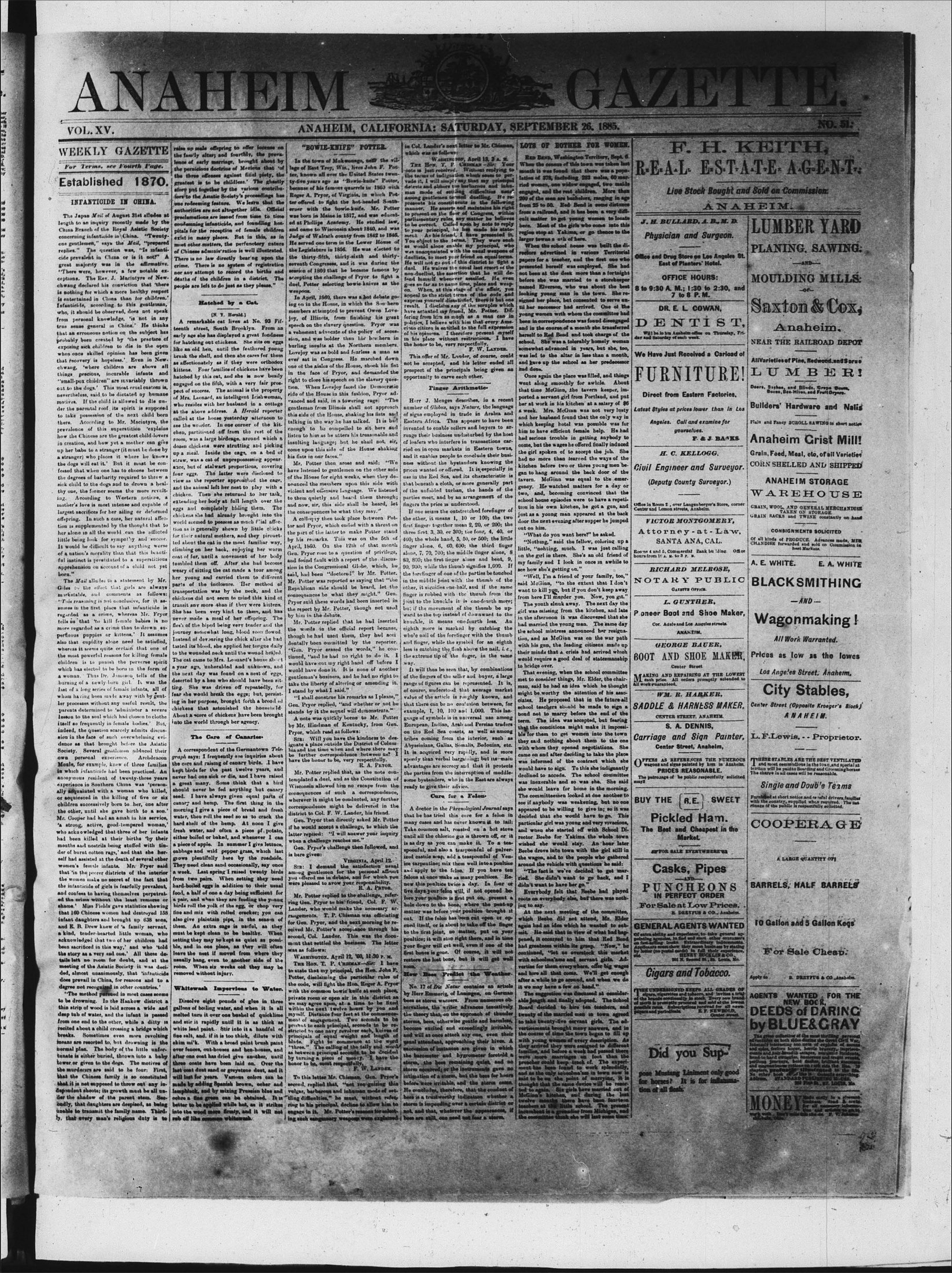
Searchable text
WEEKLY GAZETTE
For Terms, see Fourth Page.
Established 1870.
INFANTICIDE IN CHINA.
The Japan Mail of August 31st alludes at length to an inquiry recently made by the China Branch of the Royal Asiatic Society concerning infanticide in China. "Twenty-one gentlemen," says the Mail, "prepared replies." The question was, "Is infanticide prevalent in China or is it not?" A great majority was in the affirmative. "There were, however, a few notable exceptions. The Rev. J. Macintyre of Newchwang declared his conviction that 'there is nothing for which a more healthy respect is entertained in China than for children.' Infanticide, according to this gentleman, who, it should be observed, does not speak from personal knowledge, 'is not in any true sense general in China.' He thinks that an erroneous notion on the subject has probably been created by 'the practice of exposing sick children to die in the open when once skilled opinion has been given that recovery is hopeless.' Even in Newchwang, 'where children are above all things precious, incurable infants and 'small-pox children' are invariably thrown out to the dogs.' This most cruel custom is, nevertheless, said to be dictated by human motives. If the child is allowed to die under the parental roof its spirit is supposed to take possession of the next child born there. According to Mr. Macintyre, the prevalence of this superstition explains how the Chinese are the greatest child-lovers in creation, and how yet a mother can give up her babe to a stranger (it must be done by a stranger) who places it where he knows the dogs will eat it.' But it must be confessed that when one has to choose between raise up male offspring to offer incense on the family altar; and fourthly, the prevalence of early marriage, brought about by the pernicious doctrine of Menicena that 'of the three offenses against filial piety, the greatest is to be childless.' The greatly affore put together by the various contributors to the Anatic Society's proceedings has one redeeming feature. We learn that the authorities are not altogether idle. Official proclamations are issued from time to time condemning infanticide, and founding hospitals for the reception of female children exist in many places. But in this, as in most other matters, the perfunctory nature of Chinese administration is well illustrated. There is no law directly bearing upon the crime. There is no system of registration nor any attempt to record the births and deaths of the children in a district. The people are left to do just as they please."
Hatched by a Cat.
[N. Y. Herald.]
A remarkable cat lives at No. 93 Fifteenth street, South Brooklyn. From an early age she has displayed a great fondness for hatching out chickens. She sits on eggs like an old hen, until the feathered young break the shell, and then she cares for them as affectionately as if they were orthodox kittens. Four families of chickens have been hatched by this cat, and she is now busily engaged on the fifth, with a very fair prospect of success. The animal is the property of Mrs. Leonard, an intelligent Irishwoman, who resides with her husband in a cottage at the above address. A Herald reporter called at the house yesterday afternoon to see the wonder. In one corner of the kitchen, partitioned off from the rest of the room, was a large birdcage, around which a dozen chickens were strutting and picking up a meal. Inside the cage, on a bed of straw, was a cat of unprepossessing appearance, but of stalwart proportions, covering four eggs. The latter were disclosed to
"BOWIE-KNIFE"
In the town of Mukwonoma lage of East Troy, Wis., later known all over the U.S., five years ago as "Bowie because of his famous quarry Roger A. Pryor, of Virginia offered to fight the herder with the bowie-knot was born in Maine in 1817, ed at Phillips Academy, and came to Wisconsin aboard Judge of Walrath county fife. He served one term in the Legislature in 1856. In the thirty-fifth, thirty-seventh Congresses, and its session of 1860 that he be accepting the challenge of duel, Potter selecting bow weapons.
In April, 1860, there was waiting on in the House, in which members attempted to preside joy, of Illinois, from fine speech on the slavery quest a vehement advocate of the sion, and was bolder than hurling insults at the No Lovejoy was as bold and fierer sat in Congress. He one of the ailes of the House in the face of Pryor, and right to close his speech on tion. When Lovejoy faced ride of the House in this faction and said, in a tower gentleman from Illinois shout this side of the House, shaltalking in the way he has enough to be compelled listen to him as he utters his insulting language; but he come upon this side of these his fists in our faces."
Mr. Potter then arose have listened to gentlemen
The Mail alludes to a statement by Mr. Giles to the effect that girls are always marketable, and comments as follows: "This reasoning is not conclusive, for it assumes in the first place that infanticide is regarded as a crime, whereas Mr. Fryer tells us that 'to kill female babies is no more regarded as a crime than to drown superfluous puppies or kittens.' It assumes also that cupidity alone need be satisfied, whereas it seems quite certain that one of the most powerful reasons for killing female children is to punish the perverse spirit which has elected to be born in the form of a woman. Thus Dr. Jameson tells of the burning of a newly-born girl. It was the last of a long series of female infants, all of whom having been made away with by gentler processes without any useful result, the parents determined to administer a severe lesson to the soul which had chosen to clothe itself so frequently in female bodies." But, indeed, the question scarcely admits discussion in the face of such overwhelming evidence as that brought before the Asiatic Society. Several gentlemen adduced their own personal experience. Archdeacon Moule, for example, knew of three families in which infanticide had been practiced. An anonymous resident of twenty-three years experience in Southern China was 'personally acquainted with a woman who killed, or acquiesced in the killing of five or six children successively born to her, one after the other, until she gave birth to a son.' Mr. Cooper had had an amah in his service, 'a strong, active, good-tempered woman,' who acknowledged that three of her infants had been killed at their births 'by their mouths and nostrils being stuffed with tinder of burnt cotton rags,' and that she herself had assisted at the death of several other women's female infants. Mr. Fryer said that 'in the poorer districts of the interior the women make no secret of the fact that the infanticide of girls is fearfully prevalent, and confuses to have themselves perpetrated the crime without the least hesitation by this cat, and she is now busily engaged on the fifth, with a very fair prospect of success. The animal is the property of Mrs. Leonard, an intelligent Irishwoman, who resides with her husband in a cottage at the above address. A Herald reporter called at the house yesterday afternoon to see the wonder. In one corner of the kitchen, partitioned off from the rest of the room, was a large birchcage, around which a dozen chickens were strutting and picking up a meal. Inside the cage, on a bed of straw, was a cat of unprepossessing appearance, but of stalwart proportions, covering four eggs. The latter were disclosed to view as the reporter approached the cage, and the animal left her nest to play with a chicken. Then she returned to her task, extending her body at full length over the eggs and completely hiding them. The chickens she had already brought into the world seemed to possess as much fial affection as is generally shown by little chicks for their natural mothers, and they piruetted about the cat in the most familiar way, climbing on her back, enjoying her warm coat of fur, until a movement of her body tumbled them off. After she had become weary of sitting the cat made a tour among her young and carried them to different parts of the enclosure. Her method of transportation was by the neck, and the chickens did not seem to mind this kind of transit any more than if they were kittens. She has been very kind to them, and has never made a meal of her offspring. The flesh of the biped being very tender and the journey somewhat long, blood soon flowed. Instead of devouring the chick after she had tasted its blood, she applied her tongue daily to the wounded neck until the wound healed. The cat came to Mrs. Leonard's house about a year ago, unheralded and unknown, and the next day was found on a nest of eggs, deserted by a hen who should have been sitting. She was driven off repeatedly, for fear she would break the eggs; but, persisting in her purpose, brought forth a brood of chickens that astonished the household. About a score of chickens have been brought into the world through her agency.
The Care of Canaries
A correspondent of the Germantown Telegraph says: I frequently see inquiries about the care and raising of canary birds. I have kept birds for the past twelve years, and never had one sick or die, and I have raised a great many. Some think that a bird should never be fed anything but canary seed. I have always given equal parts of canary and hemp. The first thing in the morning I give a piece of bread and fresh water, then roll the seed so as to crack the hard shell of the hemp. At noon I give fresh water, and often a piece of potato, either boiled or baked, and whenever I can a piece of apple. In summer I give lettuce, cabbage and wild pepper grass, which last grows plentifully here by the roadside. They need clean sand occasionally, say once a week. Last spring I raised twenty birds from two pairs. When setting they need hard-boiled eggs in addition to their usual food, half of one a day being sufficient for a pair and when they are feeding the worm.
In the face of Pryor, right to close his speech on occasion. When Lovejoy faced ride of the House in this faction advanced and said, in a tower gentleman from Illinois shakes this side of the House, shaking talking in the way he has enough to be compelled to listen to him as he utters insulting language; but he come upon this side of these fists in our faces."
Mr Potter then arrose have listened to gentlemen of the House for eight weeks nounced the members upon evident and offensive language to them quietly and heard and now, sir, this side shall the consequences be what they.
A colleague then took plaster and Pryor, which ended the part of the latter to make by his remarks. This was April, 1860. On the 12th Gen. Pryor rose to a question and found fault with a rejection in the Congressional Guild said, had been "doctored."
Mr Potter was reported as Republican side should be consequences be what they Pryor said these words had the report by Mr. Potter, by him in the debate.
Mr Potter replied that she words in the official though he had used them, dentally been committed by "Gen. Pryor erased" and "tinned," and he had no right would have cut my right hand would have done it. It is gentleman's business, and he take liberty of altering I stand by what I said."
"I shall construe his remand Gen. Pryor replied," and will stands by it the sequel will.
A note was quickly born by Mr. Hindman of Kent Pryor, which read as follow:
Sir: Will you have these signate a place outside the hia and the time when and be further correspondence have the honor to be, very
Mr. Potter replied that, templated a duel, and as Wisconsin allowed him no consequences of such a wherever it might be could correspondence might be district to Col. F.W.Land.
Gen. Pryor then directly if he would accept a challenge latter replied: "I will assist when a challenge reaches me."
Gen. Pryor's challenge this is here given:
Sir: I demand the among gentlemen for you offered me in debate, were pleased to avow your
Mr. Potter replied to th
or acquiesced in the killing of five or six children successively born to her, one after the other, until she gave birth to a son.' Mr. Cooper had had an amah in his service,
'a strong, active, good-tempered woman,' who acknowledged that three of her infants had been killed at their births 'by their mouths and noatrils being stuffed with tinder of burnt cotton rags,' and that she herself had assisted at the death of several other women's female infants. Mr. Fryer said that 'in the poorer districts of the interior the women make no secret of the fact that the infanticide of girls is fearfully prevalent, and confess to having themselves perpetrated the crime without the least remorse or shame.' Miss Fields gave statistics showing that 160 Chinese women had destroyed 158 infant daughters and brought up 638 sons, and E. B. Drew knew of 'a family servant, a kind, tender-hearted little woman, who acknowledged that two of her children had been sacrificed in this way,' and who 'told the story as a very sad one.' All these details left no room for doubt, and at the meeting of the Asiatic Society it was decided, almost unanimously, that 'infanticide does prevail in China, for reasons and to a degree not recognized in other countries.'
'The method pursued in most cases seems to be drowning. In the Hankow district a thin strip of wood is laid across a wide and deep tub of water, and the infant is passed from one end to the other, while a ditty is recited about a child crossing a bridge which breaks. Sometimes even more revolting means are resorted to, but drowning is the normal plan. The body of the little unfortunate is either buried, thrown into a baby tower or given to the doga. The motives of the murderers are said to be four: First, that the Chinese family is so constituted that it is not supposed to throw out any independent shoots; its growth must be all under the shadow of the parent stem. Secondly, that daughters are despised, as being unable to transmit the family name. Thirdly, that every man's religious duty is to
Whitewash Impervious to Water.
Dissolve eight pounds of glue in three gallons of boiling water, and when it is all melted turn it over one bushel of quicklime and stir it rapidly until it is as thick as white lead paint. Stir into it a handful of fine salt, and if it is too thick, dilute with skim milk. With a broad paint brush paint over fences, out-houses and ben-house, and after one coat has dried give another, until three coats have been laid on. Over the last coat dust sand or greytene dust, and it will last for years. Various colors can be made by adding Spanish brown, ocher and lampblack, and by mixing Prussian blue and ochre a fine green can be obtained. It is better to be applied while hot, as it strikes into the wood more firmly, and it will not rub off like common whitewash.
ANAHEIM, CALIFORNIA: SATURDAY, SEPTEMBER 26, 1885.
"BOWIE-KNIFE" POTTER.
In the town of Mukwonago, near the village of East Troy, Wis., lives John F. Potter, known all over the United States twenty-five years ago as "Bowie-knife" Potter, because of his famous quarrels in 1860 with Roger A. Pryor, of Virginia, in which Potter offered to fight the hot-headed Southerner with the bowie-knife. Mr. Potter was born in Maine in 1817, and was educated at Phillips Academy. He studied law, and came to Wisconsin about 1840, and was Judge of Walrath county from 1842 to 1846. He served one term in the Lower House of the Legislature in 1856. He was elected to the thirty-fifth, thirty-sixth and thirty-seventh Congresses, and it was during the session of 1860 that he became famous by accepting the challenge of Pryor to fight a duel, Potter selecting bowie-knives as the weapons.
In April, 1860, there was a hot debate going on in the House, in which the Southern members attempted to prevent Owen Lovejoy, of Illinois, from finishing his great speech on the slavery question. Pryor was a vehement advocate of the policy of secession, and was bolder than his brethern in hurling insults at the Northern members. Lovejoy was as bold and fearless a man as ever sat in Congress. He marched down one of the aisles of the House, shook his fist in the face of Pryor, and demanded the right to close his speech on the slavery question. When Lovejoy faced the Democratic ride of the House in this fashion, Pryor advanced and said, in a towering rage: "The gentleman from Illinois shall not approach this side of the House, shaking his fists and talking in the way he has talked. It is bad enough to be compelled to sit here and listen to him as he utters his treasonable and insulting language; but he shall not, sir, come upon this side of the House shaking his fists in our faces."
Mr. Potter then arose and said: "We have listened to gentlemen on the other side
in Col. Lander's next letter to Mr. Chisman, which was as follows:
WASHINGTON, April 13, 2 a.m.
THE HON. T. P. CHISMAN-Sir: Your vote is just received. Without replying to the terms of indignation which seem to pervade it, I will simply say that my principal detests and abhorns the harbours and inhuman mode of settling difficulties used among gentlemen termed duelling. He represents his constituents in the following manner. He asserts and maintains his right to present on the floor of Congress, within parliamentary rules, any matter he believes to be correct. Called upon by note to reply to your principal, he has made his statement. As his friend, I have presented it. You object to the terms. They were such as would alone enable my principal, who was unacquainted with the usual weapons of duellists, to meet your friend on equal terms. He will not go out of this district to fight a duel. He waives the usual last resort of the non-duellist, the assertion that he will defend himself whenever assailed. He even goes so far as to name time, place and weapon. When, at this stage of the affair, you appeal to the strict terms of the code and express yourself dissatisfied, there is but one result. I disclaim any of the serpules which have actuated my friend, Mr. Potter. Differing from him as much as a man can in politics, I believe with him that every American citizen is entitled to the full expression of his opinions. I therefore present myself in his place without restraints. I have the honor to be, very respectfully.
P. W. LANDER.
This offer of Mr. Lander, of course, could not be accepted, and his letter ended all prospect of the principals being given an opportunity to carve each other.
Finger Arithmetic.
Herr J. Menges describes, in a recent number of Globus, says Nature, the language of signs employed in trade in Arabia and Eastern Africa. This appears to have been invented to enable sellers and buyers to arrange their business undisturbed by the host of loafers who interfere in transactions carried on in open markets in Eastern towns, and it enables people to conclude their business without the bystanders knowing the prices wanted or offered. It is especially in Lots of Bother for Women.
RED BEND, Washington Territory, Sept. 6
When the census of this town was taken last month it was found that there was a population of 378, including 293 males, 60 married women, one widow engaged, two maids engaged, and the rest children. More than 200 of the men are bachelors, ranging in age from 25 to 50. Red Bend is some distance from a railroad, and it has been a very difficult matter to get young women to locate here. Most of the girls who come into this region stop at Yakima, or go thence to the larger towns a nth of here.
When the school house was built the directors advertised in various Territorial papers for a teacher, and the first one who presented herself was employed. She had not been at the desk more than a fortnight before she was married to a storekeeper named Elverson, who was about the best looking young man in the town. She resigned her place, but consented to serve until her successor had arrived. One of the young women with whom the committee had been in correspondence was found disengaged and in the course of a month she transferred herself to Red Bend and took charge of the school. She was a tolerably homely woman somewhat advanced in years, but she, too, was led to the altar in less than a month, and gave up the school as her predecessor had done.
Once again the place was filled, and things went along smoothly for awhile. About that time McGinn, the tavern keeper, imported a servant girl from Portland, and put her at work in his kitchen at a salary of $6 a week. Mrs. McGinn was not very lusty and her husband found that the only way in which keeping hotel was possible was for him to have efficient female help. He had had serious trouble in getting anybody to come, but the wages he offered finally induced the girl spoken of to accept the job. She had no more than learned the ways of the kitchen before two or three young men began to hang around the back door of the
When Lovejoy faced the Democratic side of the House in this fashion, Pryor advanced and said: "The gentleman in Illinois shall not approach this side of the House, shaking his fists and talking in the way he has talked. It is bad enough to be compelled to sit here and listen to him as he utters his treasonable and insulting language; but he shall not, sir, come upon this side of the House shaking his fists in our faces."
Mr. Potter then arose and said: "We have listened to gentlemen on the other side of the House for eight weeks, when they denounced the members upon this side with violent and offensive language. We listened to them quietly and heard them through; and now, sir, this side shall be heard, let the consequences be what they may."
A colleague then took place between Potter and Pryor, which ended with a threat on the part of the latter to make Potter stand by his remarks. This was on the 5th of April, 1860. On the 12th of that month Gen. Pryor rose to a question of privilege, and found fault with a report of the discussion in the Congressional Globe, which he said, had been "doctoral" by Mr. Potter. Mr. Potter was reported as saying that "the Republican side should be heard, let the consequences be what they might." Gen. Pryor said these words had been inserted in the report by Mr. Potter, though not used by him in the debate.
Mr. Potter replied that he had inserted the words in the official report because, though he had used them, they had accidentally been committed by the reporter. Gen. Pryor erased the words, he continued, "and he had no right to do it. I would have cut my right hand off before I would have done it. It is none of another gentleman's business, and he had no right to take the liberty of altering or amending it. I stand by what I said."
"I shall construe his remarks as I please," Gen. Pryor replied, "and whether or not he stands by it the sequel will demonstrate."
A note was quickly borne to Mr. Potter by Mr. Hindman of Kentucky, from Gen. Pryor, which read as follows:
SIR: Will you have the kindness to designate a place outside the District of Columbia and the time when and where there may be further correspondence between us? I have the honor to be, very respectfully.
R. A. PRYOR.
Mr. Potter replied that, as the note contemplated a duel, and as the Constitution of Wisconsin allowed him no escape from the consequences of such a correspondence, wherever it might be conducted, any further correspondence might be delivered in the district to Col. F. W. Lander, his friend.
Gen. Pryor then directly asked Mr. Potter if he would accept a challenge, to which the latter replied: "I will answer your inquiry when a challenge reaches me."
Gen. Pryor's challenge then followed, and is here given:
VIRGINIA, April 12.
SIR: I demand the satisfaction usual among gentlemen for the personal affront you offered me in debate, and for which you were pleased to avow your responsibility.
R. A. PRYOR.
Mr. Potter replied to the challenge, referr
wherever it might be conducted, any further correspondence might be delivered in the district to Col. F. W. Lander, his friend.
Gen. Pryor then directly asked Mr. Potter if he would accept a challenge, to which the latter replied: "I will answer your inquiry when a challenge reaches me."
Gen. Pryor's challenge then followed, and is here given:
VIRGINIA, April 12.
Sir: I demand the satisfaction usual among gentlemen for the personal affront you offered me in debate, and for which you were pleased to avow your responsibility.
R. A. PRYOR.
Mr. Potter replied to the challenge, referring Gen. Pryor to his friend, Col. F. W. Lander, who would make the necessary arrangements. T. P. Chisman was officiating for Gen. Pryor, and the next morning he received Mr. Potter's acceptance through his second, Col. Lander. This was the document that settled the business. The letter was as follows:
WASHINGTON, April 12, '60, 11:30 p.m.
THE HON. T. P. CHISMAN—Sir: I have to state that my principal, the Hon. John P. Potter, disclaiming the particular rules of the code, will fight the Hon. Roger A. Pryor with the common bowie knife at such place, private room or open air in this district as we may agree upon, at a time to be fixed within the next twelve hours by you and myself. Distance four feet at the commencement of engagement. Two seconds to be present to each principal, seconds to be restricted to one navy revolver each, knives of principals of equal weight and length of blade. Fight to commence at the word "three." The calling of the tally and word as between principal seconds to be decided by turning a piece of money. I have the honor to be, most respectfully,
F. W. LANDER.
To this letter Mr. Chisman, Gen. Pryor's second, replied that, "not recognizing this vulgar, barbarous and inhuman mode of settling difficulties," he must, without referring to his principal, decline to allow him to engage in it. Mr. Potter's reasons for selecting such savage weapons were explained
A doctor in the Phrenological Journal says that he has tried this cure for a felon in many cases and has never known it to fail: Take common salt, roasted on a hot stove until all the chlorine gas is thrown off, or it is as dry as you can make it. To a teaspoonful, and also a teaspoonful of pulverized castle soap, add a teaspoonful of Venice turpentine; mix them well into a poultice and apply to the felon. If you have ten felons at once make as many poultices. Renew this poultice twice a day. In four or five days your felon will, if not opened before your poultice is first put on, present a hole down to the bone, where the pant-down matter was before your poultice brought out.
If the felon has been cut open or opened itself, or is about to take off the finger to the first joint, no matter, put on your poultice; it will stop right there, and in time your finger will get well, even if one of the first bones is gone. Of course, it will not restore the lost bone, but it will get well soon.
HOW BOES PREDICT THE WEATHER.
No. 17 of Die Natur contains an article by Herr Emmerig, of Laningen, on German bees as storm warners. From numerous observations, the writer advances tentatively the theory that, on the approach of thunderstorms, bees, otherwise gentle and harmless, become excited and exceedingly irritable, and will at once attack any one, even their usual attendant, approaching their hives. A succession of instances are given in which the barometer and hygrometer foretold a storm, the bees remaining quiet, and no storm occurred; or the instruments gave no intimation of a storm, but the bees for hours before were irritable, and the storm came. He concludes, therefore, that the conduct of bees is a trustworthy indication whether a storm is impending over a certain district or not, and that whatever the appearances, if bees are still, one need not fear a storm.
The suggestion was discussed at considerable length and finally adopted. The School Board decided to hire ten teachers, and twenty of the married men in town agreed to take twenty-five servant girls. The advertisements brought many answers, and in the course of time the town began to fill up with young women of every description. As they arrived they were assigned to different families, and before a week had passed there were more marriages on foot than the preacher could keep teach of. The experiment has been found to work splendidly, and as the only schoolmaster in town now is said to be on the point of marrying, it is thought that the same device will be resorted to again. Six girls have married out of McGinn's kitchen, and during the last twelve months there have been fourteen teachers at the little school. The present incumbent is a grenadier from Michigan, and the committee thank she will last some time:
GAZETTE.
1885. NO. 51:
F. H. KEITH,
REAL ESTATE AGENT:
Live Stock Bought and Sold on Commission:
ANAHEIM.
J. H. BULLARD, A.B., M.D.
Physician and Surgeon.
Office and Drug Store on Los Angeles St.
East of Planters' Hotel.
OFFICE HOURS:
8 to 9:30 A.M.; 1:30 to 2:30, and
7 to 8 P.M.
DR. E. L COWAN,
DENTIST.
Will be in his Anaheim office on Thursday, Friday and Saturday of each week.
We Have Just Received a Carload of
FURNITURE!
Direct from Eastern Factories.
Latest Styles at prices lower than in Los
Angeles. Call and examine for
yourselves.
F. & J. BACKS.
H. C. KELLOGG,
Civil Engineer and Surveyor.
LUMBER YARD
PLANING, SAWING:
AND
MOULDING MILLS:
of
Saxton & Cox,
Anaheim.
NEAR THE RAILROAD DEPOT
All Varieties of Pine, Redwood,and Sarue
LUMBER!
Doors, Sawhies, and Blinds, Grape Brushes,
Boxes,Bee-Hives,and Fruit Drying.
Builders' Hardware and Nailis
Plain and Fancy SCROLL SAWING in short notice
Anaheim Crist Mill!
Grain, Feed, Meal, etc.of all Varieties
CORN SHELLED AND SHIPPED
FURNITURE!
Direct from Eastern Factories.
Latest Styles at prices lower than in Los Angeles. Call and examine for yourselves.
P. & J. BACKS
H. C. KELLOGG,
Civil Engineer and Surveyor.
(Deputy County Surveyor.)
Office in Room 2, over Langenberger's Store, corner Center and Lemon streets, Anaheim.
VICTOR MONTGOMERY,
Attorney-at-Law,
SANTA ANA, CAL.
Rooms 4 and 5, Commercial Bank building. Office hours from 10 A.M. to 3 P.M.
RICHARD MELROSE,
NOTARY PUBLIC
GAZETTE OFFICE.
L. GUNTHER,
Pioneer Boot and Shoe Maker,
Cor. Adele and Los Angeles streets.
ANAHEIM.
GEORGE BAUER,
BOOT AND SHOE MAKER,
Center Street
MAKING AND REPAIRING AT THE LOWEST cash price. All orders promptly attended to. All work guaranteed.
WM. R. HARKER,
SADDLE & HARNESS MAKER,
CENTER STREET, ANAHEIM.
S. A. DENNIS,
Carriage and Sign Painter,
Center Street, Anaheim,
OFFERS AS REFERENCES THE NUMEROUS wagons and signs painted by him in Anaheim.
PRICES REASONABLE.
The patronage of the public respectfully solicited mays.
BUY THE R.E. SWEET
Pickled Ham.
The Best and Cheapest in the Market.
Casks, Pipes
AND
PUNCHEONS
IN PERFECT ORDER
Deers, Bayhes, and Blinds, Grepe Buns,
Boxes, Bee-Mises, and Fruit Organs.
Builders' Hardware and Nalis
Plain and Fancy SCROLL SAWING in short notice
Anaheim Crist Mill!
Grain, Feed, Meal, etc., of all Varieties
CORN SHELLED AND SHIPPED
ANAHEIM STORAGE
WAREHOUSE
GRAIN, WOOL, AND GENERAL MERCHANDISE TAKEN ON STORAGE.
GRAIN SACKS and TWINE constantly on hand
CONSIGNMENTS SOLICITED
Of all kinds of PRODUCE. Advances made, MERCHANTISE forwarded and sold on Commission in heat Markets.
A. E. WHITE.
E. A. WHITE
BLACKSMITHING
— AND —
Wagonmaking!
All Work Warranted.
Prices as low as the lowes
Los Angeles Street; Anaheim.
City Stables,
Center Street (Opposite Kroeger's Block)
ANAHEIM.
L.F.Lewis. -- Proprietor.
THESE STABLES ARE THE BEST VENTILATED
and most commodious in the town, and special attention will be paid to Boarding and Grooming horses.
The charge in all cases will be reasonable.
Single and Doub'e Teams
Furnished at short notice and as reful drivers familiar with the country, supplied when required. The manage of the public is respectfully solicited.
COOPERAGE
A LARGE QUANTITY OF
BARRELS, HALF BARRELS
Pickled Ham.
The Best and Cheapest in the Market.
Casks, Pipes
AND
PUNCHEONS
IN PERFECT ORDER
For Sale at Low Prices.
B. DREYFUS & CO., Anheim.
GENERAL AGENTS WANTED
Of extra ability and experience, to take general appolting agencies, to find and start other occupations on fast-selling books. Extraordinary inducements.
Applicants must show they mean business by stating by letter (no postal cards) in full their experience,
HENRY BUCKLIN & CO.
201 N. Second St., St. Louis, Mo.
Cigars and Tobacco.
THE UNDERSIGNED KEEPS ALL GRADES OF cigars, cigarettes and tobacco, and invites a trial of the brands continually in stock. Every new brand of merit is promptly procured and sold at the lowest possible rates. Subscriptions received for all newspapers and periodicals.
K. F. NEWBOLD,
Center street.
Did you Suppose Mustang Liniment only good for horses? It is for inflammation of all flesh.
COOPERAGE
A LARGE QUANTITY OF
BARRELS, HALF BARRELS
10 Gallon and 5 Gallon Keqs
For Sale Cheap.
AGENTS WANTED FOR THE NEW BOOK,
DEEDS of DARING by BLUE&GRAY
The great collection of the most thrilling personal adventures on both sides during the Great Civil War. Intensely interesting sets of exploits of amnesia and spies, farfrom hoops, harvish treasony, imprisonments and half-breaths escapes, suspicious incidents, hand-to-hand struggles, honors and traps events, perilous journeys, bold dudes, brilliant maneuvers and magnanimous actions on a soft side the line. 70 chapters, produced illustrated to the life.
No other book after it. Onnella everything.
Address.
STANDARD PUBLISHING HUSE.
201 Pine St., ST. LOUIS, Mo.
MONEY
Made early in a present business. Send 8 cents for all necessary information and articles to get work with. Here's mine this day. F. V. Johnson oblake, Ohio.