anaheim-gazette 1885-09-19
Scanned page
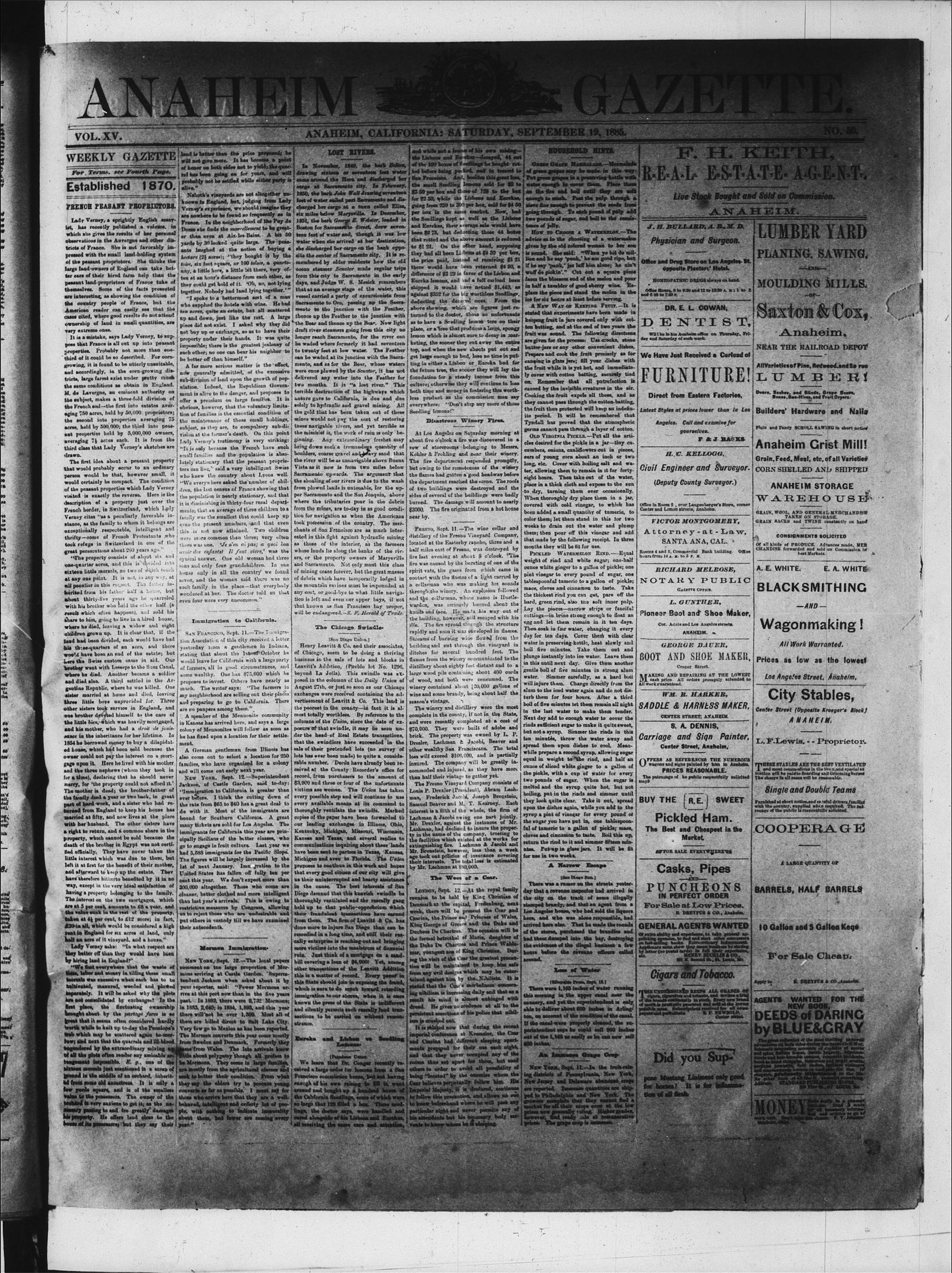
Searchable text
WEEKLY GAZETTE
For Terms, see Fourth Page.
Established 1870.
FRENCH PEASANT PROPRIETORS,
Lady Verney, a sprightly English essayist, has recently published a volume, in which she gives the results of her personal observations in the Auvergne and other districts of France. She is not favorably impressed with the small land-holding system of the peasant proprietors. She thinks the large land-owners of England can take better care of their hired farm help than the peasant land-proprietors of France take of themselves. Some of the facts presented are interesting, as showing the condition of the country people of France, but the American reader can easily see that the cases cited, where good results do not attend ownership of land in small quantities, are very extreme ones.
It is a mistake, says Lady Verney, to suppose that France is all cut up into peasant properties. Probably not more than one-third of it could be so described. For corn-growing, it is found to be utterly unsuitable, and accordingly, in the corn-growing districts, large farms exist under pretty much the same conditions as obtain in England. M. de Lavergne, an eminent authority on the subject, makes a three-fold division of the French soil—the first into estates averaging 750 acres, held by 50,000 proprietors; the second into properties averaging 75 acres, held by 500,000; the third into peasant properties held by 5,000,000 owners, averaging 7½ acres each. It is from the third class that Lady Verney's sketches are drawn.
The first idea about a peasant property that would probably occur to an ordinary person would be that, however small it land is better than the price proposed; he will not give more. It has become a point of honor on both sides not to yield; the quarrel has been going on for years, and will probably not be settled while either party is alive."
Naboth's vineyards are not altogether unknown in England, but, judging from Lady Verney's experience, we should imagine they are nowhere to be found so frequently as in France. In the neighborhood of the Puy de Dome she finds the morrellement to be greater than even at Aix-le-Bains. A bit 50 yards by 20 looked quite large. The peasants laughed at the notion of buying a hectare (2¼ acres); "they bought it by the toilee, six feet square, or 100 tolases, a quarto-many, a little here, a little bit there, very often at an hour's distance from each other, as they could get hold of it." 'Oh, no, not lying together. Nobody had land lying together.'"
"I spoke to a bettermost sort of a man who supplied the hotels with wine. He had ten acres, quite an estate, but all scattered up and down, just like the rest. A large piece did not exist. I asked why they did not buy up or exchange, so as to have their property under their hands. It was quite impossible; there is the greatest jealousy of each other; no one can bear his neighbor to be better off than himself."
A far more serious matter is the effect, now generally admitted, of the excessive sub-division of land upon the growth of population. Indeed, the Republican Government is alive to the danger, and proposes to offer a premium on large families. It is obvious, however, that the voluntary limitation of families is the essential condition of the maintenance of these small holdings, subject, as they are, to compulsory sub-division at the farmer's death. On this point Lady Verney's testimony is very striking: "It is only because the French have such small families and the population is absolutely stationary that the peasant proprietors can live," said a very intelligent Swiss looter.
In November, 1849, drawing sixteen or so came around the Horncargo at Sacramento 1850, the bark John Woolfe of water sailed past charged her cargo at six miles below Marysville 1851, the bark George E.Boston for Sacramento teen feet of water and water when she arrived she discharged her cargo site the center of Sacramento membered by older residents ocean steamer Senator from this city to Sacramento days, and Judge W. S. that at an average stage vessel carried a party of Sacramento to Oro, passimento to the junction thence up the Feather to the Bear and thence up the draft river steamers going longer reach Sacramento be waded where formerly to twenty feet at low water can be waded at its junctionmento, and as for the Horn were once plowed by them delivered any water in two months. It is "a terrible destruction of the nature gave to California solely to hydraulic and gold that has been mines would not pay these navigable rivers," the mischief is, the work ginning. Any extraorrible bring down such a trembling boulders, coarse gravel and the river will be as unnavy Vista as it now is from Sacramento upwards.
trica, large farms exist under pretty much the same conditions as obtain in England. M. de Lavergne, an eminent authority on the subject, makes a three-fold division of the French soil—the first into estates averaging 750 acres, held by 50,000 proprietors; the second into properties averaging 75 acres, held by 500,000; the third into peasant properties held by 5,000,000 owners, averaging 7½ acres each. It is from the third class that Lady Verney's sketches are drawn.
The first idea about a peasant property that would probably occur to an ordinary person would be that, however small, it would certainly be compact. The condition of the peasant properties which Lady Verney visited is exactly the reverse. Here is the description of a property just over the French border, in Switzerland, which Lady Verney cites "as a peculiarly favorable instance, as the family to whom it belongs are exceptionally respectable, intelligent and thrifty—come of French Protestants who took refuge in Switzerland in one of the great persecutions about 200 years ago."
"The property consists of about six and one-quarter acres, and this is divided into sixteen little morsels, no two of which touch at any one point. It is not, in any way, at all peculiar in this respect. The father inherited from his father half a house, but about thirty-five years ago he quarroled with his brother who held the other half (a result which often happens), and sold his share to him, going to live in a hired house, where he died, leaving a widow and eight children grown up. It is clear that, if the land had been divided, each would have had his three-quarters of an acre, and there would have been an end of the estate; but here the Swiss custom came in aid. One brother went with Lesspeps to the Suez Canal, where he died. Another became a soldier and died also. A third settled in the Argentine Republic, where he was killed. One sister married at home and died, leaving three little boys unprovided for. Three other sisters took service in England, and one brother devoted himself to the care of the little biennial which was heavily mortgaged, and his mother, who had a droit de jouissance in the inheritance for her lifetime. In 1854 he borrowed money to buy a dilapidated house, which had been sold because the owner could not pay the interest on a mortgage upon it. Here he lived with his mother and the three nephews (whom they took in for a time), declaring that he should never marry, for 'the property could not afford it.' The mother is dead; the brother-father of the family died a year or two back, in great part of hard work, and a sister who had returned from England to keep his house has married at fifty, and now lives at the place with her husband. The other sisters have a right to return, and a common share in the property, which cannot be sold because the death of the brother in Egypt was not certified officially. They have never taken the little interest which was due to them, but left it at first for the benefit of their mother, and afterward to keep up the estate. They have therefore hitherto benefited by it in no way, except in the very ideal satisfaction of having a property belonging to the family.
The immigration to California.
SAN FRANCISCO, Sept. 11.—The Immigration Association of this city received a letter yesterday from a gentlemen in Indiana, stating that about the 15th of October he would leave for California with a large party of farmers, all in good circumstances, and some wealthy. One has $75,000 which he proposes to invest. Others have nearly as much. The writer says: "The farmers in my neighborhood are selling out their places and preparing to go to California. There are no paupers among them."
A member of the Mennonite community in Kansas has arrived here, and says a large colony of Mennonites will follow as soon as he has fixed upon a location for their settlement.
A German gentleman from Illinois has also come out to select a location for 250 families, who have organized for a colony and will come out early next year.
NEW YORK, Sept. 12.—Superintendent Jackson, of Castle Garden, said to-day: "Immigration to California is greater than ever before. I think the cutting down of the rate from $65 to $40 has a great deal to do with it. Most of the immigrants are bound for Southern California. A great many tickets are sold for Los Angeles. The immigrants for California this year are principally Sicilians of the better classes, who go to engage in fruit culture. Last year we had 5,588 immigrants for the Pacific Slope. The figures will be largely increased by the lat of next January. Immigration to the United States has fallen off fully ten per cent this year. We don't expect more than 300,000 altogether. Those who come are cleaner, better clothed and more intelligent delivered any water in two months. It is "terrible destruction of the nature gave to California solely to hydraulic and gave the gold that has been these navigable rivers, and the mischief is, the work ginning. Any extra effort bring down such a trembling boulders, coarse gravel and the river will be as unnavy Vista as it now is from Sacramento upwards. To sheoaling of our rivers from plowed lands is unique per Sacramento and the South where the tributaries pass from the mines, are to-day for navigation as when took possession of the chants of San Francisco acted in this fight against those of the interior whose lands lie along their ers, or the property owned and Sacramento. Not so mining cease forever, but of debris which have tenured mountain ravines mine any cost, or good-bye to their nation is left and even our that known as San Francisco will be endangered."
Lady Verney asks: "In what respect are they better off than they would have been by hiring land in England?"
"We find everywhere that the waste of time, labor and money in tilling these small turbals was excessive when each has to be cultivated, manured, weeded and plowed separately. It will be asked why the plots are not consolidated by exchanges? In the first place, the fluctuating ownership brought about by the partage force is so great that it seems often considered hardly worth while to knit up to-day the Penelope's web which may be scattered again to more low; and next that the quarrels and ill-blood tended by the extraordinary mixing up of all the plots often render any amicable arrangement impossible. E. g., one of the alutian morsels just mentioned is a scrap of ground in the middle of an orchard, inherited from some old ancestrees. It is only a few years square, and is of the smallest value to the possessors. The owner of the orchard is very anxious to get it; as the necessity passing to and fro greatly damages his property. He offers land close to the house of its possessors; but they say their ever before.
Think the cutting down of the rate from $65 to $40 has a great deal to do with it. Most of the immigrants are bound for Southern California. A great many tickets are sold for Los Angeles. The immigrants for California this year are principally Sicilians of the better classes, who go to engage in fruit culture. Last year we had 5,588 immigrants for the Pacific Slope. The figures will be largely increased by the last of next January. Immigration to the United States has fallen off fully ten per cent this year. We don't expect more than 300,000 altogether. Those who come are cleaner, better clothed and more intelligent than last year's arrivals. This is owing to restrictive measures by Congress, allowing us to reject those who are undesirable and put others in custody till we have examined their antecedents.
Mormon Immigration
New York, Sept. 12.—The local papers comment on the large proportion of Mormons arriving at Castle Garden. Superintendent Jackson when asked about it by your reporter, said: "Pewer Mormons arrive at this port now than in the five years past." In 1882, there were 2,732 Mormons; in 1883, 2,640; in 1884, 1,893, and this year there will not be over 1,500. Most all of them are billed direct to Salt Lake City. Very few go to Mexico as has been reported. The Mormon converts this year come mostly from Sweden and Denmark. Formerly they came from Wales. The late arrivals know little about polygamy though all profess to be Mormons. They come in large families, are mostly from the agricultural classes and seek to better their condition. From what they say the elders try to procure young converts as far as possible. I must say for those who arrive here that they are a well-behaved, intelligent and orderly lot of people, with nothing to indicate immorality about them, but fewer are coming every year."
We learn that Dr. Cox ceived a large order for Francisco commission home enough of his own rain around and bought up the California Seedlings, so large that 128 filled a lings, the doctor says, cured alongside of his Lions all receiving the same e
ANAHEIM, CALIFORNIA: SATURDAY, SEPTEMBER 19, 1885.
LOST RIVERS.
In November, 1840, the bark Bolton, drawing sixteen or seventeen feet water came around the Horn and discharged her cargo at Sacramento city. In February, 1850, the bark John Wall drawing seventeen feet of water sailed past Sacramento and discharged her cargo at a town called Eliza, six miles below Marysville. In December, 1851, the bark George E. Webster, loaded in Boston for Sacramento direct, drew seventeen feet of water and, though it was low water when she arrived at her destination, she discharged her cargo on the bank opposite the center of Sacramento city. It is remembered by older residents how the old ocean steamer Senator made regular trips from this city to Sacramento in the early days, and Judge W. S. Measik remembers that at an average stage of the water, this vessel carried a party of excursionists from Sacramento to Oro, passing up the Sacramento to the junction with the Feather, thence up the Feather to the junction with the Bear and thence up the Bear. Now light draft river steamers going from this city no longer reach Sacramento, for the river can be waded where formerly it had seventeen to twenty feet at low water. The Feather can be waded at its junction with the Sacramento, and as for the Bear, whose waters were once plowed by the Senator, it has not delivered any water into the Feather for two months. It is "a lost river." This terrible destruction of the highways which nature gave to California, is due and due solely to hydraulic and gravel mining. All the gold that has been taken out of these mines would not pay the cost of restoring these navigable rivers, and yet terrible as the mischief is, the work of ruin is only beginning.
Any extraordinary freshet may bring down such a tremendous quantity of boulders, coarse gravel and heavy sand that the river will be as unnavigable above Buena Vista as it now is from two miles below Sacramento upwards. The argument that while not a lemon of his own raising—the Lisbons and Eurekas—decayed, 46 out of the 100 boxes of Seedlings he bought rotated before being packed, and in transit to San Francisco. And, besides this great loss, the small Seedling lemons sold for $3 to $3.50 per box and those of 129 to the box for $2.50, while the Lisbons and Eurekas, going from 250 to 300 per box, sold for $4.50 per box in the same market. Now, had the Seedlings kept as well as the Lisbons and Eurekas, their average sale would have been $2.75, but deducting those 44 boxes that rotted and the above amount is reduced to $1.21. On the other hand, supposing they had all been Lisbons at $4.50 per box, the price paid, instead of receiving $1.21 there would have been returned $4.50, a difference of $3.29 in favor of the Lisbons and Eureka lemons, and had a full carload been shipped it would have netted $1,440, as against $352 for the big worthless Seedlings, deducting the decimated ones. From the above showing, which are figures just returned to the doctor, those so unfortunate as to have a Seedling lemon tree on their place, or a tree that produces a large, spongy lemon which is almost sure to decay in marketing, the sooner they cut away the entire top, and when the new shoots put out and get large enough to bed, lose no time in putting in either a Lisbon or Eureka bud for the future tree, the sooner they will lay the foundation for a steady income from this culture; otherwise they will continue to lose both time and money in fostering this worthless product as the commission men say everywhere: "Don't ship any more of those Seedling lemons!"
Disastrous Winery Fire.
At Los Angeles on Saturday morning at about five o'clock a fire was discovered in a row of storerooms belonging to Messra, Kohler & Frohling and near their winery. The fire department responded promptly, but owing to the remoteness of the winery the flames had gotten a good headway before
HOUSEHOLD HINTS.
Green Guarn Marmalade—Marmalade of green grapes may be made in this way: Put green grapes in a preserving hattle with water enough to cover them. Place them on the fire and boil until they are soft enough to mash. Pass the pulp through a sieve fine enough to prevent the seeds from going through. To each pound of pulp add two pounds of sugar, and boil to the consistence of jelly.
How to Choose A Watermelon.—The advice as to the choosing of a watermelon given by the old colored woman to her son is sound. She said: "When ye hit de million and he say 'punk,' he am good rips, but if he say 'pank,' jes laff him alone; he ain't wuff de pickin'." Cut out a square piece faom the blossom end of the melon and pour in half a tumbler of good sherry wine. Replace the piece and stand the melon in the ice for six hours at least before serving.
A New Way Of Keeping Fruit.—It is stated that experiments have been made in keeping fruit in jars covered only with cotton batting, and at the end of two years the fruit was sound. The following directions are given for the process: Use cocks; stone butter-jars or any other convenient dishes. Prepare and cook the fruit precisely as for canning in glass jars; fill your dishes with the fruit while it is yet hot, and immediately cover with cotton batting, securely tied on. Remember that all putrefaction is caused by the invisible creatures in the air. Cooking the fruit expels all these, and as they cannot pass through the cotton-battling, the fruit thus protected will keep an indefinite period. It will be remembered that Tyndall has proved that the atmospheric germs cannot pass through a layer of cotton.
Old Virginia Pickle.—Put all articles desired for the pickle in a jar—tiny cucumbers, onions, cauliflowers cut in pieces, ears of young corn about an inch or two long, etc. Cover with boiling salt and water, allowing them to remain in it for forty-
The Chicago Swindle.
[San Diego Union]
Henry Leavitt & Co. and their associates, of Chicago, seem to be doing a thriving business in the sale of lots and blocks in Leavitt's Addition, (Pacebo lot No. 1296, beyond La Jolla). This swindle was exposed in the columns of the Daily Union of August 27th, or just so soon as our Chicago exchanges were received containing the advertisement of Leavitt & Co. This land is the poorest in the county—in fact it is almost totally worthless. By reference to the columns of the Union, since the date of exposure of that swindle, it may be seen under the head-of Real Estate transactions, that the swindlers have succeeded in the sale of their pretended lots (no survey of lots has ever been made) to quite a considerable number. Decda have already been received at the County Recorder's office for record, from purchasers to the amount of $3,900 and three or four of the unfortunate victims are women. The Union has taken every possible step and will continue to use every available means at its command to thoroughly ventilate the swindle. Marked copies of the paper have been forwarded to our leading exchanges in Illinois, Ohio, Kentucky, Michigan, Missouri, Wisconsin, Kansas and Texas, and several replies to communications inquiring about these lands have been sent to parties in Texas, Kansas, Michigan and even to Florida. The Union proposes to continue in this work and hopes that every good citizen of our city will give us their uninterrupted and hearty assistance in the cause. The best interests of San Diego demand that this knavish swindle be delivered any water into the Feather for two months. It is "a lost river." This terrible destruction of the highways which nature gave to California, is due and solely to hydraulic and gravel mining. All the gold that has been taken out of these mines would not pay the cost of restoring these navigable rivers, and yet terrible as the mischief is, the work of ruin is only beginning. Any extraordinary freshet may bring down such a tremendous quantity of boulders, coarse gravel and heavy sand that the river will be as unnavigable above Buena Vista as it now is from two miles below Sacramento upwards. The argument that the shoaling of our rivers is due to the wash from plowed lands is untenable, for the upper Sacramento and the San Joaquin, above where the tributaries pour in the debris from the mines, are to-day in as good condition for navigation as when the Americans took possession of the country. The merchants of San Francisco are as much interested in this fight against hydraulic mining as those of the interior, as the farmers whose lands lie along the banks of the rivers, or the property owners of Marysville and Sacramento. Not only must this class of mining cease forever, but the great masses of debris which have temporarily lodged in the mountain ravines must be impounded at any cost, or good-bye to what little navigation is left and even our upper bays, if not that known as San Francisco bay proper, will be endangered. S. P. Herald of Trade.
Disastrous Winery Fire.
At Los Angeles on Saturday morning at about five o'clock a fire was discovered in a row of storerooms belonging to Messrs. Kohler & Prolling and near their winery. The fire department responded promptly, but owing to the remoteness of the winery the flames had gotten a good headway before the department reached the scene. The roofs of two buildings were destroyed and the sides of several of the buildings were badly burned. The damage will amount to nearly $3000. The fire originated from a hot house near by.
Fresno, Sept. 11.—The wine cellar and distillery of the Fresno Vineyard Company, located at the Easterby rancho, three and a half miles east of Fresno, was destroyed by fire last evening at about 8 o'clock. The fire was caused by the bursting of one of the spirit vats, the gases from which came in contact with the flames of a light carried by a cellarman who was making his noons through the winery. An explosion followed and the cellarman, whose name is Hustlewarden, was seriously burned about the hands and face. He made his way out of the building, however, and escaped with his life. The fire spread through the structure rapidly and soon it was enveloped in flames. Streams of burning wine flowed from the building and out through the vineyard in ditches for several hundred feet. The flames from the winery communicated to the distillery about eighty feet distant and to a large wood pile containing about 400 cords of wood, and both were consumed. The winery contained about 120,000 gallons of wine and some brandy, being about half the season's vintage.
The winery and distillery were the most complete in the county, if not in the State, and were recently completed at a cost of $70,000. They were built of adobe and brick. The property was owned by L. P. Dresler, Lachman & Jacobi, Beaver and other wealthy San Franciscans. The total loss will exceed $100,000, and is partially insured. The company will be greatly insmoded and injured, as they have more than half their vintage to gather yet.
The Fresno Vineyard Company consists of Louis P. Dresler (President), Abram Lachman, Frederick Jacobi, Joseph Bronstein, Samuel Beaver and M. T. Kearney. Each interest is a fifth of the whole; the firm of Lachman & Jacobi owing one part jointly. Mr. Dresler, against the instances of Mr. Lachman, had declined to insure the property in the name of the company, trusting to the facilities which existed at the works for extinguishing fire. Lachman & Jacobi and Mr. Bronstein, however, less than a week ago took out policies of insurance covering their interests. The total loss is estimated by Mr. Lachman at $80,000.
The Wee of a Cear.
London, Sept. 12.—At the royal family reunion to be held by King Christian of England cover with cotton batting, securely tied on. Remember that all putrefaction is caused by the invisible creatures in the air. Cooking the fruit expels all these, and as they cannot pass through the cotton-battling, the fruit thus protected will keep an indefinite period. It will be remembered that Tyndall has proved that the atmospheric germs cannot pass through a layer of cotton.
Old Virginia Pickle.—Put all articles desired for the pickle in a jar—tiny cucumbers, oniona, cauliflowers cut in pieces, ears of young corn about an inch or two long, etc. Cover with boiling salt and water, allowing them to remain in it for forty-eight hours. Then take out of the water, place in a thick cloth and expose to the sun to dry, turning them over occasionally. When thoroughly dry place them in a jar, covered with cold vinegar, to which has been added a small quantity of turmeric, to color them; let them stand in this tor two weeks to drain out the water and plump them; then pour off this vinegar and add that made by the following receipt. In three months they will be fit for use.
PICKLED WATERMELON RIND.—Equal weight of rind and white sugar; one-half ounce white ginger to a gallon of pickle; one pint vinegar to every pound of sugar; one tablespoonful tumeric to a gallon of pickle; mace, cloves and cinnamon to taste. Take the thickest rind you can get, pare off the hard, green rind, also too soft inner pulp. Lay the pieces—narrow strips or fanciful cuttings—in brine strong enough to float an egg and let them remain in it ten days. Then soak in fair water, changing it every day for ten days. Cover them with clear water in preserving-kettle; heat slowly and boil five minutes. Take them out and plunge instantly into ice water. Leave them in this until next day. Give them another gentle boil of five minutes in strong alum water. Simmer carefully, as a hard boil will injure them. Change directly from the alum to the iced water again and do not disturb them for four hours. After a third boil of five minutes let them remain all night in the last water to make them tender. Next day add to enough water to cover the rinds sufficient sugar to make it quite sweet, but not a syrup. Simmer the rinds in this ten minutes; throw the water away and spread them upon dishes to cool. Meanwhile prepare a second syrup, allowing sugar equal in weight to the rind, and half an ounce of sliced white ginger to a gallon of pickle, with a cup of water for every two pounds of sugar. When the sugar is melted and the syrup quite hot, but not boiling, put in the rinds and simmer until they look quite clear. Take it out, spread upon the dishes again; while you add to the syrup a pint of vinegar for every pound of the sugar you have put in; one tablespoonful of tumeric to a gallon of pickle; mace, cloves and cinnamon to taste. Boil this up, return the rind to it and simmer fifteen minutes. Put up in glass jars. It will be fit for use in two weeks.
A Narrow Escape
[San Diego Sun]
There was a rumor on the streets yesterday that a revenge inspector had arrived in the city on the track of some illegally
every available means at its command to thoroughly ventilate the swindle. Marked copies of the paper have been forwarded to our leading exchanges in Illinois, Ohio, Kentucky, Michigan, Missouri, Wisconsin, Kansas and Texas, and several replies to communications inquiring about these lands have been sent to parties in Texas, Kansas, Michigan and even to Florida. The Union proposes to continue in this work and hopes that every good citizen of our city will give us their uninterrupted and hearty assistance in the cause. The best interests of San Diego demand that this knavish swindle be thoroughly ventilated and the rascally gang held up to that public-opprobrium which their fraudulent transactions have earned from them. The firm of Leavitt & Co. has done more to injure San Diego than can be remedied in a long time, and still their recalcly enterprise is reaching out and bringing more victims into the maelstrom of financial ruin. Just think of a mortgage on a sand-hill covering a loan of $4,000! Yet, among other transactions of the Leavitt Addition this is a matter of record. Every paper in this State should join in exposing the fraud, which is sure to do much toward retarding immigration to our shores, when it is once known the press of the State is indifferent and silently permits such rascally land transactions to be carried on without remonstrance.
Eureka and Lisbon vs Seadling Lemons.
[Pasadena Union]
We learn that Dr. Congar recently received a large order for lemons from a San Francisco commission house, but not having enough of his own raising to fill it, went around and bought up a hundred boxes of the California Seedlings, some of which were so large that 128 filled a box. These seedlings, the doctor says, were handled and cured alongside of his Lisbona and Kearnsa, all receiving the same care and attention,
Samuel Beaver and M. T. Kearney. Each interest is a fifth of the whole, the firm of Lachman & Jacobiwing one part jointly. Mr. Drexler, against the instances of Mr. Lachman, had declined to insure the property in the name of the company, trusting to the facilities which existed at the works for extinguishing fire. Lachman & Jacobi and Mr. Bronstein, however, less than a week ago took out policies of insurance covering their interests. The total loss is estimated by Mr. Lachman at $80,000.
The Wee of a Czar.
London, Sept. 12.—At the royal family reunion to be held by King Christian of Denmark at the capital, Fredenburg, next week, there will be present the Czar and Czarina, the Prince and Princess of Wales, King George of Greece and the Duke and Duchess De Chartres. The occasion will be the formal betrothal of Marie, daughter of the Duke De Chartres and Prince Wahlemar, youngest son of King Christian. During the visit of the Czar the greatest precaution will be maintained to keep him safe from any evil designs which may be entertained against him by the Nihilista. It is stated that the Czar's morbidity concerning nihilism is increasing daily and that as a result his mind is almost unhinged with dread. He gives no credence at all to the persistent assertions of his police that nihilism is crushed out.
It is related now that during the recent imperial conference at Kremsier, the Czar and Czarina had different sleeping apartments prepared for their use each night, and that they never occupied any of the rooms thus set apart for them, but used others in order to avoid all possibility of being "joasted" by the enemies whom the Czar believes perpetually follow him. His Imperial Majesty, it is declared, continues to follow this precaution, and allows no one to know beforehand where he will pass any particular night and never permit any of his attendants but his necessary body servants to know where he is sleeping.
A Narrow Escape
[San Diego Sun.]
There was a rumor on the streets yesterday that a revenue inspector had arrived in the city on the track of some illegally stamped brandy, and that an agent from a Los Angeles house, who had sold the liquors here, and who was alone responsible, had arrived here also. That he made the rounds of the stores, purchased the brands and had them dumped into the bay, destroying the evidences of the illegal business a few hours before the revenue officers called around.
Loss of Water
[Riverside Press, Sept. 12.]
There were 1,165 inches of water running this morning in the upper canal near the cannery, and yet the superintendent is only able to deliver about 600 inches in Arlington, on account of the condition of the canal. If the canal were properly cleaned, the superintendent says he could sell 900 inches out of the 1,165 as easily as he can now sell 600 inches.
An Immense Grape Crop
New York, Sept. 11.—In the fruit-raising districts of Pennsylvania, New York, New Jersey and Delaware abundant crops are reported. Immense quantities are shipped to Philadelphia and New York. The growers complain that they cannot find a market for all their crops even at the low prices now generally rising. Higher grades, however, find ready sales at remunerative prices. The grape crop is immensely...
GAZETTE.
NO. 50.
F. H. KEITH,
REAL ESTATE AGENT.
Live Stock Bought and Sold on Commission.
ANAHEIM.
J. H. BULLARD, A.B., M.D.
Physician and Surgeon.
Office and Drug Store on Los Angeles-St. opposite Planters' Hotel.
HOMEOPATHIC DRUGS always on hand.
Office Hours, 8 to 9:20 and 12 to 12:30 a.m.; 1 to 2 and 6:30 to 7:30 p.m.
DR. E. L. COWAN,
DENTIST.
Will be in his Anaheim office on Thursday, Friday and Saturday of each week.
We Have Just Received a Carload of FURNITURE!
Direct from Eastern Factories.
Latest Styles at prices lower than in Los Angeles. Call and examine for yourselves.
F. & J. BACKS.
H. C. KELLOGG.
Civil Engineer and Surveyor.
LUMBER YARD
PLANING, SAWING,
AND
MOULDING MILLS.
OF
Saxton & Cox,
Anaheim.
NEAR THE RAILROAD DEPOT
All Varieties of Pine, Redwood, and So reo LUMBER!
Doors, Sashes, and Blinds, Grape Boxes,
Boxes, Dee-Hives, and Fruit Dryers.
Builders' Hardware and Nails
Plain and Fancy SCROLL SAWING in short notice
Anaheim Grist Mill!
Grain, Feed, Meal, etc., of all Varieties
CORN SHELLED AND SHIPPED
FURNITURE!
Direct from Eastern Factories,
Latest Styles at prices lower than in Los Angeles. Call and examine for yourselves.
H. C. KELLOGG.
Civil Engineer and Surveyor.
(Deputy County Surveyor.)
VICTOR MONTGOMERY,
Attorney-at-Law,
SANTA ANA, CAL.
RICHARD MELROSE,
NOTARY PUBLIC
GAZETTE OFFICE.
L. GUNTHER.
Pioneer Boot and Shoe Maker,
Cor. Adelaide and Los Angeles streets.
GEORGE BAUER,
BOOT AND SHOE MAKER,
Center Street.
WM. R. HARKER,
SADDLE & HARNESS MAKER,
CENTER STREET, ANAHEIM.
S. A. DENNIS,
Carriage and Sign Painter,
Center Street, Anaheim.
OFFERS AS REFERENCES THE NUMEROUS wagons and signs painted by him in Anaheim.
PRICES REASONABLE.
The patronage of the public respectfully solicited may.
BUY THE R.E. SWEET
Pickled Ham.
The Best and Cheapest in the Market.
Casks, Pipes
AND
PUNCHEONS
IN PERFECT ORDER
LUMBERY
Doers, Sashes, and Blinds, Grape Boxes,
Boxes, Bee-Hives, and Fruit Dryers.
Builders' Hardware and Nails
Plain and Fancy SCROLL SAWING in short notice
Anaheim Grist Mill!
Grain, Feed, Meal, etc., of all Varieties
CORN SHELLED AND SHIPPED
ANAHEIM STORAGE
WAREHOUSE
GRAIN, WOOL, AND GENERAL MERCHANDISE TAKEN ON STORAGE.
GRAIN BACKS and TWINE constantly on hand
CONSIGNMENTS SOLICITED
Of all kinds of PRODUCE. Advances made, MER CHANDISE forwarded and sold on Commission in best Markets.
A. E. WHITE. E. A. WHITE
BLACKSMITHING
—AND—
Wagonmaking!
All Work Warranted.
Prices as low as the lowest
Los Angeles Street, Anaheim.
City Stables,
Center Street (Opposite Kroeger's Block)
ANAHEIM.
L.F.Lewis. -- Proprietor.
THESE STABLES ARE THE BEST VENTILATED
and most commodious in the town, and special attention will be paid to Boarding and Grooming horses.
The charge in all cases will be reasonable.
Single and Double Teams
Furnished at short notices, and co-fulfilled drivers, familiar with the country, supplied when required. The patronage of the public is respectfully solicited.
COOPERAGE
A LARGE QUANTITY OF
BARRELS, HALF BARRELS
Pickled Ham.
The Best and Cheapest in the Market.
Casks, Pipes
AND
PUNCHEONS
IN PERFECT ORDER
For Sale at Low Prices.
R. DREYFUS & CO., Anahiem.
GENERAL AGENTS WANTED
Of extra ability and experience, to take general applpitation agencies, to find and mark other convictions on fast-selling books. Extraordinary indemnities.
Applicants must show they mean business by stating by letter (no postal cards). In full their experiences,
HENRY BUCKLIN & CO.
201 N. Second St., St. Louis, Mo.
Cigars and Tobacco.
THE UNDERSIONED KEEPS ALL GRADES OF
cigars, cigarettes and tobacco, and invites a trial of the brands continually in stock. Every new brand of match is promptly procured and sold at the lowest possible rates. Subscriptions required for all news-papers and periodicals.
K. P. NEWBOLD.
Center street.
Did you Suppose Mustang Liniment only good for horses? It is for inflammation of all flesh.
AGENTS WANTED FOR THE
NEW BOOK,
DEEDS of DARING
by BLUE&GRAY
The great collections of the most thrilling personal ad narratives on both sides during the Great Civil War,
intimately involving accounts of exploits of women and men, fortune hopes, horrible injustices,
murders and hard-breathing scenes, romantic fidelitys,
hand-to-hand struggles, lustroons and tragic events,
perilous journeys, bad clothes, illicit customs
and misadventures on each side the last 70 chapters,
profoundly illustrated to the life.
No other book at all like it, guards everything.
Address: STANDARD PUBLISHING HOUSE.
DM Post No. ST. LOUIS, Mo.
MONEY
Made easily in a pleasant manner.
Hand $ cents for all necessary informations and articles to go to work with. Don't miss this chance. E. V. Johnson's shopkeeper, Ohio.