anaheim-gazette 1885-09-05
Scanned page
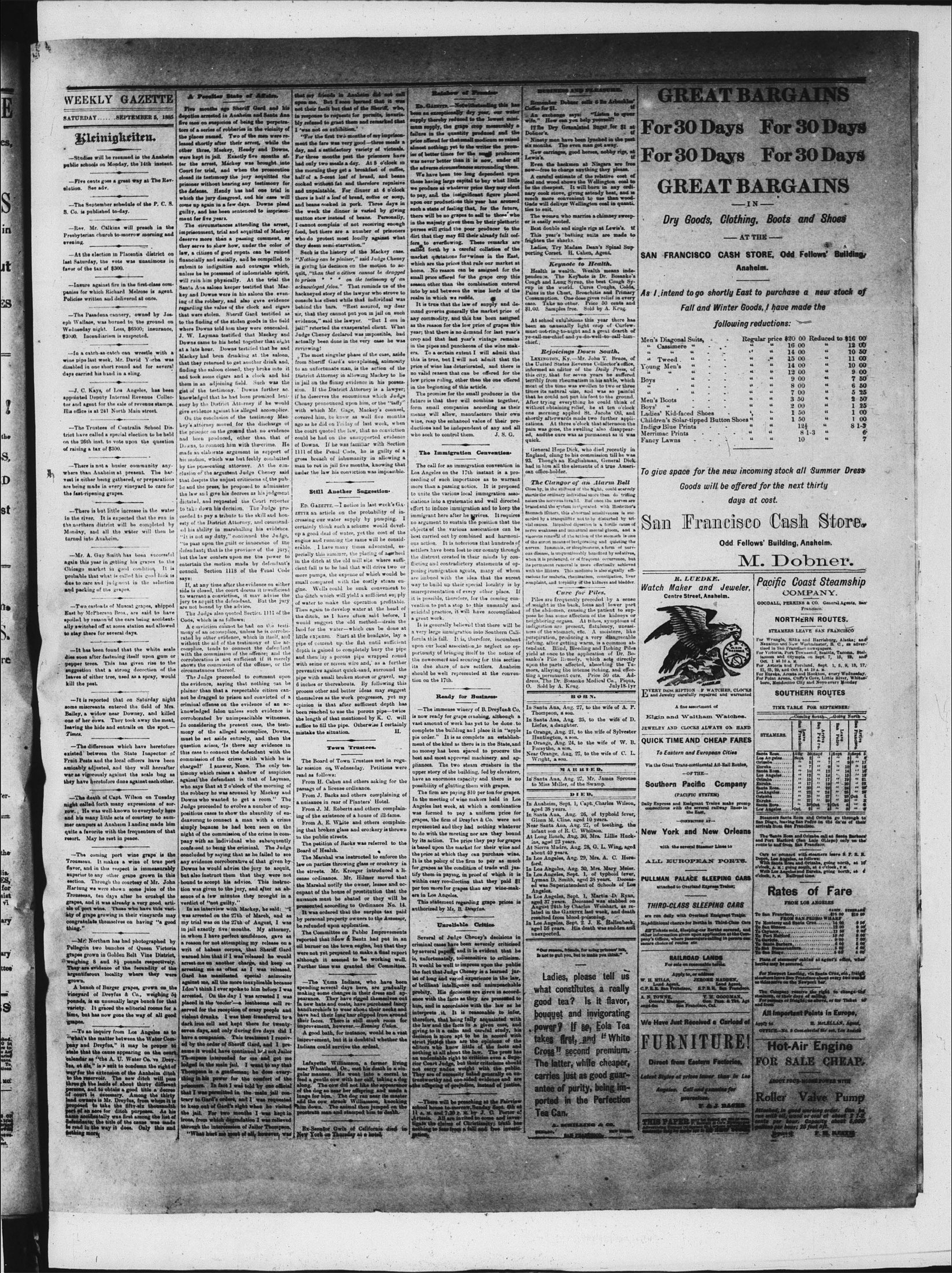
Searchable text
WEEKLY GAZETTE
SATURDAY...SEPTEMBER 5, 1885
Kleinigkeiten.
Studies will be resumed in the Anaheim public schools on Monday, the 14th instant.
Five cents goes a great way at The Revolution. See adv.
The September schedule of the P. C. S. S. Co. is published to-day.
Rev. Mr. Calkins will preach in the Presbyterian church to-morrow morning and evening.
At the election in Placentia district on last Saturday, the vote was unanimous in favor of the tax of $300.
Insure against fire in the first-class companies for which Richard Melrose is agent. Policies written and delivered at once.
The Pasadena cannery, owned by Joseph Wallace, was burned to the ground on Wednesday night. Loss, $6500; insurance, $3000. Incendiarism is suspected.
In a catch-as-catch can wrestle with a wine pipe last week, Mr. David Yorba was disabled in one short round and for several days carried his hand in a sling.
J. C. Kays, of Los Angeles, has been appointed Deputy Internal Revenue Collector and agent for the sale of revenue stamps. His office is at 241 North Main street.
The Trustees of Centralia School District have called a special election to be held on the 26th inst. to vote upon the question of raising a tax of $300.
There is not a busier community anywhere than Anaheim at present. The harbor.
A peculiar State of Affairs.
Five months ago Sheriff Gard and his deputies arrested in Anaheim and Santa Ana five men on suspicion of being the perpetrators of a series of robberies in the vicinity of the places named. Two of the men were released shortly after their arrest, while the other three, Mackey, Hendy and Downs, were kept in jail. Exactly five months after the arrest, Mackey was brought into Court for trial, and when the prosecution closed its testimony the jury acquitted the prisoner without hearing any testimony for the defense. Hendy has had one trial in which the jury disagreed, and his case will come up again in a few days. Downs plead guilty, and has been sentenced to imprisonment for five years.
The circumstances attending the arrest, imprisonment, trial and acquittal of Mackey deserve more than a passing comment, as they serve to show how, under the color of law, a citizen of good repute can be ruined financially and socially, and be compelled to submit to indignities and outrages which, unless he be possessed of indomitable spirit, will rain him physically. At the trial the Santa Ana saloon keeper testified that Mackey and Downs were in his saloon the evening of the robbery, and also gave evidence regarding the value of the clock and cigars that were stolen. Sheriff Gard testified as to the finding of the stolen goods in the field where Downs told him they were concealed. J. W. Layman testified that Mackey and Downs came to his hotel together that night at a late hour. Downs testified that he and Mackey had been drinking at the saloon, that they returned to get another drink and, finding the saloon closed, they broke into it and took some cigars and a clock and hid them in an adjoining field. Such was the gist of the testimony. Downs further acknowledged that he had been promised leniency by the District Attorney if he would give evidence against his alleged accomplice.
On the conclusion of the testimony Mackey's attorney moved for the discharge of the prisoner on the ground that no evidence had been produced, other than that of Downs, to connect him with the crime. He made an elaborate argument in support of his motion, which was but feebly combatted by the prosecuting attorney. At the conclusion of the argument Judge Cheney said that my friends in Anaheim upon me. But I seen not their fault but that o'er in response to requests for help refused to grant them I 'was not on exhibition.
"For the first two months menthe fare was very pity day, and a satisfactory day. For three months past had only two meals a day the morning they got a half of a 5-cent loaf of cooked without fat and und palatable. For there is half a loaf of bread and beans cooked in post the week the dinner in mutton stew instead of fry I cannot complain of no food, but there are a man who do protest most loudly they deem semi-starvation.
Such is the history of "Nothing can be plainer," in giving his decision on quit, "than that a citizen to prison **** on acknowledged felon." This hackneyed story of the lion console his client while behind the bars. "Respect air, that they cannot put evidence," said the lawyer jail!" retorted the exasperated Judge Cheney declared that actually been done in this review!
The most singular phantasy from Sheriff Gard's uncle to an unfortunate man, in District Attorney in alliance in jail on the flimsy evidence. If the District Attic if he deserves the encomander Cheney pronounced upon with which Mr. Gage, covered him, he knew ago as he did on Friday of the court quoted the law could be had on the uncle of Downs. If he was far 1111 of the Penal Code gross breach of inhuman man to rot in jail five mans under the law his convict
J. C. Kays, of Los Angeles, has been appointed Deputy Internal Revenue Collector and agent for the sale of revenue stamps. His office is at 241 North Main street.
The Trustees of Centralia School District have called a special election to be held on the 26th inst. to vote upon the question of raising a tax of $300.
There is not a busier community anywhere than Anaheim at present. The harvest is either being gathered, or preparations are being made in every vineyard to care for the fast-ripening grapes.
There is but little increase in the water in the river. It is expected that the run in the northern district will be completed by Monday, and all the water will then be turned into Anaheim.
Mr. A. Guy Smith has been successful again this year in getting his grapes to the Chicago market in good condition. It is probable that what is called his good luck is due to care and judgment in the selection and packing of the grapes.
Two carloads of Muscat grapes, shipped East by McPherson Bros., are said to have spoiled by reason of the cars being accidentally switched off at some station and allowed to stay there for several days.
It has been found that the white scale dies soon after fastening itself upon gum or pepper trees. This has given rise to the suggestion that a strong decoction of the leaves of either tree, used as a spray, would kill the pest.
It is reported that on Saturday night some miscreants entered the field of Mrs. Bailey, a widow near Downey, and killed one of her cows. They took away the meat, leaving the hide and entrails on the spot. Times.
The differences which have heretofore existed between the State Inspector of Fruit Pests and the local officers have been amicably adjusted, and they will hereafter war as vigorously against the scale bug as they have heretofore done against each other.
The death of Capt. Wilson on Tuesday night called forth many expressions of sorrow. He was well-known to everybody here and his many little acts of courtesy to summer campers at Anaheim Landing made him quite a favorite with the frequenters of that resort. May he rest in peace.
The coming port wine grape is the Troussseau. It makes a wine of true port flavor, and in this respect is immeasurably superior to any other grape grown in this section. Through the courtesy of Mr. John Hartung we were shown some juice of the Troussseau, ten days after he crushed the and took some cigars and a clock and hid them in an adjoining field. Such was the gist of the testimony. Downs further acknowledged that he had been promised leniency by the District Attorney if he would give evidence against his alleged accomplice.
On the conclusion of the testimony Mackey's attorney moved for the discharge of the prisoner on the ground that no evidence had been produced, other than that of Downs, to connect him with the crime. He made an elaborate argument in support of his motion, which was but feebly combatted by the prosecuting attorney. At the conclusion of the argument Judge Cheney said that despite the unjust criticisms of the public and the press, he proposed to administer the law and give his decrees as his judgment dictated, and requested the Court reporter to take down his decision. The Judge proceeded to pay a tribute to the skill and honesty of the District Attorney, and commended his ability in marshalling his evidence. "It is not my duty," continued the Judge, "to pass upon the guilt or innocence of the defendant; that is the province of the jury, but the law contends upon me the power to entertain the motion made by defendant's council. Section 1118 of the Penal Code says:
If, at any time after the evidence on either side is closed, the court declares it insufficient to warrant a conviction, it may advise the jury to acquit the defendant. But the jury are not bound by the advice.
The Judge also quoted Section 1111 of the Code, which is as follows:
A conviction cannot be had on the testimony of an accomplice, unless he is corroborated by other evidence, which in itself, and without the aid of the testimony of the accomplice, tends to connect the defendant with the commission of the offense; and the corroboration is not sufficient if it merely shows the commission of the offense, or the circumstances thereof.
The Judge proceeded to comment upon the evidence, saying that nothing can be plainer than that a respectable citizen cannot be dragged to prison and convicted of a criminal offense on the evidence of an acknowledged felon unless such evidence is corroborated by unimpeachable witnesses. In considering the present case, the testimony of the alleged accomplice, Downs, must be set aside entirely, and then the question arises, "Is there any evidence in this case to connect the defendant with the commission of the crime with which he is charged?" I answer None. The only testimony which raises a shadow of suspicion against the defendant is that of Layman, who says that at 2 o'clock of the morning of the robbery he was aroused by Mackey and Downs who wanted to get a room." The Judge proceeded to evolve a number of suppositional cases to show the absurdity of endeavoring to connect a man with a crime simply because he had been seen on the night of the commission of the crime in company with an individual who subsequently confessed to being the criminal. The Judge concluded by saying that as he failed to see any evidence corroborative of that given by Downs he would advise the jury to acquit, but also instruct them that they were not bound to accept his advice. This instruction was given to the jury, and after an absence of a few minutes they brought in a District Attorney in all jail on the flimsy eviction. If the District Attorney if he deserves the encomhe Cheney pronounced upon with which Mr. Gage, covered him, he knew an ago as he did on Friday at the court quoted the law could be had on the united Downs. If he was faxed 1111 of the Penal Code gross breach of inhumane man to rot in jail five men under the law his convict.
Ed. Gazette.-I notice Zette an article on these creasing our water supply certainly think such a scion a good deal of water, engine and running them erable. I have many times specially this summer, tha in the ditch at the old mient fall is to be had tha more pumps, the expense small compared with tha gine. Wells could be tha ditch which will yield of water to make tha oil Then again to develop wth ditch, as I have o would suggest tha old land for tha water—whlittle expense. Start at pipe of cement up tha depth is gained to compre and then lay a porous p with seine or screen win preventive against quick pipe with small broken s 5 inches or thereabouts process other and better themselves as that work opinion is that after he been reached to use tha length of that mentious suffice to fill tha pipe. O mistakethe situation.
Town Tr
The Board of Town Tlar session on Wednesday read as follows:
From H. Cahen and o passage of a license ordinance
From J. Backs and o nuisance in rear of Pl
From J. M. Roberts s ing of tha existence of a
From A. E. White s ing that broken glass an in tha public streets.
The petition of Backs Board of Health.
The Marshal was inst law on parties throwing tha streets. Mr. Kroe cone ordinance. Mr. The Marshal notify tha c ipant of tha house p puissance must be abat
The coming port wine grape is the Trouseau. It makes a wine of true port flavor, and in this respect is immeasurably superior to any other grape grown in this section. Through the courtesy of Mr. John Hartung we were shown some juice of the Trouseau, ten days after he crushed the grapes, and it was already a very good article of port wine. Those who have this variety of grape growing in their vineyards may congratulate themselves on having "a good thing."
Mr. Northam has had photographed by Pellegrin two bunches of Queen Victoria grapes grown in Golden Belt Vine District, weighing 8 and 8½ pounds respectively. They are evidence of the fecundity of the argentiferous locality where they were grown.
A bunch of Burger grapes, grown on the vineyard of Dreyfus & Co., weighing 5½ pounds, is an unusually large bunch for that variety. It graced the editorial rooms for a time, but has now gone the way of all good grapes.
To an inquiry from Los Angeles as to "what's the matter between the Water Company and Dreyfus," it may be proper to state that the cause appearing on the court calendar as "the A. U. Water Co. vs Dreyfus, at ala." is a suit to condemn the right of way for the extension of the Anaheim ditch to the reservoir. The new ditch will pass through the lands of about thirty different persons, and to obtain a good title a decree of court is necessary. Among the thirty land owners is Mr. Dreyfus, from whom it is proposed to take the fifty-six thousandth part of an acre for ditch purposes. As his home accidentally was first among the list of defendants, the title of the cause was made to read in the way it does. Only this and nothing more.
Judge proceeded to evolve a number of postitious cases to show the absurdity of endeavoring to connect a man with a crime simply because he had been seen on the night of the commission of the crime in company with an individual who subsequently confessed to being the criminal. The Judge concluded by saying that as he failed to see any evidence corroborative of that given by Downs he would advise the jury to acquit, but also instruct them that they were not bound to accept his advice. This instruction was given to the jury, and after an absence of a few minutes they brought in a verdict of "not guilty."
In an interview with Mackey, he said: "I was arrested on the 27th of March, and as my trial was on the 27th of August, I was in jail exactly five months. My attorney, in whom I have perfect confidence, gave as a reason for not attempting my release on a writ of habeas corpus, that Sheriff Gard warned him that if I was released he would arrest me on another charge, and keep on arresting me as often as I was released. Gard has manifested special animosity against me, all the more inexplicable because I don't think I ever spoke to him before I was arrested. On the day I was arrested I was placed in the 'cooler'—a loathsome cell reserved for the reception of crazy people and violent drunks. I was then transferred to a dark iron cell and kept there for twenty-seven days, and only during five days did I have a companion. This treatment I received by the order of Sheriff Gard, and I presume it would have continued bad not Jailor Thompson intereded for me and got me lodged in the main jail. I want to say that Thompson is a gentleman; he does everything in his power for the comfort of the prisoners. In fact I was told by one official that I was permitted in the main jail contrary to Gard's order, and I was requested to keep out of Gard's sight when he visited the jail. For two months I was kept in irons, from which degradation I was relieved through the intercession of Jailor Thompson.
"What hurt me most of all, however, was..."
Lafayette Williamson near Wheatland, Or., no gular manner. He went feed a gentle cow with him along. The cow did not of the dog so near her cage for him. The dog and the cow stroked him down. The animal prostrated man and stank.
Ex Senator Gwin of New York on Thursday
that my friends in Anahaim did not call upon me. But I soon learned that it was not their fault but that of the Sheriff, who, in response to requests for permits, invariably refused to grant them and remarked that I 'was not on exhibition.'
"For the first two months of my imprisonment the fare was very good—three meals a day, and a satisfactory variety of victuals. For three months past the prisoners have had only two meals a day. At 8 o'clock in the morning they get a breakfast of coffee, half of a 5-cent loaf of bread, and beans cooked without fat and therefore repulsive and unpalatable. For dinner at 4 o'clock there is half a loaf of bread, coffee or soup, and beans cooked in pork. Three days in the week the dinner is varied by giving mutton stew instead of beans. Personally, I cannot complain of not receiving enough food, but there are a number of prisoners who do protest most loudly against what they deem semi-starvation."
Such is the history of the Mackey case. "Nothing can be plainer," said Judge Cheney in giving his decision on the motion to acquit, "than that a citizen cannot be dragged to prison on the testimony of an acknowledged felon." That reminds us of the hackneyed story of the lawyer who strove to console his client while that individual was behind the bars. "Rest assured, my dear air, that they cannot put you in jail on such evidence," said the lawyer. "But I am in jail!" retorted the exasperated client. What Judge Cheney declared was impossible, had actually been done in the very case he was reviewing!
The most singular phase of the case, aside from Sheriff Gard's unexplained animosity to an unfortunate man, is the action of the District Attorney in allowing Mackey to lie in jail on the fimsy evidence in his possession. If the District Attorney is a lawyer; if he deserves the encomium which Judge Cheney pronounced upon him, or the "taffy" with which Mr. Gage, Mackey's counsel, covered him, he knew as well five months ago as he did on Friday of last week, when the court quoted the law, that no conviction could be had on the unsupported evidence of Downa. If he was familiar with Section 1111 of the Penal Code, he is guilty of a gross breach of inhumanity in allowing a man to rot in jail five months, knowing that under the law his conviction was impossible.
Matshew of Preston.
Ed. Gazette.—Notwithstanding this has been an exceptionally dry year, our water supply thereby reduced to the lowest minimum supply, the grape crop measurably a failure in the quantity produced and the price offered for that small medicum so raised almost nothing; yet to the writer the promise of better times for the small producers was never better than it is now, under all the adverse circumstances surrounding them.
We have been too long dependent upon those having large capital to buy what little we produce at whatever price they may elect to pay, and the insignificant figure placed upon our productions this year has arisen such a state of feeling that, for the future, there will be no grapes to sell to those who in the majesty given them by their plethoric purses will grind the poor producer to the dirt that they may fill their already full coffers to overflowing. These remarks are called forth by a careful collation of the market quotations for wines in the East, which are the prices that rule our market at home. No reason can be assigned for the small price offered for the grape crop this season other than the combination entered into by and between the wine lords of the realm in which we reside.
It is true that the law of supply and demand governs generally the market price of any commodity, and this has been assigned as the reason for the low price of grapes this year; that there is no demand for last year's crop and that last year's vintage remains in the pipes and puncheons of the wine makers. To a certain extent I will admit that this is true, but I will not admit that the price of wine has deteriorated, and there is no valid reason that can be offered for the low prices ruling, other than the one offered in the beginning of this article.
The promise for the small producer in the future is that they will combine together, form small companies according as their means will allow, manufacture their own wine, reap the enhanced value of their productions and be independent of any and all who seek to control them.
Rejoicings Down South.
Lexington, Ky.-Mr. John T. Bruce, of the United States Revenue Collector's office, informed an editor of the Daily Press, of this city, that for seven years he suffered terribly from rheumatism in his ankle, which most of the time was swollen to two or three times its natural size, and was so painful that he could not put his foot to the ground. After trying everything he could think of without obtaining relief, he at ten o'clock one morning applied St. Jacobs Oil, and shortly afterwards made two further applications. At three o'clock that afternoon the pain was gone, the swelling also disappeared, and the cure was as permanent as it was quick.
General Hope Dick, who died recently in England, clung to his commission till he was 93. Though an Englishman, General Dick had in him all the elements of a true American office-holder.
District Attorney in allowing Mackey to lie in jail on the fimsy evidence in his possession. If the District Attorney is a lawyer, if he deserves the encomium which Judge Choney pronounced upon him, or the "taffy" with which Mr. Gage, Mackey's counsel, covered him, he knew as well five months ago as he did on Friday of last week, when the court quoted the law, that no conviction could be had on the unsupported evidence of Downs. If he was familiar with Section 1111 of the Penal Code, he is guilty of a gross breach of inhumanity in allowing a man to rot in jail five months, knowing that under the law his conviction was impossible.
Still Another Suggestion.
Ed. Gazette. — I notice in last week's Gazette an article on the probability of increasing our water supply by pumping. I certainly think such a scheme would develop a good deal of water, yet the cost of the engine and running the same will be considerable. I have many times advocated, especially this summer, the placing of a wheel in the ditch at the old mill site where sufficient fall is to be had that will drive two or more pumps, the expense of which would be small compared with the costly steam engine. Wells could be sunk convenient to the ditch which will yield a sufficient supply of water to make the operation profitable. Then again to develop water at the head of the ditch, as I have often said before, I would suggest the old method—drain the land for the water—which can be done at little expense. Start at the headgate, lay a pipe of cement up the flat until sufficient depth is gained to completely bury the pipe and then lay a porous pipe wrapped round with seine or screen wire and, as a further preventive against quick-sand, surround the pipe with small broken stones or gravel, say 5 inches or thereabouts. By following this process other and better ideas may suggest themselves as the work progresses, yet my opinion is that after sufficient depth has been reached to use the porous pipe—twice the length of that mentioned by K. C. will suffice to fill the pipe. Otherwise I certainly mistake the situation.
Town Trustees.
The Board of Town Trustees met in regular session on Wednesday. Petitions were read as follows:
From H. Cahen and others asking for the passage of a license ordinance.
From J. Backs and others complaining of a nuisance in rear of Planters' Hotel.
From J. M. Roberts and others complaining of the existence of a house of ill-fame.
From A. E. White and others complaining that broken glass and crockery is thrown in the public streets.
The petition of Backs was referred to the Board of Health.
The Marshal was instructed to enforce the law on parties throwing glass or crockery in the streets. Mr. Kroeger introduced a license ordinance. Mr. Hilmer moved that the Marshal notify the owner, lessee and occupant of the house of prostitution that the insurance must be abated or they will be
The promise for the small producer in the future is that they will combine together, form small companies according as their means will allow, manufacture their own wine, reap the enhanced value of their productions and be independent of any and all who seek to control them.
The Immigration Convention.
The call for an immigration convention in Los Angeles on the 17th instant is a proceeding of such importance as to warrant more than a passing notice. It is proposed to unite the various local immigration associations into a systematic and well directed effort to induce immigration and to keep the immigrant here after he arrives. It requires no argument to sustain the position that the objects of the various associations can be best carried out by combined and harmonious action. It is notorious that hundreds of settlers have been lost to our county through the distrust created in their minds by conflicting and contradictory statements of opposing immigration agents, many of whom are imbued with the idea that the surest way to build up their special locality is by insurrection of every other place. If it is possible, therefore, for the coming convention to put a stop to this humanly and suicidial practice, it will have accomplished a great work.
It is generally believed that there will be a very large immigration into Southern California this fall. It is therefore, incumbent upon our local association to neglect no opportunity of bringing itself to the notice of the newcomers and securing for this section its due share of new settlers. Anaheim should be well represented at the convention on the 17th.
Ready for Business.
— The immense winery of B. Dreyfus & Co., is now ready for grape crushing, although a vast amount of work has yet to be done to complete the building and place it in "apple pie order." It is as complete an establishment of the kind as there is in the State, and no money has been spared to procure the best and most approved machinery and appliances. The two steam crushers in the upper story of the building, fed by elevators, have an enormous capacity and there is no possibility of glutting them with grapes.
The firm are paying $10 per ton for grapes. In the meeting of wine makers held in Los Angeles last week, at which a combination was formed to pay a uniform price for grapes, the firm of Dreyfus & Co. were not represented and they had nothing whatever to do with the meeting nor are they bound by its action. The price they pay for grapes is based upon the market for their wine and the price at which they can purchase wine. It is the policy of the firm to pay as much for grapes as the condition of trade will justify them in paying, in proof of which it is within easy recollection that they paid $1 per ton more for grapes than any wine-makers in Los Angeles.
Born.
In Santa Ana, Aug. 27, to the wife of A. P. Thompson, a son.
In Santa Ana, Aug. 25, to the wife of D. Liefus, a daughter.
In Orange, Aug. 21, to the wife of Sylvester Huntington, a son.
In Orange, Aug. 24, to the wife of W. B. Foraythe, a son.
Near Orange, Aug. 27, to the wife of C. L. Wright, a son.
Married.
In Santa Ana, Aug. 27, Mr. James Sprouse to Miss Miller, of Swamp.
Died.
In Anaheim, Sept. 1, Capt. Charles Wilson, aged 38 years.
In Santa Ana, Aug. 26, of typhoid fever, Glenn M. Cline, aged 10 years.
Near Santa Ana, Aug. 27, of teething, the infant son of R. C. Whitson.
At Long Beach, Aug. 30, Mrs. Lillie Huckins, aged 23 years.
At Sierra Madre, Aug. 28, G. L. Wing, aged about 40 years.
In Los Angeles, Aug. 29, Mrs. A. C. Hereford.
In Los Angeles, Aug. 30, Mrs. Mary Meier.
In Los Angeles, Sept. 1, of typhoid fever, Lyman D. Smith, aged 38 years. Deceased was Superintendent of Schools of Los Angeles.
In Los Angeles, Sept. 1, Martin D. Ryan,
Boys
Men's Boots
Boys'
Ladies' Kitchen
Indigo Blue
Merrimac Fancy Law
A nuisance in rear of Planters' Hotel.
From J. M. Roberts and others complaining of the existence of a house of ill-fame.
From A. E. White and others complaining that broken glass and crockery is thrown in the public streets.
The petition of Backs was referred to the Board of Health.
The Marshal was instructed to enforce the law on parties throwing glass or crockery in the streets. Mr. Kroeger introduced a license ordinance. Mr. Hilmer moved that the Marshal notify the owner, lessee and occupant of the house of prostitution that the nuisance must be abated or they will be prosecuted according to Ordinance No. 14.
It was ordered that the surplus tax paid by personal property owners to the Assessor, be refunded upon application.
The Committee on Public Improvements reported that Snow & Beutz had put in an oil burner on the town engine, but that they were not yet prepared to make a final report although it seemed to be working well. Further time was granted the Committee.
—The Yuma Indians, who have been spending several days here, are gradually making some changes in their dress and appearance. They have rigged themselves out in new hats and coats, have purchased fancy handkerchiefs to wear about their necks and have had their long hair clipped from around their faces. There is still much room for improvement, however.—Evening Union.
A good bath, for instance, would be a vast improvement, but it is doubtful whether the Indians could survive the erdeal.
Lafayette Williamson, a farmer living near Wheatland, Or., met his death in a singular manner. He went into a corral to feed a gentle cow with her calf, taking a dog along. The cow did not like the appearance of the dog so near her offspring and made a lunge for him. The dog ran near its master and the cow stroked Williamson, knocking him down. The animal then jumped on the prostrate man and stamped him to death.
Ex-Senator Gwin of California died in New York on Thursday at a hotel.
In the meeting of wine makers held in Los Angeles last week, at which a combination was formed to pay a uniform price for grapes, the firm of Dreyfus & Co. were not represented and they had nothing whatever to do with the meeting nor are they bound by its action. The price they pay for grapes is based upon the market for their wine and the price at which they can purchase wine. It is the policy of the firm to pay as much for grapes as the condition of trade will justify them in paying, in proof of which it is within easy recollection that they paid $1 per ton more for grapes than any wine-makers in Los Angeles.
This statement regarding grape prices is authorized by Mr. B. Dreyfus.
Unreliable Critics
Several of Judge Cheney's decisions in criminal cases have been severely criticized by several papers, and it is evident that he is, unfortunately, too sensitive to criticism. It would be well to impress upon the public the fact that Judge Cheney is a learned jurist of long and varied experience in the law, of brilliant intelligence and unimpeachable probity. His decisions are given in accordance with the facts as they are presented to him, and in accordance with the law as he interprets it. It is reasonable to infer, therefore, that being fully acquainted with the law and the facts in a given case, giving to it a calm and careful study, his decision is more apt to be in accord with strict justice than are the opinions of the editors who know little of the facts and nothing at all about the law. The press has an undeniable right to criticize even a Superior Court Judge, but their criticisms should not carry undue weight with the public. They are of necessity based generally on untrustworthy and one-sided evidence and are the offspring of prejudice, instead of justice.
—There will be preaching at the Fairview school house to morrow, Sunday Sept. 6th at 11 a.m. and 7:30 p.m. by J. C. Porter of Artistry. All are invited to come and investigate the claims of Christianity; truth has nothing to fear from a full and free investigation.
In Anaheim, Sept. 1, Capt. Charles Wilson, aged 38 years.
In Santa Ana, Aug. 26, of typhoid fever, Glenn M. Cline, aged 10 years.
Near Santa Ana, Aug. 27, of teething, the infant son of R. C. Whitson.
At Long Beach, Aug. 30, Mrs. Lillie Huckins, aged 23 years.
At Sierra Madre, Aug. 28, G. L. Wing, aged about 40 years.
In Los Angeles, Aug. 29, Mrs. A. C. Hereford.
In Los Angeles, Aug. 30, Mrs. Mary Meier.
In Los Angeles, Sept. 1, of typhoid fever, Lyman D. Smith, aged 38 years. Deceased was Superintendent of Schools of Los Angeles.
In Los Angeles, Sept. 1, Martin D. Ryan, aged 37 years. Decased was stabbed on August 24th by Charles Weishart, as related in the Gazette last week, and death resulted from blood-poisoning.
In Los Angeles, Sept. 2, J. E. Hollenbeck, aged 56 years. His death was sudden and unexpected.
"Our reason, friends, for using printers' ink, is not to guilt you, but to make you think."
Ladies, please tell us what constitutes a really good tea? Is it flavor, bouquet and invigorating power? If so, Eola Tea takes first, and "White Cross" second premium. The latter, while cheaper, carries just as good guarantee of purity, being imported in the Perfection Tea Can.
A. Schilling & Co., San Francisco
GREAT BARGAINS
For 30 Days For 30 Days
For 30 Days For 30 Days
GREAT BARGAINS
IN
Dry Goods, Clothing, Boots and Shoes
AT THE
SAN FRANCISCO CASH STORE, Odd Fellows' Building,
Anaheim.
As I intend to go shortly East to purchase a new stock of
Fall and Winter Goods, I have made the
following reductions:
Men's Diagonal Suits, Regular price $20.00 Reduced to $16.00
"Cassimere" "16.00" "12.00"
"Tweed" "14.00" "10.50"
Young Men's "15.00" "11.00"
"14.00" "10.00"
"13.00" "9.00"
Boys "9.00" "7.50"
"8.00" "6.50"
"7.00" "5.25"
Men's Boots "3.50" "2.50"
Boys' "2.00" "1.25"
Ladies' Kid-faced Shoes "1.50" "1.00"
Children's Solar-tipped Button Shoes "1.50" "1.00"
Indigo Blue Prints "12¼" "8 1-3"
Merrimac Prints "8 1-3" "6"
Fancy Lawns "10" "7"
To give space for the new incoming stock all Summer Dress
To give space for the new incoming stock all Summer Dress
Goods will be offered for the next thirty
days at cost.
San Francisco Cash Store.
Odd Fellows' Building, Anaheim.
M. Dobner.
R. LUEDKE.
Watch Maker and Jeweler,
Centre Street, Anaheim.
EVERY DESCRIPTION OF WATCHES, CLOCKS
and Jewelry carefully repaired and warranted
A fine assortment of
Elgin and Waltham Watches.
JEWELRY AND CLOCKS ALWAYS ON HAND
QUICK TIME AND CHEAP FARES
To Eastern and European Cities
Via the Great Transcontinental All-Ball Routes,
OF THE--
Southern Pacific Company
(PACIFIC SYSTEM)
Daily Express and Emigrant Trains make prompt
connections with the several railway lines in the East,
CONNECTING AT--
New York and New Orleans
with the several Steamer Lines to
ALL EUROPEAN PORTS.
PULLMAN PALACE SLEEPING CARS
attached to Overland Express Trains;
Pacific Coast Steamship COMPANY.
GOODALL, PERKINS & CO. General Agents, San Francisco.
NORTHERN ROUTES.
STEAMERS LEAVE SAN FRANCISCO
For Wrangle, Sitka and Harriburg, Alaska; and
Nenaimo and New Westminster, B.C., as advertised in San Francisco newspapers.
For Victoria, Port Townsend, Seattle, Tacoma, Stelllacoom and Olympia on Sept. 7, 15, 28, and
Oct. 1 at 10 A.M.
For Asteria and Portland, Sept. 1, 5, 9, 13, 17,
21, 25, 29, and Oct. 3 at 10 A.M.
For Eureka, Arcata and Hookton, every Wednesday.
For Point Arena, Cuffy's Cove, Little River, Whitesboro, Mendocino City and Novo every Monday.
SOUTHERN ROUTES
TIME TABLE FOR SEPTEMBER:
Coming South Going North
Steamers Santa Rosa and Orinaba go through to
San Diego, leaving San Pedro on the dates of their
arrivals from San Francisco.
The Santa Rosa and Orinaba call at Santa Barbara
and Port Harford (San Luis Olisco) only on the route to and from San Francisco.
Cars to connect with steamers leave S. P. R. R.
Depot, Los Angeles, as follows:
With Santa Rosa and Orinaba, going north, at 10
o'clock, A.M.; going south, at 6 o'clock, p.m.
With Los Angeles and Orinaba, going north, at 4
o'clock, p.m. Railroad time.
Rates of Fare
Daily Express and Emigrant Trains make prompt connections with the several railway lines in the East.
CONNECTING AT—
New York and New Orleans
with the several Steamer Lines to
ALL EUROPEAN PORTS.
PULLMAN PALACE SLEEPING CARS
attached to Overland Express Trains;
THIRD-CLASS SLEEPING CARS
are run daily with Overland Emigrant Trains.
No additional charge for Dertha in Third-Class Cars
All Tickets sold, Sleeping-car Berths secured, and other information given upon application at the Company's Office, where passengers calling in person can secure choice of routes etc.
RAILROAD LANDS
For sale on reasonable terms.
Apply to, or address
W. H. MILLS,
JEROME MADDEN,
Land Agent,
C.P.R.K. San Francisco,
& P.R.K. San Francisco.
A. N. TOWNE,
T. H. GOODMAN,
General Manager,
Gen. Pass. & Thr. Agt.
aug-6m
San Francisco, Cal.
We Have Just Received a Carload of FURNITURE!
Direct from Eastern Factories.
Latest Styles at prices lower than in Los Angeles. Call and examine for your needs.
THIS PAPER FLAT ONLY
Advertising Press Or Shares Only
Steamers Santa Rosa and Orizaba go through to San Diego, leaving San Pedro on the dates of their arrivals from San Francisco.
The Santa Rosa and Orizaba call at Santa Barbara and Port Harford (San Luis Olímpo) only on the route to and from San Francisco.
Cars to connect with steamers leave S. P. R. R. Depot, Los Angeles, as follows:
With Santa Rosa and Orizaba, going north, at 10 o'clock, A.M.; going south, at 4 o'clock, r.m.
With Los Angeles and Eureka, going north, at 4 o'clock, r.m.
Rates of Fare
FROM LOS ANGELES
CARRIES BY SEVERAL
To San Francisco.....$75 00 $10 00
FROM SAN PEDRO WHARF
To Monterey and Santa Cruz.....14 00 9 00
To San Simon.....12 00 9 00
To Cayenne.....11 50 9 00
To Fort Harford.....10 50 8 00
To Garlics.....9 00 7 00
To Santa Barbara.....6 00 5 00
To San Bunyaventura.....5 00 4 00
To San Diego.....5 00 4 00
Plans of steamers' cabling at agent's office, when berths may be secured.
For Newport Landing, via Santa Cruz, etc., freight steamers leave San Francisco about every two weeks on tides serve on the Newport bar.
The Company reserve the right to change-the steamers, or their days of sailing.
For passage or freight; as above, or for Ticket to and from.
All Important Points in Europe,
Apply to
H. McLELLAN, Agent,
OFFICE—No. 9 Comercial Street, Los Angeles
Hot-Air Engine FOR SALE CHEAP.
ABOUT FOUR-HOME POWER WITH Roller Valve Pump
Attended, in good working order: One he is run with air, wood or coal at about 2 I-2 cents per hour. Capacity about 5,000 gallons per hour; 25 foot lift.
P. H. MURKIN