anaheim-gazette 1885-09-05
Scanned page
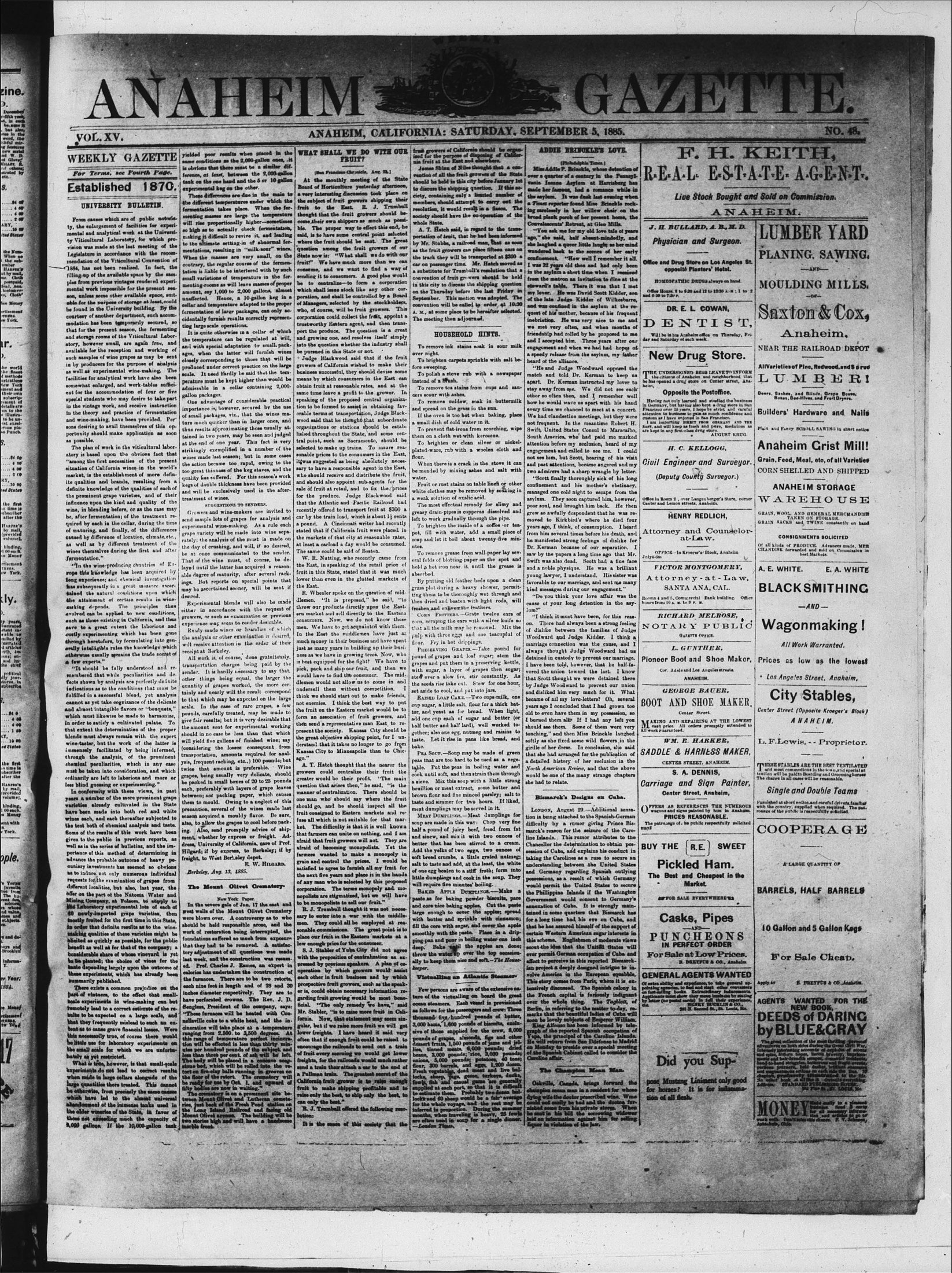
Searchable text
WEEKLY GAZETTE
For Terms, see Fourth Page.
Established 1870.
UNIVERSITY BULLETIN.
From causes which are of public notoriety, the enlargement of facilities for experimental and analytical work at the University Viticultural Laboratory, for which provision was made at the last meeting of the Legislature in accordance with the recommendation of the Viticultural Convention of 1884, has not been realized. In fact, the filling-up of the available space by the samples from previous vintages rendered experimental work impossible for the present season, unless some other available space suitable for the purpose of storage at least, could be found in the University building. By the courtesy of another department, such accommodation has been temporarily secured, so that for the present season, the fermenting and storage rooms of the Viticultural Laboratory, however small, are again free, and available for the reception and working of such samples of wine grapes as may be sent in by producers for the purpose of analysis as well as experimental wine-making. The facilities for analytical work have also been somewhat enlarged, and work-tables sufficient for the accommodation of four or five special students who may desire to take part in the vintage work, and receive instruction in the theory and practice of fermentation and wine-making, have been provided. Persons desiring to avail themselves of this opportunity should make application as soon as possible.
The plan of work in the viticultural laboratory is based upon the obvious fact that "among the first necessities of the present situation of California wines in the world's market in the establishment of more defined poor results when placed in the same conditions as the 2,000-gallon ones, it is obvious that there must be a similar difference, at least, between the 2,000-gallon tank on the one hand and the 5 or 10-gallon experimental keg on the other.
These differences are due in the main to the different temperatures under which the fermentation takes place. When the fermenting masses are large the temperature will rise proportionally higher—sometimes so high as to actually check fermentation, making it difficult to revive it, and leading to the ultimate setting-in of abnormal fermentations, resulting in "milk-sour" wines. When the masses are very small, on the contrary, the regular course of the fermentation is liable to be interrupted with by such small variations of temperature in the fermenting-rooms as will leave masses of proper amount, say 1,000 to 2,000 gallons, almost unaffected. Hence, a 10-gallon keg in a cellar and temperature adapted to the proper fermentation of large packages, can only accidentally furnish results correctly representing large scale operations.
It is quite otherwise in a cellar of which the temperature can be regulated at will, and with special adaptation to small packages, when the latter will furnish wines closely corresponding to those that will be produced under correct practice on the large scale. It need hardly be said that the temperature must be kept higher than would be admissable in a cellar containing 2,000-gallon packages.
One advantage of considerable practical importance is, however, secured by the use of small packages, viz., that the wines mature much quicker than in larger ones, and thus results approximating those usually attained in two years, may be seen and judged at the end of one year. This fact is very strikingly exemplified in a number of the wines made last season; but in some cases the action became too rapid, owing to the too great thinness of the keg staves, and the yielded poor results when placed in the same conditions as the 2,000-gallon ones, it is obvious that there must be a similar difference, at least, between the 2,000-gallon tank on the one hand and the 5 or 10-gallon experimental keg on the other.
WHAT SHALL WE FRUIT?
At the monthly meeting Board of Horticulture a very interesting discussion took place of fruit growth fruit to the East. thought that the fruit come their own shipping able. The proper way said, is to have some co-where the fruit should question among the State now: "What fruit?" We have much consume, and we want sending it to consumers be to centralize—to which shall issue stock poration, and shall be co-of Managers, selected by who, of course, will be corporation could collect trustworthy Eastern agriport produce. They and growing one, and re-into the question whether be pursued in this State.
Judge Blackwood said growers of California win business successful, they means by which consumers obtain fruit at reasonable same time leave a profiling speaking of the proposition to be formed to assorable terms of transport wood said that he though organizations or stations lished throughout the Central point, such as Sacramento selected to make up traction it was suggested as being sary to have a responsible who should receive and
The plan of work in the viticultural laboratory is based upon the obvious fact that "among the first necessities of the present situation of California wines in the world's market, is the establishment of more definite qualities and brands, resulting from a definite knowledge of the qualities of each of the prominent grape varieties, and of their influence upon the kind and quality of the wine, in blending before, or as the case may be, after fermentation; of the treatment required by each in the cellar, during the time of maturing, and finally, of the differences caused by difference of location, climate, etc., as well as by different treatment of the wines themselves during the first and after fermentation."
In the wine-producing countries of Europe this knowledge has been acquired by long experience; and chemical investigation has subsequently in a great measure ascertained the natural conditions upon which the attainment of certain results in wine-making depends. The principles thus evolved can be applied to new conditions, such as those existing in California, and thus save to a great extent the laborious and costly experimenting which has been gone through heretofore, by formulating into generally intelligible rules the knowledge which otherwise usually remains the trade secret of a few experts.
"It should be fully understood and remembered that while peculiarities and defects shown by analysis are perfectly definite indications as to the conditions that must be fulfilled in a successful blend, yet analysis cannot as yet take cognizance of the delicate and almost intangible flavors or "bonquets," which must likewise be made to harmonize, in order to satisfy a cultivated palate. To that extent the determination of the proper blends must always remain with the expert wine-taster, but the work of the latter is immensely facilitated by being informed, through the analysis, of the prominent chemical peculiarities, which in any case must be taken into consideration, and which ordinarily are left to laborious and more or less blind guessing or experimenting."
In conformity with these views, in past years a number of the more prominent grape varieties already cultivated in the State have been made into both red and white wines each, and each thereafter subjected to the test both of chemical analysis and taste. Some of the results of this work have been given to the public in previous reports, as well as in the series of bulletins, and the importance of this method of determining in advance the probable outcome of heavy pecuniary investments has seemed so obvious as to induce not only numerous individual requests for the examination of grapes from different localities, but also last year, the offer on the part of the Natoma Water and facilities for analytical work have also been somewhat enlarged, and work-tables sufficient for the accommodation of four or five special students who may desire to take part in the vintage work, and receive instruction in the theory and practice of fermentation and wine-making, have been provided. Persons desiring to avail themselves of this opportunity should make application as soon as possible.
The plan of work in the viticultural laboratory is based upon the obvious fact that "among the first necessities of the present situation of California wines in the world's market, is the establishment of more definite qualities and brands, resulting from a definite knowledge of the qualities of each of the prominent grape varieties, and of their influence upon the kind and quality of the wine, in blending before, or as the case may be, after fermentation; of the treatment required by each in the cellar, during the time of maturing, and finally, of the differences caused by difference of location, climate, etc., as well as by different treatment of the wines themselves during the first and after fermentation."
In the wine-producing countries of Europe this knowledge has been acquired by long experience; and chemical investigation has subsequently in a great measure ascertained the natural conditions upon which the attainment of certain results in wine-making depends. The principles thus evolved can be applied to new conditions, such as those existing in California, and thus save to a great extent the laborious and costly experimenting which has been gone through heretofore, by formulating into generally intelligible rules the knowledge which otherwise usually remains the trade secret of a few experts."
"It should be fully understood and remembered that while peculiarities and defects shown by analysis are perfectly definite indications as to the conditions that must be fulfilled in a successful blend, yet analysis cannot as yet take cognizance of the delicate and almost intangible flavors or "bonquets," which must likewise be made to harmonize, in order to satisfy a cultivated palate. To that extent the determination of the proper blends must always remain with the expert wine-taster, but the work of the latter is immensely facilitated by being informed, through the analysis, of the prominent chemical peculiarities, which in any case must be taken into consideration, and which ordinarily are left to laborious and more or less blind guessing or experimenting."
In conformity with these views, in past years a number of the more prominent grape varieties already cultivated in the State have been made into both red and white wines each, and each thereafter subjected to the test both of chemical analysis and taste. Some of the results of this work have been given to the public in previous reports, as well as in the series of bulletins, and the importance of this method of determining in advance the probable outcome of heavy pecuniary investments has seemed so obvious as to induce not only numerous individual requests for the examination of grapes from different localities, but also last year, the offer on the part of the Natoma Water and facilities for analytical work have also been somewhat enlarged, and work-tables sufficient for the accommodation of four or five special students who may desire to take part in the vintage work, and receive instruction in the theory and practice of fermentation and wine-making, have been provided. Persons desiring to avail themselves of this opportunity should make application as soon as possible.
The plan of work in the viticultural laboratory is based upon the obvious fact that "among the first necessities of the present situation of California wines in the world's market, is the establishment of more definite qualities and brands, resulting from a definite knowledge of the qualities of each of the prominent grape varieties, and of their influence upon the kind and quality of the wine, in blending before, or as the case may be, after fermentation; of the treatment required by each in the cellar, during the time of maturing, and finally, of the differences caused by difference of location, climate, etc., as well as by different treatment of the wines themselves during the first and after fermentation."
In the wine-producing countries of Europe this knowledge has been acquired by long experience; and chemical investigation has subsequently in a great measure ascertained the natural conditions upon which the attainment of certain results in wine-making depends. The principles thus evolved can be applied to new conditions, such as those existing in California, and thus save to a great extent the laborious and costly experimenting which has been gone through heretofore, by formulating into generally intelligible rules the knowledge which otherwise usually remains the trade secret of a few experts."
"It should be fully understood and remembered that while peculiarities and defects shown by analysis are perfectly definite indications as to the conditions that must be fulfilled in a successful blend, yet analysis cannot as yet take cognizance of the delicate and almost intangible flavors or "bonquets," which must likewise be made to harmonize, in order to satisfy a cultivated palate. To that extent the determination of the proper blends must always remain with the expert wine-taster, but the work of the latter is immensely facilitated by being informed, through the analysis, of the prominent chemical peculiarities, which in any case must be taken into consideration, and which ordinarily are left to laborious and more or less blind guessing or experimenting."
In conformity with these views, in past years a number ofthe more prominent grape varieties already cultivated inthe State have been made into both red and white wines each,and each thereafter subjected tothe test bothofchemicalanalysisandtaste.Someoftheresultsofthisworkhavebeengiventothepublicinpreviousreports.aswellasintheresistofbulletinas,andtheimportanceofthismethoddetermininginhadvancetheprobableoutcomeofheavypecuniaryinvestmentshasseemedsoobviousastoinducenotonlynumerousindividualrequestsfortheexaminationofgrapesfromdifferentlocalities,bbutalsolastyear,theofferonthepartoftheNatomaWaterandfacilitiesforanalyticalworkhavealsobeensomewhatenlarged,andwork-tablessufficientforthematurationfortheaccommodationoffourorfivespecialstudentswhommaydesiretoavailthematthemselvesbywhichconsumebetobegintowatchsonitpriceoftothecoffeeis suggestedastbeingsarytohavearesponsiblestohavea responsibilitywhoshouldreceiveandshouldalsoappointsaleoffruitatretail,andfortheproduce.JudgesthattheAtlanticandR recentlyofferedtotranscarbythetrainloadwawa pound.ACincinnati stated thatifCaliforniathemarketofthatcityatleasta carloada day.The same could be said.W.R.NuttingwhoseEast.in speakingoffruitinthisState.statelowerthanevenintheEast.R.Wheelerspokeondidlemen."Itisproposedthrowouroppartsdirectornarketand selldirectconsumers.Now.wewomenWehavegetacctInTheEastthemiddlemuchmoneyinthebuijustasmanyyearsinbusnessaswehavebeniguredforthepick,packandshipourswouldhavesofindtheclediemenwouldnotallowundersellthemwithoutthinkweshouldstartonotenemies.I thinkthatthefruitontheEasternformanassociationofthen sendarepresentationpresentthe society.Kaethegreatobjectiveshipderstandthatit takenoKansasCitytoMinneapolisago."
A.T.Hatch thoughttogrowerscouldcentralwouldbe theirquestionthat arisesthemannerofcentralizationonemanwhoshouldswouldgo,andhes fruit consignedtoEasterfuseallwhichisnotsuitedket.The difficultyisthatthe farmerscanuniteocafraidthatfruitgrowersafraidofbecomingmorefarmerswantedtomaingrainandcontrolthe satisfiedtoagreetofarmthenextfiveyearsandofanymanwhoisselectedcorporation.Thetermnopolistsarestigmaticized.
The Mount Olivet Crematory
New York Paper.
In the severe gale of Jan. 17 the east and west walls of the Mount Olivet Crematory were blown over. A controversy as to who should be held responsible arose, and the work of restoration being interrupted, the foundations suffered so much from exposure that they had to be removed. A satisfactory adjustment of all questions was made last week, and the construction was resumed. Prof. Charles J. Eames, an expert in calorics has undertaken the construction of the furnaces. There are to be two retorts, each nine feet in length and of 28 and 30 inches diameter respectively. They are to have perforated crowns. The Rev. J. D. Bengless, President of the company, says:
"These furnaces will be heated with Connellsville coke to a white heat, and the incineration will take place at a temperature ranging from 2,500 to 3,500 degrees. At this range of temperature perfect incineration will be effected in less than thirty minutes per hundred pounds of the subject, and less than three per cent. of ash will be left. The body will be placed in a concave soapstone bed, which will be rolled into the retort on fire- clay balls running in grooves on the floor of the retort. The crematory will be ready for use by Oct. I, and upward of fifty bodies are now in waiting."
The crematory is on a prominent site between Mount Olivet and Lutheran cemeteries, just back of the Fresh Pond station on the Long Island Railroad and facing old Mount Olivet avenue. The building will be two stories high and will have a handsome marble front.
One man who should go, and he should fruit consigned to Eastern fuse all which is not suitable. The difficulty is that farmers can unite or afraid that fruit growers afraid of becoming more farmers wanted to make grain and control the satisfied to agree to furnish the next five years and of any man who is select corporation. The term nopolists are stigmatized to be monopolists to sell.
R. J. Trumbull though sary to enter into a war men. They could all be sonable commissions. Place our fruit in the Elow enough price for them.
S. J. Stabler of Yuba with the proposition of pressing by previous operation by which give each other in fruit bus prospective fruit grower or is, could obtain necessary garding fruit growing wificial. "The only remit Mr. Stabler, "is to raise fernia. Now, that statue gular, but if we raise my lower freights. I have often that if enough fruition encourage the railroads of fruit every morning freights, for the railroad send a train than attach a Pullman train. The California fruit grower raise only the best, so can only the best."
R. J. Trumbull offeration:
It is the sense of th
WHAT SHALL WE DO WITH OUR FRUIT?
[San Francisco Chronicle, Aug. 24.]
At the monthly meeting of the State Board of Horticulture yesterday afternoon, a very interesting discussion took place on the subject of fruit growers shipping their fruit to the East. R. J. Trumbull thought that the fruit growers should become their own shippers as much as possible. The proper way to effect this end, he said, is to have some central point selected where the fruit should be sent. The great question among the fruit growers of our State now is: "What shall we do with our fruit?" We have much more than we can consume, and we want to find a way of sending it to consumers. A good plan would be to centralize—to form a corporation which shall issue stock like any other corporation, and shall be controlled by a Board of Managers, selected by the stockholders, who, of course, will be fruit growers. This corporation could collect the fruit, appoint a trustworthy Eastern agent, and then transport the produce. The question is a great and growing one, and resolves itself simply into the question whether the industry shall be pursued in this State or not.
Judge Blackwood said that if the fruit growers of California wished to make their business successful, they should devise some means by which consumers in the East can obtain fruit at reasonable rates, and at the same time leave a profit to the grower. In speaking of the proposed central organization to be formed to assist in obtaining favorable terms of transportation, Judge Blackwood said that he thought that subordinate organizations or stations should be established throughout the State, and some central point, such as Sacramento, should be selected to make up trains. To insure reasonable prices to the consumers in the East, it was suggested as being absolutely necessary to have a responsible agent in the East, who should receive and distribute the fruit.
fruit growers of California should be organized for the purpose of disposing of California fruit at the East and elsewhere.
James Shinn of Niles thought that a convention of all the fruit growers of the State should be held in this city before January last to discuss the shipping question. If this society, containing only a limited number of members, should attempt to carry out the resolution, it would result in a fiasco. The society should have the co-operation of the whole State.
A. T. Hatch said, in regard to the transportation of fruit, that he had been informed by Mr. Stubba, a railroad man, that as soon as the fruit growers can place fifteen cars on the track they will be transported at $300 a car on passenger time. Mr. Hatch moved as a substitute for Trumbull's resolution that a convention of fruit growers should be held in this city to discuss the shipping question on the Thursday before the last Friday in September. This motion was adopted. The convention will be called to order at 10:30 A.M., at some place to be hereafter selected. The meeting then adjourned.
HOUSEHOLD HINTS.
To remove ink stains soak in sour milk over night.
To brighten carpets sprinkle with salt before sweeping.
To polish a stove rub with a newspaper instead of a brush.
To remove tea stains from cups and saucers scour with ashes.
To remove mildew, soak in buttermilk and spread on the grass in the sun.
If the oven is too hot when baking, place a small dish of cold water in it.
To prevent flat-irons from scorching, wipe them on a cloth wet with kerosene.
To brighten or clean silver or nickel-plated ware, rub with a woolen cloth and flour.
When there is a crack in the stove it can be mended by mixing ashes and salt with
ADDIE BRINCKLE'S LOVE.
[Philadelphia Times]
Miss Addie P. Brinckle, whose detention of over a quarter of a century in the Pennsylvania Insane Asylum at Harrisburg has made her famous, had a romance while in the asylum. It was dusk last evening when a Times reporter found Miss Brinckle rocking carelessly in her willow chair on the broad plank porch of her present home, the Convalescents' Retreat, at Glen Mills.
"You ask me for my old love tale of years ago," she said, half absent-mindedly, and she laughed a queer little laugh as her mind wandered back to the scenes of her early confinement. "How well I remember it all. I was 32 years old then and had only been in the asylum a short time when I received from the matron an invitation to dine at the steward's table. There it was that I met my lover. He was David Scott Kidder, son of the late Judge Kidder of Wilkesbarre, and was confined in the asylum at the request of his mother, because of his frequent inebriation. He was very nice to me and we met very often, and when months of friendship had rolled by he proposed to me and I accepted him. Three years after our engagement and when we had had hopps of a speedy release from the asylum, my father heard of the alliance.
"He and Judge Woodward opposed the match and told Dr. Kerman to keep us apart. Dr. Kerman instructed my lover to stay away from me. We did not see each other so often then, and I remember well how he would wave us apart with his hand every time we chanced to meet at a concert. We had clandestine meetings, but they were not frequent. In the meantime Robert H. Swift, United States Consul to Maracaibo, South America, who had paid me marked attention before my seclusion, heard of my engagement and called to see me. I could not see him, but Scott, hearing of his visit and past attentions, became angered and my two admirers had a sharp wrangle by letter."
means by which consumers in the East can obtain fruit at reasonable rates, and at the same time leave a profit to the grower. In speaking of the proposed central organization to be formed to assist in obtaining favorable terms of transportation, Judge Blackwood said that he thought that subordinate organizations or stations should be established throughout the State, and some central point, such as Sacramento, should be selected to make up trains. To insure reasonable prices to the consumers in the East, it was suggested as being absolutely necessary to have a responsible agent in the East, who should receive and distribute the fruit, and should also appoint sub-agents for the sale of fruit at retail, and to fix the prices for the produce. Judge Blackwood said that the Atlantic and Pacific Railroad had recently offered to transport fruit at $300 a car by the train load, which is about 15 cents a pound. A Cincinnati writer had recently stated that if California fruit were placed in the markets of that city at reasonable rates, at least a carload a day would be consumed. The same could be said of Boston.
W. R. Nutting, who recently came from the East, in speaking of the retail price of fruit in this State, stated that it was much lower than even in the glutted markets of the East.
R. Wheeler spoke on the question of middlemen. "It is proposed," he said, "to throw our products directly upon the Eastern market and sell directly to the Eastern consumers. Now, we do not know these men. We have to get acquainted with them. In the East the middlemen have just as much money in their business and have spent just as many years in building up their business as we have in growing trees. Now, who is best equipped for the fight? We have to pick, pack and ship our fruit, and then we would have to find the consumer. The middlemen would not allow us to come in and undersell them without competition. I think we should start out to make friends, not enemies. I think the best way to put the fruit on the Eastern market would be to form an association of fruit growers, and then send a representative man East to represent the society. Kansas City should be the great objective shipping point, for I understand that it takes no longer to go from Kansas City to Minneapolis than to Chicago."
A. T. Hatch thought that the nearer the growers could centralize their fruit the greater would be their profit. "The main question that arises then," he said, "is the manner of centralization. There should be one man who should say where the fruit should go, and he should inspect all the fruit consigned to Eastern markets and refuse all which is not suitable for that market. The difficulty is that it is well known that farmers can unite on nothing, and I am afraid that fruit growers will not. They are afraid of becoming monopolists. Yet the farmers wanted to make a monopoly in grain and control the prices. I would be satisfied to agree to furnish all my fruit for the next five years and place it in the hands of any man who is selected by this proposed corporation. The terms monopoly and monopolists are stigmatized, but we will have to polish a stove rub with a newspaper instead of a brush.
To remove tea stains from cups and saucers scour with ashes.
To remove mildew, soak in buttermilk and spread on the grass in the sun.
If the oven is too hot when baking, place a small dish of cold water in it.
To prevent flat-irons from scratching, wipe them on a cloth wet with kerosene.
To brighten or clean silver or nickel-plated ware, rub with a woolen cloth and flour.
When there is a crack in the stove it can be mended by mixing ashes and salt with water.
Fruit or rust stains on table linen or other white clothes may be removed by soaking in a weak solution of oxalic acid.
The most effectual remedy for slimy and greasy drain-pipes is copperas dissolved and left to work gradually through the pipe.
To brighten the inside of a coffee-or teapot, fill with water, add a small piece of soap and let it boil about twenty-five minutes.
To remove grease from wall-paper lay several folds of blotting-paper on the spot and hold a hot iron near it until the grease is absorbed.
By putting old feather beds upon a clean grass plot during a heavy shower, permitting them to be thoroughly wet through and then dried and beaten with light rods, will freshen and enliven the feathers.
Corn Fritters—Grate twelve ears of corn, scraping the ears with a silver knife so that all the milk may be removed. Mix the pulp with three eggs and one teacupful of flour. Fry in hot drippings.
Preserving Grapes—Take pound for pound of grapes and loaf sugar; stem the grapes and put them in a preserving kettle, with sugar, a layer of grapes then sugar; ate over a slow fire, stir constantly. As the seeds rise take out. Stew for one hour, set aside to cool, and put into jars.
RAISED LOAF CAKE—Two cups milk, one cup sugar, a little salt, flour for a thick batter, and yeast as for bread. When light, add one cup each of sugar and butter (or half butter and half lard), well worked together; also one egg, nutmeg and raisin to taste. Let it rise in pans like bread, and bake.
PEA SOUP—Soup may be made of green peas that are too hard to be used as a vegetable. Put the peas in boiling water and cook until soft, and then strain them through a sieve. Mix this soup with a little strong bouillon or meat extract, some butter and brown flour and fine minced parsley; salt to taste and simmer for two hours. If liked, meat dumplings may be served in it.
MEAT DUMPLINGS—Meat dumplings for soup are made in this way: Chop very fine half a pound of juicy beef, freed from fat and sinew, and mix it with two ounces of butter that has been stirred to a cream. Add the yelks of two eggs, two ounces of soft bread crumbs, a little grated nutmeg; salt to taste and add, at the least, the white of one egg beaten to a stiff froth; form into little dumplings and cook in the soup. They will require five minutes' boiling.
BAKED APPLE DUMPLINGS—Make a paste for baking powder biscuits, pare match and told Dr. Kerman to keep us apart. Dr. Kerman instructed my lover to stay away from me. We did not see each other so often then, and I remember well how he would wave us apart with his hand every time we chanced to meet at a concert. We had clandestine meetings, but they were not frequent. In the meantime Robert H. Swift, United States Consul to Maracaibo, South America, who had paid me marked attention before my seclusion, heard of my engagement and called to see me. I could not see him, but Scott, hearing of his visit and past attentions, became angered and my two admirers had a sharp wrangle by letter.
"Scott finally thoroughly sick of his long confinement and his mother's obstinacy, managed one cold night to escape from the asylum. They soon captured him, however, poor soul, and brought him back. He then grew so awfully despondent that he was removed to Kirkbird's where he died four years ago, I think, of consumption. I heard from him several times before his death, and he manifested strong feelings of dislike for Dr. Kerman because of our separation. I saw by the papers a long time ago that Mr. Swift was also dead. Scott had a fine face and a noble physique. He was a brilliant young lawyer, I understand. His sister was favorable to our marriage, and sent me many kind messages during our engagement."
"Do you think your love affair was the cause of your long detention in the asylum?"
"I think it must have been, for this reason. There had always been a strong feeling of dislike between the families of Judge Woodward and Judge Kidder. I think a marriage connection was the cause, and I always thought Judge Woodward had us detained in custody to prevent our marriage. I have been told, however, that he half-favored the union toward the last. I know that Scott thought we were detained there by Judge Woodward to prevent our union and disliked him very much for it. What became of all my love-letters? Oh, several years ago I concluded that I had grown too old to even have them in my possession, so I burned them all. If I had any left you should see them. Some of them were very touching," and then Miss Brinckle laughed softly as she fixed some wild flowers in the girdle of her dress. In conclusion, she said that she had arranged for the publication of a detailed history of her seclusion in the North American Review, and that the above would be one of the many strange chapters she had to relate.
Bismarok's Designs on Cuba.
LONDON, August 29.-Additional sensation is being attached to the Spanish-German difficulty by a rumor giving Prince Bismarck's reason for the seizure of the Caroline Islands. This rumor attributes to the Chancellor the determination to obtain possession of Cuba, and explains his conduct in taking the Carolines as a ruse to secure an understanding between the United States and Germany regarding Spanish outlying possessions, as a result of which Germany would permit the United States to secure the Philippine Islands if the Washington Government would consent to Germany's means by which consumers in the East can obtain fruit at reasonable rates, and at the same time leave a profit to the grower. In speaking of the proposed central organization to be formed to assist in obtaining favorable terms of transportation, Judge Blackwood said that hethe Atlantic and Pacific Railroad had recently offered to transport fruit at $300 a car by the train load, which is about 15 cents a pound. A Cincinnati writer had recently stated that if California fruit were placed in the markets of that city at reasonable rates, at least a carload a day would be consumed. The same could be said of Boston.
W.R. Nutting, who recently came from the East, in speaking of the retail price of fruit in this State, stated that it was much lower than even in the glutted markets of the East.
R.Wheeler spoke on the question of middlemen. "It is proposed," he said,"to throw our products directly upon the Eastern market and sell directly to the Eastern consumers. Now, we do not know these men. We have to get acquainted with them.In the East the middlemen have just as much money in their business and have spent just as many years in building up their business as we have in growing trees.Now who is best equipped for the fight? We have to pick,pack and ship our fruit,and then we would have to find the consumer.The middlemen would not allow us to come in and undersell them without competition.I think we should start out to make friends,not enemies.I think the best way to putthe fruit onthe Eastern market would be to form an associationof fruit growers,and then senda representative man Eastto representthe society.Kansas Cityshouldbethegreatobjectiveshippingpoint,forsIunderstandthatitakesnolongertogofromKansasCitytoMinneapolisthantoChicago."
A.T.Hatch thought thatthe nearerthe growers could centralize their fruitthe greater would be theirprofit.“Themainquestionthat arisesthen,”he said,“isthemannerofcentralizationThereshouldbeonemanwhosouldsaywherefruitshouldgo,andheshouldinspectallthefruitconsignedtoEasternmarketsandrefuseallwhichisnotsuitableforthatmarket.Thedifficultyisthatitiswellknownthatfarmerscanuniteonnothing,andIamafraidthatfruitgrowerswillnot.Theyareafraidofbecomingmonopolists.Yetthefarmerswantedtowakea monopolyingrainandcontroltheprices.Iwouldbesatisfiedtogarnishallmyfruitforthenextfiveyearsandplaceitinthehandsofanymanwhoisselectedbythisproposedcorporation.ThetermsmonopolyandmonopolistsarestigmaticizedbutwewillhavemaintainitofaushereadinessoftheproductinformationsbeingattachedtotheSpanish-GermandifficultybyarumorgivingPrinceBismarck'sreasonfortheseizureoftheCarolineIslands.AthisrumortributestotheChancellorthedeterminationtoobtainpossessionofCuba,andexplainshisconductintakingtheCaroliniesasarusetocureanunderstandingbetweentheUnitedStatesandGermanyregardingSpanishoutlyingpossessions.asaresultofwhichGermanywouldpermittheUnitedStatestosecurethePhilippineIslandsiftheWashingtonGovernmentwouldconsenttoGermany'smeansbywhichconsumesinthe Eastcanobtainfruitatreasonableratesandatsametimeleaveaprofittothegrower.Introducingtheproposedcentralizationtobeformedtoassistinthefruitatreasonableratesandatsametimeleaveaprofittothegrower.Introducingtheproposedcentralizationtobeformedtoassistinthefruitatreasonableratesandatsametimeleaveaprofittothegrower.Introducingtheproposedcentralizationtobeformedtoassistinthefruitatreasonableratesandatsametimeleaveaprofittothegrower.Introducingtheproposedcentralizationtobeformedtoassistinthefruitatreasonableratesandatsametimeleaveaprofittothegrower.Introducingtheproposedcentralizationtobeformedtoassistinthefruitatreasonableratesandatsametimeleaveaprofittothegrower.Introducingtheproposedcentralizationtobeformedtoassistinthefruitatreasonableratesandatsametimeleaveaprofittothegrower.Introducingtheproposedcentralizationtobeformedtoassistinthefruitatreasonableratesandatsametimeleaveaprofittothegrower.Introducingtheproposedcentralizationtobeformedtoassistinthefruitatreasonableratesandatsametimeleaveaprofittothegrower.Introducingtheproposedcentralizationtobeformedtoassistinthefruitatreasonableratesandatsametimeleaveaprofittothegrower.Introducingtheproposedcentralizationtobeformedtoassistinthefruitatreasonableratesandatsametimeleaveaprofittothegrower.Introducingtheproposedcentralizationtobeformedtoassistinthefruitatreasonableratesandatsametimeleaveaprofittothegrower.Introducingtheproposedcentralizationtobeformedtoassistinthefruitatreasonableratesandatsametimeleaveaprofittothegrower.Introducingtheproposedcentralizationtobeformedtoassistinthefruitatreasonableratesandatsametimeleaveaprofittothegrower.Introducingtheproposedcentralizationtobeformedtoassistinthefruitatreasonableratesandatsametimeleaveaprofittotothegrower.Introducingtheproposedcentralizationtobeformedtoassistinthefruitatreasonableratesandatsametimeleaveaprofittotothegrower.Introducingtheproposedcentralizationtobeformedtoassistinthefruitatreasonableratesandatsametimeleaveaprofittotothegrower.Introducingtheproposedcentralizationtobeformedtoassistinthefruitatreasonableratesandatsametimeleaveaprofittotothegrower.Introducingtheproposedcentralizationtobeformedtoassistinthefruitatreasonableratesandatsametimeleaveaprofittotothegrower.Introducingtheproposedcentralizationtobeformedtoassistinthefruitatreasonableratesandatsametimeleaveaprofittotothegrower.Introducingtheproposedcentralizationtobeformedtoassistinthefruitatreasonableratesandatsametimeleaveaprofittotothegrower.Introducingtheproposedcentralizationtobeformedtoassistinthefruitatreasonableratesandatsametimeleaveaprofittotothegrower.Introducingtheproposedcentralizationtobeformedtoassistinthefruitatreasonableratesandatsametimeleaveaprofittotothegrower.Introducingtheproposedcentralizationtobeformedtoassistinthefruitatreasonableratesandatsametimeleaveaprofittotothegrower.Introducingtheproposedcentralizationtobeformedtoassistinthefruitatreasonableratesandatsametimeleaveaprofittotothegrower.Introducingtheproposedcentralizationtobeformedtoassistinthefruitatreasonableratesandatsametimeleaveaprofittotothegrower.Introducingtheproposedcentralizationtobeformed.toassistinthefruitatreasonableratesandatsame时间leavea利润totothegrower.Introducingtheproposedcentralizationtobeformed.toassistinthefruitatreasonablerates和atisname时间leavea利润totothegrower.Introducingtheproposedcentralizationtobeformed.toassistinthefruitatreasonablerates和atisname时间leavea利润totothegrower.Introducingtheproposedcentralization(tobeformed.toassistinthefruitatreasonablerates和atisname时间leavea利润totothegrower.Introducingtheproposedcentralization(tobeformed.toassistinthefruitatReasonablerates和atisname时间leavea利润totothegrower.Introducingtheproposedcentralization(tobeformed.toassistinthefruitatReasonablerates和atisname时间leavea利润totothegrower.Introducingtheproposedcentralization(tobeformed.toassistinthefruitatReasonablerates和atisname时间leavea利润totothegrower.Introducingtheproposedcentralization(tobeformed.toassistinthefruitatReasonablerates和atisname时间leavea利润totothegrower.Introducingtheproposedcentralization(tobeformed.toassistinthefruitatReasonablerates和atisname时间leavea利润totothegrower.Introducingtheproposedcentralization(tobeformed.toassistinthefruitatReasonablerates和atisname时间leavea利润totothegrower.Introducingtheproposedcentralization(tobeformed.toassistinthefruitatReasonablerates和atisname时间leavea利润totothegrower.Introducingtheproposedcentralization(tobeformed.toassistinthefruitatReasonablerates和atisname时间leavea利润totothegrower.Introducingtheproposedcentralization(tobeformed.toassistinthefruitatReasonablerates和atisname时间leavea利润totothegrower.Introducingtheproposedcentralization(tobeformed.toassistinthefruitatReasonablerates和atisname时间leavea利润totothegrower.Introducingtheproposedcentralization(tobeformed.toassistinthefruitatReasonablerates和atisname时间leavea利润totothegrower.Introducingtheproposedcentralization(tobeformed.toassistinthefruitatReasonablerates和atisname时间leavea利润totothegrower.Introducingtheproposedcentralization(tobeformed.toassistinthefruitatReasonablerates和atisname时间leavea利润totothegrower.Introducingtheproposedcentralization(tobeformed.toassistinthefruitatReasonablerates和atisname时间leavea利润totothegrower.Introducingtheproposedcentralization(tobeformed.toassistinthefruitatReasonablerates和atisname时间leavea利润totothegrower.Introducingtheproposedcentralization(tobeformed.toassistinthefruitatReasonablerates和atisname时间leavea利润totothegrower.Introducingtheproposedcentralization(tobeformed.toassistinthefruitatReasonablerates和atisname时间leavea利润totothegrower.Introducingtheproposedcentralization(tobeformed.toassistinthefruitatReasonablerates和atisname时间leavea利润totothegrower.Introducingtheproposedcentralization(tobeformed.toassistinthefruitatReasonablerates和atisname时间leavea利润totothegrower.Introdugingetheproposedcentralization(tobeformed.toassistinthefruitatReasonablerates和atisname时间leavea利润totothegrower.Introdugingetheproposedcentralization(tobeformed.toassistinthefruitatReasonablerates和atisname时间leavesa利润totothegrower.Introdugingetheproposedcentralization(tobeformed.toassistinthefruitatReasonablerates和atisname时间levesa利润totothegrower.Introdugingetheproposedcentralization(tobeformed.toassistinthefruitatReasonablerates和atisname时间levesa利润totothegrower.introdugingetheproposedcentralization(tobeformed.toassistinthefruitatReasonablerates和atisname时间levessa利润 totothegrower.introdugingetheproposedcentralization(tobeformed.toassistinthefruitatReasonablerates和atisname时间levessa利润 totothegrower.int introdugingetheproposedcentralization(tobeformed.toassist(intothegrowtherrate)Introdugingetheproposedcentralization(tobebasedonresearch)Introdugingetheproposedcentralization(tobebasedonresearch)Introdugingetheproposedcentralization(tobebasedonresearch)Introdugingetheproposedcentrealisation)Introdugingetheproposedcertificate)Introdugingetheproof)Introdugingetheproof)Introdugingetheproof)Introdugingetheproof)Introdugingetheproof)Introdugingetheproof)Introdugingetheproof)Introdugingetheproof)Introdugingetheproof)Introdugingetheproof)Introdugingetheproof)Introdugingetheproof)Introdugingetheproof)Introdugingetheproof)Introdugingetheproof)Introdugingetheproof)Introdugingetheproof)Introdugingetheproof)Introdugingetheproof)Intproducing)Intproducing)Intproduicing)Intproduicing)Intproduicing)Intproduicing)Intproduicing)Intproduicing)Intproduicing)Intproduicing)Intproduicing)Intproduicing)Intproduicing)Intproduicing)Intproduicing)Intproduicing)Intproduicing)Intproduicing)Intproduicing)Intproduicing)Intproduicing)Intproduicing)Intproduicing)Intproduicing)Intproduicing)Intproduicing)
INTRODUCTION
LONDON, August 29.-Additional sensation is being attached to the Spanish-German difficulty by a rumor giving Prince Bismarck's reasonfortheseizureofthemCarolineIslands.AthisrumortributestotheChancellor,theDeterminationtoobtainpossessionofCuba,andexplainshisconductin takingtheCarolineIslandsasasrusetocureanunderstandingbetween-theUnitedStatesandGermanyregardingSpanishoutlyingposssessions,aasresultofwhichGermanywouldpermittheUnitedStatestosecurethePhilippineIslandsiftheWashingtonGovernmentwouldconsenttoGermany'smeansbywhichconsumesin.the东asiacountrieswithconsumesin.the东asiacountrieswithconsumesin.the东asiacountrieswithconsumesin.the东asiacountrieswithconsumesin.the东asiacountrieswithconsumesin.the东asiacountrieswithconsumesin.the东asiacountrieswithconsumesin.the东asiacountrieswithconsumesin.the东asiacountrieswithconsumesin.the东asiacountrieswithconsumesin.the东asiacountrieswithconsumesin.the东asiacountrieswithconsumesin.the东asiacountrieswithconsumesin.the东asiacountrieswithconsumesin.the东asiacountrieswithconsumesin.the东asiacountrieswithconsumesin.the东asiacountrieswithconsumesin.the东亚洲countrieswithconsumesin.the东亚洲countrieswithconsumesin.the东亚洲countrieswithconsumesin.the东亚洲countrieswithconsumesin.the东亚洲countrieswithconsumesin.the东亚洲countrieswithconsumesin.the东亚洲countrieswithconsumesin.the东亚洲countrieswithconsumesin.the东亚洲countrieswithconsumesin.the东亚洲countrieswithconsumesin.the东亚洲countrieswithconsumesin.the东亚洲countrieswithconsumesin.the东亚洲countrieswithconsumesin.the东亚洲countrieswithconsumesin.the东亚洲countrieswithconsumesin.the东亚洲countrieswithconsumesin.the东亚洲countrieswithconsumesin.the东亚洲countrieswithconsumesin.the东亚洲countrieswithconsumesin.the东亚洲countrieswithconsumesin.the东亚洲countrieswithconsumesin.the东亚洲countrieswithconsumesin.the东亚洲countrieswithconsumeinshellcountrieswithconsumeinshellcountrieswithconsumeinshellcountrieswithconsumeinshellcountrieswithconsumeinshellcountireswithconsumeinshellcountireswithconsumeinshellcountireswithconsumeinshellcountireswithconsumeinshellcountireswithconsoleinshellcountireswithconsoleinshellcountireswithconsoleinshellcountireswithconsoleinshellcountireswithconsoleinshellcountireswithconsoleinshellcountireswithconsoleinshellcountireswithconsoleinshellcountireswithconsoleinshellcountireswithconsoleinshellcountireswithconsoleinshellcountireswithconsoleinshellcountireswithconsoleinshellcountireswithconsoleinshellcountireswithconsoleinshellcountireswithconsoleinshellcountireswithconsoleinshellcountireswithconsoleinshell countresistance
BASKET APPLE DUMPINGS——Make a paste for baking powder biscuits,pare
match and tell Dr.Kerman instructed my lover from me.Diwed not see each other so often then,and I remember well how waves us apart with his hand every time we chanced to meet at a concert.
We had claudestine meetings,both they were held on Sunday afternoon.
He was able to give us advice on how we could help him.
He was able to give us advice on how we could help him.
He was able to give us advice on how we could help him.
He was able to give us advice on how we could help him.
He was able to give us advice on how we could help him.
He was able to give us advice on how we could help him.
He was able to give us advice on how we could help him.
He was able to give us advice on how we could help him.
He was able to give us advice on how we could help him.
He was able to give us advice on how we could help him.
He was able to give us advice on how we could help him.
He was able
He was able
one man who should say where the fruit should go, and he should inspect all the fruit consigned to Eastern markets and refuse all which is not suitable for that market. The difficulty is that it is well known that farmers can unite on nothing, and I am afraid that fruit growers will not. They are afraid of becoming monopolists. Yet the farmers wanted to make a monopoly in grain and control the prices. I would be satisfied to agree to furnish all my fruit for the next five years and place it in the hands of any man who is selected by this proposed corporation. The terms monopoly and monopolists are atigmatized, but we will have to be monopolists to sell our fruit."
R. J. Trumbull thought it was not necessary to enter into a war with the middlemen. They could all be employed at reasonable commissions. The great point is to place our fruit in the Eastern markets at a low enough price for the consumer.
S. J. Stabler of Yuba City did not agree with the proposition of centralization as expressed by previous speakers. A plan of cooperation by which growers would assist each other in fruit business and by which prospective fruit growers, such as the speaker is, could obtain necessary information regarding fruit growing would be most beneficial. "The only remedy we have," said Mr. Stabler, "is to raise more fruit in California. Now, that statement may seem singular, but if we raise more fruit we will get lower freights. I have heard it said very often that if enough fruit could be raised to encourage the railroads to send out a train of fruit every morning we would get lower freights, for the railroads would much rather send a train than attach a car to the end of a Pullman train. The greatest secret of the California fruit grower is to raise enough fruit to make shipping profitable and to raise only the best, to ship only the best, to can only the best."
R. J. Trumbull offered the following resolution:
It is the sense of this society that the meat dumplings for soup are made in this way: Chop very fine half a pound of juicy beef, freed from fat and sinew, and mix it with two ounces of butter that has been stirred to a cream. Add the yelks of two eggs, two ounces of soft bread crumbs, a little grated nutmeg; salt to taste and add, at the least, the white of one egg beaten to a stiff froth; form into little dumplings and cook in the soup. They will require five minutes' boiling.
Baked Apple Dumplings—Make a paste as for baking powder biscuits, pare and core nice baking apples. Cut the paste large enough to cover the apples; spread with butter and sprinkle with cinnamon; fill the core with sugar, and cover the apple smoothly with the paste. Place in a dripping-pan and pour in boiling water one inch deep. Bake until the apples are done; throw the water up over the top occasionally to keep them nice and soft.—The Housekeeper.
Victualling an Atlantic Steamer
Few persons are aware of the extensive nature of the victualling on board the great ocean steamers. Each vessel is provisioned as follows for the passengers and crew: Three thousand five hundred pounds of butter, 3,000 hams, 1,600 pounds of biscuits, exclusive of those supplied for the crew, 8,000 pounds of grapes, almonds, figs and other dessert fruits, 1,500 pounds of jams and jellies, tinned meats, 6,000 pounds; dried beans, 3,000 pounds; rice, 3,000 pounds; onions, 5,000 pounds; potatoes, 40 tons; flour, 300 barrels; and eggs, 1,200 dozen. Fresh vegetables, dead meat and live bullets, sheep, pigs, geese, turkeys, ducks, fowls, fish and casual game are generally supplied at each port so that it is difficult to estimate them. Probably two dozen bullets and 60 sheep would be a fair average for the whole voyage, and the rest may be inferred in proportion. During the summer months, when traveling is heavy, 25 fowls are often used in soup for a single dinner.—London Times.
London, August 29.—Additional sensation is being attached to the Spanish-German difficulty by a rumor giving Prince Bismarck's reason for the seizure of the Caroline Islands. This rumor attributes to the Chancellor the determination to obtain possession of Cuba, and explains his conduct in taking the Carolines as a ruse to secure an understanding between the United States and Germany regarding Spanish outlying possessions, as a result of which Germany would permit the United States to secure the Phillippine Islands if the Washington Government would consent to Germany's annexation of Cuba. It is strongly maintained in some quarters that Bismarck has for a long time had his eye on Cuba, and that he has assured himself of the support of certain Western American sugar interests in this scheme. Englishmen of moderate views scout that the United States will ever permit German occupation of Cuba and affect to perceive in this reported Bismarckian project a deeply designed intrigue to involve America in the European equabble. This story comes from Paris, where it is extensively discussed. The Spanish colony in the French capital is furiously indignant over the whole thing. The Tagblatt, of Berlin, in referring to the matter to-day, remarks that the beautiful ladies of Cuba will soon be lovely subjects of Emperor William.
King Alfonso has been informed by telegraph of the reported Spanish occupation of Yapa, the principal of the Caroline Islanda. He will return from San Ildefonso to Madrid on Monday to preside over a special meeting of the Spanish Cabinet called to consider the Caroline affair.
The Champion Mean Man.
Oakvilla, Canada, brings forward the champion mean man in a resident for whose dying wife the doctor prescribed wine. Wine could not easily be had and the doctors furnished some from his private stores. When he sent in his bill the sorrowing widower laid an information against him for selling liquor in violation of the law.
GAZETTE.
1885.
NO. 48.
F. H. KEITH,
REAL ESTATE AGENT.
Live Stock Bought and Sold on Commission.
ANAHEIM.
J. H. BULLARD, A.B., M.D.
Physician and Surgeon.
Office and Drug Store on Los Angeles St.
opposite Planters' Hotel.
HOMEOPATHIC DRUGS always on hand.
Office Hours: 8 to 9:30 and 12 to 12:30 A.M.; 1 to 2
and 6:30 to 7:30 P.M.
DR. E. L. COWAN,
DENTIST,
Will be in his Anaheim office on Thursday, Friday and Saturday of each week.
New Drug Store.
THE UNDERSIGNED BEGS LEAVE TO INFORM
the citizens of Anaheim and neighborhood that he has opened a drug store on Center street, Anaheim.
Opposite the Postoffice.
Having not only learned and studied the business
in Germany, but having also kept a drug store in San Francisco over 15 years, I hope by strict and careful attention to business to gain as much confidence and custom as I have enjoyed in San Francisco.
I am importing DIRECT FROM GERMANY AND THE EAST, and will keep as fresh and pure, medicines as are kept in any first-class drug store.
AUGUST KRUG.
LUMBER YARD
PLANING, SAWING,
AND
MOULDING MILLS.
OF
Saxton & Cox,
Anaheim.
NEAR THE RAILROAD DEPOT
All Varieties of Pine, Redwood, and Spruce
LUMBER!
Deers, Sashes, and Blinds, Grape Boxes,
Boxes, Bee-Hives, and Fruit Dryers.
Builders' Hardware and Nails
Plain and Fancy SCROLL SAWING in short notice
Anaheim Crist Mill!
Grain, Feed, Meal, etc., of all Varieties
CORN SHELLED AND SHIPPED
Opposite the Postoffice.
Having not only learned and studied the business in Germany, but having also kept a drug store in San Francisco over 16 years, I hope by strict and careful attention to business to gain as much confidence and custom as I have enjoyed in San Francisco.
I am importing direct from Germany and the East, and will keep as fresh and pure, medicines as are kept in any first-class drug store.
H. C. KELLOGG,
Civil Engineer and Surveyor.
(Deputy County Surveyor.)
Office in Room 2, over Langenberger's Store, corner Center and Lemon streets, Anaheim.
HENRY REDLICH,
Attorney and Counselor-at-Law.
OFFICE—In Kroeger's Block, Anaheim July4-Oct.
VICTOR MONTGOMERY,
Attorney-at-Law,
SANTA ANA, CAL.
Rooms 4 and 5, Commercial Bank building. Office hours from 10 A.M. to 3 P.M.
RICHARD MELROSE,
NOTARY PUBLIC
GAZETTE OFFICE.
L. GUNTHER,
Pioneer Boot and Shoe Maker,
Cor. Adele and Los Angeles streets.
ANAHEIM.
GEORGE BAUER,
BOOT AND SHOE MAKER,
Center Street.
MAKING AND REPAIRING AT THE LOWEST cash price. All orders promptly attended to. All work guaranteed.
WM. R. HARKER,
SADDLE & HARNESS MAKER,
CENTER STREET, ANAHEIM.
S. A. DENNIS,
Carriage and Sign Painter,
Center Street, Anaheim,
OFFERS AS REFERENCES THE NUMEROUS wagons and signs painted by him in Anaheim.
PRICES REASONABLE.
The patrooage of he public respectfully solicited may?
BUY THE R.E. SWEET
Pickled Ham.
The Best and Cheapest in the Market.
LUMBER!
Deers, Sashee, and Blinds, Grape Boxes,
Boxes, Bee-Hives, and Fruit Dryers.
Builders' Hardware and Nails
Plain and Fancy SCROLL SAWING in short notice
Anaheim Crist Mill!
Grain, Feed, Meal, etc., of all Varieties
CORN SHELLED AND SHIPPED
ANAHEIM STORAGE
GRAIN, WOOL, AND GENERAL MERCHANDISHER TAKEN ON STORAGE.
GRAIN SACKS and TWINE constantly on hand
CONSIGNMENTS SOLICITED
Of all kinds of PRODUCE. Advances made, MERCHANTS forwarded and sold on Commission in best Markets.
A. E. WHITE. E. A. WHITE
BLACKSMITHING
—AND—
Wagonmaking!
All Work Warranted.
Prices as low as the lowest
Los Angeles Street, Anaheim.
City Stables,
Center Street (Opposite Kroeger's Block)
ANAHEIM.
L.F.Lewis, -- Proprietor.
THESE STABLES ARE THE BEST VENTILATED
and most commodious in the town, and special attention will be paid to Boarding and Grooming horses.
The charges in all cases will be reasonable.
Single and Double Teams
Furnished at short notice and careful drivers familiar with the country, supplied when required. The patrolage of the public is respectfully solicited.
COOPERAGE
A LARGE QUANTITY OF
BARRELS, HALF BARRELS
BUY THE R.E. SWEET
Pickled Ham.
The Best and Cheapest in the Market.
Casks, Pipes
AND
PUNCHEONS
IN PERFECT ORDER
For Sale at Low Prices.
B. DREYFUS & CO., Anaheim.
GENERAL AGENTS WANTED
Of extra ability and experience, to take general appointing agencies, to find and start other conveniences on fast-selling books. Extraordinary inducements.
Applicants must show they mean business by stating by letter (no postal cards) in fall their experience,
HENRY BUCKLIN & CO.
201 N. Second St., St. Louis, Mo.
Did you Suppose Mustang Liniment only good for horses? It is for inflammation of all flesh.
COOPERAGE
A LARGE QUANTITY OF
BARRELS, HALF BARRELS
10 Gallon and 5 Gallon Kegs
For Sale Cheap.
AGENTS WANTED FOR THE NEW BOOK,
DEEDS of DARING
by BLUE&GRAY
The great collection of the most thrilling personal adventures on both sides during the Great Civil War,
Internally interesting accounts of exploits of scouts and spies, fortunes, bravery, imprisonments and half-briendships, romance incidents,
hand-to-hand struggles, bumorous and tragic events,
partious journeys, bold dudes, brilliant summons and magnanimous actions on each side the last 70 chapters, predominantly illustrated to the life.
No other book at all like it. Outside everything.
Address: STANDARD BUSLAMING HOUSE.
204 Fine St., St. Louis, Mo.
MONEY
Made entirely in a present business used 5 cents for all necessary information and articles to go to work with. You don't take this chance. F. V. Johnson,
Anaheim, Ohio.