anaheim-gazette 1885-08-22
Scanned page
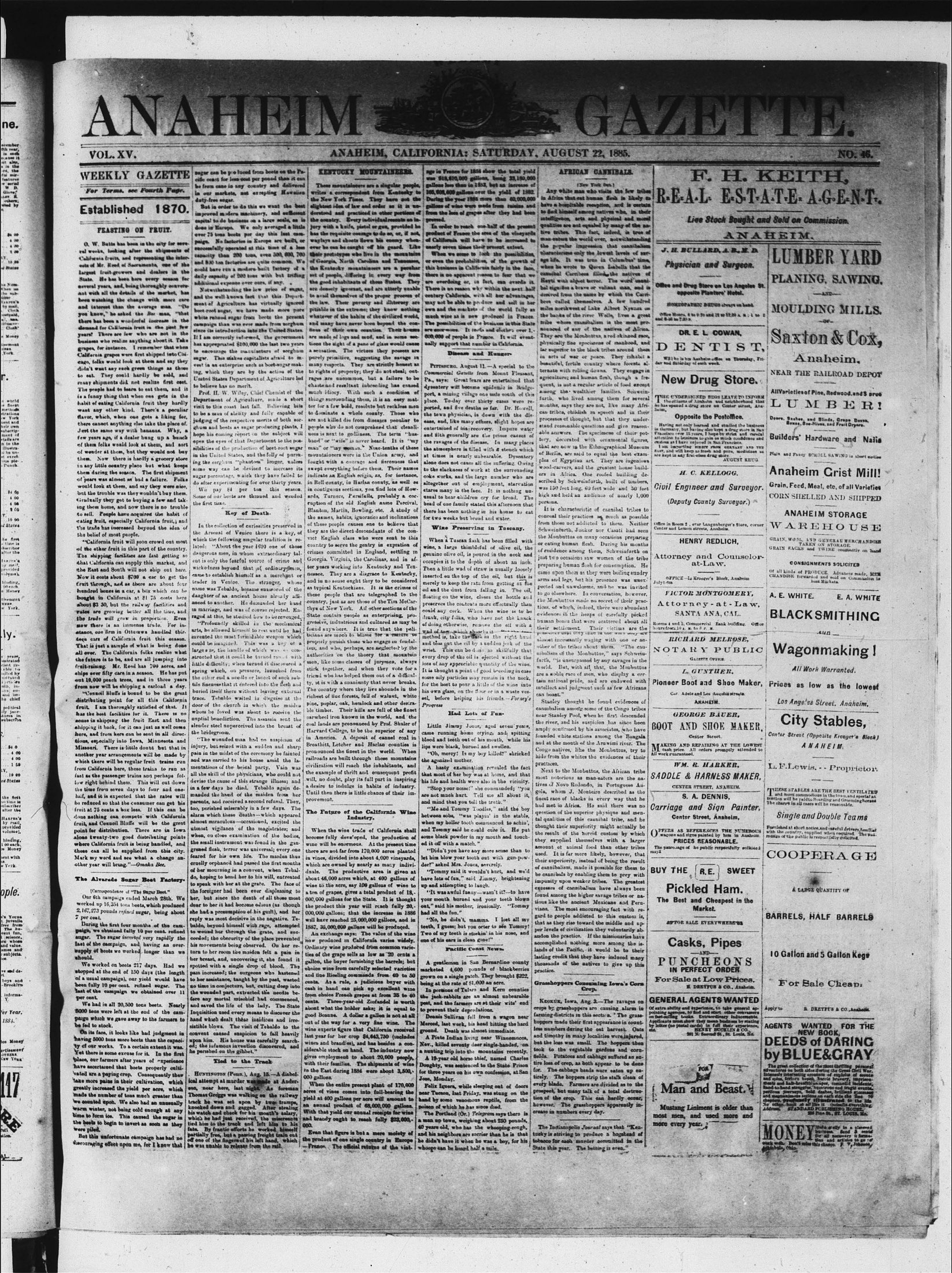
Searchable text
WEEKLY GAZETTE
For Terms, see Fourth Page.
Established 1870.
FEASTING ON FRUIT.
O. W. Butts has been in the city for several weeks, looking after the shipments of California fruits, and representing the interests of Mr. Reed of Sacramento, one of the largest fruit-growers and dealers in the State. He has been here every season for several years, and, being thoroughly conversant with all the details of the market, has been watching the change with more care and interest than the average man. "Do you know," he asked the Rev. man, "that there has been a wonderful increase in the demand for California fruit in the past few years! There are few who are not in the business who realize anything about it. Take grapes, for instance. I remember that when California grapes were first shipped into Chicago, folks would look at them and say they didn't want any such green things as those to eat. They could hardly be sold, and many shipments did not realize first cost. The people had to learn to eat them, and it is a funny thing that when one gets in the habit of eating California fruit they hardly want any other kind. There's a peculiar flavor, which, when one gets a liking for, there cannot anything else take the place of. Just the same way with bananas. Why, a few years ago, if a dealer hung up a bunch of them folks would look at them, and sort of wonder at them, but they would not buy them. Now there is hardly a grocery store in any little country place but what keeps them during the season. The first shipment sugar can be produced from beets on the Pacific coast for less cost per pound than it can be from cane in any country and delivered in our markets, not excepting Hawaiian duty-free sugar.
But in order to do this we want the best improved modern machinery, and sufficient capital to do business on a large scale, as is done in Europe. We only averaged a little over 75 tons beets per day this last campaign. No factories in Europe are built, or successfully operated at this time of a loss capacity than 200 tons, even 300,000,700 and 800 ton factories are quite common. We could have run a modern-built factory of a daily capacity of 200 tons with but trifling additional expense over ours, if any.
Notwithstanding the low price of sugar, and the well-known fact that this Department of Agriculture has virtually ignored beet-root sugar, we have made more pure white refined sugar from beets the present campaign than was ever made from sorghum since its introduction into the United States. If I am correctly informed, the government has appropriated $100,000 the last two years to encourage the manufacture of sorghum sugar. This makes capitalists afraid to invest in an enterprise such as beet-sugar making, which they are by the action of the United States Department of Agriculture led to believe has no merit.
Prof. H. W. Wiley, Chief Chemist of the Department of Agriculture, made a short visit to this coast last fall. Believing him to be a man of ability and fully capable of judging of the respective merits of both sorghum and beets as sugar producing plants, I hope his coming report on the subject will open the eyes of that Department to the possibilities of the production of beet-root sugar in the United States, and the folly of pursuing the sorghum "phantom" longer, unless some way can be devised to increase its sugar content.
These mountain writes a correspondent to the New York Times slightest idea of law understood and praised the country. Every jury with a knife has the requisite oak waylay and shoot ever he can be case their prototypes wipe of Georgia. North the Kentucky most set of people differ the good inhabitants are densely ignorant to avoid themselves the law. Their pitiable in the extra whatever of the hawks and many have newness of their own are made of logs and tions the sight of a sensation. The purely primitive, many respects. To rights of property rages are uncommon chaste and resultant much idiocy. With things surrounding ter for a few bold, to dominate a whale are not killed die f people who do not ness is next to god band" or "wife" is man or "tay mourn mountainers were fought with a count swept everything b indicate in English."
The first time is subscriber after the Harrax's by mail provided volume.
binding, 1000 each, the Money sent with a New York.
The Alvarado Sugar Beet Factory
[Correspondence of "The Sugar Beet." Our 8th campaign ended March 28th. We]
They could hardly be sold, and many shipments did not realize first cost. The people had to learn to eat them, and it is a funny thing that when one gets in the habit of eating California fruit they hardly want any other kind. There's a peculiar flavor, which, when one gets a liking for, there cannot anything else take the place of. Just the same way with bananas. Why, a few years ago, if a dealer hung up a bunch of them folks would look at them, and sort of wander at them, but they would not buy them. Now there is hardly a grocery store in any little country place but what keeps them during the season. The first shipment of pears was almost as bad a failure. Folks would look at them, and say they were nice, but the trouble was they wouldn't buy them. Gradually they got to buying a few and taking them home, and now there is no trouble to sell. People have acquired the habit of eating fruit, especially California fruit, and the trade has increased beyond the idea of the belief of most people.
"California fruit will soon crowd out most of the ether fruit in this part of the country. The shipping facilities are fast getting so that California can supply this market, and the East and South will not ship out here. Now it costs about $700 a car to get the fruit through, and as there are about four hundred boxes in a car, a box which can be bought in California at $175 costs here about $350, but the railway facilities and waters are growing better all the time, and the trade will grow in proportion. Even now there is an immense trade. For instance, one firm in Ottumwa handled three cars of California fruit this season. That is just a sample of what is being done all over. The California folks realize what the future is to be, and are all jumping into fruit-raising. Mr. Reed has 700 acres, and ships over fifty care in a season. He has put out 10,000 peach trees, and in three years from now will be shipping a carload a day.
"Council Bluffs is bound to be the great distributing point for all this California fruit. I am thoroughly satisfied of that. It has the best facilities for it. There is no noise in shipping the fruit East and then shipping it back, for it can just as well come here, and from here can be sent in all directions, especially into Iowa, Minnesota and Missouri. There is little doubt but that in another year arrangements will be made by which there will be regular fruit trains run from California here, these trains to run as fast as the passenger trains and perhaps follow right behind them. This will cut down the time from seven days to four and one half, and it is expected that the rates will be reduced so that the consumer can get his fruit at 75 cents a box less. If this can be done nothing can compete with California fruit, and Council Bluffs will be the great point for distribution. There are in Iowa alone twenty-two good distributing points where California fruit is being handled, and these can all be supplied from this city. Mark my word and see what a change another year will bring."—Omaha Bee.
The Wardman Sugar Beet Factory
[Correspondence of "The Sugar Beet." Our 6th campaign ended March 28th. We]
Prof. H. W. Wiley, Chief Chemist of the Department of Agriculture, made a short visit to this coast last fall. Believing him to be a man of ability and fully capable of judging of the respective merits of both sorghum and beets as sugar producing plants, I hope his coming report on the subject will open the eyes of that Department to the possibilities of the production of beet-root sugar in the United States, and the fulfilment of its sugar percentage, which they have failed to do after experimenting for over thirty years.
We pay $4 per ton this season. Some of our beets are thinned and weeded the first time.
Key of Death.
In the collection of cariesities preserved in the Arsenal of Venice there is a key, of which the following singular tradition is related: "About the year 1600 one of those dangerous men, in whom extraordinary talent is only the fearful source of crime and wickedness beyond that of ordinary men, came to establish himself as a merchant or trader in Venice. The stranger, whose name was Tebaldo, became enamored of the daughter of an ancient house already allied to another. He demanded her hand in marriage, and was of course rejected. Enraged at this, he studied how to berevenged."
Profoundly skilled in the mechanical arts, he allowed himself to rest until he had invented the most formidable weapon which could be imagined. This was a key of a large size, the handle of which was so constructed that it could be turned round with little difficulty; when turned it discovered a spring which, on pressure, launched from the other end a needle or lancet of such subtle fineness that it entered into the flesh and buried itself there without leaving external trace. Tebaldo waited in disguise at the door of the church in which the maiden whom he loved was about to receive the nuptial benediction. The assassin sent the slender steel unperceived into the breast of the bridegroom.
"The wounded man had no suspicion of injury, but seized with a sudden and sharp pain in the midst of the ceremony he fainted and was carried to his house amid the lamentations of the bridal party. Vain was all the skill of the physicians who could not devise the cause of this strange illness; and in a few days he died. Tebaldo again demanded the hand of the maiden from her parents, and received a second refusal. They too, perished miserably in a few days. The alarm which these deaths—which appeared almost miraculous—occasioned, excited the utmost vigilance of the magistrates; and when, on close examination of the bodies, the small instrument was found in the gangrene flesh, terror was universal; every one feared for his own life. The maiden thus cruelly orphaned had passed the first months of her mourning in a convent, when Tebaldo, hoping to bend her to his will, entreated to speak with her at the grate. The face of the foreigner had been ever displeasing to her, but since the death of all those most rages are uncommon chaste and result much idiotic.
W things surrounding ter for a few bold, to dominate a whale are not killed die people who do not ness is next to god band" or "wife" is man or "may woman mountainaceers were fought with a com sweet everything b indicate an English in Bell county, in B in contiguous section ards, Turnera Parruption of the old Blanton, Martin, Bthe names habits, Bof these people caught they are the direct victim English class country to serve their crimes committed by Georgia Virginia, t ter years working in neasce. They are ar ad in no sense ougge as typical Kentuckian these people that are country, just as are thysss of New York State contain people grevive industrious found anywhere. I technicians are much kow properly punish their fan, and who perh authorities on their men like some class stick together, and friend who has helped it is with a unnan The country where richest of forest pine poplar oak hble timber. Their l car wheel iron known coal lands are prone Harvard College to in America. A de Breathitt, Letcher pronounced the finest railroads are built civilization will reach the example of thrifl will no doubt playa desire to indulge Until then there is no provement.
The Future of The Industry
When the wine tree become fully devolved wine will be enormously there are not far froin vines divided inti which are owned by duals. The product about 46,000 acres w wine to the acre,say a ton of grapes,give 000 000 gallons for t
The Alvarado Sugar Beet Factory.
(Correspondence of "The Sugar Beet.")
Our 6th campaign ended March 28th. We worked up 16,354 tons beets, which produced 2,167,273 pounds refined sugar, being about 7 per cent.
During the first four months of the campaign, we obtained fully 10 per cent. refined sugar. The sugar inverted very rapidly the last of the campaign, and having an over-supply of beets we worked longer than we should.
We worked on beets 217 days. Had we stopped at the end of 150 days (the length of a usual campaign), our yield would have been fully 10 per cent. refined sugar. The last of the campaign we obtained over 11 per cent.
We had in all 20,500 tons beets. Nearly 5000 tons were left at the end of the campaign which we gave away to the farmers to be fed to stock.
On its face, it looks like bad judgment in having 5000 tons more beets than the capacity of our works. To a certain extent it was. Yet there is some excuse for it. In the first place, our farmers after years of experience have ascertained that beets properly cultivated are a paying crop. Consequently they take more pains in their cultivation, which greatly increased the yield per acre, which made the number of tons much greater than we counted upon. We also had an unusually warm winter, not being cold enough at any time to form ice. This caused the sugar in the beets to begin to invert as soon as they were piled.
But this unfortunate campaign has had no discouraging effect upon me, for I know that parents, and received a second refusal. They too, perished miserably in a few days. The alarm which these deaths—which appeared almost miraculous—occasioned, excited the utmost vigilance of the magistrates; and when, on close examination of the bodies, the small instrument was found in the gangrene flesh, terror was universal; every one feared for his own life. The mason thus cruelly orphaned had passed the first months of her mourning in a convent, when Tebaldo, hoping to bend her to his will, entreated to speak with her at the grate. The face of the foreigner had been ever displeasing to her, but since the death of all those most dear to her it had become odious (as though she had a presumption of his guilt), and her reply was most decisive in the negative. Tebaldo, beyond himself with rage, attempted to wound her through the grate, and succeeded; the obscurity of the place prevented his movements being observed. On her return to her room the maiden felt a pain in her breast, and, uncovering it, she found it spotted with a single drop of blood. The pain increased; the surgeons who hastened to her assistance, taught by the past, wasted no time in conjecture, but, cutting deep into the wounded part, extracted the needle before any mortal mischief had commenced, and saved the life of the lady. The State Inquisition used every means to discover the hand which dealt these insidious and irresistible blows. The visit of Tebaldo to the convent caused suspicion to fall heavily upon him. His house was carefully searched; the infamous invention discovered, and he perished on the gibbet."
Tied to the Track
HUNTINGTON (Penn.), Aug. 15. — A diabolical attempt at murder was made at Anderson, near here, last night. As foreman Thomas Greggs was walking on the railway track he was set upon by two tramps, knocked down and gagged. After stealing his watch and check for his month's salary, which he had just received, the miscreants tied him to the track and left him to his fate. By frantic efforts he worked himself partially free, but a passing freight train cut off one of the fingers of his left hand, which he was unable to release from the rail.
ANAHEIM, CALIFORNIA: SATURDAY, AUGUST 22, 1885.
KENTUCKY MOUNTAINERS.
These mountaineers are a singular people, writes a correspondent from Kentucky to the New York Times. They have not the slightest idea of law and order as it is understood and practiced in other portions of the country. Every individual resents an injury with a knife, pistol or gun, provided he has the requisite courage to do so, or, if not, waylays and shoots down his enemy whenever he can be caught off his guard. Like their prototypes who live in the mountains of Georgia, North Carolina and Tennessee, the Kentucky mountainers are a pecuhar set of people, differing in every way from the good inhabitants of these States. They are densely ignorant, and are utterly unable to avoid themselves of the proper process of the law. Their poverty and sluttery are pitiful in the extreme; they know nothing whatever of the habits of the civilized world, and many have never been beyond the confines of their own counties. Their homes are made of logs and mud, and in some sections the sight of a pane of glass would cause a sensation. The virtues they possess are purely primitive, suggesting the savage in many respects. They are strictly honest as to rights of property; they do not steal; outrages are uncommon, but a failure to be chaste and resultant in breeding has caused much idiocy. With such a condition of things surrounding them, it is an easy matter for a few bold, resolve but reckless men to dominate a whole county. Those who are not killed die from diseases peculiar to people who do not comprehend that cleanliness is next to godliness. The term "husband" or "wife" is never heard. It is "my man" or "my woman." Nine-tenths of these mountainers were in the Union army, and fought with a courage and fierceness that swept everything before them. Their names indicate on English origin for instance:
AGE IN FRANCE FOR 1834 show the total yield was 918,610,000 gallons, being 23,180,000 gallons less than in 1833, but an increase of 100,600,000 gallons over the yield of 1882. During the year 1884 more than 60,000,000 gallons of wine were made from rains and from the leaves of grapes after they had been pressed.
In order to reach one-half of the present product of France the area of vineyards of California will have to be increased to nearly seven times their present extent.
When we come to learn the possibilities or even the probabilities of the growth of this business in California fairly in the past, there is no apparent reason to fear that we are overdoing or, in fact, can overdo it. There is no reason why within the next half century California, with all her advantages, may not be able to produce and sell in her own and the markets of the world fully as much wine as is now produced in France. The possibilities of the business in this State are enormous. It needs and clothes over 1,600,000 of people in France. It will eventually support that number in California.
Disease and Hunger
PITTSBURG, August 11.—A special to the Commercial Gazette from Mount Fleasant, Pa., says: Great fears are entertained that dysentery will become epidemic in Bridgeport, a mining village one mile south of this place. To-day over thirty cases were reported, and five deaths so far. Dr. Howell, the town physician, is down with the disease, and, like many others, slight hopes are entertained of his recovery. Impure water and silk generally are the prime causes of the ravages of the disease. In many places the atmosphere is filled with a stench which at times is nearly unbearable. Dysentery alone does not cause all the suffering. Owing to the slackness of work at the surrounding areas of war or peace, they inhabit a beautiful, fertile country where forests alternate with rolling downs. They engage in agriculture; and human flesh, though a frequent, is not a regular article of food except among the wealthier families. Schweinfurth, who lived among them for several months, says they are not, like many African tribes, childish in speech and in their processes of thought, but that they understand reasonable questions and give reasonable answers. The specimens of their pottery, decorated with ornamental figures, that are now in the Ethnographical Museum of Berlin, are said to equal the best examples of Egyptian art. They are ingenious wood-carvers, and the greatest house builders in Africa. One roofed building...
When the wine trade of California shall become fully developed, the production of wine will be enormous. At the present time there are not far from 170,000 acres planted in vines, divided into about 4,000 vineyards, which are owned by nearly as many individuals. The productive area is given at about 46,000 acres which, at 400 gallons of wine to the acre, say 100 gallons of wine to a ton of grapes, gives a total product of 18,000 gallons for the State. It is thought rages are uncommon, but a failure to be chaste and resultant inbreeding has caused much idiosyncry. With such a condition of things surrounding them, it is an easy matter for a few bold, resolute but reckless men to dominate a whole county. Those who are not killed die from diseases peculiar to people who do not comprehend that cleanliness is next to godliness. The term "husband" or "wife" is never heard. It is "my man" or "my woman." Nine-tenths of these mountainers were in the Union army, and fought with a courage and fierceness that swept everything before them. Their names indicate an English origin, as, for instance, in Bell County, in Harlan county, as well as in contiguous sections, you find lots of Howards, Turnera, Parsifulla, probably a corruption of the old English name Percival. Blanton, Martin, Bowling, etc. A study of the names, habits, ignorance and inclinations of these people causes one to believe that they are the direct descendants of the convict English class who were sent to this country to serve the gentry in expiration of crimes committed in England, settling in Georgia. Virginia, the Carolinas, and in after years working into Kentucky and Tennessee. They are a disgrace to Kentucky, and in no sense ought they to be considered as typical Kentuckians. It is the crimes of these people that are telegraphed to the country, just as are those of the Tim McCarthys of New York. All other sections of the State contain people as enterprising, progressive, industrious and cultured as may be found anywhere. It is true that the politicians are much to blame for a nature to properly punish those who engage in feudalism, and who, perhaps, are neglected by the authorities on the theory that mountain men, like some classes of jurymen, always stick together, and when they vote for a friend who has helped them out of a difficulty, it is with a unanimity that never breaks. The country where they live abounds in the richest of fine forests, full of walnut, white pine, poplar, oak, hemlock and other desirable timber. Their hills are full of the finest carwheel iron known in the world, and the coal lands are pronounced by Prof. Shaler of Harvard College, to be the superior of any in America. A deposit of cannel coal in Breathitt, Letcher and Harlan counties is pronounced the finest in the world. When railroads are built through these mountains civilization will reach the inhabitants, and the example of thrift and consequent profit will, no doubt, play its full part in inspiring a desire to indulge in habits of industry. Until then there is little chance of their improvement.
The Future of the California Wine Industry.
When the wine trade of California shall become fully developed, the production of wine will be enormous. At the present time there are not far from 170,000 acres planted in vines, divided into about 4,000 vineyards, which are owned by nearly as many individuals. The productive area is given at about 46,000 acres which, at 400 gallons of wine to the acre, say 100 gallons of wine to a ton of grapes, gives a total product of 18,000 gallons for the State. It is thought rages are uncommon, but a failure to be chaste and resultant inbreeding has caused much idiosyncry. With such a condition of things surrounding them, it is an easy matter for a few bold, resolute but reckless men to dominate a whole county. Those who are not killed die from diseases peculiar to people who do not comprehend that cleanliness is next to godliness. The term "husband" or "wife" is never heard. It is "my man" or "my woman." Nine-tenths of these mountainers were in the Union army, and fought with a courage and fierceness that swept everything before them. Their names indicate an English origin, as, for instance, in Bell County, in Harlan county, as well as in contiguous sections, you find lots of Howards, Turnera, Parsifulla, probably a corruption of the old English name Percival. Blanton, Martin, Bowling, etc. A study of the names, habits, ignorance and inclinations of these people causes one to believe that they are the direct descendants of the convict English class who were sent to this country to serve the gentry in expiration of crimes committed in England, settling in Georgia. Virginia, the Carolinas, and in after years working into Kentucky and Tennessee. They are a disgrace to Kentucky, and in no sense ought they to be considered as typical Kentuckians. It is the crimes of these people that are telegraphed to the country, just as are those of the Tim McCarthys of New York. All other sections of the State contain people as enterprising, progressive, industrious and cultured as may be found anywhere. It is true that the politicians are much to blame for a nature to properly punish those who engage in feudalism, and who perhaps are neglected by the authorities on the theory that mountain men, like some classes of jurymen, always stick together, and when they vote for a friend who has helped them out of a difficulty, it is with a unanimity that never breaks. The country where they live abounds in the richest of fine forests, full of walnut, white pine, poplar, oak, hemlock and other desirable timber. Their hills are full of the finest carwheel iron known in the world, and the coal lands are pronounced by Prof. Shaler of Harvard College, to be the superior of any in America. A deposit of cannel coal in Breathitt, Letcher and Harlan counties is pronounced the finest in the world. When railroads are built through these mountains civilization will reach the inhabitants, and the example of thrift and consequent profit will, no doubt, play its full part in inspiring a desire to indulge in habits of industry. Until then there is little chance of their improvement.
The Future of the California Wine Industry.
When the wine trade of California shall become fully developed, the production of wine will be enormous. At the present time there are not far from 170,000 acres planted in vines, divided into about 4,000 vineyards, which are owned by nearly as many individuals. The productive area is given at about 46,000 acres which, at 400 gallons of wine to the acre, say 100 gallons of wine to a ton of grapes, gives a total product of 18,000 gallons for the State. It is thought rages are uncommon, but a failure to be chaste and resultant inbreeding has caused much idiosyncry. With such a condition of things surrounding them, it is an easy matter for a few bold, resolute but reckless men to dominate a whole county. Those who are not killed die from diseases peculiar to people who do not comprehend that cleanliness is next to godliness. The term "husband" or "wife" is never heard. It is "my man" or "my woman." Nine-tenths of these mountainers were in the Union army, and fought with a courage and fierceness that swept everything before them. Their names indicate an English origin, as for instance,in Bell County,in Harlan county,as well as in contiguous sections,you find lots of Howards,Turnera,Parsifulla,probably a corruption of the old English name Percival。Blanton,Martin,Bowling,etc.A study of the names,habits,ignorance和 inclinationsof these people causes one to believe that they are the direct descendants of the convict English class who were sent to this country to serve the gentry in expiration of crimes committed in England,settling in Georgia。Virginia,the Carolinas,and in after years working into Kentucky and Tennessee。They are a disgrace to Kentucky,and in no sense ought they to be considered as typical Kentuckians。It is the crimes of these people that are telegraphed to the country,just as are those of the Tim McCarthys of New York.All other sections of the State contain people as enterprising,progressive,industrious and cultured as may be found anywhere。It is true that the politicians are much to blame for a nature to properly punish those who engage in feudalism,and who perhaps,are neglected by the authorities on the theory that mountain men,like some classes of jurymen,always stick together,and when they vote for a friend who has helped them out of a difficulty,它 with a unanimity that never breaks.The country where they live abounds in the richest of fine forests,full of walnut,white pine,poplar,oak,hemlock and other desirable timber.Their hills are full of the finest carwheel iron known in the world,and the coal lands are pronounced by Prof.ShalerofHarvardCollegetobethesuperiorofanyinAmerica.A depositofcannelcoalinBreathittLetcherandHarlancountiesispronouncedthefinestinworld.Therailroadsbuiltthroughthesemountainscivilizationwillreachtheinhabitants,andtheexampleofthriftandconsequentprofitwillno doubtplayitsfullpartininspiringadesiretoindulgeinhabitionsofindustry.Untilthenthereislittlechanceoftheirimprovement.
The Future of the California Wine Industry.
When the wine trade of California shall become fully developed,the productionof winewillbeenmorous.Atthepresenttimetherearenotfarfrom17000acresplantedinvinesdividedintoabout400vineyardswhichareownedbynearlyasmanyindividuals.Theproductiveareaisgivenatabout46000acreswhichattaintheacre,say100gallonsofwineattaintheacre,say100gallonsofwineattaintheacre,say100gallonsofwineattaintheacre,say100gallonsofwineattaintheacre,say100gallonsofwineattaintheacre,say100gallonsofwineattaintheacre,say100gallonsofwineattaintheacre,say100gallonsofwineattaintheacre,say100gallonsofwineattaintheacre,say100gallonsofwineattaintheacre,say100gallonsofwineattaintheacre,say100gallonsofwineattaintheacre,say100gallonsofwineattaintheacre,say100gallonsofwineattaintheacre,say100gallonsofwineattaintheacre,say100gallonsofwineattaintheacre,say100gallonsofwineattaintheacre,say100gallonsofwineattaintheacre,say100gallonsofwineattaintheacre,say100gallonsofwineattaintheacre,say100gallonsofwineattaintheacre,say100gallonsofwineattaintheacre,say100gallonsofwineattaintheacre,say100gallonsofwineattaintheacre,say100gallonsofwineattaintheacre,say100gallonsofwineattaintheacre,say100gallonsofwineattaintheacre,say100gallonsofwineattaintheacre,say100gallonsofwineattaintheacre,say100gallonsofwineattaintheacre,say100gallonsofwineattaintheacre,say1
The Future of the California Wine Industry.
When the wine trade of California shall become fully developed, the production of wine will be enormous. At the present time there are not far from 170,000 acres planted in vines, divided into about 4,000 vineyards, which are owned by nearly as many individuals. The productive area is given at about 46,000 acres which, at 400 gallons of wine to the acre, say 100 gallons of wine to a ton of grapes, gives a total product of 18,000,000 gallons for the State. It is thought the product this year will reach fully 20,-000,000 gallons; that the increase in 1886 will have reached 25,000,000 gallons, and in 1887, 35,000,000 gallons will be produced.
An exchange says: The value of the wine now produced in California varies widely. Ordinary wine produced from common varieties of the grape sells as low as 20 cents a gallon, the buyer furnishing the barrels; but choice wine from carefully selected varieties and fine Riesling commands from 40 to 50 cents. As a rule, a judicious buyer with cash in hand can pick up excellent wine from choice French grapes at from 35 to 40 cents. Three-year-old Zinfandel is worth about what the holder sakes; it is equal to good Boanne. A dollar a gallon is not at all out of the way for a very fine wine. The wine experts figure that California received last year for her crop $4,643,750 (includes wines and brandies), and has besides a considerable stock on hand. The industry now gives employment to about 20,000 people, with their families. The shipments of wine to the East during 1884 were about 3,500,-000 gallons.
When the entire present plant of 170,000 acres of vines comes into full-bearing the yield at 400 gallons per acre will amount to an annual product of 68,000,000 gallons. With that yield our annual receipts for wine and brandy ought to reach fully $22,000,-000.
Evan that figure is but a mere moiety of the product of one single country in Europe — France. The official returns of the vint-
"Me and Tommy Toodles," said the boy between sobs, "was playin' in the stable, when my holler tooth commenced to achin', and Tommy said he could cure it. He put some black powder in my mouth and touched it off with a match."
"Didn't you have any more sense than to let him blow your tooth out with gun-powder?" asked Mrs. Jones, severely.
Tommy said it wouldn't hurt, and we'd have lots of fun," said Jimmy, brightening up and attempting to laugh.
"It was awful fanny—wasn't it?—to have your mouth burned and your teeth blown out," said his mother, ironically. "Tommy had all the fun."
No, he didn't, mamma. I lost all my teeth, I guess; but you oter to see Tommy! Two of my teeth is steakin' in his nose, and one of his ears is clean gone!"
Pacific Coast News.
A gentleman in San Bernardino county marketed 4,600 pounds of blackberries grown on a single patch. They brought $322, being at the rate of $1,000 an acre.
In portions of Tulare and Kern counties the jack-rabbits are an almost unbearable pest, and the farmers are at their wits' end to prevent their depredations.
Deanis Sullivan fell from a wagon near Merced, last week, his head hitting the hard ground. Death was almost immediate.
A Piate Indian living near Winnemucca, Nev., killed seventy deer single-handed, on a hunting trip into the mountains recently.
A 19-year old horse thief, named Charles Doughty, was sentenced to the State Prison for three years on his own confession, at San Jose, Monday.
Felix Iguera, while sleeping out of doors near Tucson, last Friday, was stung on the hand by some venomous reptile, from the poison of which he has since died.
The Portland (Or.) Telegram says there is a man up town, weighing about 250 pounds, 40 years old, who has the whooping cough, and his neighbors are sorrier than he is that he didn't have it when he was a boy, for his whoopee can be heard half a mile.
Grasshoppers Consuming Iowa's Corn Crop.
Keokuk, Iowa, Aug. 2.—The ravages on crops by grasshoppers are causing alarm in farming districts in this section. The grasshoppers made their first appearance in countless numbers during the oat harvest. Oats and timothy in many localities were injured, but the loss was small. The hoppers then took to the vegetable gardens and cornfields. Potatoes and cabbage suffered an entire loss of crop, as both appear to be done for. The cabbage heads were eaten up entirely. The hoppers strip the stalk clean of every blade. Farmers are divided as to the prospect, but many talk of a total destruction of the crop. This can hardly occur, however. The grasshoppers apparently increase in numbers every day.
The Indianapolis Journal says that "Kentucky is striving to produce a hoghead of tobacco for each murder committed in the State this year. The batting is even."
GAZETTE.
NO. 46.
F. H. KEITH,
REAL ESTATE AGENT.
Live Stock Bought and Sold on Commission.
ANAHEIM.
J. H. BULLARD, A.B., M.D.
Physician and Surgeon.
Office and Drug Store on Los Angeles St.
opposite Plantere' Hotel.
HOMEOPATHIC DRUGS always on hand.
Office Hours: 8 to 9:30 and 12 to 12:30 a.m.; 1 to 2 and 6:30 to 7:30 p.m.
DR. E. L COWAN,
DENTIST.
Will be in his Anaheim office on Thursday, Friday and Saturday of each week.
New Drug Store.
THE UNDERSIGNED BEES LEAVE TO INFORM
the citizens of Anaheim and neighborhood that he has opened a drug store on Center street, Anaheim.
Opposite the Postoffice.
Having not only learned and studied the business in Germany, but having also kept a drug store in San Francisco over 15 years, I hope by strict and careful attention to business to gain as much confidence and custom as I have enjoyed in San Francisco.
I am importing BIRECT FROM GERMANY AND THE EAST, and will keep as fresh and pure, medicines as are kept in any first-class drug store.
AUGUST KRUG.
LUMBER YARD
PLANING, SAWING.
AND
MOULDING MILLS.
OF
Saxton & Cox,
Anaheim.
NEAR THE RAILROAD DEPOT
All Varieties of Pine, Redwood, and S prue
LUMBER!
Doors, Sashes, and Blinds, Grape Boxes,
Boxes, Sea-Nives, and Fruit Dryers.
Builders' Hardware and Nails
Plain and Fancy SCROLL SAWING in short notice
Anaheim Crist Mill!
New Drug Store.
THE UNDERSIGNED BEES LEAVE TO INFORM the citizens of Anaheim and neighborhood that he has opened a drug store on Center street, Anaheim.
Opposite the Postoffice.
Having not only learned and studied the business in Germany, but having also kept a drug store in San Francisco over 15 years, I hope by strict and careful attention to business to gain as much confidence and evidence as I have enjoyed in San Francisco.
I am importing sugar from Oswego and the Eauver, and will keep as fresh and pure, medicines as are kept in any first-class drug store.
AUGUST KRUG.
H. C. KELLOGG.
Civil Engineer and Surveyor.
(Deputy County Surveyor.)
Office in Room 2, ever Langanberger's Store, corner Center and Lemon streets, Anaheim.
HENRY REDLICH,
Attorney and Counselor-Law.
OFFICE—In Krooger’s Block, Anaheim July 16th.
VICTOR MONTGOMERY,
Attorney-at-Law,
SANTA ANA, CAL.
Rooms 4 and 5, Commercial Bank building. Office hours from 10 a.m. to 3 p.m.
RICHARD MELROSE,
NOTARY PUBLIC
Gazette Office.
L. GUNTUER.
Pioneer Boot and Shoe Maker,
Car. Adele and Los Angeles streets.
ANAHEIM.
GEORGE BAUER,
BOOT AND SHOE MAKER,
Center Street.
MAKING AND REPAIRING AT THE LOWEST cash price. All orders promptly attended to. All work guaranteed.
WM. R. HARKER,
SADDLE & HARNESS MAKER,
CENTER STREET, Anaheim.
S. A. DENNIS,
Carriage and Sign Painter,
Center Street, Anaheim,
OFFERS AS REFERENCES THE NUMEROUS wagons and signs painted by him in Anaheim.
PRICES REASONABLE.
The patronage of the public respectfully solicited may?
BUY THE R.E. SWEET Pickled Ham.
All Varieties of Pine, Redwood, and S lumber!
Doors, Sashes, and Blinds, Grape Boxes,
Boxes, Bee-Hives, and Fruit Dryers.
Builders’ Hardware and Nails
Plain and Fancy SCROLL SAWING in short notice
Anaheim Crist Mill!
Grain, Feed, Meal, etc., of all varieties
CORN SHELLED AND SHIPPED
ANAHEIM STORAGE
WAREHOUSE
GRAIN, WOOL, AND GENERAL MERCHANDISE TAKEN ON STORAGE.
GRAIN SACKS and TWINE constantly on hand
CONSIGNMENTS SOLICITED
Of all kinds of PRODUCE. Advances made. MEM CHANDISE forwarded and sold on Commission in host Markets.
A. E. WHITE. E. A. WHITE
BLACKSMITHING
Wagonmaking!
All Work Warranted.
Prices as low as the lowest
Los Angeles Street, Anaheim.
City Stables,
Center Street (Opposite Krooger’s Block)
ANAHEIM.
L. F. Lewis. -- Proprietor.
THESE STABLES ARE THE BEST VENTILATED and most commodious in the town, and special at tention will be paid to Boarding and Grooming horses. The charve in all cases will be reasonable.
Single and Double Teams
Furnished at short notice, and careful drivers, familiar with the country, supplied when required. The付 ransage of the public is responsibly collected.
COOPERAGE
A large quantity of
Carriage and Sign Painter,
Center Street, Anaheim,
OFFERS AS REFERENCES THE NUMEROUS
wagons and signs painted by him in Anaheim.
PRICES BEASONABLE.
BUY THE R.E. SWEET
Pickled Ham.
The Best and Cheapest in the Market.
Casks, Pipes
AND
PUNCHEONS
IN PERFECT ORDER
For Sale at Low Prices.
K. DREYFUS & CO., Anaheim.
GENERAL AGENTS WANTED
Of extra ability and experience, to take general appointing agencies, to find and start other contractors on fast-selling books. Extraordinary inducements.
Applicants must show they mean business by stating by letter (no postal cards) in full their experience, etc.
201 N. Second St., St. Louis, Mo.
FOR Man and Beast.
Mustang Liniment is older than most men, and used more and more every year.
AGENTS WANTED FOR THE NEW BOOK,
DEEDS of DARING
by BLUE&GRAY
The great collection of the most thrilling personal adventures on both sides during the Great Civil War. Intensely interesting accounts of exploits of outcasts and spies, forlorn hope, harcole bravery, imprisonments and half-breast skirts, romantic incidents, hand-to-hand strangers, humorous and tragic events, perilous journeys, bold dashes, brilliant successes and magnanimous actions on each side the line 70 chapters, presumably illustrated to the life.
No other book as all like it. Outside everything. Addrms.
STANDARD PUBLISHING HOUSE.
203 Pine St., St. Louis, Mo.
MONEY
Make greatly in a pleasant business. Send $5 cent for all necessary information and articles to go to work with. Don't miss this chance. F. V. Johnson, Attn: Bells, Ohio.