anaheim-gazette 1885-08-15
Scanned page
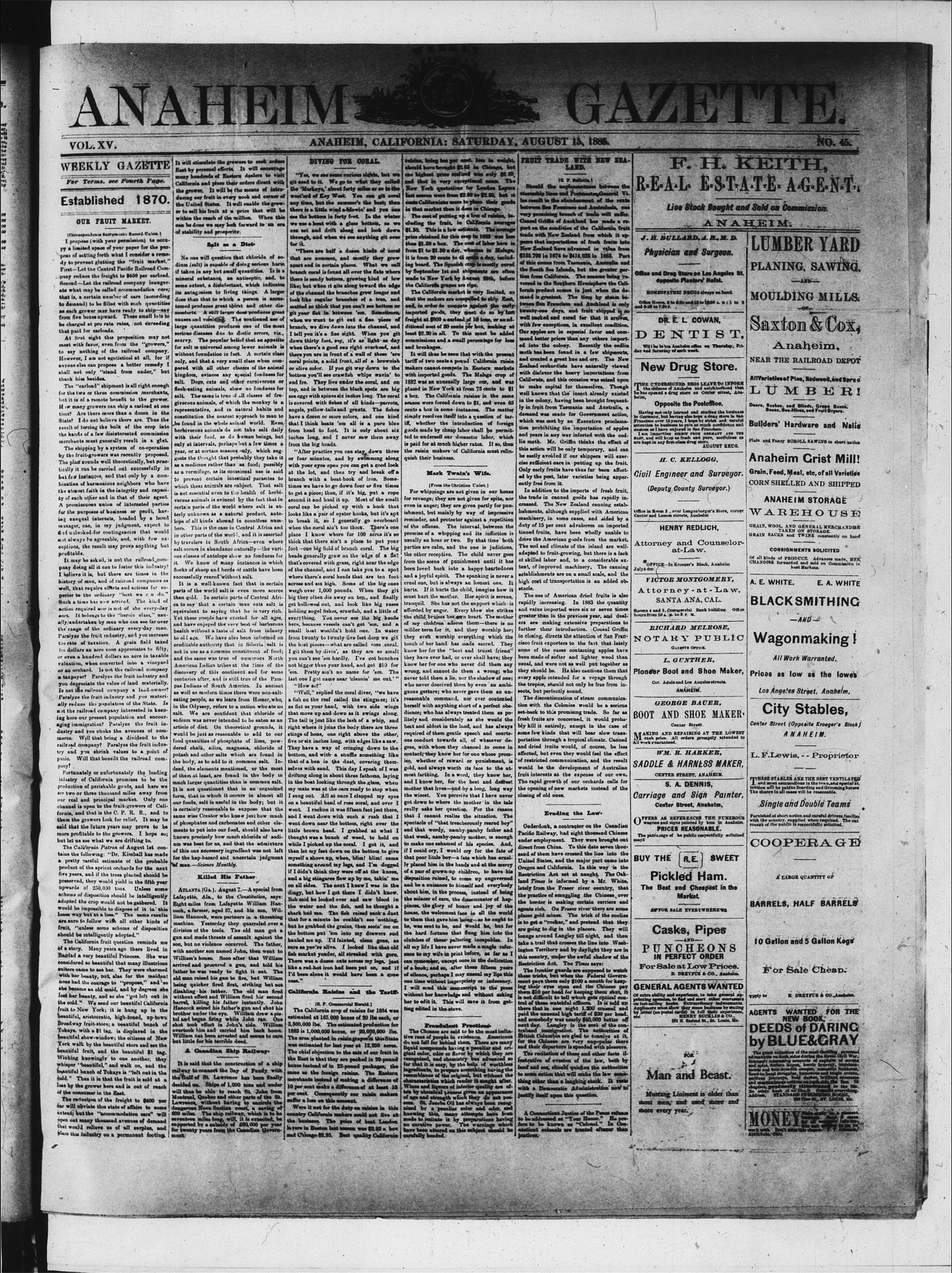
Searchable text
ANAHEIM
VOL. XV.
ANAHEIM
WEEKLY GAZETTE
For Terms, see Fourth Page.
Established 1870.
OUR FRUIT MARKET.
(Carrespondence Sacramento Record-Union.)
I propose (with your permission) to occupy a limited space of your paper for the purpose of setting forth what I consider a remedy to prevent glutting the "fruit market."
First—Let the Central Pacific Railroad Company reduce the freight to $400 per carload.
Second—Let the railroad company inaugurate what may be called accommodation cars; that is, a certain number of cars (according to demand) to be filled with such quantities as each grower may have ready to ship—say from five boxes upward. These small lots to be charged at pro rata rates, not exceeding that paid for carloads.
At first sight this proposition may not meet with favor, even from the "growers," to say nothing of the railroad company. However, I am not egotistical at all, for if anyone else can propose a better remedy I shall not only "stand from under," but thank him besides.
The "carload" shipment is all right enough for the two or three commission merchants, but it is of a remote benefit to the grower. How many growers can ship a carload at one time? Are there more than a dozen in the State? I do not believe there are. Thus the result of forcing the bulk of the crop into the hands of a few disinterested commission merchants must generally result in a glut.
The shipping by a system of co-operation by the fruit-growers was recently proposed. The plan sounds well theoretically, but practically it can be carried out successfully in
It will stimulate the growers to seek orders East by personal efforts. It will encourage many hundreds of Eastern dealers to visit California and place their orders direct with the grower. It will be the means of introducing our fruit in every nook and corner of the United States. It will enable the grower to sell his fruit at a price that will be within the reach of the million. When this can be done we may look forward to an era of stability and prosperity.
Salt as a Diet
No one will question that chloride of sodium (salt) is capable of doing serious harm if taken in any but small quantities. It is a mineral substance, an antiseptic, and, to some extent, a disinfectant, which indicates its antagonism to living things. A larger dose than that to which a person is accustomed produces great thirst and other discomforts. A still larger dose produces great nausea and vomiting. The continued use of large quantities produces one of the most serious diseases due to dietic errors, viz., scorvy. The popular belief that an appetite for salt is universal among lower animals is without foundation in fact. A certain class only, and that a very small class when compared with all other classes of the animal kingdom, evinces any special fondness for salt. Dogs, cats and other carnivorous or flesh-eating animals, show no fondness for salt. The same is true of all classes of fruivorous animals, of which the monkey is a representative, and in natural habits and constitution the nearest approach to man to be found in the whole animal world. Even herbivorous animals do not take salt daily with their food, as do human beings, but only at intervals, perhaps but a few times a year, or at certain seasons only, which suggests the thought that probably they take it as a medicine rather than as food; possibly as a vermifuge, as its occasional use is said
DIVING FOR
"Yes, we see some curious git used to it. We go to the 'Markey,' about forty west'ard of Key West. Any time, but the summer there is a little wind a blow see the bottom in forty free we use a boat with a glass can set and drift along through, and when we see for it.
There are half a dozen that are common, and a apart and in certain places branch coral is found all over there is sandy bottom, greet like; but when it gits along of the channel the branches look like regular branches matted no thick that you can git your fist in between when we want to git out branch, we dive down into I tell you it's a fine sight. down thirty foot, say, it's when there's a good sun right there you are in front of a coral points, a solid front, or olive color. If you git your bottom you'll see crawfish and froe. They live under top, and in between the blue sea eggs with spines six inches is covered with fishes of angels, yellow-tails and green have a dozen or more colors that I think beats 'em all from head to foot. It is inches long, and I never from the big heads.
"After practice you can eat or four minutes, and by with your eyes open you can at the lot, and then try
The "carload" shipment is all right enough for the two or three commission merchants, but it is of a remote benefit to the grower. How many growers can ship a carload at one time? Are there more than a dozen in the State? I do not believe there are. Thus the result of forcing the bulk of the crop into the hands of a few disinterested commission merchants must generally result in a glut.
The shipping by a system of co-operation by the fruit-growers was recently proposed. The plan sounds well theoretically, but practically it can be carried out successfully in but few instances, and that only by a combination of harmonious neighbors who have the most faith in the integrity and capacity of each other and in that of their agent. A promiseous union of interested parties for the purposes of business or profit, having unequal interests, headed by a hired manager, can, in my judgment, expect to find unlooked-for contingencies that would not always be agreeable, and, with few exceptions, the result may prove anything but profitable.
It may be asked, is not the railroad company doing all it can to foster this industry? I believe it is, but there are times in the history of men, and of railroad companies as well, that require efforts and actions far superior to the ordinary "best we can do." Such a time has now arrived. The kind of action required now is not of the everyday work. It belongs to the "heroic class," usually undertaken by men who can see far over the range of the ordinary every-day man. Paralyze the fruit industry, and you increase the rate of taxation. A grain field taxed ten dollars an acre soon appreciates to fifty, or even a hundred dollars an acre in taxable valuation, when converted into a vineyard or an orchard. Is not the railroad company a taxpayer? Paralyze the fruit industry and you depreciate the value of land materially. Is not the railroad company a land-owner? Paralyze the fruit industry and you materially reduce the population of the State. Is not the railroad company interested in keeping here our present population and encouraging immigration? Paralyze the fruit industry and you choke the avenues of commerce. Will that bring a dividend to the railroad company? Paralyze the fruit industry and you shrink values to a point of panic. Will that benefit the railroad company?
Fortunately or unfortunately the leading industry of California promises to be the production of perishable goods, and here we are two or three thousand miles away from our real and principal market. Only one channel is open to the fruit-growers of California, and that is the C.P.R.R., and to them the growers look for relief. It may be said that the future years may prove to be more profitable to the growers. I hope so; but let us see what we are drifting to.
The California Patron of August 1st contains the following: "Dr. Kimball has made a pretty careful estimate of the probable product of the apricot orchards for the next five years, and if the trees planted should be preserved, they would yield in the fifth year upwards of 250,000 tons. Unless some scheme of disposition should be intelligently kingdom, evinces any special fondness for salt. Dogs, cats and other carnivorous or flesh-eating animals, show no fondness for salt. The same is true of all classes of frugivorous animals, of which the monkey is a representative, and in natural habits and constitution the nearest approach to man to be found in the whole animal world. Even herbivorous animals do not take salt daily with their food, as do human beings, but only at intervals, perhaps but a few times a year, or at certain seasons only, which suggests the thought that probably they take it as a medicine rather than as food; possibly as a vermifuge, as its occasional use is said to prevent certain intestinal parasites to which these animals are subject. That salt is not essential even to the health of herbivorous animals is evinced by the fact that in certain parts of the world where salt is utterly unknown as a natural product, antelope of all kinds abound in countless numbers. This is case in Central Africa and in other parts of the world, and it is asserted by travelers in South Africa—even where salt occurs in abundance naturally—the various classes of antelope show no fondness for it. We know of many instances in which flocks of sheep and herds of cattle have been successfully reared without salt.
It is a well-known fact that in certain parts of the world salt is even more scarce than gold. In certain parts of Central Africa to say that a certain man eats salt is equivalent to saying that he is very rich. Yet these people have existed for all ages, and have enjoyed the very best of barbarous health without a taste of salt from infancy to old age. We have also been informed on creditable authority that in Siberia salt is not in use as a common constituent of food; and the same was true of numerous North American Indian tribes at the time of the discovery of this continent and for some centuries after, and is still true of the Pampas Indians of South America. In ancient as well as modern times there were non-salt-eating people, as we learn from Homer, who in the Odyssey refers to a nation who ate no salt. We are confident that chloride of sodium was never intended to be eaten as an article of diet. On theoretical grounds, it would be just as reasonable to add to our food quantities of phosphate of lime, powdered chalk, silica, magnesia, chloride of potash and other salts which are found in the body, as to add to it common salt. Indeed, the elements mentioned, or the most of them at least, are found in the body in much larger quantities than is common salt. It is not questioned that in an organized form, that in which it occurs in almost all our foods, salt is useful in the body; but it is certainly reasonable to suppose that the same wise Creator who knew just how much of phosphates and carbonates and other elements to put into our food, should also have known precisely how much chloride of sodium was best for us, and that the admixture of this one necessary ingredient was not left for the hap-hazard and uncertain judgment of man.—Science Monthly.
Killed His Father.
ATLANTA (Ga.). August 7.—A special from Lafayette, Ala., to the Constitution, says:
"After practice you can eat or four minutes, and by your eyes open you can eat at the lot, and then try branch with a boat-hook times we have to go down to get a piece; then, if it's around it and haul it up. Coral cap be picked up with looks like a pair of oyster hooks to break it, so I generalise when the coral isn't too thick that there aren't a plough-foot—one big field of branches generally grow on that that's covered with grass, ripe of the channel, and I can take where there's coral heads through across six high. Some weigh over 1,000 pounds. Big they often die away on get hollowed out, and look holding angel fishes, crawling everything. You never see here because vessels can't small boat wouldn't hold from twenty to twenty-five feet—the boat pieces—what are they I git them by divin', as though you can't see 'em hardly. Not bigger than your hand,' 'em. Pretty ain't no name last one I got came near 'clove.'"
"How so?"
"Well," replied the coral fish on the reef called this as flat as your hand, with that move up and down as it The tail is just like the lashtight where it joins the bodies stings of bone, one right side five or six inches long, with They have a way of crushing bottom, and with a shuffling that of a hen in the dusty selves with sand. This day driftung along in about three inches in the boat looking through my mate was at the oars reeling I sung out. All at once I on a beautiful head of rose went. I reckon it was fifteen and I went down with such went down near the bottom little brown head. I grazed thought was a bunch of wilde while I picked up the coral then let my feet down on my myself a shove up when, but something around my legs if I didn't think they were and a big stingare flew up on all sides. The next I knitting, but how I got there Bob said he looked over all sides."
our real and principal market. Only one channel is open to the fruit-growers of California, and that is the C. P. R. R., and to them the growers look for relief. It may be said that the future years may prove to be more profitable to the growers. I hope so; but let us see what we are drifting to.
The California Patron of August 1st contains the following: "Dr. Kimball has made a pretty careful estimate of the probable product of the apricot orchards for the next five years, and if the trees planted should be preserved, they would yield in the fifth year upwards of 250,000 tons. Unless some scheme of disposition should be intelligently adopted the crop would not be gathered. It would be impossible to dispose of it in this loose way but at a loss." The same results are sure to follow with all other kinds of fruit, "unless some scheme of disposition should be intelligently adopted."
The California fruit question reminds me of a story. Many years ago there lived in Bagdad a very beautiful Princess. She was considered so beautiful that many illustrious suitors came to see her. They were charmed with her beauty, but, alas for the maiden none had the courage to "propose," and so she became an old maid, and by degrees she lost her beauty, and so she "got left out in the cold." We send our beautiful California fruit to New York; it is hung up in the beautiful, aristocratic, high-toned, up-town Broadway fruit-store; a beautiful bunch of Tokaya, with a $1 tag, is displayed in the beautiful show-window; the citizens of New York walk by the beautiful store and see the beautiful fruit, and the beautiful $1 tag. Winking knowingly to one another, they whisper "beautiful," and walk on, and the beautiful bunch of Tokaya is "left out in the cold." Thus it is that the fruit is sold at a loss by the grower here and is out of reach of the consumer in the East.
The reduction of the freight to $400 per car will obviate this state of affairs to some extent; but the "accommodation care" will open out many thousand avenues of demand that would relieve us of all surplus, and place this industry on a permanent footing.
Atlanta (Ga.). August 7.—A special from Lafayette, Ala., to the Constitution, says: Eight miles from Lafayette William Hancock, a farmer, aged 57, and his son, William Hancock, were partners in a threshing machine. Yesterday they quarreled over a division of the tools. The old man got a gun and made threats of assault against the son, but no violence occurred. The father, with another son named John, then went to William's house. Soon after that William arrived and procured a gun, and told his father he was ready to fight it out. The old man raised his gun to fire, but William being quicker fired first, striking but not disabling his father. The old man fired without effect and William fired his second barrel, killing his father instantly. John Hancock seized his father's gun and shot his brother under the eye. William drew a pistol and began firing while John ran. One shot took effect in John's side. William overtook him and carried him back home. William has been arrested and seems to care but little for his terrible deed.
A Canadian Ship Railway
It is said that the construction of a ship railway to connect the Bay of Fundy with the Gulf of St. Lawrence has been finally decided on. Ships of 1,000 tons and under will thus be able to reach St. John from Montreal, Quebec and other parts of the St. Lawrence, without having to encircle the dangerous Nova Scotian coast, a saving of 600 miles. The ship railway, which is to be seventeen miles long, will, it is expected, be supported by a subsidy of $60,000 per year for twenty years from the Canadian Government.
Killed His Father
ATLANTA (Ga.). August 7.—A special from Lafayette, Ala., to the Constitution, says: Eight miles from Lafayette William Hancock, a farmer, aged 57, and his son, William Hancock, were partners in a threshing machine. Yesterday they quarreled over a division of the tools. The old man got a gun and made threats of assault against the son, but no violence occurred. The father, with another son named John, then went to William's house. Soon after that William arrived and procured a gun, and told his father he was ready to fight it out. The old man raised his gun to fire, but William being quicker fired first, striking but not disabling his father. The old man fired without effect and William fired his second barrel, killing his father instantly. John Hancock seized his father's gun and shot his brother under the eye. William drew a pistol and began firing while John ran. One shot took effect in John's side. William overtook him and carried him back home. William has been arrested and seems to care but little for his terrible deed.
California Raisins
[S.P. Commercial]
The California crop of raisins estimated at 165,000 boxes at 3,500,000 lbs. The estimate 1885 is 1,000,000 boxes, or The area planted in raising was estimated for last year The chief objection to the sale of East is that they are pay boxes instead of in 22-pound same as the foreign raising merchants instead of making 10 per cent make a different per cent Consequently one suffer a loss on this account.
Were it not for the duty country California makes owe the business. The price lay in Boston last season and Chicago $2.95. Best
DIVING FOR CORAL.
"Yes, we see some curious rights, but we git used to it. We go to what they called the 'Markeya,' about forty miles or so to the west'ard of Key West. You can git coral any time, but the summer's the best; then there is a little wind a blowin' and you can see the bottom in forty feet. In the winter we use a host with a glass bottom, so we can set and drift along and look down through, and when we see anything git over for it.
There are half a dozen kinds of coral that are common, and mostly they grow apart and in certain places. What we call branch coral is found all over the flats where there is sandy bottom, growing kind of low like; but when it gits along toward the edge of the channel the branches grow longer and look like regular branches of a tree, and matted no thick that you can't see bottom or git your fist in between 'em. Sometimes, when we want to git out a fine piece of branch, we dive down into the channel, and I tell you it's a fine sight. When you git down thirty foot, say, it's as light-as day when there's a good sun right overhead, and there you are in front of a wall of these 'ere coral points, a solid front, all of a brownish or olive color. If you git way down to the bottom you'll see crawfish whips wavin' to and fro. They live under the coral, and on top, and in between the black spots are big sea eggs with spines six inches long. The coral is covered with fishes of all kinds—parrots, angels, yellow-tails and grunts. The fishes have a dozen or more colors, and one kind that I think beats 'em all is a pure blue from head to foot. It is only about six inches long, and I never saw them away from the big heads."
After practice you can stay down three or four minutes, and by swimming along with your eyes open you can get a good look at the lot, and then try and break off a raisin, being ten per cent less in weight, should have brought $2.65 in Chicago, but the highest price realized was only $2.35, and that in very exceptional case. The New York quotations for London Layers last season were from $2.60 to $2.85, but it costs Californiaans mere to place their goods in that market than it does in Chicago.
The cost of putting up a box of raisins, including the fruit, in California averages $1.50. This is a low estimate. The average price obtained for this crop in 1883 was less than $1.50 a box. The cost of labor here is from $1 to $1.50 a day, whereas in Malaga, it is from 30 cents to 45 cents a day, including board. The Spanish crop is mostly cured by September 1st and shipments are often made to New York by August 20th, before the California grapes are ripe.
The California market is very limited, so that the makers are compelled to ship East, and in order to compete against the early imported goods, they must do so by fast freight at $800 a carload of 10 tons, or an additional cost of $8 cents per box, making at least $2.30 in all. To this must be added commissions and a small percentage for loss and breakages.
It will thus be seen that with the present tariff of two cents a pound California raisin makers cannot compete in Eastern markets with imported goods. The Malaga crop of 1882 was an unusually large one, and was placed in New York at from 75 cents to $1 a box. The California raisins in the same season were forced down to $1, and even 65 cents a box in some instances. The matter simply resolves itself into a question of tariff, whether the introduction of foreign goods made by cheap labor shall be permitted to undersell our domestic labor, which is paid for at much higher rates. If so, then the raisin makers of California must relinquish their business.
Mark Twain's Wife.
FRUIT TRADE WITH NEW SEA-LAND.
[B. F. Bulletin.]
Should the unpleasantness between the etenship lions and Postmaster General Vias result in the abandonment of the routes between San Francisco and Australia, one very promising branch of trade will suffer. Consul Griffin of Auckland has made a report on the condition of the California fruit trade with New Zealand from which it appears that importations of fresh fruits into New Zealand have advanced in value from $155,700 in 1874 to $414,035 in 1883. Part of this comes from Tasmania, Australia and the South Sea Islands, but the greater portion from California. The seasons being reversed in the Southern Hemisphere the California product comes in just when the demand is greatest. The time by steam between San Francisco and Auckland is only twenty-one days, and fruit shipped is so well packed and cared for that it arrives with few exceptions, in excellent condition. Our apples are in especial favor and command better prices than any others imported into the colony. Recently the codlin moth has been found in a few shipments, and created a great hue and cry. The New Zealand orchardists have naturally viewed with disfavor the heavy importations from California, and this occasion was seized upon to make capital for themselves. Though well known that the insect already existed in the colony, having been brought frequently in fruit from Tasmania and Australia, a demand was made for Government action, which was met by an Executive proclamation prohibiting the importation of apples and pears in any way infested with the codlin moth. Mr. Griffin thinks the effect of this action will be only temporary, and can be easily avoided if our shippers will exercise sufficient care in putting up the fruit. Only early fruits have thus far been affect-
bottom you'll see crawfish whips wavin' to and fro. They live under the coral, on top, and in between the black spots are big sea eggs with spines six inches long. The coral is covered with fishes of all kinds—parrots, angels, yellow-tails and grunts. The fishes have a dozen or more colors, and one kind that I think beats 'em all is a pure blue from head to foot. It is only about six inches long, and I never saw them away from the big heads.
"After practice you can stay down three or four minutes, and by swimming along with your eyes open you can get a good look at the lot, and then try and break off a branch with a boat-hook of iron. Sometimes we have to go down four or five times to get a piece; then, if it's big, put a rope around it and haul it up. Most of the small coral can be picked up with a hook that looks like a pair of oyster hooks, but it's apt to break it, so I generally go overboard when the coral ain't too thick. There's one place I know where for 100 acres it's so thick that there ain't a place to put your foot—one big field of branch coral. The big heads generally grow on the edge of a flat that's covered with grass, right near the edge of the channel, and I can take you to a spot where there's coral heads that are ten foot across and six high. Some of the big ones weigh over 1,000 pounds. When they git big they often die away on top, and finally get hollowed out, and look like big vases holding angel fishes, crayfish, and a little of everything. You never see the big heads here, because vessels can't get 'em, and a small boat wouldn't hold one. In water from twenty to twenty-five feet deep we git the beat pieces—what are called rose coral. I git them by divin', as they are so small you can't see 'em hardly. I've got banches not bigger than your hand, and got $10 for 'em. Pretty ain't no name for 'em. The last one I got came near 'cleanin' me out."
"How so?"
"Well," replied the coral diver, "we have a fish on the reef called the stingaice; it's as flat as your hand, with two side wings that move up and down as it swings along. The tail is just like the lash of a whip, and right where it joins the bony there are three stings of bone, one right above the other, five or six inches long, with edges like a saw. They have a way of cringing down to the bottom, and with a shuffle something like that of a hen in the dust, covering themselves with sand. This day I speak of I was drifting along in about three fathoms, laying in the boat looking through the glass, when my mate was at the oars ready to stop when I sung out. All at once I clapped my eyes on a beautiful head of rose coral, and over I went. I rackon it was fifteen feet jest there, and I went down with such a rush that I went down near the bottom, right over the little brown head. I grabbed at what I thought was a bunch of weed, to hold on while I picked up the coral. I got it, and then let my feet down on the bottom to give myself a shove up, when, blim! blim! came something around my legs, and I'm dogged if I didn't think they were off at the knees, and a big stingarce flew up by me, takin' me on all sides. The next I knew I was in the dingy, but how I got there I didn't know.
Rob said he looked over and saw blood in with imported goods. The Malaga crop of 1882 was an unusually large one, and was placed in New York at from 75 cents to $1 a box. The California raisins in the same season were forced down to $1, and even 65 cents a box in some instances. The matter simply resolves itself into a question of tariff, whether the introduction of foreign goods made by cheap labor shall be permitted to undersell our domestic labor, which is paid for at much higher rates. If so, then the raisin makers of California must relinquish their business.
Mark Twain's Wife.
[From the Christian Union.]
For whippings are not given in our house for revenge; they are not given for spite, nor even in anger; they are given partly for punishment, but mainly by way of impressive reminder, and protector against a repetition of the offense. The interval between the promise of a whipping and its infliction is usually an hour or two. By that time both parties are calm, and the one is judicious, the other receptive. The child never goes from the scene of punishment until it has been loved back into a happy-heartedness and a joyful spirit. The spanking is never a cruel one, but is always an honest one. It hurts. If it hurts the child, imagine how it must hurt the mother. Her spirit is serene, tranquil. She has not the support which is afforded by anger. Every blow she strikes the child bruises her own heart. The mother of my children adores them—there is no milder term for it, and they worship her; they even worship everything which the touch of her hand has made sacred. They know her for the "best and truest friend" they have ever had, or ever shall have; they know her for one who never did them any wrong, and cannot do them a wrong; who never told them a lie, nor the shadow of one; who never deceived them by even an ambiguous gesture; who never gave them an unreasonable command, nor ever contented herself with anything short of a perfect obedience; who has always treated them as politely and considerably as she would the best and oldest in the land, and has always required of them gentle speech and courteous conduct towards all, of whatever degree, with whom they chanced to come in contact; they know her for one whose promise, whether of reward or punishment, is gold, and always worth its face to the utmost farthing. In a word, they know her, and I know her, for the best and deserved mother that lives—and by a long, long way the wisest. You perceive that I have never got down to where the mother in the tale really asks her question. For the reason that I cannot realize the situation. The spectacle of "that treacherously reared boy" and that wordy, namby-pamby father and that weak, namby-pamby mother, is enough to make one ashamed of his species. And, if I could cry, I would cry for the fate of that poor little boy—a fate which has eruled placed him in the hands and at the mercy of a pair of grown-up children; to have his disposition ruined, to come up ungoverned and be a nuisance to himself and everybody about him, in the process, instead of being the solicitor of care, the dismucinator of harm.
California, and this occasion was seized upon to make capital for themselves. Though well known that the insect already existed in the colony, having been brought frequently in fruit from Tasmania and Australia, a demand was made for Government action, which was met by an Executive proclamation prohibiting the importation of apples and pears in any way infested with the codlin moth. Mr. Griffin thinks the effect of this action will be only temporary, and can be easily avoided if our shipper will exercise sufficient care in putting up the fruit. Only early fruits have thus far been affected by the pest later varieties being apparently free from it.
In addition to the imports of fresh fruit, the trade in canned goods has rapidly increased. The New Zealand canning establishments, although supplied with American machinery, in some cases, and aided by a duty of 15 per cent advalorem on imported tinned fruits, have been wholly unable to drive the American goods from the market. The soil and climate of the island are well-adapted to fruit-growing; but there is a lack of skilled labor and, to a considerable extent, of improved machinery. The canning establishments are on a small scale, and the high cost of transportation is an added obstacle.
The use of American dried fruits is also rapidly increasing. In 1883 quantity and value imported were six or seven times greater than in the previous year, and dealers are making extensive preparations to further their introduction. Consul Griffin in closing directs the attention of San Francisco fruit exporters to the fact that lately some of the cases containing apples have been made of softer and lighter wood than usual, and were not as well put together as they should be. He also cautions them that every apple intended for a voyage through the tropics should not only be free from insects, but perfectly sound.
The discontinuation of steam communication with the Colonies would be a serious set-back to this promising trade. So far as fresh fruits are concerned, it would probably kill entirely except in the case of some few kinds that will bear slow transportation through a tropical climate. Canned and dried fruits would, of course, be less affected, but even they would feel the effect of restricted communication, and the result would be the development of Australian fruit interests at the expense of our own. The rapid growth of our orchards calls for the opening of new markets instead of the closing of old ones.
Evading the Law.
Onderdonk, a contractor on the Canadian Pacific Railway, had eight thousand Chinese under employment. They were brought out direct from China. To this date seven thousand of them have crossed into the United States, and the major part came into Oregon and California. In this way is the Restriction Act set at naught. The Oakland Times is informed by a Mr White, lately from the Fraser river country, that the practice of smuggling the Chinese over
on a beautiful head of rose coral, and over I went. I reckon it was fifteen feet jest there,
and I went down with such a rush that I went down near the bottom, right over the little brown head. I grabbed at what I thought was a bunch of weed, to hold on while I picked up the coral. I got it, and then let my feet down on the bottom to give myself a shove up, when 'blim!' blim! came something around my legs, and I'm dogged if I didn't think they were off at the knees, and a big stingaree flew up by me, takin' me on all sides. The next I knew I was in the dingy, but how I got there I didn't know. Bob said he looked over and saw blood in the water and the fish, and he thought a shark had me. The fish raised such a dust that for a minute he couldn't see nothing, but he grabbed the grains, then seen' me on the bottom put 'em into my drawers and hauled me up. I'd fainted, clean gone, as sure as you're alive. I looked like that old fish market yonder, all streaked with gore. There was a dozen cuts across my legs, just like a red-hot iron had been put on, and if I'd been alone it would have been a gone case."
California Raisins and the Tariff
[S. F. Commercial Herald.]
The California crop of raisins for 1884 was estimated at 165,000 boxes of 20 lbs each, or 3,500,000 lbs. The estimated production for 1885 is 1,000,000 boxes, or 20,000,000 lbs. The area planted in raising grapevine this State was estimated for last year at 12,250 acres. The chief objection to the sale of our fruit in the East is that they are packed in 20-pound boxes instead of in 22-pound packages, the same as the foreign raisins. The Eastern merchants instead of making a difference of 10 per cent make a difference of at least 15 per cent. Consequently our raisin makers suffer a loss on this account.
Were it not for the duty on raisins in this country California makers could not live at the business. The price of beat London layers in Boston last season was $2.85 a bow and Chicago $2.95. Best quality California
Fraudulent Practices
The Chinese are said to be the most imitative race of people in existence. Americans do not fall far behind them. There are many liquid compounds having a peculiar and original color, odor or flavor by which they are recognized, and chemistry has advanced so far that it is easy, by the help of worthless ingredients, to prepare something having the resemblance of the original, but without the characteristic which render it sought after. Wines and liquors of inferior quality are often by chemical process given an appearance of age and strength which they do not possess. St. Jacobs Oil has always been recognized by a peculiar color and color, and knowing this, many attempts have been made to imitate it by preparations having no carative power. The warnings which have been uttered on this subject should be carefully headed.
Evading the Law
Onderdonk, a contractor on the Canadian Pacific Railway, had eight thousand Chinese under employment. They were brought out direct from China. To this date seven thousand of them have crossed the line into the United States, and the major part came into Oregon and California. In this way is the Restriction Act set at naught. The Oakland Times is informed by a Mr. White, lately from the Fraser river country, that the practice of smuggling the Chinese over the border is making certain carriers and agents rich. On Fraser river there are some placer gold mines. The trick of the coolies is to get a "rocker," and pretend that they are going to dig in the placers. They will lounge around Langley till night, and then take a trail that crosses the line into Washington Territory and by daylight they are in this country, under the awful shadow of the Restriction Act. The Times says:
The frontier guards are supposed to watch these tricks, but when the Federal Government pays them only $100 a month for keeping their eyes open and the Chinese pay them $10 per head for keeping them shut, it is not difficult to tell which gets optical control of these watchful officers. It is told up there that in one night 1,300 crossed and paid the unusual high tariff of $30 per head, and somebody was nearly $40,000 better off next day. Langley is the seat of the contraband immigration. The authorities of British Columbia are glad to connive at it, for the Chinese are very unpolar there and their departure is speeded with pleasure.
The recitation of these and other facts illustrative of evasion of the law, both by land and sea, should quicken the authorities to some action that will make the law something other than a laughing stock. It rests with a Democratic Administration now to justify itself upon this question.
A Connecticut Justice of the Peace refuses to be addressed as "Your Honor." He prefers to be known as "Colonel." In Connecticut colonels are trusted oftener than justices.
GAZETTE.
NO. 45.
F. H. KEITH,
REAL ESTATE AGENT.
Live Stock Bought and Sold on Commission.
ANAHEIM:
J. H. BULLARD, A.R., M.D.
Physician and Surgeon.
Office and Drug Store on Los Angeles St.
Opposite Planters' Hotel.
HOMEOPATHIC DRUGS always on hand.
Office Hours: 8 to 6:30 and 12 to 12:30 a.m.; 1 to 2 and 6:30 to 7:30 p.m.
DR. E. L. COWAN,
DENTIST.
Will be in his Anaheim office on Thursday, Friday and Saturday of each week.
New Drug Store.
THE UNDERSIGNED BEES LEAVE TO INFORM the citizens of Anaheim and neighborhood that he has opened a drug store on Center street, Anaheim,
Opposite the Postoffice.
Having not only learned and studied the business in Germany, but having also kept a drug store in San Francisco over 15 years, I hope by strict and careful attention to business to gain as much confidence and custom as I have enjoyed in San Francisco.
I am importing direct from Germany and the Barr, and will keep as fresh and pure, medicines as are kept in any first-class drug store.
AUGUST KRUG.
LUMBER YARD
PLANING, SAWING,
AND
MOULDING MILLS.
Saxton & Cox,
Anaheim,
NEAR THE RAILROAD DEPOT
All Varieties of Pine, Redwood, and Spruce!
Deors, Sashes, and Blinds, Grape Boxes,
Boxes, Bee-Hives, and Fruit Dryers.
Builders' Hardware and Nails
Plain and Fancy SCROLL SAWING in short notice
Anaheim Crist Mill!
Grain, Feed, Meal, etc. of all Varieties
THE UNDERSIGNED BEGS LEAVE TO INFORM the citizens of Anaheim and neighborhood that he has opened a drug store on Center street, Anaheim.
Opposite the Postoffice.
Having not only learned and studied the business in Germany, but having also kept a drug store in San Francisco over 15 years, I hope by strict and careful attention to business to gain as much confidence and custom as I have enjoyed in San Francisco.
I am importing DERM FROM GERMANY AND THE EAST, and will keep as fresh and pure, medicines as are kept in any first-class drug store.
AUGUST KRUG.
H. C. KELLOGG,
Civil Engineer and Surveyor.
(Deputy County Surveyor.)
Office in Room 2, over Langenberger's Store, corner Center and Lemon streets, Anaheim.
HENRY REDLICH,
Attorney and Counselor-Law.
OFFICE—In Kroeger's Block, Anaheim July 4-6m
VICTOR MONTGOMERY,
Attorney-at-Law,
SANTA ANA, CAL.
Rooms 4 and 5, Commercial Bank building. Office hours from 10 A.M. to 3 P.M.
RICHARD MELROSE,
NOTARY PUBLIC
Gazette Office.
L. GUNTHER,
Pioneer Boot and Shoe Maker,
Cor. Adelaide and Los Angeles streets.
ANAHEIM.
GEORGE BAUER,
BOOT AND SHOE MAKERCenter Street.
MAKING AND REPAIRING AT THE LOWEST cash price. All orders promptly attended to. All work guaranteed.
WM. R. HARKER,
SADDLE & HARNESS MAKER,
CENTER STREET, ANAHEIM.
S. A. DENNIS,
Carriage and Sign Painter,
Center Street, Anaheim,
OFFERS AS REFERENCES THE NUMEROUS wagons and signs painted by him in Anaheim.
PRICES REASONABLE.
The patrols of the public respectfully solicited may?
BUY THE R.E. SWEET Pickled Ham.
The Best and Cheapest in the Market.
All Varieties of Pine, Redwood, and Spruce!
Deers, Sashes, and Blinds, Grape Boxes, Boxes, Bee-Hives, and Fruit Dryers.
Builders' Hardware and Nails
Plain and Fancy SCROLL SAWING in short notice
Anaheim Crist Mill!
Grain, Feed, Meal, etc., of all Varieties
CORN SHELLED AND SHIPPED
ANAHEIM STORAGE
WAREHOUSE
GRAIN, WOOL, AND GENERAL MERCHANDISE TAKEN ON STORAGE.
GRAIN BACKS and TWINE constantly on hand
CONSIGNMENTS SOLICITED
Of all kinds of PRODUCE. Advances made, MER CHANDISE forwarded and sold on Commission in host Markets.
A. E. WHITE. E. A. WHITE
BLACKSMITHING — AND —
Wagonmaking!
All Work Warranted.
Prices as low as the lowes Los Angeles Street, Anaheim.
City Stables,
Center Street (Opposite Kroeger's Block)
ANAHEIM.
L.F.Lewis. -- Proprietor
THESE STABLES ARE THE BEST VENTILATED and most commodious in the town, and special atention will be paid to Boarding and Grooming horses The charge in all cases will be reasonable.
Single and Double Teams
Furnished at short notice, and careful drivers familiar with the country, supplied when required. The patrons of the public is respectfully solicited.
COOPERAGE
A LARGE QUANTITY OF
CENTER STREET, Anaheim,
OFFERS AS REFERENCES THE NUMEROUS
wagons and signs painted by him in Anaheim.
PRICES REASONABLE.
The patrols of the public respectfully solicited may
BUY THE R.E. SWEET
Pickled Ham.
The Best and Cheapest in the Market.
FOR SALE EVERYWHERE
Casks, Pipes
AND
PUNCHEONS
IN PERFECT ORDER
For Sale at Low Prices.
B. DREYFUS & CO., Anaheim.
GENERAL AGENTS WANTED
Of extra ability and experience, to take general appointing agencies, to find and start other conveyors or fast-selling books. Extraordinary inducements. Applicants must show they mean business by stating by letter (no postal cards) in full their experience, etc.
HENEY BUCKLIN & CO.
201 N. Second St., St. Louis, Mo.
FOR
Man and Beast.
Mustang Liniment is older than most men; and used more and more every year.
AGENTS WANTED FOR THE NEW BOOK;
DEEDS OF DARING
by BLUE&GRAY
The great collection of the most thrilling personal adventures on both sides during the Great Civil War. Internally interesting accounts of exploits of mounts and spies, fortune hawsers, hereto brevity, imprisonments and half-branch smugges, romantic liaisons, hand-to-hand struggles, humorous and tragic events, pirate journeys, bold dashes, brilliant moments and magnificent sights on each side like the Sea. 70 chapters, produced thoroughly to the liki.
No other book at all like it. Outside everything.
Addrm.
STANDARD PUBLISHING HOUSE.
285 Pine St., St. Louis, Mo.
MONEY
Make easily in a plumbers' business. Read 6 cents for all necessary information then and only go to work with. Don't make this charge. F.V. Johnson,
Attn: Bola, Ohio.