anaheim-gazette 1885-08-08
Scanned page
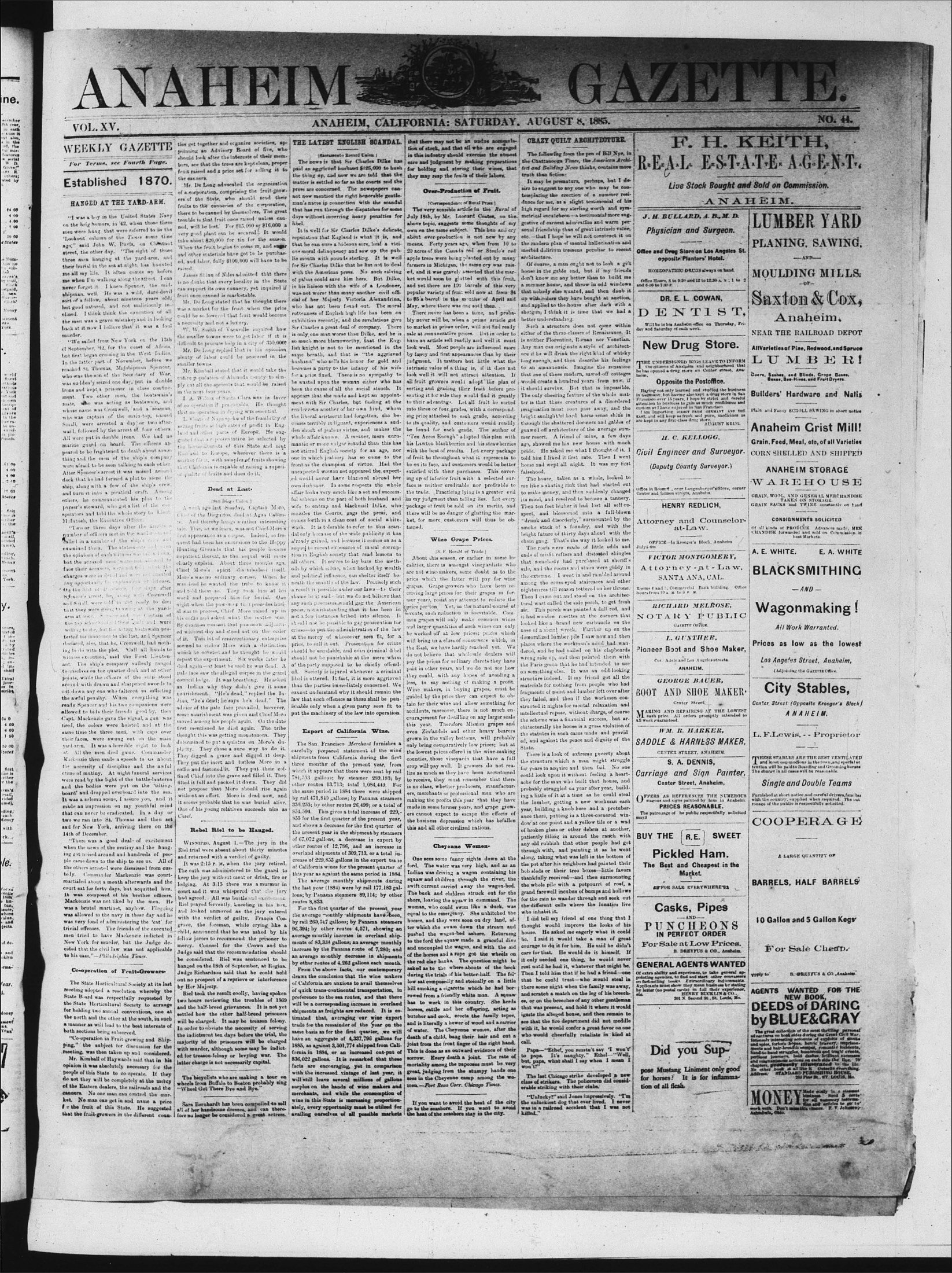
Searchable text
ANAHEIM
VOL. XV.
ANAHEIM
WEEKLY GAZETTE
For Terms, see Fourth Page.
Established 1870.
HANGED AT THE YARD-AEM.
"I was a boy in the United States Navy on the brig Semers, in '42, when those three men were hung that were referred to in the 'Lookout' column of the Times some time ago," said John W. Davis, on Chinatown street, the other day. "The sight of those three men hanging at the yard-arm, and their burial in the sea at night, has haunted me all my life. It often comes up before me when I'm walking along the street. I can never forget it. I knew Spencer, the midshipman, well. He was a wild, dare-devil sort of a fellow, about nineteen years old, but good natured, and not maliciously inclined. I think think the execution of all the men was a grave mistake and in looking back at it now I believe that it was a foul murder."
"We sailed from New York on the 13th of September, '42, for the coast of Africa, but first began cruising in the West Indies. In the latter part of November, before we reached St. Thomas, Midshipman Spencer, who was the son of the Secretary of War, was suddenly seized one day, put in double irons and kept a prisoner in close confinement. Two other men, the boatswain's mate, who was acting as boatswain, and whose name was Cromwell, and a seaman, who was captain of the main-top, named Small, were arrested a day or two afterward, followed by the arrest of four others. All were put in double irons. We had no marine guard on board. The officers appeared to be frightened to death about something and the man of the ship's company were afraid to be seen talking to each other. After Spencer's arrest it was noised around ties get together and organize societies, appointing an Advisory Board of five, who should look after the interests of their members, see that the trees are kept clean, proper fruit raised and a price set for selling it to the canners.
Mr. De Long advocated the organization of a corporation, comprising the fruit-growers of the State, who should send their fruits to the canneries of the corporation, there to be canned by themselves. The great trouble is that fruit once raised unless canned, will be lost. For $15,000 or $16,000 a very good plant can be secured. It would take about $20,000 for tin for the season. When the fruit begins to come in, and sugar and other materials have got to be purchased, and labor fully $100,000 will have to be raised.
James Shinn of Niles admitted that there is no doubt that every locality in the State can support its own cannery, yet inquired if fruit once canned is marketable.
Mr. De Long stated that he thought there was a market for the fruit when the price could be so lowered that fruit would become a necessity and not a luxury.
W. W. Smith of Vacaville inquired how the smaller towns were to get labor if it is difficult to procure help in a city of 350,000?
Mr. De Long replied that in his opinion plenty of labor could be procured in the smaller towns.
Mr. Kimball stated that it would take the entire population of Alameda county to simply cut all the apricots that would be raised in the next four years.
I A. Wilcox of Santa Clara was in favor of co-operation if practicable. He thought that co-operation in drying was essential.
L. Coast of Napa spoke of the feasibility of setting fruits at high rates of profit in England and other parts of Europe. He suggested that a representative be selected by the horizonturists of this State and sent Erica and to Europe, wherever there is a market for it, with samples of fruits showing that California is capable of raising a superior quality of fruits and does do it.
THE LATEST ENGLISH
(Sacramento Record)
The news is that Sir Paul an aggrieved husband thing up, and now we matter is settled so far as press are concerned. That not now mention the right man's name ip connection that has run through the days without incurring his libel.
It is well for Sir Charles reputation that England is that he can cure a bileous moral delinquency and lie mouth with pounds steal for Sir Charles Dulke that with the American press of palms could save him in his liaison with the wife was not worse than many special of her Majesty Victor who has not been former rottenness of English high exhibition recently, and that Sir Charles a great deal obeys is only one man worse than so much more blamsworthish knight is not to be same breath, and that in husband" who sells his house becomes a party to the insurer for a price fixed. There is be waited upon the woman been the cause of all the appears that she made and ment with Sir Charles, but rendervous another of her the liberal aristocrat had come terribly indignant, den abush of jealousy virtuous whole affair known. A man mantic or more vulgar son not stirred English society one in which jealousy has front as the champion of unexpected woman not appl
who was the son of the Secretary of War,
was suddenly seized one day, put in iron and kept a prisoner in close confinement. Two other men, the boatswain's mate, who was acting as boatswain, and whose name was Cromwell, and a seaman, who was captain of the main-top, named Small, were arrested a day or two afterward, followed by the arrest of four others. All were put in double irons. We had no marine guard on board. The officers appeared to be frightened to death about something and the men of the ship's company were afraid to be seen talking to each other. After Spencer's arrest it was noised around deck that he had formed a plot to seize the ship, along with a few of the ship's crew, and turn it into a piratical craft. Among others, he communicated his plan to the purser's steward, who got a list of the conspirators and told the whole story to Lieut. McIntosh, the Executive Officer.
"Two or three days after the arrests a number of officers met in the wardroom and called in a number of the ship's crew and examined them. The statements and even the opinions of each witness was then down, but the accused men were not allowed to face their accusers, were not told what the charges were in detail and were not granted any opportunity for expulsion or defense. On the first of these days after Spencer's arrest, he along with Cromwell and Small, were told to get ready to die; that they were going to swing at the yardarm at once. Sweeney and the Captain of the top secknowledged their guilt and were willing to die, but the acting boatswain protested his innocence to the last, and Spencer declared also that he, Cromwell, had nothing to do with the plot. 'Call all hands to witness execution,' said the First Lieutenant. The ship's company sullenly ranged themselves on the quarter deck and at other points, while the officers of the ship stood around with drawn and sharpened swords to cut down any one who faltered in inflicting the awful penalty. Wilson everything was ready Spencer and his two companions were allowed to bids their friends good by, then Capt. Mackenzie gave the signal, a gun was tired, the colors were hoisted and at the same time the three men, with caps over their faces, were swung out on the main yard arm. It was a horrible sight to look at. All the men died game. Commander Mackenzie then made a speech to us about the necessity of discipline and the awful crime of mutiny. At night funeral services were read by the light of the battle-lanterns and the bodies were put on the 'tilting-board' and dropped overboard into the sea. It was a solemn scene, I assure you, and it made an impression on my youthful mind that can never be eradicated. In a day or two we ran into St. Thomas and then set sail for New York, arriving there on the 14th of December.
"There was a good deal of excitement when the news of the mutiny and the hanging got noised around hundreds of people came down to the ship to see us. All of the others arrested were dismissed from custody. Commander Mackenzie was court-martialled about a month afterwards and the court sat for forty days, but acquitted him. It was composed of his brother officers."
[San Diego Union]
A week ago last Sunday, Captain Moro, Chief of the Diggers, died at Agua Caliente. And thereby hangs a rather interesting tale. This, as we learn, was not Chief Moro's first appearance as a corpse. Indeed, so frequent had been his excursions to the Happy Hunting Grounds that his people became impatient threat, as the sequel will more clearly explain. About three months ago, Chief Moro's spirit disembodied itself. Moro's was no ordinary corpse. When he was dead he wanted the tribe to know it and told them so. They took him at his word and prepared him for burial. One night when the pow-wow that precedes burial was in process, Chief Moro raised up in his coffin and asked what the matter was. By common consent that pow-wow self-arrested without day and stood not on the order of it. This bit of resurrectionary enterprise seemed to endow Moro with a distinction which he coveted and he thought he would repeat the experiment. Six weeks later he died again—at least he said he was dead. A pale face saw the alleged corpse in the grand council lodge. It was breathing. He asked an Indian why they didn't give it some nourishment. "He's dead," replied the Indian, "he's dead; he says he's dead." The advice of the pale face prevailed, however, some nourishment was given and Chief Moro moved among his people again. On the date first mentioned he died again. The tribe thought this was getting monotonous. They determined to put a quietus on Moro's duplicity. They chose a sure way to do it. They digged a grave and digged it deep. They put the inert and listless Moro in a coffin and fastened it. They put their coiffed Chief into the grave and filled it. They filleted it fall and packed it down. They did not propose that Moro should rise again without an effort. Moro is dead now, and it seems probable that he was buried alive. One of his young relatives succeeds him as Chief.
Rebel Riel to be Hanged.
Winnipeg, August 1—The jury in the Riel trial were absent about thirty minutes and returned with a verdict of guilty.
It was 2:15 p.m. when the jury retired. The oath was administered to the guard to keep the jury without meat or drink, fire or lodging. At 3:15 there was a murmur in court and it was whispered that the jury had agreed. All was bustle and excitement.
entire population of Alameda county to simply cat all the apprehens that would be raised in the next four years.
I.A. Wilcox of Santa Clara was in favor of co-operation if practicable. He thought that cooperation in drying was essential.
L. Coats of Napa spoke of the feasibility of selling fruits at high rates of profit in England and other parts of Europe. He suggested that a representative be selected by the bateleurists of this State and sent Ezekiel to Europe, wherever there is a market for it, with samples of fruits showing that California is capable of raising a superior quality of fruits and does it.
Dead at Last.
[San Diego Union]
A week ago last Sunday, Captain Moro, Chief of the Diggers, died at Agua Caliente. And thereby hangs a rather interesting tale. This, as we learn, was not Chief Moro's first appearance as a corpse. Indeed, so frequent had been his excursions to the Happy Hunting Grounds that his people became impatient threat, as the sequal will more clearly explain. About three months ago, Chief Moro's spirit disembodied itself. Moro's was no ordinary corpse. When he was dead he wanted the tribe to know it and told them so. They took him at his word and prepared him for burial. One night when the pow-wow that precedes burial was in process, Chief Moro raised up in his coffin and asked what the matter was. By common consent that pow-wow self-arrested without day and stood not on the order of it. This bit of resurrectionary enterprise seemed to endow Moro with a distinction which he coveted and he thought he would repeat the experiment. Six weeks later he died again—at least he said he was dead. A pale face saw the alleged corpse in the grand council lodge. It was breathing. He asked an Indian why they didn't give it some nourishment. "He's dead," replied the Indian, "he's dead; he says he's dead." The advice of the pale face prevailed, however, some nourishment was given and Chief Moro moved among his people again. On the date first mentioned he died again. The tribe thought this was getting monotonous. They determined to put a quietus on Moro's duplicity.
They chose a sure way to do it. They digged a grave and digged it deep. They put the inert and listless Moro in a coffin and fastened it. They put their coiffed Chief into the grave and filled it. They filleted it fall and packed it down. They did not propose that Moro should rise again without an effort. Moro is dead now, and it seems probable that he was buried alive. One of his young relatives succeeds him as Chief.
Rebel Riel to be Hanged.
Winnipeg, August 1—The jury in the Riel trial were absent about thirty minutes and returned with a verdict of guilty.
It was 2:15 p.m. when the jury retired. The oath was administered to the guard to keep the jury without meat or drink, fire or lodging. At 3:15 there was a murmur in court and it was whispered that the jury had agreed. All was bustle and excitement.
entire population of Alameda county to simply cat all the apprehens that would be raised in the next four years.
I.A. Wilcox of Santa Clara was in favor of co-operation if practicable. He thought that co-operation in drying was essential.
L. Coats of Napa spoke of the feasibility of selling fruits at high rates of profit in England and other parts of Europe. He suggested that a representative be selected by the bateleurists of this State and sent Ezekiel to Europe, wherever there is a market for it, with samples of fruits showing that California is capable of raising a superior quality of fruits and does it.
Dead at Last.
[San Diego Union]
A week ago last Sunday, Captain Moro, Chief of the Diggers, died at Agua Caliente. And thereby hangs a rather interesting tale. This, as we learn, was not Chief Moro's first appearance as a corpse. Indeed, so frequent had been his excursions to the Happy Hunting Grounds that his people became impatient threat, as the sequal will more clearly explain. About three months ago, Chief Moro's spirit disembodied itself. Moro's was no ordinary corpse. When he was dead he wanted the tribe to know it and told them so. They took him at his word and prepared him for burial. One night when the pow-wow that precedes burial was in process, Chief Moro raised up in his coffin and asked what the matter was. By common consent that pow-wow self-arrested without day and stood not on the order of it. This bit of resurrectionary enterprise seemed to endow Moro with a distinction which he coveted and he thought he would repeat the experiment. Six weeks later he died again—at least he said he was dead. A pale face saw the alleged corpse in the grand council lodge. It was breathing. He asked an Indian why they didn't give it some nourishment. "He's dead," replied the Indian, "he's dead; he says he's dead." The advice of the pale face prevailed, however, some nourishment was given and Chief Moro moved among his people again. On the date first mentioned he died again. The tribe thought this was getting monotonous. They determined to put a quietus on Moro's duplicity.
They chose a sure way to do it. They digged a grave and digged it deep. They put the inert and listless Moro in a coffin and fastened it. They put their coiffed Chief into the grave and filled it. They filleted it fall and packed it down. They did not propose that Moro should rise again without an effort. Moro is dead now, and it seems probable that he was buried alive. One of his young relatives succeeds him as Chief.
Rebel Riel to be Hanged.
Winnipeg, August 1—The jury in the Riel trial were absent about thirty minutes and returned with a verdict of guilty.
It was 2:15 p.m., when the jury retired. The oath was administered to the guard to keep the jury without meat or drink, fire or lodging. At 3:15 there was a murmur in court and it was whispered that the jury had agreed.
All was bustle and excitement.
entire population of Alameda county to simply cat all the apprehens that would be raised in the next four years.
I.A.Wilcox of Santa Clara was in favor of co-operation if practicable. He thought that co-operation in drying was essential.
L.Coats of Napa spoke of the feasibility of selling fruits at high rates of profit in England and other parts of Europe. He suggested that a representative be selected by the bateleurists of this State and sent Ezekiel to Europe, wherever there is a market for it, with samples of fruits showing that California is capable of raising a superior quality of fruits and does it.
Export of Californi
The San Francisco Merchant prepared state ships from California three months of this year which appears that there are routes of 12,786 miles increase of 229,855 gallons one in which jealousy has fronted at this champion not applied would never have black own dishonor.In some rare affair looks very much like scheme onthe partof wifeto entrapandblack muzzlesthe Courts,gagscomes forthin a clean coat wash.it is tolerable rotradeonly becauseofthewi already gained,and becausesequelto recent exposurestioninEnglish societythatallothers.it servesto laidbywhichcrime,whenandpolitical influence,curemeathaltmanybecauseofthemerofwhoseeverprice,tosellitout.Prosessshouldbeunavailable,andcannotstillbe punishableofthepartsupposedtoeled.Societyisinjuredwhileniblalisnotuttered.itfact.ititthanthepartiesimmediatelycannotunderstandwhyitlawthatsuchoffensesatthelishableonlywhenagivenputthemachineryofthel
Export of Californi
The San Francisco Merchant prepared state ships from California three months of this year which appears that there are routes of 12,786 miles increase of 229,855 gallons one in which jealousy has fronted at this champion not applied would never have black own dishonor.In some rare affair looks very much like scheme onthe partof wifeto entrapandblack muzzlesthe Courts,gagscomes forthin a clean coat wash.it is tolerable rotradeonly becauseofthewi already gained,andcannotstillbe punishableofthepartsupposedtoeled.Societyisinjuredwhileniblalisnotuttered.itfact.ititthanthepartiesimmediatelycannotunderstandwhyitlawthatsuchoffensesatthelishableonlywhenagivenputthemachineryofthel
It was a solemn scene, I assure you, and it made an impression on my youthful mind that can never be eradicated. In a day or two we ran into St. Thomas and then set sail for New York, arriving there on the 14th of December.
"There was a good deal of excitement when the news of the mutiny and the hanging got noised around and hundreds of people came down to the ship to see us. All of the others arrested were dismissed from custody. Commander Mackenzie was court-martialled about a month afterwards and the court sat for forty days, but acquitted him. It was composed of his brother officers. Mackenzie was not liked by the men. He was a brutal martinet, anyhow. Flogging was allowed in the navy in those days and he was very fond of administering the 'eat' for trivial offenses. The friends of the executed men tried to have Mackenzie indicted in New York for murder, but the Judge decided that the civil law was not applicable to his case." — Philadelphia Times.
Co-operation of Fruit-Growers
The State Horticultural Society at its last meeting adopted a resolution whereby the State Board was respectfully requested by the State Horticultural Society to arrange for holding two annual conventions, one at the north and the other at the south, in such a manner as will lead to the best interests of both sections being subserved.
"Co-operation in Fruit-growing and Shipping," the subject for discussion for the meeting, was then taken up and considered.
Mr. Kimball of Haywards said that in his opinion it was absolutely necessary for the people of this State to co-operate. If they do not they will be completely at the mercy of the Eastern dealers, the railroads and the canners. No one man can control the market. No man can get in and name a price for the fruit of this State. He suggested that the fruit-growers in the different coun-
Rebel Riel to be Hanged.
Winnipeg, August 1.—The jury in the Riel trial were absent about thirty minutes and returned with a verdict of guilty.
It was 2:15 p.m. when the jury retired. The oath was administered to the guard to keep the jury without meat or drink, fire or lodging. At 3:15 there was a murmur in court and it was whispered that the jury had agreed. All was bustle and excitement. Riel prayed fervently, kneeling in his box, and looked unmoved as the jury entered with the verdict of guiltty. Francis Cosgrove, the foreman, while crying like a child, announced that he was asked by his fellow jurors to recommend the prisoner to mercy. Counsel for the Crown and the Judge said that the recommendation should be considered. Riel was sentenced to be hanged on the 18th of September, at Regina. Judge Richardson said that he could hold out no prospect of a reprieve or interference by Her Majesty.
Riel took the result coolly, having spoken two hours reviewing the troubles of 1869 and the half-breed grievances. It is not yet settled how the other half-breed prisoners will be charged. It may be treason felony. In order to obviate the necessity of serving the indictment ten days before the trial, the majority of the prisoners will be charged with murder, although some may be indicted for treason-felony or levying war. The latter charge is not necessarily capital.
The bicyclists who are making a tour on wheels from Buffalo to Boston probably sing "Wheel Get There Bye and Bye."
Sara Bernhardt has been compelled to sell all of her handsome dresses, and can therefore no longer be considered a great actress.
This gives a total of 855 for the first quarter of and shows a decrease for the present year in the share of 67,072 gallons, a decrease other routes of 12,786, an overland shipments of 309 crease of 229,855 gallons in California wines for this year as against the sea.
The average monthly rate for the last year (1884) were 810; by Panama steamers routes 8,833.
For the first quarter of this average monthly ship by rail 259,517 gallons; by other routes average monthly increase of 83,334 gallons; an increase by the Panama rate an average monthly decrease by other routes of 4,262 gallons.
From above facts, draws the conclusion that California are anxious to quick trans-continental preference to the sea route will be a corresponding increase in shipments as freights are estimated that, averaging trade for the remainder of same basis as for the first have an aggregate of 4,31885, as against 3,501,774 formia in 1884, or an increase 836,022 gallons. It is reminds facts are encouraging, with the increased vintages will still leave several more surplus on the hands of merchants, and while these wine in this State is merely every opportunity availing ourselves of all
THE LATEST ENGLISH SCANDAL.
[Sacramento Record Union]
The news is that Sir Charles Dilke has paid an aggrieved husband $125,000 to hush the thing up, and now we are told that the matter is settled so far as the courts and the press are concerned. The newspapers cannot now mention the right honorable gentleman's name in connection with the scandal that has run through the dispatches for some days without incurring heavy penalties for libel.
It is well for Sir Charles Dilke's delicate reputation that England is what it is, and that he can cure a hideous sore, heal a vicious moral delinquency and saw up the public mouth with pounds sterling. It is well for Sir Charles Dilke that he has not to deal with the American press. No such salving of palms could save him here. But Dilke, in his liaison with the wife of a Londoner, was not worse than many another civil official of her Majesty Victoria Alexandrina, who has not been found out. The moral rottenness of English high life has been on exhibition recently, and the revelations give Sir Charles a great deal of company. There is only one man worse than Dilke, and he is so much more blameworthy, that the English knight is not to be mentioned in the same breath, and that is "the aggrieved husband" who sells his honor for gold and becomes a party to the intamy of his wife for a price fixed. There is no sympathy to be waisted upon the woman either who has been the cause of all the social stench. It appears that she made and kept an appointment with Sir Charles, but finding at the rendezvous another of her own kind, whom the liberal aristocrat had forgotten, she becomes terriblyignant, experiences a sudden shock of peaborns virtue, and makes the whole affair known. A meaner, more unromantic or more vulgar scandal than this has not stirred English society for an age, nor one in which jealousy has so come to the front as the champion of virtue. Had the unexpected woman not appeared the expectant there may not be an undue accumulation of stock, and that all who are engaged in this industry should exercise the utmost care and judgment by making preparations for holding and storing their wines, that they may reap the fruits of their labors.
Over-Production of Fruit.
[Correspondence of Rural Press]
The very sensible article in the Rural of July 18th, by Mr. Leonard Coates, on the above topic, suggests some thoughts of my own on the same subject. This hue and cry about over-production is not new by any means. Forty years ago, when from 10 to 20 acres of the Canada red or Steele's red apple trees were being planted out by many farmers in Michigan, the same cry was raised, and it was gravely asserted that the market would soon be glutted with this fruit, and yet there are 100 barrels of this very popular variety of fruit sold now at from $4 to $5 a barrel in the months of April and May, where there was one sold then.
There never has been a time, and probably never will be, when a prime article got to market in prime order, will not find ready sale at remunerative prices. But in order to have an article sell readily and well it must look well. Most people are influenced more by fancy and first appearances than by their judgment. It matters but little what the intrinsic value of a thing is, if it does not look well it will not attract attention. If all fruit growers would adopt the plan of sorting and grading their fruit before presenting it for sale they would find it greatly to their advantage. Let all fruit be sorted into three or four grades, with a corresponding price attached to each grade, according to its quality, and customers would readily be found for each grade. The author of "Ten Acres Enough" adopted this plan with his Lawton blackberries and his strawberries with the best of results. Let every package of fruit be throughout what it represents to be on its face, and customers would be better satisfied with their purchases. This cover-
CRAZY QUILT ARCHITECTURE.
The following from the pen of Bill Nye, in the Chattanooga Times, the American Architect and Building News thinks, contains more truth than fiction:
It may be premature, perhaps, but I desire to suggest to any one who may be contemplating the erection of a summer residence for me, as a slight testimonial of his high regard for my sterling worth and symmetrical escutcheon—a testimonial more suggestive of exalted admiration and warm personal friendship than of great intrinsic value, etc.—that I hope he will not construct it on the modern plan of mental hallucination and morbid delirium tremens peculiar to recent architecture.
Of course, a man ought not to look a gift house in the gable end, but if my friends don't know me any better than to build me a summer house, and throw in odd winnows that nobody else wanted, and then daub it up with holders they have bought at auction, and applied to the house after dark with a shotgun; I think it is time that we had a better understanding.
Such a structure does not come within either of the three classes of Renaissance. It is neither Florentine, Roman nor Venetian. Any man can originate a style of architecture if he will drink the right kind of whisky long enough, and then describe his feelings to an amannensis. Imagine the sensation that one of these modern sawed-off cottages would create a hundred years from now, if it should survive. But that is impossible. The only cheering feature of the whole matter is that those creatures of a disordered imagination must soon pass away, and the bright sunlight of hard horse-sense shine in through the shattered dormers and gables of gnawed-off architecture of the average summer resort. A friend of mine, a few days ago, showed me his new house with much pride. He asked me what I thought of it. I told him I liked it first rate. Then I went home and wept all night. It was my first falsehood.
for a price fixed. There is no sympathy to be waited upon the woman either who has been the cause of all the social stench. It appears that she made and kept an appointment with Sir Charles, but finding at the rendezvous another of her own kind, whom the liberal aristocrat had forgotten, she becomes terribly indignant, experiences a sudden shock of peaborn virtue, and makes the whole affair known. A meaner, more unromantic or more vulgar sound than this has not stirred English society for an age, nor one in which jealousy has come to the front as the champion of virtue. Had the unexpected woman not appeared the expected would never have blazoned abroad her own dishonor. In some respects the whole affair looks very much like a set and successful scheme on the part of both husband and wife to entrap and blackmail Dilke, who muzzles the Courts, gags the press, and comes forth in a clean coat of social whitewash. It is tolerable to refer to this scandal only because of the wide publicity it has already gained, and because it comes on as a sequel to recent exposures of moral corruption in English society that read lessons to all others. It serves to lay bare the methods by which crime, when backed by wealth and political influence, can shelter itself beneath the mantle of the law. Precisely such a result is possible under our laws—to their shame he is said—but we do not believe that any such processes would gag the American press, notwithstanding that it has been in not a few instances bribed into silence. It should not be possible to gag prosecution for crime—to put the administration of the law at the mercy of whosoever sees fit, for a price, to sell it out. Prosecution for crime should be available, and even criminal libel should not be punishable at the mere whim of the party supposed to be chiefly offended. Society is injured whenever a criminal libel is uttered. It fact, it is more aggrieved than the parties immediately concerned. We cannot understand why it should remain the law that such offenses as these shall be punishable only when a given party sees fit to put the machinery of the law into operation.
Export of California Wine.
The San Francisco Merchant furnishes a carefully prepared statement of the wine shipments from California during the first three months of the present year, from which it appears that there were sent by rail 781,553 gallons; by steamers 289,183; by other routes 13,713; total 1,084,449. For the same period in 1884 there were shipped by rail 471,840 gallons; by Panama steamers 358,255; by other routes 26,499; or a total of 854,594. This gives a total increase of 229,-855 for the first quarter of the present year, and shows a decrease for the first quarter of the present year in the shipment by steamers of 67,072 gallons, a decrease in export by other routes of 12,786, and an increase in overland shipments of 309,713, or a total increase of 229,855 gallons in the export trade of California wines for the present quarter of this year as against the same period in 1884.
The average monthly shipments during the last year (1884) were by rail 177,183 gallons; by Panama steamers 89,114; by other
Wine Grape Prices.
[3. F. Herald of Trade]
About this season, or earlier in some localities, there is amongst vineyardists who are not wine-makers, some doubt as to the price which the latter will pay for wine grapes. Grape growers who have been receiving large prices for their grapes in former years, resist any attempt to reduce the price per ton. Yet, in the natural course of events, such reduction is inevitable. Common grapes will only make common wines and larger quantities of such wines can only be worked off at low prices; prices which will bring us a class of consumers which, in the fast, we have hardly reached yet. We do not believe that wholesale dealers will pay the prices for ordinary clarents they have paid in other years, and we do not see how they could, with any hopes of avoiding a loss, to say nothing of making a profit. Wine makers, in buying grapes, must be guided by the price they can expect to obtain for their wine and allow something for accidents, moreover, there is not much encouragement for distilling on any larger scale this year. Therefore Mission grapes and even Zinfandels and other heavy bearers grown in the valley bottoms, will probably only bring comparatively low prices; but at the lowest prices offered in the wine-making counties, those vineyards that have a full crop will pay well. It growers do not realize as much as they have been accustomed to receive, they must remember that there is no class, whether producers, manufacturers, merchants or professional men who are making the profits this year that they have made in some former years, and grape growers cannot expect to escape the effects of the business depression which has befallen this and all other civilized nations.
Cheyenne Women-
One sees some funny sights down at the Ford. The water was very high, and as an Indian was driving a wagon containing his squaw and children through the river, the swift current carried away the wagon-bed. The buck and children struck out for the shore leaving them in command. The look well it will not attract attention. If all fruit growers would adopt the plan of sorting and grading their fruit before presenting it for sale they would find it greatly to their advantage. Let all fruit be sorted into three or four grades, with a corresponding price attached to each grade, according to its quality, and customers would readily be found for each grade. The author of "Ten Acres Enough" adopted this plan with his Lawton blackberries and his strawberries with the best of results. Let every package of fruit be throughout what it represents to be on its face, and customers would be better satisfied with their purchases. This covering up of inferior fruit with a selected surface is neither creditable nor profitable to the trade. Practicing lying is a greater evil in my judgment than telling lies. Let every package of fruit be sold on its merits, and there will be no danger of glutting the market, for more customers will thus be obtained.
Wine Grape Prices.
[3. F. Herald of Trade]
About this season, or earlier in some localities, there is amongst vineyardists who are not wine-makers, some doubt as to the price which the latter will pay for wine grapes. Grape growers who have been receiving large prices for their grapes in former years, resist any attempt to reduce the price per ton. Yet, in the natural course of events, such reduction is inevitable. Common grapes will only make common wines and larger quantities of such wines can only be worked off at low prices; prices which will bring us a class of consumers which, in the fast, we have hardly reached yet. We do not believe that wholesale dealers will pay the prices for ordinary clarents they have paid in other years, and we do not see how they could, with any hopes of avoiding a loss, to say nothing of making a profit. Wine makers, in buying grapes, must be guided by the price they can expect to obtain for their wine and allow something for accidents, moreover, there is not much encouragement for distilling on any larger scale this year. Therefore Mission grapes and even Zinfandels and other heavy bearers grown in the valley bottoms, will probably only bring comparatively low prices; but at the lowest prices offered in the wine-making counties, those vineyards that have a full crop will pay well. It growers do not realize as much as they have been accustomed to receive, they must remember that there is no class, whether producers, manufacturers, merchants or professional men who are making the profits this year that they have made in some former years, and grape growers cannot expect to escape the effects of the business depression which has befallen this and all other civilized nations.
There is a look of extreme poverty about the structure which a man might struggle for years to acquire and then fail. No one could look upon it without feeling a heartache for the man who built that house,and probably struggled on year after year,building a little of it at a time as he could steal the lumber,getting a new workman each year,building a knob here and a protuberance there,pitting in a three-cornered window at one point and a yellow tile or a wall of broken glass or other debris at another,patiently filling in around the ranch with any old rubbish that other people had got through with,and painting it as he went along,taking what was left in the bottom of the pot after his neighbors had painted their bob alled or their tree boxes—little favors thankfully received—and then surmountingthe whole pile with a potpourri of roof,a grand farewell incubus of bumps and hollows for the rain to wander through and seek out
by rail 411,810 gallons; by Panama steamers 358,255; by other routes 26,499; or a total of 854,594. This gives a total increase of 229,855 for the first quarter of the present year, and shows a decrease for the first quarter of the present year in the shipment by steamers of 67,072 gallons, a decrease in export by other routes of 12,786, and an increase in overland shipments of 309,713, or a total increase of 229,855 gallons in the export trade of California wines for the present quarter of this year as against the same period in 1884.
The average monthly shipments during the last year (1884) were by rail 177,183 gallons; by Panama steamers 89,114; by other routes 8,833.
For the first quarter of the present year the average monthly shipments have been, by rail 269,547 gallons; by Panama steamers 96,394; by other routes 4,571, showing an average monthly increase in overland shipments of 83,334 gallons; an average monthly increase by the Panama route of 7,280; and an average monthly decrease in shipments by other routes of 4,262 gallons each month.
From the above facts, our contemporary draws the conclusion that the wine makers of California are anxious to avail themselves of quick transcontinental transportation, in preference to the sea routes, and that there will be a corresponding increase in overland shipments as freights are reduced. It is estimated that, averaging our wine export trade for the remainder of the year on the same basis as for the first quarter, we will have an aggregate of 4,337,796 gallons for 1885, as against 3,501,774 shipped from California in 1884, or an increased out-put of 836,022 gallons. It is remarked that these facts are encouraging yet in comparison with the increased vintage of last year, it will still leave several millions of gallons surplus on the hands of wine makers and merchants, and while the consumption of wine in this State is increasing proportionately, every opportunity must be utilized for availing ourselves of all possible markets.
One sees some funny sights down at the Ford. The water was very high, and as an Indian was driving a wagon containing his squaw and children through the river, the swift current carried away the wagon-bed. The buck and children struck out for the shore, leaving the squaw in command. The woman, who could swim like a duck, was equal to the emergency. She unhitched the horses, and they were soon on dry land, after which she swam down the stream and pushed the wagon-bed ashore. Returning to the Ford the squaw made a graceful dive and uncoupled the wagon, and with the aid of the horses and a rope got the wheels on the red clay banks. The question might be asked as to the whereabouts of the buck during the trials of his better-half. The fellow sat composedly and stoically on a little bill smoking a cigarette which he had borrowed from a friendly white man. A squaw has to work in this country. She herds horses, cattle and her offspring, acting as butcher and cook, erects the family tepee, and is literally a hewer of wood and a carrier of water. The Cheyenne women, after the death of a child, bang their hair and cut a joint from the front finger of the right hand. This is done as an outward evidence of their sorrow. Every death a joint. The rate of mortality among the napooses must be very great, judging from the stumpy hands one sees in the Cheyenne camp among the women.—Fort Reno Corr. Chicago Times.
If you want to avoid the heat of the city go to the seashore. If you want to avoid the heat of the seashore stay in the city.
the lumber, getting a new workman each year, building a knob here and a protuberance there, putting in a three-cornered window at one point and a yellow tile or a wall of broken glass or other debris at another, patiently filling in around the ranch with any old rubbish that other people had got through with, and painting it as he went along, taking what was left in the bottom of the pot after his neighbors had painted their bob alda or their tree boxes—little favors thankfully received—and then surmounting the whole pile with a potpourri of roof, a grand farewell incubus of bumps and hollows for the rain to wander through and seek out the different cells where the lunatics live who inhabit it.
I did tell my friend of one thing that I thought would improve the looks of his house. He asked me eagerly what it could be. I said it would take a man of great courage to dq it for him. He said he didn't care for that. He would do it himself. If it only needed one thing, he would never rest until he had it, whatever that might be. Then I told him that if he had a friend—one that he could trust—who would steal in there some night when the family was away, and scratch a match on the leg of his breeches, or on the breeches of any other gentleman that was present, and hold it where it would ignite the alleged house, and then remain to see that the fire department did not meddle with it, he would confer a great favor on one who would cheerfully retaliate in kind at call.
Papa—"Ethef, you mustn't say 'I won't' to papa. It's naughty." Ethef—"Well, but, papa, what shall I say when I mean I won't?"
The last Chicago strike developed a new class of strikers. The policemen did considerable striking with their clubs.
"Unlucky!" said Jones impressively. "Tm the unluckiest dog that ever lived. I never was in a railroad accident that I was not killed."
GAZETTE.
NO. 44.
F. H. KEITH,
REAL ESTATE AGENT.
Live Stock Bought and Sold on Commission.
ANAHEIM.
J. H. BULLARD, A. B., M.D.
Physician and Surgeon.
Office and Drug Store on Los Angeles St.
opposite Planters' Hotel.
HOMEOPATHIC DRUGS always on hand.
Office Hours, 8 to 9:30 and 12 to 12:30 A.M.; 1 to 2 and 6:30 to 7:30 P.
DR. E. L. COWAN,
DENTIST,
Will be in his Anaheim office on Thursday, Friday and Saturday of each week.
New Drug Store.
THE UNDERSIGNED BEGS LEAVE TO INFORM the citizens of Anaheim and neighborhood that he has opened a drug store on Center street, Anaheim.
Opposite the Postoffice.
Having not only learned and studied the business in Germany, but having also kept a drug store in San Francisco over 16 years, I hope by strict and careful attention to business to gain as much confidence and custom as I have enjoyed in San Francisco.
I am importing direct from Germany and the East, and will keep as fresh and pure, medicines as are kept in any first-class drug store.
AUGUST KRUG.
H. C. KELLOGG,
Civil Engineer and Surveyor.
(Deputy County Surveyor.)
LUMBER YARD
PLANING, SAWING,
AND
MOULDING MILLS:
OF
Saxton & Cox,
Anaheim.
NEAR THE RAILROAD DEPOT
All Varieties of Pine, Redwood, and Spruce
LUMBER!
Doors, Sashes, and Blinds, Grape Boxes,
Boxes, Bee-Hives, and Fruit Dryers.
Bullders' Hardware and Nalis
Plains and Fancy SCROLL SAWING in short notice
Anaheim Grist Mill!
Grain, Feed, Meal, etc., of all Varieties
CORN SHELLED AND SHIPPED
ANAHEIM STORAGE
Opposite the Postoffice.
Having not only learned and studied the business in Germany, but having also kept a drug store in San Francisco over 15 years, I hope by strict and careful attention to business to gain as much confidence and custom as I have enjoyed in San Francisco.
I am importing direct from Germany and the East, and will keep as fresh and pure, medicines as are kept in any first-class drug store.
AUGUST KRUG.
H. C. KELLOGG,
Civil Engineer and Surveyor.
(Deputy County Surveyor.)
Office in Room 4, over Langanberger's Store, corner Center and Lemon streets, Anaheim.
HENRY REDLICH,
Attorney and Counselor-Law.
OFFICE—In Kroeger's Block, Anaheim July 4th
VICTOR MONTGOMERY,
Attorney-at-Law,
SANTA ANA, CAL.
Rooms 4 and 5, Commercial Bank building. Office hours from 10 A.M. to 8 P.M.
RICHARD MELROSE,
NOTARY PUBLIC
GAZETTE OFFICE.
L. GUNTHER,
Pioneer Boot and Shoe Maker,
Cor. Adele and Los Angeles streets.
ANAHEIM.
GEORGE BAUER,
BOOT AND SHOE MAKER
Center Street.
MAKING AND REPAIRING AT THE LOWEST cash price. All orders promptly attended to. All work guaranteed.
WM. R. HARKER,
SADDLE & HARNESS MAKER,
CENTER STREET, Anaheim.
S. A. DENNIS,
Carriage and Sign Painter,
Center Street, Anaheim,
OFFERS AS REFERENCES THE NUMEROUS wagons and signs painted by him in Anaheim.
PRICES REASONABLE.
The patronage of he public respectfully solicited may3
BUY THE R.E. SWEET
Pickled Ham.
The Best and Cheapest in the Market.
FOR SALE EVERYWHERE
Doers, Sashes, and Blinds, Grape Boxes, Boxes, Bee-Hives, and Fruit Dryers.
Builders' Hardware and Nalis
Plains and Fancy SCROLL SAWING in short notice
Anaheim Grist Mill!
Grain, Feed, Meal, etc., of all Varieties
CORN SHELLED AND SHIPPED
ANAHEIM STORAGE
WAREHOUSE
GRAIN, WOOL, AND GENERAL MERCHANDISE TAKEN ON STORAGE.
GRAIN SACKS and TWINE constantly on hand
CONSIGNMENTS SOLICITED
Of all kinds of PRODUCK Advances made, MEK CHANDISE forwarded and sold on Commission in best Markets.
A. E. WHITE. E. A. WHITE
BLACKSMITHING — AND —
Wagonmaking!
All Work Warranted.
Prices as low as the lowest
Los Angeles Street, Anaheim,
(Adjoining the Gazette Office).
City Stables,
Center Street (Opposite Kroeger's Block)
ANAHEIM.
L.F.Lewis, -- Proprietor
THESE STABLES ARE THE BEST VENTILATED and most commodious in the town, and special at tention will be paid to Boarding and Grooming horses The charge in all cases will be reasonable.
Single and Double Teams
Furnished at short notice and careful drivers familiar with the country, supplied when required. The patronage of the public is respectfully solicited.
COOPERAGE
A LARGE QUANTITY OF
BARRELS, HALF BARRELS
BUY THE R.E. SWEET
Pickled Ham.
The Best and Cheapest in the Market.
Casks, Pipes
AND
PUNCHEONS
IN PERFECT ORDER
For Sale at Low Prices.
B. DREYFUS & CO., Anheim.
GENERAL AGENTS WANTED
Of extra ability and experience, to take general appointing agencies, to find and start other convancers on fast-selling books. Extraordinary inducements. Applicants must show they mean business by stating by letter (no postal cards) in full their experience, etc.
HENRY BUCKLIN & CO.
201 N. Second St., St. Louis, Mo.
Did you Suppose Mustang Liniment only good for horses? It is for inflammation of all flesh.
AGENTS WANTED FOR THE NEW BOOK,
DEEDS of DARING
by BLUE&GRAY
The great collection of the most thrilling personal adventures on both sides during the Great Civil War, intensely interesting accounts of exploits of slaves and spies, fortune hepes, heracle bravery, imprisonments and hair-breadth camps, romantic incidents, hand-to-hand strugles, humorous and tragic events, perilous journeys, bold dashes, brilliant successes and magnificent actions on each side the line. 70 chapters, profusely illustrated to the life. No other book at all like it. Outsells everything. Address: STANDARD PUBLISHING HOUSE.
203 Pine St., WT. LOUIS, Mo.
MONEY
Made easily in a plenant binism. Sard 3 cents for all necessary information and articles to go to work with. Don't miss this chance. E. V. Johnson; Auburn, Ohio.