anaheim-gazette 1885-08-01
Scanned page
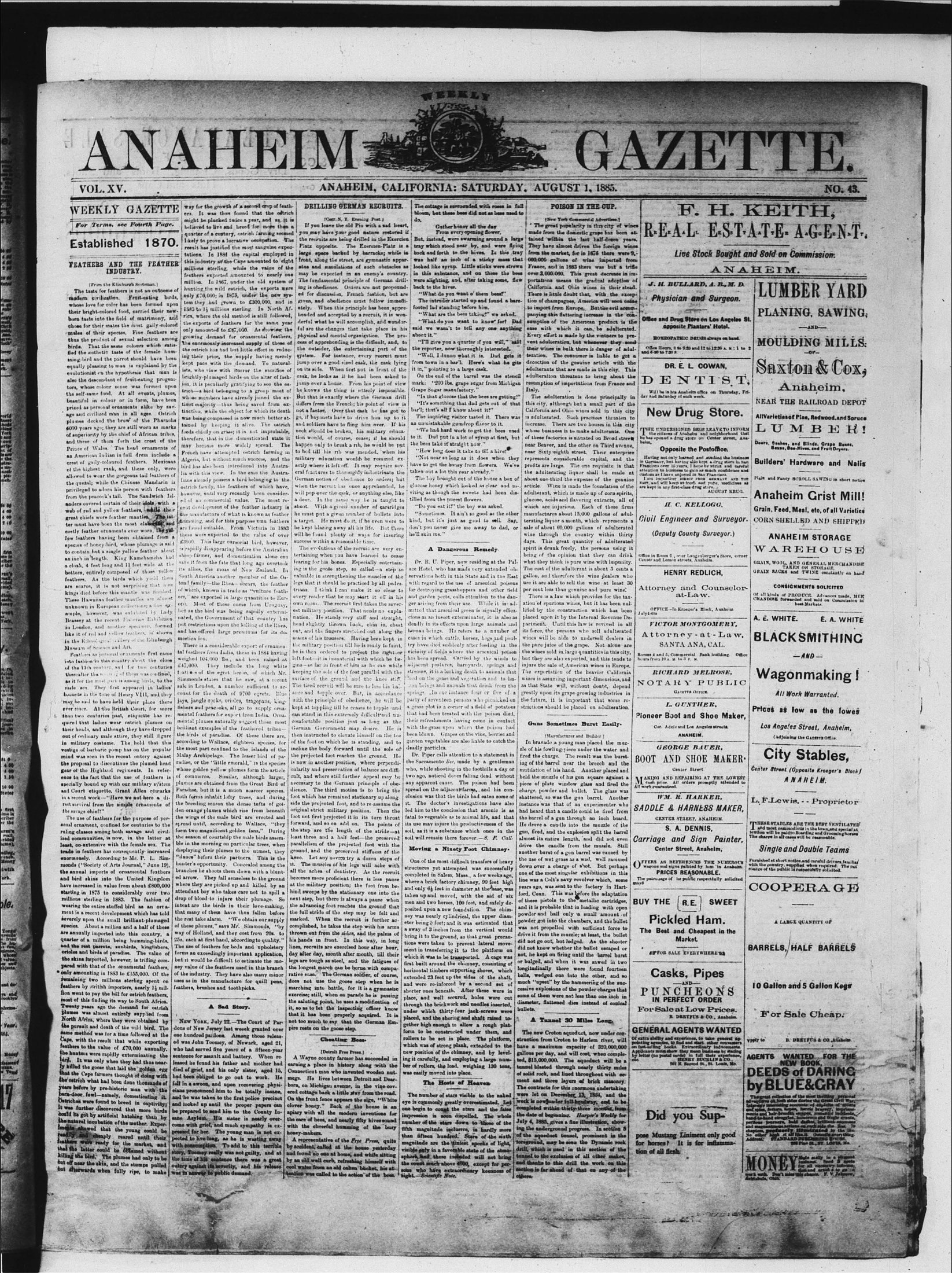
Searchable text
WEEKLY GAZETTE
For Terms, see Fourth Page.
Established 1870.
FEATHERS AND THE FEATHER INDUSTRY.
[From the Edinburgh Scotsman.]
The taste for feathers is not an outcome of modern civilization. Fruit-eating birds, whose love for color has been formed upon their bright-colored food, carried their newborn taste into the field of matrimony, and chose for their mates the most gaily-colored males of their species. Fine feathers are thus the product of sexual selection among birds. That the same colours which satisfied the aesthetic taste of the female hummingbird and the parrot should have been equally pleasing to man is explained by the evolutionist on the hypothesis that man is also the descendant of fruit-eating progenitors, whose colour sense was formed upon the self-same food. At all events, plumes, beautiful in colour or in form, have been prized as personal ornaments alike by savage and civilized man in all ages. Ostrich plumes decked the brow of the Pharaohs 4000 years ago; they are still worn as marks of superiority by the chief of African tribes, and three of them form the crest of the Prince of Wales. The head ornaments of an American Indian in full dress include a crest of gaily-coloured feathers. Mexicans of the highest rank, and these only, were way for the growth of a second crop of feathers. It was thus found that the ostrich might be plucked twice a year, and as it is believed to live and breed for more than a quarter of a century, ostrich farming seemed likely to prove a lucrative occupation. The result has justified the most sanguine expectations. In 1881 the capital employed in this industry at the Cape amounted to eight millions sterling, while the value of the feathers exported amounted to nearly one million. In 1867, under the old system of hunting the wild ostrich, the exports were only £70,000; in 1873, under the new system they had grown to £300,000, and in 1883 to 1½ millions sterling. In North Africa, where the old method is still followed, the exports of feathers for the same year only amounted to £87,000. As showing the growing demand for ornamental feathers, the enormously increased supply of those of the ostrich has had but little effect in reducing their price, the supply having merely kept pace with the demand. To naturalists, who view with horror the sacrifice of brightly-plumaged birds on the altar of fashion, it is peculiarly gratifying to see the ostrich—a bird belonging to a group most of whose members have already joined the extinct majority—thus being saved from extinction, while the object for which its death was being compassed is now much better attained by keeping it alive. The ostrich feeds chiefly on grass; it is not improbable, therefore, that in the domesticated state it may become more widely spread. The French have attempted ostrich farming in Algeria, but without much success, and the bird has also been introduced into Australia with this view. In the emu the Austra-
DRILLING GERM
[Carr. N. Y. E.]
If you leave the old you may have your good recruits are being d Platz opposite. The large space backed front, along the street, status and simulations may be expected in The fundamental principle is obedience. Ordered for discussion, Freewaven, and obedience toately. When this principle hended and accepted by derful what he will acco fare are the changes that physical and mental organ ceas of apprehending is the outider, the enter- system. For instance, jump over a good sized on its side. When first cask, he looks as if he jump over a house. Prie he knows the thing is But that is exactly when differs from the French; not a factor. Over that go, if bayonets have to and soldiers have to flim-neck should be broken tion would, of course, happen only to break a r to bed till his rib was military education wom actly where it left off.
also the descendant of fruit-eating progenitors, whose colour sense was formed upon the self-same food. At all events, plumes, beautiful in colour or in form, have been prized as personal ornaments alike by savage and civilized man in all ages. Ostrich plumes decked the brow of the Pharaohs 4000 years ago; they are still worn as marks of superiority by the chief of African tribes, and three of them form the crest of the Prince of Wales. The head ornaments of an American Indian in full dress include a crest of gaily-coloured feathers. Mexicans of the highest rank, and these only, were allowed to wear the gorgeous tail feathers of the quezal; while the Chinese Mandarin is privileged to adorn his person with feathers from the peacock's tail. The Sandwich Islanders covered certain of their idols with a web of red and yellow feathers, while their great chiefs wore feather mantles. The latter must have been the most elaborate, and costly feather ornaments ever worn, the yellow feathers having been obtained from a species of honey-bird, whose plumage is said to contain but a single yellow feather about an inch in length. King Kamehameha had a cloak, 4 feet long and 11 feet wide at the bottom, entirely composed of those yellow feathers. As the birds which yield them are scarce, it is not surprising that nine kings died before this mantle was finished. These Hawaiian feather mantles are almost unknown in European collections; a fine example, however, was exhibited by Lady Brassey at the recent Fisheries Exhibition in London, and another specimen, formed like it of red and yellow feathers, is shown in the Ethnological Gallery of the Edinburgh Museum of Science and Art.
Feathers as personal ornaments first came into fashion in this country about the close of the 13th century, and for two centuries thereafter the wreath of them was confined, as it for the most part is among birds, to the male sex. They first appeared in ladies' bonnets in the time of Henry VIII, and they may be said to have held their place there ever since. At the British Court, for more than two centuries past, etiquette has required that ladies wear catrich plumes on their heads, and although they have dropped out of ordinary male attire, they still figure in military costume. The hold that this vestige of barbary pomp has on the popular mind was seen in the recent outcry against the proposal to discontinue the plumed head gear of the Highland regiments. In reference to the fact that the use of feathers is specially bound up with our military system and Court etiquette, Grant Allen remarks in a recent work—"Have we not here a direct survival from the simple ornaments of the savage chief?"
The use of feathers for the purpose of personal ornament, confined for centuries to the ruling classes among both savage and civilized communities, is now, in the latter at least, co-extensive with the female sex. The trade in feathers has consequently increased enormously. According to Mr. P. L. Simmonds ("Society of Arts Journal," June 19), the annual imports of ornamental feathers and bird skins into the United Kingdom have increased in value from about £800,000 starting in 1875 to considerably over two millions sterling in 1883. The fashion of brightly-plumaged birds on the altar of fashion, it is peculiarly gratifying to see the ostrich—a bird belonging to a group most of whose members have already joined the extinct majority—thus being saved from extinction, while the object for which its death was being compassed is now much better attained by keeping it alive. The ostrich feeds chiefly on grass; it is not improbable, therefore, that in the domesticated state it may become more widely spread. The French have attempted ostrich farming in Algeria, but without much success, and the bird has also been introduced into Australia with this view. In the emu Australians already possess a bird belonging to the ostrich family, the feathers of which have, however, until very recently been considered of no commercial value. The most recent development of the feather industry is the manufacture of what is known as feather trimming, and for this purpose emu feathers are found suitable. From Victoria in 1883 these were exported to the value of over £3000. This large curricular bird, however, is rapidly disappearing before the Australian sheep-farmer, and domestication alone can save it from the fate that long ago overtook its allies, the moas of New Zealand. In South America another member of the Ostend family—the Rhea—occurs, the feather of which, known in trade as "vulture feathers," are exported in large quantities to Europe. Most of these come from Uruguay, but as the bird was being rapidly exterminated, the Government of that country has put restrictions upon the killing of the Rhea, and has offered large premiums for its domesticated lot.
There is a considerable export of ornamental feathers from India, these in 1884 having weighted 104,000 Ibs., and been valued at £47,000. They include the long white feathers of the egret heron, of which Mr. Simmonds states that he saw, at a recent sale in London, a number sufficient to account for the death of 9700 egrets. Blue jays, jungle cocks, orioles, tragopans, kingfishers and peacocks, all go to supply ornamental feathers for export from India. Ornamental plumes naturally suggest those most brilliant examples of the feathered tribes—the birds of paradise. Of these there are, according to Wallace, eighteen species, for the most part confined to the islands of the Malay Archipelago. The lesser bird of paradise, or the "little emerald," is the species whose golden yellow plumes form the article of commerce. Similar, although larger, plumes are obtained from the Great Bird of Paradise, but it is a much scarcer species. Both forms inhabit lofty trees, and during the breeding season the dense tufts of golden-orange plumes which rise from beneath the wings of the male bird are erected and spread until, according to Wallace, "they form two magnificent golden fans." During the season of courtship the male birds assemble in the morning on particular trees, when displaying their plumes to the utmost, they "dance" before their partners. This is the hunter's opportunity. Concealed among the branches he shoots them down with a blunted arrow. They fall senseless to the ground where they are picked up and killed by an attendant boy who takes care not to spill a drop of blood to injure their plums.
There is a considerable export of ornamental feathers from India, these in 1884 having weighted 104,000 Ibs., and been valued at £47,000. They include the long white feathers of the egret heron, of which Mr. Simmonds states that he saw, at a recent sale in London, a number sufficient to account for the death of 9700 egrets. Blue jays, jungle cocks, orioles, tragopans, kingfishers and peacocks all go to supply ornamental feathers for export from India. Ornamental plumes naturally suggest those most brilliant examples of the feathered tribes—the birds of paradise. Of these there are, according to Wallace, eighteen species for the most part confined to the islands of Malay Archipelago. The lesser bird of paradise or "little emerald," is the species whose golden yellow plumes form the article of commerce. Similar although larger plumes are obtained from the Great Bird of Paradise, but it is a much scarcer species. Both forms inhabit lofty trees and during the breeding season the dense tufts of golden-orange plumes which rise from beneath the wings of the male bird are erected and spread until according to Wallace,"they form two magnificent golden fans." During the season of courtship the male birds assemble in the morning on particular trees when displaying their plumes to the utmost,they "dance" before their partners. This is the hunter's opportunity. Concealed among the branches he shoots them down with a blunted arrow. They fall senseless to the ground where they are picked up and killed by an attendant boy who takes care not to spill a drop of blood to injure their plums.
There is a considerable export of ornamental feathers from India, these in 1884 having weighted 104,000 Ibs., and been valued at £47,000. They include the long white feathers of the egret heron, of which Mr. Simmonds states that he saw, at a recent sale in London,a number sufficient to account forthe deathof9700egrets.Bluejays,junglecocks.orioles,tragopans,kingfishersandpeacocksallgotosupplyornamentalfeathersforexportfromIndia.Ornamentalplumesnaturallysuggestthosemostbrilliantexamplesofthefeatheredtribes—thebirdsofparadise.Ofthesethereare,andaccordingtoWallace,eighteenspeciesforthemostpartconfinedtotheislandsofMalayArchipelago.Thelesserbirdofparadiseorlitthelittleemerald,"isthespecieswhosgoldenyellowplumesformthearticleofcommerce.SimilaralthoughlargerplumesareobtainedfromtheGreatBirdOfParadisebutitisa muchscarcerspecies.Bothformsinhabitloftytrees,andduringthebreedingseasonthedensetuftsfodengeneralsofthebreedingfootreachersisnowinanotherposition,cularityandpreservationoncult,andwherestillfurthernecessarytotheGermandience.Thethirdmotionfootwhichhasremainsthestidedfoot,theprojectedfootfootnotfirstprojectitifforward,andsoonaddonthesteparethelengthleastthreeandahalffeelerallelismoftheprojectground,andthepreservedknife.Letanynovicatryit.Themusclesofhislegalltheachesofdentistrybecomesmoreproficientthattatthemilitaryposition;thehind sweepsbythestationnextstepbutthereisalways
The use of feathers for the purpose of personal ornament, confined for centuries to the ruling classes among both savage and civilized communities, is now, in the latter at least, co-extensive with the female sex. The trade in feathers has consequently increased enormously. According to Mr. P. L. Simmonds ("Society of Arts Journal," June 19), the annual imports of ornamental feathers and bird skins into the United Kingdom have increased in value from about £800,000 starting in 1875 to considerably over two millions sterling in 1883. The fashion of wearing the entire stuffed bird as an ornament is a recent development which has told severely upon the small brilliant-plumaged species. About a million and a half of these are annually imported into this country, a quarter of a million being humming-birds, and the rest parrots, sunbirds, kingfishers, orioles and birds of paradise. The value of the skins imported, however, is trifling compared with that of the ornamental feathers, only amounting in 1883 to £155,000. Of the remaining two millions sterling spent on feathers by British importers, nearly 1% million went to pay the bill for ostrich feathers, most of this finding its way to South Africa. Twenty years ago the demand for ostrich plumes was almost entirely supplied from North Africa, where they were obtained by the pursuit and death of the wild bird. The same method was for a time followed at the Cape, with the result that while exporting feathers to the value of £70,000 annually, the hunters were rapidly exterminating the bird. It was only when they had thus nearly killed the goose that laid the golden egg that the Cape farmers thought of doing with the ostrich what had been done thousands of years before by pre-historic man with the barn-door fowl—namely, domesticated it. Ostriches were found to breed in captivity; it was further discovered that more birds could be got by artificial hatching than by the natural incubation of the mother. Experiments showed that the young could be readily and cheaply reared until their feathers were ready for the market, and that the latter could be obtained without killing the bird. The plumes had only to be cut off near the skin, and the stumps pulled out afterwards when fully ripe, to make breeding season the dense tufts of golden-orange plumes which rise from beneath the wings of the male bird are erected and spread until, according to Wallace, "they form two magnificent golden fans." During the season of courtship the male birds assemble in the morning on particular trees, when displaying their plumes to the utmost, they "dance" before their partners. This is the hunter's opportunity. Concealed among the branches he shoots them down with a blunted arrow. They fall senseless to the ground where they are picked up and killed by an attendant boy who takes care not to spill a drop of blood to injure their plumage. So intent are the birds in their love-making, that many of them have thus fallen before the rest take alarm. "We obtain our supply of these plumes," says Mr. Simmonds, "by way of Holland, and they cost from 20s. to 25s. each at first hand, according to quality." The use of feathers for beds and upholstery forms an exceedingly important application, but it would be difficult to estimate the money value of the feathers used in this branch of the industry. They have also many minor uses as in the manufacture for quill pens, feathers, brushes and toothpicks.
A Sad Story.
New York, July 22.—The Court of Pardons of New Jersey last week granted over one hundred pardons. Among those released was John Toomey, of Newark, aged 21, who had served five years of a fifteen-year sentence for assault and battery. When released he found his father and mother had died of grief, and his only sister, aged 15, had been obliged to go out to work. He fell in a awoon, and upon recovering physicians pronounced him to be totally insane, and he was taken to the first police precinct and locked up until the proper papers can be prepared to send him to the County Insane Asylum. His sister is nearly overcome with grief, and much sympathy is expressed for her. The young man is not expected to live long, as he is wasting away with consumption. To add to this terrible story, Toomey really was not guilty, and at the time of his sentence there was a great outcry against its severity, and his release was in answer to public demand.
Cheating B
[Detroit Free Press]
A Wayne county farmer earns a place in history by Connecticut man who invents megs. He lives between Born, on Michigan avenue, ered cottage back a little step On the front fence appears tha clover honey." Back of tha apiary with all the moderns the care of bees, and nearly with the cheerful humminghoney-makers.
A representative of the Flock by accident called at the foot and found no one at home, by an old well curb, refreshing cool water from an old oakten was called to the actu
WEEKLY
CIM GAZ
ANAHEIM, CALIFORNIA: SATURDAY, AUGUST 1, 1885.
DRILLING GERMAN RECRUITS.
[Carr. N. Y. Evening Post.]
If you leave the old Pin with a sad heart,
you may have your good nature restored if
the recruits are being drilled in the Exercien
Platz opposite. The Exercien-Platz is a large space backed by barracks; while in front, along the street, are gymnastic apparatuses and simulations of such obstacles as may be expected in an enemy's country.
The fundamental principle of German drilling is obedience. Orders are not propounded for discussion, French fashion, but are given, and obedience must follow immediately. When this principle has been apprehended and accepted by a recruit, it is wonderful what he will accomplish, and wonderful are the changes that take place in his physical and mental organization. The process of apprehending is difficult, and, to the outsider, the entertaining part of the system. For instance, every recruit must jump over a good sized cask, the cask lying on its side. When first put in front of the cask, he looks as if he had been asked to jump over a house. From his point of view he knows the thing is utterly impossible. But that is exactly where the German drill differs from the French; his point of view is not a factor. Over that cask he has got to go, if bayonets have to drive him up to it and soldiers have to fling him over. If his neck should be broken, his military education would, of course, cease; if he should happen only to break a rib, he would be put to bed till his rib was mended, when his military education would be resumed exactly where it left off. It may require several fractures to thoroughly indoctrinate the cottage is surrounded with roses in full bloom, but these bees did not as bees used to do.
Gather honey all the day
From every opening flower.
But, instead, were swarming around a large tray which stood near by, and were flying back and forth to the hives. In this tray was half an inch of a sticky mass that looked like syrup. Little sticks were strewn in this substance, and on these the bees were alighting, and, after taking some, flew back to the hives.
"What do you want o' them bees?"
The intruder started up and found a bare-footed lad standing before him.
"What are the bees taking?" we asked.
"What do you want to know for? Dad said we wasn't to tell any one anything about it."
"I'll give you a quarter if you will," said the reporter, now thoroughly interested.
"Well, I dunno what it is. Dad gets it from town in a bar! Here's what he gits it in," pointing to a large cask.
On the end of the barrel was the stencil mark: "200 lbs. grape sugar from Michigan Grape Sugar manufactory."
"Is that glucose that the bees are getting?"
It's something that dad gets out of that bar! that's all I know about it!
The inquiry visitor tasted it. There was an unmistakable gumdrop flavor to it.
"We had hard work to get the bees used to it. Dad put in a lot of syrup at first, but the bees take it straight now."
"How long does it take to fill a hive?"
Not near so long as it does when they have to get the honey from flowers. We've taken out a lot this year already."
POISON IN THE CUP.
[New York Commercial Advertiser.]
The great popularity in this city of wines made from the domestic grape has been attained within the last half-down years. They have almost driven the foreign wines from the market, for in 1876 there were 9,000,000 gallons of wine imported from France, and in 1883 there was but a trifle over 3,000,000. This great decrease in importations means the gradual adoption of California and Ohio wines in their stead. There is little doubt that, with the exception of champagnes, America will soon cease to import from Europe. But the evil accompanying this flattering increase in the consumption of the American product is the ease with which it can be adulterated. Every effort is made by the vintners to prevent adulteration, but whenever they send their wines in bulk there is danger of adulteration. The consumer is liable to get a decoction of the genuine article with the adulterants that are made in this city. This adulteration threatens to bring about the resumption of importations from France and Italy.
The adulteration is done principally in this city, although but a small part of the California and Ohio wines sold in this city is adulterated. Such practices threaten to increase. There are two houses in this city whose business is to make adulterants. One of these factories is situated on Broad street near Beaver, and the other on Third avenue, near Sixty-eighth street. Their enterprise represents considerable capital, and the profits are large. The one requisite is that the adulterating liquor shall be made at
On the end of the barrel was the stencil mark: "200 lb. grape sugar from Michigan Grape Sugar manufactory."
"Is that glucose that the bees are getting?"
"It's something that dad gets out of that barl; that's all I know about it!"
The inquiring visitor tasted it. There was an unmistakable gamelop flavor to it.
"We had hard work to get the bees used to it. Dad put in a lot of syrup at first, but the bees take it straight now."
"How long does it take to fill a hive?"
Not near so long as it does when they have to get the honey from flowers. We've taken out a lot this year already."
The boy brought out of the house a box of glucose honey which looked as clear and maving as though the sweets had been distilled from the purest flowers.
"Do you eat it?" the boy was asked.
Sometimes. It isn't so good as the other kind, but it's just as good to sell. Say, don't you never give me away to dad, or he'll skin me."
A Dangerous Remedy
Dr. R. U. Piper, now residing at the Palace Hotel, who has made very extended observations both in this State and in the East with regard to the use of arsenical poisons for destroying grasshoppers and other field and garden pests, calls attention to the danger arising from their use. While it is admitted that arsenical green is signally efficacious as an insect exterminator, it is also deadly in its effects upon large animals and human beings. He refers to a number of cases in which cattle, horses, hogs and poultry have died suddenly after feeding in the vicinity of fields where the arsenical poison has been spread. Carried by the winds to adjacent pastures, barnyards, springs and streams, it is a lurking death to animals that feed on the grass and vegetation and to humans beings and animals that drink from the springs. In one instance four or five of a party of seventeen persons who pinicked on a grass plot in a corner of a field of potatoes that had been treated with the poison died, their refreshments having come in contact with the grass upon which the poison had been blown. Grapes on the vine, berries and garden vegetables are also liable to catch the deadly particles.
Dr. Piper calls attention to a statement in the Sacramento Bee, made by a gentleman who, while shooting in the foothills a day or two ago, noticed doves falling dead without any apparent cause. The poison had been spread on the adjacent farms, and his conclusion was that the birds had eaten some of it. The doctor's investigations have also led him to the conclusion that arsenic is as fatal to vegetable as to animal life, and that its use may injure the productiveness of the soil, as it is a substance which once in the soil will remain there forever.—S. F. Call.
Moving a Ninety Foot Chimney
One of the most difficult transfers of heavy structures yet attempted was successfully completed in Salem, Mass., a few weeks ago, where a brick factory chimney, 90 feet high and only 65 feet in diameter at the base, was taken up and moved, with the aid of six adulteration threats to bring about the resumption of importations from France and Italy.
The adulteration is done principally in this city, although but a small part of the California and Ohio wines sold in this city is adulterated. Such practices threaten to increase. There are two houses in this city whose business is to make adulterants. One of these factories is situated on Broad street near Beaver, and the other on Third avenue, near Sixty-eighth street. Their enterprise represents considerable capital, and the profits are large. The one requisite is that the adulterating liquor shall be made at about one-third the expense of the genuine article. Wine is made the foundation of the adulterant, which is made up of corn spirits, glucose, acids and flavoring extracts, all of which are injurious. Each of these firms manufactures about 15,000 gallons of adulterating liquor a month, which represents a sale of about 60,000 gallons of adulterated wine through the country within thirty days. This great quantity of adulterated spirit is drunk freely, the persons using it being of the opinion that they can drink what they think is pure wine with impunity. The cost of the adulterant is about 5 cents a gallon, and therefore the wine dealers who use it are able to sell the wine at least 30 per cent less than genuine and pure wine.
There is a law which provides for the taxation of spurious wines, but it has been nullified by the construction which has been placed upon it by the Internal Revenue Department. Until this law is revived in all its force, the persons who sell adulterated wines will be able to undersell dealers in the pure juice of the grape. Not alone are the wines sold in large quantities in this city, but they are also exported, and this tends to injure the sale of American wines in Europe. The exportation of the heavier California wines is assuming important dimensions, and as that State will, without doubt, depend greatly upon its grape-growing industries in the future, it is important that some restrictions should be placed on adulteration.
Guns Sometimes Burst Easily
In bravado a young man placed the muzzle of his fowling-piece under the water and fired the charge. The result was the bursting of the barrel near the breech and the mutigation of his hand. Another placed and held the muzzle of his gun square against a piece of plate window glass and fired the charge, powder and bullet. The glass was shattered, so was the gun barrel. Another instance was that of an experimenter who had heard that a candle could be fired from the barrel of a gun through an inch board. He drove a candle into the muzzle of the gun, fired, and the explosion split the barrel almost its entire length, and did not even drive the candle from the muzzle. Still another burst of a gun barrel was caused by the use of wet grass as a wad, well rammed down over a charge of shot. But perhaps one of the most singular exhibitions in this line was a Colt's navy revolver which, some years ago, was sent to the factory in Hartford, Conn. This was before the adaptation
Moving a Ninety Foot Chimney
One of the most difficult transfers of heavy structures yet attempted was successfully completed in Salem, Mass., a few weeks ago, where a brick factory chimney, 90 feet high and only 63 feet in diameter at the base, was taken up and moved, with the aid of six men and two horses, 100 feet, and safely deposited upon a new foundation. The chimney was nearly cylindrical, the upper diameter being 5 feet; and it was estimated that a way of 3 inches from the vertical would bring it to the ground, so that great precautions were taken to prevent lateral movement in transferring it to the platform on which it was to be transported. A cage was first built around the chimney, consisting of horizontal timbers supporting shores, which extended 23 feet up the sides of the shaft, and were re-inforced by a second set of shorter ones beneath. After these were in place, and well secured, holes were cut through the brickwork and needles inserted, under which thirty-four jack-screws were placed, and the shoring and shaft raised together high enough to allow a rough platform to be constructed under them, and rollers to be set in place. The platform, which was of strong plank, extended to the new position of the chimney, and by leveling it carefully, and employing a large number of rollers, the load, weighing 130 tons, was easily moved into place.
The Hosts of Heaven
The number of stars visible to the naked eye is commonly greatly overestimated. Let one begin to count the stars and the false impression is soon dispelled. The whole number of the stars down to those of the fifth magnitude inclusive, is hardly more than fifteen hundred. Stars of the sixth magnitude are the tiniest specks of light, visible only in a favorable state of the atmosphere; these included will not bring the count much above 4000, except for persons who have extraordinary keenness of sight.—Scientific Note.
A Tunnel 30 Miles Long
The new Croton aqueduct, now under construction from Croton to Harlem river, will have a maximum capacity of 320,000,000 gallons per day, and will cost, when completed, $15,000,000. The aqueduct will be a tunnel blasted through nearly thirty miles of solid rock, and lined throughout with cement and three layers of brick masonry. The contracts for this enormous undertaking were let on December 13, 1884, and the work is now under full headway, and to be completed within thirty-three months from the date of beginning. Harper's Weekly for July 4, 1885, gives a fine illustration, showing the underground progress. In section 8 of the aqueduct tunnel, prominent in the foreground, may be seen the Dynamic rock drill, which is used in this section of the tunnel to the exclusion of all other makes, and thanks to this drill the work on this section is far ahead of that on any of the others.
GAZETTE.
1885. NO. 43.
F. H. KEITH,
REAL ESTATE AGENT.
Live Stock Bought and Sold on Commission:
ANAHEIM.
J. H. BULLARD, A.B., M.D.
Physician and Surgeon.
Office and Drug Store on Los Angeles St.
opposite Plantera' Hotel.
HOMEOPATHIC DRUGS always on hand.
Office Hours, 8 to 9:20 and 12 to 12:30 A.M.; 1 to 2
and 6:30 to 7:30 P.
DR. E. L. COWAN,
DENTIST.
Will be in his Anaheim office on Thursday, Friday and Saturday of each week.
New Drug Store.
THE UNDERSIGNED BEES LEAVE TO INFORM
the citizens of Anaheim and neighborhood that
he has opened a drug store on Center street, Anaheim.
Opposite the Postoffice.
Having not only learned and studied the business
in Germany, but having also kept a drug store in San
Francisco over 15 years, I hope by strict and careful
attention to business to gain as much confidence and
custom as Lucas enjoyed in San Francisco.
LUMBER YARD
PLANING, SAWING;
AND
MOULDING MILLS:
OF
Saxton & Cox,
Anaheim.
NEAR THE RAILROAD DEPOT
All Varieties of Pine, Redwood, and Spruce
LUMBER!
Doors, Sashes, and Blinds, Grape Boxes,
Boxes, Bee-Hives, and Fruit Dryers.
Builders' Hardware and Nails
DENTIST,
Will be in his Anaheim office on Thursday, Friday and Saturday of each week.
New Drug Store.
THE UNDERSIGNED BEGS LEAVE TO INFORM the citizens of Anaheim and neighborhood that he has opened a drug store on Center street, Anaheim.
Opposite the Postoffice.
Having not only learned and studied the business in Germany, but having also kept a drug store in San Francisco over 15 years, I hope by strict and careful attention to business to gain as much confidence and custom as I have enjoyed in San Francisco. I am importing direct from Germany and the East, and will keep as fresh and pure, medicines as are kept in any first-class drug store.
H. C. KELLOGG,
Civil Engineer and Surveyor.
(Deputy County Surveyor.)
Office in Room 2, over Langanberger's Store, corner Center and Lemon streets, Anaheim.
HENRY REDLICH,
Attorney and Counselor-Law.
OFFICE—In Kroeger's Block, Anaheim July4-6m
VICTOR MONTGOMERY,
Attorney-at-Law,
SANTA ANA, CAL.
Rooms 4 and 5, Commercial Bank building. Office hours from 10 A.M. to 3 P.M.
RICHARD MELROSE,
NOTARY PUBLIC
GAZETTE OFFICE.
L. GUNTHER,
Pioneer Boot and Shoe Maker,
Cor. Adele and Los Angeles streets.
ANAHEIM.
GEORGE BAUER,
BOOT AND SHOE MAKER
Center Street
MAKING AND REPAIRING AT THE LOWEST cash price. All orders promptly attended to. All work guaranteed.
WM. R. HARKER,
SADDLE & HARNESS MAKER,
CENTER STREET, ANAHEIM.
S. A. DENNIS,
Carriage and Sign Painter,
Center Street, Anaheim,
OFFERS AS REFERENCES THE NUMEROUS wagons and signs painted by him in Anaheim.
PRICES BEASONABLE.
The patronsage of the public respectfully solicited mays.
Anaheim.
NEAR THE RAILROAD DEPOT
All Varieties of Pine, Redwood, and Soruce LUMBER!
Doers, Sashees, and Blinds, Grape Boxes, Bexes, Bee-Hives, and Fruit Dryers.
Builders' Hardware and Nalis
Plains and Fancy SCROLL SAWING in short notice
Anaheim Crist Mill!
Grain, Feed, Meal, etc., of all Varieties
CORN SHELLED AND SHIPPED
ANAHEIM STORAGE
WAREHOUSE
GRAIN, WOOL, AND GENERAL MERCHANDISE TAKEN ON STORAGE.
GRAIN RACKS and TWINE constantly on hand
CONSIGNMENTS SOLICITED
Of all kinds of PRODUCE. Advances made, MERCHANTISE forwarded and sold on Commission in heat Markets.
A. E. WHITE. E. A. WHITE
BLACKSMITHING
—AND—
Wagonmaking!
All Work Warranted.
Prices as low as the lowes
Los Angeles Street, Anaheim,
(Adjoining the Gazette Office).
City Stables,
Center Street (Opposite Kroeger's Block)
ANAHEIM.
L.F.Lewis.-- Proprietor
THESE STABLES ARE THE BEST VENTILATED and most commodious in the town and special atention will be paid to Boarding and Grooming horses The charge in all cases will be reasonable.
Single and Double Teams
Furnished at short notice,and careful drivers,familial with the country,supplied when required.The patronsage of the public is respectfully solicited.
COOPERAGE
SADDLE & HARNESS MAKER,
CENTER STREET, ANAHEIM.
S. A. DENNIS,
Carriage and Sign Painter,
Center Street, Anaheim,
OFFERS AS REFERENCES THE NUMEROUS
wagons and signs painted by him in Anaheim.
PRICES REASONABLE.
The patronage of the public respectfully solicited may
BUY THE R.E. SWEET
Pickled Ham.
The Best and Cheapest in the Market.
FOR SALE EVERYWHERE
Casks, Pipes
AND
PUNCHEONS
IN PERFECT ORDER
For Sale at Low Prices.
B. DREYFUS & CO., Anaheim.
GENERAL AGENTS WANTED
Of extra ability and experience, to take general appointing agencies, to find and start other convoyers on fast-selling books. Extraordinary indemnities.
Applicants must show they mean business by stating by letter (no postal cards) in full their experience, etc.
201 N. Second St., St. Louis, Mo.
Did you Suppose Mustang Liniment only good for horses? It is for inflammation of all flesh.
MONEY
Made easily in a permanent handmat. Send 5 cents for all necessary information, tim and articles to go to work with. Don't miss this chance. F. V. Johnson, Ashbala, Ohio.