anaheim-gazette 1885-07-25
Scanned page
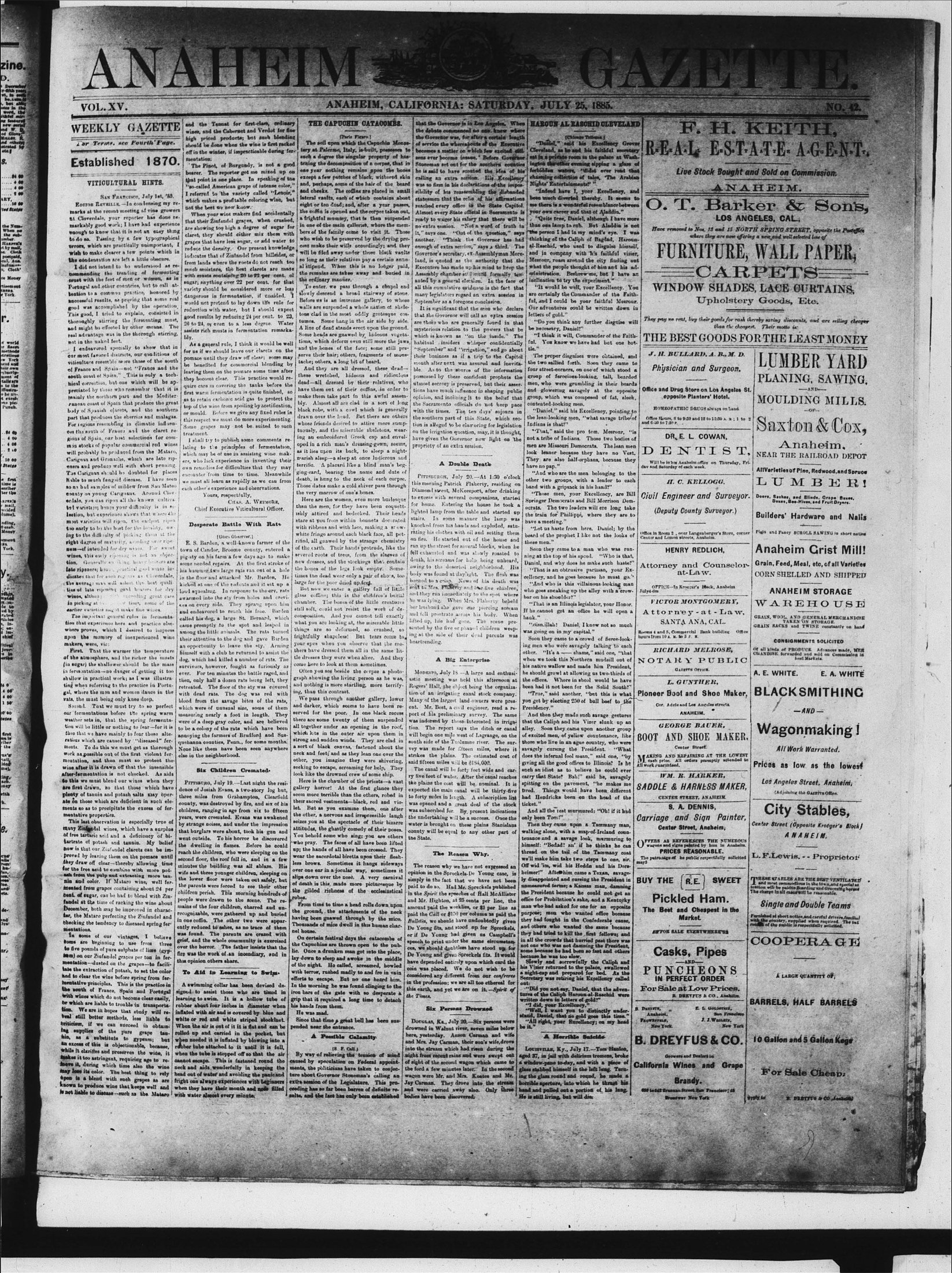
Searchable text
WEEKLY GAZETTE
For Terms, see Fourth'Page.
Established 1870.
VITICULTURAL HINTS.
San Francisco, July 1st, '85.
Editor Reverille.—In condensing my remarks at the recent meeting of vine growers at Cloverdale, your reporter has done remarkably good work; I have had experience enough to know that it is not an easy thing to do so. Passing by a few typographical errors, which are practically unimportant, I wish to make clearer a few points which in this condensation are left a little obscure.
I did not intend to be understood as recommending the treading of fermenting must with the feet of men or women, as in Portugal and other countries, but to call attention to a common practice, honored by successful results, as proving that some real good was accomplished by the operation. This good, I tried to explain, consisted in thoroughly stirring the fermenting must, and might be effected by other means. The real advantage was in the thorough stirring, not in the naked feet.
I endeavored specially to show that in our most favored districts, our conditions of viticulture resemble more those of the south of France and Spain—not "France and the south coast of Spain." This is only a technical correction, but one which will be appreciated by those who remember that it is mainly the northern part and the Mediterranean coast of Spain that produce the great body of Spanish clarets, and the southern part that produces the sherry and malagas. For regions resembling in climatic influences the south of France and the claret regions of Spain, our best selections for common stocks of popular commercial red wines will probably be produced from the Mataro, Carignan and Grenache, which are late ripeners and produce well with short pruning. The Carignan should be doubted for places and the Tannat for first-class, ordinary wines, and the Cabernet and Verdot for fine high priced products; but such blending should be done when the wine is first racked off in the winter, if impracticable during fermentation.
The Pinot, of Burgundy, is not a good boarer. The reporter got me mixed up on that point in one place. In speaking of the "so-called American grape of intense color," I referred to the variety called "Lenoir," which makes a profitable coloring wine, but not the best we now know.
When your wine makers find accidentally that their Zinfandel grapes, when crushed, are showing too high a degree of sugar for claret, they should either mix them with grapes that have less sugar, or add water to reduce the density. Our present knowledge indicates that of Zinfandel from hillsides, or from lands where the roots do not reach too much moisture, the best clarets are made with musts containing 20 to 22 per cent. of sugar; anything over 22 per cent. for that variety should be considered more or less dangerous in fermentation, if unaided. I would not pretend to lay down the rule for reduction with water, but I should expect good results by reducing 24 per cent. to 23, 26 to 24, or even to a less degree. Water assists rich musts in fermentation remarkably.
As a general rule, I think it would be well for us if we should leave our clarets on the pomace until they draw off clear; some may be benefited for commercial blending by leaving them on the pomace some time after they become clear. This practice would require care in covering the tanks before the first warm fermentation is quite finished, so as to retain carbonic acid gas to protect the top of the wine from spoiling by acetylation, or mould. Before we give any fixed rules in this respect we must do more experimenting. Some grapes may not be suited to such treatment.
I shall try to publish some comments relating to the principles of fermentation, which may be of use in assisting wine makers, who lack experience in inventing their own remedies for difficulties that they may encounter from time to time. Meanwhile
THE CAPUCHIN
[Paris]
The soil upon which tery at Palermo, Italy such a degree the singe tening the decomposition one year nothing remit except a few patches o and, perhaps, some of and cheeks. The coiff lateral vanits, each of eight or ten dead; and, the coffin is opened and a frightfulummy, thine in one of the main gall bers of the family com who wish to be preservc make their wills will be filed away unde so long as their relativ al stipend. When thie remains are taken the ordinary manner.
To enter we pass th slowly descend a brook. Before us is an immeen walls are suspended a v tons clad in the most tumes. Some hang in A line of dead stands e Some heads are gnawed tions, which deform evi serve their hair; others tache; others, a long bit.
And they are all d these wretched, hide dead—all dressed by have them out of their make them take part fibly. Almost all are cla black robe, with a cow drawn over the head. whose friends desired to tuiously, and the miser ing an embroidered G opped in a rich man's dress as it lies upon its back marish sleep—a sleep at terrific. A placard like ging-card, bearing th
This is only a technical correction, but one which will be appreciated by those who remember that it is mainly the northern part and the Mediterranean coast of Spain that produce the great body of Spanish clarets, and the southern part that produces the sherries and malagas. For regions resembling in climatic influences the south of France and the claret regions of Spain, our best selections for common stocks of popular commercial red wines will probably be produced from the Mataro, Carignan and Gronache, which are late ripeners and produce well with short pruning. The Carignan should be doubted for places liable to much fungoid disease. I have seen so many bad samples of mildew from San Mateo county on young Carignans. Around Cloverdale, you can ripen all the known cultivar varieties; hence your difficulty is in selection, but experience shows that where the most varieties will ripen, the earliest ripen too early to be the best for the locality, owing to the difficulty of picking them at the right degree of maturity, according over ripeness—if intended for dry wines. For sweet wines, this early ripening is not an objection. Generally speaking, heavy bearers are late ripeners; hence practical good sense indicates that for such rogues as Cloverdale, the average man will salute the beat qualities of late ripening good bearers for dry wines, although exceeding great care in picking at certain time, some of the earlier varieties might make fine wines.
The important general rules in fermentation that experience here and practice elsewhere prove, which I desired to impress upon the memory of inexperienced wine makers, were, viz:
First. That the warmer the temperature of the atmosphere, and the richer the insults (in sugar) the shallower should be the mass in fermentation—no danger of getting it too shallow in practical work; as I was illustrating when referring to the practice in Portugal, where the man and women dance in the vats, the must being only knee deep.
Second. That we must try to so perfect our fermentations before the spring warm weather sets in, that the spring fermentation will be little or nothing to fear—for it is then that we have mainly to fear those alterations which are caused by "diseased" ferments. To do this we must get as thorough work as possible out of the first violent fermentation, and then must so protect the wine after it is drawn off that the insensible after-fermentation is not checked. As aids to this we must blend our wines when they are first drawn, so that those which have plenty of tannin and potash salts may operate on those which are deficient in such elements so as to precipitate the excess of fermentative properties.
This last observation is especially true of many Zincandel wines, which have a surplus of free tartaric acid and a deficiency of bitartrate of potash and tannin. My belief now is that our Zinzandel clarets can be improved by leaving them on the pomace until they draw off clear—thereby allowing time for the free acid to combine with more potash from the pulp and extracting more tannin and color. If Mataro wine, well fermented from grapes containing about 24 per cent. of sugar, can be had to blend with Zincandel, July 19.—Last night the residence of Josiah Evans, a two-story log hut, three miles from Grahampton, Clearfield county, was destroyed by fire, and six of his children, ranging in age from six to fifteen years, were cromated. Evans was awakened by strange noises, and under the impression that burglaries were about, took his gun and went outside. To his horror he discovered the dwelling in flames. Before he could reach the children, who were sleeping on the second floor, the roof fell in, and in a few minutes the building was all ablaze. His wife and three younger children, sleeping on the lower floor were taken out safely, but the parents were forced to see their other children perish. This morning hundreds-of these wretched, hide-dead—all dressed by us have them out of their make them take part fairly. Almost all are clean black robe, with a cow-drawn over the head whose friends desired to tuously, and the miserable an embroidered Goped in a rich man's dress as it lies upon its back marsh sleep—a sleep at terrific. A placard like ging-card, bearing the death, is hung to the rear. Those dates make a cold very marrow of one!
Here are the women, than the men, for they wishily attired and bedstarse at you from within with ribbons and with white fringe around each riffled, all gnawed by the earth. Their hands severed roots of trees, new dresses, and the stools the bones of the logs lie times the dead wear only large for the poor dried up.
But now we enter a glass coffine; this is the chamber. The bones of still soft, could not resist composition. And you what you are looking at, things are so deformed frightfully shapeless! your eyes when you observe thereshaves dressed them,the dresses they wore whomehere to look at them.
Often you see beside them graph showing the livingand nothing is more startling than this contrast.
We pass through amberand darker, which seemserved for the poor. In there are some twenty o'clock together under an opentwhich lets in the outerstrong and sudden winds,a sort of black canvas,n neck and feet; and astheother,you imagine there seeking to escape,screamlook like the drowned creatureis the chamber of gallery horror! At thieseen more terrible than their sacred vestments—butBut as you examinethe other,a nervous andseizes you at the spectacleattitudes,the ghastly coneYou behold some who siwho pray.The faces ofaup;the hands of allhavewearthe sacerdotal birettless brows.Sometimesover one ear in a jocularalips down over the nose.of death is this,made methe gilded richnessofrobes.
ate on those which are deficient in such elements so as to precipitate the excess of fermentative properties.
This last observation is especially true of many Zinfandel wines, which have a surplus of free tartaric acid and a deficiency of bicarrate of potash and tannin. My belief now is that our Zinfandel clarets can be improved by leaving them on the pomace until they draw off clear—thereby allowing time for the free acid to combine with more potash from the pulp and extracting more tannin and color. If Mataro wine, well fermented from grapes containing about 24 per cent. of sugar, can be had to blend with Zinfandel at the time of racking the wine about December, both may be improved in character, the Mataro perfecting the Zinfandel and checking the tendency to diseased spring fermentations.
In some of our vintages, I believe some are beginning to use from three to five pounds of pure sulphate of lime (gypsum) on our Zinfandel grapes per ton in fermentation—dusted on the grapes—to facilitate the extraction of potash, to set the color and to clear the wine before spring from fermentative principles. This is the practice in the south of France, Spain and Portugal with wines which do not become clear easily, or which are liable to trouble in transportation. We are in hopes that study will reveal still better methods, less liable to criticism, if we can succeed in obtaining supplies of the pure grape tannin, as a substitute to gypsum; but an excess of this is objectionable, because, while it clarifies and preserves the wine, it makes it too astringent, requiring age to remove it, during which time also the wine may lose its color. The best thing to rely upon is a blend with such grapes as are known to produce wine that keeps well and is not liable to disease—such as the Mataro county, was destroyed by fire, and six of his children, ranging in age from six to fifteen years, were cremated. Evans was awakened by strange noises, and under the impression that burglars were about, took his gun and went outside. To his horror he discovered the dwelling in flames. Before he could reach the children, who were sleeping on the second floor, the roof fell in, and in a few minutes the building was all ablaze. His wife and three younger children, sleeping on the lower floor were taken out safely, but the parents were forced to see their other children perish. This morning hundreds of people were drawn to the scene. The remains of the four children, charred and unrecognizable, were gathered up and buried in one coffin. The other two were apparently reduced to ashes, as no trace of them was found. The parents are crazed with grief, and the whole community is exercised over the horror. The father insists that the fire was the work of an incendiary, and in this opinion others share.
To Aid in Learning to Swim
A swimming collar has been devised to assist those who are timid in learning to swim. It is a hollow tube of rubber about four inches in diameter when inflated with air and is covered by blue and white or red and white striped stockinet. When the air is out of it it is flat and can be rolled up and carried in the pocket, but when needed it is inflated by blowing into a rubber tube attached to it until it is full, when the tube is stopped off so that the air cannot escape. This is fastened round the neck and aids wonderfully in keeping the head out of water and avoiding the panic and fright one always experiences with Leginners when they have their mouth and nose filled with water almost every minute.
From time to time a bed in the ground, the attachments having been guawed through thousands of mice dwell in nel house.
On certain festival days the Capuchins are thrown lie. Once a drunken man lay down to sleep and awoke of the night. He called, with terror, rushed madly efforts to escape. But none In the morning he was for iron bars of the gate wipe that it required a long his hands from them.
He was mad.
Since that time a great pended near the entrance.
A Possible Case
[S F. CALL]
By way of relieving the caused by speculation on matters, the politicians have ture about Governor Stone extra session of the Legislature coeding has so far been bar sults, and the Iset has only
ANAHEIM, CALIFORNIA: SATURDAY, JULY 25, 1885.
THE CAPUCHIN CATAOMBS.
[Paris Figaro]
The soil upon which the Capuchin Monastery at Palermo, Italy, is built, possesses to such a degree the singular property of hastening the decomposition of a corpse, that in one year nothing remains upon the bones except a few patches of black, withered skin and, perhaps, some of the hair of the beard and cheeks. The coffins are placed in small lateral vanits, each of which contains about eight or ten dead; and, after a year passes, the coffin is opened and the corpse taken out, a frightful mummy, that is then suspended in one of the main galleries, where the members of the family come to visit it. Those who wish to be preserved by the drying process make their wills accordingly; and they will be filed away under those black vanities so long as their relatives pay a certain annual stipend. When this is no longer paid, the remains are taken away and buried in the ordinary manner.
To enter we pass through a chapel and slowly descend a broad stairway of stone. Before us is an immense gallery, to whose walls are suspended a whole nation of skeletons clad in the most oddly grotesque costumes. Some hang in the air side by side. A line of dead stands erect upon the ground. Some heads are gnawed by hideous vegetations, which deform even still more the jaws and the bones of the face; some still preserve their hair; others, fragments of moustache; others, a long bit of beard.
And they are all dressed, these dead—these wretched, hideous and ridiculous dead—all dressed by their relatives, who have them out of their coffins, in order to make them take part in this awful assembly. Almost all are clad in a sort of long black robe, with a cowl which is generally drawn over the head. But there are others whose friends desired to attire more sumptuously, and the miserable skeletons, wearing an embroidered Greek cap and enveloped in a rich man's dressing-gown, seems, as it lies upon its back, to sleep a nightmarish sleep—a sleep at once ludicrous and terrific. A placard like a blind man's begging-card, bearing the name and date of that the Governor is in Los Angeles. When the debate commenced no one knew where the Governor was, for after a certain length of service the whereabouts of the Executive becomes a matter on which few excited affections ever become insane." Before Governor Stoneman set out for the southern counties he is said to have scouted the idea of his calling an extra session. His Excellency was so firm in his declarations of the impossibility of his reassembling the disbanded statesmen that the echo of his affirmations reached every office in the State Capitol. Almost every State official in Sacramento is ready to wager his salary that there will be no extra session. "Not a word of truth in it," says one. "Out of the question," says another. "Think the Governor has had enough of extra session," says a third. The Governor's secretary, ex-Assemblyman Moreland, is quoted as the authority that the Executive has made up his mind to keep the Assembly chamber still unfit formally tented by a general election. In the face of all this cumulative evidence is the fact that many legislators regard an extra session in September as a foregone conclusion.
It is significant that the men who declare that the Governor will call an extra session are those who are generally found in that mysterious relation to the powers that be which is known as "on the inside." The habitual insiders whisper confidentially "September" and "irrigation," and go about their business as if a trip to the Capitol month after next was assured and inevitable. As to the source of the information possessed by these confident prophets the utmost secrecy is preserved, but their assertions have much influence in shaping public opinion, and inclining it to the belief that the Sacramento officials do not keep pace with the times. The ten days' sojourn in the southern part of this State, which section is alleged to be claustoring for legislation on the irrigation question, may, it is thought, have given the Governor new light on the propriety of an extra session.
A Double Death
HAROUN AL RASCHID CLEVELAND
[Chicago Tribune]
"Daniel," said his Excellency Grover Cleveland, as he and his faithful secretary sat in a private room in the palace at Washington the other evening sipping a glass of forbidden waters, "didst ever read that charming collection of tales, The Arabian Nights' Entertainment?"
"Indeed have I, your Excellency, and been much diverted thereby. It seems to me there is a wonderful resemblance between your own career and that of Aladdin."
"Quite true, Daniel, although I have more than one lamp to rub. But Aladdin is not the person I had in my mind's eye. I was thinking of the Caliph of Bagdad, Haroun-al-Raschid, who used to disguise himself, and in company with his faithful visier, Mesour, roam around the city finding out what the people thought of him and his administration. Beshew-me, but I have an inclination to try the experiment."
"It would be well, your Excellency. You are certainly the Commander of the Faithful, and I could be your faithful Mesour. Our adventures could be written down in letters of gold."
"Do you think any further disguise will be necessary, Daniel?"
"I think it will, Commander of the Faithful. You know we have had but one bottle."
"The proper disguises were obtained, and the two sallied forth. Soon they came to four street-corners, on one of which stood a group of ferocious-looking, tall, bearded men, who were grumbling in their beards and glowering savagely at the opposite group, which was composed of fat, sleek, contented-looking men."
"Daniel," said his Excellency, pointing to the lean-looking men, "what savage tribe of Indians is that?"
"That," said the pro tem. Mesour, "is not a tribe of Indians. Those two bodies of men are Missouri Democrats. The lean men look leaner because they have no Vest. They are also half-orphans, because they have no pap."
"And who are the men belonging to the
these wretched, hideous and ridiculous dead—all dressed by their relatives, who have them out of their coffins, in order to make them take part in this awful assembly. Almost all are clad in a sort of long black robe, with a cowl which is generally drawn over the head. But there are others whose friends desired to attire more sumptuously, and the miserable skeletons, wearing an embroidered Greek cap and enveloped in a rich man's dressing-gown, seems, as it lies upon its back, to sleep a night-marish sleep—a sleep at once ludicrous and terrific. A placard like a blind man's begging-card, bearing the name and date of death, is hung to the neck of each corpse. Those dates make a cold shiver pass through the very marrow of one's bones.
Here are the women, even more builtesque than the men, for they have been coquettishly attired and bedecked. Their heads stare at you from within bonnets decorated with ribbons and with lace, making a snow-white fringe around each black face, all petrified, all gnawed by the strange chemistry of the earth. Their hands protrude, like the severed roots of trees, from the slaves of new dresses, and the stockings that contain the bones of the legs look empty. Sometimes the dead wear only a pair of shoes, too large for the poor dried up feet.
But now we enter a gallery full of little glass coffin; this is the children's burial chamber. The bones of the little creatures still soft, could not resist the work of decomposition. And you cannot tell exactly what you are looking at, the miserable little things are so deformed, so crushed, so frightfully shapeless! But tears come to your eyes when you observe that the mothers have dressed them all in the same little dresses they wore when alive. And they come here to look at them sometimes.
Often you see beside the corpse a photograph showing the living person as he was, and nothing is more startling, more terrifying, than this contrast.
We pass through another gallery, lower and darker, which seems to have been reserved for the poor. In one black rocess there are some twenty of them suspended all together under an opening in the roof, which lots in the outer air upon them in strong and sudden winds. They are clad in a sort of black canvas, fastened about the neck and feet; and as they lean one over the other, you imagine they were shivering, seeking to escape, screaming for help. They look like the drowned crew of some ship.
Here is the chamber of the priests—a vast gallery horror! At the first glance they seem more terrible than the others, robed in their sacred vestments—black, red and violet. But as you examine them, one after the other, a nervous and irrepressible laugh seizes you at the spectacle of their bizarre attitudes, the ghastly comedy of their poses. You behold some who sing; you see others who pray. The faces of all have been lifted up; the hands of all have been crossed. They wear the sacerdotal birretta upon their fleshless brows. Sometimes it hangs sideways over one ear in a jocular way, sometimes it slips down over the nose. A very carnival of death is this, made more picturesque by the gilded richness of the ecclesiastical robes.
The reason why we have not expressed an opinion in the Spreckels-De Young case, is simply in the fact that we have not been paid to do so. Had Mr. Spreckels published in the Spirit the speeches of Hall McAllister and Mr. Horton may be equal to any other part of the State.
A Double Death
PITTSBURGH, July 20.—At 1:30 o'clock this morning Patrick Flaherty, residing on Diamond street, McKeesport, after drinking to excess with several companions, started for home. Entering the house he took a lighted lamp from the table and started up stairs. In some manner the lamp was knocked from his hands and exploded, saturing his clothes with oil and setting them on fire. He started out of the house and ran up the street for several blocks, when he fell exhausted and was slowly roasted to death, his screams for help being unheard, owing to the deserted neighborhood. His body was found at daylight. The flesh was burned to a crisp. News of his death was sent to Mrs. Flaherty and her five children, and they ran immediately to the spot where he was lying. When Mrs. Flaherty beheld her husband she gave one piercing scream and fell prostrate across his body. When lifted up, life had gone. The scene presented by the five orphaned children weeping at the side of their dead parents was heartrending.
A Big Enterprise
MONSTER, July 18 — A large and enthusiastic meeting was held this afternoon at Rogers' Hall, the object being the organization of an irrigating canal stock company. Many of the largest land owners were present. Mr. Bost, a civil engineer, read a report of his preliminary survey. The same was indored by those interested in irrigation. The report says the ditch or canal will begin one mile west of Lagrange, on the south side of the Toulumne river. The survey was made for fifteen miles, where it strikes the plains. The estimated cost of said fifteen miles will be $184,000.
The canal will be forty feet wide and carry five feet of water. After the canal reaches the plains the cost will be nominal. It is expected the main canal will be thirty-five to forty miles in length. A subscription list was opened and a great deal of the stock was subscribed for. By present indications the undertaking will be a success. Once the water is brought on these plains Stanislaws county will be equal to any other part of the State.
The Reason Why.
The reason why we have not expressed an opinion in the Spreckels-De Young case, is simply in the fact that we have not been paid to do so. Had Mr. Spreckels published in the Spirit the speeches of Hall McAllister and Mr. Horton may be equal to any other part of the State.
A group of ferocious-looking, tall, bearded men, who were grumbling in their beards and glowering savagely at the opposite group, which was composed of fat, sleek, contented-looking men.
"Daniel," said his Excellency, pointing to the lean-looking men, "what savage tribe of Indians is that?"
"That," said the pro tem. Mesrour, "is not a tribe of Indians. Those two bodies of men are Missouri Democrats. The lean men look leaner because they have no Vest. They are also half-orphans, because they have no pap."
"And who are the men belonging to the other two groups, with a leader to each band with a gripsack in his hand?"
"Those men, your Excellency, are Bill Springer Democrats and Bill Morrison Democrats. The two leaders will ere long take the train for Phillippi, where they are to have a meeting."
"Let us haste from here. Daniel; by the beard of the prophet I like not the looks of these men."
Soon they came to a man who was running at the top of his speed." "Who is that, Daniel, and why does he make such haste?" "That is an obtrusive partisan, your Excellency, and he goes because he must go." "And who is this villainous looking man who goes sneaking up the alley with a crow-bar on his shoulder."
"That is an Illinois legislator, your Honor. If he cannot get an office he will open a bank."
"Sissillillah! Daniel; I knew not so much was going on in my capital."
Soon they came to a crowd of fierce-looking men who were savagely talking to each other." "It's a—— shame," said one, "that when we took this Northern midsull out of his native wallow and made him President, he should growl at allowing us two-thirds of the offices. Where in shoot would he have been had it not been for the Solid South?" "True," said another, "but this is what you get by electing 250 of bull beef to the Presidency."
And then they made such savage gestures that the Caliph and his Vizer slunk up an alley. Soon they came upon another group of excited men, of yellow countenance, like those who live in an ague country, who were savagely cursing the President." "What does the internal fool mean," said one, "by giving all the good offices to Illinois? Is he such an idiot as to believe he could ever carry that State? Bah!" said he, savagely spitting on the pavement," he makes me tred. Things would have been different had Hendricks been on the head of the ticket."
And all the rest murmured: "Oh! if it had only been Tom!"
Then they came upon a Tammyman man, walking alone, with a map-of-Ireland countenance and a savage look, murmuring to himself: "Bedad! an' if he thinks he can thread on the tail of the Tammyman coat we'll make him take two steps to one, sir. Off wid 'im, wid his Heddn and his Dorsheimer!" After him came a Texan, savagely disappointed and cursing the President in unmeasured terms; a Kansas man, damning the President because he could not get an office for Prohibition's sake and a Kentucky
their sacred vestments—black, red and violet. But as you examine them, one after the other, a nervous and irrepressible laugh seizes you at the spectacle of their bizarre attitudes, the ghastly comedy of their poses. You behold some who sing; you see others who pray. The faces of all have been lifted up; the hands of all have been crossed. They wear the sacerdotal biretta upon their fleshless brows. Sometimes it hung sideways over one ear in a jocular way, sometimes it slips down over the nose. A very carnival of death is this, made more picturesque by the gilded richness of the ecclesiastical robes.
From time to time a head rolls down upon the ground, the attachments of the neck having been guawed through by the mice, Thousands of mice dwell in this human channel house.
On certain festival days the catacombs of the Capuchins are thrown open to the public. Once a drunken man got into the place, lay down to sleep and awoke in the middle of the night. He called, screamed, howled with terror, rushed madly to and fro in vain efforts to escape. But no one heard him.
In the morning he was found clinging to the iron bars of the gate with so desperate a grip that it required a long time to detach his hands from them.
He was mad.
Since that time a great bell has been suspended near the entrance.
A Possible Calamity
(S. F. Call.)
By way of relieving the tension of mind caused by speculation on Federal appointments, the politicians have taken to conjecture about Governor Stoneman's calling an extra session of the Legialature. This proceeding has so far been barren of definite results, and the last has only been established
The reason why we have not expressed an opinion in the Spreckels-De Young case, is simply in the fact that we have not been paid to do so. Had Mr. Spreckels published in the Spirit the speeches of Hall McAllister and Mr. Highton, at 25 cents per line, the amount paid the weeklies, or $1 per line as paid the Call or $150 per column as paid the Bulletin, we should have undoubtedly given De Young fits, and stood up for Spreckels, or if De Young had given us Campbell's speech to print under the same circumstances, we should doubtless have stood up for De Young and given Spreckels fits. It would have depended entirely upon which card the coin was placed. We do not wish to be considered any different from our confreres in the profession; we are all too ethereal for this earth, and yet we are on it. —Spirit of the Times.
Six Persons Drowned
Douglas, Ka., July 20.—Six persons were drowned in Walnut river, seven miles below here, yesterday. Anson Carman and wife and Mrs. Jay Carman, their son's wife, drove into the stream which had risen during the sight from recent rains and were swept out of sight of the second wagon which came to the Ford a few minutes later. In the second wagon were Mr. and Mrs. Koates and Mr. Jay Carman. They drove into the stream and were carried away also. Only three bodies have been discovered.
A Horrible Suicide
Louisville, Ky., July 17.—Tom Hanlon, aged 37, in jail with delirium tremens, broke a window-pane to-day, and with a piece of glass stabbed himself in the left lung. Turning the glass round and round, he made a horrible aperture, into which he thrust his hand and pulled out a portion of his lung. He is still living, but will die.
GAZETTE.
NO. 42.
F. H. KEITH,
REAL ESTATE AGENT.
Live Stock Bought and Sold on Commission.
ANAHEIM.
O. T. Barker & Sons,
LOS ANGELES, CAL.
Have removed to No. 15 and 15 NORTH SPEING STREET, opposite the Post offices where they are now offering a new and well selected line of
FURNITURE, WALL PAPER,
CARPETS
WINDOW SHADES, LACE CURTAINS,
Upholstery Goods, Etc.
They pay no rent, buy their goods for cash thereby saving discounts, and are selling cheaper than the cheapest. Their motto is:
THE BEST GOODS FOR THE LEAST MONEY
J. H. BULLARD, A. B., M. D.
Physician and Surgeon.
Office and Drug Store on Los Angeles St.
opposite Planters' Hotel.
HOMEOPATHIC DRUGS always on hand.
Office Hours: 8 to 9:30 and 12 to 12:30 A.M.; 1 to 2 and 6:30 to 7:30 P.
DR. E. L. COWAN,
DENTIST,
Will be in his Anaheim office on Thursday, Friday and Saturday of each week.
LUMBER YARD
PLANING, SAWING,
AND
MOULDING MILLS.
OF
Saxton & Cox,
Anaheim.
NEAR THE RAILROAD DEPOT
All Varieties of Pine, Redwood, and Spruce
Office and Drug Store on Los Angeles St. opposite Planters' Hotel.
HOMEOPATHIC DRUGS always on hand.
Office Hours: 8 to 9:20 and 12 to 12:30 A.M.; 1 to 2 and 6-30 to 7:30 P.
DR. E. L. COWAN,
DENTIST,
Will be in his Anaheim office on Thursday, Friday and Saturday of each week.
H. C. KELLOGG.
Civil Engineer and Surveyor.
(Deputy County Surveyor.)
Office in Room 2, over Langenberger's Store, corner Center and Lemon streets, Anaheim.
HENRY REDLICH,
Attorney and Counselor-at-Law.
OFFICE—In Kroezer's Block, Anaheim July4-6m
VICTOR MONTGOMERY,
Attorney-at-Law,
SANTA ANA, CAL.
Rooms 4 and 5, Commercial Bank building. Office hours from 10 A.M. to 3 P.M.
RICHARD MELROSE,
NOTARY PUBLIC
GAZETTE OFFICE.
L. GUNTHER,
Ploneer Boot and Shoe Maker,
Cor. Adele and Los Angeles streets, Anaheim.
GEORGE BAUER,
BOOT AND SHOE MAKER,
Center Street.
MAKING AND REPAIRING AT THE LOWEST cash price. All orders promptly attended to. All work guaranteed.
WM. R. HARKER,
SADDLE & HARNESS MAKER,
CENTER STREET, Anaheim.
S. A. DENNIS,
Carriage and Sign Painter,
Center Street, Anaheim;
OFFER AS REFERENCES THE NUMEROUS wagons and signs painted by him in Anaheim.
PRICES REASONABLE.
The patronage of the public respectfully solicited may3
PLANING, SAWING,
AND MOULDING MILLS.
OF
Saxton & Cox, Anaheim.
NEAR THE RAILROAD DEPOT
All Varieties of Pine, Redwood, and Spruce LUMBER!
Doors, Sashes, and Blinds, Grape Boxes, Boxes, Bee-Hives, and Fruit Dryers.
Builders' Hardware and Nails
Plain and Fancy SCROLL SAWING in short notice
Anaheim Grist Mill!
Grain, Feed, Meal, etc., of all Varieties CORN SHELLED AND SHIPPED
ANAHEIM STORAGE
WAREHOUSE
GRAIN, WOOL, AND GENERAL MERCHANDISE TAKEN ON STORAGE.
GRAIN SACKS and TWINE constantly on hand
CONSIGNMENTS SOLICITED
Of all kinds of PRODUCE Advances made, MER CHANDISE forwarded and sold on Commission in host Markets.
A. E. WHITE. E. A. WHITE
BLACKSMITHING
AND
Wagonmaking!
All Work Warranted.
Prices as low as the lowest
Los Angeles Street, Anaheim;
(Adjoining the Gazette Office.
City Stables,
Center Street (Opposite Kroeger's Block)
ANAHEIM.
L.F.Lewis.- Proprietor
BUY THE R.E. SWEET Pickled Ham
S. A. DENNIS,
Carriage and Sign Painter,
Center Street, Anaheim,
OFFERS AS REFERENCES THE NUMEROUS
wagons and signs painted by him in Anaheim.
PRICES REASONABLE.
The patronage of the public respectfully solicited
BUY THE R.E. SWEET
Pickled Ham.
The Best and Cheapest in the Market.
FOR SALE EVERYWHERE
Casks, Pipes
AND
PUNCHEONS
IN PERFECT ORDER
For Sale at Low Prices.
B. DREYFUS & CO., Anaheim.
B. DREYFUS,
Anaheim,
Frownsville,
New York.
E. L. GOLDSTEIN,
San Francisco
J. J. WESTLY,
New York
B. DREYFUS & CO.
Growers and Dealers in
California Wines and Grape
Brandy.
620 to 843 Brannan Street, San Francisco; 45
Broadway New York
City Stables,
Center Street (Opposite Kroëger's Block)
ANAHEIM.
L. F. Lewis, -- Proprietor
THESE STABLES ARE THE BEST VENTILATED
and most commodious in the town, and special at
tention will be paid to boarding and grooving borges
The charge in all cases will be reasonable.
Single and Double Teams
Furnished at short notice, and careful drivers, familial
with the country, supplied when required. The nat
room of the public is respectfully solicited.
COOPERAGE
A LARGE QUANTITY OF:
BARRELS, HALF BARRELS
10 Gallon and 5 Gallon Kege
For Sale Cheap:
Apply to B. DREYFUS & CO., Anaheim