anaheim-gazette 1885-06-20
Scanned page
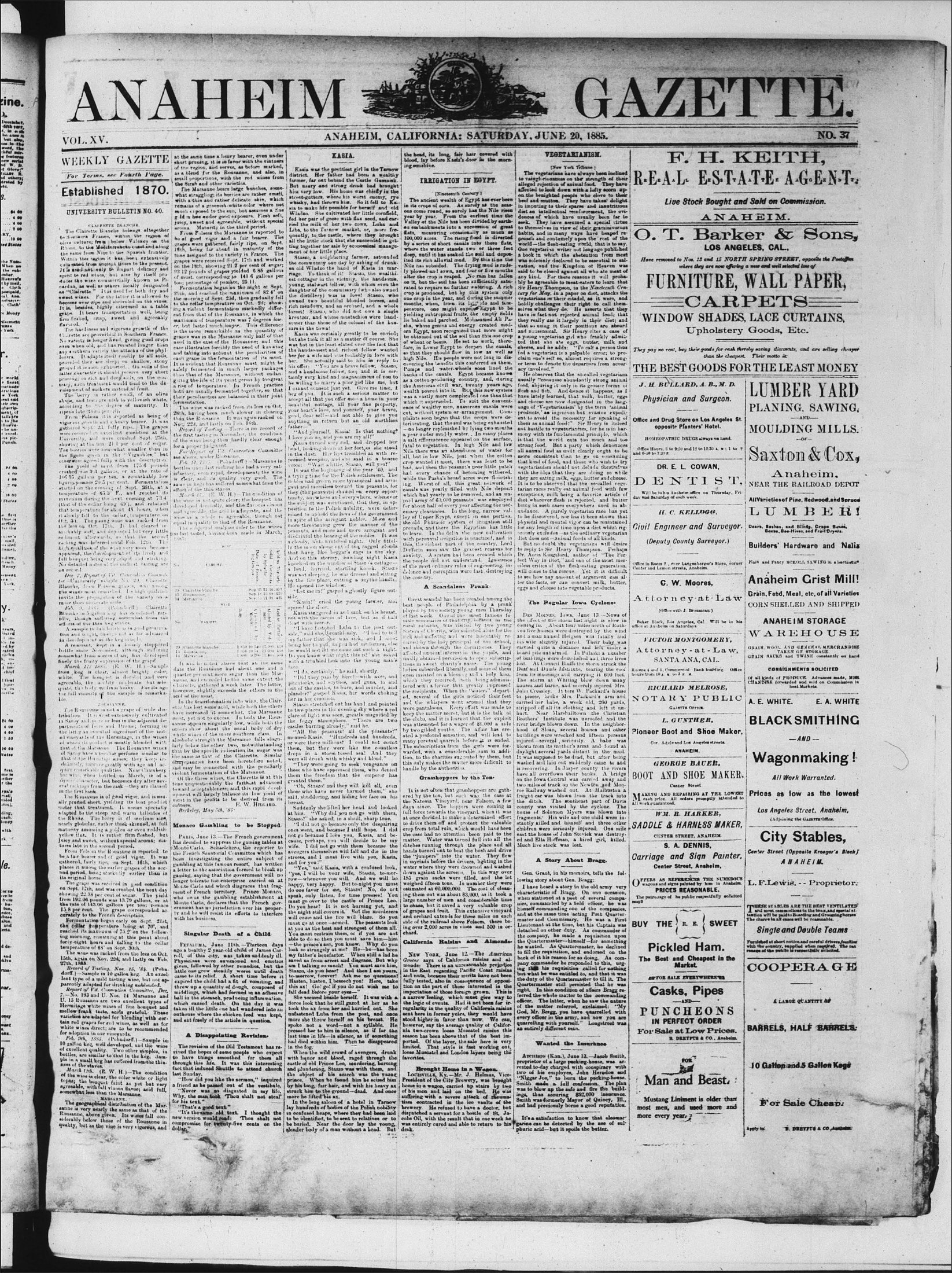
Searchable text
WEEKLY GAZETTE
For Terms, see Fourth Page.
Established 1870.
UNIVERSITY BULLETIN NO. 40.
CLAIRTTE BLANCHE.
The Clairtte Blanche belongs altogether to Southern France, within the region of olive culture; from below Valence on the Rhone, to the Mediterranean coast and along the same from Nice to the Spanish frontier. Within this region it has been extensively cultivated from ancient times to the present. It is used not only to impart delicacy and spirit to red wines, but also by itself produces the wine commercially known as Picardan, as well as others locally designated as "Clairette." It is used for both dry and sweet wines. For the latter it is allowed to become overripe and shriveled on the vines. It is, besides, highly esteemed as a table grape. It bears transportation well, being firm fleshed, crisp, sweet and agreeably flavored.
The hardiness and vigorous growth of the Clairtte are proverbial in Southern France. No variety is longer lived, giving good crops even when old, and has resisted longer than any southern variety of the phylloxera. It adapts itself readily to all soils, provided they are deep; on shallow, stony ground it is soon exhausted. On soils of the latter character it should receive very short pruning; on rich and deep soils, on the contrary, such treatment would tend to the development of suckers instead of fruit.
The berry is rather small, of an olive shape, and from greenish to yellowish white, according to the degree of maturity. It ripens late (three perpil).
From Polson it is reported as being of vigorous growth and a heavy bearer. It was gathered Sept. 23, fully ripe. The grapes were received in excellent condition at the University, and were crushed Sept. 25th, showing at the time 21 l per cent of sugar. The berries were some what smaller than in the figure given in the "Vignobles," but otherwise agreed fully with the description.
The yield of must from 175.6 pounds crushed was 9.3 gallons, or at the rate at the same time a heavy bearer, even under short pruning, it is in favor with the vintners of the region, and serves, as before marked, as a blend for the Rousanne, and also, in small proportions, with the red wines from the Sirah and other varieties.
The Marsanne bears large bunches, somewhat straggling; its berries are rather email, with a thin and rather delicate skin, which remains of a greenish-white color where not much exposed to the sun, but assumes a fine gold in hue under good exposure. Flesh soft, juicy, sweet and agreeable, without special aroma. Maturity in the third period.
From Polsom the Marsanne is reported to be of good vigor and a fair bearer. The grapes were gathered fairly ripe, on Sept. 16th, being far ahead in maturity of the time assigned to the variety in France. The grapes were received Sept. 17th and worked on the 18th, showing 21.2 per cent of sugar; 93.12 pounds of grapes yielded 6.85 gallons of must, corresponding to 141.6 gallons per ton; percentage of pomace, 25.11.
Pergementation began on the night at Sept. 20th, and reached the maximum of 82.4° on the morning of Sept. 23rd, then gradually fell to the collar temperature on Oct. 2d; showing a violent fermentation markedly different from that of the Rousanne, in which the maximum of temperature was 7 degrees lower, but lasted much longer. This difference is the more remarkable as the quantity of grapes was in the Marsanne only half of that used in the case of the Rousanne; and this case illustrates forcibly the need of knowing and taking into account the peculiarities of each grape in the fermentation of its must. It is evident that Rousanne must might be safely fermented in much larger packages than that of the Marsanne, without endangering the life of its yeast germs by too great a rise of temperature. In French practice both are usually fermented together, so that their peculiarities are balanced in their joint fermentation.
The wine was racked from its lees on Oct. 28th, having been much slower in clearing than the Rousanne. It was again racked on Nov. 22nd, and lastly on Feb. 18th.
Record of Testing - There is no record of the first tasting in November, the condition of the wine being then hardly clear enough for a proper judgment.
For Report of Vt Convention Committee see above, under Rousanne.
Feb. 11, 1835 (Poindorff) - Marsanne in bottles since last rushing has had a very satisfactory, even rapid development; the wine
KASIA.
Kasia was the prettiest district. Her father had farmed far out behind her. But naury and strong dress vary low. His home street-gatters, where his whisky, had thrown him aside to make life possible for Whalzo. She cultivated her pair of goose with friesied the milk of her two Labo, to the Farnow market quantely, to the castle, where all the little stock that sheeting together tor sale by ecoment of her little place.
Staszo, a neighboring faction in community one day by en old Wladzo the hand riage. To think of it! Staszt cottager in the vicinity young, stalwart fellow, with daughter of the commissioner the distillery) was in low owned two beautiful blooms rich meadows, and an orchid forest! Staszo, who did not kneutzer, and whose muster somen than those of the colars sinks in the town!
Kasia was certainly great but she took it all as a matter was hot in the least elated in the handsomest and richesest her for a wife and was toollier. She actually said to his offer: "You are a brave and a handsome fellow, too tainly very kind and magnifiche willing to marry a poor I cannot consent just yet. beg of you. It is such a sae accept all that you offer me beautiful cottage, all your your heart's love, and your good dear self—and not any thing in return but a father."
"And yourself, Kasia!"
I love you so, and you are my Kasia turned very red, a head looking down at her in the dust. Her lips trembled pressed weeping, and she voiced: "Wait a little Staszo."
It was the beginning of
The berry is rather small, of an olive shape, and fruit greens to yellowish white, according to the degree of maturity. It ripens late (perpelt).
From Polson it is reported as being of vigorous growth and a heavy bearer. It was gathered Sept. 23, fully ripe. The grapes were received in excellent condition at the University, and were crushed Sept. 25th, showing at the turn 21.1 per cent of sugar. The berries were some what smaller than in the figure given in the "Vignobles," but otherwise agreed fully with the description.
The yield of must from 175.6 pounds crushed was 9.3 gallons, or at the rate of 106.05 gallons per ton, a remarkably low figures poised 20.5 per cent. Fermentation started on the evening of Sept. 25th, at a temperature of 65.3 F., and reached its maximum during the next evening at 73.4 (that of the collar bearing 63%), and retained that temperature for about 48 hours, when it slowly fell to the collar, temperature on Oct. 17th. The young wine was racked from the less on Oct. 17th. It had cleared remarkably well, and deposited but very little sediment afterwards, so that the second racking was deferred until Feb. 12th. The high qualities of the wine very soon became apparent, the development of its lively and full bouquet being very rapid and stinking. No detailed notes of the earliest tasting are on record.
Dee R. Report of Vt Convention Committee - University sample No. 29. Clairette Blanche, from Poison grape, was among the wines most reminiscent. Its high qualities invite the propagation of the variety on a more than moderate scale.
Feb. 9, 1885. (Poison lot). Clairette Blanche in 5 gallon keg has been opened rapidly, though suffering somewhat from the allusion of the thin bag graves.
A sample in full bottle is in good preservation and brightness not as far advanced in development as the keg sample.
A restraint kept in a loosely stopped bottle since November, although still somewhat from access of air, has developed finely the fruity expression of the grape.
March 17, 1885. (E.W.H.) Sample from keg is clear, almost bright, color white. The bouquet is decided and very agreeable, the acidity moderate but adequate, the body medium heavy. For its age the full viscosity of the sample is remarkable.
The Rousanne is not a grape of wide distribution. It is most extensively cultivated in Sawyer and more or less in the adjacent departments of Ireland and Ireland; forming in the latter an essential ingredient of the notional vineyards of the Hermitage, in the wines of which its product is mostly blended with that of the Marsanne. The Rousanne wines of Sawyer have a peculiar perfume similar to that of Hermitage wines; they keep indelibly intense greatly with age and acquire remarkable qualities. Near Chambery the wine, when bottled in March, is of a fierce character, but becomes dry after several rackings from the cask—they are classed in the first rank.
The Rousanne is of good vigor, and is usually pruned short, yielding its best product under that treatment. It seems specially adapted to the steep and warm hillsides of the Rhone. The berry is of medium size, nearly globular, rather thick skinned, at full maturity assuming a golden or even reddish-yellow tint. It is rather firm fleshed, but juicy and sweet, without special aroma; matures late in the second period.
From Pollson the Rousanne is reported to be a fair bearer and of good vigor. It was gathered, fairly ripe, on Sept. 16th, which places it among the earlier grapes of the second period, being marketly earlier than in its original home.
The grape was received in good condition on Sept. 17th, and was crushed the next day showing 22.58 per cent of sugar. The yield late (perpelt).
From Polson it is reported as being of vigorous growth and a heavy bearer. It was gathered Sept. 23, fully ripe. The grapes were received in excellent condition at the University, and were crushed Sept. 25th, showing at the turn 21.1 per cent of sugar. The berries were some what smaller than in the figure given in the "Vignobles," but otherwise agreed fully with the description.
The yield of must from 175.6 pounds crushed was 9.3 gallons, or at the rate of 106.05 gallons per ton, a remarkably low figures poised 20.5 per cent. Fermentation started on the evening of Sept. 25th, at a temperature of 65.3 F., and reached its maximum during the next evening at 73.4 (that of the collar bearing 63%), and retained that temperature for about 48 hours, when it shortly fell to the collar, temperature on Oct. 17th. The young wine was racked from the less on Oct. 17th. It had cleared remarkably well, and deposited but very little sediment afterwards, so that the second racking was deferred until Feb. 12th. The high qualities of the wine very soon become apparent, the development of its lively and full bouquet being very rapid and stinking. No detailed notes of the earliest tasting are on record.
Dee R. Report of Vt Convention Committee - University sample No. 29. Clairette Blanche from Poison grape, was among the wines most reminiscent. Its high qualities invites the propagation of the variety on a more than moderate scale.
Feb. 9, 1885. (Polson lot). Clairette Blanche in 5 gallon keg has been opened rapidly, though suffering somewhat from the allusion of the thin bag graves.
A restraint kept in a loosely stopped bottle since November, although still suffering somewhat from access of air, has developed finely the fruity expression of the grape.
March 17, 1885. (E.W.H.) Sample from keg is clear, almost bright, color white. The bouquet is decided and very agreeable, the acidity moderate but adequate, the body medium heavy. For its age the full viscosity of the sample is remarkable.
The Rousanne wines of Sawyer have a peculiar perfume similar to that of Hermitage wines; they keep indelibly intense with age and acquire remarkable qualities. Near Chambery the wine, when bottled in March, is of a fierce character, but becomes dry after several rackings from the cask—they are classed in the first rank.
The Rousanne is of good vigor, and is usually pruned short, yielding its best product under that treatment. It seems specially adapted to the steep and warm hillsides of the Rhone. The berry is of medium size, nearly globular, rather thick skinned, at full maturity assuming a golden or even reddish-yellow tint. It is rather firm fleshed, but juicy and sweet, without special aroma; matures late in the second period.
From Pollson the Rousanne is reported to be a fair bearer and of good vigor. It was gathered, fairly ripe, on Sept. 16th, which places it among the earlier grapes of the second period, being marketly earlier than in its original home.
The grape was received in good condition on Sept. 17th, and was crushed the next day showing 22.58 per cent of sugar. The yield late (perpelt).
From Pollson it is reported as being of vigorous growth and a heavy bearer. It was gathered Sept. 23, fully ripe. The grapes were received in excellent condition at the University, and were crushed Sept. 25th, showing at the turn 21.1 per cent of sugar. Fermentation started on the evening of Sept. 25th, at a temperature of 65.3 F., and reached its maximum during the next evening at 73.4 (that of the collar bearing 63%), and retained that temperature for about 48 hours, when it shortly fell to the collar, temperature on Oct. 17th. The young wine was racked from the less on Oct. 17th. It had cleared remarkably well, and deposited but very little sediment afterwards, so that the second racking was deferred until Feb. 12th. The high qualities of the wine very soon become apparent, the development of its lively and full bouquet being very rapid and stinking. No detailed notes of the earliest tasting are on record.
Dee R. Report of Vt Convention Committee - University sample No. 29. Clairette Blanche from Poison grape, was among the wines most reminiscent.
It will be noted above that at each date the Rousanne had about one and a quarter per cent more sugar than the Marsanne, and exceeded to the same extent the Clairette, gathered a week later. The latter however slightly exceeds others in aid of the must.
In the transformation into wine, the Clairette has lost some acid, while both the others have increased it somewhat, the Marsanne most yet not to excess. In bodythe Rousanne appears singularly low, while both the others show about the usual body of dry white wines of the more southern class.In alcohol strengththe Marsanne falls singularly below the other two,不withstanding that by his pungent indication its sugar was the same as that of the Clairette.Similar direpancies have been heretofore noted,and may be connected with the peculiarly violent fermentation of the Marsanne.
Of three wines,the Clairette is at this time unquestionably the fattest advanced toward acceptableness; and this rapid development will largely balance its low yield of must in its profits to be derived from its culture.E.W.H.Hilgard.Berkley.May 5th.,85
Monaco Gambling to be Stopped
Paris.June 13.-The French government has decided to suppress the gaming tables at Monte Carlo.Schaelehro,the reporter tothe French Sanatorial Committee which has been investigatingthe entire subjectof gamblingatthis famous resort,has writtena lettertothe association formed to breakupgaming,sayingthatthegovernmentwillno longer toleratethe enterprise carriedonatMonteCarloandwhichdisgracesthatfragmentofFrenchterritory.PrinceMonaco,yowaitthegamblingestablishmentat
Iris,jaidyoudon'tStazze?"she asked.in a shrift"I did not go becauseonlyones went,andbecauseIatnotgobecauseIloveyou,cause,perehaps.youwillbewife.Idnotgowiththeavengers themselveswillfailstreets,andImustlivewinter."
Suddenly she lifted her handathim."Why did you notStazze?"she asked.in a shrift"I did not go becauseonlyones went,andbecauseIatnotgobecauseIloveyou,cause,perehaps.youwillbewife.Idnotgowiththeavengers themselveswillfailstreets,andImustlivewinter."
Yes,"saidKasia.with"yes,iWillbeyourwife.row—wheneveryouwill.happy,veryhappy.Buttoattheavengers themselveswillfallstreets,andImustlivewinter."
Monaco Gambling to be Stopped.
Paris, June 13.—The French government has decided to suppress the gaming tables at Monte Carlo. Schaelchero, the reporter to the French Sanatorial Committee which has been investigating the entire subject of gambling at this famous resort, has written a letter to the association formed to break up gaming, saying that the government will no longer tolerate the enterprise carried on at Monte Carlo and which disgraces that fragment of French territory. Prince Monaco, who owns the gambling establishment at Monte Carlo, declares that the French government has no jurisdiction over his property and he will resist its efforts to interfere with his business.
Singular Death of a Child
Petaluma, June 11th.—Thirteen days ago a healthy 2-year-old child of James Carroll, of this city, was taken suddenly ill. Physicians were summoned and emetics given, followed by other remedies, but the little one grew steadily worse until death came to its relief. A short time before it expired the child had a fit of vomiting, and threw up a quantity of dough, composed of middlings, which had formed in an adhesive ball in the stomach, producing inflammation, which caused death. On the day it was taken ill the little one had wandered into an outhouse where the chicken feed was kept, and sat freely of the article in question.
A Disappointing Revision
The revision of the Old Testament has revived the hopes of some people who expect to have things smoothed for them all through this life. It was this interesting fact that induced Shuttle to attend church last Sunday.
"How did you like the sermon," inquired a friend as he passed out of the vestibule.
"Never was so disgusted in my life. Why, the man took 'Thou shalt not steal' for his text."
"That's a good text."
It's the same old text. I thought the new version would read: "Thou shalt not compromise for twenty-five cents on the dollar."
ANAHEIM, CALIFORNIA: SATURDAY, JUNE 20, 1885.
KASIA.
Kasia was the prettiest girl in the Tarnow district. Her father had been a wealthy farmer, far out behind the Castle Gunnisk. But naury and strong drink had brought him very low. His home was chiefly in the street-gatters, where his worst enemy, rys whiskey, had thrown him. So it fell to Kasia to make life possible for herself and old Wladzo. She cultivated her little cornfield, fed her pair of gose with flax seed, and carried the milk of her two cows, Luba and Laba, to the Tarnow market, or, more frequently, to the castle, where they brought all the little stock that she succeeded in getting together for sale by economical management of her little place.
Staszo, a neighboring farmer, astounded the community one day by asking of drunken old Wladzo the hand of Kasia in marriage. To think of it! Staszo, the wealthiest cottager in the vicinity, the handsome, young, stalwart fellow, with whom even the daughter of the commissary (who also owned the distillery) was in love! Staszo, who owned two beautiful blooded horses, and rich meadows, and an orchard, and a whole forest! Staszo, who did not owe a single kreutzer, and whose mustachios were hand-somer than those of the colouel of the husars in the town!
Kasia was certainly greatly to be envied; but she took it all as a matter of course. She was not in the least elated over the fact that the handsomest and richest fellow wanted her for a wife and was foolishly in love with her. She actually said to him in reply to his offer: "You are a brave fellow, Staszo, and a handsome fellow; too, it is certainly very kind and magnanimous of you to be willing to marry a poor girl like me, but I cannot consent just yet. Give me time, I beg of you. It is such a serious matter to accept all that you offer me—a home in your beautiful cottage, all your fine property, your heart's love, and yourself, your brave, good, dear self—and not able to give you anything in return but an old worthless father."
"And yourself, Kasia!" Is that nothing? I love you so, and you are my all!"
Kasia turned very red, and dropped her head, looking down at her feet as she stood in the dust. Her lips trembled as with repressed weeping, and she said in a hoarse voice: "Wait a little, Kasiao, will you?"
It was the beginning of the year 40, and the head, its long, fair hair covered with blood, lay before Kasia's door in the morning sunshine.
IRRIGATION IN EGYPT.
[Nineteenth Century]
The ancient wealth of Egypt has ever been in its crops of corn. As surely as the seasons come round, so surely has the Nile risen year by year. From the earliest time the Valley of the Nile has been divided by earth-en embankments into a succession of great flats, measuring occasionally as much as 100,000 acres. The rising flood is diverted by a series of short canals into these flatts, where the water stands two or three feet deep, until it has soaked the soil and deposited its rich alluvial mud. By this time the Nile has subsided. The drying mud is rudely plowed and sown, and four or five months after the crop is reaped. No rain has fallen on it, but the soil has been sufficiently saturated to require no further watering. A rich crop is produced, but by this system only one crop in the year, and during the summer months, when from its latitude and temperature, one might expect Egypt to be yielding subtropical fruits; the empty fields lie baked and parched. Mohammed Ali Pasha, whose genius and energy created modern Egypt, soon recognized that more might be obtained out of the soil than this one crop of wheat or beans. He set to work therefore, in Lower Egypt to deepen the canals, so that they should flow in low as well as high Nile. His people were not long in discovering the benefits this conferred on them. Pumps and water-wheels soon lined the banks of the canals. Egypt became known as a cotton-producing country, and, during the American civil war, twenty years ago, wealth poured into it. But this new system was a vastly more complicated one than that which it superseded. To suit the convenience of wealthy men, numerous canals were cut without system or arrangement. Complaints soon began that the crops were deteriorating, that the soil being exhausted—no longer replenished by lying two months a year under muddy water. In many places a salt efflorescence appeared on the surface, fatal to vegetation. In high Nile and low Nile there was an abundance of water for all, but in low Nile, just when the cotton crop wanted it most, there was least to be had, and then the peasant's poor little patch had every chance of becoming withered.
VEGETARIANISM.
[New York Tribune]
The vegetarians have always been inclined to vaingloriousness on the strength of their alleged rejection of animal food. They have affected to look down with a lofty scorn upon the benighted people who clove to their beef and mutton. They have taken delight in imputing to their sparse and unnutritious diet an intellectual reinforcement, the evidences of which have usually been far to seek. They have assumed a special virtue to themselves in view of their graminivorous habits, and in many ways have beaped reproach and contumely upon the rest of the world—the flesh-eating world, that is to say. One vegetarian writer not long ago published a book in which he abstention from meat was soleniously declared to be essential to salvation, and the Kingdom of Heaven was said to be closed against all who ate meat of any kind. For these reasons it will probably be agreeable to meat-eaters to learn that Sir Henry Thompson, in the Nineteenth Century for May, in a paper on diet attacks the vegetarians in their citadel, as it were, and boldly challenges their right to call themselves what they do. He asserts that they have in fact not rejected animal food; that they really use it largely in their diet; and that so using it their positions are absurd and nonsensical. Sir Henry cites a case of a young vegetarian girl who frankly admitted that she ate eggs, butter, milk and cheese, and he adds: "To call a person thus fed a vegetarian is a palpable error; to proclaim one's self so, almost requires a stronger term to denote the departure from accuracy involved."
He observes that the so-called vegetarians usually "consume abundantly strong animal food, abjuring it only in its grosser forms of flesh and fish." And hence it happens, as I have lately learned, that milk, butter, eggs and cheese are now designated in the language of 'Vegetarianism' by the term 'animal products,' an ingenious but evasive expedient to avoid the necessity for speaking of them as animal food!" Sir Henry is indeed not hostile to vegetarianism; for he is in harmony with its fundamental principle, which is that the world cats too much and too strong food. But a party which denounces all animal food as unit clearly ought to be more consistent than to go on consuming that kind of food, and those who wish to try vegetarianism should not deduce themselves with the idea that they are doing so while
tainly very kind and magnanimous of you to be willing to marry a poor girl like me, but I cannot consent just yet. Give me time, I beg of you. It is such a serious matter to accept all that you offer me—a home in your beautiful cottage, all your fine property, your heart's love, and yourself, your brave, good, dear self—and not able to give you anything in return but an old worthless father.
"And yourself, Kasia! Is that nothing? I love you so, and you are my all!"
Kasia turned very red, and dropped her head, looking down at her feet as she stood in the dust. Her hips were withdrawn, and she said in a boareve voice: "Wait a little, Staszo, will you?"
It was the beginning of the year 40, and a trying time for the Polish settlement. The nobles had grown more tyrannical and arrogant and merciless toward the peasants, for they (the peasants) showed on every opportunity, anywhere and everywhere, whenever the subject was mentioned, that they in opposition to the Polish nobility, were determined to uphold the laws of the government in spite of the arrogant nobles. More and more threatening grew the manner of the peasants, and more and more arrogant and disdainful the hearing of the nobles. It was a cloudy, wet, wretched night. Only it fully the moon shone out of the ragged clouds that hung like leggar's rags in the sky. And on this stormy, howling night Kasa knocked on the window of Staszo's cottage—a lord, harried, startling knock. Staszo was not sleeping; he was dressed and sitting by the fire place, cutting a scythe-handle. He opened the window.
"Let me in!" gaped a ghostly figure outside.
Kasia! cried the young farmer, and opened the door.
Kasia staggered in and sank on his breast, not with the caress of love, but as if half dead with terror.
"I have fastened Luba to the post outside," she said, breathlessly. "I had to tell my father that she was sick, and I must bring her to you as you had medicines, else he would not let me come out such a night. Do you know what night this is?" she asked with a trembled look into the young man's face.
"I do, certainly," he said, shortly.
"Did they pay by here? with axes, and pitotorks, and sayties, and guns, in and out of the castles, to burn, and murder, and plunder?" gasped Kasia, her words choking her in her emotion.
Staszo stretched out his hand and pointed to two places in the evening sky where a red glaze of light was seen, greatly magnified by the foggy atmosphere.
"There are two casies burning already," said he.
"All the peasants! all the peasants!" meaned Kasia. "Hundreds and hundreds, or were there millions? I could not count them, but they were like the countless drops in a storm tossed seal. And they were all drunk with whiskey and blood."
"They were going to seek vengeance on those who have oppressed them, who denied them the freedom that the emperor has granted them."
"Oh, Staszo! and they will kill all, even those who have never harmed them," she sait, shuddering, and hiding her face on his breast.
Suddenly she lifted her head and looked at him. "Why did you not go with them, Staszo?" she asked in a shrill, sharp tone.
"I did not go because only the despairing ones went, and because I still hope. I did not go because I love you, Kasia, and because perhaps, you will decide to be my wife. I did not go with them because the avengers themselves will fall and die in the streets, and I must live with you, Kasia, and for you!"
"Yes," said Kasia, with a confused look, "yes, I will be your wife, Staszo, to-morrow—whenever you will. And we will be happy, very happy. But to-night you must do one favor for me, Staszo! No, do not speak, only listen; for time presses! You meet me very kindly and magnanimous of you to be willing to marry a poor girl like me, but I cannot consent just yet. Give me time, I beg of you. It is such a serious matter to accept all that you offer me—a home in your beautiful cottage, all your fine property, your heart's love, and yourself, your brave, good, dear self—and not able to give you anything in return but an old worthless father—"
"And yourself, Kasia! Is that nothing? I love you so, and you are my all!"
Kasia turned very red, and dropped her head, looking down at her feet as she stood in the dust. Her hips were withdrawn, and she said in a boareve voice: "Wait a little, Staszo, will you?"
It was the beginning of the year 40, and a trying time for the Polish settlement. The nobles had grown more tyrannical and arrogant and merciless toward the peasants, for they (the peasants) showed on every opportunity any where and everywhere whenever the subject was mentioned, that they in opposition to the Polish nobility were determined to uphold the laws of the government in spite of the arrogant nobles. More and more threatening grew the manner of the peasants, and more and more arrogant and disdainful the hearing of the nobles. It was a cloudy, wet, wretched night. Only it fully the moon shone out of the ragged clouds that hung like leggar's rags in the sky. And on this stormy, howling night Kasa knocked on the window of Staszo's cottage—a lord, harried, startling knock. Staszo was not sleeping; he was dressed and sitting by the fire place, cutting a scythe-handle. He opened the window.
"Let me in!" gaped a ghostly figure out side.
"Kasia! cried the young farmer, and opened the door."
Kasia staggered in and sank on his breast, not with the caress of love, but as if half dead with terror.
"I have fastened Luba to the post outside," she said, breathlessly. "I had to tell my father that she was sick, and I must bring her to you as you had medicines, also he would not let me come out such a night. Do you know what night this is?" she asked with a trembled look into the young man's face.
"I do, certainly," he said shortly.
"Did they pay by here? with axes, and pitotorks, and sayties, and guns, in and out of the castles, to burn, and murder, and plunder?" gasped Kasia, her words choking her in her emotion.
Staszo stretched out his hand and pointed to two places in the evening sky where a red glaze of light was seen, greatly magnified by the foggy atmosphere.
"The are two casies burning already," said he.
"All the peasants! all the peasants!" meaned Kasia. "Hundreds and hundreds or were there millions? I could not count them,但they were like the countless drops in a storm tossed seal.And they were all drunk with whiskey and blood."
"They were going to seek vengeance on those who have never harmed them," she sait,suddenly she lifted her head and looked at him. "Why did you not go with them,Staszo?" she asked in a shrill,sharp tone.
"I did not go because only the despairing ones went,and because I still hope.I did not go because I love you,Kasia,and because perhaps,you will decide to be my wife.I did not go with them because the avengers themselves will fall和die in the streets,and I must live with你,Kasia,and for you!"
"Yes," said Kasia,with a confused look,"yes,我will beyour wife,Staszo,to-morrow—wheneveryouwill.Andwewillbehappy,veryhappy.Buttonytoumhordeandfewerimportantforme,Staszo!No,donotspeakonlylisten,forsimepress!Youmeetmeverykindlyandmagnanimousofyoutobemainfoomatthecounselingsbya cotton-producingcountry,and,duringtheAmerican civil war,twenty years ago,andwealthpouredintoit.Inmanyplacesa saltefforescenceappearedonthesurface,fatalto vegetation.InhighNileandlowNiletherewasanabundanceofwaterforallbutinlowNilejustwhenthecottoncropwanteditmost,thewastletobehad,andthenthepeasantpoorlittlechampheldh Everychampbeloweverychampbeloweverychampbeloweverychampbeloweverychampbeloweverychampbeloweverychampbeloweverychampbeloweverychampbeloweverychampbeloweverychampbeloweverychampbeloweverychampbeloweverychampbeloweverychampbeloweverychampbeloweverychampbeloweverychampbeloweverychampbeloweverychampbeloweverychampbeloweverychampbeloweverychampbeloweverychampbeloweverychampbeloweverychampbelownexthermpowerinthegreatnessoftheequipmentinitsweetcharity'sname.Theyoungladiessubscribedliberally,andsomeofthemeveninsistedonablessingandaholykisswhichreceived,bothbeingadministeredwithaforverthats greatlyimpressedtherecipients.Whenthe"sisters"departedseveralofthegirlsnoticed theirfeetandwhisperswentaroundthattheywerepantaloons.Everyeffortwasmadetokeepthemattersecret,bothitalkoftheclubs,anditlearnedthattheexploitwasattemptedforwagerof$1,$000aasidebytwogildyouths.Theaffairhascreatedaprofoundsensation,andwillleadtomanypersonalquarresbeforeitisendled.Thesubscriptionsfromthegirlswereforewardedwithconsiderablesuminaddition.tothecharitiesuggestedbythem,但thisonlymakesthemmoredifficulttohandlebytheauthorities.
GrasshoppersbytheTon-
It is not often that grasshoppers are gathered by the tonn,但suchwasthecaseattheNatomaVineyard,nearFolsom,a fewdayssince.Thehopperswerecominginfullforcetowardsthevineyard.当itwasatoncedecidedtomakeademinedeforto drivetheffemoffootandprotectthe valuable cropfromtotalruin whichwouldhavebeenthecasehadnoattentionbeenpaidtothematter.Waterwasturnedfullintoallthedithesrunningthroughtheplaceandallhandturnedouttobeatbushanddrivethejumpers"intothewater They fleuwitnessbeforethedriverslightinginhaterwheretheyweredrownedand washeddownagainstthescreensinThiswayover185grainsackswerefilled,andthelotweighed fifteentons.Innumbertheywereestimatedat$3,,000,ait tookacharacteristicofBragg.Ononeoccasionwhenstationedatasteofseveralcompanies
He observes thattheso-calledvegetariansusuallyconsume abundantlystronganimalfood,jabirringitonlyinitsgrosseriesformsfishandfish.Andhenceit happens,asihewatelastlearnedthatthesecalledvegetarianrace really eat animal foodwith few exceptions,milk beinga favoritearticleofdidwhereshiefreshisrejected,andbutbeinginsuchcaseseverywhereusedinabundance.A purelyvegetarianracehasyettobediscovered,norhasitbe shownthatphysicalandmental vigorcanbe maintainedforanylengthoftimeupona dietwhichrigorouslyexcludes-astheordinaryvegetariandietdoesnot—amainfoodsofall kinds.
But no doubtthevegetarianswilldesiretolilyhestormlastnightis slowincomingin…About four miles north ofRuthven five housesweredestroyedbythewindanda mannamedHeigsonwatrallyandhiswife slightly injured.Theirbabywascarriedquitea distanceandleftunderaboardpileunarmed.InPalaiskai numberofbuildingsweredemandedandthreelives lostAtConnetBuffsthestormstrucktheDeafandDambInstitute,tearingfrostfromitsmooringsandcarryingit600ft.ShestormatWhitingblewdownmanyhousesandbarns,andseveralinjuredMrsJohnCrossley.IstoreW.Packard'shousetopieces,brokeMrs.Packard'sarmandcarriedherbabe,aweekold200 yards strippedoffallitsclothingandleftitunhurt.NearMarshalltowntheChristianBrothers'InstitutewasunroofedandtheriverbridgeblowndownIn.theneighborhoodOfSloan severalhousesandotherbuildingswerewreckedandfifteenpersonsinjuriedseveralserious.Ababewasblownfromitsmother'sarmsandfoundatdaylightseveralyardsdistinctinthe mud.Daylightseveralyardsdistinctinthe mud.Etwassupposedtobedead,但afterbeing washedandlainout suddenly came toandis recovering.InJasper countytherivershavealloverfloodtwenthebanks.AbridgeontheIowaCentralwascarriedawayandtwomilesoftrackonTheNewtonandMonroeRailway washed out.At Halburtonafreightcarwornblowfromthetrackintoetheditch.ThesoutheastpartofDavid县wasvisitedbythecyclone.ThehouseofSolomonMyerswasblownintofragments.HiswifeandonechildinstantiatedkillinghimselfandthreeotherchildrenwerespeciallyinjuredOne mile eastcasthehouseofJohnSteickwasdestroyedandEllaHoffman,a hired girl,killed.Muchlivestockwas lost.
A Story About Bragg.
Gen.Grant,在hismemoirs tellsthefollowing story aboutGen.Bragg:
I have heard a story in the old army very characteristic of Bragg.On one occasion when stationed at a post of several compasses
Suddenly she lifted her head and looked at him. "Why did you not go with them, Staszo?" she asked, in a shrill, sharp tone.
"I did not go because only the despairing ones went, and because I still hope. I did not go because I love you, Kasia, and because perhaps you will decide to be my wife. I did not go with them because the avengers themselves will fall and die in the streets, and I must live with you, Kasia, and for you."
"Yes," said Kasia, with a confused look, "yes, I will be your wife, Staszo, to-morrow—whenever you will. And we will be happy, very happy. But to-night you must do one favor for me, Staszo! No, do not speak, only listen, for time presses! You must go over to the castle of Prince Leo. Do you hear? It is not burning yet, and the night still covers it. But the murderers will come and the fire will blaze. So you must go at once—armed. The peasants look at you as the best and strongest of them all. You must restrain them, or if you are not able to do so then you must save him—him—the prince's son, you know. Why do you look so strangely at me? He—he—has been my father's benefactor. When still a lad he saved us from arrest and disgrace. But why am I talking so much? You must save him, Staszo, do you hear? And then I am yours, to-morrow, forever! Ask me no questions! Hasten, hasten, I beseech you! Here, take this ax! Go! go! if you do not wish me to fall dead before your eyes—"
She seemed beside herself. It was with a fierce look that she still gazed at her as he took the ax from her and hurried out. She unfastened Luba from the post, and once more she threw herself on his breast. He spoke not a word—not a syllable. He pressed her to him in silence, as if for the last time in life—in silence, as if something had died within him. Then he disappeared in the fog.
When the wild crowd of avengers drunk with liquor and blood, raged through the castle of old Prince Leo, nourishing and plundering, Staszo was with them, and the object of his search was the young prince. When he found him he seized him by his long, fair hair, and with his heavy ax struck him to the ground—dead. And once more he lifted his ax.
In the long saloon of a hotel in Tarnow lay hundreds of bodies of the Polish nobility in confused heaps, where they had been laid to be identified, to be sent to relatives or to be buried. Near the door lay the young slender body of a man without a head. But the Natoma Vineyard, near Folsom, a few days since. The hoppers were coming in full force towards the vineyard, when it was at once decided to make a determined effort to drive them off and protect the valuable crop from total rain, which would have been the case had no attention been paid to the matter. Water was turned full into all the ditches running through the place and all hands turned out to beat the bush and drive the "jumpers" into the water. They flew in myriads before the drivers, lighting in the water where they were drowned and washed down against the screens. In this way over 185 grain sacks were filled, and the lot weighed fifteen tons. In number they were estimated at 60,000,000. The cost of cleaning them out was about $3,000, as it took a large number of men and considerable time to chase, but it saved a very valuable crop of grapes and fruit. This extensive vineyard and orchard extends for three miles on each side of the railroad above Folsom, there being over 2,000 acres in vines and 500 in orchard.
California Raisins and Almonds
New York, June 12. The American Grocer says of California raisins and almonds: There is an unreasonable prejudice in the East regarding Pacific Coast raisins and nuts, because their merits have not been fully tested, also in consequence of opposition on the part of those interested in the importation of those foreign grown. This is a narrow feeling, which must give way to the logic of events. Had it not been for irregularity in the quality of California raisins sent here in former years, they would have stood higher in favor than now. We can, however, say the average quality of California two-crown loose Muscatel raisins this season has been above that of the best imported. Of the layer, the sale here is very limited. That style is fast working out, loose Muscatel and London layers being the favorite.
Brought Home in a Wagon.
Louisville, Ky.—Mr. J. Helmus, Vice-President of the City Brewery, was brought home in a wagon, carried up stairs by two of his men and laid on the bed. He was suffering with a severe attack of rheumatism contracted in the ice vaults of the brewery. He refused to have a doctor, but dispatched a servant for a bottle of St. Jacobs Oil, with the result that in one week he was entirely cured and able to return to his desk.
The southeast part of Davis county was visited by the cyclone. The house of Solomon Myers was blown into fragments. His wife and one child were instantly killed and himself and three other children were seriously injured. One mile east the house of John Stevick was destroyed and Ella Hoffman, a hired girl, killed. Much live stock was lost.
A Story About Bragg.
Gen. Grant, in his memoirs tells the following story about Gen. Bragg:
I have heard a story in the old army very characteristic of Bragg. On one occasion when stationed at a post of several companies commanded by a field officer, he was himself commanding one of the companies, and at the same time acting Post Quartermaster and Commissary. He was a First Lieutenant at the time, but his Captain was detached on other duty. As commander of the company, he made a requisition upon the Quartermaster—himself—for something he wanted. As Quartormaster, he declined to fill the requisition, and endorsed on the back of it his reason for so doing. As company commander he responded to this, urging that his requisition called for nothing but what he was entitled to, and that it was fully due to the Quartermaster to till it. The Quartermaster still persisted that he was right. In this condition affairs Bragg referred the whole matter to the commanding officer. The latter, when he saw the nature of the matter referred, exclaimed: "My God, Mr. Bragg you have quarrellled with every officer in the army, and now you are quarrelling with yourself." Longstreet was an entirely different man.
Wanted the Insurance
Archison (Kan.), June 13. Jacob Smith, proprietor of a large packing-house, was arrested to-day charged with conspiracy with two of his employees, John Herndon and "Niggar Joe," to burn the packing-house. Smith made a fall confession. The plan was to blow up the safe and fire the buildings; thus securing $52,000 insurance. Smith was formerly Mayor of Quincy, Ill., and had previously borne a good reputation.
It's a satisfaction to know that oleomargarine can be detected by the use of sulphuric acid—but it spoils the butter.
GAZETTE.
NO. 37
F. H. KEITH,
REAL ESTATE AGENT:
Live Stock Bought and Sold on Commission.
ANAHEIM.
O. T. Barker & Sons,
LOS ANGELES, CAL.
Have removed to Nos. 15 and 15 NORTH SPRING STREET, opposite the Post office where they are now offering a new and well selected line of
FURNITURE, WALL PAPER,
CARPETS
WINDOW SHADES, LACE CURTAINS,
Upholstery Goods, Etc.
They pay no rent, buy their goods for cash thereby saving discounts, and are selling cheaper than the cheapest. Their motto is:
THE BEST GOODS FOR THE LEAST MONEY
J. H. BULLARD, A. B., M. D.
Physician and Surgeon.
Office and Drug Store on Los Angeles St.
opposite Planters' Hotel.
HOMEOPATHIC DRUGS always on hand.
Office Hours: 8 to 9:20 and 12 to 12:30 A.M.; 1 to 2 and 6:30 to 7:30 P.
LUMBER YARD
PLANING, SAWING,
AND
MOULDING MILLS.
Saxton & Cox,
Anaheim
J. H. BULLARD, A. B., M. D.
Physician and Surgeon.
Office and Drug Store on Los Angeles St.
opposite Pfanters' Hotel.
HOMEOPATHIC DRUGS always on hand.
Office Hours: 8 to 9:30 and 12 to 12:30 A.M.; 1 to 2 and 6:30 to 7:30 P.
DR. E. L. COWAN,
DENTIST.
Will be in his Anaheim office on Thursday, Friday and Saturday of each week.
H. C. KELLOGG.
Civil Engineer and Surveyor.
(Deputy County Surveyor.)
Office in Room 2, over Langenberger's Store, corner Center and Lemon streets, Anaheim.
C. W. Moores,
Attorney-at-Law
(Office with J. Broussacau).
Baker Block, Los Angeles, Cal. Will be in his office at Anaheim on Saturdays.
VICTOR MONTGOMERY,
Attorney-at-Law,
SANTA ANA, CAL.
Rooms 4 and 5, Commercial Bank building. Office hours from 10 A.M. to 5 P.M.
RICHARD MELROSE,
NOTARY PUBLIC
GAZETTE OFFICE.
L. GUNTHER,
Pioneer Boot and Shoe Maker,
Cor. Adcle and Los Angeles streets.
ANAHEIM.
GEORGE BAUER,
BOOT AND SHOE MAKER.
Center Street
MAKING AND REPAIRING AT THE LOWEST cash price. All orders promptly attended to. All work guaranteed.
WM. R. HARKER,
SADDLE & HARNESS MAKER,
CENTER STREET, ANAHEIM.
S. A. DENNIS,
Carriage and Sign Painter,
Center Street, Anaheim,
OFFERS AS REFERENCES THE NUMEROUS wagons and signs painted by him in Anaheim.
PRICES REASONABLE.
The patronage of the public respectfully solicited
LUMBER YARD
PLANING, SAWING,
AND
MOULDING MILLS.
Of
Saxton & Cox,
Anaheim.
NEAR THE RAILROAD DEPOT
All Varieties of Pine, Redwood, and Spruce
LUMBER!
Deers, Bees, and Blinds; Grape Bunches;
Bexes, Bee-Hives, and Fruit Dryers.
Builders' Hardware and Nailz
Plain and Fancy SCROLL SAWING in a bertnotice*
Anaheim Crist Mill!
Grain, Feed, Meal, etc., of all Varieties
CORN SHELLED AND SHIPPED
ANAHEIM STORAGE
WAREHOUSE
GRAIN, WOOL, AND GENERAL MERCHANDISE TAKEN ON STORAGE.
GRAIN SACKS and TWINE constantly on hand
CONSIGNMENTS SOLICITED
Of all kinds of PRODUCE. Advances made, MMR CHANDISE forwarded and sold on Commission in best Markets.
A. E. WHITE. E. A. WHITE
BLACKSMITHING
AND
Wagonmaking!
All Work Warranted.
Prices as low as the lowest
Los Angeles Street, Anaheim.
(Adjoining the Gazette Office).
City Stables,
Center Street (Opposite Kroeger's Block)
ANAHEIM.
L.F.Lewis.- Proprietor.
WM. R. HARKER,
SADDLE & HARNESS MAKER,
CENTER STREET, ANAHEIM.
S. A. DENNIS,
Carriage and Sign Painter,
Center Street, Anaheim,
OFFERS AS REFERENCES THE NUMEROUS
wagons and signs painted by him in Anaheim.
PRICES REASONABLE.
The patronage of the public respectfully solicited may be
BUY THE R. E. SWEET
Pickled Ham.
The Best and Cheapest in the Market.
FOR SALE EVERYWHERE
Casks, Pipes
AND
PUNCHEONS
IN PERFECT ORDER
For Sale at Low Prices.
B. DREYFUS & CO., Anaheim.
FOR
Man and Beast:
Mustang Liniment is older than most men, and used more and more every year.
Los Angeles Street, Anaheim.
(Adjoining the Gazette Office)
City Stables,
Center Street (Opposite Kroeger's Block)
ANAHEIM.
L. F. Lewis, -- Proprietor:
THESE STABLES ARE THE BEST VENTILATED
and most commodious in the team, and special attention will be paid to Boarding and Grooming horses.
The charve in all cases will be reasonable.
Single and Double Teams
Furnished at short notice, and careful drivers, familiar with the country, supplied when required. The rentage of the public is respectfully solicited.
COOPERAGE
A LARGE QUANTITY OF
BARRELS, HALF BARRELS:
10 Gallon and 5 Gallon Kegs
For Sale Cheap:
Apply to: B. DREYFUS & CO., Anaheim.