anaheim-gazette 1885-06-06
Scanned page
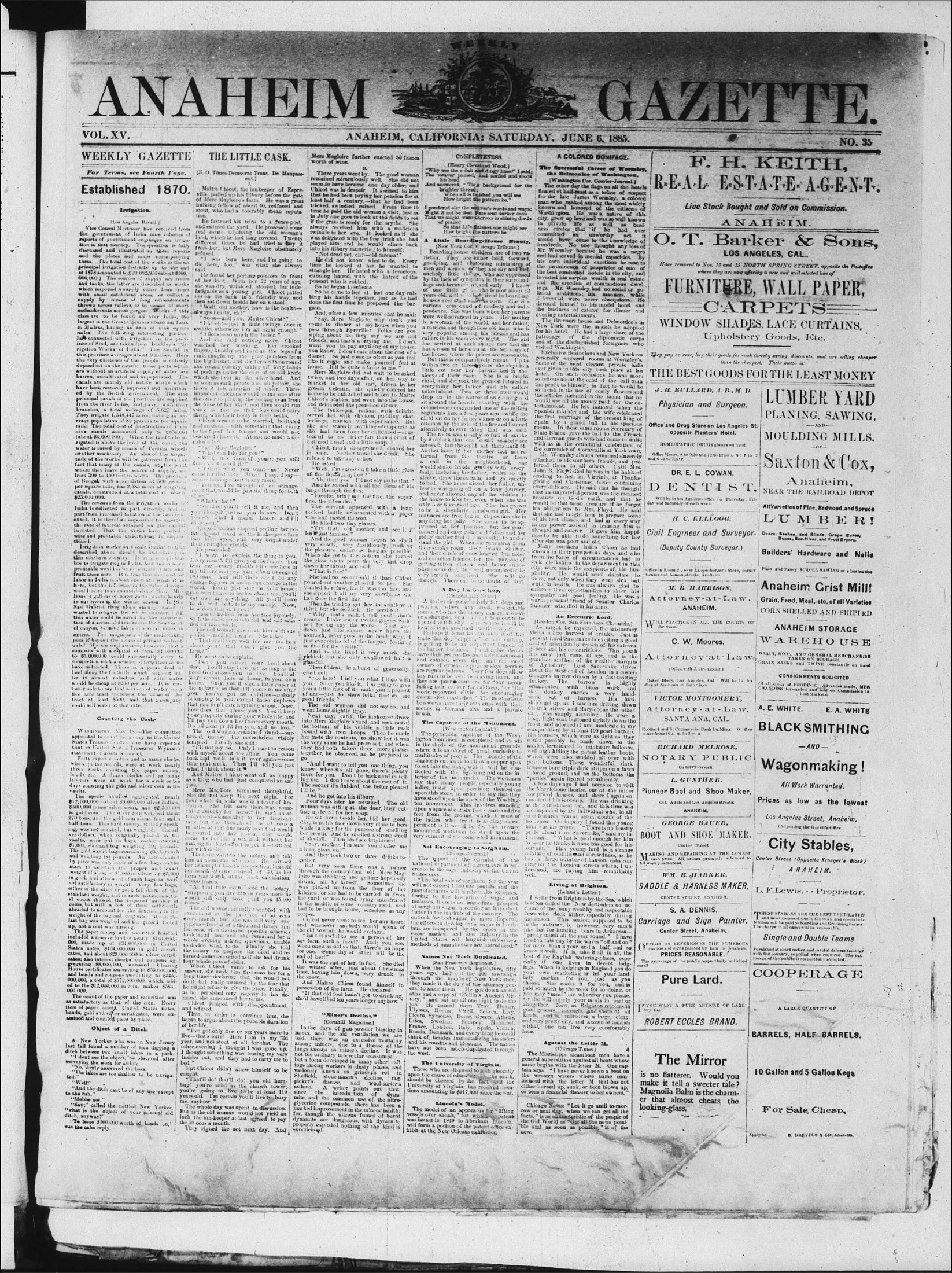
Searchable text
WEEKLY GAZETTE
Por Terms, see Fourth Page.
Established 1870.
Irrigation.
[Los Angeles Herald]
Vice Consul Mortimer has received from the government of India nine volumes of reports of government engineers on irrigation in that country. The question is fully discussed and illustrated in these reports and the plates and maps accompanying them. The total cost of the works in the six principal irrigation districts up to the end of 1874 amounted to £29,082,955 (about $100,000,000). The sources of supply are rivers and tanks, the latter are described as works which impound a supply either from rivers with small catchment areas, or collect a supply by means of long embankments thrown across valleys, or by means of short embankments across gorges. Works of this class are to be found all over India, the largest is the Great Umbriambankum Tank in Madras, having an area of nine square miles. The following interesting partitions connected with irrigation in the province of Sind, are taken from Dackley's "Irrigation Works of India." The rainfall in this province averages about 9 inches. Here the very existence of the people is entirely dependent on the canals; those parts which are without an artificial supply of water are barren, un cultivated and unpopulated. The canals are mainly old native works which have been restored, improved and maintained by the British government. The nine principal canals of the province are supplied from the river Indus, and have, with their branches, a total mileage of 5,627 miles. They irrigate 1,548,447 acres, having an average population of 89 persons to the square mile. The total cost of construction of these nine canals amounted only to £834,004 (about $4,600,000). When the land to be irrigated is above the level of the canal, the water is raised by means of Persian wheels or other machinery. An idea of the magnitude of the works will be gathered from the fact that many of the canals, at the point where they leave the source of supply, are from 1874.
THE LITTLE CASK.
[N. O. Times-Democrat Trans. De Maupassant.]
Maltre Chicot, the lancekeeper of Espreville, pulled up his tibury before the gate of Mere Magloire's farm. He was a great bulking fellow of about 40, red-faced and stout, who had a tolerably mean reputation.
He fastened his reins to a fence post, and entered the yard. He possessed some real estate adjoining the old woman's land, which he had long coveted. Twenty different times he had tried to buy it from her; but Mere Magloire obstinately refused.
"I was born here; and I'm going to die here, too," was what she always said.
He found her peeling potatoes in front of her door. With her 72 years of age, she was dry, wrinkled, stooped, but indefatigable as a young girl. Chicot patted her on the back in a friendly way, and then sat down beside her on a stool.
"Well, old mother, how is the health—always hearty, eh?"
"So so—and you, Maitre Chicot?"
"Eh! ch!—just a little twinge once in awhile, otherwise I'm all right enough."
"Allons!"—so much the better."
And she said nothing more. Chicot watched her working. Her crooked fingers, knobby and hard as the legs of a crab, caught up the gray potatoes from the big basket, and she turned them round and round quickly, taking off long bands of peelings under the edge of an old knife which she held in the other hand. And as soon as each potato was all yellow, she threw it into a bucket of water. Three impudent chickens would come one after the other to pick up the peeling even from the folios of her skirt, and then would run away as fast as their legs could carry them, with their boots in their beaks.
Chicot seemed to be worried, hesitated and anxious—with something that clung to the tip of his tongue and would not venture to leave it. At last he made a decided effort.
"ay! Mere Magloire."
"What can I do for you?"
"Weil, this farm of yours; you still don't want to sell it?"
"If that's what you want—not! Never come for that here."
Three years were remained miraculous seem to have become Chicot was in desir that he had been placed half a centre tricked, swindled, time he paid the oak in July one goes to if the grass is really received by twinkle in her eye was delighted with played him; and into his tiltary maid.
"Not dead yet."
He did not know time he looked at strangle her. He cunning hatred, wicked hatred who is rotten.
So he began to bing his hands to done the first time gain.
And, after a few "ay! Mere Magloire come to dinner pass through Eprisiping about us; friends, and that's what you want you to pay you know: I don't dunner. So just coo like it; come and home. It'll be quieter.
Mere Magloire twice, and two days market in her own groom Celestin; horse to be unhitch Chicot's stables; and demanded there.
The innkeeper served her with terrlings; mutton she ate scarcely she had been foamed to no rich buttered bread and Chicot much did in vain. Neither refused to take any he asked.
"Well I'm sure of fine lion."
Counting the Cash
Washington, May 18.—The committee appointed to count the money in the United States Treasury offices here have reported that ex United States Treasurer Wynan's statement of assets is correct.
Forty expert counts, and as many clerks, who kept the records, were at work nearly three weeks counting the paper money, books, etc. A dozen clerks and as many laborers were at work for a week or ten days counting the gold and silver coin in the vaults.
The specie handled aggregated nearly $12,000,000 about $9,000,000 silver dollars, $500,000 minor silver coins, and $2,500,000 in gold coin. The silver coin weighed about 270 tons, and the gold coin about four and a half tons. This hard money, strongly speaking, was not counted, but weighed. The silver dollars, when originally placed in the vaults, were put in bags, cash containing $1,000,000 coin and bag weighing 79 pounds. The gold was in bags containing $3,000 each and weighing 18 pounds. An actual count by piece was only made of a few bags on the start to ascertain the proper and exact weight of a bag of $1,000 in silver or $5,000 in gold, and afterward of such bags as were not satisfactory in weight. Very few bags, either of the silver or gold, fell short of the standard weight, and in such instances actual counts were taken.
The revenue from the irrigation works of India is collected in part directly, and in part from increased taxation of the land beaten out, it is therefore impossible to assert the rate of interest obtained on the capital invested. That the works have pooled a wise and profitable undertaking is unquestioned.
Irrigation works on a scale similar to that described above should be undertaken in this southern country. It is precisely profitable to irrigate ring in India, how much more profitable would it be to irrigate rivers and fruit trees here. It is true that the cost of labor in India is about one-third what it is here, but the difference in the value of crops would more than counteract that. Misuse of gallons or water go to waste hourly in our rivers in the winter season. In the Narai dried river alone enough water is wasted to irrigate the whole country. All this water could be saved by the construction of a series of dams across the San Gabriel canyon, forming lakes of several miles in extent. The magnitude of the undertaking puts it beyond the means of private individuals? We are well assured, however, that a company with a capital from $1,000,000 to $5,000,000 could successfully carry to completion such a scheme of irrigation as we have in it located. There is a great deal of land along the foothills which without water is almost valueless, and with water would be cheap at $200 per acre. It is certainly safe to say that an inch of water on a live acre treat increases the value of the tract at least $300, and that a company could sell water at that rate.
Counting the Cash
Washington, May 18.—The committee appointed to count the money in the United States Treasury offices here have reported that ex United States Treasurer Wynan's statement of assets is correct.
Forty expert counts, and as many clerks, who kept the records, were at work nearly three weeks counting the paper money, books, etc. A dozen clerks and as many laborers were at work for a week or ten days counting the gold and silver coin in the vaults.
The specie handled aggregated nearly $12,000,000 about $9,000,000 silver dollars, $500,000 minor silver coins, and $2,500,000 in gold coin. The silver coin weighed about 270 tons, and the gold coin about four and a half tons. This hard money, strongly speaking, was not counted, but weighed. The silver dollars, when originally placed in the vaults, were put in bags, cash containing $1,000,000 coin and bag weighing 79 pounds. The gold was in bags containing $3,000 each and weighing 18 pounds. An actual count by piece was only made of a few bags on the start to ascertain the proper and exact weight of a bag of $1,000 in silver or $5,000 in gold, and afterward of such bags as were not satisfactory in weight. Very few bags, either of the silver or gold, fell short of the standard weight, and in such instances actual counts were taken.
The revenue from the irrigation works of India is collected in part directly, and in part from increased taxation of the land beaten out, it is therefore impossible to assert the rate of interest obtained on the capital invested. That the works have pooled a wise and profitable undertaking is unquestioned.
Irrigation works on a scale similar to that described above should be undertaken in this southern country. It is precisely profitable to irrigate ring in India, how much more profitable would it be to irrigate rivers and fruit trees here. It is true that the cost of labor in India is about one-third what it is here, but the difference in the value of crops would more than counteract that. Misuse of gallons or water go to waste hourly in our rivers in the winter season. In the Narai dried river alone enough water is wasted to irrigate the whole country. All this water could be saved by the construction of a series of dams across the San Gabriel canyon, forming lakes of several miles in extent. The magnitude of the undertaking puts it beyond the means of private individuals? We are well assured, however, that a company with a capital from $1,000,000 to $5,000,000 could successfully carry to completion such a scheme of irrigation as we have in it located. There is a great deal of land along the foothills which without water is almost valueless, and with water would be cheap at $200 per acre. It is certainly safe to say that an inch of water on a live acre treat increases the value of the tract at least $300, and that a company could sell water at that rate.
Counting the Cash
Washington, May 18.—The committee appointed to count the money in the United States Treasury offices here have reported that ex United States Treasurer Wynan's statement of assets is correct.
Forty expert counts, and as many clerks, who kept the records, were at work nearly three weeks counting the paper money, books, etc. A dozen clerks and as many laborers were at work for a week or ten days counting the gold and silver coin in the vaults.
The specie handled aggregated nearly $12,000,000 about $9,000,000 silver dollars, $500,000 minor silver coins, and $2,500,
Object of a Ditch
A New Yorker who was in New Jersey last fall found a number of men digging a ditch between two small lakes in a park.
"I don't see the object," he observed after surveying the work for awhile.
"No," dryly answered the boss.
"The lakes are too shallow to be navigated."
"We'll."
"And the ditch can't be of any use except to the fish."
"Mebbe not."
"Say:" called the nettled New Yorker, "what is the object of your internal old ditch, anyway?"
"To issue $100,000 worth of bonds on," was the calm reply.
She felt sure there was something unicky for herself in such an arrangement—something to her disadvantage, but the thought of the 50 cecus a month—of that fine ready cash that would be poured into her account, that would come to her like a winfall, without her making the least effort to get it—tortured her with desire.
Then she went to the notary, and told him all about the situation. He advised her to accept Chicot's proposition, but told her to ask 50 cecus instead of 30, as her farm was worth at the least calculation, 60,000 francs.
At that rate even," said the notary, "supposing you live fifteen years more, he would still only have paid you 45,000 francs.
The old woman actually trembled with excitement at the prospect of 50 cecus every month, but she was still very suspicious—feared of a thousand things, unforeseen, of a thousand possible schemes to detraud her, and she remained for a whole evening asking questions, unable to decide what to do. Finally she told the notary to prepare the deed, and returned home as excited as if she had drunk four whole pots of elder.
When Chicot came to ask for his answer, she made him first coax her for a long time—declaring that she would not do it, but really tortured by the fear that he might refuse to give the price. Finally, as he persisted very eagerly in his demand, she announced her terms.
Chicot jumped with disappointment, and refused.
Then, in order to convince him, she began to argue about the probable duration of her life.
"I've got only five or six years more to live—that's sure! Here I am in my 73d year, and not stout at all for that. The other evening I thought I was gone up. I thought something was tearing my very insides out, and they had to carry me to bed."
But Chicot didn't allow himself to be caught.
"That'll do! that'll do! you old humbug! you're solid as the church tower; you're going to live to be at least 110 years old. I'm certain you'll live to bury me, anyhow."
The whole day was spent in discussion. But as the old woman would not yield an inch, the inn-keeper at last agreed to pay the 50 cecus a month.
They signed the act next day. And four whole days she was in a fever of hesitation. She felt sure there was something unicky for herself in such an arrangement—something to her disadvantage, but the thought of the 50 cecus a month—of that fine ready cash that would be poured into her account, that would come to her like a winfall, without her making the least effort to get it—tortured her with desire.
Then she went to the notary, and told him all about the situation. He advised her to accept Chicot's proposition, but told her to ask 50 cecus instead of 30, as her farm was worth at the least calculation, 60,000 francs.
At that rate even," said the notary, "supposing you live fifteen years more, he would still only have paid you 45,000 francs.
The old woman actually trembled with excitement at the prospect of 50 cecus every month, but she was still very suspicious—feared of a thousand things, unforeseen, of a thousand possible schemes to detraud her, and she remained for a whole evening asking questions, unable to decide what to do. Finally she told the notary to prepare the deed, and returned home as excited as if she had drunk four whole pots of elder.
When Chicot came to ask for his answer, she made him first coax her for a long time—declaring that she would not do it, but really tortured by the fear that he might refuse to give the price. Finally, as he persisted very eagerly in his demand, she announced her terms.
Chicot jumped with disappointment, and refused.
Then, in order to convince him, she began to argue about the probable duration of her life.
"I've got only five or six years more to live—that's sure! Here I am in my 73d year, and not stout at all for that. The other evening I thought I was gone up. I thought something was tearing my very insides out, and they had to carry me to bed."
But Chicot didn't allow himself to be caught.
"That'll do! that'll do! you old humbug! you're solid as the church tower; you're going to live to be at least 110 years old. I'm certain you'll live to bury me, anyhow."
The whole day was spent in discussion. But as the old woman would not yield an inch, the inn-keeper at last agreed to pay the 50 cecus a month.
They signed the act next day. And four whole days she was in a fever of hesitation. She felt sure there was something unicky for herself in such an arrangement—something to her disadvantage, but the thought of the 50 cecus a month—of that fine ready cash that would be poured into her account, that would come to her like a winfall, without her making the least effort to get it—tortured her with desire.
Then she went to the notary, and told him all about the situation. He advised her to accept Chicot's proposition, but told her to ask 50 cecus instead of 30, as her farm was worth at the least calculation, 60,000 francs.
At that rate even," said the notary, "supposing you live fifteen years more, he would still only have paid you 45,000 francs.
The old woman actually trembled with excitement at the prospect of 50 cecus every month, but she was still very suspicious—feared of a thousand things, unforeseen, of a thousand possible schemes to detraud her, and she remained for a whole evening asking questions, unable to decide what to do. Finally she told the notary to prepare the deed, and returned home as excited as if she had drunk four whole pots of elder.
When Chicot came to ask for his answer, she made him first coax her for a long time—declaring that she would not do it, but really tortured by the fear that he might refuse to give the price. Finally, as he persisted very eagerly in his demand, she announced her terms.
Chicot jumped with disappointment, and refused.
Then, in order to convince him, she began to argue about the probable duration of her life.
"I've got only five or six years more to live—that's sure! Here I am in my 73d year, and not stout at all for that. The other evening I thought I was gone up. I thought something was tearing my very insides out, and they had to carry me to bed."
But Chicot didn't allow himself to be caught.
"That'll do! that'll do! you old humbug! you're solid as the church tower; you're going to live to be at least 110 years old. I'm certain you'll live to bury me, anyhow."
The whole day was spent in discussion. But as the old woman would not yield an inch, the inn-keeper at last agreed to pay the 50 cecus a month.
They signed the act next day. And four whole days she was in a fever of hesitation. She felt sure there was something unicky for herself in such an arrangement—something to her disadvantage, but the thought of the 50 cecus a month—of that fine ready cash that would be poured into her account, that would come to her like a winfall, without her making the least effort to get it—tortured her with desire.
Then she went to the notary, and told him all about the situation. He advised her to accept Chicot's proposition, but told her to ask 50 cecus instead of 30, as her farm was worth at the least calculation, 60,000 francs.
At that rate even," said the notary, "supposing you live fifteen years more, he would still only have paid you 45,000 francs.
The old woman actually trembled with excitement at the prospect of 50 cecus every month, but she was still very suspicious—feared of a thousand things, unforeseen, of a thousand possible schemes to detraud her, and she remained for a whole evening asking questions, unable to decide what to do. Finally she told the notary to prepare the deed, and returned home as excited as if she had drunk four whole pots of elder.
When Chicot came to ask for his answer, she made him first coax her for a long time—declaring that she would not do it, but really tortured by the fear that he might refuse to give the price. Finally, as he persisted very eagerly in his demand, she announced her terms.
Chicot jumped with disappointment, and refused.
Then, in order to convince him, she began to argue about the probable duration of her life.
"I've got only five or six years more to live—that's sure! Here I am in my 73d year, and not stout at all for that. The other evening I thought I was gone up. I thought something was tearing my very insides out, and they had to carry me to bed."
But Chicot didn't allow himself to be caught.
"That'll do! that'll do! you old humbug! you're solid as the church tower; you're going to live to be at least 110 years old. I'm certain you'll live to bury me, anyhow."
The whole day was spent in discussion. But as the old woman would not yield an inch, the inn-keeper at last agreed to pay the 50 cecus a month.
They signed the act next day. And four whole days she was in a fever of hesitation. She felt sure there was something unicky for herself in such an arrangement—something to her disadvantage, but the thought of the 50 cecus a month—of that fine ready cash that would be poured into her account, that would come to her like a winfall, without her making the least effort to get it—tortured her with desire.
Then she went to the notary, and told him all about the situation. He advised her to accept Chicot's proposition, but told her to ask 50 cecus instead of 30, as her farm was worth at the least calculation, 60,000 francs.
At that rate even," said the notary, "supposing you live fifteen years more, he would still only have paid you 45,000 francs.
The old woman actually trembled with excitement at the prospect of 50 cecus every month, but she was still very suspicious—feared of a thousand things,unforeseen,of a thousand possible schemes to detraud her,and she remained for a whole evening asking questions,unable to decide what to do.Finally she told the notary to prepare the deed,and returned home as excited as if she had drunk four whole pots of elder.
When Chicot came to ask for his answer,she made him first coax her for a long time—declaring that she would not do it,but really tortured by the fear that he might refuse to give the price.Finally,as he persisted very eagerly in his demand,她 announced her terms.
Chicot jumped with disappointment,and refused.
Then,在order到convince他,她 beganto argueabouttheprobabledurationofherlife。
"Ivegotonlyfiveorsexmoresmoretolive-thatsure!HereIaminmy73dyear,andnotstoutatallforThat.TheothereveningIthoughtIwasgoneup.Ithoughtsomethingwetearingmyveryinsidesout,andtheyhadtocarrymetobed."
But Chicot didn't allow himself to be caught.
"That'lldo!that'lldo!youoldhumbug!you'resolidasthechurch塔;you'regoingtolivetobeatlahighyearsold;I'mcertainyoulllivetoburymeanyhow."
The whole day was spent in discussion. But as the old woman would not yield an inch,the inn-keeper at last agreed to paythe50cecusamonth."
"A writer sincetheintroductionmite,andthecommonglycerinecompounds,markedimprovementinforthoughthenitrousdynamiteare dangerouspropertyexplodednothingexperienced."
ANAHEIM, CALIFORNIA: SATURDAY, JUNE 6, 1885.
Mere Magloire further exacted 50 francs worth of wine.
Three years went by. The good woman remained miraculously well. She did not seem to have become one day older, and Chicot was in despair. It seemed to him that he had been paying her pension for at least half a century,—that he had been tricked, swindled, ruined. From time to time he paid the old woman a visit, just as in July one goes to look at the fields to see if the grass is ready for the srythe. She always received him with a malicious twinkle in her eye. It looked as if she was delighted with the fine trick she had played him; and he would climb back into his tiltary muttering to himself:
"Not dead yet, eh?—old carcass!"
He did not know what to do. Every time he looked at her, he wanted to strangle her. He hated with a ferocious, cunning hatred, with the hatred of the peasant who is robbed.
So he began to scheme.
So he came to her at last one day rubbing his hands together, just as he had done the first time he proposed the bar-gain.
And, after a few minutes' chat he said:
"Say, Mere Magloire, why don't you come to dinner at my house when you pass through Epreville? Folks are gossiping about us, they say we are not friends, and that's worrying me. I don't want you to pay anything at my house, you know: I don't care about the cost of a dinner. So just come as often as you feel like it, copie and make yourself feel at home. It will be quite a favor to me."
Mere Magloire did not wait to be asked twice, and two days after, on her way to market in her old cart, driven by her groom Celestin, she quietly ordered her horse to be unhitched and taken to Maitre Chicot's stables, and went into the house, and demanded the promised dinner.
The innkeeper, radiant with delight, served her with chicken, pudding, chatterlings, mutton with caper sauce. But she ate scarcely anything—temperate as she had been from her childhood—acustomed to no nicker fare than a crust of buttered bread and a little soup.
Chicot, much disappointed, excaled her in vain. Neither would she drink. She refused to take any coffee.
He asked:
"Well, I'm sure you'll take a little glass of fine lime and water."
COMPLETENESS
[Henry Cleveland Wood.]
"Why use the edult and dingy lines?" I said; The weaver passed, and smiled and shook his head.
And answered, "Tis a background for the brighter thread;
When all is finished you will see How bright the pattern be."
I pondered over the weaver's words and ways; Might it not be that Pate sent darker days That we might trace thereon in shining deeds of praise!
So that Life finished one might see How bright the pattern be.
A Little Boarding-House Beauty,
[New York City, Chicago Tribune.]
Boarding-house children are of two varieties. They are either bold, forward, gossiping, and chattering miniatures of men and women, of they are slay and fuel-ancholy little things, who are oppressed by the lack of sympathy in their surroundings and become corrs and early. I know of one little girl who is now about 13 years old, and who has lived in boarding-houses ever since she was born. She is a curious compound of modesty and independence. She was born when her parents were well-advanced in years. Her mother is a woman of the world, and her father, a careless and thoughtless old man, who is very popular among his friends and has callers in his room every night. The girl has arrived at such an age now that she has a room of her own at the top story of the house, where the prices are reasonable.
But this is comparatively recent. Up to within two or three years she slept in a little cot near her parents bed in the alcove of their room. She is a bright child, and she took the greatest interest in everything hers father and his callers talked about. Two or three men would drop in in the course of an evening and sit around the hearth chatting with the colonel—he commanded one of the militia regiments here a few years ago—while the child sat on her father's knee or on a little ottoman by the side of the fire and listened attentively to every thing that was said.
The roos was usually so full of smoke by 9 o'clock that one could scarcely see across it, but the child sat there until H. At that hour, if her mother had not returned from the theatre or from a call in the neighborhood, she would shake hands gravely with every body, including her father, retire to the A COLORED BONIFACE.
The Successful Career of Wormley,
the Delmonico of Washington.
The other day the flags on all the hotels floated at half-mast as a token of respect for the late James Wormley, a colored man who ranked among the most widely known and honored of the citizens of Washington. He was a native of this city, grew up here and was so well known in private life as well as business circles that if he had ever committed an unworthy act it would have come to the knowledge of hundreds. No one thought any less of Mr. Wormley because he was a negro and had served in mental capacities. By his own individual exertions he rose to the prominence of proprietor of one of the best conducted hotels in the city, and invested his sarpus wealth in real estate and the erection of commodious dwellings. Mr. Wormley had no social or political ambitions; his manners while differential were never obsequious. He devoted himself to his model hotel and the business of caterer for dinner and evening entertainments.
The Brevoort house and Delmonico's in New York were the models he adopted for his hotel. He had a large share of the patronage of the diplomatic corps and of the distinguished foreigners who visited Washington.
Exclusive Bostonians and New Yorkers generally engaged rooms at Wormley's. Some of the most elegant private balls ever given in this city took place at his hotel. On such occasions he was more solicitous about the coatl of the ball than the profit to himself; in fact he would be so lavish in use of costly flowers and the articles included in the mean that he would use all the money paid for the entertainment. He felt honored when the Spanish minister and his wife celebrated the first marriage of the present king of Spain by a grand hall in his spacious rooms. In these same rooms Secretary of State Blaine gave the ball to the French and German guests who had come to unite with us in the centennial celebration of the surrender of Cornwallis at Yorktown.
Mr. Wormley always remained sincerely attached to his southern friends, and preferred them to all others. Until Mrs. John B. Floyd died he was in the habit of...
Never I say—
arrange for both
told still
Never I say—
arrange for both
But still there was a rumor through the country that old Mere Magloire was drinking, and getting hopelessly drunk, all by herself. Sometimes she was picked up from the door of her kitchen, or she had to be carried in from the yard, or was found sitting intently.
The innkeeper, radiant with delight, served her with chicken, pudding, clatterings, matton with caper sauce. But she ate scarcely anything—temperate as she had been from her childhood—acustomed to no ricker fare than a crust of buttered bread and a little soup.
Chicot, much disappointed, coaxed her in vain. Neither would she drink. She refused to take any coffee.
He asked:
"Well, I'm sure you'll take a little glass of fine liquor, any way."
"Ah, that yes. I'll not say no to that."
And he roared with all the force of his lungs through the ion:
"Resolve, bring me the fine, the super-fine, the then-dix."
The servant appeared with a long-necked bottle crammed with a paper vine leaf pasted thereon.
He filled two tiny glasses.
"Try that, old mother, and see it is just famous."
And the good woman began to sip it very slowly, very fastidiously, making the pleasure endure as long as possible. When she got to the bottom she turned the glass up to pour the very last drop down her throat, and said:
"That is fire!"
She had no sooner said it than Chicot poured out another glassful for her. She wanted to refuse, but it was too late, and she sipped it all up, very slowly, as she had done the first time.
Then he tried to get her to swallow a third but she resisted. He persisted:
"Why, that's milk. I tell you—that's cream. I take ten or twelve glasses without feeling any the worse. That goes down just like sugar; never hurts the stomach, never goes to the head; why, it just evaporates off of the tongue. Nothing so fine for the health."
And as she liked it very much, she yielded; but she only swallowed a glassful.
Then Chicot, in a burst of generosity, cried out:
"See here! I tell you what I'll do with you. Since you like it, I'm going to give you a little cask of it—make you a present of one—just to show folks that we are good friends."
The old woman did not say no; and went home slightly tipsy.
Next day, early, the innkeeper drove into Mere Magloire's yard, and took out of the bottom of his vehicle a little cask bound with iron hoops. Then he made her taste the contents, to show her it was the very same he had prom sed; and when they had both taken three more glasses together, he observed, as he prepared to go.
"And I want to tell you one thing, you know; it's all gone, there's plenty more for you. Don't be backward in telling me. I don't care about the cost of it. The sooner it's finished, the better pleased I'll be."
And he got into his tibury.
Four days later he returned. The old woman was sitting at the door, busy cutting up bread for her soap.
He sat down beside her, bid her good-day, bent his face down very close to hers while taking for the purpose of smelling her breath. And he sniffed a strong smell of alcohol. Then his face brightened.
"Say, mother. I'm sure you'll offer me a little glass, eh!"
And they took two or three drinks together.
But very soon there was a rumor through the country that old Mere Magloire was drinking, and getting hopelessly drunk, all by herself. Sometimes she was picked up from the door of her kitchen, or she had to be carried in from the yard, or was found sitting intimately.
The innkeeper, radiant with delight, served her with chicken, pudding, clatterings, matton with caper sauce. But she ate scarcely anything—temperate as she had been from her childhood—acustomed to no ricker fare than a crust of buttered bread and a little soup.
Chicot, much disappointed, coaxed her in vain. Neither would she drink. She refused to take any coffee.
He asked:
"Well, I'm sure you'll take a little glass of fine liquor, any way."
"Ah, that yes. I'll not say no to that."
And he roared with all the force of his lungs through the ion:
"Resolve, bring me the fine, the super-fine, the then-dix."
The servant appeared with a long-necked bottle crammed with a paper vine leaf pasted thereon.
He filled two tiny glasses.
"Try that, old mother, and see it is just famous."
And the good woman began to sip it very slowly, very fastidiously, making the pleasure endure as long as possible. When she got to the bottom she turned the glass up to pour the very last drop down her throat, and said:
"That is fire!"
She had no sooner said it than Chicot poured out another glassful for her. She wanted to refuse, but it was too late, and she sipped it all up, very slowly, as she had done the first time.
Then he tried to get her to swallow a third but she resisted. He persisted:
"Why, that's milk. I tell you—that's cream. I take ten or twelve glasses without feeling any the worse. That goes down just like sugar; never hurts the stomach, never goes to the head; why, it just evaporates off of the tongue. Nothing so fine for the health."
And as she liked it very much, she yielded; but she only swallowed a glassful.
Then Chicot, in a burst of generosity,
cried out:
"See here! I tell you what I'll do with you. Since you like it. I'm going to give you a little cask of it—make you a present of one—just to show folks that we are good friends."
The old woman did not say no; and went home slightly tipsy.
Next day, early, the innkeeper drove into Mere Magloire's yard, and took out of the bottom of his vehicle a little cask bound with iron hoops. Then he made her taste the contents, to show her it was the very same he had prom sed; and when they had both taken three more glasses together, he observed as he prepared to go.
"And I want to tell you one thing, you know; it's all gone, there's plenty more for you. Don't be backward in telling me. I don't care about the cost of it. The sooner it's finished, the better pleased I'll be."
And he got into his tibury.
Four days later he returned. The old woman was sitting at the door, busy cutting up bread for her soap.
He sat down beside her, bid her good-day, bent his face down very close to hers while taking for the purpose of smelling her breath. And he sniffed a strong smell of alcohol. Then his face brightened.
"Say, mother. I'm sure you'll offer me a little glass, eh!"
And they took two or three drinks together.
But very soon there was a rumor through the country that old Mere Magloire was drinking, and getting hopelessly drunk, all by herself. Sometimes she was picked up from the door of her kitchen, or she had to be carried in from the yard, or was found sitting intimately.
The innkeeper, radiant with delight, served her with chicken, pudding, clatterings, matton with caper sauce. But she ate scarcely anything—temperate as she had been from her childhood—acustomed to no ricker fare than a crust of buttered bread and a little soup.
Chicot, much disappointed,
coaxed her in vain. Neither would she drink. She refused to take any coffee.
He asked:
"Well, I'm sure you'll take a little glass of fine liquor any way."
"Ah that yes. I'll not say no to that."
And he roared with all the force of his lungs through the ion:
"Resolve, bring me the fine, the super-fine, the then-dix."
The servant appeared with a long-necked bottle crammed with a paper vine leaf pasted thereon.
He filled two tiny glasses.
"Try that, old mother, and see it is just famous."
And the good woman began to sip it very slowly, very fastidiously,making the pleasure endure as long as possible. When she got to the bottom she turned the glass up to pour the very last drop down her throat,and said:
"That is fire!"
She had no sooner said it than Chicot poured out another glassful for her. She wanted to refuse,but it was too late,and she sipped it all up,very slowly.as she had done the first time.
Then he tried to get her to swallow a third but she resisted.Her persisted:
"Why,t hat's milk.I tell you—that's cream.I take ten or twelve glasses without feeling any the worse.That goes down just like sugar; never hurts the stomach,never goes to the head;why.it just evaporates off of the tongue.Nothing so fine for the health."
And as she liked it very much,she yielded;but she only swallowed a glassful.
Then Chicot,a burst of generosity,
cried out:
"See here! I tell you what I'll do with you.Since you like it.I'm going to give you a little cask of it—make you a present of one—just to show folks that we are good friends."
The old woman did not say no;and went home slightly tipsy.
Next day,early,the innkeeper drove into Mere Magloire's yard,and took out of the bottom of his vehicle a little cask bound with iron hoops.Then he made her taste the contents,toshowherit它wastheverysamehbehadpromsed,andwhentheyhadbothtakenthreemoreglassestogether,hheobservedashepreparedtogo.
"AndIwanttotellyouonethingyouknow;itwhentheitsallgone,theseplentymoneymoreforyou.Dontbebackwardintellingme.Idon'tcareaboutthecostofit.Thesoonerit'sfinished,thebetterpleasedIllbe."
Andhegotintohistibury.
Fourdayslaterhereturned.Theoldwomanwassittingatthedoor,busytcutingupbreadforhersoap.
Hesatdownbesideher,bidhergoodday,benthisfacedownthemovehortershewaitkforthepurposeofsmellingberath.Bandhesnailledastrongsmelodalcohol.Andhesnailledastrongsmelodalcohol.Andhesnailledastrongsmelodalcohol.Andhesnailledastrongsmelodalcohol.Andhesnailledastrongsmelodalcohol.Andhesnailledastrongsmelodalcohol.Andhesnailledastrongsmelodalcohol.Andhesnailledastrongsmelodalcohol.Andhesnailledastrongsmelodalcohol.Andhesnailledastrongsmelodalcohol.Andhesnailledastrongsmelodalcohol.Andhesnailledastrongsmelodalcohol.Andhesnailledastrongsmelodalcohol.Andhesnailledastrongsmelodalcohol.Andhesnailledastrongsmelodalcohol.Andhesnailledastrongsmelodalcohol.Andhesnailledastrongsmelodalcohol.Andhesnailledastrongsmelodalcohol.Andhesnailledastrongsmelodalcohol.Andhesnailledastrongsmelodalcohol.Andhesnailledastrongsmelodalcohol.Andhesnailledastrongsmelodalcohol.Andhesnailledastrongsmelodalcohol.Andhesnailledastrongsmelodalcohol.Andhesnailledastrongsmelodalcohol.Andhesnailledastrongsmelodalcohol.Andhesnailledastrongsmelodalcohol.Andhesnailledastrongsmelodalcohol.Andhesnailledastrongsmelodalcohol.Andhesnailledastrongsmelodalcohol.Andhesnailledastrongsmelodalcohol.Andhesnailledastrongsmelodalcohol.Andhesnailledastrongsmelodalcohol.Andhesnailledastrongsmelodalcohol.Andhesnailledastrongsmelodalcohol.Andhesnailledastrongsmelodalcohol.Andhesnailledastrongsmelodalcohol.Andhesnailledastrongsmelodalcohol.Andhesnailledastrongsmelodalcohol.Andchesnailledastrongsmelodalcohol.Andchesnailledastrongsmelodalcohol.Andchesnailledastrongsmelodalcohol.Andchesnailledastrongsmelodalcohol.Andchesnailledastrongsmelodalcohol.Andchesnailledastrongsmelodalcohol.Andchesnailledastrongsmelodalcohol.Andchesnailledastrongsmelodalcohol.Andchesnailledastrongsmelodalcohol.Andchesnailledastrongsmelodalcohol.Andchesnailledastrongsmelodalcohol.Andchesnailledastrongsmelodalcohol.Andchesnailledastrongsmelodalcohol.Andchesnailledastrongsmelodalcohol.Andchesnailledastrongsmelodalcohol.Andchesnailledastrongsmelodalcohol.Andchesnailledastrongsmelodalcohol.Andchesnailledastrongsmelodalcohol.АдноснилдалдалдалдалдалдалдалдалдалдалдалдалдалдалдалдалдалдалдалдалдалдалдалдалдалдалдалдалдалдалдалдалдалдалдалдалдалдалдалдалдалдалдалдалдалдалдалдалдалدалдамелодамелодамелодамелодамелодамелодамелодамелодамелодамелодамелодамелодамелодамелодамелодамелодамелодамелодамелодамелодамелодамелодамелодамелодамелодамелодамелодамелодамелодамелодамелодамелодамелодаммелодаммелодаммелодаммелодаммелодаммелодаммелодаммелодаммелодаммелодаммелодаммелодаммелодаммелодаммELDAMELDAMELDAMELDAMELDAMELDAMELDAMELDAMELDAMELDAMELDAMELDAMELDAMELDAMELDAMELDAMELDAMELDAMELDAMELDAMELDAMELDAMELDAMELDAMELDAMELDAMELDAMELDAMELDAMELDAMELDAMELDAMELDAMELDAMELDAMELDAMELDAMELDAMELDAMELDAMELDAMELDAMELDAMELDAMELDAMELDAMELDAMELДАМЕЛДАМЕЛДАМЕЛДАМЕЛДАМЕЛДАМЕЛДАМЕЛДАМЕЛДАМЕЛДАМЕЛДАМЕЛДАМЕЛДАМЕЛДАМАЕЛДАМАЕЛДАМАЕЛДАМАЕЛДАМАЕЛДАМАЕЛДАМАЕЛДАМАЕЛДАМАЕЛДАМАЕЛДАМАЕЛДАМАЕЛДАМАЕЛДАМАЕЛДАМАЕЛДАМАЕЛДАМАЕЛДАМАЕЛДАМАЕЛДАМАЕЛДАМАЕЛДАМАЕЛДАМАЕЛДАМАЕЛДАМАЕЛДАМАЕЛДАМАЕЛ ДАМЕЛДАМЕЛДАМЕЛДАМЕЛДАМЕЛДАМЕЛДАМЕЛДАМЕЛДАМЕНЕЛЬНАЯЯЯЯЯЯЯЯЯЯЯЯЯЯЯЯЯяяяяяяяяяяяяяяяяяяяяяяяяяяяяяяяяяяяяяяяяяяяяяяяяяяяяяяяяяяяяяяяяяяяяяяяяяяяяя я я я я я я я я я я я я я я я я я я я я Я Я Я Я Я Я Я Я Я Я Я Я Я Я Я Я Я Я Я Я Я Я Я Я Я Я Я Я Я Я Я Я Я Я Я Я Я Я Я Я Я Я Я Я Я Я Я Я Я Я Я Я Я Я Я Я Я Я Я Я Я Я Я Я Я Я Я Я Я Я Я Я Я Я Я Я Я Я ЩЪЪЪЪЪЪЪЪЪЪЪЪЪЪЪЪЪЪЪЪЪЪЪЪЪЪЪЪЪЪЪЪЪЪЪЪЪЪЪЪЪЪЪЪѣѣѣѣѣѣѣѣѣѣѣѣѣѣѣѣѣѣѣѣѣѣѣѣ鸯鸯鸯鸯鸯鸯鸯鸯鸯鸯鸯鸯鸯鸯鸯鸯鸯鸯鸯鸯鸯鸯鸯鸯鸯鸯鸯鸯鸯鸯鸯鸯鸯鸯鸯鸯鸯鸯鸯鸯鸯鸯鸯鸯鸯鸯鸯鸯鸯鸯鸯u u u u u u u u u u u u u u u u u u u u u u u u u u u u u u u u u u u u u u u u u u u u u u u u u u u u u u u u u u u u u u u u u u u u u u u u u uuUuUuUuUuUuUuUuUuUuUuUuUuUuUuUuUuUuUuUuUuUuUuUuUuUuUuUuUuUuUuUuUuUuUuUuUuUuUuUuUuUuUuUuUuUuUuUuUuUuUuuuuuuuuuuuuuuuuuuuuuuuuuuuuuuuuuuuuuuuuuuuuuuuuuuuuuuuuuuuuuuuuuuuuuuuuuuuuuuuuuuuuuuuuuuuuuuuuuuuuuuuuuuuuuuuuuuuuuuuuuuuuuuuuuuuuuuuuuuuuuuuuuuuuuuuuuuuuuuuuuuuuuuuuuuuuuuuuuuuuuuuuuumuumuumuumuumuumuumuumuumuumuumuumuumuumuumuumuumuumuumuumuumuumuumuumuumuumuumuumuumuumuumuumuumuumuumuumuumuumuumuumuumuumuumuumuumuumuumuumuumuumuumumuumneumneumneumneumneumneumneumneumneumneumneumneumneumneumneumneumneumneumneumneumneumneumneumneumneumneumneumneumneumneumneumneumneumneumneum pneumneum pneum pneum pneum pneum pneum pneum pneum pneum pneum pneum pneum pneum pneum pneum pneum pneum pneum pneum pneum pneum pneum pneum pneum pneum pneum pneum pneum pneum pneum pneum pneum pneum pneum pneum pneum pneum pneum pneum pneum pneum pneum pneum pneum pneum pneum pneum pneum pneum pneum pneum pneum pneum pneum pneum pneum pneum pneum pneum pneum pneum pneum pneum pneum pneum pneum pneum pneum pneum pneum pneum pneum pneum pneum pneum pneum pneum pneum pneum pneum pneum pneum pneum pneum pneum pneum pneum pneum pneum泵泵泵泵泵泵泵泵泵泵泵泵泵泵泵泵泵泵泵泵泵泵泵泵泵泵泵泵泵泵泵泵泵泵泵泵泵泵泵泵泵泵泵泵泵泵泵泵泵泵泵泵泵泵泵泵泵泵泵泵泵泵泵泵泵泵泵泵泵泵泵泵泵泵泵泵泵泵泵泵泵泵泵泵泵泵泵泵泵泵泵泵泵泵泵泵泵泵泉泉泉泉泉泉泉泉泉泉泉泉泉泉泉泉泉泉泉泉泉泉泉泉泉泉泉泉泉泉泉泉泉泉泉泉泉泉泉泉泉泉泉泉泉泉泉泉泉泉泉泉泉泉泉泉泉泉泉泉泉泉泉泉泉泉泉泉泉水泉水泉水泉水泉水泉水泉水泉水泉水泉水泉水泉水泉水泉水泉水泉水泉水泉水泉水泉水泉水泉水泉水泉水泉水泉水泉水泉水泉水泉水泉水泉水泉水泉水泉水泉水泉水泉水泉水泉水泉水泉水泉水流水流水流水流水流水流水流水流水流水流水流水流水流水流水流水流水流水流水流水流水流水流水流水流水流水流水流水流水流水流水流水流水流水流水流水流水流水流水流水流水流水流水流水流水流水流水流水流水流水流水流水流水流水流水流水流水流水流水流水流水流水流水流水流水流水流水流水流水流水流水流水洪水洪水洪水洪水洪水洪水洪水洪水洪水洪水洪水洪水洪水洪水洪水洪水洪水洪水洪水洪水洪水洪水洪水洪水洪水洪水洪水洪水洪水洪水洪水洪水洪水洪水洪水洪水洪水洪水洪水洪水洪水洪水洪水洪水洪水洪水洪水洪水洪水洪水洪水洪水洪水洪水洪水洪水洪水洪水洪水洪水洪水洪水洪水洪水洪水洪水洪水洪水洪水洪水洪水洪水洪水洪水洪水洪水洪水洪水瀑布瀑布瀑布瀑布瀑布瀑布瀑布瀑布瀑布瀑布瀑布瀑布瀑布瀑布瀑布瀑布瀑布瀑布瀑布瀑布瀑布瀑布瀑布瀑布瀑布瀑布瀑布瀑布瀑布瀑布瀑布瀑布瀑布瀑布瀑布瀑布瀑布瀑布瀑布瀑布瀑布瀑布瀑布瀑布瀑布瀑布瀑布瀑布瀑布瀑布瀑布瀑布瀑布瀑布瀑布瀑布瀑布瀑布瀑布瀑布瀑布瀑布瀑布瀑布瀑布瀑布瀑布瀑布瀑布瀑布瀑布瀑布瀑布瀑布瀑布瀑布瀑布瀑布瀑布瀑布瀑布瀑布瀑布瀑布瀑布瀑布瀑布瀑布瀑布瀑布瀑布瀑布瀑布瀑布瀑布瀑布瀑布瀑布
Four days later he returned. The old woman was sitting at the door, busy cutting up bread for her soap.
He sat down beside her, bid her good day, bent his face down very close to hers while taking for the purpose of smelling her breath. And he smelled a strong smell of alcohol. Then his face brightened.
"Say, mother, I'm sure you'll offer me a little glass, eh."
And they took two or three drinks together.
But very soon there was a rumor through the country that old Mere Magloire was drinking, and getting hopelessly drunk, all by herself. Sometimes she was picked up from the floor of her kitchen, or she had to be carried in from the yard, or was found lying intoxicated in the middle of some country road, and had to be brought home, senseless as any corpse.
Chicot never went to see her any more, and whenever anybody would speak of the old woman, he would exclaim:
"Isn't it awful to see a person of her age form such a habit? And; you see, when one's as old as that, there's no hope for one. Some day or other will be the end of her!"
It was the end of her, in fact. She died the winter after, just about Christmas time, having lain down, very drunk, in the snow.
And Maitre Chicot found himself in possession of the farm. He declared:
"If that old fool hadn't got to drinking, shed have lived ten years longer anyhow."
"Miner's Decline."
[Cornhill Magazine.]
In the days of gun-powder blasting in mines, and the old ventilation we are told, there was an excessive mortality among miners, due to a disease of the lungs known as miner's decline. It was not the ordinary tubercular consumption but a form developed in many other calls among workers in dusty places, and variously known as grinder's rot in Shelfblad, stone-mason's decline, ragpicker's disease, and wool-sorter's asthma. A writer points out that, since the introduction of dynamite, and the common use of the nitro-glycerine compounds, there has been a marked improvement in the miners' health; for though the nitrous fumes of burnt dynamite are dangerous, with dynamite properly exploded nothing of the kind is experienced.
Not Encouraging to Sorghum.
[Chicago Journal.]
The report of the chemist of the national department of agriculture in reference to the sugar industry of the United States says:
"The total sale of sorghum for the year will not exceed 1,500,000 pounds; and the manufacturers will hardly make expenses. Owing to the low price of sugar and molasses, there is no immediate prospect of sorghum sugar becoming an important factor in the markets of the country. The outlook for beet sugar is more hopeful; the efforts to develop cane sugar in Louisiana are hampered by the crisis in the sugar market, and that industry in the United States will languish unless new methods of manufacture are introduced."
Names Not Much Duplicated.
[San Francisco Argonaut.]
When the New York legislature, fifty years ago, laid out the 200 townships through the middle of New York state, they made it the duty of the attorney general to name them. He got down an old atlas and a copy of "Rollin's Ancient History," and sat up all one night to do the job. He named them Troy, Homer, Ulysses, Hector, Virgil, Seneca, Livy, Cicero, Syracuse, Rome, Greece, Athena, Utica, Sweden, Pompey, Hannibal, France, London, Italy, Spain, Vienna, Russia, Denmark, and everything he could think of, besides immortalizing his sisters and his cousins and his aunts. The names have not been much duplicated through the west.
The University of Virginia.
Those who are disposed to hatch gloomily upon the cause of education—the south, should be cheered by the fact that the University of Virginia has received donations amounting to $907,000 since the war.
Lincoln's Model.
The model of an apparatus for "lifting vessels over shoals," for which patent was issued in 1849 to Abraham Lincoln, will form a portion of the patent office exhibit at the New Orleans exhibition.
Living at Brighton.
[Leland's Letter.]
I write from Brighton-by-the-Sea, which is often called the New Jerusalem on account of the many wealthy and respectable Jews who flock hither, especially during the season. This season, supposed to be in the autumn, is, however, very much like that for hunting bears in Arkansas—"pretty much all the year round." I have lived in this city by the waves "off and on" for more than a year and a half and so know it well. It is, take it all in all, the best of the English watering places, especially if one lives in decent lodgings. When in lodgings in England you do your own marketing or let your land-lady market for you, just as you choose. She cooks it for you, and is paid so much by the week for so doing, or you may "meal" out wherever you please. Or she will supply your meals in part or altogether. Now, as Brighton rejoices in good grocers markets and shops of all kinds, and is moreover a large clean and very pretty city, and a town of tourists withal, one can live very comfortably here.
Against the Lettter M.
[Chicago Times.]
The Mississippi steamboat men have a general superstition against all boats whose name begins with the letter M. One captain says: "I have never known a boat on the western waters whose name commenced with the letter M that has not either burned up, sunk, or been blown up, or been a financial disaster to her owners."
Chicago News: "Let it go until to-morrow or next day, when we can get all the facts," is as characteristic of the people of the Old World as "Get all the news possible and as soon as possible," is of the new.
GAZETTE.
16, 1885. NO. 35
F. H. KEITH,
REAL ESTATE AGENT.
Live Stock Bought and Sold on Commission.
ANAHEIM.
O. T. Barker & Sons,
LOS ANGELES, CAL.
Have removed to Nos. 13 and 15 NORTH SPRING STREET, opposite the Postoffice where they are now offering a new and well selected line of FURNITURE, WALL PAPER, CARPETS
WINDOW SHADES, LACE CURTAINS, Upholstery Goods, Etc.
They pay no rent, buy their goods for cash thereby saving discounts, and are selling cheaper than the cheapest. Their motto is:
THE BEST GOODS FOR THE LEAST MONEY
J. H. BULLARD, A. B., M. D.
Physician and Surgeon.
Office and Drug Store on Los Angeles St.
opposite Planters' Hotel.
HOMEOPATHIC DRUGS always on hand.
Office Hours: 8 to 9:30 and 12 to 12:30 A.M.; 7 to 2 and 9:30 to 7:30 P.M.
LUMBER YARD
PLANING. SAWING,
AND
MOULDING MILLS.
OF
Saxton & Cox,
DR. E. L. COWAN.
J. H. BULLARD, A. B., M. D.
Physician and Surgeon.
Office and Drug Store on Los Angeles St.
opposite Planters' Hotel.
HOMEOPATHIC DRUGS always on hand.
Office Hours: 8 to 9:30 and 12 to 12:30 A.M. P to 2
and 6:30 to 7:30 P.
DR. E. L COWAN,
DENTIST,
Will be in his Anaheim office on Thursday, Friday and Saturday of each week.
H. C. KELLOGG.
Civil Engineer and Surveyor.
(Deputy County Surveyor.)
Office in Room 2, over Langenberger's Stora, corner Center and Lemon streets, Anaheim.
M. B. HARRISON,
Attorney-at-Law,
ANAHEIM.
WILL PRACTICE IN ALL THE COURTS OF the State.
C. W. Moores,
Attorney-at-Law
(Office with J. Bronzeau.)
Baker Block, Los Angeles, Cal. Will be in his office at Anaheim on Saturdays.
VICTOR MONTGOMERY,
Attorney-at-Law,
SANTA ANA, CAL.
Rooms 4 and 5, Commercial Bank building. Office hours from 10 A.M. to 3 P.M.
RICHARD MELROSE,
NOTARY PUBLIC
GAZETTE OFFICE.
L. GUNTHER.
Pioneer Boot and Shoe Maker,
Cor. Adelaide and Los Angeles streets.
ANAHEIM.
GEORGE BAUER,
BOOT AND SHOE MAKER,
Center Street
MAKING AND REPAIRING AT THE LOWEST cash price. All orders promptly attended to All work guaranteed.
WM. R. HARKER,
SADDLE & HARNESS MAKER,
CENTER STREET, ANAHEIM.
LUMBER YARD
PLANING, SAWING,
AND
MOULDING MILLS.
Saxton & Cox,
Anaheim,
NEAR THE RAILROAD DEPOT
All Varieties of Pine, Redwood,and Spruce
LUMBER!
Doors, Sashes, and Blinds, Grape Boxes,
Boxes,Bee-Hives,and Fruit Dryers.
Builders' Hardware and Nails
Plain and Fancy SCROLL SAWING in a hortnotice
Anaheim Crist Mill!
Grain, Feed, Meal, etc.of all Varieties
CORN SHELLED AND SHIPPED
ANAHEIM STORAGE
GRAIN, WOOL, AND GENERAL MERCHANDISE
TAKEN ON STORAGE.
GRAIN SACKS and TWINE constantly on hand
CONSIGNMENTS SOLICITED
Of all kinds of PRODUCE. Advances made,MERCHANTISE forwarded and sold on Commission in best Markets.
A. E. WHITE.
E. A. WHITE
BLACKSMITHING
—AND—
Wagonmaking!
All Work Warranted.
Prices as low as the lowest
Los Angeles Street, Anaheim,
(Adjoining the Gazette Office)
City Stables,
Center Street (Opposite Kroeger'a Bloek)
ANAHEIM.
L.F.Lewis.- Proprietor.
GEORGE BAUER,
BOOT AND SHOE MAKER.
Center Street
MAKING AND REPAIRING AT THE LOWEST
cash price. All orders promptly attended to.
All work guaranteed.
WM. R. HARKER.
SADDLE & HARNESS MAKER,
CENTER STREET, ANAHEIM.
S. A. DENNIS,
Carriage and Sign Painter,
Center Street, Anaheim,
OFFERS AS REFERENCES THE NUMEROUS
vagons and signs painted by him in Anaheim.
PRICES REASONABLE.
The patronage of the public respectfully solicited may be
Pure Lard.
IF YOU WANT A PURE ARTICLE OF LAKE
buy it at
ROBERT ECCLES BRAND.
The Mirror
is no flatterer. Would you make it tell a sweeter tale?
Magnolia Balm is the charmer that almost cheats the looking-glass.
Los Angeles Street, Anaheim,
(Adjoining the Gazette Office)
City Stables,
Center Street (Opposite Kroeger's Block)
ANAHEIM.
L. F. Lewis. - Proprietor.
THESE STABLES ARE THE BEST VENTILATED
and most commodious in the town and special attentions will be paid to Boarding and Grooming horses.
The charge in all cases will be reasonable.
Single and Double Teams
Furnished at short notice, and careful drivers familiar with the country, supplied when required. The vast range of the public is respectfully solicited.
COOPERAGE
A LARGE QUANTITY OF
BARRELS, HALF BARRELS.
10 Gallon and 5 Gallon Kegs
For Sale, Cheap,
Apply to:
B. DREYFUS & CO., Anaheim.