anaheim-gazette 1885-05-16
Scanned page
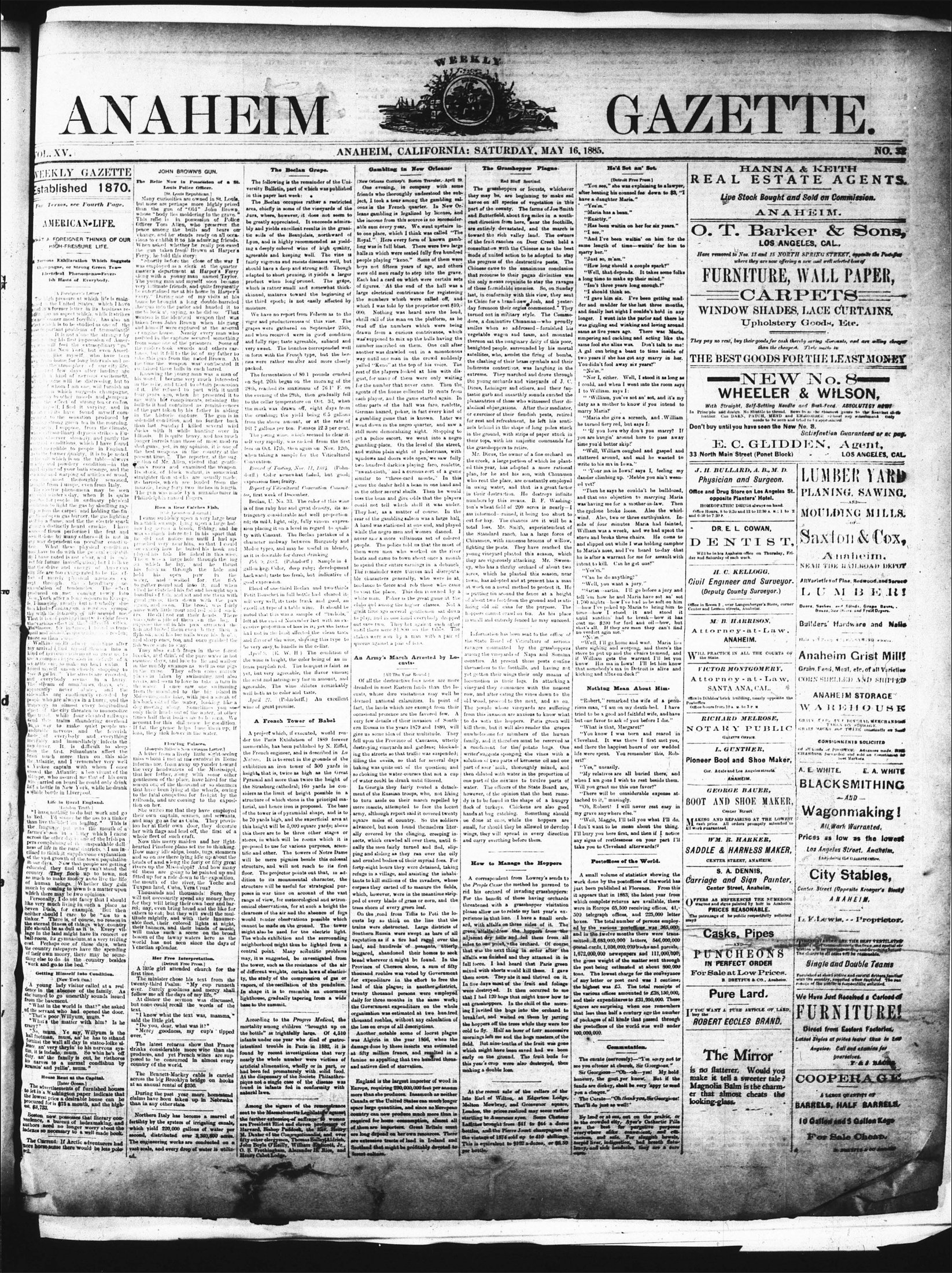
Searchable text
ANAHEIM
WEEKLY GAZETTE
Established 1870.
For Terms, see Fourth Page.
AMERICAN-LIFE.
WHAT A FOREIGN THINKS OF OUR HIGH-FRESSURE LIFE.
A nervous Exhilaration Which Suggests champagne, or Strong Green Tea—Electrical Phenomena—Feverish Haste of Everybody.
[A Foreigner's Letter]
The high pressure at which life is maindained in the United States, which I have
used in a former letter in its business review, has an aspect which, while it strikes
me most forebly, has also an
first which is to be studied as one of the
most important problems of transatlantic
life. It is not a one the stranger by
bringing his first impression of Americanism will feel the extraordinary "go"
like New York, but even American like myself, who have been
from home for long intervals and receiving the atmosphere of our city life,
first few days after landing age
with a kind of nervous excitement,
one will be distressing, but to
whom I am one, will furnish an
answer which suggests champagne,
especially to other moods and temperament, the effect of strong tea or coffee.
I find it varying, and in
these habits have found myself companied to the sensation produced by
creating strong green tea in the morning.
I suppose, from the climate,
who extraordinary dryness strikes a Futer-recoverer strongly and partly the
restricted conditions, which I have found
reliable to people in England.
As the former quality, it is to be noted
that which is on the table—always
matter and powdery condition—in the
rapid drying of your bath stonge, and the
warming of articles of wood.
JOHN BROWN'S GUN.
The Relie Now in Possession of a St.
Louis Police Officer.
[St. Louis Republican.]
Many curiosities are owned in St. Louis,
but none are perhaps more highly prized
than the gun of "Old" John Brown,
whose "body lies moldering in the grave."
This relief is in possession of Police
Officer Tom Allen, who preserves the
peace among the builts and bears on
change, and he stands ready on all occations to exhibit it to his admiring friends.
When asked whether he really possessed
the gun taken from Brown at Harper's
Ferry, he told this story:
"Shortly before the close of the war I was employed as a clerk at the quarter master's department at Harper's Ferry along with a young man named Taylor.
The young man and myself soon became very intimate friends, and quite frequently be entertained me at his home in Harper's Ferry. During one of my visits at his home he brought a long double-barreled shotgun into the parlor and handed it to me to look at, saying, as he did so: 'That weapon is the identical weapon that was taken from John Brown when his gang and himself were captured at the arsenal or engine house. Nearly every man who assisted in the capture secured something from some one of the prisoners. Some of the riders took swords and others caribones, but it fell to the lot of my father to take this gun from the noted Brown. At too time the weapon was confiscated it contained three balls in each barred.
Knowing the young man was a man of his word, I became very much interested in the relief, and tried to obtain possession of it. He refused to part with it until four years ago, when he presented it to me with his compliments, retaining the bullets it had contained as reminences of the part taken by his father in adding in the historic capture. The gun is in solendid condition, and no further back than last Sunday I killed several wild ducks with it while hunting over in Illinois. It is quite heavy, and has much longer barrels than those of most modern shotguns, yet, in my opinion, it is one of the best weapons in the country at the present time."
The reporter, at the suggestion of Mr. Allen, visited that gentleman's room and examined the weapon. His stock, of black walnut, is somewhat weak.
The Beelan Grape.
The following is the remainder of the University Bulletin, part of which was published in this paper last week:
The Beelan occupies rather a restricted area, chiefly in some of the vineyards of the Jura, where, however, it does not seem to be greatly appreciated. It succeeds admirably and yields excellent results in the granitic soils of the Beanjolais, northward of Lyon, and is highly recommended as yielding a deeply colored wine of high quality, agreeable and keeping well. The vine is fairly vigorous and resists diseases well, but should have a deep and strong soil. Though adapted to short pruning, it yields a larger product when long-pruned. The grape, which is ratner small and somewhat thick-skinned, matures toward the beginning of the third epoch; is not easily affected by moisture.
We have no report from Polsom as to the vigor and productiveness of this vine. The grapes were gathered on September 25th, and when received were in good condition and fully ripe; taste agreeable, subacid and very sweet. The bunches corresponded well in form with the French type, but the berries were rather smaller and more closely packed.
The fermentation of 80.1 pounds crushed on Sept. 26th began on the morning of the 28th, reached its maximum of 76.1° F. on the evening of the 29th, then gradually fell to the cellar temperature on Oct. 31, when the mark was drawn off, eight days from the crushing; the yield being 6.5 gallons from the above amount, or at the rate of 161.7 gallons per ton. Pomace 12.3 per cent.
The young wine, which seemed to clear itself very rapidly, was racked from the first lea on Oct. 17th, then again on Nov. 12th, when taking a sample for the Viticultural Convention.
Record of Tasting, Nov. 11, 1884. (Pohnschaff.) Color somnathat foulest but goodest.
Life in Rural England.
I have nothing to do but work and go to bed. I remember the tinker than live the life of a tinker.
This is the language put into the mouth of a farmer's son in a letter which I came across the other day in one of the Irish pars complaining of the unspeakable dullness of life in the rural districts. I am inclined to think it supplices some explanation of the vast growth of the town population in our days. Now that people are getting educated, they find they can't stand the country. They lock up to town, not so much to make money as to live the life of human beings. Whether they gain much by coming to town is a matter upon which there may be two opinions.
Personally, I do not feel that I should know the young man was a man of his word. I became very much interested in the role, and tried to obtain possession of it. He refused to part with it until four years ago, when he presented it to me with his complements, retaining the built-it it had contained as reminiscences of the part taken by his father in adding in the historic capture. The gun is in solitary condition, and no further back than last Sunday I killed several wild ducks with it while hunting over in Illinois. It is quite heavy, and has much longer barrels than those of most modern shot-guns, yet, in my opinion, it is one of the best weapons in the country at the present time."
The reporter, at the suggestion of Mr. Allen, visited that gentleman's room and examined the weapon. His stock of black walnut, is somewhat straighter than stocks are usually made; its barrels, which are loaded from the muzzle, being forty-two inches in length. The gun was made by a manufacturer in Philadelphia named Rogers.
How a Bear Catches Fish.
(John Leaviston Journal)
I came suddenly upon a very large bear in a thick swamp, living upon a large hot log across a brook, fishing, and he was so much interest in his sport that he did not notice me until I had approached very near him, so that I could see exactly how he baited his hook and played his fish. He lished in this wise. There was a large hole through the log on which he lay, and he thrust his forearm through the hole and held his open paw in the water, and waisted for the fish to gather round and into it, and when he clutched his fist and brought up a handful of fish, and sat and ate them with great gusto, then down with the jaw again, and so on. The brook was fairly alive with little trout and red snailocks. He did not eat their heads. There was quite a pile of them on the log. I suppose the oil in his paw attracted the fish and lusted them even better than a lily-hook, and his toe nails were his hoof and sharp ones, too, and once grabbed the fish were sure to say.
They also catch frogs in these forest brooks, and drink of the pure water in hot summer days, and love to lie and wallow in the muddy swamps as well as our pigs in the mine. They often cross narrow places in lakes by swimming and also rovers, and seem to love to take a turn in the water. Once saw one swimming from the mainland to the big island in Moeensburg lake, with just a screak of his back out of the water, looking like a dog moving along. Sometimes you see only their heads out of the water; at other times half their bodies are to be seen. We account for this difference by condition. If fat, the grease helps kue them up; if lean, they sink lower in the water.
Floating Palaces.
(Josquin Miller's New Orleans Letter)
A letter from a lovely little sight-seeking miss who met at the carnival in home informs me, from away up yonder toward the very headwaters of the Mississippi, that her father, along with some other gentlemen of the place, have hired for the season one of the thousand or so steamers that have been lying at the wharfs, owing to the fatal competition for freight by the railroads, and are coming to the exposition on her.
She writes me that they have employed their own captain, seaman, and servants, and may go as far as Cuba. They provision her at their own door, they decorate her with flags and lead off, the first of a whole fleet of such craft.
Now this merry maiden and her light-hearted Pinafore plans set me to thinking: How many idle ships, boats, tugs, steamers and so on are there lying file up about the heads of and along the forty or fifty great rivers up the Mississippi? And how many of them are going to be painted up and fitted up for a ride down to the exposition, the mouth of the river, the Teche and Tuxpan land, Cuba, Vera Cruz?
Thousands and thousands! Sure, they will not necessarily spend any money here.
The fermentation of 80.1 pounds crushed on Sept. 29th began on the morning of 28th, reached its maximum of 76.1° F. on the evening of the 29th, then gradually fell to the cellar temperature on Oct. 34, when the mark was drawn off, eight days from the crushing; the yield being 6.5 gallons from the above amount, or at the rate of 161.7 gallons per ton. Poinsce 12.3 per cent.
The young wine, which seemed to clear itself very rapidly, was racked from the first lee on Oct. 17th, then again on Nov. 12th, when taking a sample for the Viticultural Convention.
Record of Tasting, Nov. 11, 1884.
(Pohndorff) Color somewhat failed, but good; expression fine; fruity.
Report of Viticultural Convention Committee, first week of December.
Beclan, U. No. 33. The color of this wine is of fine ruby hue and great density; its stringency considerable and well proportioned; its mild light, oily, fully vinous expression placing it on a level in regard to quality with Cinsaut. The Beclan partakes of a character midway between Burgandy and Medoc types, and may be useful in blends, as it is desirable for direct drinking.
Feb. 9, 1887.
(Pohndorff) Sample in 4 gallon keg; Color deep ruby; development backward; taste too fresh, but indicative of good expression.
Blend of one-third Beclan and two-thirds Petit Boussechet in full bottle had cleared itself very well; its taste frank and good; an excellent type of a table wine. It should be noted that this was a sample of "turbals," laid at the end of November last with an excessive proportion of bees in it; yet the latter had not in the least affected the clean taste and flavor of the wine; showing this type to be very easy to handle in the collar.
April 9, (E.W.H.) The condition of the wine is bright; the color being of an intense purpure red. The bouquet is faint as yet, but very agreeable; the flavor vicious; the acid and astringney far in amount, and agreeable. The wine dilutes remarkably well both as to color and taste.
April 27.
(Pohndorff.) An excellent wine of great promise.
A French Tower of Babel
A project which, if executed, would render the Paris Exhibition of 1889 forever memorable, has been published by N.Eiffel, the French engineer, and is described in La Nature. It is to erect in the grounds of the exhibition an iron tower of 300 yards in height that is, twice as high as the Great Pyramid and more than twice the height of the Strasburg cathedral; 160 yards he considers as the limit of height possible in a structure of which stone is the principal material; and hence iron is proposed. The base of the tower is of pyramidal shape, and is to be 70 yards high; and the superficial area at this height will be 5,000 square yards; above this there are to be three other stages or stores; in which will be rooms which it is proposed to use for various purposes, scientific and other.
The toweres of Notre Dame will be mere pigmies beside this colossal structure; and will not reach to its first floor. The projector points out that, in addition to its monumental character, the structure will be useful for strategical purposes in war time on account of the vast size of room for meteorological and astronomical observations.
Life in Royal England.
[London Truth]
"I have nothing to do but work and go to bed. I'd sooner be the ass to a tinker than live the life I am leading." This is the language put into the mouth of a farmer's son in a letter which I came across the other day in one of the Irish papers complaining of unspeakable dullness of life in the rural districts. I am inclined to think it supplies some explanation of the vast growth of the town population in our days. Now that people are getting educated they find they can't stand the country. They flock up to town, not so much to make money as to live the life of human beings. Whether they gain much by coming to town is a matter upon which there may be two opinions.
Personally, I do not fancy that I should like very much living in such a place as Seven Dials, for example. But then neither should I care to be "ass to a tinker." There is, of course, no reason in the eternal fitness of things why country life should be as dull as it is. Every village in the land might have its concert or ball-room, its gymnasium at a very triling cost. Perhaps one of these days, when the country ratepayers have the spending of their own money, there may be something else to do in the country besides "work and go to the bed."
Getting Himself Into Condition.
[New York Sun]
A young lady visitor called at a residence in the absence of the family. As she turned to go unearthly sounds issued from the basement.
"What in the world is that?" she asked of the servant who had opened the door.
"That's poor Willyum, mum."
"What's the matter with him? Is he crazy?"
No, mum. Ye say, Willyum is the hall footman, mum, an' he has to stand formist the wall all day in statue-like silence, an' very thriny' to his nervous system, it is indade, mum. So whin he's off duty, an' the family is out, he rishores his narves to a normal condishun by kramin' and yellia', mum."
House Rent at the Capital.
[Inter Ocean]
The advertisements of furnished houses to let in a Washington paper indicate that the lowest price a desirable house can be procured for is $75 a month, and the highest, $3,783.
Boston now possesses that literary convenience, a bureau of indexmaking, and authors need no longer worry about the indexes so necessary to a well-made book.
The Current: If Arctic adventurers had more horse-sense there would be less poliwil.
Her Free Interpretation.
[Detroit Free Press]
A little girl attended church for the first time.
The minister chose his text from the twenty-third Psalm: "My cup runneth over. Surely goodness and mercy shall follow me all the days of my life."
At dinner the sermon was discussed, but none could recall the words of the text.
"I know what the text was, mamma," said the little girl.
"Do you, dear, what was it?"
"Mercy goodness, my cup's tipped over."
The latest returns show that France drinks considerable more wine than she produces, and yet French wines are supposed to be consumed in almost every country of the world.
The Bennett-Mackey cable is carried across the big Brooklyn bridge on hooks at an annual rental of $250.
During the past year more homestead claims have been taken up in Nebraska than in any other state.
Northern Italy has become a marvel of fertility by the system of irrigating canals, which yield 220,000 gallons of water per second, distributed over 2,300,600 acres. The engineering works are conducted on a vast scale, and every drop of water is utilized.
She writes me that they have employed their own captain, seamen, and servants, and may go as far as Cuba. They provision her at their own door, they decorate her with flags and lead off, the first of a whole fleet of such craft.
Now this merry maiden and her lighthearted Pinafore plans set me to thinking. How many idle ships, boats, tugs, steamers and so on are there lying idle up about the heads of and along the forty or fifty great rivers up the Mississippi? And how many of them are going to be painted up and fitted up for a ride down to the exposition, the mouth of the river, the Teche and Tuxpan land, Cuba, Vera Cruz?
Thousands and thousands! Surely they will not necessarily spend any money here, for they will bring their own beer and barrel; nay, even bring bread and the like for others to eat; but they will swell the multitude mightily, and with their innumerable feet, their colored lights at night, their banners, and their bands of music, will make such a scene on the broad bosom of the tawny waters here as the world has not seen since the days of Venetian splendor.
According to the Progress Medical, the mortality among children "brought up on the bottle" as frightfully large. Of 4,510 infants under one year who died of gastrointestinal trouble in Paris in 1882, it is found by recent investigations that very nearly the whole number were victims of artificial alimenation, wholly or in part, or had been fed prematurely with solid food. At the dispensary of the Societe Philanthropique not a single case of the disease was found in infants fed in conformity with natural laws.
Among the signers of the remonstrance sent to the Massachusetts Legislature against the further extension-of suffrage to women are President Pilot and eleven professors of Harvard, Bishop Faiddoak, the Rev. Henry M. Daxter of the Congregationalist, and over fifty other clergymen, Thomas Kailey Aldrich, John Boyle O'Reilly, William Eshcottt Jr., O. B. Frethingham, Alexander H. Rice, and Henry Cabot Lodge.
WEEKLY
GAL
ANAHEIM, CALIFORNIA: SATURDAY, MAY 16, 1885.
The Beclan Grape.
Long is the remainder of the Uniminum part of which was published last week:
the occupies rather a restricted
some of the vineyards of the
however, it does not seem to
reciated. It succeeds admiratively recommended as yieldobed wine of high quality,
keeping well. The vine is
deep and strong soil. Though
short pruning, it yields a larger
long-pruned. The grape,
or small and somewhat thicker toward the beginning of
chic; is not easily affected by
report from Polsom as to the
ductiveness of this vine. The
fathered on September 25th,
died were in good condition
taste agreeable, subacid and
the bunches corresponded well
the French type, but the berder smaller and more closely
ation of 80.1 pounds crushed
began on the morning of the
ents maximum of 76.1 F. on
the 29th, then gradually fell
temperature on Oct. 31, when
drawn off, eight days from
the yield being 6.5 gallons
amount, or at the rate of
per ton. Pornace 12.3 per cent.
time, which seemed to clear itly, was racked from the first
thick, then again on Nov. 12th,
sample for the Viticultural
casting, Nov. 11, 1884.
Gambling in New Orleans.
[New Orleans Correspondent's Boston Traveler., April 29.
One evening, in company with some
friends who thoroughly understood the subject, I took a tour among the gambling salcions in the French quarter. In New Orleans gambling is legalized by license, and
the income from this source is no inconsiderable sum every year. We went upstairs in
one place, which I think was called "The
Royal." Here every form of known gambling was in full blast. There were two large
halls in which were seated fully five hundred
people playing "keno." Some of them were
boys not fifteen years of age, and others
were old men ready to step into the grave.
Each had a card on which were certain sets
of figures. At the end of the hall was a large electrical contrivance for registering
the numbers which were called off, and
which I was told by the proprietor cost $10,
000. Nothing was heard save the loud,
shrill call of the man on the platform, as he
read off the numbers which were being drawn from a curious contrivance, which
was supposed to mix up the balls having the number inscribed on them. One call after another was drawled out in a monotonous way until one man in the crowd suddenly yelled "Keno" at the top of his voice. The rest of the players looked at him with disgust, for many of them were only waiting for the number that never came. Then the agents of the house collected 10 cents from each player, and the game started again. In other parts of the hall was faro, roulette,
German hazard, poker, in fact every kind of a gambling game that is known. Later we went down in the negro quarter, and saw a still more demoralizing sight. Stopping to get a police escort, we went into a negro gambling-place. On the level of the street,
and within plain sight of pedestrians, with windows and doors wide open, we saw fully two hundred darkies playing faro, roulette,
"sweat-cloth," and a curious sort of a game
The Grasshopper Plague.
Red Bluff Seventinel.
The grasshoppers or locusta, whichever they may be, are beginning to make sad haves on all species of vegetation in this part of the county. The farms of Joe Smith and Butterfield, about five miles in a southeast direction from here, near the foothills, are entirely devastated, and the march is toward the rich valley land. The owners of the fruit ranches on Deer Creek held a consultation with the Chinese as to the best mode of united action to be adopted to stay the progress of the destructive pests. The Chinese came to the unanimous conclusion that recourse to their pagan divinities was the only means requisite to stay the ravages of these formidable enemies. So, on Sunday last, in conformity with this view, they sent to Chico for a brand-new Josh, and yesterday forenoon their orgies commenced.* They turned out in military style. The Commodore, a diminutive Chinaman—who proudly smiles when so addressed—furnished his vegetable wagon and team, and mounted thereon sat the imaginary deity of this poor, benighted people, surrounded by his mortal satellites, who amidst the firing of bombs, the clashing of their brass cymbals and their ludicrous contortions, was laughing in the extreme. They marched and drove through the young orchards and vineyards of J. C. Dicus, Leininger and others, and their fantastic garb and unearthly sounds exerted the pleasantries of those who witnessed their diabolical objurgations. After their mediator, or exerciser of their fiendish pests, retired for rest and refreshment, he left his sentinels behind in the shape of long poles stuck in the ground, with strips of paper stuck in their tops, with his majestic commands for the grasshoppers to retire.
Mr. Dicus, the owner of a fine orchard on the creek, a large portion of which he planted this year, has adopted a more rational plan for he and his son with Chinamen.
He'd Sot an' Sot.
[Detroit Free Press.)
"You see," she was explaining to a lava after beating his counsel fee down to $ have a daughter Maria."
"Yes'm."
"Maria has a bean."
"Exactly."
"Has been waitin on her for six years"
"I see."
"And I've been waitin' on him for same length of time—waitin' for his marry her."
"Just so, m'am."
"How long should a couple spark?"
"Well, that depends. It takes some a long time to make up their mind."
"Isn't three years long enough?"
"I should think so."
"I gave him six. I’ve been getting der and mudder for the last three mond and finally last night I couldn’t hold in longer. I went into the parlor and there was giggling and winking and loving are same as five years ago. There was M simpering and cackling and acting like same fool she allius was. Don’t talk to A gal can bring a bean to time inside two years if she has got any marry in You didn’t fool away six years?"
"No'm."
"Nor I, either. Well, I stood it as low I could, and when I went into the room I to William says I:
"William, you’ve sot an’ sot, and it’s duty as a mother to know if you intend marry Maria?
Maria she give a screech, and . Will he turnl fiery red, but says I:
"If you love why don’t you marry you are hangin’ around here to pass a time you’d better skip?
Well, William coughed and gasped stuttered around, and said he wanted write to his ma in Iowa."
"Your ma in Iowa’ says I, feeling
A small volume of statistics showing work done by the postoffices of the world just been published at Florence. From it appears that in 1863, the latest year for publication.
An Army's March Arrested by Locusts
[All The Year Round]
Of all the destructive foes none are more dreaded in most Eastern lands than the locusts, whose dire visitations may well be deemed national calamities. In point of fact, the lands which are exempt from their occasional presence are the favored few. A very few details of their invasion of Southern Russia in the years 1879 and 1880, will give us some idea of their multitude. They fell upon the Province of Caucasus, utterly destroying vineyards and gardens; blockading the streets so that traffic was suspended; filling the ovens, so that for several days baking was quite out of the question; and so choking the water-courses that not a cup of water could be drank until filtered.
In Georgia they fairly routed a detachment of the Russian troops, who, not liking to turn aside on their march repelled by mere insects, attempted to face the locust army, although report said it covered twenty square miles of country. So the soldiers advanced, but soon found themselves literally covered by the clinging, creeping insects, which crawled all over them, until finally the men fairly turned and fleed, slipping and sliding as they ran over the oily and crushed bodies of their myriad foes. For forty-eight hours they were detained, taking refuge in a village, and assisting the inhabitants to kill millions of the invaders, whose corpses they carted off to manure the fields, which, however, were in the meantime striping extreme. They marched and drove through the young orchards and vineyards of J. C. Diecus, Leininger and others, and their fantastic garb and unearthly sounds exerted the pleasantries of those who witnessed their diabolical objections. After their mediator, or exercisor of their fiendish pests, retired for rest and refreshment, he left his sentinels behind in the shape of long poles stuck in the ground, with strips of paper stuck in their tops, with his majestic commands for the grasshoppers to retire.
Mr. Dicus, the owner of a fine orchard on the creek, a large portion of which he planted this year, has adopted a more rational plan for he and his son, with Chinamen who rent the place, are constantly employed in using water, and that is a great factor in their destruction. He destroys infinite numbers by this means. B. F. Washington's wheat field of 200 acres is nearly—I am informed—ruined, it being too short to cut for hay. The chances are it will be a total loss. Mr. Smith, superintendent of the Standard ranch, has a large force of Chinamen, with immense brooms of willow, fighting the pests. They have reached the young vineyard planted this season, which they are vigorously attacking. Mr. Sweeney, who has a thrifty orchard of about two acres, which he planted this season, near town, has adopted and at present has a man at work on a novel method to protect it. He is putting tine around the fence at a height of about two feet from the ground and is utilizing old oil canns for the purpose. The hoppers cannot crawl on tin. As his place is small and entirely fenced he may succeed.
Information has been sent to the office of the State Board of Vineulture of serious ravages committed by the grasshoppers among the vineyards of Napa and Sonoma counties. At present these pests confine themselves to the foothills, and having not yet gotten their wings their only means of locomotion is their legs. In attacking a vineyard they commence with the nearest row, and after eating the vines down to the old wood, proceed to the next, and so on. The people whose vineyards are suffering from this invasion are anxious to know what to do with the hoppers. Paris green will kill them, but it will also render the grapes unwholesome for members of the human family, and it therefore must be reserved as a condiment for the potato bugs. One writer suggests sponging the vines with a solution of two parts of kerosene oil and one part of sour milk, thoroughly mixed, and then diluted with water in the proportion of one part of the mixture to twelve parts of water. The officers of the State Board are, however, of the opinion that the best remedy is to be found in the shape of a hungry flock of turkeys. Chickens are also good hands at bug catching. Something should be done at once while the hoppers are small, for should they be allowed to develop wings, they will spread in every direction and carry everthing before them.
How to Manage the Hoppers
A correspondent from Lowrey's sends to the People Casse method he pursued to rid his orchard of invading grasshoppers: For the benefit of those having orchards extreme.
They marched and drove through the young orchards and vineyards of J. C. Diecus, Leininger and others, and their fantastic garb and unearthly sounds exerted the pleasantries of those who witnessed their diabolical objections. After their mediator, or exercisor of their fiendish pests, retired for rest and refreshment, he left his sentinels behind in the shape of long poles stuck in the ground, with strips of paper stuck in their tops, with his majestic commands for the grasshoppers to retire.
Mr. Dicus, the owner of a fine orchard on the creek, a large portion of which he planted this year, has adopted a more rational plan for he and his son, with Chinamen who rent the place are constantly employed in using water, and that is a great factor in their destruction. He destroys infinite numbers by this means. B. F. Washington's wheat field of 200 acres is nearly—I am informed—ruined, it being too short to cut for hay. The chances are it will be a total loss. Mr. Smith, superintendent of the Standard ranch, has a large force of Chinamen, with immense brooms of willow, fighting the pests. They have reached the young vineyard planted this season, which they are vigorously attacking. Mr. Sweeney, who has a thrifty orchard of about two acres, which he planted this season, near town, has adopted and at present has a man at work on a novel method to protect it. He is putting tine around the fence at a height of about two feet from the ground and is utilizing old oil canns for the purpose. The hoppers cannot crawl on tin. As his place is small and entirely fenced he may succeed.
Information has been sent to the office of the State Board of Vineulture of serious ravages committed by the grasshoppers among the vineyards of Napa and Sonoma counties. At present these pests confine themselves to the foothills, and having not yet gotten their wings their only means of locomotion is their legs. In attacking a vineyard they commence with the nearest row, and after eating the vines down to the old wood, proceed to the next, and so on. The people whose vineyards are suffering from this invasion are anxious to know what to do with the hoppers. Paris green will kill them, but it will also render the grapes unwholesome for members of the human family, and it therefore must be reserved as a condiment for the potato bugs. One writer suggests sponging the vines with a solution of two parts of kerosene oil and one part of sour milk, thoroughly mixed, and then diluted with water in the proportion of one part of the mixture to twelve parts of water.
The officers of the State Board are, however, of the opinion that the best remedy is to be found in the shape of a hungry flock of turkeys. Chickens are also good hands at bug catching. Something should be done at once while the hoppers are small, for should they be allowed to develop wings, they will spread in every direction and carry everthing before them.
Nor I, either. Well, I stood it as low I could I could I could I could I could I could I could I could I could I could I could I could I could I could I could I could I could I could I could I could I could I could I could I could I could I could I could I could I could I could I could I could I could I could I could I could I could I could I could I could I could I could I could I could I could I could I could I could I would be able to marry M was having me for a mother-in-law. The cyclone broke loose. Also she wired him back wind. Also two or three earthquakes side four minutes Maria had fainted William was a wreck, and we had upset stove and broke three chairs. He combed and slipped out while I was holding cameltoe Mary's nose, and I've heard today he is after a warrant for me for assault intent to kill. Can he get one?
Yes!"
Can he do anything?
Well you want a jury!
Sartin—sartin. I'll go before a jury tell me how he and Maria have sot an 1700 nights—how I've had to be soft on—how I've poked up Maria to bring time-I stood it and stood until sunshine had to break-how it cost me $200 for fuel and oil-how that's all if they are men they can't no verdict again me."
No m!
Well I'll go home and wait. Maria there sighting and weeping,and there's stove to put up and the chairs to mend.
If William gets the warrant I'll let know.His ma in Iowa! I'll let him know that somebody's ma in Detroit is alive kicking and alles on deck!
Nothing Mean About Him
"Robert," remarked the wife of a perious man,"I am on my death-bed.I had tried to how he and Maria have sot an 1700 nights—how I've had to be soft on—how I've poked up Maria to bring time-I stood it and stood until sunshine had to break-how it cost me $200 for fuel and oil-how that's all if they are men they can't no verdict again me."
No m!
Well I'll go home and wait. Maria there sighting and weeping,and there's stove to put up and the chairs to mend.
If William gets the warrant I'll let know.His ma in Iowa! I'll let him know that somebody's ma in Detroit is alive kicking and alles on deck!
Postoffice Of The World
A small volume of statistics showing work done by the postoffices of the world just been published at Florence.From it it appears that in 1863,the latest year from
The towers of Notre Dame pigmies beside this colossal will not reach to its first sector points out that, in admonimental character, the useful for strategical purpose on account of the vast meteorological and astronomical, for at such a height the air and the absence of fog observations possible which on the ground. The tower used for the electric light position and the surrounding light thus be lighted from a Many scientific problems stated, be investigated from the resistance of the air lights, certain laws of elasticity the compression of gas or excitation of the pendulum. To resemble an enormous usually tapering from a wide suit.
In the Progress Medical, the children "brought up on sightfully large. Of 4,510 year who died of gastro-ile in Paris in 1882, it is that investigations that very number were victims of motion, wholly or in part, or omnaturely with solid food. Why of the Societe Philanthrope case of the disease was fed in conformity with signers of the remonstrance Massachusetts Legislature against section-of-suffrage to women not and eleven professors of Faldock, the late Henry Conreputationist, and over women Thomas Bailey Aldrich, William Edhincott Jr., John Alexander H. Rice, and George.
England is the largest importer of wood in Europe, requiring 290,000,000 feet per annum more than she produces. Inasmuch as neither Canada or the United States can much longer spare large quantities, and since no European country can now produce much more than is required for home consumption, almost all of them are importers. Great Britain must long depend on her own resources. There are extensive tracts of land in Ireland and Scotland that might be profitably devoted to forest cultivation.
At the recent sale of the collars of the late Earl of Wilton, at Edgerton Lodge, Melton Mowbray, and Groavenor square, London, the priests realized may seem rather startling to American eyes. Some Chateau Laffites brought from $41 to $44 a dozen battles, and the Pierre Jouet champagne of the vintage of 1874 sold up to 410 shillings. This is equivalent to $102 a dozen, or $8.50 per bottle.
How to Manage the Hoppers
A correspondent from Lowrey's sends to the People Cause the method he pursued to rid his orchard of invading grasshoppers: For the benefit of those having orchards threatened with a grasshopper visitation please allow me to relate my last year's experience in that line. I have a small orchard, with alfalfa on three sides of it. The green alfalfa drew the hoppers from the adjacent dry hills and led them from all sides to one point, the orchard. Of course that was the next thing in order after the alfalfa was finished and they attacked it in full force. I had heard that Paris green mixed with shorts would kill them. I gave them some. They ate it and thrived on it. In five days most of the fruit and foliage were destroyed. It then occurred to me that I had 120 hogs that might know how to eat grasshoppers. In the chill of the morning I invited the hogs into the orchard to breakfast, and waited on them by jarring the hoppers off the trees while they were too cold to fly. Half an hour of four successive mornings left me and the hogs masters of the field. But nine-tenths of the fruit was gone which might have been saved had we been early on the ground. The fruit buds for this year's crop were also destroyed, thus making a double loss.
At the recent sale of the collars of the late Earl of Wilton, at Edgerton Lodge, Melton Mowbray, and Groavenor square, London, the priests realized may seem rather startling to American eyes. Some Chateau Laffites brought from $41 to $44 a dozen battles, and the Pierre Jouet champagne of the vintage of 1874 sold up to 410 shillings. This is equivalent to $102 a dozen, or $8.50 per bottle.
Postoffices of the World.
A small volume of statistics showing work done by the postoffices of the world just been published at Florence. From it appears that in 1863, the latest year from which complete returns are available, there were in Europe 65,500 receiving offices, 4500 telegraph offices, and 225,000 letter boxes. The total number of persons employed by the various postoffices was 365,000 and in the twelve months there were trained 3,683,000,000 letters, 546,000,000 postal cards, 1,036,000,000 books and 1,672,000,000 newspapers and 111,000,000 gross weight of the matter sent through the post being estimated at about 800 tons. The lowest charge for the conveyance of any letter or post card was 1 centime highest was £5. The total receipts for various offices amounted to £38,150,000 and their expenditures to £31,950,000. The figures are surprising when one remember that less than half a century ago the number of packages of all kinds that passed through the postoffices of the world was well under 100,000,000.
Commutation.
The curate (nervously)—"I'm sorry not see you oftener at church; Sir Georgous." Sir Georgions—"Oh—oh—yes! My honesty, the gout yer know. But if you funds are dickey shall be very 'apply to me' you a cheque."
The Curate—"Oh thank you; Sir Georgious That'll do just as well!"
GAZETTE.
NO. 32
He'd Sot an' Set.
[Detroit Free Press.] she was explaining to a lawyer,
taking his counsel fee down to $3, "I
daughter Maria."
m."
via has a bean."
notly."
been waitin on her for six years."
e."
I've been waitin' on him for the
length of time—waitin' for him to
er."
so, m'am."
long should a couple spark?"
that depends. It takes some folks
time to make up their mind."
three years long enough."
could think so.
have him six. I've been getting madmadder for the last three months,
only last night I couldn't hold in any
I went into the parlor and there he
engling and winking and loving around
five years ago. There was Maria,
and cackling and acting like the
she allius was. Don't talk to me!
can bring a bead to time inside of
ers if she has got any marry in her.
n't fool away six years?
I, either. Well, I stood it as long as
and when I went into the room says
William, says I:
William, you've sot an' sot, and it's my
mother to know if you intend to
maria?
she give a screech, and William
al fiery red, but says I:
you love why don't you marry? If
hangin' around here to pass away
'd better skip?
William coughed and gasped and
around, and said he wanted to
his main Iowa."
our ma in Iowa says I, feeling my
HANNA & KEITH
REAL ESTATE AGENTS.
Live Stock Bought and Sold on Commission.
ANAHEIM.
O. T. Barker & Sons,
LOS ANGELES, CAL.
Have removed to No. 13 and 15 NORTH SPRING STREET, opposite the Post Office
where they are now offering a new and well selected line of
FURNITURE, WALL PAPER,
CARPETS
WINDOW SHADES, LACE CURTAINS.
Upholstery Goods, Etc.
They pay no rent, buy their goods for cash thereby saving discounts, and are selling cheaper than the cheapest. Their motto is
THE BEST GOODS FOR THE LEAST MONEY
NEW No. 8
WHEELER & WILSON,
With Straight, Self-Setting Needle and Back-Feed. ABSOLUTECY NEW!
In Principle and design. No Shuttle to thread. Seems from the thinnest gauge to the heartiest of coleather. Can DAKN, PATCH, MEND and EMRODER without any adjustment only
needs to be seen and tried to be appreciated.
Don't buy until you have seen the New No. 8.
Satisfaction Guaranteed or no pay.
E. C. GLIDDEN, Agent,
33 North Main Street (Ponet Block)
LOS ANGELES, CAL.
J. H. BULLARD, A. B., M. D.
NEW No. 8
WHEELER & WILSON,
With Straight, Self-Setting Needle and Beak-Feed. ABSOLUTEGY NEW!
In Principle and design. No Shuttle to thread. News from the thinnest gear to the heaviest drive.
Can DAKN, PATCH, MEND and EMBRODER without any adjustment, they need to be seen and tried to be appreciated.
Don't buy until you have seen the New No. 8.
Satisfaction Guaranteed or no pay.
E. C. GLIDDEN, Agent,
33 North Main Street (Ponet Block)
LOS ANGELES, CAL.
J. H. BULLARD, A. B., M. D.
Physician and Surgeon.
Office and Drug Store on Los Angeles St.
opposite Planters' Hotel.
HOMEOPATHIC DRUGS always on hand.
Office Hours, 8 to 9:30 and 12 to 12:30 a.m.; 1 to 2
and 6:30 to 7:30 p.m.
DR. E. L. COWAN,
DENTIST,
Will be in his Anaheim office on Thursday, Friday and Saturday of each week.
H. C. KELLOGG.
Civil Engineer and Surveyor.
(Deputy County Surveyor.)
Office in Room 2, over Langenberger's Store, corner Center and Leemon streets, Anaheim.
M. B. HARRISON.
Attorney-at-Law.
ANAHEIM.
WILL PRACTICE IN ALL THE COURTS OF the State.
VICTOR MONTGOMERY,
Attorney-at-Law,
SANTA ANA, CAL.
Office in Dibbles' brick building, nearly opposite the Postoffice.
Office hours from 10 a.m. to 5 p.m.
RICHARD MELROSE,
NOTARY PUBLIC
GAETTE OFFICE.
L. GUNTHER,
Pioneer Boot and Shoe Maker,
Cor. Adele and Los Angeles streets.
ANAHEIM.
GEORGE BAUER,
BOOT AND SHOE MAKER,
Center Street.
MAKING AND REPAIRING AT THE LOWEST cash price. All orders promptly attended to All work guaranteed.
WM. R. HARKER,
SADDLE & HARNESS MAKER,
CENTER STREET, ANAHEIM.
S. A. DENNIS,
Carriage and Sign Painter,
Center Street, Anaheim.
LUMBER YARD
PLANING, SAWING,
MOULDING MILLS.
Saxlon & Cox,
Anaheim.
NEAR THE RAILROAD DEPOT
All varieties of Pine, Redwood, and Spruce
LUMBER!
Doors, Sashes, and Blinds, Grape Bowers,
Doors, Sashes and Fruit Dryers.
Builders' Hardware and Nails
Anaheim Grist Mill!
Grain, Feed, Meal, etc., of all Varieties
CORN SHELLLED AND SHIPPED
ANAHEIM STORAGE
WAREHOUSE
GRAVES AND GENERAL MERCHANDISE
TANGO ON STORAGE.
CONSIGNMENTS SOLICITED
Of all kinds of PRODUCTION Advances made by CHANDISE forwarded and sold on Commission for best Markets.
A. E. WHITE.
E. A. WHITE
BLACKSMITHING
AND
Wagonmaking!
All Work Warranted.
Prices as low as the lowest Los Angeles Street, Anaheim.
And joining the Gazette Office.
City Stables,
Center Street (Opposite Kroeger's Block)
BOOT AND SHOE MAKER,
Center Street
MAKING AND REPAIRING AT THE LOWEST
cash price. All orders promptly attended to
All work guaranteed.
WM. R. HARKER,
SADDLE & HARNESS MAKER,
CENTER STREET, Anaheim.
S. A. DENNIS,
Carriage and Sign Painter,
Center Street, Anaheim,
OFFERS AS REFERENCES THE NUMEROUS
wagons and signs painted by him in Anaheim.
PRICES REASONABLE.
The patronage of the public respectfully solicited may
Casks, Pipes
AND
PUNCHEONS
IN PERFECT ORDER
For Sale at Low Prices.
B. DBEYFUS & CO., Anaheim.
Pure Lard.
IF YOU WANT A PURE ARTICLE OF LARD,
buy the
ROBERT EGCLES BRAND.
The Mirror
is no flatterer. Would you make it tell a sweeter tale?
Magnolia Balm is the charmer that almost cheats the looking-glass.
Wagonmaking!
All Work Warranted.
Prices as low as the lowest
Los Angeles Street, Anaheim.
City Stables,
Center Street (Upper Kroger's Block)
ANAHEIM.
L. F. Lewis, - Proprietor.
PATIENTS STANDING ARE THE NEXT VENTILATE
and have promised to stay the team and special air
tension will be provided and Grooming hands.
The charge in all cases will be reasonable.
Single and Double Teams
Furnished at short police and curial drivers' facilities
with the country, supplied when required. The was
renewed of the public is responsibly solicited.
We Have Just Received a Carload of
FURNITURE!
Direct from Eastern Factories.
Latest Styles at prices lower than in Los
Angeles. Call and examine for
yourselves.
T. & S. MACKIE
COOPERAGE
A large quantity of
BARRELS, HALF BARRELS.
10 Gallon and 5 Gallon Kegs
For Sale Cheap.