anaheim-gazette 1885-04-25
Scanned page
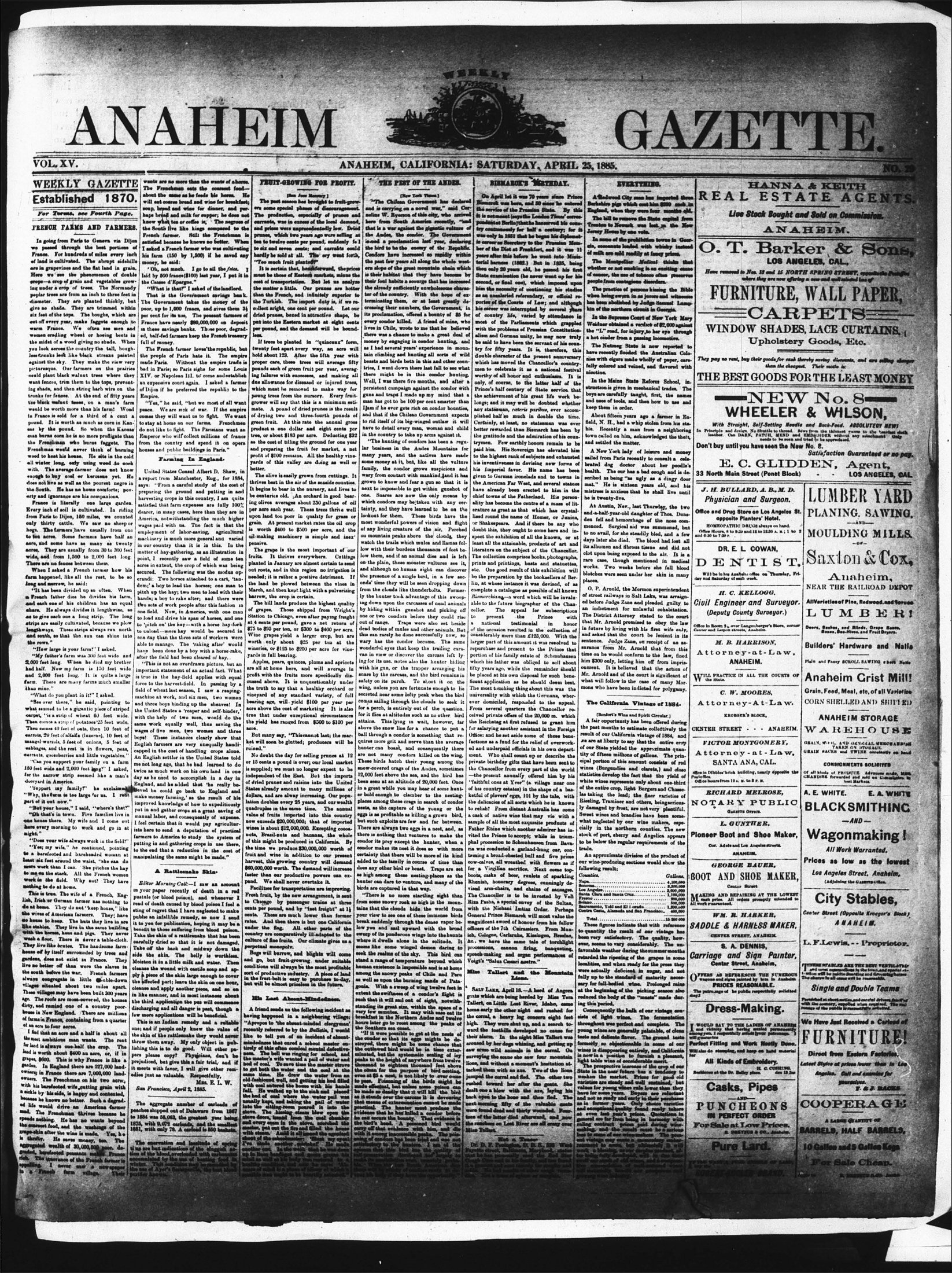
Searchable text
ANAHEIM
VOL. XV.
WEEKLY GAZETTE
Established 1870.
For Terms, see Fourth Page.
FRENCH FARMS AND FARMERS.
In going from Paris to Geneva via Dijon we passed through the best portions of France. For hundreds of miles every inch of land is cultivated. The abrupt sidehill are in grapevines and the flat land in grain. Here we see the phenomenon of double crops—a crop of grain and vegetables growing under a crop of trees. The Normandy poplar trees are from an inch to three feet in diameter. They are planted thickly, but give no shade. They are trimmed within six feet of the tops. The boughs, which are cut off every year, make faggots enough to warm France. We often see men and women cradling wheat or hoeing beets in the midst of a wood giving no shade. When you look across the country the tall, boughless crunks look like black streaks painted against the sky. They make the view very picturesque. Our farmers on the prairies could plant black walnut trees where they want fences, trim them to the tops, preventing shade, and then string barb wire on the trunks for fences. At the end of fifty years the black walnut trees, on a man's farm would be worth more than his farm! Wood in France is sold for a third of a cent a pound. It is worth as much as corn in Kansas by the pound. So when the Kansas man burns corn he is no more profligate than the Frenchman who burns faggota. The Frenchman would never think of burning wood to heat his house. He sits in the cold all winter long, only using wood to cook with. The average farmer does not know wants are no more than the wants of others. The Frenchman sets the correct food—about the same as he feeds his horse. He will eat coarse bread and wine for breakfast; soup, bread and wine for dinner, and perhaps bread and milk for supper; he does not know what tea or coffee is. The negroes of the South live like kings compared to the French farmer. Still the Frenchman is satisfied because he knows no better. When I asked a French farmer who was cultivating his farm (150 by 1,500) if he saved any money, he said:
"Oh, not much. I go to all the farms. I laid by 500 francs ($100) last year, I put it in the Caisse d'Epargne."
"What is that?" I asked of the landlord.
That is the Government savings bank. The Government takes the money of the poor, up to 1,000 francs, and gives them 3½ per cent for its use. The peasant farmers of France have nearly $80,000,000 on deposit in these savings banks. Those poor, degraded, half-fed farmers keep the French treasury full of money.
The French farmer loves the republic, but the people of Paris hate it. The empire made Paris. Without the empire trade is bad in Paris; so Paris sighs for some Louis XIV. or Napolean III. to come and establish an expensive court again. I asked a farmer of Dijon if he preferred the republic to the Empire.
"Yes," he said, "but we most of all want peace. We are sick of war. If the empire comes they will want us to fight. We want to stay at home on our farms. Frenchmen do not like to fight. The Parisians want an Emperor who will collect millions of francs from the country and spend it on opera houses and public buildings in Paris."
Farming In England.
United States Consul Albert D. Shaw, in
FRUIT-GROWING FOR PROFIT.
[Sam Jones Mercury]
The past season has brought to fruit-growing some special phases of discouragement. The production, especially of prunes and currants, was in excess of the local demand and prices were unprecedentedly low. Driving prunes, which two years ago were selling ten to twelve cents per pound, suddenly fell to six and seven cents; and currants could hardly be sold at all. The cry went forth: "Too much fruit planted!" It is certain that hands forward, the price must be those of Eastern markets, minus the cost of transportation. But let us analyze the matter a little. Our prunes are better than the French, and infinitely superior to the Turkish. The import duty is, if we recollect aright, one cent per pound. Let our dried prunes, boxed in attractive shape, be put into the Eastern market at eight cents per pound, and the demand will be boundless.
If trees be planted in "quincunx" form twenty feet apart every way, an acre will hold about 123. After the fifth year with proper care, these trees will average fifteen pounds each of green fruit per year, averaging failures with successes, and making a due allowance for diseased or injured trees which must be removed to make way for young trees from the nursery. Every fruit grower will say that this is a minimum estimate. A pound of dried prunes is the result of drying two and three-fourth pounds of green fruit. At this rate the annual gross product is one dollar and eight cents per tree, or about $183 per acre. Deducting $32 as the cost of tilling the ground for one year and preparing the fruit for market, a net profit of $100 remains. All the healthy vineyards of this valley are doing as well or better.
could plant black walnut trees where they want fences, trim them to the tops, preventing shade, and then string harb wire on the trunks for fences. At the end of fifty years the black walnut trees, on a man's farm would be worth more than his farm! Wood in France is sold for a third of a cent a pound. It is worth as much as corn in Kansas by the pound. So when the Kansas enn burns corn he is no more profligate than the Frenchman who burns faggots. The Frenchman would never think of burning wood to heat his house. He sits in the cold all winter long, endly using wood to cook with. The average farmer does not know enough to buy cool or kerosene yet. He does not live as well as the poorest negro in the South. He has no home comforts; poverty and ignorance are his companions.
France is literally one large garden. Every inch of soil is cultivated. In riding from Paris to Dijon, 150 miles, we counted only thirty cattle. We saw no sheep or hogs. The farmers have usually from one to ten acres. Some farmers have half an acre, and some have as many as twenty acres. They are usually from 30 to 300 feet wide, and from 1,500 to 2,000 feet long. There are no fences between them.
When I asked a French farmer how his farm happened, like all the rest, to be so long and marrow, he said:
"It has been divided up so often. When a French father dies he divides his farm, and each one of his children has an equal share. He always divides it lengthwise, so as to give each one a long strip. The long strips are easily cultivated, because we plow lengthways. These strips always run north and south, so that the sun can shine into the rows."
"How large is your farm?" I asked.
"My father's farm was 300 feet wide and 2,000 feet long. When he died my brother had half. Now my farm is 150 feet wide and 2,000 feet long. It is quite a large farm. There are many farms much smaller than mine."
"What do you plant in it?" I asked.
"See over there," he said, pointing to what seemed to be a gigantic piece of striped carpet, "is a strip of wheat 60 feet wide. Then comes a strip of potatoes 25 feet wide. Then comes 40 feet of oats, then 10 feet of carrots, 20 feet of alfalfa (luzerne), 10 feet of mangel-wurzel, 5 feet of onions, 5 feet of cabbage, and the rest is in flowers, peas, currants, quinceberries and little vegetables."
"Can you support your family on a farm 150 feet wide and 2,000 feet long?" I asked, for the narrow strip seemed like a man's dooryard in America.
"Support my family!" he exclaimed.
"Why, the farm is too large for us. I rent part of it out now."
"But your house," I said, "where's that?"
"Oh that's in town. Five families live in one house there. My wife and I come out here every morning to work and go in at night."
"Does your wife always work in the field?"
"Yes; my wife," he continued, pointing to a barefooted and bareheaded woman at least six feet around the waist, "she can do more work than I can." She pitches the hay to me on the stack. All the French women work in the field. Why not? They have nothing to do at home.
This is true. The wife of a French, England Consul Albert D. Shaw, in a report from Manchester, Eng., for 1884, says: "From a careful study of the cost of preparing the ground and putting in and harvesting crops in this country, I am quite satisfied that farm expenses are fully 100% dearer, in many cases, here than they are in America, notwithstanding the much higher wages paid with us. The fact is that the employment of labor-saving, agricultural machinery is much more general and varied in our country than it is in this. In the matter of hay-gathering, as an illustration in point, I recently saw a field of some ten acres in extent, the crop of which was being secured. The following was the modus operandi: Two horses attached to a cart, 'tandem,' a boy to lead the horses; one man to pitch up the hay; two men to load with their hands; a boy to rake after; and there were two sets of work people after this fashion in one field. Now, in America, with one man to load and drive his span of horses, and one to 'pitch on' the hay—with a horse hay-fork to载load—more hay would be secured in one day than the three sets of workers were able to manage. The 'raking after' would have been done by a boy with a horse-rake, after the field had been cleared of hay."
"This is not an overdrawn picture, but an important statement of an actual fact. What is true in the hay-field applies with equal force to the harvest-field. In passing by a field of wheat last season, I saw a reaping-machine at work, and six men, two women and three boys binding up the sheaves! In the United States a 'reaper and self-binder,' with the help of two men, would do the same work equally well, thus saving the wages of five men, two women and three boys! These instances clearly show that English farmers are very unequally handicapped in the cost of handling crops alone. An English settler in the United States told me not long ago, that he had learned to do twice as much work on his own land in one day as he used to accomplish in a day in England, and he added that 'he really believed he could go back to England and make money farming,' as the result of his improved knowledge of how to expeditiously put in and gather crops at a great saving of manual labor, and consequently of expense. I feel certain that it would pay agriculturists here to send a deputation of practical farmers to America to study the system of putting in and gathering crops in use there, to the end that a reduction in the cost of manipulating the same might be made."
A Rattlemake Skim
Editor Morning Call—I saw an account in your paper recently of death in a red pustule (or blood poison), and whenever I asked a farmer does all that will allow him to grow fruit without losing successes, and making any due allowance for diseased or injured trees which must be removed to make way for young trees from the nursery. Every fruit grower will say that this is a minimum estimate. A pound of dried prunes is the result of drying two and three-fourth pounds of green fruit. At this rate the annual gross product is one dollar and eight cents per tree, or about $183 per acre. Deducting $32 as the cost of tilling the ground for one year and preparing the fruit for market, a net profit of $100 remains. All the healthy vineyards of this valley are doing as well or better.
The olive is easily grown from cuttings. It thrives best in the air of the seaside counties. It begins to bear in the nursery, and lives to be centurious old. An orchard in good bearing olives averages about 250 gallons of oil per acre each year. These trees thrive well upon land too poor in quality for grass or grain. At present market rates the oil crop is worth $400 to $500 per acre, and the oil-making machinery is simple and inexpertive.
The grape is the most important of our fruits. It thrives everywhere. Cuttings planted in January are almost certain to send out roots, and in this region no irrigation is needed; it is rather a positive detriment. If the land be plowed between the vines in March, and then kept light with a pulverizing harrow, the crop is certain.
The hill lands produce the highest quality of grapes. Those shipped from Wright's Station to Chicago, even after paying freight at 4 cents per pound, gave a net return of $75 to $95 per ton, or $300 to $400 per acre. Wine grapes yield a larger crop, but are worth only about $25 per ton at the wineries, or $125 to $200 per acre for vineyards in fall bearing.
Apples, pears, quinces, plums and apricots are all at home here, and will average in profit with the fruits more specifically discussed above. It is unquestionably under the truth to say that a healthy orchard or vineyard of any standard variety, of full bearing age, will yield $100 per year per acre above the cost of marketing. It is also true that under exceptional circumstances the yield has ranged from $500 to $100 per acre.
But many say, "This caannot last; the market will soon be glutted; producers will be ruined."
No doubt the day for selling prunes at 12 or 15 cents a pound is over; our local market is supplied; we must no longer expect to be independent of the East. But the imports of dried prunes and raisins into the United States already amount to many millions of dollars, and are always increasing. Our population doubles every 25 years, and our wealth quadruples in the same time. The annual value of fruits imported into this country now exceeds $20,000,000; that of imported wines is about $12,000,000. Excepting cocoa nuts, Brazil-nuts and bananas, the whole of this might be produced in California. By the time we produce $30,000,000 worth of fruit and wine in addition to our present harvest, this growing country will demand $60,000,000 worth. The demand will increase faster than our productive powers can expand. We shall never overtake it.
Facilities for transportation are improving. Fresh fruit, by the new arrangement, is sent
"But your house," I said, "where's that?"
Oh that's in town. Five families live in one house there. My wife and I come out here every morning to work and go in at night."
"Does your wife always work in the field?"
Yes; my wife," he continued, pointing to a barefooted and bareheaded woman at least six feet around the waist, "she can do more work than I can. She pitches the hay to me on the stack. All the French women work in the field. Why not? They have nothing to do at home.
This is true. The wife of a French, English, Irish or German farmer has nothing to do at home. They do not "keep house," like the wives of American farmers. They have no house to keep. The huts they live in are like stables. They live in the same building with the horse, house and pigeon. They never wash a floor. There is never a table-cloth. They live like brutes. The handsome farmhouse off by itself surrounded by trees and gardens, does not exist in France. They live no better off than were the slaves in the south before the war. French farmers always congregate in little table-down villages situated about two miles apart. These villages may have been built 300 years ago. The roofs are moss-covered, the houses dirty, and remind one of a country poor-house in New England. There are millions of farms in France, containing from a quarter of an acre to four acres.
I find that an acre and a half is about all the most ambitious man wants. The rent for land is always one-half the crop. The land is worth about $400 an acre, or, if in grape, $600. This is why France is like a garden. In England there are 227,000 landowners; in France there are 7,000,000 landowners. The Frenchman on his two acres, with his barefooted wife cutting grain with a sickle by his side, is happy and contented, because he knows no better. Such a degraded life would drive an American farmer mad. The Frenchman thrives because he spends nothing. He has no wants beyond the closest food, and the washes of the krape-skin after the wine is made. Yes, he is thrifty. He saves money, too. The aggregated wealth of 30,000,000 poor, degraded, barefooted peasants makes France rich. The ignorance of the French farmer is appalling. I never saw a newspaper in a French farm village.
The improved knowledge of how to expeditiously put in and gather crops at a great saving of manual labor, and consequently of expense. I feel certain that it would pay agriculturists here to send a deputation of practical farmers to America to study the system of putting in and gathering crops in use there, to the end that a reduction in the cost of manipulating the same might be made."
A Rattlesnake Skin
Editor Morning Call—I saw an account in your paper recently of death in a red pustule (or blood poison), and whenever I read of death caused by blood poison I feel a sting of regret that I have neglected to make public an infallible remedy, so now I send it to you for publication, hoping it may be a benefit to those suffering from blood poison. Take the skin of a rattle snake that has been carefully dried so that it is not damaged. Take off the back and midway down the side the skin. The belly is worthless. Moisten it in a little milk and water. Then cleanse the wound with castile soap and apply a piece of the skin large enough to cover the affected part; leave the skin on one hour, cleanse and apply another piece, and so on in like manner, and in most instances about the third application the pus will commence discharging and all danger is past, though a few more applications will be beneficial.
This is an Indian remedy and a reliable one; and if people only knew the value of the skin of the rattle snake they would never throw them away. My only object in publishing this is to do good. Will other papers please copy? Physicians, don't be prejudiced, but give this a fair trial, and if it meets with favor, I will give other remedies just as valuable. Respectfully,
Mrs. E. L. W.
San Francisco, April 2, 1885.
The aggregate number of carloads of peaches shipped out of Delaware from 1867 to 1884 was 58,063, the greatest year being 1875, with 9,072 carloads, and the smallest 1881, with only 78. A carload is 850 baskets.
The enervation and latitude of spring time are but indications of the elongated action of the blood overloaded with carbon dioxide accumulated by the use of heating food in windows. This condition must be remedied by the use of Ayur's Carriageville, the best blood purifier known.
lation doubles every 25 years, and our wealth quadruples in the same time. The annual value of fruits imported into this country now exceeds $20,000,000; that of imported wines is about $12,000,000. Excepting cocoa nuts, Brazil-nuts and bananas, the whole of this might be produced in California. By the time we produce $30,000,000 worth of fruit and wine in addition to our present harvest, this growing country will demand $60,000,000 worth. The demand will increase faster than our productive powers can expand. We shall never overtake it.
Facilities for transportation are improving. Fresh fruit, by the new arrangement, is sent to Chicago by passenger trains at three cents per pound, and by "fast freight" at 1½ cents. These are much lower than former rates. And then there is but one California under the flag. All other parts of the country are comparatively ill-advised to the culture of fine fruits. Our climate gives us a perpetual monopoly.
Bugs will burrow, and blights will come and go, but fruit-growing under suitable conditions will always be the most profitable sort of productive industry. A piece of land in the fruit-belt is easy to purchase to-day, but will be almost priceless in the future.
His Last Absent-Minded Mess.
A friend sends us the following incident as having happened in a neighboring village: "Apropos to 'the absent-minded clergyman' recently referred to by the Bulletin, I would like to tell you of an incident of absent-mindedness that ended a school master entirely of this often comical mental defectiveness. The bell was ringing for school, and the master's wife wanted a pail of water and bed of coal. To save time the master strove to get both the water and the coal at the same time. He drew the water from an old-fashioned well, and getting his hod filled with coal entered the house with his hands full. He walked up to the sink and placed the hod of coal where the water pail was usually kept, and taking the pail of water into the sitting-room poured it into the stove. The hissing steam blow open the stove door from the cool chamber and every room in the stove searched the master, put out the fire and filled the house with steam. Amidst all unimpeded agitation of the schoolmaster: 'Most my eyes I've made another mistake.' He made another run. In the week that he was done up in lean handcradles and quick grenades he mind as well as his body was warranted by his health care and saw how much trouble he had caused."
WEEKLY
IM GAIN
ANAHEIM, CALIFORNIA: SATURDAY, APRIL 25, 1885.
GROWING FOR PROFIT.
(Sun June Mercury)
The season has brought to fruit-growspecial phases of discouragement.
Action, especially of prunes and
wines in excess of the local demand,
were unprecedentedly low. Dried
which two years ago were selling at
five cents per pound, suddenly fell
seven cents; and currents could
hold at all. The cry went forth,
a fruit planted."
In that, he forwarded, the prices
of Eastern markets, mines the
transportation. But let us analyze
a little. Our prunes are better
rench, and infinitely superior to
the import duty is, if we reright, one cent per pound. Let our
trees, boxed in attractive shape, be
Eastern market at eight cents
and the demand will be bound-
planted in "quincunx" form,
apart every way, an acre will
123. After the fifth year with
these trees will average fifty
of green fruit per year, averagwith successes, and making all
price for diseased or injured trees,
he removed to make way for
from the nursery. Every fruit-say that this is a minimum estiound of dried prunes is the result
two and three-fourth pounds of
At this rate the annual gross
one dollar and eight cents per
at $183 per acre. Deducting $32
of tilling the ground for one year
ug the fruit for market, a net
remains. All the healthy vinesis valley are doing as well or
THE PEST OF THE ANDES.
(New York Times)
"The Chilean Government has declared
and is carrying on a novel war," said Cornelius W. Ryerson of this city, who arrived here from South America recently, "and that is a war against the gigantic vulture of the Andes, the condor. The Government is a proclamation last year, declaring the bird to be the enemy of the Republic. Condors have increased so rapidly within the past few years all along the whole western slope of the great mountain chain which is their habitat that they have become by their soul habits a source that has increased the already sufficiently unwholesome character of the country. With the hope of exterminating them, or at least greatly decreasing their numbers, the Government, in its proclamation, offered a bounty of $5 for every condor killed. A friend of mine, who lives in Chile, wrote to me that he believed there was a chance to make a great deal of money by engaging in condor hunting, and as I had several years' experience in mountain climbing and hunting all sorts of wild beasts and birds both in this and other countries, I went down there last fall to see what there might be in this condor hunting. Well, I was there five months, and after a persistent campaign against the condor with guns and traps I made up my mind that a man has got to be 100 per cent smarter than I am if he ever gets rich on condor bounties, and that if the Chilean Government expects to rid itself of its big-winged outlaw it will have to detail every man, woman and child in the country to take up arms against it.
"The hunting of condors has been a regular business in the Andes Mountains for many years, and the natives have made some money at it, but, like all the vulture family, the condor grows suspicious and wanty from contact with mankind land it has"
BISMARCK'S BIRTHDAY.
On April 1st it was 70 years since Prince Bismarck was born, and 50 since he entered the service of the Prussian State. By this it is not meant (maybe the London Times' correspondent at Berlin) that he has served his country continuously for half a century; for it was only in 1851 that he began his diplomatic career as Secretary to the Prussian Member of the Diet at Frankfort, and it was 11 years after this before he went into Ministerial harness (1862.) But in 1835, being then only 20 years old, he passed his first State examination (he never went up for his second, or final one), which imposed upon him the necessity of continuing his studies as an unqualified referendum, or official reporter of the Courts of Law; and although his career was interrupted by several years of country life, varied by attendance in most of the Parliaments which grappled with the problems of Prussian Constitutionalism and German unity, he may now truly be said to have been the servant of his country for fifty years. It is, therefore, this double character of the present anniversary which has moved the Chancellor's countrymen to celebrate it as a national festival worthy of all honor and enthusiasm. It is only, of course, to the latter half of the Prince's half century of State service that the achievement of his great life work belongs; and it may well be doubted whether any statesman, cateris paribus, ever accomplished half so much in double time. Certainly, at least, no statesman was ever better rewarded than Bismarck has been by the gratitude and the admiration of his countrymen. Few earthly honors remain to be paid him. His Sovereignity has elevated him to the highest rank of subjects and exhausted his inventiveness in devising new forms of his imperial favor. His name has been sailed from Paris recently to consultated dog doctor about her health. The our has a bad cough an-
with successes, and making all
price for diseased or injured trees,
be removed to make way for
from the nursery. Every fruitsay that this is a minimum estiground of dried prunes is the result
two and three-fourth pounds of
at this rate the annual gross
one dollar and eight cents per
at $183 per acre. Deducting $2
of tilling the ground for one year
tug the fruit for market, a net
$40 remains. All the healthy vineis valley are doing well or
is easily grown from cuttings. It
in the air of the seaside counties.
bear in the nursery, and lives to
old. An orchard in good bearverages about 250 gallons of oil
in year. These trees thrive well
no poor in quality for grass or
present market rates the oil crop
to $500 per acre, and the
machinery is simple and inextric is the most important of our
drives produce the highest quality.
Those shipped from Wright's
vicage, even after paying freight
or pound, gave a net return of
ton, or $300 to $400 per acre.
Yield a larger crop, but are
about $25 per ton at the
125 to $200 per acre for vinepeering.
Ara, quinces, plums and apricots
are here, and will average in
the fruits more specifically dislay. It is unquestionably under
that a healthy orchard or any standard variety, of full
will yield $100 per year per
cost of marketing. It is also exceptional circumstances
ranged from $500 to $100 per
day. "This causes last; the marbe glutted; producers will be
one day for selling prunes at 12
bound is over; our local market
must no longer expect to be
of the East. But the imports
and raisins into the United
amount to many millions of
always increasing. Our popuevery 25 years, and our wealth
the same time. The annual
imported into this country
$20,000,000; that of imported
$12,000,000. Excepting coconuts
and bananas, the whole
produced in California. By
produce $30,000,000 worth of
as in addition to our present growing country will demand worth.
The demand will increase for productive powers can exall never overtake it.
transportation are improving.
by the new arrangement, is sent
there might be in this condor hunting.
Well, I was there five months, and after a persistent campaign against the condor with guns and traps I made up my mind that a man has got to be 100 per cent smarter than Islam if he ever gets rich on condor bounties, and that if the Chilean Government expects to rid itself of its big-winged outlaw it will have to detail every man, woman and child in the country to take arms against it.
"The hunting of condors has been a regular business in the Andes Mountains for many years, and the natives have made some money at it, but, like all the vulture family, the condor grows suspicious and wary from contact with mankind, and it has grown to know and fear a gun so that it is next to impossible to get within gunshot of one. Suares are now the only means by which condors may be taken with any certainty, and they have learned to be on the lookout for them. These birds have the most wonderful powers of vision and flight of any living creature of the air. Perched on mountain peaks above the cloudy, they watch the trails which mules and llamas follow with their burdens thousands of feet below them, and if an animal dies and is left on the plain, these monster vultures see it, and although no human sight can discover the presence of a single bird, in a few seconds' time they will be seen dropping down from the clouds like thunderbolts. Formerly the hunter took advantage of this swooping down upon the carcasses of nead animals by hiding within gunshot and picking off one or two condors before they could rise out of range. Traps were also set beside dead bodies of mules and other animals. But this can rarely be done successfully now, so wary has the condor become. The same wonderful eyes that keep the trailing caravan in view or discover the carcass left lying for its use. notes also the hunter hiding with his gun, or the trapper arranging his snare by the carcass, and the bird remains in safety on its perch. To shoot it on wing, unless you are fortunate enough to lie secreted near some lofty peak when the bird comes sailing through the clouds to seek it for a perch, is entirely out of the question, for it flies at altitudes such as no other bird attains. This lying in wait, however, far above the snow line for a chance to put a ball through a condor is something that requires more grit and nerve than the average hunter can boast, and consequently there are not many condors killed on the wing. These birds hatch their young among the snow-covered crags of Andes, sometimes 12,000 feet above the sea, and the bird has been seen at an altitude of 20,000 feet. Once in a great while you may hear of some hunter bold enough to clamber to the nesting-places among these crags in search of condor nests, as the capture of the young or the eggs is as profitable as killing a grown bird, but such exploits are few and far between. There are always two eggs in a nest, and, as there is nothing two eggs in a nest, and as there is nothing two eggs in a nest, and as there is nothing two eggs in a nest, and as there is nothing two eggs in a nest, and as there is nothing two eggs in a nest, and as there is nothing two eggs in a nest, and as there is nothing two eggs in a nest, and as there is nothing two eggs in a nest,
worthy of all honor and enthusiasm. It is only, of course, to the latter half of the Prince's half century of State service that the achievement of his great life work belongs; and it may well be doubted whether any statesman, cateria paribus, ever accomplished half so much in double the time. Certainly, at least, no statesman was ever better rewarded than Bismarck has been by the gratitude and admiration of his countrymen. Few earthly honors remain to be paid him. His Sovereign has elevated him to the highest rank of subjects and exhausted his inventiveness in devising new forms of his imperial favor. His name has been given to German ironclads and to towns in the American Far West, and several statues have already been erected to him in the chief towns of the Fatherland. His personality has become the centre of a mass of literature as great as that which has crystallised round the name of Homer, or Junina, or Shakespeare. And if there be any who doubt this, they ought to come here and inspect the exhibition of all the known, or at least all the attainable, products of art and literature on the subject of the Chancellor. The collection comprises books, photographs, prints and printings, busts and statuettes, etc. One good result of this exhibition will be the preparation by the booksellers of Berlin, at whose instance it was devised, of as complete a catalogue as possible of all known Bismarckians—a word which will be invaluable to the future biographer of the Chancellor. The appeal for subscriptions to present the Prince with a national testimonial in honor of the occasion resulted in the collection of considerably more than £125,000. With the larger part of this amount it was resolved to repurchase and present to the Prince that portion of his family estate of Schenhausen which his father was obliged to sell about fifty years ago, while the remainder should be placed at his own disposal for such beneficial application as he should deem best. The most touching thing about this was the universality with which the Germans, wherever domiciled, responded to the appeal. From several quarters the Chancellor received private offers of the 20,000 m. which the Reichstag at first refused to grant him for salarying another assistant in the Foreign Office: and he set aside some of these benefactions as a fund for the relief of overworked and underpaid officials in his own department. Who shall count up or describe the private birthday gifts that have been sent to the Chancellor from every part of the world—the present annually offered him by his "faithful ones at Yver" (a village near one of his country estates) in the shape of a basket of plovers' eggs; 101 by the tale, with delicacies of all sorts which he is known to relish! From distant Australia has come a cask of native wine that may vie with a sample of all the most exquisite products of Father Rhine which another admirer has invited the Prince to accept; while in triumphal procession to Schenhausen from Bavaria was conducted a garland-hung car, containing a broad-heated bull and five prime cow-calves, all wreathed with flowers as if for a Virgilian sacrifice. Next come top-boots, casks of beer, runlets of sparkling Rhenish, honorary degrees,unningly devised arm-chairs,and chains of sanges.The Chancellor is to be invested by Vell
every 25 years, and our wealth is imported into this country. The annual trade in it is $20,000,000; that of imported goods is $12,000,000. Excepting cocoa nuts and bananas, the whole crop produced in California. By produce $30,000,000 worth of cocoa nuts and bananas, the whole crop produced in California. By produce $30,000,000 worth of cocoa nuts and bananas, the whole crop produced in California.
The demand will increase for productive powers can extend all never overtake it.
Transportation are improving by the new arrangement, is sent by my passenger trains at three paces, and by "fast freight" at 1½ paces much lower than former ones there is but one California pig. All other parts of the comparatively ill-adapted to the fruits. Our climate gives us a copolymorph.
Arrow, and blights will come fruit-growing under suitable always be the most profitable industry. A piece of land it easy to purchase to-day, most priceless in the future.
Absent-Minded man.
Uses us the following incident as used in a neighboring village: the absent-minded clergyman had to by the Bulletin, I would soon of an incident of absentee care a school master entered a comical mental defective was ringing for school, and he wanted a pair of water and to save time the master strove water and the coal at the side drew the water from an well, and getting his hod filled and the house with his hands up to the sink and placed where the water pail was taking the pair of water-room poured it into the steam blow open the sand from the coal chamber in the sieve, searched the fire and filled the house with sand is all named the aquacled coelomaker; "Mant my eyelid another mistake." He made in the worst that he was deprived of groceries and gave him his body was restrained to be so tightly secured that he could not escape.
There is no more startling sight than from some snowy rock so high in the mountains that the clouds hide the world from your view to see one of these immense birds break suddenly through the dense vapor below you and sail upward with the broad sweep of its ponderous wings into the haunts where it dwells alone in the solitude. It seems like some winged demon daring to seek the realms of the sky. This bird can stand a range of temperature beyond which human existence is impossible and is at home among the snowy peaks of Chile and Peru as well as upon the burning sands of Patagonia. With a sweep of wing twelve feet in extent the swiftness of a condor's flight is such that it will sail out of sight, notwithstanding its great size, within the space of a very few minutes. It may with ease eat its breakfast in the Northern Andes and twelve hours later go to roost among the peaks of the Southern sea coast.
"If it were possible to get at the nests of the condor so that its eggs might be destroyed, there might be some chance that the outlawed bird would be in time exterminated, but the systematic scaling of ice peaks to the height of anywhere from twelve thousand to eighteen thousand feet above the ocean for the purpose of bird nesting, even at $5 a nest, is not likely to ever come to pass. Poisoning of the birds might be made effectual, but unless some poison can be made so deadly that it will kill the bird as it stands over the carcass it is devouring that means of extermination cannot be made practical. The hunter must produce the evidence that he has killed a condor before he can secure the bounty. That evidence in the bird's head. A possessed bird would carry off that evidence with him, and die with it among unaccessible peaks. The poisoning of condors has been tried and was not satisfactory to the hunter. I am of the opinion that this bird has the quality of wild preservation developed and hardly needs its conservation now."
Rising, Traminer and others, being eagerly damaged by frost, are not very pleased what neglected by our wine makers, specially in the northern counties. The stock of port, sherry and Angelica appears to be below the regular requirements of trade.
An approximate division of the product our wine-producing sections would show following result:
Counties.
Napa.
Bonoma.
Los Angeles.
Santa Clara and Santa Cruz.
Presno.
Solano.
Sacramento, Yolo and El Dorado.
Contra Costa, Alameda and San Francisco.
Total.
These figures indicate that with reference to quantity the result of our vintages been very satisfactory. The quality, even seems to vary considerably. The favorable weather during the summer may retarded the ripening of the grapes in localities, and when ready for the press were actually deficient in sugar, and fully up to the standard of maturity may reduce the body of the "muste" made using this period.
Consequently the bulk of our vintages sists of light wines. The fermentation throughout was perfect and complete. Young wines are generally palatable, of taste and delicate flavor. The ground formerly so objectionable in some wines is disappearing entirely, and California is now in position to furnish a pleasant light table wine of considerable merit.
The prospective increase of the crop on State in the near future has a temporary weaken market. Prices for good varieties are steady and well sustained, valves for young wines rule lower than have for some years. Buyers are relaxed and not as ready and early in their purchase as in former years. Only choice variances and exceptional quality found rarely at even last year's price. Quotation general are far from being in harmony with raling contract prices paid during making, and the result must be a new hue to some of our wine-makers. The present vintage may seem a monumental resurrection to some but ultimately it works a blinding as our dryliner graduates being fully developed, with its clear smallness never overtake it.
GAZETTE.
1885. NO. 29
EVERYTHING.
Redwood City man has imported three shire pigs which cost him $300 each in land, when they were four months old. The bill to remove the State capital from Newton to Newark was lost in the New York House by one vote.
Some of the prohibition towns in Georgetown have cocoa loaded with whiskey instead milk are sold readily at fancy prices.
The Montpellier Medical thinks that either or not smoking is an exciting causeancer, the use of tobacco often preserves life from contagious disorders.
The practice of persons missing the Bible being eworn in an jersey and witnesses been abolished by Judge Samuel Lamp of the northern circuit in Georgia.
The Supreme Court of New York Mary Wardner obtained a verdict of $2,000 against "L" road, for injury, so her eye through it cinder from a passing locomotive.
The Nutmeg State is now reported to recently flooded the Australian Colo- with cigars made wholly of paper, care-colored and veined, and flavored with wine.
The Maine State Reform School, institution is given in mechanical trades. The are carefully taught, first, the names of tools, and then how to use and them in order.
About fifteen years ago a farmer in En-N. H., had a whip stolen from his stall. Recently a man from a neighboring called on him, acknowledged the theft, settled the matter.
New York lady of leisure and money from Paris recently to consult a cole-dog doctor about her poodle's health. The our has a bad cough and is de-
HANNA & KEITH
REAL ESTATE AGENTS.
Live Stock Bought and Sold on Commission.
ANAHEIM.
O. T. Barker & Sons,
LOS ANGELES, CAL.
Have removed to No. 13 and 15 NORTH SPRING STREET, appendix the Pacific where they are now offering a new and well minted line of FURNITURE, WALL PAPER,
CARPETS
WINDOW SHADES, LACE CURTAINS,
Upholstery Goods, Etc.
They pay no rent, buy their goods for cash thereby saving discounts, and are selling cheaper than the cheapest. Their motto is:
THE BEST GOODS FOR THE LEAST MONEY
NEW No. 8
WHEELER & WILSON,
With Straight, Self-Setting Needle and Back-Feed. ABSOLUTEGY NEW!
In Principle and design. No Shuttle to thread. News from the thinnest game to the heaviest cloth leather. Can DARN, PATCH, MEND and EMBROIDER without any attachment Only needs to be seen and tried to be appreciated.
Don't buy until you have seen the New No. 8.
Satisfaction Guaranteed or no pay.
E. C. GLIDDEN, Agent,
33 North Main Street (Penat Block)
NEW No. 8 WHEELER & WILSON,
With Straight, Self-Setting Needle and Back-Feed. ABSOLUTECY NEW!
In Principle and design. No Shuttle to thread. Sews from the thinnest gauge to the heaviest cloth leather. Can DARN, PATCH, MEND and EMBROIDER without any attachment. Only needs to be seen and tried to be appreciated.
Don't buy until you have seen the New No. 8.
Satisfaction Guaranteed or no pay.
E. C. GLIDDEN, Agent.
33 North Main Street (Ponet Block) LOS ANGELES, CAL.
J. H. BULLARD, A. B., M. D. Physician and Surgeon.
Office and Drug Store on Los Angeles St. opposite Planters' Hotel.
HOMEOPATHIC DRUGS always on hand.
Office Hours: 6 to 9:30 and 12 to 12:30 A.M.; 1 to 2 and 6:30 to 7:20 P.
DR. E. L COWAN, DENTIST.
Will be in his Anaheim office on Thursday, Friday and Saturday of each week.
H. C. KELLOGG, Civil Engineer and Surveyor.
(Deputy County Surveyor.)
Office in Room 2, over Langenberger's Store, corner Center and Lepton streets, Anaheim.
M. B. HARRISON, Attorney-at-Law,ANAHEIM.
WILL PRACTICE IN ALL THE COURTS OF the State.
C. W. MOORES, Attorney-At-Law.
KROEGER'S BLOCK,
CENTER STREET . . . ANAHEIM.
VICTOR MONTGOMERY, Attorney-at-Law,SANTA ANA,CAL.
Office in Dibbles' brick building, nearly opposite the Postoffice.
Office hours from 10 A.M. to 8 P.M.
RICHARD MELROSE, NOTARY PUBLIC
GALETTE OFFICE.
L. GUNTHER, Pioneer Boot and Shoe Maker,
Our Adela and Los Angeles streets.
ANAHEIM.
GEORGE BAUER, BOOT AND SHOE MAKER,
Center Street
MAKING AND REPAIRING AT THE LOWEST price. All orders currently attended to.
LUMBER YARD PLANING. SAWING.
AND MOULDING MILLS.
OF Saxton & Cox,Anaheim,
NEAR THE RAILROAD DEPOT
All Varieties of Pine, Redwood,and Serues LUMBER!
Doors,Gashes,and Blinds,Grape Bones,Boxes,Bee-Mines,and Fruit Dryers.
Builders' Hardware and Nails
Plain and Fancy SCROLL SAWING,short Notle
Anaheim Crist Mill!
Grain,Feed,Meal,etc.of all Varieties CORN SHELLED AND SHIFTED
ANAHEIM STORAGE
GRAIN,WOOD,AND DENIAL MERCHANDIAL TAKEN ON STORAGE.
GRAIN BUCKLE AND TWINK constantly on hand
CONSIGNMENTS SOLICITED
Of all kinds of PRODUCE. Advances made,Men CHANDISE forwarded and sold on Commodities in host Markets.
A. E. WHITE. E. A. WHITE BLACKSMITHING
AND
Wagonmaking!
All Work Warranted.
Prices as low as the lowest Los Angeles Street.Anaheim,
(Adjoining the GALETTE Office).
City Stables
NOTARY PUBLIC
GARNETS OFFICE.
L. GUNTHER,
Pioneer Boot and Shoe Maker,
Our Adela and Los Angeles streets.
ANAHEIM.
GEORGE BAUER,
BOOT AND SHOE MAKER,
Center Street
MAKING AND REPAIRING AT THE LOWEST
mash price. All orders promptly attended to
All work guaranteed.
WM. R. HARKER,
SADDLE & HARNESS MAKER,
CENTER STREET, ANAHEIM.
S. A. DENNIS,
Carriage and Sign Painter,
Center Street, Anaheim,
OFFERS AS REFERENCES THE FUMEROUS
wagons and signs painted by him in Anaheim.
PRICES REASONABLE.
The patrology of the public respectfully solicited may3
Dress-Making.
I WOULD SAY TO THE LADIES OF ANAHEIM
and vicinity that having settled permanently
among you, I responsibly admit your patronage.
I will guarantee
Perfect Fitting and Work Mostly Done.
Will also do stamping, and keep on hand material
for
All Kinds of Embroidery.
H. C. CUSHING.
Residence at the Dr. Bullay place.
Casks, Pipes
AND
PUNCHEONS
IN PERFECT ORDER
For Sale at Low Prices.
R. PRETEUS & CO., Anaheim.
Pure Lard.
BLACKSMITHING
— AND —
Wagonmaking!
All Work Warranted.
Prices as low as the lowest
Los Angeles Street, Anaheim,
(Adjoining the Garrett Office).
City Stables,
Center Street (Opposite Kröeger's Black)
ANAHEIM.
L. F. Lewis. -- Proprietor.
THREE STABLES ARE THE BEST VERTILATED
and most accommodations in the town and special attention will be paid to Boarding and Grooming horses.
The sheriff is all cases will be reasonable.
Single and Double Teams
Purchased at short notice, and careful drivers, small or with the country, supplied when required. The sole remuneration of the public is suspectfully solicited.
We Have Just Received a Carload of
FURNITURE!
Direct from Eastern Factories.
Latest Styles at prices lower than in Los Angeles. Call and examine for yourself.
T. & J. BACKS.
COOPERAGE
A LARGE QUANTITY OF
BARRELD, HALF BARRELS,
10 Gallon and 5 Gallon Kegs
For Sale Cheap.