anaheim-gazette 1885-02-21
Scanned page
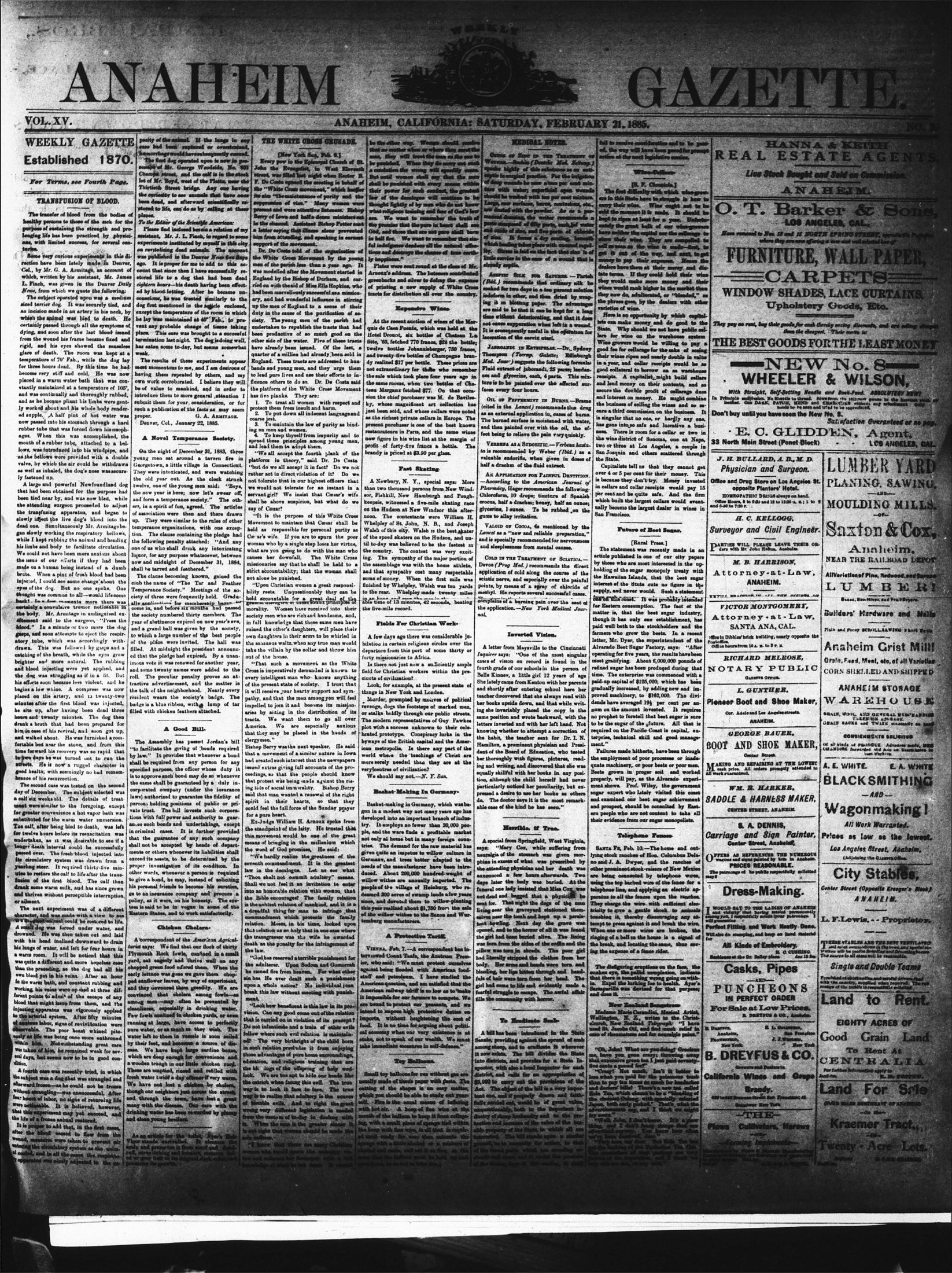
Searchable text
WEEKLY GAZETTE
Established 1870.
For Terms, see Fourth Page.
TRANSFUSION OF BLOOD.
The transfer of blood from the bodies of healthy persons to those of the sick for the purpose of sustaining the strength and prolonging life has been practiced by physicians, with limited success, for several centuries.
Some very curious experiments in this direction have been lately made in Denver, Col., by Mr. G. A. Armitage, an account of which, written by his assistant, Mr. James L. Finch, was given in the Denver Daily News, from which we quote the following:
The subject operated upon was a medium sized terrier dog. It was securely tied, and an incision made in an artery in his neck, by which the animal was bled to death. He certainly passed through all the symptoms of dying, and soon after the last blood issued from the wound his frame became fixed and rigid, and his eyes showed the senseless glare of death. The room was kept at a temperature of 70° Fah., while the dog lay for three hours dead. By this time he had become very stiff and cold. He was now placed in a warm water bath that was constantly maintained at a temperature of 105°F, and was continually and thoroughly rubbed, and as he became pliant his limbs were gently worked about and his whole body rendered supple. A half pint of hot water was now passed into his stomach through a hard rubber tube that was forced down his esophagus. When this was accomplished, the mouth of a rubber tube, attached to a belows, was introduced into his windpipe, and as the bellows were provided with a double valve, by which the air could be withdrawn as well as inhaled, the dog's nose was securely pacity of the animal. If the lungs in any case had been ruptured or overstrained, hemorrhage would have subsequently ensued.
The first dog operated upon is now in possession of Mr. George Woodside, No. 361 Champa street, and the calf is in the stock lot of Mr. Boyd, west of the Platte, near the Thirtieth Street bridge. Any one having the curiosity to see animals that have once been dead, and afterward scientifically restored to life, can do so by calling at these places.
To the Editor of the Scientific American:
Please find enclosed herein a relation of my assistant, Mr. J. L. Finch, in regard to some experiments instituted by myself in this city on revitalizing dead animals. The account was published in the Denver News five days ago. It is proper for me to add to this account that since then I have successfully restored life to a dog that had been dead eighteen hours—his death having been effected by blood-letting. After he became unconscious, he was treated similarly to the dog first mentioned in the article enclosed, except the temperature of the room in which he lay was maintained at 40° Fah., to prevent any probable change of tissue taking place. This ease was brought to a successful termination last night. The dog is doing well, has eaten some day, but seems somewhat weak.
The results of these experiments appear most momentous to me, and I am desirous of having them repeated by others, and my own work corroborated. I believe they will be of value to mankind, and in order to introduce them to more general attention I submit them for your consideration, or for such a publication of the facts as may seem proper.
G. A. ARMITAGE.
Denver, Col., January 22, 1885.
A Novel Temperance Society.
On the night of December 31, 1883, three young men sat around a tavern fire in Georgetown, a little village in Connecticut. They were intoxicated, and were watching capacity of the animal. If the lungs in any case had been ruptured or overstrained, hemorrhage would have subsequently ensued.
The first dog operated upon is now in possession of Mr. George Woodside, No. 361 Champa street, and the calf is in the stock lot of Mr. Boyd, west of the Platte, near the Thirtieth Street bridge. Any one having the curiosity to see animals that have once been dead, and afterward scientifically restored to life, can do so by calling at these places.
To the Editor of the Scientific American:
Please find enclosed herein a relation of my assistant, Mr. J. L. Finch, in regard to some experiments instituted by myself in this city on revitalizing dead animals. The account was published in the Denver News five days ago. It is proper for me to add to this account that since then I have successfully restored life to a dog that had been dead eighteen hours—his death having been effected by blood-letting. After he became unconscious, he was treated similarly to the dog first mentioned in the article enclosed, except the temperature of the room in which he lay was maintained at 40° Fah., to prevent any probable change of tissue taking place. This ease was brought to a successful termination last night. The dog is doing well, has eaten some day, but seems somewhat weak.
The results of these experiments appear most momentous to me, and I am desirous of having them repeated by others, and my own work corroborated. I believe they will be of value to mankind, and in order to introduce them to more general attention I submit them for your consideration, or for such a publication of the facts as may seem proper.
G. A. ARMITAGE.
Denver, Col., January 22, 1885.
THE WHITE CROSS ORUSADE
[New York Sug., Feb. 9.] Every pew in the Episcopal Church of John the Evangelist, in West Elm street, was filled last night when Rector F. De Costa opened the meeting in behalf the "White Cross movement," which has its aim "the maintenance of purity and suppression of vice." Many women present and were attentive listeners. Bisherry of Lawn and half dozen ministers in the church; Assistant Bishop Petter said a letter saying that illness alone prevents him from attending; and speaking in earl support of the movement.
Dr. De Costa told of the organization of the White Cross Movement by the young men of the parish less than a year ago; she modelled after the Movement started England by the Bishop of Durham, and cried on with the aid of Miss Ella Hopkins; who had been marvellously successful as missionary; and had wonderful influence in stirring up the men of England to a sense of duty in the cause of the purification of society. The young men of the parish had undertaken to republish the tracts that he had been productive of so much good on other side of the water. Five of these tracts have already been issued. Of the last quarter of a million had already been sold England. These tracts are addressed to both bands and young men, and they urge them to lead pure lives and use their efforts to influence others to do so. Dr. De Costa said that platform of the White Cross Movement has five planks. They are:
1. To treat all women with respect and protect them from insult and harm.
2. To put down all indecent language and coarse jest.
3. To maintain the law of purity as binding on men and women.
4. To keep thyself from impurity and spread these principles among young men and lead them to adopt them.
"We all accept the fourth plank of this platform in theory," said Dr. De Costa "but do we all accept it in fact? Do we not rather act in direct violation of it?" Do we
A large and powerful Newfoundland dog that had been obtained for the purpose had been tied near by, and was now bled, while the attending surgeon proceeded to adjust the transfusing apparatus, and began to slowly infect the live dog's blood into the dead one. Simultaneously Mr. Armitage began slowly working the respiratory bellows, while I kept rubbing the animal and bending his limbs and body to facilitate circulation. We could not have been more anxious about the sens of our efforts if they had been made on a human being instead of a dumb brute. When a pint of fresh blood had been injected, I could see some change about the eyes of the dog. But no one spoke. One thought was common to all—would life come back! In a few moments more there was certainly a convulsive tremor noticeable in the body. Mr. Armitage undisguised excitement said to the surgeon, "Press the blood." In a minute or two more the dog gasps, and soon attempts to eject the respiratory tube, which was accordingly withdrawn. This was followed by gasps and a catching of the breath, while the eyes grow brighter and more natural. The rubbing and blood injecting were yet applied, and the dog was struggling as if in a fit. But his efforts soon became less violent, and he begins a low whine. A compress was now placed on the artery, and in twenty-two minutes after the first blood was injected, he site up, after having been dead three hours and twenty minutes. The dog then drank a broth that had been prepared for him in case of his revival, and soon got up, and walked about. He was furnished a comfortable bed near the stove, and from this time forward his recovery was so rapid that in two days he was turned out to run the streets. He is now a rugged character in good health, with seemingly no bad remembrance of his resurrection.
The second case was tested on the second day of December. The subject selected was a calf six weeks old. The details of treatment were similar to the foregoing, except for greater convenience a hot vapor bath was substituted for the warm water immersion. The calf, after being bled to death, was left for twelve hours before its resuscitation was undertaken, as it was desirable to see if a longer death interval could be successfully passed over. The fresh-blood injected into its circulatory system was drawn from a yearling steer. It required thirty-five minutes to restore the calf to life after the transfusion of the first blood. The calf then drank some warm milk, and has since grown and thriven without perceptible interruption.
A Novel Temperance Society.
On the night of December 31, 1883, three young men sat around a tavern fire in Georgetown, a little village in Connecticut. They were intoxicated, and were watching the old year out. As the clock struck twelve, one of the young men said: "Boys, the new year is here; now let's swear off, and form a temperance society." The others, in a spirit of fun, agreed. The articles of association were then and there drawn up. They were similar to the rules of other temperance organizations, with one exception. The clause containing the pledge had the following penalty attached: "And any one of us who shall drink any intoxicating liquor, for any purpose whatsoever, between now and midnight of December 31, 1884, shall be tarred and feathered."
The clause becoming known, gained the club name of "The Tar and Feather Temperance Society." Meetings of the society of three were frequently held. Gradually applications for membership began to come in, and before six months had passed the society numbered thirty members. The year of abstinence expired on new year's eve, and a grand ball was given by the society, to which a large number of the beat people of the place were invited. The hall was filled. At midnight the president announced that the pledge had expired. By a unanimous vote it was renewed for another year, and some twenty names were added to the roll. The peculiar penalty proves an attractive advertisement, and the matter is the talk of the neighborhood. Nearly every resident wears the society's badge. The badge is a blue ribbon, with a lump of tar filled with chicken feathers attached.
A Good Bill.
The Assembly has passed Jordan's bill "to facilitate the giving of bonds required by law." It provides that whenever a bond shall be required from any person for any specified purpose, the officer whose duty it is to approve such bond may do so whenever the same shall be guaranteed by a duly incorporated company (under the insurance laws) authorized to guarantee the fidelity of personal holding positions of public or private trust. The bill invests such corporations with full power and authority to guarantee such bonds and undertakings, except in criminal cases. It is further provided that the guarantee of any such company shall not be accepted by heads of departments or others whenever its liabilities shall exceed its assets, to be determined by the proper investigation of its condition. In other words, whenever a person is required to give a bond, he may instead of soliciting his personal friends to become his surtees, go to an insurance company and procure a loan from them repeated by others, and my own work corroborated. I believe they will be of value to mankind, and in order to introduce them to more general attention I submit them for your consideration, or for such publication of the facts as may seem proper.
G.A. ARMITAGE
Denver, Col., January 22, 1885.
A Novel Temperance Society.
On the night of December 31, 1883, three young men sat around a tavern fire in Georgetown, a little village in Connecticut. They were intoxicated, and were watching the old year out. As the clock struck twelve, one of the young men said: "Boys, the new year is here; now let's swear off, and form a temperance society." The others, in a spirit of fun, agreed. The articles of association were then and there drawn up. They were similar to the rules of other temperance organizations, with one exception. The clause containing the pledge had the following penalty attached: "And any one of us who shall drink any intoxicating liquor, for any purpose whatsoever, between now and midnight of December 31, 1884, shall be tarred and feathered."
The clause becoming known, gained the club name of "The Tar and Feather Temperance Society." Meetings of the society of three were frequently held. Gradually applications for membership began to come in, and before six months had passed the society numbered thirty members. The year of abstinence expired on new year's eve, and a grand ball was given by the society, to which a large number of the beat people of the place were invited. The hall was filled. At midnight the president announced that the pledge had expired. By a unanimous vote it was renewed for another year, and some twenty names were added to the roll. The peculiar penalty proves an attractive advertisement, and the matter is the talk of the neighborhood. Nearly every resident wears the society's badge. The badge is a blue ribbon, with a lump of tar filled with chicken feathers attached.
A Good Bill.
The Assembly has passed Jordan's bill "to facilitate the giving of bonds required by law." It provides that whenever a bond shall be required from any person for any specified purpose, the officer whose duty it is to approve such bond may do so whenever the same shall be guaranteed by a duly incorporated company (under the insurance laws) authorized to guarantee the fidelity of personal holding positions of public or private trust. The bill invests such corporations with full power and authority to guarantee such bonds and undertakings, except in criminal cases. It is further provided that the guarantee of any such company shall not be accepted by heads of departments or others whenever its liabilities shall exceed its assets, to be determined by the proper investigation of its condition. In other words, whenever a person is required to give a bond, he may instead of soliciting his personal friends to become his surties, go to an insurance company and procure a loan from them repeated by others, and my own work corroborated. I believe they will be of value to mankind, and in order to introduce them to more general attention I submit them for your consideration, or for such publication of the facts as may seem proper.
G.A. ARMITAGE
Denver, Col., January 22, 1885.
A Novel Temperance Society.
On the night of December 31, 1883, three young men sat around a tavern fire in Georgetown, a little village in Connecticut. They were intoxicated, and were watching the old year out. As the clock struck twelve, one of the young men said: "Boys, the new year is here; now let's swear off, and form a temperance society." The others, in a spirit of fun, agreed. The articles of association were then and there drawn up. They were similar to the rules of other temperance organizations, with one exception. The clause containing the pledge had the following penalty attached: "And any one of us who shall drink any intoxicating liquor, for any purpose whatsoever, between now and midnight of December 31, 1884, shall be tarred and feathered."
The clause becoming known, gained the club name of "The Tar and Feather Temperance Society." Meetings of the society of three were frequently held. Gradually applications for membership began to come in, and before six months had passed the society numbered thirty members. The year of abstinence expired on new year's eve, and a grand ball was given by the society, to which a large number of the beat people of the place were invited. The hall was filled. At midnight the president announced that the pledge had expired. By a unanimous vote it was renewed for another year, and some twenty names were added to the roll. The peculiar penalty proves an attractive advertisement, and the matter is the talk of the neighborhood. Nearly every resident wears the society's badge. The badge is a blue ribbon, with a lump of tar filled with chicken feathers attached.
A Good Bill.
The Assembly has passed Jordan's bill "to facilitate the giving of bonds required by law." It provides that whenever a bond shall be required from any person for any specified purpose, the officer whose duty it is to approve such bond may do so whenever the same shall be guaranteed by a duly incorporated company (under the insurance laws) authorized to guarantee the fidelity of personal holding positions of public or private trust. The bill invests such corporations with full power and authority to guarantee such bonds and undertakings, except in criminal cases. It is further provided that the guarantee of any such company shall not be accepted by heads of departments or others whenever its liabilities shall exceed its assets, to be determined by the proper investigation of its condition. In other words, whenever a person is required to give a bond, he may instead of soliciting his personal friends to become his surties, go to an insurance company and procure a loan from them repeated by others, and my own work corroborated. I believe they will be of value to mankind, and in order to introduce them to more general attention I submit them for your consideration, or for such publication of the facts as may seem proper.
G.A. ARMITAGE
Denver, Col., January 22, 1885.
A Novel Temperance Society.
On the night of December 31, 1883, three young men sat around a tavern fire in Georgetown, a little village in Connecticut. They were intoxicated, and were watching the old year out. As the clock struck twelve,one ofthe young men said: "Boys,the new year is here;now let's swear off,and forma temperance society." The others,in a spiritof fun,agreed.Thearticlesofassociationwerethenandtheredrawedinupontheblemesthatiscommontoallofthepresentstateofsociety.Womenhavereceivedintothessocietymenwhoreallyhandome,andinfullknowledgethatthesemenehmenhaveruinedtheother's daughters,willplacetheowndaughtersintheirarmstobewhirledinthesonanouswaltz,whenanytruemanwouldtakethevillainbythecollarandthrowhimoutofthehouse.
"ItsuchamovementastheWhiteCrossimperativelydemandedisknowntoteveryintelligentmanwhoknowsanythingofthepresentstateofsociety.Itrustthatitwillreceiveyourheartysupportandsympathy,andthatthemenamongyouwillimpelledtojoinitandbecomeitsmissionariesbyaisinginthedistributionoftiracts.WewantthetowgoaloverAmerica.Weareespeciallyanxiousthattheymaybeplacedinthehaudsofclergymen."
Bishop Berrywasthenextspeaker.He saidthatatmovementofsimilarnatureinIowahadcreatedsuchinterestthatthenewspapersissuedextrasgivingfullaccountsfotheproceedings,southerndaughterswouldknowthatprotestwasbeingmadeagaintherisingtideofsocialimmunity.BishopBarrysaidthatmanwantedac renewalofttherightspiritin theirhearts,sothattheycouldfeelthefullforceoftheSundayprayfora Pureheart.
Ex-JudgeWilliamH.Anrnouxspokefromthestandpointofthelaity.Hu trustedthatthismovementwouldbeoneofthegreatmeansbof bringinginthemillenniumwhichthewordOfGodpromises.He said:
"WehardlyrealizethegreatnessoftheseventhcommandmentItisthegreatestlawinthedecalogue.Letusseewhat"Thoushaltnotcommitadultery"means.ShallwenotfeelitannointicipationwithwomanthattheBibleencourages?Thefamilyrelation
The next experiment was of a different character, and was made with a view to see if a drained animal could be restored to life. A small dog was forced under water, and drowned. He was then taken out and laid with his head inclined downward to drain his lungs of water, and left for four hours in a warm room. It will be noticed that this was quite a different and more hopeless case than the preceding, as the dog had all his own blood yet in his veins. After an hour in the warm bath, and constant rubbing and working, his veins were opened at three different points to admit of the escape of any blood that might issue from them, and the injecting apparatus was vigorously applied to the arterial system. After fifty minutes of anxious labor, signs of revivification were observable. The poor beast whined piteously as life was being once more enthroned within him. Notwithstanding great care was taken of him, he remained weak for several days, but seems now to be in good condition.
A fourth case was recently tried, in which the subject was a dog that was strangled and afterward frozen—as he could not be frozen without strangling—was unsuccessful. After four hours of labor, no signs of returning life were noticeable. It is believed, however, that this experiment may yet succeed, and the life of a frozen animal restored.
It is proper to add that, in the first cases, after the blood ceased to flow from the wound, measures were taken to prevent air entering the circulatory system as the animal cooled, and in all the cases the respiration apparatus was nicely adjusted to the ca
Chicken Cholera
A correspondent of the American Agricultural Society says: We find that our stock of thirty Plymouth Rock fowls, confined in a small yard, eat eagerly and thrive well on any chopped green food offered them. When the early lettuce was gone we gave them chopped sunflower leaves, by way of experiment, and they nourished them greedily. We are convinced that cholera among fowls—as among men—may often be prevented by cleanliness, especially in drinking water. Few fowls confined in chicken yards, or even running at large, have access to perfectly pure water, or as much as they wish. The water left to them in vessels is soon soiled by their feet, and becomes a source of disease. We have kept large sardine boxes, which are deep enough for convenience and a wooden trough in our little chicken yard. These are emptied, rinsed and refilled with fresh water twisted a day often if very warm. We have not lost a chicken by cholera, though our neighbors just across the street and through the town, have lost a great many with the disease. Our care with the drinking water has been rewarded by plamp and clean young broilers.
As an article for the toilet, Ayer's Hole Virge stands unrivalled. It cleans the skin and preserves it from scurf and chaffs, oresbiting and blemishes, faded or may harden to its original dark color and promotion its growth.
Spirit in their hearts, so that they could feel the full force of the Sunday prayer for a pure heart.
Ex-Judge William H. Arnoux spoke from the standpoint of the laity. He trusted that this movement would be one of the great means of bringing in the millennium which the word of God promises. He said:
"We hardly realize the greatness of the seventh commandment. It is the greatest law in the decalogue. Let us see what "Thou shalt not commit adultery" means. Shall we not feel it an invitation to enter into an honorable relation with women that the Bible encourages? The family relation is the noblest relation of mankind, and it is a dreadful thing for man to infringe that commandment which protects the family relation. Moses, in his time, looked upon that relation as so holy that in one case where the transgressor was the wife he awarded death as the penalty for the infringement of the law.
"God has reserved a terrible punishment for the adulterer. Upon Sodom and Gomorrah he rained fire from heaven. For what other sin has He ever dealt such a punishment upon a whole nation? No individual can break this law without meeting with punishment."
"Look how beneficent is this law in its provision. Can any good come out of the relation that is carried on in violation of its precept? Do not infanticide and a train of other evils follow where such evil relation is maintained? The very birthright of the child born in such relation precludes it from enjoying those advantages of pure home surroundings, education, and religious training that are the blithes of the offspring of holy wedlock. We are too apt to hide our heads like the catrich when facing this evil. The true way is to look it face to face. The true way is to realize that adultery is the source of terrible evils. And to right the great wrong very different legislation is needed from the custom of to-day in dealing with it. When the man is the greater sinner it is not right that woman should be made the sole sufferer."
ANAHEIM, CALIFORNIA: SATURDAY, FEBRUARY 21. 1885.
WHITE CROSS CRUSADE.
New York Sun, Feb. 9.] New in the Episcopal Church of St. Evangelist, in West Elvethen filled last night when Rector B. the opened the meeting in behalf of the Cross movement," which hangs the maintenance of purity and the cause of vice." Many women were attentive listeners. Bishop Town and half a dozen ministers sent Assistant Bishop Potter sent saying that illness alone prevented attending, and speaking in earnest the movement.
Costa told of the organization of Cross Movement by the young parish less than a year ago. It led after the Movement started in the Bishop of Durham, and carried the aid of Miss Ella Hopkins, who marvelously successful nas mission and wonderful influence in stirring England to a sense of their cause of the purification of so many young men of the parish had to republish the tracts that had active of so much good on the face of the water. Five of these tracts have been issued. Of the last, a million had already been sold in These tracts are addressed to husbands men, and they urge them to live and use their efforts to insure to do so. Dr. De Costa said of the White Cross Movement banks. They are: great all women with respect and love from insult and harm. It down all indecent language and maintain the law of purity as bind-ground women. Up thyself from impurity and to principles among young men, men to adopt them. Accept the fourth plank of the theory," said Dr. De Costa all accept it in fact? Do we not direct violation of it? Do we be the other way. Women should runve that no matter when or where they meet the man, they will treat the man as the one to be punished. When they do curry out such a resolution the wrong will spontily come. But until women shall say that the man shall be punished with every means within their power for each conduct, the greatest law of the deslogne will continue to be thought lightly of by men who do not know what religious training and fear of God's law are. We want to remember the truth of the promise that the pure in heart shall see God, and those that are not pure shall burn in hall fire. We want to remember that sinful indulgence deadens all the natural affections and destroys the chance of true earthly happiness."
Plates were sent round at the close of Mr. Arnoux's address. The listeners contributed greenbacks and silver to defray the expense of printing a new supply of White Cross tracts for distribution all over the country.
Expensive Wines.
At the recent auction of wines of the Marquis de Casa Fuente, which was held at the Hotel Dronot, six bottles of Chateau La fitte, '65, fetched 770 francs, $24 the bottle; twelve bottles Johannisberger, 750 francs, and twenty-five bottles Champagne brandy realized $17 per bottle. These prices are not extraordinary for those who remember the sale which took place four years ago in the same rooms, when two bottles of Chateau Margaux fetched $77. On that occasion the chief purchaser was M. de Bavilesky, whose magnificent art collection has just been sold, and whose cellars were noted as the richest private cellars in Europe. The present purchaser is one of the best known restaurateurs in Paris, and the same wines now figure in his wine list at the margin of profit of forty-five francs a bottle. The brandy is priced at $3.50 per glass.
Fast Skating.
MEDICAL NOTES.
Oxine as Zinc in THE TREATMENT OF WOMEN—Sochin (Deutsche Med. Zahnp.) speaks highly of this substance as an anti-neptile in surgical practice. For the irrigation of deep wounds he uses a ten per cent mixture with water; superficial open wounds should be washed with ten per cent mixture. Large, raw surfains, burnt ointments, etc., new dusted with the powder. As as a permanent dressing, the writer recommends a paste composed of fifty parts, each lot water and oxide of zinc, and five parts of chloride of zinc. It forms a dry coating, breath which healing takes place with annual regality. Stress is laid on the fact that nine is of little service in the case of a wound that is already septica.
ASPTIC SILK FOR SATURDAY — Partah (Ibid.) recommends that ordinary silk be maaked for two days in a ten percent solution iodeform in either, and then dried by wrapping it in blotting paper. The advantages are said to be that it can be kept for a long time without deteriorating, and that it does not cause suppuration when left in a wound. It is consequently useful in the operation for laceration of the cervix uteri.
JABROANDI IN ERVIBIPELAR — Dr., Sydney Thompson (Tecrap. Galette; Edinburgh Med. Jour.) suggests the following formula: Fluid extract of jaborandi, 25 parses; laudanum and glycerine, each, 4 parts. This mixture is to be painted over the affected surfaces every four hours.
Oil OF PEPPERMINT IN BURNS — Brame (cited in the Lancet) recommends this drug as an external application in cases of burns. The burned surface is moistened with water, and then painted over with the oil, the effect being to relieve the pain very quickly.
VERBENA AS A SUDORITIC — Verbina hastata is recommended by Weber (Ibid.) as a valuable sudorific, when given in doses of half a drachm of the fluid extract.
As APPLICATION FOR PAYMENT DURING
fail to receive consideration unless they would have been paid at the next legislative session.
Wine-Gallium.
[S. F. Chronicle].
The first difficulty with which are in this State have to struggle carry their wine. Wine growers sold the moment it is made haunt to ripen at least for a year nutrally the great bulk of our wine have neither the capital nor their wine. They are still as soon as the wine is not got it out of the way, nor money to pay their expenses dealers have them at their mate terms. If they could hold they would make more wines would rank higher in their they now do, adulterated, or "the phrase goes, by the dealer variety of wine.
Here is no opportunity by wineists can make money and do State. Why should we not have lace for wine on the warehouses Wine growers would be willing good fee for cellarage for the sale their wines ripen and nearly die in a year, and cellar receipts good collateral to borrow on receipts. A capitalist might lend and lend money on their contract secure the double profit of cash and interest on money. He must business of selling the wines cure a third commission on the sale is singular that no one, or hardly has gone into so safe and lucrative ness. There is room for a cellar the wine district of Sonoma, two or three at Los Angeles, San Josquin and others scattered State.
Capitalists tell us that they over 4 or 5 per cent for their ness
Fast Skating
A Newbury, N. Y., special says: More than two thousand persons from New Windsor, Fishkill, New Hamburg and Poughkeepsie, witnessed a five-mile skating race on the Hudson at New Windsor this afternoon. The contestants were William H. Whalley of St. John, N. B., and Joseph Walsh of this city. Walsh is the best skater of the speed skaters on the Hudson, and until today was believed to be the fastest in the country. The contest was very exciting. The sympathy of the major portion of the assemblage was with the home athlete, and that sympathy cost many respectable sums of money. When the first mile was finished by Whalley, Walsh was ten yards to the rear. Whalley made twenty miles in an hour and man the man in the able time of 13 minutes, 42 seconds, beating the five-mile record.
Fields For Christian Work
A few days ago there was considerable jubilation in certain religious circles over the departure from this port of some thirty or forty missionaries to Africa.
Is there not just now a sufficiently ample field for Christian workers within the precincts of civilization?
Look, for example, at the present state of things in New York and London.
Murder, prompted by motives of political revenge, dogs the footsteps of marked men, or stalks boldly through our public streets. The modern representatives of Guy Fawkes plot with a success unknown to their celebrated prototype. Conspiracy lurks in the byways of the British capital and the American metropolis. Is there any part of the world where the teachings of Christ are more sorely needed than they are at the very leastcourses of civilization?
We should say not.—N. Y. Sun.
Basket-Making In Germany
Basket-making in Germany, which was begun in a modest way not many years ago has developed into an important branch of industry. It employs no fewer than 20,000 people, and the ware finds a profitable market not only at home but in many foreign countries. The demand for the raw material has given quite an impetus to willow culture in Germany, and trees better adapted to the needs of the manufacturer have been introduced. About 200,000 hundred-weight of willow winters are annually imported. The people of the village of Heinburg, who deserved 200 acres of swamp lands a few years ago which took place four years ago in the same rooms, when two bottles of Chateau Margaux fetched $77. On that occasion the chief purchaser was M. de Bavilesky, whose magnificent art collection has just been sold, and whose cellars were noted as the richest private cellars in Europe. The present purchaser is one of the best known restaurants in Paris, and the same wines now figure in his wine list at the margin of profit of forty-five francs a bottle. The brandy is priced at $3.50 per glass.
Fast Skating
A Newbury, N. Y., special says: More than two thousand persons from New Windsor, Fishkill, New Hamburg and Poughkeepsie, witnessed a five-mile skating race on the Hudson at New Windsor this afternoon. The contestants were William H. Whalley of St. John, N. B., and Joseph Walsh of this city. Walsh is the best skater of the speed skaters on the Hudson, and until today was believed to be the fastest in the country. The contest was very exciting. The sympathy of the major portion of the assemblage was with the home athlete, and that sympathy cost many respectable sums of money. When the first mile was finished by Whalley, Walsh was ten yards to the rear. Whalley made twenty miles in an hour and man the man in the able time of 13 minutes, 42 seconds, beating the five-mile record.
Fields For Christian Work
A few days ago there was considerable jubilation in certain religious circles over the departure from this port of some thirty or forty missionaries to Africa.
Is there not just now a sufficiently ample field for Christian workers within the precincts of civilization?
Look, for example, at the present state of things in New York and London.
Murder, prompted by motives of political revenge, dogs the footsteps of marked men, or stalks boldly through our public streets. The modern representatives of Guy Fawkes plot with a success unknown to their celebrated prototype. Conspiracy lurks in the byways of the British capital and the American metropolis. Is there any part of the world where the teachings of Christ are more sorely needed than they are at the very leastcourses of civilization?
We should say not.—N. Y. Sun.
Basket-Making In Germany
Basket-making in Germany, which was begun in a modest way not many years ago has developed into an important branch of industry. It employs no fewer than 20,000 people, and the ware finds a profitable market not only at home but in many foreign countries. The demand for the raw material has given quite an impetus to willow culture in Germany, and trees better adapted to the needs of the manufacturer have been introduced. About 200,000 hundred-weight of willow winters are annually imported. The people of the village of Heinburg, who deserved 200 acres of swamp lands a few years ago which took place four years ago in the same rooms, when two bottles of Chateau Margaux fetched $77. On that occasion the chief purchaser was M. de Bavilesky, whose magnificent art collection has just been sold, and whose cellars were noted as the richest private cellars in Europe. The present purchaser is one of the best known restaurateurs in Paris, and the same wines now figure in his wine list at the margin of profit of forty-five francs a bottle. The brandy is priced at $3.50 per glass.
Fast Skating
A Newbury, N. Y., special says: More than two thousand persons from New Windsor, Fishkill, New Hamburg and Poughkeepsie, witnessed a five-mile skating race on the Hudson at New Windsor this afternoon. The contestants were William H. Whalley of St. John, N. B., and Joseph Walsh of this city. Walsh is the best skater of the speed skaters on the Hudson, and until today was believed to be the fastest in the country. The contest was very exciting. The sympathy of the major portion of the assemblage was with the home athlete, and that sympathy cost many respectable sums of money. When the first mile was finished by Whalley, Walsh was ten yards to the rear. Whalley made twenty miles in an hour and man the man in the able time of 13 minutes, 42 seconds, beating the five-mile record.
Fields For Christian Work
A few days ago there was considerable jubulation in certain religious circles over the departure from this port of some thirty or forty missionaries to Africa.
Is there not just now a sufficiently ample field for Christian workers within the precincts of civilization?
Look, for example, at the present state of things in New York and London.
Murder, prompted by motives of political revenge, dogs the footsteps of marked men, or stalks boldly through our public streets. The modern representatives of Guy Fawkes plot with a success unknown to their celebrated prototype. Conspiracy lurks in the byways of the British capital and the American metropolis. Is there any part of the world where the teachings of Christ are more sorely needed than they are at the very leastcourses of civilization?
We should say not.—N. Y. Sun.
Basket-Making In Germany
Basket-making in Germany, which was begun in a modest way not many years ago has developed into an important branch of industry. It employs no fewer than 20,000 people, and the ware finds a profitable market not only at home but in many foreign countries. The demand for the raw material has given quite an impetus to willow culture in Germany, and trees better adapted to the needs of the manufacturer have been introduced. About 200,000 hundred-weight of willow winters are annually imported. The people of the village of Heinburg, who deserved 200 acres of swamp lands a few years ago which took place four years ago in the same rooms, when two bottles of Chateau Margaux fetched $77. On that occasion the chief purchaser was M. de Bavilesky, whose magnificent art collection has just been sold, and whose cellars were noted as the richest private cellars in Europe. The present purchaser is one of the best known restaurateurs in Paris, and the same wines now figure in his wine list at the margin of profit of forty-five francs a bottle. The brandy is priced at $3.50 per glass.
Fast Skating
A Newbury, N. Y., special says: More than two thousand persons from New Windsor, Fishkill, New Hamburg and Poughkeepsie, witnessed a five-mile skating race on the Hudson at New Windsor this afternoon. The contestants were William H. Whalley of St. John, N. B., and Joseph Walsh of this city. Walsh is the best skater of the speed skaters on the Hudson, and until today was believed to be the fastest in the country. The contest was very exciting. The sympathy of the major portion of the assemblage was with the home athlete, and that sympathy cost many respectable sums of money. When the first mile was finished by Whalley, Walsh was ten yards to the rear. Whalley made twenty miles in an hour and man the man in the able time of 13 minutes, 42 seconds, beating the five-mile record.
Fields For Christian Work
A few days ago there was considerable jubulation in certain religious circles over the departure from this port of some thirty or forty missionaries to Africa.
Is there not just now a sufficiently ample field for Christian workers within the precincts of civilization?
Look, for example, at the present state of things in New York and London.
Murder, prompted by motives of political revenge, dogs the footsteps of marked men, or stalks boldly through our public streets. The modern representatives of Guy Fawkes plot with a success unknown to their celebrated prototype. Conspiracy lurks in the byways ofthe British capital andthe American metropolis.Is there any part ofthe world wherethe teachingsofChristaremoresorelyneededthantheyareattheveryleastcoursesof civilization?
We should say not.-N.Y.Sun.
Basket-Making In Germany
Basket-making in Germany, which was begun in a modest way not many years ago has developed into an important branch of industry. It employs no fewer than 20,000 people,andthewarefindsa profitablemarketnotonlyathomebutinmanyforeigncountries.ThedemandfortherawmaterialhasgivenquiteanimpetustowillowcultureinGermany,andtreesbetteradaptedtocheekindemandsofwriting,anddiscoveredthatshewasreadwithherbooksupsidedown,andthatwhilewritingsheinvariablyplacedthecopyinthesamepositionandwrotebackward,theletters invertedandwithherlefthand.Notknowing whethertoattempta correctionofthehabit,theteacher sentforDr.I.N.Hamilton,aprominentphysicianandPresidentofTheBoardOfEducation,thetestedherthoroughlywithfigures,pictures,readingandwriting,anddiscoveredthatshewasequallyskillfulwithherbooksinanyposition althoughthechildherselfhadneparticularly noticedherpeculiarity,butexpressedadefaultuseherbooksasothersdo.Thedoctor says itisthemostremarkablecaseofthekindhehasseen."
Herrible If True
A special from Springfield, West Virginia,says: "Mary Cox ,while sufferingfromneuralgiaofthe stomachwasgivenmorphineinexcessofwhatwasprescribedbytheattendingphysicianandherdeathwasannounceda fewhoursafterwards.Twodayslaterthebodywasburied.Atthefuneralone lady insisted thatMissCoxwasnotdeadandbeggedthataphysicianbeacceptedbecauseofthefungescounteringtheevidencefromoursugarmonkey."
Basket-making in Germany, which was begun in a modest way not many years ago has developed into an important branch of industry. It employs no fewer than 39,000 people, and the ware finds a profitable market not only at home but in many foreign countries. The demand for the raw material has given quite an impetus to willow culture in Germany, and trees better adapted to the needs of the manufacturer have been introduced. About 200,000 hundred-weight of willow withes are annually imported. The people of the village of Heinburg, who redeemed 300 acres of swamp lands a few years since, and devoted them to willow-planting this year realized about $1,750 from the sale of the willow withes to the Saxon and Wurtemburg manufacturers.
A Protective Tariff.
VIENNA, Feb. 7.—A correspondent has interviewed Count Taaffe, the Austrian Premier, who said: "We must protect ourselves against being flooded with American foodstuff and petroleum. I have studied the American question, and am satisfied that the American railway tariff is no low as to make it impossible for our farmers to compete. We are bound to protect our peasants, and we intend to impose high protective duties on imports, without heightening the cost of food. It is no time for arguing about political economy when our very existence is at stake, not to speak of our wealth. We must take immediate measures in self-defense."
Toy Balloons.
Small toy balloons for use without gas are usually made of tissue paper with paste. The cutting of the shapes is an easy matter, which you should be able to study out yourself. Fire is the usual means of inflating with hot air. A hoop of fine wire at the mouth of the balloon to keep it from collapsing, with a small piece of sponge tied within the hoop with fine wire, is all that is required until ready for use. Then materials like spheres with a little alcohol or a mixture of alcohol and water, and cut if on fire, are used until they hold up well.
The doctor says it is the most remarkable case of the kind he has seen."
Horrible, if True.
A special from Springfield, West Virginia, says: "Mary Cox, while suffering from neuralgia of the stomach was given morphine in excess of what was prescribed by the attending physician and her death was announced a few hours afterwards. Two days later the body was buried. At the funeral one lady insisted that Mice Cox was not dead and begged that a physician be sent for. That night the dept of the man living near the graveyard stationed themselves near the tomb and kept up a persistent howling. Next day the grave was opened, and to the horror of all it was found the girl had been buried alive. The lining was torn from the sides of the coffin and the pillow was torn in shreds. The poor girl had literally stripped the clothes from her body. Her arms and hands were torn and bleeding, her lips bitten through and handfuls of hair were torn from her head. The girl had come to life and evidently made a fearful struggle to escape. The awful affair fills the community with horror.
To Handle Snake
A bill has been introduced in the State Senate, providing against the spread of snakes among sheep, and to eradicate it wherever it now exists. The bill divides the State into districts, and provides for a State Inspector, with also a local Inspector for each district, and calls for an appropriation of $5,000 to carry out the provisions of the Act. The object of the bill is a very important one, and if properly drawn and faithfully carried out, would be of great value, unquestionably both to the Important Industry of sharp huskhandry and to the protection and insurance of the value of the valuable property of the State, in which all are interested. The bill stands upon a similar ground, so that of the intact parts which are invading wounds and burns and injuries of the living form of the snake, in which all are interested.
The disfiguring eruptions on the snaken eye, the pallid complexion that there is something wrong going in. Expal the lurking foe to heal Samparilla was devised for that and does it.
New Zealand Seminar
Madame Marie Carandini, Music Wallington, N. Z., writes to the church, New Zealand Telegraph; used St. Jacoba Oil, and find much ease in rheumatism and for neural disorders.
"Oh John! What are you doing me, have you gone crazy; throw that expensive green tea I just put five cents a pound for?"
"Crazy! Not much. I'm it less what you paid for the poison than to pay ten times its much for doctors' bills! There's a new Hola Tea, which clams to be a "the chinese Onang with specially Japan, both early piñach." That's advertisements my, and I think try some."
"Well John, I don't know. In thing, and I don't fancy things advertised anyway. You know I've been deceived dear."
"Very fine, say dear. That Hola put the husband of the Worlandton woman in his own place," and I wish I could examine our best sugar adverbs prospectively should be consulted earlier people who are not content their evidence from our sugar more closely examined our best sugar adverbs prospectively should be consulted earlier people who are not content their evidence from our sugar more closely examined our best sugar adverbs prospectively should be consulted earlier people who are not content their evidence from our sugar more closely examined our best sugar adverbs prospectively should be consulted earlier people who are not content their evidence from our sugar more closely examined our best sugar adverbs prospectively should be consulted earlier people who are not content their evidence from our sugar more closely examined our best sugar adverbs prospectively should be consulted earlier people who are not content their evidence from our sugar more closely examined our best sugar adverbs prospectively should be consulted earlier people who are not content their evidence from our sugar more closely examined our best sugar adverbs prospectively should be consulted earlier people who are not content their evidence from our sugar more closely examined our best sugar adverbs prospectively should be consulted earlier people who are not content their evidence from our sugar more closely examined our best sugar adverbs prospectively should be consulted earlier people who are not content their evidence from our sugar more closely examined our best sugar adverbs prospectively should be consulted earlier people who are not content their evidence from our sugar more closely examined our best sugar adverbs prospectively should be consulted earlier people who are not content their evidence from our sugar more closely examined our best sugar adverbs prospectively should be consulted earlier people who are not content their evidence from our sugar more closely examined our best sugar adverbs prospectively should be consulted earlier people who are not content their evidence from our sugar more closely examined our best sugar adverbs prospectively should be consulted earlier people who are not content their evidence from our sugar more closely examined our best sugar adverbs prospectively should be consulted earlier people who are not content their evidence from our sugar more closely examined our best sugar adverbs prospectively should be consulted earlier people who are not content their evidence from our sugar more closely examined our best sugar adverbs prospectively should be consulted earlier people who are not content their evidence from our sugar more closely examined our best sugar adverbs prospectively should be consulted earlier people who are not content their evidence from our sugar more closely examined our best sugar adverbs prospectively should be consulted earlier people who are not content their evidence from our sugar more closely examined our best sugar adverbs prospectively should be consulted earlier people who are not content their evidence from our sugar more closely examined our best sugar adverbs prospectively should be consulted earlier people who are not content their evidence from our sugar more closely examined our best sugar adverbs prospectively should be consulted earlier people who are not content their evidence from our sugar more closely examined our best sugar adverbs prospectively should be consulted earlier people who are not content their evidence from our sugar more closely examined our best sugar adverbs prospectively should be consulted earlier people who are not content their evidence from our sugar more closely examined our best sugar adverbs prospectively should be consulted earlier people who are not content their evidence from our sugar more closely examined our best sugar adverbs prospectively should be consulted earlier people who are not content their evidence from our sugar more closely examined our best sugar adverbs prospectively should be consulted earlier people who are not content their evidence from ourugar more closely examined our bestugar more closely examined ourbestugarmorecloselyexaminedourbestugarmorecloselyexaminedourbestugarmorecloselyexaminedourbestugarmorecloselyexaminedourbestugarmorecloselyexaminedourbestugarmorecloselyexaminedourbestugarmorecloselyexaminedourbestugarmorecloselyexaminedourbestugarmorecloselyexaminedourbestugarmorecloselyexaminedourbestugarmorecloselyexaminedourbestugarmorecloselyexaminedourbestugarmorecloselyexaminedourbestugarmorecloselyexaminedourbestugarmorecloselyexaminedourbestugarmorecloselyexaminedourbestugarmorecloselyexaminedourbestugarmorecloselyexaminedourbestugarmorecloselyexaminedourbestugarmorecloselyexaminedourbestugarmorecloselyexaminedourbestugarmorecloselyexaminedourbestugarmorecloselyexaminedourbestugarmorecloselyexaminedourbestugarmorecloselyexaminedourbestugarmorecloselyexaminedourbestugarmorecloselyexaminedourbestugarmorecloselyexaminedourbestugarmorecloselyexaminedourbestugarmorecloselyexaminedourbestugarmorecloselyexamines
GAZETTE.
RY 21. 1885.
fail to receive consideration and to be pursued, the way will have been proved for prompt action at the next legislative session.
Wine Cellars
[S. F. Chronicle.]
The first difficulty with which wine-growers in this State have to struggle is how to carry their wine. Wine ought not to be sold the moment it is made. It should be kept to ripen at least for a year. Unfortunately the great bulk of our wine-growers have neither the capital nor the collage to store their wine. They are compelled to sell as soon as the wine is made—first, to get it out of the way, and next, to get money to pay their expenses. Hence the dealers have them at their mercy and dictate terms. If they could hold their wine they would make more money and their wines would rank higher in the market than they now do, adulterated, or "blended," as the phrase goes, by the dealers with other variation of wine.
Here is no opportunity by which capitalists can make money and do good to the State. Why should we not have public cellars for wine on the warehouse system? Wine growers would be willing to pay a good fee for cellarage for the sake of selling their wines ripen and nearly double in value in a year, and cellar receipts would be as good collateral to borrow on as warehouse receipts. A capitalist might build cellars and lend money on their contents, and so secure the double profit of cellarage dues and interest on money. He might combine the business of selling the wines and no secure a third commission on the business. It is singular that no one, or hardly any one, has gone into so safe and lucrative a business. There is room for a cellar or two in the wine district of Sonoma, one at Napa, two or three at Los Angeles, a couple in San Joquin and others scattered through the State.
Capitalists tell us that they cannot get over 4 or 5 per cent for their money. This
HANNA & KEITH
REAL ESTATE AGENTS
Live Stock Bought and Sold on Commission.
ANAHEIM.
O. T. Barker & Sons,
LOS ANGELES, CAL.
Have removed to Nov. 13 and 15 NORTH SPRING STREET, opposite the Poplar where they are one offering a new and well related line of
FURNITURE, WALL PAPER,
CARPETS
WINDOW SHADES, LACE CURTAINS,
Upholstery Goods, Eto.
They pay no rent, buy their goods for cash thereby saving discounts, and are asking almost than the cheapest. Their motto is:
THE BEST GOODS FOR THE LEAST MONEY
NEW No. 8
WHEELER & WILSON,
With Straight, Self-Setting Needle and Such-Feed. ABSOLUTely NEW!
In Principle and Jokeism. No Shuttle to thread. Sew from the thinner gauge to the heaviest cloth or leather. One DARK, PATUH, MEND and EMBRIDER without any attachment. Only needs to be seen and tried to be approached.
Don't buy until you have seen the New No. 8.
Satisfaction Guaranteed or no pay.
E. C. GLIDDEN, Agent,
33 North Main Street (Ponet Block)
LOS ANGELES, CAL.
J. H. BULLARD, A. D., M. D.
Physician and Surgeon.
LUMBER YARD
WHEELER & WILSON,
With Straight, Self-Setting Needle and Bush-Feed. ABSOLUTEOFT NEW!
In Principle andademen. No Shuttle to thread. Sew from the thinner game to the heavier cloth or leather. On DARK, PATUM, MEND and EMROFFIX without any attachment. Only needs to be seen and tried to be appreciated.
Don't buy until you have seen the New No. 8.
Satisfaction Guaranteed or no pay.
E. C. GLIDDEN, Agent,
33 North Main Street (Ponet Block) LOS ANGELES, CAL.
Future of Beet Sugar.
[Rural Press.]
The statement was recently made in an article published in one of our city papers by those who are most interested in the upholding of the sugar monopoly treaty with the Hawaiian Islands, that the best sugar interest of the State cuts no figure in the supply, and never would. Such a statement off this coast. It was probably intended for Eastern consumption. The fact of the matter is, that the best sugar industry, though it has only one establishment, has laid well both to the stockholders and the farmers who grow the beets. In a recent letter, Mr. Dyer, the superintendent of the Alvarado Beet Sugar Factory, says: "After operating for five years, the results have been good gratifying. About 6,000,000 pounds of refined sugar has been produced during that time. The enterprise was commenced with a mid-up capital of $125,000, which has been gradually increased, by adding new and improved machinery, to $162,000. The dividends have averaged 19% per cent per annum on the amount invested. It requires prophet to foretell that beet sugar is sure to be the sugar of the future. All that is required on the Pacific Coast is capital, enterprise, technical skill and good management."
Failures made hitherto, have been through the employment of poor processes or inadequate machinery, or poor beets or pour men. Beets grown in proger soil and worked properly, will pay, as the Alvarado experiment shows. Prof. Wiley, the government sugar expert who lately visited this coast and examined our beet sugar achievement and prospect, should be consulted by East-people who are not content to take all their evidence from our sugar monopolists.
Telephone FenceSanta Fe, Feb. 10.—The home and outgoing stock ranches of Hom. Columbus Delaware and J. A. Dwyer, and the ranches of near prominent stock-raisers of New Mexico being connected by telephone wires, bring the top barbed wire of the fence for a telephone line, and applying an electric apparatus to all the fences upon the ranches.
J. H. BULLARD, A.B., M.D.
Physician and Surgeon.
Office and Drug Store on Los Angeles St. opposite Planters' Hotel.
HOMEOPATHIC DRUGS always on hand.
Office Hours, 8 to 9:30 and 12 to 12:30 a.m.; 1 to 2 and 6:30 to 7:30 p.m.
H. C. KELLOGG,
Surveyor and Civil Engineer.
PARTIES WILL PLEASE LEAVE THEIR ORDERS with Mr. John Habma, Anaheim.
M. B. HARRISON,
Attorney-at-Law.
ANAHEIM.
VICTOR MONTGOMERY,
Attorney-at-Law,
SANTA ANA, CAL.
Office in Dibbles' brick building, nearly opposite the Postoffice.
Office hours from 10 a.m. to 3 p.m.
RICHARD MELROSE,
NOTARY PUBLIC
GAENTY OFFICE.
L. GUNTHER,
Pleneer Boot and Shoe Maker,
Cor. Adele and Los Angeles streets.
ANAHEIM.
GEORGE BAUER,
BOOT AND SHOE MAKER,
Center Street.
MAKING AND REPAIRING AT THE LOWEST cash price. All orders promptly attended to All work guaranteed.
WM. E. HARKER,
SADDLE & HARNESS MAKER,
CENTER STREET, ANAHEIM.
S. A. DENNIS,
Carriage and Sign Painter,
Center Street, Anaheim.
OFFERS AS REFERENCES THE NUMEROUS weapons and sign painted by him in Anaheim.
PRICES REASONABLE.
The patronage of he public respectfully solicited mays.
LUMBER YARD PLANING. SAWING.
AND MOULDING MILLS.
OF Saxton & Cox,
Anaheim.
NEAR THE RAILROAD DEPOSIT
All Varieties of Pine, Redwood,and Sarasota LUMBER
Bases,Bos-Hives,and Fruit Dryers.
Builders' Hardware and Nails
Plain and Fine SCROLL SAWING Short Bits
Anaheim Grist Mill!
Grain,Feed,Meal,etc.of all Varieties CORN SHELLED AND SHIPPED
ANAHEIM STORAGE WAREHOUSE
GRAIN,WOOL AND OTHER MERCHANDISES TAKEN ON AGRACE
GRAIN BACKS AND TWINE constantly on hand
CONSIGNMENTS SOLICITED
Of all kinds of PRODUCE Advances made,MERCHANTS forwarded and paid on Commission in best Markers.
A.E. WHITE.
E.A.WHITE BLACKSMITHING
AND
Wagonmaking!
All Work Warranted.
Prices as low as the lowest.
Los Angeles Street,Anaheim.
(Adjoining the Gaentine Office).
City Stables,
Center Street (Opposite Kreager's Block)
ANAHEIM
Telephone Females
Santa Fe, Feb. 10.—The home and outstanding stock ranches of Hon. Columbus Delandy and J. A. Dwyer, and the ranches of
other prominent stock-raisers of New Mexico
being connected by telephone wires,
using the top barbed wire of the fence for a
telephone line, and applying an electric apratue to all the fences upon the ranches,
they charge the wire with sufficient eleccity to give a gentle shock to animals
catching it, thereby discouraging any abrupt to press against it and break the wire.
When one or more wires are broken, the
aging of a ball in the house is a signal of
break, and locating the same, thus saver the expense of a fence rider.
The disfiguring eruptions on the face, the
skin eye, the pallid complexion, indicate
that there is something wrong going on withExpel the lurking foe to health. Ayer's
naparilla was devised for that purpose;
and does it.
New Zealand Semi-drum
Madame Marie Caraudini, Musical Artist,
Willington, N. Z., writes to the Christurch, New Zealand Telegraph: "I have
had Sk. Jacoba Oil, and find much relief in
of rheumatism and for neuralgie pain."
Oh John! What are you doing? Gracious
have you gone crazy; throwing away
expensive green tea I just paid seventycents a pound for?"
Crazy! Not much. Im's it better to
what you paid for the painless trash
to pay ten times as much for hand-scales
doctors' bills? There's a new tea called
Ten, which claims to be a "blinding of
christmas Oaks with specially selected
miles both early plucked." That's what the
artifacts my, and I think we might
sure."
Well John, I don't know. It's a new
grain, and I don't fancy things that are
without anyway. You have how often
we have deformed corn.
Very fine, my dear. But Mills Ten has
the business of the Farmlands Ten. One
of them is of that kind and very good.
And I think we are not sure.
S. A. DENNIS,
Carriage and Sign Painter,
Center Street, Anaheim,
OFFERS AS REFERENCES THE NUMEROUS
warrons and signs painted by him in Anaheim.
PRICES REASONABLE.
The patronage of he public respectfully solicited
Dress-Making.
WOULD SAY TO THE LADIES OF ANAHEIM
and vicinity that having settled permanently
among you, I respectfully solicit your patronage.
I will guarantee.
Perfect Fitting and Work Neatly Done.
Will also do stamping, and keep on hand material
for
All Kinds of Embroidery.
H. C. CUSHING.
Residence at the Dr. Bailey place.
Dec 18 Sun
Casks, Pipes
AND PUNCHEONS
IN PERFECT ORDER
For Sale at Low Prices.
B. DREYFUS & CO., Anaheim.
R. DARBYSON,
Annaheim,
New York.
B. DREYFUS & CO.
Growers and Dealers in
California Wines and Grape
Brandy.
620 to 650 Brannan Street Sub Branch; 48
Brandway New York.
THEPlews Cultivators, Harrows
FORMING IMPLEMENTS
Handmade by Plants & Diseases Specialists and growers in Anaheim.
Wagonmaking!
All Work Warranted.
Prices as low as the lowest.
Los Angeles Street, Anaheim.
City Stables,
Center Street (Opposite Kreeger's Bloch)
ANAHEIM.
L. F. Lewis.- Proprietor.
THERE STABLES ARE THE BEST VENTILATED
and most comfortable in the room, and special actions will be paid to Boarding and Grooming here.
The course in all cases will be reasonable.
Single and Double Teams
Permitted at short notice and careful driver's land
with the country, supplied when required. The rent
toonage of the public is responsibly solicited.
Land to Rent.
EIGHTY ACRES OF
Good Grain Land
To Rent At
CENTRALIA
For further information apply to
Jardim.
Land For Sale
(Your Miles Northeast of Anaheim)
On the:
Kraemer Tract,
Twenty - Acre Lots.