anaheim-gazette 1885-02-14
Scanned page
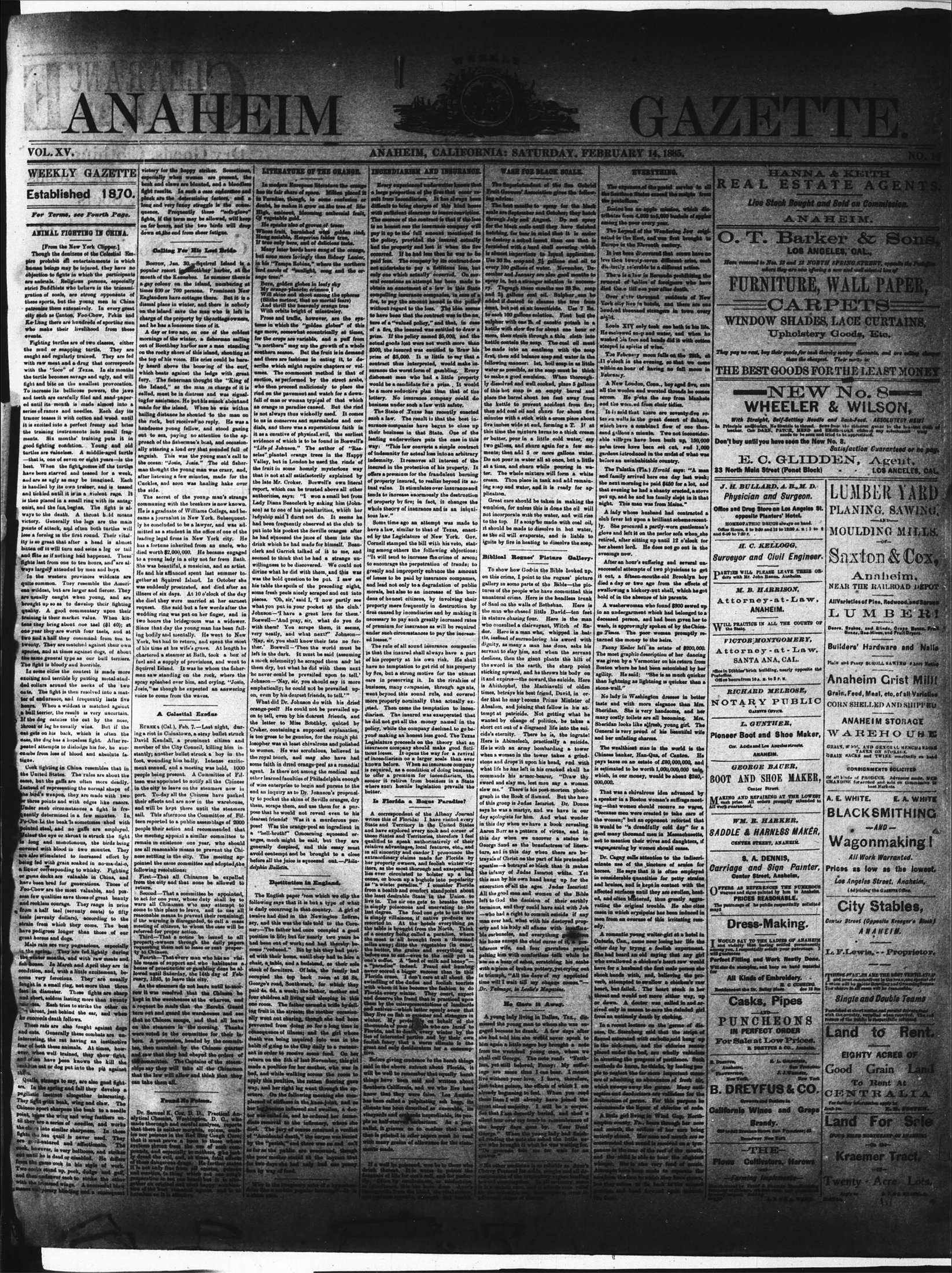
Searchable text
ANAHEIM
VOL. XV.
WEEKLY GAZETTE
Established 1870.
For Terms, see Fourth Page.
ANIMAL FIGHTING IN CHINA.
[From the New York Clipper.]
Though the denizens of the Celestial Empire prohibit all entertainments in which human beings may be injured, they have no objection to fights in which the participants are animals. Religious persons, especially strict Buddhists who believe in the transmi- migration of souls, are strong opponents of these sports, but the young men in China patronize them extensively. In every great city such as Canton, Foo-Chow, Pekin and Ke-Ling there are hundreds of sporting men who make their livelihood from these events.
Fighting turtles are of two classes, either the mud or snapping turtle. They are caught and regularly trained. They are fed with raw meat and a drug that corresponds with the "loco" of Texas. In six months the turtle becomes savage and ugly, and will fight and bite on the smallest provocation. To increase its bellicose powers, the jaws and teeth are carefully filed and sand-papered until its mouth is made almost into a series of razors and needles. Each day its trainer teases it with cotton and wood until it is excited into a perfect frenzy and bites the training instruments into small fragments. Six months' training puts it in good fighting condition. Young and old turtles are valueless. A middle-aged turtle—that is, one of seven or eight years—is the best. When the fight comes off the turtles have been starved and teased for a week,
victory for the happy striker. Sometimes, especially when women are present, the beak and claws are blunted, and a bloodless fight results. In such a case endurance and plack are the determining factors, and a long and very funny struggle is the consequence. Frequently these "soft-glove" fights, if the term may be allowed, will keep on for hours, and the two birds will drop down at the end from sheer fatigue.
Calling For His Lost Bride
Bosrow, Jan. 30.—Squirrel Island is a popular resort in Boothbay harbor, at the mouth of the Kennebec. In summer there is a gay colony on the island, numbering at times 600 or 700 persons. Prominent New Englanders have cottages there. But it is a dismal place in winter, and there is nobody on the island save the man who is left in charge of the property by the cottage owners, and he has a lonely time of it.
A day or two ago, on one of the coldest mornings of the winter, a fisherman sailing out of Boothbay harbor saw a man standing on the rocky shore of this island, shouting at the top of his voice. His cries could be barely heard above the booing of the surf, which beats against the ledge with great fury. The fisherman thought the "King of the Island," as the man in charge of it is called, must be in distress and was signaling for assistance. He put his snack about and made for the island. When he was within hailing distance he shouted to the man on the rock, but received no reply. He was a handsome young fellow, and stood gazing out to sea, paying no attention to the approach of the fisherman's boat, and occasionally uttering a loud cry that sounded full of anguish. This was the young man's call to the ocean: "Josie, Josie." The old fisherman thought the young man was crazy, and,
LITERATURE OF THE ORANGE
In modern European literature the oranges have its fair share of space. Milton places in Paradise, though, in some confession doubt, he makes it grow on the tree of High eminent, blooming amberal foliage Of vegetable gold.
He speaks also of groves of trees: Whores fruit, burnished with golden sugar; sensible, Hesperian fables true; If true only here, and of delicious taste.
Many later hards have sung of the oranges but none more lovingly than Sidney Lane in his "Tampa Robins," where the northern bird carols of "sunlight, song and the ange tree:"
Burn, golden globes in leafy sky
My orange planets; crimson I
Will shine and shoot among the spheres (Blithe meteor, that no mortal fears)
And thrill the heavenly orange tree With orbits bright of minstrelsy.
Prose and traffic, however, are the terms in which the "golden globes" of age move, somewhat eccentrically at tiptoe for the crops are variable, and a puff fills "a northern" may nip the growth of a whiter southern season. But the fruit is in demand and there are fashionable eating it, to describe which might require chapters or volumes. The commonest method is that suction, as performed by the street arrows who then proceed maliciously to place rind on the pavement and watch for a downfall of man or woman typical of that which an orange in paradise caused. But the rind is not always thus wickedly used. It comes to us in conserves and marcalades and oval diales, and there was a superstitious faith it as a curative of physical evil, the earliest evidence of which is to be found in Boswell's "Life of Johnson." The author of "Roselae" planted orange trees in the Hapag Valley, but in London he used the rinds for fruit in some homely mysterious way...
the turtle becomes savage and ugly, and will fight and bite on the smallest provocation.
To increase its bellicose powers, the jaws and teeth are carefully filed and sand-papered until its mouth is made almost into a series of razors and needles. Each day its trainer teases it with cotton and wood until it is excited into a perfect frenzy and bites the training instruments into small fragments.
Six months' training puts it in good fighting condition. Young and old turtles are valueless. A middle-aged turtle—that is, one of seven or eight years—is the best. When the fight comes off the turtles have been starved and teased for a week, and are as ugly as may be imagined. Each is handled by its own trainer, and is tensed and tickled until it is in a violent rage. It is then placed in a small ring with its antagonist, and the fun begins. The fight is always to the death. A throat held means victory. Generally the legs are the main points of attack, and often both turtles will lose a foreleg in the first round. Their vitality is so great that after a head is almost bitten off it will turn and seize a log or tail and bite as if nothing had happened. These fights last from one to ten hours, and are always largely attended by men and boys.
In the western provinces wildcats are quite common. They resemble the American wildcat, but are larger and fiercer. They are usually caught when young, and are brought up so as to develop their fighting quality. A good commentary upon their training is their market value. When kittens they bring about one tael ($1 40); at one year they are worth four taels, and at two and a half they command from ten to twenty. They are matched against their own species, and at times against dogs, of about the same general type as our bull terriers. The fight is bloody and horrible.
In some cities the contest is made more exciting and terrible by putting metal-studded collars around the necks of the two cats. The fight is then resolved into a matter of endurance, and frequently lasts five hours. When a wildcat is matched against a bull terrier, the result is very uncertain. If the dog catches the cat by the nose, throat of lag he usually wins. But if the cat gets on his back, which is often the case, the dog has a hopeless fight. After repeated attempts to dislodge his foe, he succeeds from loss of blood and absolute fatigue.
Cock fighting in China resembles that in the United States. The rules are about the same, but the gaffs are often more deadly. Instead of representing the normal shape of the bird's weapon, they are made with two or three points and with edges like razors. Under such circumstances a fight is frequently determined in a few minutes.
In Peking Li the beak is sometimes shod with pointed steel, and no gaffs are employed. Unless the eye or throat is struck the fight is long and monotonous, the birds being covered with blood in two minutes. They are also stimulated to increased effort by being fed with grain soaked in no-ma-dai-o, a liquor corresponding to whisky. Fighting or game cockers are valuable in China, and have been bred for generations. Those of Foo-Chew are the most valuable, and possess few qualities save those of great beauty.
The fisherman thought the "King of the Island," as the man in charge of it is called, must be in distress and was signal for assistance. He put his snack about and made for the island. When he was within hailing distance he shouted to the man on the rock, but received no reply. He was a handsome young fellow, and stood gazing out to sea, paying no attention to the approach of the fisherman's boat, and occasionally uttering a loud cry that sounded full of anguish. This was the young man's call to the ocean: "Josie, Josie." The old fisherman thought the young man was crazy, and after listening a few minutes, made for the Cuckles, and soon was hauling hake over the side.
The secret of the young man's strange communing with the breakers is now known. He is a graduate of Williams College, and became a journalist in New York. Subsequently he concluded to be a lawyer, and was admitted as a student in the office of one of the leading legal firms in New York city. He has a fortune inherited from an uncle, who died worth $2,000,000. He became engaged to a young lady in a city not far from Bath. She was beautiful, a musician, and an artist. He and his afflianced spent last summer together at Squirrel Island. In October she was suddenly prostrated, and died after an illness of six days. At 10 o'clock of the day she died they were married at her earnest request. She said but a few words after the wedding ring was put on her finger, and in two hours the bridegroom was a widower. Since that day the young man has been failing bodily and mentally. He went to New York, but had to return, and spent most of his time at his wife's grave. At length he chartered a steamer at Bath, took a box of fuel and a supply of provisions, and went to Squirrel Island. It was he whom the fisherman saw standing on the rock, where the spray splashed over him, and crying: "Josie, Josie," as though he expected an answering voice to come from the waves.
A Celestial Exodus
Eureka (Cal.), Feb. 7.-Last night, during a riot in Chinatown, a stray bullet struck David Kendall, a prominent citizen and member of the City Council, killing him instantly; another bullet struck a boy in the foot, wounding him badly. Intense excitement ensued, and a meeting was held, 1000 people being present. A Committee of Fifteen was appointed to notify all the Chinese in the city to leave on the steamers now in port. To-day all the Chinese have packed their effects and are now in the warehouse, and will be kept there until the steamers sail. This afternoon the Committee of Fifteen reported to a public assemblage of 2000 people their action and recommended that the meeting appoint a similar committee to remain in existence one year, who should use all reasonable means to prevent the Chinese settling in the city. The meeting appointed the same committee and adopted the following resolutions:
First—That all Chinamen be expelled from the city and that none be allowed to return.
Second—That a committee be appointed to act for one year whose duty shall be to divine what he did with them, and this way was the bold question to be put. I saw his table spoils of the preceding night some fresh peels nicely scraped and cut in pieces. 'Oh, sir,' said I, 'I now partly say what you put in your pocket at the club Johnson—I have a great love for them Boswell—And pray, sir, what do you with them? You scrape them, it seems very neatly, and what next?" Johnson 'Nay, air, you shall know their fate no further.' Boswell—Then the world must left in the dark. It must be said (assuming a mock solemnity) he scraped them and bled them dry, but what he did with them never could be prevailed upon to tell Johnson—'Nay, sir, you should say it more emphatically; he could not be prevailed upon even by his dearest friends, to tell.'
or three points and with edges like razors. Under such circumstances a fight is frequently determined in a few minutes. In Pe-Ohe Li the beak is sometimes shod with pointed steel, and no gaffs are employed. Unless the eye or throat is struck the fight is long and monotonous, the birds being covered with blood in two minutes. They are also stimulated to increased effort by being fed with grain soaked in no-ma-dai-o, a liquor corresponding to whisky. Fighting or game cocks are valuable in China, and have been bred for generations. Those of Foo-Chow are the most valuable, and possess few qualities save those of great beauty and reckless courage. They range in price from a half tael (seventy cents) to fifty taels (seventy dollars), according to the strain from which they come. The best have pedigrees longer than those of our great horses and dogs.
Male rats are very pugnacious, especially in the spring. They are fed lightly during the winter months, and with raw meats and fish houses. In March and April they are in condition, and with a little excitement, become very ferocious. They are usually fought in a small ring, not more than three feet in diameter. These fights are sharp and short, caldoun lasting more than twenty minutes. Each tries to strike the other on the throat, just behind the ear, and when he succeeds death follows.
These rats are also fought against dogs and cats. Generally these combats are uninteresting, the rat having an instinctive fear of both these animals. At times, however, when well trained, they show fight, and often have been known the kill the snakecat or dog put into the pit against them.
Quails strange to say, are also good fighters. In the spring and fall they develop a pugilistic instinct altogether interesting. They fight with beak, wing and claw. The Chinese sport sharpens the beak to a needle point, trims the wing and wing feathers until they are a series of needles, and works the claws into similar sharpness. In these fights the hen quail is never used. They are good-natured and affectionate. The cook, however, is very bellicose, and strikes out until he is dead or disabled. He differs from the game cock in his style of work. Two cooks stand up, peck, dudge and gaff, and then endeavor each to strike the other with the trimmed wings. A successful blow makes temporary bleeding and a consequent their effects and are now in the warehouse, and will be kept there until the steamers sail. This afternoon the Committee of Fifteen reported to a public assemblage of 2000 people their action and recommended that the meeting appoint a similar committee to remain in existence one year, who should use all reasonable means to prevent the Chinese settling in the city. The meeting appointed the same committee and adopted the following resolutions:
First—That all Chinamen be expelled from the city and that none be allowed to return.
Second—That a committee be appointed, to act for one year, whose duty shall be to warn all Chinamen who may attempt to come to this place to leave, and to use all reasonable means to prevent their remaining; if the warning is disregarded, to call a mass meeting of citizens, to whom the case will be referred for proper action.
Third—That a notice be issued to all property owners through the daily papers requesting them not to lease or rent property to Chinese.
Fourth—That every man who has no visible means of support and who habituates a house of prostitution or gambling dens be allowed until Saturday, the 14th day of February, 1885, to leave this city.
As the steamers do not leave until to-morrow it was resolved that the Chinese be kept in the warehouses at the wharves, and a request be made that the Eureka Guard turn out and guard the warehouses and see that no Chinese escape, and that all leave on the steamers in the morning. Thanks were voted to the committee for their labor. A procession, headed by the committee, then marched by the Chinese quarter and saw that they had obeyed the orders of the committee. The Captains of the steamships say they will take all the Chinamen that the law will allow and think that they can take them all.
Found No Poison.
Dr. Samuel K. Cox, D. D., Practical Analytical Chemist, Washington, D. G., who made thorough and careful analyses, reports that there is neither morphia, optimum nor poison in the first Star Cough Core; that it must prove a boon to those whose systems shrink from the use of such compounds, and especially to mothers, who hardly drank the evil, and at times fatal effects of these dangerous drugs. He further states it is not only free from all causes, poisones and enables (a thing which not one could prepare in tea one hour) but it is almost an original and most happy combination of the best renamed agents, and in no hurry or it is effective.
The English paper from which we clip this following says that it is but a type of white daily occurring in that country. A girl twelve had died in the Newington Infirmary, and this was the tale told to the Coroner:—The father had once occupied a good position in life; but for nearly two years he had been out of work; and had thereby been "reduced." Bit by bit they had paraded with their home, until they had to hire chair, table, and bedstand, as their sole stock of furniture. Of late, the family had occupied the top back room at 86 George's road, Southwark, for which they paid 44. 6d. a week; the father, mother and four children all living and sleeping in this one room. The father earned a trifle by selling fruit in the streets; the mother occasionally went out charing, though she had been prevented from doing so for a long time in consequence of illness; and the girl whose death was being inquired into was in her habit of going to the City daily to a restant ant in order to receive some food. On her return on the 5th of last November, this girl made a poultice for her mother, who was in bed, and while walking across the room she apply this poultice, the retread flooring gave way, and her right leg went through the aperture. On the following morning she complained of stiffness in the knee-joint, and her leg jerks inflamed and swollen, a doctor was called in, and he ordered her immature diets removal to the infirmary, where she died. The jury of course returned a verdict of "Accidental death," the corpses were buried by the "parish," and there was an end so far as the public are concerned, though the poor mother stated at the inquiry that for two days she had only had one penny lunny leg way of food.
Why is the innermost corner of a hypothalamus distinct from a certain popular brain? It is a thin bone.
```
ANAHEIM, CALIFORNIA: SATURDAY, FEBRUARY 14, 1836
FRATURE OF THE ORANGE.
Every European literature the orange share of spice. Milton placed it on, though, in some confusion or makes it grow on the tree of Hecapineut, blooming ambrosial fruit, table gold.
Take also of groves of trees:
It is burnished with golden sind, stable, Hesperian fables true, fully here, and of delicious taste.
Water bards have song of the orange, more lovingly than Sidney Leaner,ampa Robina," where the northern oak of "sunlight, song and the ear."
Golden globes in leafy sky range planets; crimson I time and shoot among the spheres meteor; that no mortal fears) will the heavenly orange tree rubble bright of minstreley.
And traffic, however, are the sys-which the "golden globes" of this somewhat eccentricly at times,ops are variable, and a puff from corn" may nip the growth of a whole season. But the fruit is in demand rare fashions in eating it, to de-ich might require chapters or volumes commonest method is that of performing by the street arabe, proceeded maliciously to place the pavement and watch for a down-or woman typical of that which man paradise caused. But the rind days thus wickedly used. It comes conserves and marmalades and cor-there was a superstitious faith in native of physical evil, the earliest of which is to be found in Boswell's Johnson." The author of "Ras-tered orange trees in the Happy City in London he used the rinds of some homely mysterious way all satisfactorily explained.
INCENDIARISM AND INSURANCE.
Every experienced underwriter knows that a large proportion of the fires that occur result from incendiarium. It has always been difficult to bring charges of this kind house with sufficient clearance to insure conviction. The essence of the contract is that if the loss is an honest one the insurance company will pay it up to the full amount mentioned in the policy, provided the insured actually had the property and lost it when the fire occurred. If he had less then he was to be paid less. The company by its contract does not undertake to pay a factitious loan, but only one which actually occurred. On several occasions an attempt has been made to obtain an enactment of a law in this State compelling insurance companies, in case of a fire, to pay the amount named in the policy without regard to the loss. The idea seems to have been that the contract was in the na-ture of a "valued policy," and that, in case of a fire, the insured was entitled to draw a prize. If the policy named $5,000, and the actual goods lost were not worth more than $500, the insured was entitled to draw his prize of $5,000. It is little to say that a contract thus interpreted, would make insurance the worst form of gambling. Every dishonest man who had a little property would be a candidate for a prize. It would be a more seductive plan than that of the lottery. No insurance company could do business under such a law with safety.
The State of Texas has recently enacted such a law. The result is that the best insurance companies have begun to close up their business in that State. One of the leading underwriters puts the case in this way: "This law converts a simple contract of indemnity for actual loss into an arbitrary indemnity. It removes all interest of the insured in the protection of his property. It offers a premium for the fraudulent burning.
WASH FOR BLACK SCALE.
The Superinfantent of the San Gabriel Fruit Growers' Association gives the following advice:
The best months to spray for the black scale are September and October; they batch through July and August. Do not spray for the black scale until they have finished hatching, for bear in mind that it is easier to destroy a naked insect than one that is furnished with a hard shell covering which is almost impervious to liquid application. Use 30 lbs. soap and 2½ gallons coal oil to every 100 gallons of water. November, December and January are also good months to spray in, but a stronger solution is necessary. Through these months use 38 lbs. soap and 2½ gallons coal oil. Salphur can be added if desired to cleanse the tree from smat, but not as an insecticide. Use 7 lbs. to each 100 gallons solution. First boil sulphur with one lb. of canstic potash in a kettle with slow fire for about one hour or more, then strain through a thin cloth into kettle contain the soap. The coal oil must be made into an emulsion with the soap first, then add balance soap and water in the following manner: 1st, boil soap in as little water as possible, as the soap must be thick to make a good emulsion. When thoroughly dissolved and well cooked, places 5 gallons of this hot soap in an empty barrel and place the barrel about ten feet away from the kettle to prevent accident from fire; then add coal oil and churn for about five minutes with a stick with a cross piece about five inches wide at end, forming a T. If at this time the mixture turns to a thick cream or batter, pour in a little cold water, say two gallons, and churn again for a few moments; then add 5 or more gallons water. Do not pour in water all at once, but a little at a time, and churn while pouring in water. The whole mixture will form a white
EVERYTHING.
The expenses of the postal service the Southern States exced tha-the postoffice.
Doston has an apple mini-tributes from 4,000 to 5,000 bays among the poor every year.
The Legend of the Wanderer noted in the East, and was first Europe in the Novembert.
It has been discovered that less than twenty-seven diffusively referable to a different There is a law in Bermuda removed of ballets of foreign died there a till one year after.
Over sixty thousand run York city live in hotels, and hundred thousand strangers night.
Louis XIV only took one He encumbered soap and water, washed his face and hands did steeped in spirits of wine.
The February moon falls on 11 o'clock in the evening, so within an hour of having no February.
A New London, Conn., boy all the woolen and worsed tha-across. He picks the nap and the worn from chair tha-it is said that there are seven on walls in the great desi-which have a combined flow sand gallons a minute. Two able villages have been built po'm trees have been set gardens introduced in the mid-before an uninhabitable count-The Palatka (Fla.) Herald
A correspondent of the Albany Journal writes this of Florida: I have visited every State and Territory in the United States and have explored every nook and corner of those States and Territories, therefore I feel qualified to speak authoritatively of their relative advantages, local features, etc., and in all sincerity and candor I pronounce the extraordinary claims made for Florida by her property owners, and foolish winter visitors, as the most thorough and exasperating lies ever circulated to bolster up a bad cause, or boom up a boghole into popularity as "a winter paradise." I consider Florida from a health and comfort standpoint about the least desirable State in the Union to dishonest man who had a little property would be a candidate for a prize. It would be a more seductive plan than of the lottery. No insurance company could do business under such a law with safety.
The State of Texas has recently enacted such a law. The result is that the best insurance companies have begun to close up their business in that State. One of the leading underwriters puts the case in this way: "This law converts a simple contract of indemnity for actuarial loss into an arbitrary indemnity. It removes all interest of the insured in the protection of his property. It offers a premium for the fraudulent burning of property insured, to realize beyond its actual value. It stimulates over-insurance and tends to increase enormously the destruction of property by fire; in fact, it changes the whole theory of insurance and is an iniquitous law."
Some time ago an attempt was made to have a law similar to that of Texas, enacted by the Legislature of New York. Gov. Cornell stamped the bill with his veto, stating among others the following objections:
"It will tend to increase the crime of arson; to encourage the perpetration of traps; to greatly and improperly enhance the amount of losses to be paid by insurance companies, and lead not only to a degradation of public morals, but also to an increase of the burdens of honest citizens, by involving their property more frequently in destruction by fires caused by incendiaries and by making it necessary to pay such greatly increased rates of premium for insurance as will be required under such circumstances to pay the increased losses."
The rule of all sound insurance companies is that the insured shall always have a part of his property at his own risk. He shall have no temptation to get rid of his property by fire, but a strong motive for the utmost care in preserving it. In the rivalries of business, many companies, through agents, went beyond this sound rule, and covered more property nominally than actually existed. Then came the temptation to incendiarism. The insured was exasperated that he did not get all the money named in the policy, while the company declined to go beyond making an honest loss good. The Texas Legislature proceeds on the theory that an insurance company should make good fictitious losses. It opens the way for a revival of incindiation on a larger scale than ever known before. When an insurance company is required, as a condition of doing business, to offer a premium for incindiation, the sooner it retires from business in a State where such hostile legislation prevails the better.
Is Florida a Bogus Paradise?
A correspondent of the Albany Journal writes this of Florida: I have visited every State and Territory in the United States and have explored every nook and corner of those States and Territories, therefore I feel qualified to speak authoritatively of their relative advantages, local features, etc., and in all sincerity and candor I pronounce the extraordinary claims made for Florida by her property owners, and foolish winter visitors, as the most thorough and exasperating lies ever circulated to bolster up a bad cause, or boom up a boghole into popularity as "a winter paradise." I consider Florida from a health and comfort standpoint about the least desirable State in the Union to dishonest man who had a little property would be a candidate for a prize. It would be a more seductive plan than of the lottery. No insurance company could do business under such a law with safety.
The State of Texas has recently enacted such a law. The result is that the best insurance companies have begun to close up their business in that State. One of the leading underwriters puts the case in this way: "This law converts a simple contract of indemnity for actuarial loss into an arbitrary indemnity. It removes all interest of the insured in the protection of his property. It offers a premium for the fraudulent burning of property insured, to realize beyond its actual value. It stimulates over-insurance and tends to increase enormously the destruction of property by fire; in fact, it changes the whole theory of insurance and is an iniquitous law."
Some time ago an attempt was made to have a law similar to that of Texas, enacted by the Legislature of New York. Gov. Cornell stamped the bill with his veto, stating among others the following objections:
"It will tend to increase the crime of arson; to encourage the perpetration of traps; to greatly and improperly enhance the amount of losses to be paid by insurance companies, and lead not only to a degradation of public morals, but also to an increase of the burdens of honest citizens, by involving their property more frequently in destruction by fires caused by incendiaries and by making it necessary to pay such greatly increased rates of premium for insurance as will be required under such circumstances to pay the increased losses."
The rule of all sound insurance companies is that the insured shall always have a part of his property at his own risk. He shall have no temptation to get rid of his property by fire, but a strong motive for the utmost care in preserving it. In the rivalries of business, many companies, through agents, went beyond this sound rule, and covered more property nominally than actually existed. Then came the temptation to incendiarism. The insured was exasperated that he did not get all the money named in the policy, while the company declined to go beyond making an honest loss good. The Texas Legislature proceeds on the theory that an insurance company should make good fictitious losses. It opens the way for a revival of incindiation on a larger scale than ever known before. When an insurance company is required, as a condition of doing business, to offer a premium for incindiation, the sooner it retires from business in a State where such hostile legislation prevails the better.
Biblical Rogues' Picture Gallery
To show how God in the Bible looked up on this crime, I point to the rogues' picture gallery in some parts of the Bible—the pictures of the people who have committed this unnatural crime. Here is the headless trunk of Saul on the walls of Bethshan. Here is the man who chased little David—ten feet in stature chasing four. Here is the man who consulted a clairvoyant, Witch of Endor. Here is a man who, whipped in battle, instead of surrendering his sword with dignity, as many a man has done, asks his servant to slay him, and when the servant declines, then the giant plants the hilt of the sword in the earth, the sharp point sticking upward, and he throws his body on it and expires—the coward, the suicide. Here is Ahithophel, the Machiavelli of old times, betrays his best friend, David, in order that he may become Prime Minister of Absalom, and joining at patricide. Not getting what he wanted by change of politics, he takes a short cut out of a disgraced life into the suicide's eternity. There he is, the ingrate! Here is Abimelech, practically a suicide. He is with an army bombarding a tower when a woman in the tower takes a grindstone and drops it upon his head, and with what life he has left in his cracked skull he commands his armor-bearer," Draw thy sword and slay me, leet man say a woman slew me." There is his post-mortem photograph in the Book of Samuel. But the hero of this group is Judas Iscariot. Dr. Donne says he was a martyr, and we have in our day apologists for him. And what wonder in this day when we have a book revealing Aaron Burr as a pattern of virtue, and in this day when we uncover a statue to George Sand as the benefactress of literature, and in this day when there are betrayals of Christ on the part of his pretended apostles—a betrayal so black that it makes the infamy of Judas Iscariot white. Yet this man by his own hand hung up for the execution of all the ages. Judas Iscariot! All the good men and women of the Bible make use of the tinuture or horses. He says that it is often all too wished for women and braises, and is kept in contact with other surfaces until they are seized or even blasted.
Returnary.
A New London County boy all these woolen and worsted across his face. He picks the napkin and waits from chair thief.
It is said that there are seven men in walls in the great deserts which have a combined flowering gallons a minute. Two able villages have been built palm trees have been set cuckoo gardens introduced in mid-December before an uninhabitable country.
The Palatka (Fla.) Herald and family arrived here one day at next morning he had $450 that evening he had a shanty put up, and he and his family night. This man was from Mason.
A lady whose husband had club fever hit upon a brilliantly lily. She procured a partly-worn glove and left it on the parlor retired, after sitting up until her absent lord. He does not evenings now.
After an hour's suffering and successful attempts of two physiots out it, fifteen-months-old died a day or two ago from swallowing a hickory-nut shell hold of in the absence of his pants.
A washerwoman who found herself in an underground which had deceased person, and had been washed with approving spoken off go Times. The poor woman turned the money to the heirs.
Fanny Esaler left an estate.The most graphic description owed was given by a Vermonton on his Boston where he had been astonished agility. He said: "She is as soon as lightning as lightning is quail stone-wall."
No lady in Washington dress taste and with more elegant Sheridan. She is very handsome many costly toiletts are all become Sheridan looks like afresh, you General is very proud of his baker and her unfading charms.
The wealthiest man in this Chinese banker Han-Qua, of China pays taxes on an estate of £9000 is estimated to be worth 100000 which, in our money, would be 2000000.
That was a chivalrous idea as a speaker in a Boston woman's singing—that women should receive "because men were created to touch them" but an opponent would be "a dreadfully cold good many thousand men in India not to mention their wives and wages earning by women should."
Dr. Cagny calls attention to minute use of the tinuture or horses. He says that it is often considerable quantities for pork and braises, and is kept in considerable quantities for pork and braises, and is kept in considerable surfaces until they are seized or even blasted.
Institution in England.
Ish paper 'from which we clip the dishonest man who had a little property would be a candidate for a prize. It would be a more seductive plan than of the lottery. No insurance company could do business under such a law with safety.
The State of Texas has recently enacted such a law. The result is that the best insurance companies have begun to close up their business in that State. One of the leading underwriters puts the case in this way: "This law converts a simple contract of indemnity for actuarial loss into an arbitrary indemnity. It removes all interest of the insured in the protection of his property." It increases all interest of the insured in the protection of his property.
It increases all interest of the insured in the protection of his property.
It increases all interest of the insured in the protection of his property.
It increases all interest of the insured in...
Is Florida a Bogus Paradise?
A correspondent of the Albany Journal writes this of Florida: I have visited every State and Territory in the United States and have explored every nook and corner of those States and Territories, therefore I feel qualified to speak authoritatively of their relative advantages, local features, etc., and in all sincerity and candor I pronounce the extraordinary claims made for Florida by her property owners, and foolish visitors, as the most thorough and exasperating lies ever circulated to bolster up a bad cause, or boom up a boghole into popularity as "a winter paradise." I consider Florida from a health and comfort standpoint about the least desirable State in the Union to live in. The air one gets to breathe there is simply poisonous and enervating to the last degree. The food one gets to eat there is simply villainous, if native products are resorted to. At the hotels everything on the table is brought from the North. Think of a country being called a paradise, where the meat is all brought from a thousand miles away; ditto the vegetables (in canns), the butter, the grains and everything set before one to eat—even to the milk put in one's coffee. A "land of milk and honey"—a "paradise" indeed. Fraud and humbug never scored a bigger success than in this Florida craze. I don't care at all about the swindling of the dudes and foolish tourists with whom it has become the fashion to do Florida every winter. They court, expect and deserve the fraud that is practiced upon them by the misrepresentations of landlords and natives—which latter openly awow that they live on fish in summer and strangers in winter. My pretence on behalf of the thousands of poor idiot who are lured to Florida, and to death, every winter by the lies of intersted parties and by their own foolish fancy that a warm climate is the great and only desideratum for a consumptive.
Before giving credence to the harsh things said in the above extract about Florida, it will be well to remember that equally harsh things have been said and written about Southern California, and we who live here know that they were false. Los Angeles has been called a palpitating ash heap, its climate has been described as exasperable, its vineyards and orchards unprofitable, its people as half-starved barbarians. As a journalist, it grieves us to confess that much that is printed in other papers must be read with many grains of allowance for the statements made.
If a well be performed, was be to those who drink thirsten. It is warm to poison the foundation of life for men's call, and for pardonry. Often by mistake, or unfortunate, this him hoax done. Agreements from the blacks, the white drummers, are not reliable as Ayur's Cherry Pomegranate for adults, couples and all determinations of the arsenic organ handling toward consumption. In all these cases, we are not for the undesirable use of this group is Judas Iscariot. Dr. Donne says he was a martyr, and we have in our day apologists for him. And what wonder in this day when we have a book revealing Aaron Burr as a pattern of virtue, and in this day when we uncover a statue to George Sand as the benefactress of literature, and in this day when there are betrayals of Christ on the part of his pretended apostles—a betrayal so black that it makes the infamy of Judas Iscariot white. Yet this man by his own hand hung up for the execution of all the ages. Judas Iscariot! All the good men and women of the Bible left to God the decision of their earthly terminus, and they could have said with Job—who had a right to commit suicide if any man ever had, what with his destroyed property and his body all afame with insuffable carbuncles, and everything good from his home except the chief curse of it, a periferous wife, and four garrulous people pelting him with comfortless talk while he sits on a heap of ashes, scratching his scabs with a piece of broken pottery, yet crying out in triumph. "All the days of ray appointed time will I wait till my change comes."—Dr. Talmage, in Leslie's Magazine.
He Gave it Away.
A young lady living in Dallas, Tax, dismissed the young man to whom she was engaged because he drank. A few days after she had told him she would never speak to him again a little negro boy brought a note from the wretched young man, whom we shall call George. The note read: "Fatheless yet still beloved; Fanny: My sufferings are more than I can hear. I cannot live without your love. I have, therefore, just taken poison, the effects of which I am already beginning to feel. When you read these lines I will already have joined the great silent majority. I will be a corpse. See that I am decently buried, and shed a silent tear over my tomb in remembrance of the happy days gone by. Your Dead George." When the young lady had finished reading the note she asked the little negro who brought it when he was waiting for. "Do germination take me terribly wait for an answer."
No other medicine is so reliable as Ayur's Cherry Pomegranate for adults, couples and all determinations of the arsenic organ handling toward consumption. In all these cases, we are not for the undesirable use of this group is Judas Iscariot. Dr. Donne says he was a martyr, and we have in our day apologists for him. And what wonder in this day when we have a book revealing Aaron Burr as a pattern of virtue, and in this day when we uncover a statue to George Sand as the benefactress of literature, and in this day when there are betrayals of Christ on the part of his pretended apostles—a betrayal so black that it makes the infamy of Judas Iscariot white. Yet this man by his own hand hung up for the execution of all the ages. Judas Iscariot! All the good men and women of the Bible left to God the decision of their earthly terminus, and they could have said with Job—who had a right to commit suicide if any man ever had, what with his destroyed property and his body all afame with insuffable carbuncles, and everything good from his home except the chief curse of it, a periferous wife, and four garrulous people pelting him with comfortless talk while he sits on a heap of ashes, scratching his scabs with a piece of broken pottery, yet crying out in triumph. "All the days of ray appointed time will I wait till my change comes."—Dr. Talmage, in Leslie's Magazine.
He Gave it Away.
A young lady living in Dallas, Tax, dismissed the young man to whom she was engaged because he drank. A few days after she had told him she would never speak to him again a little negro boy brought a note from the wretched young man, whom we shall call George. The note read: "Fatheless yet still beloved; Fanny: My sufferings are more than I can hear. I cannot live without your love. I have, therefore, just taken poison, the effects of which I am already beginning to feel. When you read these lines I will already have joined the great silent majority. I will be a corpse. See that I am decently buried, and shed a silent tear over my tomb in remembrance of the happy days gone by. Your Dead George." When the young lady had finished reading the note she asked the little negro who brought it when he was waiting for. "Do germination take me terribly wait for an answer."
No other medicine is so reliable as Ayur's Cherry Pomegranate for adults, couples and all determinations of the arsenic organ handling toward consumption. In all these cases, we are not for the undesirable use of this group is Judas Iscariot. Dr. Donne says he was a martyr, and we have in our day apologists for him. And what wonder in this day when we have a book revealing Aaron Burr as a pattern of virtue, and in this day when we uncover a statue to George Sand as the benefactress of literature, and in this day when there are betrayals of Christ on the part of his pretended apostles—a betrayal so black that it makes the infamy of Judas Iscariot white. Yet this man by his own hand hung up for the execution of all the ages. Judas Iscariot! All the good men and women of the Bible left to God the decision of their earthly terminus, and they could have said with Job—who had a right to commit suicide if any man ever had, what with his destroyed property and his body all afame with insuffable carbuncles, and everything good from his home except the chief curse of it, a periferous wife, and four garrulous people pelting him with comfortless talk while he sits on a heap of ashes, scratching his scabs with a piece of broken pottery, yet crying out in triumph. "All the days of ray appointed time will I wait till my change comes."—Dr. Talmage, in Leslie's Magazine.
In a recent lecture on the gossip case, Dr. Sternberg said that flannel saturated with carbollisn in the sick-room, and the child placed under the bed, are where in arresting the progress of past methods do harm; he thinks, by plea to neglect far more important of admitting an abundance which sweeps away the germs; caption out deodorizers are valuable destruction of germs. For this recommends the liquor of chlorine.
A little girl living in Wind County, Pa., haunt throne and mouth the critic of hair entirely closed. Her nose and constructed that sound is received panum in the ear of the reef oil and the child is able to hear whisper. She is also very fearful Attempts have been made to make fromthe floor by which they back they adhere to her thick fur coat forward
GAZETTE.
BRUARY 14, 1885.
EVERYTHING.
The expense of the postal service in all the Southern States caused the ruptures from the postoffice.
London has an apple mission, which distributes from 4,000 to 5,000 bushels of apples among the poor every year.
The Legend of the Wandering Jew originated in the East, and was first brought to Europe in the Nineteenth century.
It has been discovered that crowds have no less than twenty-seven different orien, each distinctly referable to a different action.
There is a law in Bermuda prohibiting the removal of bodies of foreigners who have died there till one year after death.
Over a city thousand residents of New York city live in hotels, and there are one hundred thousand strangers in town every night.
Louis XIV only took one bath in his life. He escaped soap and water, and when he washed his face and hands did it with cotton steeped in spirits of wine.
The February moon falls on the 28th, at 11 o'clock in the evening, so that we come within an hour of having no full moon in February.
A New London, Conn., boy aged five, cate all the woolen and worsted threads he comes across. He picks the nap from blankets and the worsted from chair tidies.
It is said that there are seventy-five artesan walls in the great desert of Sahara, which have a combined flow of one thousand gallons a minute. Two not inconsiderable villages have been built up, 150,000 palm trees have been set cut, and 1,000 gardens introduced in the midst of what was before an uninhabitable country.
The Palatka (Fla.) Herald says: "A man
HANNA & KEITH
REAL ESTATE AGENTS.
Live Stock Bought and Sold on Commission.
ANAHEIM.
O. T. Barker & Sons,
LOS ANGELES, CAL.
Have removed to Nov. 13 and 13 NORTH SPRING STREET, appoints the Patrons where they are now offering a new and well advertised line of
FURNITURE, WALL PAPER,
CARPETS
WINDOW SHADES, LACE CURTAINS,
Upholstery Goods, Eto.
They pay no rent, buy their goods for cash thereby saving discounts, and are selling cheaper than the cheapest. Their motto is:
THE BEST GOODS FOR THE LEAST MONEY
NEW No. 8
WHEELER & WILSON,
With Straight, Self-Setting Needle and Dash-Feed. ABSOLUTECY NEW!
In Principle and Modern. No Shuttle to thread. News from the thinnest gauge to the heaviest cloth of leather. Can DARK, PATCH, MEND and EMULSION whitest any attachment; only needs to be seen and tried to be appreciated.
Don't buy until you have seen the New No. 8.
Satisfaction Guaranteed or no pay.
E. C. GLIDDEN, Agent.
33 North Main Street (Ponet Block)
LOS ANGELES, CAL.
A New London, Conn., boy aged five, cate all the woolen and worsted threads he comes across. He picks the sap from blankets and the woolen from chair tidies.
It is said that there are seventy-five or so wells in the great desert of Sahara, which have a combined flow of one thousand gallons a minute. Two not inconsiderable villages have been built up, 150,000 people trees have been set cut, and 1,000 gardens introduced in the midst of what was before an uninhabitable country.
The Palatka (Fla.) Herald says: "A man and family arrived here one day last week; the next morning he paid $450 for a lot, and that evening he had a shanty erected, a stove put up, and he and his family slept in it that night. This man was from Maine."
A lady whose husband had contracted a club fever hit upon a brilliant scheme recently. She procured a partly-worn gentleman's glove and left it on the parlor sofa when she retired, after sitting up until 12 o'clock for her absent lord. He does not go out in the evenings now.
After an hour's suffering and several unsuccessful attempts of two physicians to get it out, a fifteen-months-old Brooklyn boy died a day or two ago from the effects of swallowing a hickory-nut shell, which he got hold of in the absence of his parents.
A washerwoman who found $800 sewed up in an undergarment which had belonged to a deceased person, and had been given her to wash, is approvingly spoken of by the Chicago Times. The poor woman promptly returned the money to the heir.
Fanny Essler left an estate of $200,000. The most graphic description of her dancing was given by a Vermonter on his return from Boston where he had been astonished by her agility. He said: "She is as much quicker than lightning as lightning is quicker than a stone-wall."
No lady in Washington dresses in better taste and with more elegance than Mrs. Sheridan. She is very handsome, and her many costly toilets are all becoming. Mrs. Sheridan looks like afresh, young girl. The general is very proud of his beautiful wife and her unfading charms.
The wealthiest man in the world is the Chinese banker, Han-Qua, of Canton. He pays taxes on an estate of £90,000,000, and is estimated to be worth 1,000,000,000 taig, which, in our money, would be about $240,-000,000.
That was a chivalrous idea advanced by a speaker in a Boston woman's suffrage meeting—that women should receive no wages, "because men were created to take care of the women;" but an opponent retorted that it would be "a dreadfully cold day" for a good many thousand men in Massachusetts, not to mention their wives and daughters, if wages/earnings by women should cease.
Dr. Cagny calls attention to the indiscriminate use of the tincture of arnica for horses. He says that it is often employed on considerable quantities for petty strains and bruises, and is kept in contact with the affected surfaces until they are swollen, heat-affected, and often blistered, then greatly aggre
Dr. Cagny calls attention to the indiscriminate use of the tinature of arnica for orches. He says that it is often employed in considerable quantities for petty strains and bruises, and is kept in contact with the affected surfaces until they are swollen, heated, and often blistered, thus greatly aggravating the original trouble. He also cites cases in which erysipelas has been induced in men from an overuse of this irritating remedy.
A romantic young waiter-girl at a hotel in Ontario, Can., came near losing her life the other day by trying a foolish experiment. She had heard an old saying that any girl who swallowed a chicken's heart raw would have for a husband the first male person she hook hands with, and believing the proverb, attempted to swallow a chicken's raw heart, but failed. The heart stuck in her throat and would not move either way, up or down. A doctor was called in and arrived only in season to save the deluded girl from an untimely death by choking.
In a recent lecture on the germs of disease, Dr. Sternberg said that the stripes of jaundice estimated with carbolic acid hang up on the sick room, and the chlorine sensor placed under the bed, are wholly valueless in airing the progress of pests. Such methods do harm, he thinks, by leading pups to neglect the far more important measure of admittance an abundance of fresh air, which sweeps away the germs. Many antitipsic and dandorizers are valide for the destruction of germs. For this purpose he recommends the liquor of chlorine of soda.
A little girl living in Wind Gap, Northampton county. Fr., learns through her nose and mouth, the origins of her own being entirely closed. Her nose and mouth are no constricted that sound is received on a tympanum in the ear of the roof of the mouth, and the child is able to hear the slightest chatter. She is also very fond of music. All these have been made so appropriate that from the farm he which they have grown, and they refuse to be back in the national mansion, and found forever again homeless.
WM. R. HARKER,
8ADDLE & HARNESS MAKER,
CENTER STREET, ANAHEIM.
S. A. DENNIS,
Carriage and Sign Painter,
Center Street, Anaheim,
OFFERS AS REFERENCES THE NUMEROUS wargons and signs painted by him in Anaheim.
PRICES REASONABLE.
The patronage of his public respectfully solicited may?
Dress-Making.
I WOULD SAY TO THE LADIES OF ANAHEIM and vidacity that having settled permanently among you, I responsibly select your patronage. I will guarantee Perfect Fitting and Work Nearly Done. Will also do stamping, and keep on hand material for All Kinds of Embroidery.
B. C. CUSHING.
Residence at the Dr. Bailley place.
DEC 12 SUN
Casks, Pipes
AND
PUNCHEONS
IN PERFECT ORDER
For Sale at Low Prices.
B. DREYFUS & CO.
Growers and Distributors in California Wines and Grape Brandy.
650 to 643 Dumbann Street San Francisco; 82 Broadway New York.
THE
Plows Cultivators, Harrows
—Farming Implements—
Manufactured by Frank & Thomas Manufacturing Company of California and District with permission.
BLACKSMITHING
AND
Wagonmaking!
All Work Warranted.
Prices as low as the lowest.
Los Angeles Street, Anaheim.
(Adjoining the Gasette Office).
City Stables,
Center Street (Opposite Kranger's Block)
ANAHEIM.
L. F. Lewis, -- Proprietor.
THREE STABLES ARE THE BEST VENTILATED AND most commandable in the town and special service will be quite boarding and Orcading bargains The share in all cases will be reasonable.
Single and Double Teams
Founded at short notice and parallel delivery from with the country, supplied when rented. The real name of the public is responsible relating.
Land to Rent.
EIGHTY ACRES OF Good Grain Land
To Rent At CENTRALIA
For further information apply to Land In.
Land For Sale
(FOUR MILE NORTHEAST OF ANAHEIM)
On the
Kraemer Tract.
Twenty • Acre Lots.
B. J. O. MAHLEM.