anaheim-gazette 1885-01-03
Scanned page
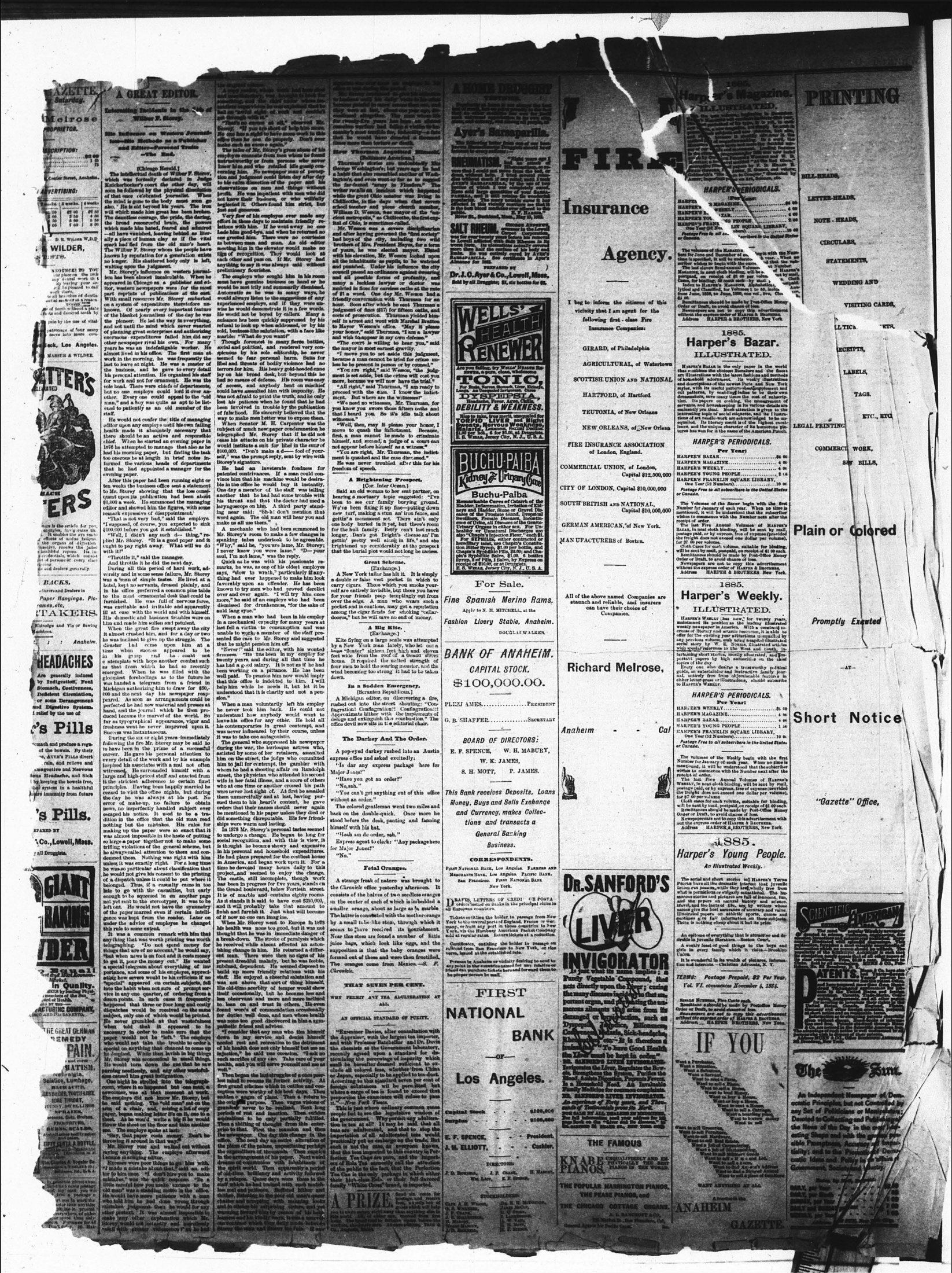
Searchable text
A GREAT EDITOR.
Interesting Incidents in the Life of Wilbur F. Storey.
His influence on Western Journalism—the Methods as a Publisher and Editor—Personal Truth—The End.
[Chicago Herald.]
The intellectual death of Wilber F. Storey, which was formally declared in Judge Knickerbocker's court the other day, will soon be followed by the physical dissolution of that once celebrated journalist. When the mind is gone to the body must soon go also. He is old beyond his years. The iron will which made him great has been broken. The damnless courage, the pride, the daring, the broad resourceful brain, the powers which made him hated, feared and admired—all have vanished, leaving behind as literally a piece of human clay as if the vital spark had fled from the old man's heart. The Wilbur F. Storey whom the people have known by reputation for a generation exists no longer. His shattered body only is left, waiting upon the judgment.
Mr. Storey's influence on western journalism has been almost incalculable. When he appeared in Chicago as a publisher and editor, western newspapers were for the most part reprints of publications at the east. With small resources Mr. Storey embarked on a system of expenditure therefore unknown. Of nearly every important feature of the blanket journalism of the day he was the planner. He led the way in everything, and not until the mind which never wearied of planning great enterprises and authorizing enormous expenditures failed him did any other newspaper rival his own. For many years he was an indefatigable worker. He almost lived in his office. The first man at work in the morning, he was frequently the last to leave at night. He was a master of the business, and he gave to every detail his personal attention. He organized his staff for work and not for ornament. He was the sole head. There were chiefs of departments, but no one employee could lord it over another. Every one could appeal to the "old man," and a boy was quite as apt to be listened to patiently as an old member of the staff.
He would not confer the title of managing editor upon any employee until his own failing health made it absolutely necessary that there should be an active and responsible chief. When he started an evening paper in 1876 he attempted to manage that also as he had his morning paper, but finding the task too onerous at length in brief notes informed the various heads of departments that he had appointed a manager for the evening paper.
The engineer when work had been slow and麻烦ly done, he brought to book for something, and the chief editor when unsatisfied with him he was instead eight of work and couldn't get through with it."
"That's no excuse at all," observed Mr. Storey. "If you are short of help into more office than he can do properly. Don't ever make such an excuse again."
The tale of Mr. Storey's great alms of his employees emanate from men whom he found trustworthy or from persons who never knew him and who retired like good counsel him. No newspaper man of perception and judgment could listen day after day to his calm dissection of the paper and his observations on men and things without profit. He was impatient with men who did not know their business, or who willfully neglected it. Others found him strict, but just and generous.
Very few of his employees ever made any effort in those days to maintain friendly relations with him. If he went away no one made him good-bye, and when he returned no one greeted him. There were no courtesies as between man and man. An old editor meeting him in the elevator would make no sign of recognition. They would look at each other and pass on. If Mr. Storey had anything to say it was always said without preliminary flourishes.
The employee who sought him in his room must have genuine business on hand or he would be not icily and summarily dismissed. Autocratic as he was in many ways, he would always listen to the suggestions of any experienced employee, and if they were unwise he would demonstrate it in a few words. He would not be bored by callers. Many a nuisance has been quickly suppressed by his refusal to look up when addressed, or by his cold, business-like salutation, with a face like marble: "What do you want?"
Though foremost in many fierce battles, social and political, and rendered very conspicuous by his sole editorship, he never seemed to fear personal harm. Suits for libel and threats of bodily violence had no terrors for him. His heavy gold-headed cane lay on his broad desk, but beyond this he had no means of defense. His room was easy of access, and anybody bent on mischief could have assaulted him with impunity. He was not afraid to print the truth; and he only lost his patience when he found that he had been involved in trouble by the publication of falsehood. He sincerely believed that the way to make men better was to expose them.
When Senator M. H. Carpenter was the subject of much newspaper condemnation he telegraphed Mr. Storey that if he did not cease his attacks on his private character he would institute a suit for libel in the sumr of $100,000." "Don't make a d—— fool of yourself," was the prompt reply, sent by wire with Storey's signature.
He had an inveterate fondness for patented contrivances. If a man could con-
He would not confer the title of managing editor upon any employ until his own failing health made it absolutely necessary that there should be an active and responsible chief. When he started an evening paper in 1876 he attempted to manage that also as he had his morning paper, but finding the task too onerous at length in brief notes informed the various heads of departments that he had appointed a manager for the evening paper.
After this paper had been running eight or ten weeks the business office sent a statement to Mr. Storey showing that the loss consequent upon its publication had been about $1,000 a week. He summoned the managing editor and showed him the figures, with some remark expressive of disappointment.
"That is not very bad," said the employee. "I supposed, of course, you expected to sink $100,000 before you got it established."
"Well, I didn't any such d—thing," replied Mr. Storey. "It is a good paper and it ought to pay right away. What will we do with it?"
"Throttle it," said the manager.
And throttle it he did the next day.
During all this period of hard work, adversity and in some sense failure, Mr. Storey was a man of simple tastes. He lived at a hotel, kept no servants, dressed plainly, and in his office preferred a common pine table to the most ornamental desk that could be furnished. He was full of nervous force, was excitable and irritable and apparently ill at ease with the world and with himself. His domestic and business troubles were on him and made him sullen and petulant.
When the great fire swept away the city it almost crushed him, and for a day or two he was inclined to give up the struggle. The disaster had come upon him at a time when success appeared to be in his grasp and he could not contemplate with hope another combat such as that from which he had so recently emerged. When he was filled with the gloomiest forebodings as to the future he was handed a telegram from a friend in Michigan authorizing him to draw for $50,000 and the next day his newspaper reappeared. As soon as arrangements could be perfected he had now material and presses at hand, and the journal which he then produced became the marvel of the world. So far as typographical appearance, vigor and freshness went he never improved upon it. Success was instantaneous.
During the six or eight years immediately following the fire Mr. Storey may be said to have been in the prime of a successful career. He gave his personal attention to every detail of the work and by his example inspired his associates with a zeal not often witnessed. He surrounded himself with a large and high-priced staff and exacted from it the strictest adherence to certain fixed principles. Having been happily married he ceased to visit the office nights, but during the day he was always at his post. No error of make-up, no failure to obtain news, no imperfectly handled subject ever escaped his notice. It used to be a tradition in the office that the old man read nothing but the mistakes. His rules for making up the paper were so exact that it was almost impossible in the haste of putting so large a paper together not to make some trifling violations of the general scheme, but he always called attention to them and condemned them. Nothing was right with him unless it was exactly right. For a long time he was so particular about classification that he would not give his consent to the printing of a dispatch unless it could be put where belonged. Thus, if a casualty came in too late to go with the casualties, but early enough to be squeezed in on another page
He would not confer the title of managing editor upon any employ until his own falling health made it absolutely necessary that there should be an active and responsible chief. When he started an evening paper in 1876 he attempted to manage that also as he had his morning paper, but finding the task too onerous at length in brief notes informed the various heads of departments that he had appointed a manager for the evening paper.
After this paper had been running eight or ten weeks the business office sent a statement to Mr. Storey showing that the loss consequent upon its publication had been about $1,000 a week. He summoned the managing editor and showed him the figures, with some remark expressive of disappointment.
"That is not very bad," said the employee. "I supposed, of course, you expected to sink $100,000 before you got it established."
"Well, I didn’t any such d— thing," replied Mr. Storey. "It is a good paper and it ought to pay right away. What will we do with it?"
"Throttle it," said the manager.
And throttle it he did the next day.
During all this period of hard work, adversity and in some sense failure, Mr. Storey was a man of simple tastes. He lived at a hotel, kept no servants, dressed plainly, and in his office preferred a common pine table to the most ornamental desk that could be furnished. He was full of nervous force, was excitable and irritable and apparently ill at ease with the world and with himself. His domestic and business troubles were on him and made him sullen and petulant.
When the great fire swept away the city it almost crushed him, and for a day or two he was inclined to give up the struggle. The disaster had come upon him at a time when success appeared to be in his grasp and he could not contemplate with hope another combat such as that from which he had so recently emerged. When he was filled with the gloomiest forebodlings as to the future he was handed a telegram from a friend in Michigan authorizing him to draw for $50,000 and the next day his newspaper reappeared. As soon as arrangements could be perfected he had now material and presses at hand, and the journal which he then produced became the marvel of the world. So far as typographical appearance, vigor and freshness went he never improved upon it. Success was instantaneous.
During the six or eight years immediately following the fire Mr. Storey may be said to have been in the prime of a successful career. He gave his personal attention to every detail of the work and by his example inspired his associates with a zeal not often witnessed. He surrounded himself with a large and high-priced staff and exacted from it the strictest adherence to certain fixed principles. Having been happily married he ceased to visit the office nights, but during the day he was always at his post. No error of make-up, no failure to obtain news, no imperfectly handled subject ever escaped his notice. It used to be a tradition in the office that the old man read nothing but the mistakes. His rules for making up the paper were so exact that it was almost impossible in the haste of putting so large a paper together not to make some trifling violations of the general scheme, but he always called attention to them and condemned them. Nothing was right with him unless it was exactly right. For a long time he was so particular about classification that he would not give his consent to the printing of a dispatch unless it could be put where belonged. Thus, if a casualty came in too late to go with the casualties, but early enough to be squeezed in on another page
He would not confer the title of managing editor upon any employ until his own failing health made it absolutely necessary that there should be an active and responsible chief. When he started an evening paper in 1876 he attempted to manage that also as he had his morning paper, but finding the task too onerous at length in brief notes informed the various heads of departments that he had appointed a manager for the evening paper.
After this paper had been running eight or ten weeks the business office sent a statement to Mr. Storey showing that the loss consequent upon its publication had been about $1,000 a week. He summoned the managing editor and showed him the figures, with some remark expressive of disappointment.
"That is not very bad," said the employee. "I supposed, of course, you expected to sink $100,000 before you got it established."
"Well, I didn’t any such d— thing," replied Mr. Storey. "It is a good paper and it ought to pay right away. What will we do with it?"
"Throttle it," said the manager.
And throttle it he did the next day.
During all this period of hard work, adversity and in some sense failure, Mr. Storey was a man of simple tastes. He lived at a hotel, kept no servants, dressed plainly, and in his office preferred a common pine table to the most ornamental desk that could be furnished. He was full of nervous force, was excitable and irritable and apparently ill at ease with the world and with himself. His domestic and business troubles were on him and made him sullen and petulent.
When the great fire swept away the city it almost crushed him, and for a day or two he was inclined to give up the struggle. The disaster had come upon him at a time when success appeared to be in his grasp and he could not contemplate with hope another combat such as that from which he had so recently emerged. When he was filled with the gloomiest forebodlings as to the future he was handed a telegram from a friend in Michigan authorizing him to draw for $50,000 and the next day his newspaper reappeared. As soon as arrangements could be perfected he had now material and presses at hand, and the journal which he then produced became the marvel of the world. So far as typographical appearance, vigor and freshness went he never improved upon it. Success was instantaneous.
During the six or eight years immediately following the fire Mr. Storey may be said to have been in the prime of a successful career. He gave his personal attention to every detail of the work and by his example inspired his associates with a zeal not often witnessed. He surrounded himself with a large and high-priced staff and exacted from it the strictest adherence to certain fixed principles. Having been happily married he ceased to visit the office nights, but during the day he was always at his post. No error of make-up, no failure to obtain news, no imperfectly handled subject ever escaped his notice. It used to be a tradition in the office that the old man read nothing but the mistakes. His rules for making up the paper were so exact that it was almost impossible in the haste of putting so large a paper together not to make some trifling violations of the general scheme, but he always called attention to them and condemned them. Nothing was right with him unless it was exactly right. For a long time he was so particular about classification that he would not give his consent to the printing of a dispatch unless it could be put where belonged. Thus, if a casualty came in too late to go with the casualties, but early enough to be squeezed in on another page
He would not confer the title of managing editor upon any employ until his own failing health made it absolutely necessary that there should be an active and responsible chief. When he started an evening paper in 1876 he attempted to manage that also as he had his morning paper, but finding the task too onerous at length in brief notes informed the various heads of departments that he had appointed a manager for the evening paper.
After this paper had been running eight or ten weeks the business office sent a statement to Mr. Storey showing that the loss consequent upon its publication had been about $1,000 a week. He summoned the managing editor and showed him the figures, with some remark expressive of disappointment.
"That is not very bad," said the editor, with his wonted firmness." He has been in my employ for twenty years, and during all that time he has had a good salary. It is not as if he had been working on a pittance. He has been well paid. To pension him now would imply that this office is indebted to him. I will help him while he needs it, but let it be understood that it is charity and not a pension."
When a man voluntarily left his employ he never took him back. He could not understand how anybody would want to leave his office for any other. He held all his contemporaries in great contempt, and was never influenced by their course, unless it was to take one antagonistic.
The general who suppressed his newspaper during war, the burlesque actress who assisted by some of her retainers, assailed him on the street, the judge who committed him to jail for contempt, the gambler with whom he had a shooting affair on Randolph street, the physician who attended his second wife in her fatal illness, and a score of others who at one time or another crossed his path were never lost sight of. At first he assaulted them unmercifully and at last having pursued them to his heart's content, he gave orders that their names should never again be mentioned in his paper unless they died or did something disreputable. His few friendships were warm and lasting.
In 1873 Mr. Storey's personal taste seemed to undergo a change. He began to long for social recognition, and with this is view, it is thought he became showy and expensive in his personal and household expenditures. He had plans prepared for the costliest house in America, and began work upon it. For a time he devoted many hours daily to this project,and seemed to enjoy the change.
The castle still incomplete, though work has been progress for five years stands on the Grand boulevard below Fortieth street It is of marble and contains eighty rooms
It was a common remark with him that anything that was worth printing was worth telegraphing. "Do not spend money for things that are of no account," he would say, "but when news is on foot and it costs money to get it, pour the money out." He wanted a special telegram about everything of importance, and some of his employees, appreciating how severe would be his criticism if no special appeared on certain subjects, fell into the habit when not sure of prompt service in any one quarter, of ordering from a dozen points. In such cases it frequently happened that three or four long and costly dispatches would be received on the same subject, only one of which would be printed. He never grumbled at that wastefulness when told that it appeared to be necessary in order to make sure that the paper would not be "left." The employee who would not take the trouble to order a special on anything that chance to come up he despair. While thus lavish in big things Mr. Storey was economical in small things. He would turn down the one that he saw turning needlessly, and any other wastefulness caused him great indignation.
One night he strolled into the telegraph room, where it so happened but one man, a newcomer, was at that moment at work. The employee did not know Mr. Storey, but he said nothing. The "old man" sat on the arm of a chair, and, saluting a lot of copy paper, began making letter S's on it, one to a sheet. As he wouldn't write a big S he would throw the sheet on the floor and take another one. The employee spoke at last:
"Say, that paper costs money. Don't be throwing it around in that way."
Mr. Storey rose and walked out without saying anything. The employee afterward became managing editor.
Excesses were poor things to go him with. "I made a mistake at out that," said an editor to him once. "I don't hire you to make mistakes," was the quick response. "Be a little careful how you make excuses to the old man" was a standing motto in the office. He would have more patience with a man who told him he had done wrong through mistaken judgment than he would for any other pretext. It was almost impossible to make any offer explanation which Mr. Storey would not instantly and immediately small with greater valence I am he had sued them to his heart's content, he gave orders that their names should never again be mentioned in his paper unless they died or did something disreputable. His few friendships were warm and lasting.
In 1878 Mr. Storey's personal tastes seemed to undergo a change. He began to long for social recognition, and with this is view, it is thought he became showy and expensive in his personal and household expenditures. He had plans prepared for the costliest house in America, and began work upon it. For a time he devoted many hours daily to this project, and seemed to enjoy the change. The castle, still incomplete, though work has been in progress for five years, stands on the Grand boulevard, below Fortieth street. It is of marble and contains eighty rooms. As it stands it is said to have cost $300,000, and it will probably take that amount to finish and furnish it. Just what will become of it now no one can imagine.
When Mr. Storey went to Europe in 1878 his health was none too good, but it was not thought that he was in immediate danger of a break-down. The stroke of paralysis which he received while absent effect an astonishing change in him. He returned a different man. There were then no signs of his present dreadful malady, but he was feeble, subdued, dependent. He seemed disposed to build up more friendly relations with his staff. He enjoyed a cheerful salutation and was not above that sort of thing himself. His old-time acerbity of temper would show itself occasionally, but he became less and less observant and more and more inclined to lean on and trust in others. He even found worrisome commendation occasionally for duties well done, and men whose health was none too good discovered in him a sympathetic friend and adviser.
"I consider that any man who ties himself down in my service and denies himself needed rest and recreation to the detriment of his health does not only himself but me an injustice," he said too occasionly. "I do not such sacrifice of any man." Take care of your health, and you will serve yourself and me as well."
Then began the last struggles of a once poor-less mind to resume its former activity. At first grand schemes which in outline and conception were worthy of his best days. Then sudden angles of plants. Then a return to the original purpose. Then vague visions of grandeur never to be realized. Next long periods of rest and imitation. Then sudden inspirations to be only partially fulfilled. Then a shifting of thought from this enterprise to that. First the mansion and then the newspaper. One day this change in the office. The next day an entire alteration of the plans of the palace, necessitating perhaps the expenditure of thousands. Then caprice in the arrangement of his paper. Next wad dreams of communion with inhabitants of the spirit world. Then apparently a period of old-time brilliance and activity followed by a relapse. Quater days were there to the staff which he had trained with such mathematicial and patience. Buffeted hither and thither, listening to the poor old man's quarrel and strangling with meaning looks and in silence his surprising orders, and yet warming forward him to reason of his hollow hearts and his kindly ways; issuing a nervous comment which they daily made between stories the man and forever rule.
A strange the Chronicle consists of in the census smaller ones.
The latter by a small seems to Near this juice bag supposition formed out The orange Chronicle.
WHY PERFECT?
AN ONLY
"Examine the Appraisal and with the chemistry recounting small be clude all or Japan According foreign foreign practically such is no that the taction Teers of Holes of the public Tea Can lie their high family "WAP
How Thurman acquitted Minnesota.
(Baltimore American.)
Thurman's stories are un doubtedly like George Washington's; but years ago he had a habit that also resembled another of Washington's, and even so far as to suggest the far-famed "army in Flanders." The writer recalls an incident which happened while the great Ohio senator was living in Chillicothe, in the days when that severe school teacher and plow church member, William D. Wesson, has mayor of the "ancient metropolis," as Chillicothe, the first capital of Ohio, is sometimes called.
Mr. Wesson was a severe disciplinarian and after having governed the "first society" had boys of the city, including two wild brothers of Mrs. President Hayes, for a term of years, he was elected mayor. Elated with his elevation, Mr. Wesson looked upon all the inhabitants as pupils, to be watched and punished. Under his influence the city council passed an ordinance against swearing and all possible forms of profanity, and many a luckless lawyer or doctor was mucked in fines for careless oaths at the rate of $1 a word. One day Mr. Wesson had a friendly conversation with Thurman for an hour. Soon after which he sent Thurman a judgment of fines ($17) for fifteen oaths, and costs of prosecution. Thurman yielded himself in arrest and went with Marshal Bratton to Mayor Wesson's office. "May it please your honor," said Thurman, "I am a lawyer and wish to appear in my own defense."
"The court is willing to hear you," said the mayor in most earnest gravity.
"I move you to set aside this judgment, because a man cannot be tried for crime unless he be present in person or by counsel."
"You are right," said Wesson, "the judgment is set aside, but the crime will cost you more, because we will now have the trial."
"All right," said Thurman, "I am ready to proceed with the case. I know the indictment. But where are the witnesses?"
"We need no witnesses, Mr. Thurman, for you know you swore those fifteen oaths and that I heard you. So it's idle talk about witnesses."
"We well, then may it please your honor, I move to quash the indictment. Because, first, a man cannot be made to criminate himself, and second, a judge of a court can not appear before himself as a witness."
"You are right, Mr. Thurman, the indictment is quashed and the case dismissed."
He was never troubled after this for his freedom of speech.
A HOME DRUGGIST
THE TIME.
Specially at home is not always the best end of mind, but we regard parity to the fact that we often admire him for his kindness and warmth all people.
Ayer's Sarsaparilla.
The following letter from one of our bountiful Mississippi Draughts should be of interest to every reader:
MNEHMATISM.
"Night years age I did not move from the bed, or dome, without help. I tried several yummies effort much if my mind mollit I took ATUND BARAPARILLA, by the use of two bottles of which I was completely cured. Here said large quantities of your SARSAPARILLA, and it still rotates its wonderful popularity. The many notable cover it has elected in this vicinity convince me that it is the bus blood medicine ever offered to the public.
K. F. HARRER."
Hiver St., Buchland, Mass., May 25, 1832.
SALT RHEUM.
George Andrew concurred in the Lowell Carpet Corporation for over twenty years before his removal to Lowell affiliated with field Brown in its worst form. Its observations actually governed more than half the surface of his body and banks. He was entirely cured by Ayer's Baraparilla. See certificate in Ayer's Almanac for 1833.
PREPARED BY
Dr.J.O.Ayer & Co., Lowell, Mass.
Sold by all Druggists; $1, six bottles for $1.
WELLS' HEALTH RENEWER
Are you falling, try Wells' Health Renewer, a pure, clean, wholesome TONIC,
For Brains, Nervous Stomach, Liver, Kidneys,
Lungs. An Unqualified Invigorant.
Curious DYSPEPSIA,
Headache, Fever, Ague, Chills,
DEBILITY & WEAKNESS.
Nice to take, trust merit, unequaled for TORPID LIVER and Night B sweats, Nervous Weakness,
Migratory, Leninism, Sexual Decline,
$1.00 per bottle & for $0.00 at Druggists.
E. S. WELLS, Jersey City, N. J., U.B.A.
BUCHU-PAIBA
COMMERCIAL UNION, of London,
Capital $125,000.00
A Brightening Prospect.
[Cor. Inter Ocean.]
Said an old woman to her seat partner, on bearing a mortuary topic suggested: "I've been to see our family burying ground. We've been fixing it up fine—putting down new turf, making a stun an' iron fence, and getting' a monument not. There isn't only one body buried in it yet, but there's room for the bull family. Betty can't last much longer. Dan's got Bright's disease an' I'm gettin' pretty well along in life," and she brightened up considerably at the prospect that the burial plot would not long be useless.
Great Scheme.
[Exchange.]
A New York tailor has hit it. It is simply a double or false vest pocket in which to carry cigars. Those which you smoke yourself are entirely invisible, but those you have for your friends peep temptingly out from over the edge. A man who wears such a pocket and is cautious, may got a reputation among the cigar flends for smoking cellar-doors," but he will save no end of money.
A Big Kite.
[Exchange.]
Kite flying on a large scale was attempted by a New York man lately, who let out a huge "floater" sixteen feet high and eleven feet wide from the roof of a Grand street house. It required the united strength of four men to hold the soaring monster, and the wind becoming too strong it had to be taken down.
In a Sudden Emergency.
[Scranton Republican.]
A Michigan editor, on discovering a fire, rushed into the street shouting: "Conflagration! Conflagration!! Conflagration!!! Approximate hither with the implements of deluge and extinguish this combustion." The office devil now sits in the editorial chair.
The Darkey And The Order.
A pop-eyed darkey rushed into an Austin express office and asked excitedly:
"Is dar any express package here for Major Jones?"
"Have you got an order?"
"No,sah."
"You can't get anything out of this office without an order."
The colored gentleman went two miles and back on the double-quick. Once more he stood before the desk, panting and fanning himself with his hat.
"Hoah am de order, sah."
Express agent to clerk: "Any package hero for Major Jones?"
"No."
Fetal Oranges.
A strange freak of nature was brought to the Chronicle office yesterday afternoon. It consists of the halves of two seedless oranges.
For Sale.
Fine Spanish Merino Rams.
Apply to N. H. MITCHELL, at the Fashion Livery Stable, Anaheim.
DOUGLAS WALKER
BANK OF ANAHEIM.
CAPITAL STOCK,
$100,000.00.
PLEZJ AMES....President
G. B. SHAFFER....Secretary
BOARD OF DIRECTORS:
E. F. SPENCE, W. H. MABURY, W. K. JAMES,
S. H. MOTT, P. JAMES.
This Bank receives Deposits, Loans Money, Buys and Sells Exchange and Currency, makes Collections and transacts a General Banking Business.
CORRESPONDENTS.
First National Bank, Los Angeles. Farmers and Merchants Bank, Los Angeles. Pacific Bank, San Francisco. First National Bank, New York.
The colored gentleman went two miles and back on the double-quick. Once more he stood before the desk, panting and fanning himself with his hat.
"Heah am de order, sah."
Express agent to clerk: "Any package here for Major Jones!"
"No."
Fetal Oranges.
A strange freak of nature was brought to the Chronicle office yesterday afternoon. It consists of the halves of two seedless oranges in the center of each of which is imbedded a smaller orange, about as large as a marble. The latter is connected with the mother orange by a small tube-like stem, through which it seems to have received its nourishment. Near this stem are found a number of little juice bags, which look like eggs, and the supposition is that the baby oranges were formed out of these and were then fructified. The oranges come from Mexico.—S. P. Chronicle.
THAT SEVEN PER CENT.
WHY PERMIT ANY TEA ADULTERATION AT ALL?
AN OFFICIAL STANDARD OF PURITY.
"Examiner Davies, after consultation with the Appraiser, with the largest tea importer, and with Professor Batchellor and Dr. Davis the chemists at the Government laboratory, recently agreed upon a standard for determining the percentage of impurity which small be herafter deemed sufficient to exclude all colored teas, whether from China or Japan, especially to be applied to tea-dust. According to this standard seven per cent of foreign substances will be permitted but where a cargo of tea is found to exceed that proportion the examiners will refuse to pass it."—New York Times.
This is just where ordinary common sense people fail to see the legislative wisdom of the government. Why permit any adulteration in tea as all? It may be said that all teas are adulterated, and that to stop the importation of all adulterated teas would practically put an embargo on the trade. But such is not the case, as everyone knows, that the teas imported to this country in Perfection Tea Caps are pure, and the importers of Eola Tea can easily call the attention of the public to the fact that the Perfection Tea Can is the only package in which either their high-class Eola, or their full-savored family "White Cross" brand, is imported.
A PRIZE.
Send six cents for postage, and receive from a trady bar of frogs which will take you to two miles right away than anything else in this world. All of either sea, moved from first born. The board shall forward upon the workmen already ready. At once ordered, Trust & Co., Angus House.
Money, Buys and Sells Exchange and Currency, makes Collections and transacts a General Banking Business.
CORRESPONDENTS.
First National Bank, Los Angeles. Farmers and Merchants Bank, Los Angeles. Pacific Bank, San Francisco. First National Bank New York.
DRAFTS, LETTERS OF CREDIT OR POSTAGE issued on Banks in the principal cities in all European countries.
Tickets entitling the holder to passage from New York to the several ports of England, France or Germany, or from any port in those countries to New York, via the Hamburg American Packet Company sold at regular rates. Return tickets at a reduction.
Certificates, entitling the holder to passage on railroad from San Francisco to New York, or vice versa, issued at the established rate.
Persons in Anaheim or vicinity desiring to send to any point in the countries named for any relative or friend can purchase tickets here and forward them to be proper person by mail.
FIRST NATIONAL BANK OF Los Angeles.
Capital Stock $100,000
Surplus $100,000
E. F. SPENCE, President.
J. M. ELLIOTT, Cashier.
DIRECTORS:
J. D. BURNSHAW, J. F. CRANE, H. MAHNEY.
WM LACT, R.F. SPENCE.
STOCKHOLDERS:
CAFE A. H. WILCOX,
O. A. WITHERBY,
J. F. CRANE,
J. E. MOLEANNER,
K. MAHNEY,
WOOD MANAY,
J. D. BURNSHAW,
Dr. H. H. McDONALD,
JAMES MCCOVY,
D. Q. STEIN,
I. LANSMERGER,
J. W. VAR,
S. H. MOTT,
H. F. STENE.
THE FAMOUS
KNABE UNQUALIFIEDLY AND EMPHATICALLY THE BEST PIANOS IN THE WORLD.
THE POPULAR MARRINGTON PIANOS.
THE PEASE PIANOS, and
THE CHICAGO COTTAGE ORGANS.
A. I. DANCESTORE & CO.
132 Martin St., Dan Frascoe, Cal.
General Agents for Pacific Coast...
1895.
Harper's Magazine.
ILLUSTRATED.
With the new volume, beginning in December,
Harper's Magazine will combine both year,
the most practical of its type. It is yet, to such
new and important of his type, it simply becomes in
pictures, a new magazine, not simply because in
pictures, a new picture and tour planism, but also,
and more because it specifically advances in the
method of magazine making. In a word, the
Historian of American and more the faithful murer of our history and movement. Loading fashions
in the stimulating programmes for 1895 and new serials by Charles Perkins Woman and W. D. Hewitt; a number entitled "All the Red Gloves"
interpretive Illustrated paper by F. H. Mullan R.
Barton Gurnett, M. A. Amner, H. Gunnar, and others;
Golden old's "The Men to Genius," illustrated by
Amery; important pages on Art, Science, etc.
HARPER'S PERIODICALS.
For Home:
HARPER'S MAGAZINE.....$4.00
HARPER'S BAZAR.....4.00
HARPER'S YOUNG PEOPLE.....2.00
One Year (52 Numbers).....10.00
Postage Free to all superscribers in the United States or Canada.
The volumes of the Magazine begin with the Numbers for June and December of each year. When necipher wishes to begin with the current number,
Magazine, in next cloth binding, will be a copy of Harper's
postpaid, on receipt of $3.00 per volume sent by mail,
Cases, for bidding, 50 cents each-by-mail.
Cloth Index to Harper's Magazine, Alphabetical,
Lytical and Classified, for Volumes 1 to 60, inclution from June, 1850, to June, 1860, one vol., $ve. Closure, $1.00.
Remittances should be made by Post-Office Money Order or Draft, to avoid chance of loss.
Newspapers are not to copy this advertisement without the express order of Harper & Brothers.
Address: HARPER & BROTHERS, New York.
1885.
Harper's Bazar.
ILLUSTRATED.
Harper's Bazar is the only paper in the world that combines the choice literature and the finest art illustrations with the latest fashion and methods of household adornment. Its weekly illustrations and descriptions of the newest Paris and New York styles, with its useful pattern-sheet supplement and cut patterns, by enabling ladies to be their own dressmakers, save many times the cost of subscription. Its papers on cooking, the management of servants, and housekeeping in its various details are eminently practical. Much attention is given to the interesting topic of social etiquette, and its illustrations of art needle-work are acknowledged to be unequalled. Its literary merit is of the highest excellence, and the unique character of its humorous pictures has won for it the name of the American Punch.
HARPER'S PERIODICALS.
Per Year:
HARPER'S BAZAR.....$4.00
HARPER'S MAGAZINE.....4.00
HARPER'S WEEKLY.....4.00
HARPER'S YOUNG PEOPLE.....2.00
HARPER'S PERIODICALS.
Per Year:
HARPER'S BAZAR.....$4 00
HARPER'S MAGAZINE.....4 00
HARPER'S WEEKLY.....4 00
HARPER'S YOUNG PEOPLE.....2 00
HARPER'S FRANKLIN SQUARE LIBRARY,
One Year (52 Numbers).....10 00
Postage Free to all subscribers in the United States or Canada.
The Volumes of the Bazar begin with the first Number for January of each year. When no time is mentioned, it will be understood that the subscriber wishes to commence with the Number next after the receipt of order.
The last Five Annual Volumes of Harper's Bazar, in neat cloth binding, will be sent by mail, postage paid, or by express, free of expense (provided the freight does not exceed one dollar per volume), for $7 00 per volume.
Cloth Cases for each volume, suitable for binding, will be sent by mail, postpaid, on receipt of $1 00 each.
Remittances should be made by Post-Office Money Order or Draft, to avoid chance of loss.
Newspapers are not to copy this advertisement without the express order of Harper & Brothers.
Address HARPER & BROTHERS New York.
1885.
Harper's Weekly.
ILLUSTRATED.
Harper's Weekly has now, for twenty years, maintained its position as the leading illustrated weekly newspaper in America. With a constant increase of literary and artistic resources, it is able to offer for the ensuing year attractions unequalled by any previous volume, embracing a capital illustrated serial story by W. E. Norris, illustrated articles with special reference to the West and South, entertaining short stories, mostly illustrated, and important papers by high authorities on the chief topics of the day.
Every one who desires a trustworthy political guide, an entertaining and instructive family journal, entirely free from objectionable features in either letter-press or illustrations, should subscribe to Harper's Weekly.
HARPER'S PERIODICALS.
Per Year:
HARPER'S WEEKLY.....$1 00
HARPER'S MAGAZINE.....4 00
HARPER'S BAZAR.....4 00
HARPER'S YOUNG PEOPLE.....1 00
HARPER'S FRANKLIN SQUARE LIBRARY,
One Year (52 Numbers).....10 00
Postage Free to all subscribers in the United States or Canada.
The volumes of the Weekly begin with the first Number for January of each year. When no time is mentioned, it will be understood that the subscriber wishes to commence with the Number next after the receipt of order.
The Instal Fire Annual Volumes of Harper's Weekly, in neat cloth binding, will be sent by mail, postage paid, or by express, free of expense (provided the freight does not exceed one dollar per volume), for $7 00 per volume.
Cloth cases for each volume, suitable for binding, will be sent by mail, postpaid, on receipt of $1 00 each.
Remittances should be made by Post-Office Money Order or Draft, to avoid chance of loss.
Newspapers are not to copy this advertisement with out the express order of Harper & Brothers.
Address HARPER & BROTHERS New York.
1885.
Harper's Young People.
An Illustrated Weekly.
The serial and short stories in Harper's Young People have all the dramatic interest that juvenile fiction can possess, while they are, wholly free from what is pernicious or vulgarly sensational. The humorous stories and pictures are full of innocent fun.
1885.
Harper's Young People.
An Illustrated Weekly.
The serial and short stories in Harper's Young People have all the dramatic interest that juvenile fiction can possess, while they are, wholly free from what is pernicious or vulgarly sensational. The humorous stories and pictures are full of innocent, fun, and the papers on natural history and science travel, and the facts of life, are by writers whose names give the best assurance of accuracy and value. Illustrated papers on athletic sports, games and pastimes give full information on these subjects. There is nothing cheap about it but its price.
An epitome of everything that is attractive and desirable in juvenile literature—Boston Court.
A weekly feast of good things to the boys and girls in every family which it visits—Brooklyn Union.
It is wonderful in its wealth of pictures, information and intercourse—Christian Advocate, X. Y.
TERMS: Postage Prepaid, $2 Per Year.
Vol. VI. commences November 4, 1885.
SINGLE NUMBER, FIVE CENTS each.
Remittance should be made by Postoffice Money Order or Draft, to avoid chance of loss.
Newspapers are not to copy this advertisement without the express order of Harper & Brothers.
Address: HARPER BROTHERS, New York.
IF YOU
Want a Purchase,
Want a Situation,
Want a Salutation,
Want a Sermant,
Want to rent a Farm,
Want to sell a Home,
Want to lend Money,
Want to buy a House,
Want to buy a House,
Want to rent a Carriage,
Want to borrow money,
Want to sell
Want to sell Grouseres,
Want to sell Furniture,
Want to sell Hardware,
Want to sell Hardware,
Want a Job of Carpentrying,
Want a Job of Mechanical Goods,
Want to sell a It in a sand Lob,
Want to sell a farm,
Want to find An-good's Address,
Wanted to find a Straped Animal,
Want to sell a piece of furniture
WANT ANYTHING AT ALL.
A advertise in the ANAHEIM.
Gazette Office.