anaheim-gazette 1884-12-20
Scanned page
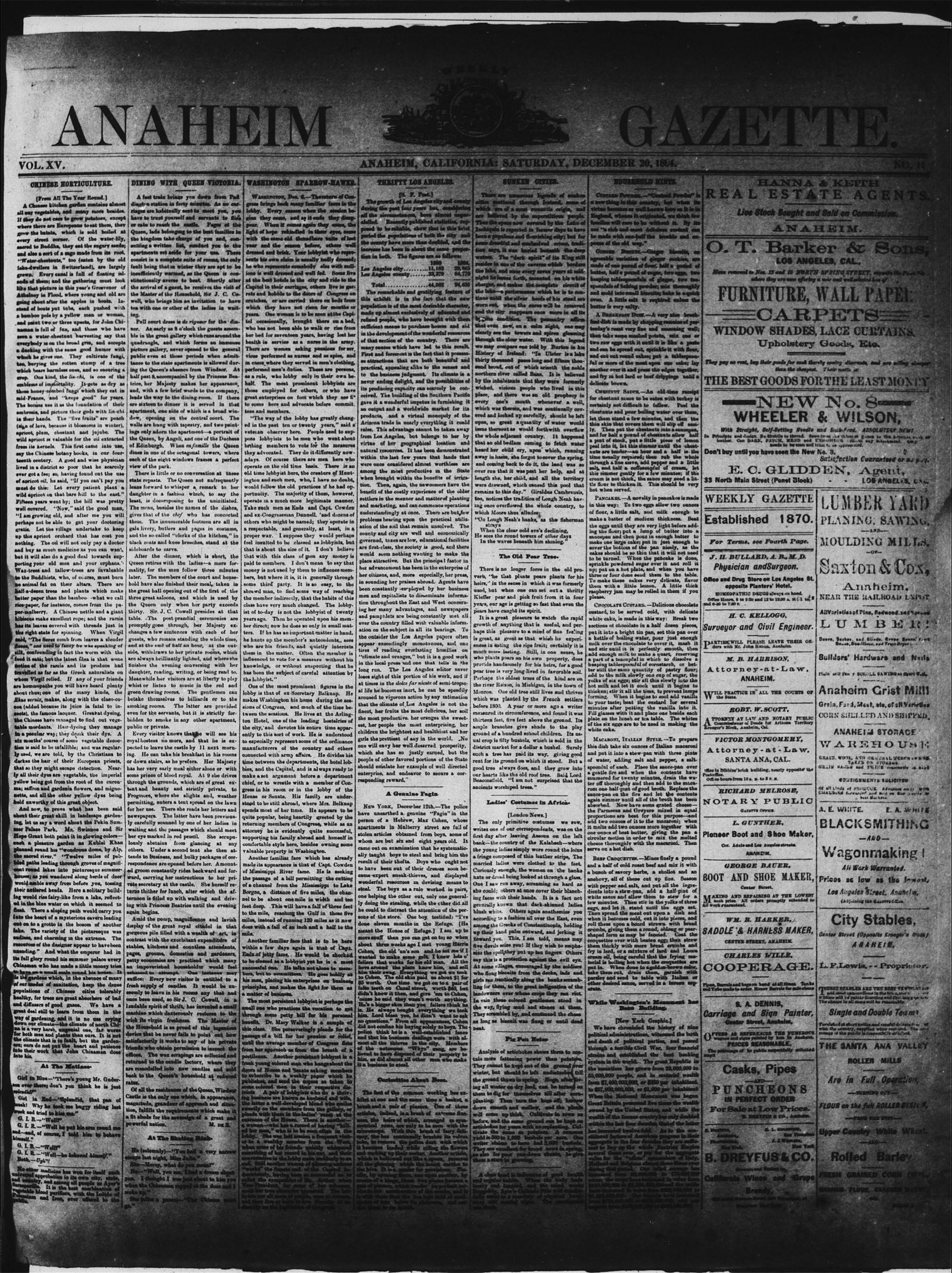
Searchable text
CHINESE HORTICULTURE.
[From All The Year Round.]
A Chinese kitchen garden contains almost all our vegetables, and many more besides. If they do not care to grow potatoes, except where there are Europeans to eat them, they grow the batata, which is sold boiled at every street corner. Of the water-lily, sacred to Buddha, they eat the sugary seeds; and also a sort of a sage made from its root. "Water chestnuts," too (eaten by the old lake-dwellers in Switzerland), are largely grown. Every canal in full of floating islands of them; and the gathering must look like that picture in this year's Grosvenor of Athalney in Flood, where young and old are going about after the apples in boats. Instead of boats put tubes, each pushed with a bamboo pole by a yellow man or woman, and paint two or three upsets, for John Chinaman is full of fun, and those who have seen a water chestnut harvesting say that everybody is on the broad grun, and accepts a ducking with the same good humor with which he gives one. They cultivate fungi, tea, burying the rotten stump of a tree which bears harmless ones, and so ensuring a crop. One kind, the lin-chi, is one of the emblems of immortality. It gets as dry as those honey-combed fungi which they eat in mid-France, and "keeps good" for years. The bonuses use it as the foundation of their ambrosia, and picture their gods with lin-chi in their hands. The "five fruits" are peach (sign of love, because it blossoms in winter), apricot, plum, chestnut and jujube. The wild apricot is valuable for the oil extracted from its kernels. This first came into use, say the Chinese botany books, in our fourteenth century. A good and wise physician lived in a district so poor that he scarcely ever got a fee; so having found out the use
DINING WITH QUEEN VICTORIA.
A fast train brings you down from Paddington station in forty minutes. As no carriages are habitually sent to meet you, you have to trust yourself and servants to fiddle or call to reach the castle. Pages of the Queen, lads belonging to the best families in the kingdom take charge of you and, consulting a written list, conduct you to the apartments set aside for your use. These consist in a complete suite of rooms, the only fault being that in winter they are apt to be insufficiently warmed, as the Queen is constitutionally averse to heat. Shortly alter the arrival of a guest, he receives the visit of the Master of the Household, Sir J. C. Cowell, who brings him an invitation to have tea with one or other of the ladies in waiting.
Full court dress is de rigueur for the dinner. As early as 8 o'clock the guests assemble in the great gallery which runs around the quadrangle, and which forms an immense picture gallery, never opened to the general public even at those periods when admission to the state apartments is allowed during the Queen's absence from Windsor. At half past 8, accompanied by the Princess Beatrice, her Majesty makes her appearance, and with a few brief words to the company, leads the way to the dining-room. If there are sixteen to dinner it is served in that apartment, one side of which is a broad window, opening on the central court. The walls are hung with tapestry, and two paintings only adorn the apartment—a portrait of the Queen, by Angeli, and one of the Duchess of Edinburgh. When en famille the Queen dines in one of the octagonal towers, where each of the eight windows frames a perfect view of the park.
There is little or no conversation at these
WASHINGTON SPAREW-HAWKS.
Washington, Dec. 6.—The return of Congress brings back many familiar faces in the lobby. Every season when the session begins they come, and as it ends they disappear. When it comes again they come, the light of hope rekindled in their eyes, some with the same old threadbare suits of last year and the season before, others well dressed and brisk. Your lobbyist who represents his own claim is usually badly dressed; he who represents somebody else with millions is well dressed and well fed. Some live at the best hotels in the city and ride to the Capitol in their carriages, others live in garrets and hobble to the doors of Congress on crutches, or are carried there on beds from which they have not risen for months or years. One woman is to be seen at the Capitol occasionally, brought there on a bed, who has not been able to walk or rise from her bed for seventeen years, having lost her health in service as a nurse in the army. There are women asking pensions for ser vice performed as nurses and as spies, and in cases where they served in men's clothing, performed men's duties. These are persons as a rule, who lobby only in their own behalf. The most prominent lobbyists are those employed for others, or who have great enterprises on foot which they see fit to come here and advocate before committees and members.
"The way of the lobby has greatly changed in the past ten or twenty years," said a veteran observer here. People used to suppose lobbyists to be men who went about bribing members to vote for the measures they advocated. They do it differently nowadays. Of course there are men here who operate on the old time basis. There is an old time lobbyist here, the creature of Hunt-
One kind, the lin-chi, is one of the emblems of immortality. It gets as dry as those honey-combed fungi which they eat in mid-France, and "keeps good" for years. The bonuses use it as the foundation of their ambrosia, and picture their gods with lin-chi in their hands. The "five fruits" are peach (sign of love, because it blossoms in winter), apricot, plum, chestnut and jujube. The wild apricot is valuable for the oil extracted from its kernels. This first came into use, say the Chinese botany books, in our fourteenth century. A good and wise physician lived in a district so poor that he scarcely ever got a fee; so, having found out the use of apricot oil, he said, "If you can't pay you must do this: Let every patient plant a wild apricot on that bare hill to the east." Fifteen years went by; the hill was pretty well covered. "Now," said the good man, "I am growing old, and after me you will perhaps not be able to get your doctoring gratis. Let the village undertake to keep up this apricot orchard that has cost you nothing. The oil will not only pay a doctor and buy as much medicine as you can want, but it will also do a good deal towards supporting your old men and your orphans." Wax-trees and tallow-trees are invaluable to the Buddhists, who, of course, must burn no animal fat on their altars. There are half-a-dozen trees and plants which make better paper than the bamboo—what we call rice-paper, for instance, comes from the paper-hibiscus make excellent rope; and the ramie has its leaves covered with threads just in the right state for spinning. When Virgil said, "The Series comb from leaves a slender flese," one used to fancy he was speaking of silk, confounding in fact the worm with the feed it eats; but the latest idea is that some notion of the ramie and its produce had travelled as far as the Greek naturalists on whom Virgil roiled. If any of your friends are homoeopaths you will have heard plenty about rhus; one of the many kinds, the Rhus vernix, makes, along with the elaeo-coen (added because its juice is fatal to insects), the famous lacquer. Greatat dyeing, the Chinese have managed to find out vegetable mordants. Hair-dyeing they manage in a peculiar way; they drink their dye. A six months' course of some vegetable decoction is said to be infallible; and was regularly used, we are told, by the Christians to darken the hair of their European priests, that so they might escape detection. Nearly all their dyes are vegetable, the imperial yellow being got from the root of the curcuma; saffron and gardenia flowers, and mignonette, and all the other yellow dyes being held unworthy of this great object.
And now, to prove what has been said about their great skill in landscape gardening, let us say a word about the Pekin Summer Palace Park. Mr. Swinnoe and Sir Hope Grant both paint it in glowing colors—such a pleasure garden as Kublai Khan planned round his "wondrous dome," by Alp, the sacred river." Twelve miles of pebbled paths leading through groves of magnificent round lakes into picturesque summer houses; as you wandered along herds of deer would amble away from before you, tossing their antlered heads. Here a solitary building would rise fairy-like from a lake, reflect-
half past 8, accompanied by the Princess Bentrice, her Majesty makes her appearance, and with a few brief words to the company, leads the way to the dining room. If there are sixteen to dinner it is served in that apartment, one side of which is a broad window, opening on the central court. The walls are hung with tapestry, and two paintings only adorn the apartment—a portrait of the Queen, by Angeli, and one of Duchess of Edinburgh. When en famille the Queen dines in one of the octagonal towers, where each of the eight windows frames a perfect view of the park.
There is little or no conversation at these state repasts. The Queen not unfrequently leans forward to whisper a remark to her daughter in a fashion which, to say the least, is decomposing to the uninitiated. The menu, besides the names of the dishes, gives that of the chef who has concocted them. The innumerable footmen are all in gala livery, butlers and pages in costume, and the so-called "clerks of the kitchen," in black coats and knee breeches, stand at the sideboards to carve.
After the dinner, which is short, the Queen retires with the ladies—a mere formality, for the men follow three minutes later. The members of the court and household have also finished their meal, taken in the great hall opening out of the first of the three great saloons, and which is used by the Queen only when her party exceeds thirty. Sir J. C. Cowell presides at that table. The post-prandial ceremonies are promptly gone through, her Majesty exchanges a few sentences with each of her guests, who remain standing the whole time, and at the end of half an hour, at the outside, withdraws to her private rooms, which are always brilliantly lighted, and where she finishes the evening conversing with her daughter, reading, writing, or being read to. Meanwhile her visitors are at liberty to play whist or listen to music in the red and green drawing rooms. The gentlemen can betake themselves to billiards or to the smoking rooms. The latter are provided even for the servants, but it is strictly forbidden to smoke in any other apartment, public or private.
Every visitor knows that he will see his royal hostess no more, and that he is expected to leave the castle by 11 next morning. He can take his breakfast in his rooms or down stairs, as he prefers. Her Majesty has her very early meal either alone or with some prince of blood royal. At 9 she drives through the grounds, which are of great extent and beauty and strictly private, to Frogmore, where she alights and, weather permitting, enters a tent spread on the lawn for her use. There she reads her letters and newspapers. The latter have previously carefully scanned by one of her ladies in waiting and the passages which should meet her eye marked in red pencil. She serupously abstains from glancing at any others. Under a second tent she then attends to business, and bulky packages of correspondence are opened before her. Amounted groom constantly rides backward and forward, carrying her instructions to her private secretary at the castle. She herself returns thither for lunch, after which the afternoon is filled up with walking and driv-
as a rule, who lobby only in their own behalf. The most prominent lobbyists are those employed for others, or who have great enterprises on foot which they see 6" to come here and advocate before committees and members.
"The way of the lobby has greatly changed in the past ten or twenty years," said a veteran observer here. People need to suppose lobbyists to be men who went about bribing members to vote for the measures they advocated. They do it differently nowadays. Of course there are men here who operate on the old time basis. There is an old time lobbyist here, the creature of Huntington and such men, who I have no doubt would follow the old practices if he had opportunity. The majority of them, however, operate in a much more legitimate manner. Take such men as Eads and Capt. Cowden and ex-Congressman Dunnell. 'and dozens of others who might be named; they operate in a respectable, and generally; at least, in a proper way. I suppose they would perhaps feel insulted to be classed as lobbyists, but that is about the size of it. I don't believe that with this class of men any money is paid to members. I don't mean to say that money is not used by them to influence members, but where it is, it is generally through some third party. It is so easy, to the shrewd man, to find some way of reaching the member indirectly; that the habits of this class have very much changed. The lobbyist of to-day is not the lobbyist of twenty years ago. Then he operated upon his member direct; now he does so only in small matters. If he has an important matter in hand, he hunts up the member's antecedents., sees who are his friends,and quietly interests them in the matter. Often the member is influenced to vote for a measure without his knowledge, or without suspecting that he has been the subject of careful attention by the lobbyist."
One of the most prominent figures in the lobby is that of ex-Secretary Balknap. He makes Washington his home during the sessions of Congress,and much ofthe time betweenthe sessions.Hewives attheArlingtonHotel,theoneoftheleadinghostelriesofthecity,anddevoteshis entiretimeapparentlytothissortofwork.Heisunderstoodtoespeciallyrepresentsomeoftheordinancemanufacturersofthecountryandothersconnectedwitharmyaffaire.Hedivideshistimebetweenthedepartments,thehotloblies,andtheCapitol,andisalwaysreadytomakeasetargumentbeforeadepartmentchief,或wrestlewithamemberOfCongressinhisroomorinthelobbyoftheHouse或Senate.Hisfamilyareunderstoodtobe stillabroadwhereMrs.Balknapspendsmostofhertime.Heappearstobequitepopular.beeingheartilygreetedbythereturningmembersofCongress,而asanattorneyheis evidentlyquitesuccessful,supportinghisfamilyabroadandhimselfincomfortablestylehere,besidesowningsomevaluablepropertyinWashington.
Another familiar face which has already made its appearance is that of Capt.CowdenofMississippiRiverfame.HeisseekingthepassageofbillpermittingthecuttingofachannelfromtheMississippitoLakeBorgne,a distanceoffivemiles,thechanneltobeaboutonemileinwidth,andten
hold unworthy of this great object.
And now, to prove what has been said about their great skill in landscape gardening, let us say a word about the Pekin Summer Palace Park. Mr. Swinnoe and Sir Hope Grant both paint it in glowing colors—unh a pleasure garden as Kublai Khan planned round his "wondrous dome, by Alp, the sacred river." "Twelve miles of pebbled paths leading through groves of magnificent round lakes into picturesque summer houses; as you wander along herds of deer would amble away from before you, tossing their antlered heads. Here a solitary building would rise fairy-like from a lake, reflected in the blue water on which it seemed to float. There a sloping path would carry you into the heart of a mysterious cavern leading out on to a grotto in the bosom of another lake. The variety of the picturesque was endless, and charming in the extreme. The resources of the designer appear to have been unending." And what the emperor had in its full glory round his summer palace every Chinaman who has made a little money tries to have one small scale round his house. It is the gardens which, in the absence of many of our modes of sanitation, keep the dense populations of Chinese cities tolerably healthy, for trees are great absorbers of bad and diffusers of good gases. We have a great deal still to learn from them in the way of gardening, and it is no use crying down our climate—the climate of north China is a very harsh, unpleasant one, far worse for both men and plants than oura. It is not the climate that is to fault, but the gardeners; oure do not put the heart and patience into their work that John Chinaman does into his.
At The Matinee
Girl in Blue—"There's young Mr. Guderon over there; don't you think he is just splendid!"
Girl in Red—"Splendid, that pan of mash! Why he took me buggy riding last week and tried to kiss me."
G. I. B.—"Well!"
G. I. B.—"Well he put his arm round me—and, of course, I told him to behave himself."
G. I. B.—"Well!"
G. I. B.—"Well—be behored himself."
Both—"Ugh!"
No other medicine has won for itself such universal approbation in its own city, state, and country, and among all people as Ayer's Gardenville. It is the best combination of vegetable blood purifiers, with the Lodide of Potassium and Iron, ever offered to the public.
permitting, enters a tent spread on the lawn for her use. There she reads her letters and newspapers. The latter have been previously carefully scanned by one of her ladies in waiting and the passages which should meet her eye marked in red pencil. She scrupulously abstains from glancing at any others. Under a second tent she then attends to business, and bulky packages of correspondence are opened before her. Amounted groom constantly rides backward and forward, carrying her instructions to her private secretary at the castle. She herself returns thither for lunch, after which the afternoon is filled up with walking and driving with Princess Beatrice until the evening again begins.
Amid the pomp, magnificence and lavish display of the great royal citadel in that gorgeous pile filled with a wealth of art, in contrast with the exorbitant expenditure of stables, kitchens and countless attendants, pages, grooms, domestics and gardeners, petty economics are practised which many an impoverished householder would feel ashamed to attempt. One instance may suffice: Every new visitor is entitled to a fresh supply of candles. It would be unseemly to leave in his rooms any that had once been used, so Sir J. C. Cowell, in a laudable spirit of thrift, has invented a small machine which dexterously restores to the wick its virgin freshness. The Master of the Household is so proud of this ingenious device that he never fails to point out how satisfactorily it works to any of his private friends who obtain permission to inspect the offices. The wax scrapings are collected and returned to the candle factory, where they are remodelled into new candles and sold back to the Queen's household at reduced rates.
Of all the residents of the Queen, Windsor Castle is the only one which, in appearance, magnitude, grandeur of approach and situation, fulfills the requirements which make it a fit abode for the sovereign of a great and powerful nation.
M. de S.
At The Shaking Rink
He (solennly)—"You had a very narrow escape last night, Miss John."
She—"Marry, what do you mean?"
He—"Well, you see. I had a dream about you. I thought I was just about to kiss you when the Chinaman raped of the door and I woke up."
She (after a pause)—"The Chinaman tried go."
ANAHEIM, CALIFORNIA: SATURDAY, DECEMBER 20, 1854
TON SPARROW-HAWK.
Now, Dec. 6.—The return of Conk many familiar faces in the city season when the session begins, and so it ends they dispel it comes again they come, the rekindled in their eyes, some old threadbare tuits of last season before, others well drunk. Your lobbyist who reproach claim is usually badly dressed; someone else with millerised and well fed. Some live at the city and ride to the carriages, others live in garage to the doors of Congress on are carried there on beds from have not risen for months or woman is to be seen at the Capitol, brought there on a bed, been able to walk or rise from seventeen years, having lost her service as a nurse in the army. Men asking pensions for serenaded as nurses and as spies, and they served in men's clothing, women's duties. These are persons on lobby only in their own behalf prominent lobbyists are used for others, or who have bases on foot which they see fi' and advocate before commit others.
If the lobby has greatly changed ten or twenty years," said a never here. People used to sup- to be men who went about them to vote for the measures. They do it differently now; there are men here who old time basis. There is an artist here, the creature of Hunt-
THRIFTY LOS ANGELES.
[S. F. Post.]
The growth of Los Angeles city and county during the past four years has considered all the circumstances, been almost imperalled. Recently published statistics, supposed to be reliable, show that in this brief period the populations of both the city and the county have more than doubled, and the increase has been in about the same proportion in both. The figures are as follows:
1880 1894
Los Angeles city...11,183 20,665
Los Angeles county...33,379 64,770
Total...44,562 94,635
The remarkable and gratifying feature of this exhibit is in the fact that the new population is of the most desirable character, made up almost exclusively of educated and refined people, who have brought with them sufficient means to purchase homes and aid in the development of the wonderful resources of that section of the country. There are many causes which have led to this result. First and foremost is the fact that it possesses attractions that are both beautiful and practical, appealing alike to the senses and to the business judgment. Its climate is a never ending delight, and the possibilities of its producing capacity can scarcely be conceived. The building of the Southern Pacific gave it a wonderful impetus in furnishing it an output and a worldwide market for its products, and a virtual monopoly of the Arizona trade in nearly everything it could raise. This advantage cannot be taken away from Los Angeles, but belongs to her by virtue of her geographical location and natural resources. It has been demonstrated within the last few years that lands that were once considered almost worthless are among the most productive in the State.
SUNKEN CITIES.
There are numerous legends of sunken cities scattered through Ireland, some of which are of a most romantic origin, and are believed by the superstitious people. Thus the space now covered by the Lake of Inchiquin is reported in former days to have been a populous and flourishing city; but for some dreadful and unabsolved crime, tradition says, it was buried beneath the deep waters. The "dark spirit" of its King still resides in one of the caverns which border the lake, and once every seven years at midnight he hunts forth, mounted on his white charger, and makes the complete circuit of the lake—a performance which he is to continue until the silver hoops of his steed are worn out, when the curse will be removed and the city reappears once more in all its bright condition. The peasantry affirm that even now, on a calm night, one may clearly see the towers and spires glancing through the clear water. With this legend we may compare one told by Barton in his History of Ireland: "In Ulster is a lake thirty thousand passes long and fifteen thousand broad, out of which ariseeth the noble northern river called Bana. It is believed by the inhabitants that they were formerly wicked, vicious people who lived in this place, and there was an old prophecy in every one's mouth whenever a well, which was therein, and was continually covered and locked up carefully, should be left open, so great a quantity of water would issue thereout as would forthwith overflow the whole adjacant country. It happened that an old bedlam coming to fetch water heard her child cry, upon which, running away in haze, she forgot to cover the spring, and coming back to do it, the land was so over run that it was past her help, and at
HOUSEHOLD HINTS.
Curand Powers.—"Curand a new thing is this country, but virtue becomes as well known here England, whom it originated, we families will care to be without use "n rich and most delicieux o be made with one-half the trouble posses of the old way."
Ginger Bunny.—Ginger buns agreeable variation of ginger no made of one pound of flour; half a butter; half a pound of sugar; two beeping tabling gentle of ginger spoonfuls of baking powder; mix and mold into small blossoms; bake even. A little salt is required butter is very salty.
A Breakfast Dusk.—A very fast dish is made by chopping yesterday's roast very fine and season then take some mashed potato; mix two raw eggs with it until it is lily and can be spread out; sprinkle it and cut out round cakes; put a ful or more of the meat upon one another over it and press the edge and fry in hot lard or beef dripping delicate brown.
Chestnut Sauce.—An old-time for chestnut sauce to be eaten with certainly not difficult to follow. chestnuts and pour boiling water let them stand a few minutes, and thin skin that covers them will easily. Then put the chestnuts into a pan of stock, put a little piece peel into it; let this simmer until nuts are tender—an hour and a half usually required; then rub through a fine sieve, add pepper and salt; and half a coffee-cupful of this simmer gently for a few minutes."
of the lobby has greatly changed ten or twenty years,” said a clever here. People used to support men to be men who went about meeting to vote for the measures they do it differently now. There are men here who old time basis. There is an artist here, the creature of Hunt-ish men, who, I have no doubt, the old practices if he had op-ten more legitimate manner, can as Eads and Capt. Cowden Cassman Dannell. “and dozens of night be named; they operate in and generally, at least, in a I suppose they would perhaps be classed as lobbyists, but the size of it. I don’t believe in a class of pon any money is hers. I don’t mean to say that used by them to influence meme- it is, it is generally through party. It is so easy, to the find some way of reaching directly, that the habits of this city much changed. The lobby is not the lobby of twenty men be operated upon his meme- he does so only in small mat- an important matter in hand, the member’s antecedents, sees friends, and quietly interacts matter. Often the member is note for a measure without his without suspecting that he subject of careful attention by most prominent figures in the ex-Secretary Balknap. He cynthon his home during the ses-sas, and much of the time be- oms. He lives at the Arling- uge of the leading hostelries of devotes his entire time appar- t of work. He is undertood present some of the ordinance of the country and others army affairs. He divides his departments, the hotel lob- capitol, and is always ready to document before a department settle with a member of Con- sitte or in the lobby of the state. His family are under- abroad, where Mrs. Belknap her time. He appears to be being heartily greeted by the bersa of Congress, while as an evidently quite successful, family abroad and himself in life here, besides owning someerty in Washington.
Silari face which has alreadyrance is that of Capt. Cowden River fame. He is seeking a bill permitting the cutting from the Mississippi to Lake chance of five miles, the chan- one mile in width and too
New York, December 12th.—The police have unearthed a genuine “Fagin” in the person of a Hebrew, Max Cohen, whose apartments in Mulberry street are full of stolen articles obtained from boys, some of whom are but six and eight years old. It came out on examination that he systemically taught boys to steal and bring him the result of their thefts. Boys who ought not to have been out of their dresses soon became expert sneak-thieves, and displayed wonderful resources in devising means to steal. The boys as a rule worked in pairs, one helping the other out, only one general- one helping the other out, only one general- northern river called Dana. It is believed by the inhabitants that they were formerly wicked, vicious people who lived in this place, and there was an old prophecy in every one’s mouth whenever a well, which was therein, and was continually covered and locked up carefully, should be left open, so great a quantity of water would issue thereout as would forthwith overflow the whole adjacant country. It happened that an old bedlam coming to fetch water heard her child cry, upon which, running away in haste, she forgot to cover the spring, and coming back to do it, the land was so over run that it was past her help, and at length she, her child, and all the territory were drowned, which caused this pool that remains to this day.” Giraldus Cambrensis, too, notices the tradition of Lough Neah having once overflowed the whole country, to which Moore thus alludes.
“On Lough Neah’s banks, as the fisherman strays
When the clear cold eve’s declining, He sees the round tower of other days
In the waves beneath him shining.”
The Old Pear Tree.
There is no longer force in the old proverb, “the that plants pears plants for his heirs,” in the sense in which it was formerly used, but when one can set out a thrifty Kieffer pear and pick fruit from it in four years, our age is getting so fast that even the pear have caught its spirit.
It is a great pleasure to watch the rapid growth of anything that is useful, and perhaps this pleasure to a mind of fine feeling is great, as great as that which he experiences in eating the ripe fruit; certainly it is much more lasting. Still, in one sense, he who plants pears on his own property, does provide handsomely for his heirs, for a good pear tree is very long-lived in favorable soil. Perhaps the oldest trees of the kind are on the river Raison, in Michigan, in the town of Monroos. One old tree still lives and thrives which was planted by the French settlers before 1800. A year or more ago a writer measured its circumference, and found it was thirteen feet, five feet above the ground. Its ample branches give shade to the play ground of a hundred school children. Its usual crop is fifty bushels, which is sold in the district market for a dollar a bushel. Surely such a tree has paid its way, giving good rent for its ground on which it stood. But a good tree always does, and they grow into our hearts like the old roof tree. Said Lord Beaconfield, “I am not surprised that the ancients worshiped trees.”
Ladies’ Costumes in Africa.
[London News.] The only primitive costumes we saw, writes one of our correspondents, was on the first day after leaving Assoun on the left bank—the country of the Kalabseh—where the young ladies simply wore round the loins a fringe composed of thin leather stripe. The married ladies were clothed to the feet. Curiously enough, the women on the banks hate or dread being looked at through a glass. One I saw run away, screaming as hard as she could; others at once cover their blanching faces with their hands. It is a fact not believed by the inhabitants that they were formerly wicked, vicious people who lived in this place, and there was an old prophecy in every one's mouth whenever a well, which was therein, and was continually covered and locked up carefully, should be left open, so great a quantity of water would issue thereout as would forthwith overflow the whole adjacant country. It happened that an old bedlam coming to fetch water heard her child cry, upon which, running away in haste, she forgot to cover the spring, and coming back to do it, the land was so over run that it was past her help, and at length she, her child, and all the territory were drowned, which caused this pool that remains to this day.” Giraldus Cambrensis, too, notices the tradition of Lough Neah having once overflowed the whole country, to which Moore thus alludes.
“On Lough Neah’s banks, as the fisherman strays
When the clear cold eve’s declining, He sees the round tower of other days
In the waves beneath him shining.”
The Old Pear Tree.
There is no longer force in the old proverb, “the that plants pears plants for his heirs,” in the sense in which it was formerly used, but when one can set out a thrifty Kieffer pear and pick fruit from it in four years, our age is getting so fast that even the pear have caught its spirit.
It is a great pleasure to watch the rapid growth of anything that is useful, and perhaps this pleasure to a mind of fine feeling is great, as great as that which he experiences in eating the ripe fruit; certainly it is much more lasting. Still, in one sense, he who plants pears on his own property does provide handsomely for his heirs; for a good pear tree is very long-lived in favorable soil. Perhaps the oldest trees of the kind are on the river Raison, in Michigan, in the town of Monroos. One old tree still lives and thrives which was planted by the French settlers before 1800. A year or more ago a writer measured its circumference, and found it was thirteen feet,五 feet above the ground. Its ample branches give shade to the play ground of a hundred school children. Its usual crop is fifty bushels,which is sold in the district market for a dollar a bushel. Surely such a tree has paid its way,giving good rent for its ground on which it stood. But a good tree always does,and they grow into our hearts like the old roof tree. Said Lord Beaconfield,“I am not surprised that the ancients worshiped trees.”
Sauce-pan on the fire and let again simmer until all of the broth absorbed. Now have some grated for the Parmesan and Gryture mixed proportions are best for this purpureo ice melts add two ounces more together one ounce of best butter,giving this circular motion in order to mix cheese thoroughly with the macaroni serve on a hot dish.
BEEF CROQUETTER.-Mines finely and a half of cold roast beef and milk an bunch of savory herbs,a shallow anchovy,all of these cut up fine with pepper and salt,and put all three diets into a stew-pan,add a half white sauce and allow them to stew
New York, December 12th.—The police have unearthed a genuine "Fagin" in the person of a Hebrew, Max Cohen, whose apartments in Mulberry street are full of stolen articles obtained from boys, some of whom are but six and eight years old. It came out on examination that he systematically tangled boys to steal and bring him the result of their thefts. Boys who ought not to have been out of their dresses soon became expert sneak-thieves, and displayed wonderful resources in devising means to steal. The boys as a rule worked in pairs, one helping the other out, only one generally doing the stealing, while the other did all he could to distract the attention of the persons of the store. One boy testified: "I've done eleven months in the Refuge. [He meant the House of Refuge.] I am up to more snuff than you can get on to; so when about three weeks ago I met young Harris Cohen, the old 'un's son and he sat me if I wanted to make some gelt. I knew lots of fellows that works for his old man. All the bovins around the place know him, and sell him their awag. Everything we got we took to Cohen. The old skin paid us about $1 for $ worth. One time we got on to a pair of false teeth on Canal street, worth $40, but didn't know it then, and give 'em to Cohen, 'cause he said they wasn't worth anything. He's a bigger skin than you fellers think he is. He always bought everything we took him. Lord bless you, he didn't want to ask no questions." From all appearances, Cohen did not confine his buying solely to boys. The police think he is a well-established fence and that his business dealings were with almost all the thieves in the city. Members of the notorious "Whyo" gang are believed to have disposed of their property to him, as did almost all other men who make it a business to steal.
Curiosities About Bees.
The feet of the common working bee exhibit at one and the same time a basket, a brush and a pair of pinsers. One of these articles, indeed, is a brush of extreme finesse; the hairs of which, arranged in symmetrical rows, are only to be seen with the microscope. With this brush of fairy delicacy, the bee continually brushes its velvous rube, to remove the pollen dust with which it becomes loaded while rilling the flowers and making up their nectar. Another article, which is hollowed out like a spoon, removes all the gluing which the insect carries in the hive. It is a guider for provisions. Finally, by opening them, one opens another, by means of a bangle, these two pieces become a pair of pinsers, which number in perfect measure in the construction of the comb, and in with them the bee lays field of wax before he shaves it and cuts them for his mouth.
Ladies' Costumes in Africa
[London News.]
The only primitive costumes we saw, writes one of our correspondents, was on the first day after leaving Assoun on the left bank—the country of the Kalabsch—where the young ladies simply wore round the loins a fringe composed of thin leather strips. The married ladies were clothed to the feet. Curiously enough, the women on the banks hate or dread being looked at through a glass. One I saw run away, screaming as hard as she could; others at once cover their blanching faces with their hands. It is a fact not generally known that dark-skinned ladies blush white. Others again anathemize you according to a fashion all over the East, even among the Greeks of Constantinople, holding up their hand palm outward, and jerking it toward you. This, I am told, means five devils seize you! If they wish to emphasize the spell they put up ten fingers. Others say this is a protection against the evil eye. At some villages, encouraged by the soldiers who flung biscuits from the decks, lads and girls ran frantically along the banks scrambling for them, to the great indignation of the landowners over whose crops they ran riot. In vain these colored gentlemen stood in the way, flying mud and stones at them. They scrambled by, and continued the chase as long as biscuit was flung or until dead beat.
Pig Pen Noten
Analysis of artichokes shows them to contain more fattening power than potatoes. They cannot be kept one of the ground ever winter, but should be left undisturbed till the ground thaws in spring. Hogs, after living all winter on dry feed, can be turned on them to dig for themselves till after corn-planking. Then turn the hogs off; harrow down smooth and mellow, and the plants will come up thick. OilIVATE in rows as before, and the same ground can be kept on artichokes for years with no replanting. Cultivate the same at potatoes. A common yield is 500 to 1,000 bushels per亩. One writer claims to have had 2,000 bushels. They are excellent for bread sacks in spring, also for your run down whites, to give them a start in growing.
A close bond is indicative of good health and regular habits. When the body feels heavy and impatient, Aguir Cochino's pills will wonderfully aid to a recovery of physical health and mental rigour.
Ladies' Costumes in Africa
[London News.]
The only primitive costumes we saw, writes one of our correspondents, was on the first day after leaving Assoun on the left bank—the country of the Kalabsch—where the young ladies simply wore round the loins a fringe composed of thin leather strips. The married ladies were clothed to the feet. Curiously enough, the women on the banks hate or dread being looked at through a glass. One I saw run away, screaming as hard as she could; others at once cover their blanching faces with their hands. It is a fact not generally known that dark-skinned ladies blush white. Others again anathemize you according to a fashion all over the East, even among the Greeks of Constantinople, holding up their hand palm outward, and jerking it toward you. This, I am told, means five devils seize you! If they wish to emphasize the spell they put up ten fingers. Others say this is a protection against the evil eye. At some villages, encouraged by the soldiers who flung biscuits from the decks, lads and girls ran frantically along the banks scrambling for them, to the great indignation of the landowners over whose crops they ran riot. In vain these colored gentlemen stood in the way, flying mud and stones at them. They spread the meat out upon a table roll these upon a board strewn with cremba, giving them a round, oblong shaped form as may be fancied. Croquettes over with beaten egg; they thickly with more bread crumbs fry in lard, or a mixture of lard and cream oil, being careful that the fried material be hot when the croquette put in. When done to agolden-breast take them out, drain them, paralyze and send to table with other desired sauce, served in a tavern.
While Washington's Monument Beam Building.
[New York Graphic.] We have chronicled the history political administrations, witnessing and death of political parties through a terrible Civil War; four strains and established the best system in the world. The great Himalayas mean time has grown from 235 million people, and in motions from 740 million people, or $20 per mile to 870 million people, or $1,000 per mile. When the National Movement Great Britain pursued five times owned by the United States, and wealth of the former country has increased twelvefold. As an attendant feature of American programs aggregate in the four decades they went to buy up the whole Anatomy several times over, or pay for that value for the "Official" manuscript Holland and Belgium almost during that period. Our soldier has increased from 200 million dollars to 250 million dollars since 1919-2000 dollars to 260 million dollars since 2019-2000 dollars.
A close bond is indicative of good health and regular habits. When the body feels heavy and impatient, Aguir Cochino's pills will wonderfully aid to a recovery of physical health and mental rigour.
Ladies' Costumes in Africa
[London News.]
GAZETTE.
EMBER 20, 1864.
NO. 11
HOUSEHOLD MINDS.
Currand Powder.—"Ontard Powder" is now thing in this country, but when it becomes as well known here as it is in England, whence it originated, we think few millions will愈来愈 to be without it. By the "rich and most delicious custard can made with one-half the trouble and excess of the old way."
Ginger Biscuit.—Ginger biscuit, an irreducible variation of ginger cookies, are made of one pound of flour, half a pound of butter, half a pound of sugar, two eggs, two tapering tablespoons of ginger, two teaspoonfuls of baking powder; mix thoroughly and mold into small blossoms; bake in a quick oven. A little salt is required unless the latter is very salty.
A Breakfast Dish.—A very nice breakfast dish is made by chopping remains of yesterday's roast very fine and seasoning well; then take some mashed potato, mix one or two raw eggs with it until it is like a paste can be spread out, sprinkle it with flour, and cut out round cakes; put a tablespoon or more of the meat upon one cake; lay another over it and press the edges together; fry in hot lard or beef drippings until a delicate brown.
Cheesnut Sauce.—An old-time receipt cheesnut sauce to be eaten with turkey is certainly not difficult to follow. Peel the chestnuts and pour boiling water over them, then stand a few minutes, and then the skin that covers them will slip off easily. Then put the chestnuts into a saucepan, for half a pound of chestnuts allow half an hour of stock, put a little piece of lemon into it, let this simmer until the chestnuts are tender—an hour and a half is the usual requirement; then rub the wholeough a fine sieve, add pepper and a little salt, and half a coffeecapful of cream, let simmer gently for a few minutes; if the
THE BEST GOODS FOR THE LEAST MONEY
NEW No. 8
WHEELER & WILSON,
With Straight, Self-Setting Needle and Back-Feed. ABSOLUTely NEW!
In Principle and design. No Shuttle to thread. Sew from the thimble at grain to the bobbin, which is leather. Can DARK, PAYUH, MEND and ENMOSOIR. Should any attachment only needs to be sewn and tried to be approved.
Don't buy until you have seen the New No. 3.
E. C. GLIDDEN, Agent,
33 North Main Street (Ponet Block) - LOS ANGELES, CA.
WEEKLY GAZETTE
Established 1870.
For Terms, see Fourth Page.
J. H. BULLARD, A. B., M.D.
Physician and Surgeon.
Office and Drug Store on Los Angeles St. opposite Planters' Hotel.
HOMEPATHIC DRUGS always on hand.
Office Hours: 8 to 9:30 and 12 to 12:30 a.m. to 5 p.m.
H. C. KELLOGG,
Surveyor and Civil Engineer.
Parties will please leave their orders with Mr. John Henna, Anaheim.
M. B. HARRISON,
Attorney-at-Law,
ANAHEIM.
Will Practice in all the Courts of the State.
ROBT. W. SCOTT,
Attorney at Law and Notary Public Commissioner of Deeds for Arizona Territory Broeger's Block, Anaheim, Cal.
VICTOR MONTGOMERY,
Attorney-at-Law,
SANTA ANA, CAL.
Office in Dibbles' brick building, nearly opposite the Postoffice.
Office hours from 10 a.m. to 3 p.m.
RICHARD MELROSE,
NOTARY PUBLIC
GAZETTE OFFICE.
L. GUNTHER,
Pioneer Boot and Shoe Maker,
Cor. Adelaide and Los Angeles streets.
ANAHEIM.
GEORGE BAUER,
BOOT AND SHOE MAKER,
Center Street.
MAKING AND REPAIRING AT THE LOWEST
LUMBER YARD
PLANING, SAWING,
AND
MOULDING MILLS.
OF
Saxton & Cox,
Annaheim.
NEAR THE RAILROAD LEFT
All varieties of Pine, Redwood and Spruce
LUMBER
Doors, Sashes, and Slides. Grape Brewery House, Sue-Hive, and Trust Dryer.
Builders' Hardware and Nails
Main and Fancy SURROLL SAWING at Short Wall.
Anaheim Crist Milli
Grain, Food, Meat, etc. of All Varieties
CORN SHIELLED AND SHIPPED.
ANAHEIM STORAGE
WAREHOUSE
GRAIN, WOOL AND ORIGINAL MERCHANDISES TAKEN ON STORAGE.
GRAIN NACKS AND TWEED CONTAINS IN AHEAD OF CONSTRUCTION.
Of all kinds of PRODUCE. Advance may be made by mail or by post office.
A. E. WHITE.
E. A. WHITE
BLACKSMITHING
AND
Wagonmaking!
All Work Warranted.
Prices as low as the lowest Los Angeles Street, Anaheim.
Mince finely a pound
a half of cold roast beef and mix it with
lemon of savory herbs, a shollot and an
ovoyy, all of these cut up fine. Season
pepper and salt, and put all the ingrete into a stew-pan, add a half-pint of
sauce and allow them to stew for a
minutes. Then stir in the yolks of three
and let it stand until the eggs set.
Then spread the meat out upon a dish and
it becomes cold, cut it into pieces, and
these upon a board strewn with bread
bins, giving them a round, oblong or pearped form as may be fancied. Coat the
quettes over with beaten egg; then strew
on thickly with more bread crumbs and
in lard, or a mixture of hard and Lucca
oil, being careful that the frying maal is boiling hot when the quettes are in.
When done to agolden-brown color,
the them out, drain them, garnish with
valley and send to table with Italian or
her desired sauce, served in a turkey seplice.
Washington's Monument has Been Building.
[New York Graphic.]
We have chronicled the history of nine
political administrations, witnessed the birth
death of political parties, and passed
through a terrible Civil War, four financial
times and established the best banking
team in the world. The great Republic is
meantime has grown from 23,000,000 to
100,000 people, and in material wealth
from $7,400,000,000, or $200 per inhabitant.
$57,000,000,000, or $1,000 per inhabitant.
From the National Monument was begun
Britain possessed five times the wealth
end by the United States, and while the
birth of the former country has only doubled
in the last four decades, that of the latter
increased twelvefold. As to the commment factor of American progress in their
legale in the four decades they are sufficient to buy up the whole American Empire
real times over, or pay for the aggregate
for the "Folio" memorial of Italy,
Land and Belgium almost three times ever,
going this past. Our sold average has
grown from 80,000,000 to 170,000,000,
the crops have increased in value from
9,000,000 to 21,000,000, and the cattle
have increased in value from $250,000,000 to
Casks, Pipes
AND PUNCHEONS IN PERFECT ORDER
For Sale at Low Prices.
R DREYFUS & CO.
California Wines and Grape Brandy.
A.E. WHITE.
E.A. WHITE
BLACKSMITHING
AND
Wagonmaking!
All Work Warranted.
Prices as low as the lowest.
Los Angeles Street, Anaheim.
(Adjoining the Gastry Office).
City Stables,
Center Street (Opposite Kroneger's Grove)
ANAHEIM.
L.F.Lewis... Propritor.
S.A.DENNIS,
Carriage and Sign Painter,
Center Street, Anaheim,
OFFERS AS REFERENCES THE NUMEROUS wagons and signs painted by him in Anaheim.
PRICES REASONABLE.
The priceage of he public respectfully solicited may
THE SANTA ANA VALLEY
ROLLER MILLS
Are in Full Operation,
TURNING OUT
FLOUR on the full ROLLER SYSTEM,
FROM THE BEST
Upper Country White Wheat
Rolled Barley.
FRESH GRAINED CORN MILLS.
GRAIN-FLOUR, CRAKED WHEAT.
NEW YORK
B. DREYFUS & CO.
California Wines and Grape Brandy.
A.E. WHITE.
E.A. WHITE
BLACKSMITHING
AND
Wagonmaking!
All Work Warranted.
Prices as low as the lowest.
Los Angeles Street, Anaheim.
(Adjoining the Gastry Office).