anaheim-gazette 1884-12-13
Scanned page
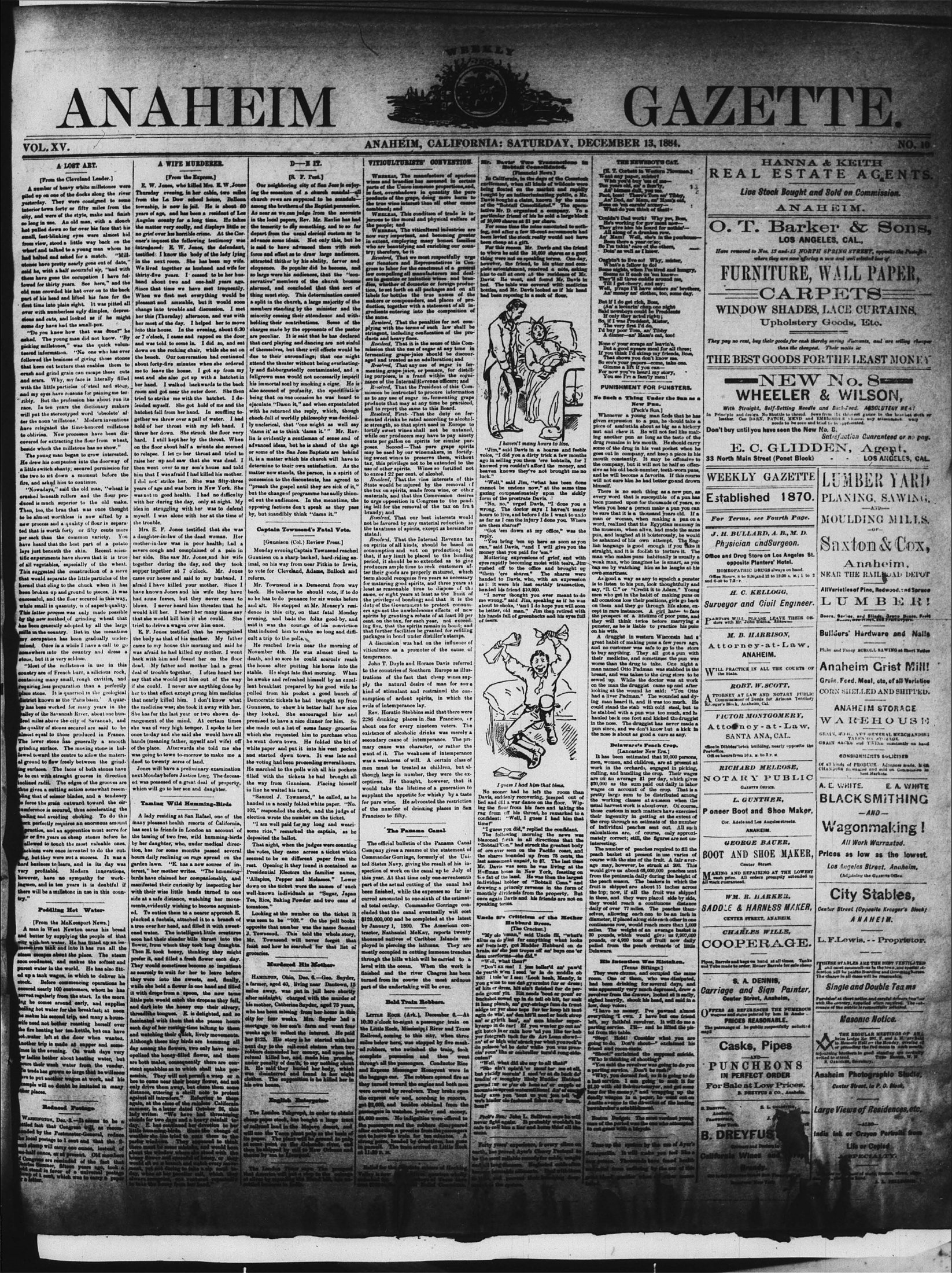
Searchable text
ANAHEIM
VOL. XV.
A LOST ART.
[From the Cleveland Leader.]
A number of heavy white millstones were piled up on one of the docks along the river yesterday. They were consigned to some interior town forty or fifty miles from the city, and were of the style, make and finish no long in use. An old man, with a slouch hat pulled down so far over his face that his small, fast-blinking eyes were almost hid from view, stood a little way back on the wharf and talked to a young man whom he had halted and asked for a match. "Millstones have pretty nearly gone out of date," said he, with a half mournful air, "and with them have gone the occupation I have followed for thirty years. See here," and the old man crowded his hat over on to the back part of his head and lifted his face for the first time into plain sight. It was pitted all over with numberless ugly dimples, depressions and cuts, and looked as if he might some day have had the small-pox.
"Do you know how that was done?" he asked. The young man did not know. "By picking millstones," was the quick volunteered information. "No one who has ever followed the business of giving those stones that keen cut texture that enables them to crush and grind grain can escape these cuts and scars. Why, my face is literally filled with the little particles of steel and stone, and my eyes have reasons for painting me terribly. But the profession has about run its race. In ten years the dictionary makers will put the stereotyped word 'obsolete' after the noun 'millstone.' Modern inventions have relegated the time-honored millstone to oblivion. Now processes have been discovered for extracting the flour from wheat, beside which the millstone has no show."
The young man began to grow interested. He drew his companion into the doorway of a little switch shanty; secured permission for him before the
A WIFE MURDERER.
[From the Express.]
E. W. Jones, who killed Mrs. E. W. Jones Thursday evening, in her cabin, two miles from the La Dow school house, Bellona township, is now in jail. He is about 60 years of age, and has been a resident of Los Angeles county for a long time. He takes the matter very coolly, and displays little or no grief over his horrible crime. At the Cornerer's inquest the following testimony was introduced: E. W. Jones, the defendant, testified: I know the body of the lady lying in the next room. She has been my wife. We lived together as husband and wife for thirty-five years. I ceased to be her husband about two and one-half years ago. Since that time we have met frequently. When we first met everything would be pleasant and amenable, but it would soon change into trouble and discussion. I met her this (Thursday) afternoon, and was with her most of the day. I helped her to move into this house. In the evening, about 6:30 or 7 o'clock, I came and raped on the door and was told to come in. I did so, and sat down on the rocking chair, while she sat on the bench. Our conversation had continued about forty-five minutes when she ordered me to leave the house. I got up from my seat and she also got up with a hatchet in her hand. I walked backwards to the back room and got near the outer door. She then tried to strike me with the hatchet. I defended myself. She got hold of me and the hatchet fell from her hand. In scuffling together we threw over a pail of water. I had hold of her throat with my left hand. I threw her down. She struck the floor very hard. She still kept her by the throat. When on the floor about half a minute she seemed to relapse. I let go her throat and tried to raise her up and saw that she was dead. I then went over to my son's house and told him that I was afraid I had killed his mother.
D—E IT.
[S. F. Post.]
Our neighboring city of San Jose is enjoying the sensation of a church scandal—the church rows are supposed to be scandalous among the brotherhood of the Baptist permission As near as we can judge from the accounts in the local papers, Rev. Mr. Ravlin has hated the temerity to say something, and to so depart from the usual clerical custom as advance some ideas. Not only this, but he is said to have advanced them with such force and effect as to draw large audiences attracted thither by his ability, fervor and eloquence. So popular did he become, so large were his audiences, that the "cooperative" members of the church became alarmed, and concluded that that sort of thing must stop. This determination caused a split in the church, a large majority of the members standing by the minister and the minority ceasing their attendance and withdrawing their contributions. Some of them charges made by the opponents of the past are peculiar. It is said that he has declared that card playing and dancing are not sinful of themselves, but their evil effects would be due to their aroundings; that one might attend the theater without being everlastingly and flabbergastedly contaminated, and fallgrown man would not necessarily imperil his immortal soul by smoking a cigar. He also accused of profanity, the specification being that on one occasion he was heard ejaculate "Damn it," and when expostulated with he returned the reply, which, though chock-full of worldly philosophy was decidedly unclerical, that "one might as well say 'damn it' as to think 'damn it.'" Mr. Ravlin is evidently a gentleman of sense and an advanced idea, but he is ahead of the age or some of the San Jose Baptists are behind it, is a matter which his church will have determined to their own satisfaction. As the matter now stands, the parson, in a spirit
The young man began to grow interested. He drew his companion into the doorway of a little switch shanty; secured permission for the two to sit down a moment before the fire, and asked him to continue.
"Nowadays," said the old man, "wheat is crushed beneath rollers and the flour produced is much superior to the old make. Then, too, the bran that was once thought to be almost worthless is now sifted by a new process and a quality of flour is separated that is worth forty or fifty cents more per sack than the common variety. You have heard that the best part of a potato lays just beneath the skin. Recent scientific experiments have shown that it is true of all vegetables, especially of the wheat. This suggested the construction of a sieve that would separate the little particles of kernel that cling to the chuck when it has been broken up and ground to pieces. It was successful, and the flour secured in this way, while small in quantity, is of superb quality. This latter process was only made possible by the new method of grinding wheat that has been generally adopted by all the large mills in the country. But in the meantime my occupation has been gradually undermined. Once in a while I have a call to go somewhere into the country and dress a stone, but it is very seldom.
"Most of the millstones in use in this country are of French burr, a silicious rock, containing many small, rough cavities, and requiring less preparation than a perfectly plan stone. It is quarried in the geological district known as the 'Paris basin.' A quarry has been worked for many years in the valley of the Savannah River, about one hundred miles above the city of Savannah, and the quality of stones secured are said to be almost equal to those produced in France. The lower stone has generally a smooth grinding surface. The moving stone is hollowed toward the centre to allow the material ground to flow freely between the grinding surfaces. The faces of both stones have to be cut with straight grooves in direction inclined radii. The edges of the grooves are thus given a cutting action somewhat resembling that of scissor blades, and a tendency force the grain outward toward the circumference is secured, thus accelerating the cooling and avoiding choking. To do this work perfectly requires an enormous amount of practice, and an apprentice must serve for over or five years on cheap stones before he allowed to touch the most valuable ones. Machines were once invented to do the cutting, but they were not a success. It was a hard business to learn, and in its day was very profitable. Modern innovations, however, have no sympathy for workingmen, and in ten years it is doubtful if there will be a millstone in use in this country."
Mrs. E. F. Jones testified that she was a daughter-in-law of the dead woman. Her mother-in-law was in poor health; had a severe cough and complained of a pain in her side. She saw Mr. Jones and his wife together during the day, and they took supper together at 7 o'clock. Mr. Jones came our house and said to my husband, I afraid I have killed your mother. Since I have known Jones and his wife they have had some fusses, but they never came to blows. I never heard him threaten that he would kill her. I heard her many times say that she would kill him if she could. tried to drive a wagon over him once.
E. F. Jones testified that he recognized the body as that of his mother. My father came to my house this morning and said he was afraid he had killed my mother. I went back with him and found her on the floor dead. My father and mother had a great deal of trouble together. I often heard her say that she would put him out of the way if she could. I never saw anything done by her to that effect except giving him medicine that nearly killed him. I don't know what the medicine was; she took it away with her. She has for the last year or two shown derangement of the mind. At certain times she was of very high temper. I spoke to her once to-day and she said she would have all hands (meaning father, myself and wife) off of the place. Afterwards she told me she was going to town to-morrow to make me a deed to twenty acres of land.
Jones will have a preliminary examination next Monday before Justice Lang. The deceased was possessed of a great deal of property, which will go to her son and daughter.
Taming Wild Humming-Birds
A lady residing at San Rafael, one of the many pleasant health resorts of California, has sent to friends in London an account of the taming of two free, wild humming-birds by her daughter, who, under medical direction, has for some months passed several hours daily reclining on rugs spread on the garden lawn. "E. has a new source of interest," her mother writes. "The humming-birds have claimed their companionship, and manifested their curiosity by inspecting her with their wise little heads turned to one side at a safe distance watching her move and she also got up with a hatchet in her hand. I walked backwards to the back room and got near the outer door. She then tried to strike me with the hatchet. I defended myself. She got hold of me and the batchet fell from her hand. In souffling together we threw over a pail of water. I had hold of her throat with my left hand. I threw her down. She struck the floor very hard. I still kept her by the throat. When on the floor about half a minute she seemed to relapse. I let go her throat and tried to raise her up and saw that she was dead. I then went over to my son's house and told him that I was afraid I had killed his mother. I did not strike her. She was fifty-three years of age and was born in New York. She was not in good health. I had no difficulty with her during the day, only at night. My ideas in struggling with her was to defend myself. I was alone with her at the time of the trouble.
Mrs. E. F. Jones testified that she was a daughter-in-law of the dead woman. Her mother-in-law was in poor health; had a severe cough and complained of a pain in her side. She saw Mr. Jones and his wife together during the day, and they took supper together at 7 o'clock. Mr. Jones came our house and said to my husband, I afraid I have killed your mother. Since I have known Jones and his wife they have had some fusses, but they never came to blows. I never heard him threaten that he would kill her. I heard her many times say that she would kill him if she could. tried to drive a wagon over him once.
E. F. Jones testified that he recognized the body as that of his mother. My father came to my house this morning and said he was afraid he had killed my mother. I went back with him and found her on the floor dead. My father and mother had a great deal of trouble together. I often heard her say that she would put him out of the way if she could. I never saw anything done by her to that effect except giving him medicine that nearly killed him. I don't know what the medicine was; she took it away with her. She has for the last year or two shown derangement of the mind. At certain times she was of very high temper. I spoke to her once to-day and she said she would have all hands (meaning father, myself and wife) off of the place. Afterwards she told me she was going to town to-morrow to make me a deed to twenty acres of land.
Jones will have a preliminary examination next Monday before Justice Lang. The deceased was possessed of a great deal of property, which will go to her son and daughter.
Captain Townsend's Fatal Vote.
[Gunnison (Col.) Review Press]
Monday evening Captain Townsend reached Gunnison on a sharp-backed, hard-riding animal, on his way from near Pitkin to Irwin to vote for Cleveland, Adame, Bullock and reform.
Mr Townsend is a Democrat from Waxley back. He believes he should vote, if so he has to do penance for six weeks before and alt. He stopped at Mr Monsey's residence in this city, on that fatal Monday evening, and bade the folks good-by, and said it was the courage of his conviction that induced him to make so long and difficult a trip to the polls.
He reached Irwin near the morning on November 4th. He was almost tired to death, and so sore he could scarcely reach the house after putting his horse into the stable. He slept late that morning. When he awoke and refreshed himself by an excellent lent breakfast prepared by his good wife he pulled from his pocket a good bunch of Democratic tickets he had brought up from Gunnison, to show his better half how nice they looked. He encouraged him and promised to have a nice dinner for him.She made out a list of some fancy groceries which she requested him to purchase where he went down town.He folded the bit of white paper and put it into his vest pocket and started down town.I was late and the voting had been proceeding several hours He marched to the polls with all his pocketfilled with the tickets he had brought allthe way from Gunnison.Placing himself in line he waited his turn.
"Samuel J. Townsend," he called, as he handed in a neatly folded white paper."No 102," responded the clerk, and the judge of election wrote the number on the ticket.
"I am well paid for my long and weari-some ride," remarked the captain, as he deposited the ballot.
That night, when the judges were counting the votes, they came across a ticket which seemed to be on different paper from their rest.Opening it they found it contained an Presidential Electors the familiar names,"Allapice, Pepper and Molasses."Lower down on the ticket were the names of such well-known individuals as "Sugar, Japan
The force the grain outward toward the circumference is secured, thus accelerating the
breaking and avoiding choking. To do this
work perfectly requires an enormous amount
of practice, and an apprentice must serve for
a year or five years on cheap stones before he
allowed to touch the most valuable ones.
Machines were once invented to do the cutting, but they were not a success. It was a
hard business to learn, and in its day was
very profitable. Modern innovations,
however, have no sympathy for workingmen, and in ten years it is doubtful if
there will be a millstone in use in this country."
Peddling Hot Water
[From the McKeesport News.]
A man in West Newton carms his bread
and butter by supplying the people of that
city with hot water. He has fitted up an immense iron tank and into it has run all the
steam occupies about the place. The steam
soon condenses, and makes the softest and
purest water in the world. He has also fitted up a tank wagon, in which to deliver his
stock. Before commencing operations he
secured nearly 100 customers, whom he has
served regularly from the start. In the mornning he comes around early, and supplies
boiling hot water for the breakfast; at noon
he makes his second trip, and many a housewife need not bother roasting herself over
the fire heating her tea-kettle, but can have
hot-water left at the door when wanted.
Another trip is made at supper and sometimes in the evening. On wash days very
low ladies bother about heating water, but
some their wash water from the vender.
His trade has grown so large that he will soon
have to put another wagon at work, and his
example will no doubt be imitated in many
other places.
Badneed Postage
WASHINGTON, Dec. 3.—It seems to be a
settled fact that Congress will, as recomended by the Postmaster-General, reduce
the local postage to 1 cent and that the 2cent stamp will carry one cents, instead of
one-half ounce, or at present. Old members
of Congress are reminded of the fact that
Charles Sumner, fifteen years ago, took a
hold in favor of a universal postage
stamp of 1 cent, which was to carry a paper
or letter.
Taming Wild Humming-Birds
A lady residing at San Rafael, one of the
many pleasant health resorts of California,
has sent to friends in London an account of
the taming of two free, wild humming-birds
by her daughter, who, under medical direction, has for some months passed several
hours daily reclining on rugs spread on the
garden lawn. "E. has a new source of interest," her mother writes. "The humming-birds have claimed her companionship, and manifested their curiosity by inspecting her with their wise little heads turned to one side at a safe distance, watching her movements, evidently wishing to become acquainted.
To entice them to a nearer approach E.
plucked a fuchsia, attached it to a branch of a tree over her head, and filled it with sweetened water. The intelligent little creatures soon had their slender bills thrust into the flower, from which they took long draughts. Then E. took honey, thinking they might prefer it, and filled a fresh flower each day. They would sometimes become so impatient as scarcely to wait for her to leave before they were into the sweets, and, finally, while she held a flower in one hand and filled it with drope from a spoon, the now tame little pets would catch the drops as they fell, and dart into the honey cup their silvery, threadlike tongues. E. is delighted, and so fascinated with them that she passes hours each day of her resting-time talking to them and watching their quick, lively movements.
Although these tiny birds are humming all day among the flowers, two only have monopolized the honey-filled flower, and there are both males, consequently there are constant squabbles as to which shall take possession. They will not permit a swap or a bee to come near their honey flower, and not only drive them away, but chase them some distance, uttering a shrill note to protest against all intruders." Referring to them again, at the close of the rainfall California summer, in a latter dated October 26, this lady writes: "We have had threatening clouds for two days and a heavy rainfall today. E. has continued her devotion to her little humming-birds. Since the change of weather she has tried to ease them to the perfor windows. They appeared to think there must be some mistake, and would hear about the window where she stood with the honey flower and spunful of honey, or they would sit on a branch and watch every movement, yet not during to take a big snap today when all her perilous call, which they direct repeatedly, on a restrained position to take the honey from her hand."
I am well paid for my long and wearisome ride," remarked the captain, as he deposited the ballot.
That night, when the judges were counting
the votes, they came across a ticket which seemed to be on different paper from the rest. Opening it they found it contained an Presidential Electors the familiar names,
"Allspice, Pepper and Melissa." Lower down on the ticket were the names of such well-known individuals as "Sugar, Japan Tea, Rice, Baking Powder and two cans of tomatoes."
Looking at the number on the ticket it was seen to be "102." On the poll books opposite that number was the name Samuel J. Townsend. This told the whole story,
Mr. Townsend will never forget that feast and how he searched for that list of groceries.
Murdered His Mother
HAMILTON, Ohio, Dec. 6.—Geo. Snyder,
a farmer, aged 40, living near Dantown, 15 miles away, was put in jail here shortly after midnight, charged with the murder of his mother, Catherine Snyder, aged 75 years, who has been missing from her home in this city for four weeks. Mrs. Snyder had a mortgage on her son's farm and went four weeks ago to collect the interest. He paid her $125. His story is he started with her next day to the railroad station when two robbers demanded her money, and upon her refusal killed her, and made him promise under penalty of death; to say nothing about it. He said they buried her body, which was disinterred and found in her night clothes. The supposition is he killed her in his own house.
English Endorsement
The London Telegraph, in order to obtain cheap paper stock, has bought a large tract of railroad land in the Mojave desert, and will use the Yucan plant pulp on the basis of its paper. The plant will be ground to pulp at some point on the Colorado river, and then be shipped by roll to New Orleans and thence by sea to Liverpool.
The London Telegraph sign. The presumed that disaster will put a stop to the collapse of aliens by repelling like flames hit his unattended barn in India.
ANAHEIM, CALIFORNIA: SATURDAY, DECEMBER 13, 1880
D—H IT.
[S. F. Post.]
Laboring city of San Jose is enjoyment of a church scandal—all papers, Rev. Mr. Ravlin has had to say something, and so far the usual clerical custom as to ideas. Not only this, but he have advanced them with such effect as to draw large audiences. Neither by his ability, fervor and popularity did he become, and he has audiences, that the "concerns of the church became concluded that sort of stop. This determination caused the church, a large majority of the standing by the minister and the causing their attendance and with contributions. Some of the men by the opponents of the pastor. It is said that he has declared saying and dancing are not sinful, but their evil effects would be for aroundings; that one might theater without being everlastingly contaminated, and a man would not necessarily imperil soul by smoking a cigar. He is of profanity, the specification on one occasion he was hoarded it," and when expostulated turned the reply, which, though worldly philosophy was decided, that "one might as well say to think 'damn it.'" Mr. Ravlin a gentleman of sense and of mass, but he is ahead of the age of the San Jose Baptists are behind which his church will have to meet their own satisfaction. As the stands, the parson, in a spirit of viticultureists' convention.
WHEREAS, The manufacture of spirous wines and brandies has assumed in certain parts of the Union immense proportions, and, in fact, overshadows in quantity the pure products of the grape, doing more harm to the true wine interest than all other causes combined; and
WHEREAS, This condition of trade is injurious to the moral and physical welfare of the people; and
WHEREAS, The viticultural industries are now very important, and becoming greater in extent, employing many honest families who are beautifying and enriching our country; therefore, be it
Resolved, That we most respectfully urge our Senators and Representatives in Congress to labor for the enactment of a general law compelling all manufacturers and dealers in genuine or imitation wines and brands, whether of domestic or foreign production, to set forth on all packages and on all labels for bottles the true names of the makers or compounders, and places of production, together with a statement of all ingredients entering into the composition of the same.
Resolved, That the penalties for not complying with the terms of such law shall be stringent, including confiscation of the products and heavy fines.
Resolved, That it is the sense of this Commission that the use of sugar at any time in fermenting grape-juice should be discouraged and treated as an adulteration; and
Resolved, That any use of sugar in fermenting grape-juice, or pomace, for distilling purposes, is a fraud within the cognizance of the Internal Revenue officers; and
Resolved, That the President of this Commission be instructed to procure information as to any use of sugar in fermenting grape products that may at any time be practiced, and to report the same to this Board.
Resolved, First—That the duty on fermented drinks be rated according to alcoholic strength, so that spirit used in Europe to tortify sweet wines shall not be untaxed, while our producers may have to pay ninety cents per gallon on spirits for similar purposes. Second—That pure grape spirits may be used by our winemakers, in fortifying sweet wines to preserve them, without tax, this privilege not to be extended to the use of other spirits. Wines so fortified not to exceed 22 per cent. of alcohol.
Mr. Davis' Two Transactions in Bottle Conciliation.
In California, in the days of the Comstock revolution, when all kinds of wildcats were being floated on the market and rapidly bought by an indiscriminating public, a Mr. Davis bought a claim, known by the name of the "Bobtail Commodifier." The speculative Mr. D. organized a company. To a particular friend of his he sold a large block of 10,000 shares at $1 per share.
For some time the mine amounted to nothing, and after a few 25-cent assessments had been levied the stock really would not have been cheap at a gift.
For this reason Mr. Davis and the friend to whom he told the 10,000 shares as a good thing were not on speaking terms. One day, however, the friend, to his utter and complete astonishment, received a note, asking him to call at once at the residence of Mr. Davis. He went, and found Mr. Davis in bed. The table was covered with medicine bottles, and Mr. Davis looked as if his hand had been reposing in a sack of flour.
THE NEWBOYS CAUSE
[M. T. Carbett in Western Thief] Want any paper, mister?
Wish you'd buy 'un of me—Ten years old, an 'a family,
An 'bness dull you see.
Pact home! There's Tom an 'T
An 'Dad, an 'Mam, an 'Mam'
None on 'en carms' money—What do you think of that?
Couldn't Dad work? Why yes?
He's working for government now.
They give him his board for me.
All along of a drunken row.
An 'Mam! Well, she's in the Beam there a year or so;
So I'm takin' care of the others.
Doin' as well as I know.
Onghtn't to live no? Why, mis?
What's a fellow to do?
Some nights, when I'm tired and bored as if each on 'un knows They'll all three cuddle around Till I get cheery, and say:
Well, praps I'll have sisters An 'money an 'clothes, too,
But if I do get rich, Boss,
(An 'a lecturni' chap one night Said newsboys could be Preddie If only they acted right);
So if I was President, Mistor,
The very first I'd do,
I'd buy poor Tom, an 'Tibby A dinner—an 'Mam's cat, too!
None o' your scraps an' leavin' w?
But a good square meal for al If you think I'd skimp my friend That shows you don't know me So evo's your papers—come, take Gimme a lift if you can— For now you've heard my story You see Pr a famly man!
PUNISHMENT FOR PUNISHMENT FOR PUNISHMENT FOR PUNISHMENT FOR PUNISHMENT FOR PUNISHMENT FOR PUNISHMENT FOR PUNISHMENT FOR PUNISHMENT FOR PUNISHMENT FOR PUNISHMENT FOR PUNISHMENT FOR PUNISHMENT FOR PUNISHMENT FOR PUNISHMENT FOR PUNISHMENT FOR PUNISHMENT FOR PUNISHMENT FOR PUNISHMENT FOR PUNISHMENT FOR PUNISHMENT FOR PUNISHMENT FOR PUNISHMENT FOR PUNISHMENT FOR PUNISHMENT FOR PUNISHMENT FOR PUNISHMENT FOR PUNISHMENT FOR PUNISHMENT FOR PUNISHMENT FOR PUNISHMENT FOR PUNISHMENT FOR PUNISHMENT FOR PUNISHMENT FOR PUNISHMENT FOR PUNISHMENT FOR PUNISHMENT FOR PUNISHMENT FOR PUNISHMENT FOR PUNISHMENT FOR PUNISHMENT FOR PUNISHMENT FOR PUNISHMENT FOR PUNISHMENT FOR PUNISHMENT FOR PUNISHMENT FOR PUNISHMENT FOR PUNISHMENT FOR PUNISHMENT FOR PUNISHMENTFOR PUNISHMENTFORPUNISHMENTFORPUNISHMENTFORPUNISHMENTFORPUNISHMENTFORPUNISHMENTFORPUNISHMENTFORPUNISHMENTFORPUNISHMENTFORPUNISHMENTFORPUNISHMENTFORPUNISHMENTFORPUNISHMENTFORPUNISHMENTFORPUNISHMENTFORPUNISHMENTFORPUNISHMENTFORPUNISHMENTFORPUNISHMENTFORPUNISHMENTFORPUNISHMENTFORPUNISHMENTFORPUNISHMENTFORPUNISHMENTFORPUNISHMENTFORPUNISHMENTFORPUNISHMENTFORPUNISHMENTFORPUNISHMENTFORPUNISHMENTFORPUNISHMENTFORPunishmentforpunishmentforpunishmentforpunishmentforpunishmentforpunishmentforpunishmentforpunishmentforpunishmentforpunishmentforpunishmentforpunishmentforpunishmentforpunishmentforpunishmentforpunishmentforpunishmentforpunishmentforpunishmentforpunishmentforpunishmentforpunishmentforpunishmentforpunishmentforpunishmentforpunishmentforpunishmentforpunishmentforpunishmentforpunishmentforpunishmentforpunishmentforpunishmentforpunishmentforpunishmentforpunishmentforpunishmentforpunishmentforpunishmentforpunishmentforpunishmentsincepenaltyforepenaltyforepenaltyforepenaltyforepenaltyforepenaltyforepenaltyforepenaltyforepenaltyforepenaltyforepenaltyforepenaltyforepenaltyforepenaltyforepenaltyforepenaltyforepenaltyforepenaltyforepenaltyforepenaltyforepenaltyforepenaltyforepenaltyforepenaltyforepenaltyforepenaltyforepenaltyforepenaltyforepenaltyforepenaltyforepenaltyforepenaltyforepenaltyforepenaltyforepenaltyforepenaltyforepenaltyforepenaltyforepenaltyforepenaltyforepenaltyforepenaltyforepenaltyforepenaltyForepenaltyForepenaltyForepenaltyForepenaltyForepenaltyForepenaltyForepenaltyForepenaltyForepenaltyForepenaltyForepenaltiesincepenaltyForepenaltiesincepenaltyForepenaltiesincepenaltiesincepenaltiesincepenaltiesincepenaltiesincepenaltiesincepenaltiesincepenaltiesincepenaltiesincepenaltiesincepenaltiesincepenaltiesincepenaltiesincepenaltiesincepenaltiesincepenaltiesincepenaltiesincepenaltiesincepenaltiesincepenaltiesincepenaltiesincepenaltiesincepenaltiesincepenaltiesincepenaltiesincepenaltiesincepenaltiesincepenaltiesincepenaltiesincepenaltiesincepenaltiesincepenaltiesincepenaltiesincepenaltiesincepenaltiesince penaltiesincepenaltiesincepenaltiesincepenaltiesincepenaltiesincepenaltiesincepenaltiesincepenaltiesince Penaltiesince Penaltiesince Penaltiesince Penaltiesince Penaltiesince Penaltiesince Penaltiesince Penaltiesince Penaltiesince Penaltiesince Penaltiesince Penaltiesince Penaltiesince Penaltiesisce Penaltiesisce Penaltiesisce Penaltiesisce Penaltiesisce Penaltiesisce Penaltiesisce Penaltiesisce Penaltiesisce Penaltiesisce Penaltiesisce Penaltiesisce Penaltiesisce Penaltiesisce Penaltiesisce Penaltiesisce Penaltiesisce Penaltiesisce Penutiesce Penutiesce Penutiesce Penutiesce Penutiesce Penutiesce Penutiesce Penutiesce Penutiesce Penutiesce Penutiesce Penutiesce Penutiesce Penutiesce Penutiesce Penutiesce Penutiesce Penutiesce Penutiesce Penutiesce Penutiesce Penutiesce Penutiesce Penutiesce Penutiesce Penutiesce Penutiesce Penutiesce Penutiesce Penutiesce Penutiesce Penutiesce Penutiesce Penutiesce penaltiesece penaltiesece penaltiesece penaltiesece penaltiesece penaltiesece penaltiesece penaltiesece penaltiesece penaltiesece penaltiesece penaltiesece penaltiesece penaltiesece penaltiesece penaltiesece penaltiesece penaltiesece penaltiesece penaltiesece penALTIESCE penALTIESCE penALTIESCE penALTIESCE penALTIESCE penALTIESCE penALTIESCE penALTIESCE penALTIESCE penALTIESCE penALTIESCE penALTIESCE penALTIESCE penALTIESCE penALTIESCE penALTIESCE penALTIESCE penALTIESCE penALTIESCE penALTIESCE penALTIESCE penALTIESCE penALTIESCE penALTIESCE penALTIESCE penALTIESCE penALTIESCE penALTIESCE penALTIESCE penALTIESCE penALTIESCE penALTIESCE penALTIESCE penALTIESCE penALTIESCE penALTIESCE penALTIESCE penALTIESCE penALTIESCE penALTIESCE penALTIESCE penALTIESCE penALTIESCE penALTIESCE penALTERSCE penALTERSCE penALTERSCE penALTERSCE penALTERSCE penALTERSCE penALTERSCE penALTERSCE penALTERSCE penALTERSCE penALTERSCE penALTERSCE penALTERSCE penALTERSCE penALTERSCE penALTERSCE penALTERSCE penALTERSCE penALTERSCE penALTERSCE penALTERSCE penALTERSCE penalTERS CE penalTERS CE penalTERS CE penalTERS CE penalTERS CE penalTERS CE penalTERS CE penalTERS CE penalTERS CE penalTERS CE penalTERS CE penalTERS CE penalTERS CE penalTERS CE penalTERS CE penalTERS CE penalTERS CE penalTERS CE penalTERS CE penalTERS CE penalTERS CE penalTERS CE penalTERS CE penalTERS CE penalTERS CE penalTERS CE penalTERS CE penalTERS CE penalTERSE CE penalTERSE CE penalTERSE CE penalTERSE CE penalTERSE CE penalTERSE CE penalTERSE CE penalTERSE CE penalTERSE CE penalTERSE CE penalTERSE CE penalTERSE CE penalTERSE CE penalTERSE CE penalTERSE CE penalTERSE CE penalTERSE CE penalTERSE CE penalTERSE CE penalTERSE CE penalTERSE CE penalTERSE CE penalTERSE CE penalTERSE CE penalTERSE CE penalTERNES CE penalTERNES CE penalTERNES CE penalTERNES CE penalTERNES CE penalTERNES CE penalTERNES CE penalTERNES CE palernTESCe palernTESCe palernTESCe palernTESCe palernTESCe palernTESCe palernTESCe palernTESCe palernTESCe palernTESCe palernTESCe palernTESCe palernTESCe palernTESCe palernTESCe palernTESCe palernTESCe palernTESCe palernTESCe palernTESCe palernTESCe palernTESCe palernTESCe palernTESCe palERNTESCe palERNTESCe palERNTESCe palERNTESCe palERNTESCe palERNTESCe palERNTESCe palERNTESCe palERNTESCe palERNTESCe palERNTESCe palERNTESCe palERNTESCe palERNTESCe palERNTESCe palERNTESCe palERNTESCe palERNTESCe palERNTESCe palERNTESCe palERNTESCe palERNTESCe palERNTESCe palERNTES Ce palERNTES Ce palERNTES Ce palERNτες Ce palERNτες Ce palERNτες Ce palERNτες Ce palERNτες Ce palERNτες Ce palERNτες Ce palERNτες Ce palERNτες Ce palERNτες Ce palERNτες Ce palERNτες Ce palERNτες Ce palERNτες Ce palERNτες Ce palERNτες Ce palERNτες Ce palERNτες Ce palmRNTECs palmRNTECs palmRNTECs palmRNTECs palmRNTECs palmRNTECs palmRNTECs palmRNTECs palmRNTECs palmRNTECs palmRNTECs palmRNTECs palmRNTECs palmRNTECs palmRNTECs palmRNTECs palmRNTECs palmRNTECs palmRNTECs palmRNTECs palmRNTECs palmRNTECs palmRNTECs palmRNTECs palmRNTECs palmRNTEs palmRNTEs palmRNTEs palmRNTEs palmRNTEs palmRNTEs palmRNTEs palmRNTEs palmRNTEs palmRNTEs palmRNTEs palmRNTEs palmRNTEs palmRNTEs palmRNTEs palmRNTEs palmRNTEs palmRNTEs palmRNTEs palmRNTEs palmRNTEs palmRNTEs palmRNTEs palmRNTEs palmRNTEs palmRNTeCs palmRNTeCs palmRNTeCs palmRNTeCs palmRNTeCs palmRNTeCs palmRNTeCs palmRNTeCs palmRNTeCs palmRNTeCs palmRNTeCs palmRNTeCs palmRNTeCs palmRNTeCs palmRNTeCs palmRNTeCs palmRNTeCs palmRNTeCs palmRNTeCs palmRNTeCs palmRNTeCs palmRNTeCs palmRNTeCs palmRNTeCs
I haven't many hours to live.
"I Jim" said Davis in a hoarse and feeble voice," I did you a dirty trick a few months ago in selling you them're bobtails,' for I knew you couldn't afford the money,and heaven knows they've not brought me no
I haven't many hours to live.
"I Jim" said Davis in a hoarse and feeble voice," I did you a dirty trick a few months ago in selling you them're bobtails,' for I knew you couldn't afford the money,and heaven knows they've not brought me no
Townsend's Fatal Vote.
Bison (Col.) Review Press.] Opening Captain Townsend reached a sharp-backed, hard-riding away from near Pitkin to Irwin, Cleveland, Adama, Bullock and send is a Democrat from way believes he should vote, if to do so penance for six weeks before stopped at Mr. Monsey's resi-sion on city, on that fatal Monday had bade the folks good-by, and the courage of his conviction him to make so long and difficlly think "damn it."
Irwin near the morning of th. He was almost tired to sore he could scarcely reach after putting his horse into the slept late that morning. When he refreshed himself by an excel-lent prepared by his good wife he his pocket a good bunch of tickets he had brought up from show his better half how nice She encouraged him and have a nice dinner for him. So a list of some fancy groceries requested him to purchase when in town. He folded the bit of and put it into his vest pocket down town. It was late and been proceeding several hours. No the polls with all his pockets the tickets he had brought all on Gunnison. Placing himself tied his turn.
Townsend," he called, as he neatly folded white paper. "No used the clerk, and the judge of the number on the ticket. Paid for my long and weari-remarked the captain, as he ballot.
when the judges were counting they came across a ticket which on different paper from the it they found it contained as Electors the familiar names, pepper and Melissa." Lower ticket were the names of such individuals as "Sugar, Japan ing purposes, is a fraud within the cognizance of the Internal Revenue officer; and Resolved, That the President of this Commission be instructed to procure information as to any use of sugar in fermenting grape products that may at any time be practiced, and to report the same to this Board.
Resolved, First.-That the duty on fermented drinks be rated according to alcoholic strength, so that spirit used in Europe to tortify sweet wines shall not be untaxed, while our producers may have to pay ninety cents per gallon on spirits for similar purposes.
Second—That pure grape spirits may be used by our winemakers, in fortifying sweet wines to preserve them, without tax, this privilege not to be extended to the use of other spirits. Wines so fortified not to exceed 22 per cent. of alcohol.
Resolved, That the vine interests of this State would be injured by the removal of the tax on spirits, made from wine, or other materials, and that this Commission desires to urge opposition in Congress to the penal bill for the removal of the tax on fruit brandy; and
Resolved, That our best interests would not be favored by any material reduction in the taxations of spirits, except as hereinafter stated:
Resolved, That the Internal Revenue tax on spirits of all kinds, should be based on consumption and not on production; but that, if any limit be placed to the bonding period, it should be so extended as to give producers ample time to seek customers after their goods are properly matured, which term should recognize five years as necessary for maturing good spirits, and three years at least as reasonable time to dispose of the same, or eight years at least as the limit of the privilege of bonding; and that it is the duty of the Government to protect consumers against the unwholesome effects of new spirits by granting a rebate of at least 10 per cent, on the tax, for each year, not exceeding five, that the spirits remain in bond; and that further facilities be granted for refilling packages in bond under distiller's stamps.
A discussion was had on the influence of viticulture as a promoter of the cause of temperance.
John T. Doyle and Horace Davis referred to the countries of Southern Europe as illustrations of the fact that cheap wines supply the natural desire of man for some kind of stimulant and restrained the consumption of ardent spirits, in which the evils of intemperance lay.
Rev. Horatio Stebbins said that there were 2286 drinking places in San Francisco, or about one for every nineteen voters. The existence of alcoholic drinks was merely a secondary cause of intemperance. The primary cause was character, or rather the want of it. The weakness of intemperance was a weakness of will. A certain class of men must be treated as children, but although large in number, they were the exceptions. He thought, however, that it would take the lifetime of a generation to supplant the appetite for whisky by a taste for pure wine. He advocated the restriction of the number of drinking places in San Francisco to fifty.
The Panama Canal
The official bulletin of the Panama Canal Company gives a resume of the statement of Commander Gorringe, formerly of the United States Navy, giving the result of his inspection of work on the canal up to July of this year. At that time only one-seventeenth part of the actual cutting of the canal had been finished, while the expenses so far incurred amounted to one-sixth of the estimat-
I haven't many hours to live.
"Jim," said Davis in a hoarse and feeble voice, "I did you a dirty trick a few months ago in selling you them 'ere bobtails, for I knew you couldn't afford the money, and heaven knows they've not brought me no luck."
"Well," said Jim, "what has been done cannot be undone now," at the same time gazing compassionately upon the sickly form of the prostrate Davis.
"No, no," urged Davis, "I done you a wrong. The doctor says I haven't many hours to live, and before I die I want to undo as far as I can the injury I done you. Where are them shares?"
"Got 'em down at my office," was the reply.
"You bring 'em up here as soon as you can," said Davis, "and I will give you the money that you paid for 'em."
Muttering expressions of grief, and eyes rapidly becoming moist with tears, Jim rushed off to the office and brought up "them' shares." The shares were handed to Davis, who, with an expression as it it were his last earthly transaction, handed his friend $10,000.
"I never thought you ever meant to do me wrong," said Jim, speaking as if he was about to choke, "and I do hope you will soon be better, old man." Jim then retired with his hands full of greenbacks and his eyes full of tears.
It was also easy to go through say, "B. C." or "Credit it to Adam men who get in the habit of making all occasions lose their positions, giv on them and they go through life cept in rare instances. A girl had the prospect of a lifetime of pooh they will think twice before me punster, as he is liable to practice on his wife.
A druggist in western Wisconsin great habit of making puns a few wnd no customer was safe to go to buy anything. They all got their medicine, and sometimes worse than the drug to take. One man named Otto Padman was sta-breast, and was taken to the drug sewed up. While the doctor was on man the druggist came up looking at the wound he said: "Had a liver Padman." The wound- ing man heard it, and it was too ould stand the stab with cold stu be stabbed with a pun was too mu hauled back one foot and kicked tn in the nose. The druggist has new pun since, and we don't know but tho nose is about as good a cure ar
Delaware's Peach Crop
[Lancaster New Ers.] It has been estimated that 20,000 men, women, and children, are at work in the orchards, engaged in culling, and handling the crop. There are on an average $1 per day, wa- $20,000 as the sum paid out daily wages on account of the crop. Pretty large sum to be distributed by working classes at a season usual harvest work is about over those cautious in such matters hav- their ingenuity in getting at tha crop through an estimate of thaof individual peaches sent out. calculations are, of course, only mately correct; still, the figures are interesting.
The number of peaches required peach basket at present in use with size of the fruit. A age may, however, be struck at would give us about $60,000 peaches from the peninsula daily during tha peach season. The baskets in fruit is shipped are about 15 inch on top; now, if all the fruit was in these, and they were placed si-
The Panama Canal
The official bulletin of the Panama Canal Company gives a resume of the statement of Commander Gorringe, formerly of the United States Navy, giving the result of his inspection of work on the canal up to July of this year. At that time only one-seventeenth part of the actual cutting of the canal had been finished, while the expenses so far incurred amounted to one-sixth of the estimated total outlay. Commander Gorringe concluded that the canal eventually will cost $120,000,000 and be completed at the latest by January 1, 1890. The American contractor, Nathaniel McKay, reports twenty thousand natives of Caribbean Islands employed in piercing the isthmus. They are mostly occupied in cutting immense trenches through the hills which will be carried to a level with the ocean. When the work is finished and the river Chagres has been turned from its course the most arduous part of the undertaking will be over.
Bold Train Robbery
Little Rock (Ark.), December 6.—At 10:30 o'clock to-night a passenger train on the Little Rock, Mississippi River and Texas Railroad, coming to this city, when three miles below here, was stopped by five masked robbers, who switched the train, took complete possession and then went through all the passengers. Conductor Rice and Express Messenger Honeycut were in the baggage car. The robbers opened fire as they turned toward the engine and both men were covered by revolvers. They broke open the express safe and, according to reports, got $2,000, and besides obtained from the passengers in watch, jewelry and money, $4,000 more. No indigities were offered to the passengers and the robbers disappeared after exhorting a promise from the passengers not to have the train for ten minutes. A strong pontoon, headed by detectives, has gone in pursuit. The train arrived at Little Rock at 11:50 p.m.
Railroad for the Panama Canal of Hasking Valley is now under construction wholly owned by John L. Bullivan may he never fight again. It probably wouldn't be safe to call him a liar and home thief all the time.
Forty years' experience, is every close on earth, has proved Ayer's Cherry Furniture to be the most reliable furniture for only one long dimension. Neglected candle often becomes flickering illuminated. Dual with them is lamp and perennial thick burning deep within the garden.
Uncle Si's Criticism of the Mother Hubbard Dress.
[The Cracker.]
"My old 'omman,' said Uncle Si, 'what's allus on de pint fur ennothing what looks an' er lassy, got Maddie Hubbard on de brain, an she jes tropes off an' buys one 'er dem userforms—she did."
"Well, what then?"
"Don't ax me! I jen beller'd an' pawd do yearth w'en I need 'er in middle ob hit! I tole 'er I six: 'Look heah, Mandy, is you gwine to use dat gyrmint fur or dress; of hits er dress, hat sin't finished fur de parade ground' yit. Hit needs 'bout er poun' or backshot sowed up in de fall ob hit, ter mek it hang plumb, an' guy-strings fun de frunt aidge ter yer shoot tops fur ter keep hit taut agin de win', an' den hit'll need or back stop an' er gyrth ben', an' num kinder superkyargo in de rars! If you winter go out an' git kotch in er rain how 'ud you like ter hab yer fotegraft tuck fur de Art Loan show!—an' ef er high win struck yer what you rock'n de polece 'ud be done' white you was pranc' roona' like er embroller turn'd rong-side out!
"Well, what did she say to all that?"
"She ain't opin'd 'er mouf ter me at all but yylidy mormin' I used 'er at de back do tradin' er moughtly likely Mulder Hubbard gown: or yer ob hams an' or cuppe or mountain-spread water millions! An' of empty body axes you 'bout us you jen tell 'we's kinder ole-fashioned folks at my home, hom!"
Fock's Sun: John L. Bullivan says he will never fight again. It probably wouldn't be safe to call him a liar and home thief all the time.
Why, you darned fool, no it is go a last service. I am going to me $1.50 with old Schwartzmayer, and bear for the money," and wrapping deadly weapon in a paper, he was Austin avenue in the direction of the pawnbroker's establishment.
Boston Budget: The most worden man of the period was the one who sat on court grants with a big push.
Tens up the system by the use of steampillow. It will make you feel painless. The walls have finally been unblocked from suffling by the new grate blind window when it falls down.
GAZETTE.
CEMBER 13, 1884.
NO. 10
THE NEWSBOY'S CAT.
[E. T. Corbett in Western Flowman]
Want any paper, mister!
Wish you'd buy 'un of me—
Ten years old, an' a funny,
An' bimene dull, you ma.
Past, bent! There's Tom an' Tibby,
An' Dad, an' Mom, an' Mann's cat,
None on 'un earns' money—
What do you think of that?
Couldn't Dad work? Why yes, Bom,
He's working for government now—
They give him his board for nothin'
All along of a drunken row.
An' Mam! Well, she's in the yourhouse—
Bom there a year or so;
So I'm takin' care of the other,
Doin' an well as I know.
Onghtn't to live so? Why, mister,
What's a fellow to do?
Some night, when I'm tired and hungry,
Some as if each on 'un know—
They'll all three cuddle me,
Till I get cheery, and my:
Well, praps I'll have sisters an' brothers,
An' money an' clothes, too, some day.
But if I do get rich, Bom,
(An'a lecturin) chap one night
Said newsboys could be Presidents
If only they acted right?
So, if I was President, Mister,
The very first I'd do,
I'd buy poor Tom, an' Tibby
A dinner—an' Mam's cat, too!
None o'your scraps an' leavin',
But a good square meal for all three;
If you think I'd skimp my friends, Bom,
That shows you don't know me.
So ere's your papers—come, take one.
Gimme a lift if you can—
For now you've heard my story,
You see Fr. a famly man!
PUNISHMENT FOR PUNSTERS.
No Such a Thing Under the Sun as a New Fun.
[Peck's Sun]
Whenever a young man finds that he has given expression to a pun, he should take a piece of asafoetida about as big as a hickory out and chew it. He will not feel like making another pun as long as the taste of the drug remains in his mouth. He should carry some of the drug in his vest pocket when he goes out in company, and keep a piece in his mouth constantly. It may be offensive to the company, but it will not be half so offensive as his old back-number, teeth-worn pans, and he will become a favorite. If this is true, HANNA & KEITH REAL ESTATE AGENTS.
Live Stock Bought and Sold on Commission.
ANAHEIM.
O. T. Barker & Sons,
LOS ANGELES, CAL.,
Have removed to Nov. 15 and-15 NORTH SPRING STREET, appoints the Postmaster where they are now offering a new and well selected law of FURNITURE, WALL PAPER,
CARPETS
WINDOW SHADES, LACE CURTAINS,
Upholstery Goods, Etc.
They pay no rent, buy their goods for cash thereby saving discounts, and are selling cheaper than the cheapest. Their motto is:
THE BEST GOODS FOR THE LEAST MONEY
NEW No. 8
WHEELER & WILSON,
With Straight, Self-Setting Needle and Duck-Feed. ABSOLUTEGY NEAT!
In Principle and design. No Shuttle to thread. Seems from the thicker gauge in the heaviest cloth. Can DARN, PATCH, MEND and EMBROIDER it almost any attachment. Why needs to be seen and tried to be appreciated.
Don't buy until you have seen the New No. 8.
Satisfaction Guaranteed or no pay.
E. C. GLIDDEN, Agent.
33 North Main Street (Ponet Block)
LOS ANGELES, CAL.
PUNISHMENT FOR PUNSTERS.
No Such a Thing Under the Sun as a New Fun.
[Peck's Sun.]
Whenever a young man finds that he has given expression to a pun, he should take a piece of asafetitia about as big as a hickory but chew it. He will not feel like making another pun as long as the taste of the drug remains in his mouth. He should carry some of the drug in his vest pocket when he goes out in company, and keep a piece in his mouth constantly. It may be offensive to the company, but it will not be half so offensive as his old back-number, teeth-worn puns, and he will become a favorite. If this course will not cure him he had better go and drown himself.
There is no such thing as a new pun, as every word that is susceptible of a pun has been punned upon for thousands of years, so when you hear a person make a pun you can sure that it is a thousand years old. If a man or woman, when making a pun on a word, realized that the Egyptian mummy in the museum, when alive, had made the same pun, and laughed at it boisterously, he would ashamed of his own attempt. The English language is good enough if you take it straight, and it is foolish to torture it. The man who makes puns habitually is usually a peak man, who imagines he is smart, as you see by watching him as he laughs at his own smartness.
As good a way as any to squelch a punster to listen to his pun, look thoughtfully and play, "B. C." or "Credit it to Adam." Young men who get in the habit of making puns on occasions lose their positions, girls go back them and they go through life alone, except in rare instances. A girl hates to face the prospect of a lifetime of poor puns, and they will think twice before marrying a punster, as he is liable to practice his pun with his wife.
A druggist in western Wisconsin had a great habit of making puns a few years ago, and no customer was safe to go to the store buy anything. They all got a pun with their medicine, and sometimes the pun was worse than the drug to take. One night a man named Otto Padman was stabbed in the neck, and was taken to the drug store to be seduced up. While the doctor was at work the man the druggist came up and after looking at the wound he said: "You Otto and a liver Padman." The wounded and dying man heard it, and it was too much. He could stand the stab with cold steel, but to stabbed with a pun was too much, and he pulled back one foot and kicked the druggist the nose. The druggist has never made a pun since, and we don't know but a kick in the nose is about as good a cure as any.
Delaware's Peach Crop.
[Lancaster New Ers.]
It has been estimated that 20,000 persons, women, and children, are at present at work in the orchards, engaged in picking, milling, and handling the crop. Their wages on an average $1 per day, which gives 10,000 as the sum paid out daily in labor wages on account of the crop. That is a pretty large sum to be distributed among the working classes at a season when the usual harvest work is about over. Of course, those curious in such matters have exercised their ingenuity in getting at the extent of crop through an estimate of the number individual peaches sent out. All such calculations are, of course, only approximately correct; still, the figures are not uninteresting.
The number of peaches required to fill the basket at present in use varies of course with the size of the fruit. A fair averages may, however, be struck at 200. This would give us about 66,000,000 peaches sent from the peninsula daily during the height of peach season. The baskets in which the fruit is shipped are about 15 inches across top; now, if all the fruit was shipped these, and they were placed side by side.
NEW No. 8
WHEELER & WILSON,
With Straight, Self-Setting Needle and Back-Feed. ASSOLUTEGY NEAT!
In Principle and design. No Shuttle to thread. Seems from the thither gesture in the best last touch or leather. Can DARN, PATCH, MEND and EMBROIDER without any attachment. Why needs to be seen and tried to be appreciated.
Don't buy until you have seen the New No. 6.
Satisfaction Guaranteed or no pay.
E. C. GLIDDEN, Agent.
33 North Main Street (Ponet Block)
LOS ANGELES, CAL.
WEEKLY GAZETTE
Established 1870.
For Terms, see Fourth Page.
J. H. BULLARD, A.B., M.D.
Physician and Surgeon.
Office and Drug Store on Los Angeles St. opposite Planters' Hotel.
HOMEOPATHIC DRUGS always on hand.
Office Hours: 8 to 9:30 and 12 to 12:30 A.M.; 1 to 2 and 6-30 to 7:30 P.M.
H. C. KELLOGG,
Surveyor and Civil Engineer.
ARTISTS WILL PLEASE LEAVE THEIR ORDERS with Mr. John Haun.
ANAHEIM.
M. B. HARRISON,
Attorney-at-Law,
ANAHEIM.
WILL PRACTICE IN ALL THE COURTS OF the State.
ROBT. W.SCOTT,
ATTORNEY AT LAW AND NOTARY PUBLIC Commissioner of Deeds for Arizona Territory Krueger's Block, Anaheim, Cal.
VICTOR MONTGOMERY,
Attorney-at-Law,
SANTA ANA, CAL.
Office in Dibbles' brick building, nearly opposite the Postoffice.
Office hours from 10 A.M. to 3 P.M.
RICHARD MELEOSE,
NOTARY PUBLIC
GAENTTE OFFICE.
L. GUNTHER,
Pioneer Boot and Shoe Maker,
Cor. Adele and Los Angeles streets.
ANAHEIM.
GEORGE BAUER,
BOOT AND SHOE MAKER,
Center Street.
MAKING AND REPAIRING AT THE LOWEST cash price. All orders promptly attended to all work guaranteed.
WM. R. HARKER,
LUMBER YARD
PLANING, SAWING.
AND
MOULDING MILLS.
OF
Saxton & Cox,
Anaheim.
NEAR THE RAILROAD DEPT
All Varieties of Pine, Redwood,and Spruce
LUMBER!
Doors,Sarches,and Blinds.Structures.Fruit
Builders' Hardware and Nails
Plain and Fancy SCROLL NAWING at Short Notion
Anaheim Crist Mill!
Grain.Feed.Meal, etc.of all Varieties
CORN SHELLED AND SHIPPED.
ANAHEIM STORAGE
WAREHOUSE
GRAIN.WOOL AND GENERAL MERCHANDISING
TAKEN ON STORAGE
GRAIN MACKS AND TINS constantly on hand
CONSIGNMENTS SOLICIED
Of all kinds of PRODUCE.Advances made.Milk CHANDISK fo乳奶和 sold on Commission in best Markets.
A.E. WHITE.
E.A.WHITE
BLACKSMITHING
AND
Wagonmaking!
All Work Warranted.
Prices as low as the lowest.
Los Angeles Street.Anaheim.
(Adjoining the GAENTTE Office.)
L. GUNTHER,
Pioneer Boot and Shoe Maker,
Cor. Adele and Los Angeles streets.
ANAKEIM.
GEORGE BAUER,
BOOT AND SHOE MAKER,
Center Street.
MAKING AND REPAIRING AT THE LOWEST
cash price. All orders promptly attended to
All work guaranteed.
WM. R. HARKER,
SADDLE & HARNESS MAKER,
CENTER STREET, ANAHEIM.
CHARLES WILLE,
COOPERAGE.
Pipes, Barrels and keys on hand at all times. Tanks
and Tube made to order. Honey Barrels for sale cheap
S. A. DENNIS,
Carriage and Sign Painter,
Center Street, Anaheim.
OFFERS AS REFERENCES THE NUMEROUS
wagons and signs painted by him in Anahee.
PRICES REASONABLE.
The patroage of the public respectfully solicited
Casks, Pipes
AND
PUNCHEONS
IN PERFECT ORDER
For Sale at Low Prices.
B. DREYFUS
California Wines and Wrap
Brandy.
BLACKSMITHING
AND
Wagonmaking!
All Work Warranted.
Prices as low as the lowest.
Los Angeles Street, Anaheim.
(Adjoining the Garage Office).
City Stables,
Center Street (Opposite Kroeger's Block)
ANAHEIM.
L. F. Lewis, -- Proprietor.
THESE STARLES ARE THE BEST VENTILATED
and most comfortable in the town, and special attention will be paid to Boarding and Dressing berries.
The charge in all cases will be reasonable.
Single and Double Teams
Purchased at short notice and careful drivers, free with the country, supplied when required. The sub-range of the public is responsibly polished.
Masonic Notice.
THE REGULAR MEETINGS OF ANAheim Lodge No 207, F. and A. M. gryphail in Monroe Hall on the Monday evening of or preceding the full moon in such manner, sojourning between in good standing are cordially invited to attend.
Three Rows, W. M.
R. OAKDEN, Secretary.
Anaheim Photographic Studio,
Center Street, in P. O. Block.
Large Views of Residences, etc.
ALSO
India ink or Crayon Portraits from Life or Copied
ASSPECIALTY.