anaheim-gazette 1884-12-06
Scanned page
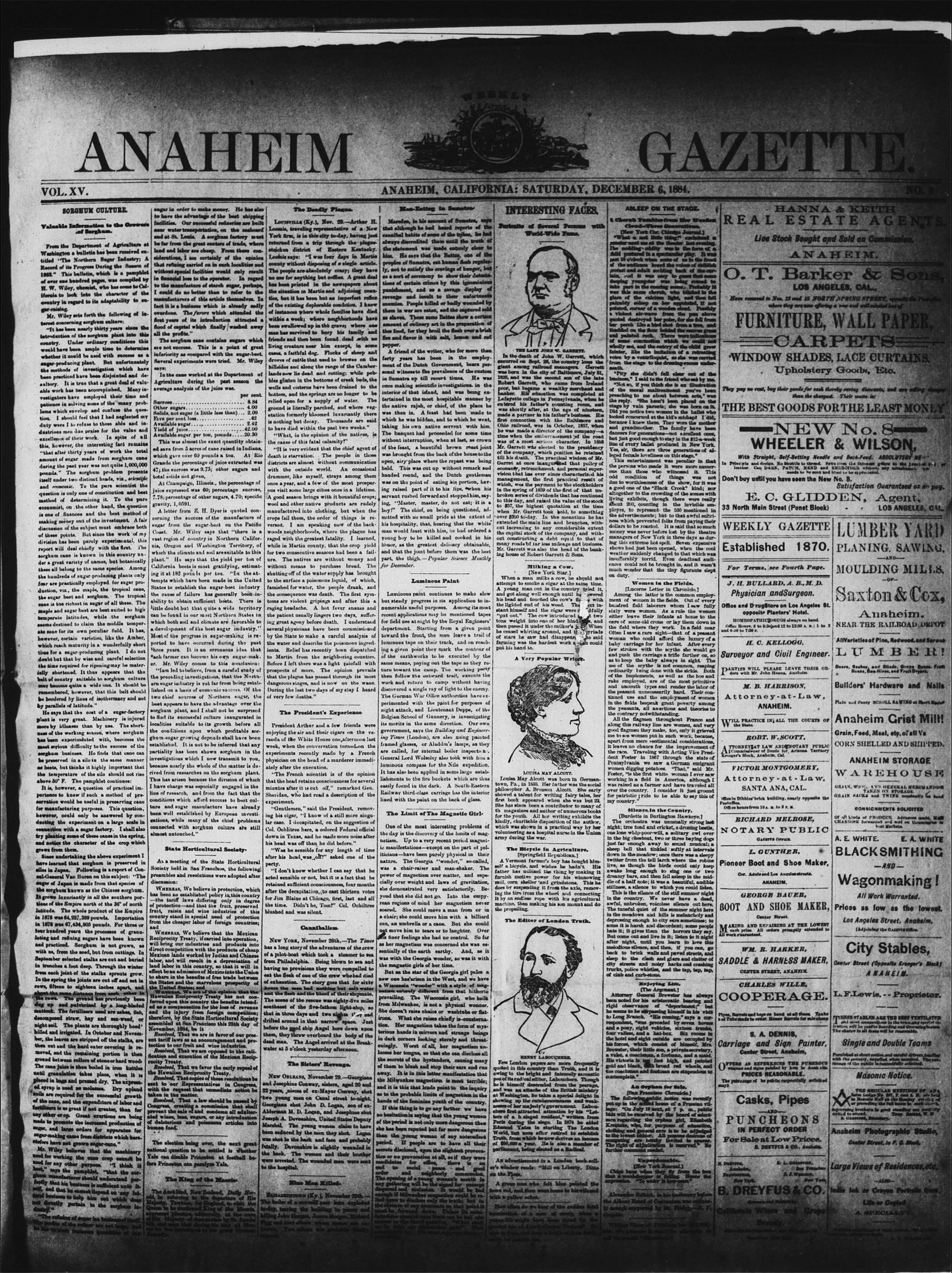
Searchable text
SORGHUM CULTURE.
Valuable Information to the Growth of Sorghum.
From the Department of Agriculture at Washington a bulletin has been received entitled "The Northern Sugar Industry; A Record of its Progress During the Season of 1863." This bulletin, which is a pamphlet of over one hundred pages, was compiled by H. W. Wiley, chemist, who has come to California to look into the character of the country in regard to its adaptability to sugar-raising.
Mr. Wiley sets forth the following interest concerning sorghum culture:
"It has been nearly thirty years since the introduction of the sorghum plant into this country. Under ordinary conditions this would have been ample time to determine whether it could be used with success as a sugar-producing plant. But unfortunately the methods of investigation which have been practiced have been disjointed and deutory. It is true that a great deal of valuable work has been accomplished. Many investigators have employed their time and patience in solving some of the many problems which envelop and confuse the question. I should feel that I had neglected my duty were I to refuse to these able and industrious men due praise for the value and excellence of their work. In spite of all this, however, the interesting fact remains that after thirty years of work the total amount of sugar made from sorghum cane during the past year was not quite 1,000,000 pounds." The sorghum problem presents sugar in order to make money. He has also to have the advantage of the best shipping facilities. Our successful refineries are built near water transportation, on the seaboard and at St. Louis. A sorghum factory must be far from the great centers of trade, where land and labor are cheap. From these considerations, I am certainly of the opinion that refining carried on in such localities and without special facilities would only result in financial loss to the operator. In regard to the manufacture of starch sugar, perhaps, I could do no better than to refer to the manufacturers of this article themselves. In fact it is a business which is already sadly overdone. The furore which attended the first years of its introduction attracted a flood of capital which finally washed away all the profits."
The sorghum cane contains sugars which are not sucrose. This is a point of great inferiority as compared with the sugar-beet. Several experiments were tried. Mr. Wiley says:
In the cane worked at the Department of Agriculture during the past season the average analysis of the juice was.
per cent.
Sucrose... 8.84
Other sugars... 4.00
Solids, not sugar (a little less than)... 2.00
Five per cent loss... 42
Available sugar... 2.42
Yield of juice... 42.00
Available sugar per ton, pounds... 20.30
This was almost the exact quantity obtained save from 5 acres of cane raised in Indiana, which gave over 60 pounds a ton. At Rio Grande the percentage of juice extracted was 47; the sucrose was 9.75; other sugars and
The Deadly Flagua.
LOUISVILLE (Ky.), Nov. 29.-An Loomis, traveling representative of York firm, is in this city to-day, has returned from a trip through the stricken district of Eastern Ky., Loomis says: "I was four days in county without disposing of a single The people are absolutely crazy; there no use for anything but coffins. A grap has been printed in the newspapers the situation in Martin and adjoining it, but it has been but an imperfect of the existing deplorable condition of instances where whole families have within a week; where neighborhood been swallowed up in the grave; who man has survived to bury his family friends and then been found dead living creature near him except cases, a faithful dog. Flocks of skirts glisten in the bottoms of creek wells and cisterns have been drained bottom, and the springs are no longer relied upon for a supply of water ground is literally parched, and whitetation formerly bloomed luxurant is nothing but decay. Thousands to have died within the past two weeks."
"What, in the opinion of the naihe cause of this fatal calamity?"
"It is very evident that the chief death is starvation. The people districts are almost without communication with the outside world. An o
been practiced have been disjointed and deaultory. It is true that a great deal of valuable work has been accomplished. Many investigators have employed their time and
patience in solving some of the many problems which envelop and confuse the question. I should feel that I had neglected my
duty were I to refuse to these able and indistrious men due praise for the value and
excellence of their work. In spite of all
this, however, the interesting fact remains
"that after thirty years of work the total
amount of sugar made from sorghum cane
during the past year was not quite 1,000,000
pounds." The sorghum problem presents
itself under two distinct heads, viz., scientific
and economic. To the pure scientist the
question is only one constitution and best
method of determining it. To the pure
economist, on the other hand, the question
is one of finances and the best method of
making money out of the investment. A fair
discussion of the subject must embrace both
of these points. But since the work of my
division has been purely experimental, this
report will deal chiefly with the first. The
sorghum cane is known in this country under a great variety of names, but botanically
these all belong to the same species. Among
the hundreds of sugar-producing plants only
four are practically employed for sugar production, viz., the maple, the tropical cane,
the sugar beet and sorghum. The tropical
cane is the richest in sugar of all these. The
maple and sugar beet are best suited to high
temperate latitudes, while the sorghum
seems destined to claim the middle temperate zone for its own peculiar field. It has,
however, certain varieties, like the Amber,
which reach maturity in a wonderfully short
time for a sugar-producing plant. I do not
doubt but that by wise and careful selection
the time required for ripening may be materially shortened. It thus appears that the belt of country suitable to sorghum culture may become quite a wide one. It should be remembered, however, that this belt should be bordered by lines of isothermacy and not by parallels of latitude."
He says that the cost of a sugar-factory plant is very great. Machinery is injured more by idiosyncrasy than by use. The shortness of the working season, where sorghum has been experimented with, becomes the most serious difficulty to the success of the sorghum business. He finds that cane can be preserved in a silo in the same manner as beets, but thinks it highly important that the temperature of the silo should not rise above 50° F. The pamphlet continues:
It is, however, a question of practical importance to know if such a method of preservation would be useful in preserving cane for manufacturing purposes. This question, however, could only be answered by conducting the experiment on a large scale in connection with a sugar factory. I shall also try planting some of these canes in the spring, and notice the character of the crop which grows from them.
Since undertaking the above experiment I have learned that sorghum is preserved in silos in Japan. Following is a report of Consul-General Van Buren on this subject: "The sugar of Japan is made from that species of the sorghum known as the Chinese sorghum. It grows luxuriously in all the southern pornents."
In the case worked at the Department of Agriculture during the past season the average analysis of the juice was.
per cent.
Sucrose...8.84
Other sugars...4.00
Solids, not sugar (a little less than)...2.00
Rye per cent loss...42
Available sugar...2.42
Yield of juice...42.00
Available sugar per ton, pounds...20.30
This was almost the exact quantity obtained save from 5 acres of cane raised in Indiana, which gave over 60 pounds a ton. At Rio Grande the percentage of juice extracted was 47; the sucrose was 9.75; other sugars and total solids not given.
At Champaign, Illinois., the percentage of juice expressed was 60; percentage sucrose, 7.78; percentage of other sugars, 4.70; specific gravity, 1.0591.
A letter from E. H. Dyer is quoted concerning the success of the manufacture of sugar from the sugar-beet on the Pacific Coast. Mr. Wiley says that "there is a vast region of country in Northern California, Oregon and Washington Territory, of which the climate and soil are suitable to this plant." He says that the yield per ton of California beets is most gratifying, estimating it at 182 pounds per ton. "In the attempts which have been made in the United States to establish the sugar-beet industry the cause of failure has generally been inability to obtain sufficient beets. There is little doubt but that quite a wide territory can be found in our most Northern States in which both soil and climate are favorable to a development of the best sugar industry."
Most of the progress in sugar-making is reported to have occurred during the past three years. It is an erroneous idea that each farmer can become his own sugar-maker. Mr. Wiley comes to this conclusion:
"I am led to believe, from a careful study of the preceding investigations, that the Northern sugar industry is yet far from being established on a basis of economic success. Of the two chief sources of Northern sugar, the beet appears to have advantage over the sorghum plant, and I shall not be surprised to find its successful culture inaugurated in localities suitable to its growth before all the conditions upon which profitable sorghum-sugar growing depends shall have been established. It is not to be inferred that any partiality has been shown sorghum in the investigations which I now transmit to you, because nearly the whole of the matter is derived from researches on the sorghum plant. This has arisen because the division of which I have charge was especially engaged in the line of research, and from the fact that the conditions which afford success to beet culture and sugar manufacture have already been well established by European investigations, while many of the chief problems connected with sorghum culture are still almost untouched."
State Horticultural Society
At a meeting of the State Horticultural Society held in San Francisco, the following preambles and resolutions were adopted after discussion:
WHEREAS We believe in protection, which has been an established policy in this country
In the case worked at the Department of Agriculture during the past season the average analysis of the juice was.
per cent.
Sucrose...8.84
Other sugars...4.00
Solids, not sugar (a little less than)...2.00
Rye per cent loss...42
Available sugar...2.42
Yield of juice...42.00
Available sugar per ton, pounds...20.30
This was almost the exact quantity obtained save from 5 acres of cane raised in Indiana, which gave over 60 pounds a ton. At Rio Grande the percentage of juice extracted was 47; the sucrose was 9.75; other sugars and total solids not given.
At Champaign, Illinois., the percentage of juice expressed was 60; percentage sucrose, 7.78; percentage of other sugars, 4.70; specific gravity, 1.0591.
A letter from E. H. Dyer is quoted concerning the success of the manufacture of sugar from the sugar-beet on the Pacific Coast. Mr. Wiley says that "there is a vast region of country in Northern California, Oregon and Washington Territory, of which the climate and soil are suitable to this plant." He says that the yield per ton of California beets is most gratifying, estimating it at 182 pounds per ton. "In the attempts which have been made in the United States to establish the sugar-beet industry the cause of failure has generally been inability to obtain sufficient beets. There is little doubt but that quite a wide territory can be found in our most Northern States in which both soil and climate are favorable to a development of the best sugar industry."
Most of the progress in sugar-making is reported to have occurred during the past three years. It is an erroneous idea that each farmer can become his own sugar-maker.
Mr. Wiley comes to this conclusion:
"I am led to believe, from a careful study of the preceding investigations, that the Northern sugar industry is yet far from being established on a basis of economic success. Of the two chief sources of Northern sugar, the beet appears to have advantage over the sorghum plant,"
This has arisen because the division of which I have charge was especially engaged in the line of research, and from the fact that the conditions which afford success to beet culture and sugar manufacture have already been well established by European investigations, while many of the chief problems connected with sorghum culture are still almost untouched."
"The French scientist is of the view that he head retains consciousness for minutes after it is cut off," remarks Sheridan, who had read a description experiment.
"Gentlemen," said the President, ing his cigar, "I know of a still more larvae. I decapitated, on the suggest Col. Ochlitree here, a colored Federa down in Texas, and he made more no head was off than he did before."
"Was he sensible for any length after his head was off?" asked one party.
"I don't know whether I can say acted sensible or not, but it is a fact retained sufficient consciousness, four after the decapitation, to cast thirtieth for Jim Blaine at Chicago first."
servation would be useful in preserving cane for manufacturing purposes. This question, however, could only be answered by conducting the experiment on a large scale in connection with a sugar factory. I shall also try planting some of these canes in the spring, and notice the character of the crop which grows from them.
Since undertaking the above experiment I have learned that sorghum is preserved in milies in Japan. Following is a report of General Van Buren on this subject: "The sugar of Japan is made from that species of sorghum known as the Chinese sorghum. It grows luxuriously in all the southern portions of the Empire north of the 36° of north latitude. The whole product of the Empire in 1878 was 64,297,389 pounds. Importation in 1878 was 67,434,805 pounds. For three or four hundred years the processes of granulating and refining sugars have been known and practiced. Sorghum is not grown, as with us, from the seed, but from cuttings. In September selected stalks are cut and buried in trenches a foot deep. Through the winter from each joint of the stalks sprouts grow. In the spring the joints are cut off and set in rows, fifteen to eighteen inches apart, and about the same distance from each other in the rows. The ground has previously been dig up and palverized by a long-bladed matteock. The fertilizers used are ashes, fish, decomposed straw, hay and seaweed, or night soil. The plants are thoroughly holed and irrigated. In October and November, the leaves are stripped off the stalks, are then cut and the hard outer covering is removed, and the remaining portion is then ground between rollers of stone or hard wood. The cane juice is then boiled in iron kettles until granulation takes place, when it is placed in hage and pressed dry. The expressed syrup is used as molasses. Dry upland soils are required for the successful growth of the cane, and the expenditure of labor and fertilizers is as great if not greater than for any other crop. Great exertions are being made to promote the increased production of sugar, and large orders for apparatus for sugar-making came from districts which herefore have not grown sugar-cane."
Mr. Wiley believes that the machinery need for working the cane crop cannot be used for any other purpose. "I think it best," says the pamphlet, "that the sorghum manufacturer should understand perfectly that his business is sufficient unto itself, and that he cannot depend on any local business to help him out which does not directly pertain to the sorghum industry."
"The refining of sugar into business of itself profits of the refiner are not foreign, and he has no much immense quantities of new conditions which afford success to beat culture and sugar manufacture have already been well established by European investigations, while many of the chief problems connected with sorghum culture are still almost untouched."
State Horticultural Society
As a meeting of the State Horticultural Society held in San Francisco, the following preambles and resolutions were adopted after discussion:
Whereas We believe in protection, which has been an established policy in this country—the tariff laws differing only in degree of protection—and that the fruit, preserved fruit, raisin and wine industries of this country stand in special need of protection from the cheaper labor of foreign countries; and
Whereas We believe that the Mexican Reciprocity Treaty, if carried into operation, will bring our industries and products into direct competition with the products of cheap Mexican lands worked by Indian and Chinese labor, and will result in a depreciation of land labor in this country, so that it will in effect be an admission of Mexico into the Union to share in the benefits of free trade between the States and the marvelous prosperity of the United States; and
Whereas We are of the opinion that the Hawaiian Reciprocity Treaty has not conferred upon this country the benefits intended as a compensation for the loss of revenue and the injury from foreign competition; therefore, by the State Horticultural Society assembled at San Francisco this 28th day of November, 1884, be it
Resolved That we are in favor of our present tariff laws as an encouragement and protection to our fruit and wine industries.
Resolved That we are opposed to the ratification and execution of the Mexican Reciprocity Treaty.
Resolved That we favor the early repeal of the Hawaiian Reciprocity Treaty.
Resolved That copies of these resolutions be sent to our Representatives in Congress, with the request that immediate action be taken in the matter.
Resolved That a law should be passed by Congress, creating a commission that shall prevent the sale of and condemn all adulterated wines, teas, sugars, or any introduction of deleterious and poisonous articles into human food.
The election being over, the next great national question to be settled is whether Yale can disable Princeton at football before Princeton can paralyze Yala.
The King of the Moors
The Ankland, New Zealand, Daily Herald, in referring to the departure of His Majesty, Tawhien, for England, to visit the Queen to be confirmed King of the Moors, expenses pleasure, editorially, at the court of His Majesty of Shrewsbury by St James's Church and may that during his stay at New York be satisfied by his presence there.
Gentlemen," said the President, ing his cigar, "I know of a still more lar case. I decapitated, on the suggestion Col. Ochlitree here, a colored Federals down in Texas, and he made more no his head was off than he did before."
"Was he sensible for any length after his head was off?" asked one party.
"I don't know whether I can say acted sensible or not, but it is a fact retained sufficient consciousness, found after the decapitation, to cast thirteen for Jim Blaine at Chicago, first, last time. Didn't he, Tom!" Col. Ochlitree blushed and was silent.
Cannibalism
New York, November 28th.—There has a long story of the adventures of two of a pilot-boat which took a steamship from Philadelphia. Being blown to having no provisions they were compelled to fleash of one of the crew who had exhaustion. The story goes that sheurethe men had nothing but salts and the flesh and the blood of their shirts. The scene of the rescue was eighty-five southeast of the five-fathom light-sail that in three days and two nights drifted around in that narrow space before the good ship Angel bore down them, they throw overboard the body dead man. The Angel arrived at the water at 5 o'clock yesterday afternoon.
The Sisters' Revenge
New Orleans, November 29.—George and Josephine Conway, sisters, aged 22 years, nieces of ex-Mayor Conway two young men on Canal street to Georgiana shot John D. Logan, son Alderman M. D. Logan, and Josephine Joseph A. Devonshire, United States Marine. The young women claim they been seduced by the men they shot. Was shot in the back and face and probably devoted. Devonshire is slightly wounded back. The women and their boys were arrested. The wounded men went to the hospital.
Nine Men Killed
Elizabeth Town (Ky.) November 29. The boiler of a sawmill near here expired daily tearing the building to pinwheel killing John Morgan James Morgan Mike Ping and two others whose names are known. Two others are probably killed.
ANAHEIM, CALIFORNIA: SATURDAY, DECEMBER 6, 1853
The Deadly Plague.
LOUVREVILLE (Ky.), Nov. 29.—Arthur H. Morris, traveling representative of a New York firm, is in this city to-day, having just arrived from a trip through the plague-filled district of Eastern Kentucky. This says: "I was four days in Martin City without disposing of a single article. People are absolutely crazy; they have no use for anything but coffins. A great deal been printed in the newspapers about institution in Martin and adjoining countryside but it has been but an imperfect reflex of existing deplorable condition. I knew instances where whole families have died in a week; where neighborhoods have swallowed up in the grave; where one has survived to bury his family and kids and then been found dead with no creature near him except, in some cases, a faithful dog. Plocks of sheep and cows of cattle that used to browse on the sides and along the range of the Camberlands now lie dead and rotting; while pub-glisten in the bottoms of creek beds, the banks and cisterns have been drained to the bottom, and the springs are no longer to be used upon for a supply of water. The land is literally parched, and where vegetation formerly bloomed luxurantly there thing but decay. Thousands are said to have died within the past two weeks."
What, in the opinion of the natives, is cause of this fatal calamity?
It is very evident that the chief agent of this starvation. The people in those districts are almost without communication outside world. An occasional man-eating in Sumatra.
Mareden, in his account of Sumatra, says that although he had heard reports of the cannibal habits of some of the tribes, he had always discredited them until the truth of the statement was made entirely clear to him. He says that the Battas, one of the peoples of Sumatra, eat human flesh regularly, not to satisfy the cravings of hunger, but as a sort of ceremony to show their detentions of certain crimes by this ignominious punishment, and as a savage display of revenge and insult to their unfortunate enemies. People killed or badly wounded by them in war are eaten, and the captured sold as slaves. These same Battas show a certain amount of culinary art in the preparation of this food, for they breil the flesh over a brisk fire and flavor it with salt, lemon and red pepper.
A friend of the writer, who for more than forty years has been in the employment of the Dutch Government, bears personal witness to the prevalence of the custom in Sumatra up till recent times. He was once making scientific investigations in the interior of that island, and was being entertained in the most hospitable manner by the native rajah, or chief, of the place he was then in. A feast had been made to which he was bidden, and to which he went, taking his own native servant with him. The banquet had proceeded for some time without interruption, when at last, as crown of the feast, a beautiful brown roast joint was brought from the back of the house to the open, airy place where the repast was being held. This was cut up without remark and handed round and the Dutch gentleman.
INTERESTING FACES.
Fortune of Several Persons with World-Wide Fame.
THE LAKE JOHN W. GARRETT.
In the death of John W. Garrett, which occurred on Sept. 20, the country loses the giant among railroad managers. Garrett was born in the city of Baltimore, July 51, 1830, and was the second son of the late Robert Garrett, who came from Ireland poor, but became a wealthy merchant and banker. His education was completed at Lafayette college in Pennsylvania, when he entered his father's counting room, and was shortly after, at the age of nineteen, made a partner in his father's business. His first connection with the Baltimore and Ohio railroad, was in October, 1857, when he was made a director of the company—a time when the embarrassment 'of the road was of a most serious character. In 1858 Mr. Garrett was elected to the presidency of the company, which position he retained till his death. The practical wisdom of Mr. Garret at once inaugurated that policy of economy, retrenchment, and personal supervision that has ever since characterized his life.
ASLEEP ON THE CLOUD—Three Gossips.
"What a nod little thing summer next us at the theater! The nodling oddity was child postured in a spectator past 10 o'clock when someone of the audience heard the protest and adult scolding him, and it was easy to deepen youngster's waist this same cherish, we glare of the calcium light calmably sleep on her pointed corner of a woodpecker, a violent air-wave from quoted destroyed her point her perch like a bird shot thundered on the floor behinand painted rock. There of some commotion wholly see, and the entery fainter, like the imitation voice by a ventriloquist, from the stage to the drawn neath.
"Pity she didn't fall business," I said to the friere.
"Not so, if you think share of the moral malnutrition preaching to me about beating reply." She hasn't been beaten by vain parents; she Did you notice two women looked concerned at the kid because I knew them. They and grandmother. The few dancers for generations—near but just good enough to stay line of every ballet production Yes, air; there are three legged female loveliness on this entertainment was the persons who made it very vicious than those who will
It is very evident that the chief agent of starvation in those cities are almost without communication from the outside world. An occasional farmer, like myself, strays among them a year, and a few of the most prosperous some large cities once in a lifetime. Good season brings with it bountiful crops; and other native products are rudely into clothing, but when they fail them, the order of things is red. I am speaking now of the backyard neighborhoods, where the plague has withdrawn with the greatest fatality. I learned, in Martin county, that the crop yield two consecutive seasons had been a failure. The natives are without money and out means to purchase bread. The ing off of the water supply has brought the surface a poisonous liquid, of which, shed for water, the people drank, and consequence was death. The first sympathy violent gripings and after this a big headache. A hot fever ensues and patient usually lingers two days, sufferreat agony before death. I understand physicians have been commissioned by the State to make a careful analysis of water and describe the poisonous ingredient. Relief has recently been dispatched Martin from the neighboring counties. We left there was a light rainfall with effects of more. The opinion prevails the plague has passed through its most serious stages, and is now on the wane. The last two days of my stay I heard very few deaths."
The President's Experience
President Arthur and a few friends were moving air and their cigars on the veil of the White House one afternoon last when the conversation turned on theiments recently made by a Frenchician on the head of a murderer immediatethe execution.
The French scientist is of the opinion the head retains consciousness for several days after it is cut off," remarked Gen. Dan, who had read a description of theiment.
Gentlemen," said the President, removi-vis cigar, "I know of a still more sanguine. I decapitated, on the suggestion of Mohitree here, a colored Federal official in Texas, and he made more noise after he was off than he did before."
As he sensible for any length of time his head was off!" asked one of the don't know whether I can say that he sensible or not, but it is a fact that he used sufficient consciousness, four months the decapitation, to cast thirteen votes in Blaire at Chicago, first, last and all
In Sumatra up till recent times. He was once making scientific investigations, in the interior of that island, and was being entertained in the most hospitable manner by the native rajah, or chief, of the place he was then in. A feast had been made to which he was bidden, and to which he went, taking his own native servant with him. The banquet had proceeded for some time without interruption, when at last, as crown of the feast, a beautiful brown roast joint was brought from the back of the house to the open, airy place where the repast was being held. This was cut up without remark and handed round, and the Dutch gentleman was on the point of eating his portion, having raised part of it to his lips, when his servant rushed forward and stopped him, saying, "Master, master, do not eat; it is a boy!" The chief, on being questioned, admitted with no small pride at the extent of his hospitality, that hearing that the white man would feast with him, he had ordered a young boy to be killed and cooked in his honor, as the greatest delicacy obtainable, and that the joint before them was the best part, the thigh.-Popular Science Monthly for December.
Luminous Paint
Luminous paint continues to make slow but steady progress in its application to innumerable useful purposes. Among its most recent applications may be mentioned tapes for field use at night by the Royal Engineers' department. Starting from a given point toward the front, the men leave a trail of luminous tape on their track, and on reaching a given point they mark the contour of the earthworks to be executed by the same means, paying out the tape as they return toward the camp. The working party then follow out the outward trail, execute the work and return to camp without having discovered a single ray of light to the enemy. The German War Office authorities have experimented with the paint for purposes of night attack, and Lieutenant Deppe, of the Belgian School of Gunnery, is investigating its merits in the same direction. Our government, says the Building and Engineering Times (London), are also using painted framed glasses, or Aladdin's lamps, as they called, for internal boiler inspection. General Lord Wolseley also took with him a luminous compass for the Nile expedition. It has also been applied in some large establishments to the fire buckets which are thus easily found in the dark. A South-Eastern Railway third-class carriage has the interior lined with the paint on the back of glass.
The Limit of The Magnetic Girl
One of the most interesting problems of the day is the discovery of the limits of magnetism. Up to a very recent period magnetic manifestations—except on the part of politicians—have been purely physical in their nature. The Georgia "wonder," so-called, was a chair-raiser and man-shaker. The power of magnetism over matter, and especially over weight and laws of gravitation, she demonstrated very satisfactorily. Beyond that she did not go. Into the empy-in Sumatra up till recent times. He was once making scientific investigations, in the interior of that island, and was being entertained in the most hospitable manner by the native rajah, or chief, of the place he was then in. A feast had been made to which he was bidden, and to which he went, taking his own native servant with him. The banquet had proceeded for some time without interruption, when at last, as crown of the feast, a beautiful brown roast joint was brought from the back of the house tothe open, airy place where the repast was being held. This was cut up without remark and handed round, and the Dutch gentleman was on the point of eating his portion, having raised part of it to his lips, when his servant rushed forward and stopped him, saying," Master, master, do not eat; it is a boy!" The chief, on being questioned, admitted with no small pride at the extent of his hospitality, that hearing that the white man would feast with him, he had ordered a young boy to be killed and cooked in his honor, as the greatest delicacy obtainable,and that the joint before them was the best part,the thigh.-Popular Science Monthly for December.
Milking a Cow.
[New York Star.]
When a man milks a cow, he should not attempt to smoke a cigar at the same time. A young man out in the country tried it,and got along well enough until he powered his head and touched cow's face with the lighted end of his weed. The next instant himself and the cigar were dully "put out." The cow introduced itself two tons weight into one of her hind legs,and then passed it under the milker's feet. When he ceased whirling around,and they tripped farming was the hardest work a man could put his hand to.
A Very Popular Writer.
LOUISA MAY ALCOTT.
Louisa May Alcoott was born in German-town,Pa.,in 1833.Her father was the social philosopher A.Bronson Alcott.She early showed a talent for writing fairy tales,hers first book appeared when she was but 22.She has since been a contributor to many ofthe magazines and author of numerous books forthe youth.All her writing exhibits kindly,charitable dispositionofthe authorwhich was shown in a practical wayby her volunteeringas a hospital nurse inthe Union army duringthe war.
The Bicycle In Agriculture.
[Springfield Republican.] A Vermont farmer's boy has bought himself a bicycle,and wishes he hadn't.His father has utilizedthe thing by making it furnish motive power forhis winnowing mill,corn shelter'and grindstone.This he does by suspending itfromthe axle,movingthe tire fromthe wheelandconnecting itby an endless ropewithhis agricultural
Therapy is not difficult to treatthe reply."She hasn'tbeen stage by vain parents;Did you notice two womenlooked concerned atthe kidbecause I knew them.Twoand grandmother.The fashions for generations—but just good enough to stayYes,sirthere are threeleged female loveliness ontheThis entertainmentwasthe personswho made itworse than those whowidod conditionofthea good one ofthe "BlackOaltogethertothe crowdingliving exhibitions,boughtabout200countingintheployes,totheadvertisements;butto thesemewhich prevented folkdollarsto be roasted.it ismoneywas neverbeforemanagerofNewYorkinimingthisextremehot spell.showedshadjust been openedweather suddenly changedinsusferably torrid.Evenencencescouldnotbearmuchwonderthatthetimeon duty.
Women in The
[Lucerne Letter in]
Amongthe latter isthementof womeninthefieldhundred field laborersweresixtyweared eitherleave theirinfantscareofsome old croneorthefieldwheretheyworkOltienI sawa rare sight—womanwho couldaffordbabycarriageforherinteworkfew strokeswiththeeyestandpushthe carriagea tru-astokeepthe babyalwaysuseofthe seytheisnotordinarilybeing donewithoftheimplements,aweholduncreatingtheatemissentimentitleavesno chancefortherace.TravelingwithAdvent Fosterin1867throught Pennsylvaniawe sawA womandigging potatoes."Foster,"isfirstwhitewinter;tree toadandcrickletone longwhip-poor-will,ainthebig chestnut,twoorjustfar enoughawaytosheepbellthatinkleddowninthemeadow;oncetwitterfromthetallwlive,aasoughlong enoughtosdaydreambars,andthen felldeleofa halfnote;itwasa stiffness,a silencetowhichThisisthesilenceofthecountry.Wenewhere
The Limit of The Magnetic Girl
One of the most interesting problems of the day is the discovery of the limits of magnetism. Up to a very recent period magnetic manifestations—except on the part of politicians—have been purely physical in their nature. The Georgia "wonder," so-called, was a chair-raiser and man-shaker. The power of magnetism over matter, and especially over weight and laws of gravitation, she demonstrated very satisfactorily. Beyond that she did not go. Into the empire regions of mind her magnetism never soared. She could move a man from or in a chair; she could move him with a billiard cue, an umbrella or a cane. But she could not move him to tears or to laughter. Over his inner feelings she had no control. So far as her magnetism was concerned she was essentially of the earth earthy. And, as it was with the Georgia wonder, so was it with the magnetic girls of her time.
But as the star of the Georgia girl pales a new one has'arisen in the West, and we have a Wisconsin "wonder" with a style of magnetism entirely different from that hitherto prevailing. The Wisconsin girl, who hails from Milwaukee, is not a physical wonder. She doesn't raise chairs or washtubs or flatirons. What she raises chiefly is consternation. Her magnetism takes the form of mysterious hands in mirrors and strange beings in dark corners looking sternly and threateningly. Worst of all, her magnetism unlooses her tongue, so that she can disclose all the secrets of the bystanders, causing many of them to blush and stop their ears and run away. It is in this latter manifestation that the Milwaukee magnetism is most terrible; and it is this that lends point to the inquiry as to the probable limits of magnetism in the bands of the feminine youth of the country.
If this thing is to go any farther we have no hesitation in saying that the young woman of the period is not only more dangerous than she has been reputed but far more dangerous than the young woman of any antecedent period. If people are to have all their secrets disclosed upon the slightest provocation or no provocation at all, as if they were candidates for office, there is an end to social peace and good order and neighborly community. The opening of a young woman's mouth in any gathering will be the signal for prompt dispulsion and scollation. It would be bad enough if Milwaukee magnetism could be realized upon disclosure only the truth but in the absence of any assurance on that point it must be forewarned down. Unless its manifestations occur at once there can be but one officer do we hear of the sudden fatal termination of a case of enquiry, when a young man might have been arrested by the police because he was off than he did before."
Cannibalism.
New York, November 28th.—The Times long story of the adventures of the crew pilot-boat which took a steamer to sea Philadelphia. Being blown to sea and no provisions they were compelled to fleash of one of the crew who had died auction. The story goes that for sixty years the men had nothing but salt water fleash and the blood of their shipmate. None of the rescue was eighty-five miles east of the five-fathom light-ship, so three days and two nights they nad around in that narrow space. Just the good ship Angel bore down upon they threw overboard the body of the man. The Angel arrived at the Break at 5 o'clock yesterday afternoon.
The Sisters' Revenge.
Oklahoma, November 29.—Georgiana Josephine Conway, sisters, aged 20 and 31, nieces of ex-Mayor Conway, shot young men on Canal street to night. Ana shot John D. Logan, son of ex-Mary M. D. Logan, and Josephine shot A. Devenshire, United States Deputy Inspector. The young women claim to have reproduced by the men they shot. Logan got in the back and face and probably Devenshire is slightly wounded in back. The women and their brother trested. The wounded men were sent hospital.
Hime Men Killed.
Arkansas (Ky.), November 29th.—Lesser of a swill near here exploded tearing the building in prison and John Morgan, James Morgan, Richard and other whose names are not known are possibly involved with the paint on the back of glass.
The Limit of The Magnetic Girl
One of the most interesting problems of the day is the discovery of the limits of magnetism. Up to a very recent period magnetic manifestations—except on the part of politicians—have been purely physical in their nature. The Georgia "wonder," so-called, was a chair-raiser and man-shaker. The power of magnetism over matter, and especially over weight and laws of gravitation, she demonstrated very satisfactorily. Beyond that she did not go. Into the empire regions of mind her magnetism never soared. She could move a man from or in a chair; she could move him with a billiard cue, an umbrella or a cane. But she could not move him to tears or to laughter. Over his inner feelings she had no control. So far as her magnetism was concerned she was essentially of the earth earthy. And, as it was with the Georgia wonder, so was it with the magnetic girls of her time.
But as the star of the Georgia girl pales a new one has'arisen in the West, and we have a Wisconsin "wonder" with a style of magnetism entirely different from that hitherto prevailing. The Wisconsin girl, who hails from Milwaukee, is not a physical wonder. She doesn't raise chairs or washtubs or flatirons. What she raises chiefly is consternation. Her magnetism takes the form of mysterious hands in mirrors and strange beings in dark corners looking sternly and threateningly. Worst of all, her magnetism unlooses her tongue, so that she can disclose all the secrets of the bystanders, causing many of them to blush and stop their ears and run away. It is in this latter manifestation that the Milwaukee magnetism is most terrible; and it is this that lends point to the inquiry as to the probable limits of magnetism in the bands of the feminine youth of the country.
If this thing is to go any farther we have no hesitation in saying that the young woman of the period is not only more dangerous than she has been reputed but far more dangerous than the young woman of any antecedent period. If people are to have all their secrets disclosed upon the slightest provocation or no provocation at all, as if they were candidates for office, there is an end to social peace and good order and neighborly community. The opening of a young woman's mouth in any gathering will be the signal for prompt dispulsion and scollation. It would be bad enough if Milwaukee magnetism could be realized upon disclosure only the truth but in the absence of any assurance on that point it must be forewarned down. Unless its manifestations occur at once there can be but one officer do we hear of the sudden fatal termination of a case of enquiry, when a young man might have been arrested by the police because he was off than he did before."
GAZETTE.
DECEMBER 6, 1884.
ASLEEP ON THE STAGE.
A Cherub Tumbles from Her Wooden Cloud—Three Generations.
[New York Cor. Chicago Journal.]
"What a not little thing?" contained a tender next me at the theater last evening. The nodding oddity was in the form of a child postured in a spectacular play. It was past 10 o'clock when some of us in the front of the audience heard the voices of children protest and adult scolding back of the curtain, and it was easy to guess that some deeping youngster was being roused to take part in the evening scene. Probably it was this same cherub, who blinked in the glare of the calcium light, and then fell palmably sleep on her appended, if not pointed, corner of a wooden cloud. Possibly a violent air-wave from the pan above quoted destroyed her point, for she fell from her porch like a bird shot from a tree, and fluddled on the floor behind the curve gras and painted rock. There were indications of some commotion which we could not wholly see, and the entry of the child grew fainter, like the imitation of a retreating voice by a ventriloquist, as she was carried from the stage to the drumming-rooms underneath.
"Pity she didn't fall clear out of the business," I said to the friend who sat by me.
"Not so, if you think she is an illustration of the moral maltreatment you've been preaching to me about between acts," was the reply. "She hasn't been placed on the stage by vain parents; she was born on it. Did you notice two women in the ballet who looked concerned at the kid's mishap? I did, because I knew them. They wore the mother and grandmother. The family have been dancers for generations—not excellent ones, but just good enough to stay in the $12-a-week line of every ballet produced in New York. Yes, sir, there are three generations of alleged female loveliness on this stage."
This entertainment was peculiar in that the persons who made it were more numerous than those who witnessed it. This
HANNA & KEITH
REAL ESTATE AGENTS.
Live Stock Bought and Sold on Commission.
ANAHEIM.
O. T. Barker & Sons,
LOS ANGELES, CAL.
Here removed to Nov. 18 and 19 NORTH SPRING STREET, opposite the Post Office where they are now offering a new and well-sheltered line of FURNITURE, WALL PAPER, CARPETS, WINDOW SHADES, LACE CURTAINS, Upholstery Goods, Eto.
They pay no rent, buy their goods for cash thereby saving discounts, and are selling cheaper than the cheapest. Their motto is:
THE BEST GOODS FOR THE LEAST MONLY
NEW No. 8
WHEELER & WILSON,
With Straight, Self-Setting Needle and Back-Feed. ABSOLUTEDLY NEW!
In Principle and design. No Shuttle to thread. Seems from the thinnest garment to the least woolier. Can DARN, PATCH, MEND and EMBROider without any attachment. Needs to be seen and tried to be approved.
They pay no rent, buy their goods for cash thereby saving discounts, and are selling cheaper than the cheapest. Their motto is:
THE BEST GOODS FOR THE LEAST MONLY
NEW No. 8
WHEELER & WILSON.
With Straight, Self-Setting Needle and Back-Feed. ABSOLUTEGY NEW!
In Principle and design. No Shuttle to thread. Sews from the thinnest grain to the nearest wool or leather. Can DARN, PATCH, MEND and EMBOURDER without any attachment. Needs to be seen and tried to be approved.
Don't buy until you have seen the New No. 8.
Satisfaction Guaranteed on no pay.
E. C. GLIDDEN, Agent,
33 North Main Street (Ponet Block)
LOS ANGELES, CAL.
WEEKLY GAZETTE
Established 1870.
For Terms, see Fourth Page.
J. H. BULLARD, A. B., M. D.
Physician and Surgeon.
Office and Drug Store on Los Angeles St.
opposite Planters' Hotel.
HOMEOPATHIC DRUGS always on hand.
Office Hours, 8 to 9:30am and 12 to 12:30 a.m.; 1 to 2 and 6:30 to 7:30 p.m.
H. C. KELLOGG.
Surveyor and Civil Engineer.
PARTIES WILL PLEASE LEAVE THEIR ORDERS with Mr. John Hanna, Anaheim.
M. B. HARRISON,
Attorney-at-Law,
ANAHEIM.
WILL PRACTICE IN ALL THE COURTS OF the State.
ROBT. W. SCOTT.
ATTORNEY AT LAW AND NOTARY PUBLIC
Commissioner of Deeds for Arizona Territory Kroeger's Block, Anaheim, Cal.
VICTOR MONTGOMERY,
Attorney-at-Law,
SANTA ANA, CAL.
Office in Dibbles' brick building, nearly opposite the Postoffice.
Office hours from 10 a.m. to 3 p.m.
RICHARD MELROSE,
NOTARY PUBLIC
GASHTER OFFICE.
L. GUNTHER.
Pioneer Boot and Shoe Maker,
Cor. Adelaide and Los Angeles streets.
ANAHEIM.
GEORGE BAUER,
LUMBER YARD
PLANING. SAWING.
AND
MOULDING MILLS.
OF
Saxton & Cox,
Anaheim.
NEAR THE RAILROAD DEPT.
All Varieties of Pine, Redwood, and Spruce LUMBER!
Doors, Sashes, and Slides, Grape Boxes, Prill Boxes, Bee-Hives, and Fruit Dryers.
Builders' Hardware and Nails.
Plain and Fancy SCROLL SAWING at Short Modes.
Anaheim Grist Mill!
Grain, Feed, Meal, etc., of all Va.
CORN SHELLED AND SHIPTED.
ANAHEIM STORAGE
WAREHOUSE
GRAIN, WOOL AND GENERAL MERCHANDISE TAKEN ON STORAGE.
GRAIN BACKS and TWINK constantly on hand.
CONSIGNMENTS POLICITED
Of all kinds of PRODUCE. Advance made. Mail CHANDLER forwarded and sold on Consumption in best markets.
A. E. WHITE.
E. A. WHITE
BLACKSMITHING
AND
Wagonmaking!
All Work Warranted.
Silence in the Country.
[Burdette in Burlington Hawkoye.]
The orchestra was unusually strong last night; tree toad and cricket, a droning beetle, one lone whip-poor-will, a solitary owl over in the big chestnut, two or three baying dogs just far enough away to sound musical; a sheep bell that tinkled softly at intervals down in the meadow; once there was a sleepy twitter from the tall larch where the robins live, as though the birds could only keep awake long enough to sing one or two dreamy bars, and then fell asleep in the middle of a half note; it was a beautiful, audible stillness, a silence to which you could listen.
This is the silence of the still summer night in the country. We never have a dead, awful, unbroken, voiceless silence out here. The tuneful quiet of the summer night here in the meadows and hills is melancholy and depressing enough to city ears sometimes; to some it is harsh and discordant; some people hate it; it gives them the horrors they say. But come out and live in it; listen to it night after night, until you learn to love this melodious silence, and then, if you can, go back to brick walls and paved streets, and sleep to the clash and glare and clatter of city streets and noisy hacks and crashing trucks, police whistles, and the tap, tap, tap, of club and curb-stone.
Enjoying Life.
[The Argonaut.]
Attorney General Brewster has always been noted for his aristocratic bearing and rigid observance of "department;" but he seems to be surpassing himself in his visit to Long Branch. "His coming," says a correspondent, "was preceded by seven horses and a pony, eight vehicles, sixteen trunks, four valises, and a hat-box. Six rooms in the hotel and eight outside are occupied by his forces, which consist of himself. Mrs. Brewster, their little son, a private secretary, a valet, a coachman, a footman, and a maid. His victoria is too feet high, and painted gold and black, with broad red wheels, and the coachman and footman are stupendous to contemplate."
An Orphan for Sale.
[San Francisco Chronicle.]
The following public notice was recently put up in the school house of a Prussian village: "On July 19 next, at 7 p.m., public bills will be received by the board of selectmen regarding the orphan girl, Elizabeth Kretske, who, for purposes of education, clothing and general care is to be adjudged to the lowest bidder. All persons desirous of competing are hereby invited to appear. The right of adjudication is reserved." No further comment needed.
Unpandable.
[New York Journal.]
Chips bum when they fly from the tree that a woodchopper is falling. House the expression. "To whither is here man."
Alexander Selkirk, in his testimony before the Albany Board of Correction was culturally unsupported by Mr. Fidler.—H. T. Gough.
RICHARD MELROSE,
NOTARY PUBLIC
GASHTE OFFICE.
L. GUNTHER.
Pioneer Boot and Shoe Maker,
Cor. Adele and Los Angeles streets.
ANAMEIM.
GEORGE BAUER,
BOOT AND SHOE MAKER,
Center Street.
MAKING AND REPAIRING AT THE LOWEST cash price. All orders promptly attended to. All work guaranteed.
WM. R. HARKER,
SADDLE & HARNESS MAKER,
CENTER STREET, ANAHEIM.
CHARLES WILLE,
COOPERAGE.
Pipes, Barrels and keys on hand at all times. Tanks ail Tube made to order. Honey Barrels for sale cheap
S. A. DENNIS,
Carriage and Sign Painter,
Center Street, Anaheim,
OFFERS AS REFERENCES THE NUMKROUS wagons and signs painted by him in Anahiim PRICES REASONABLE.
The petroange of be public respectfully solicited may?
Casks, Pipes
AND
PUNCHEONS
IN PERFECT ORDER
For Sale at Low Prices.
B. DREYFUS & CO.
California Wines and Grape Brandy.
CONSIGNMENTS SOLICITED
Of all kinds of PRODUCK. Advances made. MA CHANDINK forwarded and sold on Commission in host Markets.
A. E. WHITE.
E. A. WHITE
BLACKSMITHING
AND
Wagonmaking!
All Work Warranted.
Prices as low as the lowest.
Los Angeles Street, Anaheim,
(Adjoining the Gashtte Office).
City Stables,
Center Street (Opposite Kroeger's Block)
ANAHEIM.
L.F.Lewis.- Proprietor.
THESE STABLES ARE THE BEST VENTILATED and most commodities in the town and spartan the tradition will be paid to Boarding and Grassing homes. The charge in all cases will be reasonable.
Single and Double Teams
Purchased at short notice and careful diligence with the authority supplied when required. The pale tone of the public is responsibly solicited.
Masonic Notice.
THE REGULAR MEETINGS OF ANAheim Lodge No 207, F. and A.M. are held in Anaheim Hall on the Monday evening of or preceding the full hours in each month. Beginning breakfast in good standing are entitled to attend.
B. GASSHINE, San Bernardino.
Ananaheim Photographic Studio,
Center Street, In P. O. Block.
Large Views of Residences, etc.
ALSO
India ink or Crayon Portraits from Life or Copied
A MIDDLELAYS