anaheim-gazette 1884-11-29
Scanned page
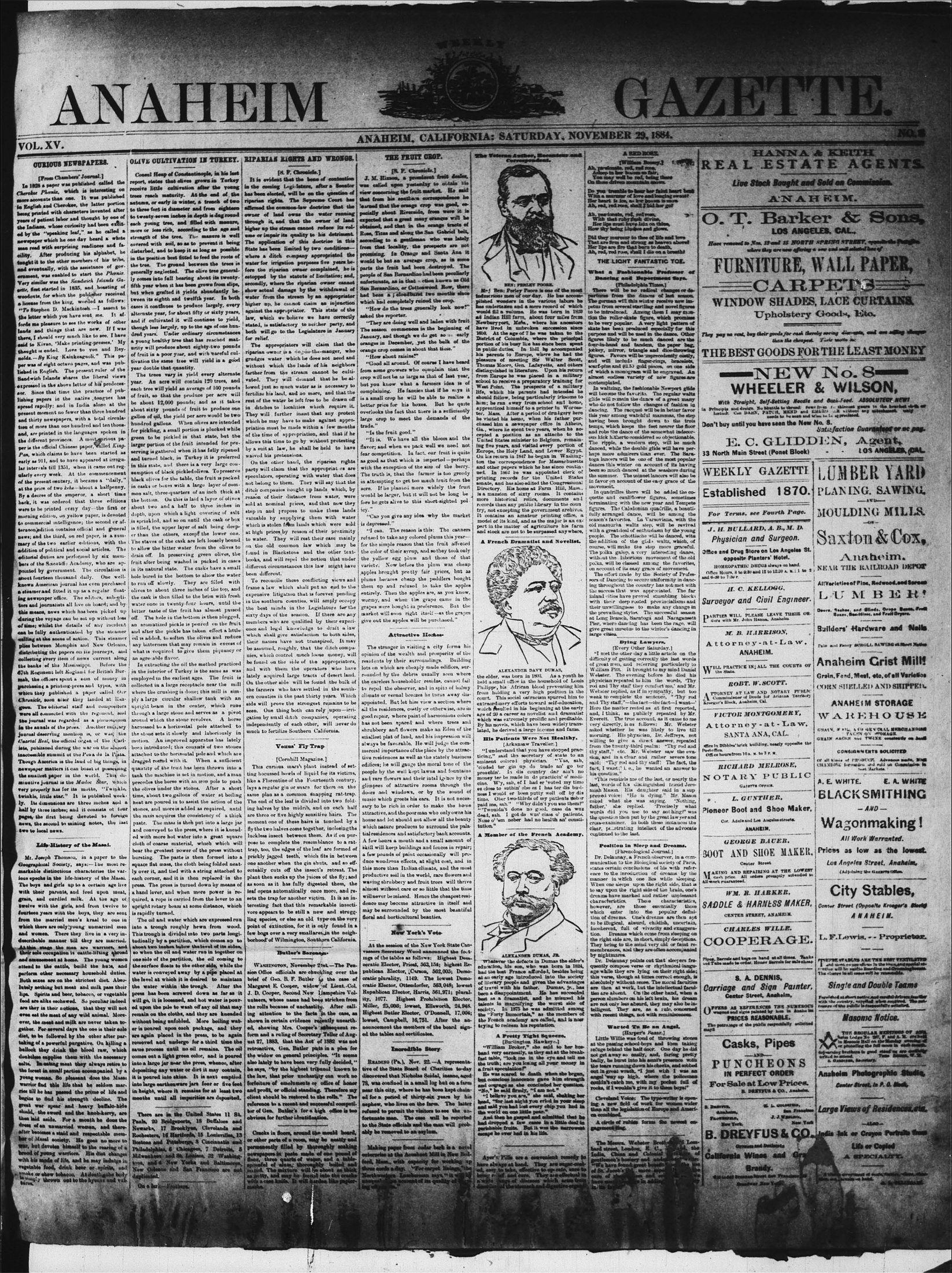
Searchable text
VOL. XV.
CURIOUS NEWSPAPERS.
[From Chambers' Journal.]
In 1828 a paper was published called the Cherokee Phenix, which is interesting on more accounts than one. It was published in English and Cherokee, the latter portion being printed with characters invented after years of patient labor and thought by one of the Indians, whose curiosity had been excited by the "speaking leaf," as he called a newspaper which he one day heard a white man read with surprising readiness and facility. After producing his alphabet, he taught it to the other members of his tribe, and eventually, with the assistance of government, was enabled to start the Phenix. Very similar was the Sandwich Islands Gazette, first started in 1835, and boasting of woodcents, for which the publisher received a license from the king, worried as follows: "To Stephen D. Mackintosh — I assemit to the letter which you have sent me. It affords me pleasure to see the works of other lands and things that are new. If I was there, I should very much like to see. I have said to Kivan, 'Make printing-presses.' My thought is ended. Love to you and Reynolds. — By King Kainkeaguoli.' This paper was of eight octavo pages, and was published in English. The present ruler of the Sandwich Islands shares the liberal views expressed in the above letter of his predecessor. Since that time the practice of publishing papers in the native tongues has spread rapidly; and in India alone at the present moment no fewer than three hundred and thirty newspapers, with a total circulation of more than one hundred and ten thousand, are printed in the languages spoken in the different provinces. A most curious paper is the official Chinese paper, called King Pan, which claims to have been started as early as 911, and to have appeared at irregular intervals till 1351, when it came out regularly week. At the commencement
OLIVE CULTIVATION IN TURKEY.
Consul Heap of Constantinople, in his last report, states that olives grown in Turkey receive little cultivation after the young trees reach maturity. At the end of the autumn, or early in winter, a trench of two to three feet in diameter and from eighteen to twenty-seven inches in depth is dug round each young tree, and filled with manure, more or less rich, according to the age and strength of the tree. The manure is well covered with soil, so as to prevent it being disturbed, and to keep it as long as possible in the position best fitted to feed the roots of the tree. The ground between the trees is generally neglected. The olive tree generally comes into full bearing about its twenty-fifth year when it has been grown from alips, but when grafted it yields abundantly between its eighth and twelfth year. In both cases it continues to produce largely every alternate year, for about fifty or sixty years, and if cultivated it will continue to yield, though less largely, up to the age of one hundred years. Under ordinary circumstances a young healthy tree that has reached maturity will produce about eighty-two pounds of fruit in a poor year, and with careful cultivation the same tree will yield in a good year double that quantity.
The trees vary in yield every alternate year. An acre will contain 120 trees, and each tree will yield an average of 100 pounds of fruit, so that the produce per acre will be about 12,000 pounds; and as it takes about sixty pounds of fruit to produce one gallon of oil, the yield per acre would be two hundred gallons. When olives are intended for pickling, a small portion is plucked while green to be pickled in that state, but the larger portion of the fruit intended for preserving is gathered when it has fully ripened and turned black, in Turkey it is preferred in this state, and there is a very large consumption of black pickled olives. To preserve RIPARIAN RIGHTS AND WRONGS.
[S. F. Chronicle.]
It is evident that the bone of contention in the coming Legi-lature, after a Senator has been elected, will be on the question of riparian rights. The Supreme Court has affirmed the common-law doctrine that the owner of land owns the water running through it, and that the owner of land higher up the stream cannot reduce its volume or impair its quality to his detriment. The application of this doctrine in this State has been limited by two conditions—where a ditch company appropriated the water for irrigation purposes five years before the riparian owner complained, he is estopped by the statute of limitation; and, secondly, where the riparian owner cannot show actual damage by the withdrawal of water from the stream by an appropriator higher up, he cannot claim an injunction against the appropriator. This state of the law, which we believe we have correctly stated, is satisfactory to neither party, and both will go to the Legislature in January for relief.
The appropriators will claim that the riparian owner is a dog-in-the-manger, who grudges water which he does not need and without which the lands of his neighbors farther from the stream cannot be cultivated. They will demand that he be allowed just so much water as is necessary to fertilize his land, and no more, and that the rest of the water be left free to be drawn off in ditches to localities which require it. They will further insist that any protest which he may have to make against appropriation must be made within a few months of the time of appropriation, and that if he allows this time to go by without protesting by a suit at law, he shall be held to have waived his pretensions.
On the other hand, the riparian rights party will claim that the appropriators are
Sandwich Islands shares the liberal views expressed in the above letter of his predecessor. Since that time the practice of publishing papers in the native tongues has spread rapidly; and in India alone at the present moment no fewer than three hundred and thirty newspapers, with a total circulation of more than one hundred and ten thousand, are printed in the languages spoken in the different provinces. A most curious paper is the official Chinese paper, called King Pan, which claims to have been started as early as 911, and to have appeared at irregular intervals till 1351, when it came out regularly every week. At the commencement of the present century, it became a "daily," at the price of two kehs—about a halfpenny. By a decree of the emperor, a short time back, it was ordered that three editions were to be printed every day—the first or morning edition, on yellow paper, is devoted to commercial intelligence; the second or afternoon edition contains official and general news; and the third, on red paper, is a summary of the two earlier editions, with the addition of political and social articles. The editorial duties are performed by six members of the Scientific Academy, who are appointed by government. The circulation is about fourteen thousand daily. One well-known American journal has even purchased a steamer and fitted it up as a regular floating newspaper office. The editors, sub-guilts and journalists all live on board; and by this means, news which has been picked up during the voyage can be set up without loss of time; whilst the details of any incident can be fully authenticated by the steamer calling at the scene of action. This steamer plies between Memphis and New Orleans, distributing the papers on its journeys, and collecting every item of news current along the banks of the Mississippi. Before the 67th Regiment left England for British Burmah, the officers spent a sum of money in purchasing a printing-press and types, with which they published a paper called Our Chronicle, soon after they landed at Kangoum. The editorial staff and compositors were all connected with the regiment, and the journal was regarded as a phenomenon in the annals of the press. Another military journal deserving mention is, or was, the Quartal Real, the official organ of the Carists, published during the war on the almost inaccessible summit of the Pous de la Plata. Though America is the land of big things, in newspaper matters it can boast of possessing the smallest paper in the world. This diminutive journal is the Maloc Star, which very properly has for its motto, "Twinkle, twinkle little star." It is published weekly. Its dimensions are three inches and a half by three inches; and it consists of four pages, the first being devoted to foreign news, the second to mining notes, the last two to local news.
Life History of the Masai.
Mr. Joseph Thomson, in a paper to the Geographical Society, says: "The most remarkable distinctions characterise the various epochs in the life-history of the Masai. The boys and girls up to a certain age live with their parents, and feed upon meat, grain and curdled milk. At the age of
The trees vary in yield every alternate year. An acre will contain 120 trees, and each tree will yield an average of 100 pounds of fruit, so that the produce per acre will be about 12,000 pounds; and as it takes about sixty pounds of fruit to produce one gallon of oil, the yield per acre would be two hundred gallons. When olives are intended for pickling, a small portion is plucked while green to be pickled in that state, but the larger portion of the fruit intended for preserving is gathered when it has fully ripened and turned black, in Turkey it is preferred in this state, and there is a very large consumption of black pickled olives. To preserve black olives for the table, the fruit is packed in casks or boxes with a large layer of common salt, three-quarters of an inch thick at the bottom. On this is laid a layer of olives about two and a half to three inches in depth, upon which a light covering of salt is sprinkled, and so on until the cask or box is filled, the upper layer of salt being deeper than the others, except the lower one. The staves of the cask are left loosely bound to allow the bitter water from the olives to drain off. In preserving green olives, the fruit after being washed is packed in cases in its natural state. The casks have a small hole bored in the bottom to allow the water to run off slowly. They are filled with olives to about three inches of the top, and the cask is then filled to the brim with fresh water once in twenty-four hours, until the bitter taste of the fruit has almost passed off. The hole in the bottom is then plugged, an aromatized pickle is poured on the fruit and after the pickle has taken effect a little oil is added, to soften the olives and reduce any bitterness that may remain in excess of what is required to give them piquancy or an agreeable flavor.
In extracting the oil the method practiced in the interior of Turkey is the same as was employed in the earliest ages. The fruit is collected in a large receptacle near the mill where the crushing is done; this mill is simply a large circular shallow tank with an upright beam in the center, which runs through a large stone and serves as a pivot around which the stone revolves. A horse harnessed to a horizontal pole attached to the stone sets it slowly and laboriously in motion. An improved apparatus has lately been introduced; this consists of two stones attached to the horizontal pole and which are dragged round with it. When a sufficient quantity of the fruit has been thrown into a tank the machine is set in motion, and a man precedes the horse with an iron pole to push the olives under the stones. After a short time, about two gallons of water at boiling heat are poured in to assist the action of the stones, and more is added as required, until the mass acquires the consistency of a thick paste. The mass is then put into a large jar and conveyed to the press, where it is kneaded with more hot water into a great square cloth of coarse material, which which will bear the greatest power of the press without bursting. The paste is then formed into a square flat mass, the cloth being folded neatly over it, and tied with a string attached to each corner, and it is then replaced in the press. The press is turned down by means of a hand lever, and when more power is required a rope is carried from the lever to an
Venus' Fly Trap
[Cornbill Magazine.] This curious marsh plant instead of setting hocussed bowls of liquid for its victims, like a Florentine of the Fourteenth century, lays a regular gin or snarfs for them on the same plan as a common snapping rat-trap. The end of the leaf is divided into two folding halves by the midrib, and on each half are three or five highly sensitive hairs. The moment one of these hairs is tonched by a fly the two halves come together, inclosingthe luckless insect between them. As if on purpose to complete the resemblance to a rat trap, too, the edges of the leaf are formed on prickly jagged teeth, which fits in between one another when the gin shuts, and so effectually cuts off the insect's retreat. The plant then sucks up the juices of the fly; and as soon as it has fully digested them,the leaf opens automatically once more,and resets tthe trap for another victim. It is an im
Life-History of the Masai.
Mr. Joseph Thomson, in a paper to the Geographical Society, says:—The most remarkable distinctions characterise the various epochs in the life-history of the Masai. The boys and girls up to a certain age live with their parents, and feed upon meat, grain, and curdled milk. At the age of twelve with the girls, and from twelve to fourteen years with the boys, they are sent from the married men's kraal to one in which there are only young unmarried men and women. There they live in a very indescribable manner till they are married. At this stage the men are warriors, and their sole occupation is cattle-lifting abroad and amusement at home. The young women attend to the cattle, build the huts, and perform other necessary household duties. Both sexes are on the strictest diet. Abolutely nothing but meat and milk pass their lips. Spirits and beer, tobacco, or vegetable food are alike eschewed. So peculiar indeed are they in their notions, that they will not even eat the meat of any wild animal. Moreover, the meat and milk are never taken together. For several days the one is their sole diet, to be followed by the other after partaking of a powerful purgative. On killing a ballock they drink the blood raw, which doubtless supplies them with the necessary salts. In eating meat they always retire to the forest in small parties accompanied by a young woman. So pleasant does the Masai warrior find this life that he seldom marries till he has passed the prime of life and begins to find his strength decline. The great war spear and heavy buffalo-hide shield, the sword and the knob-kerry, are then laid aside. For a month he dons the dress of an unmarried woman, and thereafter becomes a staid and respectable member of Masai society. He goes no more to war, but devotes himself to the rearing of a brood of young warriors. His diet changes with his mode of life, and he may indulge in vegetable food, drink beer or spirits, and smoke or chew tobacco. At death the body is simply thrown out to the bye-ear and vulnature.
There are in the United States 11 St. Paul, 20 Bridgesports, 18 Buffaloes and Newarka, 17 Brooklyn, Cleveland and Rochesters, 16 Hartfordia, 15 Louisvilles, 13 Boston and Pittsburgh, 3 Cincinnati and Philadelphia, 6 Chicago, 7 Detroit, 5 Milwaukee and St. Louis, 32 Washington, and 4 New York and Baltimore, New Orleans and San Francisco are not duplicated.
On a lark—Petersen.
The end of the leaf is divided into two folding halves by the midrib, and on each half are three or five highly sensitive hairs. The moment one of these hairs is touched by a fly the two halves come together, enclosing the luckless insect between them. As if on purpose to complete the resemblance to a rat trap, too, the edges of the leaf are formed on prickly jagged teeth, which fits in between one another when the gin shuts, and so efficiently cuts off the insect's retreat. The plant then sucks up the juices of the fly; and as soon as it has fully digested them, the leaf opens automatically once more, and rests sets the trap for another victim. It is an interesting fact that this remarkable insect vore appears to be still a new and struggling species, or else an old type on the very point of extinction, for it is only found in few bogs over a very small area in the neighborhood of Wilmington, Southern California.
Butler's Sarcasm
WASHINGTON, November 21st—The Peninsula Office officials are chuckling over the brief of Gen. B. F. Butler in the case of Margaret K. Cooper, widow of Lient. Colon J. D. Cooper, Second New Hampshire Volunteer whose name had been stricken from the rolls because of unchastity. After calling attention to the facts in the case, she shown in certain evidence recently unearthed, showing Mrs. Cooper's subsequent reform and a ruling of Secretary Teller of August 27, 1883, that the Act of 1882 was not retroactive, Gen. Butler puts in a plea for the widow on general principles. "It seems also lately to have been very fully decided," he says, "by the highest tribunal known to the law, that prior unchastity can work no forfeiture of emoluments or office of honor and profit, or official standing. Therefore my client should be restored to the rolls."
The reference to a recent and successful competition of Gen. Butler's for a high office is too obvious for further identification.
Cracks in floors around the mould heard or other parts of a room may be neatly and permanently filled by thoroughly making newspapers in paste made of one pound of flour, three quartes of water, and a table spoonful of alum; thoroughly boiled and mashed. The mixture will be about as thick as petty, and may be forced into the cracks with a case knife. It will garden like papier-mâché.
ANAHEIM, CALIFORNIA: SATURDAY, NOVEMBER 29, 1884.
RIGHTS AND WEONGS.
[S. P. Chronicle.]
It that the bone of contention
for Legislature, after a Senator
had, will be on the question of
a. The Supreme Court has
common-law doctrine that the
and owns the water running
and that the owner of land
stream cannot reduce its volits quality to his detriment.
On of this doctrine in this
limited by two conditions—
h company appropriated the
legation purposes five years berian owner complained, he is
the statute of limitation; and,
are the riparian owner cannot
damage by the withdrawal of
the stream by an appropriator
cannot claim an injunction
appropriator. This state of the
we believe we have correctly
factory to neither party, and
to the Legislature in January
prators will claim that the
er is a dog-in-the-manger, who
or which he does not need and
the lands of his neighbors
the stream cannot be cultiwill demand that he be almuch water as is necessary to
land, and no more, and that the
ter be left free to be drawn off
localities which require it,
further insist that any protest
have to make against approbe made within a few months
appropriation, and that if he
neme to go by without protesting
law, he shall be held to have
extensions.
THE FRUIT GROP.
[S. P. Chronicle.]
J. M. Hixson, a prominent fruit dealer,
was called upon yesterday to obtain his
view concerning the fruit market. He said
that from his southern correspondence he
learned that the orange crop was good, epecially about Riverside, from where it is
expected that a great many oranges will be
obtained, and that in the orange tracts of
Rose, Titus and along the San Gabriel belt,
according to a gentleman who was lately
from that locality, the prospects are not
promising. In Orange and Santa Ana it
would be but an average crop, as in some
parts the fruit had been destroyed. The
people of San Bernardino had been peculiarly
unfortunate, as in that action known as Old
San Bernardino, or Cottonwood Row, there
had been a cloudburst two months since
which had completely ruined the crop.
"How do the trees generally look now?"
asked the reporter.
"They are doing well and laden with fruit
The season commences in the beginning of
January, and though we do get so early
oranges in December, yet the bulk of the
orange crop comes in about that time."
"How about rains?"
"Good all around. Of course I have heard
from some growers who complain that the
crop will not be as large as that of last year,
but you know what a farmers idea is of
complaining. He fancies that if he says it is a small crop he will be able to realize a better price for his boxes. But he quite overlooks the fact that there is a sufficiently large crop to meet the demands of the trade."
"Is the fruit good."
"It is. We have all the bloom and the flavor; and when we pack well we need not fear competition. In fact, our fruit is quite as good as that which is imported—perhaps with the exception of the size of the berry. The truth is that the farmer is too greedy."
The Veteran Author, Macintour and Correspondent.
BEN: PERLEY FOORE.
M-j Ben: Perley Poore is one of the most industrious men of our day. He has accomplished wonders in the various labors he has undertaken and a mere record of which would fill a volume. He was born in 1830 at Indian Hill farm, about four miles from Newburyport, Maña, where his ancestors have lived in umbroken succession since 1650. At the age of 7 he was taken to the District of Columbia, where the principal portion of his busy life has since been spent in public duties. In 1831 he accompanied his parents to Europe, where he had the pleasure of meeting Sir Walter Scott, Thomas Moore, Gen. Lafayette, and others distinguished in literature. Upon his return from Europe he was placed in a military school to receive a preparatory training for West Point. The prospects of a military life, which his parents had intended should follow, being particularly irksome to him; he ran away from school and home, apprenticed himself to a printer in Worcester, Mass. After a period of drudgery here he visited his home, when his father purchased him a newspaper office in Athens, Ga., where he spent two years, when he accepted a position as an attache to the United States minister to Belgium, remaining five years, and visited every portion of Europe, the Holy Land, and Lower Egypt. On his return in 1847 he began in Washington the correspondence for Massachusetts and other papers which he has since continued. In 1862 he was appointed clerk of
A RED ROSE.
[William Booney.] Ah, pavelonate, red, red rose.
Asleep in her bosom so fair.
You may well be red, being there.
On those driven mountain snows.
Do you tremble to hear her faint hale?
With a murmur of love and longing.
Her heart is fine, as her bosom is sane.
Ah, red, red rose, shall I hid her gold?
Ah, passionata, red, red rose.
With that ruby flesh divine,
Her lips must have laja on thins.
How thy being lilies and glows.
Did they murmur to tnee of life and?
That are firm and strong as heavens.
Her lips are fire that burn to death.
Ah, red, red rose, shall I dis on a bristle.
THE LIGHT FANTASTIC TIME.
What a fashionable Profession Dancing and Department
[Philadelphia Times.]
There will be no radical change partures from the dances of last The german will this winter receive petts from several startling and now to be introduced. Among them I am tition the roller-skate figure, which to be very popular. A very light skate has been produced especially purpose and will be used in the dance figures likely to be much danced four-in-hand and tandem, the pa-jockey, mirror, triangle and disc-figures. Favors will be unprecedented and will include finger-rings, scarf-pins and $2.50 gold pieces, one of which a monogram will be engraved almost endless variety of new fi- contemplated.
In waltzing, the fashionable New York will become the favorites. The regular glide will remain the dance of a grace who do not follow the changes of flair dancing. The racquet will be in best this year among watchful mammals having been brought down to temps, which keeps the feet nearer and robs the dance of the somewhat our kick hitherto considered so objective. The ripple, a western step, will dangle, while the double glide will hape more admirers than ever. To tonga lancers will be one of the most dances this winter on account of it been so much danced at the seashore.
will demand that he be as much water as is necessary to land, and no more, and that the water left free to be drawn off localities which require it. Further insist that any protest have to make against approbation, and that if he goes to go by without protesting law, he shall be held to haveExtension.
Other hand, the riparian rights form that the appropriators are operating with water that does not them. They will say that the trees bought up lands which, by their distance from water, were no price, and that now they propose to make these lands supplying them with water from lands which were sold by reason of their proximity they will rest their case mainly common law which may be backstone and the other text will repel the notion that under circumstances this law might have been large tracts of desert land.aside will be found the bulk of who have settled in the southin the past thirty years.Which gave the strongest remains to be thing both can rely upon—irrational ditch companies, operating of each other, will never doize Southern California.
Venus' Fly Trap
Cornhill Magazine.] has marsh plant instead of set-bows of liquid for its victims, nine of the Fourteenth century, nineteen of the Fourteenth century, nineteen of the Fourteenth century, nineteen of the Fourteenth century, nineteen of the Fourteenth century, nineteen of the Fourteenth century, nineteen of the Fourteenth century, nineteen of the Fourteenth century, nineteen of the Fourteenth century, nineteen of the Fourteenth century, nineteen of the Fourteenth century, nineteen of the Fourteenth century, nineteen of the Fourteenth century, nineteen of the Fourteenth century, nineteen of the Fourteenth century, nineteen of the Fourteenth century, nineteen of the Fourteenth century, nineteen of the Fourteenth century, nineteen of the Fourteenth century, nineteen of the Fourteenth century, nineteen of the Fourteenth century, nineteen of the Fourteenth century, nineteen of the Fourteenth century, nineteen of the Fourteenth century, nineteen of the Fourteenth century, nineteen of the Fourteenth century, nineteen of the Fourteenth century, nineteen of the Fourteenth century, nineteen of the Fourteenth century, nineteen of the Fourteenth century, nineteen of the Fourteenth century, nineteen of the Fourteenth century, nineteen of the Fourteenth century, nineteen of the Fourteenth century, nineteen of the Fourteenth century, nineteen of the Fourteenth century, nineteen of the Fourteenth century, nineteen of the Fourteenth century, nineteen of the Fourteenth century, nineteen of the Fourteenth century, nineteen of the Fourteenth century, nineteen of the Fourteenth century, nineteen of the Fourteenth century, nineteen of the Fourteenth century, ninteen of the Fourteenth century, ninteen of the Fourteenth century, ninteen of the Fourteenth century, ninteen of the Fourteenth century, ninteen of the Fourteenth century, ninteen of the Fourteenth century, ninteen of the Fourteenth century, ninteen of the Fourteenth century, ninteen of the Fourteenth century, ninteen of theFourthcentury,ninerethcentury,ninerethcentury,ninerethcentury,ninerethcentury,ninerethcentury,ninerethcentury,ninerethcentury,ninerethcentury,ninerethcentury,ninerethcentury,ninerethcentury,ninerethcentury,ninerethcentury,ninerethcentury,ninerethcentury,ninerethcentury,ninerethcentury,ninerethcentury,ninerethcentury,ninerethcentury,ninerethcentury,ninerethcentury,ninerethcentury,ninerethcentury,ninerethcentury,ninerethcentury,ninerethcentury,ninerethcentury,ninerethcentury,ninerethcentury,ninerethcentury,ninerethcentury,ninerethcentury,ninerethcentury,ninerethcentury,ninerethcentury,ninerethcentury,ninerethcentury,ninerethcentury,ninerethcentury,ninerethcentury,ninerethcentury,ninerethcentury,ninerethcentury,ninerethcentury,ninerethcentury,ninerethcentury,NINEREHENTARY,NINEREHENTARY,NINEREHENTARY,NINEREHENTARY,NINEREHENTARY,NINEREHENTARY,NINEREHENTARY,NINEREHENTARY,NINEREHENTARY,NINEREHENTARY,NINEREHENTARY,NINEREHENTARY,NINEREHENTARY,NINEREHENTARY,NINEREHENTARY,NINEREHENTARY,NINEREHENTARY,NINEREHENTARY,NINEREHENTARY,NINEREHENTARY,NINEREHENTARY,NINEREHENTARY,NINEREHENTARY,NINEREHENTARY,NINEREHENTARY,NINEREHENTARY,NINEREHENTARY,NINEREHENTARY,NINEREHENTARY,NINEREHENTARY,NINEREHENTARY,NINEREHENTARY,NINEREHENTARY,NINEREHENTARY,NINEREHENTARY,NINEREHENTARY,NINEREHENTARY,NINEREHENTARY,NINEREHENTARY,NINEREHENTARY,NINEREHENTARY,NINEREHENTARY,NINEREHENTARY,NINEREHENTARY,NINEREHENTARY,NINEREHENTARY,NINEREHENTARY,NINEREHENTARY,NINEREHENTARY,NINEREHENTARY,NINEREHENTary.NINEREHENTary.NINEREHentary.NINHEREhentary.NINHEREhentary.NINHEREhentary.NINHEREhentary.NINHEREhentary.NINHEREhentary.NINHEREhentary.NINHEREhentary.NINHEREhentary.NINHEREhentary.NINHEREhentary.NINHEREhentary.NINHEREhentary.NINHEREhentary.NINHEREhentary.NINHEREhentary.NINHEREhentary.NINHEREhentary.NINHEREhentary.NINHEREhentary.NINHEREhentary.NINHEREhentary.NINHEREhentary.NINHEREhentary.NINHEREhentary.NINHEREhentary.NINHEREhentary.NINHEREhentary.NINHEREhentary.NINHEREhentary.NINHEREhentary.NINEhentary.NINEhentary.NINEhentary.NINEhentary.NINEhentary.NINEhentary.NINEhentary.NINEhentary.NINEhentary.NINEhentary.NINEhentary.NINEhentary.NINEhentary.NINEhentary.NINEhentary.NINEhentary.NINEhentary.NINEhentary.NINEhentary.NINEhentary.NINEhentary.NINEhentary.NINEhentary.NINEhentary.NINEhentary.NINEhentary.NINEhentary.NINEhentary.NINEhentary.NINEhentary.NINEhentary.NINEhentary.NINEhentary.NINEhentary.NINEhentary.NINEhentary.NINEhentary.NINEhentary.NINEhentary.NINEhentary.Nine h entery. Nine h entery. Nine h entery. Nine h entery. Nine h entery. Nine h entery. Nine h entery. Nine h entery. Nine h entery. Nine h entery. Nine h entery. Nine h entery. Nine h entery. Nine h entery. Nine h entery. Nine h entery. Nine h entery. Nine h entery. Nine h entery. Nine h entery. Nine h entery. Nine h entery. Nine h entery. Nine h entery. Nine h entery. Nine h entery. Nine h entery. Nine h entery. Nine h entery. Nine h entery. Nine h entery. Nine h entery. Nine h entery. Nine h entery.
Nine h entery. Nine h entery. Nine h entery. Nine h entery. Nine h entery. Nine h entery. Nine h entery. Nine h entery. Nine h entery. Nine h entery. Nine h entery. Nine h entery. Nine h entery. Nine h entery. Nine h entery. Nine h entery. Nine h entery. Nine h entery. Nine h entey. Nine h entey. Nine h entey. Nine h entey. N nine h entey. N nine h entey. N nine h entey. N nine h entey. N nine h entey. N nine h entey. N nine h entey. N nine h entey. N nine h entey. N nine h entey. N nine h entey. N nine h entey. N nine h entey. N nine h entery.
N nine h entery.
N nine h entery.
N nine h entery.
N nine h entery.
N nine h entery.
N nine h entery.
N nine h entery.
N nine h entery.
N nine h entery.
N nine h entery.
N nine h entery.
N nine h entery.
N nine h entery.
N nine h entery.
N nine h entery.
N nine h entery.
N nine H ENTERY.
A French Dramatist and Novelist.
ALEXANDER DAVY DUMAS,
the elder, was born in 1803.As a youth he held a small office in the household of Louis Philippe,his African blood preventing him from holding a very high position in the court.His social ostracism spurred him to extraordinary efforts to ward self-educationwhich resulted in his beginning at the early ageof 20a career as novelist and dramatistwhich was extremely prolific and profitable.By his novelswhich have been widely translatedby derived a large income and fame.
His Patients Were Not Healthy.[Arkansaw Traveller.] "I understand that you have stopped practicing," said the secretary of state to an eminent colored physician."Yas,sah,'cured tor gin up de trade an'go ter prachin'.In dis country darain'tno money ter made in de practicant'o medicine.Wy,sah,f if had er 'voted my time ez close or suthin' else ez I has ter dis businessI would er been putty well off by di time.Ober two-thirds of my patients weremade me,sah."Why didn't you sue them?"Twouldn't done no good,case da wuz dead,sah.I got do was'class o patientsNone o'me nober had no health an' constitution."
A Member of the French Academy.
[Frenchological Journal].Dr.Delaunay,a French observer,munication to the Biological societystates certain conclusions of hiswcience to the introduction dreammanner in which one lies whilowWhen one sleeps upon the right sideto say upon the right sideto markthe dreams have marked and rather continue to the last.
Position in Sleep and Dream
[Frennological Journal].Dr.Delaunay,a French observer,munication to the Biological societystates certain conclusions of hiswcience to the introduction dreammanner in which one lies whilowWhen one sleeps upon the right sideto say upon the right sideto markthe dreams have marked and rather continue to the last.]
Butler's Sarcasm.
November 21st.—The Penficials are chuckling over the B. F. Butler in the case of Cooper, widow of Lieut. Col., Second New Hampshire Volunteer name had been stricken from cause of unchastity. After call-in to the facts in the case, a main evidence recently unearth Mrs. Cooper's subsequent re- calling of Secretary Teller of Aug- that the Act' of 1882 was not Gen. Butler puts in a plea for a general principles. "It seems have been very fully decided," the highest tribunal known to prior unchastity can work no emoluments or office of honor official standing. Therefore may be restored to the rolls." The recent and successful competitor Butler's for a high office is too further identification.
Doors, around the mould board, of a room, may be neatly and filled by thoroughly snaking at paste made of one pound of quarts of water, and a table-lum; thoroughly bled and mixture will be about as thick may be furial into the creaks of it. It will happen like papier-mâché.
Making paper from cedar bark is a novel enterprise as the Acushnet Mill in New Bedford, Mass., with capacity for working up three cords a day. "For carpet lining," the Northwestern Lumberman says, "is well suited to an account of its quality of handling."
ALEXANDER DUMAS, JR.
Whatever the defects in Dumas the elder's education, his son, who was born in 1824, had the best France afforded, besides being at an early age introduced into the society of literary people and given the advantages of travel with his father. Dumas, Jr., has been a disappointment. He has succeeded best as a dramatist, and he misused his talents in magnifying the worst side of society. In 1875 he was admitted among the "French Immortals," as the members of the French academy are called, and is now trying to redeem his reputation.
A Pretty Tight Squeeze.
[Burlington Hawkeye.]
"William Broker," she said to her husband very earnestly, as they sat at the breakfast table, "look me in the eye and tell me the truth; are you losing all your money in a fruit speculation!"
He was scared to death when she began, but conscious innocence gave him strength and courage as she concluded her question. "No," he said firmly, "I am not."
"I believe you are," she said, shaking her head, "for last night you erred in your sleep and said you had lost every chip you had in the world on one little pear." And then he gasped and admitted that he had dropped a few cases in a little deal in perishable fruits. But it was the narrowest escape he ever had in his life.
Ayer's Pills are a convenient remedy to have always at hand. They are sugar-coated, easy to take, effective to operate, safe to bring relief and cure. They are effectual in a wide range of diseases which arise from desirous of the stomach and digestive organs.
A Member of the French Academy.
Phrenological Journal.
Dr. Delaunay, a French observer, munication to the Biological Society states certain conclusions of his wience to the introduction of dream manner in which one lies whilow. When one sleeps upon the right side to say upon the right side of the bed dreams have marked and rather characteristics. These charac- however, are those essential which enter into the population of dreams. One's dreams are to be illogical, absurd, childish, inconherent, full of vivacity and tion. Dreams which come from s- right side are, in short, simply o They bring to the mind very old o membrances, and they are often acco- by nightmares.
Dr. Delaunay points out that she quietly compose verse or rhythm age while they are lying on their this verse, though at times correct absolutely without rense. The mo- are then at work, but the intellect ties are absent. On the other hand person slumbers on his left brain, are not only less absurd, they may telligent. They are, as a rule, with recent things, not with remin-
Wanted To Be An Angle.
[Harper's Pazar.]
Little Willie was food of throw- at the passing school-boy and the refuge behind the half door. One s- not get away so easily, and, far bady, he burst into his annu's press the tears running down his cheeks, out in great wrath. "I just wish angel 'way up high, where thou couldn't catch me, with my pocket rocks, if I wouldn't give it to them.
Cleveland Voice: The type-writing a new field of work for wo- than all the legislation of Europe an combined.
A circle of rubies forms the n gagement fing.
The Mosera Webster Brother hard street, London, E. U., India, China and Colonial gentlemen's biography and analysis. "We have found great benefit of St. Jacob's Gift more appre- care of shadows and so have much pleasure in adding
GAZETTE.
EMBER 29, 1884.
A RED ROSE.
[William Bosny.]
ravelate, red, red rose,
sleep in her bloom on fair,
son may well be red, being there
those driven mountain snow.
you tremble to hear her faint heart bent
in murmur of love and longing sweat
heart is too, as her bosom is now
red, red rose, shall I bid her go!
passionate, red, red rose,
with that ruby flesh divine,
her lips must have lace on thine,
thy being lilies and glows.
they murmur to thee of life and love
it are firm and strong as heaven above!
lips are fire that burn to death,
red, red rose, shall I die on a breath!
THE LIGHT FANTASTIC TOE.
HANNA & KEITH
REAL ESTATE AGENTS.
Live Stock Bought and Sold on Commission.
ANAHEIM.
O. T. Barker & Sons,
LOS ANGELES, CAL.
Have removed to Nov. 13 and 15 NORTH SPRING STREET, opposite the Patio,
where they are now offering a new and well-advised line of
FURNITURE, WALL PAPER,
CARPETS
WINDOW SHADES, LACE CURTAINS.
Upholstery Goods, Ltd.
They pay no rent, buy their goods for cash thereby saving dollars, and are selling cheaper than the cheapest. Their motto is:
THE BEST GOODS FOR THE LEAST MONEY
NEW No. 8
WHEELER & WILSON,
With Straight, Self-Setting Needle and Book-Feed. ABSOLUTEC NEW!
In Principle and design. No Shuttle to thread. News from the thinest gauge to the heaviest birth or last inch. Can DARN, PATCH, MEND and EMBED without any attachment. Only needs to be seen and then to be appreciated.
Don't buy until you have seen the New No. 8.
Satisfaction Guaranteed or no pay.
E. C. GLIDDEN, Agent,
33 North Main Street (Ponet Block)
LOS ANGELES, CAL.
WEEKLY GAZETTE
UMBER YARD
WEEKLY GAZETTE
Established 1870.
For Terms, see Fourth Page.
J. H. BULLARD, A.B., M.D.
Physician and Surgeon.
Office and Drug Store on Los Angeles St.
opposite Planters' Hotel.
HOMEOPATHIC DRUGS always on hand.
H. C. KELLOGG.
Surveyor and Civil Engineer.
PARTIES WILL PLEASE LEAVE THEIR ORDERS with Mr. John Hanna, Anaheim.
M. B. HARRISON,
Attorney-at-Law,
ANAHEIM.
WILL PRACTICE IN ALL THE COURTS OF the State.
ROBT. W. SCOTT.
ATTORNEY AT LAW AND NOTARY PUBLIC
Commissioner of Deeds for Arizona Territory
VICTOR MONTGOMERY,
Attorney-at-Law,
SANTA ANA, CAL.
office in Dibbles' brick building, nearly opposite the Post office.
Office hours from 10 a.m. to 3 p.m.
RICHARD MELROSE,
NOTARY PUBLIC
GAZETTE OFFICE.
L. GUNTHER.
Pioneer Boot and Shoe Maker,
Cor. Adelaide and Los Angeles streets.
ANAHEIM.
GEORGE BAUER,
300T AND SHOE MAKER,
Center Street.
MAKING AND REPAIRING AT THE LOWEST cash price. All orders promptly attended to.
WM. R. HARKER,
LUMBER YARD
PLANING. SAWING.
MOULDING MILLS.
SAxton & Cox,
Anaheim.
NEAR THE RAILROAD DEPOSIT
All Varieties of Pine, Redwood, and Scream
LUMBER!
Doors, Sashes, and Glinda, Grope Boxes, Fruit Boxes, Bee-Store, and Fruit Dryers.
Builders' Hardware and Nails
Pain and Fancy SCROLL SAWING at Short Nation
Anaheim Crist Mill!
Grain, Feed, Meal, etc., of all Varieties
CORN SHELLED AND SHIPPER.
ANAHEIM STORAGE
WARE HOUSE
GRAIN, WOLL AND GENERAL MERCHANDISE
TAKEN ON STORAGE.
GRAIN MADE AND TWIXE constantly on hand.
CONSIGNMENTS SOLICITED
Of all kinds of PRODUCE, Adventure made, Mail CHANDISK forwarded and sold on Commission in best market.
A. E. WHITE.
E. A. WHITE
BLACKSMITHING
AND
Wagonmaking!
All Work Warranted.
Prices as low as the lowest.
Los Angeles Street, Anaheim.
(Adjoining the Gazette Office).
City Stables,
Position in Sleep and Dreams.
[Phrenological Journal.]
Dr. Delaunay, a French observer, in a communication to the Biological society of Paris, states certain conclusions of his with reference to the introduction of dreams by the inn者 in which one lies while sleeping. When one sleeps upon the right side, that is say upon the right side of the brain, one's dreams have marked and rather unpleasant characteristics. These characteristics, however, are those essentially those which enter into the popular definition of dreams. One's dreams are then apt to be illogical, absurd, childish, uncertain, soberent, full of vivacity and exaggeration. Dreams which come from sleeping on the right side are, in short, simply deceptions they bring to the mind very old or faint remembrances, and they are often accompanied nightmares.
Dr. Delaunay points out that sleepers frequently compose verse or rhythmic language while they are lying on their right side; as verse, though at times correct enough, is solutely without reuse. The moral faculties he then at work, but the intellectual faculties are absent. On the other hand, when a person slumber on his left brain, his dream does not only less absurd, they may also be intelligent. They are, as a rule concerned with recent things, not with reminiscences.
Warted To Be an Angel.
[Harper's Razar.]
Little Willie was fond of throwing stones the passing school-boys and then taking stage behind the half door. One day he did get away so easily, and, faring pretty well, he burst into his aunt's presence with tears running down his cheeks, and sobbed in great wrath. I just wish I was an angel way up high, where the policeman couldn't catch me, with my pocket full of keys, if I wouldn't give it to them boyal."
Cleveland Voice: The type-writer is opening a new field of work for women wider than all the legislation of Europe and Ameri-combined.
A circle of rubics forms the newest en-gagement ring.
The Messrs. Webster Brothers & Lomard street, London, E. U., described the India China and Colonial institutions of pulleen's history and endeavors written. We have found great benefit from the use St. Jacob's Old more especially in the area of shorthand and calligraphy. We are sure this form will add value to our business.
L. GUNTHER,
Pioneer Boot and Shoe Maker,
Cor. Adele and Los Angeles streets.
ANAHEIM.
GEORGE BAUER,
300T AND SHOE MAKER.
Center Street
MAKING AND REPAIRING AT THE LOWEST cash price. All orders promptly attended to All work guaranteed.
WM. R. HARKER,
SADDLE & HARNESS MAKER,
CENTER STREET, ANAHEIM.
CHARLES WILLE.
COOPERAGE.
Pipes, Barrels and keys on hand at all times. Tanks and Tubs made to order. Honer Barrels for sale cheap
S. A. DENNIS,
Carriage and Sign Painter,
Center Street, Anaheim,
OFFERS AS REFERENCES THE NUMEROUS wagons and signs painted by him in Anaheim PRICES REASONABLE.
The patronage of the public respectfully admitted may?
Casks, Pipes
AND
PUNCHEONS
IN PERFECT ORDER
For Sale at Low Prices.
B. DREYFUS & CO., Anaheim.
B. DREYFUS & CO.
Grooms and Designers
California Wines and GraBrandy.
641 204 Brannan Street New Francisco
Broadway New York.
AND
Wagonmaking!
All Work Warranted.
Prices as low as the lowest.
Los Angeles Street, Anaheim.
(Adjoining the Gazette Office)
City Stables,
Center Street (Opposite Kroeger's Block)
ANAHEIM.
L.F.Lewis. -- Proprietor.
THE STABLISH ARE THE BEST VENTILATED and most expensive in the town, and special attention will be paid to boarding and grooming homes. The charges in all cases will be reasonable.
Single and Double Teams
Furnished at short notice and careful drivers familiar with the country, supplied when required. The purpose of the public is respectfully solicited.
Masonic Notice.
THE REGULAR MERITIES OF ADMISSION Lodge No. 297, P. and A. N. are held in Mountain Hall on the Monday evening of or praising the full moon in each month. Self-employed brothers in good standing are similarly written to attend. Tune Reunion, W. X.
S. Ganderm, Secretary.
Anaheim Photographic Studio,
Center Street, In P. O. Blank.
Large Views of Residences etc.
ALSO
India ink or Crayon Portraits from Life or Copied
A SPECIALITY.
A change arrangement of mats, tattoos, wines, chateaues are currently on hold.