anaheim-gazette 1884-11-22
Scanned page
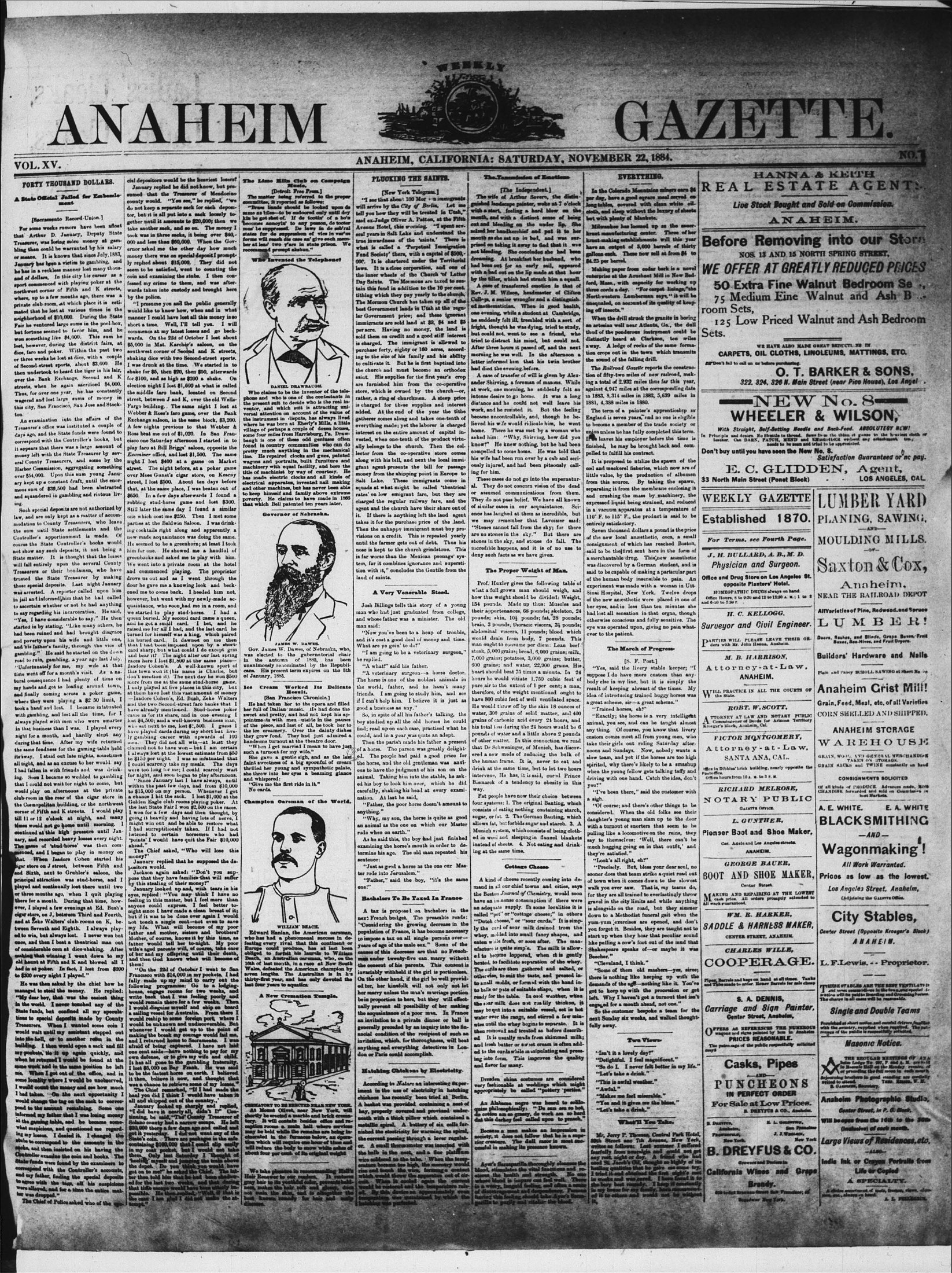
Searchable text
PORTY THOUSAND DOLLARS.
A State Official Jailed for Embellishment
[Sacramento Record-Union.]
For some weeks rumors have been afloat that Arthur D. January, Deputy State Treasurer, was losing more money at gambling than could be warranted by his salary or means. It is known that since July, 1883, January has been a victim to gambling, and he has in a reckless manner lost many thousand of dollars. In this city his career as a sport commenced with playing poker at the northwest corner of Fifth and K streets, where, up to a few months ago, there was a private club-room, at which place it is estimated that he lost at various times in the neighborhood of $10,000. During the State Fair he ventured large sums in the pool-box, but fortune seemed to favor him, and he won something like $4,000. This sum he lost, however, during the district fairs, at dices, faro and poker. Within the past two or three weeks he lost at dice, with a couple of Second-street sports, about $3,600. He then undertook to board the tiger in his lair, over the Bank Exchange, Second and K streets, when he again sacrificed $4,000. Thus, for over one year, he has constantly wagered and lost large sums of money in this city, San Francisco, San Jose and Stockton.
An examination into the affairs of the Treasurer's office was instituted a couple of days ago, and the State funds were found to correspond with the Controller's books, but it appears that there was a large amount of money left with the State Treasurer by several County Treasurers, and some by the Harbor Commission, aggregating something special depositors would be the heaviest losers?
January replied he did not know, but presumed that the Treasurer of Mendocino county would. "You see," he replied, "we do not keep a separate sack for each depositor, but it is all put into a sack loosely together until it amounts to $20,000; then we take another sack, and so on. The money I took was in three sacks, it being over $40,-000 and less than $60,000. When the Governor asked me the other day how much money there was on special deposit I promptly rephed about $15,000. They did not seem to be satisfied, went to counting the coin and examining the stubs. I then confessed my crime to them, and was afterwards taken into custody and brought here by the police.
"I presume you and the public generally would like to know how, when and in what manner I could have lost all this money in so short a time. Well, I'll tell you. I will commence at my latest losses and go backwards. On the 22d of October I lost about $5,000 in Mat. Karcher's saloon, on the southwest corner of Second and K streets, shaking dice with two Second-street sports. I was drunk at the time. We started in to shake for $5, then $20, then $50, afterwards for $100, and as high as $200 a shake. On election night I lost $1,600 at what is called the middle faro bank, located on Second street, between J and K, over the old Wells-Fargo building. The same night I lost at Webber & Ross's faro game, over the Bank Exchange saloon, in the same block, $3,200. A few nights previous to that Webber & Ross beat me out of $1,020. In San Francisco one Saturday afternoon I started in to play faro at Bill Briggs' saloon, opposite the Examiner office, and lost $1,500. The same night I lost $400 at a game on Market street. The night before, at a poker game over Moore Gunet's sister store on Kearny."
The Lime Mill Club on Campaign Music.
[Detroit: Free Press.]
The master being referred to the proper committee, it reported as follows:
"Brass bands should be looked upon de same as tiles—to be endowed only until day kin be got shot of. If de tooth' of a bo'n becomes annoyin' to any passion, de tooter must' be suppressed. De laws in de sebral states fur de suppressun of vice in var'ms forms will reach dis case an' give each member at least two y'ars in state prison. We recommend prompt akshun."
Who invented the Telephone?
Daniel Drawhaugh.
Who claims to be the inventor of the telephone and who is one of the contestants in the present suit to decide who is the real inventor, and which suit is attracting universal attention on account of the value of the instrument in disputes, has always lived where he was born at Eberly's Mills, a little village of perhaps a couple of dozen houses, some four miles from Harrisburg, Pa. Drawhaugh is one of these odd geniuses often found in country communities who can do pretty much anything in the mechanical line. He repaired clocks and guns, painted wagons and portraits, built furniture and machinery with equal facility, and bore the title of machinist by way of courtesy. He
An examination into the affairs of the Treasurer's office was instituted a couple of days ago, and the State funds were found to correspond with the Controller's books, but it appears that there was a large amount of money left with the State Treasurer by several County Treasurers, and some by the Harbor Commission, aggregating something over $54,000. Upon this sum young January kept up a constant draft, until the enormous sum of $39,500 had been abstracted and squandered in gambling and riotous living.
Such special deposits are not authorized by law, and are only kept as a matter of accommodation to County Treasurers, who leave the sum until State settlements and the Controller's apportionment is made. Of course the State Controller's books would not show any such deposits, it not being a State matter. It is thought that the losses will fall entirely upon the several County Treasurers or their bondsmen, who have trusted the State Treasurer by making those special deposits. Last night January was arrested. A reporter called upon him in jail and informed him that he had called to ascertain whether or not he had anything to say regarding his incarceration. He said, "Yes, I have considerable to say." He then started in by stating, "Like many others, he had been ruined and had brought disgrace and poverty upon his wife and little one, and his father's family, through the vice of gambling." He said he started on the down road to ruin, gambling, a year ago last July. "Unfortunately for me, my wife at that time went off for a month's visit. As a natural consequence I had plenty of time on my hands and got to loafing around town, and finally coming across a poker game, where they were playing a $2 50 limit, I took a hand and lost. I became infatuated with gambling, and lost all the time, for I always played with men who were smarter in that business than I was. I played every night for a month, and hardly slept any during that time. After my wife returned the same fondness for the gaming-table held its away. I stood out late nights, sometimes all night, and as an excuse to her would say I had fallen in with friends and was drinking. Soon I became so wedded to gambling that I could not wait for night to come, but would play on afternoons at the private club-room in the rear of the cigar store in the Cosmopolitan building, or the northwest corner of Fifth and K streets. I would play till 11 or 12 o'clock at night, and many times would not go home until morning. I continued at this high pressure until January, and recorded heavy losses every night. The game of 'stud-horse' was then commenced, and I began to play in money on that. When Isadore Cohen started his cigar store on J street, between Fifth and Sixth, next to Gruhler's saloon, the principal attraction was stud-horse, and I played and continually lost there until two or three months ago, when I quit playing election night I lost $1,600 at what is called the middle faro bank, located on Second street, between J and K, over the old Wells-Fargo building. The same night I lost at Webber & Ross's faro game, over the Bank Exchange saloon, in the same block, $3,200. A few nights previous to that Webber & Ross beat me out of $1,020. In San Francisco one Saturday afternoon I started in to play faro at Bill Briggs' saloon, opposite the Ezaminer office, and lost $1,500. The same night I lost $400 at a game on Market street. The night before, at a poker game over Mose Gunst's cigar store, on Kearny street, I lost $500. About ten days before that, at the same place, I was beaten out of $650. In a few days afterwards I found a robbing stud-horse game and lost $300. Still later the same day I found a similar one which cost me $250. Then I met some parties at the Baldwin Saloon. I was drinking cocktails right along and apparently a new-made acquaintance was doing the same. He seemed to be a greenhorn; at least I took him for one. He showed me a handful of greenbacks and asked me to play with him. We went into a private room at the hotel and commenced playing. The proprietor drove us out and as I went through the door he gave me a knowing look and beckoned me to come back. I beeded him not, however, but went with my newly-made acquaintance, who soon had me in a room, and we started to play stud-horse. I had a queen buried. My second card came a queen, and he got a small card. I bet, and he raised me for all I had, and the last card he turned for himself was a king, which paired his buried card. It dawned on me then that I had been imposed upon by a short-card sharp; but what could I do except grin and bear it? The night after our last spring races here I lost $1,800 at the same place—Isadore Cohen's. A well-known sport of this town won it (his name is Charlie, but don't mention it). The next day he won $500 more from me at the same stud-horse game. I only played at five places in this city, but at them have lost this vast amount of money—Isadore Cohen's Ed. Bush, Zeke Walters and the two Second-street faro banks that I have already mentioned. Stud-horse poker came in for its share, and in one evening I lost $4,500; and a well-known business man who sat next to me, lost $1,500. I guess I have played cards during my short but livey gambling career with upwards of 100 men. They did not all win—at least they claimed not to have won—but I am certain I always lost at the lowest estimate from $50 to $150 per night. I was so infatuated that I could scarcely take my meals. The days were too long for me; I could scarcely wait for night, and soon began to play afternoons.
Since January last I have always, until within the past few days, had from $10,000 to $15,000 on my person. Whenever I got a chance I hit the sack. I lost $1,000 at the Golden Eagle club rooms playing poker. At the last State Fair I won $2,500 on the races. I won for a few days and then thought, by going it heavily and having lots of nerve, I might win out and be able to restore what I had surreptitiously taken. If I had not listened to certain horsemen who had 'points' I would have quit the Fair $10,000 ahead.
The Chief asked,"Who will lose this money?"
January replied that he supposed the depositors would.
Jackson again asked: "Don't you suppose that they have families that will suffer by this stealing of their money?"
January looked up and, with tears in his eyes, replied: "You may think I have no faith in this matter but I feel more than..."
DANIEL DRAWRAOK.
Who claims to be the inventor of the telephone and who is one of the contestants in the present suit to decide who is the real inventor, and which suit is attracting universal attention on account of the value of the instrument in dispute, has always lived where he was born at Eberly's Mills, a little village of perhaps a couple of dozen houses, some four miles from Harrisburg, Pa. Drawbaugh is one of these odd geniuses often found in country communities who can do pretty much anything in the mechanical line. He repaired clocks and guns, painted wagons and portraits, built furniture and machinery with equal facility, and bore the title of machinist by way of courtesy. He has made electric clocks and all kinds of electrical apparatus, invented nail making and other machines, but has never been able to keep himself and family above extreme poverty. He claims to have made in 1866 that which Bell patented ten years later.
Gov. James W. Dawes,
Governor of Nebraska,
Wisconsin Worked Its Delicate Result.
[San Francisco Chronicle]
He had taken her to the opera and filled her full of Italian music. He had done this sweet and pretty, and had not kept his appointments with men outside in the paces of the piece, and last of all, he took her to the ice creamery. Over the dainty dishes they grew fond. They had just admired a handsome turnout at the theatre door.
"When I get married I mean to have just such a turnout for my wife."
She gave a gentle sigh, and as the last faint sweetness of a big spoonful of cream thrilled her young and sympathetic palate she throw into her eyes a beaming glance and whispered:
"Give me the first ride in it."
No cards.
Champion Oarsman of the World.
He was then asked by the chief how he managed to steal the money. He replied:
"My dear boy, that was the easiest thing in the world. I never touched any of the State funds, but confined all my speculations to special deposits made by County Treasurers. When I wanted some coin I would wait until my assistant stepped out into the hall, or to another room in the building. I then would open a sack and fill my pocket, tie it up again quickly, and when he returned I would be found at the same work and in the same position he left me. When I got out of the office, and in some locality where I would be unobserved, I would count the money and see how much I had taken. On the next opportunity I would change the tag on the sack to correspond to the amount remaining. Some one informed my father that I was losing money at the gaming table, and he became somewhat suspicious, and questioned me regarding my losses. I denied it. I changed the stube to correspond to the amounts in the books, and then insisted on his having the Controller examine the coin and books. The State funds were found by the examiners to correspond with the Controller's accounts, and my father, finding the special deposits to agree with the tam, all his auspicious were allayed, and for a time the entire matter was dropped."
The Chief of Police asked who of the Golden Eagle club rooms playing poker. At the last State Fair I won $2,500 on the races. I won for a few days and then thought, by going it heavily and having lots of nerve, I might win out and be able to restore what I had surreptitiously taken. If I had not listened to certain horsemen who had 'points' I would have quit the Fair $10,000 ahead.
The Chief asked, "Who will lose this money?"
January replied that he supposed the depositors would.
Jackson again asked: "Don't you suppose that they have families that will suffer by this stealing of their money?"
January looked up and, with tears in his eyes, replied: "You may think I have no feeling in this matter, but I feel more than anyone could express. I feel better tonight since I have made a clean breast of it; but if it was to be done over again I would not touch a single cent—not even to save my life. What will become of my poor father and mother, sisters and brothers? Mother, of course, knows it by this time, as father would tell her to-night. My poor wife's aged parents will, of course, take care of her and my offspring until their death, and then God knows what will become of them!"
"On the 22d of October I went to San Francisco with $14,000 in my pocket. I had fully made up my mind to carry out the following programme: Go to a lodging-house, engage rooms for two weeks, and write back that I was feeling poorly and would remain there for a few weeks. Then I would disguise myself and ship on board a sailing vessel for Australia. From there I would reship to some foreign port, where I would be unknown and undiscoverable. But whenever I would get up to the point of making the break my courage would fail me, and I returned home to Sacramento. I was afraid of being captured. I have not laid one cent aside—have nothing to pay for my own defense, or to give my wife and child. It has all gone to the gambling fraternity. I lost $5,000 on Bay Frank. He was said to be the fastest horse on earth. I believed it then, believe it now, and thought that was a chance to retrieve some of my losses."
The Chief remarked, "If I had made the haul you did I think I would have taken it all and skipped out of the country."
January looked up sharply and replied, "I did have it nearly all, didn't it?" Continuing, he said, "The County Treasurer of Solano county had a narrow escape. He left $20,000 there a few days ago and called and got it yesterday. I did not want any of the State's coin. There are packages in the safe containing $100,000 that I could slip easily in my coat pocket, but I would not take them. Only last Saturday I thought of 'heeling' myself and jumping the train above the depot. Do you think you would have got on to meet" he asked the Chief. The latter then told him that he had been shadowed for the last two weeks, and that during that title escape would have been utterly impossible. He then replied, "Well, if that is the case I am glad I did not make the attempt."
ANAHEIM, CALIFORNIA: SATURDAY, NOVEMBER 22, 1884.
Kilm Club on Campaign Music,
Attrib: Free Press.
Referred to the proper supported as follows:
It should be looked upon de to be endoored only until day of it. If do tootin' of a bo'n tin't to any pumon, de tooter issued. Do laws in de subral suppreshun of vice in var'ms which dis case an' give each mem- o'years in state prison. We exempt akshun."
Printed the Telephone?
PLUCKING THE SAINTS.
[New York Telegram.]
"I see that about 100 Mor immigrants will arrive by the City of Berlin, Let me tell you how they will be treated in Utah," said ex-Judge Oliver A. Patton, at the Fifth Avenue Hotel, this morning. "I spent several years in Salt Lake and understand the true inwardness of the 'saints.' There is what is called a 'Perpetual Immigration Fund Society' there, with a capital of $500,-00C. It is chartered under the Territorial laws. It is a close corporation, and one of the inner wheels of the Church of Latter Day Saints. The Motious are taxed to sustain this fund in addition to the 10 per cent tithing which they pay yearly to the church. The Mormon Church has taken up all of the best Government lands in Utah at the regular Government price; and these ignorant immigrants are sold land at $3, $4 and $5 per acre. Having no money, the land is sold them on credit and a good stiff interest is charged. The immigrant is allowed to purchase forty, eighty or 160 acres, according to the size of his family and his ability to cultivate it. But he is first baptized into the church and must become an orthodox saint. His supplies for the first year's crop are furnished him from the co-operative store, which is owned by the church—or, rather, a ring of churchmen. A steep price is charged for these supplies and interest added. At the end of the year the tithe gatherer comes along and takes one-tenth of everything made; yet the laborer is charged interest on the entire amount of capital invested, when one-tenth of the product virtually belongs to the church. Then the collector from the co-operative store comes along with his bill, and next the local immigrant agent presents the bill for passage money from the shipping point in Europe to
The Transmission of Emotions.
[The Independent.]
The wife of Arthur Severn, the distinguished landscape painter, woke at 7 o'clock with a start, feeling a hard blow on the mouth, and with a distinct sense of being cut and bleeding on the under lip. She seized her handkerchief and put it to her mouth as she sat up in bed, and was surprised on taking it away to find that it was not bleeding. She concluded she had been dreaming. At breakfast her husband, who had been out for an early sail, appeared with a bad cut on the lip made at that hour by the tiller, which had struck him a squall.
A case of transferred emotion is that of Rev. J. M. Wilson, headmaster of Clifton College, a senior wrangler and a distinguished mathematician. When in good health, one evening, while a student at Cambridge, he suddenly felt ill, trembled with a sort of fright, thought he was dying, tried to study, but could not, went to see a friend, who tried to distract his mind, but could not. After three hours it passed off, and the next morning he was well. In the afternoon a letter informed him that his twin brother had died the evening before.
A case of transfer of will is given by Alexander Shirving, a foreman of maisons. While at work, one morning, he suddenly felt an intense desire to go home. It was a long distance and he could not well leave his work, and he resisted it. But the feeling became uncontrollable, and though he believed his wife would ridicule him, he went home. There he was met by a woman who asked him: "Why, Shirving, how did you know?" He knew nothing, but he had been compelled to come home. He was told that his wife had been run over by a cab and seriously injured, and had been piteously calling for him.
EVERYTHING.
In the Colorado Mountains mines per day, have a good square meal long tables, covered with clean w cloth, and sleep without the luxury but with plenty of blankets.
Milwankee has loomed up as the kraut manufacturing center. The kraut-making establishments will have an output of 5,000 barrels gallons each. These new sell at fro $4.25 per barrel.
Making paper from cedar bark in enterprise at the Acushnet Mill in Ford, Mass., with capacity for two three cords a day. "For carpet linen Northwestern Lumberman says," unequaled, on account of its quality ing off insects."
When the drill struck the granite an artesian well near Atlanta, Ga., thundid of the powderous instrument distinctly heard at Clarkson, to a way. A ledge of rocks of the sam-tion crops out in the town which the sound of the falling drill.
The Railroad Gazette reports the tion of fifty-two miles of new railroading a total of 2,932 miles thus far against 4,947 miles at the correspondence in 1883, 8,314 miles in 1882, 5,639 miles in 1881, 4,388 miles in 1880.
The term of a painter's apprentice England is seven years, and no one to become a member of the trade union unless he has fully completed it. If he leaves his employer before they finished, he may be brought back as pelled to fulfill his contract.
It is proposed to utilize the spawning cod and mackerel fisheries, which n
To be the inventor of the telephone is one of the contestants in a competition to decide who is the real in-chief suit is attracting unanimous account of the value of an in dispute, has always lived born at Eberly's Mills, a little capa of a couple of dozen houses from Harrisburg, Pa. Drawings of these old geniuses often portrayed clocks and guns, painted portraits, built furniture and a equal facility, and bore the first by way of courtesy. He criticized clocks and all kinds of statues, invented nail making machines, but has never been able to family above extreme claims to have made in 1865 patented ten years later.
MORAL OF NEBRAKA.
W. Dawes, of Nebraska, who was the gubernatorial chairman of 1882, has been nominated by the Republican term expires on the 8th January.
WORKED ITS DELICATE RESULT.
Francisco Chronicle.] A hero to the opera and filled man music. He had done the duty, and had not kept his apache men outside in the pauses and last of all, he took her to cry. Over the dainty dishes. They had just admired a court at the theatre door. Married I mean to have just for my wife," gentle sigh, and as the last of a big spoonful of cream pudding and sympathetic palate, her eyes a beaming glance: "the first ride in it."
Darsman of the World.
BACHELORS TO BE TAXED IN FRANCE.
His supplies for the first year's crop are furnished him from the co-operative store, which is owned by the church—or, rather, a ring of churchmen. A steep price is charged for these supplies and interest added. At the end of the year the title gatherer comes along and takes one-tenth of everything made; yet the laborer is charged interest on the entire amount of capital invested, when one-tenth of the product virtually belongs to the church. Then the collector from the co-operative store comes along with his bill, and next the local immigrant agent presents the bill for passage money from the shipping point in Europe to Salt Lake. These immigrants come in squads at what might be called 'theatrical rates' on low emigrant fare, but they are charged the regular railway fare, and the agent and the church have their share out of it. If there is anything left the land agent takes it for the purchase price of the land. Then the unhappy immigrant must buy provisions on a credit. This is repeated yearly until the farmer gets out of debt. Thus his nose is kept to the church grindstone. This is far worse than the Mexican peonage system, for it combines ignorance and superstition with it," concludes the Gentile from the land of saints.
A Very Venerable Steed.
Josh Billings tells this story of a young man who had just graduated from college, and whose father was a minister. The old man said:
"Now you've been to a heap of trouble, and it's cost a good deal of money and time. What are ye goin' to do?"
"I am going to be a veterinary surgeon," he replied.
"A what?" said his father.
"A veterinary surgeon—a horse doctor. The horses is one of the noblest animals in the world, father, and he hasn't many friends. I am going to study him, and see if I can't help him. I believe it is just as good a business as any."
So, in spite of all his father's talking, the boy studied up all the old horses he could find; read up on each case, practised what he could, and in a year was quite an adept.
Then the parish made his father a present of a horse. The parson was greatly delighted. The people had paid a good price for the horse, and the old gentleman was anxious to have the judgment of his son on the animal. Taking him into the stable, he asked his boy to look him over, which he did carefully, shaking his head at every examination. At last he said,
"Father, the poor horse doesn't amount to anything."
"Why, my son, the horse is quite as good an animal as the one on which our Master rode when on earth."
As he said this, the boy had just finished examining the horse's mouth in order to determine his age. The old man repeated his sentence:
"Just as good a horse as the one our Master rode into Jerusalem."
"Father," said the boy, "it's the same one!"
Bachelors To Be Taxed In France.
A case of transfer of will is given by Alexander Shirving, a foreman of masons. While at work, one morning, he suddenly felt an intense desire to go home. It was a long distance and he could not well leave his work, and he resisted it. But the feeling became uncontrollable, and though he believed his wife would ridicule him, he went home. There he was met by a woman who asked him: "Why, Shirving, how did you know?" He knew nothing, but he had been compelled to come home. He was told that his wife had been run over by a cab and seriously injured, and had been piteously calling for him.
These cases do not go into the supernatural. They do not concern vision of the dead or assumed communications from them. They do not pass belief. We have all known of similar cases in our acquaintance. Science has lagged at them as incredible, but we may remember that Lavoisier said: "Stones cannot fall from the sky; for there are no stones in the sky." But there are stones in the sky, and stones do fall. The incredible happens, and it is of no use to deny such facts as we have given.
The Proper Weight of Man.
Prof. Huxley gives the following table of what a full grown man should weigh, and how this weight should be divided: Weight, 154 pounds. Made up thus: Muscles and their appertenances, 68 pounds; skeleton, 24 pounds; skin, 10½ pounds; fat, 28 pounds; brain, 3 pounds; thoracic viscera, 3½ pounds; abdominal viscera, 11 pounds; blood which would drain from body, 7 pounds. This man ought to consume per diem: Lean beefsteak, 5,000 grains; bread, 6,000 grains; milk, 7,000 grains; potatoes, 3,000 grains; butter, 600 grains; and water, 22,900 grains. His heart should beat 75 times a minute. In 24 hours he would vitiate 1,750 cubic feet of pure air to the extent of 1 per cent; a man therefore, of the weight mentioned ought to have 800 cubic feet of well ventilated space. He would throw off by the skin 18 ounces of water, 300 grains of solid matter, and 400 grains of carbonic acid every 24 hours, and his total loss during the 24 hours would be 6 pounds of water and a little above 2 pounds of other matter. In this connection we read that Dr Schweninger, of Munich, has discovered a new mode of reducing the bulk of the human frame. It is, never to eat and drink at the same time, but to let two hours intervene. He has, it is said, cursed Prince Bismarck of a tendency to obesity in this way.
Fat people have now their choice between four systems: 1. The original Banting, which consists of eating nothing containing starch, sugar, or fat. 2. The German Banting, which allows fat, but forbids sugar and starch. 3. A Munich system, which consists of being clothed in wool and sleeping in flannel blankets instead of sheets. 4. Not eating and drinking at the same time.
Cottage Cheese
A kind of cheese recently coming into demand in all our chief towns and cities says the Boston Journal of Chemistry would soon tion fifty-two miles of new railroad being a total of 2,932 miles thus far against 4,947 miles at the correspondence in 1883, 8,314 miles in 1882, 5,639 miles in 1881, 4,388 miles in 1880.
The term of a painter's apprentice England is seven years ago; and no one becomes a member of the trade union unless he has fully completed his training. He leaves his employer before they finish; he may be brought back as pled to fulfill his contract.
It is proposed to utilize the spawn cool and mackerel fisheries, which make little value by the production of meat from this source. By taking this separating it from the membrane ename and crushing the mass by machine expressed liquid being strained, and in a vacuum apparatus at a temperature 110° F. to 115° F., the product is entirely satisfactory.
Seven thousand dollars a pound is discovered by a German student said to be capable of making a part of the human body insensible to pain experiment was made with a woman Sinai Hospital, New York. Twelve of the new anesthetic were placed her eyes, and in less than ten minutes had lost all sensation in that organ otherwise conscious and fully sensitive eye was operated upon giving no ever to the patient.
The March of Progress
[S. F. Post.] "Yes, said the livery stable kinsuppose I do have more custom to body else in my line; but it is sin result of keeping abreast of the time idea of introducing trained buggy hail a great scheme; air—a great scheme."
"Trained horses," eh?
"Exactly; the horse is a very animal you see; and can be taught any thing. Of course, you know that custom comes most all from young girls take their girls out riding Saturday noons and Sundays. Now nobody slow team; and yet if the horses are spirited why there's likely to be a when young fellow gets talking driving with one hand. Catch them you!" "I've been there," said the custo sigh.
"Of course; and there's other things considered. When the old folks daughter's young man slam up to with a turnout of snorters that seem pulling like a locomotive on the road say to themselves: 'Well there much hugging going on in that our they're satisfied.'"
"Look's all right, eh!" "Precisely. But bless your desi sooner does that team strike a quiet town when it comes down to that walk you ever saw. That is my for they are all trained to everlast
"Father, the poor horse doesn't amount to anything."
"Why, my son, the horse is quite as good an animal as the one on which our Master rode when on earth."
As he said this, the boy had just finished examining the horse's mouth in order to determine his age. The old man repeated his sentence:
"Just as good a horse as the one our Master rode into Jerusalem."
"Father," said the boy, "it's the same one!"
Bachelors To Be Taxed In France
A tax is proposed on bachelors in the next French budget. The preamble reads: "Considering the growing decrease in the population of France, it has become necessary to impose a tax on all single persons over years of age of the male sex." Some of the causes of this decrease are that no Frenchman under twenty-five can marry without the consent of his parents. This consent is invariably withheld if the girl is portionless. On the other hand, if the girl be well provided for, her kinsfolk will not only not let her marry unless the man's marriage portion be in proportion to hers, but they will effectually prevent all possibility of her making the acquaintance of a poor man. In France an invitation to a private dinner or ball is generally preceded by an inquiry into the financial condition of the recipient of such an invitation, which, for thoroughness, will beat anything and everything detectives in London or Paris could accomplish.
Matching Chickens by Electricity
According to Nature an interesting experiment in the use of electricity in hatching chickens has recently been tried at Berlin. A basket was provided containing a nest of hay, properly covered and provisioned underneath with a thick pillow which contained a metallic spiral. A battery of six cells furnished the electricity for warming the spiral, the current passing through a lever regulator. A small thermometer was inserted with the bulb in the nest, and a fine platinum wire soldened to the take. When the temperature became too high, the memory would rise and touch the wire, forming a contact which would throw the separation out of circuit. When it cooled again the current would be restored and the temperature raised. By this device an approximately even temperature was maintained by which the hatching was performed.
Cottage Cheese
A kind of cheese recently coming into demand in all our chief towns and cities, says the Boston Journal of Chemistry, would soon have an immense consumption if there were an adequate supply. In some localities it is called "pot" or "cottage cheese;" in others "Dutch cheese," or "sour curds." It is simply the card of sour milk drained from the whey, molded into small fancy shapes, and eaten while fresh, or soon after. The manufacture is quite simple. The milk is allowed to become loppered, when it is gently heated to facilitate separation of the whey. The cards are then gathered and salted, or otherwise, to suit the taste, and pressed into small molds, or formed with the hand into balls or pats of suitable shape, when it is ready for the table. In cool weather, when the sour milk does not really thicken, it may be quit into a suitable vessel, set in hot water over the range, and stirred a few minutes until the whey begins to separate. It is then removed and treated as before described. It is usually made from skimmed milk; and fresh butter or sweet cream is often added to the curds while manipulating and pressing into form. Tais improves the quality and flavor for many.
Dreadden china costumes are considered very fashionable at weddings which might appropriately be called "pottery parties."
An Alabama negro was heard to soilise philosophically: "Do sun am so hot, do cotton am so grasay, do work am so hard dat this darkey feel called upon to praech."
Because a man makes an impression in society, it does not follow that he is a superior creature. The dull rasor is most successful in making its presence known.
Ayer's Sausapilla thoroughly cleanses the blood, stimulates the vital functions and restores the health and strength. No one whose blood is impure can feel well. There is a worry, languid feeling, and often a sense of displeasure and dependency. Persons having this feeling should take Ayer's Sausapilla to purify and silhouer the blood.
Of course; and there's other things considered. When the old folks daughter's young man slam up to with a turnout of snorters that seem pulling like a locomotive on the road say to themselves: 'Well, there much hugging going on in that out they're satisfied.'
"Look's all right, eh!"
Precisely. But, bless your deser sooner does that team strike a quiet of town when it comes down to the walk you ever saw. That is, my for they are all trained to everlasting gravel in the city limits and while is alongside on the road, but the down to a Methodist funeral gait yum-yum exercises are opened, you forget it. Besides, they are taut start up when they hear that peculiar pulling a cow's foot out of the Shakespeare speaks of—or maybe Beecher."
"Cleveland, I think."
"Some of them old mashers—there is nothing like keeping up demands of the age—nothing like got to keep up with the procession left. Why I haven't got a turnout engaged for a month ahead, not once. So the customer bespoke a team next Sunday six weeks, and walked fully away.
Two Views
"Isn't it a lovely day?"
"Detightful. I feel magnificent."
"So do L. I never felt better."
"Let's take a drink."
"This is awful weather."
"Awful."
"Makes me feel miserable."
"Yes and it gives me the blues."
"Let's take a drink."
What'll You Take?
Mr. Jerry P. Thomas, Central 80th Street and 7th Avenue, writes as follows: Last summer fearfully from neuroglia and gave any root night or day. A friend used St. Jacob's Oil, thought he had healing qualification that he gave me I tried it and obtained the first in worms and was cured. I kept it in my house for my family, hence off of it to others and would not it,
GAZETTE.
MEMBER 22, 1884.
EVERYTHING.
In the Colorado Mountains miners earn $6 a day, have a good square meal served on tables, covered with clean white oil, and sleep without the luxury of sheets with plenty of blankets.
Milwaukee has loomed up as the center manufacturing center. Three of her art-making establishments will this year output of 5,000 barrels of thirty tons each. These now sell at from $4 to $5 per barrel.
Making paper from cedar bark is a novel surprise at the Acushnet Mill in New Bedford, Mass., with capacity for working up cords a day. "For carpet linings," the western Lumberman says, "it will be nailed, on account of its quality of keep-off insects."
When the drill struck the granite in boring Martesian well near Atlanta, Ga., the dullness of the ponderous instrument could be instantly heard at Clarkson, ten miles away. A ledge of rocks of the same formace out in the town which transmits sound of the falling drill.
The Railroad Gazette reports the construc-tion of fifty-two miles of new railroad, mak-ing total of 2,932 miles thus far this year, cost 4,947 miles at the corresponding date 1883, 8,314 miles in 1882, 5,639 miles in 1880.
The term of a painter's apprenticeship in land is seven years, and no one is eligible become a member of the trade society or unless he has fully completed this term. He leaves his employer before the time is called, he may be brought back and com-mended to fulfill his contract.
Is proposed to utilize the spawn of the sand mackerel fisheries, which now are of value by the production of albumen.
HANNA & KEITH
REAL ESTATE AGENTS.
Live Stock Bought and Sold on Commission.
ANAHEIM.
Before Removing into our Store
NOS. 13 AND 15 NORTH SPRING STREET,
WE OFFER AT GREATLY REDUCED PRICES
50 Extra Fine Walnut Bedroom Se75 Medium Eine Walnut and Ash Bedroom Sets,
125 Low Priced Walnut and Ash Bedroom Sets.
WE HAVE ALSO MADE GREAT REDUCTIONS IN CARPETS, OIL CLOTHS, LINOLEUMS, MATTINGS, ETC.
Don't fail to call on us before purchasing.
O. T. BARKER & SONS,
322. 824. 826 N. Main Street (near Pico House), Los Angeles.
NEW No. 8
WHEELER & WILSON,
With Straight, Self-Setting Needle and Back-Feed. ABSOLUTEGY NEW!
In Principle and design. No Shuttle to thread. Sews from the thin at gauge to the heaviest cloth or leather. Can DARN, PATCH, MEND and EMULSION without any attachment. On needs to be seen and tried to be appreciated.
Don't buy until you have seen the New No. 8.
Satisfaction Guaranteed or no pay.
E. C. GLIDDEN, Agent,
NEW No. 8
WHEELER & WILSON,
With Straight, Self-Setting Needle and Back-Feed. ABSOLUTEOY NEW!
In Principle and design. No Shuttle to thread. Bows from the thinnest of gauze to the heaviest cloth or leather. Can DARN, PATCH, MEND and ENHARDER without any attachment. Only needs to be seen and tried to be appreciated.
Don't buy until you have seen the New No. 8.
Satisfaction Guaranteed or no pay.
E. C. GLIDDEN, Agent,
33 North Main Street (Ponet Block)
LOS ANGELES, CAL.
WEEKLY GAZETTE
Established 1870.
For Terms, see Fourth Page.
J. H. BULLARD, A.B., M.D.
Physician and Surgeon.
Office and Drug Store on Los Angeles St.
opposite Planters' Hotel.
HOMEOPATHIC DRUGS always on hand.
Office Hours, 8 to 9:30 and 12 to 12:30 A.M.; 1 to 2 and 6:30 to 7:30 P.
H. C. KELLOGG,
Surveyor and Civil Engineer.
PARTIES WILL. PLEASE LEAVE THEIR ORDERS with Mr. John Hopus, Anaheim.
M. B. HARRISON,
Attorney-at-Law,
ANAHEIM.
WILL PRACTICE IN ALL THE COURTS OF the State.
ROBT. W. SCOTT,
ATTORNEY AT LAW AND NOTARY PUBLIC
Commissioner of Deeds for Arizona Territory
Kroger's Block, Anaheim, Cal.
VICTOR MONTGOMERY,
Attorney-at-Law,
SANTA ANA, CAL.
office in Dibbles' brick building, nearly opposite the Postoffice.
Office hours from 10 a.m. to 3 p.m.
RICHARD MELROSE,
NOTARY PUBLIC
GAZETTE OFFICE.
L. GUNTHER,
Pionser Boot and Shoe Maker,
Cor. Adelaide and Los Angeles streets.
ANAHEIM.
GEORGE BAUER,
BOOT AND SHOE MAKER,
Center Street.
MAKING AND REPAIRING AT THE LOWEST cash price. All orders promptly attended to.
LUMBER YARD
PLANING, SAWING,
AND
MOULDING MILLS.
OF
Saxton & Cox,
Anaheim.
NEAR THE RAILROAD DEPOT
All varieties of Pine, Redwood, and Spruce LUMBER!
Deers, Seahorses, and Blinds, Grape Bees, Fruit Boxes, See-Mines, and Fruit Dryers.
Builders' Hardware and Nails
Plain and fancy SCROLL SAWING at Short No.
Anaheim Crist Mill!
Grain, Feed, Meal, etc., of all Varieties
CORN SHELLED AND SHIPPED.
ANAHEIM STORAGE
WAREHOUSE
GRAIN, WOOD, AND GENERAL MERCHANDISE TAKEN ON STORAGE.
GRAIN SACKS and TWINE constantly on hand
CONSIGNMENTS SOLICITED
Of all kinds of PRODUCK. Advances made. Mills CHANDISK forwarded and sold on Commissions in host Markets.
A. E. WHITE.
E. A. WHITE
BLACKSMITHING
AND
Wagonmaking!
All Work Warranted.
Prices as low as the lowest.
Los Angeles Street, Anaheim.
Adjoining the Gazette Office.
Of course; and there’s other things to be considered. When the old folks see their neighbor’s young man slam up to the door in a turnout of snorters that seem to be sitting like a locomotive on the reins, they try to themselves: ‘Well, there can’t be much hugging going on in that outfit,’ and they’re satisfied.’
Look’s all right, eh?”
Precisely. But, bless your dear soul, no one does that team strike a quiet road out down when it comes down to the slowest walk you ever saw. That is, my teams do, they are all trained to everlastingly throw level in the city limits and while anything alongside on the road, but they simmer down to a Methodist funeral gait when the n-yum exercises are opened, and don’t forget it. Besides, they are taught not to set up when they hear that peculiar sound pulling a cow’s foot out of the mud that Shakespeare speaks of—or maybe it was rocher.”
Cleveland, I think.”
Some of them old masheres—yes, sirce; there is nothing like keeping up with the hands of the age—nothing like it. You’ve to keep up with the procession or get away. Why I haven’t got a turnout that isn’t engaged for a month ahead, not one.”
Do the customer bespoke a team for the next Sunday six weeks, and walked thoughtfully away.
Two Views—
“Isn’t it a lovely day?”
“Detightful. I feel magnificent.”
“So do I. I never felt better in my life.”
“Let’s take a drink.”
“This is awful weather.”
“Awful.”
“Makes me feel miserable.”
“Yes and it gives me the blues.”
“Let’s take a drink.”
What’ll You Take.
Mr. Jerry P. Thomas, Central Park Hotel, 7th Street and 7th Avenue, New York, writes as follows: Last summer I suffered seriously from neuralgia and could not get any rest, night or day. A friend who had St. Jacob’s Oil, thought so highly of its quality that he gave me some try. Print it and obtained the first eight’s most recent and was saved. I have found it to be very best remedy. I keep it constantly my house for my family, been recommitted to others and would not be without any trouble.
L. GUNTHER,
Pioneer Boot and Shoe Maker,
Cor. Adelaide and Los Angeles streets.
ANAHEIM.
GEORGE BAUER,
BOOT AND SHOE MAKER,
Center Street.
MAKING AND REPAIRING AT THE LOWEST cash prices. All orders promptly attended to All work guaranteed.
WM. R. HARKER,
SADDLE & HARNESS MAKER,
CENTER STREET, ANAHEIM.
CHARLES WILLE,
COOPERAGE.
Pipes, Barrels and keys on hand at all times. Tanks and Tubes made to order. Honest Barrels for sale cheap.
S. A. DENNIS,
Carriage and Sign Painter,
Center Street, Anaheim.
OFFERS AS REFERENCES THE NUMEROUS wagons and signs painted by him in Anaheim PRICES REASONABLE.
The patronage of the public respectfully solicited may?
Casks, Pipes—and PUNCHEONS IN PERFECT ORDER For Sale at Low Prices.
B. DREYFUS & CO.
Growers and Dealers in California Wines and Grape Brandy.
650 to 642 Brannan Street San Francisco; 650 Brandwar New York.
A.E. WHITE.
E.A. WHITE BLACKSMITHING—andWagonmaking!
All Work Warranted.
Prices as low as the lowest.
Los Angeles Street, Anaheim.
(Adjoining the Gazette Office).
City Stables,
Center Street (Opposite Kroger’s Block)
ANAHEIM.
L.F.Lewis.-Proprietor.
THERE STABLES ARE THE BEST VENTILATED and most commodious in the two rooms specialization will be paid to Boarding and Ornamentation.The charge in all cases will be reasonable.
Single and Double Teams
Purchased at short notice and careful drivers familiar with the country, supplied when required. The petrangers of the public is respectfully solicited.
Masonic Notice.
THE REGULAR MEETINGS OF ANAHEIM Lodge No. 917, F and A.M. are held in Anaheim Hall on the Monday morning of or preceding the full moon in each month.Sojourning brothers in good standing are certainly invited to attend.Tune: Names.W.M.R.GARDENS.Secretary.
Anaheim Photographic Studio,
Center Street, in P.O. Box,
Will be open from the 16th to the 30th (inclusive) of each month.
Large Views of Resideness, etc.
ALSOIndia Ink or Crayon Portraits from Life or Copied
A SPECIALTY.
A clothement of mats, franges, clams, olives,must, etc., always on hand.
A.L.PHILIPSON.