anaheim-gazette 1884-10-04
Scanned page
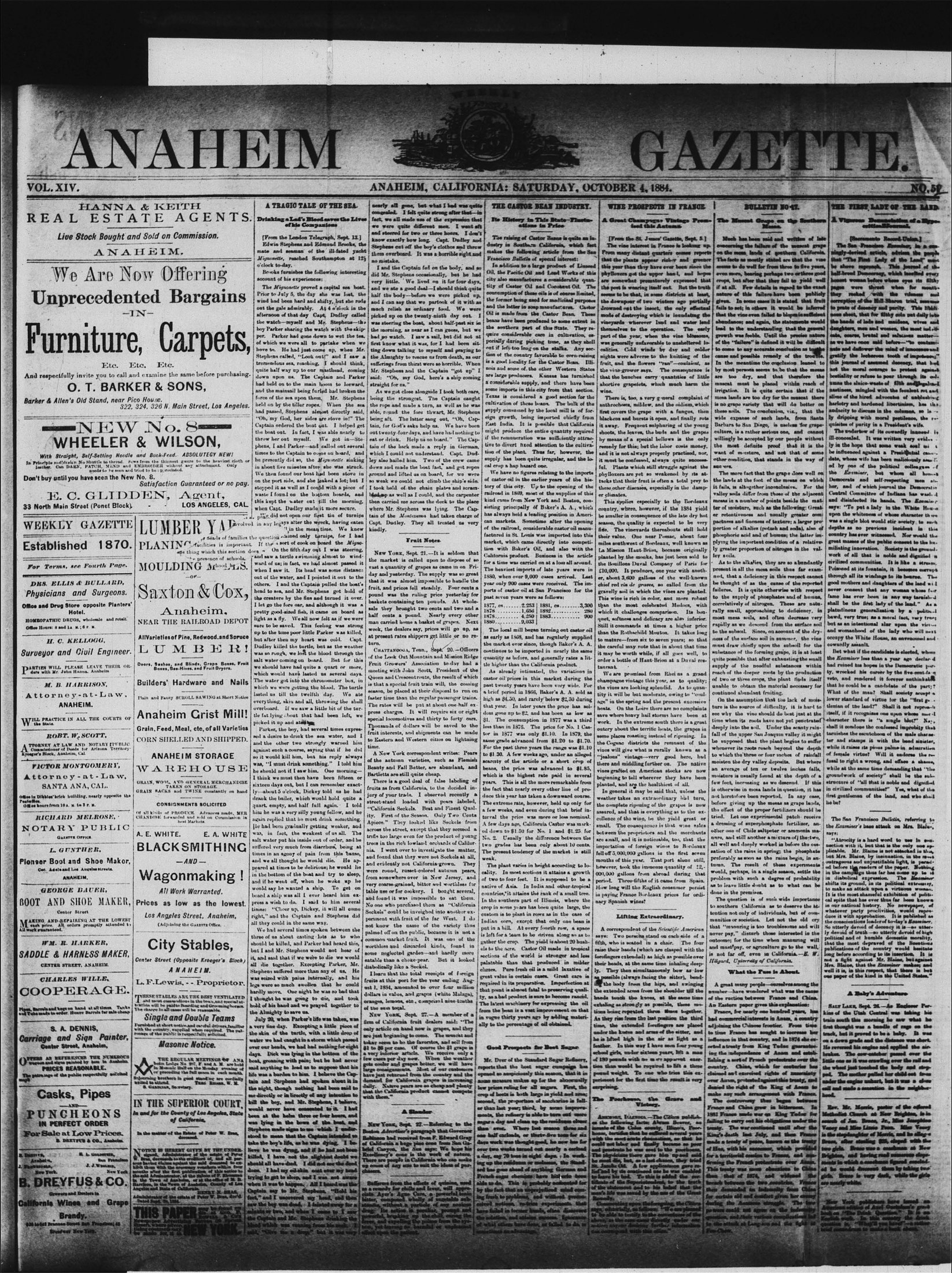
Searchable text
ANAHEIM
VOL. XIV.
HANNA & KEITH
REAL ESTATE AGENTS.
Live Stock Bought and Sold on Commission.
ANAHEIM.
We Are Now Offering
Unprecedented Bargains
INFurniture, Carpets,
Etc. Etc. Etc.
And respectfully invite you to call and examine the same before purchasing.
O. T. BARKER & SONS,
Barker & Allen's Old Stand, near Pico House.
322, 324, 326 N. Main Street, Los Angeles.
NEW No. 8
WHEELER & WILSON,
With Straight, Self-Setting Needle and Back-Feed. ABSOLUTEGY NEW!
In Principle and design No Shuttle to thread. News from the thinnest gauge to the heaviest cloth or leather. Can DARN, PATCH, MEND and EMBROIDER without any attachment. Only needs to be seen and tried to be appreciated.
A TRAGIC TALE OF THE SEA
Drinking a Lad's Blood saves the Life of his Companions
[From the London Telegraph, Sept. 12]
Edwin Stephens and Edmund Brooks mate and seaman of the ill-fated yacht Mignonette, reached Southampton at o'clock to-day.
Brooks furnishes the following interesting account of his experiences:
The Mignonette proved a capital sea breeze Prior to July 5, the day she was lost, wind had been hard and shifty, but she out the gale admirably. At 4 o'clock in afternoon of that day Capt. Dudley caled the watch—myself and Mr. Stephens—boy Parker sharing the watch with the per. Parker had gone down to wet the of which we were all to partake when hove to. He had just come up, when Stephens called, "Look out!" and I saw tremendous sea, reaching. I should the quite half way up to our masthead, com down upon us. The Captain and Park had held on to the main boom to leew and the mainsail being furled had broken force of the sea upon them. Mr. Steph held on by the tiller ropes. When the had passed, Stephens almost directly said "Oh, my God, her sides are stove in!"
Captain ordered the boat out. I helped the boat out. In fact, I was able nearly throw her out myself. We got in—phens, I and Parker—and called out several times to the Captain to come on board, he presently did so, the Mignonette sink in about five minutes after she was stru We then found our boat had been stowed
And respectfully invite you to call and examine the same before purchasing.
O. T. BARKER & SONS,
Barker & Allen's Old Stand, near Pico House.
322. 324. 326 N. Main Street, Los Angeles.
NEW No. 8
WHEELER & WILSON,
With Straight, Self-Setting Needle and Buck-Feed. ABSOLUTEGY NEW!
In Principle and distinctions No Shuttle to thread. News from the thinnest gauze to the heaviest cloth or leather. Can DARN, PATCH, MEND and EMBROIDER without any attachment. Only needs to be seen and tried to be preprinted.
Don't buy until you have seen the New No. 8.
Satisfaction Guaranteed or no pay.
E. C. GLIDDEN, Agent,
33 North Main Street (Ponet Block). LOS ANGELES, CAL
WEEKLY GAZETTE
Established 1870.
For Terms, see Fourth Page.
DRS. ELLIS & BULLARD,
Physicians and Surgeons.
Office and Drug Store opposite Planters' Hotel.
HOMEOPATHIC DRUGS, wholesale and retail.
Office Hours: 8 and 1a.M.; 6.P.M.
H. C. KELLOGG,
Surveyor and Civil Engineer.
PARTIES WILL PLEASE LEAVE THEIR ORDERS with Mr. John Hanua. Anaheim
M. B. HARRISON,
Attorney-at-Law.
ANAHEIM.
WILL PRACTICE IN ALL THE COURTS OF the State.
ROBT. W. SCOTT.
ATTORNEY AT LAW AND NOTARY PUBLIC Commissioner of Deeds for Arizona Territory Kreager's Block, Anaheim, Cal.
VICTOR MONTGOMERY,
Attorney-at-Law,
SANTA ANA, CAL.
Office in Dibbles' brick building, nearly opposite the Postoffice.
Office hours from 10 a.m. to 3 p.m.
RICHARD MELROSE,
NOTARY PUBLIC
GAZETTE OFFICE.
L. GUNTHER,
Pioneer Boot and Shoe Maker,
Cor. Adelaide and Los Angeles streets.
ANAHEIM.
GEORGE BAUER,
LUMBER YARD
PLANING facilities is important. If the sort of cook on board the Migrating thing which this section does... On the fifth day out I was stuertie and saw a turtle swimming almost to wi ward of us; in fact, we had almost passed when I saw it. Its head was some distance out of the water, and I pointed it out to others. I and the Captain pulled the boat head to sea, and Mr. Stephens got hold of the creature by the fins and turned it over. I let go the fore oar, and although it was pretty good-sized fish, it came on board light as a fly. We all now felt as if we were sure to be saved. This feeling was strug up to the time poor little Parker was killed but after then my heart was cold. Cal Dudley killed the turtle, but as the weather was so rough, we lost the blood through salt water coming on board. But for them we should have had quite a quart or more which would have lasted us several days. The water got into the chronometer box, which we were getting the blood. The tunelasted us till the twelfth day. We did everything skin and all, throwing the all overboard. If we saw a little bit of the tite fat lying about that had been left, picked it up and ate.
Parker, the boy, had several times expressed a desire to drink the sea water, and and the other two strongly warned him against such a course, saying that he so it would kill him, but his reply always was, "I must drink something." I told him he should not if I saw him. One morning I think we must then have been fifteen days out, but I can remember exactly about 5 o'clock, Dickey told us he had drank the bailer, which would hold quite quart, empty, and half full again. I told him he was a very silly young fellow, and again replied that he must drink something he had gradually getting weaker, and was, in fact, the weakest of us all. The salt water put his inside out of order, and suffered very much from diarrhoeus, being times in an agony of pain from this baum and we all thought he would die. He peared at times to be delirious; he would in the bottom of the boat and try to sleep and if he went off, when he woke up would say he wanted a ship. To get board a ship was all I ever heard him e
RICHARD MELROSE,
NOTARY PUBLIC
GAZETTE OFFICE.
L. GUNTHER,
Pioneer Boot and Shoe Makor,
Cor. Adelaide and Los Angeles streets.
ANAHEIM.
GEORGE DAUER,
BOOT AND SHOE MAKER,
Center Street
MAKING AND REPAIRING AT THE LOWEST
cash price. All orders promptly attended to.
All work guaranteed.
WM. R. HARKER,
SADDLE & HARNESS MAKER,
CENTER STREET, ANAHEIM.
CHARLES WILLE,
COOPERAGE.
Pipes, Barrels and keys on hand at all times. Tanks and Tubes made to order. Honey Barrels for sale cheap.
S. A. DENNIS,
Carriage and Sign Painter,
Center Street, Anaheim,
OFFERS AS REFERENCES THE NUMEROUS warrants and signs painted by him in Anaheim.
PRICES REASONABLE.
The parapage of the public respectfully solicited may
Casks, Pipes
AND
PUNCHEONS
IN PERFECT ORDER
For Sale at Low Prices.
B. DREYFUS & CO., Anaheim.
R. BARRITA,
R. L. GOLDTURZ,
Anaheim.
San Francisco.
J. FLORENZA,
J. J.WEULER,
New York.
B. DREYFUS & CO.
Growers and Dealers in California Wines and Grape Brandy.
630 Lo445 Brannan Street San Francisco; 45 Broadway New York.
CONSIGNMENTS SOLICITED
Of all kinds of PRODUCE. Advances made, MER CHANDISE forwarded and sold on Commission in best Markets.
A. E. WHITE.
E. A. WHITE
BLACKSMITHING
— AND —
Wagonmaking!
All Work Warranted.
Prices as low as the lowest.
Los Angeles Street, Anaheim,
(Adjoining the Gazette Office).
City Stables,
Center Street (Opposite Kroeger's Block)
ANAHEIM.
L. F. Lewis, -- Proprietor.
THESE STABLES ARE THE BEST VENTILATED and most comfortable in the town, and special attention will be paid to Boarding and Grooming horses.
The charge in all cases will be reasonable.
Single and Double Teams
Furnished at short notice and careful drivers familiar with the country, supplied when required. The rate of the public is respectfully solicited.
Masonic Notice.
THE REGULAR MEETINGS OF ANAHEIM Lodge No. 297, F. and A. M. are held in Monroe Hall on the Monday evening or preceding the full moon in each month.
Solonning brothers in good standing are cordially invited to attend.
Treasury Exhibition, W. M.
S. GARNER, Secretary.
IN THE SUPERIOR COURT,
In and for the County of Los Angeles, State of California.
In the matter of the Estate of Peter W. Bran, deceased.
NOTICE IS HEREBY GIVEN BY THE UNDER-Signed Administrator of the estate of Peter W. Bran, decrement to the creditors of, and all persons having claims against the said demand to enclose them with the necessary witnesses within four months after the first publication of this notice to the said Administrator, at the Saloon of P. Blumman in the Town of Anaheim, or at the office of M. B. Harrison, in the Town of Anaheim, County of Los Angeles and State of California.
HENRY N. BRAN,
Administrator of the estate of Peter W. Bran, deceased.
Dated Sept. 29, 1836.
THIS PAPER may be found on file at GOO, R.
ROWELL, A.CON
Newspaper Advertising Times 00 Papers
Street, where advice taking continues may be made for it, in NEW YORK.
ANAHEIM, CALIFORNIA: SATURDAY, OCTOBER 4, 1884.
RAGIO TALE OF THE SEA.
In a London Telegraph, Sept. 13.] Stephens and Edmund Brooks, the seaman of the ill-fated yacht Mignonette, reached Southampton at 12:30 a.m. furnishes the following interesting of his experiences:
Mignonette proved a capital sea boat. July 5, the day she was lost, the ship been hard and shifty, but she rode admirably. At 4 o'clock in the afternoon that day Capt. Dudley called myself and Mr. Stephens—the merchant sharing the watch with the skip-sailer had gone down to wet the tea. We were all to partake when we He had just come up, when Mr. called, "Look out!" and I saw a us sea, reaching. I should think, away up to our masthead, coming on us. The Captain and Parker went to the main boom to leeward, mainsail being furled had broken the sea upon them. Mr. Stephens by the tiller ropes. When the sea sail, Stephens almost directly said, God, her sides are stove in!" The ordered the boat out. I helped get out. In fact, I was able nearly to out myself. We got in—Stead and Parker—and called out several the Captain to come on board, and only did so, the Mignonette sinking five minutes after she was struck. Round our boat had been stove in nearly all gone, but what I had was quite congraled. I felt quite strong after that—in fact, we all made use of the expression that we were quite different men. I went aft and steered for two or three hours. I don't know exactly how long. Capt. Dudley and Stephens cut off the boy's clothes and throw them overboard. It was a horrible sight and no mistake.
I and the Captain fed on the body, and so did Mr. Stephens occasionally, but he had very little. We lived on it for four days, and we ate a good deal—I should think quite half the body—before we were picked up, and I can say that we partook of it with as much relish as ordinary food. We were picked up on the twenty-ninth day out. I was steering the boat, about half-past six in the morning, as near as I can guess, but we had no watch. I saw a sail, but did not at first know what it was, for I had been sitting down talking to myself and praying to the Almighty to rescue us from death, as our sufferings from thirst were so horrible. When Mr. Stephens and the Captain "got up" I said: "Oh, my God, here's a ship coming straight for us."
As we got close alongside I took both oars, being the strongest. The Captain caught the rope and made a turn, as well as he was able, round the fore thwart, Mr. Stephens being aft. The latter sang out, "Oh, Captain, for God's sake help us." We have been out twenty-four days, and have nothing to eat or drink. Help us on board." The Captain of the bark made a reply in German, which I could not understand. Capt. Dudley also hailed him. Two of the crew came down and made the boat fast, and got ropes around and lifted us on board; for we were
THE CASTOR BEAN INDUSTRY.
Its History in This State—Fluctuations in Price
The raising of Castor Beans is quite an industry in Southern California, which fact makes the following article from the San Francisco Bulletin of special interest:
In addition to a large product of Linseed Oil, the Pacific Oil and Lanol Works of this city also manufactures a considerable quantity of Castor Oil and Coconut Oil. The consumption of these oils is of course limited, the former being used for medicinal purposes and the latter in soap manufacture. Castor Oil is made from the Castor Bean. These beans have been produced to some extent in the southern part of this State. They require considerable care in cultivation, especially during picking time, as they shell out if left too long on the stalks. Any section of the country favorable to corn-raising is a good locality for the Castor Bean. Illinois and some of the other Western States are large producers. Kansas has furnished a considerable supply, and there have been some imports in this city from that section.
Texas is considered a good section for the cultivation of these beans. The bulk of the supply consumed by the local mill is of foreign growth, being imported chiefly from East India. It is possible that California might produce the entire quantity required if the remuneration was sufficiently attractive to divert fixed attention to the cultivation of the plant. Thus far, however, the supply has been quite irregular, and the local crop a hap hazard one.
We have no figures relating to the imports.
WINE PROSPECTS IN A Great Champagne Vineyard led this Autumn.
[From the St. James' Gazette]
The vine interest in France From many distant quarters that the plants appear richer this year than they have ever phylloxera got the upper hand are somewhat prematurely the pest is wearing itself out seems to be that, in some distressed downpour of two winters drowned out the insect, the mode of destroying which is vineyards wherever land themselves to the operation part of the year, when the was generally unfavorable to calities. Cold winds by night nights were adverse to the kings fruit, and the flowers "ran" the vine-grower says. The that the bunches carry quant abortive grapelets, which make wine.
There is too a very general anthrochoesis mildew, and then first covers the grape with a blackens and bursts it open, after it away. Frequent sulphurizing shoots, the leaves, the buds are by means of a special bellow remedy for this; but the labor and it is not always properly it must be confessed, always ful. Plants which still struggle phylloxera are yet so weaken
The Captain and Parker went to the main boon to leeward, brainsail being furled had broken the sea upon them. Mr. Stephens by the tiller ropes. When the sea silt, Stephens almost directly said, God, her sides are stove in! The ordered the boat out. I helped get out. In fact, I was able nearly to out myself. We got in—Stead Parker—and called out several the Captain to come on board, and only did so, the Mignonette sinking five minutes after she was struck. Round our boat had been stored in side, and she leaked a lot; but I as well as I could with a piece of ground on the bottom boards, and the water out till the morning. Dudley made it more secure. Not open our first tin of turnips days after the wreck, having eaten all in the mean time. We knewained only turnips, for I had sort of cook on board the Mignoote fifth day out I was steering, turtle swimming almost to wind-in fact, we had almost passed it now. Its head was some distance water, and I pointed it out to the end and the Captain pulled the boat's sails, and Mr. Stephens got hold of fire by the fins and turned it over. He fore oar, and although it was a hood-sized fish, it came on board as easily. We all now felt as if we were saved. This feeling was strong some poor little Parker was killed, when my heart was cold. Capt.ailed the turtle, but as the weather high, we lost the blood through the coming on board. But for this have had quite a quart or more, did have lasted us several days. Got into the chronometer box, in were getting the blood. The turtle still the twelfth day. We ate skin and all, throwing the shell. If we saw a little bit of the turkey about that had been left, we up and atlized.
The boy, had several times expressed to drink the sea water, and I other two strongly warned him with a course, saying that if he did kill him, but his reply always must have been fifteen or so out, but I can remember exact-oclock, Dickey told us he had bailer, which would hold quite a吨, and half fall again. I told him a very silly young fellow, and he told that he must drink something gradually getting weaker, and act, the weakest of us all. The put his inside out of order, and he very much from diarrhoea, being at agony of pain from this cause, thought he would die. He apistes to be delirious; he would he vom of the boat and try to sleep, eat off, when he woke up he he wanted a ship. To get on up was all I ever heard him ex-
New York, Sept. 21. — It is seldom that the market is called upon to dispose of so vast a quantity of grapes as came in on Friday and yesterday. The supply was so great that it was almost impossible to handle the fruit, and prices fell steadily. Four cents a pound was the ruling price yesterday for baskets containing ten pounds. At wholesale they brought two cents and two and a half cents a pound. Nearly every other man carried home a basket of grapes. Next week, the dealers say, prices will go up, as at present rates shippers get little or no return.
CHATTANOOGA, Tenn., Sept. 20. — Officers of the Look Out Mountain and Mission Ridge Fruit Growers' Association to-day had a meeting with John Scott, President of the Queen and Crescent route, the result of which is that a special fruit train will, the coming season, be placed at their disposal to run on faster time than the regular passenger trains. The rates will be put at about one-half express charges. It will require six or eight special locomotives and thirty to forty cars. Thousands of dollars will be saved to the fruit interests, and shipments can be made to Eastern and Western cities on lightning time.
A New York correspondent writes: Pears of the autumn varieties, such as Flemish Beauty and Fall Butter, are abundant, and Bartletts are still quite cheap.
There is a good deal of false labeling of fruits as from California, to the decided injury of your trade. I observed recently a street-stand loaded with pearls labeled, "California Seekels. Best and Finest Quality." First of the Season. Only Two Cents Apiece." They looked like Seekels from across the street, except that they seemed a trifle too large even for the product of young trees in the rich lowland orchards of California. I went over to investigate the matter, and found that they were not Sockols at all, and evidently not California-grown. They were round, russet-colored autumn pears, from somewhere over in New Jersey, and very coarse-grained, bitter and worthless for table use or for cookery. I bought several, and found it was impossible to eat them.
As we got close alongside I took both oars, being the strongest. The Captain caught the rope and made a turn, as well as he was able, round the fore thwart, Mr. Stephens being aft. The latter sang out, "Oh, Captain, for God's sake help us. We have been out twenty-four days, and have had nothing to eat or drink. Help us on board." The Captain of the bark made a reply in German, which I could not understand. Capt. Dudley also hailed him. Two of the crew came down and made the boat fast, and got ropes around and lifted us on board, for we were so weak we could not climb the ship's side. I took hold of the chain plates and scrambled up as well as I could, and the carpenter then carried me across the deck to the place where Mr. Stephens was lying. The Captain of the Montezama had taken charge of Capt. Dudley. They all treated us very kindly.
Fruit Notes
New York, Sept. 21. — It is seldom that the market is called upon to dispose of so vast a quantity of grapes as came in on Friday and yesterday. The supply was so great that it was almost impossible to handle the fruit, and prices fell steadily. Four cents a pound was the ruling price yesterday for baskets containing ten pounds. At wholesale they brought two cents and two and a half cents a pound. Nearly every other man carried home a basket of grapes. Next week, the dealers say, prices will go up, as at present rates shippers get little or no return.
CHATTANOOGA, Tenn., Sept. 20. — Officers of the Look Out Mountain and Mission Ridge Fruit Growers' Association to-day had a meeting with John Scott, President of the Queen and Crescent route, the result of which is that a special fruit train will, the coming season, be placed at their disposal to run on faster time than the regular passenger trains. The rates will be put at about one-half express charges. It will require six or eight special locomotives and thirty to forty cars. Thousands of dollars will be saved to the fruit interests, and shipments can be made to Eastern and Western cities on lightning time.
A New York correspondent writes: Pears of the autumn varieties, such as Flemish Beauty and Fall Butter, are abundant, and Bartletts are still quite cheap.
There is a good deal of false labeling of fruits as from California, to the decided injury of your trade. I observed recently a street-stand loaded with pearls labeled, "California Seekels. Best and Finest Quality." First of the Season. Only Two Cents Apiece." They looked like Seekels from across the street, except that they seemed a trifle too large even for the product of young trees in the rich lowland orchards of California. I went over to investigate the matter, and found that they were not Sockols at all, and evidently not California-grown.
They were round, russet-colored autumn pears, from somewhere over in New Jersey, and very coarse-grained, bitter and worthless for table use or for cookery. I bought several, and found it was impossible to eat them.
As already intimated, the variations in castor oil prices in this market during the past twenty years have been very wide. For a brief period in 1866, Baker's A. A. sold as high as $4.50, and rarely below $2.50 during that year. In later years the price has seldom gone up to $2, and has been as low as $1.The consumption in 1877 was a third less than in 1873.The price for No.1 Castor in 1877 was only $1.10.In 1879,the same grade advanced from $1.20 to $1.70.For the past three years the range was $1.10 to $1.30.A few weeks ago, under an alleged scarcity of the article or a short crop of beans,the price was advanced to $1.85which is the highest rate paid in several yearsThis is all the more remarkable from the fact that nearly every other line of produce this year has taken a downward course.The extreme rate,however,held up only for a few weeks,and even during that brief intervalthe price was more or less nominal.A few days ago,California Castor was marked down to $1.50 for No.I 1 and $1.25 for No.J 2Usually,the difference between the two grades has been only about 10 cents.The present tendency of the market is still weak.
The plant varies in height according to locality.In most sections it attains a growth of two to four feet。它 is supposed to be a native of Asia.In India and other tropical countries,它 attains the rank of a small tree.In large producers.Kansas has furnished a considerable supply,and there have been some imports in this city from this section.Texas is considered a good section for the cultivation of these beans.The bulk of the supply consumed by the local mill is of foreign growth,被 imported chiefly from East India。它 is possible that California might produce the entire quantity required if the remuneration was sufficiently attractive to divert fixed attention to the cultivation of the plant Thus farhowever,the supply has been quite irregular,and the local crop a hap hazard one.
We have no figures relating to the imports of castor oil in this earlier years ofthe history of this city.Up to the opening ofthe railroad in 1869,most ofthe supplies ofthis kind came from New York and Boston,consisting principally of Baker's A.A.,which has always held a leading position in American markets.Sometime afterthe openingofthe railroad,couldable castor oil manufacturein St.Louis was imported into thismarket,which came directly into competitionwith Baker's Oil,and also withthe Californian product.Business inthe articlefora timewas carried onat lossall around.The heaviestimportsof late yearswerein 1880when over9000casesarrived.Lastyearonly900 caseswere received.Theimportsof castor oilatSan Franciscoforthe past seven yearswere as follows:
1877,css.....2253 1881,css.....3300
1878.....1656 1882.....280
1878.....4250 1883.....900
1880.....9033
The local mill began turning out castor oilas early as 1868,and has regularly suppliedthe market ever since though Baker's A.A.continuestobeimportedinnearlythe samequantityasbefore,andgenerallyratesalittlehigherthantheCalifornianproduct.
As already intimated,the variationsin castor oil pricesin this marketduringthe past twenty yearshave beenvery wide.Foreabriefperiodin1866,Baker'sA.A.soldashighas$4.50,andrarelybelow$2.50duringthatyear.In Lateryearsthepricehasseldomgoneupto$2,andhasbeenaslowas$1.Theconsumptionin1877wasathirdlessthanin1873.ThepriceforsNo.I 1Castorin1877wasonly$1.10.In1879,thesamegradeadvancedfrom$1.20to$1.70.Forthepastthreeyearstherangewas$1.10to$1.30.Afewweeksago,-underan allegedscarcityofthearticleorashortcropofbeans,thepricewasadvancedto$1.85whichisthehighestratepaidinseveralyearsThisisallthemoreremarkablefromthefactthatnearlyeveryotherlinefrodduranticealthoughtheyarelookinginsplendid.itwillbebutmoderate.oageinthespringandthepressheats.OntheLoiretherearesavewhereheavyhailstormshorework.Intheextreme southtoutteryabouttheterriticheats,someplacesrosating insteadoftheCoguaindistrictstheremineswill givewhatisruraly"jealous"vintage—verygoodthereandmiddlingfurtheron.vinegraftedonAmericanstorebeginingtoll wherevertheplanted,andarehealthiest.
In generalit may be said thatweather takes an extraordinariacompleteripeningofthegivassured,andthatiseverythingcollisenceofthewine.beetheyismalldimall.Theconsequencesthatisbetweentheproprietorsandtheraresmall.Theconsequencesthatisbetweentheproprietorsandtheraresmall,anditisnoticeable,totheimportationofforeignwinesfalloff50000gallonsinthemonthsofasthisyear.Taitporthowever,tooktheimmensequality00000gallonsfromabroadperiod.Tree-filingsofitwillTheEnglishconstrainpayFrancebordeauxprices
street-stand loaded with pears labeled,
"California Seckels. Best and Finest Quality."
First of the Season. Only Two Cents Apiece." They looked like Seckels from across the street, except that they seemed a trifle too large even for the product of young trees in the rich lowland orchards of California. I went over to investigate the matter, and found that they were not Seckels at all, and evidently not California-grown. They were round, russet-colored autumn pearls, from somewhere over in New Jersey, and very coarse-grained, bitter and worthless for table use or for cookery. I bought several, and found it was impossible to eat them. No one who purchased them as "California Seckels" could be inveighed into another experiment with fruit of the far West. I do not know the name of the variety thus palmed off on the public, because it is not a common market fruit. It was one of the worthless and discarded kinds, found in some neglected garden—and hardly more editable than a choke-pear. But it looked diabolically like a Seckel.
I learn that the total receipts of foreign fruits at this port for the year ending August 1, 1884, amounted to over four million dollars in value, and grapes (white Malaga), oranges, lemons, etc., comprised nine tenths of the sum total.
New York, Sept. 27.—A member of a firm of California fruit dealers said: "The only article on hand now is grapes, and they are just beginning to come. The muscat and tokay seem to be the favorites, and sell from $1 to $6 per case. Of course the $1 grape is a very interior article. We receive only a few cases per day now. When the weather gets cooler and grapes better, we will have large consignments. Most of our customers have just returned from the country and the demand for California grapes is increasing daily. Nature pears are so cheap and plenty that the California product cannot compete with them."
A Standor
New York, Sept. 27.—Referring to the Boston Advertiser's paragraph that Governor Robinson had received from F. Edward Gray of California a huge pine come from San Gabriel Canyon, the Sun sign; We hope his Excellency's come in the work of nature. There are people in California who can make up cases of any size to suit the ideas of purchasers.
Sufferers from the effects of quinine, used as a remedy for chills and fever, will appreciate Ayer's Agua Cura, a powerful tonic bitter, composed wholly of vegetable substances, without a particle of any notion drug. Its action is painful, prussis and powerful, breaking up the chill, caring the fever, and expelling the poison from the system, yet leaving no harmful or unpleasant effect upon the patient.
The extreme rate, however, held up only for a few weeks, and even during that brief interval the price was more or less nominal. A few days ago, California Castor was marked down to $1.50 for No. 1 and $1.25 for No. 2. Usually the difference between the two grades has been only about 10 cents. The present tendency of the market is still weak.
The plant varies in height according to locality. In most sections it attains a growth of two to four feet. It is supposed to be a native of Asia. In India and other tropical countries, it attains the rank of a small tree. In the southern part of Illinois, where the crop in some years has been quite large, the custom is to plant in rows as in the case of Indian corn, except that only one bean is put in a hill. At every fourth row, a space is left for a team to be driven along so as to gather the crop. The yield is about 20 bushels to the acre. Castor Oil made in tropical sections of the world is stronger and less palatable than that produced in milder climates. Pure fresh oil is a mild laxative of great value in certain cases. Great care is required in its preparation. Imperfection at that point is almost fatal to preserving quality, as a bad product is sure to become rancid. The latest machinery for expressing the oil from the bean is a vast improvement on that in vogue thirty years ago by adding materially to the percentage of oil obtained.
Good Prospects for Beet Sugar
Mr. Dyer of the Standard Sugar Refinery, reports that the beet sugar campaign has opened so suspiciously this season, that it in some measure makes up for the abnormally low prices ruling for all sugars. First, the crop of beets is both large in yield and area; second, the proportion of saccharine in faller than last year; third, by some improvements, the refinery is able to turn out more sugar a day and clean up the residuum closer than ever. Where last season three and one half carloads, or thirteen-five tons for six days work was thought good, he now has for over two weeks turned out nearly a carload a day, say 70 tons in eight days. In working up the residuum or molasses, the Standard has gone ahead of anything German and French sugar chemists have hit well once to do. This is probably accounted for by the fact that an unprejudiced mind comes flush to problems, and without preconceived notions, re-frame experiments that have failed in former hands, often dimenors the solution, and admits success. Ignorance of what others have done or failed to do seems an advantage.
The Poorhouse, the Grief Victory.
Askmore, Harrods — The Clerk on the following factor: Abram insults of the Clerk county. Ill house, tortifluent that he suffered with the most acute rheumatism could not labor and finally became and prostrate he was most to this. The physicians there gave him he must die, lost, as a last chance St.James Old. A few applicants listened by its continued use he would leave his bed. To this is added tribute of the Superintendent, toof of the statement and to his current life was saused by the use of Remedy.
Commenting upon these surprising signs, editorially, as follows: "We should be able to testify to the current above, as the case can directly indicate anyone drinking further wine can correspond with this offer."
GAZETTE.
TOBER 4, 1884.
WINE PROSPECTS IN FRANCE
A Great Champagne Vintage Promised this Autumn.
[From the St. James' Gazette, Sept. 5.]
The vine interest in France is looking up. From many distant quarters comes reports that the plants appear richer and greener this year than they have ever been since the phylloxera got the upper hand, and hopes are somewhat prematurely expressed that the pest is wearing itself out. But the truth seems to be that, in some districts at least, the downpour of two winters ago partially drowned out the insect, the only effectual mode of destroying which is inundating the vineyards wherever land and water lend themselves to the operation. The early part of the year, when the vine blossoms, was generally unfavorable to unsheltered localities. Cold winds by day and colder nights were adverse to the knitting of the fruit, and the flowers "ran"—coulaient, as the vine-grower says. The consequence is that the bunches carry quantities of little abortive grapelets, which much harm the wine.
There is, too, a very general complaint of anthrochoma, mildew, and the oidium, which first covers the grape with a fungus, then blackens and bursts it open, and finally rots it away. Frequent sulphuring of the young shoots, the leaves, the buds and the grapes by means of a special bellows is the only remedy for this; but the labor costs money, and it is not always properly practiced, nor, it must be confessed, always quite successful. Plants which still struggle against the phylloxera are yet so weakened by its at-
BULLETIN NO. 47.
The Muscat Grape on the Southern Mesa.
Much has been said and written of late concerning the failure of the muscat grape on the mesa lands of southern California. The facts as mostly stated are that the vine seems to do well for from three to five years, even more bearing perhaps two or three good crops, but after that they fail to yield well if at all. Few details in regard to the exact nature of this failure have been publicly given. In some cases it is stated that fruit fails to set; in others it would be inferred that the vine even failed to bloom in sufficient abundance; and again, the statements would lead to the understanding that the general growth was feeble. Until the precise nature of the "failure" is defined it will be difficult to come to any accurate conclusion as to the cause and possible remedy of the trouble. In the meantime the conclusion leaned to by most persons seems to be that the means are too dry, and that therefore the muscat must be placed within reach of irrigation. It is quite certain that if the mesa lands are too dry for the muscat there is no grape variety that will do better on these soils. The conclusion, viz., that the wide expanse of such lands, from Santa Barbara to San Diego, is useless for grape-culture, is rather serious one, and cannot willingly be accepted by our people without the most definite proof that it is the want of moisture, and not that of some other condition, that stands in the way of success.
The more fact that the grape does well on
THE FIRST LADY OF THE LAND
A Vigorous Demandation of a Hypocritical Mournful.
[Sacramento Record-Union.]
The San Francisco Examiner, in a seemingly-deviated article, admits the people that "The First Lady of the Land" must be above reproach. This journal of the half-broad Democracy, which insulted every honest woman before whose eyes its filthy pages were thrust when for months they racked with the vitisness and corruption of the Mill-Sharon trial, measures to prate of decency and purity. This libilious sheet, that for filthy coin put daily into the hands of lads and maidens, wives and daughters, men and women, the most indolcata, coarse, brutal and salacious matter—as we have once said before—"to contaminate and deflower the mind of innocence and gratify the lecherous tooth of impurity;" this journal of assumed decency, that had not the moral courage to protest against bestiality or refuse to pour through its columns the alice-waste of fifth and legalized nastiness, mingled with the feculent rot and allure of the hired advocates of unblushing harlotry and hardened libertinism, has thus audacity to discuss in the columna, so laxly dripping with moral postilence, the requisites of purity in a President's wife.
The undertow of its cowardly innend is ill-conceived. It was written very violently in the hope that some weak soul might be influenced against a Presidential candidate, whose wife has been maliciously annulled by one of the political colleagues of the Exterminer, but whom all human
that the bunches carry quantities of little abortive grapelets, which much harm the wine.
There is, too, a very general complaint of anthrochoes, mildew, and the oidium, which first covers the grape with a fungus, then blackens and bursts it open, and finally rots it away. Frequent sulphuring of the young shoots, the leaves, the buds and the grapes by means of a special bellows is the only remedy for this; but the labor costs money, and it is not always properly practised, nor, it must be confessed, always quite successful. Plants which still struggle against the phylloxera are yet so weakened by its attacks that their fruit is often a total prey to these other diseases, especially in the damper climates.
This applies especially to the Bordeaux country, where, however, if the 1884 yield be smaller in consequence of the late dry hot season, the quality is expected to be very fine. The vineyards thereabouts still hold their value. One near Pessac, about four miles southwest of Bordeaux, well known as La Mission Haut-Brion, because originally planted by the monks, has just been sold to the Bouillons Duval Company of Paris for £10,000. It produces one year with another, about 3,600 gallons of the well-known chief red wine de grasse, so called from the gravelly soil in which the vines are planted. This wine is rich in color, and more robust than the most celebrated Medocs, with which it challenges comparison. Its bonquet, softness and delicacy are also inferior. Still it commands at times a higher price than the Rothschild Mouton. It takes long to mature—from six to seven years; so that the careful may note that in about that time it may be worth while, if all goes well, to order a bottle of Haut-Brion at a Duval restaurant.
We are promised from Rheims a grand champagne vintage this year, as to quality; the vines are looking splendid. As to quantity it will be moderate, owing to "coulage" in the spring and the present excessive heats. On the Loire there are no complaints save where heavy hail storms have been at work. In the extreme south there is a great outcry about the terrific heats, the grapes in some places roasting instead of ripening. In the Cognac districts the remnant of the vines will give what is rurally known as a "jealous" vintage—very good here, bad there and middling further on. The native vines grafted on American stocks are now beginning to tell wherever they have been planted, and are the healthiest of all.
In general it may be said that, unless the weather takes an extraordinary bad turn, the complete ripening of the grapes is now assured, and that is everything as to the excellence of the wine, so the yield great or small. The consequence is that wine sales between the proprietors and the merchants are small, and it is noticeable, too, that the importation of foreign wines to Bordeaux fell off 5,000,000 gallons in the first seven months of this year. That port alone still, however, took the immense quantity of 12,000,000 gallons from abroad during that period. Three-fifths of it came from Spain. How long will the English consumer persist in paying France Bordeaux prices for ordi-
are too dry, and that therefore the muscat must be placed within reach of irrigation. It is quite certain that if the mesa lands are too dry for the muscat there is no grape variety that will do better on these soils. The conclusion, viz., that the wide expanse of such lands, from Santa Barbara to San Diego, is useless for grape-culture, is a rather serious one, and cannot willingly be accepted by our people without the most definite proof that it is the want of moisture, and not that of some other condition, that stands in the way of success.
The more fact that the grape does well on the lands at the foot of the mesas on which it fails, is altogether inconclusive. For the valley soils differ from those of the adjacent mesas in a number of such beside the matter of moisture, such as the following: Greater retentiveness and usually greater compactness and fineness of texture; a larger proportion of alkalies (potash and soda), also of phosphoric acid and of humus; the latter implying the important condition of a relatively greater proportion of nitrogen in the valley soils.
As to the alkalies, they are so abundantly present in all the mesa soils thus far examined, that a deficiency in this respect cannot be thought of as the cause of the reported failures. It is quite otherwise with respect to the supply of phosphates and of humus, correlatively of nitrogen. These are naturally small, approaching to deficiency, in most mesa soils, and often decrease very rapidly as we descend from the surface soil to the subsoil. Since, on account of the dryness of the surface soil in summer, the vine must draw chiefly upon the subsoil for the substance of the forming grape, it is at least possible that after exhausting the small supply of the needful substances within reach of the deeper roots by the production of two or three crops, the plant finds itself unable to obtain the material necessary for continued abundant fruiting.
On the assumption that the lack of moisture is the source of difficulty, it is hard to see why the vine should do best just at the time when its roots have not yet penetrated deeply into the soil. Under the scanty rainfall of the upper San Joaquim valley it might be supposed that the plant begins to suffer whenever its roots reach beyond the depth to which the three or four inches of rainfall moisten the dry valley deposits. But where an average of ten or twelve inches falls, moisture is usually found at the depth of a few feet, increasing as we descent. If this is otherwise in mesa lands in question, it has not heretofore been reported. In any case, before giving up the mesas as grape lands, the effect of the proper fertilizers should be tried. Let one experimental patch receive a dressing of superphosphate fertilizer, another one of Chile saltpeter or ammonia manure, and still another a mixture of these two, all well and deeply worked in before the cessation of the rains in spring; the phosphate preferably as soon as the rains begin in autumn. The result of these experiments would, perhaps, in a single season, settle the problem with such a degree of probability as to leave little doubt as to what can be done in the premises.
The question is of such wide importance that there is no doubt through its columns the sluice-waste of fifth and legalized nastiness, mingled with the feebulent rot and aline of the hired advocates of unblushing harlotry and hardened libertinism, has this audacity to discuss in the columns so lazily dripping with moral pestilence, the requisites of purity in a President's wife.
The underow of its cowardly innocence is ill-concealed. It was written very evidente in in hope that some weak soul may be influenced against a Presidential candidate whose wife has been maliciously assaulted by one of political colleagues of Emminer, but whom all homemakers and self-respecting men author, and of which journalthe Democratic Central Committee of Indiana has washed and disinfected its hands. The Examiner says: "To put a lady in the White House upon the whiteness of whose character thou was a single blot would stir society to such depths as no previous incident in this country has ever witnessed. Nor would she great masses of public consent to her humiliating innovation. Society is the groundwork of all that is noble and dignified in civilized communities. It is like a stream. Poisoned at its fountain, it becomes corrupted through all its windings to its bourne. The good mothers and daughters of the land will never consent that any woman whose fair fame has ever been in any way tarnished shall be the first lady ofthe land." As a platitudinal generalization by a political awbwd, very true; as a moral fact, very true; but as an intentional alar upon the virtues and womanhood ofthe lady who will next occupythe White House, an envenomed and cowardly assault.
But what ifthe candidate is elected, whomthe Examiner less than a year ago declared had ruined his hopes inthe Democratic party, wrecked his career bythe five-cent-fair veto,and renderedit forever unthinkable that he could be a candidateofthe party? Whatofthe man? Shall society accepta lower standardof virtue torthe "first gentlemanofthe land!" Shallit not representitself ifit recognizesone uponwhose moralcharacterthereis"asingleblot?"Nayshallit condoneconfessedimprobitythattarnishestheescutcheonofthemalecharacterandstampsitwiththebandsimisterwhileitraisesitspiouspalmsinadmirationoffemalevirtue! Willitendorsetherefusaltorightawrong,andeffaceashamewhileatthesametimedemandingthat"thegroundworkofsociety"shallbethesubstructureof"allthatisnobleanddigiencedincivilizedcommunities!"Yeswhatofthefirstgentlemanoftheland,andwhoishebe?
The San Francisco Bulletin referringtotheExaminer'sbaseattackonMrs.Blauus,says:
"Aatrocityisahardwordtouseinconnectionwithit,bbutthatisonlyoneapplicable.Mr.BlaineisnotattackedinthisbutMrs.Blainebyininstitution,themostoutrageousandunjustifiablelightispermittedbeforethereadersofthepaper.Nothinginthecampaignthusfarhascomeupto16indiabolicexpression.TheExaminershiftsitsground.initispoliticalextremeyettomakeanattackupapritiouswoman.itIsthemostshamfulexhibitionofpoliticalwritethathasthusfearbeenused."
Lifting Extraordinary.
A correspondent of the Scientific American says: Two persons stand on each side of a fifth, who is seated in a chair. The four raise their hands (which are clasped with the forefingers extended) as high as possible over their heads, at the same time inhaling deeply. They then simultaneously bow as low as possible (always facing the sitter), bending the body from the hips, and swinging the extended arms from the shoulder till the hands touch the knees, at the same time exhaling as strongly as possible, these motions being repeated three times together. As they rise from the last position the third time, the extended forefingers are placed under the knees and arms of the sitter, and he is lifted high in the air as light as a feather. In this way I have seen four young school girls, under sixteen years, lift a man 180 pounds with no more apparent exertion than would be required to lift a three pound weight. To one who tries this experiment for the first time the result is very surprising.
The Poorhouse, the Grave and Victory.
Assumption, Louisiana — The Citizen publish the following fact: Abrams Beaver, an mate of the Coin county, Illinois, Poorman, tartifish that he cultured several years with the most acute rhinismation, so that he did not labor and finally became so poor and prostitute he was meant to the poorhouse. The physicians there gave him up and said he must die, but as a last chance, they tried James Old. A few applications gave recalled by its continued use he was enabled leave his bed. To this is added the contents of the Superintendent, to the truth the statement and to his belief that the man's life was sound by the use of the Great Council.
Commenting upon the foregoing, the Citizen, obviously, as follows: "We are pleased to testify to the correctness of the own, as the case came directly quarrel our sister; anyone doubting further information or correspond with this office."
The San Francisco Bulletin, referring to the Examiner's base attack on Mrs. Blalu, says:
"Atrocity is a hard word to use in connection with it, but that is the only one applicable. Mr. Blaine is not attacked in this, but Mrs. Blaine, by insinuation, in the raws outrageous and unjustifiable light, is persecuted before the readers of the paper. Nothing in the campaign thus far has come up to it in diabolical expression. The Examiner shifts its ground, in its political extremist, to make an attack upon a virtuous woman. It is the most shameful exhibition of political spite that has ever thus far been known in our national history. No newspaper, of whatever party proclivities, would reproduce it with approbation. It is published as the conscientious leader of today's Examiner. So utterly devoid of decency it is—an utterly devoid of truth—so utterly devoid of high political and of humble domestic morality, that the most depraved of the licentious publications of the country would hesitate long before according to its insertion. It is not a fight against Mr. Blaine, but against Mrs. Blaine, that the Examiner makes; and well it is, in this respect, that there is but one paper of the kind in the United States."
A Baby's Adventure
Salt Lake, Sept. 26.—An Engineer Perkins of the Utah Central was taking his train south this morning he saw what he first thought was a handle of rage on the track, but it proved to be a baby. It was on a down grade and the distance was short. He reversed his engine and applied the airbrakes. The cow-catcher passed over little one as it was crawling over the rail and the wheat just touched the body and stepped. The mother pulled her child out from under the engine unhurt, but it was a close call and made a sensation in the neighborhood.
Rev. Mr. Morris, pastor of the offered Methodist Church at New Brighton, in search of Jan. Brenn, Jr., Miss Jannahine Vancey and Miss Lissie Pena. Miss Vancey in the simplaughter of Marris, and he alleges Brenn after stalling Gill, alleged with two girls. Brenn was a cochinam at New Brighton, and having read numerous dependents in which a cochinam figure included he would descend them by taking two girls. Brenn is very dull, while the girls are nearly white.
New York publication here issued an American edition of Axel Ostwald's graft book on "The Drink Question." It is an English rush. In this country the drink question is, "What if you drink?" a routine trial encounter to make a book about...