anaheim-gazette 1884-09-20
Scanned page
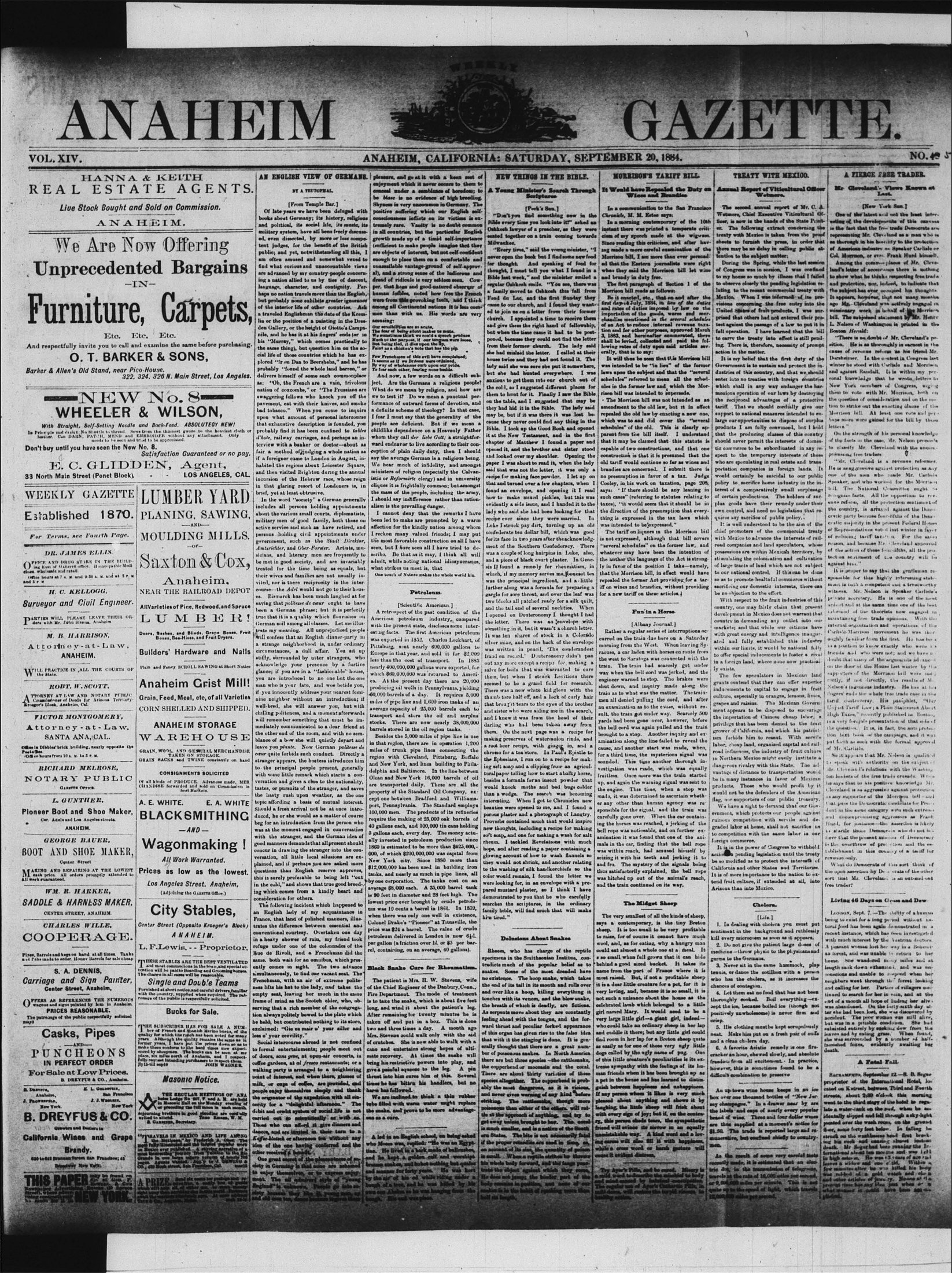
Searchable text
ANAHEIM
VOL. XIV.
HANNA & KEITH
REAL ESTATE AGENTS.
Live Stock Bought and Sold on Commission.
ANAHEIM.
We Are Now Offering
Unprecedented Bargains
INFurniture, Carpets,
Etc. Etc. Etc.
And respectfully invite you to call and examine the same before purchasing.
O. T. BARKER & SONS,
Barker & Allen's Old Stand, near Pico-House.
322. 324. 326 N. Main Street, Los Angeles.
NEW No. 8
WHEELER & WILSON,
With Straight, Self-Setting Needle and Back-Feed. ABSOLUTEGY NEW!
In Price ple and design No Shuttle to thread. Seems from the thinnest gauze to the heaviest cloth or leather. Can DARN, PATCH, MEND and EMBROIDER without any attachment. Only needs to be seen and tried to be appreciated.
Don't buy until you have seen the New No. 8.
Satisfaction Guaranteed or no pay.
E. C. GLIDDEN, Agent,
AN ENGLISH VIEW OF GERMANY
BY A TEUTOPHAL.
Of late years we have been deluged by books about Germany; its history, religion and political, its social life, its military system, have all been freely dissected, even dissected, by more or less content judges, for the benefit of the public; and yet, notwithstanding all this am often amused and somewhat vexed find what curious and unaccountable we are advanced by my country-poople concerning a nation allied to us by ties of despair language, character, and contiguity. Haps no nation travels more than the English but probably none exhibits greater ignorance of the interior life of other countries. A traveled Englishman the date of the Klin or the position of a painting in the Den Gallery, or the height of Giotto's Cathedral, and he has it at his fingers' ends (on his "Murray," which comes practically the same thing), but question him on the social life of those countries which he has plored "from Dan to Beersheba," and he probably "found the whole land barren" delivers himself of some such commonness as: "Oh, the French are a vain, trivial nation of coxcombs," or "The Prussian swaggering follows who knock you off pavement, eat with their knives, and sundried tobacco." When you come to inform upon what amount of personal interest that exhaustive description is founded, probably find it has been confined to the d'hote, railway carriages, and perhaps a terview with a banker or doctor—about fair a method of judging a whole nation if a foreigner came to London in August habited the regions about Leicester Square and then visited Brighton during the an...
NEW No. 8
WHEELER & WILSON,
With Straight, Self-Setting Needle and Back-Feed. ABSOLUTEGY NEW!
In Price ple and design No Shuttle to thread. Sews from the thinnest gauge to the heaviest cloth or leather. Can DARN, PATCH, MEND and EMBROIDER without any attachment. Only needs to be seen and tried to be appreciated.
Don't buy until you have seen the New No. 8.
Satisfaction Guaranteed or no pay.
E. C. GLIDDEN, Agent,
33 North Main Street (Ponet Block).
LOS ANGELES, CAL.
WEEKLY GAZETTE
Established 1870.
For Terms, see Fourth Page.
DR. JAMES ELLIS.
OFFICE AND DRUG STORE IN THE BUILDING East of Garbery office. Homeopathic Medicine wholesale and retail.
Office hours at 7 A.M. and 9:30 A.M. and at 2 P.M. and 5 P.M.
H. C. KELLOGG.
Surveyor and Civil Engineer.
PARTIES WILL PLEASE LEAVE THEIR ORDERS with Mr. John Hanua, Anaheim.
M. B. HARRISON.
Attorney-at-Law, Anaheim.
WILL PRACTICE IN ALL THE COURTS OF the State.
ROBT. W. SCOTT.
ATTORNEY AT LAW AND NOTARY PUBLIC Commissioner of Deeds for Arizona Territory-Kroger's Block, Anaheim, Cal.
VICTOR MONTGOMERY,
Attorney-at-Law, Santa Ana, Cal.
Office in Dibbles' brick building, nearly opposite the Patio Place.
Office hours from 10 A.M. to 3 P.M.
RICHARD MELROSE,
NOTARY PUBLIC Gazette Office.
L. GUNTHER.
Ploneer Boot and Shoe Maker, Cor. Adela and Los Angeles streets, Anaheim.
GEORGE BAUER,
BOOT AND SHOE MAKER, Center Street
MAKING AND REPAIRING AT THE LOWEST cash price. All orders promptly attended to All work guaranteed.
WM. R. HARKER,
LUMBER YARD
PLANING, SAWING,
AND
MOULDING MILLS.
OF
Saxton & Cox, Anaheim.
NEAR THE RAILROAD DEPOSIT
All Varieties of Pine, Redwood,and Spruce LUMBER!
Doors, Sashes, and Blinds, Grape Boxes, Fruit Boxes, Bee-Hives, and Fruit Dryers.
Builders' Hardware and Nails
Plain and Fancy SCROLL SAWING at Short Notice
Anaheim Crist Mill!
Grain, Feed, Meal, etc., of all Varieties CORN SHELLED AND SHIPPED.
ANAHEIM STORAGE
WAREHOUSE
GRAIN, WOOL, AND GENERAL MERCHANDISE TAKEN ON STORAGE.
GRAIN BACKS and TWINE constantly on hand
CONSIGNMENTS SOLICITED
Of all kinds of PRODUCE. Advances made, MER CHANDISE forwarded and sold on Commission in best Markets.
A. E. WHITE.
E. A. WHITE
BLACKSMITHING
AND
Wagonmaking!
All Work Warranted.
Prices as low as the lowest.
Los Angeles Street, Anaheim,
(Adjoining the Gazette Office.)
L. GUNTHER,
Ploneer Boot and Shoe Maker,
Cer. Adale and Los Angeles streets.
ANAHEIM.
GEORGE BAUER,
BOOT AND SHOE MAKER,
Center Street
MAKING AND REPAIRING AT THE LOWEST
mash price. All orders promptly attended to
All work guaranteed.
WM. R. HARKER,
SADDLE & HARNESS MAKER,
CENTER STREET, ANAHEIM.
CHARLES WILLE,
COOPERAGE.
Plaes, Barrels and kegs on hand at all times. Tanks
and Fabs made to order. Honest barrels for sale cheap
S. A. DENNIS,
Carriage and Sign Painter,
Center Street, Anaheim,
OFFERS AS REFERENCES THE NUMEROUS
wagons and signs painted by him in Anaheim.
PRICES REASONABLE.
The patrology of the public respectfully solicited may?
Casks, Pipes
AND
PUNCHEONS
IN PERFECT ORDER
For Sale at Low Prices.
B. DREYFUS & CO., Anaheim.
R. DARVER,
Anahiem,
San Francisco
J. PROWSELL,
J. J. WHOLMIX.
New York.
B. DREYFUS & CO.
Orenere and Dealers in
California Wines and Grape
Brandy.
630 to 642 Brannan Street San Francisco; 45
Brannan Street New York.
THIS PAPER may be found renished on page 148.
K. NOWMANING Advertising Bureau (30 acres)
Street, which adverts fishing condemned near
Atlanta street New York.
A. E. WHITE.
E. A. WHITE
BLACKSMITHING
— AND —
Wagonmaking!
All Work Warranted.
Prices as low as the lowest.
Los Angeles Street, Anaheim,
(Adjoining the GAZETTE Office.)
City Stables,
Center Street (Opposite Kroeger's Block)
ANAHEIM.
L. F. Lewis, -- Proprietor.
THESE STABLES ARE THE BEST VENTILATED
and most commensilous in the town, and special attention will be paid to Boarding and Grooming horses.
The charve in all cases will be reasonable.
Single and Double Teams
Furnished at short notice, and careful drivers, familiar with the country, supplied when required. The patronage of the public is respectfully solicited.
Bucks for Sale.
THE SUBSCRIBER HAS FOR SALE A NUMber of French and Spanish Merino bucks, of the quality for which the raph has been noted for many years. Although the quality remains the same as in former years, I have put the prices down go as to make them conform to the hard times now experienced by sheepmen. The bucks can be seen at my place, six miles north of Anaheim, and I respectfully request intending purchasers to inspect them.
Jly 15-till seple
JOHN WAGNER.
Masonic Notice.
THE REGULAR MEETINGS OF ANAhiem Lodge No. 207, F. and A. M. are held in Masonic Hall on the Monday evening of or preceding the full moon in each month.
Sojourning brothers in good standing are cordially invited to attend.
Tnoo Ransom, W. M.
& Garsynen, Secretary.
"TRAVELS IN MEXICO AND LIFE AMONG
the Mexicans" by Frederick A. Ober. The men fully illustrated and the largest papale work on Mexico ever published. A stirring narrative of a most interesting journey from Yelchin to the Bin Grande in one large ocean volume of nearly 100 pages.
Agents wanted: Apply to J. DEWING &
CO., 420 Bush street, San Francisco, Cal.
A PRIZE.
Send six cents for postage and responsible extra from a costly box of pennies which will pay all of either one, so much money right away than any other British world. Postmaster at the same time shares a penny with all others.
Should a fresh arrival not be at once induced, he or she would as a matter of course beg for an introduction from the person who was at the moment engaged in conversation with the stranger, and the German ideal good manners demands that all present should concur in drawing the stranger into the conversation, all little local allusions are plained, and if perhaps you are asked more questions than English reserve approving this is surely preferable to being left "in the cold," and shows that true good brewing which comes from a kindly heart is consideration for others.
The following incident which happened an English lady of my acquaintance France, that land of polished manners, illustrates the difference between essential and conventional courtesy. Overtaken one o'clock in a heavy shower of rain, my friend took refuge under one of the colonnades of the Bue de Rivoli, and a Frenchman did the same, both wait for an omnibus, which probably comes in sight. The two advances simultaneously, to find one vacant seat. The Frenchman, with an air of extreme politeness lifts his hat to the lady, and takes empty seat, leaving her much in the same frame of mind as the Scotch elder, who, serving that a rich member of the congregation always politely bowed to the plate while he held, but contributed nothing to its store-exclaimed: "Gie us mair o' your siller a less o' your ceevility."
Social intercourse abroad is not confined to formal entertainments; people meet of doors, sans gene, at open-air concerts, coffee gardens, at al fresco restaurants; or walking party is arranged to a neighbor's point of interest, and when there, glasses milk, or cups of coffee, are provided, people enjoy themselves simply and thus the originator of the expedition with all sincerity for a "delightful afternoon." The debit and credit system of social life is carried out so scientifically as with these who can afford it give dinners and dances, and are invited in their turn to Kafet-klatsch or afternoon tea without any idea of the one having conferred and the other received a benefit.
One great secret of the pleasantness of city in Germany is that some are ashamed to enjoy themselves, or to express enjoyment. The all admirers style of "year England" is unknown. People go into city heaven they like it young man and old man too, dress common frogs there
ENGLISH VIEW OF GERMANS.
BY A TEUTOMAL.
[From Temple Bar.]
The years we have been deluged with most Germany; its history, religious artical, its social life, its music, its system, have all been freely discussed, dissected, by more or less competences, for the benefit of the British and yet, notwithstanding all this, I am amused and somewhat vexed to be curious and unaccountable viewsenced by my country-people concernion allied to us by ties of descent, character, and contiguity. Perception travels more than the English, probably none exhibits greater ignorance anterior life of other countries. Ask Englishman the date of the Kremenze position of a painting in the Dressey, or the height of Giotto's Campahe has it at his fingers' ends (or in array), which comes practically to thing), but question him on the so-fi those countries which he has ex-rom Dan to Beeraheba," and he has "found the whole land barren," or himself of some such commonplace, the French are a vain, trivolous coxcombe," or "The Prussians are long fellows who knock you off the eat with their knives, and smoke cocco." When you come to inquire that amount of personal intercourse description is founded, you find it has been confined to tables railway carriages, and perhaps an inwith a banker or doctor—about as method of judging a whole nation asigner came to London in August, in the regions about Leicester Square, visited Brighton during the annual pleasure, and go at it with a keen seat of enjoyment which it never occurs to them to conceal under a semblance of boredom; to be blase is no evidence of high breeding. Shyness is very uncommon in Germany. The positive suffering which our English self-consciousness inflicts on its victims is extremely rare. Vanity is no doubt common in all countries, but the particular English growth made up of a timid self-importance (sufficient to make people imagine that they are objects of interest, but not self-confident enough to place them on a comfortable and unassailable vantage-ground of self-approval), and a strong sense of the ladicorous and dread of ridicule is very seldom seen. Cowper, that keen and good-natured observer of human fobles, noted how free the French were from this provoking fault, and I think among all Continental nations it is less common than with us. His words are very amusing:
Our sensibilities are so acute.
The fear of being silent makes us mute.
We sometimes think we could a speech produce Much to the purpose, if our tongues were loose,
But being tied, it dies upon the lip.
Paint as a chicken's note that has the pip.
Few Frenchmen of this evil have complained;
It seems as if we Britons were ordained.
By way of wholesome curb upon our pride.
To fear each other, fearing none besides.
And now, a few words on a difficult subject. Are the Germans a religious people? What do we mean by religion, and how are we to test it? Do we mean a punctual performance of outward forms of devotion, and a definite scheme of theology? In that case, I fear I must say that the generality of the people are deficient. But if we mean a childlike dependence on a Heavenly Father whom they call der liebe Gott; a straightforward endeavor to live according to their conception of plain daily duty, then I should say the average German is a religious being. We hear much of infidelity, and among ministers of religion (especially the Calvan-
NEW THINGS IN THE BIBLE.
A Young Minister's Search Through Scriptures
[Peck's Sun.]
"Don't you find something new in the Bible every time you look into it?" asked an Oshkosh lawyer of a preacher, as they were eased together on a train coming towards Milwankee.
"Every time," said the young minister, "I never open the book but I find some new food for thought. And speaking of food for thought, I must tell you what I found in a Bible last week," and the minister smiled a regular Oshkosh smile. "You see, there was a family moved to Oshkosh this fall from Fund de Lac, and the first Sunday they came to our church, and I found they wanted to join us on a letter from their former church. I appointed a time to receive them and give them the right hand of fellowship, but when the time came it had to be postponed, because they could not find the letter from their former church. The lady said she had misaid the letter. I called at their house twice and they had not found it. The lady said she was sure she put it somewhere, but she had hunted everywhere. I was anxious to get them into our church out of the cold, so I suggested different places for them to hunt for it. Finally I saw the Bible on the table, and I suggested that may be they had hid it in the Bible. The lady said may be, but if it was there it was lost because they never could find any thing in the Bible. I took up the Good Book and opened it at the New Testament, and in the first chapter of Matthew I found a paper and opened it, and the brother and sister stood and looked over my shoulder. Opening the paper I was about to read it, when the lady said that was not the letter, it was only a Morrison's Tariff.
It Would have Repealed Wines and Brandy
In a communication to the Chronicle, M. M. Estes says:
In a morning contemporar instant there was printed a tism of my speech made at Since reading this criticism, ing made a more careful exam Morrison bill, I am more than ed that the Eastern journal when they said the Morrison and brandy in duty free.
The first paragraph of Sean Morrison bill reads as follows:
Be it enacted, etc., that en first day of July, 1834, in lieu and rates of duties imposed by importation of the goods, we chandise mentioned in the act of an Act to reduce internal tism and for other purposes, as 3, 1883, and hereinafter annuall shall be levied, collected and lowing rates of daty upon sai erally, that is to say:
It will thus be seen that tht it was intended to be "in lion" laws upon the subject and tht schedules" referred to mean alies in the former law and w rien bill was intended to sup-
· The Morrison bill was not t amendment to the old law by repealed the old law by enact which was to and did cover schedules" of the old. This parent from the bill itself.
that it may be claimed that capable of two constructions; construction is that it is prest old tariff would continue so far brandies are concerned. I su
And now, a few words on a difficult subject. Are the Germans a religious people? What do we mean by religion, and how are we to test it? Do we mean a punctual performance of outward forms of devotion, and a definite scheme of theology? In that case, I fear I must say that the generality of the people are deficient. But if we mean a childlike dependence on a Heavenly Father whom they call der liebe Gott; a straightforward endeavor to live according to their conception of plain daily duty, then I should say the average German is a religious being. We hear much of infidelity, and amongst ministers of religion (especially the Calvinistic or Reformirte clergy) and in university cliques it is frightfully common; but amongst the mass of the people, including the army, I should say indifference rather than rationalism is the prevailing danger.
I cannot deny that the remarks I have been led to make are prompted by a warm affection for the kindly nation among whom I reckon many valued friends; I may put the most favorable construction on all I have seen, but I have seen all I have tried to describe. Be that as it may, I think all will admit, while noting national idiosyncrasies, what strikes us most is, that
One touch of Nature makes the whole world kin.
Petroleum
[Scientific American.]
A retrospect of the past condition of the American petroleum industry, compared with the present state, discloses some interesting facts. The first American petroleum was exported in 1852. Charles Lockhart, of Pittsburgh, sent nearly 600,000 gallons to Europe in that year, and sold it for $2,000 less than the cost of transport. In 1883 nearly 400,000,000 gallons were exported, for which $60,000,000 was returned to America. At the present day there are 20,000 producing oil wells in Pennsylvania, yielding 60,000 barrels of a day. It requires 5,000 miles of pipe line and 1,600 iron tanks of an average capacity of 25,000 barrels each to transport and store the oil and surplus stocks. There are now nearly 38,000,000 barrels stored in the oil region tanks.
Besides the 5,000 miles of pipe line in use in that region, there are in operation 1,200 miles of trunk pipe lines connecting the region with Cleveland, Pittsburg, Buffalo and New York, and lines building to Philadelphia and Baltimore. In the line between Olean and New York 16,000 barrels of oil are transported daily. These are all the property of the Standard Oil Company, except one between Bradford and Williamsport, Pennsylvania. The Standard employs 100,000 men. The products of its refineries require the making of 25,000 oak barrels of 40 gallons each, and 100,000 tin can holding 5 gallons each, every day. The money actually invested in petroleum production since 1860 is estimated to be more than $425,000,000, of which $200,000,000 was capital from New York city. Since 1880 more than $12,000,000 has been used in building iron tanks, and nearly as much in pipe lines, all by one corporation. The tanks cost on an average $8,000 each. A 35,000 barrel tank is 90 feet in diameter and 28 feet high.
And here are had hunted everywhere. I was anxious to get them into our church out of the coll., so I suggested different places for them to hunt for it. Finally I saw the Bible on the table, and I suggested that may be they had hid it in the Bible. The lady said may be, but if it was there it was lost because they never could find anything in the Bible. I took up the Good Book and opened it at the New Testament, and in the first chapter of Matthew I found a paper and opened it, and the brother and sister stood and looked over my shoulder. Opening the paper I was about to read when the lady said that was not the letter, it was only a recipe for making face powder. I let up on that and turned over a few chapters, when I found an envelope, and opening it I read how to make mixed pickles, but this was evidently a side issue, and I handed it to the lady who said she had been looking for that recipe ever since they were married. In Luke I struck pay dirt, turning up an old confederate ten dollar bill, which was good for its face in two years after the acknowledgment of the Southern Confederacy. There was a couple of long hairpins in Luke also, and a piece of black court plaster. In Genesis II found a remedy for rheumatism in which, if my memory serves me, boneseat tea was the principal ingredient, and a little further along was a formula for preparing a gargle for sore throat, and over the leaf was two blocks all patched ready for a silk quilt, and the tail end of several neckties. When I opened on Deuteronomy I thought I had the letter. There was an envelope with something in it, but it wasn't a church letter. It was ten shares of stock in a Colorado silver mine, and on the back of the envelope was written in pencil. 'The comelmdeest fraud on record.' Deuteronomy didn't pan out any more except a recipe for making a salve for boils that was warranted to cure them, but when I struck Leviticus there seemed to be a grand field for research. There was a new white kid glove with the thumb tore half off, and a lock of curly hair that brought it tears to the eyes of the brother and sister who were aiding me in the search, and I knew it was from the head of their darling who had been taken away from them. On next page was a recipe for making preserves of watermelon rinds, and a root beer recipe with ginger in, and a chrome for a tea store. In Paul's Epistle to the Ephesians, I run on to a recipe for making soft soap and a clipping from an agricultural paper telling how to start a balky horse, besides a formula for an insect powder that would knock moths and bed bugsolder than a wedge. The search was becoming interesting. When I got to Chronicles new beauties were opened to me, and I found a porous plaster and a photograph of Langtry. Proverbs contained much that would inspire new thoughts, including a recipe for making soft soap, and one for making a wash for salt rheum. I tackled Revelations with much hope, and after reading a paper containing a glowing account of how to洗 flannels so they would not shrink, and another relating to the washing of silk handkerchiefs so the color would remain. I found the letter we were looking for, in an envelope with a prepared mustard plaster, so I think I have demonstrated to you that he who carefully schedules" referred to meanules in the former law and wriison bill intended to supra.The Morrison bill was not amended to the old law by enactment which was to and did cover schedules" of the old.
This parent from the bill itself. That it may be claimed that capable of two constructions is that it is presetold tariff would continue so far brandies are concerned. I su no presumption in favor of Cooley, in his work on taxation says: 'If there should be such cases' (referring to statutes), 'it would seem that it is direction of the presumptious thing is expressed in the tax was intended to be expressed.
The tariff on liquors in the area not expressed although the "several schedules" on the form whatever may have been tha author of the language of tha in favor of the position in that The Morrison bill, in effect repealed the former Act provided on wines and brandies with for a new tariff on these articles.
Fun'in a Horse
[Albany Journal.
Rather a regular series of observations on the train due here on morning from the West. Whose racuse,a car laden with horses west to Saratoga was countrymain train.The train had scarce way when the bell cord was jee engineer warned to stop.The shut down,and inquiry main train as to what wasthe matter men all denied pullingthe cooran examination astothe cause suit,the train got underway.yards had been gone over,howthe bell cord was again pulled brought to a stop.Another imitation along the line failed cause,and another start wasfor a third time,the mysterious sounded.This time another investigation was madewhich fruitless.Once morewas thereup-up,and againthe warning signthe engine.Thus time,mwhenimitation alongthe line failed cause,and another start wasfora third time,the mysterious sounded.This time another investigation was madewhich fruitless.Once morewas thereup-up,and againthe warning signthe engine.S thus mysteryofthe thus satisfactorily explained,twas hitched up outoftheandthe train continued onits
bidding a basis of mutual interest. Fresh arrival not be at once introduced; she would as a matter of course introduction from the person who moment engaged in conversation with stranger, and the German idea of others demands that all present should withdraw the stranger into the cone of all little local allusions are extended if perhaps you are asked more than English reserve approves, preferably to being left "out," and shows that true good breed comes from a kindly heart and motion for others.
A growing incident which happened to Mrs. lady of my acquaintance in that land of polished manners, illusu-difference between essential and special courtesy. Overtaken one day by a shower of rain, my friend took order one of the colonnades of the civivoli, and a Frenchman did the wait for an omnibus, which presides in sight. The two advance equally, to find one vacant seat. The patient is Mrs. H. W. Stevens, wife of the Chief Engineer of the Danbury, Conn., Fire Department. The mode of treatment is to take the snake, which is about five feet long, and wind it about the patient's leg. After remaining for twenty minutes he is taken off and put in a box. This is done two and three times a day. A month ago Mrs. Stevens could walk only with the aid of crutches. She is now able to walk with a cane and entertains strong hopes of ultimate recovery. At times the snake will bring his restrictive powers into play, and give painful squeeze to the leg. A pin thrust into him cures him of this. Several times he has bitten his handlers, but no harm has followed.
We are inclined to think a thin rubber tube filled with warm water might replace the snake, and prove to be more advantageous as a cure.
A led in an English school, on being asked who Ms. was, replied: "He was an Egyptian. He lived in a hark made of bullrushes, and he kept a golden call and worships brenna sahah, and hakes nothing but quiesce and manner for forty years. He was hurt by the air of his eld while riding under a heap of a tree, and he was killed by his own son Abdun as he was hanging from the leath. His end was placed.
When I got to Chronicles new beauties were opened to me, and I found a porous plaster and a photograph of Langtry. Proverbe contained much that would inspire new thoughts, including a recipe for making soft soap, and one for making a wash for salt rheum. I tackled Revelations with much hope, and after reading a paper containing a glowing account of how to wash flannels so they would not shrink, and another relating to the washing of silk handkerchiefs so the color would remain, I found the letter we were looking for, in an envelope with a prepared mustard plaster, so I think I have demonstrated to you that he who carefully searches the scriptures, in the ordinary family Bible, will find much that will make him tired."
Delusions About Snakes
Rheem, who has charge of the reptile specimens in the Smithsonian Institution, contradicts much of the popular belief as to snakes. Some of the most dreaded have no existence. The hoop snake, which takes the end of its tail in its mouth and rolls over and over like a hoop, killing everything it touches with its venom, and the blow snake, the breath of which is deadly, are fictions. As serpents move about they are constantly feeling ahead with the tongue, and the forward thrust and peculiar forkel appearance of this organ has given rise to the false idea that with it the stinging is done. It is generally thought that there are a great number of poisonous snakes. In North America there are but three species—the rattlesnake, the copperhead or moccasin and the coral. There are about thirty varieties of these species altogether. The copperhead is probably the most dangerous, as it is vicious, and never gives warning of any kind before striking. The rattlesnake, though more poisonous than either of the others, will rat-tie at the approach of anything, and try to get away unless brought to bay. The coal is much smaller, and is a native of the South or States. The bite is not necessarily fatal if the proper remedies are used in time, as on account of its size, the quantity of poison is small. When a reptile strikes her thorns his whole body forward, and the fangs penetrate the object against which they come. He does not jump; the blender part of the body remains in position, and none of our snakes in it has habit of squishing them half its length.
The very smallest of all the kings says a contemporary, is their sheep. It is too small to be veiled to raise, for of course it cannot wool, and as for eating, why could eat almost a whole one alms so small when full grown that behind a good sized bucket name from the part of France most raised. But, if not a protrusion it is a dear little creature for a very loving, and because it is not such a nuisance about the celebrated lamb which belonged girl named Mary. It would not very large little girl—a giant gorilla who could take an ordinary shoe and cuddle it there; but any little find room in her lap for a Breton as easily as for one of those very dogs called by the ugly name of this little creature's peculiarity treme sympathy with the feeling man friends when it has been born a pet in the house and has learned guish between happiness and joy? If any person whom it likes is pleased about anything and laughing, the little sheep will with every sign of joy; but if, ory, this person sheds team, then friend will evince its narrow unmistakable way. A kind wringing carcass will also fill it within while a cross word or harsh noise it violent distrom.
Try Ayur's Pills, and he curses a mild word to dissemble the mind and mind sound by habitual regular use of Ayur's Coffees until done, will remodel the turpentine healthy action.
GAZETTE.
TEMBER 20, 1884.
MORRISON'S TARiff BILL.
It Would have Repealed the Duty on Wines and Brands.
In a communication to the San Francisco Chronicle, M. M. Etes says:
In a morning contemporary of the 10th instant there was printed a temperate criticism of my speech made at the wigwam. Since reading this criticism, and after having made a more careful examination of the Morrison bill, I am more than ever persuaded that the Eastern journalists were right when they said the Morrison bill let wine and brandy in duty free.
The first paragraph of Section 1 of the Morrison bill reads as follows:
Be it enacted, etc., that on and after the first day of July, 1834, in lieu of the duties and rates of duties imposed by law on the importation of the goods, wares and merchandise mentioned in the several schedules of an Act to reduce internal revenue taxation and for other purposes, approved March 3, 1883, and hereinafter enumerated, there shall be levied, collected and paid the following rates of duty upon said articles severally, that is to say:
It will thus be seen that this Morrison bill was intended to be "in lieu" of the former laws upon the subject and that the "several schedules" referred to mean all the schedules in the former law and which the Morrison bill was intended to supersede.
The Morrison bill was not intended as an amendment to the old law, but it in effect repealed the old law by enacting a new one, which was to and did cover the "several schedules" of the old. This is clearly apparent from the bill itself. I understand that it may be claimed that this statute is capable of two constructions, and that one construction is that it is presumed that the old tariff would continue so far as wines and brandies are concerned. I submit there is
TREATY WITH MEXICO.
Annual Report of Viticultural Officer Wetmore.
The second annual report of Mr. C. A. Wetmore, Chief Executive Viticultural Officer, is now in the hands of the State Printer. The following extract concerning the treaty with Mexico is taken from the proof sheets to furnish the press, in order that there may be no delay in calling public attention to the subject matter:
During the Spring, while the last session of Congress was in session, I was confined to my house so much by illness that I failed to observe closely the pending legislation relating to the recent commercial treaty with Mexico. When I was informed of its provisions concerning the free entry into the United States of fruit products, I was surprised that others had not entered their protest against the passage of a law to put it in full operation. I have learned that the bill to carry the treaty into effect is still pending. There is, therefore, necessity of prompt action in the matter.
It is my belief that the first duty of the Government is to sustain and protect the industries of this country, and that we should enter into no treaties with foreign countries which shall in any way endanger the harmious operation of our laws by destroying the reciprocal advantages of a protective tariff. That we should cordially give our support to national measures intended to enlarge our opportunities to dispose of surplus products I am fully convinced, but I hold that the producing classes of this country should never permit the interests of domestic commerce to be subordinated in any respect to the temporary interests of those who are speculating in real estate and transportation companies in foreign lands.
A FIERCE FREE TRADER.
Mr. Cleveland's Views Known at Last.
[New York Sun.]
One of the latest and not the least interesting of the developments of this canvass is the fact that the free trade Democrats are representing Mr. Cleveland as a man who is as thorough in his honesty to the protection of American industry as Speaker Carlisle or Col. Morrison, or even Frank Hurd himself.
Among the commonplaces of Mr. Cleveland's letter of acceptance there is nothing to show what he thinks respecting free trade and protection, nor indeed, to indicate that the subject has ever occupied his thoughts. It appears, however, that not many months ago Mr. Cleveland was actively engaged in missionary work in behalf of the Morrison bill. The subjoined statement by Mr. Henry L. Nelson of Washington is printed in the Boston Herald:
"There is no doubt of Mr. Cleveland's position. He is as thoroughly in earnest in the cause of revenue reform as his friend Mr. Dorsheimer. In the contest in Congress last winter he stood with Carlisle and Morrison and against Randall. It is within my personal knowledge that he wrote letters to New York members of Congress, urging them to vote with Mr. Morrison, both on the question of consideration and on the motion to strike out the enacting clause of the Morrison bill. At least one vote and perhaps more were gained for the bill by these letters."
On the strength of his personal knowledge of the facts in the case, Mr. Nelson promises to classify Mr. Cleveland with the uncompromising free traders.
Mr. Cleveland is a revenue reformer. He is as aggressive against protection as any one of the men who made Mr. Cleveland's views known at last."
Fun in a Horse
[Albany Journal.]
Rather a regular series of interruptions occurred on the train due here on a Saturday morning from the West. When leaving Syracuse, a car laden with horses en route from the west to Saratoga was connected with the train. The train had scarcely got under way when the bell cord was jerked, and the engineer warned to stop. The brakes were shut down, and inquiry made along the train as to what was the matter. The trainmen all denied pulling the cord, and after an examination as to the cause, without result, the train got under way. Scarcely 500 yards had been gone over, however, before the bell cord was again pulled and the train brought to a stop. Another inquiry and examination along the line failed to reveal the cause, and another start was made, when, for a third time, the mysterious signal was sounded. This time another thorough investigation was made, which was equally fruitless. Once more was the train started up, and again the warning signal was sent to the engine. This time, when a stop was made, it was determined to ascertain whether any other than human agency was responsible for the signal, and the train was carefully gone over. When the car containing the horses was reached, a jerking of the bell rope was noticeable, and on further examination it was found that one of the animals in the car, finding that the bell rope was within reach, had amused himself by seizing it with his teeth and jerking it to and fro. The mystery of the signals being thus satisfactorily explained, the bell rope was hitched up out of the animal's reach, and the train continued on its way.
Enter into no treaties with foreign countries which shall in any way endanger the harmonious operation of our laws by destroying the reciprocal advantages of a protective tariff. That we should cordially give our support to national measures intended to enlarge our opportunities to dispose of surplus products I am fully convinced, but I hold that the producing classes of this country should never permit the interests of domestic commerce to be subordinated in any respect to the temporary interests of those who are speculating in real estate and transportation companies in foreign lands. It would certainly be suicidal to our public policy to sacrifice home industry in the interest of a comparatively small surplusage of certain productions. The holders of surplus goods have their remedy under their own control, and need no legislation that requires any sacrifice of public policy.
It is well understood to be the aim of the chief promoters of the commercial treaty with Mexico to advance the interests of railroad companies and land speculators, whose possessions are within Mexican territory, by stimulating the colonization and cultivation of large tracts of land which are not subject to our national control. If this can be done so as to promote healthful commerce without sacrificing our domestic interests, there can be no objection to the effort.
With respect to the fruit industries of this country, one may fairly claim that present development in Mexico does not warrant that country in demanding any outlet into our markets; and that while our citizens have great energy and intelligence inaugurated and fully established this industry within our limits, it would be nationalally to offer special inducements to foster a rival in a foreign land, where none now practically exists.
The few speculators in Mexican land grants contend that they can offer superior inducements to capital to engage in fruit culture, especially in oranges, lemons, limes, grapes and rains. The Mexican Government appears to be disposed to encourage the importation of Chinese cheap labor, a privilege that has been denied to the fruit grower of California, and which his patriotism forbids him to resent. With servile labor, cheap land, organized capital and railroad influences, the industry of fruit culture in Northern Mexico might easily institute a dangerous rivalry with this State. The advantage of distance to transportation would be in many instances in favor of Mexican products. Those who would profit by it would not be the defenders of the American flag, nor supporters of our public treasury.
We have a right to demand that our Government, which protects our people against ruthin competition with servile and degraded labor at home, shall not sacrifice us to competition with the same labor in our foreign commerce.
It is in the power of Congress to withhold action upon pending legislation until the treaty be so modified as to protect the interests of California and other States and Territories. It is of more importance to the nation to extend fruit culture, if extended at all, into Arizona than into Mexico.
conal knowledge that he wrote letters to New York members of Congress, urging them to vote with Mr. Morrison, both on the question of consideration and on the motion to strike out the enacting clause of the Morrison bill. At least one vote and perhaps more were gained for the bill by these letters.
On the strength of his personal knowledge of the facts in the case, Mr. Nelson presents to classify Mr. Cleveland with the uncompromising free traders.
"Mr. Cleveland is a revenue reformer. He is as aggressive against protection as any one of the men who made Mr. Carlisle Speaker, and who worked for the Morrison bill. The National Committee ought to recognize facts. All the opposition to revenue reform, all the protection sentiment of the country, is arrayed against the Democratic party because four-fifths of the Democratic majority in the present Federal House of Representatives voted last winter in favor of reducing tariff taxation. For the same reason, and because Mr. Cleveland approved of the action of these five-fifths, all the protection amendment of the country will be against him."
It is proper to say that the gentleman responsible for this highly interesting statement is both a competent and a trustworthy witness. Mr. Nelson is Speaker Carlisle's private secretary. He is one of the most ardent and at the same time one of the best informed of thetheorists now engaged in maintaining free trade opinions. With internal organization and operations of the Carlisle-Morrison movement he was thoroughly familiar from the first. He has been in a position to know exactly who were his friends and who were not; and we have no doubt that many of the arguments advanced on the door of the House last winter by the supporters of the Morrison bill were indirectly, if not directly, the results of Mr. Nelson's ingenious industry. He has at his fingers ended the whole free trade case in the tariff controversy. His pamphlet, "Our Unjust Tariff Law: A Plain Statement About High Taxes," recently published in Boston is a very forgiving presentation of that side of the question. It is, in fact, the anti-protection text book of the campaign, and it was put forth as such with the formal approval of Mr. Carlisle.
So it appears that Mr. Nelson is qualified to speak with authority on the subject of Mr. Cleveland's relations with the Washington leaders of the free trade crusade. When he says that to his positive knowledge Mr. Cleveland is as aggressive against protection as any supporter of the Morrison bill—and that poses the Democratic candidate for President in this category with such extreme and uncompromising aggressors as Frank Hurd, for instance—the assertion is likely to startle those Democrats who do not believe that the present mission of Democracy is the overthrow of protection and the establishment in this country of a tariff for revenue only.
What do Democrats of this sort think of the open assertion by Democrats of other sorts that Mr. Cleveland is an out-and-out free trader?
The Midget Sheep
The very smallest of all the kinds of sheep, says a contemporary, is the tiny Breton sheep. It is too small to be very profitable to raise, for of course it cannot have much wool, and, as for eating, why a hungry man could eat almost a whole one at a meal. It is so small when full grown that it can hide behind a good sized bucket. It takes its name from the part of France where it is most raised. But, if not a profitable sheep it is a dear little creature for a pet, for it is very loving, and, because it is so small, it is not such a nuisance about the house as the celebrated lamb which belonged to a little girl named Mary. It would need to be a very large little girl—a giant girl, indeed—who could take an ordinary sheep in her lap and cuddle it there; but any little girl could find room in her lap for a Breton sheep quite easily as for one of those very ugly little dogs called by the ugly name of pug. One of this little creature's peculiarities is its extreme sympathy with the feelings of its human friends when it has been brought up as a pet in the house and has learned to distinguish between happiness and unhappiness.
If any person whom it likes is very much pleased about anything and shows it by laughing, the little sheep will frisk about with every sign of joy; but if, on the contrary, this person sheds tears, the sympathetic friend will evince its sorrow in an equally mismistakable way. A kind word and a loving carus will also fill it with happiness, while a cross word or harsh gesture will make it evident distress.
Try Ayer's Pills, and be sure. Misery is mild word to describe the mischief to body and mind caused by industrial constipation. The regular use of Ayer's Cinnabert Pills, in cold down, will render the torpid rumen in inability action.
We have a right to demand that our Government, which protects our people against ruinous competition with servile and degraded labor at home, shall not sacrifice us to competition with the same labor in our foreign commerce.
It is in the power of Congress to withhold action in pending legislation until the treaty be so modified as to protect the interests of California and other States and Territories. It is of more importance to the nation to extend fruit culture, if extended at all, into Arizona than into Mexico.
Cholera.
[Life.]
1. In dealing with cholera you must put sentiment in the background and ruthlessly kill every microcem as soon as it appears.
2. Do not give the patient large doses of medicine—throw physic to the physicians and germs to the Germans.
3. Never sit in the same hammock, play tennis, or dance the cotillion with a person who has the cholera, as it increases the chances of contagion.
4. Let them eat no food that has not been thoroughly cooked. Boil everything—except the ice, because boiled ice (though not positively unwholesome) is never firm and crisp.
5. His clothing must be kept scrupulously neat. Make him put on a fresh pair of cuffs and a clean cholera day.
6. A favorite Asiatic remedy is one firecracker an hour, chewed slowly, and absolute freedom from all excitement. In practice, however, this is sometimes found to be a difficult combination to preserve.
An up-town wine house keeps in an ice box over one thousand bottles of "New Jersey champagne." In a drawer near by are the labels and caps of nearly every popular brand of wine. Three and four dollar wines are thus supplied at a moment's notice for $1.50. The trade is reported large and remunerative, but confined chiefly to country-men.
As the result of some very careful tests recently made, it is estimated that an electric dot, in the transmission of telegrams, touches at the rate of 16,000 miles per second, or 9,000,000 miles per minute. This is not quite up to the speed of light, which travels 12,000,000 miles per second.
Living 46 Days on Grass and Dew
London, Sept. 7. — The ability of a human being to exist for a long period without natural food has been again demonstrated in a recent instance, which has been investigated with much interest by the Austrian doctors. A peasant woman lost her way in a Bohemian forest, and was unable to return to her home. She wandered many miles and at length sank down exhausted, and was unconscious and unable to respond when her neighbors went through the forest looking and calling for her. Parties of villagers continued to search for her in vain, and at the end of a month all hope of finding her alive was abandoned. On the forty-sixth day after she had been lost, she was discovered by accident. The poor woman was still alive, but was in a pitiful condition. She had subsisted entirely by sucking dew from the leaves and by eating grass. When found, she was surrounded by a number of half-framed foxes, evidently awaiting her death.
A Fatal Fall
SACRAMENTO, September 12. — S. B. Segue proprietor of the International Hotel, located on Kutrest, between Third and Fourth streets, about 2:30 o'clock this morning went to the third story of the hotel to regulate a water tank on the road, when he accidentally slipped and fell through a sky-light potted over the wash room, on the ground floor, some forty feet below. In falling he struck on the washbasin head first breaking his neck and causing almost instant death. Mr Segue had been running the International about ten minutes and was held in high estates. He was 63 years of age and leaves a wilow and one child. Within a few minutes after he was killed his body was robbed of a gold watch and clean and other articles of January. Noons at 11 present time has any idea just when or what manner is could have been assumed placed.