anaheim-gazette 1884-08-16
Scanned page
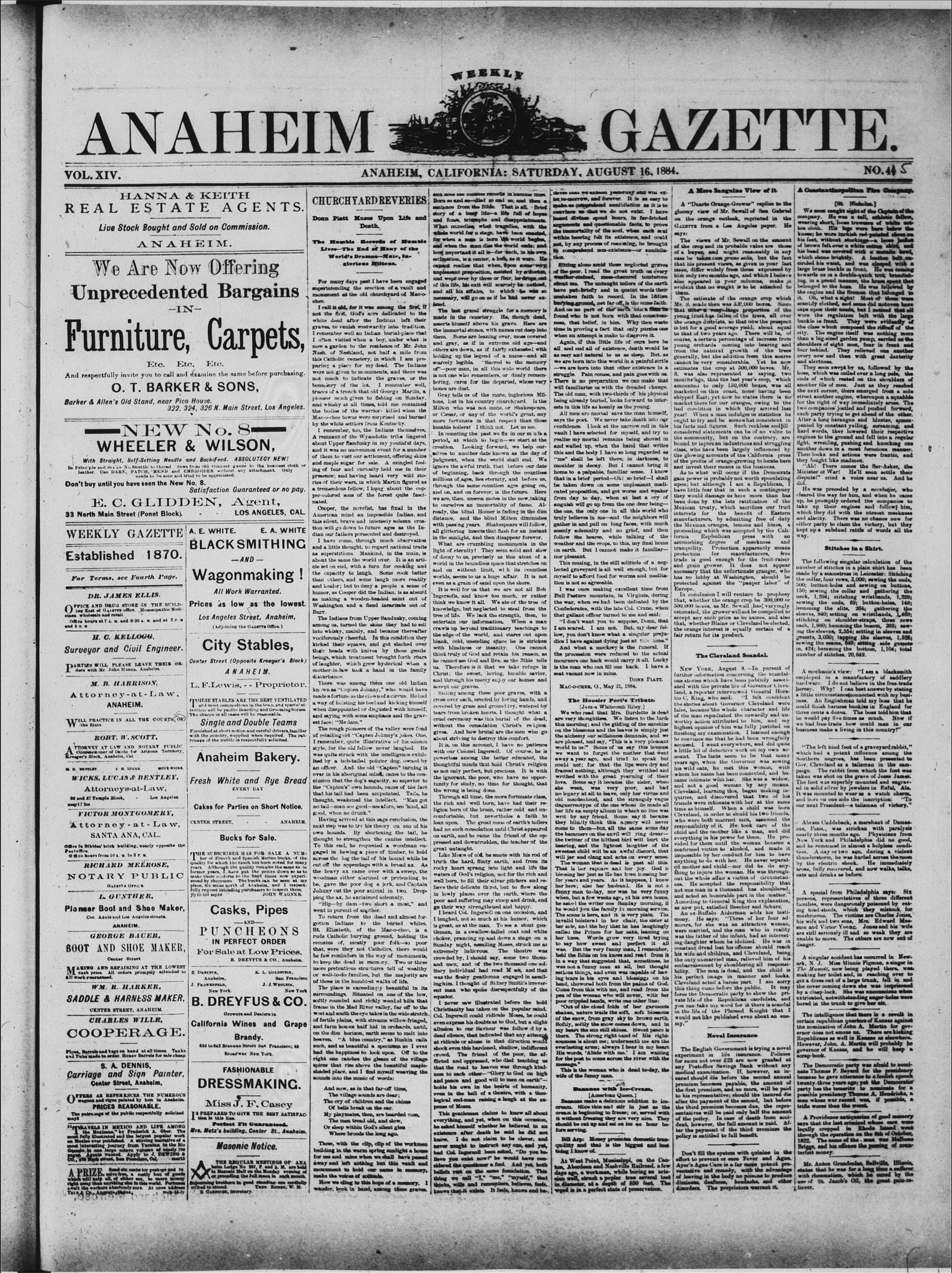
Searchable text
ANAHEIM
VOL. XIV.
HANNA & KEITH
REAL ESTATE AGENTS.
Live Stock Bought and Sold on Commission.
ANAHEIM.
We Are Now Offering
Unprecedented Bargains
INFurniture, Carpets,
Etc. Etc. Etc.
And respectfully invite you to call and examine the same before purchasing.
O. T. BARKER & SONS,
Barker & Allen's Old Stand, near Pico House.
322, 324, 326 N. Main Street, Los Angeles.
NEW No. 8
WHEELER & WILSON,
With Straight, Self-Setting Needle and Back-Feed. ABSOLUTEGY NEW!
In Principle and design No Shuttle to thread. Sews from the thinnest gauze to the heaviest cloth or leather. Can DARN, PATCH, MEND and EMBROIDER without any attachment. Only
O. T. BARKER & SONS,
Barker & Allen's Old Stand, near Pico House.
322, 324, 326 N. Main Street, Los Angeles.
NEW No. 8
WHEELER & WILSON,
With Straight, Self-Setting Needle and Back-Feed. ABSOLUTEGY NEW!
In Principle and design No Shuttle to thread. News from the thinnest gauze to the heaviest cloth or leather. Can DARN, PATCH, MEND and EMBROIDER without any attachment. Only needs to be seen and tried to be appreciated.
Don't buy until you have seen the New No. 8.
Satisfaction Guaranteed or no pay.
E. C. GLIDDEN, Agent,
33 North Main Street (Ponet Block). LOS ANGELES, CAL.
WEEKLY GAZETTE
Established 1870.
For Terms, see Fourth Page.
DR. JAMES ELLIS.
OFFICE AND DRUG STORE IN THE BUILDING East of GAZETTE office. Homeopathic medicines wholesale and retail.
Office hours at 7 A.M. and 9:30 A.M. and at 2 P.M. and 5 P.M.
H. C. KELLOGG.
Surveyor and Civil Engineer.
PARTIES WILL PLEASE LEAVE THEIR ORDERS with Mr. John Hanna, Anaheim.
M. B. HARRISON,
Attorney-at-Law,
ANAHEIM.
WILL PRACTICE IN ALL THE COURTS OF the State.
ROBT. W. SCOTT.
ATTORNEY AT LAW AND NOTARY PUBLIC Commissioner of Dues for Arizona Territory.
Roger's Block, Anaheim, Cal.
M. H. BENTLEY.
J. H. LUCAS.
MOVE WICKS.
WICKS, LUCAS & BENTLEY,
Attorneys-at-Law,
86 and 87 Temple Block, Los Angeles.
may 17 3m.
VICTOR MONTGOMERY,
Attorney-at-Law,
SANTA ANA, CAL.
Office in Dibbles' brick building, nearly opposite the Postoffice.
Office hours from 10 A.M. to 3 P.M.
RICHARD MEIROSE,
NOTARY PUBLIC
GAZETTE OFFICE.
L. GUNTHER,
A. E. WHITE.
E. A. WHITE
BLACKSMITHING
—AND —
Wagonmaking!
All Work Warranted.
Prices as low as the lowest.
Los Angeles Street, Anaheim,
(Adjoining the Gazette Office).
City Stables,
Center Street (Opposite Kroeger's Block)
ANAHEIM.
L. F. Lewis, -- Proprietor.
THESE STABLES ARE THE BEST VENTILATED and most commodious in the town and special attention will be paid to boarding and grooming horses.The charge in all cases will be reasonable.
Single and Double Teams
Furnished at short notice and careful drivers,familiar with the country, supplied when required.The patronage of the public is respectfully solicited.
Anaheim Bakery.
Fresh White and Rye Bread
EVERY DAY
Cakes for Parties on Short Notice.
CENTER STREET,
ANAHEIM.
Bucks for Sale.
THE SUBSCRIBER HAS FOR SALE A NUMBER of French and Spanish Merino bucks, of the quality for which the ranch has been noted for many years.Although the quality remains the same as in former years, I have put the prices down so as to make them conform to the hard times now experienced by sheepmen.The bucks can be seen at my place, six miles north of Anaheim, and I respectfully request intending purchasers to inspect them.Jlyl 15-till sep19
John Wagner.
I remember, to A remnant of the about Upper Sandwich it was no uncle of them to visit o and maple sugar ing of fear and presence; and harries of their wars a tremendous fellow per-colored sons nated.
Cooper, the m American mind this silent, brave tion will go down dian our fathers p I have come, and a little though as superstitions about the same cle set on end, w the capacity to than others, and and louder; but th humor, as Cooper as making a w Washington and Burr.
The Indians fro among us, turned into whisky, mai vociferously cheek kicked their squirt their heads with beings, which trot of laughter, while mother-in-law to disturbance.
There was an known as "Capice made a fortune as a way of housing when disappointment and saying with the best face;" Me丹an The rough pioneer of retailing old "I remember, quiet style, for the old was quite struck it by a bob-tail officer.And over in his aboriginal clusion that the c he "Capten's" o that his tail had thought, weaken no tail-man see good, when no d Having arrived next step was to own hounds.I thought to streem To this end, ho gaged in hewing across the log th cut off the apppehe heavy ax co woodman either be, gave the po Johnny cut the p ping the ax, he
VICTOR MONTGOMERY,
Attorney-at-Law,
SANTA ANA, CAL.
Office in Dibbles' brick building, nearly opposite the Postoffice.
Office hours from 10 a.m. to 3 p.m.
RICHARD MELOSE,
NOTARY PUBLIC
Gazetta Office.
L. GUNTHER,
Plommer Boot and Shoe Maker,
Cor. Adele and Los Angeles streets.
ANAHEIM.
GEORGE BAUER,
BOOT AND SHOE MAKER,
Center Street
MAKING AND REPAIRING AT THE LOWEST cash price. All orders promptly attended to all work guaranteed.
WM. R. HARKER,
SADDLE & HARNESS MAKER,
CENTER STREET, ANAHEIM.
CHARLES WILLE,
COOPERAGE.
Pipes, Barrels and kegs on hand at all times. Tanks and Tubs made to order. Honey Barrels for sale cheap.
S. A. DENNIS,
Carriage and Sign Painter,
Center Street, Anaheim,
OFFERS AS REFERENCES. THE NUMEROUS wagons and signs painted by him in Anaheim.
PRICES REASONABLE.
The patrons of the public respectfully solicited may?
TRAVELS IN MEXICO AND LIFE AMONG the Mexicans," by Frederick A. Ober. The most fully illustrated and the largest popular work on Mexico ever published. A stirring narrative of a most interesting journey from Yucatan to the Rio Grande in one large octavo volume of nearly 700 pages. Agent wanted. Apply to J. DEWING & CO., 428 High street, San Francisco, Cal.
A PRIZE. Send six cents for postage and re-which will help all, of either sex, to more money right away than anything else in this world. Fortunately await the workers absolutely sure. At once address Thorn & Co., Augusta plains.
Cakes for Parties on Short Notice.
CENTER STREET.
ANAHEIM.
Bucks for Sale.
THE SUBSCRIBER HAS FOR SALE A NUMBER of French and Spanish Merino bucks, of the quality for which the ranch has been noted for many years. Although the quality remains the same as in former years, I have put the prices down so as to make them conform to the hard times now experienced by sheepmen. The bucks can be seen at my place, six miles north of Anaheim, and I respectfully request intending purchasers to inspect them. Fly 15-til sep19.
JOHN WAGNER.
Casks, Pipes
AND
PUNCHEONS
IN PERFECT ORDER
For Sale at Low Prices.
B. DREYFUS & CO., Anaheim.
B. DREYFUS,
E. L. GOLDSTEIN,
Anaheim,
San Francisco.
J. FROWENFIELD,
New York.
J. J.WEOLEIX,
New York.
B. DREYFUS & CO.
Growers and Dealers in California Wines and Grape Brandy.
650 to 642 Brannan Street San Francisco; 45 Broadway New York.
FASHIONABLE
DRESSMAKING.
Miss J. F. Casey
IS PREPARED TO GIVE THE REST SATISFACTION in this line.
Perfect Fit Guaranteed.
Mrs. Metz's building, Center St., Anaheim.
Masonic Notice.
THE REGULAR MEETINGS OF ANAheim Lodge No 207, F. and A. M. are held in Masonic Hall on the Monday evening of or preceding the full moon in each month.
Sojourning brethren in good standing are cordially invited to attend.
Theo. Remana, W. M.
S. GARDINER, secretary.
Hip-by damn went in pursuit of To return from gotten Indians St. Elizabeth, rude Catholic but remains of, more that, were they be few reminders to keep the dead more pretentious or well-to-do fam of those in the hut The place is e surroundings. Softly rounded a frame in the Mac west and south th of fertile plains, and farm houses on the dim horizon heaven. "A blu such, and as bead had the happiness right one catch spires that rise shaded place, and sounds into the m And now, as The village The cry of c Of bells bro My playmate The men tr Or sleep with Where bro These, with the building in the w for me and min away and left monument to ha make the voices How we cling t wander, book in
WEEKLY
EIM GA
ANAHEIM, CALIFORNIA: SATURDAY, AUGUST 16, 1884
TS.
CHURCHYARDREVERIES
Donn Piatt Muses Upon Life and Death.
The Mumble Records of Mumble Lives—The End of Many of the World's Dramas—Mute, Inglorious Miltona.
For many days past I have been engaged superintending the erection of a vault and monument at the old churchyard of Mac-o-chee.
I call it old, for it was among the first, if not the first, God's acre dedicated to the white dead after the Indians left their graves, to vanish westwardly into tradition. I remember well an Indian burial-place that I often visited when a boy, under what is now a garden to the residence of Mr. John Nash, of Nashland, not half a mile from this Catholic cemetery, in which I am preparing a place for my dead. The Indians were not given to monuments, and there was not much to indicate the graves, or the boundary of the lot. I remember well, traces of a trench that old George Martin, a pioneer much given to fishing on Sunday, and whisky at all times, told me contained the bodies of the warrior killed when the Mac-o-chee towns were surprised and burned by the white settlers from Kentucky.
I remember, too, the Indians themselves. A remnant of the Wyandotte tribe lingered about Upper Sandusky in my youthful days, and it was no uncommon event for a number of them to visit our settlement, offering skins and maple sugar for sale. A mingled feeling of fear and curiosity held me in their ana note see numerous records in humble times. Born so and so—died so and so, and then a sentence from the Bible. That is all. Brief story of a busy life—a life full of hopes and fears, triumphs and disappointments. What comedies, what tragedies, with the whole world for a stage, have been enacted, for when a man is born 'the world begins', and when the man dies the world ends; and how important it all is—for each, in his own estimation, is a center, a hub, as it were. He cannot realize that when, upon some very unpleasant proposition, assisted by ardoctom, and wept over by three or four, he drops out of this life, his exit will scarcely be noticed, and all his affairs, to which he was so necessary, will go on as if he had never existed.
The last grand struggle for a memory is made in the cemetery. He, though dead, asserts himself above his grave. Here are the immortal stones, with names cut deep into them. Some are leaning over, moss covered and gray, as if in extreme old age—and others are down, as if fairly exhausted with holding up the legend of a name—and all scarcely legible. "Sacred to the memory of"—poor man, in all this wide world there is not one who remembers, or dimly remembering, cares for the departed, whose very bones are dust.
Gray tells us of the mute, inglorious Miltons, lost in his country churchyard. Is the Milton who was not mute, or Shakespeare, or Caesar, or any of the world's great, any more fortunate in that respect than these humble tollers? I think not. Let us see.
In counting the past we fix in our minds a period, at which to begin—we start at the creation. Looking forward, we help ourselves to another date known as the day of judgment, when the world shall end. We ignore the awful truth, that before our date of beginning, back through the countless times we extend yesterday and will exist to morrow, and forever. It is as easy to make us comprehend annihilation as it is to convince us that we do not exist. I have heard divines spend hours, in far-fetched arguments and questionable facts, to prove the immortality of the soul, when each soul within hearing felt its existence, and could not, by any process of reasoning, be brought to comprehend non-existence—or annihilation.
Sitting alone amid these neglected graves of the poor. I read the great truth on every weather-stained, most obscured tombstone about me. The untaught toilers of the earth have put briefly and in quaint words their unshaken faith to record. In the Italian burying ground, not far off, is the same faith. And on no part of the earth can a film be found who is not born with that consciousness, that belief, in him. Why then waste time in proving a fact that only puzzles one when an attempt is make to disprove it.
Again, if this little life of ours here be all and end all of existence, death would be as easy and natural to us as sleep. But, as we are born into this world in a painful strife—we are born into that other existence in a struggle. Pain comes, and pain goes with us. There is no preparation we can make that will familiarize us with the dreaded change. The old man, with two-thirds of his physical being already buried, looks forward to interests in this life as keenly as the young.
All men are mortal save the man himself, says the poet. We never take death into our confidence. I look at the narrow cell in this vault I have selected for myself, and try to realize my mortal remains being shoved in and walled up, when the hand that writes this and the body I have so long regarded as "me" shall be left there, in darkness, to moulder in decay. But I cannot bring it home to a palpable, familiar sense. I know
The woman that is dead is past all this. That is her rapture and her joy. God is blessing her just as He has been blessing her for years and years. As it happens, I know her here; also her husband. He is not a funny man to-day, nor was he very funny when, but a few weeks ago, at his own home.
In counting the past we fix in our minis a period, at which to begin—we start at the creation. Looking forward, we help ourselves to another date known as the day of judgment, when the world shall end. We ignore the awful truth, that before our date of beginning, back through the countless millions of ages, lies eternity, and before us, through the same countless ages going on, and on, and on forever, is the future. Here we are, then, unseen motes in the now,taking to ourselves an immortality of fame. Already, the blind Homer is fading in the dim distance, and the blind Milton diminishes with passing years. Shakespeare will follow, all glittering insects that flash for an instant in the sunlight, and then disappear forever.
What are crumbling monuments in the light of eternity! They seem solid and slow of decay to us, precisely as a atom of a world in the boundless space that stretches on and on without limit, with its countless worlds, seems to us a huge affair. It is not even as a grain of sand upon the shore.
It is well for us that we are not all Bob Ingersolls, and know too much, or rather think we know it all. We ate of the tree of knowledge, but neglected to steal from the tree of life. We lack the strength, thon, to entertain our information. When a man crawls up beyond traditionary teachings to the edge of the world, and stares out upon blank, cold, unending space he is stricken with blindness or insanity. One cannot think truly of God and retain his reason, as he cannot see God and live, as the Bible tells us. Therefore it is that we take refuge in Christ; the sweet, loving, humble savior, and through his mercy enjoy our homes and accept our graves.
Sitting among these poor graves, with a cross over each, erected by loving hands, and covered by grass and ground ivy, watered by tears from broken hearts. I thought what a cruel ceremony was this burial of the dead, without the consolation Christ's religion gives. And how brutal are the men who go about striving to destroy this comfort.
It is on this account, I have no patience with our Colonel Ingersoll. Of course, he is powerless among the better educated, the thoughtful minds that hold Christ's religion as not only perfect, but precious. It is with the ignorant, the poor, who have no opportunity for study, no time for thought, that the wrong is being done.
Through all time, the more fortunate class, the rich and well born, have had their religion born of the brain, rather cold and uncomfortable, but nevertheless a faith to lean upon. The great mass of earth's tollers had no such consolation until Christ appeared on earth, and he came the friend of the oppressed and downdrodden, the teacher of the great untaught.
Like Moses of old, he smote with his rod of truth the hard, flinty earth, and from its rocky heart sprang into light and life the waters of God's religion, not for the rich and well born, to fill their silver pitchers and relieve their delicate thirst, but to flow along in lowly places over the earth, where the offering is not one who remembers, or dimly remembering, cares for the departed, whose very bones are dust.
Gray tells us of the mute, inglorious Miltons lost in his country churchyard. Is the Milton who was not mute, or Shakespeare, or Caesar, or any of the world's great, any more fortunate in that respect than these humble tollers! I think not. Let us see.
In counting the past we fix in our minis a period, at which to begin—we start at the creation. Looking forward, we help ourselves to another date known as the day of judgment, when the world shall end. We ignore the awful truth, that before our date of beginning, back through the countless millions of ages, lies eternity, and before us, through the same countless ages going on,and on,and on forever,the future.Here we are then.unseen motes in the now,taking to ourselves an immortality of fame.Already,the blind Homer is fading in the dim distance,and the blind Milton diminishes with passing years.Shakespeare will follow.all glittering insects that flash for an instant in the sunlight,and then disappear forever.
What are crumbling monuments in the light of eternity! They seem solid and slow of decay to us, precisely as a atom of a world in the boundless space that stretches on and on without limit,with its countless worlds,sems to us a huge affair. It is not even as a grain of sand upon the shore.
It is well for us that we are not all Bob Ingersolls,and know too much,rather think we know it all.We ate of the tree of knowledge,但 neglected to steal from the tree of life.We lack the strength,thon,to entertain our information。When a man crawls up beyond traditionary teachings to the edge of the world,and stares out upon blank,cold,unending space he is stricken with blindness or insanity.One cannot think truly of God and retain his reason.as he cannot see God and live,as the Bible tells us.Therefore it is that we take refuge in Christ;the sweet,loving,humble savior,and through his mercy enjoy our homes and accept our graves.
Sitting among these poor graves,with a cross over each,erected by loving hands,and covered by grass and ground ivy,水tered by tears from broken hearts.I thought what a cruel ceremony was this burial of the deadwithout the consolation Christ's religion gives.And how brutal are the men who go about striving to destroy this comfort.
It is on this account,I have no patience with our Colonel Ingersoll.Of course,he is powerless among the better educated,the thoughtful minds that hold Christ's religionas not only perfect,但 precious。它是with the ignorant,the poor,who have no opportunity for study,no time for thought,thatthe wrong is being done.
Through all time,the more fortunate class,the rich and well born,Have had their religionborn ofthe brain,rather coldand uncomfortable,but neverthelessa faithto lean upon.The great massof earth's tollershad no such consolation untilChristappearedonearth,andhe camethefriendoftheopressedanddowndroddent,theteacherofthegreatuntaught.
Like Moses of old.他 smote with his rod of truththe hard,flinty earth,andfromitsrockyheartsprungintolightandlifethewatersofGod'sreligion,notfortherichandwellborn,tilltheirsilverpitchersandreleivethedelicatethirst,intoflowalinlowylocationsovertheearth,thewhereofferingisnotonewhoremembers,或dimlyremembering,caresforthedepartedwhoseverybonesaredust.Paincomes,andpaingoeswithusThereisnopreparationwecanmakethatwill familiarizeuswiththedreadedchange.Theoldman.withtwo-thirdsofhisphysicalbeingalreadyburied.looksforwardtointerestsinthislifeaskeenlyastheyoung.Allmenaremortalsavethehimself,saysthepoet.Weweretakedeathintoourconfidence.IlookatthenarrowcellinhthisvaultIhaveselectedformyself,andtrytorealizemy mortalremainsbe shovedinandwalledup,whenthehandthatwritesthisandthebodyIhavesolongregardedas"me"shallbeleftthere,intdarkness,tomoulderindecay.BUTIcannotbringithometoa palpable,familiarsense.Iknowthatinabriefperiod-Oh!sobrief-Ishallbe takendownonsomeunpleasantmedicatedproposition,andgetworseandweakerfromdaytoday,whenatlasta cryofanguishwillgoupfromtheonedearbeing—theone,theonlyoneinallthisworldwhotrulybelievesinme—andtheneighborswillgatherinandpullonlongfaces,withmuchseemlysolemnityandnogrief,andthenfollowthehearse,whiletalkingoftheweatherandthecrops,tothis,myfinalhomeonearth.BUTIcannotmakeitfamiliar-norpleasant.
Thismusing,在thestsolitudeofaneglectedgraveyardisallwellenoughbutformyselftoaffordfoodforwormsandmeditationisnotsopeenable.
IwasoncemakingexcellenttimefromBullPasturemountain.inVirginia,duringthewar,whenwehadbeendefectedbytheConfederates,withthelateCol.Crane,whenthatgalantofficerturnedtomeandsaid:
"IdonnPiatt.MAC-o-cheek.O.,May21,1884."
TheHooslerPoetsTribute.[JamesWhitcombRiley.]WewhoreadthatMrs.Burdetteisdeadareverythoughtless.Welistentobirdthismorning;andthegildingofsunshineontheblossomsandtheleavesissimplyjustthealchenyouselflishnessdemands,andwearepleased,andsay,"Thisisaverypleasantworldtous!"Someofus saythisbecausewewanttor forgetthemotherthatwentawayayearago,andtriedtolookbutcouldnot;forthatthelipsweredryandframednothingalthoughtheywrithedandwrittedwiththegreatyearningof theirlove.Some sayitbecausethesister,当shewent,verypoor,andhadnolegacyatalltoleave-onlyhervirtueandoldmaidenhood,andthestrangelyvaguedaguerreotypeoftheonewhoseliemadeallherlifeanemptyalbuminwhichnolinewiswtobyanyfriend.Some sayitbecausetheyblinklythinkthisagencywillnevercometometh—but.allthesame somedaythehammersonanowlwillringdream—thetwitterofthelibtestbirdwill hurtthehearing,andthelightestlaughterofthesweetestchildwillbeanawfuldiscord,
thatwilljarandclangandacheoneverysense.
ThewomanthatisdeadispastallthisThatisherraptureandherjoy.GodisblessingherjustasHehasbeenblessingharferforyearsandyears.Asithappens.Iknowherhere;alsoherhusband.Heisnotafunnymantoclay,norwasheveryfunwhen.bbutaweeksage,aathisownhome.
thought, weakened the intellect. "Man got no tail—man see good—see hind, all good, when no drunk."
Having arrived at this sage conclusion, the next step was to try his theory on one of his own bounds. By shortening the tail, he thought to strengthen the canine intellect.
To this end, he requested a woodman engaged in hewing a piece of timber, to hold across the log the tail of his bound while he cut off the appendage with a broad ax. As the heavy ax came over with a sweep, the woodman either alarmed or pretending to be, gave the poor dog a jerk, and Captain Johnny cut the poor animal in two. Dropping the ax, he exclaimed solemnly.
"Hip-by dam-two short a most," and went in pursuit of another.
To return from the dead and almost forgotten Indians to the buried whites. St. Elizabeth, of the Mac-o-chee, is a rude Catholic burying ground, holding the remains of, mostly poor folk—so poor that, were they not Catholics, there would be few reminders in the way of monuments, to keep the dead in memory. Two or three more pretentious structures tell of wealthy or well-to-do families, but the majority are of those in the humblest walks of life.
The place is exceedingly beautiful in its surroundings. Situated on one of the low, softly rounded and richly woolled hills that frame in the Mad River valley, far off to the west and south the eye takes in the wide stretch of fertile plains, with streams willow-fringed, and farm houses half hid in orchards, until, on the dim horizon, earth seems to melt into heaven. "A blue country," as Ruskin calls such, and as beautiful a specimen as I ever had the happiness to look upon. Off to the right one catches the gleam of the village spires that rise above the beautiful mapla-shaded place, and I find myself weaving the sounds into the music of words:
And now, as in that far-off time,
The village sounds are dear;
The cry of children and the chime
Of bells break on the ear.
My playmates, then, are bearded men,
The men tread old, and slow,
Or sleep within God's silent glen
Where broods the long ago.
These, with the clip, clip of the workmen building in the warm spring sunlight a house for me and mine when we shall have passed away and left nothing but this vault and monument to hold our name in memory, make the voices of solitude.
How we cling to this hope of a memory. I wander, book in hand, among these graves.
Through it all, we have learned that the rich and well born, have had their religion born of the brain, rather cold and uncomfortable, but nevertheless a faith to lean upon. The great mass of earth's toilers had no such consolation until Christ appeared on earth, and he came the friend of the oppressed and downtrodden, the teacher of the great untaught.
Like Moses of old, he smote with his rod of truth the hard, flinty earth, and from its rocky heart sprang into light and life the waters of God's religion, not for the rich and well born, to fill their silver pitcherers and relieve their delicate thirst, but to flow along in lowly places over the earth, where the poor and suffering may stoop and drink, and go their way strengthened and happy.
I heard Col. Ingersoll on one occasion, and I laughed, not so much at his humor, which is great, as at the man. To see a stout gentleman, in a swallow-tailed coat and white choker, prancing up and down a stage on a Sunday night, assailing Moses, struck me as extremely ludicrous. The theatre was crowded by, I should say, some two thousand men; and of the two thousand one saliary individual had read Moses, and that was the fleshy gentleman engaged in assailing him. I thought of Sidney Smith's irreverent man who spoke disrespectfully of the equator.
I never saw illustrated before the hold Christianity has taken on the popular mind. Col. Ingersoll could ridicule Moses, he could even express his doubts to God, but a slight allusion to our Saviour was followed by a dead silence, that indicated that any attempt at ridicule or abuse in that direction would shock even this hardened, shallow, indifferent crowd. The friend of the poor, the afflicted and oppressed, who died teaching us that the road to heaven was through kindness to each other—"Glory to God on high and peace and good will to men on earth"—holds his own in the hearts of humanity, even in the hell of a theatre, with a theoretical end-man raising a laugh at the expense of Moses.
This gentleman claims to know all about everything, and yet, when on this occasion, he asked himself whether he believed in an existence after death he said he did not know. I do not claim to be clever, and never sought to instruct anyone, and yet, had Col. Ingersoll been asked, "Do you believe you exist now?" he would have considered the questioner a fool. And yet, both beliefs rest on the same foundation. This thing we call "I," "me," "myself," that thinks, wills and remembers believes feels knows that it exists. It feels knows and be-
old maidenhood, and the strangely vague daguerreotype of the one whose life lie made all her life an empty album in which no line was writ by any friend. Some say it because they blindly think this agency will never come to them—but, all the same some day the hammers on the anvil will ring drear—the twitter of the blithest bird will hurt the hearing, and the lightest laughter of the sweetest child will be an awful discord, that will jar and clang and ache on every sense.
The woman that is dead is past all this. That is her rapture and her joy. God is blessing her just as He has been blessing her for years and years. As it happens, I knew her here; also her husband. He is not a funny man to lay; nor was he very funny when, but a few weeks age; at his own home, he asks the writer one Sunday morning; if he would join the family in morning service. The scene is here, and it is very plain. The invalid bolstered in her chair, the sister at her side, and the boy that he has laughingly called the Prince for her sake, leaning on her knee. Words grow very tired trying to say how sweet and perfect it all was. But the very funny man, I remember, held the Bible on his knees and read from it in a way that suggested that, sometimes he was not a funny man at all, but thought serious things, and even was capable of having tears in his eyes and blessings on his head, showered both from the palms of God. Come from this with me, and read from the pen of the woman who will never, with her poor crippled hands, write one other line:
"Out of the cloud folds of her garments shaken, nature trails the soft, soft blossoms of the snow, from gray sky to brown earth. Softly, softly the snow comes down, and in my heart the sun still shines. Sweet peace is there. The strong right hand of His righteousness is about me; underneath me are the everlasting arms; always I hear in my heart His words 'Abide with me.' I am waiting for the post to come across the river with the message."
This is the woman who is dead to-day, the wife of the funny man.
Bananas with Ice-Cream.
[American Queen.]
Bananas make a delicious addition to ice cream. Slice thin and stir in just as the cream is beginning to froze; or served with it without freezing they are very nice. They should be cut up and set on ice an hour before serving.
Bill Arp: Money promotes domestic tranquility and that is the biggest and best thing I know of.
At West Point, Mississippi, on the Cannon, Aberdeen and Nashville Railroad,a few days ago,a workman,and while boring an artesian well,struck a poplar tree several feet in diameter.at a depth of 550 feet.The wedge is in a perfect state of preservation.
GAZETTE.
AUGUST 16, 1884.
A More Sanguine View of it
A "Duarte Orange-Grower" replies to the gloomy view of Mr. Sewall of San Gabriel on the orange outlook, reprinted in the Gazette from a Los Angeles paper. He says:
The views of Mr. Sewall on the amount of the crop and its probable value are those of a buyer, and might reasonably in any case be taken cum grano solis, but the fact that his present views, as given in your last issue, differ widely from those expressed by him only two months ago, and which I believe also appeared in your column, make it evident that no weight is to be attached to them.
The estimate of the orange crop which Mr. S. made then was 300,000 boxes. Since that time a very large proportion of the young fruit has fallen of the trees, all over the orange districts, so that now the prospect is but for a good average yield, about equal to that of two years ago. There will be, of course, a certain percentage of increase from young orchards coming into bearing and from the natural growth of the trees generally, but the addition from this source cannot be very considerable. Yet he now estimates the crop at 500,000 boxes. Mr. S. was also represented as saying, two months ago, that the last year's crop, which amounted to only 150,000 boxes, was all marketed on this coast, none having been shipped East; yet now he states there is no market there for our oranges, owing to the bad condition in which they arrived last year! When a man indulges in statistics he ought to try and be somewhat consistent in his facts and figures. Such reckless and ill-considered statements can be of no value to the community, but on the contrary, are bound to injure industrious and struggling class, who have been largely influenced by the glowing accounts of the California press of the profits of orange-growing to locate here and invest their means in the business.
As to what will occur if the Democrata
A Constantinepolitan Fire Company.
[St. Nicholas.]
We soon caught sight of the Captain of the company. He was a tall, athletic fellow, wearing short loose trousers of white cotton cloth. His legs were bare below the knees; he wore tarkish red-pointed shoes on his feet, without stockings—a loose jacket of brown felt over a white cotton shirt, and his head was covered with a metallic bowl, which shone brightly. A leather belt encircled his waist, and was clasped with a large brass buckle in front. He was coming towards us in a double-quick trot, broadishing, in a proud manner, the brass spout that belonged to the hose. He was followed by the engine and the firemen that belonged to it. Oh, what a sight! Most of them were scantily clothed, and some did not even have capa upon their heads, but I noticed that all wore the regulation belt with the large buckle in front. They were evidently of the class which composed the riflefruit of the city. The engine itself was nothing more than a big-sized garden pump, carried on the shoulders of eight men, four in front and four behind. They relieved one another every now and then with great dexterity and alertness.
They soon swept by us, followed by the hose, which was coiled over a long pole, the ends of which rested on the shoulders of another file of men. Just as they reached the next corner, there emerged from a side street another engine, whereupon a squabble for the right of way immediately arose. The two companies jostled and pushed forward, each party trying to get ahead of the other. After a long harangue and bluster, accompanied by constant yelling, screaming, and hard words, they lowered their respective engines to the ground and fell into a regular fight, wrestling, pushing and knocking one another down in a most ferocious manner. Their looks and actions were frantic, and they fought like madmen.
"Ah! There comes the Ser-Asker, the Minister of War! He'll soon settle their
In the still solitude of a negro is all well enough, but for food for worms and medita-blee.
Making excellent time from mountain, in Virginia, during he had been defeated by the with the late Col. Crane, when her turned to me and said: you to suppose, Donn, that I am not. But, my dear fellow what a singular preju-ust dying just at this time." Mockery is the funeral. If were reduced to the actual trick would carry it all. Lucky one fill one hack. I have a mine.
DONN PIATT.
D., May 21, 1884.
Oliver Poet's Tribute.
Whitcomb Riley.]
Burdette is dead unless. We listen to the bird and the gilding of the sunshine and the leaves is simply just selfishness demands, and we say, "This is a very pleasant some of us say this because forget the mother that went out and triel to speak but that the lips were dry and although they writhed and the great yearning of their it because the sister, when was very poor, and had to leave, only her virtue and, and the strangely vague of the one whose lie made all my album in which no line was friend. Some say it because think this agency will never but, all the same some day the anvil will ring drear—the blithest bird will hurt the lightest laughter of the will be an awful discord, that sing and ache on every sense that is dead is past all this picture and her joy. God is as He has been blessing her ears. As it happens, I knew other husband. He is not a way, nor was he very funny weeks age, at his own home,
The Cleveland Soandal.
New York, August 8.—In pursuit of further information concerning the scandalous stories which have been publicly associated with the private life of Governor Cleveland, a reporter interviewed General Horatio C. King, who said: "I felt confident the stories about Governor Cleveland were false, because the whole character and life of the man repudiated the cowardly and unworthy action attributed to him, and my highest opinion of him was fully justified on finishing my examination. I learned enough to convince me that he had been wrongfully accused. I went everywhere, and did quite a little bit of detective work on my own account. The facts seem to be that many years ago, when the Governor was sowing his wild oats, he met this woman, with whom his name has been connected, and became intimate with her. She was a widow, and not a good woman by any means. Cleveland, learning this, began making inquiries, and discovered that two of his friends were intimate with her at the same time as himself. When a child was born Cleveland, in order to shield his two friends, who were both married men, assumed the responsibility of it. He took care of the child and the mother like a man, and did everything in his power for them. He provided for them until the woman became a confirmed victim to alcohol, and made it impossible by her conduct for him to have anything to do with her. He never separated mother and child—nor did he do anything to injure the woman. He was throughout the whole affair a victim of circumstances. He accepted the responsibility that not one man in a thousand has shouldered, and acted an honorable part in the matter."
A special from Philadelphia says: Six persons, representatives of three different
and the strangely vague of the one whose life made all my album in which no line was friend. Some say it because this agency will never but, all the same some day the anvil will ring drear—the blithest bird will hurt the lightest laughter of the will be an awful discord, that sing and ache on every sense that is dead is past all this picture and her joy. God is as He has been blessing her ears. As it happens, I knew another husband. He is not a boy, nor was he very funny two weeks ago, at his own home, after one Sunday morning, if the family in morning service, and it is very plain. The man in her chair, the sister in boy that he has laughingly once for her sake, leaning on both from the palms of God. With me, and read from the man who will never, with her hands, write one other line: good folds of her garments raills the soft, soft blossoms from gray sky to brown earth. Snow comes down, and in still shines. Sweet peace is right hand of His right-me; underneath me are the always I hear in my heartide with me.' I am waiting some across the river with the man who is dead to-day, the man.
with Ice-Cream.
American Queen.]
a delicious addition to ice-kin and stir in just as the king to freese; or, served with king they are very nice. They and set on ice an hour before Mississippi, on the Can-land Nashville Railroad, a few man, while boring an artemite a poplar tree several feet depth of 550 feet. The perfect state of preservation.
The English Government is trying a novel experiment in life insurance. Policies for sums not over £25 are now granted at any Postoffice Savings Bank without any medical examination. If, however, an insured should die before the second annual premium becomes payable, the amount of the first premium, and no more, will be paid to his representative; should the insured die after the payment of the second, but before the third premium becomes due, the representatives will be paid only half the amount of the policy. In case of death from accident, however, the full amount is paid. After the payment of the third premium the policy is entitled to full benefit.
Don't fill the system with quinine in the effort to prevent or cure Fever and Ague. Ayer's Ague Cure is a far more potent preventive and remedy, with the advantage of leaving in the body no poisons to produce dizziness, deafness, headache, and other disorders. The proprietors warrant it.
Abram Cuddeback, a merehant of Damascus, Penn., was stricken with paralysis nearly three months ago. Physicians from New York and Philadelphia did no good, and he remained in almost a helpless condition. A day or two ago, during a violent thunderstorm, he was hurled across the room by the electric shock. He immediately arose, fully recovered, and now walks, talks, eats and drinks as before.
A special from Philadelphia says: Six persons, representatives of three different families, were dangerously poisoned by eating toad-stools, which they mistook for mushrooms. The victims are Charles Jones, his wife and two sons, Mrs. Edward Mussain and Victor Young. Jones and his wife are still seriously ill and so weak they are unable to move. The others are now out of danger.
A singular accident has occurred in Newark, N.J. Miss Minnie Pigman, a singer in The Mascott, now being played there, was making her toilet and, in reaching over to get a dress out of a large trunk, fell in and the cover coming down she was imprisoned by a clasp-lock. She was unconscious when extricated, notwithstanding anger-holes were bored in the trunk to give her sigh.
The intelligence that there is a revolt in certain republican quarters of Kansas against the nomination of John A. Martin for governor does not amaze us. There are kissing Republicans as well in Kansas as elsewhere. However, John A. Martin will probably be governor of Kansas, and he will keep a scrap-book.
The Democratic party was afraid to nominate Thomas F. Bayard for the presidency because he gave utterance to a foolish speech twenty-three years ago; yet the Democratic party has the temority to nominate for a possible presidency Thomas A. Hendricks, a man whose war record was, if possible, a trifle worse than the worst.
A Providence antiquarian of good memory says that the last criminal whose ear was legally cropped in Rhode Island went through the operation on the 8th of October, 1822. The name of the man was Malbone Briggs, and his offence the passing of counterfeit money.
Mr. Anton Grandcolas Bellville, Illinois states that he was for a long time a sufferer with rheumatism, which he cured by the use of St. Jacob's Oil, the great pain-reliever.