anaheim-gazette 1884-07-05
Scanned page
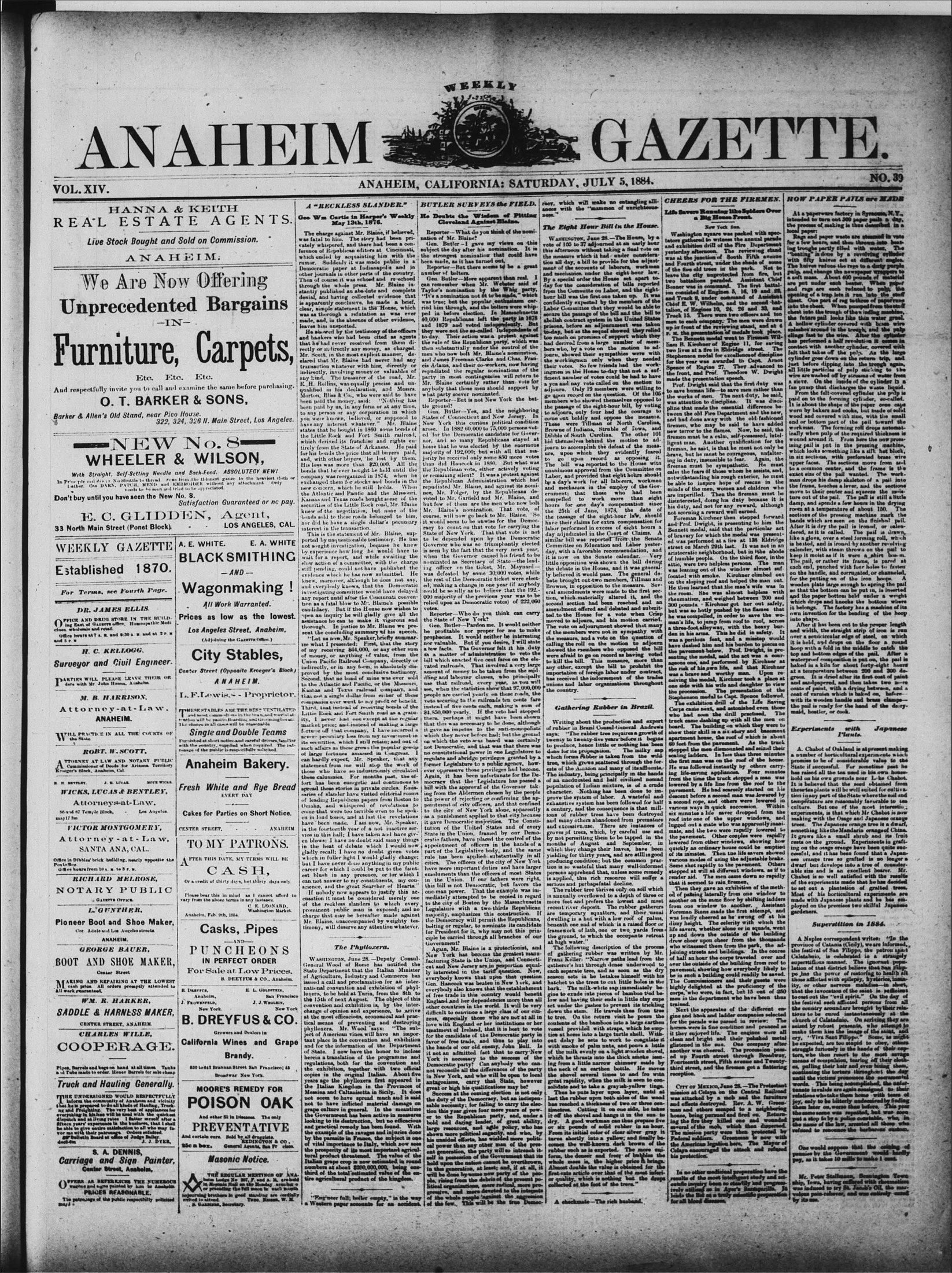
Searchable text
ANAHEIM
VOL. XIV.
HANNA & KEITH
REAL ESTATE AGENTS.
Live Stock Bought and Sold on Commission.
ANAHEIM:
We Are Now Offering
Unprecedented Bargains
INFurniture, Carpets,
Etc. Etc. Etc.
And respectfully invite you to call and examine the same before purchasing.
O. T. BARKER & SONS,
Barker & Allen's Old Stand, near Pico House.
322, 324, 326 N. Main Street, Los Angeles.
NEW No. 8
WHEELER & WILSON,
With Straight Self-Setting Needle and Back-Feed. ABSOLUTEGY NEW!
Etc. Etc. Etc.
And respectfully invite you to call and examine the same before purchasing.
O. T. BARKER & SONS,
Barker & Allen's Old Stand, near Pico House.
322, 324, 326 N. Main Street, Los Angeles.
NEW No. 8
WHEELER & WILSON,
With Straight, Self-Setting Needle and Back-Feed. ABSOLUTEGY NEW!
In Principle and does No Shuttle to thread. News from the thinnest gauge to the heaviest cloth or leather. Can DARN, PATCH, MEND and EMBROIDER without any attachment. Only needs to be seen and tried to be appreciated.
Don't buy until you have seen the New No. 8.
Satisfaction Guaranteed or no pay.
E. C. GLIDDEN, Agent,
33 North Main Street (Ponet Block).
LOS ANGELES, CAL.
WEEKLY GAZETTE
Established 1870.
For Terms, see Fourth Page.
DR. JAMES ELLIS.
OFFICE AND DRUG STORE IN THE BUILDING East of Gazette office. Homeopathic Medicine wholesale and retail.
Office hours at 7 a.m. and 9:30 a.m. and at 2 p.m. and 5 p.m.
H. C. KELLOGG.
Surveyor and Civil Engineer.
PARTIES WILL PLEASE LEAVE THEIR ORDERS with Mr. John Hamma, Anaheim.
M. B. HARRISON.
Attorney-at-Law, ANAHEIM.
WILL PRACTICE IN ALL THE COURTS OF the State.
ROBT. W. SCOTT.
ATTORNEY AT LAW AND NOTARY PUBLIC Commissioner of Deeds for Arizona Territory Kroger's Block, Anaheim, Cal.
R. H. BENTLEY.
J. H. LECAR.
NOTRE WICKS.
WICKS, LUCAS & BENTLEY,
Attorneys-at-Law,
86 and 87 Temple Block, Los Angeles may 173m.
VICTOR MONTGOMERY,
Attorney-at-Law, SANTA ANA, CAL.
Office in Dibbles' brick building, nearly opposite the Post Office.
Office hours from 10 a.m. to 3 p.m.
RICHARD MELROSE,
NOTARY PUBLIC
A. E. WHITE.
E. A. WHITE
BLACKSMITHING
— AND —
Wagonmaking!
All Work Warranted.
Prices as low as the lowest.
Los Angeles Street, Anaheim,
(Adjoining the GAZETTE Office)
City Stables,
Center Street (Opposite Kreeger's Block)
ANAHEIM.
L.F.Lewis - Proprietor.
THESE STABLES ARE THE BEST VENTILATED and most comfortable in the town and worst attuned will be paid boarding and rooming here.The charge in all cases will be reasonable.
Single and Double Teams
Furnished at short notice and careful drivers familiar with the country, supplied when required.The tuition of the public is respectfully solicited.
Anaheim Bakery.
Fresh White and Rye Bread
EVERY DAY
Cakes for Parties on Short Notice.
CENTER STREET.
ANAHEIM.
TO MY PATRONS.
AFTER THIS DATE, MY TERMS WILL BE CASH,
Or a credit of thirty days only.
Please bear this in mind as I cannot afford to any kind of interest w states that he bought the Little Rock and which derived its fratry from the State for his bonds the price and, with other buyers His loss was more than bonds that he ever borne company was reorganized exchange them for a new concern, which the Atlantic and Pacific securities of the Little knew of the negotiation bonds sold to these rans did he have a similar interest in the transaction.
This is the statement ported by unquestioned not sought investigation by experience how long wait for a report, a slow action of a committee still pending could evidence which he had knew, moreover, although everybody known investigating commit any report until after tion as a fatal blow to candidacy. But if it open an inquiry he will assistance he can to thorough. In justice sent the concluding g "Let us now,Mr.Size what I presented of my receiving $60 of money, or anything Union Pacific Railroad indirectly, or in any proved by the most Second, that no bond to the Atlantic and Kansas and Texas that not a single dollar companies ever went Third, that instead of Little Rock and Fort city, I never had no market price; and in fortune off that comp severe pecuniary loss its securities, which such affairs as these of large fortunes can hardly expect.M statement from me those who have so these calumnies.Fort has been energet spread these stories series of slanders having of leading Republican Omaha, and whisper come that were too en in loud tones,and have been made.In the fourteenth year vice in this hall;I have en blows;I have no in the heat of debate gladly recall;I have which in fuller light but I have never done career for which I cast blush in any can not answer to my science, and the great If nobody now apen creation it must be
Attorneys-at-Law,
86 and 87 Temple Block,
Los Angeles,
may 17th.
VICTOR MONTGOMERY,
Attorney-at-Law,
SANTA ANA, CAL.
Office in Dibbles' brick building, nearly opposite the Postoffice.
Office hours from 10 a.m. to 3 p.m.
RICHARD MELROSE,
NOTARY PUBLIC
GARNETTE OFFICE.
L. GUNTHER,
Pioneer Boot and Shoe Maker,
Cor. Adele and Los Angeles streets.
ANAHEIM.
GEORGE BAUER,
BOOT AND SHOE MAKER,
Center Street
MAKING AND REPAIRING AT THE LOWEST cash price. All orders promptly attended to. All work guaranteed.
WM. R. HARKER,
SADDLE & HARNESS MAKER,
CENTER STREET, ANAHEIM.
CHARLES WILLE,
COOPERAGE.
Pipes, Barrels and kegs on hand at all times. Tanks and Tubs made to order. Honey Barrels for sale cheap.
Truck and Hauling Generally.
THE UNDERSIGNED WOULD RESPECTFULLY inform the community of Anaheim and vicinity that he is prepared to do all kinds of Hauling, Trucking and Freighting. The very best of appliances for everything in his line will be used with the quickest dispatch and at living rates. Iatter myself after a fifteen years' experience in the business, that I shall be able to give entire satisfaction to all who may favor me with their patronage. Orders solicited.
B. BULLETIN Board at office of Judge Bailey.
J. J. DYER,
S. A. DENNIS,
Carriage and Sign Painter,
Center Street, Anaheim.
OFFERS AS REFERENCES THE NUMEROUS prices REASONABLE.
The patronsage of the public respectfully solicited may J...
Cakes for Parties on Short Notice.
CENTER STREET, ANAHEIM.
TO MY PATRONS.
AFTER THIS DATE, MY TERMS WILL BE CASH,
Or a credit of thirty days, but thirty days only.
Please bear this in mind as I cannot afford to vary from the above terms in any instance.
C. E. LEONARD,
Washington Market.
Anaheim, Feb. 9th, 1884.
Casks, Pipes
AND
PUNCHEONS
IN PERFECT ORDER
For Sale at Low Prices.
B. DREYFUS & CO., Anaheim.
B. DREYFUS,
Anaheim,
San Francisco
J. FROWENFIELD,
New York.
New York
B. DREYFUS & CO.
Growers and Dealers in California Wines and Grape Brandy.
630 to 642 Brannan Street San Francisco; 45 Broadway New York.
MOORE'S REMEDY FOR POISON OAK
And other St in Diseases. The only PREVENTATIVE
And certain cure. Sold by all druggists.
REDINGTON & CO., General Agents, San Frisco.
Masonic Notice.
THE REGULAR MEETINGS OF ANAHEIM Lodge No. 207, F. and A. M. are held in Massale Hall on the Monday evening or preceding the full moon in each month sojourning brother in good standing are cordially invited to attend.
Tuno, Renshaw, W. M.
B. GARDNER, Secretary.
WASHINGTON, June General Wood of State Department thirteenth of Agriculture, India issued a call and proclaimed national convention loxera, to be held at the 15th of next Autumn convention and exhibit change of opinion and at the most efficacious means of prephylloxera. Mr. Wject of American virtue place in the court and for the information of State. I now have herein a translation regulations, both for the exhibition, together copies in the original years ago the phylloxera the Italian Kingdoms Messina and Caltana not seem to have inflict grape culture in general the Government having looked to its destrucand practical remedy the example of the one by the parasite in Kof vital importance the prosperity of its natural product threaten Italian grape crop in numbers at about third of the total tire agricultural pro-
"Eng'neer full; but a Western paper ac
WEEKLY
EIM GA
ANAHEIM, CALIFORNIA: SATURDAY, JULY 5, 1884.
A "RECKLESS SLANDER."
Geo Wm Curtis in Harper's Weekly May 13th, 1876.
The charge against Mr. Blaine, if believed, was fatal to him. The story had been privately whispered, and there had been a conference of Republican editors at Cincinnati, which ended by acquainting him with the rumor. Suddenly it was made public in a Democratic paper at Indianapolis and in other journals in other parts of the country. Then of course it was echoed and re-echoed through the whole press. Mr. Blaine instantly published an absolute and complete denial, and having collected evidence that is apparently conclusive, he made a brief, clear, simple statement in the House, which was as thorough a refutation as was ever made, and, in the absence of other evidence, leaves him unspotted.
He showed by the testimony of the officers and bankers who had been cited as agents that he had never received from them directly or indirectly any money, as charged. Mr. Scott, in the most explicit manner, declared that Mr. Blaine had never had any transaction whatever with him, directly or indirectly, involving money or valuables of any kind. The treasurer of the road, Mr. E.H. Rollins, was equally precise and unqualified in his declaration, and Messrs. Morton, Bliss & Co., who were said to have been paid the money, said: "Nothing has been paid by us, in any form or at any time, to any person or any corporation in which you were known, believed, or supposed to have any interest whatever." Mr. Blaine states that he bought in 1860 some bonds of the Little Rock and Fort Smith railroad, which derived its franchise and rights entirely from the State of Arkansas. He paid for his bonds the price that all buyers paid, and, with other buyers, he lost by them. His loss was more than $20,000. All the bonds that he ever bought he held until the
BUTLER SURVEYS THE FIELD.
He Doubts the Wisdom of Pitting Cleveland Against Blaise.
Reporter—What do you think of the nomination of Mr. Blaine?
Gen. Butler—I gave my views on this subject the day after his nomination. It is the strongest nomination that could have been made, as it has turned out.
Reporter—But there seems to be a great number of bolters.
Gen. Butler—More apparent than real. I can remember when Mr. Webster said of Taylor's nomination by the Whig party, "It's a nomination not fit to be made," which was true; but the popular enthusiasm carried him through, and the bolsters were whipped in before election. In Massachusetts 40,000 Republicans left the party in 1878 and 1879 and voted independently. But they were not the so-called Independents of to-day. Their action was a protest against the rule of the Republican party, which was then substantially under the control of the men who now bolt Mr. Blaine's nomination, and James Freeman Clarke and Chas. Francis Adams, and their co-workers, now having repudiated the regular nominations of the party in most contingencies will return to Mr. Blaine certainly rather than vote for anybody that those men should support by what party soever nominated.
Reporter—But is not New York the battle ground?
Gen. Butler—Yes, and the neighboring States of Connecticut and New Jersey. In New York this curious political condition arose. In 1882 60,000 to 75,000 persons voted for the Democratic candidate for Governor, and so many Republicans stayed at home that he was elected by the enormous majority of 192,000; but with all that majority he received only some 850 more votes than did Hancock in 1880. But what was the Republican vote, either actively voting or remaining silent? It was a protest against racy, which will make no entangling alliances with the "mammon of unrighteousness."
The Eight Hour Bill in the House.
WASHINGTON, June 28.—The House, by a vote of 105 to 37 adjourned at an early hour this afternoon without taking a final vote on the measure which it had under consideration all day, a bill to provide for the adjustment of the accounts of laborers, workmen and mechanics, under the eight-hour law. By a special order the House set apart today for the consideration of bills reported from the Committee on Labor, and the eight-hour bill was the first one taken up. It was confidently expected by the members of the Labor Committee that they would be able to secure the passage of the bill and the bill to abolish contract system in the United States prisons, before an adjournment was taken to-day, but as the sequel showed they relied too much on promises of support which they had derived from a large number of members who, by a vote on the motion to adjourn, showed their sympathies were with the workingmen only when they needed their votes. So few friends had the workingmen in the House to-day that not a sufficient number of votes could be had to have a yea and nay vote called on the motion to adjourn. Only 19 members were willing to go upon record on the question. Of the 105 members who showed themselves opposed to the passage of the eight-hour bill, by voting to adjourn, only four had the courage to come out boldly and oppose the measure. These were Tillman of North Carolina, Browne of Indiana, Struble of Iowa, and Dibble of South Carolina. The other 101 hid themselves behind the motion to adjourn to accomplish the defeat of the measure, upon which they evidently feared to go upon record as opposing it. The bill was reported to the House with unanimous approval from the Committee on
The treasurer of the road, Mr. E.H. Rollins, was equally precise and unqualified in his declaration, and Messrs. Morton, Bliss & Co., who were said to have been paid the money, said: "Nothing has been paid by us, in any form or at any time, to any person or any corporation in which you were known, believed, or supposed to have any interest whatever." Mr. Blaine states that he bought in 1860 some bonds of the Little Rock and Fort Smith railroad, which derived its franchise and rights entirely from the State of Arkansas. He paid for his bonds the price that all buyers paid, and, with other buyers, he lost by them. His loss was more than $20,000. All the bonds that he ever bought he held until the company was reorganized in 1874, when he exchanged them for stocks and bonds in the new concern, which he still holds. When the Atlantic and Pacific and the Missouri, Kansas and Texas roads bought some of the securities of the Little Rock road, Mr. Blaine knew of the negotiation, but none of the bonds sold to these roads belonged to him, nor did he have a single dollar's pecuniary interest in the transaction.
This is the statement of Mr. Blaine, supported by unquestionable testimony. He has not sought investigation, because he knew by experience how long he would have to wait for a report, and while awaiting the slow action of a committee, with the charge still pending, could not have published the evidence which he has now submitted. He knew, moreover, although he does not say, and everybody knows, that the Democratic investigating committee would have delayed any report until after the Cincinnati convention as a fatal blow to Mr. Blaine's possible candidacy. But if the House now wishes to open an inquiry he will gladly give all the assistance he can to make it vigorous and thorough. In justice to Mr. Blaine we present the concluding summary of his speech.
"Let us now, Mr. Speaker, briefly summarize what I presented: First, that the story of my receiving $64,000, or any other sum of money, or anything of value, from the Union Pacific Railroad Company, directly or indirectly, or in any form, is absolutely disproved by the most conclusive testimony. Second, that no bond of mine was ever sold to the Atlantic and Pacific, or the Missouri, Kansas and Texas railroad company, and that not a single dollar from either of these companies ever went to my profit or benefit. Third, that instead of receiving bonds of the Little Rock and Fort Smith road as a gratuity, I never had one except at the regular market price; and instead of making a large fortune off that company, I have incurred a severe pecuniary loss from my investment in its securities, which I still retain; and out of such affairs as these grows the popular gossip of large fortunes amassed in Congress. I can hardly expect, Mr. Speaker, that any statement from me will stop the work of those who have so industriously circulated these calumnies. For months past, the effort has been energetic and continuous to spread these stories in private circles. Emissaries of alander have visited editorial rooms of leading Republican papers from Boston to Omaha, and whispered of revelations to come that were too terrible even to be spoken in loud tones, and at last the revelations have been made. I am now, Mr. Speaker, in the fourteenth year of a not inactive service in this hall; I have taken and have given blows; I have no doubt said many things in the heat of debate which I would now gladly recall; I have no doubt given votes which in fuller light I would gladly change; but I have never done anything in my public career for which I could be put to the faintest blush in any presence, or tor which I cannot answer to my constituents, my conscience, and the great Searcher of Hearts."
If nobody now appears to justify this accusation it must be considered merely one kind.
The treasurer of the road, Mr. E.H. Rollins, was equally precise and unqualified in his declaration, and Messrs. Morton, Bliss & Co., who were said to have been paid the money, said: "Nothing has been paid by us, in any form or at any time, to any person or any corporation in which you were known, believed, or supposed to have any interest whatever." Mr. Blaine states that he bought in 1860 some bonds of the Little Rock and Fort Smith railroad, which derived its franchise and rights entirely from the State of Arkansas. He paid for his bonds the price that all buyers paid, and, with other buyers, he lost by them. His loss was more than $20,000. All the bonds that he ever bought he held until the company was reorganized in 1874, when he exchanged them for stocks and bonds in the new concern, which he still holds. When the Atlantic and Pacific and the Missouri, Kansas and Texas roads bought some of the securities of the Little Rock road, Mr. Blaine knew of the negotiation, but none of the bonds sold to these roads belonged to him, nor did he have a single dollar's pecuniary interest in the transaction.
This is the statement of Mr. Blaine, supported by unquestionable testimony. He has not sought investigation, because he knew by experience how long he would have to wait for a report, and while awaiting the slow action of a committee, with the charge still pending, could not have published the evidence which he has now submitted. He knew, moreover, although he does not say, and everybody knows, that the Democratic investigating committee would have delayed any report until after the Cincinnati convention as a fatal blow to Mr. Blaine's possible candidacy. But if the House now wishes to open an inquiry he will gladly give all the assistance he can to make it vigorous and thorough. In justice to Mr. Blaine we present the concluding summary of his speech.
"Let us now, Mr. Speaker, briefly summarize what I presented: First, that the story of my receiving $64,000, or any other sum of money, or anything of value, from the Union Pacific Railroad Company, directly or indirectly, or in any form, is absolutely disproved by the most conclusive testimony. Second, that no bond of mine was ever sold to the Atlantic and Pacific, or the Missouri, Kansas and Texas railroad company, and that not a single dollar from either of these companies ever went to my profit or benefit. Third, that instead of receiving bonds of the Little Rock and Fort Smith road as a gratuity, I never had one except at the regular market price; and instead of making a large fortune off that company, I have incurred a severe pecuniary loss from my investment in its securities, which I still retain; and out of such affairs as these grows the popular gossip of large fortunes amassed in Congress. I can hardly expect, Mr. Speaker, that any statement from me will stop the work of those who have so industriously circulated these calumnies. For months past, the effort has been energetic and continuous to spread these stories in private circles. Emissaries of alander have visited editorial rooms of leading Republican papers from Boston to Omaha, and whispered of revelations to come that were too terrible even to be spoken in loud tones, and at last the revelations have been made. I am now, Mr. Speaker, in the fourteenth year of a not inactive service in this hall; I have taken and have given blows; I have no doubt said many things in the heat of debate which I would now gladly recall; I have no doubt given votes which in fuller light I would gladly change; but I have never done anything in my public career for which I could be put to the faintest blush in any presence, or tor which I cannot answer to my constituents, my conscience, and the great Searcher of Hearts."
If nobody now appears to justify this accusation it must be considered merely one kind.
The treasurer of the road, Mr. E.H. Rollins was equally precise and unqualified in his declaration, and Messrs. Morton, Bliss & Co., who were said to have been paid the money, said: "Nothing has been paid by us, in any form or at any time, to any person or any corporation in which you were known,believed,or supposed to have any interest whatever." Mr. Blaine states that he bought in 1860 some bonds of the Little Rock and Fort Smith railroad,which derived its franchise and rights entirely from the State of Arkansas. He paid for his bonds the price that all buyers paid,and with other buyers,he lost by them. His loss was more than $20,000。All the bonds that he ever bought he held until the company was reorganized in 1874,when he exchanged them for stocks和 bonds in the new concern,which he still holds。When the Atlantic and Pacific and the Missouri,Kansas and Texas roads bought some of the securities of the Little Rock road,Mr. Blaine knew of the negotiation,but none of the bonds sold to these roads belonged to him,nor did he have a single dollar's pecuniary interest in the transaction.
This is the statement of Mr. Blaine,supported by unquestionable testimony. He has not sought investigation,because he knew by experience how long he would have to wait for a report,and while awaiting the slow action of a committee,with the charge still pending,could not have published the evidence which he has now submitted。He knew,moreover,although he does not say,and everybody knows,that the Democratic investigating committee would have delayed any report until after the Cincinnati convention as a fatal blow to Mr. Blaine's possible candidacy。但 ifthe House now wishes to open an inquiry he will gladly give all the assistance he can to make it vigorous and thorough.In justice to Mr.Blaine we presentthe concluding summaryofhis speech.
"Letus now,Mr.Speakerbriefly summarizewhatIpresented:First,thestoryofmyreceiving$64,000,或anyothersumofmoney,从theUnionPacificRailroadCompany,直接orindirectly,或inanyform,是absolutelydisprovedbythemostconclusivetestimony.Second,该nobondofminewaseversoldtotheAtlanticandPacific,或theMissouri.KansasandTexasrailroadcompany,andthatnotasingledollarfromeitherofthecompanieseverwenttomyprofitorbenefitThird,则instalefetrecivingbondsoftheLittleRockandFortSmithroadasagratuity.Ineverhadoneexceptatthereliquarymarketprice;andinstalefetrecivingbondsoftheLittleRockandFortSmithroadasagratuity.Ineverhadoneexceptatthereliquarymarketprice;andinstalefetrecivingbondsoftheLittleRockandFortSmithroadasagratuity.Ineverhadoneexceptatthereliquarymarketprice;andinstalefetrecivingbondsoftheLittleRockandFortSmithroadasagratuity.Ineverhadoneexceptatthereliquarymarketprice;andinstalefetrecivingbondsoftheLittleRockandFortSmithroadasagratuity.Ineverhadoneexceptatthereliquarymarketprice;andinstalefetrecivingbondsoftheLittleRockandFortSmithroadasagratuity.Ineverhadoneexceptatthereliquarymarketprice;andinstalefetrecivingbondsoftheLittleRockandFortSmithroadasagratuity.Ineverhadoneexceptatthereliquarymarketprice;andinstalefetrecivingbondsoftheLittleRockandFortSmithroadasagratuity.Ineverhadoneexceptatthereliquarymarketprice;andinstalefetrecivingbondsoftheLittleRockandFortSmithroadasagratuity.Ineverhadoneexceptatthereliquarymarketprice;andinstalefetrecivingbondsoftheLittleRockandFortSmithroadasagratuity.Ineverhadoneexceptatthereliquarymarketprice;andinstalefetrecivingbondsoftheLittleRockandFortSmithroadasagratuity.Ineverhadoneexceptatthereliquarymarketprice;andinstalefetrecivingbondsoftheLittleRockandFortSmithroadasagratuity.Ineverhadoneexceptatthereliquarymarketprice;andinstalefetrecivingbondsoftheLittleRockandFortSmithroadasagratuity.Ineverhadoneexceptatthereliquarymarketprice;andinstalefetrecivingbondsoftheLittleRockandFortSmithroadasagratuity.Ineverhadoneexceptatthereliquarymarketprice;andinstalefetrecivingbondsoftheLittleRockandFortSmithroadasagratuity.Ineverhadoneexceptatthereliquarymarketprice;andinstalefetrecivingbondsoftheLittleRockandFortSmithroadasagratuity.Ineverhadoneexceptatthereliquarymarketprice;andinstalefetrecuringbondsoftheLittleRockandFortSmithroadasagratuity.Ineverhadoneexceptatthereliquarymarketprice;andinstalefetrecuringbondsoftheLittleRockandFortSmithroadasagratuity.Ineverhadoneexceptatthereliquarymarketprice;andinstalefetrecuringbondsoftheLittleRockandFortSmithroadasagratuity.Ineverhadoneexceptatthereliquarymarketprice;andinstalefetrecuringbondsoftheLittleRockandFortSmithroadasagratuity.Ineverhadoneexceptatthereliquarymarketprice;andinstalefetrecuringbondsoftheLittleRockandFortSmithroadasagratuity.Ineverhadoneexceptatthereliquarymarketprice;andinstalefetrecuringbondsoftheLittleRockandFortSmithroadasagratuity.Ineverhadoneexceptatthereliquarymarketprice;andinstalefetrecuringbondsoftheLittleRockandFortSmithroadasagratuity.Ineverhadoneexceptatthereliquarymarketprice;andinstalefetrecuringbondsoftheLittleRockandFortSmithroadasagratuity.Ineverhadoneexceptatthereliquarymarketprice;andinstalefetrecuringbondsoftheLittleRockandFortSmithroadasagratuity.Ineverhadoneexceptatthereliquarymarketprice;andinstalefetrecuringbondsoftheLittleRockandFortSmithroadasagratuity.Ineverhadoneexceptatthereliquarymarketprice;andinstalefetrecuringbondsoftheLittleRockandFortSmithroadasagratuity.Ineverhadoneexceptatthereliquarymarketprice;andinstalefetrecuringbondsoftheLittleRockandFortSmithroadasagratuity.Ineverhadoneexceptatthereliquarymarketprice;andinstalefetrecuringbondsoftheLittleRockandFortSmithroadasagratuity.Ineverhadoneexceptatthereliquarymarketprice;andinstalefetrecuringbondsoftheLittleRockandFortSmithroadasagratuity.Ineverhadoneexceptatthereliquarymarketprice;andinstalefetrecuringbondsoftheLittleRockandFortSmithroadasagratuity.Ineverhadoneexceptatthereliquarymarketprice;和instalefetrecuringbondsoftheLittleRock和fortSmithroadasagratuity.Ineverhadoneexceptatthereliquarymarketprice;和instalefetrecuringbondsoftheLittleRock和fortSmithroadasagratuity.Ineverhadoneexceptatthereliquarymarketprice;和instalefetrecuringbondsoftheLittleRock和fortSmithroadasagratuity.Ineverhadoneexceptatthereliquarymarketprice;和instalefetrecuringbondsoftheLittleRock和fortSmithroadasagratuity.Ineverhadoneexceptatthereliquarymarketprice;和instalefetrecuringbondsoftheLittleRock和fortSmithroadasagratuity.Ineverhadoneexceptatthereliquarymarketrice;和instalefetrecuringbondsoftheLittleRock和fortSmith路边asagratuity.Ineverhadoneexceptatthereliquarymarketrice;和instalefetrecuringbondsoftheLittleRock和fortSmith路边 as agratuity.Ineverhadoneexceptatthereliquarymarketrice;和instalefetrecuringbondsoftheLittleRock和fortSmith路边 as agratuity.Ineverhadoneexceptatthereliquarymarketrice;和instalefetrecuringbondsoftheLittleRock和fortSmith路边 as agratuity.Ineverhadoneexceptatthereliquarymarketrice;和instalefetrecuringbondsOftheLittleRock和fortSmith路边 as agratuity.Ineverhadoneexceptatthereliquarymarketrice;和instalefetrecuringbondsOftheLittleRock和fortSmich路边 as agratuity.Ineverhadoneexceptatthereliquarmymarketrice;和instalefetrecuringbondsOftheLittleRock和fortSmich路边 as agratuity.Ineverhadoneexceptatthereliquarrymarketrice;和instalefetrecuringbondsOftheLittleRock和fortSMich路边 as agratuity.Ineverhadoneexceptatthereliquarrymarketrice;和instalefetrecuringbondsOftheLittleRock和fortSMich路边 as agratuity.Ineverhadoneexceptatthereliquarrymarketrice;和instalefetrecuringbondsOftheLittleRock和fortSMich路边 as agratuity.Ineverhadoneexceptatthereliquarrymarketrice;和instalefetrecuringbondsOfTheLittleRock和fortSMich路边 as agratuity.Ineverhadoneexceptatthereliquarrymarketrice;和instalefetrecuringbondsOfTheLittleRock和fortSMich路边 as agratuity.Ineverladdenexceptatthereliquarrymarketrice;和instalefetrecusingbondsOfTheLittleRock和fortSMich路边 as agratuity.Ineverladdenexceptatthereliquarrymarketrice;和instaliefetrecusingbondsOfTheLittleRock和fortSMich路边 as agratuity.Ineverladdenexceptatthereliquarrymarketrice;和instaliefetrecusingbondsOfTheLittleRock和fortSMich路边 as agratuity.Ineverladdenexceptatthereliquarrymarketrice;和instaliefetrecusingbondsOfTheLittleRock和fortSMich路边 as agratuity.Ineverladdenexceptatthereliquarrymarketrice;和instaliefetrecusingbondsOfTheLittleRock和fortSMich路边 as agratuity.Ineverladdenexceptatthereliquarrymarketrice;和instaliefetrecusingbondsOfTheLittleRock和fortSMich路边 as agratuity.Ineverladdenexceptatthereliquarrymarketrice;和instaliefetrecusingbondsOfTheLittleRock和fortSMich路边 as agratuity.Ineverladdenexceptathereliquarry市场rice;和instaliefет_recusingbondsOfTheLittleRock和fortSMich路边 as ag ratuity.Ineverladdenexceptatthereliquarry市场rice;和.instaliefет_recusingbondsOfTheLittleRock和fortSMich路边 as ag ratuity.Ineverladdenexceptatthereliquarry市场rice;和.instaliefет_recusingbondsOfTheLittleRock和fortSMich路边 as ag ratuITY.Ineverladdenexceptatthereliquarry市场rice;和.instaliefет_recusingbondsOfTheLittleRock和fortSMich路边 as ag ratuITY.Ineverladdenexceptatthereliquarry市场rice;和.instaliefет_recusingbondsOfTheLittleRock和fortSMich路边 as ag ratuITY.Ineverladdenexceptatthereliquarry市场rice;和.instaliefет_recusingbodiesOfTheLittleRock和fortSMich路边 as ag ratuITY.Ineverladdenexceptatthereliquarry市场rice;和.instaliefет_recusingbodiesOfTheLittleRock和fortSMich路边 as ag ratuITY.Ineverladdenexceptatthereliquarry市场rice;和.instaliefет_recusingbodiesOfTheLittleRock和fortSMich路边 as ag ratuITY.Ineverladdenexceptatthereliquarry市场rice;和.instaliefет_recusingbodiesOfTheLittleRock和fortSMich路边 as ag ratuITY.Ineverladdenexceptatthereliquarry市场rice;和.instaliefет_recusingbodiesOfTheLittleRocksAndForestsAndGroundsAndSeasonsAndWeatherAndTimeAndWeatherAndWeatherAndWeatherAndWeatherAndWeatherAndWeatherAndWeatherAndWeatherAndWeatherAndWeatherAndWeatherAndWeatherAndWeatherAndWeatherAndWeatherAndWeatherAndWeatherAndWeatherAndWeatherAndWeatherAndWeatherAndWeatherAndWeatherAndWeatherAndWeatherAndWeatherAndWeatherAndWeatherAndWeatherANDWEATHERANDWEATHERANDWEATHERANDWEATHERANDWEATHERANDWEATHERANDWEATHERANDWEATHERANDWEATHERANDWEATHERANDWEATHERANDWEATHERANDWEATHERANDWEATHERANDWEATHERANDWEATHERANDWEATHERANDWEATHERANDWEATHERANDWEATHERANDWEATHERANDWEATHERANDWEATHERANDWEATHERANDWEATHER AND WEATHER AND WEATHER AND WEATHER AND WEATHER AND WEATHER AND WEATHER AND WEATHER AND WEATHER AND WEATHER AND WEATHER AND WEATHER AND WEATHER AND WEATHER AND WEATHER AND WEATHER AND WEATHER AND WEATHER AND WEATHER AND WEATHER AND WEATHER AND WEATHER AND WEATHER AND WEATHER AND WEATHERS AND WEATHERS AND WEathers AND Weathers AND Weathers AND Weathers AND Weathers AND Weathers AND Weathers AND Weathers AND Weathers AND Weathers AND Weathers AND Weathers AND Weathers AND Weathers AND Weathers AND Weathers AND Weathers AND Weathers AND Weathers AND Weathers AND Weathers AND Weathers AND Weathers OR WEathers OR WEathers OR WEathers OR WEathers OR WEathers OR WEathers OR WEathers OR WEathers OR WEathers OR WEathers OR WEathers OR WEathers OR WEathers OR WEathers OR WEathers OR WEathers OR WEathers OR WEathers OR WEathers OR WEathers OR WEathers OR WEathers OR WEathers OR WEathers OR WEathers OR WEathers OR WEathers OR WEathers OR WEathers OR WEathers OR WEathers OR WEathers OR WEathers OR WEathers OR WEathers OR WEathers OR WEathers OR WEathers OR WEathers OR WEathers OR WEathers OR WEathers OR WEathers OR WEathers OR WEathers OR WEathers OR WEathers OR WEathers OR WEathers Or WEathers Or Weathers Or Weathers Or Weathers Or Weathers Or Weathers Or Weathers Or Weathers Or WeathersOR WEATHERSOR WEATHERSOR WEATHERSOR WEATHERSOR WEATHERSOR WEATHERSOR WEATHERSOR WEATHERSOR WEATHERSOR WEASTHERSOR WESTHERSOR WESTHERSOR WESTHERSOR WESTHERSOR WESTHERSOR WESTHERSOR WESTHERSOR WESTHERSOR WESTHERSOR WESTHERSOR WESTHERSOR WESTHERSOR WESTHERSOR WESTHERSOR WESTHERSOR WESTHERSOR WESTHERSOR WESTHERSOR WESTHERSOR WESTHERSORWESTHERSORWESTHERSORWESTHERSORWESTHERSORWESTHERSORWESTHERSORWESTHERSORWESTHERSORWESTHERSORWESTHERSORWESTHERSORWESTHERSORWESTHERSORWESTHERSORWESTHERSORWESTHERSORWESTHERSORWESTHERSORWESTHERSORWESTHERSORSORTHESTHESORTHESTHESORTHESTHESORTHESTHESORTHESTHESORTHESTHESORTHESTHESORTHESTHESORTHESTHESORTHESTHESORTHESTHESORTHESTHESORTHESTHESORTHESTHESORTHESTHESORTHESTHESORTHESTHESORTHESTHESORTHESTHESORTHESTHESORTTHESTHESORTHSortHESTHESORTHSortHESTHESORTHSortHESTHESORTHSortHESTHESORTHSortHESTHESORTHSortHESTHESORTHSortHESTHESORTHSortHESTHESORTHSortHESTHESORTHSortHESTHESORTHSortHESTHESORTHSortHESTHESORTHSortHESTHESORTHSortHESTHESORTHSort HESESTHESORTHSort HESESTHESORTHSort HESESTHESORTHSort HESESTHESORTHSort HESESTHESORTHSort HESESTHESORTHSort HESESTHESORTHSort HESESTHESORTHSort HESESTHESORTHSort HESESTHESORTHSort HESESTHESORTHSort HESESTHESORTHSort HESE STHThesort HESE STHThesort HESE STHThesort HESE STHThesort HESE STHThesort HESE STHThesort HESE STHThesort HESE STHThesort HESE STHThesort HESE STHThesort HESE STHThesort HESE STHThesort HESE STHThesort HESE STHThesort HESE STHThesort HE
of leading Republican papers from Boston to Omaha, and whispered of revelations to come that were too terrible even to be spoken in loud tones, and at last the revelations have been made. I am now, Mr. Speaker, in the fourteenth year of a not inactive service in this hall; I have taken and have given blows; I have no doubt said many things in the heat of debate which I would now gladly recall; I have no doubt given votes which in fuller light I would gladly change; but I have never done anything in my public career for which I could be put to the faintest blush in any presence, or tor which I can not answer to my constituents, my conscience, and the great Searcher of Hearts."
If nobody now appears to justify this accusation it must be considered merely one of the reckless slanders to which every prominent public man is exposed; and no charge that may be hereafter made against Mr. Blaine, unaccompanied by weighty testimony, will deserve any attention whatever.
The Phylloxera.
WASHINGTON, June 28. — Deputy Consul-General Wood of Rome has notified the State Department that the Italian Minister of Agriculture, Industry and Commerce has issued a call and proclamation for an international convention and exhibition of phylloxera, to be held at Turin, from the 8th to the 15th of next August. The object of this convention and exhibition is, by the interchange of opinion and experience, to arrive at the most efficacious, economical and practical means of preventing and destroying phylloxera. Mr. Wood says: "The subject of American vines will have an important place in the convention and exhibition and for the information of the Department of State. I now have the honor to inclose herein a translation of the programme and regulations, both for the convention and the exhibition, together with two official copies in the original Italian. About five years ago the phylloxera first appeared in the Italian Kingdom in the Provinces of Messina and Caltanisetta in Sicily. It does not seem to have spread much and is said not to have inflicted material damage on grape culture in general. In the meantime the Government has been active in measures looking to its destruction, but no efficacious and practical remedy has been found. With the example of the ravages and injuries done by the parasite in France, the subject is one of vital importance to Italy, which now sees the prosperity of its most important agricultural product threatened. The value of the Italian grape crop is now estimated in round numbers at about $200,000,000, being one-third of the total estimated value of the entire agricultural product of the kingdom.
"Engineer full; boiler empty," is the way a Western paper accounts for an accident.
the power of rejecting or confirming the appointment of city officers, and that confined to the city of New York alone, apparently as a punishment applied to that city because it gave Democratic majorities. The Constitution of the United States and of every State in the Union, framed by our Democratic fathers, have placed the control of the appointment of officers in the hands of a part of the Legislative body, and the same rule has been applied substantially in all cities. The officers of the city of New York have more important duties and have larger emoluments than the officers of most States in the Union. If our fathers were right, this bill is not Democratic, but favors the one-man power. That the example was immediately attempted to be copied in regard to the city of Boston by the Massachusetts Legislature with a two-thirds Republican majority, emphasizes this construction. If the Democracy will permit the Republicans, bolting or regular, to nominate its candidate for President for it, why may not this principle be carried through all branches of our Government?
Again, Mr. Blaire is a protectionist, and New York has become the greatest manufacturing State in the Union, and Connecticut and New Jersey are in proportion equally interested in the tariff question. Now everybody knows that upon that question Gen. Hancock was beaten in New York, and everybody also knows that the establishment of free trade in this country would benefit England and her dependencies more than all other countries in the world. It will be very difficult to convince a large class of our citizens, especially those who are not at all in love with England or her institutions or her treatment of Ireland, that it is best to vote for the candidate of the Democratic party in favor of free trade, and thus to play into the hands of our old enemy, John Bull. Is it not an admitted fact that to carry New York is necessary to the success of the Democratic party? Can anybody who cannot reconcile all the differences of the party in New York, and who will be open to local antagonisms, carry that State, however great or high his qualifications may be?
Success at the coming election is not only the duty of the Democracy, but an indispensable necessity; for failing to carry the election this year gives four more years of power to the Republican party, and under a bold and daring leader, of great ability, large resources, and agile policy, who has shown more political sagacity, and who, by his unaided efforts, has wielded more political power than any other man of the present generation, the party will so intrench itself in possession of the Government that its hold upon the nation cannot be overthrown, in this generation, at least; and, if at all, it will be done by some new party of the people, rising from the debris of the present political organizations, more radical, more progressive, and more devoted to the interests of the whole people against the aggression of the few. This will be the true Democ-
prove the system of exhaustive system has been followed for half a century, and the consequence is that millions of rubber trees have been destroyed and many others abandoned from premature and excessive use. There are instances of groves of trees, which, by careful use and by not permitting them to be tapped in the months of August and September, in which they change their leaves, have been yielding for thirty years, and are still good producing condition; but the common practice is so wasteful that many well-informed persons apprehend that, unless some remedy is applied, this rich resource will suffer a serious and perhaps fatal decline.
The rubber tree thrives only on soil which is annually overflowed to a depth of three or more feet and prefers the lowest and most recent river deposit. The rubber gatherers are temporary squatters, and their usual dwelling is a hut with a low roof of palms, beneath one end of which is a raised floor or framework of lath, one or two yards from the ground, to which the occupants retreat at high water."
The following description of the process of gathering rubber was written by Mr. Franz Keller: "Narrow paths lead from the gatherer's hut through dense underwood to each separate tree, and as soon as the dry season sets in he betakes himself with his hatchet to the trees to cut little holes in the bark. The milk-white sap immediately begins to exude into pieces of bamboo tied below and having their ends in little clay cups set under the gashes to prevent its trickling down the stem. He travels thus from tree to tree. On the return visit he pours the contents of the bamboos into a large earthen vessel provided with straps, which he empties at home into a large turtle shell. Without delay he sets to work to coagulate it with smoke of palm nuts, and pours a little of the milk evenly on a light wooden shovel, which he thrusts into the thick smoke issuing from a little narrow chimney made by the neck of an earthen bottle. He moves the shovel several times to and fro with great rapidity, when the milk is seen to consolidate and to take a grayish-yellow tinge.
Thus he puts layer upon layer, until at last the rubber upon both sides of the wood has reached a thickness of two or three centimetres. Cutting it on one side, he takes it off the shovel and hangs it in the sun to dry. A good workman can thus prepare five or six pounds of solid rubber in an hour. From its initial color of clear silver gray it turns shortly into a yellow; and finally becomes the well-known dark brown of the rubber such as is exported. The more uniform, the denser and freer of bubbles—the whole mass is,the higher price it brings.Almost double the value is obtained for the first-rate article over that of the most inferior quality, which is nothing but the drops collected at the foot of the trees."
GAZETTE.
JULY 5, 1884.
NO. 39
CHEERS FOR THE FIREMEN.
Life Savers Running the Spiders Over a Big House Front.
New York Sun.
Washington square was packed with spectators gathered to witness the annual parade and exhibition drill of the Fire Department yesterday afternoon. The reviewing stand was at the junction of South Fifth avenue and Fourth street, under the shade of some of the five old trees in the park. Not to leave the city unprotected from fire, but two battalions paraded. Assistant Chief Bonner was in command. The first battalion consisted of Engines 5, 16, 19 and 22, and Truck 9, under command of Assistant Chief E. W. Wilhelm, and the second battalion, of Engines 10, 24, 26 and 33, and Truck 15. There were two officers and ten men to each company. The men were drawn up in front of the reviewing stand, and at 4 P.M. the presentation of medals took place.
The Bennett medal went to Fireman William B. Kirchner of Engine 11, for saving two lives at a fire in Eldridge street. The Stephenson medal for excellence of discipline for the year was awarded to Capt. Arnot Spence of Engine 27. They advanced to the front, and Prof. Theodore W. Dwight made the presentation speech.
Prof. Dwight said that the first duty was to save human life—to save men rather than the works of men. The next duty, he said, was attention to discipline. It was discipline that made the essential difference between the old Fire Department and the new, and had done away with the old-fashioned firemen, who may be said to have added new terror to the flames. Now, he said, the firemen must be a calm, self-possessed, intelligent man. Another qualification for the fireman, he said, is that he must not only be brave, but he must be courageous, unfaltering in duty, insensible to fear. Again, the fireman must be sympathetic. He must calm the fears of those whom he assists, and,
HOW PAPER PAILS ARE MADE
At a paperware factory in Syracuse, N.Y., intended to turn out 500 paper pails a day, the process of making is thus described in a local paper:
Rags and paper waste are stained in vats for a few hours, and then thrown into heating troughs partly filled with water. The "beating" is done by a revolving cylinder with fifty knives set at different angles. The knives reduce the rope to a dirty purple pulp, and change the newspaper wrapper to a soft mass. About 400 pounds of material are put under each beater. When paper and rags are each reduced to pulp, the opening of a trap lets it run into the staff chest. One part of rag to three of paper runs into the chest. When pumped from the stuff chest into the trough of the winding machine, the future pail looks like thin water groul. A hollow cylinder covered with brass wire splashes around in the trough, and the pulp clings fast to the wire. After the cylinder has performed a half revolution it comes in contact with another cylinder, covered with felt that takes off the pulp. As the large cylinder goes down on the return trip, and just before dipping into the trough again, all little particles of pulp sticking to the wire are washed off by streams of water from a sieve. On the inside of the cylinder is a fan pump that discharges the waste liquid.
From the felt-covered cylinder the pulp is paid on to the forming cylinder, so-called. It is about the shape of the paper once caps worn by bakers and cooks, but made of solid wood and covered with zinc, with the small end or bottom part of the pail toward the workman. The forming roll drops automatically when pulp of the required thickness is wound around it. From here now promising pail is put in the pressing machine, which looks something like a silk hat block, in six sections, with perforated brass wire upper faces. The sections move from and to a common center, and the frame is the exact size of the pail wanted.
Rubber in Brazil.
The production and export Consul-General Andrews for tree requires a growth of five years before it begins little or nothing has beenation. The milky sap is taken from the wild scattered through the forest and many of its affluent principally in the hands and half civilized nomad mixture, is of a crude ing been done to im- imf labor. A wasteful and has been followed for half consequence is that mill-ces have been destroyed abandoned from premature there are instances of which, by careful use and them to be tapped in the first and September, in their leaves, have been years, and are still in good condition; but the common prac-tion that many well-informed that, unless some remedy with resource will suffer a fatal decline.
Thrives only on soil which thrives on a depth of three or more inches on soil which thrives on a depth of three or more inches on soil which thrives on a depth of three or more inches on soil which thrives on a depth of three or more inches on soil which thrives on a depth of three or more inches on soil which thrives on a depth of three or more inches on soil which thrives on a depth of three or more inches on soil which thrives on a depth of three or more inches on soil which thrives on a depth of three or more inches on soil which thrives on a depth of three or more inches on soil which thrives on a depth of three or more inches on soil which thrives on a depth of three or more inches on soil which thrives on a depth of three or more inches on soil which thrives on a depth of three or more inches on soil which thrives on a depth of three or more inches on soil which thrives on a depth of three or more inches on soil which thrives on a depth of three or more inches on soil which thrives on a depth of three or more inches on soil which thrives on a depth of three or more inches on soil which thrives on a depth of three or more inches on soil which thrives on a depth of three or more inches on soil which thrives on a depth of three or more inches on soil which thrives on a depth of three or more inches on soil which thrives on a depth of three or more inches on soil which thrives on a depth of three or more inches on soil which thrives on a depth of three or more inches on soil which thrives on a depth of three or more inches on soil which thrives on a depth of three or more inches on soil which thrives on a depth of three or more inches on soil which thrives on a depth of three or more inches on soil which thrives on a depth of three or more inches on soil which thrives on a depth of three or more inches on soil which thrives on a depth of three or more inches on soil which thrives on a depth of three or more inches on soil which thrives on a depth of three or more inches on soil which thrives on a depth of three or more inches on soil which thrives on a depth of three or more inches on soil which thrives on a depth of three or more inches on soil which thrives on a depth of three or more inches on soil which thrives on a depth of three or more inches on soil which thrives on a depth of three or more inches on soil which thrives on a depth of three or more inches on soil which thrives on a depth of three or more inches on soil which thrives on a depth of three or more inches on soil which thrives on a depth of three or more inches on soil which thrives on a depth of three or more inches on soil which thrives on a depth of three or more inches on soil which thrives on a depth of three or more inches on soil which thrives on a depth of three or more inches on soil which thrives ONLY if it seemed to rain firemen.
Then they gave an exhibition of the method of passing laterally from one window to another floor by shifting ladders.
Prof. Dwight said that the first duty was to save human life—to save men rather than the works of men. The next duty, he said, was attention to discipline. It was discipline that made the essential difference between the old Fire Department and the new, and had done away with the old-fashioned firemen, who may be said to have added new terror to the flames. Now, he said, the firemen must be a calm, self-possessed, intelligent man. Another qualification for the fireman, he said, is that he must not only be brave, but he must be courageous, unfaltering in duty, insensible to fear. Again, the fireman must be sympathetic. He must calm the fears of those whom he assists, and notwithstanding his rough exterior, he must be able to inspire hope of rescue in the minds of the men, women and children who are imperilled. Then the fireman must be disinterested, doing his duty because it is his duty, and not for any reward, although not scorning a reward well earned.
Foreman Kirchner then stepped forward and Prof. Dwight, in presenting to him the Bennett medal, said that the particular act of bravery for which the medal was presented was performed at a fire at 138 Eldridge street on March 29th last. It was not in an aristocratic neighborhood, but in the abode of humble people. On the third floor, in the attic, were two helpless persons. The man was leaning out of the window almost suffocated with smoke. Kirchner climbed out on the sloping roof and helped the man out. He then learned that the man's wife was in the room. She was almost helpless with rheumatism, and weighed between 200 and 300 pounds. Kirchner got her out safely, but was so hotly pushed by the flames that he was compelled, in order to save the woman's life, to jump from roof to roof, across a three-foot alleyway, with the heavy burden in his arms. This he did in safety. It was a perilous feast, and did a misstep would have dashed him and his burden to pieces on the pavement below. Prof. Dwight, in presenting the medal, said the act was a courageous one, and performed by Kirchner as the risk of his own life, and that Kirchner was a brave and worthy man. Upon receiving the medal, Kirchner took a place at one side with his wife and daughter to view the procession. The presentation of the Stephenson medal to Capt. Spence followed.
The exhibition drill of the Life Saving Corps came next, and astonished even those who had seen the drill practised. The truck came dashing up with all the men on board. The building on which they were to show their skill is six-story and basement apartment house, the roof of which is about 60 feet from the pavement. As the truck stopped the men dismounted and seized their scaling ladders. In less than three minutes the first man was on the roof of the house. He was followed instantly by others carrying life-saving appliances. Four minutes from time the truck stopped a man was lowered by a life line from the roof to the pavement. He had scarcely started his descent before a second man was lowered by a second rope, and others were lowered in various ways in quick succession. Within six minutes a life saver dropped from the roof into one of the upper windows, and lugged out a mate who was apparently innamate, and the two were rapidly lowered to the pavement. Other couples were rapidly lowered from other windows, showing how quickly an ordinary house could be emptied of its inmates. Then the life savers showed various modes of using the adjustable brake. Some shot rapidly to the pavement. Others stopped at will at different windows, as if to render aid. The men came down so rapidly that it seemed to rain firemen.
On the inside of the cylinder is a sieve wire are washed off by streams of water from a sieve.
From the felt-covered cylinder the pulp is paid onto to the forming cylinder, so-called. It is about the shape of the paper ome caps worn by bakers and cooks, but made of solid wood and covered with zinc, with the small end or bottom part of the pail toward the workman. The forming roll drops automatically when pulp of the required thickness is wound around it. From here she now promising pail is put in in the pressing machine,which looks something like a silk hat block,in six sections, with perforated brass wire upper faces. The sections move from and to a common center,and the frame is the exact size of the pail wanted.The workman drops his damp skeleton of a pail into the frame,touches a lever,and the sections move to their center and squeeze the moisture out of the pail.The pall is still a little damp,and spends a few hours in the drying room at a temperature of about 150.The sections of the pressing machine mark the bands which are seen on the finished pail.After it is dry the pail is ironed,or calendered,as it is called.The pail is drawn like a glove,over a steel forming roll,the is heated,and is ironed by another revolving calendar,with steam thrown on the pail to keep it moist as if it were a shirt boom.The pail,or rather its frame,是 pared at each end,punched with four holes to fastenOnthe handle,and corrugated,或channeled,fork putting_onofthe iron hoops.A wooden plate large enough to springthe pail so thatthe bottom can be put in.is insertedandthe paper bottom held undera weightwhich drops and knocksthe bottomwhereit belongs.The factory hasa machineofitsown invention forthebendingofthehoopintoshape.
After it has been cut tothe proper length and width,the straight stripofironisrun overa semicircular edgeofsteel.onwhichitisheld,anddropsontheflooraroundhoopwithafoldinthemiddletocatchthetopandbottomedgesofthepail.Afterawaterproofcompositionisputon,thepailisbakedinakilnforabout forty-eighthoursatatemperaturebetween200and300degreesItisdriedafteritsfirstcoatofpaintand sandpapered,andthentakestwothmorecoatsofpaint.witha dryingbetween,andacostofvarnishwhichisbakedon,beforewithitswoodenhandleandbrassclamps—thepailisreadyfordothehandofthedaisymaid,hootler.orcook.
Experiments with Japanese Plants.
A. ChabotofOaklandisatpresentmakinganumberhorticulturalexperimentswhichpromisetobeconsiderablevaluetotheStateifsuccessful.ForsometimepasthehasraisedalltheteausedinhisownhouseholdonhisowngroundnearLakeChabot.ItsbelievedthattheseedobtainfromtheseweaplantswillbewellsuitedforcultivationinanypartoftheStatewherethesoilandtemperaturereasonablyfavorableto茶 culture.Butoneofthemostinterestexperiments,intthatwhichMrChabotisnowmakingwiththeOsageandJapaneseorangetrees.TheJapaneseorangetreeisa dwarf,somethingliketheMandarinorangeofChinaItgrowslikeasmallshrubanditsfruitrestsontheground.Experimentsingraftingontheosageorangehavebeenquitesuccessful,andithasbeenfoundthattheJapaneseorange树so graftedisno longera dwarfbutdevelopsintoa treeofconsiderablesizeandisanexcellent bearer.MrChabotissowell satisfiedwiththeresultsoftheexperimentsmadethathehasdecidedtosetoutaplantationofgrantedtrees.MostofhisphorticulturalexperimentsaremadewithJapaneseplantsandhasenin
has been followed for half consequence is that milltees have been destroyed
expanded from premature
There are instances of
which, by careful use and
them to be tapped in the
st and September, in
their leaves, have been
years, and are still in good
but the common practhat many well-informed
that, unless some remedy
resource will suffer a fatal decline.
thrives only on soil which
wowed to a depth of three or
ther the lowest and most
t. The rubber gatherers
matters, and their usual
with a low roof of palms,
which is a raised floor or
one or two yards from
such the occupants retreat
description of the process
paper was written by Mr.
arrow paths lead from the
rough dense underwood to
and as soon as the dry
betakes himself with his
to cut little holes in the
white sap immediately bepieces of bamboo tied beseir ends in little clay cups
to prevent its trickling.
He travels thus from tree
return visit he pours the
bamboos into a large earthen
with straps, which he empalarge turtle shell. Withto work to coagulate it
from nuts, and pour a little
on a light wooden shovel,
into the thick smoke issuarrow chimney made by arthen bottle. He moves
all times to and fro with
when the milk is seen to conduce a grayish-yellow tinge.
over upon layer, until at
on both sides of the wood
kness of two or three conit on one side, he takes
and hangs it in the sun. To
human can thus prepare five
solid rubber in an hour.
Color of clear silver gray it
to a yellow; and finally beknown dark brown of the
exported. The more uniand freer of bubbles the
higher price it brings.
value is obtained for the
wer that of the most inferins nothing but the drops
of the treca."
The rich husband.
Then they gave an exhibition of the method of passing laterally from one window to another on the same floor by shifting ladders from one window to another. Assistant Foreman Binns made the first attempt, and was loudly cheered as he swung off at his dizzy height. The celerity with which the life saver, whether alone or in squads, went up and down the outside of the building drew cheer upon cheer from the thousands who witnessed them from the park, the adjoining streets and buildings. In the course of half an hour the corpse traveled over and over the outside of the building from roof to pavement, showing how everybody likely to be in such a building could readily be saved. The Commissioners and their guests were highly delighted at the proficiency of the corps, who were, in fact, but 15 out of 250 men in the department who have been thus trained.
Next the apparatus of the different engine and book and ladder companies selected for the parade was passed in review: The horses were in fine condition and pranced as it they enjoyed life. The engines were all clean and bright and their polished metal glistened in the sun. One company after another was cheered. The procession passed up Fourth street through Broadway, Fourteenth street, Fifth avenue and Twenty-third street, and the firemen got a flattering reception.
CITY OF MEXICO, June 28.—The Protestant mission at Celaya on the Central Railroad was attacked by a mob and the furniture and effects destroyed. Rev. A.W. Greenman and others escaped to a neighboring house, being pursued and fired on. Returning the fire they killed one and wounded several of the mob, which then dispersed. The mission party were then protected by Federal soldiers. Greenman is now with the American legation here. The Mayor of Celaya encouraged the attack and refused his protection.
In no other medicinal preparation have the results of the most intelligent study and scientific inquiry been so startily and progressively utilized as in Ayer's Sanaparjilla. It leads the list as a truly scientific preparation for all blood diseases.
temperature are reasonably favorable to ten culture. But one of the most interesting experiments is that which Mr Chabot is now making with the Osage and Japanese orange trees. The Japanese orange tree is a dwarf, something like the Mandarin orange of China. It grows like a small shrub and its fruit rests on the ground. Experiments in grafting on the osage orange have been quite successful, and it has been found that a Japanese orange tree so grafted is no longer a dwarf but develops into a tree of considerable size and is an excellent bearer. Mr. Chabot is so well satisfied with the results of the experiments made that he has decided to set out a plantation of grafted trees. Most of his horticultural experiments are made with Japanese plants and he has employed on the premises two skilful Japanese gardeners.
Superstition in 1884.
A Naples correspondent writes: "In the province of Catania (Cleily), we are informed, the festival of San Filippo, the patron saint Calatabuio, is celebrated in a strangely superstitious manner. The ignorant population of that district believe that San Filippo has the power of restoring to health all those afflicted with epilepsy, hysteria, insanity, or other nervous maladies—in short, that the invocation of the saint is sufficient to cast out the 'evil spirit.' On the day of the festival such afflicted persons from all the country aroundiare brought by their relations to be cured instantaneously at the church of Calatadnio. On arriving they are seized by robust peasants, who attempts to make them kiss the image of the saint, and cry, 'Viva Sant Filippo.' Some, as might be expected, are too stupid to obey others struggle furiously in the hands of their captors, who then resort to the most savage means of compulsion, tearing off their clothes, pulling their hair and even biting them, continuing the torture throughout the day until the victims pronounce the sacramental words. This being accomplished, the unfortunate invalids are again consigned to their relations who take them home with teams of joy, only to be bitterly undeserved by finding them later on, worse than before. This year the name some was repeated, but was soon put a stop to by a police constable, who, in the name of the law, arrested all those who refused to renounce the barbarous custom.
One would suppose that the coming of peace by the Government would hardly pay, as it takes 10 mills to make 1 unit.
Mr. Peter Stallmann, Seinington Town ship, Iowa, having suffered with rheumatism was induced to try St. Jansib's Oil, the marvulous pain reliever, and was entirely ensured by its use.