anaheim-gazette 1884-06-28
Scanned page
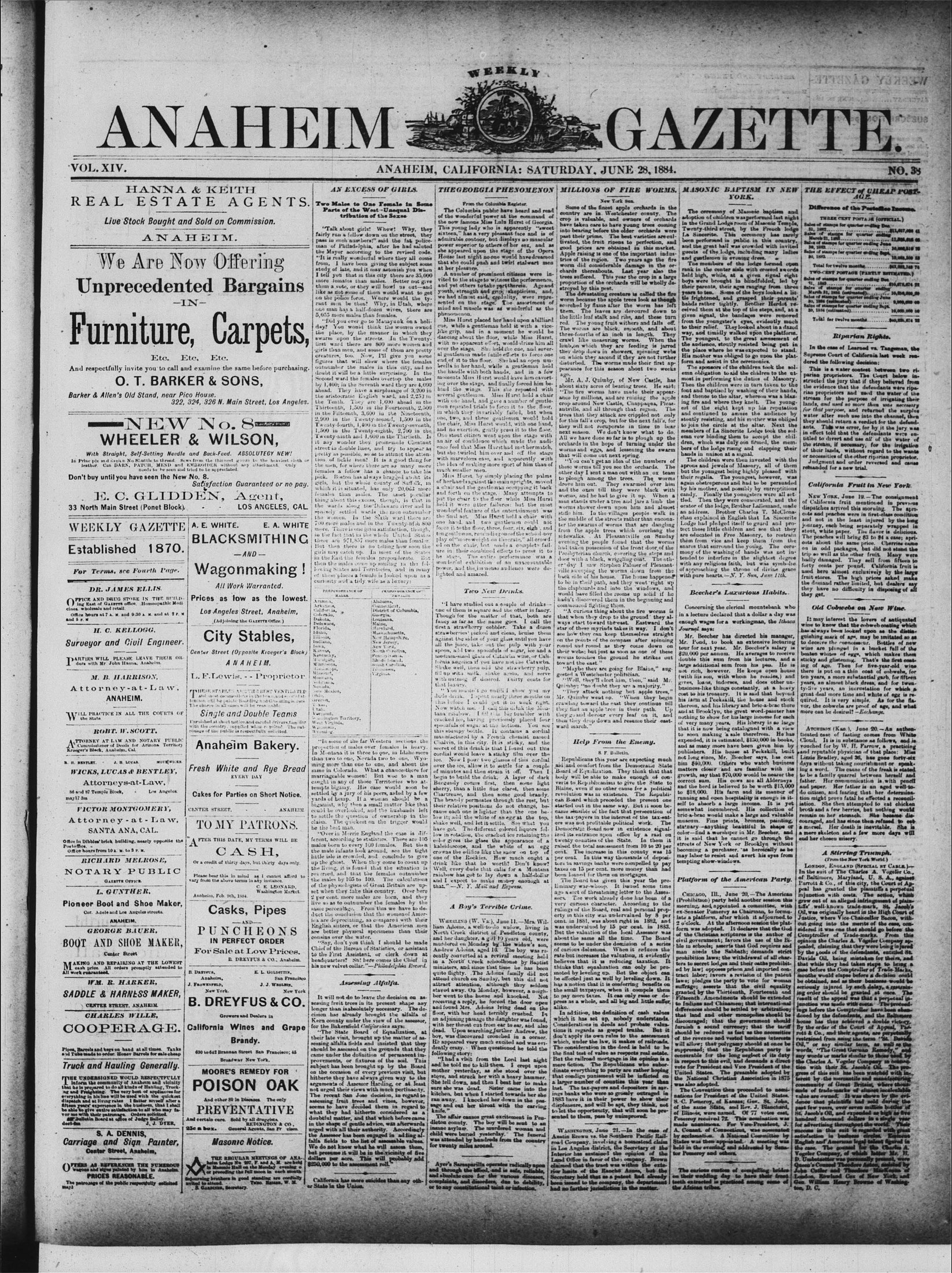
Searchable text
ANAHEIM
VOL. XIV.
HANNA & KEITH
REAL ESTATE AGENTS.
Live Stock Bought and Sold on Commission.
ANAHEIM.
We Are Now Offering
Unprecedented Bargains
—IN—
Furniture, Carpets,
Etc. Etc, Etc.
And respectfully invite you to call and examine the same before purchasing.
O. T. BARKER & SONS,
Barker & Allen's Old Stand, near Pico House.
322, 324, 326 N. Main Street, Los Angeles.
NEW No. 8
WHEELER & WILSON,
With Straight, Self-Setting Needle and Back-Feed. ABSOLUTEGY NEW!
In Primeple and design No Shuttle to thread. Seems from the thinnest gauge to the heaviest cloth or leather. Can DARN, PATCH, MEND and EMBROIDER without any attachment. Only needs to be seen and tried to be appreciated.
O. T. BARKER & SONS,
Barker & Allen's Old Stand, near Pico House.
322, 324, 326 N. Main Street, Los Angeles.
NEW No. 8
WHEELER & WILSON,
With Straight, Self-Setting Needle and Back-Feed. ABSOLUTEGY NEW!
In Price plea andission No Shuttle to thread. News from the thirnest gauge to the heaviest cloth or leather. Can DARN, PATCH, MEND and EMBROIDER without any attachment. Only needs to be seen and tried to be appreciated.
Don't buy until you have seen the New No. 8.
Satisfaction Guaranteed or no pay.
E. C. GLIDDEN, Agent,
33 North Main Street (Ponet Block). LOS ANGELES, CAL.
WEEKLY GAZETTE
Established 1870.
For Terms, see Fourth Page.
DR. JAMES ELLIS.
OFFICE AND DRUG STORE IN THE BUILDING East of GASHTRE office. Homeopathic Medicine wholesale and retail.
Office hours at 7 A.M. and 9:30 A.M. and at 2 P.M. and 5 P.M.
H. C. KELLOGG.
Surveyor and Civil Engineer.
PARTIES WILL PLEASE LEAVE THEIR ORDERS with Mr John Hanna, Anaheim.
M. B. HARRISON,
Attorney-at-Law, ANAHEIM.
WILL PRACTICE IN ALL THE COUETS OF the State.
ROBT. W. SCOTT.
ATTORNEY AT LAW AND NOTARY PUBLIC Commissioner of Deeds for Arizona Territory Kroeger's Black, Anaheim, Cal.
R. H. BENTLEY.
J. H. Lucas.
MOYEWICKS.
WICKS, LUCAS & BENTLEY,
Attorneys-at-Law,
86 and 87 Temple Block, Los Angeles, may 173m
VICTOR MONTGOMERY,
Attorney-at-Law, SANTA ANA, CAL.
Office in Dibbles' brick building, nearly opposite the Post office.
Office hours from 10 A.M. to 3 P.M.
RICHARD MELROSE,
NOTARY PUBLIC GAZETTE OFFICE.
L. GUNTHER.
A. E. WHITE.
E. A. WHITE
BLACKSMITHING
—AND—
Wagonmaking!
All Work Warranted.
Prices as low as the lowest.
Los Angeles Street, Anaheim,
(Adjoining the Gazette Office)
City Stables,
Center Street (Opposite Kroeger's Block)
ANAHEIM.
L. F. Lewis.- Proprietor
THE STABLES ARE THE BEST VENTILATED AND most comfortable in the town and so comfort will be quite boarding and those living there The charge in all cases will be reasonable.
Single and Double Teams
Furnished at short notice and careful drivers familiar with the country supplied when required. The rentage of the public is respectfully solicited.
Anaheim Bakery.
Fresh White and Rye Bread
EVERY DAY
Cakes for Parties on Short Notice.
CENTER STREET.
ANAHEIM
TO MY PATRONS.
AFTER THIS DATE, MY TERMS WILL BE CASH,
Or a credit of thirty days, but thirty days only.
Please bear this in mind as I cannot afford to vary from the above terms in any instance.
C. E. LEONARD,
Washington Market.
Anaheim, Feb. 9th, 1884.
"In some of the proportion of man In Montana it is than two to one, ming more than same in Colorado marriageable work caught in any of tempts bigamy settled by a jury yards of hemp, bigamist, why could be overlook to settle the que claim. The quick be the best man."
"Over in Merriferent, according males born to evile the male infants little island is crowed up the ghost. W the living, it is for reversed, and the males by 105 of the physiolog set when they take 2 per cent, more."
VICTOR MONTGOMERY,
Attorney-at-Law,
SANTA ANA, CAL.
Office in Dibbles' brick building, nearly opposite the Post office.
Office hours from 10 a.m. to 3 p.m.
RICHARD MELROSE,
NOTARY PUBLIC
GAZETTE OFFICE.
L. GUNTHER.
Pioneer Boot and Shoe Maker,
Cor. Adele and Los Angeles streets.
ANAHEIM.
GEORGE BAUER,
BOOT AND SHOE MAKER,
Center Street
MAKING AND REPAIRING AT THE LOWEST cash price. All orders promptly attended to
All work guaranteed.
WM. R. HARKER,
SADDLE & HARNESS MAKER,
CENTER STREET, ANAHEIM.
CHARLES WILLE,
COOPERAGE.
Pipes, Barrels and keys on hand at all times. Tanks and Tube made to order. Home Barrels for sale cheap
Truck and Hauling Generally.
THE UNDERSIGNED WOULD RESPECTFULLY inform the community of Anaheim and vicinity that he is prepared to do all kinds of Hauling, Trucking and Freighting. The very best of appliances for everything in his line will be used with the quickest dispatch and at living rates. I latter myself after a fifteen years' experience in the business, that I shall be able to give entire satisfaction to all who may favor me with their patronage. Orders solicited.
Bulletin Board at office of Judge Bailey.
dee5-ilm
J. J. DYER,
S. A. DENNIS,
Carriage and Sign Painter,
Center Street, Anaheim,
OFFERS AS REFERENCES THE NUMEROUS Wagons and signs painted by him in Anaheim.
PRICES REASONABLE.
The patronage of the public respectfully solicited may3
CENTER STREET.
ANAHEIM
TO MY PATRONS.
AFTER THIS DATE, MY TERMS WILL BE CASH,
Or a credit of thirty days, but thirty days only.
Please bear this in mind as I cannot afford to vary from the above terms in any instance.
C. E. LEONARD,
Washington Market.
Anaheim, Feb. 9th, 1884.
Casks, Pipes
AND
PUNCHEONS
IN PERFECT ORDER
For Sale at Low Prices.
B. DREYFUS & CO., Anaheim.
B. DREYFUS,
E. L. GOLDSTM,
Anaheim,
San Francisco
J. FROWENFIELD,
J. J. WEGLIN,
New York.
B. DREYFUS & CO.
Growers and Dealers in California Wines and Grape Brandy.
630 to 642 Brannan Street San Francisco; 45 Broadway New York.
MOORE'S REMEDY FOR POISON OAK
And other St in Diseases. The only PREVENTATIVE
And certain cure. Sold by all druggists.
REDINGTON & CO., General Agents, San Francisco.
Masonic Notice.
THE REGULAR MEETINGS OF ANAHEIM Lodge No 207, F. and A. M. are held in Masonic Hall on the Monday evening or preceding the full moon in each month.
Sojourning brother in good standing are cordially invited to attend.
Two. Ramara, W. M.
S. GARDENS, Secretary.
It will not do sewing fruit trees longer than is abbreviated has already Kern county under for the Bakersfield.
The State has assessed fruit trees seems to have done what they had doubled before, in the shape of genius urged with all the Assessor has been falfa fields to the We do not know what dollars per acre.
$250,000 to the annuity State In the Un
WEEKLY
EIM-GA
ANAHEIM, CALIFORNIA: SATURDAY, JUNE 28, 1884
AN EXCESS OF GIRLS.
Two Males to One Female in Some Parts of the West-Unequal Distribution of the Sexes
"Talk about girls! Whew! Why, they fairly run a fellow down on the street, they pass in such numbers!" said the fak policeman of Philadelphia, after he had saluted the Mayor according to the revised code. "It is really wonderful where they all come from. I have been giving the subject some study of late, and it may astonish you when I tell you that in this city there are 35,000 more females than males. Better not give them a vote, or they will bowl us out—and like as not some of them would want to get on the police force. Where would the tyrant men be then? Why, in Utah, where one man has a half-dozen wives, there are 5,055 more males than females."
"Did you ever go to Manayunk on a holiday? You would think the women owned the place, by the maunner in which they swarm upon the streets. In the Twenty-first ward there are 800 more women and girls than men, and some of them are pretty creatures, too. Now, I'll give you some figures that will show where the females outnumber the males in this city, and no doubt it will be a little surprising. In the Second ward the females overtop the males by 1,400; in the Seventh ward they are 4,000 ahead. They have a surplusage of 3,200 in the aristocratic English ward, and 2,250 in the Tenth. They are 1,600 ahead in the Thirteenth, 1,500 in the Fourteenth, 2,500 in the Fifteenth, 3,600 in the Nineteenth, 2,900 in the Twenty-second, 1,500 in the Twenty-fourth, 1,400 in the Twenty-seventh, 1,500 in the Twenty-eighth, 2,700 in the Twenty-ninth and 1,600 in the Thirtieth. Is it any wonder they promenade Chestnut street in double lines, and try to appear as pretty as possible, so as to attract the attention ofickle men? It is a good thing for the men, for where there are so many more females a fellow has a chance to take his
THE GEORGIA PHENOMENON
From the Columbia Register.
The Columbia public have heard and read of the wonderful power at the command of the now famous Miss Lulu Hurst of Georgia. This young lady who is apparently "sweet sixteen," has a very pleasant face and is of admirable contour, but displays no muscular power superior to others of her sex, and as she appeared upon the stage of the Opera House last night no one would have dreamed that she could push and twirl stalwart men at her pleasure.
A number of prominent citizens were invited to the stage to witness the performance, and yet others to take part therein. Age and youth, strength and grip, skepticism, and, we had almost said, credulity, were represented on the stage. The assortment of mind and muscle was as wonderful as the phenomenon.
Miss Hurst placed her hand upon a billiard cue, while a gentleman held it with a vice-like grip, and in a moment he would be dancing about the floor, while Miss Hurst, with no apparent effort, would drive him all over the stage. She held the cue, and several gentlemen made fatile efforts to force one end of it to the floor. She had an open umbrella in her hand, while a gentleman held the handle with both hands, and in a few moments Miss Hurst would have him cavorting over the stage, and finally forced him behind the wings. This she repeated with several gentlemen. Miss Hurst held a chair with one hand, and gave a number of gentlemen repeated trials to force it to the floor, in which they invariably failed, but when one two, and three gentlemen would hold the chair, Miss Hurst would, with one hand, and no exertion, gently press it to the floor. One stout citizen went upon the stage with an air of confidence which made the audience feel that Miss Hurst had met hermatch, but she twirled him over and off the stage with marvelous ease, and apparently with the idea of making more sport of him than of much smaller men.
MILLIONS OF FIRE WORMS
New York Sun.
Some of the finest apple orchards in this country are in Westchester county. The crop is valuable, and owners of orchards have taken care to have young trees coming into bearing before the older orchards were past their prime. The best varieties are cultivated, the fruit ripens to perfection, and good prices are obtained in this market. Apple raising is one of the important industries of the region. Two years ago the fireworm did considerable damage in our orchards thereabouts. Last year also these suffered. This year the crop in a large proportion of the orchards will be wholly destroyed by this pest.
The devastating creature is called the fireworm because the apple trees look as though scorched by flame after the worm has left them. The leaves are deroured down to the little leaf stalk and ribs, and these turn red. The young fruit withers and falls off. The worms are black, smooth, and about three-fourths of an inch in length. The crawl like measuring worms. When they drop down in showers, spinning webs on which they ascend if they are not further disturbed. The worms made their first appearance for this season about two weeks ago.
Mr. A. J. Quimby, of New Castle, has about sixty acres of bearing trees. He said: "The fireworms have made their appearance by millions, and are ruining the apple crop around New Castle, Chappaqua, Please antville, and all through that region. The trees that they attack are crippled not only for this fall's crop, but for the next fall's; for they will not recuperate in time to bear next season. We don't know what to do. All we have done so far is to plough up the orchards in the hope of turning under the worms and eggs, and lessening the swarm that will come out next spring."
"You can't get an idea of the numbers of these worms till you see the orchards." The other day I sent a man out with an ox team.
In some of the far Western sections the proportion of males over females is heavy. In Montana it is three to one, in Idaho more than two to one, Nevada two to one, Wyoming more than one to one, and about the same in Colorado. What a chance there for marriageable women! But woe to a man caught in any of those Territories who attempts bigamy. His case would soon be settled by a jury of his peers, auded by a few yards of hemp. If a woman should be a bigamist, why then a small matter like that could be overlooked, and the husbands left to settle the question of ownership in the claim. The quickest on the trigger would be the best man.
"Over in Merrie England the case is different, according to statistics. There are 105 males born to every 100 females. But then the male infants look around, see the tight little island is crowded, and conclude to give up the ghost. When they come to count up the living, it is found that the situation is reversed, and that the females outnumber the males by 105 to 100. The calculations of the physiologists of Great Britain are upset when they take this country. Over here 2 per cent, more males are born, and they momenta Miss Hurst would have him cavorting over the stage, and finally forced him behind the wings. This she repeated with several gentlemen. Miss Hurst held a chair with one hand, and gave a number of gentlemen repeated trials to force it to the floor, in which they invariably failed, but when one, two, and three gentlemen would hold the chair, Miss Hurst would, with one hand, and no exertion, gently press it to the door. One stout citizen went upon the stage with an air of confidence which made the audience feel that Miss Hurst had met her match, but she twirled him over and off the stage with marvelous ease, and apparently with the idea of making more sport of him than of much smaller men.
Miss Hurst by simply placing the palms of her hands against the main uprights, moved a chair and the gentleman occupying it back and forth on the stage. Many attempts to put the chair to the floor while Miss Hurst held it were utter failures; but the most wonderful feature of the entertainment was the final act. Miss Hurst held a chair with one hand, and two gentlemen could not force it to the floor, three, four, six, eighth and tongentleman, reminding one of the school boy play of "more weight on the crate," all crowded on the chair, but made a complete failure in their combined efforts to press it to his stage. The entire performance was a wonderful exhibition of an unaccountable power, and the immense audiences were delighted and amazed.
Two New Drinks.
"I have studied out a couple of drinks—one of them is square and the other is fancy. Though for the matter of that, both are fancy as far as the name goes. I call the first a strawberry cobbler. Take a dozen strawberries' picked and clean, bruise them against the sides of your glass until you have all the juice, take out the pulp with your spoon, add two spoonfuls of sugar, ice and a medium-sized glass of Catawba wine, or California angelica if you have not the Catawba Shake well, then add the strawberry pulp, till up with milk, shake again, and serve with natmog if desired. Thirty cents for that luxury.
You mustn't go until I show you my dude drink. I spent nearly three months on this before I could get it to work right. Now watch me. I call this drink the Montana rainbow. I fill it big tumbler with cracked ice, having previously placed four spoonfuls of sugar at the bottom. You see this stampy bottle. It contains a cordial manufactured by a French chemist named Chalvin, in this city. It is sticky, and the secret of this drink is that I found out this cordial would leave a sticky film over the ice. Now I pour two glasses of this cordial over the ice, allow it to settle for a couple of minutes and then strain it off. Then I begin to build the drink. A layer of dark Burgundy comes first, then some light cherry, than a little fine clarat, then some Chartreuse, and then some good brandy. The brandy permeates through the rest, but their relative positions do not change, because each one is lighter than the one below it; add the white of an egg at the top; shake well, and let it settle. See what you have got. The different colored liquors follow in rotation, the cracked ice retaining the color gives the glass the appearance of a kaleidoscope, and the white of an egg crowns the edifice like the snow on top of one of the Rockies. How much ought a drink like that be worth? Don't know? Well, every dude that calls for a Montana rainbow has got to lay down a half-dollar and I expect to make money enouggh at that." —N.Y.Mail and Express.
Mr. A.J. Quimby, of New Castle, has about sixty acres of bearing trees. He said "The fire worms have made their appearance by millions, and are ruining the apple crop around New Castle, Chappaqua, Pleasantville, and all through that region. The trees that they attack are crippled not only for this fall's crop, but for the next fall's; for they will not recuperate in time to bear next season. We don't know what to do. All we have done so far is to plough up the orchards in the hope of turning under the worms and eggs, and lessening the swarm that will come out next spring."
"You can't get an idea of these worms till you see the orchards. The other day I sent a man out with an ox team to plough among the trees. The worm drove him out. They swarmed over him and the oxen till they were black with worms, and he had to give it up. When a man stands under a tree and jams a limb the worms shower down upon him and almost stile him. In the villages people walk in middle of the streets rather than encounter the swarms of worms that are dangling from the apple trees which overhang the sidewalks. At Pleasantville on Sunday evening the people found that the worms had taken possession of the front door of the Peabysterian church, covering the steps and door with a black, wriggling coat. The other day I saw Stephen Palmer of Pleasantville sweeping the worms down from the back side of his house. The house happened to be in their path, and they went right up the clapboards and into the windows, and would have filled the rooms up solid if he hadn't discovered them in the beginning and commenced fighting them.
"A curious thing about the fire worms is that when they drop to the ground they always start toward the east. Eastward the star of these myriads takes it way. I don't see how they can keep themselves straight on the points of the compass after spinning round and round as they come down on their webs; but just as soon as one of these worms touches the ground he strikes out toward the east."
"Maybe they are going for Blaine," suggested a Westchester politician.
"Well, they'll elect him then," said Mr. Quimby; "no doubt they are a majority."
"They attack nothing but apple trees," Mr. Quimby went on. "When they begin crawling toward the east they continue till they find an apple tree in their path. Up they go and devour every leaf on it, and then they drop down and resume their east-ward march."
Help From The Enemy.
S.F.Ballett.
Republicans this year are expecting much aid and comfort from the Democratic State Board of Equalization. They think that that body will be able to make enough of conversions to Republicanism to give State to Blaine, even if no other cause for a political revolution was in existence. The Republican Board which preceded the present one started out in the same way. But it soon became sensible of the fact that persecution of the tax-payers in interest of the tax-eaters was not profitable political work. The Democratic Board now in existence signaled its entrance upon office by a raid on twenty counties of State. In them it raised total assessment from 10 to 20 per cent. The increase in this county was 15 per cent. In this way thousands of depositors in savings banks were compelled to pay taxes on 15 per cent. more money than had been loaned for them on mortgages.
The Board has given this year the preliminary war-whoop. It issued some time ago a sort of threatening letter to the Assessors. The work already done has been of a
It will not do to leave the decision on assessing fruit trees in its present shape any longer than is absolutely necessary. The decision has already brought the alfalfa of Kern county under the view of the assessor, for the Bakersfield California says:
"The State Board of Equalization, at their late visit, brought up the matter of assessing alfalfa fields and insisted that they should be assessed on the grounds that they came under the definition of permanent improvements, or fixtures of the soil. This subject has been brought up by the Board on the occasion of every previous visit, but hitherto they have always given way to the arguments of Assessor Harding, or at least not urged their views with much pertinacity. The recent San Jose decision, in regard to assessing fruit trees and vines, however, seems to have decided them in regard to what they had hitherto considered as a doubtful matter, and that which before came in the shape of gentle advice, was afterwards urged with all their authority. Accordingly the Assessor has been engaged in adding alfalfa fields to the list of assessable values. We do not know what he will assess them, but presume it will be in the vicinity of five dollars per acre. This will probably add $250,000 to the assessment roll."
California has more suicides than any other State in the Union.
The brandy permeates through the rest, but their relative positions do not change, because each one is lighter than the one below it; add the white of an egg at the top, shake well, and let it settle. See what you have got. The different colored liquors follow in rotation, the cracked ice retaining the color gives the glass the appearance of a kaleidoscope, and the white of an egg crowns the edifice like the snow on top of one of the Rockies. How much ought a drink like that be worth? Don't know? Well, every dude that calls for a Montana rainbow has got to lay down a half-dollar and I expect to make money enough at that." —N.Y.Mail and Express.
A Boy's Terrible Crime.
Wheeling (W.Va.), June 11.—Mrs. William Adoins, a well-to-do widow, living in North Creek district of Pendleton county, and her daughter, a gift 10 years old, were murdered on Monday by the widow's son, Andrew Adoins, aged 16. The boy was recently converted at a revival meeting held in a North Creek schoolhouse by Baptist ministers, and since that time he has been quite flighty. The Adoins family did not attend church on Sunday, but this did not attract attention, although they seldom stayed away. On Monday, however, a neighbor went to the house and knocked. Not receiving a reply, he forced the door open and found Mrs. Adoins lying dead on the floor, with her head terribly crushed. In an adjoining passage the daughter was found, with her throat cut from ear to ear, and also dead. Upon searching further Andrew, the boy, was discovered crouched in a corner. He appeared very much excited and was evidently crazy. When questioned he told the following story:
"I had a visit from the Lord last night and he told me to kill them. I crept upon mother yesterday, as she stood over the stove, and struck her with a heavy hammer. She fell down, and then I beat her to make sure she was dead. Sister came into the kitchen, but when I started towards her she ran away. I knocked her down in the passage and cut her throat with the carving knife."
The affair causes great excitement in Pendleton county. The boy will be sent to an insane asylum. The murdered woman and child were burned yesterday. The funeral was attended by hundreds from the country for twenty miles around.
Ayer's Sarasapilla operates radically upon and through the blood, and is safe, reliable, and absolute cure for the various diseases, complaints, and disorders, due to debility, or to any constitutional taint or infection.
The board which preceded the present one started out in the same way. But it soon became sensible of the fact that persecution of the tax-payers in the interest of the tax-setters was not profitable political work. The Democratic Board now in existence signaled its entrance upon office by a raid on twenty counties of the State. In them it raised the total assessment from 10 to 20 per cent. The increase in this county was 15 per cent. In this way thousands of depositors in savings banks were compelled to pay taxes on 15 per cent. more money than had been loaned for them on mortgages.
The Board has given this year the preliminary war-whoop. It issued some time ago a sort of threatening letter to the Assessors. The work already done has been of a very curious character. According to the rulings of the Board, real and personal property in this city was undervalued by 8 per cent. in 1881, was about right in 1882, and was undervalued by 15 per cent. in 1883. But the valuation of the local Assessor was about the same all the time. The Board seems to be under the dominion of a series of curious delusions. When it reduces the rate but increases the valuation, it evidently believes that it is reducing taxation. It thinks that equalization can only be promoted by leveling up. But the object can be effected just as well by leveling down. It has a notion that it is conferring benefits on the small taxpayers when it compels them to pay more taxes. It can only raise or depress as a whole, and all big and little suffer alike.
In addition, the definition of cash values which it has set up, nobody understands. Considerations in deeds and probate valuations it regards as gospel truths. But it don't apply its own rules to the assessment which, under the law, it makes of railroads. The consideration in the deed is held to be the final test of value as respects real estate. But the railroad mortgage in its opinion is a mere fiction. The Republicans who subordinate everything to party are rather hoping that condign punishment will be inflicted on a larger number of counties this year than last. The tax-payers and depositors in savings banks who were so grossly outraged in 1883 have it in their power to show their displeasure, and will be apt, they think, not to let the opportunity that will soon be presented to them, pass by unimproved.
WASHINGTON, June 21.-In the case of Austin Brown vs. the Southern Pacific Railroad Company, involving a homestead claim in Los Angeles district, the Secretary of the Interior has sustained the opinion of the Land Office in favor of the company. Brown claimed that the trust was within the exterior limits of the Rancho Azna, but the Secretary held that as a patent had already been issued to the company, the department had no farther jurisdiction in the matter.
GAZETTE.
JUNE 28, 1884.
S OF FIRE WORMS.
New York Sun.
The finest apple orchards in the
Westchester county. The
table, and owners of orchards
are to have young trees coming
before the older orchards were
done. The best varieties are cultuit ripens to perfection, and
are obtained in this market.
It is one of the important indussion. Two years ago the fire
considerable damage in the orabouts. Last year also the
This year the crop in a large
the orchards will be wholly depest.
Getting creature is called the fire
the apple trees look as though
some after the worm has left
leaves are devoured down to
stalk and ribs, and these turn
fruit withers and falls off,
black, smooth, and about
of an inch in length. They
seasoning worms. When the
they are feeding is jarred
in showers, spinning webs
ascend if they are not further
the worms made their first aphis season about two weeks
Imbry, of New Castle, has
trees of bearing trees. He said:
"Mums have made their appearnais, and are ruining the apple
New Castle, Chappaqua, Pleasall through that region. The
w attack are crippled not only
drop, but for the next fall's, for
recurporate in time to bear
We don't know what to do,
one so far is to plough up the
hope of turning under the
gae, and lessening the swarm
out next spring."
Get an idea of the numbers of
all you see the orchards. The
at a man out with an ox team
MASONIC BAPTISM IN NEW YORK.
The ceremony of Masonic baptism and adoption of children was performed last night in the Grand Lodge room of Masonic Temple,
Twenty-third street, by the French lodge La Sincerite. This ceremony has rarely been performed in public in this country,
and the great hall was crowded with invited guests of the lodge, including many ladies and gentlemen in evening dress.
The members of the lodge formed open rank in the center aisle with crossed swords held high, while, at a given signal eight boys were brought in blindfolded, led by their parents, their ages ranging from three years to ten. Some of the boys looked a little frightened, and grasped their parents' hands rather tightly. Brother Herdot received them at the top of the steps, and, at a given signal, the bandages were removed from the youngster's eyes, evidently much to their relief. They looked about in a dazed way, and timidly walked upon the platform. The youngest, to the great amusement of the audience, stoutly resisted being put in the place where he was expected to stand. His mother was obliged to go upon the platform and assist in the ceremonies.
The sponsors of the children took the solemn obligation to aid the children to the utmost in performing the duties of Masonry. Then the children were in turn taken to the font and baptised by washing of their hands, and thenose to the altar, whereon was a blazing fire and where they knelt. The youngest of the eight kept up his reputation and continued to amuse the audience by stoutly resisting, and his mother was obliged to join the circle at the altar. Next the members of La Sincerite Lodge took the solemn vow binding them to accept the children, which was duly con firmed, the members of the lodge rising and clapping their hands in unison at a signal.
The children were then invested with the aprons and jewels of Masonry, all of them but the youngest being highly pleased with
THE EFFECT OF CHEAP POSTAGE.
Difference of the Postoffice Income.
THREE CENT POSTAGE (OFFicial.)
31, 1882 211,017,000 41
Sales of stamps for quarter ending March 31, 1882 11,005,015 66
Sales of stamps for quarter ending June 30, 1882 10,000,519 70
Sales of stamps for quarter ending Sept. 30, 1882 10,000,509 53
Total for twelve months $43,982,740 76
TWO-CENT POSTAGE (PARTLY ESTIMATED.)
71, 1883 $10,678,674 22
Sales of stamps for quarter ending March 31, 1884 (estimated) 10,200,000 90
Sales of stamps for quarter ending June 30, 1884 (estimated) 9,000,000 69
Sales of stamps for quarter ending Sept. 30, 1884 (estimated) 10,000,000 69
Total for twelve months $40,228,674 92
Riparian Rights.
In the case of Learned vs. Tangeman, the Supreme Court of California last week rendered the following decision:
This is a water contest between two riparian proprietors. The Court below instructed the jury that if they believed from the evidence that the defendants were riparian proprietors and used the water of the stream for the purpose of irrigating their lands, and used no more than was necessary for that purpose, and returned the surplus water after such use into the channel, then they should return a verdict for the defendants. This was error; for by it the jury was in effect told that the defendants were entitled to divert and use all of the water of the stream; if necessary, for the irrigation of their lands, without regard to the wants or necessities of the other riparian proprietor.
Judgment and order reversed and cause remanded for a new trial.
get an idea of the numbers of all you see the orchards. The man at a man out with an ox team along the trees. The worms they swarmed over him till they were black with had to give it up. When a order tree and jewels of Masonry, all of them but the youngest being highly pleased with their regalia. The youngest, however, was again obstreperous and had to be persuaded by his mother, and possibly by surreptitious candy. Finally the youngsters were all settled. Then they were consecrated, and the orator of the bodge, Brother Lailemand, made an address. Brother Charles T. McClenachan explained in English that La Sincerite Lodge had pledged itself to guard and protect these little children and see that they are educated in Free Masonry, to restrain them from vice and keep them from the snakes that surround the young. The ceremony of the washing of hands was not intended to interfere in the slightest degree with any religious faith, but was sympathetic of approaching the throne of divine grace with pure hearts.—N. Y. Sun, June 11th.
Beecher's Luxurious Habits.
Concerning the clerical mountbank who in a lecture declared that a dollar a day was enough wages for a workingman, the Ithaca Journal says:
Mr. Beecher has directed his manager, Mr. Pond, to book an extensive lecturing tour for next year. Mr. Beecher's salary is $20,000 per annum. He averages to receive double this sum from his lectures, and a large additional sum from his pen. He is not rich, however. He keeps open house (with his son, whom he resides), and gives loans, indorses, and does other business-like things constantly, at a heavy cost to his treasury. It is said that beyond his farm at Peekskill, the house and stock thereon, and his library and bric-a-brac there and at Brooklyn, the great word-painter has nothing to show for his large income for each of very many years. His library is so large that it is now being catalogued with a view to soon making a sale therefrom. He has expended it is estimated, $130,000 in books, and as many more have been given him by publishers. His house at Peekskill, built not long since, Mr. Beecher says, has cost him $40,000. Others who watch business matters closer and are familiar with its growth, say that $70,000 would be nearer the correct sum. His cows are all Aldermys and the bird is believed to be worth $15,000 to $18,000. His farm and its manner of running and open hospitality is enough in itself to absorb a large income. It is yet somewhat incumbered. His collection of bric-a-brac would make a large and valuable museum. Fine prints, bronzes, painting, statuary—anything beautiful in shape or color—find a worshiper in Mr. Beecher, and it is said that he cannot go through the streets of New York or Brooklyn without becoming a purchaser," as heroically as he may labor to resist and avert his eyes from tempting show-windows.
Platform of the American Party.
Chicago, Ill., June 20.
The Court below instructed the jury that if they believed from the evidence that the defendants were riparian proprietors and used the water of the stream for the purpose of irrigating their lands, and used no more than was necessary for that purpose, and returned the surplus water after such use into the channel, then they should return a verdict for the defendants. This was error, for by it the jury was in effect told that the defendants were entitled to divert and use all of the water of the stream, if necessary, for the irrigation of their lands, without regard to the wants or necessities of the other riparian proprietor.
Judgment and order reversed and cause remanded for a new trial.
California Fruit in New York.
New York, June 19.
The consignment of California fruit mentioned in previous dispatches arrived this morning. The apricots and peaches were in first-class condition and not in the least injured by the long journey, each being separately wrapped in stout, white paper. The flavor is delicious. The peaches will bring $3 to $4 a case; apricots about the same price. Cherries came on in odd packages, but did not stand the trip so well as the other fruit. Many were badly damaged. They sell from fifteen to forty cents per pound. California fruit is used here almost exclusively by the large fruit stores. The high prices asked make the demand rather limited, but dealers say they have no difficulty in disposing of all they get.
Old Cobwebs on New Wine.
It may interest the lovers of antiquated wine to know that the cobweb coating which has always been looked upon as the distinguishing mark of age, may be imitated so as to deceive the connoisseur. Bottles of new wine are plunged in a bucket full of the beaten whites of eggs, which makes them sticky and glistening. That's the first coating of age. Then for five-year-old wine there is put on a thin coat of cobwebs, for ten years, a more substantial garb, for fifteen years, an almost black dress, and for twenty-five years, an incrustation for which a great deal more time and white of egg is required. It is very simple. As for the flavor, the cobwebs are proof of age, and what more can be desired?—Echange.
Atchison (Kan.), June 20.
An authenticated case of fasting comes from White Cloud. It is in substance as follows, and is vouched for by W. H. Farrow, a practicing and reputable physician of that place: Miss Lizzie Bradley, aged 36, has gone forty-six days without taking nourishment or speaking a word. The cause of the freak is stated to be a family quarrel between herself and father. Her communication is with pencil and paper. Her father is an aged well-to-do citizen, and fearing that her determination might prove fatal he effected a reconciliation. She then attempted to eat chicken broth and a few berries, but nothing would remain on her stomach. She became discouraged, and has since then refused to eat a morsel. Her death is inevitable. She is a mere skeleton and a few more days will end her chosen misery.
A Stirring Triumph.
(From the New York World.)
London, England (Special By Cable.)—In the suit of The Charles A. Vogeler Co., of Baltimore, Maryland, U.S.A., against Parrott & Co., of this city, the Court of Appeal has granted the plaintiffs a perpetual injunction with costs. The action, which
Platform of the American Party.
Chicago, Ill., June 20,—The American (Prohibition) party held another session this morning, and appointed a committee, with ex-Senator Pomeroy as Chairman, to formulate a platform, after which it adjourned to 2 o'clock. At the afternoon session the platform was adopted. It declares that the God of the Christian scriptures is the author of civil government; favors the use of the Bible in schools; asserts that God requires and man needs the Sabbath; demands strict prohibition laws; the withdrawal of all charities to secret lodges and their oath prohibited by law; opposes prison and imported contract labor; favors a revision of the patent laws; pledges the party to vote for woman suffrage; asserts that the civil equality granted by the Thirteenth, Fourteenth and Fifteenth Amendments should be extended to Indians and Chinamen; that international differences should be settled by arbitration; that land and other monopolies should be discouraged; that the government should furnish a sound currency; that the tariff should be reduced as fast as the necessities of the revenue and vested business interests will allow; that polygamy should at once be suppressed; that the Republican party is censurable for the long neglect of its duty in respect to this evil, and demands a direct vote for President and Vice President of the United States. The preamble adopted by the National Christian Association in 1875 was also adopted.
The Convention then proceeded to nominations for President of the United States. S. C. Pomeroy, of Kansas; Gov. St. John, of the same State, and Rev. J. Blanchard, of Illinois, were named. Of 77 votes cast, Pomeroy received 72. This nomination was made unanimous. For Vice-President, J. A. Conant, of Connecticut, was nominated by acclamation. A National Committee by States was then appointed. A meeting was held in the evening and addressed by Senator Pomeroy and others.
The curious custom of compelling brides on their wedding day to have their front teeth extracted is practiced among some of the African tribes.
A Stirring Triumph.
(From the New York World)
In the suit of The Charles A. Vogeler Co., of Baltimore, Maryland, U. S.A., against Parrott & Co., of this city, the Court of Appeal has granted the plaintiffs a perpetual injunction with costs. The action, which grew out of an alleged infringement of plaintiffs’ well-known trade-mark, St. Jacob’s Oil, was originally heard in the High Court of Justice, where Vice-Chancellor Bacon, without going into the merits of the case, considered it was one that should go before the Comptroller of Trade-marks. From this opinion the Charles A. Vogeler Company appealed, claiming that they were being injured by the goods of the defendants, entitled St. David's Oil, being mistaken for them, and that while they had taken steps to bring a case before the Comptroller of Trade-Marks, months would elapse before a decision could be obtained, and as their business would be seriously injured by such delay, a restraining order should be granted at once. The result of the appeal was that a perpetual injunction was made with costs. The proceedings before the Comptroller have been abandoned by the defendants, and the Baltimore house has thus achieved a double victory. By the order of the Court of Appeal, Parrott & Co., and their agents, are perpetually restrained from using the term “St. David's Oil,” or any similar term, as well as the words, “The Great German Remedy,” and any words or marks similar to those used by the Charles A. Vogeler Company in connection with their St. Jacob’s Oil. The progress of this suit has been watched with interest by the mercantile and manufacturing community of Great Britain, where thousands of trade-marks of almost incalculable value are owned. It was shown by the evidence that plaintiffs had sold during the past few years, over seven million bottles of St. Jacob’s Oil, and expended as high as five hundred thousand dollars in a single year for advertising throughout the world. Their success in this suit is regarded with great satisfaction in business circles. Emmental English and American legal talent figured in the case. The ground for the Charles A. Vogeler Company, of which latter Mr. H. D. Umbuttler was personally present, were Queen's Counsel Thaddeus MacKenna of London, Rowland Cox of New York, and Gan William Henry Browne of Washington, D.C.