anaheim-gazette 1884-06-21
Scanned page
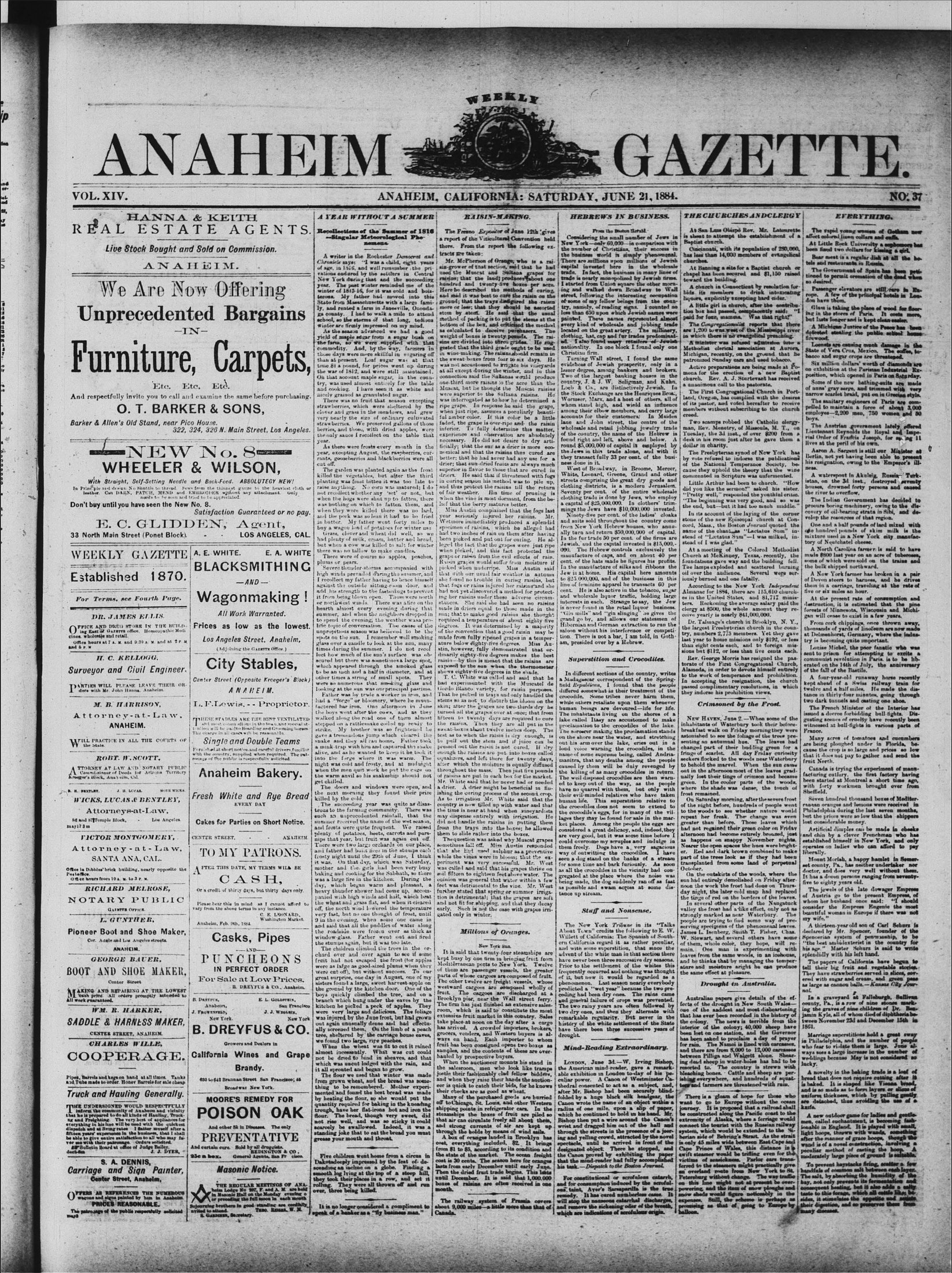
Searchable text
ANAHEIM
VOL. XIV.
HANNA & KEITH
REAL ESTATE AGENTS.
Live Stock Bought and Sold on Commission.
ANAHEIM.
We Are Now Offering
Unprecedented Bargains
INFurniture, Carpets,
Etc. Etc. Etc.
And respectfully invite you to call and examine the same before purchasing.
O. T. BARKER & SONS,
Barker & Allen's Old Stand, near Pico House.
322, 324, 326 N. Main Street, Los Angeles.
NEW No. 8
WHEELER & WILSON,
Etc. Etc. Etc.
And respectfully invite you to call and examine the same before purchasing.
O. T. BARKER & SONS,
Barker & Allen's Old Stand, near Pico House.
322, 324, 326 N. Main Street, Los Angeles.
NEW No. 8
WHEELER & WILSON,
With Straight, Self-Setting Needle and Back-Feed. AB80LUTEGY NEW!
In Principle sard design. No Shuttle to thread. News from the thinnest gauge to the heaviest cloth or leather. Can DARN, PATCH, MEND and EMBROider without any attachment. Only needs to be seen and tried to be appreciated.
Don't buy until you have seen the New No. 8.
Satisfaction Guaranteed or no pay.
E. C. GLIDDEN; Agent,
33 North Main Street (Ponet Block). LOS ANGELES, CAL.
WEEKLY GAZETTE
Established 1870.
For Terms, see Fourth Page.
DR. JAMES ELLIS.
OFFICE AND DRUG STORE IN THE BUILDING East of Gazette office. Homeopathic Medicine wholesale and retail.
Office hours at 7 A.M. and 9:30 A.M. and at 2 P.M. and 5 P.M.
H. C. KELLOGG.
Surveyor and Civil Engineer.
PARTIES WILL PLEASE LEAVE THEIR ORDERS with Mr. John Hanna. Anaheim.
M. B. HARRISON,
Attorney-at-Law, ANAHEIM.
WILL PRACTICE IN ALL THE COURTS OF the State.
ROBT. W. SCOTT.
ATTORNEY AT LAW AND NOTARY PUBLIC Commissioner of Deeds for Arizona Territory Krueger's Block, Anaheim, Cal.
R. H. BENTLEY.
J. H. LUCAS.
MOVE WICKS
WICKS, LUCAS & BENTLEY,
Attorneys-at-Law,
86 and 87 Temple Block, Los Angeles, may 173 m.
VICTOR MONTGOMERY,
Attorney-at-Law, SANTA ANA, CAL.
Office in Dibbles' brick building, nearly opposite the Postoffice.
Office hours from 10 A.M. to 3 P.M.
RICHARD MELROSE,
NOTARY PUBLIC
WICKS, LUCAS & BENTLEY,
Attorneys-at-Law,
86 and 87 Temple Block, Los Angeles.
May 17th.
VICTOR MONTGOMERY,
Attorney-at-Law,
SANTA ANA, CAL.
Office in Dibbles' brick building, nearly opposite the Postoffice.
Office hours from 10 a.m. to 3 p.m.
RICHARD MELROSE,
NOTARY PUBLIC
GALETTE OFFICE.
L. GUNTHER,
Pioneer Boot and Shoe Maker,
Cor. Angle and Low Angeles streets.
ANAHEIM.
GEORGE BAUER,
BOOT AND SHOE MAKER,
Center Street
MAKING AND REPAIRING AT THE LOWEST cash price. All orders promptly attended to. All work guaranteed.
WM. R. HARKER,
SADDLE & HARNESS MAKER,
CENTER STREET, ANAHEIM.
CHARLES WILLE,
COOPERAGE.
Pipes, Barrels and kegs on hand at all times. Tanks and Tubs made to order. Honev Barrels for sale cheap.
Truck and Hauling Generally.
THE UNDERSIGNED WOULD RESPECTFULLY inform the community of Anaheim and vicinity that he is prepared to do all kinds of Hauling, Trucking and Freighting. The very best of appliances for everything in his line will be used with the quickest dispatch and at living rates. Iatter myself after a fifteen years' experience in the business, that I shall be able to give entire satisfaction to all who may favor me with their patronage. Orders solicited.
425 Bulletin Board at office of Judge Bailey.
dec-9th.
J. J. DYER,
S. A. DENNIS,
Carriage and Sign Painter,
Center Street, Anaheim,
OFFERS AS REFERENCES THE NUMEROUS wagons and signs painted by him in Anaheim.
PRICES REASONABLE.
The parrotsage of the public respectfully solicited may3
Fresh Wines and Age Bread
EVERY DAY
Cakes for Parties on Short Notice.
CENTER STREET. ANAHEIM.
TO MY PATRONS.
AFTER THIS DATE, MY TERMS WILL BE CASH,
Or a credit of thirty days, but thirty days only.
Please bear this in mind as I cannot afford to vary from the above terms in any instance.
C. E. LEONARD,
Washington Market.
Anaheim, Feb. 9th, 1884.
Casks, Pipes
AND
PUNCHEONS
IN PERFECT ORDER
For Sale at Low Prices.
B. DREYFUS & CO., Anaheim.
B. DREYFUS,
Anaheim,
San Francisco
J. FROWENFIELD,
New York.
New York
B. DREYFUS & CO.
Growers and Dealers in California Wines and Grape Brandy.
630 to 642 Brannan Street San Francisco; 45 Broadway New York.
MOORE'S REMEDY FOR POISON OAK
And other Sk in Diseases. The only PREVENTATIVE
And certain cure. Sold by all druggists.
REDINGTON & CO.
25c a box.
General Agents, San Frisco.
Masonic Notice.
THE REGULAR MEETINGS OF ANAHEIM Lodge No 197, F. and A. M. are held in Masonite Hall on the Monday evening or preceding the full moon in each month.
Sojourning brothers in good standing are cordially invited to attend.
S. GARDNER, Secretary.
WEEKLY
EIM GA
ANAHEIM, CALIFORNIA: SATURDAY, JUNE 21, 1884
A YEAR WITHOUT A SUMMER
Recollections of the Summer of 1816—Singular Meteorological Phenomena
A writer in the Rochester Democrat and Chronicle says: "I was a child, eight years of age, in 1816, and well remember; the privations endured by the settlers in Central New York during that and the succeeding year. The past winter reminded me of the winter of 1815-16, for it was cold and boisterous. My father had moved into this State from Massachusetts with a large family, and rented a farm in Janesville, Onondaga county. I had to walk a mile to attend school, so the storms of that long, tedious winter are firmly impressed on my mind.
As the season advanced we had a good yield of maple sugar from a sugar bush on the farm, so we were supplied with that commodity. And, by the way, farmers in those days were more skillful in sugaring off than at present. Loaf sugar was at that time $8 a pound, for prices went up during the war of 1812, and were still maintained. On that account maple sugar, in the country, was used almost entirely for the table and cooking. I have seen it as white and nicely grained as granulated sugar.
There was no fruit that season excepting strawberries, which were sheltered by the clover and grass in the meadows, and grew very nearly the size of ordinary cultivated strawberries. We preserved gallons of those berries, and those, with dried apples, were the only sauce I recollect on the table that year.
As there were frosts every month in the year, excepting August, the raspberries, currants, gooseberries and blackberries were all cut off.
The garden was planted again as the frost killed the vegetable but after the third harvest.
RAISIN-MAKING.
The Presno Expositor of June 12th gives a report of the Viticultural Convention held there. From the report the following extracts are taken:
Mr. McPherson of Orange, who is a raisin-grower of that section, said that he had used the Muscat and Sultana grapes for raisins; that the land produces about one hundred and twenty-five boxes per acre. Here he described the methods of curing, and said it was best to cure the raisin on the ground; that the trays disfigured the raisin more or less; that they should be assorted stem by stem. He said that the usual method of packing is to put the stems at the bottom of the box, and criticized the method as calculated to deceive purchasers. The weight of boxes is twenty pounds. The raisins are divided into three grades. He suggested that the third grade ought to be used in wine-making. The raisins should remain in the sweat-boxes from four to six days. He was not accustomed to irrigate his vineyards at all except during the winter, and in this connection said the Sultanas would produce one-third more raisins to the acre than the Muscat, but he thought the Muscat raisins were superior to the Sultana raisins. He was interrogated as to how he determined a ripe grape. In response he said the grape, when just ripe, assumes a peculiarly beautiful amber color. If this color be a little faded, the grape is over-ripe and the raisin inferior. To fully determine this matter, experience and observation are absolutely necessary. He did not desire to dry artificially; that the sun as a drier is more economical and that the raisins thus cured are better; that he had never had any use for a drier; that sun-dried fruits are always much superior in flavor to those that are cured in steam.
HEBREWS IN BUSINESS.
From the Boston Herald.
Considering the small number of Jews in New York—only 60,000—in comparison with the number of Christians, their success in the business world is simply phenomenal. There are millions upon millions of Jewish capital invested here in the wholesale trade. In fact, the business in many lines of trade is nearly monopolized by Jewish firms. I started from Union square the other morning and walked down Broadway to Wake Street, following the interesting occupation of some of my fellow beings from the country, namely, of reading signs. I counted no less than 650 upon which Jewish names were painted. These names represented almost every kind of wholesale and jobbing trade located on the great artery. The millinery clothing, hat, cap and fur trades predominated. I also found many retailers of Jewish nationality. In one block I found only one Christian firm.
Turning Wall street, I found the same evidence of Jewish prosperity, only in lesser degree, among bankers and brokers. Two of the largest banking houses in the country, J. & J. W. Seligman, and Kuhb Laeb & Co., are distinctively Jewish. In the Stock Exchange are the Hearrques Brothers Wormser, Marx, and a host of others, all whom stand high, and wield an influence among their elbow members, and carry large accounts for their customers. In Maidstone lane and John street, the centre of this wholesale and retail jobbing jewelry trade of the country, the name of the Hebrew Jew in this trade alone, and with them transact fully 33 per cent. of the business done in it.
West of Broadway, in Broome, Mercer White Leonard Greene Grand and other
On that account maple sugar, in the country, was used almost entirely for the table and cooking. I have seen it as white and nicely grained as granulated sugar.
There was no fruit that season excepting strawberries, which were sheltered by the clover and grass in the meadows, and grew very nearly the size of ordinary cultivated strawberries. We preserved gallons of those berries, and those, with dried apples, were the only sauce I recollect on the table that year.
As there were frosts every month in the year, excepting August, the raspberries, currants, gooseberries and blackberries were all cat off.
The garden was planted again as the frost killed the vegetables, but after the third planting was frost bitten it was too late to raise anything. No corn was matured; I do not collect whether any 'set' or not, but when the hogs were shut up to fatten, there was nothing on which to fatten them, and when they were killed there was no lard, and the pork was so lean it had to be fried in butter. My father went forty miles to buy a wagon load of potatoes for winter use. Grass, clover and wheat did well, so we had plenty of milk, cream, butter and bread, but when a cow was killed to salt for winter there was no tallow to make candles.
There were of course no apples, peaches, plums or pears.
Severe thunder-storms accompanied with high winds prevailed during the summer, and I recollect my father having to brace himself against the outside sitting-room door, and add his strength to the fastenings to prevent it from being blown open. Those were north or northwest winds. There was a fire on the hearth almost every evening during that summer, and when the neighbors dropped in to spend the evening, the weather was a prolific topic of conversation. The cause of the unpropitious season was believed to be the spots on the sun. I remember well smoking glass over a candle to look at the sun, many times during the summer. I do not recollect how much of the sun's surface was obscured but there was sometimes a large spot, which appeared through the smoked glass to be an inch and a half in diameter, and at other times a string of small spots. They were so numerous that smoking glass and looking at the sun was our principal pastime.
Father was by trade a worker in iron, and had a "forge" or bloomery, where he manufactured bar iron. One afternoon in June the boys went after the cows, and as they walked along the road one of them almost stepped on a rattlemake coiled up ready to strike. My brother was so frightened he gave a tremendous jump which cleared the snake and they all ran home. Father took a munk trap with him and captured the snake alive, and as he wanted to keep it he took it into the forge where it was warm. The night was cold and frosty, and at midnight when the men quit work he put the cage on the warm anvil so his snakeship should not get chilled.
The doors and windows were open, and the next morning they found their prize killed by the cold.
The succeeding year was quite as disastrous to the farming community. There was such an unprecedented rainfall, that the summer received the name of the wet season, and frosts were quite frequent. We raised plenty of potatoes, beets, carrots and parsnips that year, but fruit was again cut off. There were two large orchards on our place, and father had baked nies in the stumps each frosty night until the 29th of June. I think it was. On that day, which was Saturday, mother and the girls had been very busy baking and cooking for the Sabbath, so there was a large fire in the kitchen. During the day, which began warm and pleasant, a heavy thunder shower had come up, accompanied with high winds and hail, which beat connection said the Skanasa would produce one-third more raisins to the acre than the Muscat, but he thought the Muscat raisins were superior to the Sulana raisins. He was interrogated as to how he determined a ripe grape. In response he said the grape, when just ripe, assumes a peculiarly beautiful amber color. If this color be a little faded, the grape is over-ripe and the raisin inferior. To fully determine this matter, experience and observation are absolutely necessary. He did not desire to dry artificially; that the sun as a drier is more economical and that the raisins thus cured are better; that he had never had any use for a drier; that sun-dried fruits are always much superior in flavor to those that are cured in drers. He said that if threatened with fogs in curing season his method was to pile up, and thus protect the raisins till the return of fair weather. His time of pruning is when the vine is most dormant, from the belief that the berry matures better.
Miss Austin complained that the fogs last year seriously injured her raisins. Mr. Wetmore immediately produced a splendid specimen of raisins, which he alleged had had two inches of rain on them after having been picked and put out for earing. He alleged the fact that the grapes were just ripe when picked, and this fact protected the grape or raisin from the evil effects of rain. Rusin grapes would suffer from moisture if picked when undereripe. Miss Austin said that with our usual fair weather in autumn she found no trouble in curing raisins, but that fogs or rains injured her raisins and she had not yet discovered a method for protecting her raisins under these adverse circumstances. She said she had seen no raisins made in driers equal to those made in the sun; that to make good raisins she thought required a temperature of about eighty-five degrees. It was determined by a majority of the convention that a good raisin may be made from fully ripened grapes in a temperature below eighty-five degrees. Miss Austin, however, fully demonstrated that ordinarily eighty-five degrees makes the best raisin—by this is meant that the raisins are exposed to the sun when the thermometer shows eighty-five degrees in the shade.
T.C. White was called and said that he had experimented with the Muscat de tordo blanco variety, for raisin purposes. That he picked in trays and only handled the stems so as not to disturb the bloom on the skin; after the grapes are two-thirds dry he turned all the grapes over at once; that from fifteen to twenty days are required to cure the raisins. Then they are all put in the sweat-boxes about twelve inches deep. The test as to when the raisin is dry enough, is to pull out the stem and if juice can be pressed out the raisin is not cured. If dry enough the raisins are put into boxes called equalizers, and left for twenty days, after which the moisture is equally diffused throughout the mass. Then just five pounds of raisins are put in each box for the market. Mr. White said that he never had or needed a drier. A drier might be beneficial in finishing the curing process of the second crop. As to irrigation Mr. White said that the country is now tilled up with water and that the time is near at hand when vineyardists may dispense entirely with irrigation. He did not handle the raisins in putting them from the trays into the boxes; he allowed them to slide rather into the boxes.
The question was asked why Muscat grapes sometimes fall off. Miss Austin responded that she had used sulphur as a preventive while the vines were in bloom; that the experiment was very successful. Mr.West was called and said that his grapes thrive on soil fifteen to eighteen feet above water. The opinion was general that water within a few feet was detrimental to the vine. Mr.West further stated that spring or summer irrigation is detrimental; that the grapes are soft
Two of the largest banking houses in this country, J.A.J.W., Seligman, and Kuhai Loeb & Co., are distinctively Jewish. In The Stock Exchange are the Henriques Brosse Wormer, Marx, and a host of others, all whom stand high, and wield an influence among their elbow members, and carry large accounts for their customers! In Maiden lane and John street, the centre of this wholesale and retail jobbing jewelry trade of the country, the name of The Hebrew found right and left, above and below. Round $50,000 of capital is employed by The Jews in this trade alone, and with them transact fully 33 per cent. ofthe business done in it.
West of Broadway, in Broome, Mercer White, Leonard, Greene, Grand and other streets comprising the great dry goods and clothing districts, is a modern Jernalen Seventy per cent. ofthe entire wholesale clothing trade is done by Jews who employ a capital of $25,000,000. In clothers' trimmings The Jews have $10,000,000 invested.
Ninety-five per cent.ofthe ladies' clothes and suits sold throughoutthe country come from New York Hebrew houses, who annually turn and return $50,000,000of capital.In The fur trade 50 per cent.ofthe firms are Jewish,andthe capital invested is $15,000,000.The Hebrew controls exclusivelythe manufacture of caps,and on about 40 percent.ofthe hatsmadehefigureshisprofit.Inthe manufacture of silksand ribbonsthe Jew is at home.His capital here amountto $25,000,000,andofthe businessinthislineoffeminineapparelhetransacts60percent.He is also activeinthetobacco,sugarsandwholesaleliquortraffic,holdinglargeinterestsineach.Strangeto say,theJewisefoundintheretailliquorbusiness"Ginmills"and"ginsluing"hegivesthegrandgooby,andallowsoursstatemenonHibernianandGermanextractiontorunthesaloonwithouthis interferenceorcompetition.Thereisnotabar.Iam told,Gothamam,presidedoverbyA Hebrew.
SuperstitionandCrocodiles.
In different sections ofthe country,写a Madagascar correspondent ofthe Spring fieldRepublican.I foundthatthepeople differed somewhatin their treatmentofthecrocodile.Some tribesnever harmthemwhileothersretaliate uponthewheneverhumanbeingsaredevoured—lifeforlifeTheinhabitanta livingontheshoresofla lakecalledItasyareaccustomedtomakeproclamationtothecrocodilesoftheLakeThesovereatmakingtheproclamationstandontheshorenearthewater,andstretchingouthisarmoverthelake,criesoutin loudvoicewarningthecrocodiles.inthenameofsomesupremebeing,calledAndriasmanira,thatanydeathsamongthepeoplecausedbythemenwillbedulyrevengedbythekillingofasmanycrocodilesinreturnThewelldiscoveredcrocodilesarethenwarnedtokeepoutoftheway.astheyhavenoquarrelwiththembutonlywith theirevil-mindedrelativeswhohavehumanlife.Lithuaniasuperstitionrelativetothecrocodilesdoesnotseemto extendtothecrocodile'seggs,forkinmanyofthevillagestheymaybefoundfor saleinthemarketplaces.AmongthepeopletheeggsareconsideredaGreatdelicacy,andindeed,theyareverygood,bitamwereasimpleandindulceupfromchewingmyscrublesandindulcein themfreely.Dogshavea,verysagaciouswayofoutwittingthecrocodiles.Ihaveseena dogstandonthebanksofastreamforsometimeandbarkfuriously.As soonasallthecrocodilesinthevicinityhadcongratulatedattheplacewherethenoisewasbeingmade,thedogsunedlyranoffasfastaspossibleandswamacrossatsomedistanceupstream.
The succeeding year was quite as disastrous to the farming community. There was such an unprecedented rainfall that the summer received the name of the wet season, and frosts were quite frequent. We raised plenty of potatoes, beets, carrots and parsnips that year, but fruit was again cut off. There were two large orchards on our place, and father had built fences in the stumps each frosty night until the 29th of June. I think it was. On that day, which was Saturday, mother and the girls had been very busy baking and cooking for the Sabbath, so there was a large fire in the kitchen. During the day, which began warm and pleasant, a heavy thunder shower had come up, accompanied with high winds and hail, which beat the wheat and grass flat, and when it cleared off, the north wind lowered the temperature very fast, but no one thought of frost, until 9 in the evening, when some one came in and said that all the puddles of water along the roadside were frozen over as thick as window-glass. Father went out and fired the stumps again, but it was too late.
The children climbed the trees in the orchard over and over again to see if some fruit had not escaped the frost (for apples were as large as good-sized plums when they were cut off), but without success. To our great surprise, one day in August, one of my sisters found a large sweet harvest-apple on the ground by the kitchen door. One of the boys quickly climbed the tree, and on a branch which hung under the eaves by the kitchen he picked a peck of apples. They were very large and delicious. The foliage was injured by the June frost, but had grown out again unusually dense and had effectually screened them. On the limb of a peach tree, sheltered by the carriage house eaves, we found two large, ripe peaches.
When the wheat was fit to cut it rained almost incessantly. What was cut could not be dried to bind in sheaves, and that which was uncut lodged with the rain, and it all sprouted and began to grow.
The flour we used that winter was made from grown wheat, and the bread was something to be remembered. Mother experimented and found the best bread was made by heating the flour, so she would put the quantity required for baking in the kneading trough, have her flat-irons hot and iron the flour. The bread, though very sweet, did not rise well, and was so sticky it could scarcely be swallowed. Indeed, it was a standing joke that to eat the bread you must grease your mouth and throat.
Five children went home from a circus in Dakotadeeply impressed by the feat of descending an incline on a globe. Finding a smooth log lying at the top of a steep hill, they took their places in a row, and set it rolling. They were all thrown off and run over, three being killed.
It is no longer considered a compliment to speak of a banker as a "fly business man."
As to irrigation Mr. White said that the country is now tilled up with water and that the time is near at hand when vineyardists may dispense entirely with irrigation. He did not handle the raisins in putting them from the trays into the boxes; he allowed them to slide rather into the boxes.
The question was asked why Muscat grapes sometimes fall off. Miss Austin responded that she had used sulphur as a preventive while the vines were in bloom; that the experiment was very successful. Mr. West was called and said that his grapes thrive on soil fifteen to eighteen feet above water. The opinion was general that water within a few feet was detrimental to the vine. Mr. West further stated that spring or summer irrigation is detrimental; that the grapes are soft and not fit for shipping, and that they decay early. Such is not the case with grapes irrigated only in winter.
Millions of Oranges.
New York Sun.
It is said that twenty-four steamships are kept busy by one firm in bringing fruit from Mediterranean ports to New York. Twelve of them are passenger vessels, the greater parts of whose cargoes are composed of fruit. The other twelve are freight vessels, whose westward cargoes are composed wholly of fruit. The cargoes are discharged at a Brooklyn pier, near the Wall street ferry. The firm has just finished an extensive salesroom, which is said to constitute the most extensive fruit market in this country. Sales take place at noon on the day after a cargo has arrived. A crowd of importers, brokers, grocers, venders, and Western buyers is always on hand. Each importer to whom fruit has been consigned opens two boxes as samples, and the contents of these are overhauled by prospective buyers.
When the auctioneer mounts his stand in the salesroom, men who look like tramps jostle their fashionably clad fellow bidders, and when they raise their hands the auctioneer is quick to catch their bids, for he knows their checks are as good as wheat.
Many of the purchased goods are hurried off to Chicago, St. Louis, and other Western shipping points in refrigerator cars. In the steamships the boxes of fruit are piled so that air can circulate freely all about them, and strong currents of air are kept up through the holds by means of wind sails.
A box of oranges landed in Brooklyn has coat, everything included, $2. It brings from $1 to $5, according to its condition and the state of the market. The ocean freight cost is 30 cents. The season here for oranges lasts from early December until early June. Then the dried fruit trade begins. This lasts until December. It is said that 1,000,000 boxes of raisins are often received in one month.
The railway system of Prussia covers about 9,000 miles—a little more than that of Canada.
Human life. This superstition relative to the crocodiles does not seem to extend to the crocodile's eggs, for in many of the villages they may be found for sale in the market places. Among the people the eggs are considered a great delicacy, and indeed, they are very good, but it was some time before could overcome my scruples and indulge in them freely. Dogs have a very sagacious way of outwitting the crocodiles. I have seen a dog stand on the banks of a stream for some time and bark furiously. As soon as all the crocodiles in the vicinity had congratulated at the place where the noise was being made, the dog suddenly ran off as fast as possible and swam across at some distance up stream.
Stuff and Nonsense.
The New York Tribune in its "Talk About Town" credits the following to E.W. Willett of California: The Spanish of Southern California regard it as rather peculiar and with some superstition, that since the advent of the white man in that section there have never been three successive dry seasons. Prior to the settlement of the whites this frequently occurred and nothing was thought of it, but now it would be regarded as a phenomenon. Last season nearly everybody predicted had been dry ones. The rains came and general failure of crops was prevented. The two rainy years are often followed by two dry ones, and then they alternate with remarkable regularity. But never in history of the white settlement of the State have there been three successive years of drought.
Mind-Reading Extraordinary.
London, June 3d.-W. Irving Bishop, the American mind-reADER, gave a remarkable exhibition in London to-day of his peculiar power. A Canon of Westminster Cathedral consented to act as a subject, and after Mr. Bishop had been securely blinded by a huge black silk headgear, the Canon wrote the name of an object within a radius of one mile, upon a slip of paper, which he continued to hold in his hand. Mr. Bishop then put a wire around the Canon's wrist and dragged him out of the hall and through the streets in the presence of a joering and yelling crowd, attracted by the novel spectacle, until he arrived in front of the designated object. There he stopped, and the Canon proved by exhibiting the paper that the mind-reader had fully accomplished his task.-Dispatch to the Boston Journal.
For constitutional or scrofulous catarrh, and for consumption induced by the scrofulous taint, Ayer's Sarapartha is true remedy. It has cured numberless cases. It will stop the nauseous catarrhal discharge, and remove the sickening odor of the breath, which are indications of scrofulous origin.
GAZETTE.
JUNE 21, 1884.
NEWS IN BUSINESS.
At San Luis Obispo Rev. Mr. Latourette is about to attempt the establishment of a Baptist church.
Cincinnati, with its population of 250,000, has less than 14,000 members of evangelical churches.
At Banning a site for a Baptist church or chapel has been secured and $1,150 raised toward the building.
A church in Connecticut by resolution forbids its members to drink intoxicating liquors, explicitly excepting hard cider.
A little girl in church, after the contribution box had passed, complacently said: "I paid for four, unamma. Was that right?"
The Congregationalist reports that there are 1,200 towns west of the Mississippi river in which there is no evangelical preaching.
A minister was refused admission into a Methodist clerical association at Aurora, Michigan, recently, on the ground that he patronized Sunday cars and used tobacco.
Active preparations are being made at Pomona for the erection of a new Baptist church. Rev. A. J. Sturtevant has received a unanimous call to the pastorate.
The First Congregational Church in Portland, Oregon, has complied with the desires of its pastor, and voted hereafter to receive members without subscribing to the church creed.
Two scamps robbed the Catholic clergyman, Rev. Menetry, of Missoula, M. T., on Tuesday, the 3d inst., of over $200 from a desk in his room just after he gave them a dollar in charity.
The Presbyterian synod of New York has by vote refused to indorse the publications of the National Temperance Society, because they uphold the theory that the wine
EVERYTHING.
The vapid young women of Gotham now affect colored linen collars and cuffs.
At Little Rock University a sophomore has been fined two dollars for kissing a girl.
Bear meat is a regular dish at all the hotels and restaurants in Russia.
The Government of Spain has been petitioned to permit cromation of the dead when so desired.
Passenger elevators are still rare in Europe. A few of the principal hotels in London have them.
Glass is taking the place of wood for flooring in the stores of Paris. It costs more, but lasts longer and is kept clean easier.
A Michigan Justice of the Peace has been defeated stealing the public school house firewood.
Loans are causing much damage in the State of Vera Cruz, Mexico. The coffee, tobacco and sugar crops are threatened.
Six million dollars' worth of diamonds are on exhibition at the Parish Industrial Exposition, which opened in Paris on Saturday.
Some of the new bathing-suits are made of nuns' gray sarge, and trimmed with very narrow scarlet braid, put on in Grecian style.
The sanitary engineers of Paris are compelled to maintain a force of about 3,000 employees—2,200 men, 750 women and 50 boys.
The Austrian government lately offered Lieutenant Reynolds the Royal and Imperial Order of Francis Joseph, for saving 11 lives at the peril of his own.
Aaron A. Sargent is still our Minister at Berlin, not yet having been able to present his resignation, owing to the Emperor's illness.
The largest banking houses in the J.W. Seligman, and Kuhn, are distinctively Jewish. In exchange are the Henriques Bros., Marx, and a host of others, all of high, and wield an influence above members, and carry large their customers. In Maiden John street, the centre of the retail jobbing jewelry trade, the name of the Hebrew is left, above and below. A 1000 of capital is employed by this trade alone, and with it fully 33 per cent. of the business.
Badway, in Broome, Mercer,ird, Greene, Grand and other areas, is a modern Jerusalem district. Of the entire wholesale industry, is a modern Jerusalem district. Of the entire wholesale industry, is a modern Jerusalem district.
Per cent. of the ladies' cloaks throughout the country come from Hebrew houses, who annuall return $50,000,000 of capital. Per cent. of the firms are the capital invested is $15,000,- Hebrew controls exclusively the cops, and on about 40 per cent. active in the tobacco, sugar or liquor traffic, holding large businesses. Strange to say, the Jew in the retail liquor business and "gin slinging" he gives the allowance our statesmen of German extraction to run the his interference or competition not a bar, I am told, in Gothenburg by a Hebrew.
Section of the country, writes correspondent of the Springfield, I found that the people whom in their treatment of the same tribes never harm them, instalate upon them whenever they are devoured—life for life. As living on the shores of a easy are accustomed to make no crocodiles of the lake. Making the proclamation stands near the water, and stretching over the lake, cries out in a warning the crocodiles, in the supreme being, called Andriaan deaths among the people will be duly revenged by many crocodiles in return. Based crocodiles are then warned of the way, as the people deal with them, but only with related relatives who have taken this superstition relative to does not seem to extend to eggs, for in many of the villages among the people the eggs are great delicacy, and indeed, they but it was some time before I see my scrubles and indulge in Dogs have a very sagacious crocodiles. I have had on the banks of a stream and bark furiously. As soon crocodiles in the vicinity had con- place where the noise was the dog suddenly ran off as fast as swam across at some dis-
New Haven, June 2. — When some of the inhabitants of Waterbury took their before-breakfast walk on Friday morning they were astonished to see the foliage of the trees presenting an autumnal hue. The leaves had changed part of their budding green for a fringe of scarlet. All day Friday curiosity seekers flocked to the woods near Waterbury to behold the marvel. When the sun came out in the afternoon most of the leaves gradually lost their tinge of crimson and became green. In the cooler parts of the woods, where the shade was dense, the touch of frost remained.
On Saturday morning, after the severe frost of the night before, hundreds of people went to the woods to see whether nature would repeat her freak. The change was even greater than before. Those leaves which had not regained their green color on Friday afternoon had become entirely bronzed, just as happens on snappy November nights. Nearer the open spaces the hues were brighter. Red and dark brown combined to make part of the trees look as if they had been transplanted from some land of perpetual October.
On the outskirts of the woods, where the sun had entirely demolished on Friday afternoon the work the frost had done on Thursday night, the later cold snap had replaced the tinge of red on the borders of the leaves.
Some of the new bathing-suits are made of nuns' gray sarge, and trimmed with very narrow scarlet braid, put on in Grecian style.
The sanitary engineers of Paris are compelled to maintain a force of about 3,000 employees—2,200 men, 750 women and 50 boys.
The Austrian government lately offered Lieutenant Reynolds the Royal and Imperial Order of Francis Joseph, for sparing 11 lives at the peril of his own.
Aaron A. Sargent is still our Minister at Berlin, not yet having been able to present his resignation, owing to the Emperor's illness.
A waterspout in Akulski, Russia; Turkistan, on the 3d inst., destroyed seventy houses, drowned forty persons and caused the river to overflow.
The Indian Government has decided to procure boring machinery, owing to the discovery of oil-bearing strata in Sibi, and develop the resources of that region.
One and a half pounds of hard mixed with one hundred pounds of skim milk is the mixture used in a New York city manufactory of Neutchatel cheese.
A North Carolina farmer is said to have made $800 last year on an acre of tuberose, some of which were sold on the trains and the bulk shipped northward.
A New York farmer has broken in a pair of Devon steers to harness, and he drives them in a carriage, traveling at the rate of five or six miles an hour.
At the present rate of consumption and destruction, it is estimated that the pine forests of Minnesota, Wisconsin and Michigan will cease to exist in a few years.
From cork chippings, once thrown away, thousands of yards of linoleum are now made at Delmenhorst, Germany, where the industry is becoming quite important.
Louise Michel, the poor fanatic who was sent to prison for attempting to excite a communist revolution in Paris is to be liberated on the 14th of July, the anniversary of the fall of the Bastile.
A four-year-old runaway horse recently kept ahead of a Swiss railway train for twelve and a half miles. He made the distance in thirty-four minutes, going through two dark tunnels and casting one shoe.
The French Minister of the Interior has issued a decree forbidding bull fights. Disgusting scenes of cruelty have recently been witnessed at bull-fights in various parts of France.
Many acres of tomatoes and cucumbers are being plugged under in Florida, because the crop is so large and prices so low that it does not pay to gather and send the fruit North.
Canada is trying the experiment of manufacturing cutlery; the first factory having been started at Montreal a short time ago, with forty workmen brought over from Sheffield.
Seven hundred thousand boxes of Mediterranean oranges and lemons were received in Philadelphia during the last seven months, but the prices were so low that the shippers lost considerable money.
Artificial dimples can be made in cheeks and chin by a clever Frenchman who has established himself in New York, and only operates on ladies who can afford to pay liberally.
Mount Morlah, a happy hamlet in Semarset county, Pa., has neither undertaker nor doctor, and does very well without them. It has a dozen persons ranging from seventy-five to eighty years old.
The jewels of late dowager Empress of Austria go to the present Empress, of
This superstition relative to does not seem to extend to egg, for in many of the village be found for sale in the marsh among the people the eggs are great delicacy, and, indeed, they but it was some time before I see my scruples and indulge in Dogs have a very sagacious eating the crocodiles. I have had on the banks of a stream and bark furiously. As soon nodules in the vicinity had come the place where the noise was the dog suddenly ran off as fast as swam across at some distance.
T and Nonsense.
York Tribune in its "Talks credits in its "Talks years are often followed by and then they alternate with regularity. But never in the white settlement of the State even three successive years of leading Extraordinary.
June 3d.—W. Irving Bishop, mind-reader, gave a remark in London to-day of his pen of Canon of Westminster Cathedral to act as a subject, and he had been securely blinded black silk headgear, the name of an object within a smile, upon a slip of paper, bound to hold in his hand. Mr. at a wire around the Canon's led him out of the hall and sweets in the presence of a jeer-crowd, attracted by the novel that he arrived in front of the effect. There he stopped, and tried by exhibiting the paper reader had fully accomplished match to the Boston Journal.
National or scrofulous catarrh,ption induced by the scrofuler's Sarsaparilla is the true cured numberless cases. It unseous catarrhal discharges, sickening oder of the breath,ations of scrofulous origin.
On Saturday morning, after the severe frost of the night before, hundreds of people went to the woods to see whether nature would repeat her freak. The change was even greater than before. Those leaves which had not regained their green color on Friday afternoon had become entirely bronzed, just as happens on snappy November nights. Nearer the open spaces the hues were brighter. Red and dark brown combined to make part of the trees look as if they had been transplanted from some land of perpetual October.
On the outskirts of the woods, where the sun had entirely demolished on Friday afternoon the work the frost had done on Thursday night, the later cold snap had replaced the tinge of red on the borders of the leaves.
In several other parts of the Naugatuck valley the frost had a like effect, only not as strongly marked as near Waterbury. The people are trying to find some way of preserving specimens of the phenomenal leaves. James L. Isenberg, Smith T. Fisher, Chas W. Stewart, and several others have some of them, whole color, they hope, will remain. One man is experimenting with leaves from the same woods, in an icehouse, and he thinks that by managing the temperature and moisture aright he can produce the same effect at pleasure.
Drought in Australia.
Australian papers give details of the effects of the drought in New South Wales—one of the saddest and most disheartening that has ever been recorded in the history of the colony. The news is terrible from the interior of the colony; 40,000 sheep have been lost on one station, and the Governor has been asked to proclaim a day of prayer for rain. The Namoi is lined with carcasses, and there are from 8,000 to 12,000 carcasses between Pilliga and Walgett alone. Shearing dead sheep in water-holes has had to be resorted to. The country is strewn with bleaching bones. Cattle and sheep are perishing everywhere, and hundreds of squatters and farmers are threatened with ruin.
There is a gleam of hope for those who want to go to Europe without the ocean journey. It is proposed that a railroad shall be constructed along the Pacific coast to the extremity of Alaska, where a ferriage would connect the tourist with the Russian railway system, which would be extended to the Siberian side of Behring's Strait. As the strait is only 45 miles wide between East Cape and Cape Prince of Wales, this distance in a swift steamer would be trilling even for the victims of seasickness. Parlor cars transferred to the steamers might practically give an overland route from New York to St. Petersburg without change. The way traffic on this line might not at present be overpowering, and the item of snow ploughs and snow sheds would figure noticeably in the expenses. Still, the scheme is perhaps as promising as that of going to Europe by balloon.
Seven hundred thousand boxes of Mediterranean orange and lemons were received in Philadelphia during the last seven months, but the prices were so low that the shippers lost considerable money.
Artificial dimples can be made in cheeks and chin by a clever Frenchman who has established himself in New York, and only operates on ladies who can afford to pay liberally.
Mount Morlah, a happy hamlet in Semser-set county, Pa., has neither undertaker nor doctor, and does very well without them. It has a dozen persons ranging from seventy-five to eighty years old.
The jewels of the late dowager Empress of Austria go to the late Empress, of whom her husband once said: "I should consider the Empress Engeniele the most beautiful woman in Europe if there was not my wife."
A thirteen-year old son of Carl Schurz is declared by Mr. Spencer, founder of the Spencerian system of penmanship, to be "the best ambidexterist in the country for his age." Master Schurz is said to write splendidly with his left hand.
The papers of California have begun to tell their big fruit and vegetable stories. They have strawberries served in slices, covered with sugar and cream, and green peas as large as cannou balls.—Kansas City Journal.
In a graveyard at Fallsburgh, Sullivan county, Pa., is a row of nine stones marking the graves of nine children of Dr. Benjamin Kyle, all of whom died of diphtheria between November 23d and December 15th in 1861.
Marriage superstititions hold a great sway in Philadelphia, and the number of people who fear to violate them is large. June always sees a large increase in the number of weddings because May is not considered so lucky.
A novelty in the haking trade is a loaf of bread that does not require cutting after it is baked. It is shaped like Vienna bread, and is so made as to form layers or slices of uniform thickness, which by pulling gently are detached, thus avoiding the use of a knife.
A new outdoor game for ladies and gentlemen, called enchantment, is becoming fashionable in England. It is played with small light hoops, thrown with wands, something after the manner of grace hoops, though the wand is of a novel construction, involving a peculiar method of casting the hoop. A moderately large piece of ground is suitable.
To prevent haysstacks firing, scatter a few handfuls of common salt between each layer. The salt, by absorbing the humidity of the hay, not only prevents its fermentation and consequent heating, but it also adds a calyx taste to this forage, which all casts like; besides it stimulates the appetite and maintains their digestion, and so preserves them from many diseases.