anaheim-gazette 1884-04-19
Scanned page
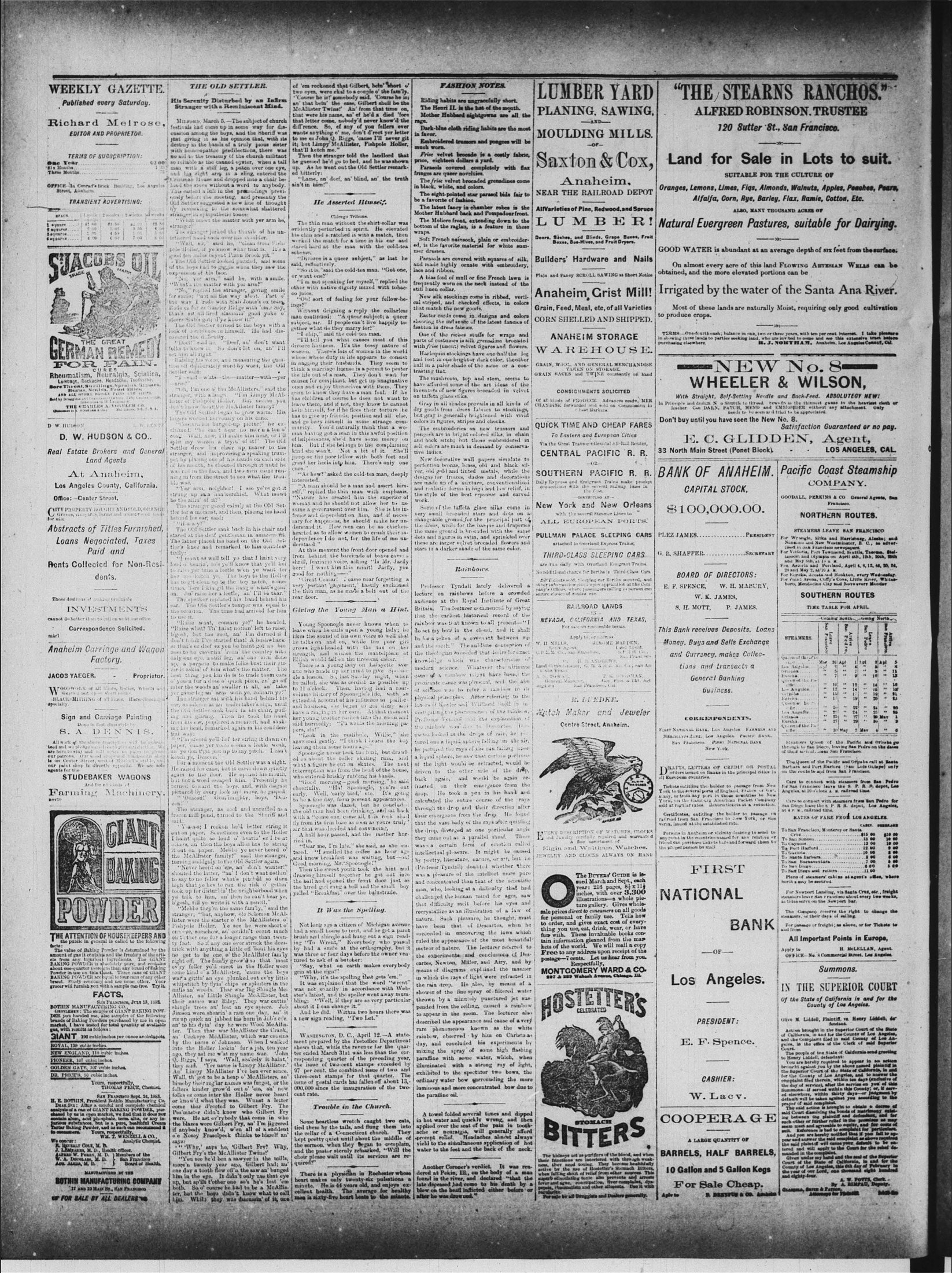
Searchable text
WEEKLY GAZETTE.
Published every Saturday.
Richard Melrose,
EDITOR AND PROPRIETOR.
TERMS OF SUBSCRIPTION:
One Year.....$2.00
Rix Months.....1.50
Three Months.....7.50
OFFICE: In Comrad's brick Building, Los Angeles Street, Anahaim.
TRANSIENT ADVERTISING:
SPACE
1 square...81.00
2 squares...2.00
3 squares...5.00
4 squares...4.00
5 squares...6.00
THE GREAT GERMAN REMEDY FOR PAIN.
CURES
Rheumatism, Neuralgia, Sciatica,
Lumbage, Backache, Headache, Toothache,
Sore Throat, Nausea, Spinal Muscle,
Hurts, Needs, Frost Hits,
AND ALL OTHER BODY PAINS AND AILTS.
Bldd by Druguese and Co.
THE CHARLES A. VOGULER CO.
Commencement to May 1st.
D. W. HUDSON
D. W. HUDSON & CO..
Real Estate Brokers and General Land Agents
At Anaheim.
THE OLD SETTLER.
His Serenity Disturbed by an Infirm Stranger with a Reminiscent Mind.
Milford, March 5.—The subject of church festivals had come up in some way for discussion among the boys, and the Sheriff was just giving it as his opinion that, with its destiny in the hands of a truly pious sister with homoeopathic predilections, there was no aid to the treasury of the church militant so reliable as the canned oyster, when a tail man with a stiff leg, a paten over one eye, and his right arm in a sling, entered the Crusman House and dropped into a chair behind the stove without a word to anybody. This caused a full in the proceedings previously before the meeting, and presently the Old Settler suggested a new line of thought by remarking to the somewhat shattered stranger in sympathetic tones:
"What mowt the matter with yer arm be, stranger?
The stranger jerked the thumb of his un-tethered hand each over his shoulder.
"Wail, sir," said he, "clean from Fishpole Holder, if ye know what that is. It's a good ten miles beyond Pizun Brook yet."
The Old Settler looked puzzled, and some of the boys had to giggle when they saw the expression of his face.
"No, yer arm," said he, with a smile.
"What's the matter with yer arm?"
No, replied the stranger, giving smile for smile; "not all the way about. Part o' the way I rode with Slab Jones's ox team, Rhode ez for ex Gander Ridge with 'omz Say, that's an all fired slammin' good yoke o steers Slab's got; d'ye know it?"
The Old Settler turned to the boys with a look of constance in himself. He had discovered the difficulty.
"Doe!" said he. "Deef, an' don't want folks to know it. So don't let on, an' I'll set him all right."
Raising his voice, and measuring the question of deliberately word by word, the Old Settler said:
"I—said—wats—the-matter-with-yer-arm?"
Oh, I'm one of the McAllisters," said the stranger, with a laugh. "I'm Limpy McAllister of Fishpole Holder. But maybe you don't know your McAllister family!"
The Old Settler began to grow warm. His fingers worked nervously on his cane.
"Concern has bunged-up picture!" he exclaimed, "he can't hear no morn a ton o' coal." Wall now, I'd make him near, or I'll split my wizzen a trym' of it!" The Old Settler drew his chair up nearer to the stranger, and improvising a speaking trumpet by placing one of his hands on each side of his mouth, he shouted through it until he was rad in the face, and two men came run-of'em reckoned that Gwen two eyes were ekal to say "'Course he is! somebody an' that bein' the case, McAllister Twins!" And that were his name, an' that letter come, nobody difference. So, ef any y wants anything o' me, do to me ez John Q. Rigga; it; but Limpy McAllister that'll ketch me."
Then the stranger told he guessed he'd go to bed up. As he went out the ed bitterly:
"Lame, an' deef, an' hain't in him!"
He Asserted:
Chicago Trader
The thin man without evidently perturbed in a his clim and a ratched it worked the match for a stared hard at the man scheme:
"Divorce is a queer sire said, reflectively.
"So it is," said the cold or want one?
"I'm not speaking for other with native dignity co juice."
"Ob sort of feeling inges?"
Without designating a man continued: "A queer subject, sir. If people can gether what do they marry"
"I chip," said the color"
"I'll tell you what our divorce business. It's thie women. There's lots of whose whole duty in life in nagging their husband think a marriage license the life out of a man. The cause for complaint, but ones and enjoy themselves seem to know they have has children of course he leave them, and if not, to help himself, for if he flees has to give up friends, po and go bury himself in munity. You'd natural man having got a man in helplessness, she'd haunt him. But if she belongs kind she won't. Not a jump on the poor fellow grind her heels into him cure."
As how?" asked the c
D. W. HUDSON & CO.
Real Estate Brokers and General Land Agents
At Anaheim,
Los Angeles County, California.
Office:—Center Street,
Abstracts of Titles Furnished,
Loans Negotiated, Taxes Paid and
Rents Collected for Non-Residents.
Those desirous of making profitable
INVESTMENTS cannot do better than to call on us at our office.
Correspondence Solicited.
mary1
Anaheim Carriage and Wagon Factory.
JACOB YAEGER, Proprietor.
Woodwork of all kinds, Bodiest, Wheels and Gearing put up on short notice.
BLACKSMITHING of all kinds, Horse-Shoeing a specialty.
Sign and Carriage Painting
Done in first-class style by S. A. DENNIS.
All work of the shop description will be enclosed lead and we please ground both goods satisfaction. We are here to stay and will secure no papers to present our patrons. Our wood shop and blacksmith shop is on Center Street, west of Mitchell's stall, and our paint shop is directly opposite. We are sole agents for the STUDEBAKER WAGONS And for all kinds of Farming Machinery.
GIANT BAKING
"I—said w'ats—the matter—with—yer arm."
Oh, I'm one of the McAllisters," said the stranger, with a laugh. "I'm Lumpy McAllister of Pisapole Holler. But maybe you don't know the McAllister family."
The Old Settler began to grow warm. His fingers worked nervously on his cane.
"Concern has hunged-up picture!" he exclaimed. "the can't hear no mornin' a ton o' coon Wall, now, I'll make him near, or I'll split my wizzen a tryin' of it!" The Old Settler drew his chair up nearer to the stranger, and improvising a speaking trumpet by placing one of his hands on each side of his mouth, he shouted through it until he was railed in the face, and two men came running in from the street to see what the trouble was.
"Yer arm, neighbor! I see ye've got it string up in a hamker chief. What mowt be the aim' of it?"
The stranger gazed calmly at the Old Settler for a moment, and then, placing his hand behind his ear, said:
"Ha-ayy!
The Old Settler sank back in his chair and stared at the deaf gentleman in amazement. The latter placed his hand on the Old Settler's knee and remarked to him confidently:
"I mowt as well tell ye that I haint very loud o hearin', soo yell know that yell will raise yer tune a leetle wen ye want ter hew me ketch ye. The boys to the Holler has to get clean up to the top noten, sometimes, fore I kin git the hang o what's goin' on. Jas' raise her a leetle, an 'I'll be thar."
The speaker replaced his hand behind his ear. The Old Settler's temper was equal to the occasion. The time had arrived for him to use it.
"Raise what, consarn ye?" he howled.
"Raise what? Tr' haunt nothin' left to raise, bigoh, but the root, an' I'm darned if I don't think I've started that! A busswhacker that's ez deef ez you be haint got no bizness to be cavortin' from the country wit only one eye, a still leg, an' one arm done up, a purpose to make folks bust their gizards askin' of him what's the matter. The best thing you kin do is to trade them cars of younn fur a dose o' quik picken, an' go off inter the woods an' swaller it all, an' take yer game leg an' arm with ye, consarn ye."
The stranger sat with his hand behind his ear, as solenon as an undertaker's sign, until the Old Settler sank back in his chair, puffing and glaring. Then he took his hand from his ear, popped a moment, and shaking his head, remarked again in his confidential way:
"I'm accord ye'll heft ter string it down on paper, cause yer voice seems a leetle weak, an ye don't grit just up to my pitch. I can't ketch ye, Deacon."
For a moment the Old Settler was a sight. He raised his case, but it came down quietly again to the door. He opened his mouth, but not a word escaped him. Presently he turned toward the boys, and, with daugest pictured by every look and move, he gasped:
"Deacon! Goos! haughty, boys, Deacon."
The stranger, as cool and unruffled as a frozen mill pond, turned to the Sheriff and said:
"Ya-aas; I reckon he'd better string it out on paper. Sometimes even to the Holler I haunt quite so loud o' hearin' ez I be at others, an then the boys alles has to string it out on paper. Mobles ye never heard o' the McAllister family?" said the stranger, turning suddenly to the Old Settler again.
"Never heard on 'em, an' don't wantter! shouted the latter, 'an I don't want nothn' to say to no feller what's pitched so durm high that ye hev to run the risk o' gettn' took up for disturbin' the neighborhood when ye talk to him, an' then he can't hear ye."
"I—said w'ats—the matter—with—yer arm."
Oh, I'm one of the McAllisters," said the stranger, with a laugh. "I'm Lumpy McAlister of Pisapole Holler. But maybe you don't know how the McAllister family."
The Old Settler began to grow warm. His fingers worked nervously on his cane.
"Concern has hunged-up picture!" he exclaimed. "the can't hear no mornin' a ton o' coon Wall, now, I'll make him near, or I'll split my wizzen a tryin' of it!" The Old Settler drew his chair up nearer to the stranger, and improvising a speaking trumpet by placing one of his hands on each side of his mouth, he shouted through it until he was railed in the face, and two men came running in from the street to see what the trouble was.
"Yer arm, neighbor! I see ye've got it string up in a hamker chief. What mowt be the aim' of it?"
The stranger gazed calmly at the Old Settler for a moment, and then, placing his hand behind his ear, said:
"Ha-ayy!
The Old Settler sank back in his chair and stared at the deaf gentleman in amazement. The latter placed his hand on the Old Settler's knee and remarked to him considertially:
"I mowt as well tell ye that I haint very loud o hearin', soo yell know that yell will raise yer tune a leetle wen ye want ter hew me ketch ye. The boys to the Holler has to get clean up to the top noten, sometimes, fore I kin git the hang o what's goin' on. Jas' raise her a leetle, an 'I'll be thar."
The speaker replaced his hand behind his ear. The Old Settler's temper was equal to the occasion. The time had arrived for him to use it.
"Raise what, consarn ye?" he howled.
"Raise what? Tr' haunt nothin' left to raise, bigoh, but the root, an' I'm darned if I don't think I've started that! A busswhacker that's ez deef ez you be haint got no bizness to be cavortin' from the country wit only one eye, a still leg, an' one arm done up, a purpose to make folks bust their gizards askin' of him what's the matter. The best thing you kin do is to trade them cars of younn fur a dose o' quik picken, an' go off inter the woods an' swaller it all, an' take yer game leg an' arm with ye, consarn ye."
The stranger sat with his hand behind his ear, as solenon as an undertaker's sign, until the Old Settler sank back in his chair, puffing and glaring. Then he took his hand from his ear, popped a moment, and shaking his head, remarked again in his considertial way:
"I'm accerd yo'll heft ter string it down on paper, cause yer voice seems a leetle weak, an ye don't grit just up to my pitch. I can't ketch ye, Deacon."
For a moment the Old Settler was a sight. He raised his case, but it came down quietly again to the door. He opened his mouth, but not a word escaped him. Presently he turned toward the boys, and with daugest pictured by every look and move, he gasped:
"Deacon! Goos! haughty, boys, Deacon."
The stranger, as cool and unruffled as a frozen mill pond, turned to the Sheriff and said:
"Ya-aas; I reckon he'd better string it out on paper. Sometimes even to the Hollerin I haunt quite so loud o' hearin' ez I be at others, an then the boys alles has to string it out on paper. Mobles ye never heard o' the McAllister family?" said the stranger, turning suddenly to the Old Settler again.
"Never heard on 'em, an' don't wantter! shouted the latter, 'an I don't want nothn' to say to no feller what's pitched so durm high that ye hev to run the risk o' gettn' took up for disturbin' the neighborhood when ye talk to him, an' then he can't hear ye."
THE ATTENTION OF HOUSEKEEPERS AND
the public in general is called to the following facts:
The value of Baking Powder is determined by the amount of gas it contains and the freedom of the article from any injurious ingredients. The GIANT BAKING POWDER is absolutely pure, and contains about one-quarter more gas than any brand of Baking Powder in use on this Coast. Three cans of GIANT BAKING POWDER are equal to four cans of any other brand. Study economy and use none other. Your grocer will furnish you with a sample can free. Try it.
FACTS.
San Francisco, July 13, 1883.
BOTHIN MANUFACTURING CO.
Gentlemen: The sample of GIANT BAKING POWDER you handed me, also samples of the following brands of Baking Powders purchased by me in open market, I have tested for total quantity of available gas, with results as follows:
GIANT 190 cubic inches per ounce avoiddupota.
ROYAL, 159 cubic inches.
NEW ENGLAND, 110 cubic inches.
PIONEER, 107 cubic inches.
GOLDEN GATE, 107 cubic inches.
DR. PRICE'S, 90 cubic inches.
Yours, respectfully,
THOMAS PRICE, Chemist.
San Francisco Sept. 24, 1883.
H. E. BOTHIN, President Bothin Manufacturing Co.
Dear Sir: After a careful and complete chemical analysis of a can of GIANT BAKING POWDER, purchased by us in open market, we find that it does not contain alum, acid phosphate, term alia, or any injurious substances, but is a pure, healthful Cream Tartar Baking Powder, and as such can recommend it to consumers.
WM. T. WENZELL & CO., Analytic Chemist.
R. HERVELLY COLE, M. D.
J. LEMPAES, M. D., Health officer.
ALFRED W. PERRY, M. D.
W. A. DOUGLASS, M. D.
San Francisco Board of Health.
MANUFACTURED BY THE
BOTHIN MANUFACTURING COMPANY
17 AND 12 MAIN ST., SAN FRANCISCO
FOR SALE BY ALL DEALERS
The stranger, as cool and unruffled as a frozen mill pond, turned to the Sheriff and said:
"Ye-a-s; I reckon he'd better string it out on paper. Sometimes even to the Holler I haunt quite so loud o' nearness ez I be at others, au then the boys allus has to string it out on paper. Mobile ye never heard o' the McAllister family?" said the stranger, turning suddenly to the Old Settler again.
"Never heard on 'em, an' don't wanter!" shouted the latter, "an' I don't want nothing to say to no feller what's puffball so durn high that ye hey to run the risk o' gettn' took up for disturbin' the neighborhood when ye talk to him, an' then he can't hear ye, b'gosh, till ye write it with a pencil."
"Mebbe they'm the same family," said the stranger; "but, anyhow, ole Selomon McAllister were the starter o' the McAllisters o' Fishpole Holler. Ye see he wore short o' ones eye, somehow, an' couldn't count much on either one far a longer range than twenty foot. So if any one ever struck the dee-trick with anything a little off about his eyes he got to be one, o' the McAllister family right off. The family growd so that 'most evry feller yo'd sneet in the Holler were some kind o' o' the McAllister, cause the boys war a gittin' an eye plunked out evry littie whipstitch by flyin' chips or splinters in the mills an' woods. Thar war Big Shingle McAllister, an' Little Shingle McAllister, but their names war Riley. They war cuttin' shingle trees an' lost an eye apiece. Job Jimson were shearin'a ram one day, an' it riz up quick an' jabbed his horn in job's eye. an' to his dyin' day he were Wool McAllister.
Then thar war McAllister the Crank, an' Cookeye McAllister, which war cousins by the name o' Johnson. When I walked into the Holler lookin' fur a job, ten year ago, they ast me w'att my name war. John Q. Rugga,' I says. 'Wall, sea-cely it haint,' they said. 'Yer name is Limpy McAllister.' An' Limpy McAllister I've ben ever sence. Wall, th got to be a heap o' McAllisters, an' bimby their regular names was forgot, or the fellers kinder growd out o' em, an' new folks ez come inter the Holler never heard or know'd what they was. Wunat a letter come thar d'rected to Gilbert Fry. The Pos master didn't know who Gilbert Fry were. He ast evrybody that come in who the blazes were Gilbert Fry, an' I'm jiggered if anybody know'd, w'en all of a suddent o'e Nosey Fraselpeek thinks to hiself an' says:
"'Why,' says he, 'Gilbert Fry? Why, Gilbert Fry's the McAllister Twins!'
"You see he'd ben a sawyer in the mills, more'n twenty year age, Gilbert had; an' one day a tooth flaw off'n the saw an' bunged him in the eye. It didn't only use that eye up, but spilt t'tother one so's he's lost 'em both. So o' course he had to be a McAllister, but the boys didn't know what to call him. While they was discussin'in of it, one"
The stranger, as cool and unruffled as a frozen mill pond, turned to the Sheriff and said:
"Ye-a-s; I reckon he'd better string it out on paper. Sometimes even to the Holler I haunt quite so loud o' nearness ez I be at others, au then the boys allus has to string it out on paper. Mobile ye never heard o' the McAllister family?" said the stranger, turning suddenly to the Old Settler again.
"Never heard on 'em, an' don't wanter!" shouted the latter, "an' I don't want nothin' to say to no feller what's puffball so durn high that ye hey to run the risk o' gettn' took up for disturbin' the neighborhood when ye talk to him, an' then he can't hear ye, b'gosh, till yo write it with a pencil."
"Mebbe they're'm the same family," said the stranger; "but, anyhow, ole Selomon McAllister were the starter o' the McAllisters o' Fishpole Holler. Ye see he wore short o' ones eye, somehow, an' couldn't count much on either one far a longer range than twenty foot. So if any one ever struck the dee-trick with anything a little off about his eyes he got to be one, o' the Mcallister family right off. The family growd so that 'most evry feller yo'd sneet in the Holler were some kind o' o' the Mcallister, cause the boys war a gittin' an eye plunked out evry littie whipstitch by flyin' chips or splinters in the mills an' woods. Thar war Big Shingle McAllister, an' Cookeye McAllister which war cousins by the name o' Johnson. When I walked into the Holler lookin' fur a job, ten year ago, they ast me w'att my name war. John Q. Rugga,' I says. 'Wall, sea-cely it haint,' they said. 'Yer name is Limphy McAllister.' An' Limpy McAllister I've ben ever sense. Wall, th got to be a heap o' Mcallisters, an' bimby their regular names was forgot, or the fellers kinder growd out o' em, an' new folks ez come inter the Holler never heard or know'd what they was. Wunat a letter come thar d'rected to Gilbert Fry. The Pos master didn't know who Gilbert Fry were. He ast evrybody that come in who the blazes were Gilbert Fry, an' I'm jiggered if anybody know'd, w'en all of a suddent o'e Nosey Fraselpeek thinks to hisself an' says:
"'Why,' says he, 'Gilbert Fry? Why, Gilbert Fry's the McAllister Twins!"
"You see he'd ben a sawyer in the mills, more'n twenty year age, Gilbert had; an' one day a tooth flaw off'n the saw an' bunged him in the eye. It didn't only use that eye up, but spilt t'tother one so's he's lost 'em both. So o' course he had to be a McAllister, but the boys didn't know what to call him. While they was discussin'in of it, one"
The stranger, as cool and unruffled as a frozen mill pond, turned to the Sheriff and said:
"Ye-a-s; I reckon he'd better string it out on paper. Sometimes even to the Holler I haunt quite so loud o' nearness ez I be at others, au then the boys allus has to string it out on paper. Mobile ye never heard o' the Mcallister family?" said the stranger, turning suddenly to the Old Settler again.
"Never heard on 'em, an' don't wanter!" shouted the latter, "an' I don't want nothin' to say to no feller what's puffball so durn high that ye hey to run the risk o' gettn' took up for disturbin' the neighborhood when ye talk to him, an' then he can't hear ye, b'gosh, till yo write it with a pencil."
"Mebbe they're'm the same family," said the stranger; "but anyhow, ole Selomon McAllister were the starter o' the Mcallisters o' Fishpole Holler. Ye see he wore short o' ones eye, somehow, an' couldn't count much on either one far a longer range than twenty foot. So if any one ever struck the dee-trick with anything a little off about his eyes he got to be one, o' the Mcallister family right off. The family growd so that 'most evry feller yo'd sneet in the Holler were some kind o' o' the Mcallister, cause the boys war a gittin' an eye plunked out evry littie whipstitch by flyin' chips or splinters in the mills an' woods. Thar war Big Shingle McAllister, an' Cookeye McAllister which war cousins by the name o' Johnson. When I walked into the Holler lookin’ fur a job,ten year ago,they ast me w'att my name war. John Q. Rugga,’ I says. 'Wall,sea-cely it haint,' they said. 'Yer name is Limphy McAllister.' An’ Limphy McAllister I've ben ever sense. Wall,th got to be a heap o’ Mcallisters,an’ bimby their regular names was forgot,或the fellers kinder growd out o’ em,an’ new folks ez come inter the Holler never heard or know'd what they was.Wunat a letter come thar d'rected to Gilbert Fry.The Pos master didn't know who Gilbert Fry were.Hest evrybody that come in who the blazes were Gilbert Fry,an’ I'm jiggered if anybody know'd,w’en all of a suddent o'e Nosey Fraselpeek thinks to hisself an’ says:
"'Why,’ says he,‘Gilbert Fry? Why, Gilbert Fry's the McAllister Twins!"
"You see he'd ben a sawyer in the mills,more'n twenty year age,Gilbert had;an’ one day a tooth flaw off'n the saw an’ bunged him in the eye.In didn’t only use that eye up,但 spilt t'tother one so’s he's lost ’em both.So o’ course he had to be a McAllister,但the boys didn’t know what to call him." While they was discussin’in of it,one
of 'em reckoned that Gilbert, behn' short o' two eyes, were ekal to a couple o' the family.
"Course he is! somebody said. 'Course he is; an that bein' the case, Gilbert shell be the McAllister Twins!' An' from that time on, that were his name, an' ef he'd a died 'fore that letter come, nobody'd never know'd the difference. So, ef any of you fellers ever wants anything o' me, don't d'rect yer letter to me es John Q. Riggs, 'cause I'll never git it; but Limpy McAllister, Fishpole Holler, that'll ketch me."
Then the stranger told the landlord that he guessed he'd go to bed, and he was shown up. As he went out the Old Settler remarked bitterly:
"Lame, an' deef, an' blind, an' the truth ain't in him!"
He Asserted Himself.
Chicago Tribune.
The thin man without the shirt-collar was evidently perturbed in spirit. He elevated his chin and a ratched it with a match, then worked the match for a time in his ear and stared hard at the man with the cold-tea scheme.
"Divorce is a queer subject," as last he said, reflectively.
"So it is," said the cold-tea man. "Got one, or want one?"
"I'm not speaking for myself," replied the other with native dignity mixed with tobacco juice.
"Oh! sort of feeling for your fellow-beings?"
Without designating a reply the collarless man continued: "A queer subject; a queer subject, sir. If people can't live happily together what do they marry for?"
"I chip," said the cold-tea man.
"I'll tell you what causes most of this divorce business. It's the bossy nature of women. There's lots of women in the world whose duty in life appears to consist in nagging their husbands. They seem to think a marriage license is a permit to pester the life out of a man. They don't wait for cause for complaint, but get up imaginative ones and enjoy themselves with them. They seem to know they have a man foul. If he has children of course he does not want to leave them, and if not, they know he cannot help himself, for if he flees their torture he has to give up friends, position and all else, and go bury himself in some strange community. You'd naturally think that a woman having got a man in this awful position of helplessness, she'd have some mercy on him. But if she belongs to the complaining kind she won't. Not a bit of it. She'll jump on the poor fellow with both feet and grind her heels into him. There's only one cure."
FASHION NOTES.
Riding habits are ungracefully short.
The Henri IL is the hat of the mouth.
Mother Hubbard nightgowns are all the rage.
Dark-blue cloth riding habits are the most in favor.
Embroidered trussors and pongees will be much worn.
Frise velvet brocade is a costly fabric, price, eighteen dollars a yard.
Parasols covered completely with flax fringes are queer novelties.
The frise velvet brocaded grenadines come in black, white, and colors.
The eight-pointed star parasol bids fair to be a favorite of fashion.
The latest fancy in chamber robes is the Mother Hubbard back and Pompadour front.
The Moliere front, extending down to the bottom of the raglan, is a feature in these wraps.
Soft French nainsook, plain or embroidered, is the favorite material for white summer dresses.
Parasols are covered with squares of silk, and made highly ornate with embroidery, lace and ribbon.
A bias fold of mull or fine French lawn is frequently worn on the neck instead of the still linen collar.
New silk stockings come in ribbed, vertical striped, and checked effects, in colors that match the new goods.
Easter cards come in designs and colors showing the influence of the latest fancies of fashion in dress fabrics.
One of the riches stuffs for wraps and parts of costumes is silk grenadine brocaded with frise (uncut) velvet figures and flowers.
Harlequin stockings have one-half the leg and foot in one bright dark color, the other half in a paler shade of the same or a contrasting tint.
The mushroom, top and stem, seems to have afforded some of the art ideas of the inventors of new figures brocaded in velvet on tafteta glace stiks.
Gray in all shades prevails in all kinds of dry goods from dress fabrics to stockings, but gray is generally brightened with vivid colors in figures, stripes and checks.
The embroideries on new trussors and pongees are in bright colored silks, in chain and back sitch; but those emboidered in self colors are much in demand by conservative ladies.
New decorative wall papers simulate to perfection bronze, brass, old and black silver, old gold and tinted metals, while the
LUMBER YARD PLANING. SAWING,
AND MOULDING MILLS.
OF
Saxton & Cox,
Anaheim.
NEAR THE RAILROAD DEPOT
All Varieties of Pine, Redwood,and Spruce
LUMBER!
Doors,Sashes,and Blinds,Grape Boxes,Fruit Boxes,Bee-Hives,and Fruit Dryers.
Builders' Hardware and Nails
Plain and Fancy SCKOLL SAWING at Short Notice
Anaheim Grist Mill!
Grain,Feed,Meal,etc.ofall Varieties CORN SHELLED AND SHIPPED.
ANAHEIM STORAGE
WAREHOUSE.
GRAIN,WOOL AND GENERAL MERCHANDISE TAKEN ON STORAGE
GRAIN SACKS and TWINE constantly on hand
CONSIGNMENTS SOLICITED
Of all kinds of PRODUCE Advances made MER CHANDISE forwarded and sold on Commission in best Markets.
QUICK TIME AND CHEAP FARES
To Eastern and European Cities
Via the Great Transcontinental All-Nail Routes,
CENTRAL PACIFIC R.R.
OR
SOUTHERN PACIFIC R.R.
The life out of a man. They don't wait for cause for complaint, but get up imaginative ones and enjoy themselves with them. They seem to know they have a man foul. If he has children of course he does not want to leave them, and if not, they know he cannot help himself, for if he flees their torture he has to give up friends, position and all else, and go bury himself in some strange community. You'd naturally think that a woman having got a man in this awful position of helplessness, she'd have some mercy on him. But if she belongs to the complaining kind she won't. Not a bit of it. She'll jump on the poor yellow with both feet and grind her heels into him. There's only one cure."
"As how?" asked the cold-tea man, deeply interested.
"A man should be a man and assert himself," replied the thin man with emphasis. "Nature has created him the superior of woman and he should not allow her to assume a government over him. She is his inferior and dependent on him, and if necessary for happiness, he should make her understand it. How men can be so chickenhearted as to allow women to crush their independence I do not, for the life of me understand."
At this moment the front door opened and from behind the barricade of boxes came a shrill, feminine voice, asking "Is Mr. Jardy here? I want him this morning! Jardy, you good for nothing—"
"Great Coanar! I came near forgetting a very 'portant' gagement," hastily exclaimed the thin man, as he made a bolt out of the rear door.
Giving the Young Man a Hint.
Young Spoonogle never knows when to leave when he calls upon a young lady; he likes the sound of his own voice so well that he talks on and on, while the poor girl grows light-headed with the tax on her strength, and wishes the mantlepiece of Elijah would fall on the tiresome caller.
There is a young lady on Lafayette avenue who made up her mind to give Spoonogle a lesson. So last Sunday night, when he called, she was as cordial as possible up to 11 o'clock. Then, having had a four-volume history of Spoonogle's life, with an extended account of his influence in politics and business, she began to get dizzy and have a ring in her ears. At that moment her young brother ran into the room and said hurriedly: "Pa wants the morning papers, sis!"
"Look in the vestibule, Willie," she answered gently. "I think I heard the boy leaving them some hours ago."
Spoonogle never took the hint, but drawled on about the roller skating rink, and what a figure he cut on skates. The next interruption was from the head of the house, who entered briskly rubbing his hands.
"Good morning—good morning," he said cheerfully. "Ha! Spoonogle, you're out early. Well, early bird," etc. It's going to be a fine day, from present appearances.
Spoonogle was dazed, but he concluded the old man had been drinking, and sat back with a "come one, come all, this rock shall fly from its firm base as soon as yours truly" air that was decided and convincing.
A half hour passed, and the mother hurried in.
Dear me, I'm late," she said, as she entered. "I smelled the coffee an hour ago and knew breakfast was waiting, but—on Good morning, Mr. Spoonogle!"
Then the sweet youth took the hint and drawing himself together he got out into the hall and opened the front door just as the hired girl rang a ball and the small boy yelled "Breakfast" over the balustrade.
The mushroom, top and stem, seems to have afforded some of the art ideas of the inventors of new figures brocaded in velvet on tafteta glace stika.
Gray in all shades prevails in all kinds of dry goods from dress fabrics to stockings, but gray is generally brightened with vivid colors in figures, stripes and checks.
The embroideries on new trussors and pencers are in bright colored silks, in chain and back stitch; but those embroidered in self-colors are much in demand by conservative ladies.
New decorative wall papers simulate to perfection bronze, brass, old and black silver, old gold and tinted metals, while the designs for frozes, dados and decorations are made up of a mixture, conventionalized and realistic forms in high and low relief, in the style of the beat repousse and carved work.
Some of the tafteta glace silks come in very small brocaded stars and dots on a changeable ground for the principal part of the dress, while for the basque and draperies the same ground is brocaded with the same dots and figures in satin, and sprinkled over these are larger velvet brocaded flowers and stars in a darker shade of the same color.
Rainbows.
Professor Tyndall lately delivered a lecture on rainbows before a crowded audience at the Royal Institute of Great Britain. The lecturer commenced by saying that the earliest historical record of the rainbow was that known to all present—"I do set my bow in the cloud, and it shall be for a token of a covenant between me and the earth." The subtime conception of thetheologian exceeded that desire for exact knowledge which was characteristic of modern science. Whatever the ultimate cause of a rainbow might have been, the proximate cause was physical, and the aim of science was to refer a rainbow to its physical principles. After referring to the labors of Keeler and Wilbard Snell in investigating the phenomenon of the rainbow, Professor Tyndall and the explanation of the rainbow was closed.
Cartes looked at the drops of rain, he pictured one a liquid sphere falling in the air; he pictured the rays of the sun falling upon a liquid sphere; he saw that certain portions of the light would be retracted, would be driven to the other side of the drop, back again, and would be again refracted on their emergence from the drop. He took a pen in his hand and calculated the entire course of the rays through the drop and their direction after their emergence from the drop. He found that the vast body of the rays after quitting the drop, diverged at one particular angle they came out as a parallel sheaf. There was—a certain form of emotion called intellectual pleasure. It might be caused by poetry, literature, nature or art; but he (Professor Tyndall) doubted whether there was a pleasure of the intellect more pure and concentrated than that of the scientific man, who looking at a difficulty that had challenged the human mind for ages, saw
to be a fine day, from present appearances.
Spoonogle was dazed, but he concluded the old man had been drinking, and sat back with a "come one, come all, this rock shall fly from its firm base as soon as yours truly" air that was decided and convincing.
A half hour passed, and the mother hurried in.
"Dear me, I'm late," she said, as she entered. "I smelled the coffee an hour ago and knew breakfast was waiting, but—on Good morning, Mr. Spoonogle!"
Then the sweet youth took the hint and drawing himself together he got out into the bail and opened the front door just as the hired girl rang a ball and the small boy yelled "Breakfast" over the balustrade.
It Was the Spelling.
Not long ago a citizen of Michigan avenue had a small house to tent, and he got a paint brush and shingle and hung out a sign reading "To Wrent." Everybody who passel by had a smile at the orthography, but it was three or four days before the owner ventured to ask of a butcher:
"Say, what on earth makes everybody grin at the sign?"
"Why, it's the spelling that gets 'em."
It was explained that the word "wrent" was not exactly in accordance with Webster's latest, and the speller went away mumbling: "Well, if they are so very particular about it I can change it."
And he did. Within two hours there was a new sign reading, "Two Let."
WASHINGTON, D.C., April 12. A statement prepared by the Postoffice Department shows that, while the revenue for the quarter ended March 31st was less than the corresponding quarter of the preceding year, the issue of two-cent stamps exceeded by 27 per cent, the combined issue of two and three-cent stamps for that quarter. The issue of postal cards has fallen off about 13,000,000 since the inauguration of the two-cent rate.
Trouble in the Church.
Some heartless wretch caught two cats, tied them by the tails, and flung them into the cellar of a Connecticut church. They kept pretty quiet until about the middle of the sermon, when they began to complain, and the pastor sternly remarked, "Will the choir please wait until its services are required?"
There is a physician in Rochester whose heart makes only twenty-six pulsations a minute. He is 44 years old, and enjoys excellent health. The average for healthy men is sixty-five heart beats to the minute.
A towel folded several times and dipped in hot water and quickly wrung, and then applied over the seat of the pain in toothache or neuralgia, will generally afford prompt relief. Headaches almost always yield to the simultaneous application of hot water to the feet and the back of the neck.
Another Coroner's verdict. It was rendered at Pekin, Ill., on the body of a man found in the river, and declared "that the late deceased had come to his death by a blow on the head inflicted either before or after he was drowned."
THE STEARNS RANCHOS.
ALFRED ROBINSON. TRUSTEE
120 Sutter St., San Francisco.
Land for Sale in Lots to suit.
SUITABLE FOR THE CULTURE OF
Oranges, Lemons, Limes, Figs, Almonds, Walnuts, Apples, Peaches, Pears,
Alfalfa, Corn, Rye, Barley, Flax, Ramie, Cotton, Etc.
ALSO, MANY THOUSAND ACRES OF
Natural Evergreen Pastures, suitable for Dairying.
GOOD WATER is abundant at an average depth of six feet from the surface.
On almost every acre of this land FLOWING ARTESIAN WELLS can be obtained, and the more elevated portions can be
Irrigated by the water of the Santa Ana River.
Most of these lands are naturally Moist, requiring only good cultivation to produce crops.
TERMS: One-fourth cash; balance in one, two or three years, with ten per cent interest. I take pleasure in showing these lands to parties seeking land, who are invited to come and see this extensive tract before purchasing elsewhere.
R. J. NORTHAM. Anaheim, Los Angeles County, Cal.
NEW No. 8
WHEELER & WILSON,
With Straight, Self-Setting Needle and Back-Feed. ABSOLUTEGY NEW!
In Principle and design. No Shuttle to thread. News from the thinnest gauge to the heaviest cloth or leather. Can DARN, PATCH, MEND and EMBROIDER without any attachment. Only needs to be seen and tried to be appreciated.
Don't buy until you have seen the New No. 8.
Satisfaction Guaranteed or no pay.
E. C. GLIDDEN, Agent,
33 North Main Street (Ponet Block). LOS ANGELES, CAL.
BANK OF ANAHEIM. Pacific Coast Steamship
WHEELER & WILSON,
With Straight, Self-Setting Needle and Back-Feed. ABSOLUTEGY NEW!
In Principle and design No Shuttle to thread. News from the thinnest gauge to the heaviest cloth or leather. Can DARN, PATCH, MEND and EMBROIDER without any attachment. Only needs to be seen and tried to be appreciated.
Don’t buy until you have seen the New No. 8.
Satisfaction Guaranteed or no pay.
E. C. GLIDDEN, Agent,
33 North Main Street (Ponet Block).
LOS ANGELES, CAL.
BANK OF ANAHEIM.
CAPITAL STOCK,
$100,000.00.
PLEZ JAMES...President
G. B. SHAFFER...Secretary
BOARD OF DIRECTORS:
E. F. SPENCE, W. H. MAPURY,
W. K. JAMES,
S. H. MOTT, P. JAMES.
This Bank receives Deposits, Loans Money, Buys and Sells Exchange and Currency, makes Collections and transacts a General Banking business.
CORRESPONDENTS.
First National Bank, Los Angeles Farmers and Merchants Bank, Los Angeles, Pacific Bank, San Francisco. First National Bank, New York.
DRITS, LETTERS OF CREDIT OR POSTAL orders issued on Banks in the principal cities in all European countries.
Tickets entitle the holder to passage from New York to the several ports of England, France or Germany, or from any port in those countries to New York, via the Hamburg American Packet Company sold at regular rates. Return tickets at a reduction.
Certificates, entitle the holder to passage on railroad from San Francisco to New York, or vice versa, issued at the established rate.
Persons in Anaheim or vicinity desiring to send to any point in the countries named for any relative or friend can purchase tickets here and forward them to the proper person by mail.
FIRST NATIONAL
Pacific Coast Steamship COMPANY.
GOODALL, PERKINS & CO. General Agents, San Francisco.
NORTHERN ROUTES.
STEAMERS LEAVE SAN FRANCISCO
For Wrangle, Sitka and Harrisonburg, Alaska; and Nanaimo and New Westminster, R. C., as advertised in San Francisco newspapers.
For Victoria, Port Townsend, Seattle, Tacoma, Stellaroom and Olympia on April 4th, 12th, 20th, 30th and May 6th, at 10 A.M.
For Astoria and Portland, April 4, 5, 12, 46, 20, 24, 28 and May 2, at 10 A.M.
For Eureka, Arcata and Hookton, every Wednesday.
For Point Arena, Cuffy’s Cove, Little River, Whitesboro; Mendocino City and Novo every Monday.
SOUTHERN ROUTES
TIME TABLE FOR APRIL.
Steamers Queen of the Pacific and Oriental go through to San Diego, leaving San Pedro on the dates of their arrival from San Francisco.
The Queen of the Pacific and Oriental call at Santa Barbara and Port Hartford (San Luis Obispo) only on the route to and from San Francisco.
Cars to connect with steamers from San Pedro for San Francisco leave the S. P. R. R. depot, Los Angeles, at 10 o’clock a.m. railroad time.
Cars to connect with steamers from San Pedro for San Diego leave the S. P. R. R. depot, Los Angeles, at 4 p.m. railroad time.
RATES OF FARE FROM LOS ANGELES.
CABIN: SERVICE
To San Francisco, Monterey or Santa Cruz.
$15.00 $10.00
To San Sancone.
$13.00 $10.00
To Cayucas.
$12.00 $10.00
To Port Harford.
$12.00 $9.00
To Gayota.
$10.00 $8.00
To Santa Barbara.
$8.00 $6.00
To San Buenaventura.
$7.00 $6.00
To San Diego.
$6.00 $6.00
To San Diego and return.
$11.00
Plans of steamers’ cabins at agent’s office, where berths may be secured.
For Newport Landing, via Santa Cruz, etc., freight steamers leave San Francisco about every two weeks.
FIRST NATIONAL BANK
OF Los Angeles.
PRESIDENT:
E. F. Spence.
CASHIER:
W. Lacv.
COOPERAGE
A LARGE QUANTITY OF
BARRELS, HALF BARRELS,
10 Gallon and 5 Gallon Kegs
For Sale Cheap.
Apply to R. BRYFUH & Co. Amalien