anaheim-gazette 1884-04-05
Scanned page
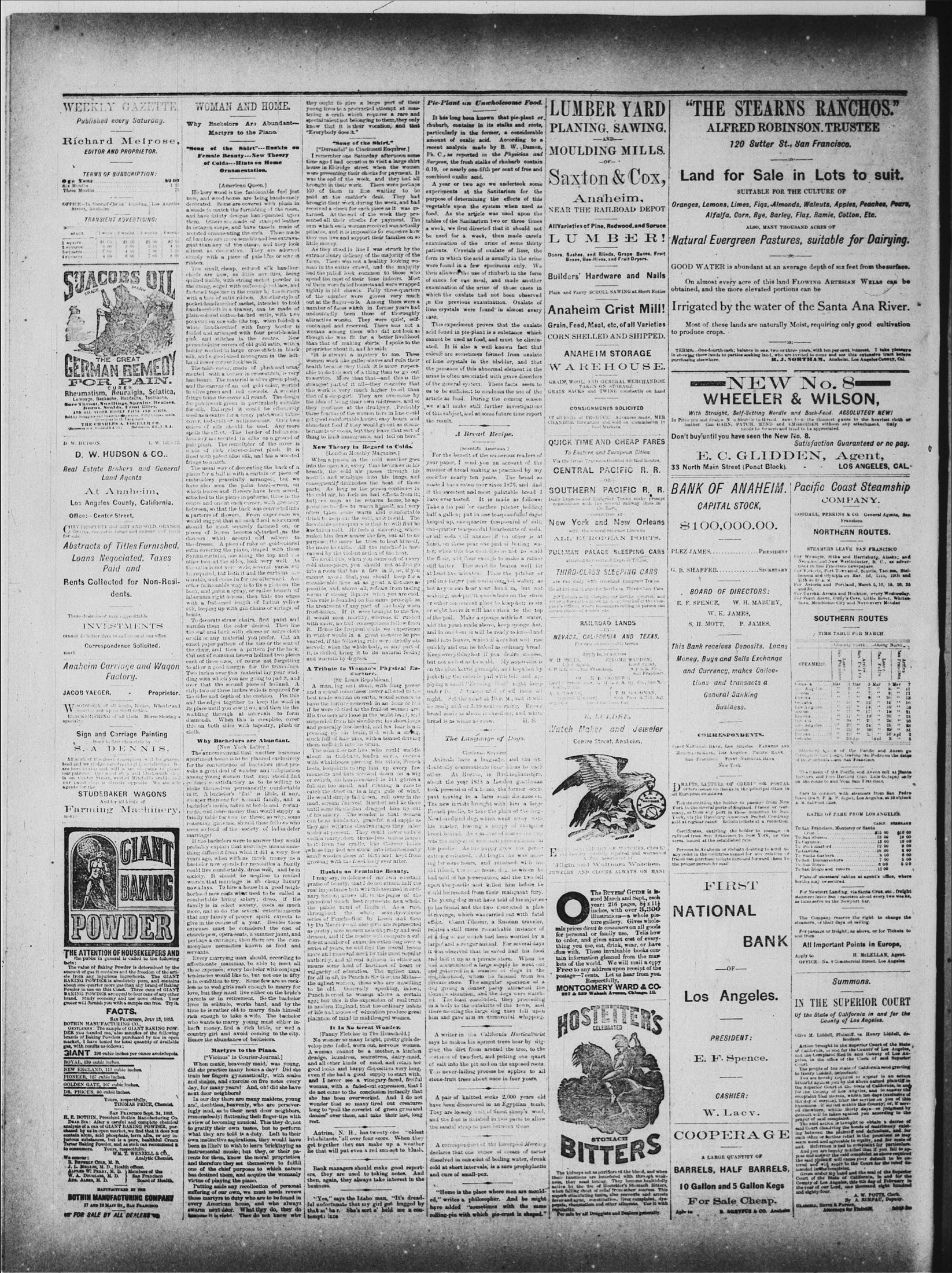
Searchable text
WEEKLY GAZETTE
Published every Saturday.
Richard Melrose,
EDITOR AND PROPRIETOR.
TERMS OF SUBSCRIPTION:
Age Year $2.00
Six Months 1.25
Three Months 75
OFFICE—In Conrad's Brick Building, Los Angeles Street, Anaheim
TRANSIENT ADVERTISING:
WOMAN AND HOME.
Why Bachelors Are Abundant—Martyrs to the Piano.
"Bong of the Shirt"...Ruskin on Female Beauty...New Theory of Colds...Hints on Home Ornamentation.
[American Queen.]
Hickory wood is the fashionable fuel just now, and wood boxes are being hand-somely decorated. Some are covered with plush in a snake to match the furnishing of the room, and have dignity designs band-painted upon them. Others are made of stamped leather in octagon shape, and have tassels made of worsted ornamenting the ends. Those made of bamboo are more sensible and less extravagant than any of the others, and they look almost as decorative. They are adorned simply with a piece of pale blue or scarlet ribbon.
The small, cheap, colored silk handkerchiefs are now, as little novelties, being quilted inside, with strong sachet powder in the timing, edged with coffee-colored face, and fastened together in the center by the corners with a bow of satin ribbon. Another style of pocket-handkerchief sachet, intended to hold handkerchiefs in a drawer, can be made of plain-colored cotton-backed satin, with two pockets; on one side (the top, when folded) a white handkerchief with fancy border is folded and arranged with four pearl-headed pink and stitches in the centre. New perambulator covers of old gold satin, with a bobber worked in large cross-stitch in black silk, and a good-sized monogram in the left-hand lower corner look well.
The table cover, made of plush and ornamented with a border in cross-stitch, is very handsome. The material is olive green plush, and the canvas of an old gold color, worked in olive green and red crewels. A worsted fringes trims the cover all round. The design for patchwork given is particularly suitable for silk. Enlarged it could be effectively used as a centre for a crazy patchwork tablecover, bed-quilt or antimacassar. Only two colors of silk should be used. Any more spells the effect. The border of Indian embroidery is executed in silks on a ground of pure plush. The remainder of the cover is made of rich claret-colored plush. It is lined with palet blue silk, and has a worsted fringe to match.
The usual way of decorating the back of a piano for a ball is with a curtain or piece of they ought to give young lives to a protering a craft which special talent not be known that it is the "Everybody does it."
"Nong o"
["Durandal"] in
I remember one time ago I had occudent in Eichridge where were presenting thouwas the end of the brood in their work
150 of them in paid at the cash
brought their work received a check fotarned. At the end sent all their chaisum which each wore pittable, and it is in
they can live and so little money.
As they stood in extraorinary deliciefaces. There was no man in the entire creehad the pulled look spend the most of thiof them worn faded tightly in old shawof the number worn out at the finger-end
number of faces who undoubtedly been attractive women.
contained and resourwoman among thouthough she was fit than that of making proprietor about it.
"It is always a women work like gessh health because they able to do this sort of to service. More thastrangest part of it this work is very n that of a shop-girl.
the idea of being thathey continue at three-fourths of the get good comfortabl abundant food if thabermaids or cooks, thing to Irish immig-
FOR PAIN.
Rheumatism, Neuraigla, Sciatica,
Lumbage, Backache, Headache, Toothache,
More Threat, Nwellings, Springs, Neuces,
Hurra, Senids, Front Lites,
AND ALL OTHER BODILY PAINS AND ATHES.
Bold by Draughtsman and Treasurer. Fifty yrs before the publication.
THE CHARLES A. VOGELER CO.
(Baltimore, MD) U.S.A.
D. W. HUDSON.
L. W. DENTZ
D. W. HUDSON & CO..
Real Estate Brokers and General Land Agents
At Anaheim,
Los Angeles County, California.
Office: - Center Street.
Abstracts of Titles Furnished,
Loans Negociated, Taxes Paid and
Rents Collected for Non-Residents.
Those designs of making profitable
INVESTMENTS cannot do better than to call on us at our office.
Correspondence Solicited.
marl
Anaheim Carriage and Waqon Factory.
JACOB YAEGER, Proprietor.
WOODWORK of all kinds, Bodies, Wheels* and tools put up on short notice.
BLACKSMITHING of all kinds Horse-Shoeing a specialty.
Sign and Carriage Painting
Done in first-class style by S. A. DENNIS.
All work of the above description will be guaranteed and we pledge ourselves to satisfies. We are here to stay and will are no plans to please our patrons. Our wood shaping and blacksmith shop is on Center Street, west of Mitchell's stable, and our paint shop is directly opposite. We are sold agents for the STUDEBAKER WAGONS
And for all kinds of Farming Machinery.
GIANT BAKING
The material is olive green plush, and the canvas of an old gold color, worked in olive green and red crewels. A woreted fringes trims the cover all round. The design for patchwork given is particularly suitable for silk. Enlarged it could be effectively used as a centre for a crazy patchwork tablecover, bed-quilt or antimacarassar. Only two colors of silk should be used. Any more spills the effect. The border of Indian embroidery is executed in silks on a ground of pale plush. The remainder of the cover is made of rich charret-colored plush. It is lined with palest blue silk, and has a woreted fringe to match.
The usual way of decorating the back of a piano for a ball is with a curtain or piece of embroidery gracefully arranged; but we have also seen the pain hand-screen, on which leaves and flowers have been sewed, attached to the piano in patterns, three in the centre and one at each corner, with greenery between, so that the back was converted into a parterre of flowers. From experience we would suggest that all such floral adornment should be most securely fastened on, or pieces of leaves become detached, as the dancers whirl around and adhere to the dresses. A piece of ruby or gold-colored satin covering the piano, drapeled with three Syrian curtains, one along the top and one other two at the sides, look very well. As the satin is not very wide, several yards will be required, but both it and the curtains are durable, and come in for use afterward. Another fashionable way is to fix a glass on the back, and paint a spray, or rather branch of laburnum right across; then hide the edges with a festooned length of Indian yellow silk, looping up with gilt chains or strings, of beads.
To decorate straw chairs, first paint and varnish them the color desired. Then line the seat and back with cheese or serge cloth or silk or any material you prefer. Cut an exact paper pattern of the size or the seat of the chair, and then a pattern for the back. Cut out of common brown holland two pieces each of these sizes, of course not forgetting to allow a good margin for the trimnings. Two inches over this material lay your wadding with which you are going to pad it, and over that the second piece of holland. A strip two or three inches wide is required for the sides and depth of the cushion. Pin this and the edges together to keep the wool in its place until you saw it on, and then tie the wadding through at intervals to form diamonds. When this is complete, cover this on both sides with tapestry, plush or cloth.
Why Bachelors are Abundant.
[New York Letter]
The announcement that another immense apartment house is to be planned exclusively for the convenience of bachelors must provoke a great deal of wonder and indignation among young women that men should indulge so satisfactory as to be willing to make themselves permanently comfortable in it. A bachelor's "flat" is little, if any, cheaper than one for a small family, and a bachelor's menis, taken at hotels and restaurants, cost more money than would supply a family table for two or three; so why, some reasoning girls ask, should these follow who seem so fond of the society of ladies defer marriage?
If the bachelors were to answer they would probably explain that marriage means something different from what it did a very few years ago, when with as much money as a bachelor now spends for necessities a family could live comfortably, dress well, and be in society. It should be nearness to remind women that marriage is no cheap luxury now always. To hire a house in a good neighborhood now costs what used to be called a comfortable living salary; dress if the handbums. The material is olive green plush, and the canvas of an old gold color, worked in olive green and red crewels. A woreted fringes trims the cover all round. The design for patchwork given is particularly suitable for silk. Enlarged it could be effectively used as a centre for a crazy patchwork tablecover, bed-quilt or antimacarassar. Only two colors of silk should be used. Any more spells the effect. The border of Indian embroidery is executed in silks on a ground of pale plush. The remainder of the cover is made of rich charret-colored plush. It is lined with palest blue silk, and has a woreted fringe to match.
The usual way of decorating the back of a piano for a ball is with a curtain or piece of embroidery gracefully arranged; but we have also seen the pain hand-screen, on which leaves and flowers have been sewed, attached to the piano in patterns, three in the centre and one at each corner, with greenery between, so that the back was converted into a parterre of flowers. From experience we would suggest that all such floral adornment should be most securely fastened on, or pieces of leaves become detached, as the dancers whirl around and adhere to the dresses. A piece of ruby or gold-colored satin covering the piano, drapeled with three Syrian curtains, one along the top and one other two at the sides, look very well. As the satin is not very wide, several yards will be required, but both it and the curtains are durable, and come in for use afterward. Another fashionable way is to fix a glass on the back, and paint a spray or rather branch of laburnum right across; then hide the edges with a festooned length of Indian yellow silk, looping up with gift chains or strings, of beads.
To avoid this, while cold atmosphere you into a room that has cannot avoid that considerable time in possible, and above warm or strong life This rule is founded the treatment of any frost-bitten. If it it would soon move with snow no bad it. Hence the freque n in winter would invented; if the following served; when the wint it is chilled, bring warmth by degree.
A Tribute to W
[St Louis]
A man, big and a spinal robust best made woman can have torture reared if he were clothed at His trousers are loosely suspended from his hands and generally low-pressing on his b stuck full of hair put them well caught into The man does not about in tired-back with whale-shoes peeks hoops skirts to moments and hats or switch his hands full size too small catch the street car He would simply faint scream There until some Sam hit off his misery. The can be as handsome they are with their under at present such a martyr down to it from the crane whose tiny feet are small wooden shoes growing with the fur.
Ruskin on
I may say, in def praise of beauty, tha real importance to nary fiction; above
And for all kinds of Farming Machinery.
GIANT BAKING POWDER
THE ATTENTION OF HOUSEKEEPERS AND the public in general is called to the following facts:
The value of Baking Powder is determined by the amount of gas it contains and the freedom of the article from any injurious ingredients. The GIANT BAKING POWDER is absolutely pure, and contains about one-quarter more gas than any brand of Baking Powder in use on this Coast. Three cans of GIANT BAKING POWDER are equal to four cans of any other brand. Study economy and use none other. Your grocer will furnish you with a sample can free. Try it.
FACTS.
SAN FRANCISCO, JULY 13, 1853.
DOTHIN MANUFACTURING CO.
GENTLEMEN: The sample of GIANT BAKING POWDER you handed me, also samples of the following brands of Baking Powders purchased by me in open market, I have tested for total quantity of available gas, with results as follows:
GIANT 196 cubic inches per ounce avoirdupois.
ROYAL, 130 cubic inches.
NEW ENGLAND, 110 cubic inches.
PIONEER, 107 cubic inches.
GOLDEN GATE, 107 cubic inches.
DR. PRICE'S, 90 cubic inches.
Yours, respectfully,
THOMAS PRICE, Chemist.
SAN FRANCISCO Sept. 24, 1853.
H. E. DOTHIN, President Bothin Manufacturing Co.
DRARE SIR: After a careful and complete chemical analysis of a can of GIANT BAKING POWDER, purchased by us in open market, we find that it does not contain alum, acid phosphate, termal alba, or any injurious substances, but is a pure, healthful Cream Tartar Baking Powder, and as such can recommend it to consumers.
W.M. T. WENZELL & CO., Analytic Chemist.
R. BEVERLY COLE, M.D.
J. L. MAKER, M.D., Health officer.
ALFRED W. PERRY, M.D.
W. A. DOUGLASS, M.D.
ADG ALERA, M.D.
MANUFACTURED BY THE BOTHIN MANUFACTURING COMPANY
17 AND 19 MAIN ST., SAN FRANCisco
FOR SALE BY ALL DEALERS
Martyrs to the Piano.
["Vicinus" in Courier-Journal.]
When music, heavenly maid, was young, did she practice many hours a day? Did she train her fingers gymnastically, with scales and shakes, and exercise on five notes every day, for many years? And, oh! did she have next door neighbors?
In our day there are many maidens, young and doubtless, heavenly, who are perseveringly (and, as to their next door neighbors, remorselessly) flattening their finger-tips with a view of becoming musical. This they do, not to gratify their own tastes, but to perform what they are told is a duty. Left to their own instinctive aspirations, they would have been as likely to wish to learn bricklaying as instrumental music; but they, or their parents for them, know the moral proprieties and therefore they set themselves to fulfill one of the chief purposes to which nature has destined them, and acquire the womanly virtue of playing the piano.
Putting aside any recollection of personal suffering of our own, we must needs revere those martyrs to duty who are to be found in every American home, and who always swarm next door. What they do, they do because it is right. They do not know why
they ought to give a large part of their young lives to a protracted attempt at mastering a craft which requires a rare and special talent not belonging to them, they only know that it is their vocation, and that "Everybody does it."
"Nong of the Shirt."
[“Durandal” in Cincinnati Enquirer.]
I remember one Saturday afternoon some time ago I had occasion to visit a large shirt house in Elbridge street when the women were presenting their checks for payment. It was the end of the week, and they had all brought in their work. There were perhaps 150 of them in line waiting to be paid at the cashier's desk. They had brought their work during the week, and had received a check for each piece as it was returned. At the end of the week they presented all their checks for payment. The sum which each woman received was actually pittable, and it is impossible to conceive how they can live and support their families on so little money.
As they stood in line I was struck by the extraordinary delicacy of the majority of the faces. There was not a healthy looking woman in the entire crowd, and the majority had the piled look common to those who spend the most of their time indoors. Most of them wore faded bonnets and were wrapped tightly in old shawls. Fully three-quarters of the number wore gloves very much out at the finger ends. Among them were a number of faces which in former years had undoubtedly been those of thoroughly attractive women. They were quiet, self-contained and reserved. There was not a woman among them who did not look as though she was fit for a better livelihood than that of making shirts. I spoke to the proprietor about it, and he said:
"It is always a mystery to me. These women work like galley slaves and ruin their health because they think it is more respectable to do this sort of a thing than to go out to service. More than that—and this is the strangest part of it all—they conceive that this work is very much higher tones than that of a shop-girl. They are overcome by the idea of being their own mistresses, and so they continue at the drudgery. Probably three-fourths of the women here in line could get good comfortable homes, easy hours and abundant food if they would go out as chambers or cooks, but they leave that sort of thing to Irish immigrants, and toll on here."
New Theory in Regard to Colds.
[London Monthly Magazine.]
When a person in the cold weather goes into the open air, every time he draws in his breath, the cold air passes through his
Pie-Plant an Unicholesome Food.
It has long been known that pie-plant or rhubarb, contains in its stalks and roots, particularly in the former, a considerable amount of oxalic acid. According to a recent analysis made by B. W. Damon, Ph. C., as reported in the Physician and Surgeon, the fresh stalks of rhubarb contain 0.19, or nearly one-fifth per cent of free and combined oxalic acid.
A year or two ago we undertook some experiments at the Sanitarium for the purpose of determining the effects of this vegetable upon the system when used as food. As the article was used upon the tables of the Sanitarium two or three times a week, we first directed that it should not be used for a week, then made careful examination of the urine of some thirty patients. Crystals of oxalate of lime, the form in which the acid is usually in the urine were found in a few specimens only. We then allowed the use of rhubarb in the form of sauce for one meal, and made another examination of the urine of those cases in which the oxalate had not been observed in the previous examination. Oxalate of lime crystals were found in almost every case.
This experiment proves that the oxalate acid found in pie-plant is a substance which cannot be used as food, and must be eliminated. It is also a well-known fact that calculi are sometimes formed from oxalate of lime crystals in the bladder, and that the presence of this abnormal element in the urine is often associated with grave disorders of the general system. These facts seem to us to be sufficient to condemn the use of the article as food. During the coming season we shall make still further investigations of this subject, and at some future time report the result.
A Bread Recipe.
[Scientific American.]
For the benefit of the numerous readers of your paper, I send you an account of the manner of bread making as practiced by my
New Theory in Regard to Colds.
[London Monthly Magazine.]
When a poison in the cold weather goes into the open air, every time he draws in his breath, the cold air passes through his nostrils and windpipe into his lungs, and consequently diminishes the heat of those parts. As long as the person continues in the cold air, he feels no bad effects from it; but as soon as he returns home, he approaches too fire to warm himself, and very often takes some warm and comfortable drink to keep on the cold, as it is said. The inevitable consequence is that he will find he has taken cold. He feels a shivering, which makes him draw nearer the fire, but all to no purpose; the more he tries to heat himself, the more he chills. All the mischief is here caused by the violent action of the heat.
To avoid this, when you come out of a very cold atmosphere, you should not at first go into a room that has a fire in it, or if you cannot avoid that, you should keep for a considerable distance at as great a distance as possible, and above all, refrain from taking warm or strong liquors when you are cool. This rule is founded on the same principle as the treatment of any part of the body when frostbitten. If it were brought to the fire, it would soon mortify, whereas if robbed with snow, no but consequences follow from it. Hence the frequent calls we experience in winter would in a great measure be prevented, if the following rule were strictly observed: when the whole body, or any part of it, is chilled, bring it to its natural feeling and warmth by degrees.
A Tribute to Woman's Physical Endurance.
[St Louis Republican.]
A man, big and stout, with lung power and a spinal robustness never allotted to the best made woman on earth, would scream to have the torture removed in an hour or less if he were clothed as the frailest women are. His trousers are loose in the waistband, and suspended from his shoulders; his shoes large and generally low-heels, and his hair is not pressing on his brain, tied with a sailing-stuck full of hair pins, with a bonnet driving them well-anchored into his brain.
The man does not live who could waddle about in tired-back, leaden skirts, coats with whale-bones piercing his vitals, French heels, hoop-skirts to trip him up every few moments and hats screwed down on a wig or switch, his hands are encased in kit gloves a full size too small, and running a race to catch the street car in a high gale of wind. He would simply fall down, roll over in the mud, scream Throves! Murder! and lie there until some Samurai dragged him up out of his misery. The wonder is that women can be as handsome, graceful and supple as they are with their disadvantages they labor under at present. They could never endure such a martyrdom themselves unless hurried to it from the cradle, like Chinese hailies whose tiny feet are stuck into innumerably small wooden shoes at birth and kept from growing with the fixed body ever after.
Ruskin on Feminine Beauty.
I may say, in defense of my own constant praise of beauty, that I do not attach half the real importance to it which is assumed in ordinary nation; above all, in the pages of the urine is often associated with grave disorders of the general system. These facts seem us to be sufficient to condemn the use of the article as food. During the coming season we shall make still further investigations of this subject, and at some future time report the result.
A Bread Recipe.
[Scientific American.]
For the benefit of the numerous readers of your paper, I send you an account of the manner of bread making as practiced by my cook for nearly ten years. The bread so made I have eaten since 1876, and find it the sweetest and most palatable bread I have ever tasted. It is made as follows:
Take a tin pail or earthen pitcher holding half a gallon; put in one teaspoonful of sugar heaped up, one-quarter teaspoonful of salt; one-quarter teaspoonful of碳酸钠 soda; or salt soda will answer if no other is at hand, on these pour one pint of boiling water; when this has could do so not to scald the flour, old flour enough to make a rather stiff batter. This must be beaten well for at least five minutes. Place the pitcher or pail in a larger pan containing hot water; as hot as you can bear your hand in, but not scalding, and put it somewhere on the stove or other convenient place to keep hot; in six or eight hours it will have risen to the top of the poil. Make a sponge with hot water, add the yeast made above, keep sponge hot, and in one four it will be ready to knead and mold into leaves, which if kept hot will rise quickly and can be baked as ordinary bread. Keep everything hot if you desire success, but not so hot as to scald. My apparatus is on the glue kettle principle, and kept hot by jacketing the outside pail with felt and applying a small "Eveing Star" night lamp under it. A teaspoonful of oil lays all night. Set the yeast at 10 p.m., and it will be ready at 5 or 5:39 next morning. Brown bread made as above is excellent, and white bread is as white as snow.
The Language of Dogs.
Cochinat. Requiree
Animals have a language, and can on doubtfully communicate their ideas to each other. At Horton, in Brickinghamshire, about the year 1813 a London gentleman took possession of a house, the former occupant moving to a farm some distance on. The new inmate brought with him a large French poolee, to take the place of the large Newfoundland dog, when went away with his master, leaving a puppy of the same breed bound. As a matter of course the pup was the subject of numerous persecutions in the poolee. As the puppy grew the persecution continued. At length he was missing for some hours, and returned with his old friend, the loose house dog, to whom he had told of his persecution, and the two fell upon the poolee and killed him before he could be rescued from their malignant fury.
Ruskin on Feminine Beauty.
I may say, in defense of my own constant praise of beauty, that I do not attach half the real importance to it which is assumed in ordinary fiction; above all, in the pages of the periodical which best represents, as a whole, the public mind of England. As a rule throughout the whole seventy-volume series of Punch—first by Leech and then by Du Maurier—all men girls are represented as pretty; nine women as both pretty and well dressed; and if the reader will compare a sufficient number of examples extending over a series of years, he will find the moral lesson more and more enforced by this most popular authority, and all real urgency in either sex means some kind of hardness of heart or vulgarity of education. The ugliest man, for all in all, in Punch is Sir Gorgius Midas—the ughest woman, those who are unwilling to be old. Generally speaking, in leek, Punch is cruel to women above a certain age; but this is the expression of real truth in modern England, that the ordinary habits of life and movies of education produce great plainness of mind in middle-aged women.
It Is No Great Wonder.
[Fanny Fletcher in The Household.]
No wonder so many bright, pretty girls develop into faded, worn out, nervous women. A woman cannot be a mother, a kitchen drudge, laundress, seamstress, dairy-maid, and all other kinds of maid, and retain her good looks and happy disposition very long, even if she had a good supply to start with, and I never see a vinegar-faced, freestful woman, with a faded-out expression, that I do not come to the conclusion instantly that she has been overworked. And I do not wonder that so many tired out creatures long to "pull the coverlet of green grass and daisies" over them, and take their last, long rest.
Antrim, N. H., has twenty-one "oldest inhabitants," all over four score. When they get together they can make up a weather lie that will put even a red sun-set to blush.
Bank managers should make good reporters, they are used to taking notes. And then, again, they always take interest in the business.
"Yes," says the Idaho man, "It's dreadful unfortunate that my girl got hugged by that at' bar. She's sort o' held me a contemptizee
The new inmate brought with him a large French poterie, to take the place of the large Newfoundland dog, which went away with his master, leaving a puppy of though the breed bound. As a matter of course the pup was the subject of insults persecution in the poterie. As the puppy grew the persecution continued. At length he was missing for some hours, and returned with his old friend, the loose housedog, to whom he had told of his persecution, and the two fell upon the poterie and killed him before he could be rescued from their malignant fury. The young dog must have told of his injuries to his friend and the two concocted a plan of revenge, which was carried out with fatal effect. Count Tilesiur, a Russian traveler, relates a still more remarkable instance of a dog or cat which had been worried by a larger and stronger animal. For several days it was observed that he saved half his food and laid it up as a private store. When he had accumulated a large supply he went out and gathered in a number of dogs in the neighborhood, whom he feasted from his private store. The singular spectacle of a dog giving a dinner party attracted the Counsellor attention, and the dogs were watched. The least concluded, they proceeding in a body to the outskirts of the town, and there meeting the large dog they fell upon him and gave him an unmerciful whipping.
A writer in the California Horticulturist says he makes his apricot trees bear by digging the dirt from around the tree, to the instance of two feet, and putting one quart of salt into the pit and on the exposed roots. This never-failing process he applies to all stone-fruit trees about once in four years.
A pair of knitted socks 2,000 years old have been discovered in an Egyptian tomb. They are loosely knit of finest sheep's wool, and the foot is finished in two parts to allow the sandal strap to pass between these.
A correspondent of the Liverpool Mercury declares that one ounce of cream of tartar dissolved in one pint of boiling water, drunk cold at short intervals, is a sure prophylactic and cure of small-pox.
"Home is the place where men are mouldled," writes a philosopher. And he might have added "sometimes with the same rolling-pin with which pie-crust is shaped."
"THE STEARNS RANCHOS."
ALFRED ROBINSON. TRUSTEE
120 Sutter St., San Francisco.
Land for Sale in Lots to suit.
SUITABLE FOR THE CULTURE OF
Oranges, Lemons, Limes, Figs, Almonds, Walnuts, Apples, Peaches, Pears,
Alfalfa, Corn, Rye, Barley, Flax, Ramie, Cotton, Etc.
ALSO, MANY THOUSAND ACRES OF
Natural Evergreen Pastures, suitable for Dairying.
GOOD WATER is abundant at an average depth of six feet from the surface.
On almost every acre of this land Flowing Artesian Wells can be obtained, and the more elevated portions can be
Irrigated by the water of the Santa Ana River.
Most of these lands are naturally Moist, requiring only good cultivation to produce crops.
TERMS: One-fourth cash; balance in one, two or three years, with ten per cent interest. I take pleasure in showing these lands to parties seeking land, who are invited to come and see this extensive tract before purchasing elsewhere.
H. J. NORTHAM. Anaheim, Los Angeles County, Cal.
NEW No. 8
WHEELER & WILSON,
With Straight, Self-Setting Needle and Back-Feed. ABSOLUTEGY NEW!
In Principle and design No Shuttle to threed. News from the thinnest gauge to the heaviest cloth or leather. Can OARN, PATCH, MEND and EMBROIDER without any attachment. Only needs to be seen and tried to be appreciated.
Don't buy until you have seen the New No. 8.
Satisfaction Guaranteed or no pay.
E. C. GLIDDEN, Agent,
33 North Main Street (Ponet Block). LOS ANGELES, CAL.
NEW No. 8
WHEELER & WILSON,
With Straight, Self-Setting Needle and Back-Feed. ABSOLUTEGY NEW!
In Principle and design N. No shuttle to threed. News from the thinnest gauge to the heaviest cloth or leather. Can DARN, PATCH, MEND and EMBROIDER without any attachment. Only needs to be seen and tried to be appreciated.
Don't buy until you have seen the New No. 8.
Satisfaction Guaranteed or no pay.
E. C. GLIDDEN, Agent,
33 North Main Street (Ponet Block).
LOS ANGELES, CAL.
BANK OF ANAHEIM.
CAPITAL STOCK,
$100,000.00.
PLEZ JAMES...President
G. B. SHAFFER...Secretary
BOARD OF DIRECTORS:
E. F. SPENCE, W. H. MAURY,
W. K. JAMES,
S. H. MOTT, P. JAMES.
This Bank receives Deposits, Loans Money, Buys and Sells Exchange and Currency, makes Collections and transacts a General Banking Business.
CORRESPONDENTS.
First National Bank, Los Angeles, Farmers and Merchants Bank, Los Angeles, Pacific Bank, San Francisco, First National Bank, New York.
DRAPTS, LETTERS OF CREDIT OR POSTAL orders issued on banks in the principal cities in all European countries.
Tickets entitling the holder to passage from New York to the several ports of England, France or Germany, or from any port in those countries to New York, via the Hamburg American Packet Company sold at regular rates. Return tickets at a reduction.
Certificates entitling the holder to passage on railroad from San Francisco to New York, or vice versa, issued at the established rate.
Persons in Anaheim or vicinity desiring to send to any point in the countries named for any relative or friend can purchase tickets here and forward them to the proper person by mail.
FIRST
Pacific Coast Steamship COMPANY.
GOODALL, PERKINS & CO. General Agents, San Francisco.
NORTHERN ROUTES.
STEAMERS LEAVE SAN FRANCISCO
For Wrangle, Sitka and Harrisburg, Alaska; and Nevada and New Westminster, B.C., as advertised in San Francisco newspapers.
For Victoria, Port Townsend, Seattle, Tacoma, Stellascoom and Olympia on Mar. 2d, 11th, 19th and 20th at 11 A.M.
For Astoria and Portland, March 5, 10, 16, 20, 25 and 30.
For Eureka, Arcata and Hockton, every Wednesday.
For Point Arena, Cuity's Cove, Little River, Whitesboro, Mendocino City and Novo every Monday.
SOUTHERN ROUTES
TIME TABLE FOR MARCH.
Steamers Queen of the Pacific and Anaeon go through San Diego, leaving San Pedro on the dates of their arrivals from San Francisco.
The Queen of the Pacific and Anaeon call at Santa Barbara and Port Harford (San Luis Obispo) only on the route to and from San Francisco.
Cars to connect with steamers from San Pedro leave the S. P. & R. depot, Los Angeles, at 10 o'clock a.m. railroad time.
RATES OF FAKE FROM LOS ANGELES.
CABIN, SEBRAGE
To San Francisco, Monterey or Santa Cruz.
$15 00 $10 00
To San Stinson
13 00 10 00
To Cayenne
13 00 10 00
To Port Harford
12 00 9 00
To Gavinota
10 00 8 00
To Santa Barbara
8 00 6 00
To San Duanaventura
7 00 5 00
To San Diego
6 00 5 00
To San Diego and return
11 00
Plans of steamers' cabins at agent's office, where berthing may be secured.
For Newport Landing, via Santa Cruz, etc., freight steamers leave San Francisco about every two weeks.
FIRST NATIONAL BANK OF Los Angeles.
PRESIDENT: E. F. Spence.
CASHIER: W. Lacv.
COOPERAGE
A LARGE QUANTITY OF BARRELS, HALF BARRELS, 10 Gallon and 5 Gallon Kegs For Sale Cheap.
KATES OF FARE FROM LOS ANGELES.
CABIN, SERVICE
To San Francisco, Monterey or Santa Cruz.....$15.00 $10.00
To San Shinom...13.00 18.00
To Capucina.....15.00 19.00
To Peek Harford.....12.00 9.00
To Garvita.....10.00 8.00
To Santa Barbara.....8.00 6.00
To San Buenaventura.....7.00 5.00
To San Diego.....6.00 5.00
To San Diego and return.....11.00
Plans of steamers' cabins at agent's office, where berths may be secured.
For Newport Landing, via Santa Cruz, etc., freight steamers leave San Francisco about every two weeks, as titles serve on the Newport bar.
The Company reserve the right to change the steamers, or their days of sailing.
For passage or freight; as above, or for Tickets to and from All Important Points in Europe,
Apply to H. McLELLAN, Agent.
OFFICE—No. 8 Commercial Street, Los Angeles.
Summons.
IN THE SUPERIOR COURT Of the State of California in and for the County of Los Angeles.
Olive M. Liddell, Plaintiff, va Henry Liddell, defendant.
Action brought in the Superior Court of the State of California, in and for the County of Los Angeles, and the Complaint filed in said County of Los Angeles, in the office of the Clerk of said Superior Court.
The people of the state of California send greeting to Henry Liddell, defendant:
You are hereby required to appear in an action brought against you by the above named plaintiff in the Superior Court of the State of California, in and for the County of Los Angeles, and to answer the complaint filed therein, within ten days (exclusive of the day of service), after the service on you of this summons-if served within this County; or, if served elsewhere, within thirty days-or judgment by default will be taken against you according to the prayer of said complaint.
The said action is brought to obtain a decree of said Court dissolving the bonds of matrimony existing between the plaintiff and defendant, and for such other or further relief in the premises as may seem meet and agreeable to equity, and for costs of suit. Reference is had to complaint for particulars.
And you are hereby notified that if you fail to appear and answer the said complaint as above required the said plaintiff will raise your default to be entered and will apply to the Court for the relief demanded in the complaint.
Given under my hand and the seal of the Superior Court of the State of California, in and for the County of Los Angeles, this 6th day of February in the year of our Lord, one thousand eight hundred and eighty-four.
A. W. POTTS, Clerk.
By A. RIMPAU, Deputy.
Glassell, Suit & Parson.
Attorneys for Plaintiff.