anaheim-gazette 1884-03-15
Scanned page
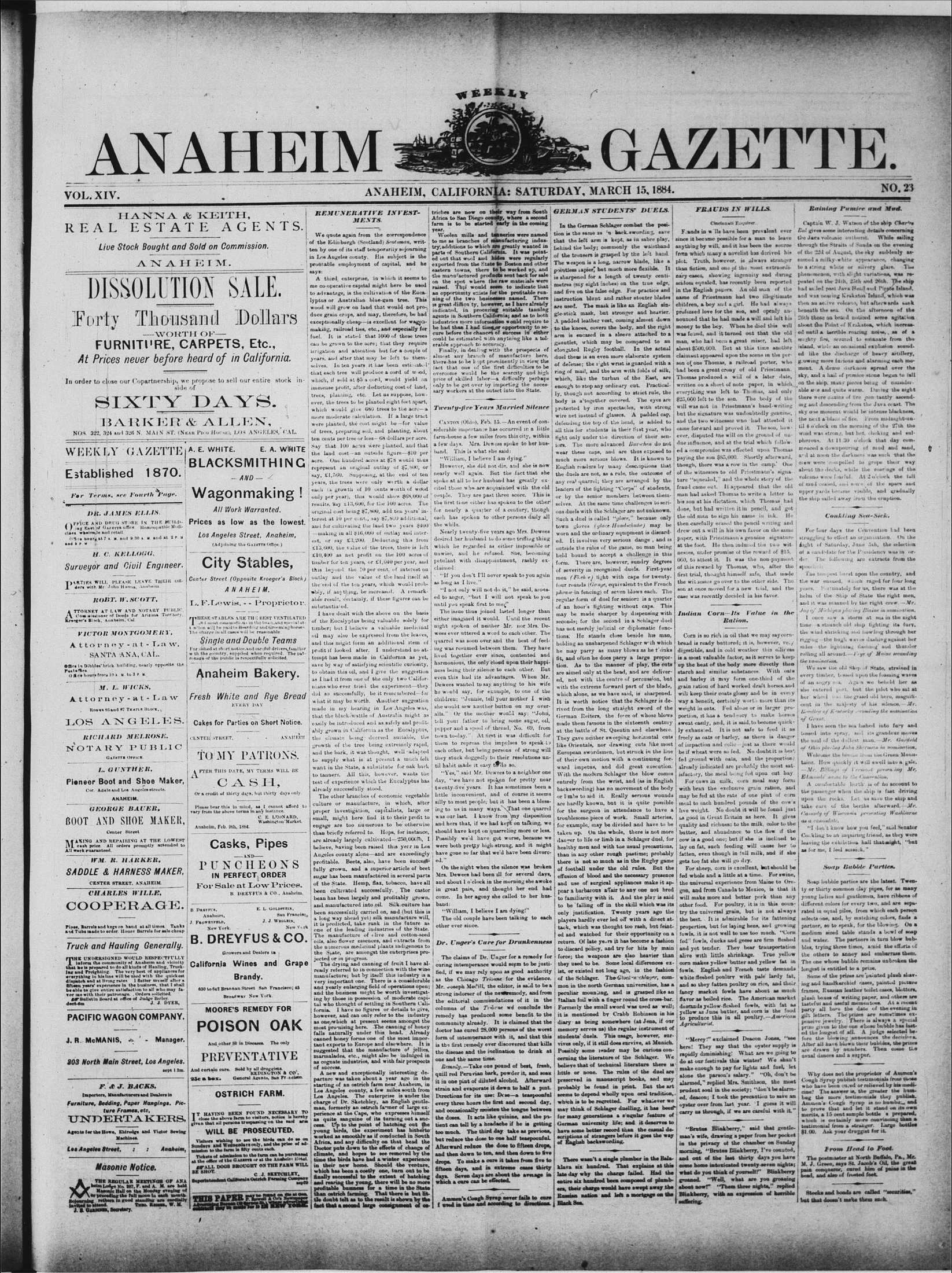
Searchable text
ANAHEIM
VOL. XIV.
HANNA & KEITH,
REAL ESTATE AGENTS.
Live Stock Bought and Sold on Commission.
ANAHEIM.
DISSOLUTION SALE.
Forty Thousand Dollars
WORTH OF
FURNITURE, CARPETS, Etc.,
At Prices never before heard of in California.
In order to close our Coppartnership, we propose to sell our entire stock inside of
Sixty Days.
BARKER & ALLEN,
NOS. 322, 324 and 326 N. MAIN ST. (NEAR PICO HOUSE), LOS ANGELES, CAL.
WEEKLY GAZETTE
A. E. WHITE.
E. A. WHITE
BLACKSMITHING
Established 1870.
In order to close our Coppartnership, we propose to sell our entire stock inside of
SIXTY DAYS.
BARKER & ALLEN,
NOS. 322, 324 and 326 N. MAIN ST. (Near Pico House), LOS ANGELES, CAL.
WEEKLY GAZETTE
Established 1870.
For Terms, see Fourth Page.
DR. JAMES ELLIS.
OFFICE AND DRUG STORE IN THE BUILDING East of Gazette office. Homopathic Medicine wholesale and retail.
Office bourg at 7 A.M. and 9:30 A.M. and at 2 P.M. and 5 P.M.
H. C. KELLOGG.
Surveyor and Civil Engineer.
PARTIES WILL PLEASE LEAVE THEIR ORDERS with Mr. John Hamma, Anaheim.
ROBT. W. SCOTT.
ATTORNEY AT LAW AND NOTARY PUBLIC Commissioner of Doeds for Arizona Territory. Kreeger's Block, Anaheim, Cal.
VICTOR MONTGOMERY,
Attorney-at-Law.
SANTA ANA, CAL.
Office in Dibbles' brick building, nearly opposite the Postoffice.
Office hours from 10 A.M. to 3 P.M.
M. L. WICKS,
Attorney-at-Law
Rooms 86 and 87 Temple Block.
LOS ANGELES.
RICHARD MELROSE.
NOTARY PUBLIC
Gazette Office.
L. GUNTHER.
Pioneer Boot and Shoe Maker,
Cor. Adele and Los Angeles streets.
ANAHEIM.
GEORGE BAUER,
BOOT AND SHOE MAKER,
Center Street
MAKING AND REPAIRING AT THE LOWEST cash price. All orders promptly attended to All work guaranteed.
WM. R. HARKER,
SADDLE & HARNESS MAKER,
CENTER STREET, ANAHEIM.
CHARLES WILLE,
A. E. WHITE.
E. A. WHITE
BLACKSMITHING
AND
Wagonmaking!
All Work Warranted.
Prices as low as the lowest.
Los Angeles Street, Anaheim,
(Adjoining the Gazette Office).
City Stables,
Center Street (Opposite Kroeger's Block)
ANAHEIM.
L. F. Lewis.- Proprietor.
THESE STABLES ARE THE BEST VENTILATED
I will commissions in the town and special attention will be paid to Boarding and Grooming horses.
The charge in all cases will be reasonable.
Single and Double Teams
Furnished at short notice, and careful drivers, familiar with the country, supplied when required. The patronage of the public is respectfully solicited.
Anaheim Bakery.
Fresh White and Rye Bread
EVERY DAY
Cakes for Parties on Short Notice.
CENTER STREET.
ANAHEIM
TO MY PATRONS.
AFTER THIS DATE, MY TERMS WILL BE CASH,
Or a credit of thirty days, but thirty days only.
Please bear this in mind, as I cannot afford to vary from the above terms in any instance.
C. E. LEONARD,
Washington Market.
Anaheim, Feb. 9th, 1884.
Casks, Pipes
AND
PUNCHEONS
IN PERFECT ORDER
For Sale at Low Prices.
B. DREYFUS & CO., Anaheim.
I have dealt well of the Eucalyptus timber; but I do so successfully what it may be made in my hand that the black-wheat easily be introducedably grown in California the climate best growth of the tree and the bark, it to supply what want in the State to tanners. All test of experience already successful.
The other brains culture or man proper investigates small, might have engage are too than briefly referre are already larger believe, having Angeles county profitable. Bee fully grown, an sugar has been raised of the State. He been cultivated bean has been la
GEORGE BAUER,
BOOT AND SHOE MAKER,
Center Street
MAKING AND REPAIRING AT THE LOWEST
cash price. All orders promptly attended to
All work guaranteed.
WM. R. HARKER,
SADDLE & HARNESS MAKER,
CENTER STREET, ANAHEIM.
CHARLES WILLE,
COOPERAGE.
Pipes, Barrels and keys on hand at all times. Tanks
and Tubs made to order. Honey Barrels for sale cheap
Truck and Hauling Generally.
THE UNDERSIGNED WOULD RESPECTFULLY
inform the community of Anaheim and vicinity
that he is prepared to do all kinds of Hauling, Trucking and Freighting. The very best of appliances for
everything in his line will be used with the quickest
dispatch and at living rates. I flatter myself after a
fifteen years' experience in the business, that I shall
be able to give entire satisfaction to all who may favor me with their patronage. Orders solicited.
Bulletin Board at office of Judge Beley.
dec8-6m
J. J. DYER,
PACIFIC WAGON COMPANY.
J. R. McMANIS, - Manager.
303 North Main Street, Los Angeles.
sept 15m.
F. & J. BACKS,
Importers, Manufacturers and Dealers in
Furniture, Bedding, Paper Hangings, Picture Frames, etc,
UNDERTAKERS,
Agents for the Howe, Eldredge and Victor Sewing Machines.
Los Angeles Street, : Anaheim,
Masonic Notice.
THE REGULAR MEETINGS OF ANAheim Lodge No. 207, F. and A. M. are held
Masonic Hall on the Monday evening of
or preceding the full moon in each month.
Sojourning rehern in good standing are cordially
invited to attend.
J. R. GARRUM, Secretary.
Please bear this in mind, as I cannot afford to
vary from the above terms in any instance.
C. E. LEONARD,
Washington Market.
Anaheim, Feb. 9th, 1884.
Casks, Pipes
AND
PUNCHEONS
IN PERFECT ORDER
For Sale at Low Prices.
B. DREYFUS & CO., Anaheim.
B. DREYFUS,
E. L. GOLDSTEIN,
Anaheim,
San Francisco,
J. J. WEDLEIN,
New York.
B. DREYFUS & CO.
Growers and Dealers in
California Wines and Grape
Brandy.
630 to 642 Brannan Street San Francisco; 45
Broadway New York.
MOORE'S REMEDY FOR
POISON OAK
And other St in Diseases. The only
PREVENTATIVE
And certain cure. Sold by all druggists.
REDINGTON & CO',
General Agents, San Francisco.
OSTRICH FARM.
IT HAYING BEEN FOUND NECESSARY TO
close the above farm to visitors, notice is hereby
given that all persons trespassing on the said arm
WILL BE PROSECUTED.
Visitors wishing to see the birds can do so on Sundays and Wednesdays only, and the price of admission to the farm is fifty cents each.
Tickets of admission to the farm can be purchased at the office of the GAZETTE or at the Anaheim Hotel.
ALL DOGS BROUGHT ON THE FARM WILL BE SHOT.
C. J. SKETCHLEY,
Superintendent California Ostrich Farming Company
sep29
THIS PAPER may not be found on site at Geo.
Advertising Bureau (10 Seward Rd.), where advertising contracts may be made for it in NEW YORK.
WEEKLY
EIM GA
ANAHEIM, CALIFORNIA: SATURDAY, MARCH 15, 1884.
REMUNERATIVE INVESTMENTS.
We quote again from the correspondence of the Edinburgh (Scotland) Scotman, written by one of its staff temporarily sojourning in Los Angeles county. His subject is the profitable employment of capital, and he says:
A third enterprise, in which it seems to me co-operative capital might here be used to advantage, is the cultivation of the Eucalyptus or Australian blue-gum tree. This wood will grow on land that would not produce grain crops, and may, therefore, be had exceptionally cheap—is excellent for wagon-making, railroad ties, etc., and especially for fuel. It is stated that 1000 of these trees can be grown to the acre; that they require irrigation and attention but for a couple of years, and after that may be left to themselves. In ten years it has been estimated that each tree will produce a cord of wood, which, if sold at $5 a cord, would yield an immense profit, after deducting cost of land, trees, planting, etc. Let us suppose, however, the trees to be planted eight feet apart, which would give 680 trees to the acre—a more moderate calculation. If a large tract were planted, the cost might be—for value of trees, preparing soil, and planting, about ten cents per tree or less—68 dollars per acre. Say that 100 acres were planted, and that the land cost—an outside figure—$10 per acre. One hundred acres at $78 would thus represent an original outlay of $7,800, or say $1,523. Suspending at the end of ten triches are now on their way from South Africa to San Diego county, where a second farm is to be started early in the coming year.
Woolen mills and tanneries were named to me as branches of manufacturing industry, additions to which are greatly wanted in parts of Southern California. It was pointed out that wool and hides were regularly exported from the State to Boston and other eastern towns, there to be worked up, and the manufactured products sent back for sale on the spot where the raw materials were raised. This would seem to indicate that an opportunity exists for the profitable running of the two businesses named. There is great difficulty, however, as I have already indicated, in procuring suitable tanning agents in Southern California; and as to both industries more information would require to be had than I had time or opportunity to secure before the chances of success in either could be estimated with anything like a tolerable approach to accuracy.
Finally, in dealing with the prospects of almost any branch of manufacture here, there has to be kept prominently in view the fact that one of the first difficulties to be overcome would be the scarcity and high price of skilled labor—a difficulty perhaps only to be got over by importing the necessary workers at the outset into the State.
Twenty-five Years Married Silence
CANTON (Ohio). Feb. 15.—An event of considerable importance has occurred in a little farm-house a few miles from this city, within a few days. Mrs. Dewess spoke to her husband. This is what she said:
"William, I believe I am dying."
However, she did not die, and she is now nearly well again. But the fact that she
GERMAN STUDENTS' DUELS.
In the German Schlager combat the position is the same as 'n back swording, save that the left arm is kept, as in sabre play, behind the body; commonly the waistband of the trousers is grasped by the left hand. The weapon is a long, narrow blade, like a pointless rapier, but much more flexible. It is sharpened for a length of twenty centimetres (say eight inches) on the true edge, and five on the false edge. For practice and instruction blunt and rather stouter blades are used. The mask is like an English single-stick mask, but stronger and heavier. A padded leather vest, coming almost down to the knees, covers the body, and the right arm is encased in a sleeve attached to a gauntlet, which may be compared to an elongated Rugby football. In the actual duel these is an even more elaborate system of defense; the right wrist is guarded with a ring of mail, and the arm with folds of silk, which, like the turban of the East, are enough to stop any ordinary cut. Practically, though not according to strict rule, the body is altogether covered. The eyes are protected by iron spectacles, with strong wire net instead of glasses. A padded cap, defending the top of the head, is added to all this for students in their first year, who fight only under the direction of their seniors. The more advanced Bar-schen do not wear these caps, and are thus exposed to much more serious blows. It is known to English readers by many descriptions that the duels are not, as a rule, the outcome of
Twenty-five Years Married Silence
CANTON (Ohio). Feb. 15.—An event of considerable importance has occurred in a little farm-house a few miles from this city, within a few days. Mrs. Dewees spoke to her husband. This is what she said:
"William, I believe I am dying."
However, she did not die, and she is now nearly well again. But the fact that she spoke at all to her husband has greatly excited those who are acquainted with the old couple. They are past three score. This is the first time either has spoken to the other for nearly a quarter of a century, though each has spoken to other persons daily all the while.
Nearly twenty-five years ago Mrs. Dewees desired her husband to do some trifling thing which he regarded as either impossible or unwise, and he refused. She becoming petulant with disappointment, rashly explained:
"If you don't I'll never speak to you again as long as I live."
"I not only will not do it," he said, aroused to anger, "but I will not speak to you until you speak first to me."
The issue thus joined lasted longer than either imagined it would. Until the recent night spoken of neither Mr. nor Mrs. Dewees ever uttered a word to each other. The quarrel was soon over and the best of feeling was resumed between them. They have lived together ever since, contented and harmonious, the only cloud upon their happiness being their silence to each other. But even this had its advantages. When Mr. Dewees wanted to say anything to his wife he would say, for example, to one of the children: "Jennie, tell your mother I wish she would sew another button on my overalls." Or the mother would say: "John, tell your father to bring some sugar, oil, pepper and a spool of thread, No. 69, from town to-day." At first it was difficult for them to repress the impulses to speak to each other, but being persons of strong will they stuck doggedly to their resolutions until habit made it easy to do so.
"Yes," said Mr. Dewees to a neighbor one day, "we have not spoken for pretty near twenty-five years. It has sometimes been a little inconvenient, and of course it seems silly to most people; but it has been a blessing to us in many ways." That one quarrel was our last. I know from my disposition and hers that, if we had kept on talking, we should have kept on quarreling more or less. Possibly we'd have got worse, because we were both pretty high strung, and it might have gone so far that we'd have been divorced."
On the night when the silence was broken Mrs. Dewees had been ill for several days, and about 1 o'clock in the morning she awoke in great pain, and thought her end had come. In her agony she called to her husband.
which, like the turban of the East, are enough to stop any ordinary cut. Practically, though not according to strict rule, the body is a together covered. The eyes are protected by iron spectacles, with strong wire net instead of glasses. A padded cap, defending the top of the head, is added to all this for students in their first year, who fight only under the direction of their seniors. The more advanced Barschen do not wear these caps, and are thus exposed to much more serious blows. It is known to English readers by many descriptions that the duels are not, as a rule, the outcome of any real quarrel; they are arranged by the leaders of the fighting "Corps" of students, or by the senior members between themselves. At the same time challenges to serious duels with the Schlager are not unknown. Such a duel is called "glace," because only town gloves (glace Handschuh) may be worn and the ordinary equipment is discarded. It involves very serious dange , and is outside the rules of the game, no man being held bound to accept a challenge in this form. There are, however, sundry degrees of severity in recognized duels. First-year men (Fichee) fight with caps for twenty-four rounds (George, equivalent to the French phrase in fencing) of seven blows each. The regular form of duel for seniors is a quarter of an hour's fighting without caps. This may be made sharper by dispensing with seconds; for the second in a Schlager duel has not merely judicial or diplomatic functions: He stands close beside his man, holding an unsharpened Schlager with which he may parry as many blows as he thinks fit, and often he does parry a large proportion. As to the manner of play, the cuts are aimed only at the head, and are delivered, not with the centre of percussion, but with the extreme forward part of the blade, which alone, as we have said, is sharpened. It is worth notice that the Schlager is derived from the long straight sword of the German Reiters, the force of whose blows made them famous in the sixteenth century at the battle of St. Quentin and elsewhere. They gave neither sweeping horizontal cuts like Orientals, nor drawing cuts like most European swordsmen, but struck in the line of their own motion with a continuing forward impetus, and did great execution. With the modern Schlager the blow comes entirely from the wrist, and (as in English backswording) has no movement of the body or limbs to aid it. Really serious wounds are hardly known, but it is quite possible for the surgeon in attendance to have a troublesome piece of work. Small arteries, for example, may be divided and have to be taken up. On the whole, there is not more danger to life or limb in a Schlager duel, for healthy men and with tue usual precautions, than in any other rough pastime; probably there is not so much as in the Rugby game of football under the old rules. But the effusion of blood and the necessary presence and use of surgical appliances make it appear a barbarous affair to any one not bred to familiarity with it. And the play is said
culture or manufacture, in which, after proper investigation, capitalists, large or small, might here find it to their profit to engage are too numerous to be otherwise than briefly referred to. Hops, for instance, are already largely cultivated—250,000 lb., I believe, having been raised this year in Los Angeles county alone—and are exceedingly profitable. Beets, also, have been successfully grown, and a superior article of beet sugar has been manufactured in several parts of the State. Hemp, flax, tobacco, have all been cultivated successfully. The castor bean has been largely and profitably grown, and manufactured into oil. Silk culture has been successfully carried on, and (but this is a long way ahead yet) silk manufacture will, it is predicted, take rank in the future as one of the leading industries of the State. The manufacture of olive and cotton-seed oils, also flower essences, and extracts from the numerous medicinal plants indigenous to the State, are amongst the enterprises projected or in progress.
The drying and canning of fruit I have already referred to in connection with the wine manufacture; but by itself this industry is a very important one. There is a considerable and yearly enlarging field of operations open; and the business might be worth investigating by those in possession of moderate capital who thought of settling in Southern California. I have no figures or details to give, however, and can only refer to the industry as one which at present seems amongst the most promising here. The canning of honey falls naturally under this head. Already canned honey forms one of the most important exports to Europe and elsewhere. It is suggested that the manufacture of jellies, marmalades, etc., might also be indulged in as cognate industries, and with fair prospects of success.
A new and exceptionally interesting departure was taken about a year ago in the starting of an ostrich farm near Anaheim, in Los Angeles county, a few miles south from Los Angeles. The enterprise is under the charge of Dr. Sketchley, an English gentleman, formerly an ostrich farmer of large experience at the Cape, who expresses himself as quite sanguine of its turning out a success. Up to the point of hatching out the young birds, the experiment has hitherto worked as smoothly as if conducted in South Africa, and any difficulty on that head the Doctor puts down to the effects of change of climate, and hopes to see removed by the time the birds have had a winter experience in their new home. Should the venture, which has been a costly one, turn out to be finally successful to the extent of batching and rearing the young, there will be no more profitable business for a time in the State than ostrich farming. That there is but little doubt felt as to the result is shown by the fact that a second large consignment of osseous to most people; but it has been a blessing to us in many ways. That one quarrel was our last. I know from my disposition and hers that, if we had kept on talking, we should have kept on quarreling more or less. Possibly we'd have got worse, because we were both pretty high strung, and it might have gone so far that we'd have been divorced."
On the night when the silence was broken Mrs. Dewees had been ill for several days, and about 1 o'clock in the morning she awoke in great pain, and thought her end had come. In her agony she called to her husband:
"William, I believe I am dying!"
The old couple have been talking to each other ever since.
Dr. Unger's Cure for Drunkenness
The claims of Dr. Unger for a remedy for curing intemperance would seem to be justified, if we may rely upon as good authority as the Chicago Triune for the evidence. Mr. Joseph Medill, the editor, is said to be a strong indorser of the new remedy, and from the editorial commendations of it in the columns of the Triune we conclude the remedy has produced some benefit to the community already. It is claimed that the doctor has cured 28,000 persons of the worst form of intemperance with it, and that this is the first remedy ever discovered that kills the disease and the inclination to drink at one and the same time.
Remedy.—Take one pound of best, fresh, quill red Peruvian bark, powder it, and soak it in one pint of diluted alcohol. Afterward strain and evaporate it down to half a pint. Directions for its use: Dose—a teaspoonful every three hours the first and second day, and occasionally moisten the tongue between the doses. It acts like quinine, and the patient can tell by a headache if he is getting too much. The third day take as previous, but reduce the dose to one half teaspoonful. Afterward reduce the dose to fifteen drops, and then down to ten, and then down to five drops. To make a cure it takes from five to fifteen days, and in extreme cases thirty days. Seven days are about the average in which a cure can be effected.
Ammen's Cough Syrup never fails to cure if used in time and according to directions.
are hardly known, but it is quite possible for the surgeon in attendance to have a troublesome piece of work. Small arteries, for example, may be divided and have to be taken up. On the whole, there is not more danger to life or limb in a Schlager duel, for healthy men and with too usual precautions, than in any other rough pastime; probably there is not so much as in the Rugby game of football under the old rules. But the effusion of blood and the necessary presence and use of surgical appliances make it appear a barbarous affair to any one not breed to familiarity with it. And the play is said to be falling off in the skill which was its only justification. Twenty years ago the players hardly ever led off with a direct attack, which was thought too rash, but feinted and watched for their opportunity on a return. Of late years it has become a fashion to discard policy, and try for hits by main force; the weapons are also heavier than they used to be. Some local differences exist, or existed not long ago, in the fashion of the Schlager. The Stockton-Schlager common in the north German universities, has a peculiar mounting, and is grasped like an Italian foil with a finger round the cross-bar. Formerly the small sword was used as well; it is mentioned by Crabb Robinson in his diary as being somewhere (at Jena, if our memory serves us) the regular instrument of students' duels. This usage, however, survives only, if it still does survive, at Munich. Possibly some reader may be curious concerning the literature of the Schlager. We believe that of technical literature there is little or none. The rules of the duel are preserved in manuscript books, and may probably be found in print. But the art seems to depend wholly upon oral tradition, which is to be regretted. For whatever we may think of Schlager duelling, it has been for many generations a singular feature of German university life; and it deserves to have some better record than the casual descriptions of strangers before it goes the way of English backswording.
There wasn't a single plumber in the Bala-klava six hundred. That explains at this late day why the charge failed. Had the entire six hundred been composed of plumbers, their charge would have swept away the Russian nation and left a mortgage on the Black Sea.
GAZETTE.
MARCH 15, 1884.
STUDENTS' DUELS.
Schlager combat the position in back swording, save them is kept, as in sabre play, commonly the waistband is grasped by the left hand. Long, narrow blade, like a but much more flexible. It has a length of twenty centimeters on the true edge, false edge. For practice and rest and rather stouter blades mask is like an English sinister but stronger and heavier. Her vest, coming almost down covers the body, and the right arm in a sleeve attached to a may be compared to an easy football. In the actual even more elaborate system right wrist is guarded with a pad the arm with folds of silk, turban of the East, are many ordinary cut. Practical according to strict rule, the other covered. The eyes are iron spectacles, with strong of glasses. A padded cap, top of the head, is added to patients in their first year, who for the direction of their senile advanced Barischen do not miss, and are thus exposed to serious blows. It is known to be by many descriptions that it as a rule, the outcome of
FRAUDS IN WILLS.
Cincinnati Esquiler.
Frands in wills have been prevalent ever since it became possible for a man to leave anything by will, and it has been the source from which many a novelist has derived his plot. Truth, however, is always stranger than fiction, and one of the most extraordinary cases, showing ingenuity and daring seidom equaled, has recently been reported in the English papers. An old man of the name of Priestmann had two illegitimate children, a boy and a girl. He had always professed love for the son, and openly announced that he had made a will and left his money to the boy. When he died this will was found, and it turned out that the old man, who had been a great miser, had left about $500,000. But at this time another claimant appeared upon the scene in the person of one Thomas, a railroad porter, who had been a great crony of old Priestmann. Thomas produced a will of a later date, written on a sheet of note paper, in which everything was left to Thomas, and only $25,000 left to the son. The body of the will was not in Priestmann's hand-writing but the signature was undoubtedly genuine, and the two witnesses who had attested it came forward and proved it. The son, however, disputed the will on the ground of undue influence, and at the trial which followed a compromise was effected upon Thomas paying the son $85,000. Shortly afterward, though, there was a row in the camp.' One of the witnesses to old Priestmann's signa-
Raining Pumice and Mud.
Captain W. J. Watson of the ship Charles Eal gives some interesting details concerning the Java volcanic outburst. While sailing through the Straits of Sunda on the evening of the 22d of August, the sky suddenly assumed a milky-white appearance, changing to a strong white or silvery glare. The phenomenon, with slight variations, was repeated on the 24th, 25th and 26th. The ship had sailed past Java Head and Pirate Island, and was nearing Krakatoa Island, which was then an active volcano, but afterwards sank beneath the sea. On the afternoon of the 26th those on board noticed some agitation about the Point of Krakatoa, which increased until a terrible roaring noise, as of a mighty fire, seemed to emanate from the island, while an occasional explosion sounded like the discharge of heavy artillery, growing more furious and alarming each moment. A dense darkness spread over the sky, and a hail of pumice stone began to fall on the ship; many pieces being of considerable size and quite warm. During the night there were chains of fire constantly ascending and descending from the Java coast. The sky one moment would be intense blackness, the next a blaze of fire. From midnight-until 4 o'clock on the morning of the 27th the wind was strong, but hot, choking and sulphorous. At 11:30 o'clock that day commenced a downpour of mud and sand, and at noon the darkness was such that the crew were compelled to grope their way about the decks, while the roarings of the
The turban of the East, are many ordinary cut. Practical according to strict rule, the other covered. The eyes are brown spectacles, with strong black of glasses. A padded cap, top of the head, is added to incidents in their first year, who for the direction of their senile advanced Barschen do not miss, and are thus exposed to serious blows. It is known to be by many descriptions that it, as a rule, the outcome of them; they are arranged by theighting "Corps" of students, for members between them same time challenges to seriate the Schlager are not unknown. Called "glace," because only (place Handschuhe) may be ordinary equipment is discarded very serious dange, and is used of the game, no man being accepted a challenge in this case, however, sundry degrees recognized duels. First-year night with caps for twenty-oneage, equivalent to the French age of seven blows each. The duel for seniors is a quarter nighting without caps. This sharper by dispensing with the second in a Schlager duel judicial or diplomatic fences close beside his man, sharpened Schlager with which he as many blows as he thinks does parry a large proportion of play, the cuts at the head, and are deliver- the centre of percussion, but one forward part of the blade, we have said, is sharpened. Notice that the Schlager is de-long straight sword of the cuts, the force of whose blows runs in the sixteenth century St. Quentin and elsewhere. Other sweeping horizontal cuts minor drawing cuts like most dishmis, but struck in the line motion with a continuing for- and did great execution. Corn Schlager the blow comes on the wrist, and (as in English has no movement of the body it). Really serious wounds down, but it is quite possible men in attendance to have a piece of work. Small arteries, may be divided and have to be the whole, there is not more fur limb in a Schlager duel, for and with tue usual precautions, utter rough pastime; probably too much as in the Rugby game under the old rules. But the old and the necessary presence surgical appliances make it apus affair to any one not bred with it. And the play is said Thomas produced a will of a later date, written on a sheet of note paper, in which everything was left to Thomas, and only $25,000 left to the son. The body of the will was not in Priestmann's hand-writing but the signature was undoubtedly genuine, and the two witnesses who had attested it came forward and proved it. The son, however, disputed the will on the ground of undue influence, and at the trial which followed a compromise was effected upon Thomas paying the son $85,000. Shortly afterward, though, there was a row in the camp.' One of witnesses to old Priestmann's signature "squealed," and the whole story of the fraud came out. It appeared that the old man had asked Thomas to write a letter to his son at his dictation, which Thomas had done, but had written it in pencil, and got the old man to sign his name in ink. He then carefully erased the pencil writing and drew out a will in his own favor on the same paper, with Priestmann's genuine signature at the foot. He then induced the two witnesses, under promise of the reward of $15,000, to attest it. It was the non-payment of this reward by Thomas, who, after the first trial, thought himself safe, that made the witnesses go over to the other side. The son at once moved for a new trial, and the case was recently decided in his favor.
Indian Corn—Its Value in the Ration.
Corn is so rich in oil that we may say corn-bread is ready buttered; it is, however, very digestible, and in cold weather this olliness is a most valuable factor, as it serves to keep up the heat of the body more directly than starch and similar substances. With oats and barley it may form one-third of the grain ration of hard worked draft horses,and will keep their coats glossy and be in every way a benefit, certainly worth more than its weight in oats. Fed alone or in larger proportion, it has a tendency to make horses sweat easily, and it is said, to become quickly exhausted. It is not safe to feed it as freely as oats or barley, as there is danger of impaction and colic—just as there would be if wheat were so fed. No doubt it is best fed ground with oats, and the proportion already indicated are probably the most satisfactory, the meal being fed upon cut hay.
For cows in milk, corn meal may form with bran the exclusive grain ration, and may be fed at the rate of one pint of corn meal to each hundred pounds of the cow's live weight. No doubt it will be found just as good in Great Britain as here. It gives quality and richness to the milk, color to the butter, and abundance to the flow if the cow is a good one; but if she is inclined to lay on fat, such feeding will cause her to fatten, even though in full milk, and if she gets too fat she will go dry.
For sheep, corn is excellent, but should be fed whole and a little at a time. For swine, the universal experience from Maine to Oregon, and from Canada to Mexico, is that it will make more and better pork than any sky, and a hail of pumice stone began to fall on the ship, many pieces being of considerable size and quite warm. During the night there were canins of fire constantly ascending and descending from the Java coast. The sky one moment would be intense blackness,the next a blaze of fire. From midnight until 4 o'clock on the morning of the 27th wind was strong, but hot, choking and sulphorous. At 11:30 o'clock that day commenced a downpouring of mud and sand,and at noon the darkness was such that the crew were compelled to grope their way about the decks while the roarings of the volcano were fearful. At 2 o'clock the tail of mud ceased,and some of the spars and upper yards became visible,and gradually the ship sailed away from the eruption.
Conkling Sea-Sick.
For four days the Convention had been struggling to effect an organization. On the flight of Saturday June 5th,the selection of a candidate for the Presidency was in order.The following are extracts from the speeches.
The tempest burst upon the country,and the war ensued,which raged for four long years.Fortunately for us,the was at the helm of the Ship of State right men,and it was manned by the right crew.-Mr.Jog of Michigan placing Blaine in nomination.
I once saw a storm at sea in the night time—a staunch old ship fighting its fury,the wind shrieking and howling through her rigging—the hugh waves dishing against her sides—the lightning dashing and thunder rolling all around.-Page of Maine seconding the nomination.
We saw the old Ship of State strained in every timber,tossed upon the foaming waves of an angry sea.Again we behold her as she entered port,but the pilot who sat at her wheel was the grand old hero,magnificent in the majesty of his silence.-Mr.Bradley of Kentucky seconding the nomination of Grant.
I have seen the sea lashed into fury and tossed into spray,and its grandeur movesthe soul of the dullest man.-Mr.Garefield of Ohio placing John Sherman in nomination.
Welcome the brews from the Green Mountains.How quickly it will swell into a gale.-Mr.Billings of Vermont presenting Mr.Eldmaude names to the Convention.
A comfortable berth'is of no account tothe passenger when the ship is fast drivingupon the rocks.Let us save the shipand take care of the berths afterward.-Mr.Cassely of Wisconsin presenting Washbourneas a candidate.
"I don't know how you feel," said Senator Conkling to an inquiry friend,a as they were leavingthe exhibition hall that night,"but as for me,i feel seasick."
Soap Bubble Parties.
Soap bubble parties are the latest.Twenty or thirty common clay pipes,fors many young ladies and gentlemen,have ribbons of
but it is quite possible
in attendance to have a
piece of work. Small arteries,
may be divided and have to be
the whole, there is not more
for limb in a Schlager duel, for
and with the usual precautions,
other rough pastime; probably
so much as in the Rugby game
under the old rules. But the
food and the necessary presence
of surgical appliances make it apous affair to any one not bred
with it. And the play is said
off in the skill which was its
edition. Twenty years ago the
ever led off with a direct attus thought too rash, but feinted for their opportunity on a
years it has become a fashion
try, and try for hits by main
apons are also heavier than
some local differences exnot long ago, in the fashion
er. The Stock-mchlager, commeth German universities, has a
king, and is grasped like an
with a finger round the cross-bar.
Small sword was used as well;
and by Crabb Robinson in his
somewhere (at Jena, if our
us) the regular instrument of
This usage, however, surstill does survive, at Munich.
Reader may be curious contature of the Schlager. We
technical literature there is
The rules of the duel are
manuscript books, and may
bound in print. But the art
and wholly upon oral tradition,
regretted. For whatever we
Schlager duelling, it has been
nations a singular feature of
crity life; and it deserves to
record than the casual derangers before it goes the way
passwording.
In a single plumber in the Baladred. That explains at this
the charge failed. Had the
breed been composed of plumbbobs would have swept away the
and left a mortgage on the
meal to each hundred pounds of the cow's live weight. No doubt it will be found just as good in Great Britain as here. It gives quality and richness to the milk, color to the butter, and abundance to the flow of the cow is a good one; but if she is inclined to lay on fat, such feeding will cause her to fatten, even though in full milk, and if she gets too fat she will go dry.
For sheep, corn is excellent, but should be fed whole and a little at a time. For swine, the universal experience from Maine to Oregon, and from Canada to Mexico, is that it will make more and better pork than any other food. For poultry, it is in this country the universal grain, but is not always the best. It is admirable for its fattening properties, but for laying hens, and growing fowls, it is not well to use too much. "Corn fed" fowls, ducks and geese are firm fleshed and yet tender. They bear transportation alive with little shrinkage. True yellow corn makes yellow butter and yellow fat in fowls. English and French taste demands white fleshed poultry with pale lardy fat, and so they fatten poultry on rice, and their fancy market fowls have about as much flavor as boiled rice. The American market demands yellow-fleshed fowls, with fat as yellow as June butter, and corn is the food to produce this in all poultry.—American Agriculturist.
"Mercy!" exclaimed Deacon Jones, "see here! They say that the oyster supply is rapidly diminishing! What are we going to do at our festivals this winter? We shan't make enough to pay for lights and fuel, let alone the parson's salary." "Oh, don't be alarmed," replied Mrs. Smithson, the most prudent soul in the society; "don't be alarmed, deacon; I took the precaution to save an oyster over from last year. I guess it will carry us through, if we are careful with it."
"Brutus Blinkberry," said that gentleman's wife, drawing a paper from her pocket in the privacy of the chamber on Sunday morning. "Brutus Blinkberry, I've counted, and out of the last thirty days you have come home intoxicated twenty-seven nights; what do you think of yourself?" Blinkberry groaned. "Well, what are you groaning about now?" "Them three nights," replied Blinkberry, with an expression of horrible suffering.
Soap Bubble Parties.
Soap bubble parties are the latest. Twenty or thirty common clay pipes, for as many young ladies and gentlemen, have ribbons of different colors for every two, and are separated in equal piles, from which each person selects one, and, by matching colors, finds a partner, so to speak, for the blowing. On a medium sized table stands a bowl of soap and water. The partners in turn blow bubbles, trying three times, amid the efforts of the others to annoy and embarrass them. The one whose bubble remains unbroken the longest is entitled to a prize.
Some of the prizes are painted plush shaving and handkerchief cases, painted picture frames, Russian leather toilet cases, blotters, plush boxes of writing paper, and others are tasteful and useful mementoes. At a recent party all bore the date of the evening in gilt letters. The prizes are sometimes expensive jewelry. There is always a special prize given to the one whose bubble has lasted the longest of all. A judge selected before the blowing announces the decisions. After all have blown their bubbles, the prizes are drawn by numbers. Then come the usual dances and a supper.
Why does not the proprietor of Ammen's Cough Syrup publish testimonials from those who have been cured or relieved by his medicine? The answer is, the greater the humbug the more testimonials they publish. Ammen's Cough Syrup is no humba-, and to prove that and let it stand on its own merits, a 15 cent sample bottle's prepared, which is certainly more convincing than a testimonial from a stranger. Large bottles $1.00. Ask your druggist for it.
From Head to Foot.
The postmaster at North Buffalo, Pa., Mr.
M. J. Green, says St. Jacob's Oil, the great pain conqueror, cured him of pains in the head, and also of frusted feet.
Stocks and bonds are called "securities," but that doesn't make them such.