anaheim-gazette 1884-03-08
Scanned page
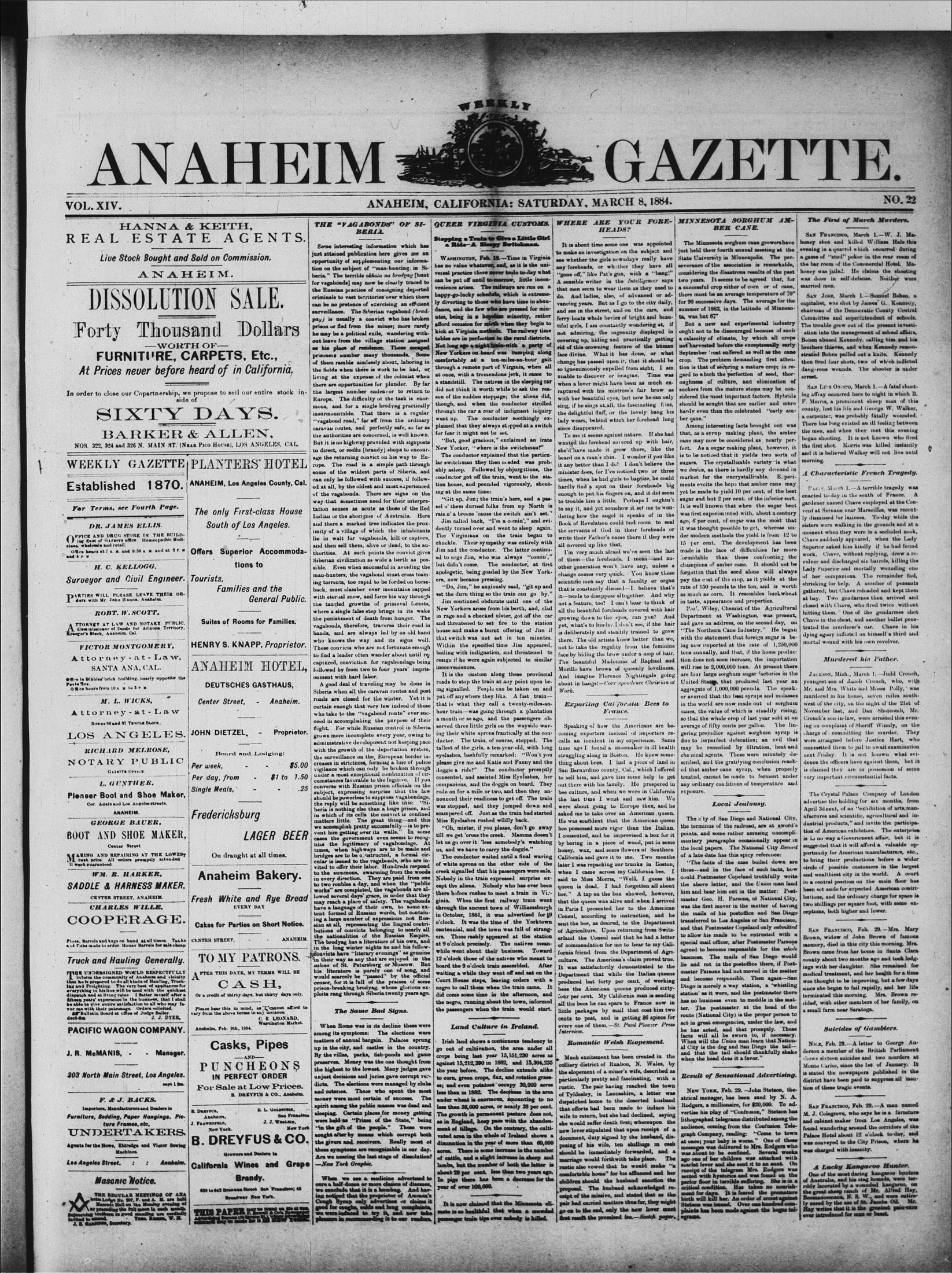
Searchable text
ANAHEIM
VOL. XIV.
HANNA & KEITH,
REAL ESTATE AGENTS.
Live Stock Bought and Sold on Commission.
ANAHEIM.
DISSOLUTION SALE.
Forty Thousand Dollars
WORTH OF
FURNITURE, CARPETS, Etc.,
At Prices never before heard of in California.
In order to close our Coppartnership, we propose to sell our entire stock inside of
Sixty Days.
BARKER & ALLEN,
NOS. 322, 324 and 326 N. MAIN ST. (NEAR PICO HOUSE), LOS ANGELES, CAL.
WEEKLY GAZETTE PLANTERS' HOTEL
In order to close our Coppartnership, we propose to sell our entire stock inside of
SIXTY DAYS.
BARKER & ALLEN,
NOS. 322, 324 and 326 N. MAIN ST. (NEAR PICO HOUSE), LOS ANGELES, CAL.
WEEKLY GAZETTE
Established 1870.
For Terms, see Fourth Page.
DR. JAMES ELLIS.
OFFICE AND DRUG STORE IN THE BUILDING East of GAZETTS office. Homeopathic Medicine, wholesale and retail.
Office hours at 7 A.M. and 9:30 A.M. and at 2 P.M.
H. C. KELLOGG.
Surveyor and Civil Engineer.
PARTIES WILL PLEASE LEAVE THEIR ORDERS with Mr. John Hanna, Anaheim.
ROBT. W. SCOTT.
ATTORNEY AT LAW AND NOTARY PUBLIC. Commissioner of Deeds for Arizona Territory, Kreger's Black, Anaheim, Cal.
VICTOR MONTGOMERY,
Attorney-at-Law,
SANTA ANA, CAL.
Office in Dibbles' brick building, nearly opposite the Post Office.
Office hours from 10 A.M. to 5 P.M.
M. L. WICKS,
Attorney-at-Law
Rooms 86 and 87 Temple Block.
LOS ANGELES.
RICHARD MELROSE,
NOTARY PUBLIC
GAZETTE OFFICER.
L. GUNTHER.
Pleneer Boot and Shoe Maker,
Cor. Adele and Los Angeles streets.
ANAHEIM.
GEORGE BAUER.
BOOT AND SHOE MAKER,
Center Street
MAKING AND REPAIRING AT THE LOWEST cash price. All orders promptly attended if work guaranteed.
WM. R. HARKER,
SADDLE & HARNESS MAKER,
CENTER STREET, ANAHEIM.
PLANTERS' HOTEL
ANAHEIM, Los Angeles County, Cal.
The only First-class House South of Los Angeles.
Offers Superior Accommodations to Tourists,
Families and the General Public.
Suites of Rooms for Families.
HENRY S. KNAPP, Proprietor.
ANAHEIM HOTEL,
DEUTSCHES GASTHAUS,
Center Street, - Anaheim.
JOHN DIETZEL, - Proprietor.
Board and Lodging:
Per week, - $5.00
Per day, from - $1 to 1.50
Single Meals, - .25
Fredericksburg
LAGER BEER
On draught at all times.
Anaheim Bakery.
Fresh White and Rue Bread
living at the edge there are opportunities the largest number Europe. The dawn mouss, and for insurmountable "vagabond road, caravan routes, the authorities are But it is no high to direct, or vodage the returning rope. The road some of the way can only be followed at all, by the of the vagabond way that sometimes Indian or the abode and there a manimity of a village lie in wait for and then sell the thorities. At a Siberian civilization sible. Even when man-hunters, the ing torrents, too back, must claim with eternal snow the tangled groove where a single face the punishment of vagabonds, there bands, and are who knows the These convicts want to find a leader captured, convicted followed by from onment with harm. A good deal of Siberia when all roads are closed certain enough who take to the ceed in accomplice flight. For which grows more in administrative duty with the growth the surveillance creases in strict vigilance which under a most exconstances favors converse with R subject, express should be power the reply will be beria is nothing in which of its matters little. We accomplish p vent him getting cases the govern nine the legitit times, when his bridges are to be cular is issued t vited to offer them to the summons in every direction to two roubles a works" are comp led several days
GEORGE BAUER,
BOOT AND SHOE MAKER,
Center Street
MAKING AND REPAIRING AT THE LOWEST
cash price. All orders promptly attended
will work guaranteed.
WM. R. HARKER,
SADDLE & HARNESS MAKER,
CENTER STREET, ANAHEIM.
CHARLES WILLE.
COOPERAGE.
Prices, Barrels and kegs on hand at all times. Tanks
and Tube made to order. Honey Barrels for sale cheap
Truck and Hauling Generally.
THE UNDERSIGNED WOULD RESPECTFULLY
inform the community of Anaheim and vicinity
that he is prepared to do all kinds of Hauling, Truckling and Freighting. The very best of appliances for
everything in his line will be used with the quickest
dispatch and at living rates. I flatter myself after a
fifteen years' experience in the business, that I shall
be able to give entire satisfaction to all who may favor me with their patronage. Orders solicited.
Bulletin Board at office of Judge Bailey.
dece-6m.
J. J. DYER.
PACIFIC WAGON COMPANY.
J. R. McMANIS, - Manager.
303 North Main Street, Los Angeles.
sept 18m.
F. & J. BACKS.
Importers, Manufacturers and Dealers in
Furniture, Bedding, Paper Hangings, Picture Frames, etc,
UNDERTAKERS.
Agents for the Howe, Eldredge and Victor Sewing Machines.
Los Angeles Street: Anaheim.
Masonic Notice.
THE REGULAR MEETINGS OF ANAhaim Lodge No. 297, F. and A. M. are held
Masonic Hall on the Monday evening of
or preceding the full moon in each month.
Becoming brothers in good standing are cordially
invited to attend.
Tama Runner, W. M.
J. B. Gannam, Secretary.
Fredericksburg
LAGER BEER
On draught at all times.
Anaheim Bakery.
Fresh White and Rye Bread
EVERY DAY
Cakes for Parties on Short Notice.
CENTER STREET, ANAHEIM.
TO MY PATRONS.
AFTER THIS DATE, MY TERMS WILL BE
CASH,
Or a credit of thirty days, but thirty days only.
Please bear this in mind, as I cannot afford to vary from the above terms in any instance.
C. E. LEONARD,
Washington Market.
Anaheim, Feb. 9th, 1894.
Casks, Pipes
AND
PUNCHEONS
IN PERFECT ORDER
For Sale at Low Prices.
B. DREYFUS & CO., Anaheim.
B. DREYFUS,
Anaheim,
San Francisco
J. FROWENFIELD,
New York
B. DREYFUS & CO.
Growers and Dealers in
California Wines and Grape
Brandy.
630 to 642 Brannan Street San Francisco; 45
Broadway New York.
THIS PAPER may not be run on one or more
Advertising Bureau (10 Square Feet) where advertising
shall be made for it in NEW YORK.
THE "VAGABONDS" OF SIBERIA.
Some interesting information which has just attained publication here gives me an opportunity of supplementing our information on the subject of "man-hunting in Siberia." The terrible okhoia na brodyag [hunt for vagabonds] may now be clearly traced to the Russian practice of consigning deported criminals to vast territories over which there can be no pretence of exercising an efficient surveillance. The Siberian vagabond (brad-yay) is usually a convict who has broken prison or fled from the mines; more rarely he may be a political exile, wandering without leave from the village station assigned as his place of residence. These escaped prisoners number many thousands. Some of them ramble aimlessly about, laboring in the fields when there is work to be had, or living at the expense of the colonist when there are opportunities for plunder. By far the largest number endeavor to return to Europe. The difficulty of the task is enormous, and for a single brodyag practically insurmountable. That there is a regular "vagabond road," far off from the ordinary caravan routes, and perfectly safe, so far as the authorities are concerned, is well known. But it is no highway provided with signposts to direct, or vodka [brandy] shops to encourage the returning convict on his way to Europe. The road is a simple path through some of the wildest parts of Siberia, and
QUEER VIRGINIA CUSTOMS.
Stepping a Train to Give a Little Girl a Ride—A Sleepy Switchman.
WASHINGTON, Feb. 18.—Time in Virginia has no value whatever, and, as it is the universal practice there never to do to-day what can be put off until to-morrow, little inconvenience arises. The railways are run on a happy-go-lucky schedule, which is extremely diverting to those who have time in abundance, and the few who are pressed for minutes, being in a hopeless minority, rather afford occasion for mirth when they begin to kick at Virginia methods. The railway time tables are in perfection in the rural districts. Not long ago a night train-with a party of New Yorkers on board was bumping along comfortably at a ten-miles-an-hour gait through a remote part of Virginia, when all at once, with a tremendous jerk, it came to a standstill. The natives in the sleeping car did not think it worth while to ask the reason of the sudden stoppage; the aliens did, though, and when the conductor strolled through the car a roar of indignant inquiry went up. The conductor soothingly explained that they always stopped at a switch for fear it might not be set.
"But, good gracious," exclaimed an irate New Yorker, "where is the switchman?"
The conductor explained that the particular switchman they then needed was probably asleep. Followed by objurgations,
WHERE ARE YOUR FORE-HEADS?
It is about time some one was appointed to make an investigation on the subject and see whether the girls nowadays really have any foreheads, or whether they have all "gone off," like Pat's gun, with a "bang!" A sensible writer in the Intelligencer says that men seem to wear them as they used to do. And ladies, also, of advanced or advancing years. But as I go to the city daily, and see in the street, and on the cars, and ferry-boats whole bevies of bright and beautiful girls, I am constantly wondering at, if not admiring, the ingenuity displayed in covering up, hiding and practically getting rid of this crowning feature of the human face divine. What it has done, or what change has passed upon it, that it should be so ignominiously expelled from sight, I am unable to discover or imagine. Time was when a lover might have been as much enraptured with his mistress's fair brow as with her beautiful eyes, but now he can only sing, if he sings at all, the fascinating frizz; the delightful fluff, or the lovely bang his lady wears, behind which her forehead long since disappeared.
To me it seems against nature. If she had wanted the forehead covered up with hair, she'd have made it grow there, like the beard on a man's chin. I wonder if you like it any better than I do? I don't believe the minister does, for I've noticed two or three
living at the expense of the colonist when there are opportunities for plunder. By far the largest number endeavor to return to Europe. The difficulty of the task is enormous, and for a single brodyag practically insurmountable. That there is a regular "vagabond road," far off from the ordinary caravan routes, and perfectly safe, so far as the authorities are concerned, is well known. But it is no highway provided with signposts to direct, or vodka [brandy] shops to encourage the returning convict on his way to Europe. The road is a simple path through some of the wildest parts of Siberia, and can only be followed with success, if followed at all, by the oldest and most experienced of the vagabonds. There are signs on the way that sometimes need for their interpretation senses as acute as those of the Red Indian or the aborigine of Australia. Here and there a marked tree indicates the proximity of a village of which the inhabitants lie in wait for vagabonds, kill or capture, and then sell them, alive or dead, to the authorities. At such points the convict gives Siberian civilization as wide a berth as possible. Even when successful in avoiding the man-hunters, the vagabond must cross foaming torrents, too rapid to be forded on horseback, must clamber over mountains capped with eternal snow, and force his way through the tangled growths of primeval forests, where a single false step brings in its wake the punishment of death from hunger. The vagabonds, therefore, traverse their road in bands, and are always led by an old hand who knows the way and its signs well. These convicts who are not fortunate enough to find a leader often wander about until recaptured, conviction for vagaboundage being followed by from two to four years' imprisonment with hard labor.
A good deal of traveling may be done in Siberia when all the caravan routes and post roads are closed for the winter. Yet it is certain enough that very few indeed of those who take to the "vagabond route" ever succeed in accomplishing the purpose of their flight. For while Russian control in Siberia grows more incomplete every year, owing to administrative development not keeping pace with the growth of the deportation system, the surveillance on the European border increases in strictness, forming a line of police vigilance which can only be broken through under a most exceptional combination of circumstances favorable to the fugitive. If you converse with Russian prison officials on the subject, expressing surprise that the law should be powerless to suppress vagabondage, the reply will be something like this: "Siberia is nothing else than a huge prison, and in which of its cells the convict is confined matters little. The great thing—and this we accomplish pretty successfully—is to prevent him getting over its walls." In some cases the government even seems to recognise the legitimacy of vagabondage. At times, when highways are to be made and bridges are to be constructed, a formal circular is issued to the vagabonds, who are invited to offer their labor. Hundreds respond to the summons, swarming from the woods in every direction. They are paid from one to two roulles a day, and when the "public works" are completed, the vagabonds are allowed several days' grace, in order that they
at once, with a tremendous jerk, it came to a standstill. The natives in the sleeping car did not think it worth while to ask the reason of the sudden stoppage; the aliens did, though, and when the conductor strolled through the car a rear of indignant inquiry went up. The conductor soothingly explained that they always stopped at a switch for fear it might not be set.
"But, good gracious," exclaimed an irate New Yorker, "where is the switchman?"
The conductor explained that the particular switchman they then needed was probably asleep. Followed by objurgations, the conductor got off the train, went to the station house, and pounded vigorously, shouting at the same time:
"Git up, Jim; the train's here, and a passel o' them durned folks from up North is raisin'n a breeze 'cause the switch ain't set."
Jim called back, "I'm a comin'," and evidently turned over and went to sleep again. The Virginiaans on the train began to chuckle. Their sympathy was entirely with Jim and the conductor. The latter continued to urge Jim, who was always "comin'," but didn't come. The conductor, at first apologetic, being goaded by the New Yorkers, now became pressing.
"Do, Jim," he anxiously said, "git up and set the durn thing so the train can go by."
Jim continued obduretate until one of the New Yorkers arose from his berth, and, clad in rage and a checked ulster, got off the car and threatened to set fire to the station house and make a burnt offering of Jim if that switch was not set in ten minutes. Within the specified time Jim appeared, boiling with indignation, and threatened to resign if he were again subjected to similar inconveniences.
It is the custom along these provincial roads to stop the train at any point upon being signalled. People can be taken on and put off anywhere they like. A fast train—that is what they call a twenty-miles-an-hour train—was going through a plantation a month or so ago, and the passengers observed three little girls on the wayside waving their white aprons frantically at the conductor. The train, of course, stopped. The tallest of the girls, a ten-year-old, with long eyelashes, bashfully remarked: "Won't you please give me and Katie and Fanny and the doggie a ride?" The conductor promptly consented, and assisted Miss Eyelashes, her companions, and the doggie on board. They rode on for a mile or two, and then they announced their readiness to get off. The train was stopped, and they jumped down and scampered off. Just as the train had started Miss Eyelashes rushed wildly back.
"Oh, mister, if you please, don't go away till we get 'cross the creek. Mamma doesn't let us go over it 'less somebody's watching us, and we have to carry the doggie."
The conductor waited until a final waving of white aprons on the other side of the creek signalled that his passengers were safe. Nobody in the train expressed surprise except the aliens. Nobody who has ever been there before rushes to meet a train in Vienna.
Unable to discover or imagine. Time was when a lover might have been as much enraptured with his mistress's fair brow as with her beautiful eyes, but now he can only sing, if he sings at all, the fascinating fizz; the delightful fluff, or the lovely bang his lady wears, behind which her forehead long since disappeared.
To me it seems against nature. If she had wanted the forehead covered up with hair she'd have made it grow there, like the beard on a man's chin. I wonder if you like it any better than I do? I don't believe the minister does, for I've noticed two or three times, when he had girls to baptize he could hardly find a spot on their foreheads big enough to put his fingers on, and it did seem to trouble him a little. Perhaps I oughtn't to say it, and yet somehow it set me to wondering how the angel it speaks of in the Book of Revelation could find room to seach the servants of God in their foreheads or write their Father's name there if they were all covered up like that.
I'm very much afraid we've seen last of them—the foreheads. I mean—and another generation won't have any, unless a change comes very quick. You know these scientific men say that a faculty or organ that is constantly disused—I believe that's it—tends to disappear altogether. And why not a feature, too? I can't bear to think out all of the beautiful foreheads covered with hair growing down to the eyes, can you? And yet, what's to hinder I don't see, if the hair is deliberately and steadily trained to grow there. The old artists knew better than we not to take the regality from the feminine face by hiding the brow under a mop of hair. The beautiful Madonna of Raphael and Murillo have brows of queenly loveliness And imagine Florence Nightingale going about in bangs!—Correspondence Christian Work.
Exporting California Bees to France.
Speaking of how the Americans are becoming exporters instead of importers recalls an incident in my experience. Some time ago I found a shoemaker in ill health struggling along in Boston. He knew some thing about bees. I had a piece of land in San Bernardino county, Cal., which I offered to sell him, and gave him some help to get out there with his family. He prospered in bee culture, and when we were in California last time I went and saw him. We were about going to Europe then, and asked me to take over an American queen. He was confident that the American queen bee possessed more vigor than the Italian bee consented, and he improvised a box for it by boring in a piece of wood, put in some honey, wax, and some flowers of Southern California and gave it to me. Two months later I was repacking our trunks in Boston when I came across my California bee. I said to Miss Morrisa, "Well, I guess the queen is dead. I had forgotten all about her." A tap on the box showed, however...
The reply will be something like this: "Siberia is nothing else than a huge prison, and in which of its cells the convict is confined matters little. The great thing—and this we accomplish pretty successfully—is to prevent him getting over its walls." In some cases the government even seems to recognize the legitimacy of vagabondage. At times, when highways are to be made and bridges are to be constructed, a formal circular is issued to the vagabonds, who are invited to offer their labor. Hundreds respond to the summons, swarming from the woods in every direction. They are paid from one to two rumbles a day, and when the "public works" are completed, the vagabonds are allowed several days' grace, in order that they may reach a place of safety. The vagabonds have a language of their own, to some extent formed of Russian words, but containing a large number of expressions not Russian at all, representing the lingual contributions of convicts belonging to nearly all the nationalities of the Russian Empire. The brodyag has a literature of his own, and in the long winter nights he and his fellow convicts have "literary evenings" as genuine in their way as any that are enjoyed in the salons of St. Petersburg or Moscow. But his literature is purely one of song, and would scarcely be "passed" by the official censor, for it is full of the praises of some prison-breaking brodyag, whose glorious exploits rang through Siberia twenty years ago.
The same bad signs.
When Rome was in its decline these were among its symptoms: The elections were matters of annual bargain. Palaces sprung up in the city, and castles in the country. By the villas, parks, fish-ponds and game preserves. Money was the one thought from the highest to the lowest. Many judges gave unjust decisions and juries gave corrupt verdicts. The elections were managed by clubs and coteries. Those who spent the most money were most certain of success. The spirit among the public masses was dead and sleeping. Certain places for money getting were held as "Prizes of the State," being "in the gift of the people." These were sought after by means which corrupt both the givers and receivers. Really most of these symptoms are recognizable in our day. Are we nearing the last stage of dissolution? —New York Graphic.
When we see a medicine advertised to cure a half-down or more classes of diseases, we conclude that it is a humbug. And having noticed that the proprietor of Ammen's Cough Syrup only advertises or claims it good for coughs, colds and lung complaints, we were induced to try it, and now take pleasure in recommending it to our readers.
Land Culture in Ireland.
Irish land shows a continuous tendency to go out of cultivation, the area under all crops being last year 15,151,230 acres as against 15,212,390 in 1882, and 15,304,235 the year before. The decline extends alike to corn, green crops, flax, and rotation grasses; and even potatoes occupy 30,000 acres less than in 1882. The decrease in the area under wheat is enormous, amounting to no less than 58,000 acres, or nearly 38 per cent. The growth in permanent pasture does not, as in England, keep pace with the abandonment of tillage. On the contrary, the cultivated area in the whole of Ireland shows a diminution in the year of more than 60,000 acres. There is some increase in the number of cattle, and a slight increase in sheep and lamb, but the number of both the latter is about 28 per cent. less than two years ago. In pigs there has been a decrease for the year of over 100,000.
It is now claimed that the Minnesota climate is so healthful that when a crowded passenger train tips over nobody is killed.
The conductor waited until a final waving of white aprons on the other side of the creek signalled that his passengers were safe. Nobody in the train expressed surprise except the aliens. Nobody who has ever been there before rushes to meet a train in Virginia. When the first railway train went through the ancient town of Williamsburgh in October, 1881, it was advertised for 9 o'clock. It was time of the Yorktown centennial, and the town was full of strangers. These rashly appeared at the station at 9 o'clock precisely. The natives meanwhile went about their business. Toward 12 o'clock those of the natives who meant to board the 9 o'clock train assembled. After waiting a while they went off and sat on the Court House steps, leaving orders with a negro to call them when the train came. It did come some time in the afternoon, and the negro, running about the town, informed the passengers when the train would start.
Romantic Welsh Elopement.
Much excitement has been created in the colliery district of Ruabon, N. Wales, by the elopement of a miner's wife, described particularly pretty and fascinating, with a rustic. The pair having reached the town of Tyldesley, in Lancashire, a letter was dispatched home to the deserted husband that efforts had been made to induce his wife to return, but she had declined, saying she would suffer death first; whereupon she new lover stipulated that upon receipt of a document, duily signed by the husband, disposing of his wife, ten shillings in cash should be immediately forwarded, and a marriage would forthwith take place. The rustic also vowed that he would make "comfortable home" for his affluanced and he children should the husband sanction their proposal. The husband acknowledged receipt of the missive, and stated that as they pair had carried matters thus far, they might go on to the end, only the new lover must first ramft the promised fee. —Scotch paper
GAZETTE.
MARCH 8, 1884. NO. 22
ARE YOUR FOREHEADS?
Some one was appointed investigation on the subject and girls nowadays really have or whether they have all Pat's gun, with a "bang!" Her in the Intelligencer says to wear them as they used to, also, of advanced or ad-But as I go to the city daily, street, and on the cara, and able bevies of bright and beaut-constantly wondering at, if the ingenuity displayed in telling and practically getting evening feature of the human What it has done, or what used upon it; that it should be expelled from sight, I am ever or imagine. Time was might have been as much enchis mistress's fair brow as painful eyes, but now he can only at all, the fascinating fizz, duff, or the lovely bang his mind which her forehead long need.
Bins against nature. If she had head covered up with hair, did it grow there, like the chin. I wonder if you like I do? I don't believe theor I've noticed two or three
MINNESOTA SORGHUM AMBER CANE.
The Minnesota sorghum cane growers have just held their fourth annual meeting at the State University in Minneapolis. The perseverance of the association is remarkable, considering the disastrous results of the past two years. It seems to be agreed that, for a successful crop either of corn or of cane, there must be an average temperature of 70° for 90 successive days. The average for the summer of 1883, in the latitude of Minnesota, was but 67°.
But a new and experimental industry ought not to be discouraged because of such a calamity of climate, by which all crops not harvested before the exceptionally early September frost suffered as well as the cane crop. The problem demanding first attention is that of securing a mature crop; in regard to which the perfection of seed, thoroughness of culture, and elimination of suckers from the mature stems may be considered the most important factors. Hybrids should be sought that are earlier and more hardly even than the celebrated "early amber cane."
Among interesting facts brought out was that, as a syrup making plant, the amber cane may now be considered as nearly perfect. As a sugar making plant, however, it is to be noticed that it yields two sorts of sugars. The crystallizable variety is what we desire, as there is hardly any demand in
The First of March Murders.
SAN FRANCISCO, March 1.—W. J. Mahoney shot and killed William Hale this evening in a quarrel which occurred during a game of "stud" poker in the rear room of the bar room of the Commercial Hotel. Mahoney was jailed. He claims the shooting was done in self-defense. Neither were married men.
SAN JOSE, March 1.—Samuel Bohen, a capitalist, was shot by James G., Kennedy, chairman of the Democratic County Central Committee and superintendent of schools. The trouble grew out of the present investigation into the management of school affairs. Bohen abused Kennedy, calling him and his brothers thieves, and when Kennedy remonstrated Bohen pulled out a knife. Kennedy then fired four shots, two of which indicted dangerous wounds. The shooter is under arrest.
SAN LUIS O'REilly, March 1.—A fatal shooting affray occurred here to night in which B. F. Morris, a prominent sheep man of this county, lost his life and George W. Walker, a carpenter, was probably fatally wounded. There has long existed an ill feeling between the men, and when they met this evening began shooting. It is not known who fired the first shot. Morris was killed instantly and it is believed Walker will not live until morning.
A Characteristic French Tragedy.
Time was might have been as much enchanted his mistress's fair brow as painful eyes, but now he can only sit at all, the fascinating fizz, bluff, or the lovely bang his mind which her forehead long needed.
Anms against nature. If she had head covered up with hair, hide it grow there, like the man's chin. I wonder if you like him do? I don't believe the forer I've noticed two or three he had girls to baptize, he could spot on their foreheads big this fingers on, and it did seem a little. Perhaps I oughtn't yet somehow it set me to wonder angel it speaks of in the cotton could find room to seal God in their foreheads or mother's name there if they were alike that.
Much afraid we've seen the last foreheads. I mean—and another won't have any, unless a very quick. You know these may that a faculty or organ really disused—I believe that's disappe altogether. And why sooo? I can't bear to think of real foreheads covered with hair to the eyes, can you? And shindler I don't see, if the hair and steadily trained to grow artists knew better than we, be regality from the feminine the brow under a mop of hair. Madonnas of Raphael and brows of queenly loveliness. Florence Nightingale going—Corrspoundence Christian at
My California Bees to France.
Show the Americans are better instead of importers reent in any experience. Some found a shoemaker in ill health in Boston. He knew some ones. I had a piece of land in no county, Cal., which I offered and gave him some help to get this family. He prospered in and when we were in California I went and saw him. We going to Europe then, and he take over an American queen, not that the American queen more vigor than the Italian, and he improvised a box for it a piece of wood, put in some and some flowers of Southern gave it to me. Two months tacking our trunks in Boston, across my California bee. I Morris, "Well, I guess the." I had forgotten all about the box showed, however,
Among interesting facts brought out was that, as a syrup making plant, the amber cane may now be considered as nearly perfect. As a sugar making plant, however, it is to be noticed that it yields two sorts of sugars. The crystallizable variety is what we desire, as there is hardly any demand in market for the uncrystallizable. Experiments excite the hopes that amber cane may yet be made to yield 10 per cent, of the best sugar and but 2 per cent. of the inferior sort. It is well known that when the sugar beet was first experimented with, about a century ago, 6 per cent. of sugar was the most that it was thought possible to get, whereas under modern methods the yield is from 12 to 15 per cent. The development has been made in the face of difficulties far more formidable than those confronting the champions of amber cane. It should not be forgotten that the seed alone will always pay the cost of the crop, as it yields at the rate of 150 pounds to the ton, and is worth as much as corn. It resembles buckwheat in taste, appearance and properties.
Prof. Wiley, Chemist of the Agricultural Department at Washington, was present, and gave an address, on the second day, on "The Northern Cane Industry." He began with the statement that foreign sugar is being now imported at the rate of 1,250,000 tons annually, and that, if the home production does not soon increase, the importation will rise to 2,000,000 tons. At present there are four large sorghum sugar factories in the United States, that produced last year an aggregate of 1,000,000 pounds. The speaker averred that the best syrups and molasses in the world are now made out of sorghum canes, the value of which is steadily rising; so that the whole crop of last year sold at an average of fifty cents per gallon. The lingering prejudice against sorghum syrup is due to imperfect defecation; an evil that may be remedied by filtration, heat and chemical agents. These were minutely described, and the gratifying conclusion reached that amber cane syrup, when properly treated, cannot be made to ferment under any ordinary conditions of temperature and exposure.
Local Jealousy.
The city of San Diego and National City, the terminus of the railroad, are at sword's points, and some rather amusing uncomplimentary paragraphs occasionally appear in the local papers. The National City Record of a late date has this spicy reference:
"The facts of the case boiled down are these—and in the face of such facts, how could Postmaster Copeland truthfully write the above letter, and the Union man land him and bear him out in the matter: Postmaster Geo H Parsons of National City."
San Luis Obispo, March 1. A fatal shooting affray occurred here to night in which B. F. Morris, a prominent sheep man of this county, lost his life and George W. Walker, a carpenter, was probably fatally wounded. There has long existed an ill feeling between the men, and when they met this evening began shooting. It is not known who fired the first shot. Morris was killed instantly and it is believed Walker will not live until morning.
A Characteristic French Tragedy.
Paris, March 1. A terrible tragedy was enacted to-day in the south of France. A gardener named Chave employed at the Convent at Sernane near Marseilles, was recently dismissed for laziness. To-day while the sisters were walking in the grounds and at a moment when they were in a secluded nook, Chave suddenly appeared, when the Lady Superior asked him kindly if he had found work. Chave without replying, drew a revolver and discharged six barrels, killing the Lady Superior and mortally wounding one of her companions. The remainder fled, shrieking for help. A number of peasants gathered, but Chave reloaded and kept them at bay. Two gendarmes then arrived and closed with Chave, who fired twice without hitting them. One of the gendarmes shot Chave in the chest, and another bullet penetrated the murderer's ear. Chave in his dying agony inflicted on himself a third and mortal wound with his own revolver.
Murdered his Father.
Jackson, Mich., March 1. Judd Crouch, youngest son of Jacob Crouch, who, with Mr. and Mrs. White and Moses Polly," was murdered in his house, seven miles southwest of the city, on the night of the 21st of November last, and Dan Shotcomb, Mr. Crouch's son-in-law, were arrested this evening on complaint of Sheriff Winnyl on the charge of committing the murder. They were arraigned before Justice Hart, who committed them to jail to await examination next Friday. It is not known what evidence the officers have against them, but it is claimed they are in possession of some very important circumstantial facts.
The Crystal Palace Company of London advertise the holding for six months, from April 3dnext, of an "exhibition of arts,mufactures and scientific,agricultural and industrial products," and invite the participation of American exhibitors. The enterprise is in no way a Government affair, but it is suggested that it will afford a valuable opportunity for American manufacturers,ect.,to bring their productions before a wider circle of possible customers in the largest and wealthiest city in the world. A court in a central position on the main floor has been set aside for expected American contributions,and the ordinary charge for space is
Local Jealousy.
The city of San Diego and National City, the terminus of the railroad, are at sword's points, and some rather amusing uncomplimentary paragraphs occasionally appear in the local papers. The National City Record of a late date has this spicy reference:
"The facts of the case boiled down are these—and in the face of such facts, how could Postmaster Copeland truthfully write the above letter, and the Union man land him and bear him out in the matter: Postmaster Geo. H. Parsons, of National City, was the first mover in the matter of having the mails of his postoffice and San Diego transferred to Los Angeles or San Francisco, and that Postmaster Copeland only submitted to allow his mails to be entrusted with a special mail officer, after Postmaster Parsons agreed to become responsible for the whole business. The mails of San Diego would lie and rot in the postoffice there, if Postmaster Parsons had not moved in the matter and become responsible. Then again—San Diego is merely a way station, a 'whistling station' as it were, and the postmaster there has no business even to meddle in the matter. The postmaster at the head of the route (National City) is the proper person to act in great emergencies, under the law, and he has acted, and that promptly. These facts will all be sworn to, if necessary. When will the Union man learn that National City is the dog and San Diego the tail—and that the tail should thankfully shake when the head does it a favor."
Result of Sensational Advertising.
New York, Feb. 29. —John Stetson, theatrical manager, has been sued by N. A. Rodgers, a millionaire, for $20,000. To advertise his play of "Confusion," Stetson has lithographed telegrams distributed among the audience, coming from the Confusion Telegraph Company, reading: "Come to town at once; your baby is worse." One of these messages was delivered to Mrs. Rodgers who was about to be confined. Several weeks ago one of her children was attacked with scarlet fever and she sent it to an aunt. On receipt of the telegram Mrs. Rodgers was seized with hysterics and was found on the parlor floor in terrible suffering. She is in a critical condition. Has taken no nourishment for days. It is feared the premature birth will kill her. An order of arrest against Stetson was issued. Over one hundred complaints has been made against the bogus telegrams.
SAN FRANCISCO, Feb. 29. —Mrs. Mary Brown, widow of John Brown of famous memory, died in this city this morning. Mrs. Brown came from her home in Santa Clara county about two months ago and took lodgings with her daughter. She remained for medical treatment, and her health for a time was thought to be improving, but a few days since she began to fail rapidly, and her life terminated this morning. Mrs. Brown resided, with other members of her family, on a small farm near Saratoga.
Suicides of Gamblers.
NICE, Feb. 29. —A letter to George Anderson a member of the British Parliament shows sixteen suicides and two murders at Monte Carlos, since the 1st of January. It is stated the newspapers published in the district have been paid to suppress all mention of these tragic events.
SAN FRANCISCO, Feb. 29. —A man named M. J. Colegrove, who says he is a furniture and cabinet maker from Los Angeles, was found wandering around the corridors of the Palace Hotel about 12 o'clock to-day, and was conveyed to the City Prison, where he was charged with insanity.
A Lucky Kangaroo Hunter.
One of the most daring kangaroo hunters of Australia, and his stag hounds, were terribly lacerated by a wounded kangaroon, on the great sheep ranch of Mr. Alfred Hay, Boomanoomana, N. S. W., and were entirely cured by the use of St. Jacobs Oil. Mr. Hay writes that it is the greatest pain-cure ever introduced for man or beast.