anaheim-gazette 1884-03-01
Scanned page
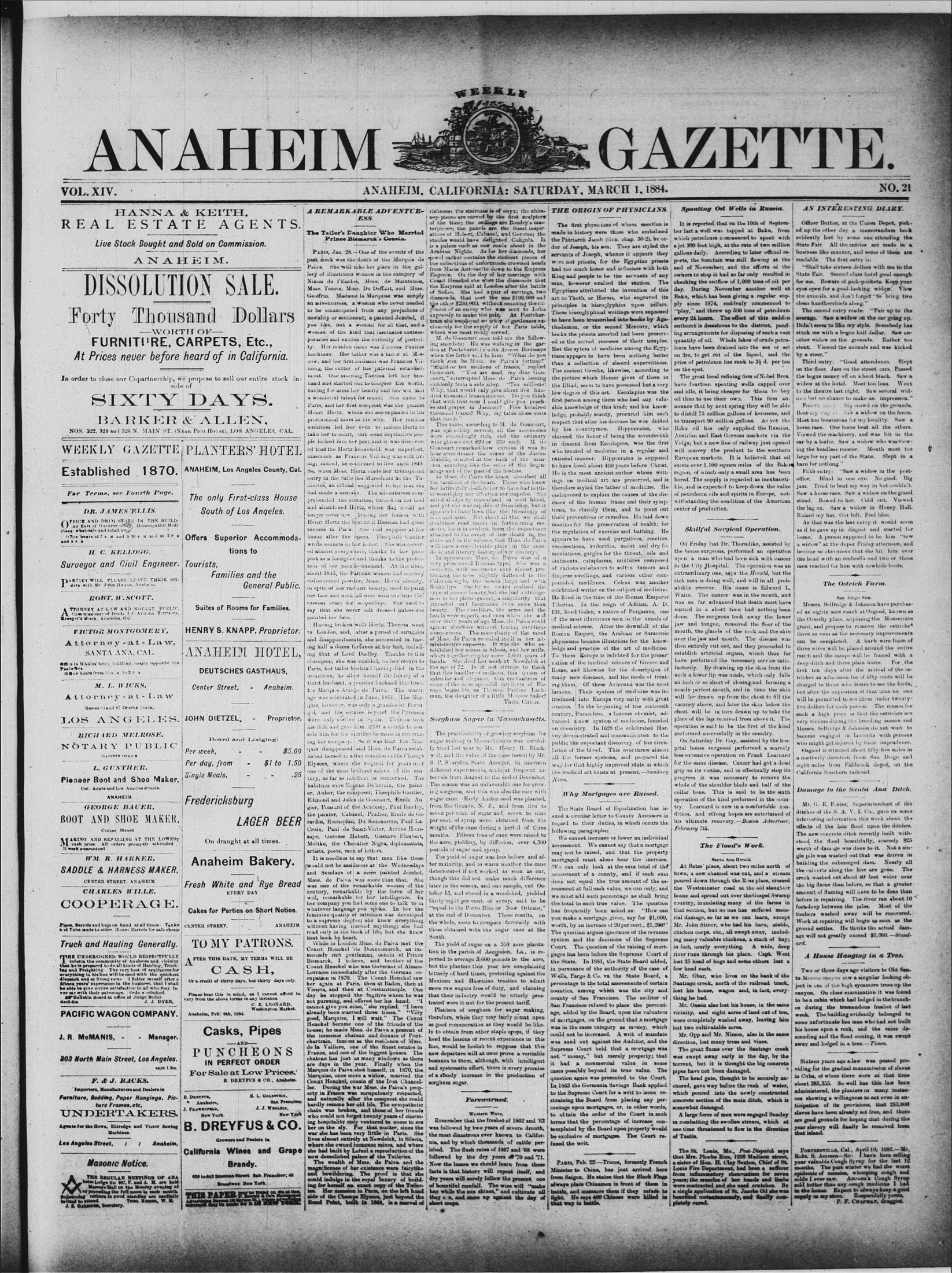
Searchable text
ANAHEIM
VOL. XIV.
HANNA & KEITH,
REAL ESTATE AGENTS.
Live Stock Bought and Sold on Commission.
ANAHEIM.
DISSOLUTION SALE.
Forty Thousand Dollars
WORTH OF
FURNITURE, CARPETS, Etc.,
At Prices never before heard of in California.
In order to close our Coppartnership, we propose to sell our entire stock inside of
Sixty Days.
BARKER & ALLEN,
NOS. 322, 324 and 326 N. MAIN ST. (NEAR PICO HOUSE), LOS ANGELES, CAL.
WEEKLY GAZETTE PLANTERS' HOTEL
Established 1870.
ANAHEIM, Los Angeles County, Cal.
A REMARK
The Tailor's Day
Prince Bi
Paris, Jan. 28., past week was the
Palace. She will the
lery of illustrious
Ninon de l'Eucalyptus
Mune. Tenein, MunGeoffrin. Madam
an adventures, a
to be emancipated
morality or sentiment
you like, but a
woman of the kniporaries and exectety. Her maiden n
Lachman. Her tacow, and her first
long, the cutter
ment. One morning
hand and started o
having for arms he
a wonderful talent.
Paris, and her first
Henri Hertz, whi
professional tours
ambition led her
take her to court,
ple looked into her
ed that the Hertz
masmuch as Franing; indeed, he coSo, when Mune.
In order to close our Coppartnership, we propose to sell our entire stock inside of
SIXTY DAYS.
BARKER & ALLEN,
NOS. 322, 324 and 326 N. MAIN ST. (NEAR PICO HOUSE), LOS ANGELES, CAL.
WEEKLY GAZETTE
Established 1870.
For Terms, see Fourth Page.
DR. JAMES ELLIS.
OFFICE AND DRUD STORE IN THE BUILDING East of GAZETTE OFFICE. Homeopathic Medicine wholesale and retail.
Office hours at 7 A.M. and 9:30 A.M. and at 2 P.M.
H. C. KELLOGG.
Surveyor and Civil Engineer.
PARTIES WILL PLEASE LEAVE THEIR ORDERS with Mr. John Hanna, Anaheim.
ROBT. W. SCOTT.
ATTORNEY AT LAW AND NOTARY PUBLIC. Commissioner of Deeds for Arizona Territory. Kreoger's Block, Anaheim, Cal.
VICTOR MONTGOMERY,
Attorney-at-Law.
SANTA ANA, CAL.
Office in Dibbles' brick building, nearly opposite the Post Office.
Office hours from 10 A.M. to 3 P.M.
M. L. WICKS.
Attorney-at-Law.
Rooms Island St. Temple Stock.
LOS ANGELES.
RICHARD MELROSE,
NOTARY PUBLIC
Gazette Office.
L. GUNTHER.
Pioneer Boot and Shoe Maker,
Cor. Adele and Los Angeles streets.
ANAHEIM.
GEORGE BAUER,
BOOT AND SHOE MAKER,
Center Street
MAKING AND REPAIRING AT THE LOWEST cash price. All orders promptly attended if work guaranteed.
WM. R. HARKER,
SADDLE & HARNESS MAKER,
CENTER STREET, ANAHEIM
CHARLES WILLE.
PLANTERS' HOTEL
ANAHEIM, Los Angeles County, Cal.
The only First-class House South of Los Angeles.
Offers Superior Accommodations to Tourists, Families and the General Public.
Suites of Rooms for Families.
HENRY S. KNAPP, Proprietor.
ANAHEIM HOTEL,
DEUTSCHES GASTHAUS,
Center Street, - Anaheim.
JOHN DIETZEL, - Proprietor.
Board and Lodging:
Per week, - $5.00
Per day, from - $1 to 1.50
Single Meals, - .25
Fredericksburg
LAGER BEER
On draught at all times.
Anaheim Bakery.
Fresh White and Rye Bread
EVERY DAY
Having broken into London, and, and disappointment half a dozen firing that of Lord champion, she was Paris, her tailor his meantime, to allow third husband, a the Marquis Aran age was celebrated quis, however, was gel, and his estate were only castles his title and gave sole him for the seizing her company.
quis disappeared himself in a Elysees, where she one of the most boury, as far as inhabitues were Auger, Aubor, the con Edmond and Jules gier, Pousard of the painter, Cabalardin, Rocueplan, Croix, Paul de Saye, Gerome Holtke, the Chew artists, poets, men
It is needless to would not be assidious and Sundays of Mine. de Paiva was one of the recentary, remarka will, remarkable
GEORGE BAUER,
BOOT AND SHOE MAKER,
Center Street
MAKING AND REPAIRING AT THE LOWEST
cash price. All orders promptly attended
will work guaranteed.
WM. R. HARKER.
SADDLE & HARNESS MAKER,
CENTER STREET, ANAHEIM
CHARLES WILLE.
COOPERAGE.
Pipes, Barrels and kegs on hand at all times. Tanks
and Tubs made to order. Honey Barrels for sale cheap
Truck and Hauling Generally.
THE UNDERSIGNED WOULD RESPECTFULLY
inform the community of Anaheim and vicinity
that he is prepared to do all kinds of Hauling, Trucking and Freighting. The very best of appliances for
everything in his line will be used with the quickest
dispatch and at living rates. I falter myself after a
fifteen years' experience in the business, that I shall
be able to give entire satisfaction to all who may favor me with their patronage. Order solicited.
&W Bulletin Board at office of Judge Bailey.
dece8-6m
J. J. DYER,
PACIFIC WAGON COMPANY.
J. R. MoMANIS, - Manager.
803 North Main Street, Los Angeles.
sept 13m.
F. & J. BACKS.
Importers, Manufacturers and Dealers in
Furniture, Bedding, Paper Hangings, Picture Frames, etc.
UNDERTAKERS,
Agents for the Howe, Eldredge and Victor Sewing Machines.
Los Angeles Street. : Anaheim.
Masonic Notice.
THE REGULAR MEETINGS OF ANAheim Lodge No. 207, F. and A. M. are held
Masonic Hall on the Monday evening of
or preceding the full moon in each month.
Sojourning retern in good standing are cordially
invited to attend.
Turo Ruana, W. M.
J. R. GARSTEIN, Secretary.
Fredericksburg
LAGER BEER
On draught at all times.
Anaheim Bakery.
Fresh White and Rye Bread
EVERY DAY
Cakes for Parties on Short Notice.
CENTER STREET, ANAHEIM.
TO MY PATRONS.
AFTER THIS DATE, MY TERMS WILL BE
CASH,
Or a credit of thirty days, but thirty days only.
Please bear this in mind, as I cannot afford to
vary from the above terms in any instance.
C. E. LEONARD,
Washington Market.
Anaheim, Feb. 9th, 1884.
Casks, Pipes
AND
PUNCHEONS
IN PERFECT ORDER
For Sale at Low Prices.
B. DREYFUS & CO., Anaheim.
B. DARYFUS,
Anaheim,
San Francisco
J. FROWENFELD,
New York
J. J. WEOLIN,
New York
B. DREYFUS & CO.
Growers and Dealers in
California Wines and Grape
Brandy.
630 to 642 Brannan Street San Francisco; 45
Broadway New York.
THIS PAPER may be found on file at Gen.
Advertising Bureau (10 Service St.), whose advertising
contract may be made for $18 NEW YORK.
Edmond and Julie
gier, Ponsard of the
the painter, Caballer,
rardin, Rocneplan,
Croix, Paul de S.
saye, Gerome H.
Moltke, the Chewartists, poets, men
It is needless to
would not be assiduand Sundays of the
Mine. de Paiva was one of the rarcentury, remarkable,
will, remarkable
her company you b
whatever language
feminine quality oi
to a supreme degree
without having learead only in the boothat book by heart.
While in London,
Count Henckel wimenely rich geniBismarck, I beliCount Henckel whiLorraine immediate
cupsation in 1870.
her again at ParVienna, and then
day he stopped t
not pursuing, and d
cannot give you mialready been marrigood, Marquise, I
Henckel became oi
house; he made Mithe immense chachartrain, famous
de la Valliere, on
France, and one of
chateau has just a
are days in the
Marquis de Paiva,
Marquise, once moCount Henckel, color. During the werty in France waand naturally aftehardly resume her chain was broken,
who could not forgeing hospitality only her on the sly.
War she has been wives almost entirely where she owned it she had built by L now demolished p
The wealth of magnificence of he and bewildering could indulge in the ing for herself an ienion. Her mansion side of the Champa-Rond Point, buil
A REMARKABLE ADVENTURES.
The Tailor's Daughter Who Married Prince Bismarck's Cousin.
Paris, Jan. 28. One of the events of the past week was the death of the Marquis de Paixa. She will take her place in the gallery of illustrious women in the category of Ninon de l'Euclos, Mme. de Maintenon, Mme. Tencen, Mme. Du Deffant, and Mme. Geoffrin. Madame la Marquise was simply an adventress, a woman who never needed to be emancipated from any prejudices of morality or sentiment; a painted Jezebel, if you like, but a woman for all that, and a woman of the kind that fascinates contemporaries and excites the curiosity of posterity. Her maiden name was Lucreza Pauline Lachman. Her father was a tailor at Moscow, and her first husband was Francois Villoing, the cutter of the paternal establishment. One morning Theresa left her husband and started out to conquer the world, having for arms her beauty and her wit and a wonderful talent for music. She came to Paris, and her first conquest was the pianist Houri Hertz, whom she accompanied in his professional tours as his wife. Her restless ambition led her even to induce Hertz to take her to court, but some inquisitive people looked into her past and it was discovered that the Hertz household was imperfect, masmuch as France is Vilolong was still living; indeed, he continued to live until 1849. So, when Mme. Hertz made her triumphant richness; the staircase is of onyx; the chimney-pieces are carved by the first sculptors of the time; the ceilings are Bondry's masterpieces; the panels are the finest inspirations of Hebert, Cabanel, and Gerome; the stables would have delighted Caligula. It is a palace such as one reads about in the Arabian Nights. As for her diamonds, her jewel casket contains the choicest pieces of the collections of unfortunate crowned heads from Marie Antoinette down to the Empress Eugenie. On the day of her marriage with Count Henekel she wore the diamonds that the Empress sold at London after the battle of Sedan. She had a pair of earrings, two diamonds, that cost the one $100,000 and the other $200,000, without counting the expenses of an envoy who was sent to India expressly to make the pair. At Pontechartrain she employed an army of gardeners exclusively for the supply of her Paris table, which was most richly served.
M. de Goncourt once told me the following anecdote: He was walking in the garden at Pontechartrain with Arsene Housseaye when the letter said to him: "What do you think can be Mme. de Paiva's fortune?" "Eight or ten millions of francs," replied Goncourt. "You are mad, my dear Goncourt," interrupted Mme. de Paiva issuing suddenly from a side alley. "Ten millions! Why, that would only give about five hundred thousand francs income. Do you think that with that sum I could give you peaches and grapes in January? Five hundred thousand francs? Why, my table alone costs that much."
This table, according to M. de Goncourt, was splendidly served; all the accessories were exceedingly rich, and the ordinary wine glasses cost $20 or $30 each. M. de Goncourt remarked how curious it was to hear after dinner the music of the Jardin Mabille, situated at the back of the manion, sounding like the echo of the beginnings and of the past of the hostess.
THE ORIGIN OF PHYSICIANS.
The first physicians of whom mention is made in history were those who embalmed the Patriarch Jacob (Gen. chap. 50-2), by order of Joseph, his son. They are styled the servants of Joseph, whence it appears they were not priests, for the Egyptian priests had too much honor and influence with both King and people to be the servants of any man, however exalted the station. The Egyptians attributed the invention of this art to Thoth, or Herms, who engraved its principles in hieroglyphics upon pillars. These hieroglyphical writings were supposed to have been transcribed into books by Agathodemon, or the second Mercury, which books the priests asserted had been preserved in the sacred recesses of their temples. But the system of medicine among the Egyptians appears to have been nothing better than a collection of absurd superstitions. The ancient Greeks, likewise, according to the picture which Homer gives of them in the Illiad, seem to have possessed but a very low degree of this art. Esculapius was the first person among them who had any valuable knowledge of this kind; and his knowledge, probably scanty, procured him such respect that after his decease he was deified by his countrymen. Hippocrates, who claimed the honor of being the seventeenth in descent from Esculapius, was the first who treated of medicine in a regular and rational manner. Hippocrates is supposed to have lived about 400 years before Christ. He is the most ancient author whose writ-
One morning Theresa left her husband and started out to conquer the world, having for arms her beauty and her wit and a wonderful talent for music. She came to Paris, and her first conquest was the pianist Henri Hertz, whom she accompanied in his professional tours as his wife. Her restless ambition led her even to induce Hertz to take her to court, but some inquisitive people looked into her past and it was discovered that the Hertz household was imperfect, masmuch as France is Villegong was still living; indeed, he continued to live until 1849. So when Mine. Hertz made her triumphant entry in the Salie des Marcheaux at the Tuileries, an official suggested to her that she had made a mistake. The adventures comprehended the situation, turned on her heel and abandoned Hertz, whose flag could no longer cover her. During her haison with Henri Hertz the beautiful Russian had great success in Paris. She had suppers at her house after the opera. Theophile Gautier wrote sonnets in her honor. She was received almost everywhere, thanks to her passport as a foreigner and thanks to the protection of her pseudo-husband. At this time, about 1845, the Parisian women had scarcely rediscovered powder; Mine. Hertz already, in spite of her radiant beauty, used to paint her face and neck all over with the true Circassian craze for maquillage. She used to say that she never felt dressed unless she painted her face.
Having broken with Hertz, Theresa went to London, and after a period of struggles and disappointments, she succeeded in having half a dozen fortunes at her feet, including that of Lord Dulley. Thanks to this champion, she was enabled, on her return to Paris, her tailor husband having died in the meantime, to allow herself the luxury of a third husband, a genuine husband this time, the Marquis Aranjo de Paiva. The marriage was celebrated in June, 1851. The Marquis, however, was only a grandee of Portugal, and his estates beyond the Pyrenees were only castles in Spain. Theresa took his title and gave him $200 a month to console him for the sacrifice he made in renouncing her company. So it was that the Marquis disappeared and Mine. de Paiva established herself in a fine mansion in the Champs Elysees, where she reigned for years over one of the most brilliant salons of the century, as far as intellect is concerned. The habitues were Eugene Delacroix, the painter. Aubor, the composer, Theophile Gautier, Edmond and Jules de Goncourt, Emile Augier, Pousard of the Academy, Paul Baudry, the painter, Cabanel, Pradier, Emile de Girardin, Rocueplan, Du Sommerro, Paul LaCroix, Paul de Saint-Victor, Arsene Houssaye, Gerome Hebert, Gustave Flaubert, Moltke, the Chevalier Nigra, diplomatists, artists, poets, men of letters.
It is needless to say that men like these would not be assiduous at the Wednesdays and Sundays of a mere painted Jezebel. Mine. de Paiva was more than that. She was one of the remarkable women of the century, remarkable by the force of her will, remarkable for her intelligence.
This table, according to M. de Goncourt, was splendidly served; all the accessories were exceedingly rich, and the ordinary wine glasses cost $20 or $30 each. M. de Goncourt remarked how curious it was to hear after dinner the music of the Jardin Mabille, situated at the back of the manion, sounding like the echo of the beginnings and of the past of the hostess.
In Mine. de Paiva the brain absorbed all the faculties of the heart. Those who knew her latently declare her to have had neither sensibility nor affection nor impulse. She acted always by reason and in cold blood, and yet she was capable of friendship, but it appears to have been like the friendship of man and man. But about all this we shall doubtless read much in forthcoming memoirs; for it is evident, from the importance attached to the event of her death in the cubs and in the saloons, that Mine. de Paiva will have a considerable place in the anecdote and literary history of her century.
In appearance Mine. de Paiva was of a very prominent Russian type. She was a bennett with enormous eyes almost protruding; the nose slightly flattened in the Calenck style; the mouth large and with fleshy lips. She by no means realized the type of classic beauty; but she had a strangeness in her physique, a singularity that attracted and fascinated even more than beauty. The shoulders, the arms and the hands were superb, and even when she was over sixty years of age Mine. de Paiva could appear docile without fearing invidious comparisons. The masculinity of the mind of Mine. de Paiva revealed itself if in her administrative capacity. It was she who established her names in Silesia, and her mills which together employ some 5,000 pairs of hands. She died last week at Newledek at the age of 72. Is it not strange to think that this handler of millions, this queen of splendor and elegance, this enchantress of some of the most splendid intellects of Europe, began life as Theresa Pauline Lachman, the daughter of a little Moscow tailor? THEO. CHILD.
Sorghum Sugar in Massachusetts.
The practicability of growing sorghum for sugar making in Massachusetts was carefully tried last year by Mr. Henry B. Blackwell, and the value of the cane tested by Mr. S. P. Sharples, State Assayer, in nineteen different experiments, made at frequent intervals from August to the end of December.
The season was an unfavorable one for growing sorghum, and this was also the case with sugar cane. Early Amber seed was planted from Rio Grande, N. J., and from five to seven per cent. of sugar and seven to nine per cent. of syrup were obtained from the weight of the cane during a period of three months. Fifteen tons of cane were raised to the acre, yielding by diffusion over 4,500 pounds of sugar and syrup.
The yield of sugar was less before and after maturity, and in warm weather the cane deteriorated if not worked as soon as cut, though this did not make much difference later in the season, and one sample, cut October 15, and stored in a woodshield, yielded
the picture which Homer gives them in the Iliad, seem to have possessed but a very low degree of this art. Esculapius was the first person among them who had any valuable knowledge of this kind; and his knowledge probably scanty, procured him such respect that after his decease he was deified by his countrymen. Hippocrates who claimed the honor of being the seventeenth in descent from Esculapius, was the first who treated medicine in a regular manner. Hippocrates is supposed to have lived about 400 years before Christ.
He is the most ancient author whose writings on medical art are preserved, and is therefore styled the father of medicine. He endeavored to explain the causes of the diseases of the human frame and their symptoms, to classify them, and to point out their preventives or remedies. He laid down maxims for the preservation of health; for the regulation of exercise and bathing. He appears to have used purgatives, emetics venesections, audorifies, moist and dry fomentations, gargles for the throat, oils and ointments, cataplasms, mixtures composed of various substances to soften tumors and disperse swellings, and various other compounds medicines. Celius was another celebrated writer on the subject of medicine. He lived in the time of the Roman Emperor Tiberius. In the reign of Adrian, A.D. 131, lived Galen, a native of Pergamus, one of the most illustrious men in the annals of medical science. After the downfall of the Roman Empire, the Arabian or Saracen physicians became illustrious for the knowledge and practice of the art of medicine. To them Europe is indebted for the preservation of the medical science of Greece and Rome, and likewise for the description of many new diseases, and the mode of treating them. Of these Avicennna was the most famous. Their system of medicine was introduced into Europe very early with great success. In the beginning of the sixteenth century, Paracelsus, a famous chemist, advanced a new system of medicine founded on chemistry. In 1628 he celebrated Harvey demonstrated and communicated to public the important discovery of the circulation of the blood. This overthrew almost all the former systems, and prepared the way for that highly improved state in which the medical art exists at present.
Sanitary News.
Why Mortgages are Raised.
The State Board of Equalization has issued a circular letter to County Assessors in regard to their duties, in which occurs the following paragraphs:
We cannot increase or lower an individual assessment. We cannot say that a mortgage may not be raised; and that the property mortgaged must alone bear the increase. We can only look at the sum total of the assessment of a county; end if such sum does not equal the true amount of the assessment at full cash value; we can only; and we must add such percentage as shall bring
Edmond and Jules de Goncourt, Emile Augier, Ponsard of the Academy, Paul Baudry, the painter, Cabanel, Pradier, Emile de Girardin, Rocueplan, Du Sommerro, Paul La Croix, Paul de Saint-Victor, Arsene Housaye, Gerome Hebert, Gustave Flanbert, Moltke, the Chevalier Nigra, diplomatists, artists, poets, men of letters.
It is needless to say that men like these would not be assiduous at the Wednesdays and Sundays of a mere painted Jezebel. Mme. de Paiva was more than that. She was one of the remarkable women of the century, remarkable by the force of her will, remarkable for her intelligence. In her company you had some to talk to in whatever language you spoke. In her the feminine quality of intuition was developed to a supreme degree; she knew everything without having learned anything; she had read only in the book of life, but she knew that book by heart.
While in London Mme. de Paiva met the Count Henckel de Donnesmarck, an immense rich gentleman, cousin of Prince Bismarck, I believe, and brother of the Count Henckel who was Governor of Alsace-Lorraine immediately after the German occupation in 1870. The Count Henckel saw her again at Paris, then at Baden, then at Vienna, and then at Constantinople. One day he stopped the fugitive whom he was not pursuing, and offered her his hand. "I cannot give you mine," she replied. "I have already been married three times." "Very good, Marquise, I will wait." The Count Henckel became one of the friends of the house; he made Mme. de Paiva a present of the immense chateau and domain of Pontchartrain, famous as the residence of Mme. de la Valliere, one of the finest estates in France, and one of the biggest houses. The chateau has just as many windows as there are days in the year. Finally when the Marquis de Paiva shot himself, in 1870, the Marquise, once more a widow, married the Count Henckel, cousin of the Iron Chancellor.
During the war Mme. de Paiva's property in France was scrupulously respected, and naturally after the conquest she could hardly resume her old life. The sympathetic chain was broken, and those of her friends who could not forget twenty years of charming hospitality only ventured to come see her on the ally. For that matter, since the war she has been very little in Paris. She lives almost entirely at Nawdelck, in Silenia, where she owned immense mines, and where she had built by Lefuel a reproduction of the now demolished palace of the Tuileries.
The wealth of Mme. de Paiva and the magnificence of her existence were fairylike and bewildering. The proof is that she could indulge in the royal luxury of building for herself an exact copy of the Tuileries. Her mansion in Paris, on the left hand side of the Champs Elysees, just beyond the Road Point, built in 1864, is a marvel of sugar cane. Early Amber seed was planted from Rio Grande, N. J., and from five to seven per cent. of sugar and seven to nine per cent. of syrup were obtained from the weight of the cane during a period of three months. Fifteen tons of cane were raised to the acre, yielding, by diffusion, over 4,500 pounds of sugar and syrup.
The yield of sugar was less before and after maturity, and in warm weather the cane deteriorated if not worked as soon as cut, though this did not make much difference later in the season, and one sample, cut October 15, and stored in a woodished, yielded thirty-eight per cent. of syrup, said to be "equal to the Porto Rico or New Orleans," at the end of December. These results, on the whole, seem to compare favorably with those obtained with the sugar cane at the South.
The yield of sugar on a 500 acre plantation in the parish of Ascension, La., is reported to average 3,600 pounds to the acre, but the planters this year are complaining bitterly of hard times, protesting against the Mexican and Hawaiian treaties to admit more raw sugars free of duty, and claiming that their industry would be utterly protracted were it not for the present tariff.
Planters of sorghum for sugar making, therefore, while they may fairly count upon as good remuneration as they would be likely to obtain from other staple crops, if they heed the lessons of recent experience in this line, would be foolish to suppose that this new departure will at once prove a veritable bonanza to them, although, with intelligent and systematic effort, there is every promise of a steady increase in the production of sorghum sugar.
Forewarned.
Western Wave
Remember that the freshet of 1862 and '63 was followed by two years of severe drouth, the most disastrous ever known to California, and by which thousands of cattle perished. The flush rains of 1867 and '68 were followed by the dry years '70 and '71. Now the lesson we should learn from these facts is that history will repeat itself, and dry years will surely follow the present one of bountiful rainfall. The wise will "make hay while the sun shines," and cultivate all they can, and store up against the day of short crops.
The State Board of Equalization has issued a circular letter to County Assessors in regard to their duties, in which occurs the following paragraphs:
We cannot increase or lower an individual assessment. We cannot say that a mortgage may not be raised, and that the property mortgaged must alone bear the increase. We can only look at the sum total of the assessment of a county, end if such sum does not equal the true amount of the assessment at full cash value, we can only, and we must add such percentage as shall bring the total to such true value. The question has frequently been asked us: "How can you make a mortgage given, say for $1,000 worth, by an increase of 20 per cent., $1,200?" The question argues ignorance of the revenue system and the decisions of the Supreme Court.
The question of the raising of mortgages has been before the Supreme Court of the State. In 1881, the State Board added, in pursuance of the authority of the case of Wells, Fargo & Co. vs. the State Board, a percentage to the total assessments of certain counties, among which was the city and county of San Francisco. The auditor of San Francisco refused to place the percentage added by the Board upon the valuation of mortgages on the ground that a mortgage was in the same category as money, which could not be increased. A writ of mandate was sued out against the Auditor, and the Supreme Court held that a mortgage was not "money," but merely property; that it had a commercial value in some cases possibly beyond its true value. The question again was presented to the Court. In 1883 the Germania Savings Bank applied to the Supreme Court for a writ to issue restraining the Board from placing any percentage upon mortgages, or, in other words, to obtain the order of the Court in such terms that the percentage of increase contemplated by the Board upon property would be exclusive of mortgages. The Court refused the writ.
PARIS, Feb. 22—Tricou, formerly French Minister to China, has just arrived here from Saigon. He states that the Black Flags always place Chinamen in front of them in battle, and massacre them if they refuse to fight. He says 400 Chinese were killed in that way in battle.
GAZETTE.
MARCH 1, 1884. NO. 21
NON OF PHYSICIANS.
Medicians of whom mention is were those who embalmed job (Gen. chap. 50-2), by or son. They are styled the both, whence it appears they for the Egyptian priests minor and influence with both to be the servants of any arrested the station. The stated the invention of this Herms, who engraved its seroglyphics upon pillars. Historical writings were supposed described into books by Agaias second Mercury, which asserted had been preserving recesses of their temples. Medicine among the Egyptians have been nothing better than of absurd superstitions. Books, likewise, according to Homer gives of them in who have possessed but a very art. Esculapius was the king them who had any valuation of this kind; and his know-canty, procured him such his decease he was deified men. Hippocrates, who author of being the seventeenth Esculapius, was the first medicine in a regular and Hippocrates is supposed about 400 years before Christ, ancient author whose writ-
Spouting Oil Wells in Russia.
It is reported that on the 10th of September last a well was tapped at Baku, from which petroleum commenced to spout with a jet 300 feet high, at the rate of two million gallons daily. According to later official reports, the fountain was still flowing at the end of November; and the efforts of the owners to stop it had so far only resulted in checking the outflow of 1,000 tons of oil per day. During November another well at Baku, which has been giving a regular supply since 1874, suddenly commenced to "play," and threw up 500 tons of petroleum every 24 hours. The effect of this sudden outburst is disastrous to the district, pending arrangements for disposing of such a vast quantity of oil. Whole lakes of crude petroleum have been drained into the sea or set on fire, to get rid of the liquid, and the price of petroleum has sunk to 3½ d. per ton on the spot.
The great local refining firm of Nobel Bros. have fourteen spouting wells capped over and idle, it being cheaper for them to buy oil than to use their own. This firm announces that by next spring they will be able to distill 75 million gallons of kerosene, and to transport 90 million gallons. As yet the Baku oil has only supplied the Russian, Austrian and East German markets via the Volga; but a new line of railway just opened will convey the product to the southern European markets. It is believed that oil exists over 1,100 square miles of the Baku region, of which only a small area has been
AN INTERESTING DIARY.
Officer Button, at the Union Depot, picked up the other day a memorandum book evidently lost by some one attending the State Fair. All the entries are made in a business like manner, and some of them are readable. The first entry is:
"Shall take sixteen dollars with me to the State Fair. Second-class hotel good enough for me. Beware of pick-pockets. Keep your eyes open for a good-looking widow. View the animals, and don't forget to bring two clean handkerchiefs along."
The second entry reads: "Fair up to the average. Saw a widow on the car going up. Didn't seem to like my style. Somebody has stuck me with a bogus half dollar. Saw another widow on the grounds. Rather too stout. Viewed the animals and was kicked by a steer."
Third entry: "Good attendance. Sleep on the floor. Jam on the street cars. Passed the bogus money off on a boot black. Saw a widow at the hotel. Most too lean. Went to the theatre last night. Saw several widows but no chance to make an impression."
Fourth entry: Big crowd on the grounds. Beat my way in. Saw a widow on the fence. Most too boisterous for my locality. Saw a horse race. One horse beat all the others. Viewed the machinery, and was hit in the ear by a loafer. Saw a widow who was viewing the headless rooster. Mouth most too large for my part of the State. Slept in a barn for nothing."
Fifth entry: "Saw a widow in the post-
The great local refining firm of Nobel Bros. have fourteen spouting wells capped over and idle, it being cheaper for them to buy oil than to use their own. This firm announces that by next spring they will be able to distill 75 million gallons of kerosene, and to transport 90 million gallons. As yet the Baku oil has only supplied the Russian, Austrian and East German markets via the Volga; but a new line of railway just opened will convey the product to the southern European markets. It is believed that oil exists over 1,100 square miles of the Bakau region, of which only a small area has been bored. The supply is regarded as inexhaustible, and is expected to keep down the value of petroleum oils and spirits in Europe, notwithstanding the condition of the American center of production.
Skillful Surgical Operation
On Friday last Dr. Thorndike, assisted by the house surgeons, performed an operation upon a man who had been sick with cancer in the City Hospital. The operation was an extraordinary one, says the Herald, but the sick man is doing well, and will in all probability recover. His name is Edward L. Waite. The cancer was in the mouth, and was so far advanced that death must have ensued in a short time had nothing been done. The surgeons took away the lower jaw and tongue, removed the floor of the mouth, the glands of the neck and the skin over the jaw and mouth. The disease was then entirely cut out, and they proceeded to establish artificial organs, which thus far have performed the necessary service satisfactorily. By drawing up the skin from the neck a lower lip was made, which only falls an inch or so short of closing and forming a nearly perfect mouth, and in time the skin will be drawn up from the chest to fill the vacancy above, and later the skin below the chest will be in turn drawn up to take the place of the lap received from above it. The operation is said to be the first of the kind performed successfully in the country.
On Saturday Dr. Gay, assisted by the hospital house surgeons performed a scarcely less extensive operation on Frank Learnard for the same disease. Cancer had got a dead grip on its victim, and to effectually stop its progress it was necessary to remove the whole of the shoulder blade and half of the collar bone. This is said to be the sixth operation of the kind performed in the country. Learnard is now in a comfortable condition, and strong hopes are entertained of his ultimate recovery.—Boston Advertiser, February 7th.
The Flood's Work.
Santa Ana Herald.
At Rates' place, about two miles north of town, a new channel was cut, and a stream poured down through the Ross place, crossed the Westminster road at the old slaughter house and spread out over the Gospel Swamp
the bogus money off on a boot black. Saw a widow at the hotel. Most too lean. Went to the theatre last night. Saw several widows but no chance to make an impression."
Fourth entry: Big crowd on the grounds. Beat my way in. Saw a widow on the fence. Most too boisterous for my locality. Saw a horse race. One horse beat all the others. Viewed the machinery, and was hit in the ear by a loafer. Saw a widow who was viewing the headless rooster. Mouth most too large for my part of the State. Slept in a barn for nothing.
Fifth entry: "Saw a widow in the post-office. Blind in one eye. No good. Big jam. Tried to beat my way in but couldn't. Saw a horse-race. Saw a widow on the grand stand. Bowed to her. Cold cut. Viewed the big ox. Saw a widow in Honey Hall. Raised my hat. Got left. Feel blue.
As that was the last entry it would seem as if he gave up in disgust and started for home. A person supposed to be him "saw a widow" at the depot Friday afternoon, and became so obnoxious that she hit him over the head with an umbrella and two or three men reached for him with cowhide boots.
The Ostrich Farm.
San Diego Sun.
Messrs. Selfridge & Johnson have purchased an eighty-acre ranch at Osgood, known as the Ormsby place, adjoining the Monserrate grant, and propose to remove the ostriches there as soon as the necessary improvements can be completed. A barb wire fence of three wires will be placed around the entire ranch and the camps will be fenced with a deep ditch and three plain wires. For the first ten days after the arrival of the ostriches an admission fee of fifty cents will be charged to those who desire to see the birds, but after the expiration of that time no one will be permitted to see them under twenty-five dollars for each person. The reason for such a high price is that the ostriches are very vicious during the breeding season and Messrs. Selfridge & Johnson do not wish to become engaged in lawsuits with persons who might get injured by their imprudence.
Osgood is situated about fifty-five miles in a northerly direction from San Diego and eight miles from Fallbrook depot, on the California Southern railroad.
Damage to the Santa Ana Ditch.
Mr. G. E. Foster, Superintendent of the ditches of the S.A.V.L.Co., gave us some interesting information this week about the effects of the late flood upon the ditches. The new concrete ditch recently built withstood the flood beautifully, scarcely 825 worth of damage was done to it. Not a single pile was washed out that was driven in building the submerged dam. Nearly all the culverts along the line are gone. The creek washed out about 40 feet wider near the big flume than before, so that a greater amount of flaming will have to be done than before in rearing. The river ran about 10
The Flood's Work.
Santa Ana Herald.
At Bates' place, about two miles north of town, a new channel was cut, and a stream poured down through the Rosa place, crossed the Westminster road at the old slaughter house and spread out over the Gospel Swamp country, inundating many of the farms in that section, but no one has suffered material damage, so far as we can learn, except Mr. John Stiner, who had his barn, stable, chicken coops, etc., all swept away, including many valuable chickens, a stack of hay; in fact, nearly everything. A wide, deep river runs through his place. Capt. West lost 25 head of hogs and some others lost a few head each.
Mr. Obar, who lives on the bank of the Santiago creek, north of the railroad track, lost his house, wagon and, in fact, everything he had.
Mr. Onsón also lost his house, in the same vicinity, and eight acres of land out of ten, were completely washed away, leaving him but two cultivatable acres.
Mr. Opp and Mr. Nisson, also in the same direction, lost many trees and vines.
The great flume over the Santiago creek was swept away early in the day, by the torrent, but it is thought the big concrete pipes have not been damaged.
The head gate, thought to be securely anchored, gave way before the rush of water, which poured into the newly constructed concrete section of the main ditch, which is somewhat damaged.
A large force of men were engaged Sunday in combatting the swollen stream, which at one time threatened to flow in the direction of Tustin.
The St. Louis Mo., Post-Dispatch says that Mrs. Phoebe Rice, 1208 Madison street, a sister of Hon. H. Clay Sexton, Chief of St. Louis Fire Department, had been a sufferer from inflammatory rheumatism for seven years; the muscles of her hands and limbs were contracted and she used crutches. By a single application of St. Jacobs Oil she was benefited instantaneously, and finally completely cured.
Mr. G. E. Foster, Superintendent of the ditches of the S. A. V. L. Co., gave us some interesting information this week about the effects of the late flood upon the ditches. The new concrete ditch recently built withstood the flood beautifully, scarcely $25 worth of damage was done to it. Not a single pile was washed out that was driven in building the submerged dam. Nearly all the culverts along the line are gone. The creek washed out about 40 feet wider near the big flume than before, so that a greater amount of flaming will have to be done than before in repairing. The river ran about 10 feet deep between the piles. Most of the timbers washed away will be recovered. Work at repairing will begin as soon as the ground settles. He thinks the actual damage will not greatly exceed $5,000.
A House Hanging in a Tree.
Two or three days ago visitors to Old Santa Monica canyon saw a singular looking object in one of the high sycamore trees up the canyon. On close examination it was found to be a cabin which had lodged in the branches during the tremendous freshet of last week. The building evidently belonged to some unfortunate bee man who had not built his house upon a rock, and the rains descending and the flood coming, it was swept away and lodged in a tree.
Sixteen years ago a law was passed providing for the gradual manumission of slaves in Cuba, of whom there were at that time about 385,355. So well has this law been administered, the planters in many instances showing a willingness to act even in anticipation of its provisions, that 285,000 slaves have been already set free, and there are good grounds for hoping that during the year slavery will finally be removed from that island.
PORTERSVILLE, Cal., April 10, 1882.-Mr. Robt. S. Ammen—Sir: I have been selling your valuable Cough Syrup for the last 12 months. The past winter we had the worst epidemic of measles, whooping cough and colds I ever saw. Ammen's Cough Syrup sold better than any cough medicine I had in the house. Expect to always keep a good supply in my store.
P. F. Chapman, druggist.