anaheim-gazette 1884-02-23
Scanned page
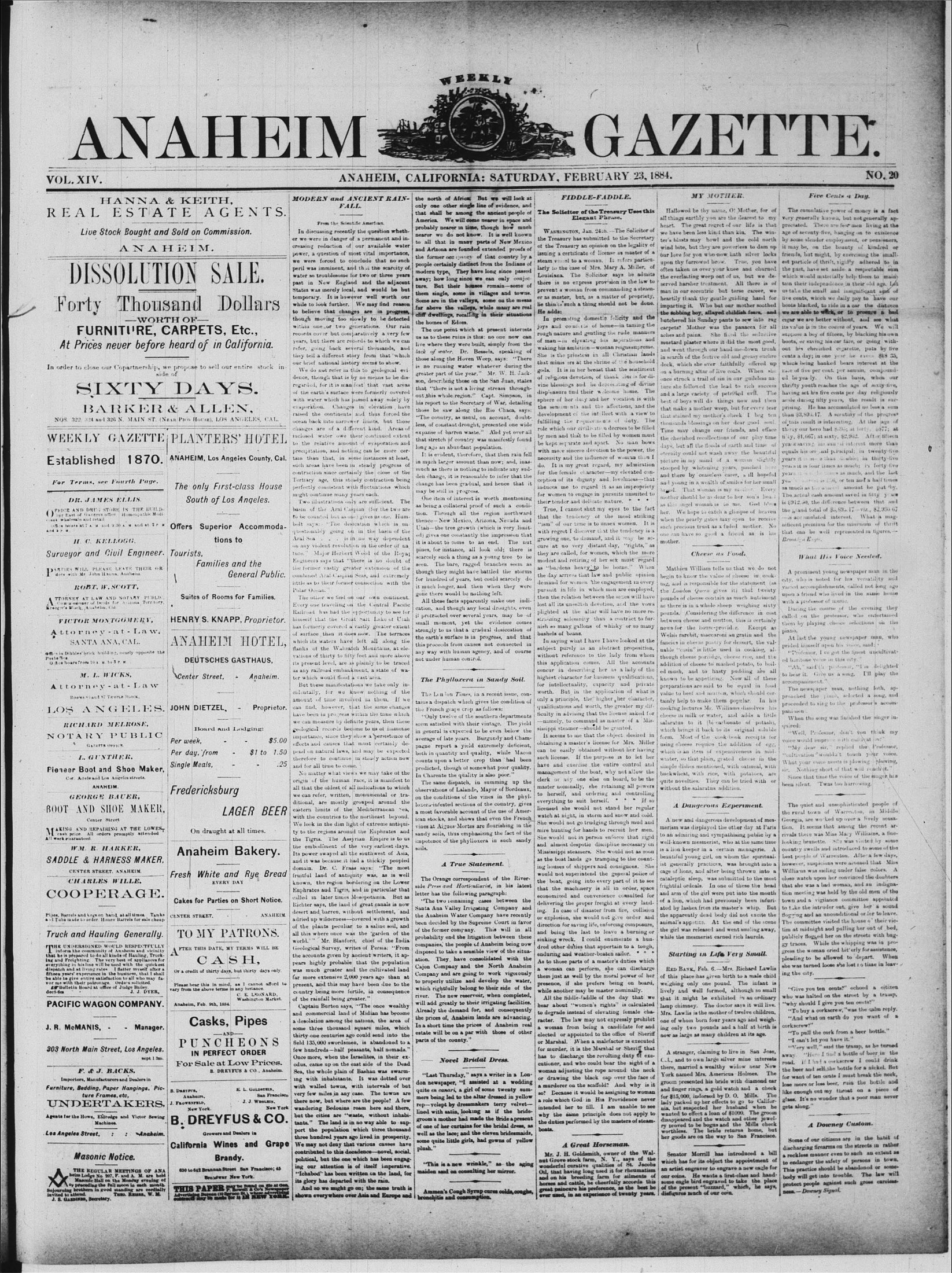
Searchable text
ANAHEIM
VOL. XIV.
HANNA & KEITH,
REAL ESTATE AGENTS.
Live Stock Bought and Sold on Commission.
ANAHEIM.
DISSOLUTION SALE.
Forty Thousand Dollars
WORTH OF
FURNITURE, CARPETS, Etc.,
At Prices never before heard of in California.
In order to close our Coppartnership, we propose to sell our entire stock inside of
Sixty Days.
BARKER & ALLEN,
NQS. 322, 324 and 326 N. MAIN ST. (NEAR PICO HOUSE), LOS ANGELES, CAL.
WEEKLY GAZETTE PLANTERS' HOTEL
Established 1870. ANAHEIM, Los Angeles County, Cal.
MODERN AND ANCIENT FALL
From the Scientist
In discussing recently er we were in danger of creasing reduction of power, a question of mo we were forced to corperil was imminent, and water so troublesome for past in New England States was merely local, temporary. It is however while to look further, to believe that change though moving too slow within one or two ge records cover but comp years, but there are rec refer, going back seven they tell a different sto our brief national histor We do not refer in the dence, though that is by regarded, for it is mani of the earth's surface w with water which has pe evaporation. Changes raised the continents ocean back into narrow changes are of a differ enclosed water owe th to the relative amount precipitation, and nothing than that, in son such areas have been in contraction since certain
SIXTY DAYS.
BARKER & ALLEN,
NOS. 322, 324 and 326 N. MAIN ST. (NEAR PICO HOUSE), LOS ANGELES, CAL.
WEEKLY GAZETTE
Established 1870.
For Terms, see Fourth Page.
DR. JAMES ELLIS.
OFFICE AND DRUG STORE IN THE BUILDING East of Barker office. Homeopathic Medicine wholesale and retail.
Offices at 7 A.M. and 9:30 A.M. and at 2 P.M. and 4 P.M.
H. C. KELLOGG.
Surveyor and Civil Engineer.
PARTIES WILL PLEASE LEAVE THEIR ORDERS with Mr. John Hanna, Anaheim.
ROBT. W. SCOTT.
ATTORNEY AT LAW AND NOTARY PUBLIC. Commissioner of Deeds for Arizona Territory, Kreeger's Block, Anaheim, Cal.
VICTOR MONTGOMERY,
Attorney-at-Law, Santa Ana, Cal.
Office in Dibbles brick building, nearly opposite the Post Office.
Office hours from 10 A.M. to 3 P.M.
M. L. WICKS,
Attorney-at-Law
Rooms St and St Temple Block,
LOS ANGELES.
RICHARD MELROSE,
NOTARY PUBLIC
Gazette Office.
L. GUNTHER.
Pioneer Boot and Shoe Maker,
Cor. Adele and Los Angeles streets, Anaheim.
GEORGE BAUER,
BOOT AND SHOE MAKER,
Center Street
MAKING AND REPAIRING AT THE LOWEST cash price. All orders promptly attended.
WM. R. HARKER,
SADDLE & HARNESS MAKER,
CENTER STREET, Anaheim
CHARLES WILLE,
COOPERAGE.
PLANTERS' HOTEL
ANAHEIM, Los Angeles County, Cal.
The only First-class House South of Los Angeles.
Offers Superior Accommodations to Tourists, Families and the General Public.
Suites of Rooms for Families.
HENRY S. KNAPP, Proprietor.
ANAHEIM HOTEL,
DEUTSCHES GASTHAUS,
Center Street, Anaheim.
JOHN DIETZEL, - Proprietor.
Board and Lodging:
Per week, - $5.00
Per day, from - $1 to 1.50
Single Meals, - .25
Fredericksburg
LAGER BEER
On draught at all times.
Anaheim Bakery.
Fresh White and Rye Bread
EVERY DAY
No matter what view origin of the human all that the oldest of all we can refer, written, traditional, are mostly eastern limits of the with the countries to the We look in the dim light to the regions around the Tigris. The Assyrian embodiment of the Its power swayed all that it was because it had domain. Dr. C. Fraas fruitful land of antiquity known, the region born Euphrates and Tigris, called in later times
BOOT AND SHOE MAKER,
Center Street
MAKING AND REPAIRING AT THE LOWEST
cash price. All orders promptly attended
All work guaranteed.
WM. R. HARKER,
SADDLE & HARNESS MAKER,
CENTER STREET. ANAHEIM.
CHARLES WILLE.
COOPERAGE.
Truck and Hauling Generally.
THE UNDERSIGNED WOULD RESPECTFULLY
inform the community of Anaheim and vicinity
that he is prepared to do all kinds of Hauling, Trucking and Freighting. The very best of appliances for
everything in his line will be used with the quickest
dispatch and at living rates. I flatter myself after a
fifteen years' experience in the business, that I shall
be able to give entire satisfaction to all who may favor
me with their patronage. Order's solicited.
Bulletin Board at office of Judge Bailey.
dec 6m.
J. J. DYER,
PACIFIC WAGON COMPANY.
J. R. McMANIS, - Manager.
303 North Main Street, Los Angeles.
sept 13m.
F. & J. BACKS,
Importers, Manufacturers and Dealers in
Furniture, Bedding, Paper Hangings, Picture Frames, etc,
UNDERTAKERS,
Agents for the Howe, Eklredge and Victor Sewing Machines.
Los Angeles Street, : : Anaheim.
Masonic Notice.
THE REGULAR MEETINGS OF ANAheim Lodge No. 207, F. and A. M. are held
Masonic Hall on the Monday evening of
or preceding the full moon in each month.
Sojourning brother in good standing are cordially invited to attend.
Theo. Reissa, W. M.
J. S. GARDINES, Secretary.
LAGER BEER
On draught at all times.
Anaheim Bakery.
Fresh White and Rye Bread
EVERY DAY
Cakes for Parties on Short Notice.
CENTER STREET.
ANAHEIM
TO MY PATRONS.
AFTER THIS DATE, MY TERMS WILL BE CASH,
Or a credit of thirty days, but thirty days only.
Please bear this in mind, as I cannot afford to vary from the above terms in any instance.
C.E. LEONARD,
Washington Market.
Anaheim, Feb. 9th, 1884.
Casks, Pipes
AND
PUNCHEONS
IN PERFECT ORDER
For Sale at Low Prices.
B. DREYFUS & CO., Anaheim.
B. DREYFUS,
Anaheim,
San Francisco
J. FROWENFELD,
New York
J. J. WEOLNIN,
New York
B. DREYFUS & CO.
Growers and Dealers in
California Wines and Grape Brandy.
630 to 642 Brannan Street San Francisco; 45 Broadway New York.
THIS PAPER may be found on file at Gen.
Advertising Bureau (10 Spruce St.), where advertising contract may be made for it in NEW YORK.
Captain Burton says,
and commercial land or a desolation among the
some three thousand one field 135,000 swordsmen few hundreds—half peas.
Once more, when the Isaodus, came up on the east Sea, the whole plain of ing with inhabitants,
with walled towns, we very few miles in any c there now, but where a wandering Bedouins r but the cities are "wa tants." The land is in port the population w three hundred years ago.
We may not deny that contributed to this decr political, but the one w ing our attention is "Ichabod" has been wr its glory has departed w And so we might go shown everywhere over
MODERN and ANCIENT RAIN-FALL.
From the Scientific American.
In discussing recently the question whether we were in danger of a permanent and increasing reduction of our available water power, a question of most vital importance, we were forced to conclude that no such peril was imminent, and that the scarcity of water so troublesome for two or three years past in New England and the adjacent States was merely local, and would be but temporary. It is however well worth our while to look further. We may find reason to believe that changes are in progress, though moving too slowly to be detected within one or two generations. Our rain records cover but comparatively a very few years, but there are records to which we can refer, going back several thousands, and they tell a different story from that which our brief national history seems to show.
We do not refer in this to geological evidence, though that is by no means to be regarded; for it is manifest that vast areas of the earth's surface were formerly covered with water which has passed away solely by evaporation. Changes in elevation have raised the continents and thus forced the ocean back into narrower limits, but those changes are of a different kind. Areas of inclosed water owe their continued extent to the relative amount of evaporation and precipitation, and nothing can be more certain than that, in some instances at least, such areas have been in steady progress of contraction since certainly the close of the
the north of Africa. But we will look at only one other single line of evidence, and that shall be among the ancient people of America. We will come nearer in space and probably nearer in time, though how much nearer we do not know. It is well known to all that in many parts of New Mexico and Arizona are founded extended proofs of the former occupancy of that country by a people certainly distinct from the Indians of modern type. They have long since passed away; how long since we can only conjecture. But their houses remain—some of them single, some in villages and towns. Some are in the valleys, some on the mesas far above the valleys, while many are real cliff dwellings, recalling in their situations the homes of Elom.
The one point which at present interests us as to these ruins is this: no one now can live where they were built, simply from the lack of water. Dr. Bessels, speaking of those along the Hoven Weep, says: "There is no running water whatever during the greater part of the year." Mr. W. H. Jackson, describing those on the San Juan, states that "there is not a living stream throughout this whole region." Capt. Simpson, in his report to the Secretary of War, detailing those he saw along the Rio Chaca, says: "The country, as usual, on account, doubtless, of constant drought, presented one wide expanse of barren waste." And yet over all that stretch of country was manifestly found long ago an abundant population.
It is evident, therefore, that then rain fell in much larger amount than now; and, inasmuch as there is nothing to indicate any sudden change in its intensity of woman than I do. It is my great regard, my admiration for the female character—my elevated conFIDDLE-FADDLE.
The Solicitor of the Treasury Uses this Elegant Phrase.
WASHINGTON, Jan. 24th.—The Solicitor of the Treasury has submitted to the Secretary of the Treasury an opinion on the legality of issuing a certificate of license as master of a steam vessel to a woman. It refers particularly to the case of Mrs. Mary A. Miller, of Louisiana. The Solicitor says he admits there is no express provision in the law to prevent a woman from commanding a steamer as master, but, as a matter of propriety, lie thinks such a thing should not be done. He adds:
In promoting domestic felicity and the joys and comforts of home—in taming the rough nature and gentling the rude manners of man—in elevating his aspirations and waking his ambition—woman reigns supreme. She is the priestess in all Christian lands that ministers at the shrine of the household gods. It is in her breast that the sentiment of religious devotion, of thankness for divine blessings and he depreciating of divine displeasure find their welcome home. The sphere of her duty and her vocation is with the sentiments and the affections, and the development of the intellect with a view to fulfilling the requirements of duty. The role which our civilization decrets to be filled by men and that to be filled by women must be kept separate and apart. No man bows with more sincere devotion to the power, the necessity and the influence of woman than I do. It is my great regard, my admiration for the female character—my elevated con-
dence, though that is by no means to be disregarded, for it is manifest that vast areas of the earth's surface were formerly covered with water which has passed away solely by evaporation. Changes in elevation have raised the continents and thus forced the ocean back into narrower limits, but those changes are of a different kind. Areas of enclosed water owe their continued extent to the relative amount of evaporation and precipitation, and nothing can be more certain than that, in some instances at least, such areas have been in steady progress of contraction since certainly the close of the Tertiary age, this steady contraction being perfectly consistent with fluctuations which might continue many years each.
Two illustrations only are sufficient. The basin of the Aral Caspian (for the two are to be counted but as one) gives us one. Humbolt says: "The desiccation which is unquestionably going on in the basin of the Aral Sea is in no way dependent on any violent revolution in the order of nature." Major Herbert Wood of the Royal Engineers says that "there is no doubt of the former vastly greater extension of the combined Aral Caspian Seas, and extremely little as to their former connection with the Polar Ocean."
The other we find on our own continent. Every one traveling on the Central Pacific Railroad has had the opportunity to see for himself that the Great Salt Lake of Utah has formerly covered a vastly greater extent of surface than it does now. The terraces which its waters have left all along the flanks of the Wahatch Mountains, at elevations of thirty to fifty feet and more above its present level, are as plainly to be traced as any railroad embankment, a state of water which would flood a vast area.
But these manifestations we take only incidentally, for we know nothing of the amount of time involved in them. If we can find, however, that the same changes have been in progress within the time which we can measure by definite years, then these geological records become to us of immense importance, since they show a persistence of effects and causes that must certainly depend on natural laws, and may be expected therefore to continue in steady action now and for all time to come.
No matter what views we may take of the origin of the human race, it is manifest to all that the oldest of all indications to which we can refer, written, monumental or traditional, are mostly grouped around the eastern limits of the Mediterranean sea, with the countries to the northeast beyond. We look in the dim light of extreme antiquity to the regions around the Euphrates and the Tigris. The Assyrian Empire is to us the embodiment of the very earliest days. Its power swayed all the southwest of Asia, and it was because it had a thickly peopled domain. Dr. C. Fraas says: "The most fruitful land of antiquity was, as is well known, the region bordering on the Lower Euphrates and Tigris, and in particular that called in later times Mesopotamia. But as
The Phylloxera in Sandy Soil.
The London Times, in a recent issue, contains a dispatch which gives the condition of the French grape crop as follows:
"Only twelve of the southern departments seem satisfied with their vintage. The yield in general is expected to be even below the average of late years. Burgundy and Champagne report a yield extremely deficient, both in quantity and quality, while Macon counts upon a better crop than had been predicted, though of somewhat poor quality. In Charente the quality is also poor."
The same dispatch, in summing up the observations of Lalande, Mayor of Bordeaux, on the conditions of the vines in the phylloxera-infested sections of the country, gives a most favorable account of the use of American stocks, and shows that even the French vines at Aigues-Mortes are flourishing in the sandy soils, thus emphasizing the fact of the impotence of the phylloxera in such sandy soils.
A True Statement.
The Orange correspondent of the River-side Press and Horticulturist, in his latest letter has the following paragraph:
Mr. W. H. Jackson, describing those on the San Juan, states that "there is not a living stream throughout this whole region." Capt. Simpson, in his report to the Secretary of War, detailing those he saw along the Rio Chaca, says: "The country, as usual, on account, doubtless, of constant drought, presented one wide expanse of barren waste." And yet over all that stretch of country was manifestly found long ago an abundant population.
It is evident, therefore, that then rain fell in much larger amount than now; and, inasmuch as there is nothing to indicate any sudden change, it is reasonable to infer that the change has been gradual, and hence that it may be still in progress.
One item of interest is worth mentioning as being a collateral proof of such a condition. Through all the region northward thence—New Mexico, Arizona, Nevada and Utah—the tree growth (which is very limited) gives one constantly the impression that it is about to come to an end. The nut pines, for instance, all look old; there is scarcely such a thing as a young tree to be seen. The bare, ragged branches seem as though they might have battled the storms for hundred of years, but could scarcely do it much longer, and then when they were gone there would be nothing left.
All these facts apparently make one indication, and though any local droughts, even if protracted over several years, may be of small moment, yet the evidence comes strongly to us that a gradual desiccation of the earth's surface is in progress, and that this proceeds from causes not connected in any way with human agency, and of course not under human control.
True, I cannot shut my eyes to the fact that the tendency of the most striking "ism" of our time is to unsex women. It is with regret I discover that the tendency is a growing one, to demand, and it may be secure at no very distant day," "rights," as they are called, for women, which the more modest and retiring of her sex must regard as "burdens heavy to be borne." When the day arrives that law and public opinion demand for women the engagement in every pursuit in life in which men are employed, then the relation between the sexes will have lost all its unselfish devotion, and the vows plighted at the altar will have no more restraining solemnity than a contract to furnish so many gallons of whisky or so many bushels of beans.
In saying what I have I have looked at the subject purely as an abstract proposition without reference to the lady from whom this application comes. All the accounts concur in describing her as a lady of the highest character for business qualifications, for intellectual capacity and private worth. But in the application of what is only a principle, the higher her character, qualifications and worth, the greater my difficulty in advising that the license asked for—namely, to command as master of a Mississippi steamer—should be granted.
It seems to me that the object desired in obtaining a master's license for Mrs. Miller can be easily obtained without her having such license. If the purpose is to let her have and exercise the entire control and management of the boat, why not allow the clerk or any one else on board, to be the master nominally, she retaining all powers to herself, and ordering and controlling everything to suit herself.* If so licensed she would not stand her regular watch at night, in storm and snow and cold. She would not go trudging through mud and mire hunting for hands to recruit her men. She would not in person enforce that rigid and almost despotic discipline necessary on Mississippi steamers. She would not as soon as the boat lands go tramping to the counting houses of shippers and consignees. She would not superintend the general police of the boat, going into every part of it to see that the machinery is all in order, space economized and convenience consulted for
ditional, are mostly grouped around the eastern limits of the Mediterranean Sea, with the countries to the northeast beyond. We look in the dim light of extreme antiquity to the regions around the Euphrates and the Tigris. The Assyrian Empire is to us the embodiment of the very earliest days. Its power swayed all the southwest of Asia, and it was because it had a thickly peopled domain. Dr. C. Fraas says: "The most fruitful land of antiquity was, as is well known, the region bordering on the Lower Euphrates and Tigris, and in particular that called in later times Mesopotamia. But as Richter says, the land of great canals is now desert and barren, without settlement, and adried up wilderness—covered with a growth of the plants peculiar to a saline soil, and all this where once was the 'garden of the world.'" Mr. Blanford, chief of the India Geological Survey, writes of Persia: "From the accounts given by ancient writers, it appears highly probable that the population was much greater and the cultivated land far more extensive 2,000 years ago than at present, and this may have been due to the country being more fertile, in consequence of the rainfall being greater."
Captain Burton says, "The once wealthy and commercial land of Midian has become a desolation among the nations, the area of some three thousand square miles, which thirty-one centuries ago could send into the field 135,000 swordsmen, is abandoned to a few hundreds—half peasants, half nomads." Once more, when the Israelites, in their exodus, came up on the east side of the Dead Sea, the whole plain of Bashan was swarming with inhabitants. It was dotted over with walled towns, with intervals of but very few miles in any case. The towns are there now, but where are the people? A few wandering Bedouins roam here and there, but the cities are "waste, without inhabitants." The land is in no way able to support the population which three thousand three hundred years ago lived in prosperity. We may not deny that various causes have contributed to this decadence—novel, social, political, but the one which has been engaging our attention is of itself imperative. "Ichabod" has been written on the land, for its glory has departed with the rain.
And so we might go on; the same truth is shown everywhere over Asia and Europe and lozenge-infested sections of the country, gives a most favorable account of the use of American stocks, and shows that even the French vines at Aigues-Mortes are flourishing in the sandy soils, thus emphasizing the fact of the impotence of the phylloxera in such sandy soils.
A True Statement.
The Orange correspondent of the River-side Press and Horticulturalist, in his latest letter has the following paragraph:
"The two remaining cases between the Santa Ana Valley Irrigating Company and the Anaheim Water Company have recently been decided by the Supreme Court in favor of the former company. This will in all probability end the litigation between these companies, the people of Anaheim being now disposed to take a sensible view of the situation. They have consolidated with the Cajon Company and the North Anaheim Company and are going to work vigorously to properly utilize and develop the water, which rightfully belong to their side of the river. The new reservoir, when completed, will add greatly to their irrigating facilities. Already the demand for, and consequently the prices of, Anaheim lands are advancing. In a short time the prices of Anaheim real estate will be on a par with those of other parts of the county."
Novel Bridal Dress.
"Last Thursday," says a writer in a London newspaper, "I assisted at a wedding quite en canari, a girl of some twenty summers being led to the altar dressed in yellow rep—yelept by dressmakers terry velvet—lined with satin, looking as if the bride-groom's mother had made the bride a present of one of her curtains for the bridal dress, as well as the lace; and the eleven bridesmaids, some quite little girls, had gowns of yellow plush."
"This is a new wrinkle," as the aging maiden said on consulting her mirror.
Ammen's Cough Syrup cures colds, coughs, bronchitis and consumption.
If so licensed she would not stand her regular watch at night, in storm and snow and cold. She would not go trudging through mud and mire hunting for hands to recruit her men. She would not in person enforce that rigid and almost despotic discipline necessary on Mississippi steamers. She would not as soon as the boat lands go tramping to the counting houses of shippers and consigresses. She would not superintend the general police of the boat, going into every part of it to see that the machinery is all in order, space economized and convenience consulted for delivering the proper freight at every landing. In case of disaster from fire, collision or explosion, she would not give order and direction for saving life, enforcing composure, and being the last to leave a burning or sinking wreck. I could enumerate a hundred other duties that appertain to a tough, enduring and weather-beaten sailor.
As to those parts of a master's duties which a woman can perform, she can discharge them just as well by the moral power of her presence, if she prefers being on board, while another may be master nominally.
All the middle-faddle of the day that we bear about "women's rights" is calculated to degrade instead of elevating female character. The law may not expressly prohibit a woman from being a candidate for and elected or appointed to the office of Sheriff or Marshal. When a malefactor is executed for murder, it is the Marshal or Sheriff that has to discharge the revolting duty of executioner, and who could bear the sight of a woman adjusting the rope around the neck or drawing the black cap over the face of a murderer on the scaffold? And why is it so? Because it would be assigning to woman a role which God-in His Providence never intended her to fill. I am unable to see why the same principle does not apply to the duties performed by the masters of steamboats.
A Great Horseman.
Mr. J. H. Goldsmith, owner of the Walnut Grove stock farm, N. Y., says of the wonderful curative qualities of St. Jacobs Oil, that having long used it for rheumatism and on his breeding farm for ailments of horses and cattle, he cheerfully accords this great pain cure his preference, as the best he ever used, in an experience of twenty years.
GAZETTE.
JUARY 23, 1884.
NO. 20
FADDLE.
The Treasury Uses this Phrase.
24:n. — The Solicitor of the Court appointed to the Secretary of Justice on the legality of his license as master of a man. It refers particulars. Mary A. Miller, of the solicitor says he admits provision in the law to commanding a steamship a matter of propriety, which should not be done.
esthetic felicity and the home—in taming the living the rude manners his aspirations and woman reigns supreme. In all Christian lands shrine of the household must that the sentiment of thankness for depreciating of divine welcome home. The other vocation is with the affections, and the intellect with a view to moments of duty. The ten decrees to be filled filled by women must part. No man bows notion to the power, the essence of woman than I regard, my admiration latter—my elevated confidence.
MY MOTHER.
Hallowed be thy name, O! Mother, for of all things earthly you are the dearest to my heart. The great regret of our life is that we have been less kind than kin. The winter's blasts may howl and the cold north wind bite, but they are powerless to dam up our love for you who now hath silver locks upon thy furrowed brow. True, you have often taken us over your knee and churned the everlasting weep out of us, but we deserved harsher treatment. All there is of man in our eccentric but terse career, we heartily thank thy gentle guiding hand for imparting it. Who but our mother soothed the sobbing boy, allayed childish fears, and butchered his Sunday pants to sew into rag carpets? Mother was the panacea for all aches and pains. She fixed the seductive mustard plaster where it did the most good, and went through our hand-me-down trunk in search of the festive old and greasy treasure deck, which she ever faithfully offered up on a burning altar of live coals. When she once struck a trail of sin in our guileless nature she followed the lead to rich success and a large variety of petrified evil. The best of boys will do things now and then that make a mother weep, but for every tear that stained my mother's cheek I beg ten thousands blessings on her dear good soul. Time may change our friends, and efface the cherished recollections of our play time days, but all the floods of earth and time of eternity could not wash away the beautiful picture in my mind of a woman slightly stooped by whitening years, pinched here and there by gareness cares—all hopeful.
Five Cents a Day.
The cumulative power of money is a fact very generally known, but not generally appreciated. There are few men living at the age of seventy-five, banging on to existence by some slender employment, or pensioners, it may be, on the bounty of kindred or friends, but might, by exercising the smallest particle of thrift, rigidly adhered to in the past, have set aside a respectable sum which would materially help them to mainly their independence in their old age. Let us take the small and insignificant sum of five cents, which we daily pay to have our boots blacked, to ride in a car the distance we are able to work, or to procreate a bad cigar we are better without, and see what its value is in the course of years. We will suppose a boy of fifteen, by blacking his own boots, or saving his car fare, or going without his cherished cigarette, puts by five cents a day; in one year he saves $48 35, which being banked bears interest at the rate of five per cent. per annum, compounded bi-yearly. On this basis, when our thrifty youth reaches the age of sixty-five, having set his five cents per day religiously aside during fifty years, the result is surprising. He has accumulated no less a sum than $3,894.17. A scrutiny of the progress of this result is interesting. At the age of thirty our hero had $306; at forty, $877; at fifty, $1,667; at sixty, $2,962. After fifteen years saving his annual interest more than equals his original principal; in twenty-five years it is more than double; in thirty-five years it is four times as much; in forty-five years it is twice as much; and the last
once struck a trail of sin in our guileless nature she followed the lead to rich success and a large variety of petrified evil. The best of boys will do things now and then that make a mother weep, but for every tear that stained my mother's cheek I beg ten thousands blessings on her dear good soul. Time may change our friends, and efface the cherished recollections of our play time days, but all the floods of earth and time of eternity could not wash away the beautiful picture in my mind of a woman slightly stooped by whitening years, pinched here and there by ceaseless care, still hopeful and young in a wealth of smiles for her small body. That woman is my mother. Every mother should be as dear to her son's head as this angel woman is to me. God bless her. We hope to catch a glimpse of heaven when the pearly gates may open to receive such precious trust as a faded mother. No one can have so good a friend as is his mother.
Cheese as Food.
Mathieu William tells us that we do not begin to know the value of cheese in cooking, and is responsible for the statement (as the London Queen gives it) that twenty pounds of cheese contain as much nutrition as there is in a whole sheep weighing sixty pounds. Considering the difference in cost between cheese and mutton, this is certainly news for the house-provider. Except as Welsh rarebit, maccaroni an gratin and the fancies in cheese pasty for dessert, the valuable "casin" is little used in cooking, although cheese porridge, cheese rice, and the addition of cheese to mashed potato, to boiled mash, and to hasty pudding are all known to be appetizing. Now all of these preparations are said to be equal in food value to beef and mutton, which should certainly help to make them popular. In his cooking lectures Mr. Williams dissolves his cheese in milk or water, and adds a little salaratus to it (bi-carbonate of potash), which brings it back to its original soluble form. Most of the cook-book receipts for using cheese require the addition of egg, which is an item of expensiveness in mid-winter, so that plain, grated cheese in the simple dishes mentioned, with oatmeal, with buckwheat, with rice, with potatoes, are quite novelties. They can be tried with or without the salaratus addition.
A Dangerous Experiment.
A new and dangerous development of mesmerism was displayed the other day at Paris to an admiring and sympathising public by a well-known mesmerist, who at the same time is a lion keeper in a certain menagerie. A beautiful young girl, on whom the spiritualist generally practices, was brought into a cage of lions, and after being thrown into a catalectic sleep, was submitted to the most frightful ordeals. In one of these the head and arm of the girl were put into the mouth once struck a trail of sin in our guileless nature she followed the lead to rich success and a large variety of petrified evil. The best of boys will do things now and then that make a mother weep, but for every tear that stained my mother's cheek I beg ten thousands blessings on her dear good soul. Time may change our friends, and efface the cherished recollections of our play time days, but all the floods of earth and time of eternity could not wash away the beautiful picture in my mind of a woman slightly stooped by whitening years, pinched here and there by ceaseless care, still hopeful and young in a wealth of smiles for her small body. That woman is my mother. Every mother should be as dear to her son's head as this angel woman is to me. God bless her. We hope to catch a glimpse of heaven when the pearly gates may open to receive such precious trust as a faded mother. No one can have so good a friend as is his mother.
What His Voice Needed.
A prominent young newspaper man in the city, who is noted for his versatility and varied accomplishments, called not long ago upon a friend who lived in the same house with a professor of music.
During the course of the evening they called on the professor, who entertained them by playing cheese selections on the piano.
At last the young newspaper man, who prided himself upon his voice, said:
"Professor, I've got the finest uncultivated baritone voice in this city."
"Ah," said the professor, "I'm delighted to hear it. Give us a song. I'll play the accompaniment."
The newspaper man, nothing loth, approached the piano, selected a song, and proceeded to sing to the professor's accompaniment.
When the song was finished the singer inquired:
"Weil Professor, don't you think my voice would improve with cultivation?"
"My dear sir," replied the Professor,
"cultivation wouldn't touch your voice. What your voice needs is plowing blowing air. Nothing short of that will reach it."
Since that time the voice of the singer has been silent. "Twas too harrowing."
The quiet and unsophisticated people of the rural town of Warrenton, in Middle Georgia, are worked up over a lively sensation. It seems that among the recent arrivals there was Miss Mary Williams, a fine-looking brunette. She was visited by some country swells and introduced to some of the best people of Warrenton. After a few days, however, suspicions were aroused that Miss Williams was sailing under false colors. A close watch upon her convinced the doubters that she was a bad woman, and an indignation meeting was held by the old men of the town and a vigilance committee appointed
A Dangerous Experiment.
A new and dangerous development of mesmerism was displayed the other day at Paris to an admiring and sympathising public by a well-known mesmerist, who at the same time is a lion keeper in a certain managerie. A beautiful young girl, on whom the spiritualist generally practices, was brought into a cage of lions, and after being thrown into a catalectic sleep, was submitted to the most frightful ordeals. In one of these the head and arm of the girl were put into the mouth of a lion, which had previously been infuriated by lashes from its master's whip. But the apparently dead body did not excite the animal's appetite. At the end of the scene the girl was released and went smiling away, while the mesmerist earned rich laurels.
Starting in Life Very Small.
RED BANK, Feb. 6.—Mrs. Richard Lawlis of this place has given birth to a male child weighing only one pound. The infant is lively and well formed, although so small that it might be exhibited in an ordinary lamp chimney. The doctor says it will live. Mrs. Lawlis is the mother of twelve children, one of whom born four years ago and weighing only two pounds and a half at birth is now as large as many children at its age.
A stranger, claiming to live in San Jose, Cal., and to own large silver mine interests there, married a wealthy widow near New York named Mrs. Americus Holmes. The groom presented his bride with diamond ear and finger rings, a gold watch and a check for $15,000, inforsed by D. O. Mills. The lady packed up her effects to go to California, but suspected her husband when he wanted to effect a loan of $1000. The groom disappeared and the watch and other jewelry proved to be bogus and the Mills check worthless. The bride returns home, but her goods are on the way to San Francisco.
Senator Morrill has introduced a bill which has for its object the appointment of an artist engraver to engrave a new eagle for our coins. He wants a first-class and handsome eagle bird engraved to take the place of the present "buzzard," which, he says, disfigures much of our coin.
The quiet and unsophisticated people of the rural town of Warrenton, in Middle Georgia, are worked up over a lively sensation. It seems that among the recent arrivals there was Miss Mary Williams, a fine-looking brunette. She was visited by some country swells and introduced to some of the best people of Warrenton. After a few days, however, suspicions were aroused that Miss Williams was sailing under false colors. A close watch upon her convinced the doubters that she was a bad woman, and an indignation meeting was held by the old men of the town and a vigilance committee appointed to take the intruder out, give her a sound flogging and an unconditional order to leave. The committee visited the house o' their victim at midnight and pulling her out of bed, publicly flogged her on the streets with buggy traces. While the whipping was in progress the woman cried bitterly for assistance, pleading to be allowed to depart. When she was turned loose she lost no time in leaving the city.
"Give you ten cents?" echoed a citizen who was halted on the street by a tramp,
"why should I give you ten cents?"
To buy a corkscrew,"was the calm reply.
And what on earth do you want of a corkscrew?
To pull the cork from a beer bottle."
"I can't let you have it."
"Very well," said the trump, as he turned away. "Here I find a bottle of beer in the road. If I had a corkscrew I could drink the beer and sell the bottle for a nickel. But for want of ten cents I must break the neck, lose more or less beer, ruin the bottle and like enough cut my throat on a piece of glass. It's no wonder that a poor man never gets along."
A Downey Custom.
Some of our citizens are in the habit of discharging firearms on the streets in rather a reckless manner even to such an extent as to endanger the safety of persons in town. This practice should be abandoned or somebody will get into trouble. The law will protect people against such gross carelessness.—Downey Signal.