anaheim-gazette 1884-02-16
Scanned page
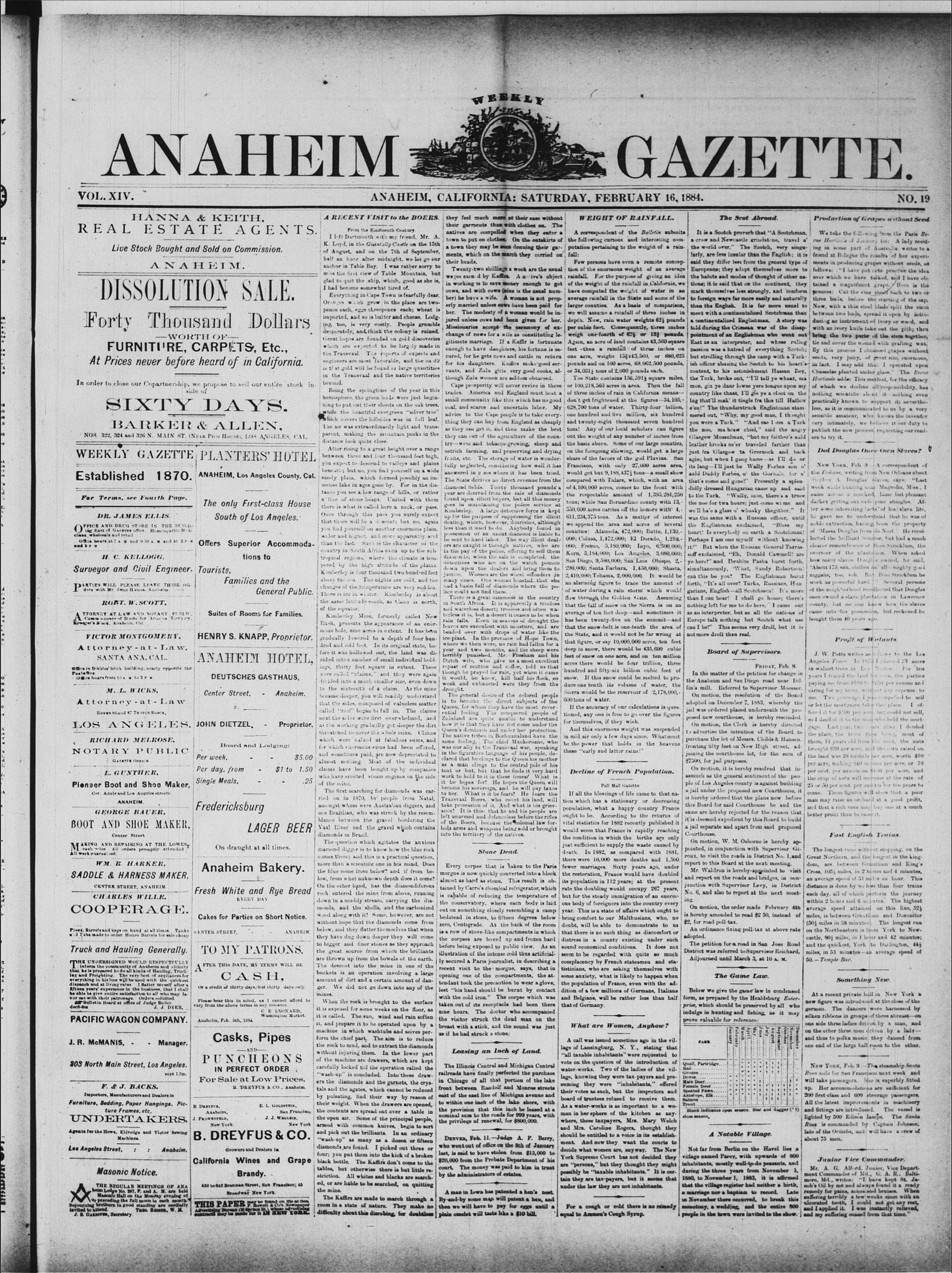
Searchable text
ANAHEIM
VOL. XIV.
HANNA & KEITH,
REAL ESTATE AGENTS.
Live Stock Bought and Sold on Commission.
ANAHEIM.
DISSOLUTION SALE.
Forty Thousand Dollars
WORTH OF
FURNITURE, CARPETS, Etc.,
At Prices never before heard of in California.
In order to close our Coppartnership, we propose to sell our entire stock inside of
Sixty Days.
BARKER & ALLEN,
NO. 322, 324 and 326 N. MAIN ST. (NEAR PICO HOUSE), LOS ANGELES, CAL.
WEEKLY GAZETTE PLANTERS' HOTEL
Established 1870
ANAHEIM Los Angeles County Cal.
In order to close our Coppartnership, we propose to sell our entire stock inside of
SIXTY DAYS.
BARKER & ALLEN,
NOS. 322, 324 and 326 N. MAIN ST. (NEAR PICO HOUSE), LOS ANGELES, CAL.
WEEKLY GAZETTE
Established 1870.
For Terms, see Fourth Page.
DR. JAMES ELLIS.
OFFICE AND DRUG STORE IN THE BUILDING East of Barker's office. Homespotable Medicine wholesale and retail.
Office hours at 7 A.M. and 9:30 A.M. and at 2 P.M.
H. C. KELLOGG.
Surveyor and Civil Engineer.
PARTIES WILL PLEASE LEAVE THEIR ORDERS WITH Mr. John Hanna, Anaheim.
ROBT. W. SCOTT.
ATTORNEY AT LAW AND NOTARY PUBLIC. Commissioner of Doors for Arizona Territory, Kregger's Block, Anaheim, Cal.
VICTOR MONTGOMERY.
Attorney-at-Law, SANTA ANA, CAL.
Office in Deblas' brick building, nearly opposite the Post Office.
Office hours from 10 A.M. to 3 P.M.
M. L. WICKS.
Attorney-at-Law
Rooms 86 and 87 Thomas Block,
LOS ANGELES.
RICHARD MELROSE,
NOTARY PUBLIC
Gazettee Office.
L. GUNTHER.
Pioneer Boot and Shoe Maker,
Cor. Adele and Los Angeles streets.
ANAHEIM.
GEORGE BAUER.
BOOT AND SHOE MAKER,
Center Street
MAKING AND REPAIRING AT THE LOWEST COST PRICE. All orders promptly attended. All work guaranteed.
WM. R. HARKER.
SADDLE & HARNESS MAKER,
CENTER STREET, ANAHEIM.
CHARLES WILLE.
PLANTERS HOTEL
ANAHEIM, Los Angeles County, Cal.
The only First-class House South of Los Angeles.
Offers Superior Accommodations to Tourists.
Families and the General Public.
Suites of Rooms for Families.
HENRY S. KNAPP, Proprietor.
ANAHEIM HOTEL,
DEUTSCHES GASTHAUS,
Center Street, Anaheim.
JOHN DIETZEL, Proprietor.
Board and Lodging:
Per week, - $5.00
Per day, from - $1 to 1.50
Single Meals, - .25
Fredericksburg
LAGER BEER
On draught at all times.
Anaheim Bakery.
Fresh White and Rye Bread
EVERY DAY.
ANAHEIM.
GEORGE BAUER,
BOOT AND SHOE MAKER,
Center Street
MAKING AND REPAIRING AT THE LOWEST
cash price. All orders promptly attended.
All work guaranteed.
WM. R. HARKER,
SADDLE & HARNESS MAKER,
CENTER STREET, ANAHEIM.
CHARLES WILLE.
COOPERAGE.
Pipes, Barrels and keys on hand at all times. Tanks
and Tubs made to order. Honey Barrels for sale cheap
Truck and Hauling Generally.
THE UNDERSIGNED WOULD RESPECTFULLY
inform the community of Anaheim and vicinity that he is prepared to do all kinds of Hauling, Tricking and Freighting. The very best of appliances for
everything in his line will be used with the quickest
dispatch and at living rates. I flatter myself after a
fifteen years' experience in the business, that I shall
be able to give entire satisfaction to all who may favor me with their patronage. Orders solicited.
J. B. DYER,
Bulletin Board at office of Judge Bailey
dece8-dm
PACIFIC WAGON COMPANY.
J. R. McMANIS, - Manager.
303 North Main Street, Los Angeles.
sept 13m.
F. & J. BACKS.
Importers, Manufacturers and Dealers in
Furniture, Bedding, Paper Hangings, Picture Frames, etc,
UNDERTAKERS,
Agents for the Howe, Eldredge and Victor Sewing Machines.
Los Angeles Street, : : Anaheim.
Masonic Notice.
THE REGULAR MEETINGS OF ANAheim Lodge No. 207, F. and A. M. are held
Masonic Hall on the Monday evening of
or preceding the full moon in each month.
Sojourning brethren in good standing are cordially invited to attend.
Tuzo Reiser, W. M.
J. B. GARDINER, Secretary.
Fredericksburg
LAGER BEER
On draught at all times.
Anaheim Bakery.
Fresh White and Rye Bread
EVERY DAY
Cakes for Parties on Short Notice.
CENTER STREET, ANAHEIM.
TO MY PATRONS.
AFTER THIS DATE, MY TERMS WILL BE
CASH,
Or a credit of thirty days, but thirty days only.
Please bear this in mind, as I cannot afford to vary from the above terms in any instance.
C.E LEONARD,
Washington Market.
Anaheim, Feb. 9th, 1884.
Casks, Pipes
AND
PUNCHEONS
IN PERFECT ORDER
For Sale at Low Prices.
B. DREYFUS & CO., Anaheim.
B. DREYFUS,
E.L. GOLDSTEIN,
Anaheim,
San Francisco
J. FROWESFIELD,
New York,
J. J. WEGLEN,
B. DREYFUS & CO.
Growers and Dealers in
California Wines and Grape Brandy.
630 to 642 Brannan Street, San Francisco; 45 Broadway New York.
THIS PAPER may be found on file at Gea.
Advertising Bureau (10 Spence St.), where advertising contracts may be made for it in NEW YORK.
A RECENT VISIT to the BOERS.
From the Nineteenth Century.
I left Dartmouth with my friend, Mr. A. K. Loyd, in the Grantally Castle on the 15th of August, and on the 7th of September, half an hour after midnight, we let go our anchor in Table Bay. I was rather sorry to miss the first view of Table Mountain, but glad to quit the ship, which, good as she is, I had become somewhat tired of.
Everything in Cape Town is fearfully dear. Oranges which grow in the place are two-pence each, eggs threepence each; wheat is imported, and so is butter and cheese. Lodging, too, is very costly. People grumble desperately, and think the colony is ruined. Great hopes are founded on gold discoveries which are expected to be largely made in the Transvaal. The reports of experts and engineers are most favorable, and the on dit is that gold will be found in large quantities in the Transvaal and the native territories beyond.
Being the springtime of the year in this hemisphere, the green bails were just beginning to put out their shoots on the oak trees, while the beautiful evergreen "silver tree" which covers the hillsides was in full leaf. The air was extraordinarily light and transparent, making the mountain peaks in the distance look quite close.
After rising to a great height over a range between three and four thousand feet high, you expect to descend to valleys and plains beneath; but no, you find yourself on a wide they feel much more at their ease without their garments than with clothes on. The natives are compelled when they enter a town to put on clothes. On the outskirts of a town they may be seen donning their garments, which on the march they carried on their heads.
Twenty-two shillings a week are the usual wages earned by Kaffir. A native's object in working is to save money enough to get cows, and with cows (nine is the usual number) he buys a wife. A woman is not properly married unless cows have been paid for her. The modesty of a woman would be injured unless cows had been given for her. Missionaries accept the ceremony of exchange of cows for a wife as constituting legitimate marriage. If a Kaffir is fortunate enough to have daughters, his fortune is secured, for he gets cows and cattle in return for his daughters. Kaffirs make good servants, and Zulu girls very good cooks, although Zula women are seldom obtained.
Cape prosperity will never revive in these trades. America and England must beat a small community like this which has no good coal, and scarce and uncertain labor. My advice to the Cape people is to take everything they can buy from England as cheaply as they can get it, and then make the best they can out of the agriculture of the country—wine and tobacco-growing, sheep and ostrich farming, and preserving and drying fruits, etc. The storage of water is wonderfully neglected, considering how well it has answered in cases where it has been tried.
WEIGHT OF RAINFALL.
A correspondent of the Bulletin submits the following curious and interesting putation pertaining to the weight of a fall:
Few persons have even a remote condition of the enormous weight of an average rainfall. For the purpose of giving an account of the weight of the rainfall in California have computed the weight of water in average rainfall in the State and some larger counties. As a basis of comparison we will assume a rainfall of three inches depth. Now, rain water weights 62½ pounds per cubic foot. Consequently, three inches weigh one-fourth of 62½ or 15½ pounds.
Again, an acre of land contains 43,560 square feet—the rainfall of three inches one acre, weighs 15½ x 43,560, or 680 pounds and on 100 acres, 68,062,500 pounds or 34,031¼ tons of 2,000 pounds each.
The State contains 156,591² square miles or 100,218,560 acres in area. Then the weight of three inches of rain in California means don't get frightened at the figures—34,1628,700 tons of water. Thirty-four billion one hundred and five million, six hundred and twenty-eight thousand seven hundred tons! Any of our local scholars can figure out the weight of any number of inches for the basis above. Some of our large councils on the foregoing showing, would get a share of the favors of the god Pluvius.
Francisco, with only 27,000 acres would get but 9,188,437¾ tons—a small
In the Transvaal and the native territories beyond.
Being the springtime of the year in this hemisphere, the green bails were just beginning to put out their shoots on the oak trees, while the beautiful evergreen "silver tree" which covers the hillsides was in fall leaf. The air was extraordinarily light and transparent, making the mountain peaks in the distance look quite close.
After rising to a great height over a range between three and four thousand feet high, you expect to descend to valleys and plains beneath; but no, you find yourself on a wide sandy plain, which formed possibly an immense lake in ages gone by. For in the distance you see a low range of hills, or rather a line of stone heaps. United with them there is what is called here a neck, or pass. Once through this pass you surely expect that there will be a descent; but no, again you find yourself on another enormous plain, wider and higher, and more apparently and than the last. Such is the character of the country in South Africa even up to the subtropical regions, where the climate is tempered by the high altitude of the plains. Kimberley is four thousand two hundred feet above the sea. The nights are cold, and the changes of the temperature are very sudden. There is ice in winter. Kimberley is about the same latitude south, as Cairo is north, of the equator.
Kimberley Mine, formerly called New Rush, presents the appearance of an enormous hole, nine acres in extent. It has been gradually lowered to a depth of four hundred and old feet. In its original state, before it was hollowed out, the land was divided into a number of small individual holdings, thirty feet square in extent. These were called "claims," and they were again divided into a much smaller size, even down to the sixteenth of a claim. As the mine became deeper, you will readily understand that the sides, composed of valueless matter called "reef" began to fall in. The claims next the sides were first overshelmed, and as the working gradually got deeper the dirt threatened to cover the whole mine. Claims which were valued at fabulous sums, and for which enormous sums had been offered, and sometimes paid, are now depreciated to almost nothing. Most of the individual claims have been bought up by companies who have erected steam engines on the side of the mine.
The first searching for diamonds was carried on in 1870, by people from Natal, amongst whom were Australian diggers, and one Brazilian, who was struck by the resemblance between the gravel bordering the Vaal River and the gravel which contains diamonds in Brazil.
The question which agitates the anxious diamond digger is to know how the blue rock comes there; and this is a practical question, more than a scientific one in his mind. Does the blue come from below? and if from below, from what unknown depth does it come? On the other hand, has the diamondiferous rock entered the mine from above, running though Zula women are seldom obtained.
Cape prosperity will never revive in these trades. America and England must beat a small community like this which has no good coal, and scarce and uncertain labor. My advice to the Cape people is to take everything they can buy from England as cheaply as they can get it, and then make the best they can out of the agriculture of the country—wine and tobacco-growing, sheep and ostrich farming, and preserving and drying fruits, etc. The storage of water is wonderfully neglected, considering how well it has answered in cases where it has been tried. The State derives no direct revenue from the diamond fields. Thirty thousand pounds a year are derived from the sale of diamonds found upon illicit buyers, but all this money goes in maintaining the police service at Kimberley. A large detective force is kept up for the purpose of suppressing the illicit dealing, which, however, flourishes, although less than it used to do. Anybody found in possession of an uncut diamond is liable to be sent to hard labor. The way illicit dealers are caught is through窃事, who are in the pay of the police, offering to sell them diamonds; when the sale is completed, the detectives who are on the watch pounce down upon the dealers and bring them to justice. Women are the worst offenders in many cases. One woman boasted that she had a basin full of diamonds where the police could not find them.
There is a great sameness in the country in South Africa. It is apparently a treeless and waterless desert; treeless and often waterless it is, but a desert it ceases to be when rain falls. Even in seasons of drought the leaves are succulent with moisture, and are beaded over with drops of water like the ice-plant. In the province of Hope Town, where we then were, no rain had fallen for a year and two months, and the sheep were terribly punished. Mr. Finschman and his Dutch wife, who gave us a most excellent repast of mutton and coffee, told us that though he prayed for rain, yet when it came it would, he knew, kill half his flock, so weak and exhausted were they from the drought.
The general desire of the colored people is to become the direct subjects of the Queen, for whom they have the most reverential feeling. The conquered people of Zuidland are quite unable to understand how it is that they have not come under the Queen's dominion and under her protection. The native tribes in Bechuanaland have the same feeling. The chief Mankoroane, who was our ally in the Transvaal war, speaking in the figurative language of his people, declared that he clings to the Queen's mother as a man clings to the central pole of his tent or hut, but that he finds it very hard work to hold to it in these times/ What is it he hopes for? He hopes the Queen will become his sovereign, and he will pay taxes to her. What is it he fears? He fears the Transvaal Boers, who covet his land, will take possession of it. And what is his grievance? It is this: that he and his people are left unarmed and defenseless before the rifles of the Boers, because the colonial law forbids arms and weapons being sold or brought into the territory of the natives.
Stone Dead.
Every corpse that is taken to the Paris morgue is now quickly converted into a block almost as hard as stone. This result is obtained by Carre's chemical refrigerator, which is capable of reducing the temperature of though Zula women are seldom obtained.
The State contains 156,591 square miles or 100,218,560 acres in area. Then the size of three inches of rain in California means don't get frightened at the figures—341628,700 tons of water. Thirty-four billion one hundred and five million, six hundred and twenty-eight thousand seven hundred tons! Any of our local scholars can figure out the weight of any number of inches for the basis above. Some of our large counties on the foregoing showing, would get a little share of the favors of the god Plavius.
Francisco, with only 27,000 acres would get but 9,188,437 tons—a small compared with Tulare, which, with an amount of 4,100,000 acres, comes to the front w/the respectable amount of 1,395,281 tons; while San Bernardino county with 550,000 acres carries off the honors with 611,234,375 tons. As a matter of interest we append the area and acres of several counties: Alameda, 472,000; Butte, 111000; Colusa, 1472,000; El Dorado, 122000; Fresno, 518000; Iloyo, 65000; Kern, 518400; Los Angeles, 308000; San Diego, 958000; San Luis Obispo, 290000; Santa Barbara, 145000; Shasta 241000; Tehama, 200000. It would also an alarming figure to trace the amount of water during a rain storm which would flow through the Golden Gate. Assume that the fall of snow on the Sierra is one average of ten feet deep—and sometimes has been twenty-five on the summit—the that the snow-belt is one-tenth—the area—the State,and it would not be far wrong that figure,soray 10,000,000 acres,ten for deep in snow,the would be 435,600 cubic feet of snow on one acre,and on ten millions there would be four trillion,the hundred and fifty-six billion cubic feet of snow. If this snow could be melted to produce one tenth its volume of water,the Sierra would be the reservoir of 2178,000,000 tons of water.
If the accuracy of our calculations is questionedany one is free to go overthe figurefor themselves,iife wish.
And this enormous weight was suspendedin mid air only a few days since.What maybe the power that holdsinhe heaviestthese "early and latter rains!"
Decline of French Population
Pall Mall Gazette.
If allthe blessingsof life came to that nationwhich has a stationary or decreasepopulationwhat a happy countryFranceoughttobe.Accordingtothereturns vital statistics for 1882 recently publishedwould seem that Franceis rapidly reachingthe conditioninwhichthebirthsareonjustsufficienttosupplythewastecausedbydeath.In1882ascomparedwith1883therewere10,000more deathsand1,5 fewer marriages.Sixty years ago,andtherestoration,Francewouldhave doubledits populationin112years;atthepreserveRatethe doublingwouldoccupy267yearsbutforthesteadyimmigrationanenorme
The question which agitates the anxious diamond digger is to know how the blue rock comes there; and this is a practical question, more than a scientific one in his mind. Does the blue come from below? and if from below, from what unknown depth does it come? On the other hand, has the diamondiferous rock entered the mine from above, running down in a muddy stream, carrying the diamonds, and the shells, and the carbonized wood along with it? Some, however, are not without hope that the diamonds come from below, and they flatter themselves that when they have dug down deeper they will come to bigger and finer stones as they approach the great source from which the brilliants are thrown up from the bowels of the earth. The descent into the mine in one of the buckets is an operation involving a large amount of dirt and a certain amount of danger. We did not go down into any of the mines.
When the rock is brought to the surface it is exposed for some weeks on the floor, as it is called. The sun, wind and rain soften it, and prepare it to be operated upon by a machine in which washtubs and seives perform the chief part. The aim is to reduce the rock to mud, and to extract the diamonds without injuring them. In the lower part of the machine are drawers, which are kept carefully locked till the operation called the "wash-up" is concluded. Into these drawers the diamonds and the garnets, the crystals and the agates, which cannot be reduced by pulsating, find their way by reason of their weight. When the drawers are opened, the contents are spread out over a table in the open air. Some of the principal people, armed with common knives, begin to sort and pick out the brilliants. In an ordinary "wash-up" as many as a dozen or fifteen diamonds are found. I picked out three or four; you put them into the kick of a broken black bottle. The Kaffirs don't come to the tables, but otherwise there is but little restriction. All whites and blacks are searched, or are liable to be searched, on quitting the mine.
The Kaffirs are made to march through a room in a state of nature. They make no difficulty about this disrobing, for doubtless
Stone Dead.
Every corpse that is taken to the Paris morgue is now quickly converted into a block almost as hard as stone. This result is obtained by Carre's chemical refrigerator, which is capable of reducing the temperature of the conservatory, where each body is laid out on something closely resembling a camp bedstead in stone, to fifteen degrees below zero, Centigrade. At the back of the room is a row of stove-like compartments in which the corpses are boxed up and frozen hard before being exposed to public view. As an illustration of the intense cold thus artificially secured a Paris journalist, in describing a recent visit to the morgue, says, that in opening one of the compartments, the attendant took the precaution to wear a glove, lest "his hand should be burnt by contact with the cold iron." The corpse which was taken out of its receptacle had been there nine hours. The doctor who accompanied the visitor struck the dead man on the breast with a stick, and the sound was just as if he had struck a stone:
Leasing an Inch of Land.
The Illinois Central and Michigan Central railroads have finally perfected the purchase in Chicago of all that portion of the lake front between Randolf and Monroe streets east of the east line of Michigan avenue and to within one inch of the lake shore, with the provision that this inch be leased at a nominal sum to the roads for 999 years, with the privilege of renewal, for $800,000.
Denver, Feb. 11.—Judge A. P. Berry, who went out of office on the 8th of January last, is said to have stolen from $15,000 to $20,000 from the Probate Department of his court. The money was paid to him in trust by the administrators of estates.
A man in Iowa has patented a hen's nest. By-and-by some man will patent a hen, and then we will have to pay for eggs until a plain omelet will taste like a $10 bill.
What are Women, Anyhow?
A call was issued sometime ago in the village of Lansingburg, N. Y., stating that "all taxable inhabitants" were requested to vote on the question of the introduction of water-works. Two of the ladies of the village, knowing they were tax-payers and presuming they were "inhabitants," offered their votes as such, but the inspectors and board of trustees refused to receive them. As a water-works is as important to a woman in her sphere of the kitchen as anywhere, these taxpayers, Mrs. Mary Welch and Mrs. Caroline Rogers, thought they should be entitled to a voice in its establishment. And now they want the courts to decide what women are, anyway. The New York Supreme Court has not decided they are "persons," but they thought they might possibly be "taxable inhabitants." It is certain they are tax-payers, but it seems that under the law they are not inhabitants.
For a cough or cold there is no remedy equal to Ammen's Cough Syrup.
GAZETTE.
FEBRUARY 16, 1884. NO. 19
RIGHT OF RAINFALL.
Dependent of the Bulletin submits curious and interesting comtaining to the weight of a rainsons have even a remote conceptenormous weight of an average
For the purpose of giving an idea
of the rainfall in California, we
noted the weight of water in an
rainfall in the State and some of the
ties. As a basis of comparison,
some a rainfall of three inches in
rain, rain water weights 62½ pounds
foot. Consequently, three inches
fourth of 62½ or 15½ pounds.
Acre of land contains 43,560 square
a rainfall of three inches on
weighs 15½x43,560, or 680,625
on 100 acres, 68,062,500 pounds,
tons of 2,000 pounds each.
The contains 156,591½ square miles,
560 acres in area. Then the fall
heights of rain in California means—
lightened at the figures—34,105,--
tons of water. Thirty-four billion,
and five million, six hundred
eight thousand seven hundred
of our local scholars can figure
height of any number of inches from
boye. Some of our large counties,
going showing, would get a large
favors of the god Pluvius. San
with only 27,000 acres area,
out 9,188,437 tons—a small show
The Scot Abroad.
It is a Scotch proverb that "A Scotchman,
a crow and Newcastle grindstone, travel a
the world over." The Scotch, very singularly, are less insular than the English; it is
said they differ less from the general type of
Europeans; they adapt themselves more to
the habits and modes of thought of other nations; it is said that on the continent, they
mark themselves less strongly, and conform
to foreign ways far more easily and naturally
than the English. It is far more usual to
meet with a continentalized Scotchman than
a continentalized Englishman. A story was
told during the Crimean war of the disappointment of an Englishman who went out
East as an interpreter, and whose ruling
passion was a hatred of everything Scotch;
but strolling through the camp with a Turkish officer abusing the Scotch to his heart's
content, to his astonishment Hassan Bay,
the Turk, broke out, "I'll tell ye whatat, mamon, gin ye daur lowse yere tongue upon my
country like thaat, I'll gie ye a cloot on the
lug that'll mak' it tingle fra this till Hallow
e'en!" The thunderstruck Englishman stammered out, "Why, my good man, I thought
you were a Turk." "And sae I am a Turk
the noo, ma braw chiel," said the angry Glasgow Mussulman, "but my faither's auid leather brecks ne'er traveled farther than just fra Glasgow ta Greenock and back again; but when I gang hame—as I'll do or its lang—I'll just be Wally Forbes son o'
auil Daddy Forbes, o' the Gorials, for a'
Production of Grapes without Seed
We take the following from the Paris Revue Horizolee of January 1st: A lady residing in some part of Australia writes to a friend at Bologne the results of her experiments in producing grapes without seeds, as follows: "I have put into practice the idea over which we have talked, and I have obtained a magnificent grape. Here is the process: Cut the vine shoot back to two or three buds, before the starting of the sap. Now, with a thin steel blade split the stem between two buds, spread it open by introducing an instrument of ivory or wood, and with an ivory knife take out the pith; then bring the two parts of the stem together, tie and cover the wound with grafting wax. By this process I obtained grapes without seeds, very juicy, of great size, enormous, in fact. I may add that I operated upon Chasselas planted under glass." The Ernest Horticole adds: This method, for the efficacy of which we decline all responsibility, has nothing scientific about it—nothing even practically known to support it; nevertheless, as it is communicated to us by a very sensible amateur, who knows the inventor very intimately, we believe it our duty to publish the new process requesting our readers to try it.
Did Douglas Once Own Staves?
of French Population.
Pall Mall Gazette.
lessings of life came to that navas a stationary or decreasing
what a happy country France
According to the returns of
1882 recently published it
that France is rapidly reaching
in which the births are only
to supply the waste caused by
1882, as compared with 1881,
10,000 more deaths and 1,500
ages. Sixty years ago, under
France would have doubled
in 112 years; at the present
cling would occupy 267 years,
readly immigration of an enorm-
Horticole adela: This method, for the efficacy
of which we decline all responsibility, has
nothing scientific about it—nothing even
practically known to support it; nevertheless, as it is communicated us by a very
sensible amateur, who knows the inventor
very intimately, we believe it our duty to
publish the new process, requesting our readers to try it.
Did Douglas Once Own Slaves?
New York, Feb. 9 — A correspondent of the Triebner, writing from New Orleans about Stephen A. Douglas' slaves, says: "Last week while hunting near Magnolia, Miss. I came across a crooked lame but pleasant darkey getting out rule pine shingles. After some interesting facts of his slave life, he gave me to understand that he was of noble extraction, having been the property of 'Massa Douglas from de Norf.' He recollected the brilliant Senator, but had a much clearer rememberance of Boss Stircklum, the overseer of the plantation. When asked how many slaves Douglas owned, he said, 'About 175 sah, chillun an all—mighty good niggals, too, sooh. But Boss Stircklum he work us powerful hard.' Several persons of the neighborhood recollected that Douglas once owned a slave plantation in Lawrence county, but no one knew how the slaves came into this possession, but reckoned he bought them 40 years ago.
Profit of Walnuts.
J. W. Potts writes as follows to the Los Angeles Times: In 1873 I planned 23 acres in walnut trees in Los Nietos. For ten years I rented the land for corn, the parties paying me from $100 to $150 per annum and caring for my trees without any expense to me. Two years ago I was compelled to sell or let the mortgage take the place. I offered it for $100 per acre, but could not sell, so I decided it to the man who held the mortgage. Last year, two years after I decided the place, the trees then being most of them, 14 years old from the soil, the nuts brought $30 per acre, and the corn raised on the land was 20 bushels per acre, worth $10 per acre, making $40 income per acre, or 10 per cent, per annum on $400 per acre, and the crop of nuts will increase at the rate of 25 or 50 per cent, per annum for ten years to come. These figures will show that a poor man may raise an orchard at a good profit, and that a rich man may buy one at a much better profit than to raise it.
Fast English Trains.
The longest runs without stopping, on the Great Northern, and the longest in the kingdom, are between Grantham and King's Cross, 105½ miles, in 2 hours and 4 minutes, an average speed of 51 miles an hour. This distance is done by no less than four trains each day, all of which perform the journey
According to the returns of laws for 1882 recently published it that France is rapidly reaching in which the births are only to supply the waste caused by 1882, as compared with 1881, 100,000 more deaths and 1,500 injuries. Sixty years ago, under French rule, France would have doubled in 112 years; at the present ruling would occupy 267 years, ready immigration of an enormous number of Germans, Italians will be rather less than half a million.
The Game Law.
Below we give the game law in condensed form, as prepared by the Healdsburg Enterprise, which should be preserved by all who indulge in hunting and fishing, as it may prove valuable for reference:
| NAME | JANUARY | FEBRUARY | MARCH | APRIL | MAY | JUNE | JULY | AUGUST | SEPTEMBER | OCTOBER | NOVEMBER | TOTAL |
| :---: | :---: | :---: | :---: | :---: | :---: | :---: | :---: | :---: | :---: | :---: | :---: | :---: |
| Quail, Partridge | ... | ... | ... | ... | ... | ... | ... | ... | ... | ... | ... | ... |
| Rail | ... | ... | ... | ... | ... | ... | ... | ... | ... | ... | ... | ... |
| Grouse | ... | ... | ... | ... | ... | ... | ... | ... | ... | ... | ... | ... |
| Doves | ... | ... | ... | ... | ... | ... | ... | ... | ... | ... | ... | ...
| Male Deer | ... | ... | ... | ... | ... | ... | ... | ... | ... | ... | ... | ...
| Female Deer | ... | ... | ... | ... | ... | ... | ... | ... | ... |... |... |
| Spotted Pawns | ... | ... | ... |...|...|...|...|...|...|...|...|
| Antelope, Elk |...|...|...|...|...|...|...|...|...|...|
| Salmon |...|...|...|...|...|...|...|...|...|...|
| Trout |...|...|...|...|...|...|...|...|...|...
Blank indicates open season. Star and dagger (*) close season.
A Notable Village.
Not far from Berlin on the Havel lies a village named Parey, with upwards of 800 inhabitants, mostly well-to-do peasants, and during the three years from November 1, 1880, to November 1, 1883, it is affirmed that the village register had neither a birth, a marriage nor a baptism to record. Late in November there occurred, to break this monotony, a wedding, and the entire 800 people in the town were invited to the show.
Fast English Trains.
The longest runs without stopping, on the Great Northern, and the longest in the kingdom, are between Grantham and King's Cross, 105½ miles, in 2 hours and 4 minutes, an average speed of 51 miles an hour. This distance is done by no less than four trains each day, all of which perform the journey within 2 hours and 6 minutes. The highest average speed attained on this line, 52½ miles, is between Grantham and Doncaster (50½ miles in 58 minutes). The longest run on the Northeastern is from York to Newcastle, 80½ miles, in 1 hour and 42 minutes; and the quickest, York to Darlington, 44½ miles, in 53 minutes—an average speed of 50. — Temple Bar.
Something New.
At a recent private ball in New York a new figure was introduced at the close of the german. The dancers were harnessed by silken ribbons in groups of three abreast—on one side three ladies driven by a man, and on the other three men driven by a lady—and thus to polka music they danced from one end of the large ball room to the other.
New York, Feb. 9 — The steamship Santa Rosa sails for San Francisco next week and will take passengers. She is superbly fitted up. Her accommodations are sufficient for 200 first-class and 600 steerage passengers. All the latest improvements in machinery and fittings are introduced. The vessel is lighted by 500 Edison lamps. The Santa Rosa is commanded by Captain Johnson, late of the Orizaba, and will have a crew of about 75 men.
Junior Vice Commander.
Mr. A. G. Alford, Junior Vice Department Commander of Md., G. A. R., Baltimore, Md., writes: "I have kept St. Jacob's Oil by me and always found it a readily remedy for pains, aches and bruises. When suffering terribly a few weeks since with an ulcerated tooth, I could not get any rest, and I applied it. I was instantly relieved, and my suffering ceased from that time."