anaheim-gazette 1884-02-02
Scanned page
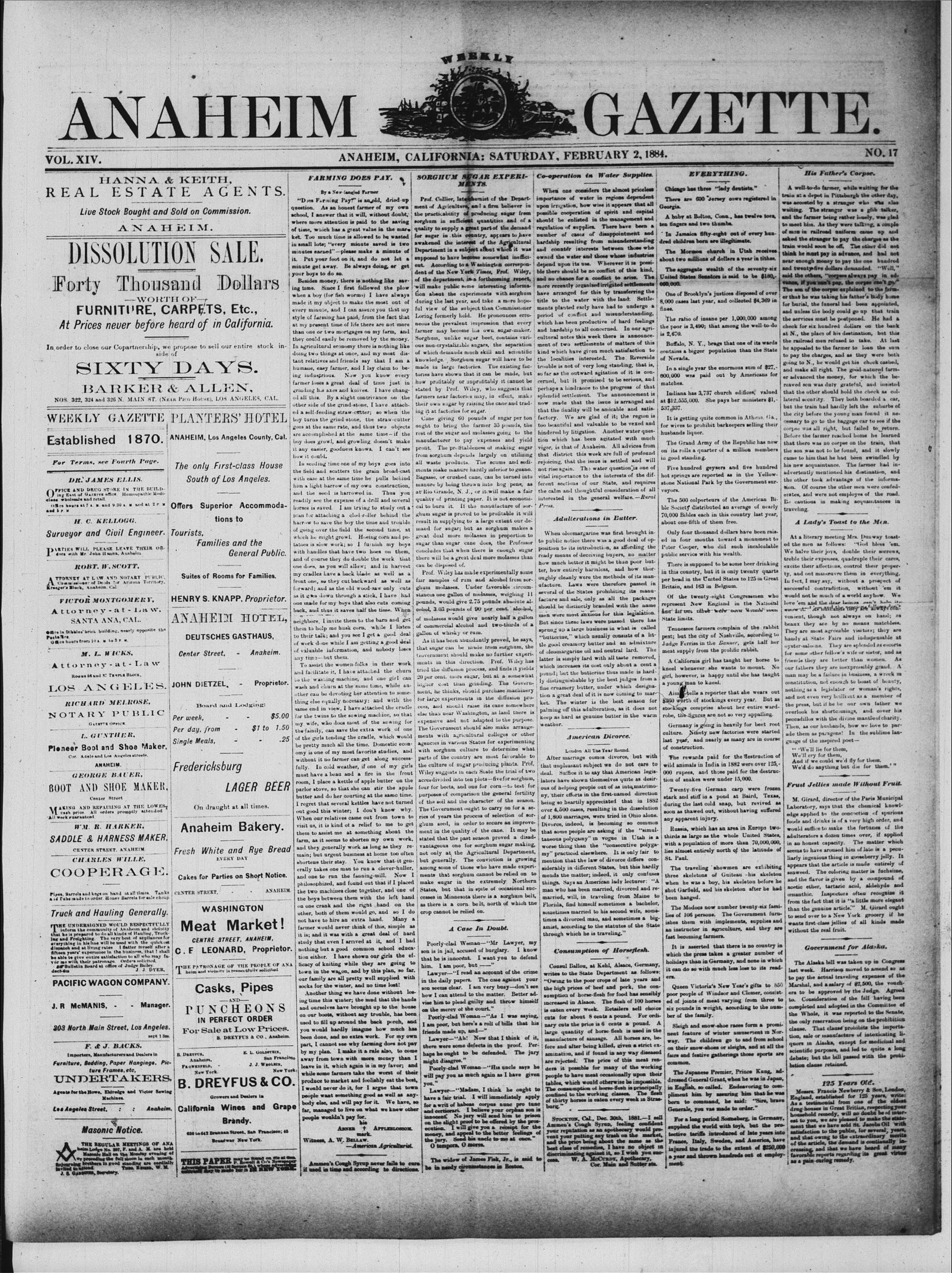
Searchable text
ANAHEIM
VOL. XIV.
HANNA & KEITH,
REAL ESTATE AGENTS.
Live Stock Bought and Sold on Commission.
ANAHEIM.
DISSOLUTION SALE.
Forty Thousand Dollars
WORTH OF
FURNITURE, CARPETS, Etc.,
At Prices never before heard of in California.
In order to close our Coppartnership, we propose to sell our entire stock inside of
Sixty Days.
BARKER & ALLEN,
NOS. 322, 324 and 326 N. MAIN ST. (NEAR PICO HOUSE), LOS ANGELES, CAL.
WEEKLY GAZETTE PLANTERS' HOTEL
Established 1870.
ANAHEIM, Los Angeles County, Cal.
For Terms, see Fourth Page.
The only First-class House
FARMING DAY
By a New Langley
"Does Farming Pay?"
question. As an honest school, I answer that it where more attention is of time, which has a great ket. Too much time is in small lots; "every minute earned"—please it. Put your foot on it, minute get away. Be a your boys to do so.
Besides money, there is ing time. Since I first when a boy (for fish work made it my object to make every minute, and I can style of farming has paid at my present time of lit than one or two mortgages they could easily be rem In agricultural economy doing two things at once tant relatives and friend humane, easy farmer, and ing industrious. Now farmer loses a great de grinding his axes and killed all this. By a slight other side of the grind- ed a self-feeding straw-boy turns the grind-stone goes at the same rate, and are accomplished at the boy does growl, and grows it any easier, goodness how it could.
In seeding time one of the field and scatters t
BARKER & ALLEN,
NOS. 322, 324 and 326 N. MAIN ST. (NEAR PICO HOUSE), LOS ANGELES, CAL.
WEEKLY GAZETTE
Established 1870.
For Terms, see Fourth Page.
DR. JAMES ELLIS.
OFFICE AND DRUG STORE IN THE BUILDING East of GAZETTE office. Homeopathic Medicine, wholesale and retail.
Office hours at 7 A.M. and 9:30 A.M. and at 2 P.M.
H. C. KELLOGG.
Surveyor and Civil Engineer.
Parties will please leave their orders with Mr. John Hanna, Anaheim.
ROBT. W. SCOTT.
ATTORNEY AT LAW AND NOTARY PUBLIC. Commissioner of Deeds for Arizona Territory, Kreager's Block, Anaheim, Cal.
VICTOR MONTGOMERY,
Attorney-at-Law,
SANTA ANA, CAL.
Office in Dibbles' brick building, nearly opposite the Post Office.
Office hours from 10 A.M. to 3 P.M.
M. L. WICKS.
Attorney-at-Law
Rooms 56 and St. Temple Block.
LOS ANGELES.
RICHARD MELROSE,
NOTARY PUBLIC
GAZETTE OFFICE.
L. GUNTHER.
Pioneer Boot and Shoe Maker,
Cor. Adele and Los Angeles streets.
ANAHEIM.
GEORGE BAUER,
BOOT AND SHOE MAKER,
Center Street
MAKING AND REPAIRING AT THE LOWEST cash price. All orders promptly attended. All work guaranteed.
WM. R. HARKER,
SADDLE & HARNESS MAKER,
CENTER STREET, ANAHEIM
CHARLES WILLE,
COOPERAGE.
PLANTERS' HOTEL
ANAHEIM, Los Angeles County, Cal.
The only First-class House South of Los Angeles.
Offers Superior Accommodations to Tourists.
Families and the General Public.
Suites of Rooms for Families.
HENRY S. KNAPP, Proprietor.
ANAHEIM HOTEL,
DEUTSCHES GASTHAUS,
Center Street, - Anaheim.
JOHN DIETZEL, - Proprietor.
Board and Lodging:
Per week, - $5.00
Per day, from - $1 to 1.50
Single Meals, - .25
Fredericksburg
LAGER BEER
On draught at all times.
Anaheim Bakery.
Fresh White and Rye Bread
EVERY DAY
Cakes for Parties on Short Notice.
CENTER STREET, - Anaheim
In seeding time one of the field and scatters with ease at the same time him a light harrow of mats and the seed is harrow readily see the expense horses is saved. I am plan for attaching a cloarkarow to save the boy of going over the field which he might growl. Tatoes is slow work; so with handles that have end of course they do do one does, as you will all my cradles have a back front one, so they cut backward; and as the old as it goes down through one made for my boys this back, and thus it saves neighbors, I invite them to help me husk to their talk; and you so of work done while I am of valuable information any time—but them.
To assist the women-and facilitate it, I have to the washing machine wash and churn at the other can be devoting thing else equally necessary same end in view, I have for the twins to the seven my wife, who does most the family, can save the of the girls tending them be pretty much all theomy is one of my most without it no farmer cafully. In cold weather must have a bean and room, I place a kettle parlor stove, so that she butter and do her courti I regret that several knots out good this winter; When our relatives can visit us, it is kind of at them to assist me at farm, as it seems to shand they generally wo-main; but urgent business shortens their stay. Yerally takes one man to and one to run the fphilosophized, and four the two machines close-the boys between them.
MAKING AND REPAIRING AT THE LOWEST
cash price. All orders promptly attended.
All work guaranteed.
WM. R. HARKER,
SADDLE & HARNESS MAKER,
CENTER STREET, ANAHEIM.
CHARLES WILLE,
COOPERAGE.
Pipes, Barrels and kegs on hand at all times. Tanks
and 14 Tubs made to order. Honey Barrels for sale cheap
Truck and Hauling Generally.
THE UNDERSIGNED WOULD RESPECTFULLY
inform the community of Anaheim and vicinity that he is prepared to do all kinds of Hauling, Trucking and Freighting. The very best of appliances for
everything in his line will be used with the quickest
dispatch and at living rates. I flatter myself after a
fifteen years' experience in the business, that I shall
be able to give entire satisfaction to all who may favor me with their patronage. Orders solicited.
Bulletin Board at office of Judge Bailey.
dec-8m.
J. J. DYER,
PACIFIC WAGON COMPANY.
J. R McMANIS, - Manager.
303 North Main Street, Los Angeles.
sept 13m.
F. & J. BACKS.
Importers, Manufacturers and Dealers in
Furniture, Bedding, Paper Hangings, Picture Frames, etc,
UNDERTAKERS,
Agents for the Howe, Eldredge and Victor Sewing
Machines.
Los Angeles Street, : : Anaheim.
Masonic Notice.
THE REGULAR MEETINGS OF ANAheim Lodge No. 297, F. and A. M. are held
Masonic Hall on the Monday evening of
or preceding the full moon in each month.
Bejourning brothers in good standing are certainly
invited to attend.
Tuan Rusua, W. M.
J. & Garrison, Secretary.
On draught at all times.
Anaheim Bakery.
Fresh White and Rye Bread
EVERY DAY
Cakes for Parties on Short Notice.
CENTER STREET, ANAHEIM.
WASHINGTON
Meat Market!
CENTRE STREET, ANAHEIM,
C. F LEONARD, Proprietor.
THE PATRONAGE OF THE PEOPLE OF ANAheim and vicinity is respectfully solicited.
Casks, Pipes
AND
PUNCHEONS
IN PERFECT ORDER
For Sale at Low Prices.
B. DREYFUS & CO., Anaheim.
B. DREYFUS,
Anaheim,
FROWESFELD,
New York.
B. DREYFUS & CO.
Growers and Dealers in
California Wines and Grape
Brandy.
620 to 642 Brannan Street, San Francisco; 45
Broadway New York.
THIS PAPER may be found on me at Goo.
Advertising Bureau (10 Spence St.), where advertising
may be made for it in NEW YORK.
I regret that several knots out good this winter;
When our relatives can visit us, it is kind of a
them to assist me at the farm, as it seems to shiand they generally womain; but urgent business shortens their stay. Yerrally takes one man t
and one to run the f
philosophized, and fouthe two machines close
the boys between them
on one crank and the
other, both of them winot have to hire an efarmer would never th
it is; and it was with a
study that even I arrive nothing but a good c
tion either. I have siltacy of knitting whiltown in the wagon, and our family are all presocks for the winter.
Another thing we h
ing time this winter;
and ourselves have b
on our boots, without
used to fill up around
you would hardly in
been done, and no expart, I cannot see whi
by my plan. I make
away from town witlh
leave in it, which agwhile some farmers t
produce to market an
I would never do it,
people want something
body else, and will p
far, managed to live
people wouldn't pay
FARMING DOES PAY.
By a New-langled Farmer
"Does Farming Pay?" is an old, dried-up question. As an honest farmer of my own school, I answer that it will, without doubt, where more attention is paid to the saving of time, which has a great value in the mare ket. Too much time is allowed to be wasted in small lots; "every minute saved is two minutes earned"—please make a minute of it. Put your foot on it, and do not let a minute get away. Be always doing, or get your boys to do so.
Besides money, there is nothing like saving time. Since I first followed the plow when a boy (for fish worms) I have always made it my object to make the most out of every minute, and I can assure you that my style of farming has paid, from the fact that at my present time of life there are not more than one or two mortgages on my farm, and they could easily be removed by the money. In agricultural economy there is nothing like doing two things at once, and my most distant relatives and friends say that I am a humane, easy farmer, and I lay claim to being industrious. Now you know every farmer loses a great deal of time just in grinding his axes and knives. I have changed all this. By a slight contrivance on the other side of the grind-stone, I have attached a self-feeding straw-cutter; so when the boy turns the grindstone, the straw-cutter goes at the same rate, and thus two objects are accomplished at the same time—if the boy does growl, and growling doesn't make it any easier, goodness knows. I can't see how it could.
In seeding time one of my boys goes into the field and scatters the grain broad-cast
SORGHUM SUGAR EXPERIMENTS.
Prof. Collier, late chemist of the Department of Agriculture, and a firm believer in the practicability of producing sugar from sorghum in sufficient quantities and of a quality to supply a great part of the demand for sugar in this country, appears to have awakened the interest of the Agricultural Department in a subject about which it was supposed to have become somewhat inefficient. According to a Washington correspondent of the New York Times, Prof. Wiley, of the department, in a forthcoming report, will make public some interesting information about the experiments with sorghum during the last year, and take a more hopeful view of the subject than Commissioner Loring formerly held. He pronounces erroneous the prevalent impression that every farmer may become his own sugar-maker. Sorghum, unlike sugar beet, contains various non-crystalizable sugars, the separation of which demands much skill and scientific knowledge. Sorghum sugar will have to be made in large factories. The existing factories have shown that it can be made, but how profitably or unprofitably it cannot be stated by Prof. Wiley, who suggests that farmers near factories may, in effect, make their own sugar by raising the cane and trading it at factories for sugar.
Cane giving 60 pounds of sugar per ton ought to bring the farmer 35 pounds, the rest of the sugar and molasses going to the manufacturer to pay expenses and yield profit. The profitableness of making sugar from sorghum depends largely on utilizing all waste products. The scums and sediments make manure hardly inferior to guano.
Co-operation in Water Supplies.
When one considers the almost priceless importance of water in regions dependent upon irrigation, how wise it appears that all possible cooperation of spirit and capital should be enlisted in the management and regulation of supplies. There have been a number of cases of disappointment and hardship resulting from misunderstanding and counter interests between those who owned the water and those whose industries depend upon its use. Wherever it is possible there should be no conflict of this kind, and no chance for a conflict to arise. The more recently organized irrigated settlements have arranged for this by transferring the title to the water with the land. Settlements planted early have had to undergo a period of conflict and misunderstanding, which has been productive of hard feelings and hardship to all concerned. In our agricultural notes this week there is announcement of two settlements of matters of this kind which have given much satisfaction to the localities interested. The Riverside trouble is not of very long standing, that is, so far as the outward agitation of it is concerned, but it promised to be serious, and perhaps a hindrance to the progress of that splendid settlement. The announcement is now made that the issue is arranged and that the finality will be amicable and satisfactory. We are glad of it; the region is too beautiful and valuable to be vexed and hindered by litigation. Another water question which has been agitated with much vigor, is that of Anaheim. All advices from that district this week are full of profound rejoicing, that the issue is settled and will not rise again. The water question is one of
ing industrious. Now you know every farmer loses a great deal of time just in grinding his axes and knives. I have changed all this. By a slight contrivance on the other side of the grind-stone, I have attached a self-feeding straw-cutter; so when the boy turns the grind-stone, the straw-cutter goes at the same rate, and thus two objects are accomplished at the same time—if the boy does growl, and growling doesn't make it any easier, goodness knows. I can't see how it could.
In seeding time one of my boys goes into the field and scatters the grain broad-cast with ease at the same time he pulls behind him a light harrow of my own construction, and the seed is harrowed in. Thus you readily see the expense of a drill and several horses is saved. I am trying to study out a plan for attaching a clob-roller behind the harrow to save the boy the time and trouble of going over the field the second time, at which he might growl. Hoeing corn and potatoes is slow work; so I furnish my boys with handles that have two hoes on them, and of course they do double the work that one does, as you will allow; and in harvest my cradles have a back blade as well as a front one, so they cut backward as well as forward; and as the old wood-saw only cuts as it goes down through a stick, I have had one made for my boys that also cuts coming back, and thus it saves half the time. When neighbors, I invite them to the barn and get them to help me husk corn, while I listen to their talk; and you see I get a good deal of work done while I am getting a good deal of valuable information, and nobody loses any time—but them.
To assist the women-folks in their work and facilitate it, I have attached the churn to the washing machine, and one girl can wash and churn at the same time, while another can be devoting her attention to something else equally necessary: and with the same end in view, I have attached the cradle for the twins to the sewing machine, so that my wife, who does most of the sewing for the family, can save the extra work of one of the girls tending the cradle, which would be pretty much all the time. Domestic economy is one of my most favorite studies, and without it no farmer can get along successfully. In cold weather, if one of my girls must have a bean and a fire in the front room, I place a kettle of apple butter on the parlor stove, so that she can stir the apple butter and do her courting at the same time. I regret that several kettles have not turned out good this winter; I don't know why. When our relatives came out from town to visit us, it is kind of a relief to me to get them to assist me at something about the farm, as it seems to shorten my own work, and they generally work as long as they remain; but urgent business at home too often shortens their stay. You know that it generally takes one man to run a clover-huller, and one to run the fanning-mill. Now I philosophized, and found out that if I placed the two machines close together, and one of the boys between them with the left hand stories have shown that it can be made, but how profitably or unprofitably it cannot be stated by Prof. Wiley, who suggests that farmers near factories may, in effect, make their own sugar by raising the cane and trading it at factories for sugar.
Cane giving 60 pounds of sugar per ton ought to bring the farmer 35 pounds, the rest of the sugar and molasses going to the manufacturer to pay expenses and yield profit. The profitability of making sugar from sorghum depends largely on utilizing all waste products. The scums and sediments make manure hardly inferior to guano. Bagaase, or crushed cane, can be turned into manure by being thrown into hog pens, as at Rio Grande, N.J., or it will make a fair quality of printing paper. It is not economical to burn it. If the manufacture of sorghum sugar is proved to be profitable it will result in supplying to a large extent our demand for sugar; but as sorghum makes a great deal more molasses in proportion to sugar than sugar cane does, the Professor concludes that when there is enough sugar there will be a great deal more molasses than can be disposed of.
Prof. Wiley has made experimentally some fair samples of rum and alcohol from sorghum molasses. Under favorable circumstances one gallon of molasses, weighing 11 pounds, would give 2.75 pounds absolute alcohol, 3.03 pounds of 90 per cent alcohol, of molasses would give nearly half a gallon of commercial alcohol and two-thirds of a gallon of whisky or rum.
As it has been abundantly proved, he says, that sugar can be made from sorghum, the Government should make no further experiments in this direction. Prof. Wiley has tried the diffusion process, and finds it yields 20 per cent more sugar, but at a somewhat higher cost than grinding. The Government, he thinks, should purchase machinery for large experiments in the diffusion process, and should raise its cane somewhere else than near Washington, as land there is expensive and not adapted to the purpose. The Government should also make arrangements with agricultural colleges or other agencies in various States for experimenting with sorghum culture to determine what parts of the country are most favorable to the culture of sugar producing plants. Prof. Wiley suggests in each State the trial of two acres divided into ten plots—five for sorghum, four for beets, and one for corn—to test for purposes of comparison the general fertility of the soil and the character of the season. The Government ought to carry on for a series of years the process of selection of sorghum seed, in order to secure an improvement in the quality of the cane. It may be stated that the past season proved a disadvantageous for sorghum sugar making, not only at the Agricultural Department, but generally. The conviction is growing among some of those who have made experiments that sorghum cannot be relied on to make sugar in the extremely Northern States, but that in spite of occasional successes in Minnesota there is a sorghum belt,
so far as the outward agitation of it is concerned, but it promised to be serious, and perhaps a hindrance to the progress of that splendid settlement. The announcement is now made that the issue is arranged and that the finality will be amicable and satisfactory. We are glad of it; the region is too beautiful and valuable to be vexed and hindered by litigation. Another water question which has been agitated with much vigor, is that of Anaheim. All advices from that district this week are full of profound rejoicing, that the issue is settled and will not rise again. The water question is one of vital importance to the interests of the different sections of our State, and requires the calm and thoughtful consideration of all interested in the general welfare. —Rural Press.
Adulterations in Butter.
When oleomargarine was first brought into public notice there was a good deal of opposition to its introduction, as affording the ready means of deceiving buyers, no matter how much better it might be than poor butter, how entirely harmless, and how thoroughly cleanly were the methods of its manufacture. Laws were therefore passed in several of the States prohibiting its manufacture and sale, only as all the packages should be distinctly branded with the name men were most anxious for this legislation. But since these laws were passed there has sprung up a large business in what is called "butterine," which usually consists of a little good creamery butter and an admixture of oleomargarine oil and neutral lard. The latter is simply lard with all taste removed, which increases its cost only about a cent a pound; but the butterine thus made is hardly distinguishable by the best judges from a fine creamery butter, under which designation a great deal of it is now coming to market. The winter is the best season for palming off this adulteration, as it does not keep as hard as genuine butter in the warm weather.
American Divorce.
London All The Year Round.
After marriage comes divorce, but with that unpleasant subject we do not care to deal. Suffice it to say that American legislators have shown themselves quite as desirous of helping people out of as intragatrimony, their efforts in the first-named direction being so heartily appreciated that in 1882 over 4,500 cases, resulting in the dissolution of 1,800 marriages, were tried in Ohio alone. Divorce indeed, is becoming so common that people are asking if the "simultaneous polygamy" in vogue in Utah is a worse thing than the "consecutive polygamy" practiced elsewhere. It is only fair to mention that the law of divorce differs considerably in different States, but this hardly mends the matter; indeed, it only confuses things. Says an American lady lecturer: "A man who has been married, divorced and remarried, will in traveling from Maine to
I regret that several kettles have not turned out good this winter; I don't know why. When our relatives came out from town to visit us, it is kind of a relief to me to get them to assist me at something about the farm, as it seems to shorten my own work, and they generally work as long as they remain; but urgent business at home too often shortens their stay. You know that it generally takes one man to run a clover-huller, and one to run the fanning-mill. Now I philosophized, and found out that if I placed the two machines close together, and one of the boys between them with the left hand on one crank and the right hand on the other, both of them would go, and so I do not have to hire an extra hand. Many a farmer would never think of this, simple as it is; and it was with a great deal of hard study that even I arrived at it, and I had nothing but a good common school education either. I have shown our girls the efficacy of knitting while they are going to town in the wagon, and by this plan, so far, our family are all pretty well supplied with socks for the winter, and no time lost!
Another thing we have done without losing time this winter; the mud that the hands and ourselves have brought up to the house on our boots, without any trouble, has been used to fill up around the back porch, and you would hardly imagine how much has been done, and no extra work. For my own part, I cannot see why farming does not pay by my plan. I make it a rule also, to come away from town with more money than I leave in it, which again is in my favor; and while some farmers take the worst of their produce to market and foolibly eat the best, I would never do it, for I argue that town people want something good as well as anybody else, and will pay for it. We have, so far, managed to live on what we knew other people wouldn't pay for.
ABNER † APPLEBLOSSOM.
mark.
Witness, A. W. BELLAW.
—American Agriculturist.
Ammen's Cough Syrup never fails to cure if used in time and according to directions.
The Government ought to carry on for a series of years the process of selection of sorghum seed, in order to secure an improvement in the quality of the cane. It may be stated that the past season proved a disadvantageous one for sorghum sugar making, not only at the Agricultural Department, but generally. The conviction is growing among some of those who have made experiments that sorghum cannot be relied on to make sugar in the extremely Northern States, but that in spite of occasional successes in Minnesota there is a sorghum belt, as there is a corn belt, north of which the crop cannot be relied on.
A Case In Doubt.
Poorly-clad Woman—"Mr Lawyer, my son is in jail, accused of burglary. I know that he is innocent. I want you to defend him. I am poor, but —"
Lawyer—"I read an account of the crime in the daily papers. The case against your son seems clear. I am very busy—don't see how I can attend to the matter. Better advise him to plead guilty and throw himself on the merey of the court."
Poorly-clad Woman—"As I was saying, I am poor, but here's a roll of bills that his friends made up, and—"
Lawyer—"Ah! Now that I think of it, there were some defects in the proof. Perhaps he ought to be defended. The jury might disagree."
Poorly-clad Woman—"His uncle says he will pay you as much again as I have given you."
Lawyer—"Madam, I think he ought to have a fair trial. I will immediately apply for a writ of habeas corpus nunc pro tune and certiorari. I believe your orphan son is innocent. No jury will send him to prison on the slight proof to be offered by the prosecution. I will give you a receipt for the money, and appeal to the better feelings of the jury. Send his uncle to me at once." O tempora, O morea.
The widow of James Fisk, Jr., is said to be in needy circumstances in Boston.
being so heartily appreciated that in 1882 over 4,500 cases, resulting in the dissolution of 1,800 marriages, were tried in Ohio alone. Divorce, indeed, is becoming so common that some people are asking if the "simultaneous polygamy" in vogue in Utah is a worse thing than the "consecutive polygamy" practiced elsewhere. It is only fair to mention that the law of divorce differs considerably in different States, but this hardly mends the matter; indeed, it only confuses things. Says an American lady lecturer: "A man who has been married, divorced and remarried, will, in traveling from Maine to Florida, find himself sometimes a bachelor, sometimes married to his second wife, sometimes a divorced maid, and sometimes a bigamist, according to the statutes of the State through which he is traveling."
Consumption of Horseflesh.
Consul Ballou, at Kehl, Alsace, Germany, writes to the State Department as follows: "Owing to the poor crops of late years and the high prices of beef and pork, the consumption of horse-flesh for food has sensibly increased in Alsace. The flesh of 100 horses is eaten every week. Retailers sell choice cents for about 8 cents a pound. A large quantity of horse flesh is used in the manufacture of sausage. All horses are, before and after being killed, given a strict examination, and if found in any way diseased are rejected. The price of this meat renders it possible for many of the working people to have meat occasionally upon their tables, which would otherwise be impossible. The consumption of horse-flesh is principally confined to the working classes. The flesh of thirty horses is eaten every week in Strasburg."
Stockton, Cal., Dec. 30th, 1881.-I sell Ammen's Cough Syrup, feeling confident your reputation as an apothecary would prevent your putting any trash on the market, and the price being about the same as the best class of remedies. I have no object in discriminating against it, so I wish you succeed.
W. A. McCurdy, Apothecary,
Cor. Main and Sutter sta.
GAZETTE.
JUARY 2, 1884. NO. 17
Water Supplies.
is the almost priceless in regions dependent on it appears that all of spirit and capital in the management and there have been a disappointment and from misunderstanding is between those who whose industries Wherever it is possible conflict of this kind, conflict to arise. The irrigated settlements is by transferring the with the land. Settle- have had to undergo a good misunderstanding, active of hard feelings concerned. In our agrig- there is announcements of matters of this much satisfaction to stated. The Riverside long standing, that is, negotiation of it is con- ceased to be serious, and to the progress of that The announcement is issue is arranged and the amicable and satisfied of it; the region is unable to be vexed and Another water ques- agitated with much him. All advices from bank are full of profound he is settled and will water question is one of the dif-
EVERYTHING.
Chicago has three "lady dentists."
There are 600 Jersey cows registered in Georgia.
A baby at Bolton, Conn., has twelve toes, ten fingers and two thumbs.
In Jamaica fifty-eight out of every hundred children born are illegitimate.
The Mormon church in Utah receives about two millions of dollars a year in tithes.
The aggregate wealth of the seventy-six United States Senators is said to be $180,-000,000.
One of Brooklyn's justices disposed of over 8,000 cases last year, and collected $4,369 in fines.
The ratio of insane per 1,000,000 among the poor is 3,490; that among the well-to-do is 2,670.
Buffalo, N. Y., brags that one of its wards contains a bigger population than the State of Nevada.
In a single year the enormous sum of $27,-600,000 was paid out by Americans for matches.
Indiana has 3,737 church edifices, valued at $12,555,000. She pays her ministers $1,-537,337.
It is getting quite common in Athens, Ga., for wives to prohibit barkeepers selling their husbands liquor.
The Grand Army of the Republic has now on its rolls a quarter of a million members in good standing.
Five hundred geyser s and five hundred hot springs are reported as in the Yellow.
His Father's Corpse.
A well-to-do farmer, while waiting for the train at a depot in Pittsburgh the other day, was accosted by a stranger who was also waiting. The stranger was a glib talker, and the farmer being rather lonely, was glad to meet him. As they were talking, a couple of men in railroad uniform came up and asked the stranger to pay the charges as the train would soon be off. The other did not think he must pay in advance, and had not near enough money to pay the one hundred and twenty-five dollars demanded. "Well," said the others, "corpses always pay in advance, if you can't pay, the corpse can't go." The son of the corpse explained to the farmer that he was taking his father's body home for burial, the funeral had been appointed, and unless the body could go up that train the services must be postponed. He had a check for six hundred dollars on the bank at N., the place of his destination, but this the railroad men refused to take. At last he appealed to the farmer to loan the sum to pay the charges, and as they were both going to N., he would get his check cashed, and make all right. The good-natured farmer advanced the money, for which the bereaved son was duly grateful, and insisted that the other should hold the check as collateral security. They both boarded a car, but the train had hardly left the suburbs of the city before the young man found it necessary to go to the baggage car to see if the corpse was all right, but failed to return. Before the farmer reached home he learned that there was no corpse on the train, that the son was not to be found, and it slowly came to him that he had been swindled by his new acquaintance. The farmer had inadvertently mentioned his destination, and
The announcement is arranged and amicable with satisfaction of it; the region is unable to be vexed and another water question is one of the interests of the different State, and requires careful consideration of all general welfare.
A Lady's Toast to the Men.
At a literary meeting Mrs. Dunway toasted the men as follows: "God bless 'em. We halve their joys, double their sorrows, treble their expenses, quadruple their cares, excite their affections, control their property, and out maneuver them in everything. In fact, I may say, without a prospect of successful contradiction, without 'em it would not be much of a world anyhow. We love 'em and the dear beings can't help it snowstorm. As most people they are always convenient, though not always on hand; as beaux they are by no means matchless. They are most agreeable visitors; they are handy at State Fairs and indispensable at oyster-saloons. They are splendid as escorts for some other fellow's wife or sister, and as friends they are better than women. As our fathers they are inexpressibly grand. A man may be a failure in business, a wreck in constitution, not enough to boast of beauty, nothing as a legislator or woman's rights, and not even very brilliant as a member of the press, but if he be our own father we overlook his shortcomings, and cover his peccadillos with the divine mantle of charity. Then, as our husbands, how we love to parade them as paragons! In the sublime language of the inspired poet—
"We'll lie for them,
We'll cry for them,
And if we could we'd fly for them.
We'd do anything but die for them."
Fruit Jellies made Without Fruit.
M. Girard, director of the Paris Municipal Laboratory, says that the chemical knowledge applied to the concoction of spurious foods and drinks is of a very high order, and would suffice to make the fortunes of the adulterators a dozen times over, if applied in an honest capacity. The matter which seems to have aroused him of late is a peculiarly ingenious thing in gooseberry jelly. It appears that the article is made entirely of seaweed. The coloring matter is fuchsiaine, and the flavor is given by a compound of acetic ether, tartaric acid, aldehyde and cannithic. Inspectors often recognize it advanced the money, for which the bereaved son was duty grateful, and insisted that the other should hold the cheek as collateral security. They both boarded a car, but the train had hardly left the suburbs of the city before the young man found it necessary to go to the baggage car to see if the corpse was all right, but failed to return. Before the farmer reached home he learned that there was no corpse on the train, that the son was not to be found, and it slowly came to him that he had been swindled by his new acquaintance. The farmer had advertently mentioned his destination, and the other took advantage of the information. Of course the other men were confederates, and were not employees of the road. Be cautious in making acquaintances in traveling.
A Lady's Toast to the Men.
At a literary meeting Mrs. Dunway toasted the men as follows: "God bless 'em. We halve their joys, double their sorrows, treble their expenses, quadruple their cares, excite their affections, control their property, and out maneuver them in everything. In fact, I may say, without a prospect of successful contradiction, without 'em it would not be much of a world anyhow. We love 'em and the dear beings can't help it snowstorm. As most people they are always convenient, though not always on hand; as beaux they are by no means matchless. They are most agreeable visitors; they are handy at State Fairs and indispensable at oyster-saloons. They are splendid as escorts for some other fellow's wife or sister, and as friends they are better than women. As our fathers they are inexpressibly grand. A man may be a failure in business, a wreck in constitution, not enough to boast of beauty, nothing as a legislator or woman's rights, and not even very brilliant as a member of the press, but if he be our own father we overlook his shortcomings, and cover his peccadillos with the divine mantle of charity. Then, as our husbands, how we love to parade them as paragons! In the sublime language of the inspired poet—
"We'll lie for them,
We'll cry for them,
And if we could we'd fly for them.
We'd do anything but die for them."
Represented that in 1882 killing in the dissolution were tried in Ohio alone. Becoming so common asking if the "simul-tion vogue in Utah is a consec-utive polygamere. It is only fair to say of divorce differs con-stantly, but this hardly indeed, it only confuses American lady lecturer: "A married, divorced and re-raveling from Maine to sometimes a bachelor, to his second wife, some-what, and sometimes a big-heart statutes of the State traveling."
Government for Alaska.
The Alaska bill was taken up in Congress last week. Harrison moved to amend so as to pay the actual traveling expenses of the Marshal, and a salary of $2,500, the voucher to be approved by the Judge. Agreed to. Consideration of the full having been completed and adopted in the Committee of the Whole, it was reported to the Senate, the only reservation being on the prohibition clause. That clause prohibits the importation, sale or manufacture of intoxicating liquors in Alaska, except for medicinal and scientific purposes, and led to quite a long debate; but the bill passed with the prohibition clause retained.
125 Years Old.
Messrs. Francis Newberry & Son, London, England, established for 125 years, write: As a testimonial from one of the oldest drug-houses in Great Britian, respecting your household remedy, will no doubt be of interest to you, we are pleased to make the statement that we have sold St. Jacobs Oil with satisfaction to the public, for several years, and that owing to the extraordinary merits of the article, the demand is continually increasing, and that we have heard of many favorable reports regarding its great virtues as a pain-curing remedy.