anaheim-gazette 1884-01-19
Scanned page
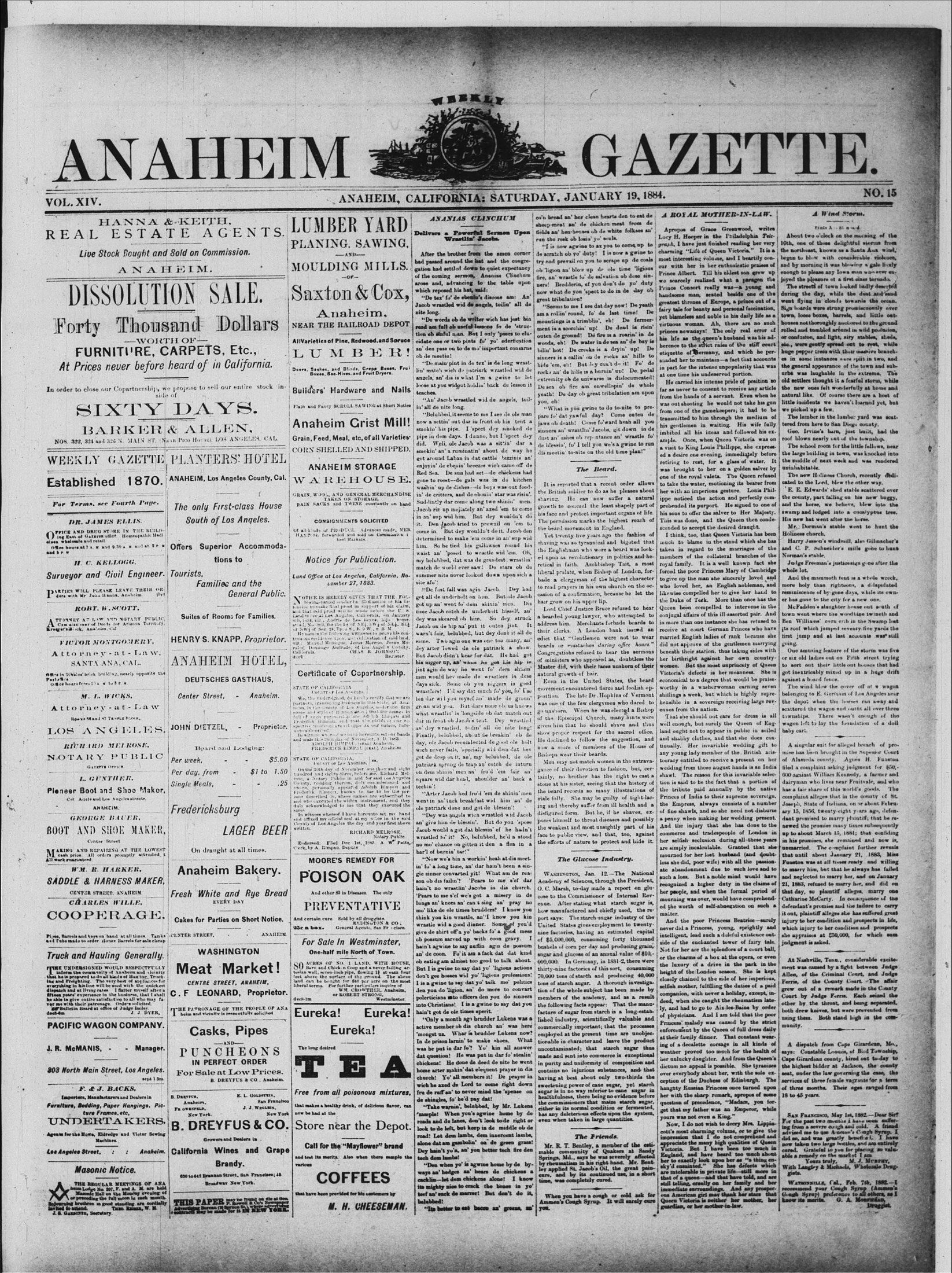
Searchable text
ANAHEIM
VOL. XIV.
HANNA & KEITH,
REAL ESTATE AGENTS.
Live Stock Dought and Sold on Commission.
ANAHEIM.
DISSOLUTION SALE.
Forty Thousand Dollars
WORTH OF
FURNITURE, CARPETS, Etc.,
At Prices never before heard of in California.
In order to close our Coppartnership, we propose to sell our entire stock inside of
Sixty Days.
BARKER & ALLEN,
NO. 322, 324 and 326 N. MAIN ST. (Near Pico House), LOS ANGELES, CAL.
WEEKLY GAZETTE PLANTERS' HOTEL
In order to close our Coppartnership, we propose to sell our entire stock inside of
SIXTY DAYS.
BARKER & ALLEN,
NOS. 322, 324 and 326 N. MAIN ST. (Near Pico House), LOS ANGELES, CAL.
WEEKLY GAZETTE
Established 1870.
For Terms, see Fourth Page.
DR. JAMES ELLIS.
OFFICE AND DRUG STORE IN THE BUILDING East of BARKER OFFICE. Homeopathic Medicine wholesale and retail.
Office hours at 7 A.M. and 9:30 A.M. and at 2 P.M.
H. C. KELLOGG.
Surveyor and Civil Engineer.
PARTIES WILL PLEASE LEAVE THEIR ORDERS with Mr John Hanna, Anaheim.
ROBT. W. SCOTT.
ATTORNEY AT LAW AND NOTARY PUBLIC. Commissioner of Doels for Arizona Territory. Kroger's Block, Anaheim, Cal.
VICTOR MONTGOMERY.
Attorney-at-Law, SANTA ANA, CAL.
Office in Dibbles' brick building, nearly opposite the Post Office.
Office hours from 10 A.M. to 3 P.M.
M. L. WICKS.
Attorney-at-Law
Rooms 56 and 57 Temple Block.
LOS ANGELES.
RICHARD MEIROSE.
NOTARY PUBLIC
GAZETTE OFFICE.
L. GUNTHER.
Ploneer Boot and Shoe Maker,
Cor. Atele and Los Angeles streets.
ANAHEIM.
GEORGE BACER,
BOOT AND SHOE MAKER,
Center Street
MAKING AND REPAIRING AT THE LOWEST cash price. All orders promptly attended, all work guaranteed.
WM. R. HARKER,
SADDLE & HARNESS MAKER,
CENTER STREET, ANAHEIM.
PLANTERS' HOTEL
ANAHEIM, Los Angeles County, Cal.
The only First-class House South of Los Angeles.
Offers Superior Accommodations to Tourists, Families and the General Public.
Suites of Rooms for Families.
HENRY S. KNAPP, Proprietor.
ANAHEIM HOTEL,
DEUTSCHES GASTHAUS,
Center Street, - Anaheim.
JOHN DIETZEL, - Proprietor.
Board and Lodging:
Per week, - $5.00
Per day, from - $1 to 1.50
Single Meals, - .25
Fredericksburg
LAGER BEER
On draught at all times.
Anaheim Bakery.
Fresh White and Rye Bread
GEORGE BACER,
BOOT AND SHOE MAKER,
Center Street
MAKING AND REPAIRING AT THE LOWEST
cash price. All orders promptly attended, t
All work guaranteed.
WM. R. HARKER,
SADDLE & HARNESS MAKER,
CENTER STREET, ANAHEIM.
CHARLES WILLE,
COOPERAGE.
Pipes, Barrels and kerns on hand at all times. Tanks
and Tubes made to order. Honey Barrels for sale cheap
Truck and Hauling Generally.
THE UNDERSIGNED WOULD RESPECTFULLY
inform the community of Anaheim and vicinity
that he is prepared to do all kinds of Hauling, Trucking and Freighting. The very best of appliances for
everything in his line will be used with the quickest
dispatch and at living rates. I flatter myself after a
fifteen years' experience in the business, that I shall
be able to give entire satisfaction to all who may faver me with their patronage. Order's solicited.
Bulletin Board at office of Judge Bailey.
dece5-6m.
J. J. DYER,
PACIFIC WAGON COMPANY.
J. R. McMANIS, - Manager.
808 North Main Street, Los Angeles.
sept 13m.
F. & J. BACKS,
Importers, Manufacturers and Dealers in
Furniture, Bedding, Paper Hangings. Picture
Frames, etc.
UNDERTAKERS,
Agents for the Howe, Eldredge and Victor Sewing
Machines.
Los Angeles Street, :: Anaheim.
Masonic Notice.
THE REGULAR MEETINGS OF ANAhaim Lodge No. 207, F. and A. M. are held
Masonic Hall on the Monday evening of
or preceding the full moon in each month.
Succourning brethren in good standing are cordially
invited to attend.
Tuno Reisen, W. M.
J. B. GARDINER, Secretary.
Fredericksburg
LAGER BEER
On draught at all times.
Anaheim Bakery.
Fresh White and Rye Bread
EVERY DAY
Cakes for Parties on Short Notice.
CENTER STREET.
WASHINGTON
Meat Market!
CENTRE STREET, ANAHEIM,
C. F LEONARD, Proprietor.
THE PATRONAGE OF THE PEOPLE OF ANAhaim and vicinity is respectfully solicited.
Casks, Pipes
AND
PUNCHEONS
IN PERFECT ORDER
For Sale at Low Prices.
B. DREYFUS & CO., Anaheim.
B. DREYFUS,
Anaheim,
San Francisco
FROWEXFIELD,
New York
J. J. WEOLIN,
New York
B. DREYFUS & CO.
Growers and Dealers in
California Wines and Grape
Brandy.
630 to 642 Brannan Street, San Francisco; 45
Broadway New York.
THIS PAPER may be found on file at GlenAdventure (10 Spring St.), where advertising
contract may be made for it IN NEW YORK.
WEEKLY
IM GAZ
ANAHEIM, CALIFORNIA: SATURDAY, JANUARY 19, 1884.
LUMBER YARD
PLANING, SAWING,
AND
MOULDING MILLS.
OF
Saxton & Cox,
Anaheim.
NEAR THE RAILROAD DEPOT
All Varieties of Pine, Redwood, and Soruce
LUMBER!
Doors, Sashes, and Blinds, Grape Boxes, Fruit Boxes, Bee-Hives, and Fruit Dryers.
Builders' Hardware and Nails
Plain and Fancy SCROLL SAWING at Short Notice
Anaheim Grist Mill!
Grain, Feed, Meal, etc., of all VarietiesCORN SHELLED AND SHIPPED.
ANAHEIM STORAGE
ANANIAS CLINCHUM
Delivers a Powerful Sermon Upon Wrastlin' Jacobs.
After the brother from the amen corner had passed around the hat and the congregation had settled down to quiet expectancy of the coming sermon, Ananias Clinchum arose and, advancing to the table upon which reposed his hat, said:
"De tex' fo' de ebenin's discose am: An' Jacob wrastled wid de angels, toilin' all de nite long.
"De words ob de writer wich has jest bin read am full ob useful lessons fo de 'struc-tion ob sinful man. But I only 'poses to elucidate one or two pints fo' yo' ederification an' den pass on to de mo' important consarns ob de meetin!
"De main pint in de tex' is de long wrastlin' match wich de patriark wrastled wid de angels, an' dis is what I'm a gwine to let loose at you widgut holdin' back de lesson it teaches.
"An' Jacob wrastled wid de angels, toilin' all de nite long.
"Belubbed, it seems to me I see de ole man now a settin' out dar in front ob his tent a smokin' his pipe. I 'spect dey smoked de pipe in dem days. I dunno, but I 'spect day did. Well, ole Jacob was a sittin' dar a smokin' an' a ruminatin' about de way he got around Laban in dat cattle 'buzzinis an' enjoyin' de ebenin' breezes wich came off de Red Sea. De sun had set—de chickens had co'n bread an' her clean hearts den to eat de sheep-meat an' de chicken meat from de fields an' hen-houses ob de white folksses an' run the roek ob losin' yo' souls.
"I is now agwine to ax you to come up to do scratch ob yo' duty! I is now a gwine to try and prevail on you to scrape up de coals ob 'ligion an' blow up de ole time 'ligious fire, an' wrastle fo' de salvation ob dese sinners! Bredderin, ef you don't do yo' duty now what do you 'spect to do in de day ob great tribulation?
"Seems to me I see dat day now! De yeath am a rollin' round, fo' de last time! De mountings is a trimblin', eh! De fermement is a scorchin' up! De dead is risin' outen de ground! De fire is a roarin'in de woods, eh! De water in de sea an' de bay is bilin'hot! De creeks is a dryin' up! De sinners is a callin'on de rocks an' hills to hide 'em, eh! But they can't do it! Fo' de rocks an' de hills is a burnin' up! De pedal extremity ob de uniwarse is dialocumcated! De sea ob fire am'enwellopin' de whole yeath! De day ob great tribulation am upon you, eh!
"What is you gwine to do to-nite to prepare fo'dat yawful day? Come outen de jaws ob death! Come fo ward heah all you sinners an' wrastlin' Jacobs, git down in de dust an' ashes ob repentance an' wrastle fo' de blessin', fo'I tell you we'e a gwine to run dis meetin'to-nite on the old time plan!"
The Beard.
Builders' Hardware and Nails
Plain and Fancy SCROLL SAWING at Short Notice
Anaheim Grist Mill!
Grain, Feed, Meal, etc, of all Varieties
CORN SHELLED AND SHIPPED.
ANAHEIM STORAGE
WAREHOUSE.
GRAIN, WOOL, AND GENERAL MERCHANDISE
TAKEN ON STORAGE.
RAIN SACKS and TWINE constantly on hand
CONSIGNMENTS SOLICITED
Of all kinds of PRODUCE. Advances made, MER HANDLED and sold on Commission in best Markets.
Notice for Publication.
Land Office at Los Angeles, California, November 27, 1883.
NOTICE IS HEREBY GIVEN THAT THE FOLLOWING named saddler a died notice of his intention to make final proof in support of his claim,
and that said proof will be made before the U.S. Land Office at Los Angeles, California, on January 5th, 1884, viz., Andria de Los Reyes, into home at No. 803, for the 14 of NE. SW. of NE. $12 of NW. of Sec 24. Tp. S. R. K.W. S.B.M.
He names the following witnesses to prove his continuous residence upon, and cultivation of said land, viz., Manuel Montime, Jesus Moreno, Jesus Morares, Domingo Andrade, of Los Angel's County, California, deel.
Certificate of Coppartnership.
STATE OF CALIFORNIA
COUNTY OF LOS ANGELES.
We, the underdogs, do hereby certify that we are partners, transcribing business in this State, at Anaheim, in the county of Los Angeles, under the firm name and style of Rimpaun and Frederick Rimpaun, and that the parties are sole owners of our names, hereunto subscribed.
In witness whereof we have hereunto set our hands and seals this day of November, A D. 1833 ADOLPH RIMPAU ISRAEL ANAHEIM, FREDERICK RIMPAU [EARL] Anaheim.
STATE OF CALIFORNIA
COUNTY OF LOS ANGELES.
On the 6th day of November one thousand eight hundred and eighty-three before me, Richard Melrose, a Notary Public in and for said Los Angeles County, residing therein, daily commissioned and sworn personally appeared Adolph Rimpaun and Frederick Rimpaun, known to me to be the person described in whose names are subscribed to and who executed the within instrument, and they duly acknowledged to me that they executed the same.
In witness whereof I have hereunto set my hand and affixed my official seal at my office in the said County of Los Angeles the day and year first above written.
RICHARD MELROSE.
Notary Public.
Endorsed: Filed Dec 1st, 1883. A W Petts Clerk, by A Rimpau. Deputy
MOORE'S REMEDY FOR POISON OAK
And other St in Diseases. The only angels, an' dis is what I'm a gwine to let loose at you widout holdin' back de lesson it teaches.
"An' Jacob wrasstled wid de angels, toil'in all de nite long.
"Belubbed, it seems to me I see de ole man now a settin' out dar in front ob his tent a smokin' his pipe. I spect de smoked de pipe in dem days. I dunno, but I spect day did. Well, ole Jacob was a sittin' dar a smokin' an' a ruminatin' about de way he got around Laban in dat cattle' bizzinis'an' enjoyin' de ebeginn' breezes which came off de Red Sea. De sun had set—de chickens had gone to roost—de gals was in de kitchen washin' up de dishes—de boys was out feedin' de critters, and de ebinin'n star was risin'. Suddintly dar come along two shinin'men. Jacob riz up metiately an' axed 'em to come in an' sup wid him. But dey wouldn't do it. Den Jacob tried to prewail on 'em to come in. But dey wouldn't do it. Jacob den determined to make 'em come in an' wid wid him. So he tied his gallows round his waist an' posed to wrastle wid em. Oh, my belubbed, dat was de grandest' wrastlin'match de world ever saw! De stars ob de summer nite never looked down upon sich a site afo':
"De fast fall was agin Jacob. Dey had got all de underholt on him. But ole Jacob got up an' went fo' dem shinin'men. Dis time Jacob cotch de underholt himself, an' deywas skeared ob him. So dey struck Jacob on de hip an' put it oten jint. It warnn't fair, belubbed, but dey done it all de same. Two agin one was one too many, an' dey arter lowed de ole patriark a show. But Jacob didn't kear for dat. He had got his migger up, an' when he got His hip in jint agin de way he went fo' dem shinin'men would hev made de wrastlers in dese days sick. Some ob you niggers is good wrastlers! I'll say dat much fo' you, fo'I use bin dar wil you myself an' made de groun' groan wid you. But dars none ob us knows what wrastlin'm is longside ob dat match out dar in front ob Jacob's tent. Dey wrastlied an' dey wrastlied, tolin'in all de nite long! Finally, belubbed, about de breakin' ob de day, ole Jacob recumlected de good ole holt wich never fails,' specially迪 dem dat he got de drop on it, an', my belubbed, de ole patriark sprung de trap an' cotch de inturn on dem shinin'men an' frod'd em fair an' square wid dar head, shoulder an' back a techin':
"Arter Jacob hed frod'd 'em de shinin'men went in an'tuck breakfast wid him an' de ole patriark had got de blessin':
"Dey was angels wien wrastled wid Jacob an' give him de blessin'. But do you 'spose Jacob would a got dat blessin'ef he hadn't wrastled to it? No, belubbed, he'd a stood no mo' chance ob gitten it den a flea in a barl of burnin't tar:"
"Now we've bin a workin' heath at dis meet-in' fo'a long time, an'dar hain't been a single sinner convarsted yit! What amde reason ob dis failun?' Pears to me s'ef dar hain't no wrastlin' Jacobs in dis church.' Pears to me s'ef we're got a misery in de extremity ob de uniwarse is dislocucated! De sea ob fire am'enwellopin'd whole yeath! De day ob great tribulation am upon you, eh!
"What is you gwine to do to-nite to prepare fo'dat yawful day? Come outen de jaws ob death! Come fo ward heah all you sinners an' wrastlin' Jacobs,git down in de dust an' ashes ob repentance an' wrastle fo'd blessin',fo'I tell you we'e a gwine to run dis meetin't to-nite on the old time plan."
The Beard.
It is reported that a recent order allows the British soldier to do as he pleases about shaving. He can now suffer a natural growth to conceal the least shapely part of his face and protect important organs of life. The permission marks the highest reach of the beard movement in England.
Yet twenty-five years ago the fashion of shaving was so tyrauntical and bigoted that the Englishman who wore a beard was looked upon as revolutionary in politics and heretical in faith. Archbishop Tait,a most liberal pratele,when Bishop of London.forade a clergyman of the highest character to read prayers in his own church on the occasion of a confirmation,because he let the hair grow on his upper lip.
Lord Chief Justice Bruce refused to hear a bearded young lawyerwho attempted to address him.Merchants forbade beards to their clerks.A London bank issued an edict that "Gentlemen were not to wear beards or mustaches during office hours." Congregatiob refused to hear the sermons of ministers who appeared as,doubtless the Master did.with their faces unshorn of their natural growth of hair.
Even in the United States,the beard movement encountered fierce and foolish opposition.The late Dr.Hopkins of Vermont was one of the few clergymen who dared to go unshorn.Wren he was elected a Bishop of the Episcopal Church,many hints were given him that he should shave and thus show proper respect for the sacred office。他 declined to follow the suggestion,and now a score of members of the House of Bishops wear their beards.
Men may not match women in the extravagance of their devotion to fashionbut,certainly,no brother has the right to cast a stone at his sister,seeing that the history of the beard records so many illustrations of male folly.She may be guilty of tight-lacing and thereby suffer from ill health and a disfigured form。但he,iif he shaves.exposes himself to throat diseases and possibly the weakest and most unsightly part of his face to public view,and that,too,against the efforts of nature to protect and hide it.
The Glucose Industry.
Washington Jan. 12.-The National Academy of Sciences,trough the President.O.C.Marsh.to-day made a report on glucoseto the Commissioner of Internal Revence
MOORE'S REMEDY FOR
POISON OAK
And other Sk in Diseases. The only
PREVENTATIVE
And certain cure. Sold by all druggists.
REDINGTON & CO.
General Agent, San Francisco.
For Sale In Westminster,
One-half mile North of Town.
80 ACRES OF NO. 1 LAND, WITH HOUSE,
Barn and Chicken Coop and a never failing artesian well, seven-inch pipe, flowing 12 at eam four feet above the surface of the ground. The above land can be bought for $40 per acre on the most liberal terms. For further particulars inquire of WM. CROWTHER, Anaheim,
or KOBERT STRONG.
Westminster.
Eureka! Eureka!
Eureka!
The long desired
TEA
Free from all poisonous mixtures,
that makes a healthy drink, of delicious flavor, can now be had at the
Store near the Depot.
Call for the "Mayflower" brand
and test its merits. Also when there sample the various
COFFEES
that have been provided for his customers by
M. H. CHEESEMAN.
went in an' tuck breakfast wid him an' de ole patriark done and got de blessin'!
"Dey was angels wich wrastled wid Jacob an' give him de blessin'. But do you 'spose Jacob would a got dat blessin' ef he hadn't wrastled to it? No, belubbed, he'd a stood no mo' chance ob gitten it den a flea in a bar'l of burnin' tar!"
"Now we's bin a workin' heah at dis meet-in' fo'a long time, an' dar hainn't been a single sinner convarted yit! What am de reason ob dis failin'? 'Pears to me s'ef dar hain't no wrastlin' Jacobs in dis church.
'Pears to me s'ef we've got a misery in de lungs an' knees an' can't sing an' pray no mo' like de ole times brudders? I know you think you kin wrastle, an'I know you kin wrastle wid a good dinner. Some of you'd give de shirt offn yo' backs fo'a good mess ob possum sarved up with coon gravy. I hain't agwine to say nuffin agin de possum an' de coon. Fo' it am a fack dat dat kind ob eating am almost too good to talk about. But I is gwine to say dat yo' ligious actions don't gee bosses wid yo' ligious professions! I is a gwine to say dat yo' talk mo' politics den you do 'ligion, an' do more to convart polerticians to officers den you do sinners into Christians! I is a gwine to say dat you hain't got de ole times sperit.
"Only a month ago brudder Lukens was a active member ob dis church an' was here 'mongst us. Whar is brudder Lukens now? In de prison larnin' to make shoes. What was he put in dar fo?' Yo' kin all answer dat question! He was put in dar fo' stealin' chickens! He done de deed de nite he went home arter makin'dat elequent prayer in dis church! Yo' all members it! De prayer in wich he axed de Lord to come right down fru de ruff an' to never mind the 'spense on de shingles, fo' he'd pay dat!
"Take warnin', belubbed, by Mr. Lukens 'zample! When you's agwine home by de roads and de lanes, don't look to de right or look to de left, but keep in de middle ob de road! Let dem lambs, dem innercent lambs, alone dat am gambolin'on de green grasa! Dey hain't yo'n, an' you better tech fire den tech dem lambs!
"Den when yo' is agwine home by de byways an' hedges an' hears de chickens a cacklin—let dem chickens alone! I know its mighty nice to crack the bones in yo' teef an' suck de marrer! But don't do it, belubbed!
"Ita better to eat bacon an' greens, an'
The Glucose Industry.
WASHINGTON, Jan. 12.-The National Academy of Sciences, through the President, O. C. Marsh, to-day made a report on glucose to the Commissioner of Internal Revenue. After stating what starch sugar is, how manufactured and chiefly used, the report says: The starch-sugar industry of the United States gives employment to twenty-nine factories, having an estimated capital of $5,000,000, consuming forty thousand bushels of corn per day and producing grain, sugar and glucose of an annual value of $10,-000,000. In Germany, in 1881-2, there were thirty-nine factories of this sort, consuming 70,000 tons of starch and producing 40,000 tons of starch sugar. A thorough investigation of the whole subject has been made by members of the academy, and as a result the following facts appear: That the manufacture of sugar from starch is a long-established industry, scientifically valuable and commercially important; that the processes employed at the present time are unobjectable in character and leave the product uncontaminated; that starch sugar thus made and sent into commerce is exceptional in purity and uniformity of composition and contains no injurious substances, and that having at best about only two-thirds the sweetening power of cane sugar, yet starch sugar is in no way inferior to cane sugar in healthfulness, there being no evidence before the commissioners that maize starch sugar, either in its normal condition or fermented, has any deleterious effects upon the system, even when taken in large quantities.
The Friends.
Mr. R. T. Bentley, a member of the estimable community of Quakers at Sandy Springs, Md., says he was severely affected by rheumatism in his right hand. Mr. Bentley applied St. Jacob's Oil, the great pain cure, and by its continued use, in a short time, was completely cured.
When you have a cough or cold ask for Ammen's Cough Syrup. It will surely cure you.
GAZETTE.
JANRY 19, 1884.
NO. 15
A ROYAL MOTHER-IN-LAW.
A propos of Grace Greenwood, writes Lucy H. Hooper in the Philadelphia Telegraph, I have just finished reading her very charming "Life of Queen Victoria." It is a most interesting volume, and I heartily concur with her in her enthusiastic praises of Prince Albert. Till his eldest son grew up we scarcely realized what a paragon the Prince Consort really was—a young and handsome man, seated beside one of the greatest thrones of Europe, a prince out of a fairy tale for beauty and personal fascination, yet blameless and noble in his daily life as a virtuous woman. Ah, there are no such princes nowadays! The only real error of his life as the queen's husband was his adherence to the strict rules of the stiff court etiquette of Germany, and which he persuaded her to maintain—a fact that accounts in part for the intense unpopularity that was at one time his undeserved portion.
He carried his intense pride of position so far as never to consent to receive any article from the hands of a servant. Even when he was out shooting he would not take his gun from one of the gamekeepers; it had to be transmitted to him through the medium of his gentlemen in waiting. His wife fully imbibed all his ideas and followed his example. Once, when Queen Victoria was on a visit to King Louis Phillippe, she expressed a desire one evening, immediately before retiring to rest, for a glass of water. It was brought to her on a golden salver by
A Wind Storm.
Franta A. B. n.a.d.
About two o'clock on the morning of the 10th, one of those delightful storms from the northeast, known as a Santa Ana wind, began to blow with considerable violence, and by morning it was blowing a gale lively enough to please any Iowa man who ever enjoyed the pleasure of a first-class tornado.
The streets of town looked badly deserted during the day, while the dust and sand went flying in clouds towards the ocean. Sign boards were strung promiscuously over town, loose boxes, barrels, and little outhouses not thoroughly anchored to the ground rolled and tumbled around in wild profusion, or confusion, and light, airy stables, sheds, etc., were gently spread out to rest, while huge pepper trees with their massive branches in some instances were split in two, and the general appearance of the town and suburbs was laughable in the extreme. The old settlers thought it a fearful storm, while the new ones felt wonderfully at home and natural like. Of course there are a host of little incidents we haven't learned yet, but we picked up a few.
The lumber in the lumber yard was scattered from here to San Diego county.
Geo. Irvine's barn, just built, had the roof blown nearly out of the township.
The school room for the little fellows, near the large building in town, was knocked into the middle of next week and was rendered uninhabitable.
He carried his intense pride of position so far as never to consent to receive any article from the hands of a servant. Even when he was out shooting he would not take his gun from one of the gamekeepers; it had to be transmitted to him through the medium of his gentlemen in waiting. His wife fully imbibed all his ideas and followed his example. Once, when Queen Victoria was on a visit to King Louis Philippe, she expressed a desire one evening, immediately before retiring to rest, for a glass of water. It was brought to her on a golden salver by one of the royal valets. The Queen refused to take the water, motioning its bearer from her with an imperious gesture. Louis Philippe noticed the action and perfectly comprehended its purport. He signed to one of his sons to offer the salver to Her Majesty. This was done, and the Queen then condescended to accept the desired draught.
I think, too, that Queen Victoria has been much to blame in the stand which she has taken in regard to the marriages of the members of the collateral branches of the royal family. It is a well known fact she forced the poor Princess Mary of Cambridge to give up the man she sincerely loved and who loved her, an English nobleman, and likewise compelled her to give her hand to the Duke of Teck. More than once has the Queen been compelled to intervene in the conjugal affairs of this ill-assorted pair. And in more than one instance she has refused to receive at court German Princes who have married English ladies of rank because she did not approve of the gentlemen marrying beneath their station, thus taking sides with her birthright against her own country-women. But the most unprincely of Queen Victoria's defects is her meanness. She is economical to a degree that would be praiseworthy in a washerwoman earning seven shillings a week, but which is highly reprehensible in a sovereign receiving large revenues from the nation.
That she should not care for dress is all well enough, but surely the Queen of England ought not to appear in public in soiled and shabby clothes, and that she does continually. Her invariable wedding gift to any young lady member of the British aristocracy entitled to receive a present on her wedding from those august hands is an India shawl. The reason for this invariable selection is said to be the fact that a portion of the tribute paid annually by the native Princes of India to their supreme sovereign, the Empress, always consists of a number of fine shawls, and so she need not disburse a penny when making her wedding present. And the injury that she has done to the commerce and tradespeople of London in her selfish seclusion during all these years are simply incalculable. Granted that she mourned for her lost husband (and doubtless she did, poor wife) with all the passionate abandonment due to such love and to such a loss. But a noble mind would have recognized a higher duty in the claims of her people, and when the formal period of morning was over would have comprehend-
The lumber in the lumber yard was scattered from here to San Diego county.
Geo. Irvine's barn, just built, had the roof blown nearly out of the township.
The school room for the little fellows, near the large building in town, was knocked into the middle of next week and was rendered uninhabitable.
The new Holiness Church, recently dedicated to the Lord, blew the other way.
E. E. Edwards' shed stable scattered over the county, part falling on his new buggy, and the horse, we believe, blew into the swamp and lodged into a cecalyptus tree. His new hat went after the horse.
Mr. Dorman's stable went to hunt the Holiness church.
Harry Jason's windmill, also Gilmacher's and C. P. Schneider's mills gone to hunt Norman's stable.
Judge Freeman's justice sign gone after the whole lot.
And the mammoth tent is a whole wreck, more holy than righteous, a dilapidated reminiscence of by-gone days, while its owner has gone to the city for a new one.
McFadden's slaughter house out south of town went where the woodbine twineth and Ben Williams' corncrib in the Swamp lost its roof which jumped seventy-five yards the first jump and at last accounts was still going.
One amusing feature of the storm was five or six old ladies out on Fifth street trying to sort out their little out houses that had got inextricably mixed up in a huge drift against a board fence.
The wind blow the cover off of a wagon belonging to E. Germain of Los Angeles near the depot when the horses ran away and scattered the wagon and outfit all over three townships. There wasn't enough of the wagon left to lay the foundation of a doll baby cart.
A singular suit for alleged breach of promise has been brought in the Superior Court of Alameda county. Agnes H. Funston filed a complaint asking judgment for $50,-000 against William Kennedy, a farmer and dairyman who lives near Fruitvale, and who has a fair share of this world's goods. The complaint alleges that in the county of St. Joseph, State of Indiana, on or about February 15, 1856, twenty-eight years ago, defendant promised to marry plaintiff; that he renewed the promise many times subsequently up to about March 15, 1881; that confiding in his promises, she remained and now is, unmarried. The complaint further reveals that until about January 21, 1883, Miss Funston was at all times ready and willing to marry him, but that he always has failed and neglected to marry her, and on January 21, 1883, refused to marry her, and did on that day, so plaintiff alleges, marry one Catharine McCarty. In consequence of the
The National through the President, made a report on glumer of Internal Revethat starch sugar is chiefly used, the res-sugar industry of the employment to twentyan estimated capital spending forty thousand
and producing 40,000 A thorough investigation has been made by him, and as a result
hear: That the manustarch is a long-establifically valuable and not; that the processes
at time are unobjecured and leave the product
starch sugar thus commerce is exceptional
quality of composition and substances, and that
only two-thirds the same sugar, yet starch
prior to cane sugar in being no evidence before
maize starch sugar,
condition or fermented,
acts upon the system,
large quantities.
Mortends.
A member of the estif of Quakers at Sandy was severely affected
right hand. Mr. Bentd Oil, the great painintinued use, in a short
cured.
Bough or cold ask for
up. It will surely cure
the Empress, always consists of a number
of fine shawls, and so she need not disburse
a penny when making her wedding present.
And the injury that she has done to the
commerce and tradespeople of London in
her selfish seclusion during all these years
are simply incalculable. Granted that she
mourned for her lost husband (and doubtless she did, poor wife) with all the passionate abandonment due to such love and to
such a loss. But a noble mind would have
recognized a higher duty in the claims of
her people, and when the formal period of
mourning was over, would have comprehended
the worth of self-abnegation on such a
matter.
And the poor Princess Beatrice—surely never did a Princess, young, sprightly and intelligent, lead such a doleful existence outside of the enchanted tower of fairy tale. Not for her are the splendors of a court ball,
or the charms of a box at the opera, or even the luxury of a drive in the park in the height of the London season. She is kept closely chained to the side of her imperious,
selfish mother, fulfilling the duties of a paid companion, with never a holiday, except, indeed, when she caught the rheumatism laterly, and had to go to Aix-les-Bains by order of physicians. And I am told that the poor Princess' malady was caused by the strict enforcement by the Queen of full dress daily at their family dinner. That constant wearing of a decalette corsage in all kinds of weather proved too much for the health of her unlucky daughter. And from the Queen's dictum no appeal is possible. She tyranizes over everybody about her, with the sole exception of the Duchess of Edinburgh. The haughty Russian Princess once turned upon her with the sharp remark, apropos of some question of precedence, "Madam, you forget that my father was an Emperor, while youra was not even a King."
Now, I do not wish to decry Mrs. Lippincott's most charming volume, or to give the impression that I do not comprehend and appreciate the many high qualities of Queen Victoria. But I have been too much in England, and have heard too much about her to exactly look upon her as "a thing ensky'd ensainted." She has defects which are intolerable in private life—still more in that of a queen—and that have told, and are still telling, cruelly on her family and her immediate surroundings. And any prosperous American girl may thank her stars that Queen Victoria is neither her mother, her guardian, or her mother-in-law.
Joseph, State of Indiana, on or about February 15, 1856, twenty-eight years ago, defendant promised to marry plaintiff; that he renewed the promise many times subsequently up to about March 15, 1881; that confiding in his promises, she remained and now is, unmarried. The complaint further reveals that until about January 21, 1883, Miss Funston was at all times ready and willing to marry him, but that he always has failed and neglected to marry her, and on January 21, 1883, refused to marry her, and did on that day, so plaintiff alleges, marry one Catharine McCarty. In consequence of the defendant's promise and the failure to carry it out, plaintiff alleges she has suffered great injury to her condition and prospects in life, which injury to her condition and prospects she appraises at £50,000, for which sum judgment is asked.
At Nashville, Tenn., considerable excitement was caused by a fight between Judge Allen, of the Criminal Court, and Judge Ferris, of the County Court. The affair grew out of a remark made in the County Court by Judge Ferris. Each seized the other by the throat, and being separated, both drew knives, but were prevented from using them. Both stand high in the community.
A dispatch from Cape Girardeau, Mo., says: Constable Loomis, of Bird Township, Cape Girardeau county, hired out to-day to the highest bidder at Jackson, the county seat, under the law governing the case, the services of three female vagrants for a term of three months. Their ages ranged from 18 to 45 years.
San Francisco, May 1st, 1882.—Dear Sir? For the past two months I have been suffering from a severe cough and cold. A friend advised me to use Ammen's Cough Syrup. I did so, and was greatly benefited. I have now taken two large bottles, and am entirely cured. Grateful to you for placing so valuable a remedy on the market I am.
Yours truly,
M. J. Murphy,
With Langley & Michaels, Wholesale Druggists.
WATSONNILLE, Cal., Feb. 7th, 1882.—I recommend your Cough Syrup (Ammen's Cough Syrup) preferences to all others, as I know its marita.
G. A. Morrhead,
Druggist.