anaheim-gazette 1883-12-29
Scanned page
Searchable text
SIX - PAGE
ANAHEIM
VOL. XIV.
WEEKLY GAZETTE
Established 1870.
For Terms, see Fourth Page.
DR. JAMES ELLIS.
OFFICE AND DRUG STORE IN THE BUILDING East of Anaheim office. Homopathic Medicine wholesale and retail.
Office hours at 7 A.M. and 9:30 A.M. and at 2 P.M.
DR. E. L. COWAN,
Dentist,
UNTIL FURTHER NOTICE MY OFFICE DAYS in Anaheim will be on Friday and Saturday each week.
DR. E. L. COWAN
H. C. KELLOGG.
Surveyor and Civil Engineer.
PARTIES WILL PLEASE LEAVE THEIR ORDERS with Mr. John Hanna, Anaheim.
ROBT. W. SCOTT.
ATTORNEY AT LAW AND NOTARY PUBLIC, Commissioner of Deeds for Arizona Territory, Kroger's Block, Anaheim, Cal.
VICTOR MONTGOMERY,
Attorney-at-Law.
THE ITALY OF AMERICA.
VIEWS FROM A MEDICAL STANDPOINT.
Examples of Longevity Effect of Anaheim's Climate on the Various Functions of the Body.
Ed. Gazette—A writer who wishes to call attention with an especial object to any specially favored spot on earth would undoubtedly lay himself open to the charge of egotism if he merely expressed his own views on the subject; but in the few remarks the writer is about to make, he feels he is only embodying opinions long since conceded to be true by those best fitted to know the value of health and how to retain it, and how to regain it when lost.
Anaheim, 12 miles from the ocean, offers to the health-seeker a home where happily no epidemic diseases have ever existed—the original denizens having either migrated to Mexico, or died of old age. Among the few Indians that remain about 150 miles from the coast, it is not uncommon to find many more than a hundred years of age, who remember helping the early Padres to build the adobe Mission at the end of the last century.
Professor Tucker, the able analyst of the American census from 1790 to 1840, says that the chances of living above 100 years are thirteen times as great among the slaves and forty times as great in the free negroes in the white population of the country.
In the climate of general and Anaheim days relieves the cold lung by taking the exercise of the body. The first of the breathe presents California, there tingencies of weak round comfortably and refreshing by gaining good from day and the from gastric malaise. But the amount breathe is a quest place. If, for instance air taken into the lungs are required for thion, and 30 or 20 to a diseased condition clearly time for the climate where the phore supplement Could such an one detriment a cold well, the density oas as to its temperature cannot without condition breathe a cold for persons with d climate where the complimentary to the and vice versa by n.
H. C. KELLOGG.
Surveyor and Civil Engineer.
PARTIES WILL PLEASE LEAVE THEIR ORDERS WITH Mr. John Hanna, Anaheim.
ROBT. W. SCOTT.
ATTORNEY AT LAW AND NOTARY PUBLIC, Commissioner of Deeds for Arizona Territory, Keegan's Block, Anaheim, Cal.
VICTOR MONTGOMERY,
Attorney-at-Law,
SANTA ANA, CAL.
Office in Dibbles' brick building, nearly opposite the Post office.
M. L. WICKS,
Attorney-at-Law
Rooms 25 and 37 Temple Block.
LOS ANGELES.
L GUNTHER.
Pioneer Bool and Shoe Maker,
Cor. Anale and Los Angeles street.
ANAHEIM.
GEORGE BAUER,
BOOT AND SHOE MAKER.
Center Street
MAKING AND REPAIRING AT THE LOWEST COST price. All orders promptly attended to. All work guaranteed.
WM. R. HARKER,
SADDLE & HARNESS MAKER.
CENTER STREET, Anaheim.
CHARLES WILLE.
COOPERAGE.
Places, Barrels and keys on hand at all times. Tanks and Tube made to order. Honey Barrels for sale cheap.
For Sale In Westminster,
One-half mile North of Town.
80 ACRES OF NO. 1 LAND, WITH HOUSE, BARN and CHicken Coop and a never failing artesian well, seven-inch pipe, flowing 11 feet above the surface of the ground. The above land can be bought for $40 per acre on the most liberal terms. For further particulars inquire of WM. CROWTHER, Anaheim, or ROBERT STRONG, Westminster.
Truck and Hauling Generally.
THE UNDERSIGNED WOULD RESPECTFULLY inform the community of Anaheim and identify that he is prepared to do all kinds of Hauling, Trucking and Freighting. The very best of appliances for everything in his line will be used with the quickest dispatch and at living rates. I flatter myself after a fifteen years' experience in the business, that I shall be able to give entire satisfaction to all who may favor me with their patronage. Orders solicited.
Bulletin Board at office of Judge Bailey.
dec8-6m
J. J. DYER,
Professor Tucker, the able analyst of the American census from 1790 to 1840, says that the chances of living above 100 years are thirteen times as great among the slaves and forty times as great in the free negroes as in the white population of the country, and ethnologists admit the Indian attains to the greatest longevity in the human race only when he exists in a country where the extremes of climate are unknown, and where the olive, fig and evergreen oak attain their greatest size and beauty; and we may remark it is only within the last few years that these naturally favored regions of the cypress and olive have been by the aid of railways placed within cheap and easy reach of all, whether seeking climate for health's sake or seeking climate where the greatest longevity is attainable, where labor is honorably rewarded and where the earth easily yieldeth her increase, where a temperate and easy life is the rule and not the exception.
Italy (and Anaheim has often been called by travelers the Italy of America) had, according to the census instituted by Vespasian, a very large number of persons living over the age of 100 years, and to this day Italians attain the greatest age, while the invalids of Europe flock to the Italian peninsula to regain health and attain a longevity unattainable in less favored climates.
Buffon, the French naturalist, says that every animal lives about six or seven times as long as it is in growing. On this supposition the relation would be as 1 to 7—but the real relation of the period of growth to the duration of life is as 1 to 5, or nearly so.
Man is twenty years growing, and he lives or ought to live five times twenty, or 100 years, provided he is not a slave to the excesses of luxury or dejected by the labors and privations of poverty and can exist in a climate where the extremes of temperature are unknown. The horse is five years growing and lives to be 25 years when not killed by hard work.
The duration of life depends more on climate than on food, and more on food than it does on race; as we have examples in the Esquimaux at the pole and the Aztec at the equator of both stunted growth and shortened years.
Many industrious persons have given to the world statistics showing how largely we possess in California a superabundance of grain crops which are exported to all parts of the world as food for those peoples living in less favored climates than we do, our wheat being the finest and fetching the highest price in the markets of Europe. Our cattle, with wild deer in abundance, would carry off the same palm as the wheat does, for beauty and quality, if such competition were original denizens having either migrated to Mexico, or died of old age. Among the few Indians that remain about 150 miles from the coast, it is not uncommon to find many more than a hundred years of age, who remember helping the early Padres to build the adobe Mission at the end of the last century.
Professor Tucker, the able analyst of the American census from 1790 to 1840, says that the chances of living above 100 years are thirteen times as great among the slaves and forty times as great in the free negroes as in the white population of the country, and ethnologists admit the Indian attains to the greatest longevity in the human race only when he exists in a country where the extremes of climate are unknown, and where the olive, fig and evergreen oak attain their greatest size and beauty; and we may remark it is only within the last few years that these naturally favored regions of the cypress and olive have been by the aid of railways placed within cheap and easy reach of all, whether seeking climate for health's sake or seeking climate where the greatest longevity is attainable, where labor is honorably rewarded and where the earth easily yieldeth her increase, where a temperate and easy life is the rule and not the exception.
Italy (and Anaheim has often been called by travelers the Italy of America) had, according to the census instituted by Vespasian, a very large number of persons living over the age of 100 years, and to this day Italians attain the greatest age, while the invalids of Europe flock to the Italian peninsula to regain health and attain a longevity unattainable in less favored climates.
Buffon, the French naturalist, says that every animal lives about six or seven times as long as it is in growing. On this supposition the relation would be as 1 to 7—but the real relation of the period of growth to the duration of life is as 1 to 5, or nearly so.
Man is twenty years growing, and he lives or ought to live five times twenty, or 100 years, provided he is not a slave to the excesses of luxury or dejected by the labors and privations of poverty and can exist in a climate where the extremes of temperature are unknown. The horse is five years growing and lives to be 25 years when not killed by hard work.
The duration of life depends more on climate than on food, and more on food than it does on race; as we have examples in the Esquimaux at the pole and the Aztec at the equator of both stunted growth and shortened years.
Many industrious persons have given to the world statistics showing how largely we possess in California a superabundance of grain crops which are exported to all parts of the world as food for those peoples living in less favored climates than we do, our wheat being the finest and fetching the highest price in the markets of Europe. Our cattle, with wild deer in abundance, would carry off the same palm as the wheat does, for beauty and quality, if such competition were original denizens having either migrated to Mexico, or died of old age. Among the few Indians that remain about 150 miles from the coast, it is not uncommon to find many more than a hundred years of age, who remember helping the early Padres to build the adobe Mission at the end of the last century.
Professor Tucker, the able analyst of the American census from 1790 to 1840, says that the chances of living above 100 years are thirteen times as great among the slaves and forty times as great in the free negroes as in the white population of the country, and ethnologists admit the Indian attains to the greatest longevity in the human race only when he exists in a country where the extremes of climate are unknown, and where the olive, fig and evergreen oak attain their greatest size and beauty; and we may remark it is only within the last few years that these naturally favored regions of the cypress and olive have been by the aid of railways placed within cheap and easy reach of all, whether seeking climate for health's sake or seeking climate where the greatest longevity is attainable, where labor is honorably rewarded and where the earth easily yieldeth her increase, where a temperate and easy life is the rule and not the exception.
Italy (and Anaheim has often been called by travelers the Italy of America) had, according to the census instituted by Vespasian, a very large number of persons living over the age of 100 years, and to this day Italians attainthe greatest age, while the invalids of Europe flock tothe Italian peninsula to regain health and attain a longevity unattainable in less favored climates.
Buffon, the French naturalist, says that every animal lives about six or seven times as long as it is in growing. On this suppositionthe relation would be as 1 to 7—butthe real relationoftheperiodofgrowthtothedurationoflifeisas1to5ornearlyso.Manistwentyyearsgrowing,andhelivoryououghttotherexcessesofluxuryordejectedbythelaborsandprivationsofpovertyandcanexistinaclimatesorfetterbythismanifestionhomemethodshowproportionmaybeimbindividuals,anabunpabulumcanbade town.Dr.Ellishasoftenandbyletterbyperstroubleisyourclimatewhatisitlike?AndtunityofansweringpalmaryinvalidthioclimaturebecausemildoftenhaveIheardfohemismanythinginflammerer—“Ineverfeltsoafamharmony.”
Truck and Hauling Generally.
THE UNDERSIGNED WOULD RESPECTFULLY inform the community of Anaheim and identify that he is prepared to do all kinds of hauling, trucking and freighting. The very best of appliances for everything in his line will be used with the quickest dispatch and at living rates. I flatter myself after a fifteen years' experience in the business, that I shall be able to give entire satisfaction to all who may favor me with their patronage. Orders solicited
B. DREYFUS & CO.
Growers and Dealers in California Wines and Grape Brandy.
650 to 642 Brannan Street, San Francisco; 45 Broadway New York.
CENTRALIA
POULTRY YARDS!
W. G. POTTER, - Proprietor.
BREEDER OF PLYMOUTH ROCKS AND BROWN LEGBEA. Req. for hatching, $1.50 per dozen. Also have on hand fit. A young cockerel of Hawk's Strain of P. R. and Bonney Strains of B. L., $2 to $3 per斗. Cash with order.
Many industrious persons have given to the world statistics showing how largely we possess in California a superabundance of grain crops which are exported to all parts of the world as food for those peoples living in less favored climates than we do, our wheat being the finest and fetching the highest price in the markets of Europe. Our cattle, with wild deer in abundance, would carry off the same palm as the wheat does, for beauty and quality, if such competition were needful.
Our vast superiority over other countries in the products of the animal and vegetable kingdoms is doubtless owing to the long period for sleep and growth afforded by our cool, refreshing nights, while summer on the Atlantic seaboard is hot both by day and night and the whole creation is working at high pressure for many weeks—no sleep and little rest. Under these forced conditions what the vegetable kingdom gains in growth it loses in quality, and what man gains in business he loses in strength, and is glad sooner or later with feeble health and shattered body to turn his tottering steps to Anaheim—the Italy of America.
Life without health is miserable indeed. Life in its larger physiological sense needs a third or a fourth part of every twenty-four hours for quiet sleep—a wonderful phenomenon; so familiar to our experience, so obscure to our philosophy, and such life, whether of the animal or vegetable kingdom, obtains the greatest advantages under the least condition of physical extremes.
One simple but certain fact runs through all we have stated, viz., that the healthiness of the organs ministering to the several functions of life constitutes the health of the man, and in the same proportion tends to prolong life. Though physiologists hold some verbal dispute on this point, yet can we hardly define vitality otherwise than as a force and power acting through the intervention of the nervous system upon organic structures and depending upon the integrity of all these parts for its own amount and completeness. Carrying this view into the practical question how vitality may best be maintained and prolonged in sickness and in health into old age, we must look to four general conditions which may be said to include all that is most essential to the fulfillment of the object. These are air as balancing pulmonary invalid the given climate bracing cold, variable and exerting mild and anti-inflammatory because mild often have I heard for him say—"Anaheim anything of inflammation—"I never felt so Anaheim;" and from feel up to the mark too relaxing for me. Mark always proceeds organic disease, then usually proceed from soothing qualities around to atmosphere, to the coldness at sundown, moisture in the air. moisture I have nothing that a sea fog soldom harm. Ask a New Year wind, the northward give for a breath of air with the balm of sea Anaheim all.the moist moisture, for we have and our geology is Quaternay, and there present Santa Ana river period a mighty surging from the Santa Ana rock canyon. To the Ana canyon presents profitable observation is little doubt but the gouged out by an immature sides of Mount San Jacinto and gravitating by way of Riverside and its trail huge water-wet clay, the denuded straight canyon showing what mineral basin; that is incline from the edge Coal, iron and rich gold in these very imperfect But to return to our sea-moisture is invisibly and respirable and its amount of heat in the surface contained moist diffuses in the early moisture at the pole and the Aztec at the equator of both stunted growth and shortened years.
B. DREYFUS & CO.
Growers and Dealers in California Wines and Grape Brandy.
650 to 642 Brannan Street, San Francisco; 45 Broadway New York.
CENTRALIA
POULTRY YARDS!
W. G. POTTER, - Proprietor.
BREEDER OF PLYMOUTH ROCKS AND BROWN LEGBEA. Req. for hatching, $1.50 per dozen. Also have on hand fit. A young cockerel of Hawk's Strain of P. R. and Bonney Strala of B. L., $2 to $3 per斗. Cash with order.
P. G. Anaheim.
nov10
WEEKLY
ANAHEIM, CALIFORNIA: SATURDAY, DECEMBER 29, 1835
ING to the function of respiration; aliment;
exercise of the body and exercise of the mind.
The first of these topics—the air we breathe, presents no difficulties in Southern California, there being absolutely no contingencies of weather. It is all the year round comfortably warm by day and cool and refreshing by night. Diseased lungs gaining good from the warm atmosphere by day and the stomach an immunity from gastric malaria by night.
But the amount and purity of the air we breathe is a question belonging to every place. If, for instance, 40 cubic inches of air taken into the lungs at each inspiration are required for the purposes of their function, and 30 or 20 only are inspired, owing to a diseased condition of the lungs, it is clearly time for the sick person to seek a climate where the conditions of the atmosphere supplement his diseased condition. Could such an one breathe always without detriment a cold atmosphere, all would be well, the density of the air being inversely as to its temperature. But diseased lungs cannot without constant danger of inflammation breathe a cold air, hence the necessity for persons with diseased lungs to seek a climate where the functions of the skin are complimentary to those of the lungs by day and vice versa by night.
In the climate of Southern California in general and Anaheim in particular, the warm days relieves the congestion of the diseased lung by taking the blood to the skin, this congestion being naturally increased through the air which gives a Claude Lorraine softness of outline to the landscape. Every one knows that a cloudy night is a warm one a bright one.
In the climate of Southern California in general and Anaheim in particular, the warm days relieves the congestion of the diseased lung by taking the blood to the skin, this congestion being naturally increased by exercise, but no ill consequence happening so long as the climate enables the skin to be the safety valve. During sleep exercise is reduced to the act of respiration alone; the air of our climate being cool at night enables the diseased lung without danger to take in figuratively more nourishment. Many invalids camping under canvas all the year round either by the sea shore or in the mountains a few miles from the coast, according as to whether their individual cases require an electrical or ozone condition of the atmosphere as regard aliment or diet in its connection with health and therefore with longevity. More belongs to man's luxury and sensuality than to his necessity, and as both food and drink are cheap and plentiful the writer counsels moderation in both; and it drinking wine use Zinfandel, and while counseling moderation bear in mind that temperance must not be made to march in manacles or fetters, for we degrade the virtue by this manner of using it, and attempt what is impossible under the endless changes incident to the life of man.
As regards the last two topics, viz: exercise of mind and body, the most confirmed and aged invalid can enjoy exercise in the open air all the year round, and the writer trusts that from both reason and analogy he has shown this particular climate to be the best fitted for the healthy to remain so, and the sick to regain their health over all other climates on this continent, and as regards mental exercise how great soever the proportion may be in the mental capacity of individuals, an abundant supply of mental pabulum can be had in the book shops of the town.
Dr. Ellis has often been asked verbally and by letter by persons affected with lung trouble, is your climate good for me, and what is it like? And I will take this opportunity of answering once for all: For the pulmonary invalid the question is not, as it cold, variable and exciting, such as favors the onome of inflammation? or is it soothing mild and anti-inflammatory? Were I to characterise the climate of Anaheim in a phrase, I would say: it is soothing and safe. Safe because anti-inflammatory; anti-inflammatory because mild and soothing. How often have I heard former visitors at Anaheim say—"Anaheim is the best place for anything of inflammation;" and from another—"I never felt so strong anywhere as at Anaheim."
Through the air which gives a Claude Loraine softness of outline to the landscape. Every one knows that a cloudy night is a warm one, a bright, clear, starlight night a cool one. A pulmonary invalid feels a difficulty in getting his breath in cold Eastern weather, or when at an altitude above the sea, but on arriving at Anaheim he takes a long breath and mentally exclaims, "Why this is breathing made easy!" Now, my reader consider what ease of breathing implies to a pulmonary invalid. It implies in a word that his lungs are doing well.
I may add, our climate, surroundings and resources are peculiarly desirable as a residence for those who are prone to suffer from diseases of the kidneys, gout, goutishness or rheumatism; not so much because our town water is soft and pure, (being merely mountain rain water filtered through granite and disintegrated felspar of which it may derive possibly some unappreciable alkalinity) as because of the climate acting beneficially on the skin and on the mucous membrane. I need scarcely add that patients thus affected are invariably benefited by treatment, and whether Allopathic or Homeopathic I will give successful instances of both from my note books with the treatment in my next letter.
JAMES ELLIS, M.D.
Winter in Los Angeles.
Winter is a name that sends a shudder through most eastern people, but to the Southern Californian, is only the significance of a delightful time of showers and sunshine. It does not say to him "bank up your house," "put up your double windows," "stack up your fuel," or suggest the terrible ordeal of "sixty degrees below zero," "snow over telegraph poles and blockading all navigation," "ice ten feet thick," or indicate so many pounds of wool on a man's back. Saturday was the first day of December, and consequently the first day of winter. Yes, it was terribly "winter like." Doors and windows all open to the warm rays of the glorious sun, ladies using fans and parasols, barefooted urchins playing about, and nature as smiling as May in New England.
Winter in Los Angeles is a time of refreshing. Usually, this season of the year is hailed with rain—not accompanied by thunder and lightning, terrible gales or hurricanes, but mostly gentle, quiet showers, which moisten the dry, parched soil, and bring joy to the honest farmer, who has lately sown his seed and now looks forward to a bountiful harvest.
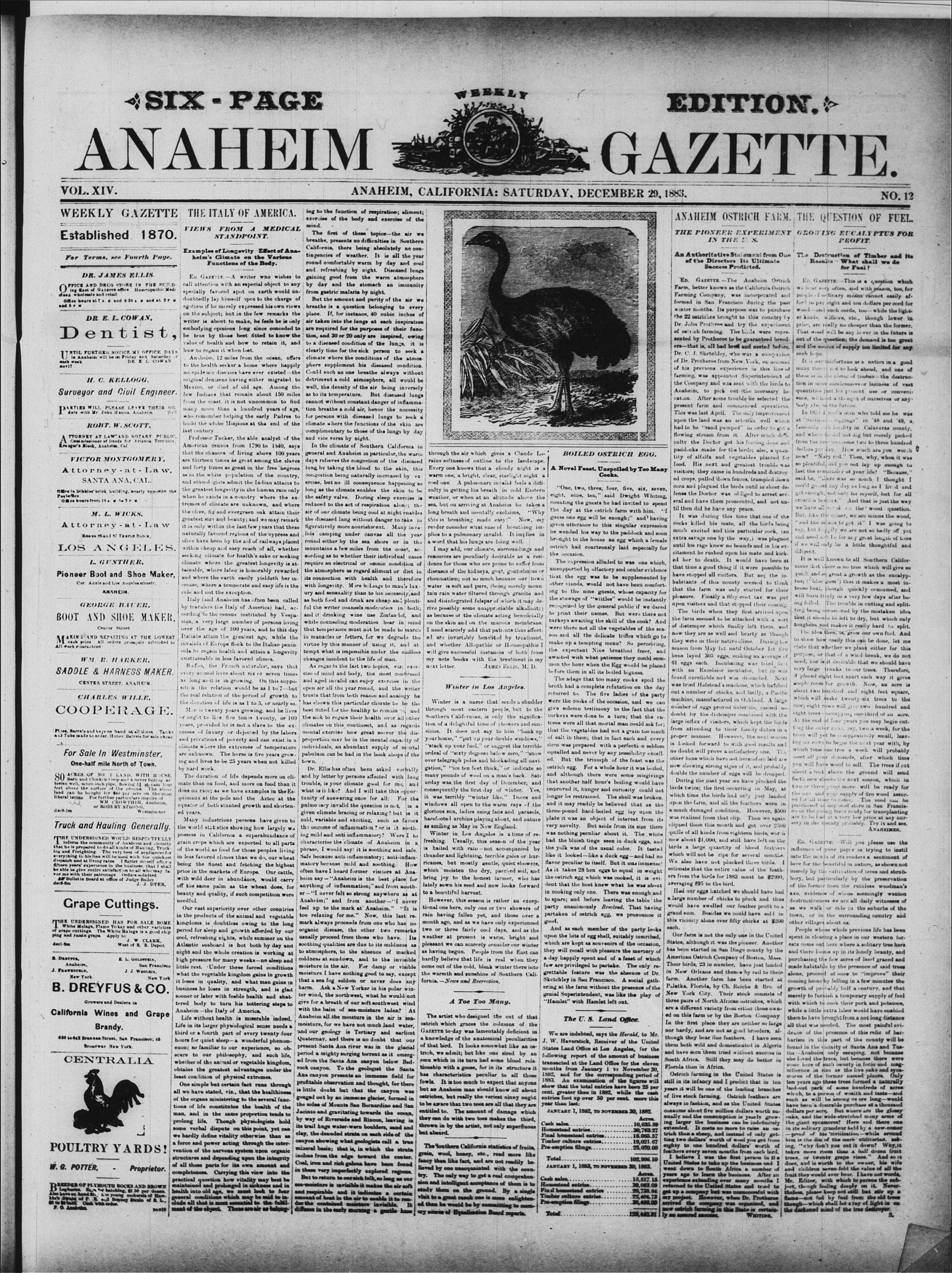
BOILED OSTRICH EGG.
A Novel Feast, Unspoiled by Too Many Cooks.
"One, two, three, four, five, six, seven, eight, nine, ten," said Dwight Whiting, counting the guests he had invited to spend the day at the ostrich farm with him. "I guess one egg will be enough;" and having given utterance to this singular expression he wended his way to the palidock and soon brought to the house an egg which a female ostrich had courteously laid especially for the occasion.
The expression alluded to was one which unsupported by olfactory and ocular evidence that the egg was to be supplemented by other viands, would not have been comforting to the nine guests, whose capacity for the stowage of "wittles" would be instantly recognized by the general public if we dared to print their names. But were there not turkeys awaiting the skill of the cook? And were there not all the vegetables of the season and all the delicate trifles which go to make up a tempting menu? So perceiving, the expectant Nine breathed freer, and awaited with what patience they could summon the hour when the Egg would be placed before them in all its boiled bigness.
The adage that too many cooks spoil the broth had a complete refutation on the day referred to. The five ladies of the party were the cooks of the occasion, and we can give solemn testimony to the fact that the turkeys were done to a turn; that the entrees were all that mortal man could ask for; that the vegetables had not a grain too much of salt in them; that in fact each and every item was prepared with a perfection seldom equalled and never by any possibility excelled. But the triumph of the feast was the ostrich egg. For a whole hour it was boiled, and although there were some misgivings that another half hour's boiling would have improved it, hunger and curiosity could not longer be restrained. The shell was broken. And it may readily be believed that as the three-pound hard-boiled egg lay upon the plate it was an object of interest from its very novelty. But aside from its size there was nothing peculiar about it. The white had the bluish tinge seen in duck eggs, and the yolk was of the usual color. It tasted like it looked—like a duck egg—and had no flavor peculiar to itself. But it was immense! As it takes 28 hen eggs to equal in weight the ostrich egg which was cooked, it is evident that the host knew what he was about in cooking only one. There was enough and to spare; before leaving the table...
A Toe Too Many.
The artist who designed the cut of that ostrich which graces the columns of the Gazette to-day was lamentably deficient in a knowledge of the anatomical peculiarities of that bird. It looks somewhat like an ostrich, we admit; but like one sired by an emu which in its turn had some blood relationship with a goose, for in its structure it has characteristics peculiar to all those fowls. It is too much to expect that anyone but an Anaheim man should know all about ostriches, but really the veriest ninny ought to be aware that two toes are all that they are entitled to. The amount of damage which they can do with two toes makes the third, thrown in by the artist, not only superfluous but absurd.
The Southern California statistics of fruits, grain, wool, honey, etc., read more like fancy than like fact, and are not readily believed by one unacquainted with the country. The only way to get a real comprehension and intelligent acceptance of them is to study them on the ground. By a single visit to a great ranch one is more enlightened than he would be by committing to memory scores of Equalization Board reports.
EDITION.
GAZETTE.
CEMBER 29, 1883. NO. 12
ANAHEIM OSTRICH FARM.
THE PIONEER EXPERIMENT IN THE U.S.
An Authoritative Statement from One of the Directors Its Ultimate Success Predicted.
Ed. Gazette—The Anaheim Ostrich Farm, better known as the California Ostrich Farming Company, was incorporated and formed in San Francisco during the past winter months. Its purpose was to purchase the 22 ostriches brought to this country by Dr. John Prothroe and try the experiment of ostrich farming. The birds were represented by Protheroe to be guaranteed breeders—that is, all had bred and nested before Dr. C. J. Sketchley, who was a companion of Dr. Protheroe from New York, on account of his previous experience in this line of farming, was appointed Superintendent of the Company and was sent with the birds to Anaheim, to pick out the necessary location. After some trouble he selected the present farm and commenced operations. This was last April. The only improvement upon the land was an artesian well which had to be "sand pumped" in order to get a flowing stream from it. After much difficulty the Doctor got his fencing done and paddocks made for the birds; also, a quantity of alfalfa and vegetables planted for food. His next and greatest trouble was visitors; they came in hundreds and destroy
THE QUESTION OF FUEL.
GROWING EUCALYPTUS FOR PROFIT.
The Destruction of Timber and its Results—What shall we do for Fuel?
Ed. Gazette:—This is a question which we hear very often, and with season, too, for people of ordinary means cannot easily afford to pay eight and ten dollars per cord for wood—and such cords, too—while the lighter kinds, willows, etc., though lower in price, are really no cheaper than the former. That wood will be any lower in the future is out of the question; the demand is too great and the source of supply too limited for any such hope.
It is our misfortune as a nation in a good many times not to look ahead, and one of these is in the abuse of timber—the destruction in more carelessness or laziness of vast quantities just for present use or convenience, without a thought of ourselves or anybody else in the future.
In 1854 I met a man who told me he was at "Switzerlandoggings" in '48 and '49, a famously rich locale in Calaveras county, and where he did not dig but merely picked from the crevices some two to three hundred dollars per day. How much are you worth now? "Nary red." Then, why, when it was so plentiful, did you not lay up enough to last the remainder of your life? "Because,"
OSTRICH EGG.
Unspoiled by Too Many Cooks.
three, four, five, six, seven,
said Dwight Whiting,
he had invited to spend
ostrich farm with him. "I
will be enough;" and having
to this singular expression
way to the paidock and soon
use an egg which a female
recently laid especially for
alluded to was one which,
factory and ocular evidence
was to be supplemented by
old not have been comfortguests, whose capacity for
wittles" would be instantly
general public if we dared
names. But were there not
the skill of the cook? And
the vegetables of the seadelicate trifles which go to
ing menu? So perceiving,
mine breathed freer, and
patience they could sumon the Egg would be placed
its boiled bigness.
too many cooks spoil the
date refutation on the day
of five ladies of the party
the occasion, and we can
mony to the fact that the
to a turn; that the enmortal man could ask for;
he had not a grain too much
at in fact each and every
with a perfection seldom
by any possibility excelllumph of the feast was the
whole hour it was boiled,
there were some misgivings
hour's boiling would have
and curiosity could not
all. The shell was broken.
be believed that as the
boiled egg lay upon the
object of interest from its
aside from its size there
ar about it. The white
seen in duck eggs, and
no usual color. It tasted
a duck egg—and had no
self. But it was immense!
eggs to equal in weight
which was cooked, it is evinew what he was about
There was enough and
leaving the table farming, was appointed Superintendent of the Company and was sent with the birds to Anaheim, to pick out the necessary location. After some trouble lie selected the present farm and commenced operations. This was last April. The only improvement upon the land was an artesian well which had to be "sand pumped" in order to get a flowing stream from it. After much difficulty the Doctor got his fencing done and paddocks made for the birds; also, a quantity of alfalfa and vegetables planted for food. His next and greatest trouble was visitors; they came in hundreds and destroyed crops, pulled down fences, trampled down corn and plagued the birds until in sheer defense the Doctor was obliged to arrest several and have them prosecuted, and not until then did he have any peace.
It was during this time that one of the cocks killed his mate, all the birds being much excited and this particular cock, (an extra savage one by the way.) was plagued until his rage knew no bounds and in his excitement he rushed upon his mate and kicked her to death. It would have been at that time a good thing if it were possible to have stopped all visitors. But no; the inhabitants of this county seemed to think that the farm was only started for their pleasure. Finally a fifty-cent tax was put upon visitors and that stopped their coming.
The birds when they first arrived upon the farm seemed to be attacked with a sort of distemper which finally left them, and now they are as well and hearty as though they were in their native clime. During the season from May 1st until October 1st five hens layed 305 eggs, making an average of 61 eggs each. Incubating was tried just with an Excelsior incubator, but it was found unreliable and was discarded. Next was tried Halstead's machine, which hatched out a number of chicks, and lastly, a Pacific machine, manufactured in Oakland. A large number of eggs proved intertile, caused no doubt by the distemper combined with the large influx of visitors, which kept the birds from attending to their family duties in a proper manner. However, the next season is looked forward to with good results and no doubt will prove a satisfactory one. The other hens which have not herefore laid are now showing strong signs of it, and probably double the number of eggs will be dropped.
During the past year we have plucked the birds twice; the first occurring in May, at which time the birds had only just landed upon the farm, and all the feathers were in a much damaged condition. However, $500 was realized from that clip. Then we again clipped them this month and got over 2500 quills of all kinds from eighteen birds, worth now about $1,000, and still have left on the birds a large quantity of blood feathers which will not be ripe for several months. We also have not plucked three birds. I estimate that the entire value of the feathers from the birds for 1883 must be $2900, averaging $95 to the bird.
Had our eggs hatched we should have had a large number of chicks to pinch and thus these is in the shape of timber—the destruction in more carelessness or laziness of vast quantities just for present use or convenience, without a thought of ourselves or anybody else in the future.
In 1854 I met a man who told me he was at "Sutha and oglings" in '48 and '49, a famously rich locality in Calaveras county, and where he did not dig but merely picked from the crevices some two to three hundred dollars per day. How much are you worth now? "Nary red." Then, why, when it was so plentiful, did you not lay up enough to last the remainder of your life? "Because," said he, "there was so much I thought I could go out any day as long as I lived and get enough, not only for myself, but for all creation besides." And that is just the way we have all acted on the wood question.
But, like the miner, we are minus the wood, "and the means to get it" I was going to say, but happily we are not so badly off yet and need not be for any great length of time if we will only be a little thoughtful and diligent.
It is well known to all Southern Californians that there is no tree which will give so quick and so great a growth as the eucalyptus; ("blue gum") that it makes a most intense heat, though quickly consumed, and will burn freely in a very few days after being felled. The trouble in cutting and splitting being occasioned by the mistaken idea that it should be left to dry, but which only toughens and makes it really hard to split.
The idea then is, grow our own fuel. And to show how easily this can be done, let me state that whether we plant either for this purpose, or that of a wind-break, we do not need nor is it desirable that we should have very large trunks to our trees. Therefore, if placed eight feet apart each way it gives ample room for growth. Now, an acre is about two hundred and eight feet square, which will make twenty-six trees to the row; eight rows will give two hundred and eight trees—occupying one-third of an acre. At the end of four years you may begin cutting the outer rows, say, two a week, for the trees will yet be comparatively small, leaving six rows to begin the next year with, by which time one tree a week will probably meet all your demands, after which time you will have wood to sell. The trees if cut about a foot above the ground will send forth new shoots the next season, which in two or three years more will be ready for the axe and your supply of fire wood assured for all times to come. The seed can be purchased at any seed store in San Francisco or the young trees ready for transplanting are to be had at a very low price at any nursery in the county probably. Try it and see.
ANAHEIMER.
Ed. Gazette: Will you please use the influence of your paper in trying to instil into the minds of its readers a sentiment of love for the beautiful in nature, as shown not merely by the cultivation of trees and shrubs, but particularly by the preservation of the former from the ruthless woodman's axe, evidence of whose seemingly wanton
There was enough and we leaving the table the Resolved. That having the egg, we pronounce it
Number of the party looks shell, suitably inscribed, souvenirs of the occasion, in pleasure the memory of and of a feast of which the partake. The only re-was the absence of Dr. Francisco. A social gath- without the presence of the out, was like the play of toilet left out.
Land Office.
ays the Herald, to Mr. Receiver of the United at Los Angeles, for the amount of business and Office for the eleven January 1 to November 30, corresponding period of motion of the figures will countries have been 25 per 1882, while the cash 50 per cent. more this NOVEMBER 30, 1882.
Acres. 10,035.59
Series 30,763.27
Series 18,065.57
Series 19,021.67
Series 25,020.00
NOVEMBER 30, 1883.
Acres. 15,817.15
Series 30,083.09
Series 20,725.84
Series 22,404.73
Series 30,400.09
128,440.81
Upon the farm, and all the feathers were in a much damaged condition. However, $500 was realized from that clip. Then we again clipped them this month and got over 2500 quills of all kinds from eighteen birds, worth now about $1,000, and still have left on the birds a large quantity of blood feathers which will not be ripe for several months. We also have not plucked three birds. I estimate that the entire value of the feathers from the birds for 1883 must be $2000, averaging $95 to the bird.
Had our eggs hatched we should have had a large number of chicks to pluck and thus would have swelled our feather profit to a grand sum. Besides we could have sold in this vicinity alone over fifty chicks at $200 each.
Our farm is not the only one in the United States, although it was the pioneer. Another has been started in San Diego county by the American Ostrich Company of Boston, Mass. Their birds, 23 in number, have just landed in New Orleans and thence by rail to their farm. Another farm has been started at Palatka, Florida, by Ch. Reiche & Bro. of New York City. Their stock consists of three pairs of North African ostriches, which are a different variety from either those owned on this farm or by the Boston Company. In the first place they are neither so large nor hardy, and are not as good brooders, although they bear fine feathers. I have seen them both wild and domesticated in Algeria and have seen them tried without success in South Africa. Still they may do better in Florida than in Africa.
Ostrich farming in the United States is still in its infancy and I predict that in ten years it will be one of the leading branches of live stock farming. Ostrich feathers are always in fashion, and as the United States consume about five million dollars worth annually and the consumption is yearly growing larger the business can be indefinitely extended. It costs no more to raise an ostrich than a sheep, and instead of only getting two dollars' worth of wool you get from eighty to one hundred dollars' worth of feathers every seven months from each bird.
I believe I was the first person in the United States to take up the business and I went down to South Africa a number of years ago to learn the business. After an experience extending over many months I returned to the United States and tried to get up a company but was unsuccessful with my project. However, when Dr. Protheroe arrived the company was organized, and now ostrich farming in this State is certainly an assured success.
WHITING.
Ed. Gazette: Will you please use the influence of your paper in trying to instil into the minds of its readers a sentiment of love for the beautiful in nature, as shown not merely by the cultivation of trees and shrubbery, but particularly by the preservation of the former from the ruthless woodman's axe, evidence of whose seemingly wanton destructiveness we are all daily witnesses of as we walk or ride in the suburbs of the town, or in the surrounding country and other villages about us.
People whose whole previous life has been spent in clearing a place in our western torrents come out here where a solitary tree here and there looms up in its lonely beauty, and purchasing the few acres of land graced and made habitable by the presence of said trees alone, proceed at once to "improve" their coming home by felling in a few minutes the growth of probably half a century, and that merely to furnish a temporary supply of fuel with which to cook their pork and potatoes, while a little extra labor would have enabled them to have brought from a not long distance all that was needed. The most painful evidence of the presence of this relic of barbarism in this part of the county will be found in the vicinity of Santa Ana and Tustin—Anaheim only escaping, not because she loved the trees, but because there were none here of such beauty in form and magnificence in size as the live oaks and sycamores of the former named places. Only ten years ago these trees formed a naturally laid-out park of some hundreds of acres which, to a person of wealth and taste—and such as will be among us ere long—would have been a desirable purchase at a thousand dollars per acre. But where are the glossy oaks, and the wide-stretched many arms of the giant sycamores? Here and there one in its solitary grandeur held by a new-comer—proof of his civilization—while around him is the din of the mere utilitarian, asking, "why don't you cut it down? Why, it takes more room than a half dozen fruit trees, or twenty grape vines." And so it does, and is worth to the owner, his wife and children seven-fold the value of all the fruit they would ever bear. I have not words, Mr. Editor, with which pursue the subject, though feeling deeply on it. Nevertheless, please keep not still but stir up a flame—not fed by fuel from the old trees though—which shall let a ray of light in on the darkened mind of the tree destroyer.
S.