anaheim-gazette 1883-07-21
Scanned page
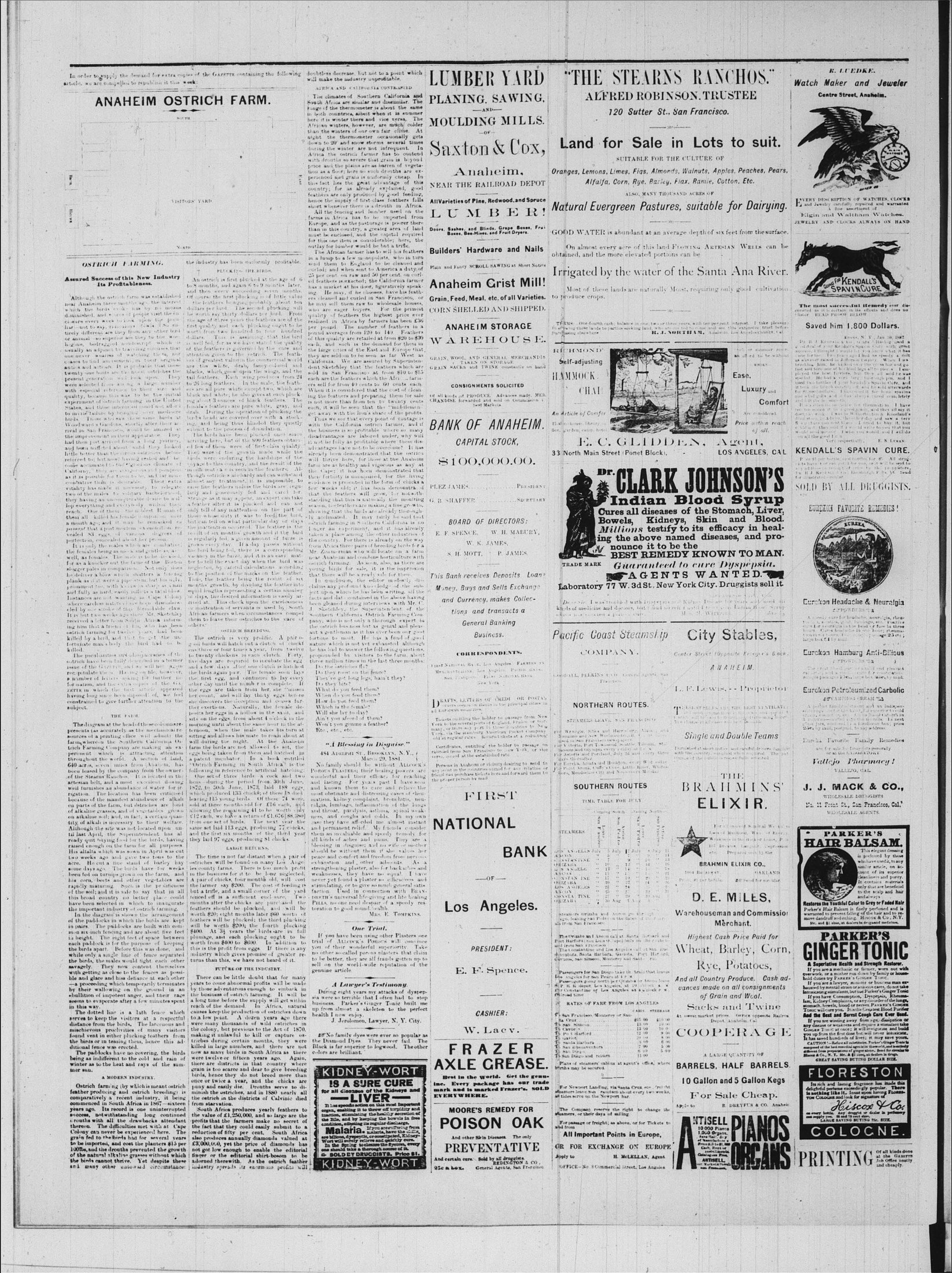
Searchable text
In order to supply the demand for extra copies of the Gazette containing the following article, we are compelled to republish it this week:
ANAHEIM OSTRICH FARM.
OSTRICH FARMING.
Assured Success of this New Industry Its Profitableness.
Although the ostrich farm was established near Anaheim three months ago, the interest which the birds evoke has by no means diminished, and scores of people visit the enclosure every week to look upon the poultry—not to say, raccoons. So tirely different are they from any other bird or animal so superior are they to the wombegone, bedraggled nondescript which is usually an aptness to traveling coccuses that one never worries of watching them, not ceases to find amusement in their original antics and actors. It is probable that these twenty-one birds are the most ostriches the present generation will look upon. They were selected from among a large number with especial reference to their size and quality, because this was to be the initial experiment of ostrich farming in the United States, and those interested could not afford to invite failure by bringing over medicine birds. Those who saw those same birds at Woodward's Gardens, shortly after their arrival in San Francisco, would be amazed at the improvement in their appearance. They had then just arrived from a long journey, and been half-tailed about until they looked little better than the curious ostriches before referred to; but now having rested and come accustomed to the giggling climate of California, they are avidorous and pompous the industry has been enormously profitable.
PLUCKING THE BIRDS.
An ostrich is first plucked at the age of 6 to 8 months, and again 6 to 9 months later, and then every succeeding seven months. Of course the first plucking is of little value; the feathers being probably about ten dollars per bird. The second plucking will be worth thirty dollars per bird. From the age of three years the feathers are of the first quality and each plucking ought to be worth from two hundred to four hundred dollars. This is assuming that the bird is well fed, for as we have stated the quality of the feathers is governed by the care and attention given to the ostrich. The feathers of greatest valuemn the commercial world are the white, drab, fancy-colored and blacks, which grow upon the wings, and the tail feathers. Each wing produces from 24 to 25 long feathers. In the male, the feathers are all pure white except two, which are black and white; he also gives at each plucking about 3 ounces of black feathers. The female's feathers are pure white, gray, and drab. During the operation of plucking the birds heads are covered over with a stocking, and being thus blinded they quietly submit to the process of denudation.
The birds have been plucked once since arriving here, but of the $900 feathers obtained few of them were of first-class quality. They were of the growth made while the birds enduring the hardships of the voyage to this country, and the result of the mouthment case is seen in the feathers. Although decrease will make the industry doubtless successful in South Africa are a range of the thermals in both countries, here it is winter there African winters, higher than the winters on night the thermals down to 20 and during the winter Africa the ostrich with drothis so se price and the plantation as a floor; her experienced and graft this fact lies there country; for as feathers are only prone hence the supply of short whenever thie All the fencing farms in Africa have Europe, and as there than in this country must be enclosed, for this one item must outlay for lumber The African farm in a lump to a few send them to Ecuador; and when 25 per cent. on raised feathers is exact has a market at hung He may, if it ers cleaned and cued he may sell them who are eager for quality of feathers realized in Africa per pound. The pound averages free of this quality are each, and such in large cities of California. We areudent Sketcheley this sold in San Francisco each are the feathers sell for from 40 When it is considered the feathers are not more than five each, it will be seen get away with them Thus we see that with the California business is so disadvantages are it not be fully as pr advantages have not already been demonstrated will thrive here farm are as healthy the Cape; it has
The ostrich have been fully described in a former issue of the Gazette, and we will not pay to repitulate them. Having on file, however, a number of letters asking for further information, and the extra copies of the Gazette in which the first article appeared having long since been disposed of, we feel constrained to give further attention to the subject.
THE FARM
The diagram at the head of these columns represents (as accurately as the mechanic resources of a printing office will admit) the farm where the Southern California Ostrich Farming Company is making an experiment which is attracting attention throughout the world. A section of land, 640 acres, seven miles from Anaheim, has been leased by the company from the owner of the Stearns Ranchos. It is located in the artesian belt, and a most excellent dwelling well furnishes an abundance of water for irrigation. The location has been criticised because of the manifest abundance of alkali on parts of the farm, but distresses are fond of alkaline grasses, and of vegetables grown on alkaline soil; and, in fact, a certain quantity of alkali is necessary to their welfare. Although the site was not located upon until April, the Superintendent has already quit buying food for the birds, having raised enough on the farm for all purposes. His alitalta which was sown in April was cut two weeks ago and gave two tons to the acre. He cut a fine stand of barley hay some days ago. The birds have for weeks been fed on turnips grown on the farm, and has corn, beets and other vegetables are rapidly maturing. Such is the proficiency of the soil; it is safe to say that in all this broad country no better place could present generation will look upon. They were selected from among a large number with especial reference to their size and quality, because this was to be the initial experiment of ostrich farming in the United States, and those interests could not afford to move failure by bringing over medicine birds. Those who saw those same birds at Woodward's Gardens, shortly after their arrival in San Francisco, would be amazed at the improvement in their appearance. They had then post arrived from a long journey, and been nailed about until they looked little better than the various ostriches before referred to; but now having rested and become accustomed to the glorious climate of California, they are vigorous and pompous as it is possible for them to be, and far more combative than is desirable. Their extra vitality has made it necessary to relegate two of the males to solitary bachelorhood, they having an uncompleter desire to wallop everything and everybody within their reach. One of them, the modest Kannah of them all killed his female companion over a month age; and it may be remarked as possessive that a post mortem examination revealed 83 eggs of various degrees of perfection, concealed about her person.
It is only the males which are combative, the females being neck and gentle as well, as females. The male is to be reared for as a knocker out the fame of the Boston sloger pales in comparison. Not only does he deliver a blow which shatters a fetal plank as it were a pipe stem but his only prominent toe with a caw is sharp as chin and fully as hard, easily indolls is a fatal blow. Instances are not waunting in Cape Colony where careless native have been disoblenced by one stroke of this ferrodible claw. It is but two weeks ago since Mr. Sketchik received a letter from South Africa informing him that a friend of his, who has been ostrich farming for twelve years, had been killed by a bird, and that to get the fortunate man's body the bird had to be killed.
The peculiarities and aliosyncrasies of the ostrich have been fully described in a former issue of the Gazette, and we will not pay to repitulate them. Having on file, however, a number of letters asking for further information, and the extra copies of the Gazette in which the first article appeared having long since been disposed of, we feel constrained to give further attention to the subject.
THE FARM
The diagram at the head of these columns represents (as accurately as the mechanic resources of a printing office will admit) the farm where the Southern California Ostrich Farming Company is making an experiment which is attracting attention throughout the world. A section of land, 640 acres, seven miles from Anaheim, has been leased by the company from the owner of the Stearns Ranchos. It is located in the artesian belt, and a most excellent dwelling well furnishes an abundance of water for irrigation. The location has been criticised because of the manifest abundance of alkali on parts of the farm, but distresses are fond of alkaline grasses, and of vegetables grown on alkaline soil; and, in fact, a certain quantity of alkali is necessary to their welfare. Although the site was not located upon until April, the Superintendent has already quit buying food for the birds, having raised enough on the farm for all purposes. His alitalta which was sown in April was cut two weeks ago and gave two tons to the acre. He cut a fine stand of barley hay some days ago. The birds have for weeks been fed on turnips grown on the farm, and has corn, beets and other vegetables are rapidly maturing. Such is the proficiency of the soil; it is safe to say that in all this broad country no better place could present generation will look upon. They had then post arrived from a long journey, and been nailed about until they looked little better than the various ostriches before referred to; but now having rested and be come accustomed to the glorious climate of California, they are vigorous and pompous as it is possible for them to be, and far more combative than is desirable. Their extra vitality has made it necessary to relegate two of the males to solitary bachelorhood, they having an uncompleter desire to wallop everything and everybody within their reach. One of them, the modest Kannah of them all killed his female companion over a month age; and it may be remarked as possessive that a post mortem examination revealed 83 eggs of various degrees of perfection, concealed about her person.
It is only the males which are combative, the females being neck and gentle as well, as females. The male is to be reared for as a knocker out the fame of the Boston sloger pales in comparison. Not only does he deliver a blow which shatters a fetal plank as it were a pipe stem but his only prominent toe with a caw is sharp as chin and fully as hard, easily indolls is a fatal blow. Instances are not waunting in Cape Colony where careless native have been disoblenced by one stroke of this ferrodible claw. It is but two weeks ago since Mr. Sketchik received a letter from South Africa informing him that a friend of his, who has been ostrich farming for twelve years, had been killed by a bird, and that to get the fortunate man's body the bird had to be killed.
The peculiarities and aliosyncrasies of the ostrich have been fully described in a former issue of the Gazette, and we will not pay to repitulate them. Having on file, however, a number of letters asking for further information, and the extra copies of the Gazette in which the first article appeared having long since been disposed of, we feel constrained to give further attention to the subject.
THE FARM
The diagram at the head of these columns represents (as accurately as the mechanical resources of a printing office will admit) the farm where the Southern California Ostrich Farming Company is making an experiment which is attracting attention throughout the world. A section of land, 640 acres, seven miles from Anaheim, has been leased by the company from the owner of the Stearns Ranchos. It is located in the artesian belt, and a most excellent dwelling well furnishes an abundance of water for irrigation. The location has been criticised because of the manifest abundance of alkali on parts of the farm, but distresses are fond of alkaline grasses, and of vegetables grown on alkaline soil; and in fact, a certain quantity of alkali is necessary to their welfare. Although the site was not located upon until April, the Superintendent has already quit buying food for the birds, having raised enough on the farm for all purposes. His alitalta which was sown in April was cut two weeks ago and gave two tons to the acre. He cut a fine stand of barley hay some days ago. The birds have for weeks been fed on turnips grown on the farm, and has corn, beets and other vegetables are rapidly maturing. Such is the proficiency of the soil; it is safe to say that in all this broad country no better place could present generation will look upon. They had then post arrived from a long journey, and been nailed about until they looked little better than the various ostriches before referred to; but now having rested and become accustomed to the glorious climate of California, they are vigorous and pompous as it is possible for them to be, and far more combative than is desirable. Each wing produces from 24 to 25 long feathers. In the male, the feathers are all pure white except two, which are black and white; he also gives at each plucking about 3 ounces of black feathers. The female feathers are pure white, gray, and drab. During the operation of plucking the birds heads are covered over with a stocking,and being thus blinded they quietly submit to the process of denudation.
The birds have been plucked once since arriving here, but of $900 feathers obtained few of them were of first-class quality. They were of growth made while the birds were enduring the hardships of the voyage to this country,andthe resultofthe mouth eatc is seen inthe feathers.Although ostriches are hardly can withstand almost any treatment.itis impossibleto raise line feathers unlessthe birdsare regularlyand generously fedand carefortragreaseasitmayappearanexpertcan takea featherafterititispluckedandcannotonly tellofanymattentiononthepartofthosewhosedutyitwastofeedthebird,butcan tellonwhatparticulardayordaysthematteroccurred.Thefeatheristheresultofsixmonths'growthanditthebirdisregularlyeated,givenamountoffurzeisgrowneverydayIfa daypasseswithoutthebirdbeingfelt,theisacompondinvacancyinthefruzze,anditisanecasymattertottelltheexactdaywhenthebirdwassneglectedbycarefulcalculationsaccordingtopositionofthemarksonthefeatherThis,thefeatherbeingtheresultofsixmonths'growth,bydividingthefeatherintoequallengthsrepresentinga certainnumberofdays,thedesiredinformationiseasilyarrivedatThischeckup uponthecarelessnessormattenightionofservantsisusedbySouthAfricanfarmerswhencircumstancescompelthetoleavetheostrichestothecareoff others."
OSTRICH BREEDING.
The ostrich is very prolific.A pair good birds will hatch outa clutch or checkenthree or four timesa year.fromtwelveto twentychickensineachclutch.Forty-five days are requiredto incubatetheegganda few days afterone clutchis hathedthebirdsagainpair.Thefemale soonlaysthefirstegg,andcontinuestolayeveryotherdayuntilthenumberiscomplete.Iltheeggsare takenfromher,she"misseshercount,"andwilllaythirtyeggsbeforeshediscoversthedeceptionandceasesfurthereverions.Naturally,thefemaledepotshereggsinahollowinthe sand,and sitsontheeggsfromabout4oclockinthemorninguntilaboutthesamehourintherafternoon,当theymakehisturnat sittingandallowshismatetoroachaboutatwillduringthenight.AttheAnaehiemfarmthebirdsarenotallowedtoset,theeggsbeingtakenfromthemandhatchedinapatientincubilator.Inabookentitled"OstrichFarminginSouthAfrica"isthefollowinginreferenceartificialhatching:
One setof threebirds-a cockandtwohens-duringtheperiodfrom30thJune1872,toward30thJune1873.laid188eggswhichproduced133chicks;ofthese18 diedlefewingbirds.Ofthese74were Soldatthreemonthsoldfor£16each,andallowingtheregaining41tobeworthonly£12eachwehaveareturnof£1.676[88380]fromonesetofbirds.Thenextyearthesamesetlaid113eggs,producing77chicks,andtheSuperintendenthasalreadyquittedbuyfoodforthebirds,havingraisedenoughonthefarmforallpurposesHisalitaltawhichwassowninAprilwascuttwoweeksagoandgavetwotonstotheacre.Hecutafinestandofbarleyhaysomedaysago.Thebirdshaveforweeksbeenfeltonurningsgrownonthefarm,andhascorn,bebetsandothervegetablesarerapidlymaturing.Suchisproficientofthesoil;itissafetosaythatinallthisbroadcountrynobetterplacecouldpresentgenerationwilllookuponTheyhadthenpostarrivedfromalongjourney,andbecomesnailedaboutuntiltheylookedlittlebetterthanthesamehourintherafternoon.当theymakehisturnat sittingandallowshismatetoroachaboutatwillduringthenight.AttheAnaehiemfarmthebirdsarenotallowedtoset,theeggsbeingtakenfromthemandhatchedinapatientincubilator.Inabookentitled"OstrichFarminginSouthAfrica"isthefollowinginreferenceartificialhatching:
Eachwingshouldbeforthemostadvantageareitnotbefullyappliedbecauseitdoesnotprovideanyadvantageareitnotbefullyappliedbecauseitdoesnotprovideanyadvantageareitnotbefullyappliedbecauseitdoesnotprovideanyadvantageareitnotbefullyappliedbecauseitdoesnotprovideanyadvantageareitnotbefullyappliedbecauseitdoesnotprovideanyadvantageareitnotbefullyappliedbecauseitdoesnotprovideanyadvantageareitnotbefullyappliedbecauseitdoesnotprovideanyadvantageareitnotbefullyappliedbecauseitdoesnotprovideanyadvantageareitnotbefullyappliedbecauseitdoesnotprovideanyadvantageareitnotbefullyappliedbecauseitdoesnotprovideanyadvantageareitnotbefullyappledbecauseitdoesnotprovideanyadvantageareitnotbefullyappledbecauseitdoesnotprovideanyadvantageareitnotbeullyappledbecauseitdoesnotprovideanyadvantageareitnotbeullyappledbecauseitdoesnotprovideanyadvantageareitnotbeullyappledbecauseitdoesnotprovideanyadvantageareitnotbeullyappledbecauseitdoesnotprovideanyadvantageareiittotbeullyappledbecauseitdoesnotprovideanyadvantageareiittotbeullyappledbecauseitdoesnotprovideanyadvantageareiittotbeullyappledbecauseitdoesnotprovideanyadvantageareiittotbeullyappledbecauseitdoesnotprovideanyadvantageareiittotbeullyappledbecauseitdoesnotprovideanyadvantageareiittotbeullyappledbecauseitdoesnotprovideanyadvantageareiittotbeullyappledbecauseitdoesnotprovideanyadvantageareiittotbeullyappledbecauseitdoesnotprovideanyadvantageareiittotbeullyappledbecauseitdoesnotprovideanyadvantageareiittotbeullyappledbecauseitdoesnotprovideanyadvantageareiittotbeullyappledbecauseitdoesnotprovideanyadvantageareiittotbeullyappledbecauseitdoesnotprovideanyadvantageareiittotbeullyappledbecauseitdoesnotprovideanyadvantageareiittotbeullyappledbecauseitdoesnotprovideanyadvantageareiittotbeullyappledbecauseitdoesnotprovideanyadvantageareiittotbeullyappledbecauseitdoesnotprovideanyadvantageareiittotbeullyappledbecause它doesn'tapplytoyourfriendshipUsedinpreventingdiseasefromostrichesintheairconditionoftheforeigncountryNofamilyshouldportorouthernplainswonderfulandtendlingweaknesses,thenevergetfoundstimulatingortofaciationUsedinpreventingdiseasefromostrichesintheairconditionoftheforeigncountryNofamilyshouldportorouthernplainswonderfulandtendlingweaknesses,thenevergetfoundstimulatingortofaciationUsedinpreventingdiseasefromostrichesintheairconditionoftheforeigncountryNofamilyshouldportorouthernplainswonderfulandtendlingweaknesses,thenevergetfoundstimulatingortofaciationUsedinpreventingdiseasefromostrichesintheairconditionoftheforeigncountryNofamilyshouldportorouthernplainswonderfulandtendlingweaknesses,thenevergetfoundstimulatingortofaciationUsedinpreventingdiseasefromostrichesintheairconditionoftheforeigncountryNofamilyshouldportorouthernplainswonderfulandtendlingweaknesses,thenevergetfoundstimulatingortofaciationUsedinpreventingdiseasefromostrichesintheairconditionoftheforeigncountryNofamilyshouldportorouthernplainswonderfulandtendlingweaknesses,thenevergetfoundstimulatingortofaciationUsedinpreventingdiseasefromostrichesintheairconditionoftheforeigncountryNofamilyshouldportorouthernplainswonderfulandtendlingweaknesses,thenevergetfoundstimulatingortofaciationUsedinpreventingdiseasefromostrichesintheairconditionoftheforeigncountryNo familyshouldportorouthernplainswonderfulandtendlingweaknesses,thenevergetfoundstimulatingortofaciationUsedinpreventingdiseasefromostrichesintheairconditionoftheforeigncountryNo familyshouldportorouthernplainswonderfulandtendlingweaknesses,thenevergetfoundstimulatingortofaciationUsedinpreventingdiseasefromostrichesintheairconditionoftheforeigncountryNo familyshouldportorouthernplainswonderfulandtendlingweaknesses,thenevergetfoundstimulatingortofaciationUsedinpreventingdiseasefromostrichesintheairconditionoftheforeigncountryNo familyshouldportorouthernplainswonderfulandtendlingweaknesses,thenevergetfoundstimulatingortofaciationUsedinpreventingdiseasefromostrichesintheairconditionoftheforeigncountryNo familyshouldportorouthernplainswonderfulandtendlingweaknesses,thenevergetfoundstimulatingortofaciationUsedinpreventingdiseasefromostrichesintheairconditionoftheforeigncountryNo familyshouldportorouthernplainswonderfulandtendlingweaknesses,thenevergetfoundstimulatingortofaciationUsedinpreventingdiseasefromostrichesintheairconditionoftheforeigncountryNo familyshouldportorouthernplainswonderfulandtendlingweaknesses,thenevergetfoundstimulatingortofaciationUsedinpreventingdiseasefromostrichesintheairconditionoftheforeigncountryNo familyshouldportorouthernplainswonderfulandtendlingweaknesses,thenevergetfoundstimulatingortofaciationUsedinpreventingdiseasefromostrichesintheairconditionoftheforeigncountryNo familyshouldportorouthernplainswonderfulandtendlingweaknesses,thenevergetfoundstimulatingortofaciationUsedinpreventingdiseasefromostrichesintheairconditionoftheforeigncountryNo familyshouldportorouthernplainswonderfulandtendlingweaknesses,thenevergetfoundstimulatingortofaciationUsedinpreventingdiseasefromostrichesintheairconditionoftheforeigncountryNo familyshouldportorouthernplainswonderfulandtendlingweaknesses,thenevergetfoundstimulatingortofaciationUsedinpreventingdiseasefromostrichesintheairconditionoftheforeigncountryNo familyshouldportorouthernplainswonderfulandtendlingweaknesses,thenevergetfoundstimulatingortofaciationUsedinpreventingdiseasefromostrichesintheairconditionoftheforeigncountryNo familyshouldportorouthernplainswonderfulandtendlingweaknesses,thenevergetfoundstimulatingortofaciationUsedinpreventingdiseasefromostrichesintheairconditionoftheforeigncountryNo familyshouldportorouthernplainswonderfullandtendlingweaknesses,thenevergetfoundstimulatingortofaciliationUsedInpreventingdiseaseFromostrichesIntotheforeigncountryNo family should port or outernational country No family should port or outernational country No family should port or outernational country No family should port or outernational country No family should port or outernational country No family should port or outernational country No family should port or outernational country No family should port or outernational country No family should port or outernational country No family should port or outernational country No family should port or outernational country No family should port or outernational country No family should port or outernational country No family should port or outernational country No family should port or outernational country No family should port or outernational country No family should port or outernational country No family should port or outernational country No family should port or outernational country No family should port or outernational country No family should port or outernational country No family should port or outernational country No family should port or outernational country No family should port or outernational country No family should port or outernational country No family should port or outernational country No family should port or outernational country No family should port or outernational country No family should port or outernational country No family should port or outernational country No family should port or outernational country No family should port or outernational country No family should port or outernational country No family should port or outernational country No family should port or outernational country No family should port or outernational country No family should port or outernational country No family should port or outernational country No family should port or outernational country No family Should Port Or Outernational Country No Family Should Port Or Outernational Country No Family Should Port Or Outernational Country No Family Should Port Or Outernational Country No Family Should Port Or Outernational Country No Family Should Port Or Outernational Country No Family Should Port Or Outernational Country No Family Should Port Or Outernational Country No Family Should Port Or Outernational Country No Family Should Port Or Outernational Country No Family Should Port Or Outernational Country No Family Should Port Or Outernational Country No Family Should Port Or Outernational Country No Family Should Port Or Outernational Country No Family Should Port Or Outernational Country No Family Should Port Or Outernational Country No Family Should Port Or Outernational Country No Family Should Port Or Outernational Country No Family Should Port Or Outernational Country No Family Should Port Or OuternionalCountryNoFamilyShouldPortOrOuternionalCountryNoFamilyShouldPortOrOuternionalCountryNoFamilyShouldPortOrOuternionalCountryNoFamilyShouldPortOrOuternionalCountryNoFamilyShouldPortOrOuternionalCountryNoFamilyShouldPortOrOuternionalCountryNoFamilyShouldPortOrOuternionalCountryNoFamilyShouldPortOrOuternionalCountryNoFamilyShouldPortOrOuternionalCountryNoFamilyShouldPortOrOuternionalCountryNoFamilyShouldPortOrOuternionalCountryNoFamilyShouldPortOrOuternionalCountryNoFamilyShouldPortOrOuternionalCountryNoFamilyShouldPortOrOuternionalCountryNoFamilyShouldPortOrOuternionalCountryNoFamilyShouldPortOrOuternionalCountryNoFamilyShouldPortOrOuternionalCountryNoFamilyShouldPortOrOuternionalCountryNoFamilyShouldPortOrOuternionalCountryNoFamilyShouldPortOrOuternionalCountryNoFamilyShouldPortOrOuternionalCountryNoFamilyShouldPortOrOuternionalCountryNoFamilyShouldPortOrOuternionalCountryNoFamilyShouldPortOrOutERNALCountryNoFamilyShouldPortOrOutERNALCountryNoFamilyShouldPortOrOutERNALCountryNoFamilyShouldPortOrOutERNALCountryNoFamilyShouldPortOrOutERNALCountryNoFamilyShouldPortOrOutERNALCountryNoFamilyShouldPortOrOutERNALCountryNoFamilyShouldPortOrOutERNALCountryNoFamilyShouldPortOrOutERNALCountryNoFamilyShouldPortOrOutERNALCountryNoFamilyShouldPortOrOutERNALCountryNoFamilyShouldPortOrOutERNALCountryNoFamilyShouldPortOrOutERNALCountryNoFamilyShouldPortOrOutERNALCountryNoFamilyShouldPortOrOutERNALCountryNoFamilyShouldPortOrOutERNALCountryNoFamilyShouldPortORoutERNALCountryNoFamilyShouldPortORoutERNALCountryNoFamilyShouldPORTORoutERNALCountryNOfamilyShouldPORTORoutERNALCountryNOfamilyShouldPORTORoutERNALCountryNOfamilyShouldPORTORoutERNALCountryNOfamilyShouldPORTORoutERNALCountryNOfamilyShouldPORTORoutERNALCountryNOfamilyShouldPORTORoutERNALCountryNOfamilyShouldPORTORoutERNALCountryNOfamilyShouldPORTORoutERNALCountryNOfamilyShouldPORTORoutERNALCountryNOfamilyShouldPORTORoutERNALCountryNOfamilyShouldPORTORoutURNALCountryNOfamilyShouldPORTORoutURNALCountryNOfamilyShouldPORTORoutURNALCountryNOfamilyShouldPORTORoutURNALCountryNOfamilyShouldPORTORoutURNALCountryNOfamilyShouldPORTORoutURNALCountryNOfamilyShouldPORTORoutURNALCountryNOfamilyShouldPORTORoutURNALCountryNOfamilyShouldPORTORoutURNALCountryNOfamilyShouldPORTORoutURNALCountryNOfamilyShouldPORTORoutURNALCountryNOfamilyShouldPORTORoutURNALCountryNOfamilyShouldPORTORoutURNALCountryNOfamilyShouldPORTORoutURNALCountryNOfamilyShouldPORTORoutURNALCountryNOfamilyShouldPORTORoutURNALCountryNOfamilyShouldPORTORoutURNAL CountryNOfamilyShouldPORTORoutURNAL CountryNOfamilyShould PORT OR OUTERNAL Country NO Family Should Port Or Outernal Country NO Family Should Port Or Outernal Country NO Family Should Port Or Outernal Country NO Family Should Port Or Outernal Country NO Family Should Port Or Outernal Country NO Family Should Port Or Outernal Country NO Family Should Port Or Outernal Country NO Family Should Port Or Outernal Country NO Family Should Port Or Outernal Country NO Family Should Port Or Outernal Country NO Family Should Port OR OUTERNAL Country NO Family Should Port OR OUTERNAL Country NO Family Should Port OR OUTERNAL Country NO Family Should Port OR OUTERNAL Country NO Family Should Port OR OUTERNAL Country NO Family Should Port OR OUTERNAL Country
because of the manifest abundance of alkali on parts of the farm, but distriches are bond of alkaline grasses, and of vegetables grown on alkaline soil; and, in fact, a certain quantity of alkali is necessary to their welfare. Although the site was not located upon until last April, the Superintendent has already quit buying food for the birds, having raised enough on the farm for all purposes. His altaïtà which was sown in April was cut two weeks ago and gave two tons to the acre. He cut a fine stand of barley hay some days ago. The birds have for weeks been fed on turnips grown on the farm, and his corn, beets and other vegetable are rapidly maturing. Such is the profitability of the soil; and it is safe to say that in all this broad country no better place could have been selected in which to inaugurate the important industry of ostrich farming.
In the diagram is shown the arrangement of the paddocks in which the birds are kept in pairs. The paddocks are built with common six-inch fencing and are about five feet in height. The eight feet of space between each paddock is for the purpose of keeping the birds apart. Before this was done, and while only a single line of fence separated the birds, the males would fight each other savagely. They now content themselves with getting as close to the fences as possible and glare and hiss defiance at each other—a proceeding which temporarily terminates by their wallowing on the ground in an ebullition of impotent anger, and their rage seems to evaporate after a few minutes spent in this way.
The dotted line is a lath fence which serves to keep the visitors at a respectful distance from the birds. The largeous and mischievous proclivities of many visitors found vent in either plucking teathers from the birds or in teasing them, hence this additional fence was erected.
The paddocks have no covering, the birds being as indifferent to the cold and rain of winter as to the heat and rays of the summer sun.
A MODERN INDUSTRY.
Ostrich farming (by which is meant ostrich feather producing and ostrich breeding) is comparatively a recent industry, it being commenced in South Africa in 1867—sixteen years ago. Its record is one uninterrupted success, notwithstanding long continued droughts with all the drawbacks attendant thereon. The difficulties met with at Cape Colony can never be experienced here. The grain fed to the birds had for several years to be imported, and cost the planters $15 per 100fls, and the drouths prevented the growth of the natural alkaline grasses without which the birds cannot thrive. Yet despite these and many other untoward circumstances
LARGE RETURNS.
The time is not far distant when a pair of ostriches will be found on many Los Angeles county farms. There is too much profit in the business for it to be long neglected. A pair of chicks, four months old, will cost the farmer say $200. The cost of feeding is but a trifle, and a small corner of the yard tended off is a sufficient enclosure. Two months after the chicks are purchased the feathers should be plucked, and will be worth $20; eight months later $60 worth of feathers will be plucked; the third plucking will be worth $200; the fourth plucking $400. At 3½ years the birds are in full plumage, and each plucking ought to be worth from $400 to $600. In addition to this is the profit from eggs. If there is any industry which gives promise of greater returns than this, we have not heard of it.
FUTURE OF THE INDUSTRY.
There can be little doubt that for many years to come abnormal profits will be made by those adventurous enough to embark in the business of ostrich farming. It will be a long time before the supply will get within reach of the demand. In Africa, natural causes keep the production of ostriches down to a low point. A dozen years ago there were many thousands of wild ostriches in the colony, but previous to the Act of 1870, making it unlawful to kill or capture ostriches during certain months, they were killed in large numbers, and there are not now as many birds in South Africa as there were twelve or fifteen years ago. Again, there are districts in that country where grain is too scarce and dear to give breeding birds, hence they do not breed more than once or twice a year, and the chicks are puny and easily die. Drooths serve to diminish the ostriches, and in 1880 nearly all the ostrich in the districts of Calvinic died from starvation.
South Africa produces yearly feathers to the value of £1,250,000, and so large are the profits that the farmers make no secret of the fact that they could easily submit to a reduction of fifty per cent. South Africa also produces annually diamonds valued at £3,000,000, yet the price of diamonds has not got low enough to enable the editorial finger or the editorial shirt-booms to be adorned therewith. As the ostrich feather industry spreads its enormous profits will
LUMBER YARD
PLANING. SAWING,
AND
MOULDING MILLS.
OF
Saxton & Cox,
Anaheim.
NEAR THE RAILROAD DEPOT
All Varieties of Pine, Redwood, and Spruce
LUMBER!
Doors, Sashes, and Blinds, Grape Boxes, Fruit
Boxes, Bee-Hives, and Fruit Dryers.
Builders' Hardware and Nails
Plain and Fancy SCROLL SAWING at Short Notice
Anaheim Grist Mill!
Grain, Feed, Meal, etc. of all Varieties.
CORN SHELLED AND SHIPPED.
ANAHEIM STORAGE
WAREHOUSE.
GRAIN, WOOL, AND GENERAL MERCHANDISSES
TAKEN ON STORAGE.
GRAIN SACKS and TWINE constantly on hand.
CONSIGNMENTS SOLICITED
Of all kinds of PRODUCE. Advances made. MERCHANTISE forwarded and sold on Commission.
BANK OF ANAHEIM.
CAPITAL STOCK,
$100,000.00.
BANK OF ANAHEIM.
CAPITAL STOCK,
$100,000.00.
PLEZ JAMES...President
G. B. SHAFFER...Secretary
BOARD OF DIRECTORS:
E. F. SPENCE, W. H. MABURY,
W. K. JAMES,
S. H. MOTT, P. JAMES.
This Bank receives Deposits Loans
Money, Buys and Sells Exchange
and Currency, makes Collections and transacts a
General Banking Business.
CORRESPONDENTS.
First National Bank, Los Angeles Farmers in
Mercantile Bank, Los Angeles Pacific Bank,
San Francisco First National Bank, New York
DRAFTS, LETTERS OF CREDIT OR POSTAL
letters on maps in the principal cities in all European countries.
Tickets entailing the holder to passage from New York to the several ports of England, France or Germany, or from any port in those countries to New York via the standard American Packet Company old at regular rates. Return tickets at a reduction.
Certificates, entailing the holder to passage on railroad from San Francisco to New York, or vice versa, issued at the established rate.
Persons in Anaheim or vicinity desiring to send to any point in the countries named for any relative or friend can purchase tickets here and forward them to the proper person by mail.
FIRST NATIONAL BANK
OF —
SOUTHERN ROUTES
TIME TABLE FOR JULY
NATIONAL BANK
OF
Los Angeles.
PRESIDENT:
E. F. Spence.
CASHIER:
W. Lacv.
FRAZER AXLE GREASE.
Best in the World. Get the genuine. Every package has our trade mark and is marked Frazer's. SOLD EVERYWHERE.
MOORE'S REMEDY FOR POISON OAK
And other Skin Diseases. The only PREVENTATIVE
And certain cure. Sold by all druggists.
General Agents, San Francisco.
E STEARNS RANCHOS."
ALFRED ROBINSON, TRUSTEE
120 Sutter St., San Francisco.
for Sale in Lots to suit.
SUITABLE FOR THE CULTURE OF
Limes, Fiqs, Almonds, Walnuts, Apples, Peaches, Pears,
alfa, Corn, Rye, Barley, Flax, Ramie, Cotton, Etc.
ALSO, MANY THOUSAND ACRES OF
evergreen Pastures, suitable for Dairying.
ER is abundant at an average depth of six feet from the surface.
every acre of this land flowing Artesian Wells can be
the more elevated portions can be
by the water of the Santa Ana River.
These lands are naturally Moist, requiring only good cultivation.
R. J. NORTHAM.
Anaheim, Los Angeles County, Cal.
EASE.
Luxury and Comfort
Are considered.
Price within reach of all.
C. GLIDDEN, Agent,
Street (Ponet Block),
Los Angeles, CA
R. LUEDKE.
Watch Maker and Jeweler
Centre Street, Anaheim.
EVERY DESCRIPTION OF WATCHES, CLOCKS
and Jewelry carefully required and warranted.
A fine assortment of
Elgin and Waltham Watches.
JEWELRY AND CLOCKS ALWAYS ON HAND.
GOURNEY FOR KENDALL'S SPAVIN CURE
The most successful Remedy ever discovered as it is certain in its effects and does no longer READ PROOF BELOW
Saved him 1.800 Dollars.
Dr. B. J. Kendall & Co., Guild Having used a good idea of your Kendall's Spavin Cure with great success I thought I would let you know what it has come for you. Two years ago I had as spadey a colt as was raised in Jefferson County. When I was breaking him, he kicked over the cross bar and go fast and for one of his bind legs all to pieces. I employed the best farriers, but they all said he was special. He had very large thigh pads, and I used two bottles of your Kendall's Spavin Cure, and it took the latitude off, and he sold afterwards for $500 (dollars). I invested it for home staining and who gets a deal if it always tured com, letely and fits properly.
It is a reason for the mention that I have been convinced it to a great point, and they all say it down to work. I was in Waltham ten & Kneeland's drug store. At Alberts the other day and saw a very fluffy cone sent them. I tried to buy it, but couldn't; they said if I would write to you that you would send me. I wish you would, and I will do on all the good items.
Very respectfully,
E. N. Lyman
KENDALL'S SPAVIN CURE.
Price $1 per bottle or bottles for $5. All drugs have to run get it for you, or it will be sent to any office in receipt of letter by the proprietors,
R. J. Kendall & Co., Guild Having used a good idea of your Kendall's Spavin Cure with great success I thought I would let you know what it has come for you. Two years ago I had as spadey a colt as was raised in Jefferson County. When I was breaking him, he kicked over the cross bar and go fast and for one of his bind legs all to pieces. I employed the best farriers, but they all said he was special. He had very large thigh pads, and I used two bottles of your Kendall's Spavin Cure, and it took the latitude off, and he sold afterwards for $500 (dollars). I invested it for home staining and who gets a deal if it always tured com, letely and fits properly.
It is a reason for the mention that I have been convinced it to a great point, and they all say it down to work. I was in Waltham ten & Kneeland's drug store. At Alberts the other day and saw a very fluffy cone sent them. I tried to buy it, but couldn't; they said if I would write to you that you would send me. I wish you would, and I will do on all the good items.
Very respectfully,
E. N. Lyman
Dr. CLARK JOHNSON'S Indian Blood Syrup
Cures all diseases of the Stomach, Liver, Bowels, Kidneys, Skin and Blood.
Millions testify to its efficacy in healing the above named diseases, and pronounce it to be the BEST REMEDY KNOWN TO MAN.
Guaranteed to cure Dyspepsia.
AGENTS WANTED.
By 77 W. 3d St, New York City. Druggists sell it.
City Stables,
Center Street (Opposite Krager's Book)
ANAHEIM.
L. F. Lewis, Proprietor
Single and Double Teams
THE BRAHMIN'S ELIXIR.
For all diseases of General Weakness in the Stomach, Liver, Kidneys, Skin and Blood.
Prepared by the BRAHMIN ELIXIR CO., 1004 Bay Ridge Oakland.
PARKER'S HAIR BALSAM.
This elegant dressing is preferred by those who have used it to any similar article, on account of its superior cleanliness and purity. It contains materials only that are beneficial to the scalp and hair and always.
ELIXIR.
BRAHMIN ELIXIR CO., 1004 Baldwin Way, Oakland Prepared by circular D. E. MILES, Warehouseman and Commission Merchant.
Highest Cash Price Paid for Wheat, Barley, Corn, Rye, Potatoes, And all Country Produce. Cash advances made on all consignments of Grain and Wool.
Sacks and Twine At lowest market prices. Office opposite Railroad Depot, Anaheim, Cal.
COOPERAGE
A LARGE QUANTITY OF BARRELS, HALF BARRELS. 10 Gallon and 5 Gallon Kegs For Sale Cheap.
APPLY TO B. DREYFUS & CO. Anaheim
ANTISELL 10,000 Pianos 1,000 Organs. Save Hall. Dry of Manufacture A Pressure 23 to 28 Inch Curb. Rest or installment. AntiseLL. Our Market & Power.
PIANOS ORGANS
PRINTING Of all kinds done at the Garrett Job Office neatly and cheaply.