anaheim-gazette 1883-07-14
Scanned page
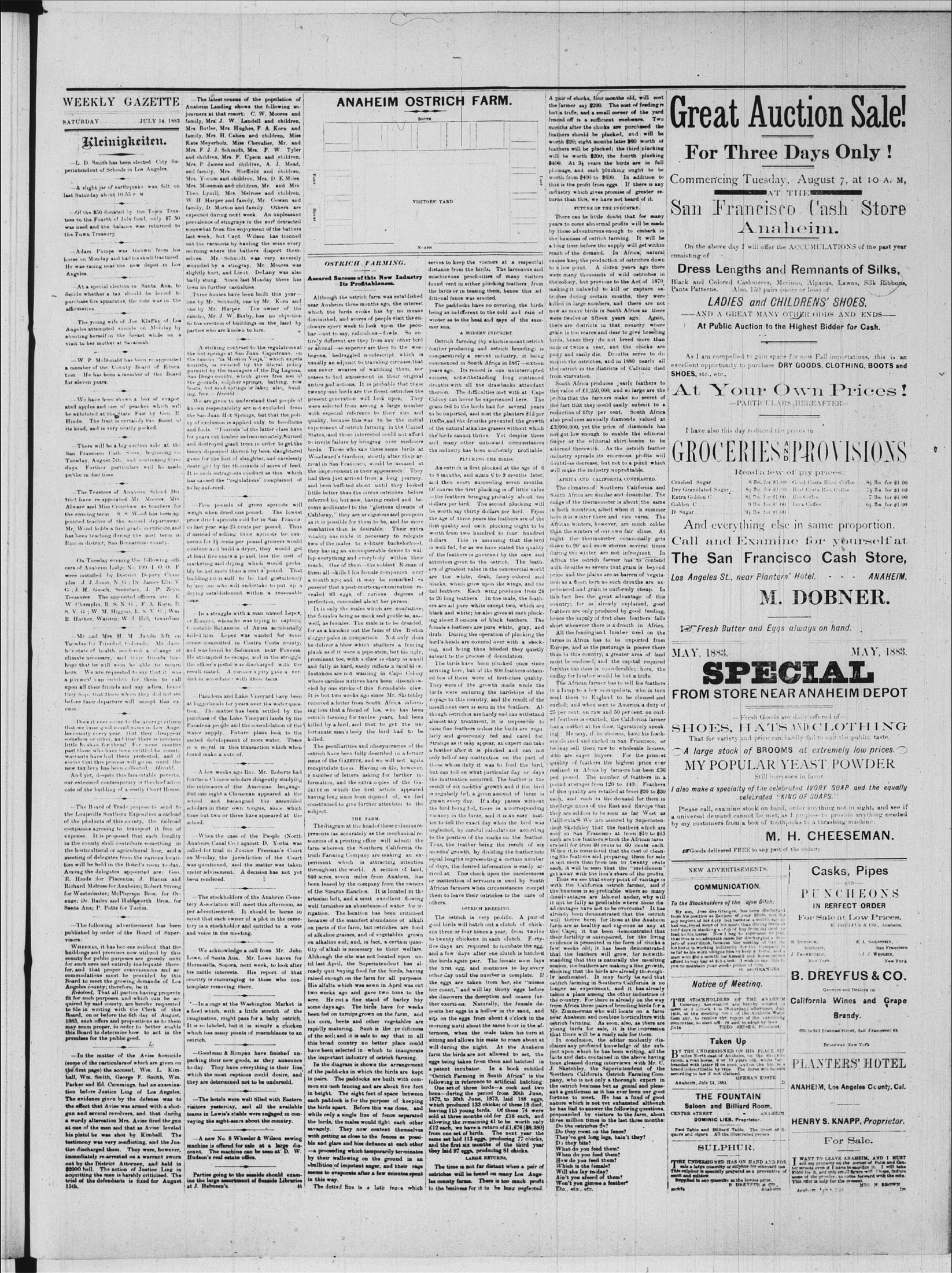
Searchable text
WEEKLY GAZETTE
SATURDAY JULY 14, 1883
Kleinigkeiten.
L. D. Smith has been elected City Superintendent of Schools in Los Angeles.
A slight jar of earthquake was felt on last Saturday about 10:55 P.M.
Of the $50 donated by the Town Trustees to the Fourth of July fund, only $7.50 was used and the balance was returned to the Town Treasury.
Adam Phipps was thrown from his horse on Monday and had his skull fractured. He was racing near the new depot in Los Angeles.
At a special election in Santa Ana, to decide whether a tax should be levied to purchase fire apparatus, the vote was in the affirmative.
The young wife of Joe Klaffki of Los Angeles attempted suicide on Monday by shooting herself in the breast while on a visit to her mother at Savannah.
W. P. McDonald has been re-appointed a member of the County Board of Education. He has been a member of the Board for eleven years.
We have been shown a box of evaporated apples and one of peaches which will be exhibited at the State Fair by Geo. R. Hinde. The fruit is certainly the finest of its kind, and is very neatly picked.
There will be a big auction sale at the San Francisco Cash Store, beginning on Tuesday, August 7th, and continuing three days. Further particulars will be made public in due time.
The latest census of the population of Anaheim Landing shows the following sojourners at that resort: C. W. Moores and family, Mrs. J. W. Landell and children, Mrs. Butler, Mrs. Hughes, F. A. Korn and family, Mrs. H. Cahen and children, Miss Kate Meyerholz, Miss Chevalier, Mr. and Mrs. F. J. J. Schmidt, Mrs. F. W. Tyler and children, Mrs. F. Upson and children, Mrs. P. James and children, A. J. Mead, and family, Mrs. Sheffield and children, Mrs. Yocum and children, Mrs. D. E.Miles, Mrs. Moissman and children, Mr. and Mrs. Theo. Lynill, Mrs. Melrose and children, W. H. Harper and family, Mr. Cowan and family, D. Morton and family. Others are expected during next week. An unpleasant prevalence of stingrays in the surf detracted somewhat from the enjoyment of the bathers last week, but Capt. Wilson has thinned out the varmints by hauling the seine every morning where the bathers disport themselves. Mr.-Schmidt was very severely wounded by a stingray, Mr. Moores was slightly hurt, and Lieut. DeLany was also badly stung. Since last Monday there has been no further casualties.
Three houses have been built this year—one by Mr. Schmidt, one by Mr. Korn and one by Mr. Harper. The owner of the rancho, Mr. J.W.Bixby, has no objection to the erection of buildings on the land by parties who are known to him.
A striking contrast to the regulations at the hot springs at San Juan Capistrano, on the ranch "La Mission Vieja," which expels tourists, is evinced by the liberal policy pursued by the managers of the Big Laguna, San Diego county, which gives free use of the grounds, sulphur springs, bathing row boats, hot mud springs or lake; also, hunting-free.-Herald.
We are given to understand that people of known respectability are not excluded from the San Juan Hot Springs, but that the policy of exclusion is applied only to hoodlums and fools." Tourists" of the latter class have for years cut timber indiscriminately burned and destroyed giant trees in order to get the honey deposited therein by bees, slaughtered game for the lust of slaughter, and carelessly destroyed by fire thousands of acres of feed. It is such outrageous conduct as this which...
We have been shown a box of evaporated apples and one of peaches which will be exhibited at the State Fair by Geo. R. Hinde. The fruit is certainly the finest of its kind, and is very neatly packed.
There will be a big auction sale at the San Francisco Cash Store, beginning on Tuesday, August 7th, and continuing three days. Further particulars will be made public in due time.
The Trustees of Anaheim School District have reappointed Mr. Moores, Mrs. Alward and Miss Crenchaw as teachers for the ensuing term. S. S. Wood has been appointed teacher of the second department. Mr. Wood holds a first grade certificate, and has been teaching during the past term in Rineon district, San Bernardino county.
On Tuesday evening the following officers of Anaheim Lodge No. 199 I O O F were installed by District Deputy Champkin J. J. Jonas, N.G.; Dr James Ellis V G; J. M. Gooch, Secretary, J. P. Zeyn, Treasurer. The appointed officers are: E W Champlin, R S N G., F A. Kern, R S V G.; W M. Higgins, L S V G.; Wm R Harker, Warden; W J Hill, Guardian
Mr. and Mrs. H. M. Jazolin left on Tuesday for Trinity, Colorado. Mr. Jacob's state of health rendered a change of climate necessary, and their friends here hope that he will soon be able to return here. We are requested to say that it was a physical impossibility for them to call upon all their friends and say alien, hence they hope that those whom they did not see before their departure will accept this excuse.
Does it ever occur to the average citizen that we raise good round sums in Los Angeles county every year, that they disappear somehow or other, and that there is precious little to show for them? For some months past those who have been entitled to county warrants have had them protested, and it seems that this process will go on until the new tax levy has been collected. Herald.
And yet, despite this lamentable poverty, our esteemed contemporary is the chief advocate of the building of a costly Court House.
The Board of Trade propose to send to the Louisville Southern Exposition a carload of the products of this county, the railroad companies agreeing to transport it free of expense. It is proposed that each locality in the county shall contribute something in the horticultural or agricultural line, and a meeting of delegates from the various localities will be held in the Board's room today. Among the delegates appointed are: Geo. R. Hinde for Placentia; J. Hanna and Richard Melrose for Anaheim; Robert Strong for Westminster; McPherson Bros. for Or-
We are given to understand that people of known respectability are not excluded from the San Juan Hot Springs, but that the policy of exclusion is applied only to hooflums and fools. "Tourists" of the latter class have for years cut timber indiscriminately burned and destroyed giant trees in order to get the honey deposited therein by bees, slaughtered gone for the last of slaughter, and carelessly destrogged by fire thousands of acres of feed. It is such outrageous conduct as this which has caused the "regulations" complained of to be enforced.
Five pounds of green apricots will weigh when dried one pound. The lowest price dried apricots sold for in San Francisco last year was 25 cents per pound. Thus if instead of selling their apricots too canneries for 1½ cents per pound growers would combine and build a dryer, they would get at least five cents a pound, less the cost of marketing and drying which would probably be not more than a cent a pound. That building lot is still to be had gratuitously by any one who will undertake to put up a drying establishment within a reasonable time.
In a struggle with a man named Lopez, or Romero, whom he was trying to capture, Constable Bahannon of Azusa accidentally killed him. Lopez was wanted for some crime committed in Contra Costa county, and was found by Bahannon near Pomona. He attempted to escape, and in the struggle the officer's pistol was discharged with the result stated. A coroner's jury gave a verdict in accordance with these facts.
Pasadena and Lake Vineyard have been at loggerheads for years over the water question. The matter has been settled by the purchase of the Lake Vineyard lands by the Pasadena people and the consolidation of the water supply. Future plans look to the united development of more water. There is a moral in this transaction which when found make a note of.
A few weeks ago Rev. Mr. Roberts had fourteen Chinese scholars diligently studying the intricacies of the American language. But one night a Chinaman appeared at the school and harangued the assembled scholars in their own tongue, since which time but two or three have appeared at the school.
When the case of the People (North Anaheim Canal Co.) against D. Yorba was called for trial in Justice Freeman's Court on Monday, the jurisdiction of the Court was questioned, and the matter was taken under advisement. A decision has not yet been rendered.
The stockholders of the Anaheim Ceme- ceases to find annual antics and actions, twenty-one birds a present generation were selected from with especial refer- quality, because the experiment of ostrich States, and those to invite failure by birds. Those who Woodward's Garden rival in San Francisco the improvement in had then just arrive and been buffeted little better than they referred to; but no come acclimated to California," they are as it is possible for combative than is vitality has made two of the males they having an unopportunity and reach. One of them all—killed him a month ago; and a passant that a post vealed 83 eggs, perfection, conceal.
It is only the male females being well, as females. For as a knocker or slogger pales in course he deliver a blow plank as if it were prominent toe, with and fully as hard. Instances are not where careless naked by one stroke! It is but two weeks received a letter firing him that a friend ostrich farming for killed by a bird, and fortunate man's body killed.
The peculiarities ostrich have been issue of the GAZETEC recapitulate them; a number of letter formation, and the ZEITE in which they having long since been constrained to give subject.
The diagram at t presents (as accurate sources of a printing farm whereon they trich Farming Company periment which throughout the wo640 acres, seven men been leased by the of the Stearns Ram artesian belt, and
The Board of Trade propose to send to the Louisville Southern Exposition a carload of the products of this county, the railroad companies agreeing to transport it free of expense. It is proposed that each locality in the county shall contribute something in the horticultural or agricultural line, and a meeting of delegates from the various localities will be held in the Board's room today. Among the delegates appointed are: Geo. R. Hinde for Placentia; J. Hanna and Richard Melrose for Anaheim; Robert Strong for Westminster; McPherson Bros. for Orange; Dr. Bailey and Haleworth Bros. for Santa Ana; P. Potts for Tustin.
The following advertisement has been published by order of the Board of Supervisors:
WHEREAS, it has become evident that the buildings and premises now utilized by this county for public purposes are grossly unfit for such uses and entirely inadequate therefor, and that proper conveniences and accommodations must be provided by this Board to meet the growing demands of Los Angeles county; therefore, be it
Resolved, That all parties having property fit for such purposes, and which can be acquired by said county, are hereby requested to file in writing with the Clerk of this Board, on or before the 6th day of August, 1883, such offers and propositions as to them may seem proper, in order to better enable this Board to determine how to act in the premises for the public good.
In the matter of the Avise homicide (some of the particulars of which are given on the first page) the accused, Wm. L. Kimball, Wm. Smith, George F. Smith, Wm. Parker and Ed. Cummings, had an examination before Justice Ling of Los Angeles. The evidence given by the defense was to the effect that Avise was armed with a shotgun and several revolvers, and that during a wordy altercation Mrs. Avise fired the gun at one of the men and that as Avise leveled his pistol he was shot by Kimball. The testimony was very conflicting, and the Justices discharged them. They were, however, immediately re-arrested on a warrant sworn out by the District Attorney, and held in $2000 bail. The action of Justice Ling in acquitting the men is harshly criticised. The trial of the defendants is fixed for August 15th.
The stockholders of the Anaheim Cemetery Association will meet this afternoon, as per advertisement. It should be borne in mind that each owner of a plot in the cemetery is a stockholder and entitled to a vote and voice in the meeting.
We acknowledge a call from Mr. John Lowe, of Santa Ana, Mr. Lowe leaves for Hermosilla, Sonora, next week, to look after his cattle interests. His report of that country is encouraging to those who contemplate removing there.
In a cage at the Washington Market is a fowl which, with a little stretch of the imagination, might pass for a baby ostrich. It is so labeled, but it is simply a chicken which has many points of resemblance to an ostrich.
Goodman & Rimpau have finished unpacking their new goods, as they announce to-day. They have everything in their line which the most captious could desire, and they are determined not to be undersold.
The hotels were well filled with Eastern visitors yesterday, and all the available teams in Lewis's stable were engaged in conveying the sight-seers about the country.
A new No. 8 Wheeler & Wilson sewing machine is offered for sale at a large discount. The machine can be seen at D. W. Hudson's real estate office.
Parties going to the seaside should examine the large assortment of Seaside Libraries at J. Helmsen's.
ANAHEIM OSTRICH FARM.
OSTRICH FARMING.
Assured Success of this New Industry - Its Profitableness.
Although the ostrich farm was established near Anaheim three months ago, the interest which the birds evoke has by no means diminished, and scores of people visit the enclosure every week to look upon the peculiar—not to say, ridiculous—fowls. So entirely different are they from any other bird or animal—so superior are they to the woobegone, bedraggled nondescript which is usually an adjunct to traveling circuses, that one never wearies of watching them, nor ceases to find amusement in their original antics and actions. It is probable that these twenty-one birds are the finest ostriches the present generation will look upon. They were selected from among a large number with especial reference to their size and quality, because this was to be the initial experiment of ostrich farming in the United States, and those interested could not afford to invite failure by bringing over mediocre birds. Those who saw these same birds at Woodward's Gardens, shortly after their arrival in San Francisco, would be amazed at the improvement in their appearance. They serve to keep the visitors at a respectful distance from the birds. The larcenous and mischievous proclivities of many visitors found vent in either plucking feathers from the birds or in teasing them, hence this additional fence was erected.
The paddocks have no covering, the birds being as indifferent to the cold and rain of winter as to the heat and rays of the summer sun.
A MODERN INDUSTRY.
Ostrich farming (by which is meant ostrich feather producing and ostrich breeding) is comparatively a recent industry, it being commenced in South Africa in 1867—sixteen years ago. Its record is one uninterrupted success, notwithstanding long continued droughts with all the drawbacks attendant thereon. The difficulties met with at Cape Colony can never be experienced here. The grain fed to the birds had for several years to be imported, and cost the planters $15 per 100fbs, and the droughts prevented the growth of the natural alkaline grasses without which the birds cannot thrive. Yet despite these and many other untoward circumstances the industry has been uniformly profitable.
PLUCKING THE BIRDS.
An ostrich is first plucked at the age of 6 to 8 months, and again 6 to 9 months later.
A pair of chicks, four months old, will cost the farmer say $200. The cost of feeding is but a trifle, and a small corner of the yard fenced off is a sufficient enclosure. Two months after the chicks are purchased the feathers should be plucked, and will be worth $20; eight months later $60 worth of feathers will be plucked; the third plucking will be worth $200; the fourth plucking $400. At 3½ years the birds are in full plumage, and each plucking ought to be worth from $400 to $600. In addition to this is the profit from eggs. If there is any industry which gives promise of greater returns than this, we have not heard of it.
FUTURE OF THE INDUSTRY.
There can be little doubt that for many years to come abnormal profits will be made by those adventurous enough to embark in the business of ostrich farming. It will be a long time before the supply will get within reach of the demand. In Africa, natural causes keep the production of ostriches down to a low point. A dozen years ago there were many thousands of wild ostriches in the colony, but previous to the Act of 1870, making it unlawful to kill or capture ostriches during certain months, they were killed in large numbers, and there are not now as many birds in South Africa as there were twelve or fifteen years ago. Again, there are districts in that country where grain is too scarce and dear to give breeding birds, hence they do not breed more than once or twice a year, and the chicks are purry and easily die. Droughts serve to diminish the ostriches, and in 1880 nearly all the ostrich in the districts of Calvinic died from starvation.
South Africa produces yearly feathers to the value of £1,250,000, and so large are the profits that the farmers make no secret of the fact that they could easily submit to a reduction of fifty per cent. South Africa also produces annually diamonds valued at £3,000,000, yet the price of diamonds has not got low enough to enable the editorial finger or the editorial shirt-bomom to be adorned therewith. As the ostrich feather industry spreads its enormous profits will doubtless decrease, but not to a point which will make the industry unprofitable.
people of the poliowoodlands class have burned to get the unhindered carelessly of feed, which isained of soots will be the lowest Francis. Thus too caners would get the cost of and probabled. That minutiously out up a reasonable lopez, capture, incidentally for some county, Pomona, struggle with the ve ver, have been better questioned by the birds by the notion of the kink to the kink. There which when perts had studying language, at at the assembled one which at the North oroba was its Court the Court has taken not yet
The diarmat at the head of these column represents (as accurately as the mechanical resources of a printing office will admit) the farm whereon the Southern California Ostrich Farming Company are making an experiment which is attracting attention throughout the world. A section of land, 640 acres, seven miles from Anahem, has been leased by the company from the owners of the Stearus Ranchos. It is located in the artesian belt, and a most excellent flowing success, notwithstanding long continued droughts with all the drawbacks attendant thereon. The difficulties met with at Cape Colony can never be experienced here. The grain fed to the birds had for several years to be imported, and cost the planters $15 per 100fbs, and the drouths prevented the growth of the natural alkaline grasses without which the birds cannot thrive. Yet despite these and many other untoward circumstances the industry has been uniformly profitable.
PLUCKING THE BIRDS.
An ostrich is first plucked at the age of 6 to 8 months, and again 6 to 9 months later, and then every succeeding seven months. Of course the first plucking is of little value—the feathers bringing probably about ten dollars per bird. The second plucking will be worth say thirty dollars per bird. From the age of three years the feathers are of the first quality and each plucking ought to be worth from two hundred to four hundred dollars. This is assuming that the bird is well fed, for as we have stated the quality of the feathers is governed by the care and attention given to the ostrich. The feathers of greatest value in the commercial world are the white, drab, fancy-colored and blacks, which grow upon the wings, and the tail feathers. Each wing produces from 24 to 26 long teathers. In the male, the feathers are all pure white except two, which are black and white; he also gives at each plucking about 3 ounces of black feathers. The female's feathers are pure white, gray, and drab. During the operation of plucking the bird's heads are covered over with a stocking, and being thus blinded they quietly submit to the process of denudation.
The birds have been plucked once since arriving here, but of the $00 feathers obtained few of them were of first-class quality. They were of the growth made while the birds were enduring the hardships of the voyage to this country, and the result of the insufficient care is seen in the feathers. Although ostriches are hardy and can withstand almost any treatment, it is impossible to raise fine feathers unless the birds are regularly and generously fed and cared for. Strange as it may appear, an expert can take a feather after it is plucked and can not only tell of any inattention on the part of those whose duty it was to feed the bird, but can tell on what particular day or days the inattention occurred. The feather is the result of six months' growth and if the bird is regularly fed, a given amount of furze is grown every day. If a day passes without the bird being fed, there is a corresponding vacancy in the furze, and it is an easy matter to tell the exact day when the bird was neglected, by careful calculations according to the position of the marks on the feather. Thus, the feather being the result of six months' growth, by dividing the feather into equal lengths representing a certain number of days, the desired information is easily arrived at. This check upon the carelessness or inattention of servants is used by South African farmers when circumstances compel them to leave their ostriches to the care of starvation.
South Africa produces yearly feathers to the value of £1,250,000, and so large are the profits that the farmers make no secret of the fact that they could easily submit to a reduction of fifty per cent. South Africa also produces annually diamonds valued at £3,000,000, yet the price of diamonds has not got low enough to enable the editorial finger or the editorial shirt-bossom to be adorned therewith. As the ostrich feather industry spreads its enormous profits will doubtless decrease, but not to a point which will make the industry unprofitable.
AFRICA AND CALIFORNIA CONTRASTED.
The climates of Southern California and South Africa are similar and dissimilar. The range of the thermometer is about the same in both countries; albeit when it is summer here it is winter there and vice versa. The African winters, however, are much colder than the winters of our own fair clime. At night the thermometer occasionally gets down to 20° and snow storms several times during the winter are not infrequent. In Africa the ostrich farmer has to contend with drouths so severe that grain is beyond price and the plains are as barren of vegetation as a floor; here no such drouths are experienced and grain is uniformly cheap. In this fact lies the great advantage of this country; for as already explained, good feathers are only produced by good feeding, hence the supply of first-class feathers falls short whenever there is a drought in Africa.
All the fencing and lumber used on the farms in Africa has to be imported from Europe, and as the pasturage is poorer there than in this country, a greater area of land must be enclosed; and the capital required for this one item is considerable; here, on outlay for lumber would be but a trifle.
The African farmer has to sell his feathers in a lump to a few monopolists, who in turn send them to England to be cleaned and curled; and when sent to America a duty of 25 per cent, on raw and 50 per cent, on curled feathers is exacted; the California farmer has a market at his door, figuratively speaking. He may, if he chooses, have his feathers cleaned and curled in San Francisco, or he may sell them raw to wholesale houses, who are eager buyers. For the primest quality of feathers the highest price ever realized in Africa by farmers has been £36 per pound. The number of feathers in a pound averages from 120 to 140. Feathers of this quality are retained at from $20 to $30 each, and such is the demand for them in large cities of the East and Europe that they are seldom to be seen as far West as California. We are assured by Superintendent Sketchley that the feathers which are sold in San Francisco at from $10 to $15 each are the feathers whichthe African farmers sell for from 40 cents to 60 cents each. When it is considered that the cost of cleaning the feathers and preparing them for sale is not more than from ten to twenty cents each, it will be seen that the "middlemen" get away with the lion's share of the profits.
Thus we see that every point of vantage is with the California ostrich farmer, and ifthe business is so profitable where so many disadvantages are labored under, why will
THE FARM.
The diagram at the head of these columns represents (as accurately as the mechanical resources of a printing office will admit) the farm whereon the Southern California Ostrich Farming Company is making an experiment which is attracting attention throughout the world. A section of land, 640 acres, seven miles from Anaheim, has been leased by the company from the owners of the Stearns Ranchos. It is located in the artesian belt, and a most excellent flowing well furnishes an abundance of water for irrigation. The location has been criticised because of the manifest abundance of alkali on parts of the farm, but ostriches are fond of alkaline grasses, and of vegetables grown on alkaline soil; and, in fact, a certain quantity of alkali is necessary to their welfare. Although the site was not located upon until last April, the Superintendent has already quit buying food for the birds, having raised enough on the farm for all purposes. His alfalfa which was sown in April was cut two weeks ago and gave two tons to the acre. He cut a fine stand of barley hay some days ago. The birds have for weeks been fed on turnips grown on the farm, and his corn, beets and other vegetables are rapidly maturing. Such is the prolificness of the soil; and it is safe to say that in all this broad country no better place could have been selected in which to inaugurate the important industry of ostrich farming.
In the diagram is shown the arrangement of the paddocks in which the birds are kept in pairs. The paddocks are built with common six-inch fencing and are about five feet in height. The eight feet of space between each paddock is for the purpose of keeping the birds apart. Before this was done, and while only a single line of fence separated the birds, the males would fight each other savagely. They now content themselves with getting as close to the fences as possible and glare and hiss defiance at each other—a proceeding which temporarily terminates by their wallowing on the ground in an abullition of impotent anger, and their rage seems to evaporate after a few minutes spent in this way.
The dotted line is a lath fence which grown every day. If a day passes without the bird being fed, there is a corresponding vacancy in the furze, and it is an easy matter to tell the exact day when the bird was neglected, by careful calculations according to the position of the marks on the feather. Thus, the teather being the result of six months' growth, by dividing the feather into equal lengths representing a certain number of days, the desired information is easily arrived at. This check upon the carelessness or inattention of servants is used by South African farmers when circumstances compel them to leave their ostriches to the care of others.
OSTRICH BREEDING.
The ostrich is very prolific. A pair of good birds will hatch out a clutch of chickens three or four times a year, from twelve to twenty chickens in each clutch. Forty-five days are required to incubate the egg, and a few days after one clutch is hatched the birds again pair. The female soon lays the first egg, and continues to lay every other day until the number is complete. If the eggs are taken from her, she "misses her count," and will lay thirty eggs before she discovers the deception and ceases further exertions. Naturally, the female deposits her eggs in a hollow in the sand, and sits on the eggs from about 4 o'clock in the morning until about the same hour in the afternoon, when the male takes his turn at sitting and allows his mate to roam about at will during the night. At the Anaheim farm the birds are not allowed to set, the eggs being taken from them and hatched in a patent incubator. In a book entitled "Ostrich Farming in South Africa" is the following in reference to artificial hatching:
One set of three birds—a cock and two hens—during the period from 30th June, 1872, to 30th June, 1873, laid 188 eggs, which produced 133 chicks; of these 18 died, leaving 115 young birds. Of these 74 were sold at three months old for £16 each, and allowing the remaining 41 to be worth only £12 each, we have a return of £1,676 [$8,380] from one set of birds. The next year the same set laid 113 eggs, producing 77 chicks, and the first six months of the third year they laid 97 eggs, producing 81 chicks.
LARGE RETURNS.
The time is not far distant when a pair of ostriches will be found on many Los Angeles county farms. There is too much profit in the business for it to be long neglected.
Each such demand for them in large cities of the East and Europe that they are seldom to be seen as far West as California! We are assured by Superintendent Sketchley that the feathers which are sold in San Francisco at from $10 to $15 each are the feathers which the African farmers sell for from 40 cents to 60 cents each. When it is considered that the cost of cleaning the feathers and preparing them for sale is not more than from ten to twenty cents each, it will be seen that the "middlemen" get away with the lion's share of the profits.
Thus we see that every point of vantage is with the California ostrich farmer, and if the business is so profitable where so many disadvantages are labored under, why will it not be fully as profitable where these disadvantages have not to be overcome? It has already been demonstrated that the ostrich will thrive here; for those at the Anaheim farm are as healthy and vigorous as any at the Cape; it has been demonstrated that their fertility is unimpaired; for the living evidence is presented in the form of chicks a few weeks old; it has been demonstrated that the feathers will grow, notwithstanding that this is naturally the moulting season; the feathers are making a fine growth, showing that the birds are already thoroughly acclimated. It may fairly be said that ostrich farming in Southern California is no longer an experiment, and it has already taken a place among the other industries of the country. For there is already on the way from Africa three pairs of breeding birds for a Mr. Zimmerman who will locate on a farm near Anaheim and combine horticulture with ostrich farming. As soon also, as there are young birds for sale, it is the impression that there will be a ready sale for them.
In conclusion, the editor modestly disclaims any profound knowledge of the subject upon which he has been writing, all the facts and data contained in the above having been gleaned during interviews with Mr. C. J. Sketchley, the Superintendent of the Southern California Ostrich Farming Company, who is not only a thorough expert in the ostrich business but as genial and pleasant a gentleman as it has ever been our good fortune to meet. He has a fund of good nature which is not yet exhausted although he has had to answer the following questions: propounded by visitors to the farm, about three million times in the last three months:
Do the ostriches fly?
Do they roost on the fence?
They've got long legs, hain't they?
Do they bite?
What do you feed them?
When do you feed them?
How do you feed them?
Which is the female?
Will she lay to-day?
Ain't you afeered of them?
Won't you gimme a feather?
Etc., etc.
Great Auction Sale!
For Three Days Only!
Commencing Tuesday, August 7, at 10 A.M,
AT THE
San Francisco Cash Store
Anaheim.
On the above day I will offer the ACCUMULATIONS of the past year consisting of
Dress Lengths and Remnants of Silks,
Black and Colored Cashmeres, Merinos, Alpacas, Lawns, Silk Ribbons,
Pants Patterns. Also, 150 pairs (more or less) of
LADIES and CHILDRENS' SHOES,
—AND A GREAT MANY OTHER ODDS AND ENDS—
At Public Auction to the Highest Bidder for Cash.
As I am compelled to gain space for new Fall importations, this is an excellent opportunity to purchase DRY GOODS, CLOTHING, BOOTS and SHOES, etc.,
At Your Own Prices!
—PARTICULARS HEREAFTER—
I have also this day reduced the prices in
GROCERIES AND PROVISIONS
Read a few of my prices:
At Your Own Prices!
—PARTICULARS HEREAFTER—
I have also this day reduced the prices in
GROCERIES AND PROVISIONS
Read a few of my prices:
Crushed Sugar 8 lbs. for $1.00 Good Costa Rico Coffee 8½ lbs. for $1.00
Dry Granulated Sugar 8½ lbs. for $1.00 Best Costa Rico Coffee 7½ lbs. for $1.00
Extra Golden C 8½ lbs. for $1.00 Rio Coffee 7 lbs. for $1.00
Golden C 9 lbs. for $1.00 Java Coffee 6½ lbs. for $1.00
D Sugar 9½ lbs. for $1.00
And everything else in same proportion.
Call and Examine for yourself at
The San Francisco Cash Store,
Los Angeles St., near Planters' Hotel. ANAHEIM.
M. DOBNER.
Fresh Butter and Eggs always on hand.
MAY, 1883. MAY, 1883.
SPECIAL
FROM STORE NEAR ANAHEIM DEPOT
—Fresh Goods are daily offered of—
SHOES, HATS AND CLOTHING
That for variety and price can hardly fail to suit the public taste.
A large stock of BROOMS at extremely low prices.
MY POPULAR YEAST POWDER
Still increases in favor.
I also make a specialty of the celebrated IVORY SOAP and the equally celebrated "KING OF SOAPS."
Please call, examine stock on hand, order anything not in sight, and see if a universal demand cannot be met, as I propose to provide anything needed by my customers from a box of toothpicks to a thrashing machine.
M. H. CHEESEMAN.
Goods delivered FREE to any part of the vicinity.
NEW ADVERTISEMENTS.
COMMUNICATION.
Casks, Pipes
AND
PUNCHEONS
Please call, examine stock on hand, order anything not in sight, and see if a universal demand cannot be met, as I propose to provide anything needed by my customers from a box of toothpicks to a thrashing machine.
M. H. CHEESEMAN.
Goods delivered FREE to any part of the vicinity.
NEW ADVERTISEMENTS.
COMMUNICATION.
To the Stockholders of the Jalon Ditch:
My son, Jose des Granges, has been discharged from his position as Zanjero of your ditch, not for any neglect of his duty but because a month ago he had employed some of his spare time during three or four days in stacking a crop of hay from my land or feed to his horse. Now I beg to represent to you that this is no adequate cause for discharging a zanjero of your ditch, because the making of hay for his horse is working indirectly for the Company as far as his work obliges him to keep a horse and a man with $50 a month for himself and horse can afford to buy hay at $10 a ton. I wish to say this to you to maintain your good opinion of him.
O. DE GRANGES
Notice of Meeting.
THE STOCKHOLDERS OF THE ANAHEIM Cemetery Association are hereby notified to meet at 3 o'clock it is (Saturday) afternoon, July 14th, at the meeting room of the Anaheim Water Company, to receive the report of the examining committee, to elect officers and to adopt by law.
THEO REISER, President.
Taken Up
BY THE UNDERSIGNED ON HIS PLACE SIN miles North-east of Anaheim, on the Shanklo ranch, a roan horse, 8 or 10 years old, white face branded with letter H on neck and on the hips is a brand indescribable by type. The horse will be sold according to law if not claimed.
ANAHEIM, July 14, 1883.
THE FOUNTAIN
Saloon and Billiard Room,
CENTER STREET
ANAHEIM
DOMINIC LIEB, Proprietor.
Pool Table and Billiard Table. The finest of liquors and cigars. All the illustrated papers.
SULPHUR.
THE UNDERSIGNED HAS ON HAND AND FOR sale a large quantity of sulphur for vineyard use. This sulphur is specially prepared as a preventive of smut and mildew.
Supplied in any quantity at the lowest price.
B DREYFUS & CO.
ANAHEIM
Casks, Pipes
AND
PUNCHEONS
IN PERFECT ORDER
For Sale at Low Prices.
B DREYFUS & CO.
ANAHEIM
B DREYFUS & CO.
Growers and Dealers in California Wines and Grape Brandy.
620 to 642 Brannan Street, San Francisco; 45 Broadway New York.
PLANTERS'HOTEL
ANAHEIM, Los Angeles County, Cal.
HENRY S. KNAPP, Proprietor.
For Sale.
I WANT TO LEAVE ANAHEIM, AND I MUST sell my property on the corner of Palm and Center streets even if I have to sacrifice it. I will take $1500 for it, and this small figure will hope, induce some of the growers to come forward with the coin. This offer is only for the present.
MRS. M BROWN
ANAHEIM, July 14, 1883.